Jane Addams, Ida B. Wells, and Racial Injustice in America

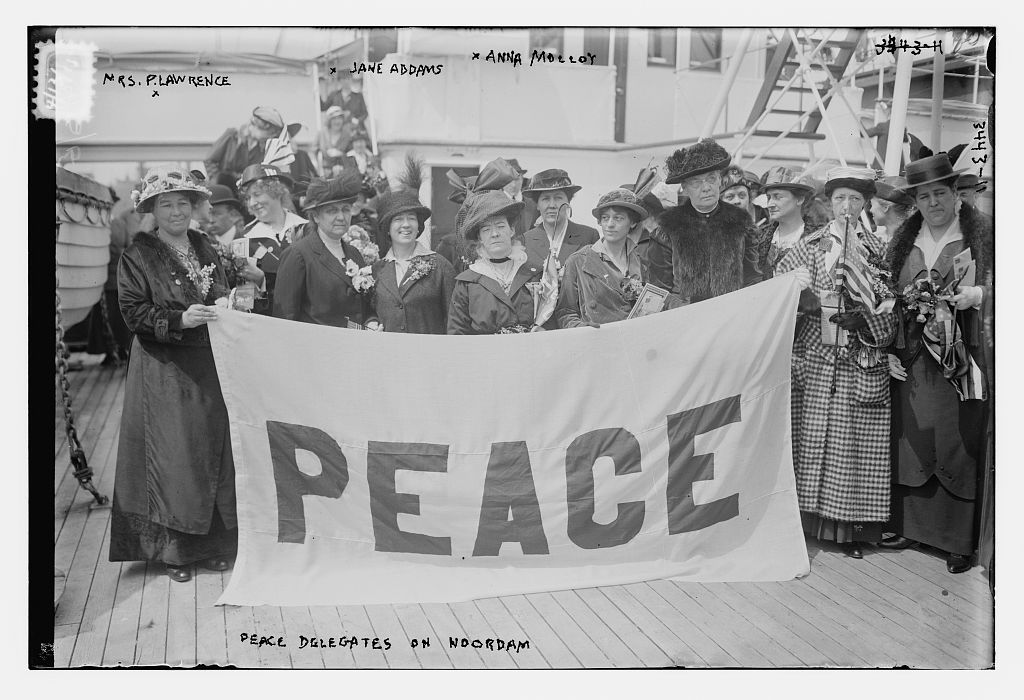
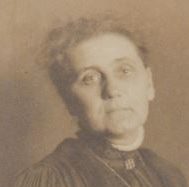
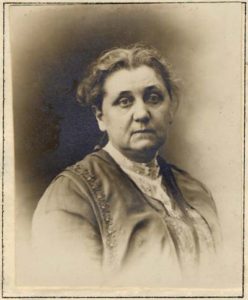
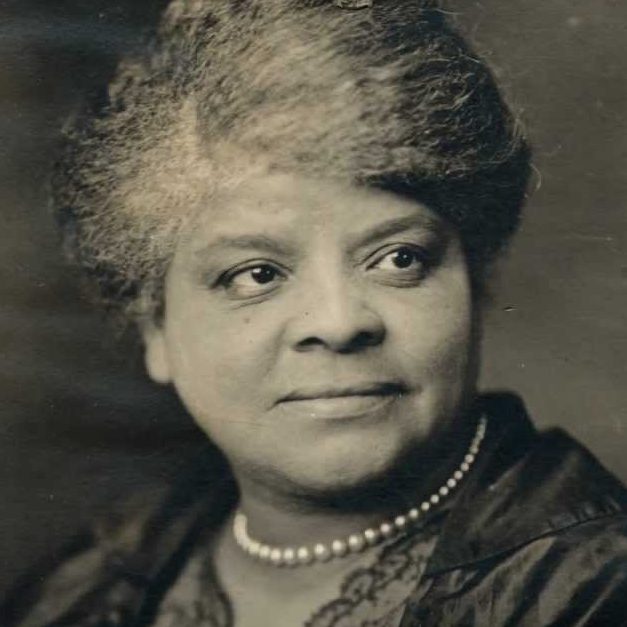
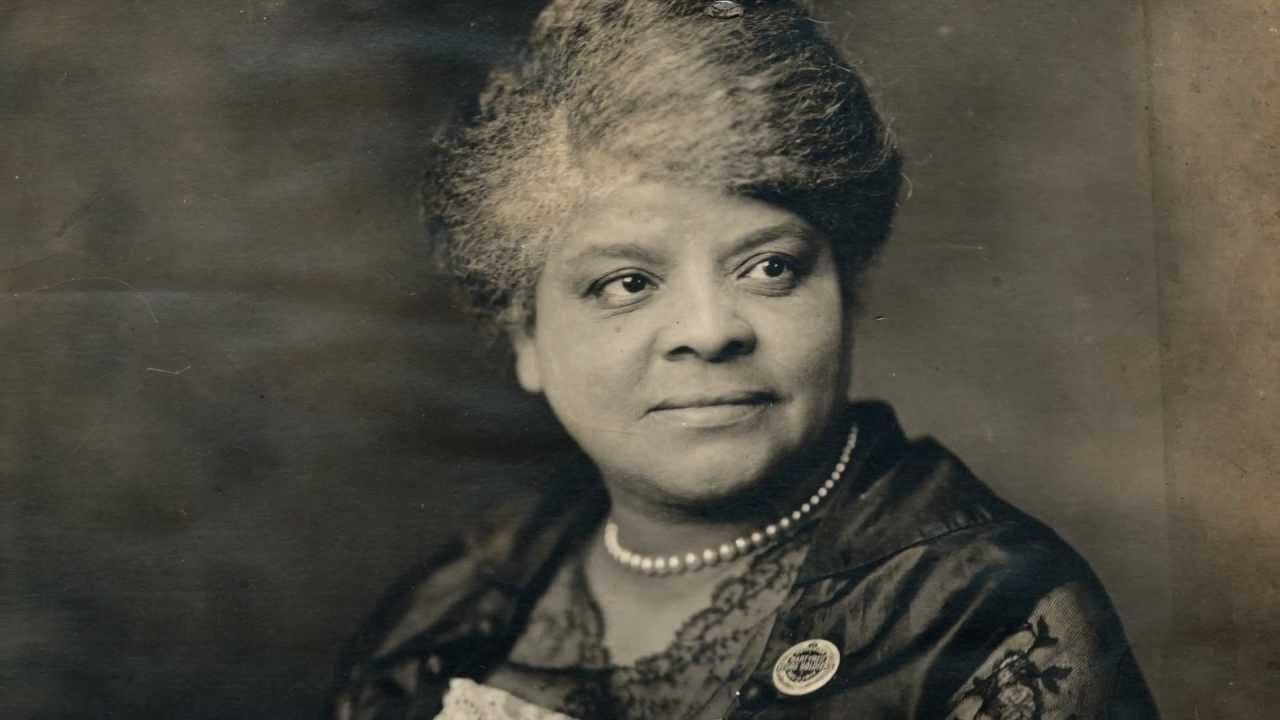
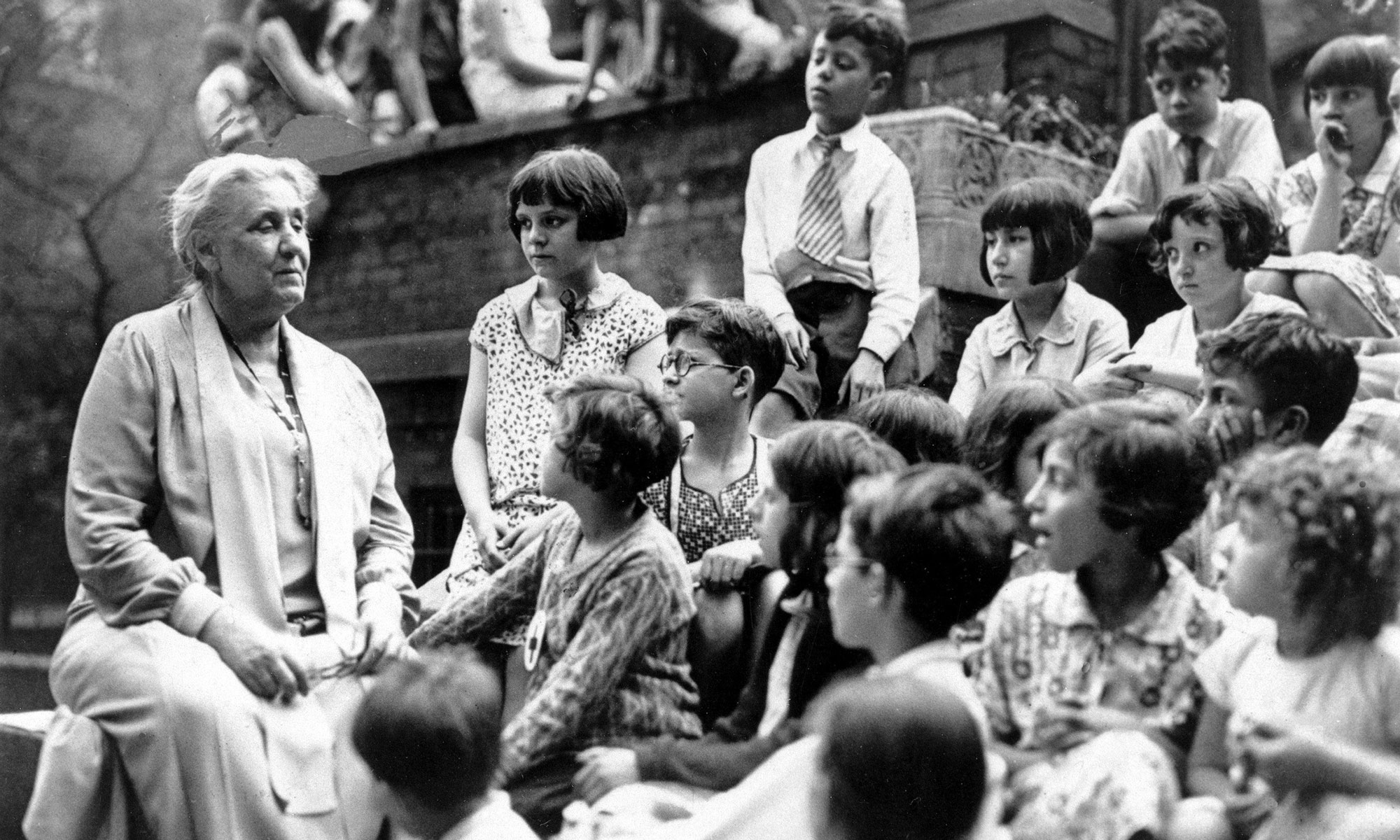
Jane Addams made the acquaintance of renown African-American journalist and civil rights activist Ida B. Wells sometime in the 1890s, but in the summer of 1899 these two extraordinary women joined forces. In Chicago, each was engaged in different but overlapping endeavors to make the world a better place, but thinking about the two of them working together reinforces my fascination with the past. Continue reading “Jane Addams, Ida B. Wells, and Racial Injustice in America”

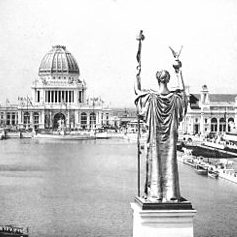
Guest Post by Taylor Mills on The New Women of Chicago’s World’s Fairs (1893-1934)

I was fortunate enough to get in contact with Taylor Mills, current curator at the Chisholm Trail Museum and recent graduate of the University of Central Oklahoma, who wrote her MA thesis on the women of the Chicago’s World’s Fairs from 1893-1934. She spoke of her interest in the topic, what her research focuses on, and her thesis process. Continue reading “Guest Post by Taylor Mills on The New Women of Chicago’s World’s Fairs (1893-1934)”

The Tragic Case of Baby Bollinger

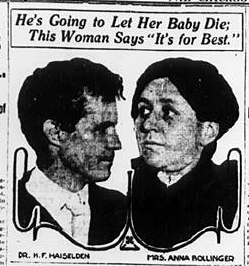
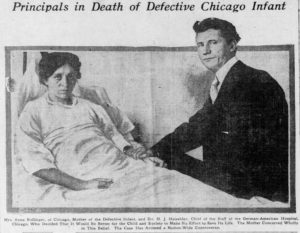
Photo of Anna Bollinger and Henry Haiselden, Chicago Tribune, March 31, 1917.

A little over 100 years ago, the case of an infant allowed to die in a Chicago hospital captured the nation’s attention. Born on November 12, 1915, “Baby Bollinger” died five days later on November 17, after physician Harry Haiselden refused to operate to save his life. Haiselden made his decision because the child was born with deformities and he believed the the boy was was mentally and morally defective. He convinced the child’s mother, who said “the doctor told me it would be, perhaps, an imbecile, a criminal. Left to itself it has no chance to live. I consented to let nature take its course.” (Boston Globe, Nov. 17, 1915, p. 1.)  Haiselden’s controversial decision led to a heated debate in newspapers across the country. Continue reading “The Tragic Case of Baby Bollinger”

Addams’ Living Legacy in Color

Giusti’s “Civilization,” made of india ink and gouache on paper, is owned by the Smithsonian American Art Museum.

The inspirational legacy and work Jane Addams left behind is no secret; from Hull House to social reform to woman’s suffrage, Addams’ was a revolutionary thinker for her time and a true inspiration for so many people, including artist George Giusti (1908-1990) who was inspired to take Addams’ vision of equality and bring it to life in one of his best regarded pieces of art.

Jane Addams was an advocate for social justice including inclusivity regardless of skin color. Addams’ wanted to give every person and equal opportunity shown through her lifelong effort to fight for social reform and offer all an equal opportunity for a better life in Hull House. After her passing, her work was still unfinished but she gave hope and opened the door for true equality for all.

Flash forward 20 years after Addams’ death, Italian-born artist, George Giusti, created his Civilization is a method of living, an attitude of equal respect for all men.”–Jane Addams, Speech, Honolulu, 1933. From the series Great Ideas of Western Man in 1955. Giusti wanted to avoid classical art and focus on a more modern and relevant effect, which shows through many of his pieces. Giusti’s works did not relate to the time period he created them in, giving them a futuristic effect that modern society still relates to.

So why did Giusti pick  Addams’ quote for the title? Well, Addams was a known advocate for equality regardless of race. The drawing that Giusti created illustrates a sense of  community, unity and equality, all goals to which Addams had dedicated her life. Her goals were not realized in her lifetime and by the 1950s were still plaguing American society. Racial tension in American society divided the nation, and Giusti was inspired to visualize Addams’ quote as a call for equality.

Despite years of advocating and pushing for change, social reform is still an issue in today’s society. Giusti’s drawing received numerous awards and recognition, while Addams’ work has lead her to be one of the most historical and influential figures of the 20th century. Her unfinished business still inspires thousands to this day, with no sign of slowing down.


Civilization is a method of living, an attitude of equal respect for all men.”–Jane Addams, Speech, Honolulu, 1933. From the series Great Ideas of Western Man. (Smithsonian American Art Museum.)

George Giusti,” ADC Hall of Fame, 1979.


Facing Death Twice: Lawyer Francis J. Heney

This is the last in Sara Catherine Lichon’s series of blog posts about interesting characters that she came across while working as a co-operative education student for the Project this semester. Her work involves identifying and describing the over 5,000 unique individuals mentioned in Addams’ correspondence.

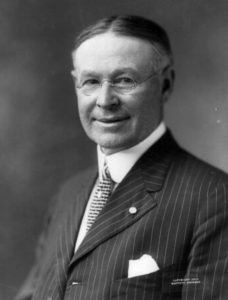
Francis J. Heney, a lawyer and politician whose life was threatened twice during his career.

Life in law can often be exciting, especially when cases take a dramatic turn. For Francis Joseph Heney, a lawyer and politician from California, drama and excitement was part of the job — and sometimes his job even became a matter of life and death. Heney was known for many cases throughout his career, but he was most famous for killing an opposing plaintiff and for being shot in the head by a juror.

As a member of the National Committee of the Progressive Party, Heney’s name appeared numerous times in letters to and from Jane Addams that discussed the National Committee. Heney was a delegate to the Republican National Convention in 1912 and ran for U.S. Senator from California as a Progressive in 1914. Outside of politics, he was a lawyer in both Arizona and California, and owned a cattle business in Arizona with his brother. From 1893 to 1895 he was Attorney General of the Arizona Territory, and he also served as the U.S. District Attorney for the District of Oregon. Heney was a well-known lawyer, having worked as a prosecutor on famous cases such as the Oregon Land Fraud scandal, where U.S. government land grants were being obtained illegally by public officials, and the San Francisco gaft trials, where members of the San Francisco Board of Supervisors were prosecuted for corruption.

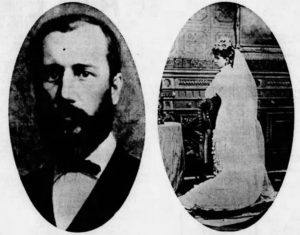
Dr. John C. Handy and Mary Ann Page Handy

In 1889, Heney defended Mary Ann Page Handy, the abused wife of Dr. John Christopher Handy, in a divorce case. Handy was known for being violent and aggressive, having abused his wife throughout their marriage, threatening to kill her when she wanted to file for divorce, and causing her to become addicted to morphine. In July 1889, Handy filed for divorce himself and sent their children to live with his mother. Handy threatened to kill anyone who dared to defend Mary, scaring away most attorneys. Originally, C. W. Wright was to defend Mary, and he asked Heney to assist him. After Heney agreed, Wright withdrew from the case, and Heney decided to do the same. After some reconsideration, though, Heney decided to defend Mary, despite the anger of Handy.

Throughout the case, Handy threatened Heney numerous times, even trying to run him over with his buggy. Ultimately, Handy won the case and received custody of the children, which Heney was quick to appeal, and a new case soon started – and the threats continued. On September 24, 1891, Handy attacked Heney outside his office, grabbing his neck and pinning him to a wall. It’s here where there are different accounts of what happened next; some newspapers say Heney broke free, ran, and drew a revolver, which Handy tried to grab. During the struggle, Heney shot Handy in the abdomen. Other papers say Heney shot Handy while running from him. After the encounter, Handy was taken to Dr. George Goodfellow for an operation but died during the procedure. Heney surrendered to the police but was bailed out by three of his friends. In a hearing two days later, the court ruled Heney acted in self-defense and he wasn’t charged.

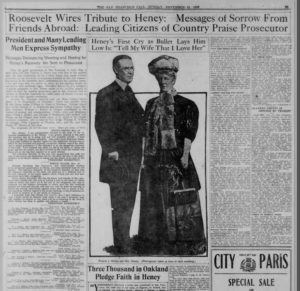
The San Francisco Call, Nov. 15, 1908

This was not the end of Heney’s exciting cases. During the San Francisco graft prosecution, Heney pointed out that one juror, Morris Haas, was ineligible to be a juror because he was an ex-convict. Heney also believed that Haas was planted by political boss Abe Ruef, who was being prosecuted by Heney at that time. Angered and resentful, Haas came into the courtroom a few weeks later while the trial was in recess and shot Heney in the head. Haas was then arrested, but found dead in his cell shortly after, leading some to believe he had been killed by one of Ruef’s gangsters. Others thought he committed suicide. Heney was expected to die, but he survived the attack. The newspapers of the time reveal how loved Heney was by the public; The San Francisco Call had an entire page dedicated to the story, describing how three thousand people gathered at Oakland’s town hall in support of Heney and how President Theodore Roosevelt sent Heney’s wife a telegram of sympathy.

Heney continued to be involved in law and politics after these incidents, and lived a fulfilling life. In 1906, he married Rebecca Wentworth McMullin. She died in 1911. Heney married to Edna I. Van Winckle in 1915, who managed his U.S. Senate campaign. Heney  died in 1937.

Heney’s work with the Progressive Party and in law have gone down in history, especially the stories of his near-death encounters. And he is yet another fascinating person who has appeared in Jane Addams’ papers!


Sources:

Dexter Marshall. “Thrilling Chapters in Lives of Public Men.” The Washington Herald. April 19, 1908, p. 36.

“Hand to Hand.” Tombstone Epitaph. September 27, 1891.

C. Martin. “Territorial Divorce – as Turbulent as the Times.” Arizona Daily Star. November 12, 1972, p. 57.

Oliver Tatom, “Francis J. Heney (1859-1937),” The Oregon Encyclopedia.

“Roosevelt Wires Tribute to Heney: Messages of Sorrow from Friends Abroad: Leading Citizens of Country Praise Prosecutor.” The San Francisco Call. November 15, 1908, p. 23.

“When Francis J. Heney Shot His Man, Too.” The Des Moines Register. December 6, 1908, p. 10.
“Francis J. Heney,” Wikipedia.

Guest Post: Addams’ Rhetoric on Home, City, and World

Dr. Liane Malinowski is a Visiting Assistant Professor of English at Marist College. Her research explores Hull House residents’ rhetoric as it relates to their planning of domestic and urban spaces. This post derives from her recently-completed dissertation titled Civic Domesticity: Rhetoric, Women, and Space at Hull House, 1889-1910. Find her on Twitter @lianemalinowski.

My recent research on Addams and her Hull House colleagues focuses on how they reimagined urban space through visual, verbal, and material means. I was particularly interested in how women at Hull House claimed the authority to speak and write about urban space to local and national audiences, especially in the late-nineteenth century when women were not conferred the status of citizen, and rhetorical convention discouraged women from speaking in public.

I was motivated to take up this project in part because I think of Addams as an important but understudied speaker, writer, and theorist of concepts important to rhetorical studies, such as democracy, ethics, and memory. After surveying published and archival sources, I found that Addams and colleagues were prolific producers of experimental and hybrid texts that drew from parlor rhetoric traditions, domestic literature, social science genres, and city planning discourses. The Jane Addams Papers Project was a wonderful resource for studying documents related to Addams, Hull House, other residents, and the interconnected web of social welfare organizations in Chicago and beyond.

Regarding Hull House residents’ rhetorics of urban space, I argue Addams, along with Ellen Gates Starr, Julia Lathrop, Florence Kelley and others represented city spaces at a variety of scales as cosmopolitan, or nationally-diverse. These spaces included their West Side neighborhood and Hull House itself. An obvious example of this kind of representation is Florence Kelley’s “Nationalities Map,” in the collaboratively-written Hull House Maps and Papers, in which she visually locates families of varying national backgrounds in Hull House’s neighborhood.

Not only did residents represent urban space as cosmopolitan in documents, they also curated cosmopolitan spaces for rhetorical purposes. For example, upon founding Hull House, Addams and Starr curated it to reflect a cosmopolitan aesthetic through its artwork and artisan-made furniture and wares. They were motivated to do this in order to establish common ground with their immigrant neighbors with whom they believed they shared an interest in European art, music, and literature.[1]

Hull House Labor Museum

Residents who represented spaces as cosmopolitan, however, did so with troubling political implications because they often spoke about and for their immigrant neighbors, and in so doing, flattened the specificity of their neighbors’ national identity in favor of emphasizing diversity. As part of this problematic history of claiming authority over cosmopolitan geographies, residents often extended their representations of urban space to include nationally-diverse people as objects of display. For example, in the early 20th century, Hull House residents curated a Labor Museum that displayed local immigrants performing artisan labor such as spinning textiles and weaving baskets. Residents also disseminated texts about the museum, such as the First Report of the Labor Museum in 1902. In this report, Addams argued that the Labor Museum presented an evolutionary narrative of work to audiences, and showed manual, pre-industrial labor as preceding industrial labor. She hoped younger people in the neighborhood would learn to appreciate their parents’ and grandparents’ artisan skills that were rendered obsolete by the industrial economy in Chicago. At the same time the museum performed this teaching function, I argue it also objectified immigrant artisans and their cultural artifacts by reinscribing older, neighborhood artisans as outside the contemporary moment by placing them and their labor prior to present industrial conditions. And, while Addams constructed herself as an authority over the entire museum and its message in the First Report of the Labor Museum, neighborhood women were figured as objects of display through photographs, captioned to suggest they are representatives of different kinds of foreign womanhood (the captions read “Italian Woman,” “Syrian Woman,” and “Irish Woman,” for example). Through the museum itself, and also texts such as the First Report, Addams and other residents participated in a trend of American women asserting their privilege to claim knowledge over foreign places and people as a way to join in public discourse about civic space and identity.[2]

After researching Hull House residents’ representations of cosmopolitan spaces in the 1890s and 1900s, I appreciate there is still much to explore about Addams’ rhetoric, especially surrounding her theorizing of how culture and class identities play a role in enabling and constraining communication. Based on my research experiences, I would encourage others undertaking study of Addams’ rhetoric to look across the JAPP Microfilm Edition, the JAPP Digital Edition, and traditional archives dedicated to Addams and Hull House in libraries. Each of these resources is organized in different ways, which can help researchers make new connections between documents. For example, some of the traditional, library archives file documents organized by author name, whereas the JAPP Microfilm Edition is largely filed by the kind of text produced at Hull House (letters, meeting minutes, financial records, etc), and the JAPP Digital Edition gets even more specific because it tags documents by key terms. Triangulating my search for documents across these resources was incredibly generative for my reading of Addams’ rhetoric.


[1] To gain a sense of Hull House’s cosmopolitan aesthetic, see Nora Marks’s “Two Women’s Work: The Misses Addams and Starr Astonish the West Siders,” Chicago Tribune. 19 May 1890, or the photographs included in Hull House Maps and Papers.1895. Urbana: UI Press, 2007.

[2] Kristin Hoganson’s Consumers’ Imperium: The Global Production of American Domesticity, 1865-1920. Chapel Hill: UNC Press, 2007, helped me understand the broader contours of American women’s claims to cosmopolitan geographies.

“Peace, War and World Order”- Dr. James Marquardt’s Web-based Timeline

The influence Jane Addams had on society is no secret; we still talk about her beliefs, achievements and historical footprint today. Jane Addams has done so much in her life that Dr. James Marquardt, Associate Professor of Politics and the Chair of International Relations Program at Lake Forest College, and his students have created an online timeline of her achievements. The timeline is called Jane Addams- Peace, War and World Order: A Web-based timeline.

The abstract of the timeline acknowledges her strides to improve the lives and living conditions for immigrants and the poor, but this timeline focuses more on her “peace advocacy,” during World War I. After looking over numerous primary and secondary sources Dr. Marquardt and his students have completed their timeline, successfully illustrating Jane Addams’ pacifist beliefs and opposition to international armament and war.

“I started digging into her primary writings on the war,” said Dr. Marquardt, “and I decided that I wanted to do this a little more elaborately so I offered a course called Jane Addams Peace Advocate. It mostly focused on her international peace advocacy before, during and after the war.”

After Lake Forest College received a grant for the school to develop digital pages and Chicago-related events, phenomena and historical developments in the humanities and social sciences, Dr. Marquardt then applied for a grant to build a page dedicated to Jane Addams peace advocacy and her historical significance, which he received and then began hiring students. Together they began studying, analyzing and building the Jane Addams – Peace, War and World Order timeline.

The timeline focuses mostly on Addams’ involvement in WWI and her opposition of the war, but Dr. Marquardt plans to continue to study Addams with the hopes of continuing to expand the timeline from her involvement in the Peace Movement with it ending when Addams received the Nobel Peace Prize. He plans on taking all of his knowledge about Addams and writing a book entitled “Jane Addams: The Great War and Her Quest to Transform National Relations.”

He’s not the only one who feels passionate about Addams; Dr. Marquardt explained that his students are very passionate about her as well. “They’re really into [the project]. Addams is such an inspirational figure that they’re a little too generous towards her, in terms of their writing and their public presentations that they’ve made about her.”

Since the timeline highlights Jane Addams’ peace advocacy I had to ask Dr. Marquardt to define peace advocacy in his own words.

“I would define it as actions, writings, ideas related to efforts to end war. That’s my thinking about it, but my students have a much more generous viewing of peace advocacy, they see peace as not simply something we ought to strive for in our international relations in our social relations generally.”  

Dr. Marquardt has learned a lot from his students during this process. “Their understanding was that advocating for peace is not simply a global issue but an issue of interpersonal relations. It’s about the end of violence along racial lines, it’s about the end of violence against women, violence against children, hunger, deprivation, unemployment.” They share the same vision and beliefs that Jane Addams did and they carry on Addams’ beliefs and visions for a brighter future for everyone.  

The website went live last week and for those interested in viewing Dr. Marquardt and his students work the link is here: http://digitalchicago.lakeforest.edu/exhibits/show/jane-addams/our-purpose.

Poet and Con-Artist: The Story of Scharmel Iris

Scharmel Iris (Lyrics of a Lad (1914)

Sara Catherine Lichon is writing a series of blog posts about interesting characters that she comes across while working as a co-operative education student for the Project this semester. Her work involves identifying and describing the over 5,000 unique individuals mentioned in Addams’ correspondence.

As a student, I’ve heard many a time that academic honesty is of the utmost importance, and that plagiarism can end one’s academic career. But back in the early 1900s, plagiarism was responsible for the rise of poet Scharmel Iris’s career, who made a living by fooling others.

Iris was born in 1889 with the name Frederico Scaramella in Castelcivita, Italy. When he was three years old, his mother married a man who helped them immigrate to the United States where they settled in Chicago. Iris changed his name and in 1905, when he was sixteen years old, his first poem was published in a Chicago Catholic newspaper. Soon his career skyrocketed as he was published in Harriet Monroe’s Poetry magazine, received positive reviews from Chicago newspapers, and published his own collections of poems. He received most of his funding and notoriety with the help of other famous poets and artists, such as T.S. Eliot, W.B. Yeats, Salvatore Dali, and Picasso, who wrote praise-filled letters to Iris’s patrons.

There was one major problem with Iris’s success, though…it was based entirely on lies. Rather than being a great poet, Iris was simply a con-artist. Letters and praise from Eliot, Yeats, and Picasso were forged by Iris himself, and Iris even wrote about himself to publishers and patrons under the pseudonym Vincent Holme. Forgery and plagiarism, rather than talent, provided the base for Iris’s career and fame.

Jane Addams’ letter to Harriet Monroe, Jan. 20, 1913. Addams stated that Iris had “no right” to claim she advised him to reach out to different poets.

Jane Addams herself was a victim of Iris’s scams. Iris spent part of his life as a Hull-House resident, and when he published Lyrics of a Lad in 1914, he supposedly received praise from art critic John Ruskin and poets Algernon Charles Swinburne and Edmund Gosse. In January 1913, Addams wrote a letter to Harriet Monroe describing how Iris claimed she had told him to reach out to Gosse and even Yeats. Addams stated, “Poor Scharmel Iris really has no right to say that I advised him to write to Miss Guiney, or to Edmund Gosse, or to Mr. Yeats.” Words had been put in Addams’ mouth by Iris, and she was only one of many.

Iris’s scams even extended to his living situation. He lived at Lewis College, a Catholic school near Joliet, despite not working or teaching there. He stayed there until he was asked to leave in 1966, and he spent the remainder of his life at St. Patrick Retirement Hotel. He died in 1967.

A poem by Scharmel Iris, published in Poetry in December 1914.

Regardless of Iris’s talent as a poet, it’s hard to deny that he had a talent for fooling others. Iris’s entire life and career was built on plagiarism, yet he lived the life he had always dreamed of — that of a successful, well-known poet . . . even if it was actually a lie.


Sources:
Announcement of Lyrics of a Lad by Scharmel Iris, 1914.
Inventory of the Scharmel Iris Papers, 1911-1964, The Newberry Library.
Jane Addams to Harriet Monroe, January 20, 1913.
Nina C. Ayoub, “Forging Fame: The Strange Career of Scharmel Iris,” The Chronicle of Higher Education, August 17, 2007.

Behind Closed Doors: The Divorce Case of Dr. Lydia Allen DeVilbiss

Dr. Lydia Allen DeVilbiss, in News-Journal, Jan. 16, 1914.

Dr. Lydia Allen DeVilbiss was a doctor and surgeon in Shelby, Ohio, who wrote Jane Addams a brief letter on August 10, 1912, commending her for her speech to the Progressive Party Convention. DeVilbiss was an active civic leader, serving as president of the Shelby Equal Franchise Association, president of the Richland county Woman’s Suffrage Association, secretary and treasurer of the Shelby Medical Society, president of the Anti-Tuberculosis Society, and medical director of the Better Babies Bureau of the Woman’s Home Companion. In addition, she was the first woman to become a member of the Shelby Socialist local. These accomplishments alone were newsworthy for a woman during the early 1900’s. But in 1912, DeVilbiss made the news for a very different reason; a dramatic divorce case that pushed her private life into the spotlight.

On Christmas day in 1906, Lydia married Albert K. Shauck, a professor and musician who was twenty years her senior. Early on, it appeared as though their life was going well; in 1907, for example, there was news of Albert opening a music school in Fort Wayne, Indiana, in the same building as his wife’s medical practice. But in November 1912, the News-Journal in Mansfield, Ohio reported that Lydia was suing for divorce. She accused Albert of having verbally abused her, using “foul, indecent and threatening language,” and slandering her reputation by spreading rumors. Lydia surmised that Albert treated her cruelly out of jealousy, as he also “materially interfered with her practice as a physician and surgeon.” Albert had also threatened Lydia’s life, she said, saying he would “take her life” and “circulate such slanderous stories about her” if she tried to leave him. Despite the threats, the couple had been separated for the six months before Lydia filed for divorce. When she made the decision to divorce Albert, she made arrangements to stay with her sisters in Fort Wayne and work as a drug saleswoman for Strong, Cobb & Company in Cleveland.

The first news announcement of the Shauck divorce case, News-Journal, Nov. 29, 1912.

Shortly after this news broke, Albert came forward with his own accusations. The News-Journal reported in early December that Lydia “treated him [Albert] worse than a dog,” subjecting him to verbal and physical abuse. He claimed that while he never abused Lydia or threatened her life, she had done so to him; in a statement made to the press, Albert presented a record of threats Lydia had made against him, which included “I wish someone would kill you” and “I wish there was no law against killing. I would just like to kill you.” Albert also alleged that Lydia once threw a butcher knife at him, smashed a bottle against his head, and broke his finger. He also complained of how, due to Lydia’s work, most of the housework fell to him.

The dramatic news coverage of the divorce case did not end there. Only about two weeks later, Albert refused to eat, and his health rapidly declined. He was sent to the Marion, Ohio sanitarium, and Lydia collected money due to him in order to pay for his treatment.

Albert K. Shauck’s account, News-Journal, Dec 2, 1912.

No news appeared on the Shaucks until one year later, when, in December 1913, Lydia dropped the divorce case. The case was dismissed without prejudice, but not because the couple had reconciled; rather, the courts believed that Lydia’s suit was not strong enough to warrant a divorce. Lydia chose to remain in Fort Wayne rather than return to Shelby. That was the last time the Shaucks’ marriage appeared in the news, but by 1920, Lydia and Albert were divorced.

After the divorce, Lydia moved to Miami, Florida, where she opened the Mothers Health Clinic in 1928. There, she conducted research on birth control and came up with inexpensive soap-based spermicidal jellies to be used with a sponge. However, Lydia believed only educated women could  understand these methods. She practiced sterilization on those she deemed less intelligent. Most of the sterilized patients were African-American women who may have been forced or mislead into having the procedure. DeVilbiss initially supported the work of African American physicians who opened a black branch of the Mothers Health Clinic, but after disagreeing with their methods, she shut them down.

All that is known of Lydia’s private life after her divorce is that by 1930, she married to Dr. George Bradford. She died in Florida in 1964. We will never know the details of the Shaucks’ private lives, nor whose account held the most truth. For now, we are left with newspaper articles as the main glimpse into the life of Lydia Allen DeVilbiss, and what may have happened behind closed doors.

Sara Catherine is writing a series of blog posts about interesting characters that she comes across while working as a co-operative education student for the Project this semester. Her work involves identifying and describing the over 5,000 unique individuals mentioned in Addams’ correspondence.

Sources:

Cathy Moran Hajo, Birth Control on Main Street: Organizing Clinics in the United States, 1916-1939 (2010), pp. 70-71, 117.

Esther Katz, Peter C. Engelman, Cathy Moran Hajo, and Amy Flanders, eds. The Selected Papers of Margaret Sanger: Volume 2: Birth Control Comes of Age, 1928-1939 (2006), pp. 230-1.

Albert K. Shauck, 1920 United States Federal Census.

“Dr. Shauck is Now Medical Director of Magazine’s ‘Better Babies’ Bureau,” News-Journal (Mansfield, Ohio), January 16, 1914, p. 7.

Lydia DeVilbiss Bradford, 1930 United States Federal Census.

Lydia D Shauck, 1910 United States Federal Census.

“A New Conservatory,” The Monroeville Breeze, August 15, 1907, p. 8.

“Professor was a Good Dodger,” News-Journal (Mansfield, Ohio), December 2, 1912, p. 5.

“Refuses to Eat,” News-Journal (Mansfield, Ohio), December 18, 1912, p. 9.

“Shauck Case is Dismissed,” News-Journal (Mansfield, Ohio), December 13, 1913, p. 8.

“Suffragette Asks Divorce,” News-Journal (Mansfield, Ohio), November 29, 1912, p. 5.