Jane Addams, the Imperialist?! by Sheryl Gordon

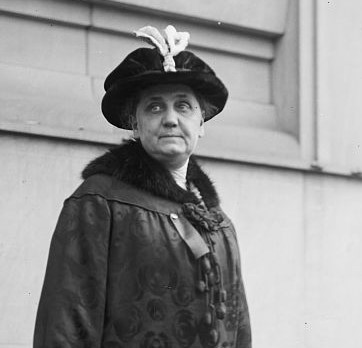
A woman wearing a dark, patterned coat with a fur collar and a decorative hat stands in front of a building, looking slightly to the side.

Sheryl Gordon is an Assistant Professor in the History and Political Science Department at Molloy University on Long Island, NY. Her research has centered on peace history and international relations in the early twentieth century. She published โ€œThe Limits of Labels: Jane Addams and Her Views on Self-determination and Imperialism, 1899โ€“1923,โ€ in Peace & Change: A Journal of Peace Research in 2024. She has book in press with Bloomsbury Academic entitled Marian P. Whitney and the Problem of Being a Prominent Person in the Progressive Era.

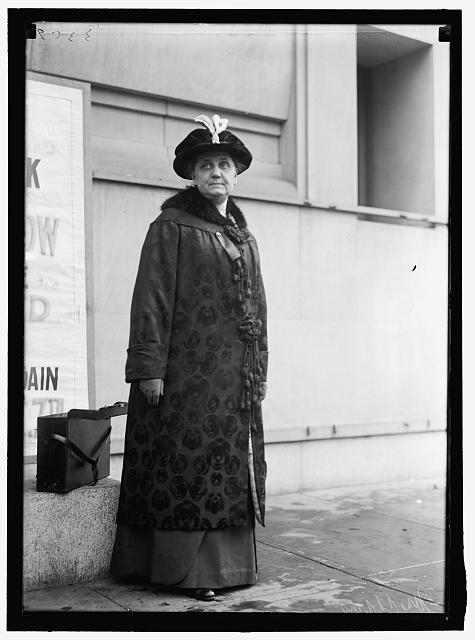
A woman in early 20th-century clothing, including a long patterned coat with a fur collar and decorative hat, stands on a sidewalk next to a case and a wall with a partial poster visible.
Jane Addams (1913) – Library of Congress

I started researching Jane Addams a few years ago for a course on women in American history I was preparing to teach. She seemed to fit well within the scope of my research interests as well, which are on peace history and the World War I era. After all, in addition to her social work, Addams was one of the best-known pacifists in America. She was even labeled โ€œthe most dangerous woman in Americaโ€ because of her national stature and her pacifist views. As I read through her published works, her dedication to peace and humanitarianism were clear. Then I came across a brief article she wrote in 1921 titled โ€œThe Potential Advantages of the Mandate System.โ€[1] The article seemed completely opposed to her other work and worldview. The mandate system was created as a provision of the League of Nations after World War I that gave Western European nations control of the economic resources of the defeated nations and former colonies of Germany. For much of the twentieth and twenty-first centuries, the mandate system has been viewed as imperialist.

Was Jane Addams really promoting imperialism, a system linked to militarism and war?

Had her views changed since 1899, when she opposed the U.S. annexation of the Philippines in the aftermath of the Spanish-American War? Or had she been misunderstood by her contemporaries and scholars in some ways?

I could not find much in the secondary sources to help explain her views on imperialism or the mandate system. Addams was labeled generally an anti-imperialist. Marilyn Fischer, Professor Emerita at the University of Dayton and scholar on Addams, provided valuable guidance on Addamsโ€™s motivations and outlook. In the Jane Addams Digital Edition, I saw how Addams maneuvered through events and issues with peace as her north star. 

I searched the digital edition to see if Addams expressed any thoughts to her colleagues in the Womenโ€™s International League for Peace and Freedom (WILPF), family members, or friends about her views on imperialism and the mandate system. Looking through various letters and material, I examined her views towards the Anglo-Irish War, or Irelandโ€™s campaign for independence from imperialist England. It began in 1919 and ended with a truce in 1921 that divided Ireland into a free state and parts controlled by England. I also found the archive useful for understanding her views on the League of Nations and mandate system.

โ€œJumping into Boiling Oil:โ€ Addams and the Anglo-Irish War

Opinion in America about the Anglo-Irish War was extremely divisive. Anti-British sentiments in America intensified as reports circulated of atrocities committed in Ireland by British soldiers. Addams was part of a group of 150 politicians, selected individuals, and clergy to examine the situation in Ireland. She even served as temporary chair of this group, known as the American Commission on Ireland. A letter written to Emily Greene Balch, International Secretary-Treasurer of WILPF, shows how dedicated Addams was to pursuing peace in this conflict. Addams wrote to Balch in 1920 about becoming involved with the Commission, โ€œI quite realize that it is jumping into boiling oil as it were, but it may be useful and even afford a chance for our old idea of continuous mediation.โ€[2] In a letter to her English friend and WILPF colleague, Henrietta Octavia Barnett, Addams explained she was involved with the Commission to lessen the chance for military escalation.[3]

Addams viewed the Commission as a way to help England and Ireland arrive at a resolution. What was not in the digital edition was also meaningful. Addams expressed sympathy for the suffering of Irish civilians and helped how she could. In her correspondence, though, Addams did not express support for Irelandโ€™s right to choose a government supported by the majority. In her published and unpublished writings, Addams prioritized food security for nations. For Addams, it was more important to avoid a war, which would further endanger the population in Ireland.  

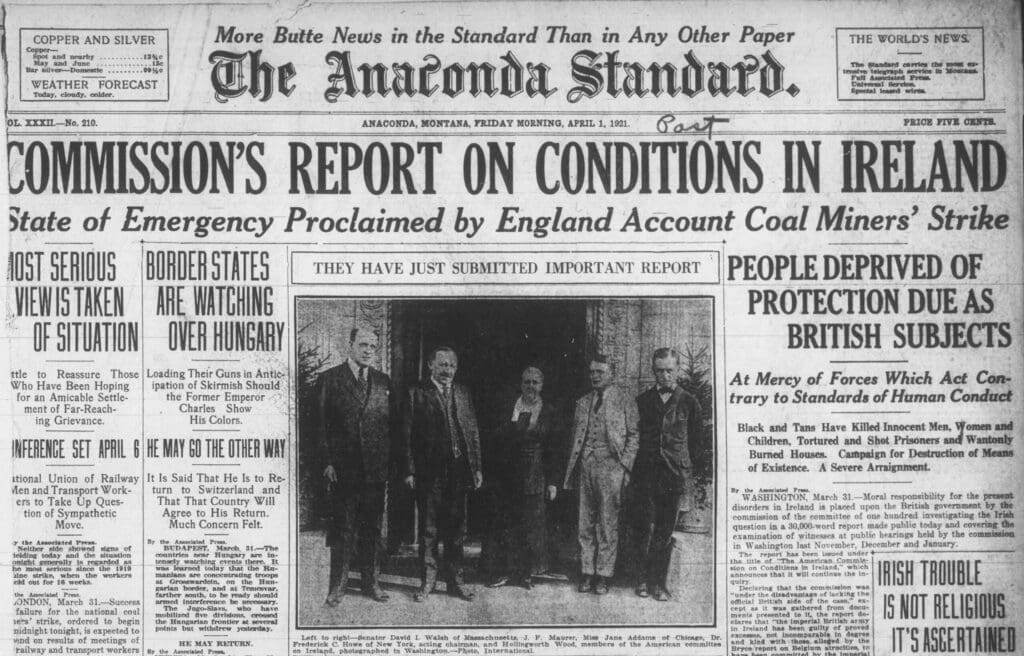
Black and white 1921 newspaper front page with bold headline about Ireland, several articles, and a photo of seven men in suits standing outside a building.
Headline of the Anaconda Standard with image of Jane Addams and other Commissioners, April 1, 1921.

Addams and the Mandate System

Reading through her unpublished letters in the digital edition, I understood better her support of the League of Nations and views of the mandate system. The thinkers she corresponded with discussed the mandate system as the path to peace in a world uprooted by war. Since the control over nations would be temporary, transparent, and supervised, they did not view the mandate system as imperialism. These thinkers reasonably influenced her views.

Addams began to envision a different pathway to permanent peace. Before the war, Addams was optimistic that citizens could work together to pressure their governments to create conditions necessary for peace. These conditions meant having enough food and resources. After the war, Addams viewed governments incapable of creating these conditions. Several governments had collapsed and economies were in shambles. For Addams, the League of Nations would be able to balance the worldโ€™s economic resources to provide humanitarian aid for immediate suffering and to help countries regrow their economies. Only then could the conditions for lasting peace be created. Addams expressed confidence that the League of Nations would be able to minimize nations from being exploited in this process.

Addams wanted America to join the League of Nations to help with this humanitarian aid. She had worked for the government during the war helping with international food relief efforts. She wrote to Balch after the war that famine relief was โ€œthe most useful thing that can be done just now.โ€[4] The digital edition contains several newspaper articles summarizing her various talks across the nation and abroad. The articles reveal how she tailored her message to each group to convey her message most effectively. Letters with Balch and Anna Garlin Spencer, the president of the U.S. Section of WILPF, indicate they had a different priority.[5] Undeterred, even when the U.S. did not join the League of Nations, Addams focused on bringing her message to the public. She continued to advocate humanitarian relief as a pathway to peace.

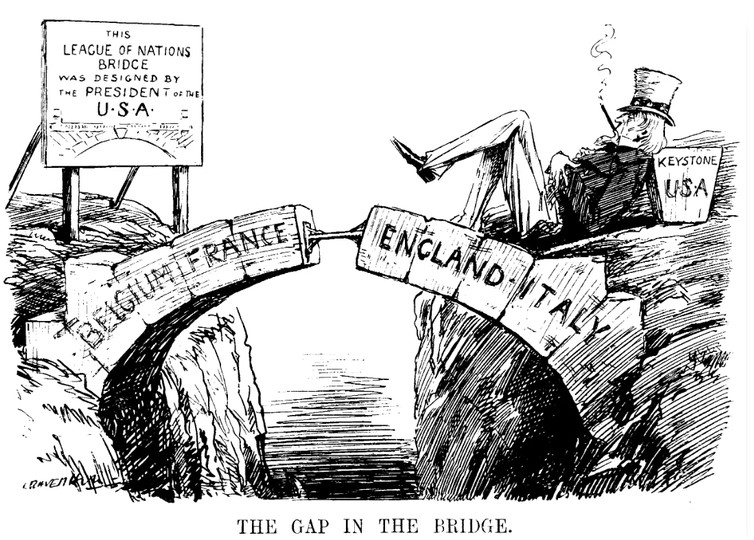
Political cartoon of a man in a top hat, labeled USA, sitting on a missing keystone between two bridge halves labeled Europe/France and England/Italy, with a sign about the League of Nations Bridge. Text: The Gap in the Bridge.
Cartoon highlighting the United States refusal to join the League of Nations (Punch, December 1919).

So, was Addams promoting imperialism?

After countless focused searches and fulfilling falls through rabbit holes in the Jane Addams Digital Edition and re-reading her published works, I had an answer to my original question. Addams was not promoting imperialism. However, she was not focused on refuting it, either. Addams was an independent thinker. She supported causes based on the consequences she foresaw. She theorized the Philippine population would not benefit from U.S. annexation in 1899, so supported the anti-imperialist side. She believed the Anglo-Irish War would lead to military escalation and endanger the population in Ireland. So, she did not promote Irelandโ€™s right to self-determination. She deemed the League of Nations able to provide large-scale economic and humanitarian relief. So, she promoted it, providing certain guardrails were placed on Western nations. Embedded in her pacifism was the concept of food and resource security.

From examining her unpublished writings, we can get a better sense of the relationship between pragmatism, imperialism, and peace. Her writings reveal that anti-imperialism and pacifism are not always tied together. This understanding can be used in how we understand the womenโ€™s rights movement, international peace movement, and political landscape in the decade following World War I. We also gain a better understanding of Jane Addams. Her actions, a testament to her humanitarian and peace-focused worldview, speak louder than labels.


[1] Jane Addams, โ€œThe Potential Advantages of the Mandate System,โ€ The Annals of the American Academy of

Political and Social Science 96, no. 1 (July 1921): 70โ€“74, https://doi.org/10.1177/000271622109600115.  

[2] Jane Addams to Emily Greene Balch, October 26, 1920, Jane Addams Digital Editionโ€”Ramapo College f New Jersey (JADE), https://digital.janeaddams.ramapo.edu/items/show/21045.

[3] Jane Addams to Henrietta Octavia Barnett, April 22, 1921, JADE, https://digital.janeaddams.ramapo.edu/items/show/21984.

[4] Jane Addams to Emily Greene Balch, March 20, 1920, JADE, https://digital.janeaddams.ramapo.edu/items/show/28643.

[5] Anna Garlin Spencer to Jane Addams, February 23, 1920, JADE, https://digital.janeaddams.ramapo.edu/%20items/show/19973

Finding Morris Osofsky

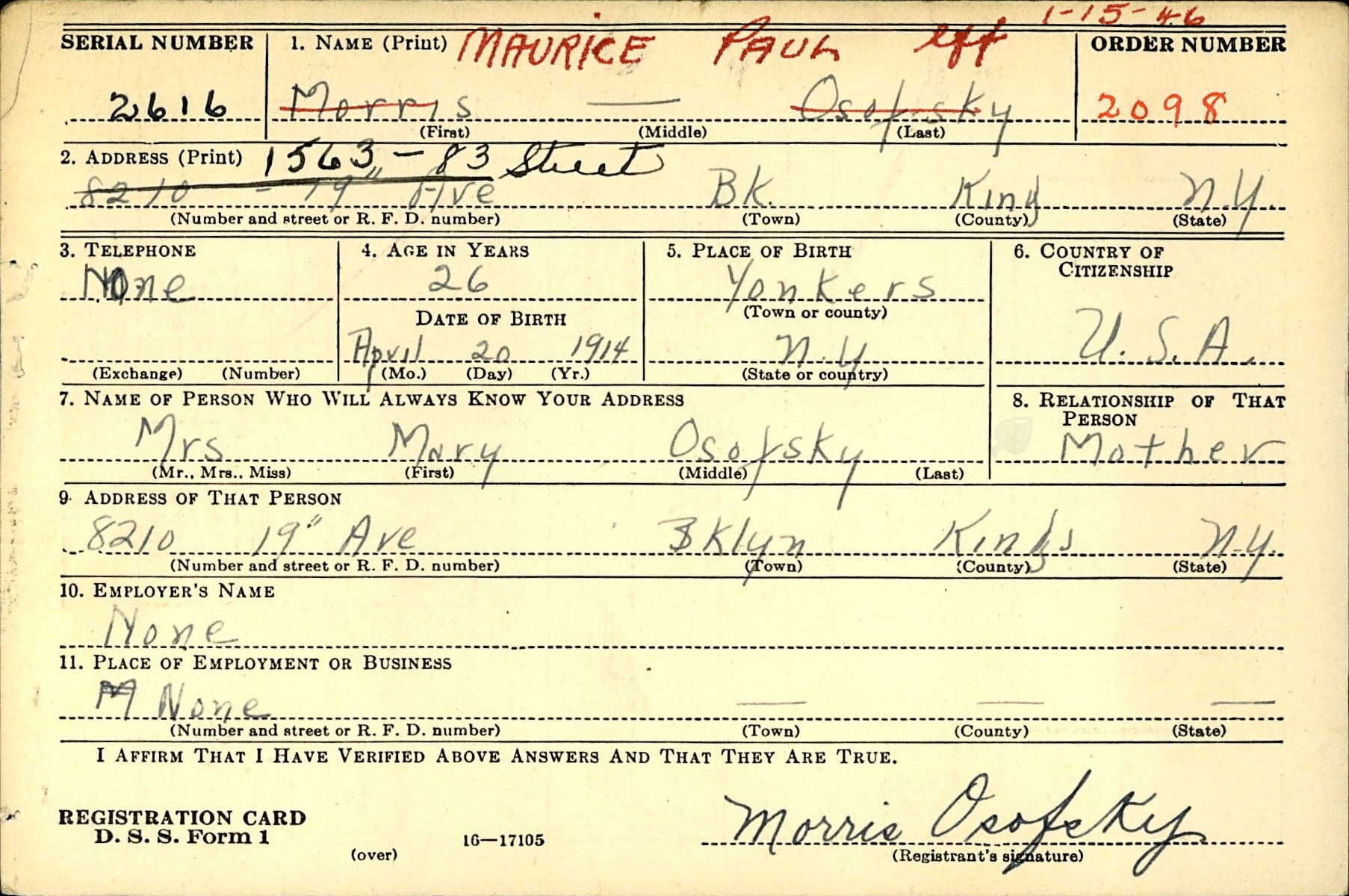
A vintage registration card filled out by hand for Maurice Osafsky, dated 1940s, listing personal details such as address, age, birthdate, place of birth, and emergency contact.

I recently finished reviewing all of the congratulatory telegrams and letters Jane Addams received when she was awarded the Nobel Peace Prize in December 1931. More than 375 of these messages are known to be extant, and they came in from across the country and around the world. The well-wishers included other peace activists, like Frederick Libby of the National Council for the Reduction of Armaments, Mary Thoday of the North Wales Womenโ€™s Peace Council, and Addamsโ€™s cowinner Nicholas Murray Butler. There were notes from friends, family members, dozens of colleagues in the social settlement and suffrage movements, and ecstatic and proud members and state, local, and national branches of the Womenโ€™s International League for Peace and Freedom, which Addams founded in 1915. Addams heard from educators, business people, writers, clergymen, and politicians. There were letters in German, Spanish, and French, two women named for Jane Addams (Jane Addams Weinreb of Chicago and Jane Addams Thompson of Thornwood, NY), and many letters included honorary resolutions passed by peace societies and organizations across the globe.

Some of the most notable among the correspondents were racial justice reformer Mary McCleod Bethune, sitting Illinois Governor Louis Lincoln Emmerson, former (and future) Canadian Prime Minister William Mackenzie King, journalist Oswald Garrison Villard, Oxford University professor Gilbert Murray, Chinese feminist writer Sophia H. Z. Chen, and Swedish-American painter Carl Eric Lindin. Of course Jane Addams heard from friends and family and professional associates. Naturally, as well, civic and political leaders who shared her world view were compelled to write, particularly those who supported Addams during the post-war years when her unwavering pacifism caused many to criticize her and to question her patriotism.

Yet the letters from the more common folks are the ones I find most revealing. The well-wishing from the people Addams didnโ€™t know illustrate more clearly the scope of her influence and the myriad ways her life and work inspired people outside of the reform movements she led. These more common messages came from women, men, and young people worried about the state of the world. They came from mothers, teachers, and religious souls who admired Addamsโ€™s integrity, humanity, intellect, and resolve. One came from Harold Palmer, an inmate in a New York Prison, who had grown up in the Hull-House neighborhood. One came from Bess Swett, a representative from the South Sioux City Womanโ€™s Club in Nebraska. Another came from Mamie Jefferson, a school teacher in Camden, NJ. And one came from Morris Osofsky, a teenager from the Bronx, New York:

2085 Walton Avenue
Bronx, New York
December 10, 193

Dear Miss Addams,

Bravo!! May a seventeen-year-old high-school student offer his very sincerest congratulations on the awarding of the Nobel Peace Prize?

As an advocate of peace and a great humanitarian you have long been the idol of we young would-be philanthropists who so often say, โ€œIf I had a million dollars. Iโ€™d give it to charity.โ€

But perhaps I bore you so I will cease now and again permit me to say thatย noย person is more deserving of the prize than yourself,ย Congratulations!

Very respectfully,
Morris Osofsky

One of my favorite tasks as a historian is to uncover the lives of ordinary people, to do the detective work necessary to identify them, and then to share their stories. It is often a difficult task, because historians are always at the mercy of the incomplete historical record. People of the past are often hiding in the historical shadows. They move, they get married and change their names, they die at sea or in foreign countries, they are illiterate, they have their foreign names butchered or change them to become American, they burn their letters. Sometimes the paper trail ends and the historical trail runs cold.

From young Mr. Osofskyโ€™s letter, I know he lived at 2085 Walton Avenue in the Bronx and was born in 1914. I quickly find him in the 1930 U.S. Census, living at that exact address with his parents and an older sister. From that census page, I learn that Morrisโ€™s father Nathan Osofsky (born c. 1875) immigrated from Russia in 1904 and was a clerk in a delicatessen. Morrisโ€™s mother Miriam Osofsky (born c. 1875) immigrated from Russia in 1910. The native language of both parents was Yiddish, so I also know now that the family was Jewish. Morris and his sister Ethel (born c. 1917) were born in New York and grew up as the children of immigrants.

I find Morris and his parents in the 1940 U.S. Census, as well, although in this record his mother is named Mary, either a personal choice or a mistake by the census taker. At some point between 1931 and 1940, the family moved to Brooklyn, New York. Morris’s father was a counter man at a delicatessen there, and Morris, aged 26, had been out of work for seventy weeks. In trying to fill in the nine-year gap and move beyond 1940, I do some searching in newspapers but quickly learn there were two Morris Osofskyโ€™s in Brooklyn at the same time and nearly the same age, and there is not enough evidence to untangle them.

A vintage registration card filled out by hand for Maurice Osafsky, dated 1940s, listing personal details such as address, age, birthdate, place of birth, and emergency contact.I then attempt one those hopeful-but cautious searches in Ancestry.com, hoping to find another clue to pick up the trail. I find a military registration card signed by a Morris Osofsky, born in Yonkers, N.Y., ย on April 14, 1914. And, huzzah! His address on the card matches his address in the 1940 census. Also on the card, Osofsky had listed his mother Mary Osofsky at that same address in Brooklyn as his contact. This card is not only a record of his name, birthdate, and current address, it is also my historical missing link. Because, at the top of the card, the name โ€œMorris Osofskyโ€ was stricken, and written in red ink was โ€œMaurice Paul [effective] 1-15-46.โ€

Eureka! Morris Osofsky had changed his name, and that is why my trail ran cold in 1940.

I then check the 1950 census and find Maurice Paul, the Brooklyn 36-year-old formerly known as the Bronx high school student named Morris Osofsky. He was living with Nathan Osofsky, age 76 (that tracks), and Mary Osofsky, age 76 (also tracks), and both born in Russia (more corroboration). Miriam had, indeed, morphed into Mary, and their son had become Maurice Paul. A quick newspaper search fills in the final detail. In 1945, Morris Osofsky petitioned the court to legally change his name to Maurice Paul. The notice included his wife Rose and one-year-old son Barry, also legally changing their surname to Paul.

Oh, how I do love playing history detective. And when a single document connects two disparate dots, in this case a corrected military registration card, I give my thanks to Clio.

The discovery of the legal name change opened up a flood of new documents and evidence of the ordinary extraordinary life of Morris Osofosky/Maurice Paul. I am especially happy to share the details here in a blog post, because only a very distilled version of his story will appear in a footnote to his letter, which we will publish in Volume 6 of The Selected Papers of Jane Addams.

As a youngster, Morris Osofsky was employed in the restaurant business, perhaps even working in the same delicatessen as his father. He appreciated the strict discipline of his parents and respected their hard work and struggle as immigrants. He was also greatly influenced by their good sense and frugality, but remembered that โ€œevery so often Pop would slip a dollar bill in the toe of my stocking while I slept (so Mom shouldnโ€™t know about it). While Mom always slipped me an extra quarter or so when I went to the movies (only donโ€™t tell Pop).

Osofsky was unemployed during at least one good stretch of time during the Great Depression, he married Rose Ress in Brooklyn on December 12, 1941, and had a son named Barry. In 1945, he changed his name to Maurice Paul; and sometime before April 1950, he and Rose were separated. I found no evidence that the couple divorced, but Maurice Paul never remarried.

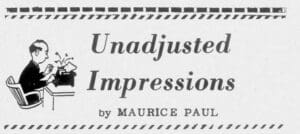
A black and white illustration of a man typing at a desk next to the title Unadjusted Impressions by Maurice Paul, framed by a decorative border.In 1950, Maurice Paul was living in Brooklyn with his parents and working as a journalist in a literary agency. It is the professional side of his story about which he left the most clues. He became a reform-minded journalist and wrote on a wide variety of subjects, especially in the beginning of his journalism career. He published articles in newspapers and periodicals, including the Brooklyn Daily, where he started writing a column entitled โ€œUnadjusted Impressions.โ€ The column was an eclectic collection of facts, observations, and literary quotes. The style of the writing was colloquial.

In 1961, Paul became the editor of the Canarsie Courier, which covered the Canarsie neighborhood of Brooklyn on Jamaica Bay. He continued to publish the โ€œUnadjusted Impressionsโ€ column in his new paper. Yet it was in his role as editor that Paul found his true calling, living up to the spirit of a good journalist by speaking truth to power. His hard-hitting editorials called out bad government and demanded community improvements, and his advocacy was hailed as instrumental in pressuring local officials to build a modern, new high school and to replace an antiquated and dilapidated police station. Paul also took on the N.Y. Transit Authority, which resulted in improved transportation networks in Brooklyn.

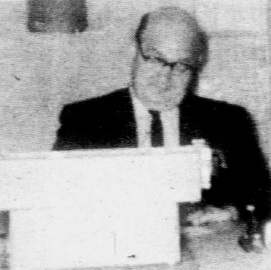
A black-and-white, grainy photo of a man in a suit and glasses sitting behind a desk or podium, looking at the camera.In 1967, Paul was awarded the Canarsie High School Human Rights Award for championing โ€œthe cause of tolerance, human decency, and brotherhood.โ€ I wonder if the 53-year-old Maurice sitting in that packed high school gymnasium being honored remembered the 17-year-old Morris who wrote to Jane Addams, identifying himself as a โ€œwould-be philanthropist.โ€ I did not have the luxury to read all of the articles Maurice Paul wrote over the years, but a search for him and Jane Addamsโ€™s name together in one newspaper database revealed no evidence that he ever publicly credited her with his civic concerns.

I wish I could write that Jane Addams inspired Maurice Paulโ€™s good deeds, although I do believe that every adult who inspires a young person gets into the subconscious mind of the emerging adult. Maurice Paul certainly had good parents, and they can take the credit for his success in the world. They fled horrible conditions for Jews in Russia to make a better life for themselves in the United States, and their all-American son, no doubt, made them proud. Yet I cannot help but believe that the teenager so inspired to write to Jane Addams in 1931 was also shaped by his knowledge of her good work. Maurice Paul was a writer in his bones, but perhaps Jane Addamsโ€™s dedication to make the world a better place inspired him to use his own unique talent and passion to make his community a better place.

Maurice Paul suffered a fatal stroke in 1969. He was only 55 years old, and his death was a terrible shock to his newspaper and his community. He had only just taken on a campaign, through his editorials, to eliminate the โ€œJet noise problemโ€ in Canarsie. His advocacy would be missed, as the obituary in the Canarsie Courier opined: โ€œCanarsie lost one of its most respected and dedicated fighters for civic improvement โ€ฆ He wrote extensively about the wonders of nature and the animal kingdom. But Maurice was at his best at a typewriter, โ€˜telling offโ€™ disinterested public officials who neglected their civic obligations.โ€

Stacy Lynn, Associate Editor

Sources:ย Legal Notice for Morris Osofsky, Brooklyn (NY) Citizen, Dec. 12, 1945, 8; 1930, 1940, 1950 U.S. Censuses; U.S., World War II Draft Cards Young Men, 1940-1947; New York, NY, U.S., Marriage License Indexes, 1907-2018; โ€œUnadjusted Impressions,โ€ Canarsie Courier, Feb. 18, 1966, 9; โ€œHuman Rights Award to Maurice Paul,โ€ Canarsie Courier, June 8, 1967, 7; โ€œMaurice Paul, Editor, Dead at 55,โ€ Canarsie Courier, Aug. 7,ย  1969, 1; Letters to Jane Addams in the Jane Addams Digital Edition: Nicholas Murray Butler, Dec. 9, 1931; Louis Lincoln Emmerson Addams, Dec. 10, 1931; William Lyon Mackenzie King, Dec. 10, 1931; Frederick Joseph Libby, Dec. 10, 1931; Carl Eric Olaf Lindin, Dec. 10, 1931; Morris Paul Osofsky, Dec. 10, 1931; Oswald Garrison Villard, Dec. 11, 1931; Jane Addams Thompson, Dec. 12, 1931; Jane Addams Weinreb, Dec. 13, 1931; Gilbert Murray Addams, Dec. 16, 1931; Mamie E. Jefferson, Dec. 17, 1931; Bess Swett, Dec. 22, 1931; Mary McLeod Bethune, Dec. 23, 1931; Sophia H. Z. Chen, Dec. 24, 1931; Mary Gladys Sykes Thoday, Feb. 6, 1932.
Scholar’s Corner: Patricia Shields

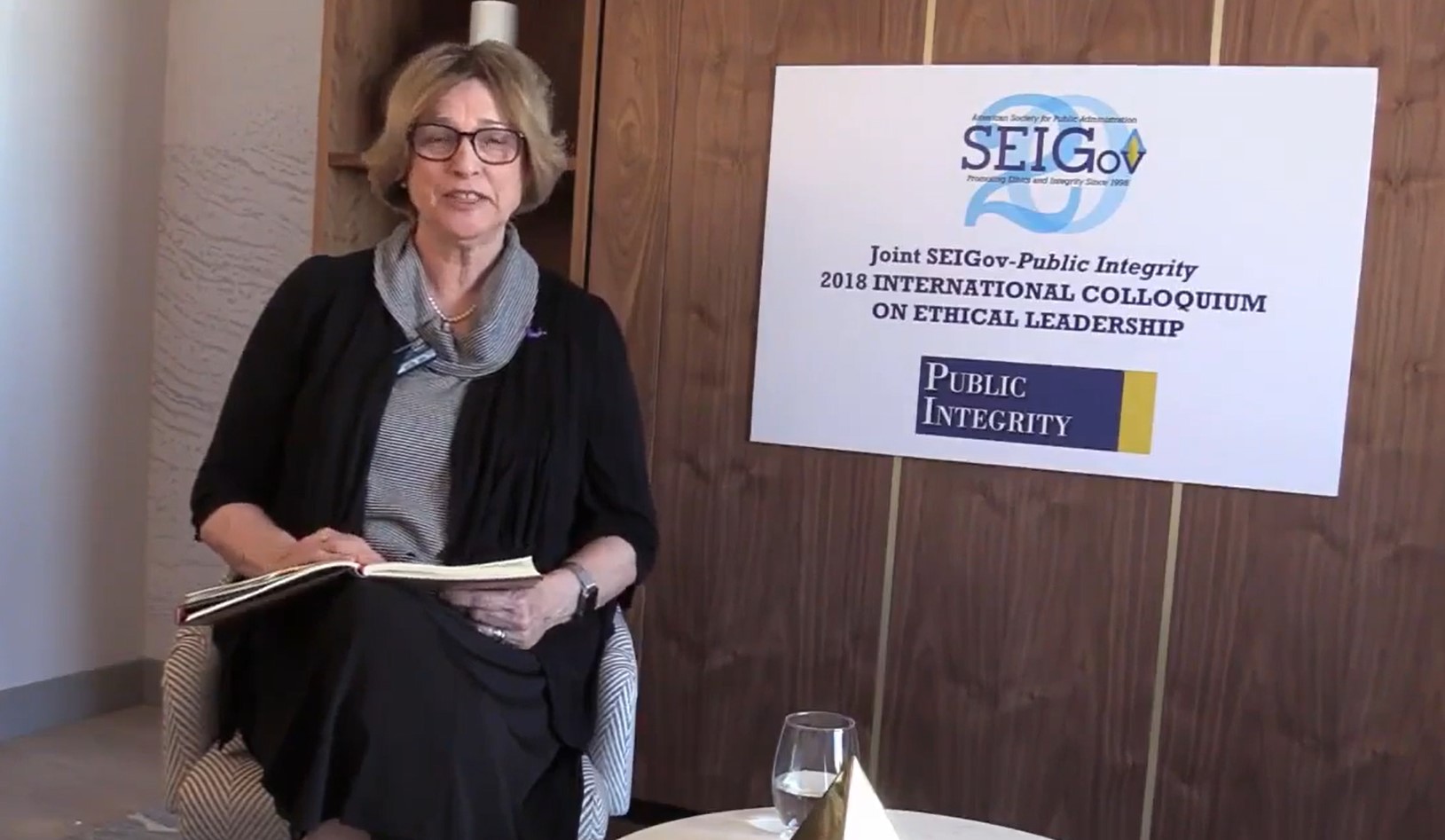
Patricia Shields sits holding a notebook, next to a sign reading 2018 International Colloquium on Ethical Leadership, Public Integrity, with SEIGov and Public Integrity logos visible behind her.

We want to thank Patricia Shields for sharing some of her research on Jane Addams!


Jane Addams’s Social Ethics (Video)

Patricia Shields on Jane Addams’s Social Ethics, April 24, 2018

https://hdl.handle.net/10877/8366

Patricia Shields sits holding a notebook, next to a sign reading 2018 International Colloquium on Ethical Leadership, Public Integrity, with SEIGov and Public Integrity logos visible behind her.
Patricia Shields, 2018


Recovering Jane Addams: Ethics, Social Work, Social Justice and Peace (PDF)

Patricia M. Shields, Recovering Jane Addams: Ethics, Social Work, Social Justice and Peace, Grace Abbott School of Social Work, University of Nebraska Omaha, October 2017.

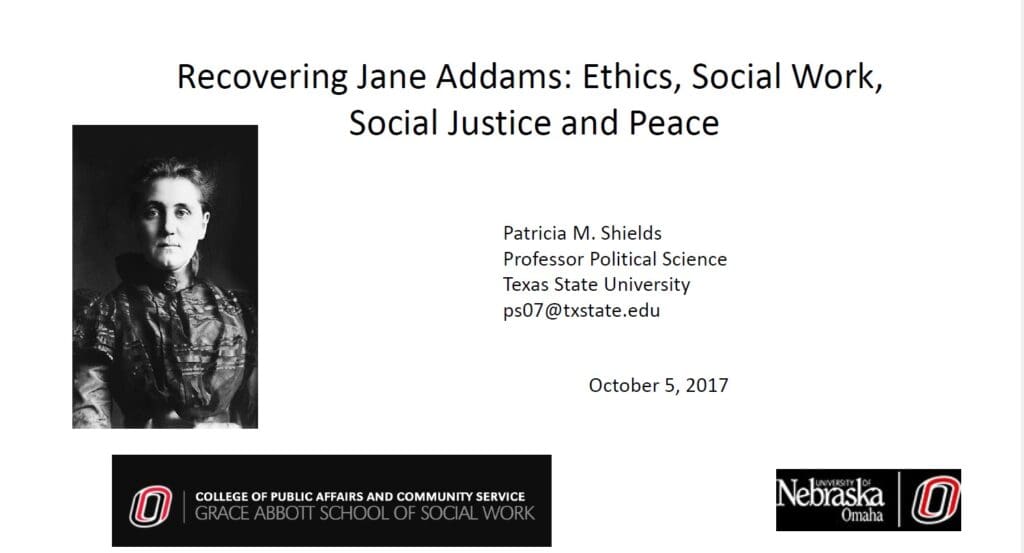
Presentation slide titled โ€œRecovering Jane Addams: Ethics, Social Work, Social Justice and Peaceโ€ with a black and white photo of Jane Addams, event details, and logos of the University of Nebraska Omaha and Grace Abbott School of Social Work.


Jane Addams and the Women’s Peace Movement (Video)

Patricia Shields on Jane Addams and the Women’s Peace Movement, from Save Texas History Symposium on Texas and the Great War, September 16, 2017.


Jane Addams’s Peaceweaving: A Feminist Response to Paternalism, Militarism, and World War I

Patricia M. Shields, Jane Addams’s Peaceweaving: A Feminist Response to Paternalism, Militarism, and World War I, Women and Gender Research Collaborative, March 24, 2017.ย  (PDF)

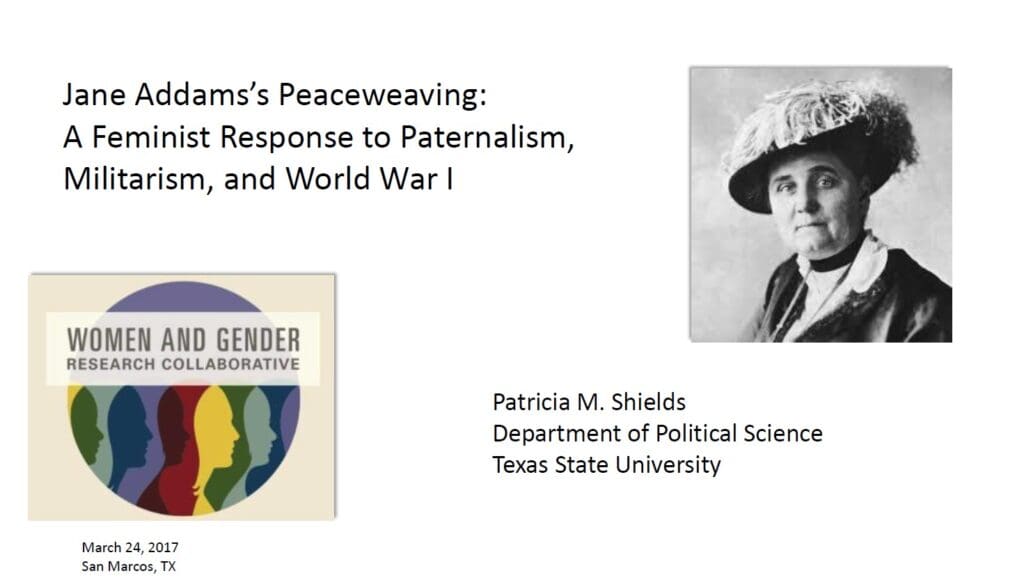
Presentation slide titled Jane Addamsโ€™s Peaceweaving: A Feminist Response to Paternalism, Militarism, and World War I with Jane Addamsโ€™s photo, a Women and Gender Research Collaborative logo, and event details for Patricia M. Shields.

Guest Post: What B. R. Ambedkar Wrote to Jane Addams

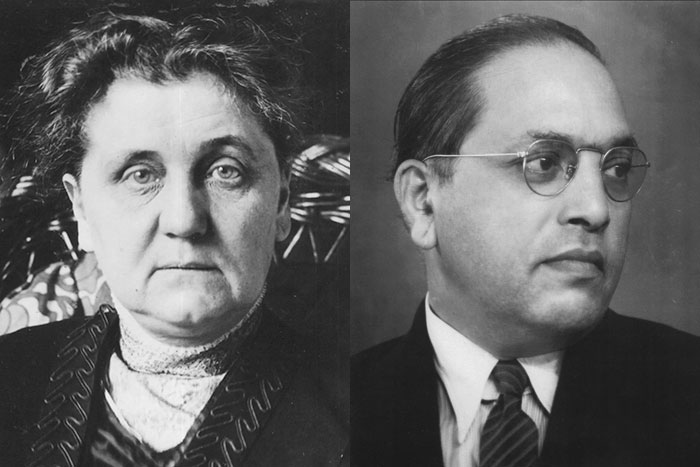
Black and white portraits of two people side by side: on the left, an older woman with short hair and a serious expression; on the right, a man with glasses in a suit and tie, looking to the side.

This is a guest post by Scott R Stroud, an associate professor in the Department of Communication Studies at the University of Texas at Austin. He is the author of The Evolution of Pragmatism in India: Ambedkar, Dewey, and the Rhetoric of Reconstruction (2023), which has also been published by HarperCollins India as The Evolution of Pragmatism in India: An Intellectual Biography of B.R. Ambedkar (2023). This post was originally published on August 3 by the South Asian American Digital Archive and we thank them for permission to reprint here.

Black and white portraits of two people side by side: on the left, an older woman with short hair and a serious expression; on the right, a man with glasses in a suit and tie, looking to the side.
Portrait photographs of Jane Addams and Dr. B. R. Ambedkar

The Indian politician and anti-caste activist Bhimrao Ambedkar (1891-1956) was heavily influenced by his experiences in the U.S. and England. He was partially shaped by his expansive education there, studying at institutions such as Columbia University, London School of Economics, and Grayโ€™s Inn. Of this set of institutions, his time in New York perhaps had the most influence on him. It was at Columbia that he was exposed to a range of progressive thinkers, not the least of which was the American pragmatist, John Dewey. While there are many ways that Deweyโ€™s pragmatism mattered for Ambedkarโ€™s thought over the following decades, there is another figure in the pragmatist tradition that has an overlooked connection to Ambedkar: Jane Addams (1860-1935).

It is often thought that Ambedkar left New York in the summer of 1916 for London and that he did return to the U.S. until much later in his lifeโ€”in 1952 when Columbia bestowed upon him an honorary degree. This is not accurate, however. On December 5, 1931, a few days after the conclusion of the second Round Table Conference, Ambedkar left London and sailed for New York. The exact purpose of this visit is hard to divine, but he ended up spending much of his time near Columbia University until he left for London on January 4, 1932.1

It was during this month in New York that Ambedkar penned a letter to Jane Addams on December 15, 1931.2 The letter is written on Ambedkarโ€™s own stationary, and its return address reveals that Ambedkar was staying at the International House at 500 Riverside Drive near the Columbia campus he roamed as a student. This building was constructed in 1924 with the funding of John D. Rockefeller Jr. to create a diverse learning and living environment for the growing numbers of international students at Columbia. In all likelihood, Ambedkar was able to stay there for the duration of his short visit given his status as an international alumnus.


Image used with permission of Prakash Ambedkar and the Jane Addams Papers Project.

Why did Ambedkar write Addams in 1931? His ostensible purpose was to wish her โ€œa full and speedy recovery from your distressful illness.โ€ Perhaps Ambedkar was reminded of her importance to causes parallel to his own given that she had been awarded the Nobel Peace Prize on December 10, 1931. On the day of her receiving this award, she was also admitted to a hospital in Baltimore, Maryland, to deal with her continuing ill health. She had been battling to regain her health ever since she suffered a heart attack in 1926. Both news of her health and her award made the papers around the globe, so Ambedkar surely heard of Addams through the media.

Ambedkar also knew of Addams from John Deweyโ€™s classes at Columbia. In John Deweyโ€™s 1915-1916 classes, Philosophy 131-132 โ€œMoral and Political Philosophy,โ€ Ambedkar and his fellow students (including the Chinese reformer, Hu Shih) heard their professor praise Addamsโ€™ 1902 book, Democracy and Social Ethics, in support of his claim that democracy implicated a wide range of community relationships beyond the political.3 Addams was an important part to the diverse tradition of American pragmatism, and she was set apart by the unique endeavor of running the settlement Hull House in Chicago. Settlement houses were part of a social movement that started around 1890 to alleviate poverty and suffering brought on by rapid industrialization. Social workers and activists would establish community centers in which they lived side-by-side with poor local residents and tried to improve the living conditions of the surrounding community. Addamโ€™s Hull House is one of the most successful American instances of this movement. It was when Dewey was in Chicago that he became friends with Addams and familiar with Hull House. Addams was not simply working for the improvement of the condition of women, immigrants, the poor, and those who might suffer from the violence of war; she also wrote and thought about the philosophy that stands behind such activism.4 Addamsโ€™ thoughts on nonviolence and democracy influenced Dewey, as Deweyโ€™s ever-growing body of work influenced Addams in turn.

When Dewey left Chicago for Columbia University in 1904, he remained friends with Addams and a supporter of the settlement movement. Addams continued with her work and expanded into international peace advocacy. Her decades-long efforts against international conflict, as unpopular as they were during the Great War, earned her the Nobel recognition in 1931.

Ambedkarโ€™s letter, however, focuses on her illness and makes no overt mention of her award. It does seem implied however, since he tells Addams โ€œYour life of devotion to the submerged of the world has been the inspiration and encouragement for us all even in darkest India.โ€ Ambedkar seems aware of her settlement work to alleviate the burdens of the poor in Chicago at Hull House, as well as the care for those in other nations evinced by her peace-building work in America and Europe. Perhaps he also knew of her trip to India in 1923, a visit where Addams was largely exposed to the figures and movements fixating on Indian self-rule, and not on the battle against untouchability. Addams was a friend and correspondent of Gandhiโ€™s, but the two were unable to meet on this trip because he was imprisoned at the time.

Addams did not seem to prioritize, or even know much about, the social evils of caste. Ambedkar seemed motivated in his letter to not only wish her improved health, but to introduce himself and his anti-caste cause. Indeed, he starts the letter referring to himself โ€œas a representative of the sixty-millions of downtrodden untouchables in India.โ€ Ambedkar seemed motivated to put the social issue of caste on Addamsโ€™ mind with his references to the size and state of the mass of humans oppressed by these long-rooted and oppressive matters of social custom. Caste limited and dehumanized most of those caught in the grips of its hierarchy, but this function was often missed by Americans like Addams.

What do we make of this letter? In archives in the U.S. and in India, I have found no evidence that Addams sent a reply to Ambedkarโ€™s letter of December 15. Nor is there any record of future correspondence between these two thinkers. Addams, of course, was deluged with congratulatory letters and telegraphs after her receipt of the Nobel Prize; combined with her uncertain health and hospitalization, itโ€™s no surprise that she did not write back to the Indian civil rights leader.

From this letter, however, we can see something of Ambedkarโ€™s motivation. He not only introduced himself and his cause in the letter, he hoped for a personal audience with Addams. โ€œI devoutedly [sic] hope,โ€ he writes at the end of the letter, โ€œthat your recovery will come within the limits of my short stay in America to permit me to present my humble respects in person.โ€ Thereโ€™s no evidence that they ever met, and Addamsโ€™ health and residence elsewhere lead us to think she did not meet Ambedkar in New York. But we can guess that Ambedkar sought a meeting with Addams not only to congratulate her, but also to build bridges between her settlement and peace work and his struggle against untouchability and caste oppression. We know that Ambedkar would later (in the 1940s) try to build similar bridges to leaders in the civil rights movement such as W.E.B. Du Bois.

Perhaps Ambedkar wanted to convince Addams that eradicating untouchability was an overlooked part to the Gandhian quest for Indian self-rule or swaraj that she was so taken by.5 Or perhaps Ambedkar wanted to compare strategies on settlement houses and their use in the Indian context. After all, he had most likely long known about settlement housesโ€”the settlement house figure, Mary Kingsbury Simkhovitch, was married to Ambedkarโ€™s economics professor, Vladimir Simkhovitch. Mary Simkhovitch directed Greenwich House in New York and was friends with Addams. She and Vladimir lived at the Greenwich Village settlement during the week, and often brought Vladimirโ€™s students to visit it. Ambedkar may have heard about her settlement activities or even visited it during his enrollment in one of his five courses from Vladimir at Columbia. In any case, we see Ambedkar initiate a series of hostels and educational organizations that similarly aimed to educate and support the lower classes (and castes) in India upon his return in the 1920s. Like Addams and Simkhovitch, as well as Dewey, Ambedkar saw the power in a holistic education that involved classes, books, as well as edifying social activities outside of formal education.

The pragmatists are a diverse lot. But one of the themes that drives Addams, Simkhovitch, and Dewey is vitally important: life was educative and intelligent action could further shape the course of experience to maximize its effects on our habits and communities. Ambedkar felt the power in this commitment, and he would often argue in his writings for a view of democracy as a way of life or a matter of our habits of associated living with our fellow humans. Addamsโ€™ ideas of social reform were a noteworthy attempt to refine harmful social habits and customs, and Ambedkar surely saw her as a fellow traveler. This overlooked letter to Addams highlights Ambedkarโ€™s drive to internationalize his mission and to connect the battle of caste to the oppression of women, the poor, and to peace-making in general.

ยงยงยง
The author would like to thank Prakash Ambedkar, Kishor Walanju, Cathy Moran Hajo, and Marilyn Fischer for their assistance with this article.

Footnotes
1. These dates are derived from the account in K. N. Kadam, Dr Babasaheb Ambedkar and the Significance of His Movement (Bombay, Popular Prakashan, 1991) and Vijay Mankar, Life and the Greatest Humanitarian Revolutionary Movement of Dr B.R. Ambedkar: A Chronology (Nagpur, Blueworld Series, 2009). I have found no evidence of meetings between Ambedkar and his Columbia contacts (including Dewey) during this time.
2. This letter can be found in the Jane Addams Papers. It was brought to my attention by the Addams scholar, Marilyn Fischer, who knows this massive set of documents very well. No biographies note the existence of this letter.
3. For information on the courses with John Dewey and their content, see Scott R. Stroud, The Evolution of Pragmatism in India (University of Chicago Press & HarperCollins India, 2023).
4. For more on Addams as a philosopher, see Marilyn Fischer, Jane Addams’s Evolutionary Theorizing: Constructing โ€œDemocracy and Social Ethicsโ€ (Chicago, University of Chicago Press, 2019).
5. Addams would continue to advocate for Gandhiโ€™s movement in her correspondence and writings after 1923, and Gandhi would write her about various matters. Gandhi reprinted some of her work in edited volumes. For more on the relationship between these two thinkers, see Elizabeth N. Agnew, โ€œJane Addams, Mohandas Gandhi, and the Promise of Soul Force,โ€ Peace & Change, 45 (4), 2020, 481-512 and Tim Gilsenan, โ€œPeacemakers & Friends: Jane Addams & Gandhi,โ€ October 6, 2013.

Excavating the History of Women and the Peace Movement

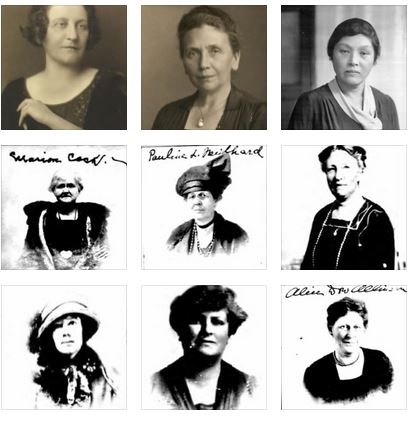
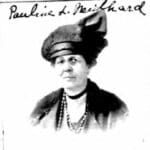
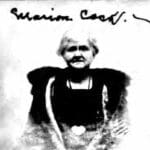
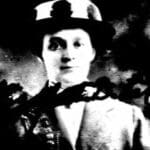
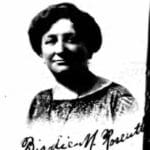
A grid of nine black-and-white portraits of women, some formal and some casual, with a few containing handwritten names above or beside the images.

The peace movement dominates Jane Addams’s work from 1914 until her death in 1935. Working through the Woman’s Peace Party, the International Committee of Women for Permanent Peace, and the Women’s International League for Peace and Freedom, Addams worked with her counterparts in many nations in a global movement to bring about peace, social justice, and equality.ย  She also served as the de facto leader of the American women’s peace movement.

Our detailed focus on the content of the documents and our efforts to identify the people mentioned in them yields a different kind of history than one that only focuses on the leaders of movements.ย  As we have begun publishing WILPF documents from both the United States and abroad, we are finding the names of early adherents, donors, and activists and adding them to the project’s database.

We know about Emily Greene Balch, Crystal Eastman, and Lucy Biddle Lewis, who were Addams’s coworkers for peace in the United States. But what about the rank and file? The women whose dollar donations funded the work of the WILPF? It turns out that within Jane Addams’s correspondence, we can learn about them too.

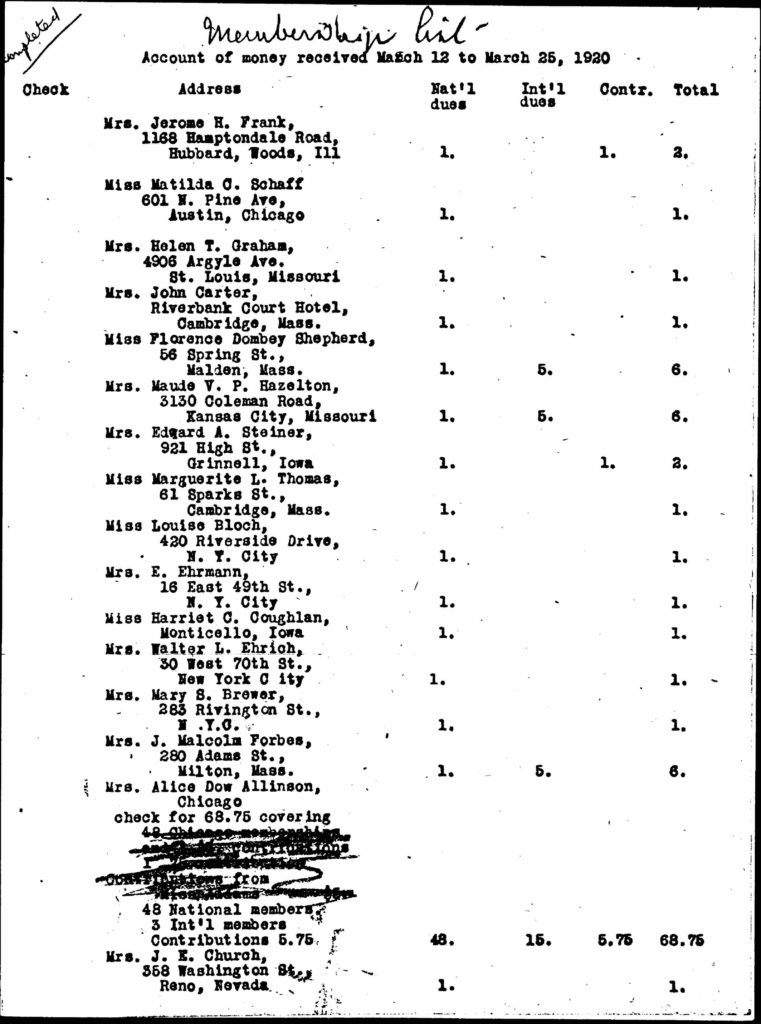
Typed list titled Membership Oil, detailing names, addresses, and amounts paid in National and International dues from March 12-25, 1920. Totals are calculated at the bottom of the typewritten page.

Eleanor Daggett Karsten, the secretary of the Woman’s Peace Party and then the United States Section of the WILPF, updated Addams every few weeks in 1920 with information about the women joining the new league, founded in 1919 at the International Congress of Women. As a document to add to our edition, I have to admit that each time I saw one of these multi-page columnar lists, I sighed, knowing that this one document might take a week or more to completely enter into our system due to the number of names. Thankfully, most of these lists contained street addresses, which made it easier (though not always easy!) to identify the women.

It didn’t take long to realize that instead of drudgery, adding the names of the early members of the WILPF was historical excavation of the best kind. Our biographical work is carried out in two steps. First the student or editor who enters the document into our system tries to link the name on the document to an existing name in our database. We use an Omeka-based system and a plug-in called Item Relations, to search the more than 12,0000 names in the system. When the person is not there, we add them. In this stage, the goal is to simply identify the person so that we are sure they are not duplicated and that we have verified their basic information.

We strive to add birth and death dates, full names, and a short biography, which we don’t publish until the second stage, when a student researcher does more in-depth work and drafts a full biography. Our goal is to then create relationships between the people in the edition and the organizations and events they participated in. This social network of Addams’s world being built slowly document by document, is one of the results of the project that we are most excited about. It will take time to build the data up, but it is time well spent.

For women, that means that “Mrs. Jerome H. Frank on 168 Hamptondale Road in Hubbard Woods, Illinois,” becomes “Florence Kiper Frank (1887?-?)” A draft biography, that isn’t publicly available yet notes that she was a member of the United States Section of the WILPF and was married to lawyer Jerome H. Franks and had a daughter named Barbara. Much of this comes from census records (having a street address on these lists is an enormous help),ย  local newspapers, and other web-based resources to get accurate information.ย  We create a bibliography pointing to the sources used so that others can follow our trail.

It is extremely exciting to find a photograph of the women, often in the U.S. Passport Applications that we access via Ancestry.com. Though the images are not of the best quality, hopefully we can add scanned originals at some point in the future.ย  We have also found that having even these short biographical stubs accessible on the web means that family members can find the project and see the associations that their ancestors had with Addams and peace. We have already received some photographs and biographical information from family members and hope that this will increase as we add more names.

Some of the more challenging research revolves around women who worked for peace outside the United States. There are many complicating factorsโ€”misspelled or partial names, the lack of genealogical resources for most non-English speaking countries, lack of language skills among our staff to read and search foreign-language resources (Google Translate only helps so much!), and often a lack of detailed geographicalย  information about where they lived.ย  Many of these peace activists are hard to trace through World War II, as records of pacifists and peace organizations often did not survive the war.

But adding them, even with partial names and limited dates, accomplishes something. As we enter more documents and move into the 1920s and 1930s, we uncover the names of those who participated in the Women’s International League for Peace and Freedom, and in time we will learn more about their lives as well.

The 1915 Trojan Women Tour

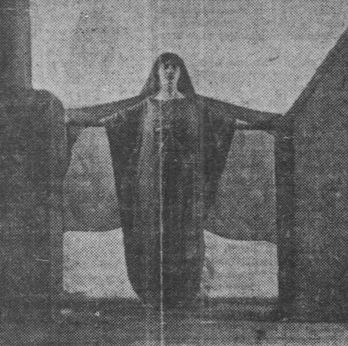
A grayscale vintage photo of a woman standing between two large structures, holding out her long, flowing dress with arms extended, creating a dramatic, wing-like effect.

1915 was a momentous year for womenโ€™s efforts for peace and suffrage. Jane Addams and others established the Womenโ€™s Peace Party (WPP), met at the International Congress for Women, formed the International Committee of Women for Permanent Peace (ICWPP), (known today as the Womenโ€™s International League for Peace and Freedom [WILPF]), and held a massive Suffrage parade in New York City, N.Y. While they worked together for one ultimate goal — equality — they used a variety of methods, one of which was revisiting Ancient Greece.

Continue reading “The 1915 Trojan Women Tour”