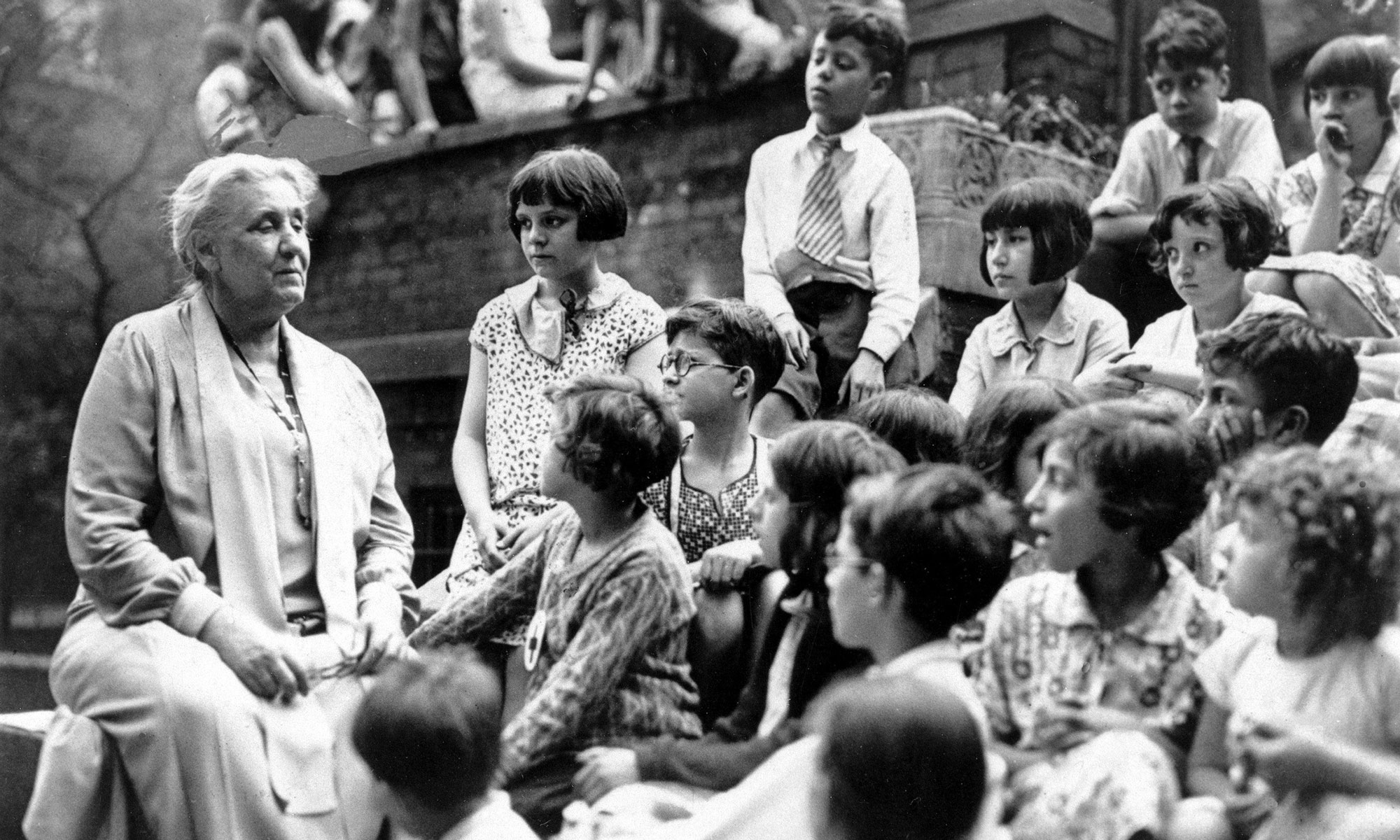
I recently finished reviewing all of the congratulatory telegrams and letters Jane Addams received when she was awarded the Nobel Peace Prize in December 1931. More than 375 of these messages are known to be extant, and they came in from across the country and around the world. The well-wishers included other peace activists, like Frederick Libby of the National Council for the Reduction of Armaments, Mary Thoday of the North Wales Women’s Peace Council, and Addams’s cowinner Nicholas Murray Butler. There were notes from friends, family members, dozens of colleagues in the social settlement and suffrage movements, and ecstatic and proud members and state, local, and national branches of the Women’s International League for Peace and Freedom, which Addams founded in 1915. Addams heard from educators, business people, writers, clergymen, and politicians. There were letters in German, Spanish, and French, two women named for Jane Addams (Jane Addams Weinreb of Chicago and Jane Addams Thompson of Thornwood, NY), and many letters included honorary resolutions passed by peace societies and organizations across the globe.
Some of the most notable among the correspondents were racial justice reformer Mary McCleod Bethune, sitting Illinois Governor Louis Lincoln Emmerson, former (and future) Canadian Prime Minister William Mackenzie King, journalist Oswald Garrison Villard, Oxford University professor Gilbert Murray, Chinese feminist writer Sophia H. Z. Chen, and Swedish-American painter Carl Eric Lindin. Of course Jane Addams heard from friends and family and professional associates. Naturally, as well, civic and political leaders who shared her world view were compelled to write, particularly those who supported Addams during the post-war years when her unwavering pacifism caused many to criticize her and to question her patriotism.
Yet the letters from the more common folks are the ones I find most revealing. The well-wishing from the people Addams didn’t know illustrate more clearly the scope of her influence and the myriad ways her life and work inspired people outside of the reform movements she led. These more common messages came from women, men, and young people worried about the state of the world. They came from mothers, teachers, and religious souls who admired Addams’s integrity, humanity, intellect, and resolve. One came from Harold Palmer, an inmate in a New York Prison, who had grown up in the Hull-House neighborhood. One came from Bess Swett, a representative from the South Sioux City Woman’s Club in Nebraska. Another came from Mamie Jefferson, a school teacher in Camden, NJ. And one came from Morris Osofsky, a teenager from the Bronx, New York:
2085 Walton Avenue
Bronx, New York
December 10, 193
Dear Miss Addams,
Bravo!! May a seventeen-year-old high-school student offer his very sincerest congratulations on the awarding of the Nobel Peace Prize?
As an advocate of peace and a great humanitarian you have long been the idol of we young would-be philanthropists who so often say, “If I had a million dollars. I’d give it to charity.”
But perhaps I bore you so I will cease now and again permit me to say that no person is more deserving of the prize than yourself, Congratulations!
Very respectfully,
Morris Osofsky
One of my favorite tasks as a historian is to uncover the lives of ordinary people, to do the detective work necessary to identify them, and then to share their stories. It is often a difficult task, because historians are always at the mercy of the incomplete historical record. People of the past are often hiding in the historical shadows. They move, they get married and change their names, they die at sea or in foreign countries, they are illiterate, they have their foreign names butchered or change them to become American, they burn their letters. Sometimes the paper trail ends and the historical trail runs cold.
From young Mr. Osofsky’s letter, I know he lived at 2085 Walton Avenue in the Bronx and was born in 1914. I quickly find him in the 1930 U.S. Census, living at that exact address with his parents and an older sister. From that census page, I learn that Morris’s father Nathan Osofsky (born c. 1875) immigrated from Russia in 1904 and was a clerk in a delicatessen. Morris’s mother Miriam Osofsky (born c. 1875) immigrated from Russia in 1910. The native language of both parents was Yiddish, so I also know now that the family was Jewish. Morris and his sister Ethel (born c. 1917) were born in New York and grew up as the children of immigrants.
I find Morris and his parents in the 1940 U.S. Census, as well, although in this record his mother is named Mary, either a personal choice or a mistake by the census taker. At some point between 1931 and 1940, the family moved to Brooklyn, New York. Morris’s father was a counter man at a delicatessen there, and Morris, aged 26, had been out of work for seventy weeks. In trying to fill in the nine-year gap and move beyond 1940, I do some searching in newspapers but quickly learn there were two Morris Osofsky’s in Brooklyn at the same time and nearly the same age, and there is not enough evidence to untangle them.
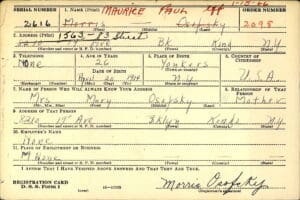 I then attempt one those hopeful-but cautious searches in Ancestry.com, hoping to find another clue to pick up the trail. I find a military registration card signed by a Morris Osofsky, born in Yonkers, N.Y., on April 14, 1914. And, huzzah! His address on the card matches his address in the 1940 census. Also on the card, Osofsky had listed his mother Mary Osofsky at that same address in Brooklyn as his contact. This card is not only a record of his name, birthdate, and current address, it is also my historical missing link. Because, at the top of the card, the name “Morris Osofsky” was stricken, and written in red ink was “Maurice Paul [effective] 1-15-46.”
Eureka! Morris Osofsky had changed his name, and that is why my trail ran cold in 1940.
I then check the 1950 census and find Maurice Paul, the Brooklyn 36-year-old formerly known as the Bronx high school student named Morris Osofsky. He was living with Nathan Osofsky, age 76 (that tracks), and Mary Osofsky, age 76 (also tracks), and both born in Russia (more corroboration). Miriam had, indeed, morphed into Mary, and their son had become Maurice Paul. A quick newspaper search fills in the final detail. In 1945, Morris Osofsky petitioned the court to legally change his name to Maurice Paul. The notice included his wife Rose and one-year-old son Barry, also legally changing their surname to Paul.
Oh, how I do love playing history detective. And when a single document connects two disparate dots, in this case a corrected military registration card, I give my thanks to Clio.
The discovery of the legal name change opened up a flood of new documents and evidence of the ordinary extraordinary life of Morris Osofosky/Maurice Paul. I am especially happy to share the details here in a blog post, because only a very distilled version of his story will appear in a footnote to his letter, which we will publish in Volume 6 of The Selected Papers of Jane Addams.
As a youngster, Morris Osofsky was employed in the restaurant business, perhaps even working in the same delicatessen as his father. He appreciated the strict discipline of his parents and respected their hard work and struggle as immigrants. He was also greatly influenced by their good sense and frugality, but remembered that “every so often Pop would slip a dollar bill in the toe of my stocking while I slept (so Mom shouldn’t know about it). While Mom always slipped me an extra quarter or so when I went to the movies (only don’t tell Pop).
Osofsky was unemployed during at least one good stretch of time during the Great Depression, he married Rose Ress in Brooklyn on December 12, 1941, and had a son named Barry. In 1945, he changed his name to Maurice Paul; and sometime before April 1950, he and Rose were separated. I found no evidence that the couple divorced, but Maurice Paul never remarried.
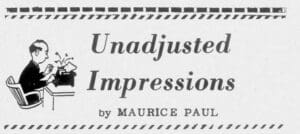 In 1950, Maurice Paul was living in Brooklyn with his parents and working as a journalist in a literary agency. It is the professional side of his story about which he left the most clues. He became a reform-minded journalist and wrote on a wide variety of subjects, especially in the beginning of his journalism career. He published articles in newspapers and periodicals, including the Brooklyn Daily, where he started writing a column entitled “Unadjusted Impressions.” The column was an eclectic collection of facts, observations, and literary quotes. The style of the writing was colloquial.
In 1961, Paul became the editor of the Canarsie Courier, which covered the Canarsie neighborhood of Brooklyn on Jamaica Bay. He continued to publish the “Unadjusted Impressions” column in his new paper. Yet it was in his role as editor that Paul found his true calling, living up to the spirit of a good journalist by speaking truth to power. His hard-hitting editorials called out bad government and demanded community improvements, and his advocacy was hailed as instrumental in pressuring local officials to build a modern, new high school and to replace an antiquated and dilapidated police station. Paul also took on the N.Y. Transit Authority, which resulted in improved transportation networks in Brooklyn.
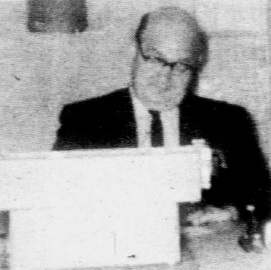 In 1967, Paul was awarded the Canarsie High School Human Rights Award for championing “the cause of tolerance, human decency, and brotherhood.” I wonder if the 53-year-old Maurice sitting in that packed high school gymnasium being honored remembered the 17-year-old Morris who wrote to Jane Addams, identifying himself as a “would-be philanthropist.” I did not have the luxury to read all of the articles Maurice Paul wrote over the years, but a search for him and Jane Addams’s name together in one newspaper database revealed no evidence that he ever publicly credited her with his civic concerns.
I wish I could write that Jane Addams inspired Maurice Paul’s good deeds, although I do believe that every adult who inspires a young person gets into the subconscious mind of the emerging adult. Maurice Paul certainly had good parents, and they can take the credit for his success in the world. They fled horrible conditions for Jews in Russia to make a better life for themselves in the United States, and their all-American son, no doubt, made them proud. Yet I cannot help but believe that the teenager so inspired to write to Jane Addams in 1931 was also shaped by his knowledge of her good work. Maurice Paul was a writer in his bones, but perhaps Jane Addams’s dedication to make the world a better place inspired him to use his own unique talent and passion to make his community a better place.
Maurice Paul suffered a fatal stroke in 1969. He was only 55 years old, and his death was a terrible shock to his newspaper and his community. He had only just taken on a campaign, through his editorials, to eliminate the “Jet noise problem” in Canarsie. His advocacy would be missed, as the obituary in the Canarsie Courier opined: “Canarsie lost one of its most respected and dedicated fighters for civic improvement … He wrote extensively about the wonders of nature and the animal kingdom. But Maurice was at his best at a typewriter, ‘telling off’ disinterested public officials who neglected their civic obligations.”
Stacy Lynn, Associate Editor
Sources: Legal Notice for Morris Osofsky, Brooklyn (NY) Citizen, Dec. 12, 1945, 8; 1930, 1940, 1950 U.S. Censuses; U.S., World War II Draft Cards Young Men, 1940-1947; New York, NY, U.S., Marriage License Indexes, 1907-2018; “Unadjusted Impressions,” Canarsie Courier, Feb. 18, 1966, 9; “Human Rights Award to Maurice Paul,” Canarsie Courier, June 8, 1967, 7; “Maurice Paul, Editor, Dead at 55,” Canarsie Courier, Aug. 7, 1969, 1; Letters to Jane Addams in the Jane Addams Digital Edition: Nicholas Murray Butler, Dec. 9, 1931; Louis Lincoln Emmerson Addams, Dec. 10, 1931; William Lyon Mackenzie King, Dec. 10, 1931; Frederick Joseph Libby, Dec. 10, 1931; Carl Eric Olaf Lindin, Dec. 10, 1931; Morris Paul Osofsky, Dec. 10, 1931; Oswald Garrison Villard, Dec. 11, 1931; Jane Addams Thompson, Dec. 12, 1931; Jane Addams Weinreb, Dec. 13, 1931; Gilbert Murray Addams, Dec. 16, 1931; Mamie E. Jefferson, Dec. 17, 1931; Bess Swett, Dec. 22, 1931; Mary McLeod Bethune, Dec. 23, 1931; Sophia H. Z. Chen, Dec. 24, 1931; Mary Gladys Sykes Thoday, Feb. 6, 1932.