Scholar’s Corner: Patricia Shields

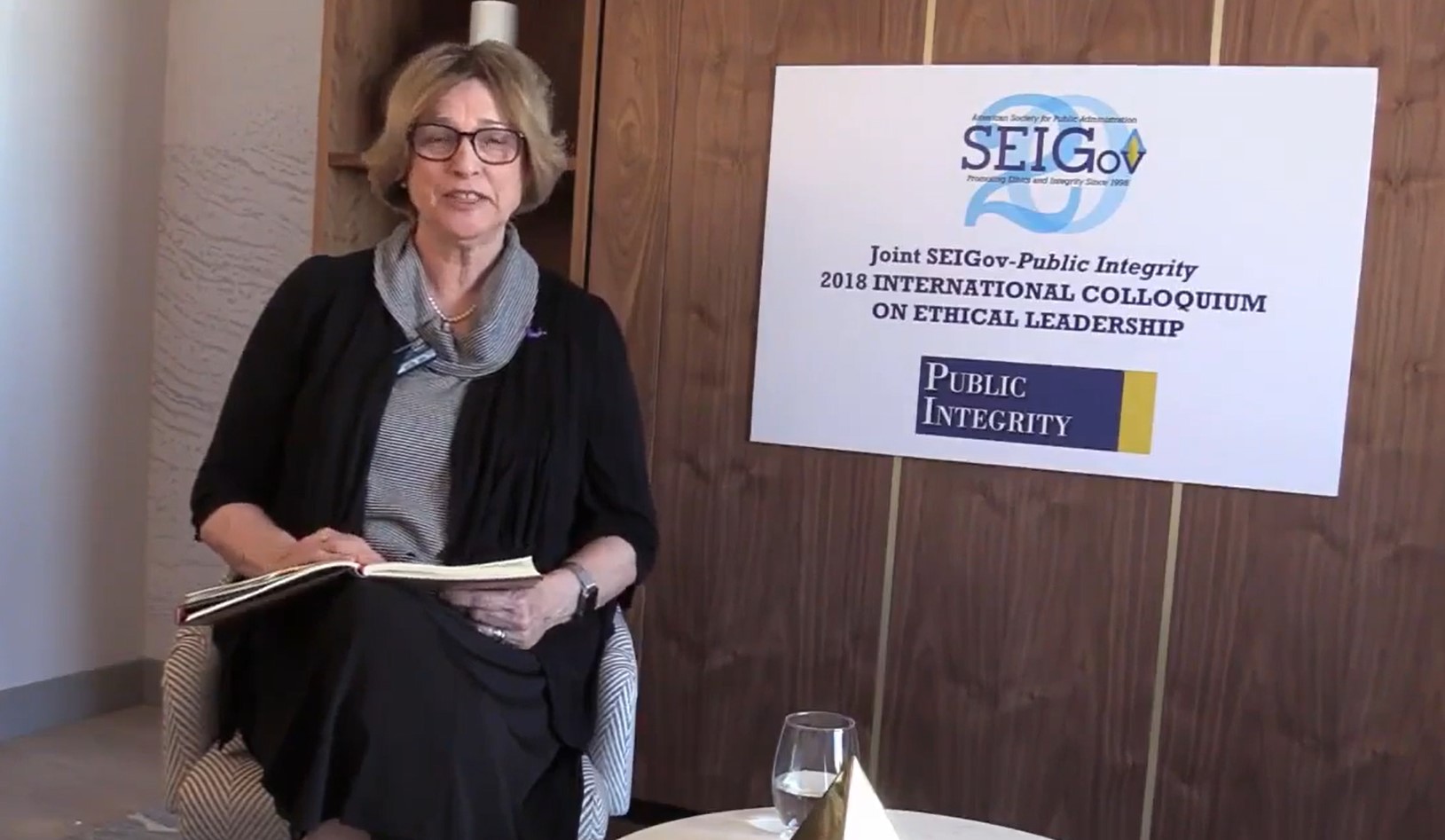
Patricia Shields sits holding a notebook, next to a sign reading 2018 International Colloquium on Ethical Leadership, Public Integrity, with SEIGov and Public Integrity logos visible behind her.

We want to thank Patricia Shields for sharing some of her research on Jane Addams!


Jane Addams’s Social Ethics (Video)

Patricia Shields on Jane Addams’s Social Ethics, April 24, 2018

https://hdl.handle.net/10877/8366

Patricia Shields sits holding a notebook, next to a sign reading 2018 International Colloquium on Ethical Leadership, Public Integrity, with SEIGov and Public Integrity logos visible behind her.
Patricia Shields, 2018

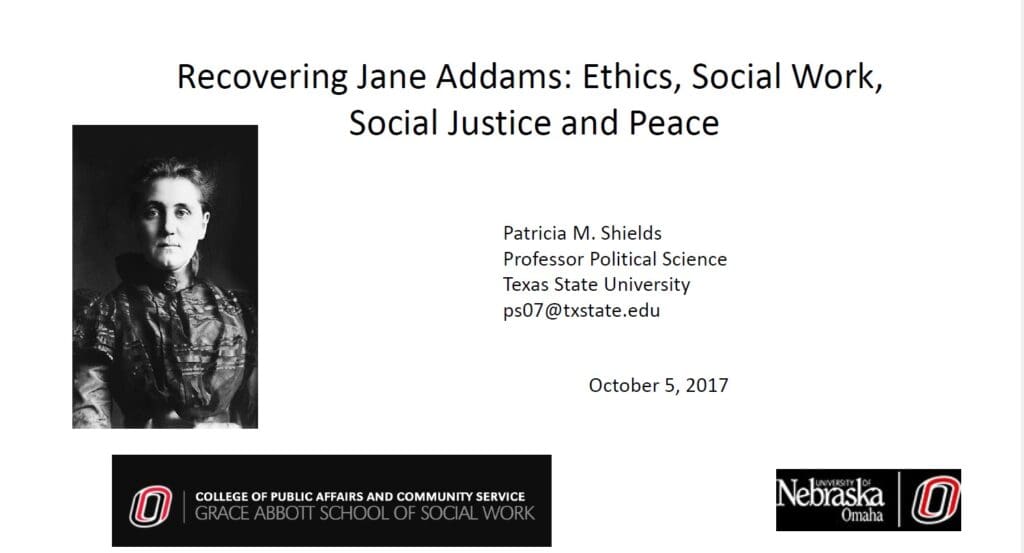
Recovering Jane Addams: Ethics, Social Work, Social Justice and Peace (PDF)

Patricia M. Shields, Recovering Jane Addams: Ethics, Social Work, Social Justice and Peace, Grace Abbott School of Social Work, University of Nebraska Omaha, October 2017.

Presentation slide titled โ€œRecovering Jane Addams: Ethics, Social Work, Social Justice and Peaceโ€ with a black and white photo of Jane Addams, event details, and logos of the University of Nebraska Omaha and Grace Abbott School of Social Work.


Jane Addams and the Women’s Peace Movement (Video)

Patricia Shields on Jane Addams and the Women’s Peace Movement, from Save Texas History Symposium on Texas and the Great War, September 16, 2017.


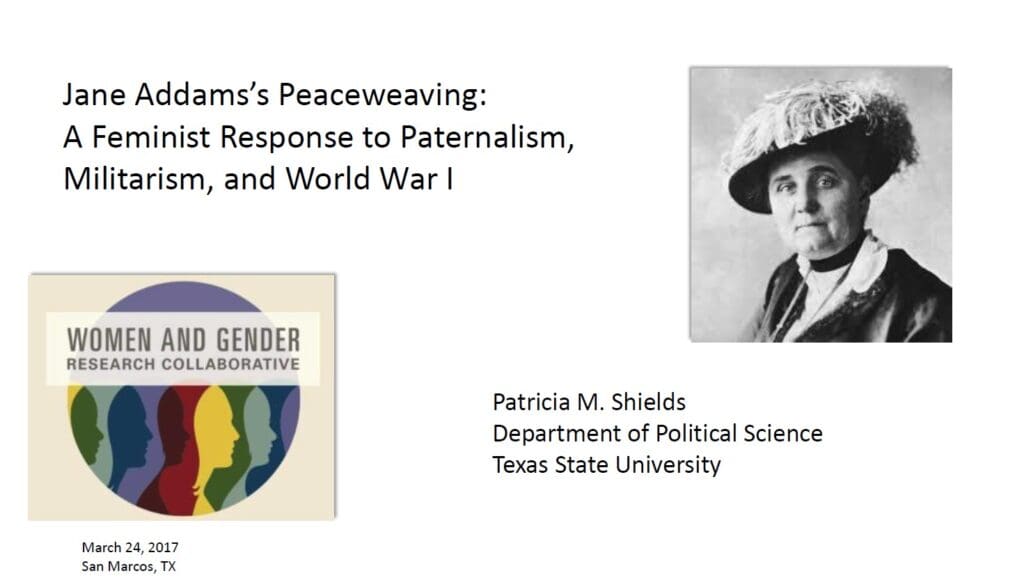
Jane Addams’s Peaceweaving: A Feminist Response to Paternalism, Militarism, and World War I

Patricia M. Shields, Jane Addams’s Peaceweaving: A Feminist Response to Paternalism, Militarism, and World War I, Women and Gender Research Collaborative, March 24, 2017.ย  (PDF)

Presentation slide titled Jane Addamsโ€™s Peaceweaving: A Feminist Response to Paternalism, Militarism, and World War I with Jane Addamsโ€™s photo, a Women and Gender Research Collaborative logo, and event details for Patricia M. Shields.

The “Real” and the “Imagined” Neighborhood: The Hull-House Maps and the Progressive Narrative of Urbanism

This post was given by Rima Lunin Schultz at the Urban History Association Eighth Biennial Conference, on October 13-16, 2016.

Urban historians have been rethinking the relationship between urban space and religion in late nineteenth-century cities.[1] The work of Jane Addams and her fellow reformers at Hull-House, visualized in the 1895 Hull-House nationalities and wages maps[2], has cast a long shadow over scholarsโ€™ understanding of urban immigrant neighborhoods. The maps began a trend that identified maladjustment and pathology in these neighborhoods.[3] In selecting the thirty or so blocks east of Halsted Street to make the best “worst” case of bad housing and sweatshop conditions during their anti-sweatshop political campaign, Hull-House residents, with the leadership of Jane Addams and Florence Kelley, shaped the neighborhood in a lasting way in the public mind. Ironically, those unmapped blocks in the vicinity of Hull-House (including the settlement itself) ย which had better housing and cultural and religious institutions of value, were also “imagined” as a slum area and, eventually, deemed suitable for land clearance projects.

By the time that Hull-House resident Edith Abbott, now dean of the School of Social Work Administration at the University of Chicago, completed Tenements of Chicago 1908-1935, ย the images of the Near West Side slums had become iconic.[4]ย  In this narrative, workers were not seen as community builders; working-class homeownership, if noted, ย was seen as a trap, an illusion of progress.

The intellect driving the maps and papers project was Florence Kelley, who had become a socialist during her graduate studies in Europe, and had worked with Frederick Engels in England, absorbing his methods ofย  using government statistics. She was prepared to study Chicago’s sweatshops and factories.[5] As State Factory Inspector, Kelley and her assistants were already collecting data on tenements when in 1893 she was asked by Carroll D. Wright, Commissioner of Labor and statistician, to select the local area to be canvassed by census men for a federal study of slums in Chicago, Baltimore, New York, and Philadelphia.[6] Kelley was influenced by Charles Booth’s maps of poverty in London; she saw the opportunity to use the data from the canvass to create maps that would dramatically demonstrate sweatshop workers’ deplorable conditions.[7]ย 

The thirty or so blocks selected were on the east sideย  of ย the Nineteenth Ward. For many, this was the Holy Family parish, settled by Catholics before the Civil War. ย In 1893 it was one of the largest Irish Catholic parishes in the United States. Hull-House, founded in 1889, was a scrappy newcomer to the neighborhood, its institutional footprint puny in comparison to the Catholic streetscape.[8] In 1893, twelve Catholic schools existed in the Hull-House neighborhood.[9]

Addams’s Protestant mindset ย imagined ย immigrants “mov[ing] constantly from one wretched lodging to another;” as she told the Chicago Women’s Club, “they live for the moment side by side, many of them without knowledge of each other, without fellowship, without local tradition, or public spirit; without social organization of any kind.โ€[10]

The maps, (and the major papers in the volume) by focusing on the ย sweatshop conditions of that one segment of the economy, ignored how local people actually defined where they lived, who they were, what they owned. Addams, in her preface, ย and Agnes Holbrook, who worked with the data to construct the maps and wrote the notes and comments for the maps, ย know how inadequate the representations are and they stress the transitory quality. It is a snapshot of a moment, captured in one dimension, and it is just a piece of a much more complex social fabric.ย ย 

The religious factor actually loomed large in the consciousness of Progressive reformers who were overwhelmingly Protestant.ย  Urban historians in neglecting the religious factor have ignored the anti-Catholic bias in the Hull-House maps. Implicit in the nationalities map is anxiety about the Catholic presence in the neighborhood.ย  The nationalities mapped are actually classes or categories constructed from a “mental map” about race, religion, ย and ethnicity.[11]

Briefly, the color white represents English-speaking people, including English, English-Canadians, Scotch, all Americans of native parentage, and children born in this country of foreign parents who were over ten years of age, or, if younger, were in attendance in public schools.[12] Children under the age of ten of foreign parents who attended parochial schools were still aggregated as foreign. This reflected the Progressive Era’s anxiety about the influence of Catholicism in the formation of new citizens and ย the use of foreign languages in some parochial schools.[13]

Two other English speaking groups were placed in separate categories: “Negroes”[14] and the Irish (green) ย “form[ing] so distinct and important an element in our politics and civic life that a separate representation has been accorded them.”[15] The Hull-House political battles against the ward boss had already begun.[16] Imagine if the Irish and their children in parochial schools were “white” in the maps—-the neighborhood would not seem so “foreign.” Were Italians “white” on arrival? Could Irish Catholics assimilate into American culture even after many generations of citizenship in this country?

The wages map, covers the same blocks; the colors now indicate income by dwelling place.[17] The largest class in the district was colored blue and represented families earning from $5 to $10 a week, or in today’s equivalency, $125 to $250 a week. 

The papers argue against blaming the victims of economic inequality and social injustice for their deplorable living conditions, instead portray them as hard working[18] underestimate the private associational strength of immigrants, and do not include a chapter on the Irish and Holy Family parish, the heart of the community.[19]ย 

Had the project mapped the west side of the Nineteenth Ward, starting with the block where the settlement house was located (yes, the settlement does not get “mapped”) the narrative would have been dramatically different showing a more “mixed” neighborhood economically, with prosperous sections and brick residences, prosperous shops owned by immigrants, and lots of parochial schools and churches.

Even the east side, the area mapped, was not all of one piece. ย Italian families who lived in this congested “slum” did not describe it that way. The Tarsitano Italian family did not feel “poor” or characterize their living conditions as substandard. Three generations remained in the old neighborhood. In 1901 Leopoldo Tarsitano had settled in the east end around the Italian parish of Holy Guardian Angel. The Tarsitano family lived for several years in a flat and Leopoldo worked as a grocery cart peddler but by 1907 the family had saved enough money to buy their own two-story store front brick home located just west ofย  Holy Guardian Angel Church, which was at 717 Forquer. Located east of Halsted Street, the church and school were in the area “mapped” as one of the worst industrial districts in Chicago. The Tarsitano store was on the first floor with the family living in the upper levels.ย 

The Tarsitano children and grandchildren all participated in the cultural and recreational opportunities offered by Hull-House and were devotees of the summer camp in Waukegan. They attended church and parish school and, ย all of Leopoldo’s four granddaughters attended St. Mary High School in the vicinity. One became a physician, after graduating from Mundelein, the Catholic women’s college run by the Sisters of Charity Blessed Virgin Mary (BVMs),ย  and Loyola University Medical School; two became school teachers, graduating from Northern Illinois University;ย  and another sister married and had children. Two of Leopold’s grandsons attended St. Ignatius Jesuit High School and Our Lady of Pompeii High School, the former attending the University of Illinois briefly and ending up with a business career at the managerial level; the latter graduated from Loyola University, did graduate work at De Paul and at the University of Nebraska and became a political science professor at the College of Du Page.[20]ย 

The Italians in the Holy Guardian Angel parish were a stable, hard working people. They built the working class church of brick–more squat than tall. By 1910 its Sunday School claimed to be “one of the largest in the world”ย  and in 1920 the congregation raised money for a new school building. ย Finding themselves located in the path of the Dan Ryan Expressway, in 1959 the old parish planned a new combination church and school structure at 860 West Cabrini, near Hull-House. The neighborhood was in a state of flux, but the parishioners had received assurances from the Mayor’s office as well as the chancery of the Archdiocese of Chicago that they had moved to a safe block that would not be part of any urban renewal plan.ย  Urban politics in Chicago is not known for transparency or integrity. Hardly “settled in,” the new school and convent was demolished in 1963 to make way for the University of Illinois.

My argument here is that an unexpected outcome of the housing surveys was the conceptualization ofย  working-class neighborhoods as one-dimensional places. The Tarsitano narrative is one of many similar stories of immigrant entrepreneurship, property ownership, intergenerational progress, and communal investments building neighborhoods ofย  rich religious infrastructures.

There were plenty of problems in the Forquer and Halsted environs, including poverty and crime. Housing varied. The “imagined” neighborhood of the Protestant lady reformers” of good character” as community activist Florence Scala’s mother defined them[21], ย however, had made slum images iconic and had relegated the communal and social life of Forquer Street off of the map.[22]ย  Florence Scala led the fight to save her neighborhood. As her nephew Father Steve Giovangelo explained: “Churches and Hull House co-existed and were at the center of social life.”

A remarkable, but missed opportunity, of Edith Abbott’s work was her use of parish histories for data and her acknowledgement thatย  “these parochial histories provide some interesting and neglected source materials for the study of the social history of our American cities.[23] My research, and that of others in the field, aims to bring the religious factor back in: This Da Prato map of Chicago clearly identifies the religious factor in urban life as ubiquitous.ย 


[1] Maureen Fitzgerald, Habits of Compassion: Irish Catholic Nuns and the Origins of New York’s Welfare System, 1830-1920 (Urbana: University of Illinois Press, 2006); Suellen Hoy, Good Hearts: Catholic Sisters in Chicago’s Past (Urbana: University of Illinois Press, 2006); Ellen Skerrett, Born in Chicago: A History of Chicago’s Jesuit University (Chicago: Loyola Press, 2002);ย  Rima Lunin Schultz and Ellen Skerrett, “‘Sister Builders’ in Chicago,” American Catholic Studies Newsletter, Vol. 42, Number 1 (Spring 2015). ย ย 

[2] The Residents of Hull-House, Hull-House Maps and Papers. A Presentation of Nationalities and Wages in a Congested District of Chicago, Together with Comments and Essays on Problems Growing Out of the Social Conditions. Introduction by Rima Lunin Schultz (Urbana: University of Illinois Press, 2007; facsimile reprint 1895 edition). The maps reflect data gathered by government men in April 1893.ย  There are 10 essays, and an appendix that describes Hull-House and its work, and includes photographs of Hull-House’s exterior and interior space. There are no photographs or illustrations of the neighborhood. Five of the essays are about sweatshops, garment workers, and the state of public charity;ย  three describe the Italians; the Jews; and the Bohemians respectively;ย  Ellen Gates Starr and Jane Addams, co-founders in 1889, describe their ideas about art and labor, and the settlement house as a factor in the labor movement in two separate essays.

[3] Florence Kelley and Alzina Parsons Stevens contributed “Wage-earning Children” in Hull-House Maps and Papers which includes charts of the measurements of defective Chicago factory-children that were made by Dr. Bayard Holmes, from measurements taken in 1893-94, in the office of Florence Kelley, State Factory Inspector of Illinois, 87-88.

[4] Edith Abbott, The Tenements of Chicago. 1908-1935 (Chicago: University of Chicago Press, 1936), ix-x.

[5] Kathryn Kish Sklar, Florence Kelley and the Nation’s Work (New Haven & London: Yale University Press, 1995), 102-03.

[6] Carroll D. Wright, “Introduction,” in Wright, The Slums of Baltimore, Chicago, New York, and Philadelphia (1894 reprint, New York: Arno Press, 1970) explains the federally funded projects. Four government men came to Chicago and conducted the door-to-door canvass supplied by Wright; Kelley selected the blocks to be surveyed.ย 

[7]The area selected to be “mapped” is located across the street from the Hull-House settlement– between Harrison on the north and Roosevelt Road (12th Street) on the south; from the east side of Halsted on the west, to the south Loop–the area around Clark Street and Plymouth Court. It is an area of residences–cottages, tenements, two-and-four-flats–, factories, warehouses, railroad yards, stores, and brothels.  Most of the people lived in various grades of housing in about thirty small blocks between Halsted and the river. East of the river the five residential blocks, crowded with people of color, were adjacent to the vice or brothel district.

[8]  โ€œThe Little Sisters of the Poor,โ€ Chicago Times (August 26, 1877): 8. Ironically, the first old age home run by the Little Sisters was in Charles Hull’s residence. The Hull family had moved out of the neighborhood during the Civil War period. The Little Sisters outgrew the Hull house soon after and moved to as larger institutional location they had built on Harrison Street, still in the neighborhood.

[9] Historian Ellen Skerrett documents twelve Catholic schools in the Hull-House neighborhood in 1892: Convent Academy of the Sacred Heart, opened fall 1860, 485 [1258] W. Taylor Street ; A free school at the northwest corner of Taylor and Lytle streets for girls of Holy Family parish, 1860; additional buildings for the Sacred Heart Academy complex wereย  constructed in 1864 and 1886; Holy Family Boys School, new building at 462 [approx. 1231] S. Morgan Street] opened 1865; St. Ignatius College, 413 [1076] W. 12th Street [Roosevelt Road]ย  opened 1870 (also enrolled young boys);St. Aloysius School, new building at 210 [631] W. Maxwell Streetย  opened 1870; Holy Guardian Angel School, 168 [ 711] W.ย  Forquer Street [Arthington Street]ย  opened 1874;St. Joseph School, on W. 13th Street near Loomis Street [1413 W. 13th Street]ย ย  opened 1876 ;St. Agnes School, 530 [approx. 1361] S. Morgan Streetย  opened 1887; Ephpheta School for the Deaf, 409 [1100] S. May Street in operation by 1890 (see attached Tribune article on Eliza Allen Starr, March 16, 1890);St. Francis of Assisi School, new building at southwest corner of 12th and Newberry Avenueย  opened 1884 ;Notre Dame [French] School, new building at Oregon [Flournoy] and Sibley Street [approx. 1338 W. Flournoy] opened 1885; St. Wenceslaus [Bohemian] School, new building at 185 [710] W. DeKoven Street opened in 1893. Sources: โ€œProvince of Chicago,โ€ [1890 statistics compiled on the Archdiocese of Chicago], in James J. McGovern, Souvenir of the Silver Jubilee in the Episcopacy of His Grace The Most Rev. Patrick Augustine Feehan, Archbishop of Chicago, 1890 (Privately printed, 1891), 242-253; Brother Thomas M. Mulkerins, S.J., Holy Family Parish Chicago: Priests and People, ed. Joseph J. Thompson (Chicago: Universal Press, 1923); Rev. Msgr. Harry C. Koenig, ed., A History of the Parishes of the Archdiocese of Chicago 2 vols. (Chicago: the Archdiocese of Chicago, 1980).

[10] โ€œThey move constantly from one wretched lodging to another; they live for the moment side by side, many of them without knowledge of each other, without fellowship, without local tradition, or public spirit; without social organization of any kind.โ€ [46-0481] And she also repeats that โ€œ[p]ractically nothing is done to remedy this.โ€ [46-0481]She calls on those who have the โ€œsocial tact and training, the large houses and traditions of custom and hospitality [who] live in other parts of the cityโ€ to stop the โ€œfatal drifting apartโ€ another phrase that is going to be repeated. Jane Addams, โ€œOutgrowths of Toynbee Hall,โ€ December 3, 1891, [address delivered to the Chicago Womanโ€™s Club], in JAMC (reel 46-0480-0496), Special Collections, Daley Library, UIC.


[12] Holbrook explains that “it would be misleading to include children under ten years living in a foreign colony, not in attendance upon schools where English is sure to be used, speaking a foreign language, and, although born in this country, ignorant of American life, manners, people, and of the English tongue.” Ibid., 15.

[13] “It would be misleading,” Holbrook writes, “to include children under ten years of age living in a foreign colony, not in attendance upon schools where English is sure to be used, speaking a foreign language, and, although born in this country, ignorant of American life, manners, people, and of the English tongue.” Holbrook, “Map Notes and Comments,” 15.

[14] Ibid., 16-17.

[15] Holbrook, “Map Notes and Comments,” 16.

[16] Jane Addams’s experiences at the local ward level first as garbage inspector and then as a leading voice opposing Alderman Powers in 1899-1898 were eye-opening; by 1900 Addams could critique the reformers as well as the ward politicians, seeing the issue of local politics in a more complex way than had been possible when she first encountered the “boss.” “Jane Addams Wears a Star: Appointed to the Force of Garbage Inspectors by Commissioner Kent,” Chicago Record (April 25, 1895), 6; Jane Addams to Henry Demarest Lloyd, December 22, 1895, State Historical Society of Wisconsin, Henry Demarest Lloyd Papers in JAMC (Reel 2-1829-1830), Special Collections, The University Library, UIC; “Two Women and A Manโ€”Jane Addams, Amanda Johnson and John Powers: Remarkable Results Achieved by Womanly Influence Against Overwhelming Odds in the Nineteenth Ward,” Chicago Times-Herald (January 30, 1898), 25; Jane Addams, “Why the Ward Boss Rules,” Outlook 58, no. 14 (April 2, 1898), 881-882.

[17] Six categories ranging from less than $5 a week to over $20 were depicted: most of the households fell in the $5 to $10 range (blue); the poorest category (black) represented an average weekly family income of $5 or less. In today’s dollars approximately, households $5 or less a week are making under $125 per week; households making from $5 to $10 per week were making from $125 to $250 dollars a week in todayโ€™s dollars. (formula is $1 = $25)

[18] Humpal-Zeman, โ€œThe Bohemians of Chicago,โ€ in HHM&P, 118.

[19]In โ€œHull House, Chicago: An Effort Toward Social Democracy,” Forum, October 1892, Jane Addams states that: โ€œThere are seven churches and two missions in the [Nineteenth] ward.ย  All of these are small and somewhat struggling, save the large Catholic church [Holy Family] connected with the Jesuit College [St. Ignatius] on the south boundary of the ward and the French Catholic church [Notre Dame de Chicago] on the west boundary.ย  There are but three out of these nine religious centres in which the service is habitually conducted in English.โ€ย  The fact that English is only spoken in three out of the nine religious institutions is particularly upsetting to Addams. Addams also ignores the twelve Catholic schools in the Nineteenth Ward already established by 1892. โ€œProvince of Chicago,โ€ [1890 statistics compiled on the Archdiocese of Chicago], in James J. McGovern, Souvenir of the Silver Jubilee in the Episcopacy of His Grace The Most Rev. Patrick Augustine Feehan, Archbishop of Chicago, 1890 (Privately printed, 1891), 242-253; Brother Thomas M. Mulkerins, S .J., Holy Family Parish Chicago: Priests and People, ed. Joseph J. Thompson (Chicago: Universal Press, 1923); Rev. Msgr. Harry C. Koenig, ed., A History of the Parishes of the Archdiocese of Chicago 2 vols. (Chicago: the Archdiocese of Chicago, 1980).ย 

[20] Rima Lunin Schultz, “Public School ‘Secularists’ vs. Women Religious: Competing Visions for Educating Catholic Immigrants in Jane Addams’s Progressive Era Chicago, 1890-1925,” chapter in Crossings and Dwellings, edited by Kyle Roberts and Steven Schloesser, (Netherlands: Brill Publishing, forthcoming 2016-17).

[21] Father Steven Giovangelo, “Memo to Rima Lunin Schultz,” June 30, 2013, in author’s possession.

[22] Edith Abbott, The Tenements of Chicago. 1908-1935 (Chicago: University of Chicago Press, 1936), ix-x.

[23] Edith Abbott, The Tenements of Chicago 1908-1935 (Chicago: University of Chicago Press, 1936), xi.

Revisiting The Social Settlement as Womanโ€™s Space: The Men At Hull-House, 1889-1935.

In the 1980s and 1990s, historians Kathryn Kish Sklar, Helen Lefkowitz Horowitz, and Robyn Muncy identified a new womenโ€™s culture at Hull-House.[1] Their work focused on the early years, analyzing the networks and alliances (across classes and across different sectors of the reform movement).  Active support by clubwomen (for example through volunteer work and financial contributions) allowed Hull-House settlement women to have an autonomous, nurturing, synergistic space from which to help build national and international reform networks.  Seeing Hull-House as a community of women continues to influence our ideas about social reform in the Progressive Era.  Hull-House continues to dominate the reform literature even as historians have attempted to recover the history of the multifarious social settlement movement. [2]

Building on the earlier work of scholars who have focused on the role of women at Hull-House, Mary Jo Deegan, Charlene Haddock Seigfried and Dorothy Ross have focused on the way Hull-House functioned as a place where women were able to carve out an intellectual domain different from the emerging male academic model.[3] Addams argued that she could learn about what the neighbors’ reality consisted of through lived experience and she claimed her work was scientific: she and other residents offered their studies “not as exhaustive treatises, but as recorded observations which may possibly be of value, because they are immediate, and the result of long acquaintance.” Addams made it clear that the authority for her political activism comes from having lived in the neighborhood not as a theoretician or scholar but as an activist engaged in constructive work. This manner of knowing the neighborhood is valorized by Addams and is the hallmark of the sociological investigation undertaken by settlement houses independently of universities or government agencies. Thus Addams created a new role for herself (and for other activist women) without being a professor at a university, a government official, an elected politician, or a captain of industry.  [4]  Jane Addams, in particular, has been recast as a public intellectual, a sociologist, and her writings seen as influential in the development of modern social policy on the industrial state and democracy: her educational ideas and innovative assessments of democracy and social ethics linked to the American pragmatist, John Dewey. [5]

This paper does not aim to dislodge the valuable scholarship mentioned above. Rather, it proposes to provoke some questions about how our interpretation of Hull-House might need to be revised if we factor into our analysis new scholarship that brings men from the periphery of settlement life into the center as influential residents, favored advisors, trustees and financial contributors, and important political allies.  Acknowledging that the notion of Hull-House as womenโ€™s space was a powerful concept for the emerging field of U.S. womenโ€™s history, to what extent did the concept gain its power from the need of the field? To what extent is it still a valid analytic tool? How might it be modified in the light of new research, both research that has been done and research that remains to be done?

Most readers are familiar with the early stories of the two womenโ€”Addams and Starrโ€”who set up housekeeping in the old, dilapidated Hull homestead located in a Chicago neighborhood teeming with immigrants. โ€œAs the years went on,โ€ Alice Hamilton, who had lived at the settlement for twenty-two years, recalled, โ€œHull-House grew till it covered more than a city block and its activities increased in variety as the little group of residents came to include many people of many interests. We had Gerard Swope and his wife, Frederick Deknatel, whose son [William] now continues his fatherโ€™s devoted service, George M. R. Twose, Edward and Charles Yeomans, George Hooker, William l. Chenery, Edith and Grace Abbott, Sophonisba Breckinridge, the Robert Morss Lovetts, Harriet Monroe, and many others.โ€[6] Hamilton named an interesting group. Most of them are individuals not associated with Hull-House. There are quite a few men; and there are married couples.  The following is a shorthand identification of Hamiltonโ€™s group: Gerard Swope, later the president of General Electric, met his wife, Mary Hill, a student of John Dewey, when the two were residents.  Co-officiating at the marriage in 1901, Jane Addams proclaimed the two exhibited exceptional social citizenshipโ€”the highest form of civic engagement in democracy. โ€œBecause all of us here have known Gerard and Mary so intimately, because they have each shown so genuine a sense of social obligation, and because each has for years striven to fulfill something of the social claim, we may perhaps venture to emphasize the social aspects of this marriage.โ€[7]  Frederick Deknatel was a local manufacturer who became a Hull-House resident after the death of his first wife; he met Wilfreda Brockway, who taught in the kindergarten, and they married. The Deknatels remained residents living in one of the apartments set up for married couples. Twose, an Englishman who taught manual training in the public schools and woodworking at the Hull House shops, was the first president of the Chicago Society of Arts and Crafts founded in 1897; he lived at Hull-House until his death.  The Yeoman brothers owned a pump factory in Chicago and both married women they met at Hull-House.  William Chenery was a journalist who after his Hull-House years became the editor of Collierโ€™s Weekly in New York . The Abbotts and Sophonisba Breckinridge are well-known for their work and need little introduction here.[8] Ida Lovett had heard Jane Addams while she was a student at Radcliffe; she and Robert, who was appointed in 1893 instructor in English at the University of Chicago, had visited Hull-House in their earlier years in Chicago and after WWI became active residents; Ida helped Addams administrate and was, according to her husband, “one of Miss Addams’ close companions, sharing her company on journeys and giving her always the watchful care which became more necessary as the years passed.”[9] Lovett had a long career as a professor of literature at the University of Chicago, was an associate editor of The New Republic, and a radical liberal who defended First Amendment rights during the 1920s.  Poet and editor Harriet Monroe was one of many talented people who found kindred spirits in the Hull-House complex. 

One of the major findings of my study of residency at Hull-House is that there were a lot more men at the settlement, even in the early years, than historians have indicated.ย  Between 1889 and 1935, 33 per cent of the Hull-House residents were men.[10] An article in the 1934 ย Hull-House Yearbookย  discussed the fortieth anniversary celebration that was held May 1930 (instead of September 1929) and summed up residency: “It was interesting that of the 350 surviving residentsโ€”naming only those men and women who had been in residence for at least six months continuously and had given substantial service to Hull-Houseโ€”divided into occupations as follows: Business, 58; education, 52; authors and journalists, 25; artists and musicians, 34; law, 18; medicine, 21; government service, 17; social and civic work, 76; agriculturists, 7; home-makers, 42.โ€ [11] ย Male residents dominated the categories of business and law and were quite visible in government service and social and civic work, absent only from the category โ€œhome-makers.โ€ My study of residents at Hull-House between 1889 and 1961 finds that 41 percent were men.[12]

What about other settlement houses in the United States? (Of course, we know that Toynbee Hall in London only had male residents and was the model for settlements worldwide.)  In 1911, the first year that statistics on male and female participation in settlements in the United States was available, โ€œ53 percent of the 214 settlements reporting to investigators housed women only; less than 2 percent only men. The rest accommodated both sexes.โ€[13] That meant 45 percent of American settlements housed women and men.  There are no statistics on what percentages of men were resident in the 45 percent of sexually integrated settlements. So it is speculation to conclude that Hull-House was unusually rich in male residency, although this โ€œcommunity of womenโ€ in fact was significantly populated by men.

There is no evidence that Jane Addams and Ellen Starr ever conceived of their settlement experiment as an effort to develop a new kind of sex-segregated space for women to inhabit.ย  During the several months prior to renting space in the old Hull homestead, Starr and Addams were busy introducing their โ€œschemeโ€ to circles of reform-minded Chicagoans, clubwomen, clergy, and college-educated women and men who might be candidates to join the two founders as residents. ย Starr gleefully reported to Addams that lots of young men had attended a reception held to talk about the plan. This was comforting because both Starr and Addams did not want to be perceived as some sort of โ€œProtestant nuns.โ€ ย Edward L. Burchard, Hull-Houseโ€™s first male resident, came to Hull-House in 1891. He had heard Addams talk about Toynbee Hall in 1888 or 1889. ย โ€œI wonder if you remember the time as a young lady you spoke on Toynbee Hall in the parlors of the First Presbyterian Church at Freeport. This was before you projected Hull-House. Your description of the hungry crowd around the huckster wagon in east London, I shall never forget.โ€[14] Burchard, who eventually served for many years as secretary of the Chicago Recreation Commission, was part of the small circle of women and men at Hull-House who first conceived and then implemented the โ€œbelief that through the exhibit methodโ€ immigrant citizenship could be promoted.[15] Burchard ย later worked at the Field Museum of Natural History, developed innovative educational tours for the Chicago public schools, and with Milton Foreman, Harriet E. Vittum, Lea Taylor, Neva Boyd and others promoted a vast array of cultural, recreational, and civic programs for the Chicago [parks] field house system.[16]

Burchard credited Addams with his interest in public service. Hull-House brought idealistic men as well as women into the widening circles of progressivism and modeled for men an alternative professional route of public service. Other male residentsโ€™ careers attest to the existence of a male dominion of public service that was incubated in social settlements and had far-reaching results. While Robyn Muncy and others are correct in emphasizing that college-educated women were very limited in opportunities to pursue careers instead of traditional womanly work, men who were not interested in the commercial or industrial world and who, like idealistic young women, hoped to work for the betterment of society, faced a variety of problems. If they were inclined to do their work in a religious context, as Graham Taylor, founder of Chicago Commons settlement and professor of applied sociology at the Congregational seminary, chose to do, they still needed a community of kindred spirits who would support new methods of dealing with modern problems. They needed new kinds of educational institutions, which was why Taylor joined with other Chicago settlement leaders to establish the Chicago School of Civics and Philanthropy. [17] In the case of Burchard, who taught at the School of Civics and Philanthropy, his niche was in the new field of adult and public school education outside the traditional classroom in newly created public spaces in urban America. The proliferation of parks and recreation centers, for example, created opportunities for persons who would manage these facilities. New theories about the importance of play in child development, ideas about constructive leisure for adults, and reformist agendas to provide wholesome entertainment as a substitute for saloons, dance halls, and pool rooms in immigrant and working class neighborhoods came out of the experiences of men and women residents of settlement houses.  It is not surprising that by 1912, the high point of progressivism, an infrastructure of theoreticians and researchers, practitioners, and public officials was in place that was implementing the settlement workersโ€™ commitment to a series of closely related reform movements. Men who had been residents at Hull-House found themselves in key positions in this new world of playgrounds, summer camps, programs for the prevention of juvenile delinquency, and programs in public schools like manual training.  Former resident Alexander A. McCormick had been elected president of the Cook County Board in 1912.  Addams had campaigned for his election. โ€œOne of his first undertakings,โ€ Addams recalled, โ€œwas to reorganize the Civil Service Board and to appoint as a member of it an able woman, long identified with the Chicago settlements.โ€[18] The appointee, Anna Nichols โ€œdid much to dissociate civil service from the conception of a cold and correct public official versus the kind-hearted and open-handed politicianโ€ approved Jane Addams. The settlement crowd had learned that the good government type reformers who did not have the benefit of residency in immigrant and working class neighborhoods โ€œoveremphasized the usefulness in keeping the rascals out and had thus allowed [the merit system] to become stranded in the shallow water of negative virtue, failing to launch it upon the deep seas of popular affection.โ€[19] As Addams had cautioned in her analysis of local politics, โ€œit is most difficult to hold to our political democracy and to make it in any sense a social expression and not a mere governmental contrivance, unless we take pains to keep on common ground in our human experiences.โ€[20] Men like A.A. McCormick, then, Addams might have argued, benefited from the settlement experience and the interaction of male and female perspectives.  

Male social reformers who emerged from the social settlement movement instead of menโ€™s good government clubs that met in downtown office buildings and had remote connections with neighborhood life, one can speculate, might not share the same agenda; perhaps the male reformers who experienced settlement life developed a viewpoint closer to the female political culture. [21]  George E. Hooker, mentioned above, was one of the few advocates of city  planning who criticized the Burnham Plan for its failure to deal with the urban housing problem. He wrote for the Review of Reviews and other periodicals including the Chicago Tribune, Hooker held degrees in law and the ministry. He was as comfortable with the City Club of Chicago as he was with the Hull-House Menโ€™s Clubโ€”a neighborhood organizationโ€”and his sensibilities about urban problems gained from his long residency in Hull-House and daily exposure to the realities of working class life.

Another Hull-House male resident, Ernest Carroll Moore, who later became the president of the University of California, Los Angeles, did his investigation of the saloons of the Nineteenth Ward โ€“Johnny Powerโ€™s fiefdom and location of the settlement houseโ€”for the Committee of Fifty while he was in residence at Hull-House. He lived at Hull-House with his wife, Dr. Dorothea Moore, a physician, while he was working toward a Ph.D. at the University of Chicago. His contact with skilled, ambitious workers in the neighborhood was extensive; he taught college extension courses to the English-speaking Americans of Irish and German descent who had not yet abandoned the old neighborhood and to whom the classes and educational offerings of the social settlement answered their strivings for self-improvement.  Mooreโ€™s unconventional conclusions about the role of the saloon in working-class lifeโ€”more empathetic and democratic in attitude than the typical temperance reformerโ€”were not unlike Addamsโ€™s realistic assessment of why the ward boss survived. In both cases the traditional institutions were performing necessary functions in the social life of people. If reformers wanted to transform popular culture and uplift the masses, they had to find effective substitutes that met the everyday needs of people.  

Numbers of males and females, of course, do not tell the whole story of the gender of institutions. Public schools are notorious as institutions with overwhelming majorities of women teachers but are dominated in the nineteenth and for more than half of the twentieth century by male administrators and male school board members. Would we call public schools a female dominion? There is no question that during the first twenty years of its existence, Hull-House was dominated by strong, independent women who emerged as leading figures in diverse fields and who influenced national events.  It is also clear that the environment at Hull-House was fertile for the development of individual careers and for alliances and lifelong and sustaining friendships among women. 

Much has been made of the way in which traditional domestic space at Hull-House was transformed into a new kind of cultural and social space that was liberating for women. Hull-House residents were freed from domestic chores [which other working-class women performed instead], and were able to actively engage in community affairs as single women without benefit of male sponsorship or guardianship.  Women settlement workers were treated like nurses or religious sisters and allowed to roam the neighborhoods, use public transportation, and come and go as they pleased without losing status or respectability as middle-class women in Victorian America.  On the other hand, there were many aspects of the Hull-House physical complex that adhered to the conventional gendered space relationships in the society as a whole.  The Hull-House Womenโ€™s Club was housed in a building just for that purpose; the Hull-House Menโ€™s Club had its own building and the interior spaces of both clubs conformed to notions of masculinity and femininity that most late nineteenth century Americans would recognize.  Childrenโ€™s care was done by women. While there were bohemian aspects to the complexโ€”artistsโ€™ studios; salon-like parlors where men and women residents discussed politics, religion, and sex; and there was a constant flow of visitors whose political and social views were controversialโ€”there was also decorum and modesty. Women residents lived in the main house; men had a cottage where they roomed; married couples were housed in apartments that were more private. Additional sex-segregated housing for working-class women and men was established at the Jane Club and at a male residence that was a short-lived experiment. The sexual orientation of the residents did not appear to be a matter for discussion, nor were other personal matters, according to Alice Hamilton. โ€œWe knew each othersโ€™ opinions and interests and work and we discussed them often and freely, but the atmosphere was impersonal, rather astonishingly so for a group composed chiefly of women.โ€[22] Everyone acknowledged the special relationship Jane Addams had with Mary Rozet Smith; yet the two lived separately, with Mary remaining in her familyโ€™s townhouse on Chicagoโ€™s fashionable North Side.[23]

It was in the governance of Hull-House where the nature of gender at Hull-House becomes more complicated. There is no question that the case for Hull-House as womenโ€™s space can best be made from the model of leadership provided by Jane Addams. This was an institution run by a womanโ€”or was it? In 1935, the Hull-House settlement had existed for forty-five years as a private, not-for-profit association governed by a board of seven trustees, including Jane Addams who called herself โ€œhead residentโ€ and did not take a salary. She was, until 1907, both the president and the treasurer of this board. The majority of the trustees had held their positions from the 1890sโ€”when the system was put into placeโ€”until Jane Addamsโ€™s death in 1935, or, if they preceded her, their own death. The trustees, during the Addamsโ€™s years, were women and men who overall can be described as wealthy civic-minded progressives who were responding to the evils of the industrial city. Addams, one of their class,[24] had established the settlement with her own funds and they backed her โ€œexperimentโ€ and accepted her leadership. Since Addams was a volunteer who invested her own money in the settlement, she fit a model of womanly benevolence not one of professionalism. The trustees were there to offer advice and counsel, not to supervise or to develop policy, unless asked directly. Addams, then, had a great deal of personal discretion and reigned almost completely unchallenged by the close-knit group of trustees.[25] In addition, Hull-House was not affiliated with a religious denomination or a university so had an enviable independent position. This may be one of the most significant sources of female empowerment at the settlement.  At Hull-House Jane Addams did not have to report to the kind of traditional male-dominated board and administrative hierarchy that ran settlements affiliated with religious denominations or universities.

The Hull-House trustees also were among the settlementโ€™s major contributors: multi-millionaire heiress and leading civic reformer Louise Bowen, who continued to dominate the trustees until her death in 1953; Mary Rozet Smith, Janeโ€™s life partner; Helen Culver, the heir of the Charles Hull real estate empire, and owner of the Hull homestead[26] and the property surrounding it; Mary Wilmarth[27], a feminist clubwoman and one of Hull-Houseโ€™s earliest supporters; William H. Colvin,  retired businessman and chairman of the executive committee of the Municipal Votersโ€™ League; Julius Rosenwald, who owned Sears Roebuck, Co., and was a leading philanthropist known for his support of education for African Americans in the South and his sponsorship of the NAACP; and Sewell Avery, president of the U.S. Gypsum Company and Chairman of the Board of Montgomery Ward & Company. Completing the list of trustees were the philosopher John Dewey, wealthy businessmen and art patrons Edward B. Butler and Charles L. Hutchinson, and Allen B. Pond, architect and social activist whose life had been animated by the ideals of the arts and crafts movement.  When old-timers died, they were replaced by other family members or individuals well-known to those on the board. Charles Hull Ewing โ€œreplacedโ€ his cousin, Helen Culver; Louise Bowen added her daughter Helen Bowen Blair in 1929 when the number of trustees increased from seven to nine.[28]

From the earliest days of settlement life, Addams relied on Pond, Colvin, and Mary Rozet Smithโ€™s father, Charles Mather Smith, in an on-going โ€œconversationโ€ about the plans she had for Hull-Houseโ€™s expansion and development. Colvin probably reminded Addams of the best men of her fatherโ€™s generation. ย A Civil War veteran, Colvin was the son of a New York shipper. Initially the young man Colvin worked for a large and established importing house in New York City before following a pattern of many East Coast business families by moving to Chicago to take advantage of the westward expansion of commerce. He became, by 1887, the largest importer in the city. Never involved in politics, he was one of sixteen good government reformers who established the Municipal Votersโ€™ League of which he served as chairmen of its executive committee. He was just the sort of enlightened capitalist who Addams cultivated andย from which she obtained financial support. When trustee William Colvin died unexpectedly in 1896, Addams was in Russia.ย  She received word of Colvinโ€™s death and wrote Gertrude Barnum, a resident who was more or less in charge of daily activities at the settlement during Addamsโ€™s six-month sojourn in Europe. โ€œOf course you know as well as I what a blow [Colvinโ€™s death] โ€ฆ is to H.H. and what a genuine personal sorrow it is as wellโ€ Addams acknowledged. Indicating how much the settlement relied on Colvin (who was โ€œdeveloping in all sorts of directions mostly in the direction of money getter for general expensesโ€[29]) she imagined Barnum feeling โ€œperfectly bereft . . . as if the prop had fallen out.โ€ [30] On her part Addams, who had just visited Tolstoy in his country estate and was scheduled to remain away from Hull-House for another six to eight weeks, lost interest in the rest of her trip and wanted โ€œto be at home.โ€[31]

While it is true that the major funding of Hull-House came from a handful of women who developed extraordinarily close relationships with Addams, the male trustees, who also contributed considerable amounts, made significant contributions,[32] especially Julius Rosenwald, Joseph T. Bowen, and Charles Mather Smith, the last two mentioned the husband and father respectively of Louise deKoven Bowen and Mary Rozet Smith.[33] More than any quantifiable amount, the visibility of such well-known Chicago industrialists and capitalists like Charles Hutchinson and Sewell Avery legitimated the institution in the eyes of society. These men  demonstrated to wealthy women like Helen Culver and Louise Bowen โ€“who were the major contributors in absolute figuresโ€”that they were investing in an institution that was a going concern.  Bowen and Culver were fiscally conservative women. Their support for Hull-House was not automatic but had to be earned. Bowen had been impressed by Addamsโ€™s judicious assessment of George Pullman during the 1894 Pullman Strike.[34] The daughter  and granddaughter of wealthy capitalists on both her maternal and paternal sides, Bowen had faith in Addams because she sensed that at heart the reformer was not a revolutionary and could see both sides of the labor and capital conflict.  Bowen would have been the last person to invest in an enterprise that was attempting to construct a space for women that was in opposition to family values or was some utopian scheme with no demonstrable practical value.[35] She felt comfortable with the male trustees because they were very successful capitalists and industrialists like her kinsmen and her husband. In a sense, the same could be said for Mary Rozet Smith. Addams understood that it was important to cultivate the entire Smith family and that Charles Mather Smith, had to be assured of the rationality and stability of the Hull-House enterprise.[36]

The case of architect Allen Pond also demonstrates how the presence of men performed a salutary role for the female trustees. Addams met Pond before she had selected the dilapidated Charles Hull homestead as the site for a settlement house.  He was one of the many reform-minded Chicagoans to whom Addams and Ellen Gates Starr introduced their scheme to open a settlement house and, from the beginning, Pond embraced the idea. Pond was the architect for the twelve additional buildings that were constructed from 1889 to 1907 as the settlement complex took shape and he served as secretary of the settlementโ€™s board of trustees for thirty-four years, until his death in 1929. Pond had other commitments in Chicagoโ€”he was the architect for most of the cityโ€™s settlement housesโ€”but he served as the โ€œgo-betweenโ€ in Addamsโ€™s initially difficult relationship with Helen Culver. Culver, who had inherited the substantial real estate business of her cousin, Charles Hull, in 1889, was a shrewd woman who had been the actual manager of the real estate firm for many years.  Culver owned the Hull homestead and all of the property that later became the settlement complex. As a landlady she was tough; eventually she warmed to the work that Addams and Starr had inaugurated, donating the land and in 1920 an additional quarter of a million dollars worth of securities. It was Culver who pushed a reluctant Addams into โ€œinstitutionalizingโ€ the โ€œexperimentโ€ by demanding it be incorporated under Illinois law (if Addams wanted her support). And part of the agreement was that Culver, or a relative of Culver, would always have a seat as a trustee of the Hull-House Association.  Without Allen Pondโ€™s skillful, persistent, and sensitive handling of Culver, it is conceivable that the enterprise would not have flourished in the manner which it did.

So the realities of institution-building brought Addams into close association with men and women who were rich and influential people.  Instead of clipping her wings, they managed to protect Addams. The meteoric rise to international prominence that Addams and the settlement achieved also gave her a protected status.[37] After her death, there were no head residents (now called directors) of equal stature or, obviously, whose relationship to the trustees had an equivalency.[38] Her relationship with male and female trustees and contributors was very empowering for Addams and gave her the ability to speak out on many controversial stands without fear of reprisal, and to defend the rights of political dissidents worldwide. It allowed her to personally ally herself with unpopular causes and individuals, to establish radical organizations such as the Womenโ€™s International League for Peace and Freedom, and to maintain a large degree of freedom for the individual residents who came to live in the Hull-House complex.[39]

There was yet another influence which men at Hull-House brought to the female-run settlement. One of the largest occupational categories of the 350 residents who were still living in 1930, at the time that the survey was made, was that of business.  It could be argued that Addams and the settlement influenced young men who were headed for careers in business in a positive direction. At the same time, knowledge and understanding of such individuals, especially as they evolved in their careers, gave Addams an unusual perspective regarding what historians have identified as welfare capitalism. The fact that both businessmen and labor leaders felt they could have a role in Hull-House was in part a recognition of Addamsโ€™s approach to cross-class interactions and her commitment to bringing all sides together. Between 1894 and 1930 Addams had reacted to crises in industrial capitalism and to men like George Pullman by advocating negotiation: she called for strong labor organizations and for enlightened stewardship on the part of owners.  She disliked conflict and preferred arbitration and reconciliation. She was a relatively inexperienced young woman when in 1894 as the representative of the Civic Federation of Chicago she unsuccessfully attempted to bring George Pullman and labor leaders at his company who hoped to gain recognition of their union together to settle the Pullman conflict.[40] Her first significant article on the role of the settlement and the labor conflict, included in Hull-House Maps & Papers (1895)[41] prefigured her later support of the role of the State as arbitrator in industrial conflict. Refusing to accept the inevitability of class conflict, Addams differed from Florence Kelley and Ellen Gates Starr.  Her analysis of the strengths and weaknesses of Pullman and his planned town, for example, were based on her belief in the democratic process where workersโ€™ rights to negotiate the conditions of the workplace and wages and hours were accepted by owners. Indeed, Pullman, by taking away the rights of his workers to determine how they would live outside of work, had stripped them of their citizenship. While she understood the reason why workers went on strike and even admired the solidarity of sympathy strikes, her goal of industrial harmony was paramount and often created misunderstandings about her positions from capitalists and workers. She was profoundly dedicated to democratic solutions to conflict and for Addams this meant the acceptance of the concept of interdependency and mutuality in all social relationships. [42] 

It is not surprising, then, that Hull-House welcomed industrial managers and businessmen as residents as well as labor leaders and radicals who advocated different political and economic solutions to the industrial conflict of the era. Addamsโ€™s major agenda, one that she articulated innumerable times in her writing, was to create a new kind of space where the expression of a democratic social intercourse was possible. โ€œUp to the time that I met [Hull-House resident Gerard] Swope, I had associated only with workers and trade-unionists,โ€ Russian Jewish immigrant Philip Davis  explained. โ€œTheir doctrine that all bosses were evil men and, by inference, that all trade-unionists were righteous, appeared absurd when I saw what sort of individual Swope was.โ€  Swope taught English and arithmetic at Hull-House and Davis, who was trying to improve himself, eagerly allowed his new mentor to correct his speech. โ€œOftentimes we went to his laboratory at Western Electric, where he showed me how to conduct experiments in physics and chemistryโ€ Davis recollected.[43] All this prepared the young immigrant for college entrance examinations.  As did Addams, Swope encouraged Davis to take an interest in labor, the field to which he returned after completing his education. Swope was an example โ€œof the future industrialist, at ease with labor men like [Abraham] Bisno, [Sidney] Hillman and others of his day, as well as with the prominent figures representing managementโ€ Davis concluded.[44] Both Bisno and Hillman were labor leaders with deep connections to Hull-House.

At the same time Addams was on good terms with the heads of many manufacturing concerns.  Enos S. Burton, who encouraged his โ€œmost promising young menโ€ from Western Electric to live at Hull-House, had most likely sent Gerard Swope to Hull-House, currently at Western Electric and the future head of General Electric; he also pushed Walter S. Gifford, the future head of American Telephone & Telegraph in the direction of the settlement, where he, too, was a resident.  โ€œLet them see all they can of all kinds of people and of their requirements,โ€ Burton told Addams. โ€œIt would be the best possible preparation in this business of electricity which is pushing out so rapidly into so many new fields in response to the incredible variety of human needs.โ€[45]

Swope had been a resident of Hull-House in the late 1890s. The son of German Jews from St. Louis, Missouri, Swopeโ€™s family had prospered (his father was a clock manufacturer in St. Louis) and Gerard graduated from Massachusetts Institute of Technology in 1895.  When Swope was President of Mercantile Electric Company  for a short period of time in St. Louis, he and his wife, Mary Dayton Hill also a resident, did not give up their interest in understanding the working class, and they rented two houses next to one another in a slum neighborhood very much like the one in which Hull-House was situated. There Mary Swope set up textile looms just like the ones she had used in her work with Italian women at Hull-House, and began doing crafts with the immigrant women and men who were her new neighbors.  Their stay in St. Louis was short, however, but the pattern of activity for the couple, as prophesized in Jane Addamsโ€™s wedding statement in 1901, had been established: the couple integrated raising children and homelife with Swopeโ€™s commitment to enlightened industrial management, and Mary and Gerardโ€™s support of a democratic social ethics through social settlements, and engagement in civic affairs both nationally and internationally.

Back in Chicago, Swope was given the responsibility of reorganizing Western Electricโ€™s Hawthorne factory. He โ€œbrace[d] Western Electric for the panic of 1907โ€ giving him a chance to โ€œtest his theories about what to do in a period of diminishing business.โ€[46] When a strike threatened, Swope consulted with his Hull-House colleagues and took their advice to negotiate honestly with his workers. [47]According to business historian Ellis W. Hawley, between 1913 and 1922 Swope accomplished three tasks that โ€œenhanced his reputation as an organizational geniusโ€: a systematic reorganization of Western Electricโ€™s foreign interests; as a dollar-a year man during World War I, the overhaul of the Army Supply Service; and third, a rebuilding of General Electricโ€™s operations abroad. โ€œAs the first president of International General Electric, a GE subsidiary, Swope became the prime mover behind an intricate series of corporate reorganizations and multinational business agreements, and in association with such foreign statesmen as Walther Rathenau of Germany and Louis Loucheur of France he took a keen interest in European reconstruction.โ€[48]

 Internally, Swope remained true to the standards for industrial relations that he had gleaned from his relationships with Hull-House reformers. He employed Dr. Alice Hamilton, whose expertise in industrial toxicology was well-known to him since his Hull-House days, to oversee the industrial environment of the GE factories to ensure the health of the workers, and by 1923 he was experimenting with stock options for his employees. [49]  Meanwhile both Mary and Gerard were on the boards of Greenwich House and the Henry Street settlements in New York and Mary continued her work with the Womenโ€™s International League for Peace and Freedom.

Meanwhile Addams had become increasingly an advocate for the โ€œAmerican effort to combine industrial and commercial activities that shall operate by consentโ€ as an alternative to โ€œthe strong-arm control by employersโ€ of industry, or the โ€œconstant struggle between organized capital and organized labor with the result in some trades of trade-union tyranny, and in others of employersโ€™ tyranny, in either case accompanied by conflict and instability.โ€[50] She favored a mixed economy: municipalization of electric systems; Federal projects like Boulder Dam; and privately run economic activities โ€œif the latter can be controlled when specifically dangerous or anti-social.โ€ [51] She had been impressed with men like Gerard Swope and Julius Rosenwald, the latter attempting similar experiments with stock ownership for his employees at Sears, Roebuck& Company in Chicago.  Even with the financial crisis of 1929, Addams could write in 1930 that โ€œa mixed type of state with competitive and cooperative elements may have the greatest survival value and prove to be the most serviceable.โ€[52] She could even look with hopeful anticipation of the globalization of American business.  In the General Electric plants she had visited in China and Japan she had witnessed the improvement of the workers of these countries โ€œso long regarded as mere labor power, lifted into regions where a standard of living became a matter of world-wide concern.โ€[53] She was happy to acknowledge the Hull-House link with Gerard Swope, who โ€œwas preparing to announce an unemployment plan designed to make funds available for such of the companyโ€™s 75,000 employees as may be forced into idleness in time of business depression.โ€[54] Swope had acknowledged the influence of Hull-House and Addams in a letter in which he detailed the new plan.[55] โ€œIn September 1931, with the economy mired in depression, Swopeโ€™s vision of an organized capitalism became the basis for the much publicized Swope Plan.  All major firms, he proposed, should be organized into mandatory  trade associations, and under federal supervision these should regulate economic activity and provide social insurance programs.โ€ [56]

Initially met with strong criticism from the business community, Swopeโ€™s approach was adopted in the National Industrial Recovery Act of 1933, and Swope served on such implementing agencies as the Industrial Advisory Board, the National Labor Board, and the Business and Advisory and Planning Council. Swope supported the New Deal after 1934, unlike the majority of businessmen, although he continued to maintain that industrial self-government should be an important part of any American plan.  He also advocated the creation of a federal social insurance system and from the start advocated that both employers and employees contribute to such a program.[57] When in 1935 the National Chamber of Commerce voted to deny support for FDRโ€™s programs, including unemployment insurance and other aspects of the proposed social security legislation, Swope and a handful of the major industrialists formed a subcommittee that voiced a minority opinion and offered their support to President Roosevelt.  Swope became one of thirty business and professional leaders who served as voluntary economic advisers to the administration.  Swopeโ€™s advocacy of the social security system came out of his belief in the cooperation of private and public sectors to create a humane society. When the Supreme Court declared the National Recovery Act unconstitutional in 1935, Swope went public: โ€œMaximum hours and minimum wages, and the abolition of child labor have come to stay, despite the verdict on the NRA.โ€[58]

Addams would have been gratified with the news of Swopeโ€™s advocacy of the Social Security Act whose passage she did not live to see. It was, perhaps, the highest example of the kind of enlightened industrial relations she had envisioned when she began her advocacy of a social citizenship for both capital and labor. How much she would have credited Swopeโ€™s Hull-House experiences in shaping his social policies we can only conjecture.

Addamsโ€™s The Second Twenty Years was published in November, 1930, before the financial crash had become a deep and catastrophic economic depression.  During the final five years of her life, Addams endured health crises and weakened physical well-being; she was awarded the Nobel Peace Prize in 1931, which helped to repair the long rejection by many Americans of her international policies that had begun in 1915. She withstood the death of her life partner, Mary Rozet Smith in 1934.  And until her death, she remained engaged in peace movement activities and advocated for New Deal programs. Hull-House had significant connections to the New Deal because many of the New Dealers were former Hull-House residents or allies of the reform network in which the settlement was a leading force.[59] Historians have linked the powerful women of Hull-House with the New Deal and the construction of the welfare state but have overlooked the powerful men of Hull-House who were also significant players in the Franklin Delano Roosevelt administrations.  Gerard Swopeโ€™s advocacy of New Deal reforms is an example of the male dominion that emanated from Hull-House and stretched to the national level of leadership at a crucial time in Americaโ€™s struggle with industrialization.

This paper is a beginning effort to use the gender lens in a more complicated interpretation of the construction of social roles for men and women. As the editor of a decade-long research project that culminated in a reference book on Chicago women, I share with the historians of the 1980s and 1990s the goal of uncovering the role of women in society in all of the depth and complexity that such work requires. It was critically important to bring women out of the shadows and when historians did so, they were shocked by the amount of work that women had accomplished before the vote was achieved and during a long period in which cultural constructions of femininity and womanhood, along with legal disabilities, made it difficult for women to change institutions and empower themselves.  Determining how women were able to achieve political and policy influence, then, was a question of enormous importance. Without this foundational work it would not be possible to ask the questions this paper raised.  This paper has focused entirely on Hull-House, but it argues that the more complicated gender story that it is attempting to tell has value for the interpretation of progressivism and post-progressive reform of capitalism that has suddenly become even more timely.  The progressives remain a difficult group to interpret.  The identity and meaning of progressivism continues to challenge historians.  The revised gender model of Hull-House as a space for a new kind of interaction between men and women may help to get at the dynamics of social policy formation and political activism that formed the modern American welfare state.


[1] Helen L. Horowitz,  Hull House as Womenโ€™s Space.โ€ Chicago History, Vol. 12 (1983):40-55; Kathryn Kish Sklar, โ€œHull House in the 1890s: A Community of Women Reformers.โ€ Signs: Journal of Women in Culture and Society 10 (Summer 1985): 658-77; Robyn Muncy, Creating A Female Dominion in American Reform 1890-1935 (New York & Oxford: Oxford University Press, 1991). 

[2] Minna Carson, Settlement Folk: Social Thought and the American Settlement Movement, 1885-1930. University of Chicago Press, 1990; Elisabeth Lasch-Quinn,  Black Neighbors: Race and the Limits of Reform in the American Settlement House Movement, 1890-1945. The University of North Carolina Press, 1993; Ruth Hutchinson Crocker, Social Work and Social order: The Settlement Movement in Two Industrial Cities, 1889-1930 (Urbana & Chicago: University of Illinois Press, 1992.  Ironically, the first modern book on the settlement movement in the United States, Allen F. Davis, Spearheads for Reform: The Social Settlements and the Progressive Movement 1890-1914.  Oxford University Press, 1967, remains an amazingly comprehensive study. Davis was quite aware of the women in the movement and how the settlements offered an important alternative for the growing numbers of college-educated women who had a sense of uselessness; but he also noted that male college students also wanted to put theory into action. (Davis, Spearheads for Reform, 37.)

[3] Charlene Haddock Seigfried,. Pragmatism and Feminism: Reweaving the Social Fabric. (Chicago: The University of Chicago Press, 1996); Mary Jo. Deegan, Jane Addams and the Men of the Chicago School, 1892-1918 (New York: Transaction Books, 1988); Dorothy Ross, The Origins of American Social Science. Cambridge University Press, 1991; Dorothy Ross, โ€œGendered Social Knowledge: Domestic Discourse, Jane Addams, and the Possibilities of Social Science,โ€ in Gender and American Social Science: The Formative Years edited by Helene Silverberg (Princeton, N.J.: Princeton University Press, 1998).

[4] Rima Lunin Schultz, โ€œIntroduction,โ€ in Hull-House Maps and Papers: A Presentation of Nationalities and Wages in a Congested District of Chicago, Together with Comments and Essays on Problems Growing Out of the Social Conditions by the residents of Hull-House (Urbana and Chicago: University of Illinois Press, 2007; originally published 1895.)

[5] Leon Fink, Progressive Intellectuals and the Dilemmas of Democratic Commitment (London & Cambridge, Mass.: Harvard University Press, 1997), 20-22; Fink discusses โ€œa distinctive womenโ€™s intellectual culture,โ€ 23, following Dorothy Rossโ€™s lead. See also Louis Menand, The Metaphysical Club: A Story of Ideas in America (New York: Farrar, Straus and Giroux, 2001), especially his chapter on Chicago.

[6] Alice Hamilton, Exploring the Dangerous Trades; The Autobiography of Alice Hamilton, M.D. (Beverly, Mass.: OEM Press, 1995; originally published 1943),108.

[7] Jane Addams [Address at the Wedding of Mary Hill and Gerard Swope. August 1901], in JAMC (Reel 46-1069), Special Collections, Richard J. Daley Library, University of Illinois at Chicago.                            

[8] Lela B. Costin, Two Sisters for Social Justice: A Biography of Grace and Edith Abbott. University of Illinois Press, 1983; Ellen Fitzpatrick,  Endless Crusade: Women Social Scientists and Progressive Reform. Oxford University Press, 1990; Robyn Muncy, Creating A Female Dominion in American Reform 1890-1935 (New York & Oxford: Oxford University Press, 1991). 

[9] Robert M. Lovett, excerpt from his autobiography All Our Years, printed in Mary Lynn Bryan & Allen Davis, One Hundred Years At Hull-House, pp. 166-167;

[10] Information taken from a list that was prepared in 1929 of all Hull-House Residents who had lived in the House for at least six consecutive months and had entered into its activities. The names were organized into groups that divided the former (and current) residents according to professional/occupational categories and gave their current business and home addresses. There was a note indicating that the Hull-House Association files were incomplete regarding former residents. See: Hull-House Residents 1889-1929, Hull-House Association Records, folder 294, Special Collections, Richard J. Daley Library, UIC.

[11] HH Yearbook , 1934, 69.

[12] My sources began with the list cited above and these additional materials: Alice Miller, “Hull House,” The Charities (February 1892): 167-173, clipping in Hull House Scrapbook I, HHA Records, Special Collections, Richard J. Daley Library (RJDL), UIC; โ€œNoble Work at Hull House,” Chronicle, June 9, 1895; Jane Addams to [Enos M.] Barton, 1896 Nov 6,  Rockford College Archives, in JAMC (Reel 3-0492-0495), Spec. Coll. RJD Lib., UIC; Florence Kelley, “Hull-House,” New England Magazine 18, no. 5 (July 1898): 550-66; HH Bulletin, 1903-04, vol. 6, no. 1;  HH Bulletin, 1906-07, 5-6; 1910, 2; Edward L. Burchard to Jane Addams, December 10, 1910, Swarthmore College Peace Collection, Jane Addams Papers, Series 1, in JAMC (reel 5-1393-1395), Spec. Coll. RJD Lib., UIC; Hull-House Yearbook, 1921, 4; Adena Miller Rich, “Report to Hull-House Trustees,” November 27, 1935, Adena Miller Rich Papers, Folder 17, Spec. Coll.,  RJD Lib., UIC; List of Residents, Autumn, 1935, Adena Miller Rich Papers, folder 40, Spec. Coll.; “New Residentsโ€”Fall 1936,” (October 5, 1936, pp. 1-3) Adena Miller Rich Papers, folder 40; “Occupations of the Residents of Hull-House,” (1935-36, pp. 1-2), Adena Miller Rich Papers, folder 40; Hull-House Magazine, vol.I, no.1 (November 1939); Donna Hodgman, “People Live At Hull-House,” 1943, typescript, Jane Addams Memorial Collection , Spec. Coll., UIC; Russell W. Ballard to the Board of Trustees, HHA, January 27, 1947, Welfare Council Papers, Box 330, Folder 2, Chicago History Museum; Mary Lynn Bryan, editor. “Residents and Workers at H.H.” The Jane Addams Papers: A Comprehensive Guide (1996).

[13] Robyn Muncy, Creating A Female Dominion in American Reform 1890-1935 (New York & Oxford: Oxford University Press, 1991), 9-10. In 1911 there were 400 settlements in the U.S. so these statistics only reflect half of the houses. So we have to settle for a very incomplete overview of male participation in settlement houses that were sexually integrated.

[14] Edward L. Burchard to Jane Addams, Dec. 21, 1931, Swarthmore College Peace Collection, Jane Addams Papers, Series 1 in JAMC (reel 23-139), Spec. Coll. Richard J. Daley Library, The University of Illinois at Chicago.

[15] Edward L. Burchard to Jane Addams, Dec. 10, 1910, Swarthmore College Peace Collection, Jane Addams Papers, Series 1, in JAMC (reel 5-1393-1395).

[16] Edward L. Burchard to Jane Addams, March 14, 1935, Swarthmore College Peace Collection, Jane Addams Papers, Series 1, in JAMC (reel 26-1188).

[17] There is a complicated gender story involved with the Chicago School of Civics and Philanthropy and its transformation into the School of Social Service Administration at the University of Chicago. Here I am indicating only that Graham Taylor who definitely had the male advantage of career opportunities in the traditional ministry, and in other fields such as academe or medicine, felt an urgent need to create something new for men and women. See: Muncy, Creating a Female Dominion, 66-92.

[18] Jane Addams, The Second Twenty Years At Hull-House (New York: The Macmillan Company, 1930), 16-17.

[19] Ibid.

[20] Jane Addams, Democracy and Social Ethics (Cambridge, Mass: The Belknap Press of Harvard University Press, 1964 ), 221-222. First published in 1902.

[21] Maureen Flanagan, Seeing With Their Hearts: Chicago Women and the Vision of the Good City 1871-1933. (Princeton, N.J.: Princeton University Press, 2002) argues that women and menโ€™s experiences were sufficiently different and that the womenโ€™s political culture which emerged in part out of settlement houses and womenโ€™s clubs led to a different vision of the city from that of male reformers. This book expands an earlier article where Flanagan compares the Womenโ€™s City Club and the [Menโ€™s] City Club in Chicago.

[22] Alice Hamilton, Exploring the Dangerous Trades, 61.

[23] Rima Lunin Schultz, โ€œSmith, Mary Rozet,โ€ in Women Building Chicago 1790-1990: A Biographical Dictionary edited by Rima Lunin Schultz and Adele Hast (Bloomington: Indiana University Press, 2001).

[24] Addams, the daughter of an Illinois State Senator and businessman who died in 1881, inherited a portion of his estate and was able to restore the old Hull homeโ€™s interior and contribute to the settlement budget, albeit with contributions from others, until about 1895. Addams was clearly a privileged woman who did not need to work; she was not, however, rich, as attested to the small amount of property and outright cash she had at the time of her death.                                                 

[25] The one exception to this is the relationship she had with Helen Culver; the incorporation of Hull-House in 1895 was a condition imposed by Culver before she would make a permanent relationship with Addams who, from 1889, had leased the house and had negotiated for each new lot for the expansion of the complex. Allen B. Pond to Helen Culver, April 18, 1906. JAMC Reel 4-1331, Spec. Coll., Daley Library, UIC.  See also: Jane Addams Memorial Collection correspondence, 1889, reel 2.  Letters to landlord Helen Culver from Jane Addams in March 1890.  Through the early years Addams struggled to get Culver to donate rent and eventually more buildings, finally convincing her after several years to offer some of the lots on the block for sale.  See especially the letter from Jane Addams to โ€œDearestโ€ (Mary Rozet Smith) March 23, 1898, JAMC reel 2.

[26] The Hull homestead was the building where Jane Addams and Ellen G. Starr opened the settlement house in 1889. For a good biography of Helen Culver see: Rima Lunin Schultz and Adele Hast, editors, Women Building Chicago: A Biographical Dictionary 1790-1990 (Bloomington: Indiana University Press, 20010.

[27] See the biographical entry of Wilmarth in Women Building Chicago. Wilmarth, among other distinctions, was the mother-in-law of Harold Ickes, a young Chicago lawyer who later went to Washington D.C.

[28] This data has been gathered primarily from the Minutes of the Hull-House Association, the Hull-House Year Books and Bulletins: April 25, 1895, March 14, 1903; April 14, 1903; October 15, 1907; January 27, 1908; April 14, 1908: October 30, 1928; November 1, 1928; April 9, 1929; June 18, 1929; October 29, 1929;  April 29, 1930;May 27, 1935, Board of Trusteesโ€™ Minutes, Hull-House  Collection, Dept. of Spec. Collections, Daley Library, University of Illinois at Chicago (UIC); Hull-House Bulletin 3, no. 12 (November and December 1899): 4. Biographical information on Sewell Avery: Marquis, Whoโ€™s Who Chicago and Illinois, 1945; for Helen Bowen Blair: Marquis, Whoโ€™s Who Chicago and Illinois, 1945; โ€œHelen Culver Funeral To Be Held Saturday.โ€ Chicago Tribune, Aug. 20, 1925, pg. 10; โ€œHelen Culver Leaves U. of C. $600,000.โ€ Chicago Tribune, Nov. 14, 1925, pg. 1; โ€œC.L. Hutchinson, Banker, Is Dead. Long Active in Civics, Art, and Charities.โ€ Chicago Tribune, Oct. 8, 1924. pg. 1. See biographies of Mary Rozet Smith, Mary Wilmarth, Louise deKoven Bowen and Helen Culver in Women Building Chicago: A Biographical Dictionary 1790-1990 edited by Rima Lunin Schultz and Adele Hast (Bloomington: Indiana University Press, 2001).

[29] Jane Addams to Mary Rozet Smith, June 27, 1895, in JAMC (reel 2-1637-1645), Special Collections, Richard J. Daley Library, The University of Illinois at Chicago (UIC).

[30] Jane Addams to [Barnum, Gertrude], July 25, 1896, Ellen Gates Starr Papers, Sophia Smith Collection, Smith College, in JAMC [  ] Special Collections, Richard J. Daley Library, The University of Illinois at Chicago.

[31] Ibid.

[32] The major study of who funded Hull-House was published by Kathryn Kish Sklar:  โ€œWho Funded Hull House.โ€ Lady Bountiful Revisited: Women, Philanthropy, and Power. Edited by Kathleen McCarthy. Rutgers University Press, 1990. This study focused on the early years of the social settlement.

[33]  Quarterly meeting of the Trustees of Hull House Association, October 30, 1928; Meeting of Trustees of Hull-House Association, November 1, 1928, Hull House Collection, Special Collections, Richard J. Daley Library, UIC.

[34] Bowenโ€™s version is in her autobiography Growing Up With A City (New York: Macmillan, 1926), 82. See Kathryn Kish Sklar, โ€œWho Funded Hull House?โ€ in Lady Bountiful Revisited: Women Philanthropy and Power. Edited by Kathleen D. McCarthy (New Brunswick & London: Rutgers University Press, 1990), 141. Fn.39.

[35] I have written about Louise deKoven Bowen who was a prominent Episcopalian in an essay, โ€œWomanโ€™s Work and Womanโ€™s Calling in the Episcopal Church: Chicago, 1880-1989,โ€ in Episcopal Women: Gender, Spirituality, and Commitment in an American Mainline Denomination edited by Catherine M. Prelinger (New York & Oxford: Oxford University Press, 1992), 21-22.

[36] Jane Addams to Mary Rozet Smith, February 3, 1895, Swarthmore College Peace Collection, Jane Addams Papers, Series 1, in JAMC (reel 2-1647-1652), Special Collections, The University Library, The University of Illinois at Chicago.

[37] There were always critics, but Addams did not experience serious and sustained criticism until her pacifism during World War I. This was a difficult period for her personally but in an extraordinary demonstration of loyalty, Louise deKoven Bowen, a pro-war Progressive, stood by Addams and continued to fund the settlement as well as raise money from others, defending her friend and colleague at every turn. Louise deKoven Bowen, โ€œLetter About Hull House,โ€ in volume 2 of Speeches, Addresses, and Letters of Louise deKoven Bowen, ed. Mary Humphreys (Ann Arbor, Michigan: Edwards Brothers, 1937): 789-92.See Allen F. Davis, American Heroine: The Life and Legend of Jane Addams. (Chicago: Ivan Dees, 2000), pp. 251-281, for a discussion of the attacks on Addams.

[38] Adena Miller Rich is the exception that proves the pattern. As the immediate successor to Addams, this Hull-House resident who headed the Immigrantsโ€™ Protective League, an affiliated agency at the settlement that had a national reputation in the field, Rich reluctantly agreed to takeover after Addamsโ€™s death, but insisted that she be a part-time, unpaid head resident The Welfare Council of Chicago urged the trustees to find a full-time paid professional as this was becoming the trend in settlements. Charlotte Carr and Russell Ballard called themselves directors and received executive salaries. HHA Minutes of Special Meeting of Trustees, August 2, 1935; HHA Minutes, Jan 8, 1937, HHA Box 1, Folder 5; 

[39] For example, no one dared suggest that Professor Robert Morss Lovett, of the University of Chicago, and his wife, Ida, leave Hull-House, where they had resided for many years, when the American Legion accused him of disloyalty. Trolander, Settlement Houses and the Great Depression, 104-105.

[40] See Victoria Brownโ€™s article in Schneirov, Richard, Shelton Stromquist, and Nick Salvatore, editors. The Pullman Strike and the Crisis of the 1890s: Essays on Labor and Politics. (Chicago & Urbana: University of Illinois Press, 1999.

[41] Residents of Hull-House, Hull-House Maps and PapersA Presentation of Nationalities and Wages in a Congested District of Chicago together with comments and essays on problems growing out of social conditions.(1895). See Addams essay on the function of the settlement and labor.

[42] See: Jane Addams, Democracy and Social Ethics (Urbana & Chicago: University of Illinois Press, 2002), especially her chapter โ€œIndustrial Amelioration.โ€

[43] Philip Davis, And Crown They Good (New York: Philosophical Library, 1952), 89-90.

[44] Ibid.

[45] Jane Addams, The Second Twenty Years at Hull-House (New York: The Macmillan Company, 1930), 394.

[46]

[47] David Loth, Swope of G.E. (New York: Simon and Schuster, 1958), 58-59.

[48] Ellis W. Hawley, โ€œSwope, Gerard,โ€ Dictionary of American Biography, John A. Garraty, editor (New York: Charles Scribnerโ€™s Sons, 1980), Supplement Six, 614.

[49] โ€œEmployes [sic]to Help Manage Business of Electric Co.โ€ Chicago Tribune, Feb. 17, 1923, pg. 16; โ€œFinancial Notes.โ€ Chicago Tribune, Aug. 5, 1923, pg. A10.

[50] Jane Addams, The Second Twenty Years, 389.

[51] Ibid., 390.

[52] Ibid.. 391.

[53] Ibid., 396.

[54] Ibid., 395.

[55] Gerard Swope to Jane Addams, December 10, 1930, Swarthmore College Peace Collection,  Jane Addams Papers, Series 1 in JAMC (reel 21-1443-1447), Special Collections, Richard J. Daley Library, The University of Illinois at Chicago.

[56] Hawley, โ€œSwope, Gerard,โ€ DAB, Supplement Six, 615.

[57] โ€œGerard Swope Backs Job Insurance Idea.โ€ New York Times, July 2, 1934, pg. 42; โ€œOpposes Insurance Bill. Gerard Swope Wants Employes [sic] to Aid in Job Compensation.โ€ New York Times, March 22, 1935, pg. 3.

[58] โ€œHour-Wage Minimums To Stay, Swope Says.โ€ New York Times, June 2, 1935, pg. 3.

[59] Clarke A. Chambers, Seedtime of Reform: American Social Service and Social Action, 1918-1933 (Ann Arbor, Michigan: University of Michigan Press, 1963); Ruth Hutchinson Crocker, Social Work and Social Order: The Settlement Movement in Two Industrial Cities, 1889-1930 (Urbana & Chicago: University of Illinois Press, 1992), 3; Robyn Muncy, Creating a Female Dominion in American Reform 1890-1935 (New York & Oxford: Oxford University Press, 1991), 152-153.
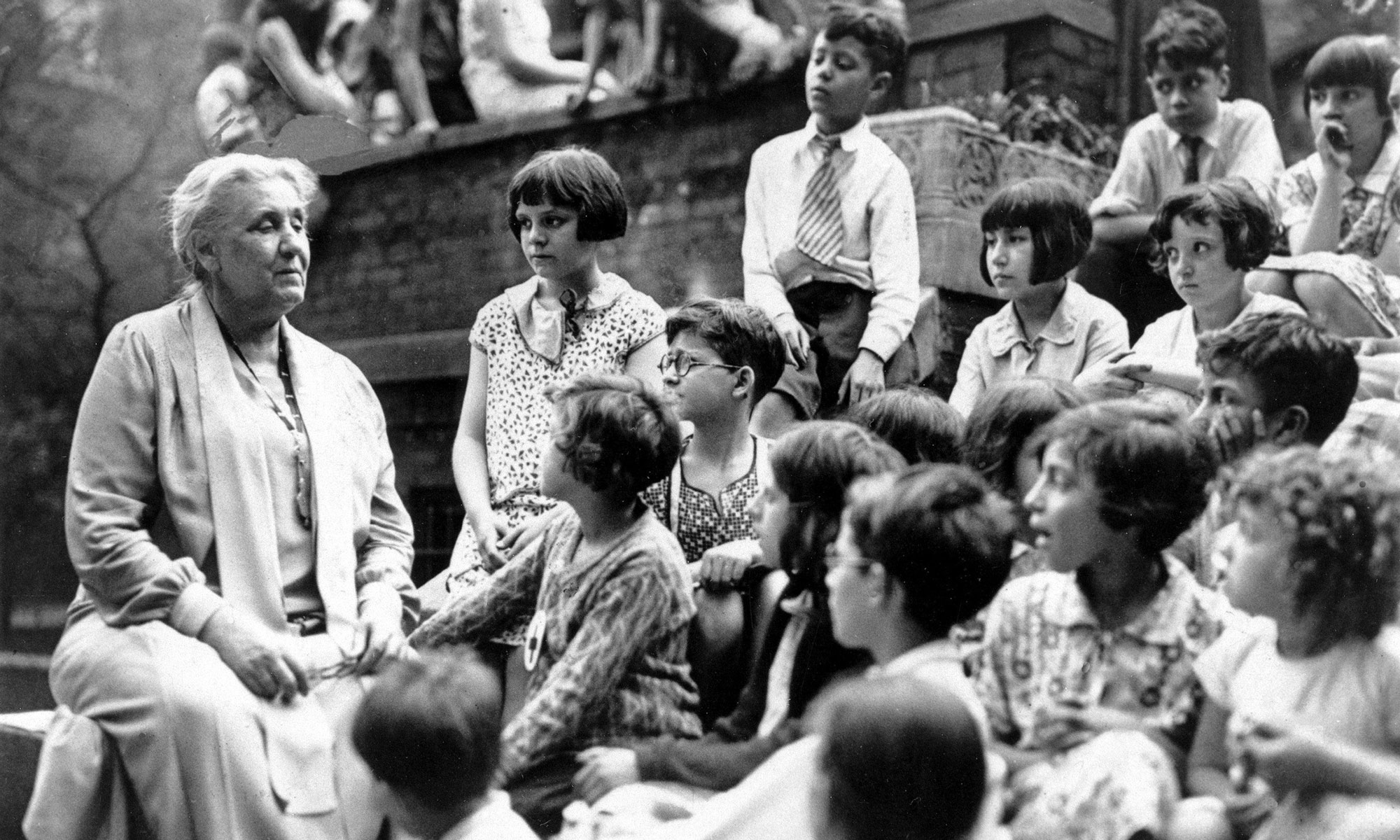

The Social Gospel of Ellen Gates Starr, 1880-1920

This post was written by Dr. Rima Lunin Schultz in June 1997, and presented at the Episcopal Church and Archives Conference, “Mine Eyes Have Seen the Glory: Anglican Visions of Apocalypse and Hope.”

Hull-House, the social settlement Jane Addams founded with Ellen Gates ย Starr in 1889, has come to symbolize one of the most successful and creative responses to the problems of industrial society ever undertaken. Much of what happened there is credited to Addams’ leadership and she remains a figure of national and international importance in the fields of social reform and peace.ย  In comparison, Ellen Gates Starr remains a supporting character whose claim to fame is that she was there at the beginning. Indeed, for Starr, the settlement was only the start of a lifelong journey to translate her radical idealism into everyday practice; it was the first of many initiatives Starr tried out in her quest to make her professed faith in Christianity a living, breathing organic part of herย existence. The following is the story of the way in which Starr’s religious convictions formed her radical consciousness and emboldened her to take great risks for her ideals.

Ellen Gates Starr was born in 1859 to an abolitionist family from New England, who had settled in Illinois.ย  As a young girl her father’s involvement with the local grange and his advocacy of a cooperative system over the vicious competition in America sensitized her to view the individual in the social context. Intellectual freedom prevailed in the household as well as strong support of women’s equality; her sister Mary became an artist, her brother William a sculptor; two cousins were art photographers and another cousin, Beatrice Starr Jenkins, became anย architect in Chicago. (1)

Her father’s sister, Eliza Allen Starr, had a profound influence also.ย  A New England Unitarian spinster who converted to Roman Catholicism in 1854 and became the leading exponent of Catholic Art and literature in the Midwest, her art studio near the Cathedral church in downtown Chicago, was one of the few places where books and reproductions of medieval and renaissance religious art were available. Eliza Starr advocated the social purpose of art in modern society fearing that the human spirit was at risk in the industrial environment. Supporting herself as a writer and lecturer on art and religion, she ran an art school. (2)

Thus Starr already had an appreciation and sympathy for catholic liturgy and art when she arrived at Rockford Seminary where she was required to attend daily chapel services and weekly prayer meetings in preparation for a traditional Protestant conversion experience. Immediately Starr knew this was not her route to religion. With family resources limited, Starr remained at Rockford for only one year, planning to reenter another college later.ย  She began teaching school, first in a small country town near her family home and in 1879, in Chicago. The next four years wereย difficult ones; she grappled with her religious feelings, in 1881 attempted to prepare for the Harvard Annex (Radcliffe College), and that same summer, ย suffered a nervous breakdown that forced her into inactivity for several weeks.ย  This was a period of experimentation with visits to a variety of churches, wide reading in English literature (Dickens and George Eliot), history and philosophy (Carlyle and Ruskin), and studies in Anglicanism including Maurice and Kingsley. In 1883 Starr joined the Episcopal Church with some hesitancy but profoundly desirous of getting on with her life. (3) She looked to her friend, Jane Addams, to sort out what that futureย might hold.

Ellen Starr had met Jane Addams the year she studied at Rockford College. The friendship continued largely through letters in which the two discussed politics, literature, religion and what was the major preoccupation of them both, the quest for useful, morally significant work. This quest for a vocation, not just employment, was fraught with a variety of concerns.ย  Both women were in their mid-to-late twenties; they were not interested in marriage.ย  Well-read, consumed by intellectual ideas about life rather than by experience, they formed a bond with each other in their desire to chart a new, unconventional course. (4)

In 1887 Addams invited Starr to accompany her to Europe and Ellen accepted Addams’ offer to pay her expenses. (5) An intense experience, Starr loved European art and traveled to religious shrines including Monte Cassino and Assisi. She was inspired by what she observed about the Benedictine Rule when she visited Monte Cassino. The idea of work as prayer captured her attention as dramatically as Jane Addams’ attention was captured when she visited Toynbee Hall settlement in the East London slum. After their return from Europe the two women began to plan a similar venture in Chicago. The two saw Toynbee as the answer to both personal and reform goals: they could create a “home” for themselves and also do meaningful work. “Jane’s idea which she puts very much to the front and on no account will give up,” Starr wrote, “is that it is more for the benefit of the people who do it [settlement work] than for the other class [the poor in the slums].ย  She has worked that out of her own experience and ill health.” (6)

While Starr and Addams agreed that they both “needed” the settlement as much or more than the people in the neighborhood “needed” such a place, it is not clear whether or not they held the same vision about what the settlement would actually do.ย  Or, perhaps at this early stage neither one had a clear sense. At age thirty-one Starr was already more preoccupied with working out the message of the social gospel she embraced in her desire to be a good Christian. In her mind the settlement would be a place where a religiously grounded fellowship addressed her concern for social as well as personal holiness. This difference in motivation was significant and within three years it was clear to both women that they had different goals for the settlement and themselves. As a practical matter, the two divided up the work of the settlement with Starr devoting herself to art, literature, and crafts, a result of her interest in Ruskin and Morris and the Arts and Crafts movement and Addams became the public spokesperson for the idea of the settlement as well as its fund-raiser.

On the personal level Starr and Addams distanced themselves from the emotional bond they had initially forged. How much their clash over Starr’s emphasis on the religious aspects of the settlement idea brought about this wedge is difficult to measure. Addams’ friendship with Mary Rozet Smith, who assumed the role of Jane’s closest and most intimate friend signaled the change that had taken place on the personal level. (7)

With the arrival of Julia Lathrop in 1890 and Florence Kelley in December 1891, Hull-House embarked on the road of social science. (8) Jane Addams and Julia Lathrop were already exploring this direction and Kelley’s knowledge of European Marxism and her university training in economics fostered a turn away from the Christian socialism expressed in Starr’s approach. Kelley and trade union leader Alzina Parsons Stevens began to collect statistics for the Illinois Bureau of Labor on the sweatshops that proliferated in the Hull-House neighborhood. (9) The factory inspection act passed in 1893 gave credibility to the investigative approach, although in the long run it would take decades before the courts outlawed sweatshops.

Lathrop and Kelley constructed moral arguments on behalf of less privileged social groups, immigrants, workers exposed to industrial hazards, women and men working more than ten hours a day, poor families generally, and child laborers, and they appealed to the State to become more activist in the protection of these groups. (10) Hull-House Maps and Papers, published in 1895 exemplified the way in which the new science of human relations was used by Hull-House women reformers with articles reporting research results on sweatshop labor, child labor, and labor organizations for working women.

Starr’s contribution, “Art and Labor” was a contrast: anti-capitalist and anti-modernist, Starr warned that it was not enough to fight for wages, you had also to fight for the soul of man against the commercial and industrial world that was crushing him. Her writing is starkly different than what develops as a maternalist-social science argument for the State assuming the protection of those who are weak.ย  Starr, unlike the majority of women progressive reformers, did not base her social justice arguments on maternalist reasoning.ย  She neither singled women out for special protection nor did she believe that women’s differences came out of essential nurturing qualities that, when expanded to societal problems, enhanced their capacity to bring about social transformation. (11)

In contrast to the others, she was searching for something close to a sacramental community that men and women settlement workers and poor people would share together, but both the church and the settlement were neglecting the religious function in modern society: the settlement in its increasing secularism; and the church in its neglect of “social holiness” in favor of “personal holiness.” (12)

Remaining a resident at Hull-House, Starr carved out her own space and developed a support system in Chicago and elsewhere to sustain her sense of a community of social holiness. (13) Even her room at Hull-House was more like a monastic cell than a bedroom in a Victorian home. She rose early every morning and either attended religious services at a neighborhood Catholic church or had private prayer and meditation. (14) Jane Addams, Starr reported, had accused her of “running after strange doctrines.”(15) She had her local chapter of the Society of the Companions of the Holy Cross, (SCHC) a lay order of Episcopal women dedicated to social justice. It provided a corporate intellectual and spiritual life, a sisterhood, that included her friend Vida Scudder and others.ย  Starr missed this at Hull House where, by the 1890s, the earlier custom of group prayer inaugurated by Starr had been replaced by a women’s political culture that had little place for corporate forms of worship and barely tolerated Starr’s religious activities.

Starr was drawn to Vida Scudder and her writings on St. Francis. Starr and Scudder became leading exponents of a self-consciously and openly religious approach to reform. They saw the settlement as a model for an alternative value system which spurned the material rewards of American society for a new ‘Franciscanism.’ Starr, Scudder, Social Gospel theologian George Herron, Episcopalian priests W. D. P. Bliss, R. Heber Newton, and James O. S. Huntington believed that a reordering of society had to take place and those who controlled wealth and property had to recognize their sins of greed and selfishness.ย  They had to see that their luxury depended on the misery and privation of oppressed workers. (16)

By the 1890s Starr had found solace and support at Denison House in Boston with Scudder and Helen Dudley and spent time in Boston away from Hull-House affairs.ย  The Denison group was influenced by Huntington, whose spiritual counsel could be seen in the development of the Companions and in the maturation of Starr’s religious ideas. (17) Huntington was a frequent guest at Hull-House prior to 1892 when the direction of the settlement was still malleable, although Starr’s request for his appearances met resistance from the more secular residents.ย  What was missing, obviously, was the cross-class alliance: a community of believers that was not class segregated. (18)

Reality and the opportunity to create this community of believers entered Hull-House with the arrival of neighborhood garment workers who were encouraged by the settlement residents to use the meeting rooms for union meetings. Trade unionist Mary Kenney became a resident.ย  In 1896 Starr participated in her first garment workers’ strike. Immediately demonstrating her desire to identify with the strikers, Starr organized relief for the workers and with Mary Kenney rushed ahead to St. Louis, Missouri, to meet a train headed for Chicago with scabs brought in to break the strike.ย  Starr and Kenney boarded the train in the middle of the night and at breakfast lectured the men on the conditions that led to the strike. ย Persuaded, the men joined the union and offered their support.ย  The strike was lost and Starr turned her attention to relocating blacklisted strikers and exhorting tailors to keep the union intact despite their losses. (19)

This was her first real engagement with the violence of labor disputes.ย  Frazzled and exhausted, she left for New York for a prolonged period. She had operated so differently from Jane Addams who had been approached by the Chicago Civic Federation to call for arbitration for the strike. (20) This was the beginning of a lifelong pattern for Starr: she rejected roles of arbitrator, mediator, or negotiator between the classes just as she had rejected the role of social science observer and institutional bureaucrat. Her radical idealism interpreted the social gospel message rather literally.ย  She determined that her fate would be with the oppressed and the downtrodden. Starr had no trouble identifying which side to join and she did so with religious zeal.

These involvements, however were exhausting and somewhat artificial. Starr not only identified with the cause of the worker, she wanted to be a artisan herself. In the summer of 1898 Starr sailed to England for a fifteen-month apprenticeship with Arts and Crafts bookbinder Thomas James Cobden-Sanderson. (21) She had decided to become a worker and teacher, to identify more closely with the poor by taking up manual labor, and to teach others to find joy andย  dignity in the simple life of a craftsman.ย  This way she would protest the economic arrangements of modern industrial capital.ย  When she returned wealthy Hull-House patron Mary Wilmarth provided Starr with funds to set up a bindery. Unfortunately, only two or three students a year were able to study, the materials were costly, and Starr was forced to work on commissions for wealthy patrons. (22) It was a terrible irony not missed by Starr.

Starr turned to what appeared a more fruitful agenda: organizing women for the Women’s Trade Union League (WTUL).ย  Other non-workingclass reformers and settlement residents had searched for ways to help American workingwomen.ย  The traditional male craft unions were reluctant to organize women, assuming that they were unreliable, transitory workers who would leave work to marry.ย  In addition, immigrant women had filled the sweatshops and, in the eyes of the male artisans, had contributed to the deskilling of the garment industry. (23) Young women, on the other hand, found it difficult to enter the world of male trade unionism because of the masculine culture of the union hall; often meeting rooms were above saloons.ย  Ellen Starr and other settlement reformers saw a need to come to the aid of working-class girls who they knew were exploited at work and ignored by the labor movement. The WTUL was organized in 1903 to assist in the organization of women wage workers into trade unions.ย  With the cooperation of Samuel Gompers and the AFL, the organization was permitted and actually encouraged, membership of non-wage-earners.ย  WTUL branch chapters agreed to affiliate with AFL central labor committees. The first slate of officers in 1903 included: Mary Morton Kehew, a socially Bostonian, president; Jane Addams, vice-president; Mary Kenney (O’Sullivan), secretary. (24) In Chicago the local chapter of the WTUL organized at Hull-House. (25) Tensions between the wealthy and middle-class allies and the trade union women existed from the beginning. The allies advocated investigation of factory conditions, legislative lobbying, and educational classes, activities many trade union women considered derivative from a focus on direct organizing.ย  On the national level, Gompers’ ambivalence about the role of non-workers in the union continued to plague the allies in the WTUL. (26)

Starr continued to work through the Episcopal Church for social change in these years, primarily with the Companions. Among the mainline denominations, the Episcopal Church was the most visionary in its rethinking of the conventional economic theories of laissez-faire capitalism and the application of Jesus’ social gospel to the contemporary wage labor system was a radical departure, even when conceived in the context of a non-violent system of mediation between labor and capital rather than a revolutionary end to private property.ย  Yet the church continued to be an exclusive community of wealthy parishioners whose connections to the ruling class were undeniable.ย  Here was a church able not only to produce James Huntington and Vida Scudder and, in its capacity to allow differences to flourish, gave these Christian Socialists the space to grow.ย  But the church was also one of the major institutional strongholds of private property.ย  It represented wealth and the power wealth had to shape the society.

Ellen Starr heard Charles Palmerston Anderson, bishop of Chicago during the garment workers’ strikes, tell propertied Episcopalians that when men used the might of money to stand out against organized and disorganized women and children over the principle of collective bargaining, they were taking a position not endorsed by the Christian church. “I believe in God,” he told his flock, “therefore I believe in the right of bargaining.” (27) The same Bishop Anderson was adept at businessmen back to Christian activism and encouraging them to join the Laymen’s Missionary Movement; at home in Chicago he set the tone for an activist, red-blooded and masculine Christianity by incorporating the leading capitalists who were members of Episcopal congregations in decision-making at the highest diocesan-wide level. Anderson, like social gospelers Walter Rausenbusch and Washington Gladden, had not called revolution or the end to private property.ย  They had accepted the need to include associations of workers at the table with capitalists and, along general Christian ethical principles, negotiate from within the system to benefit labor and capital alike. (28)

For Starr this was too conservative an answer. “How can we tolerate it that life should go on so–all the suffering of little children, all the waste and squalor and brutality and misery of a system which might be changed,” she wrote a friend. “Nothing is worth thinking of at all in comparison to that.” (29)

Mainline Protestants were in general agreement by 1900 that the church and religion were about “here and now.”ย  “We are beginning to realize,” wrote an Episcopal churchman in the diocesan newspaper, “that the Church and religion are concerned chiefly with men and women in this life, with their daily duties and obligations; that if we live as God would have us live in this world we need not be anxious about the world to come.” (30)

What continued to depress Ellen Starr, however, was the failure of the social gospel message to ignite a radical transformation inside the churches and, without that, there was little hope for change in society as a whole. Most laborers worked in oppressive conditions and lived substandard housing.ย  With seasonal layoffs and economic depressions children and women as well as men worked to survive. The churches were doing enough because their members, the wealthy and powerful, were not motivated to change the way the economy actually worked. When Starr returned from the Society for the Companions of the Holy Cross summer conference in 1909 she felt the gap between the words that were spoken at the highest levels of ecclesiastical institutions and the conditions of the poor.ย  Attending services with other Episcopalians became increasingly difficult as she felt surrounded by privilege and social pretension.ย  She had written earlier, “The Ancient Egyptian priests had one religion for themselves and another for the people, and how like them we often are.” (31) It hurt her the way civil rights activists were hurt and resented theย segregated churches they attended, especially when lip service was given to the movement for racial equality.

Starr began to attend Catholic parish churches in the Hull-House neighborhood because she identified with the poor. (32) Now she decided to look closely at what Roman Catholicism might offer her.ย  In her case, this transition was not out of character; she was drawn to the ceremony, the mystery, the symbolism of Catholicism.ย  In 1907 she collapsed from nervous exhaustion and spent a month in a sanitarium followed by weeks of recuperation. ย Struggling with depression, she was disappointed in her failure to expand the bindery at Hull-House into a successful employmentย venture. At age forty-nine having had her application rejected for residence in a communitarian experiment in Tennessee run by Huntington’s Order of the Holy Cross, she went abroad to live in relative isolation on a farm in Ireland. She came back to the States in 1909 to begin a new life. “I… went to pieces and decided I was a failure.ย  But I did have the vitality left to ask God to give me another chance–an eleventh hour chance to serve.” (33) But she continued to wander from church group to labor union, from Socialist Party politics to private tutoring from a Roman Catholic priest who gently, persistently, patiently counseled her and deflected her abusive criticism of the Roman Catholic hierarchy until she was ready to convert. ย (34)

In all this, Starr continued to actively participate in the labor struggle. In 1910 when a group of courageous women walked out of their shop at Hart, Schaffner & Marx in Chicago, they ignited the spark caused the unorganized workers in Chicago’s male-dominated establishments to rise in rebellion against their employers.ย  Starr, as a member of the WTUL picket committee, promptly joined strikers on the picket lines, patrolled the streets, and served as a witness in court for strikers arrested without due cause. (35) As the strike dragged on Starr appealed everywhere for support of the strike, including the Christian evangelical community where she successfully obtained endorsement for the strike from the Laymen’s Evangelistic Council. The Episcopal Diocese of Chicago also endorsed the strike. (36)

Shortly after the Garment Workers’ Strike Starr joined the Party, and while it was a far cry from the genteel utopian visions of William Morris or the Fabians, Ellen Starr had come a long way from the inexperienced dreamer who had begun Hull-House in 1889.ย  Starr fit in with the Marxist, hard-line, predominantly immigrant organization and although middle-class social workers were discouraged from joining, by 1915 she was serving on the Cook County Socialist Party’s executive committee. (37) She was able to do this even while deepening her commitment to Christianity. For Starr, her labor union radicalism seemed to draw her more deeply into her faith, or perhaps, the arduous task of standing up for the workers, against the wealthy and powerful, could only be endured by her through the strength of her religious convictions. It was her vision of the implementation of the social gospel here on earth that continued to inspire and sustain her as much as the realities of oppressive conditions stirred her rebellion. When she ran for alderman of the Nineteenth Ward as a socialist she explained her credo: “I became a Socialist because I was aย Christian.ย  The Christian religion teaches that all men are to be regarded as brothers, that no one should wish to profit by the loss or disadvantages of others…that none should enjoy ‘two coats’ while others are coatless. Civilized life is in grotesque contrast to all this.ย  Only socialism promised to put down the mighty from their seats and to exalt the humble and meek; to fill the hungry with good things and to send the rich, if not quite ’empty away,’ at least relieved of some of their unnecessary and arrogant fulness [sic].” (38)

In the textile strike of 1913, Starr battled the manufacturers to help the workers secure sixty percent of their demands. It was her first successful strike and buoyed her for her next foray into the eye of the storm.ย  On March 6, 1914, at age fifty-five, Starr was brought to trial on a charge of disorderly conduct stemming from her behavior on the picket line at a waitresses’ strike in Chicago. She had shouted at the police, who had unjustly ย arrested three waitresses on picket duty, “I am a citizen and as such protest this arrest.”ย  The crowd became excited and it was reported that they shouted “Kill the police.”ย  Bail was provided by Mary Wilmarth longtime friend and patron of Starr and Hull-House; her son-in-law, Harold Ickes, served as Starr’s trial attorney and, after eight hours deliberation at its conclusion, a jury found her innocent. (39) Within a few months of her trial she sailed to Europe to make another tour of the medieval shrines, revisiting Assisi and the Benedictine monastery at Monte Cassino.

The Amalgamated Clothing Workers of America (ACWA) strike of 1915 was a different experience, and placed Ellen Starr in the difficult position of disagreeing with almost everyone but the strikers themselves and a few radical friends. This strike, unlike earlier ones, did not receive the support of the Women’s Trade Union League (WTUL) or the American Federation of Labor (AFL), two of the strongest labor organizations in the nation and, in times past, allies with Starr.ย  AFL president Samuel Gompers urged his followers not to support the garment strikers led by Sidney Hillman’s ACWA because it had seceded from the AFL-affiliated United Garment Workers 1914. Gompers argued that Hillman’s defection threatened union unity. During the course of the strike, from October to December, over 1,700 strikers were arrested and two were killed.ย  Starr herself was arrested several times for “inciting a riot” and insisted on a jury trial to bring the facts to the public. (40)

In the end neither side won a decisive victory. The manufacturers’ association created to oppose the ACWA signed no agreements and refused to submit its differences with the strikers to arbitration.ย  The centrist head of the American Federation of Labor and one of, if not the most powerful, labor leaders in the United States, Samuel Gompers, debated Ellen Starr in the pages of the New Republic. Distrustful of middle-class allies whose interests could never be the same as the working class, and increasingly hostile to socialists, he told Starr to stay out of labor’s business. Starr blamed the loss on the “heavy hand of Mr. Gompers.”ย  Without AFL support the strikers had to depend upon middle-class allies. (41)

The strike had been a failure but out of it, radical union leaders of the two leading garment unions, the International Ladies’ Garment Workers’ Union and the Amalgamated Clothing Workers of America had won control from conservative union officials. The new union leaders, as well as the rank and file, demanded that their union reflect their own special vision of society, a cooperative commonwealth in which justice and equal opportunity provided the guiding principles.ย  Women union leaders especially called for programs to expand the cultural, intellectual, and social horizons of their members.ย  Starr, praised by its president, Sidney Hillman, was made an honorary member of the ACWA for her role in the union’s success. (42)

Ellen Starr’s battle with the Episcopal Church most likely was more difficult that going against Samuel Gompers.ย  In some ways Gompers, who did well with the conservative social gospel churchmen, (43) was more like the propertied leadership than the rank and file strikers she had met on the picket lines.ย  At any rate, tired and reluctant to attend General Convention in 1919, she had been persuaded by her longtime friend Vida Scudder to attend. Nineteen-nineteen was the year the church launched its nation-wide campaign as part of its organizational restructuring.ย  In the 1880s Christians hoped to apply the Golden Rule to the social problems of industrial America to save society.ย  In the 1920s, business methods were brought to the church to save Christianity.ย  Like other corporations, the church had become nationalized; social gospel work was now coordinated in a department of social service. A fund was created to operate the new bureaucracy. (44)

Starr was sixty-one at the time of her conversion to Roman Catholicism. Becoming part of a Catholic intellectual community in Chicago, she joined a circle of educated Catholics who shared her interest including Jacques Maritain and Etienne Gilson, both in residence at the University of Chicago, hardly the common folk in the parish churches, but in many ways the closest intellectual relatives to the Anglo-Catholics of her youth. ย Always the maverick, she defended Lenin and the Russian Revolution, read Gerard Manley Hopkins, and made appeals for Sacco and Vanzetti’s commutation from their death sentences.ย  Increasingly, ill health and simple old age kept Ellen Starr from more activist involvements

She affiliated herself, finally, with a Benedictine monastery and became an oblate in the third order of St. Benedict. (45) She died in Suffern, New York in 1940.

By 1920, a conservative, non-socialist “social gospel” had been incorporated into mainstream Protestantism as the institutions of Christianity began to take on the organizational structure of the business corporation itself.ย  The “social gospel” of the twentieth-century church recognized religion’s social service responsibility to a broad public but no longer pitted itself against the social injustices of industrialism.ย  In essence, the social gospel had become a generalized acceptance of institutional religion’s connection with the social life of the nation. By 1920 Ellen Starr saw little hope in organized religion’s revolutionary potential.

Starr was uncompromising, self-critical, and ultimately, a minority voice who saw in the successes of progressive social reform the death of the revolutionary gospel spirit that had awakened her conscience and whole generation of idealists in the 1880s and 1890s. In 1892, only three years after its opening, Starr accused Hull-House of being merely “an excuse for the things we ought to do and be and don’t and aren’t.” (46)

“We” was not a figure of speech; Starr was self-critical and uncompromising in the demands she made of herself.ย  She was also prophetic.ย  Few of her generation remained true to the radical idealism inherent in the social gospel message; the majority became convinced that social legislation, collective bargaining and the expansion of political rights could make the economic system more democratic and alleviate the worst abuses of industrial capitalism.ย  Theirs was a quest for a social ethic that would mediate between the classes, not end the class structure; would negotiate among the competitive elements in society, not end competition; and would apply a secularized social gospel message as a civic platform.

Starr held fast to the conviction that a fundamental reordering society must take place. This reordering could not come without a spiritual renewal of the individual leading to the restructuring of society to a collectivist and religious social ethic. Starr found all the institutional structures to which she gave her devotion and commitment ultimately incapable of bringing about this reordering–neither the settlement house, the Socialist Party, the labor movement, or the Episcopal Church were able to give the kind of leadership and support Starr had hoped to find.

Endnotes:

(1) Polly H. Ullrich, “Women in the Arts and Crafts Movement of Chicago: 1877-1915,” M.A. Thesis, Department of Art History, Theory, and Criticism, School of the Art Institute of Chicago, 1994.

(2) Archibald J. Byrne, “Eliza Allen Starr,” Notable American Women 1607-1950. A Biographical Dictionary. Edward T. James, Janet Wilson James, and Paul S. Boyer, editors. Harvard University Press, 1971, vol. III, 350-351; the Rev. James McGovern, The Life and Letters of Eliza Allen Starr. 1904.

(3) Elizabeth Palmer Carrell, “Reflections in a Mirror: The Progressive Woman and the Settlement Experience,” Ph.D. dissertation, The University of Texas at Austin, 1981, 92, 100-101.

(4) Jane Addams, Twenty Years at Hull-House. New York: Macmillan, 1910. See Starr-Addams Correspondence in Ellen Gates Starr Papers, Sophia Smith Collection (EGS/SSC), Smith College. See: Jennifer Lynne Bosch, “The Life of Ellen Gates Starr, 1859-1940,” Ph.D. dissertation, Miami University of Ohio, 1990.

(5) Carrell, 109.

(6) Ellen Starr to Mary Blaisdell, Feb. 23, 1889, EGS/SSC.

(7) Jennifer Bosch, “The Life of Ellen Gates Starr,” 76; Carrell, diss., 177-178.

(8) Kathryn Kish Sklar, “Hull-House Maps and Papers: Social Science as Women’s Work in the 1890s” in Martin Bulmer, Kevin Bales, and Kathryn Kish Sklar, eds., The Social Survey in Historical Perspective 1880-1940. New York: Cambridge University Press, 1991.

(9) Carolyn Daniel McCreesh, Women in the Campaign to Organize Garment Workers, 1880-1917. Garland Publishing, 1985, 65; Residents of Hull-House, Hull-House Maps and Papers. Arno Press & The New York Times, 1970 reprint.

(10) Sklar, 117-118.

(11) I come to this conclusion because the absence of writings or activities between 1880 and 1920 on the part of Starr in relation to women’s organizations or the suffrage question.ย  Addams takes on major leadership roles in the suffrage battle after 1900 and writes important popular arguments in the maternalist vein in favor of women voting. Starr appears not to have been involved. Female social gospelers such as Frances E. Willard, a Christian Socialist and the president of the Woman’s Christian Temperance Union, linked their arguments for the coming kingdom on earth with a special role for morally superior women.ย  Starr makes no arguments of this nature.

(12) Ellen Starr, “Settlement Life,” 1896, Society of the Companions of the Holy Cross. She describes an almost mystical relationship in which settlement workers enter into the life of the community.

(13) Looking at “List of Members,” S.C.H.C., in 1884, 1887, 1888, 1890, 1892, 1894, Ellen Gates Starr is listed for the first time in 1894.

(14) Carrell, 134-135; Mary Prentice Lillie Barrows, “God and My Mother,” mss., 312, Box 3, Frances Crane Lillie Papers, Chicago Historical Society.

(15) Ellen Starr to Mary Allen, c. 1894/95, EGS/SSC, Box VII.

(16) Vida Scudder, On Journey. New York: E. P. Dutton & Co., 1937, 240-241; Carrell, 3; Ellen Starr, “A Bypath into the Great Roadway,” Catholic World vol. 119, May 1924, 179.

(17) Ellen Starr, “A Bypath into the Great Roadway,” 179.

(18) Huntington had great difficulty balancing the demands of his contemplative life with settlement work. In 1892 the Order of the Holy Cross left the East Side of New York and settled in rural Maryland. D.G. Paz, “Monasticism and Social Reform,” Historical Magazine of the Protestant Episcopal Church, vol. XLVIII, #1, March 1979, pp. 56-57.

(19) Carrell, 233-234.

(20) Ibid.

(21) See Eileen Boris, Art and Labor: Ruskin, Morris, and the Craftsman Ideal in America. Philadelphia: Temple University Press, 1986.

(22) Carrell, 301-305.

(23) Elizabeth Payne, Reform, Labor, and Feminism: Margaret Dreier Robins and the Women’s Trade Union League, University of Illinois, 1988. This book discusses the Chicago league and its relationship to Hull-House residents.

(24) McCreesh, Women in the Campaign to Organize Garment Workers, 86-88.

(25) Payne.

(26) McCreesh, 66-67; 125-127.

(27) Charles L. Street quoting Bishop Charles P. Anderson, Memorial Sermon, The Diocese of Chicago, 1936.

(28) Rima Lunin Schultz, “The Making of An American Church: Cathedral Ideal and Parish Realities. The Episcopal Church in Illinois, 1834-1946,” unpublished mss., 1986. Archives, Episcopal Diocese of Chicago. See especially chapters eight and nine.

(29) Carrell, 343.

(30) The Diocese of Chicago, April 1910, 10.

(31) “Chicago’s Hull-House,” Report on the Address by Ellen Starr, 1895, Hull-House Scrapbook, III, JAMC.

(32) Carrell, 344.

(33) Starr to Wager, Hull-House, February 12, 1917, EGS/SSC, Box VIII.

(34) Carrell, 398-400.

(35) Women’s Trade Union League of Chicago, Official Report ofย the Strike Committee, 10.

(36) Official Report of the Strike Committee, Garment Workers’ Strike, Oct. 29, 1910-February 1911, Women’s Trade Union League, Microfilm, Chicago Historical Society.ย  Thekla Ellen Caldwell, “Women, Men, and Revival: The Third Awakening in Chicago,” Ph.D. dissertation, University of Illinois at Chicago, 1991.

(37) Carrell, 357.

(38) Clipping, “Why I am A Socialist: Miss Starr to Stick in Race,” February 10, 1916, Ellen Gates Starr Biographical File, Chicago History Museum.

(39) Carrell, 357-358.

(40) McCreesh, 218-220. The exchange of letters between Gompers and Starr were published in the New Republic January 1916- March 1916.

(41) Ibid.

(42) Carrell, 364.

(43) Elizabeth and Kenneth Fones-Wolf, “Trade-Union Evangelism: Religion and the AFL in the Labor Forward Movement, 1912-1916” in Working-Class America: Essays on Labor, Community, and American Society. Michael H. Frisch and Daniel J. Walkowitz, eds., University of Illinois Press, 1983.

(44) Schultz, “Making of An American Church,” 561-562.

(45) Carrell, 412-413.

(46) Carrell, 30.