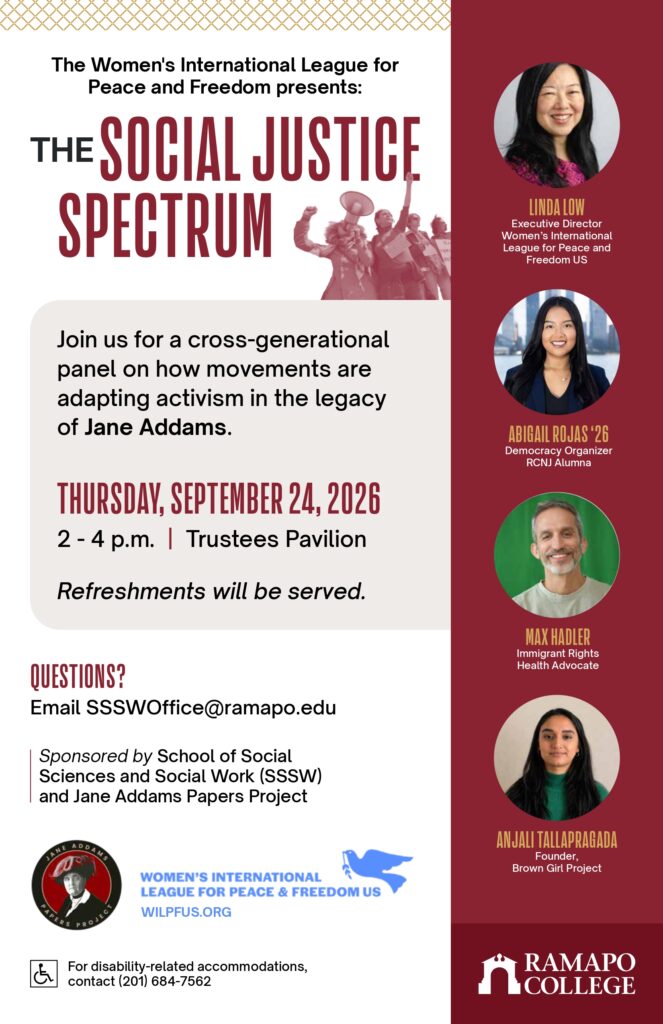
We are delighted to announce a collaboration between Ramapo College and the Women’s International League for Peace and Freedom. On September 24, the College will host a panel discussion on the Social Justice Spectrum, featuring WILP Executive Director, Linda Low, Ramapo alumna and democracy organizer Abigail Rojas, Max Handler, Immigrant Rights Health Advocate, and Anjali Tallapragada, founder of Brown Girl Project.
September 24, 2026, 2-4 pm, at the Trustees Pavilion, Ramapo College of New Jersey, 505 Ramapo Valley Road, Mahwah, NJ 07430
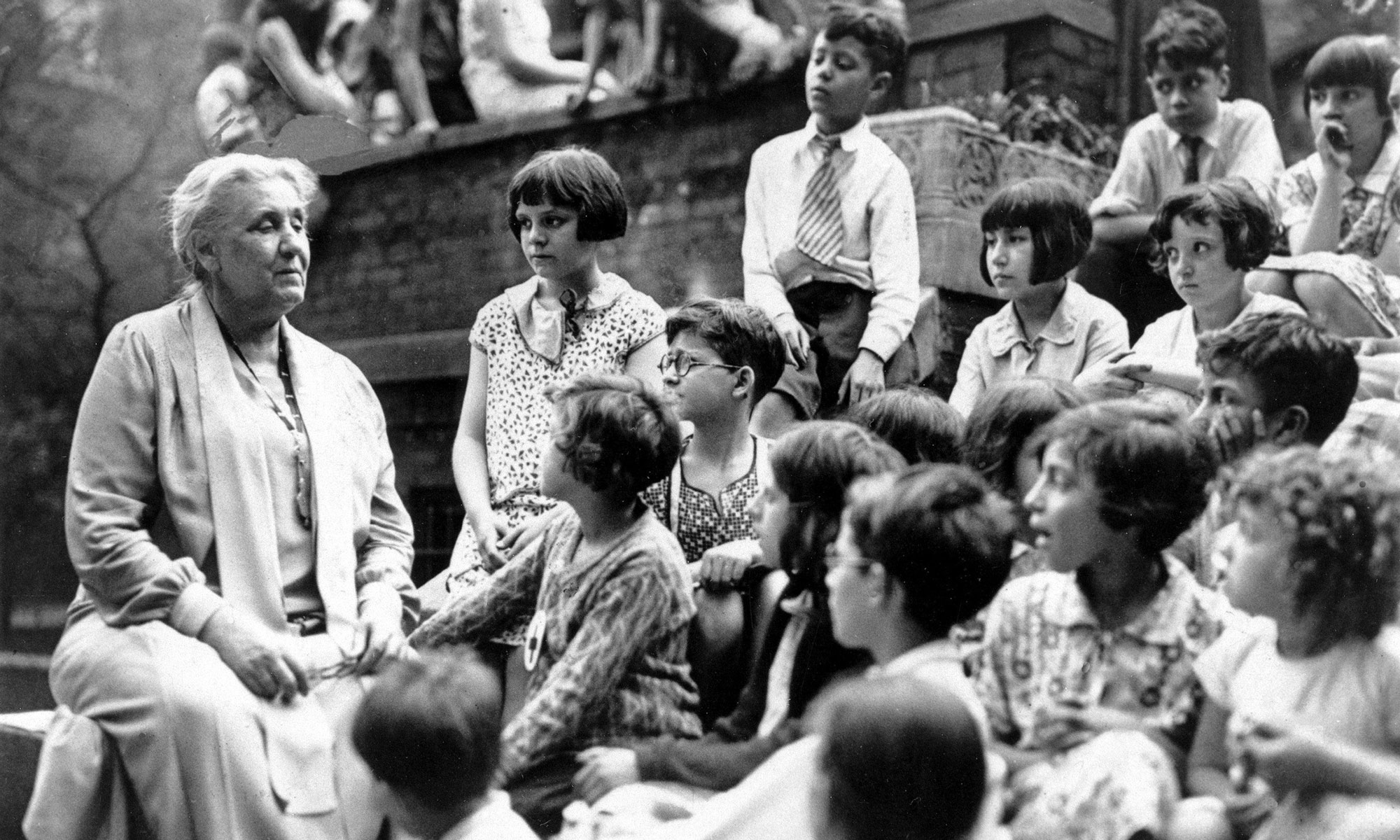
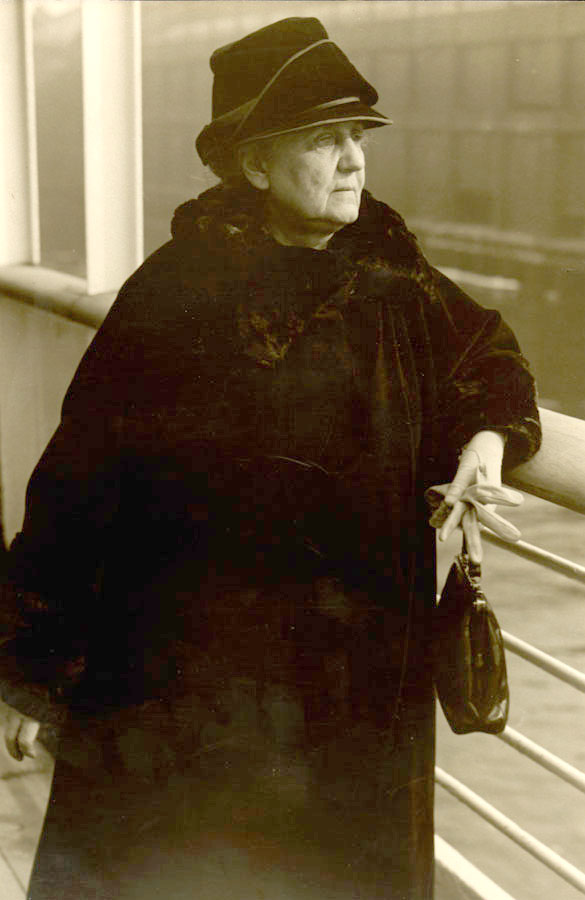
Jane Addams, 1926 (Image courtesy of Swarthmore College).
In April 1915 before leaving for The Hague to attend the peace meeting of the International Congress of Women, Jane Addams made a public statement about her mission:
“We do not expect to end the war. We have not much hope that our meeting will have immediate effect upon the present situation, but we do believe that as women, as mothers of men and soldiers, we are in position to meet, without bias, and formulate plans for the settlement of the present international troubles when the time comes to consider terms of peace. The present system of diplomacy has failed; it has plunged the world into a war the like of which it never saw before and it has done it in the infancy of the feminist movement. Now is the time for women to assert themselves and attempt to bring about a settlement that will be a lasting settlement if it be possible to do so.”
Jane Addams was right.
The diplomacy of men had failed, and now Europe was engaged in a devastating war. That failed diplomacy and resulting war would kill nearly 10 million soldiers and more than 6.5 million civilians, leave more than a million widows in France and Germany alone and result in innumerable bereaved mothers who lost children to battle, genocide, disease, and starvation. Men had failed women spectacularly. War jeopardized every reform that Addams championed since she opened Hull-House in 1889.
Jane Addams was righteous.
She knew that women had “a vested right in the developed conscience of the world.” Women had everything to lose and no political power to stop the war, but in 1915 more women than ever before in the history of humankind, were finding their voices and willing to raise them. Women could claim the moral high ground and speak out against the slaughter of their men and their boys. They could be humanity’s good sense when the powers that be had lost their minds. For Jane Addams, peace was as central to human well-being as clean food and water, safe housing and work spaces. As she wrote in Newer Ideals of Peace, there was a direct correlation between peace and humanitarianism. War jeopardized everything.
Jane Addams was brave. She led a group of forty-seven American women to The Netherlands in the middle of a war. They boarded a ship, left the safety of the United States more than 3,500 miles away from the fighting, and sailed into dangerous waters. Their purpose to convene a peace meeting with more than 1,100 women from twelve neutral, allied, and central powers, was bold. Jane Addams believed that women had “a right to protest against the destruction of that larger ideal of the state in which they had won a place now being destroyed through an appeal to the loyalties of savagery, and to deprecate a world put back upon a basis of brute force.” To be a pacifist in wartime was no path for the faint of heart. For the next decade Jane Addams endured the wrath of politicians and citizens alike who accused her of being un-American, even as she courageously exercised her First-Amendment rights.
Currently, I am working on Volume 6 of The Selected Papers of Jane Addams, which covers the years of World War I through Addams’s death in May 1935. A large proportion of the documents we selected touch on or deal solely with international peace, a selection that rightfully represents the focus of Jane Addams’s attention in these years. Yet even as I am not a procrastinator by nature, I have been procrastinating the full annotation of these documents. For months I have avoided them, worked around them, and put off for far too long the deep historic reading necessary to fully understand them. When I try to focus on these peace documents, I find myself asking, “What the heck, Jane, why are you screaming into the void about peace?”
What I should have been asking was, “What the heck, Stacy, why do you hate peace?”
I love peace as a concept. Like Jane Addams, I abhor war and I (mostly) blame men for it and view peace as a woman’s issue. As a feminist who stands on the shoulders of Addams’s pioneering generation of women, I believe that women, particularly as they are the creators of all human life, have the moral authority to condemn war and demand peace. As a practicing yogi, I adhere to the tenant of nonviolence (ahimsa), just as Jane Addams identified with Quaker pacifism and adhered to her ideals of antimilitarism, internationalism, and arbitration. I am inspired by Addams’s life, reform work, ethics, and particularly so by her unflappable commitment to her principles; and in no other part of her work did she most illustrate her integrity than in her peace work.
Addams founded the Women’s International League for Peace and Freedom, an organization that still exists today. She led the women’s movement for peace for twenty years. She left hundreds of articles, speeches, statements, and letters that illustrate her commitment to the peace movement and her arguments for antimilitarism and international cooperation, a treasure trove for historians. And she was awarded the Nobel Peace Prize in 1931.
So, if Jane Addams was right and righteous and brave and in advocating peace was most true to her foundational values, then why am I, as an editor of her papers, struggling to be compelled by the historical topic of peace? Why am I at war with peace?
I sat down to write this essay in order to ponder this question. I often write to untangle my inner knots and, in that writing process, I frequently unravel something surprising. Honestly addressing my unnatural procrastination in the editing of the peace movement documents exposed an anger in me that was most unexpected, indeed. I am afraid that my best answer to the question embarrasses me: Jane Addams’s peace movement failed, I am furious that it failed.
Despite rational pacifist arguments (or perhaps to spite pacifists), the United States entered the war, the brutality of chemical weapons on the front continued, the peace settlement was inhumane, and the world’s great powers refused to disarm afterwards. The women’s peace movement failed to counter criticism of the League of Nations or to temper reactionary, isolationist policies in America after the war. World War II happened. And 111 years after Jane Addams got on that ship and sailed toward warring Europe, humanity is still fighting, still committing genocide, still othering, and still too many of the men in power are failing at diplomacy. Jane Addams was vehemently opposed to the building of battleships, and I don’t have to wonder what she would say today about the more than 12,000 nuclear warheads stockpiled in nine countries, only one warhead of which could destroy Chicago, kill and sicken millions of people, and lay waste to the environment for hundreds of miles. Photographs of Gaza, Ukraine, and Sudan would make Jane Addams weep.
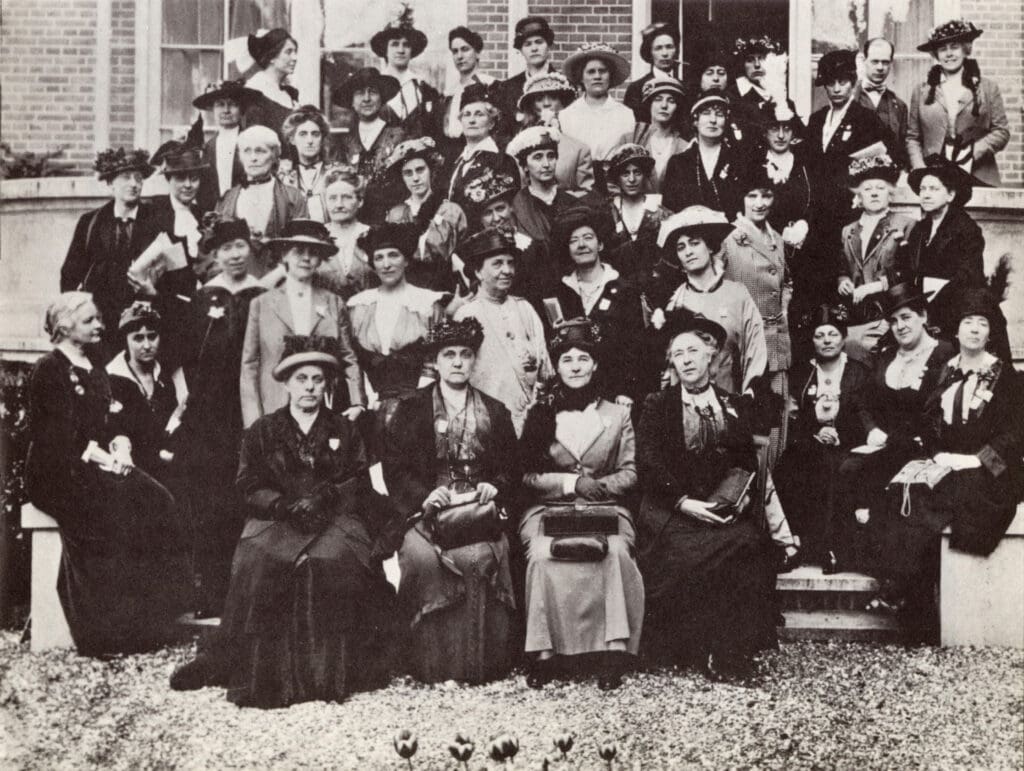
Addams and Breckinridge co-founded the Woman’s Peace Party, later to become the U.S. chapter of the Women’s International League for Peace and Freedom, in 1915. (Image Courtesy of Women’s International League for Peace and Freedom Collection, Special Collections, University of Illinois at Chicago Library)
The spectacular failure of peace makes me furious. I am mad for Jane Addams not at her, because I know that the spectacular failure of peace after the horrors of World War I is a reflection on society not on Jane Addams and her brave, optimistic sister pacifists. But I must admit that I am very sorry that she expended so much of the energy of her golden years in a losing, hopeless effort, sometimes to the detriment of her own health. Peace jeopardized Addams’s personal well-being, her reputation, Hull-House, and her other reform work and, frankly and sadly, I am more compelled by her brilliant successes than by her one magnificent failure.
Jane Addams was an extraordinary reformer, playing a direct role in most of the major reform efforts of her generation and supporting in some way all the others. She literally cleaned up the streets of Chicago. She and her Hull-House colleagues provided economic, recreational, educational, and artistic opportunities for their Hull-House neighbors that markedly improved the quality of human lives. She was instrumental in the passage of child labor laws, the improvement of food quality and workplace safety, and getting American women the right to vote. She helped build a juvenile court system and redefined the rights and needs of childhood. She personally mentored dozens of reformers who went out in the world and made a definitive difference in myriad fields, and she inspired an entire generation of women to use their unique talents for the betterment of society. She validated and provided meeting spaces for radical thinkers, and she was a remarkably prolific and accomplished author.
Peace was her one losing proposition, and after thinking through my war with peace, right here in this essay, I realize now that Jane Addams at least kind of knew it. Note the “we have not much hope” in her 1915 statement. In an April 1915 letter to fellow proponent of peace David Starr Jordon (a deeply problematic individual—perhaps I will tackle him in a future blog post), Addams called the peace mission to The Hague “a fool’s errand, perhaps. But at any rate,” she continued, “forty American women are now committed to it and I understand that the response from the European women, both of the neutral and belligerent nations, is most gratifying.” Jane Addams knew she might be screaming peace into a void, but peace was right and true and standing up for it was what mattered. And now I feel a little bit terrible for being at war with peace because it failed, and I look pretty lousy for thinking it was, indeed, a fool’s errand.
Do I think the peace women wasted their time?
Yes, I suppose I do.
Do I imagine what laws Jane Addams could have championed or what reforms she could have accomplished in the United States instead of organizing women around the world for international peace?
Yes, definitely.
Am I frustrated that Addams’s leadership of an ungovernable bevy of brilliant peace women was something akin to herding feral cats?
Yes, absolutely and, by the way, I am allergic to cats.
Do I feel any better now that I’ve written about my war with peace?
No, not really.
Because I have failed as a historian on peace and Jane Addams. It is bad history to read history backwards, and counterfactual questions, even the ones stewing in my subconscious, are problematic, distracting, and irrelevant to the work I do at the Jane Addams Papers. I am a trained historian and skilled editor, but I was so blinded by the spectacular failure of peace, that I forgot all about the historic context of 1915 and the war years. Peace was, indeed, a longshot, but Jane Addams knew what she was up against; and she did not know how it would all unfold as I know how fast it went south. Besides, peace didn’t have to fail—the League of Nations, for example, had support and enjoyed some successes. Most importantly, however, that peace did fail means nothing.
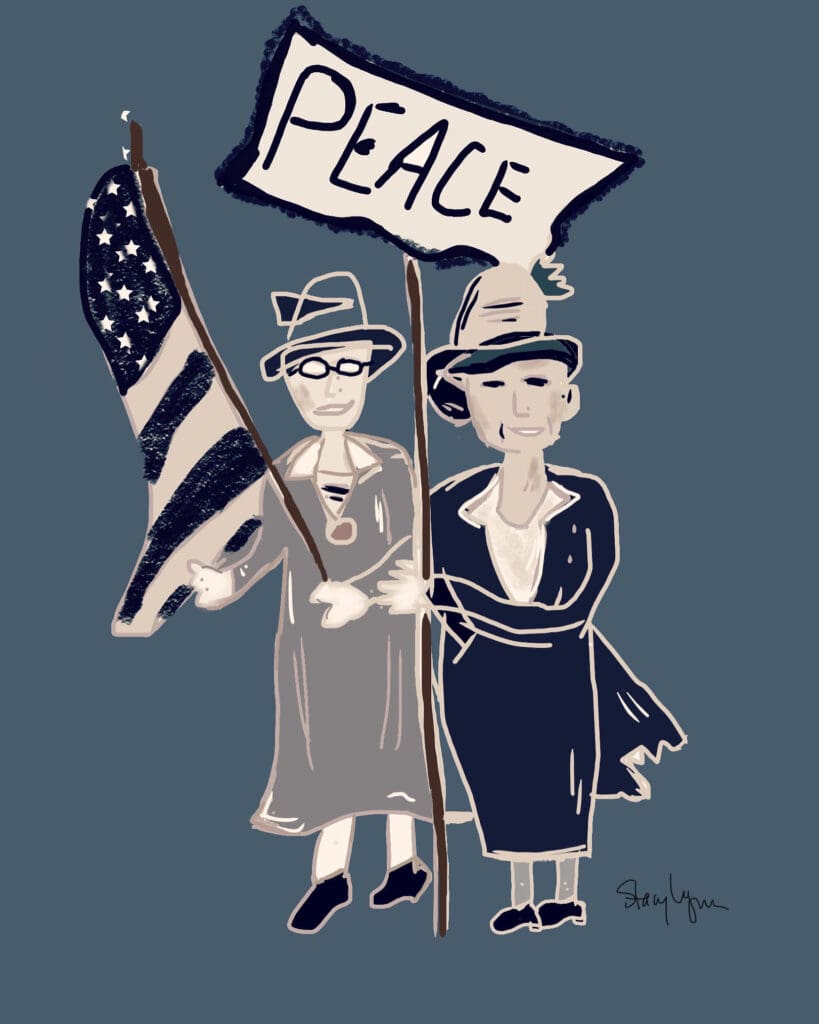
Can lousy art be evidence of my willingness to give peace a chance?
I need to stop whining about peace and be the historian I was trained to be. I need to immerse myself in Jane Addams’s world and leave my angry judgment in the present. I do that with every other aspect of her life, and so I can do it with peace. Because Jane Addams was right and righteous and brave to be a pacifist when all the world was at war. How hard should it really be let the peace movement unfold in Jane Addams’s papers, the way she saw events unfolding? I have exposed my blind spot on the topic of peace, and now I hope it will be easier to just accept the peace movement’s promise and its limitations within its particular historical contexts and let myself be cheered by its sane and optimistic rhetoric.
In order to understand Jane Addams, I simply must give peace a chance. I need to give it at least as much of a chance as she did.
Wish me luck.
Peace out.
Stacy Lynn Associate Editor
Sources: Susan R. Grayzel, Women and the First World War, 2nd ed. (Longman, 2024); Michael Kazin, War Against War: The American Fight for Peace, 1914-1918; Report of the International Congress of Women (Woman’s Peace Party, 1915); Jane Addams, Newer Ideals of Peace (Macmillan, 1907); from Jane Addams Digital Edition: What War is Destroying, Jan. 10, 1915 (Advocate of Peace, Mar. 1915, 65-66); Comments on Upcoming Peace Conference in The Hague Apr. 7, 1915 (The New York Sun, Apr. 9, 1915, 3).
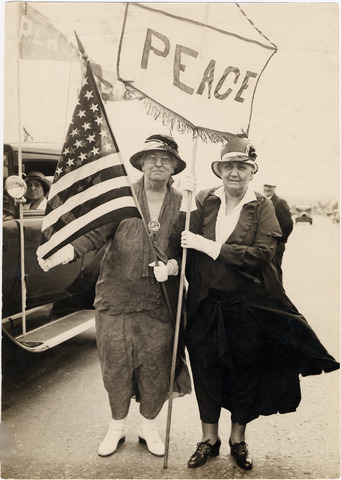
Mary McDowell and Jane Addams at the Democratic National Convention, Chicago, 1932 (Image courtesy of Swarthmore College).