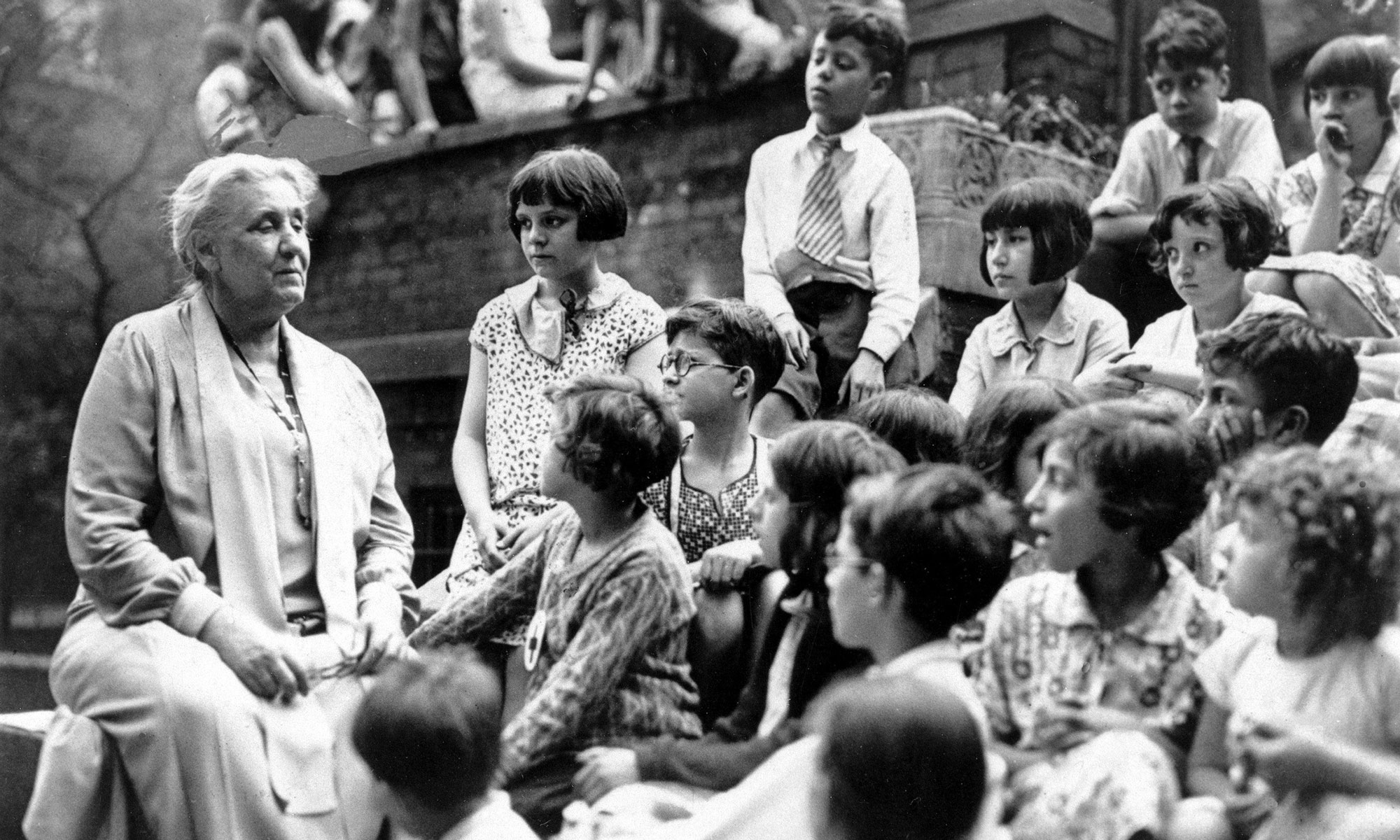

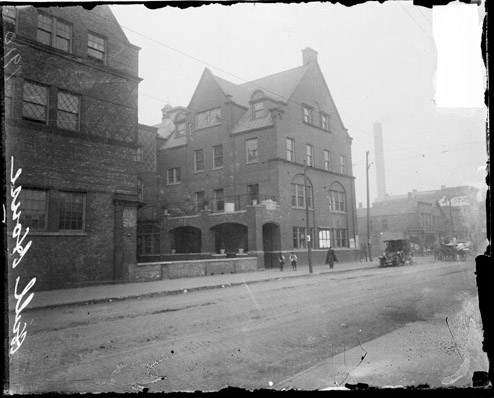
This post is by Rima Lunin Schultz and was first given at the Urban History Seminar, at the Chicago History Museum, on November 8, 2007
The three decades immediately following the death of its legendary co-founder Jane Addams in 1935 are generally viewed as a period of chaos and decline, followed by a period in which Hull-House became more of a community center with professional social work replacing the social activism of reform-minded residents. In this narrative of decline, boards of trustees became less interested in innovation and more concerned with what role, if any, the old thirteen-building complex could play in the neighborhood that was being transformed by super highways, public housing, and the loss of population. New research challenges that characterization and this evening I hope to outline the beginnings of a revisionist account.
The untold story of Hull-House in the Charlotte Carr and Russell Ballard eras is the story of how the most famous settlement house in the United States responded to the greatest historical movement of the mid to late twentieth century: the migration of African Americans from the south to the urban North. More than any other issue, the Second Great Migration to Chicago in the 1940s and 1950s challenged the deepest felt values and goals of the social settlement movement. With a contradictory legacy on the race question from the Progressive Era, Hull-House had to decide whether or not to integrate its programs and staff, remain in the neighborhood or move to another location; support public housing or give in to the local prejudices against blacks and whites living together. Other social settlements faced the same challenge and there are no examples, to my knowledge, where a policy of integration was chosen and, more importantly, that it was achieved to any degree. Abraham Lincoln Center, the Unitarian-affiliated social settlement begun by progressive era radical Jenkin Lloyd Jones, a close and valued friend of Jane Addams. Abraham Lincoln Center was strategically placed in the in-between space of black and white Chicago and from its beginnings promoted interracial democracy. It struggled to remain integrated, however, and by the 1930s had pretty much lost the battle.
While not perfect, Hull-House in the mid-1930s embraced a policy of integration and, in its programs, staffing, residency, and camp, achieved a greater degree of integration than has been acknowledged by any historians to this date. I am walking on egg shells here in my efforts to not overstate the successes of the program, but the efforts that were made were rather exceptional in the context of heightened violence against blacks when residential boundaries to enforce segregation were transgressed, and where openly defiant whites bullied the small number of black families who attempted to integrate public housing—housing built by the federal government.
Charlotte Carr, head resident from 1937 to 1942, was at first glance an unusual choice to lead in the post-Addams era. As the first full-time, paid head of the settlement she brought her experience as director of the Department of Labor under Governor Gifford Pinchot of Pennsylvania, a Left-of-center New Dealer, and as administrator of emergency relief in New York under Mayor Fiorello La Guardia. An outsider to the social settlement network, she was not an outsider to circles of women activists. A graduate of Vassar, Carr’s early career brought her into contact with the women’s political culture of the Progressive Era. When she worked for Pinchot, she made a devoted friend of his wife, a radical feminist who encouraged Carr’s investigations in the coal mining regions of Pennsylvania and, when Carr was criticized, defended her; Carr also worked under Frances Perkins in New York State. Perkins had been in Illinois long enough to spend time at Hull-House and become part of the network of activist women that spanned two reform eras—from the 1890s through the New Deal. Such connections were valuable and made up for Carr’s lack of social settlement experience. Carr had ties to the New Deal, the labor movement (and its Left-leaning C.I.O.), and to pro-integrationist activism in the Northeast.
Carr’s approach to the race issue as administrator of emergency relief in New York had impressed Dorothy Height, the Civil Rights leader who had witnessed Carr’s fairness toward blacks during the March 1935 riot in Harlem. The situation in March of 1935 was desperate for African Americans. While blacks were only 8 percent of New York City’s population, they made up 42 percent of the unemployed on welfare. They were even denied positions on work projects set up by the welfare system and there was not a single person of color in a position of authority on the management staff of the Welfare Administration. Carr remedied the problem by appointing Height to be personnel supervisor in the central office of the Home Relief Bureau.
Her involvement with civil rights leaders was authentic—Race men and women trusted Carr, and when she was about to leave New York for Chicago, a farewell dinner was given in her honor. The invited guests included Robert Elzy, founder of the Urban League in Brooklyn, New York; Dr. Channing Tobias, an executive with the YMCA, Bessye Beardon, Harlem civic leader and mother of the artist Romare Beardon; James B. Hubert of the New York Urban League, A. Philip Randolph, and T. Arnold Hill. [1] The event was reported in the Chicago Defender and the African American community in Chicago anticipated her move to the city. Carr’s network of labor and civil rights leaders and her friendships with Frances Perkins, Eleanor Roosevelt, and Fiorello La Guardia were comparable to the kinds of networks Jane Addams tapped into at the high point of her influence. Jane Addams by 1912 had forged relationships with the black leadership and, when disgruntled after the Progressive Party convention they decided to caucus, they convened at Hull-House. It was one of those places in a segregated world where African American women and men felt welcome. This is not a declaration that progressive-era Hull-House was an integrated settlement—by no means was that the case. Jenkin Lloyd Jones wrote Addams a deeply critical letter in which he questioned whether he still recognized the Jane Addams he had come to admire and respect: how could she support Theodore Roosevelt, a racist, militarist? But Addams co-existed with the contradictions that were part and parcel of Jim Crowism. She managed to push a progressive agenda on TR, albeit lacking real assurances about suffrage and equality issues; at the same time to have high level policy discussions with W.E.B. DuBois. She was one of the founding members of the NAACP, wrote for The Crisis, engaged in debates with Ida B. Wells Barnett over the lynching issue, tried in 1902, unsuccessfully, but very publicly, to integrate the General Federation of Women’s Clubs; visited the South frequently and stunned whites in Memphis when she invited twelve leading clubwomen to a luncheon. Such a breach of Jim Crow in 1899 was reported and one White Memphis paper informed Addams: “She must be one thing or the other. If, on her next visit, she is given a less cordial reception, there will be no reason why she should be surprised.”
Yet Addams was unable to integrate Hull-House. Instead the work done by Hull-House among blacks, who by 1925 had settled in significant numbers near the Maxwell Street Market, was carried out through the medium of the Hull-House Community Club, an organization of women affiliated with the State and National Federation of Colored Woman’s Clubs. In Addams’s mind this arrangement must have resembled the setups Hull-House had developed with Greek and Italian women’s clubs. I caution us to not jump to conclusions about this stage of race relations in urban America but understand the “accommodation” that both sides engaged in.
When Charlotte Carr arrived in 1937 she immediately announced that Hull-House had to integrate. She sought out Dewey Jones and his family, got a Rosenwald Fund stipend to cover his salary, and announced that Jones was going to investigate the conditions of African Americans in the neighborhood of Hull-House. Jones was anything but an accommodationist and in his report to the Welfare Council of Chicago was blunt in his criticism of the Hull-House Community Club. Hull-House, he said, had not made it clear to blacks that they were welcome (admittedly HH had not said they weren’t, and that stance wasn’t good enough anymore. I am reminded of the statement Eugene Kinckle Jones, advisor on Negro affairs to the United States Department of Commerce, made to a gathering of social workers at the time of Jane Addams’s death: “Jane Addams made no special effort to lead the Negro to the Promised Land but by no act or thought did she eliminate this race from the classes or groups most in need. At Hull house they had no set place but they were eliminated from no place. In her condemnation of crime, she condemned lynching. In her belief in the extension of suffrage to all, she included the Negro in her all.
‘In her advocacy of a living wage and the shortening of hours of the toilers of the land, she not only knew that the protection of the interests of white workers demanded that Negro workers be removed from the role of competitors and scabs against white workers, but for their own well-being she demanded that justice be meted out to this group.”[2]
Charlotte Carr, then, was a known quantity to the personnel committee of the Hull-House Association’s Board of Trustees. Even Louise Bowen understood that the social, economic, and racial issues of the late 1930s required an experienced executive to head Hull-House. Bowen was so influential in financial and policy matters after the death of Addams, it is hard to imagine that anyone could have been hired for the position of Head Resident without Bowen’s approval; Charlotte Carr visited with Bowen at her summer home in Maine on several occasions. Then the deal was made. It was a deal that reflected the pressures that Bowen, as president of the Hull-House Association, was feeling from the Welfare Council and the National Federation of Settlements. Everyone told her that she must have a full-time, paid Head Resident. Adena Miller Rich, who had served as Interim Head Resident, had refused to take a salary, and had insisted on continuing with her directorship of the Immigrants’ Protective League. Such an arrangement was no longer possible: professional standards were taking over and not even Hull-House, the place where all of this had been invented, could ignore the new canon.
Openly advocating New Deal-style cultural expression and workers’ education, as well as civil rights, Carr shifted gears at the settlement. Dewey R. Jones, a journalist, who had been an advisor to Harold Ickes in Washington, D.C., was a good choice as the first African American resident at the House. Jones; his wife, Faith Jefferson Jones, a social worker; and their toddler, Dewey R. Jones, Jr., moved into the settlement in 1938. Harold Ickes, a Chicagoan with close ties to Hull-House and Jane Addams, had served as president of the local chapter of the NAACP. The Left-leaning New Deal networks had begun to include the black bourgeoisie; Hull-House was one of the connecting links in this new infrastructure, bringing blacks and whites together.
During Carr’s years, additional WPA workers joined staff and residents. Jesse Ogden and Jean Carter—specialists in workers’ education and people’s theatre productions—coordinated a theatre production, “Halsted Street,” that engaged residents and neighbors in a free-wheeling and politically engaged process that paralleled the spirit and politics of the Hull-House Magazine. Conceived and driven largely by the cohort of William Schenk, Alexander Saxton, and Willard Motley, Hull-House Magazine arrived on the scene in 1939—well after the advent of more widely known little magazines such as Anvil and New Masses—and lasted for only three issues. Regardless of its short production, it was an important break with the past. All cultural production representing the Hull-House—bulletins, yearbooks, invitations, even scenery and costumes for plays—was designed. Of course children and adults produced ceramics and other crafts in great profusion and these had the imprint of their individuality. But the stage performances, musical programs, and yearbooks and bulletins were done under the guidance and supervision of the staff and residents. Edith de Nancrede, beloved drama teacher, was a stern disciplinarian. One of her former drama students remembered: “I think casting was pretty much a unilateral decision that Edith de Nancrede made based on her knowledge of various people and where they fit into the parts of a play. There was no democratic aspect whatsoever.”[3] “She made the decisions on casting and I would say also pretty much on the selection of plays.” Miss Nancrede suggested [the name of our club] and then we voted on it. And we liked it so much. I think she probably suggested every name of every club, because she was that talented that she knew just—her suggestions were always met unanimously. Everybody enjoyed what she offered, you know. She said, ‘Do you think we should do this?’ and then we’d vote on it. * * * * * Everybody voted that way [yes]. No one voted against it.”[4] Nesta Smith, who taught string instruments at Hull-House let slip that “these new groups [Mexicans, blacks] that came in were culturally of a much lower level to work with. You see, they didn’t come with the kind of culture back of them that the Italians and the Jewish people and the Greeks did. Besides the blacks that we got mostly were the southern blacks that migrated . . . and, morally and culturally and everything, they didn’t have back of them what these other groups did. So it was quite a turn over . [when]. most of our old reliable European families were moving out.” [5]
Integrating Hull-House was possible during Carr’s tenure because Communists like Harvey and Jessie Lloyd O’Connor, and Alexander Saxton, brought a new spirit to Hull-House. They didn’t displace the Old Guard—dedicated, but limited, women like Nesta Smith, but for a very crucial, catalytic moment, the Cultural Front provided the courage and the context for a new politics and an enthusiasm for integration: Cultural Front artists and writers identified as cultural workers; and as white radicals, they wanted to be part of the creative explosion of the Chicago Black Renaissance that was bubbling up all over the South Side and, in some few sites like Hull-House where the Race barriers were being torn down. You could see the change in the magazines and wood cuts and paintings that were being produced, and the integration not only of races, but of residents and neighbors who would now intermingle in a different social interaction from the more formal and deferential exchange that had existed for forty years. Addams and her generation had gone to the limits of their cultural and social experience in the act of settling. Addams, especially had worked to redefine the basic human relationships between the classes in society, desiring to socialize connections.
The process of cultural production changed radically after 1937 – there was a freedom of expression, a spontaneity, a level of risk-taking; and the mimeographed newsletters that followed the Hull-House Magazines were filled with stories and tidbits about people and ideas, unrehearsed as if some spigot of creativity had been opened. Of course it was a different time period and these changes were part of deeper cultural transformations nationally. The Hull-House Block News, started by Dewey Jones, was an example of this new trend.
Carr found the whole concept of a Labor Museum, one of the legacies of the Addams’s years, archaic, and she wanted no part of it. The Labor Museum was one of those ideas that Jane Addams held onto. Conceived as a way to accomplish a variety of goals, it was a product of the arts and crafts movement and the progressive era fascination with exhibition and performance as a way to educate. These images of the work rooms that became the Labor Museum on the weekends, when neighbors would dress the part and perform traditional forms of weaving, spinning, rug-making, wood working, and so forth. On one level it was a device to give respect and status to adult immigrants whose children looked askance at the old world skills. It was also an opportunity for women and men in the neighborhood to earn money by making products that were sold in Hull-House shops located in downtown Chicago. And finally, the museum-quality objects that Hull-House borrowed from the Field Museum, along with charts and other educational materials, were used by lecturers to connect industrial workers with the history of the technology of craft. Addams held this theory that contextualizing present-day work would somehow help men and women deal with the repetition and dullness of the daily grind. She remained very proud of the Labor Museum. Carr was horrified. Donna Hodgman, a resident during the Carr years, left an unpublished memoir that describes the tensions between the received authority of Jane Addams via the Old Guard, and the urgency with which Carr worked to smash those things, like the Labor Museum, that made absolutely no sense to her. Instead she instituted Workers’ Education, a form of targeted, consciousness-raising adult learning that gave workers the information they needed in order to fight for their rights. One of the first projects was the publication of a digest of labor laws. Carr wanted to clear out the weaving room and make a meeting place for unemployed men, where they could get advice, perhaps even learn new skills. She wanted to retool the industrial shops and update what was taught. And, she was positively disposed to unionization of the workers at Hull-House and soon after she arrived, she began talks with an A.F.L. union for the engineers and the Social Service Employees Union, a CIO affiliate, for the rest of the staff. Many of the Hull-House kitchen staff and waitresses were already unionized; but Carr had taken the idea of unionization in a new direction. Carr was forceful and proceeded with union negotiations, but she had begun to alarm Mrs. Bowen and other more cautious trustees.
At the same time that the Cultural Front artists, writers, and activists were settling in, the whole climate in the United States against radicals and Communists had turned even uglier, if that was possible, then the Red Scare days following World War I. Among the Left-leaning New Dealers were individuals, like Carr, who began to feel the squeeze from the Left and the Right. There is no time to go into the sectarian issues that choked the energies of the CIO and other Left-leaning organizations, or to compile the evidence for the mounting anti-red baiting that was cutting off debate in the United States. Here I want to indicate how much what happens to Carr at Hull-House comes out of the larger political situation in which the Roosevelt administration and the whole nation became embroiled in. Unfortunately we have no private correspondence written by Carr, or memos, or anything that might reveal her state of mind before she decided that the trustees had made a vote of “no-confidence” when they instructed her about how she would, in future, deal with budget decisions. Carr believed that she was fired from Hull-House because of her politics, and I don’t think she was mistaken. It wasn’t her politics in the ordinary use of the word, however. She did support candidates and take political positions, but so had Jane Addams, and everyone knew that, although Bowen in a very revealing newspaper interview downplayed Addams’s political activities. Bowen put it succinctly when she said “Miss Addams seldom appeared at gatherings outside of Hull House. Labor and other forces came to Hull House. Miss Carr goes out of Hull House. She goes to labor and other groups. She takes Hull House to the masses.”[6] Bowen, once again, was remembering a sanitized and safe version of Jane Addams, but she had pinpointed the change in attitude that New Dealers and labor leaders embraced. The unions were no longer coming to the table with hats in hand.
By placing Charlotte Carr’s tenure at the center of a narrative of decline or dissolution, it negatively frames the two innovations with which she is most associated: the literal desegregation of the Hull-House residence and all of its programs, and, secondly, the reimagining of Hull-House’s future as a kind of labor college. In similar ways, her institution of a much more aggressive agenda of consumer education, her cultivation of new relationships with labor unions, and her recruitment of other workers (Jess Ogden and Jean Carter, Mary Wing, Alice Treleaven, and many others, all of whom had connections to activist worker education projects) signaled her new and ambitious hopes for the social settlement. Instead of situating the Carr years in the shadow of a charismatic leader, we should be thinking about her leadership as part of a large-scale reorganization of American life that includes higher education reform, the emergence of mass media, new forms of labor organization, and civil rights agitation.
If Carr embraced the challenge of integration head-on, Russell Ballard’s tenure at Hull-House was really shaped by the Second Great Migration of African Americans from the South in the 1940s and 1950s. The First Great Migration of African Americans from the Southern United States impacted the neighborhood around Hull-House only peripherally. The Second Great Migration of the 1940s and 1950s, however, reconfigured the spatial, cultural, and political map of Chicago, creating a challenge for all the social settlements including Hull-House. This is the context for understanding the twenty-year tenure of Russell Ballard (1943-1963), who was, like Charlotte Carr, keenly interested in race relations in the United States, and committed to policies of integration and anti-discrimination. Demographic and economic changes coupled with slum clearance, highway building, and plans for urban renewal began to change the old neighborhood.
As early as 1940, trustee William Deknatel, a close ally of the settlement, was critical of Charlotte Carr’s emphasis on neighborhood initiatives in a fundraising letter she had drafted. “Hull-House, I feel needs a broader basis of appeal. Further, we must face the fact that the Hull-House neighborhood is solving its problem by disappearing.”[7]
The changing nature of social work also added to the challenge faced by the Hull-House Association as it asked itself about the nature of its present role and future identity. Under the two decades of leadership of Ballard, the first professionally trained social worker and first male to direct the settlement, the freewheeling and spontaneous quality of experimentation that had characterized Hull-House and its residents in prior eras diminished and retreated.
The loss of financial autonomy as Hull-House became one of many social agencies regulated by foundations and governmental bodies, the emergence of a culture of professionalism that challenged the older model of volunteer resident-activist, and the demise of Progressive-Era and the Cultural Front-New Deal reformist politics and the rise of Cold War liberalism were among the factors that led to its changing social status and presence. Ballard was a liberal and a civil rights advocate who lacked the personal standing and reputation of a Jane Addams. He also lacked the political network of progressivism and the ascendant women’s political culture of the late nineteenth and early twentieth centuries that had been so important to Addams’s success.
Hull-House continued to be a significant site of cultural expression but increasingly was unable to function as a sanctuary for unpopular and marginal views.
The high artistic cultural expressions that had been the basis of the conversation between Hull-House residents and their neighbors had been dislodged during the period of the Cultural Front, only to re-emerge in the conservative aftermath of World War II and this time without the patina of uplift. Ballard and his staff utilized and rehearsed the rhetoric of democracy and brotherhood but found the racial tensions mounting in the neighborhood and the nation difficult to counter. Instead of innovative programs for African American migrants from the South, Hull-House invested in outreach to the numerically smaller group of Puerto Ricans who had moved into the neighborhood west of the settlement. Integration efforts were carefully controlled in the off-site summer camp run by the settlement in Waukegan, Illinois. The efforts to organize the neighborhood for progressive change undertaken by the cooperative councils during the Cultural Front days now were carried out by a professional staff, with foundation grants, under the supervision of the Hull-House Association. Without a powerful progressive political network engaged in municipal, state, and federal negotiations with which to coalesce, Ballard’s advocacy of integrated public housing projects, community-based and controlled urban renewal plans, and progressive labor legislation had little success.
The Hull-House trustees who were increasingly representative of a real-estate industry-led redevelopment of post-World War II metropolitan Chicago (reflecting the Richard J. Daley plan for urban rebirth) ultimately found that the role for Hull-House was to help federal, state, and municipal authorities demolish the neighborhood that had been the focus and the context of the settlement experience between 1889 and 1959. James C. Downs, Jr., who served as president of the Hull-House Association in 1959,1960, and 1961, the crucial years in which the fate of the neighborhood was decided, was a downtown realtor who had also made a name for himself as the head of Real Estate Research Corporation, the firm that had done the original site studies for the proposed Chicago-area campus of the University of Illinois. He began his association with Hull-House sometime in the mid-1950s. He had become one of Mayor Richard J. Daley’s closest advisors. The other trustees in 1960 included: the wives of realtors Jay Beidler Camp and Ferd Kramer. Kramer, who was involved in some capacity in almost every major redevelopment project in Chicago, served as president of the Metropolitan Housing and Planning Commission and in 1941 with Holman Pettibone, and Newton Farr, helped guide Chicago’s early renewal efforts. Kramer managed Lake Meadows, a project funded by New York Life, and developed Prairie Shores. Trustees also included: two African Americans, Nathan A. Scott, an Episcopal priest and journalist Era Bell Thompson; former Hull-House residents (William Deknatel, Mrs. William F. Byron, Wayne McMillen); Mrs. Wm. McCormick Blair, Louise Bowen’s daughter; Adlai E. Stevenson, U.S. Senator and former Governor; Charles P. Schwartz, a lawyer and former advisor to Jane Addams; George Consoer, a partner in an engineering firm; Mrs. W. Press Hodgkins, a Lake Forest socialite and philanthropist; investment bankers John E. Blunt and Wallace Flower; Mrs. Alma Petersen, a close ally of Louise Bowen’s who had served as president of the HHA board when Mrs. Bowen retired; Thomas Beacom, a trust officer with First National Bank; Mrs. Theodore Askounes Ashford, a Greek immigrant active in Greek-American organizations. Russell Ballard had lobbied for fourteen years to get the trustees to accept qualified neighborhood people as trustees. Mrs. Ashford was one of his small victories in democratizing the power structure within the settlement association.[8]
Bernard E. Schaar, an industrialist, also served as a trustee. His wife, Sarah Schaar was a social worker with the United Jewish Federation and had worked with Addams.[9]
By the end of the 1950s, the Hull-House Trustees were reinventing the settlement by contemplating its removal from its historic site and its transformation into a social agency that served multiple constituencies in locations throughout the metropolitan area. The vision of settling as a bridge-building act undertaken to create cross-class and cross-ethnic and racial harmony and understanding had fallen away, replaced by strategies of delivering services in decentralized settings.
Recent scholarship on the 1940s and 1950s suggests that underneath the veneer of a consensus and conformist society, and in contradistinction from the Cold War liberalism that was dominant, women’s organizations, peace and anti-nuclear proliferation groups, and groups working for better race relations gained ground. In its last years at Halsted and Polk, the Hull-House settlement dealt with race relations on a daily basis. It was a site where pro-integrationists and civil rights advocates who were connected at the federal and local levels kept a vision of a multi-racial and multicultural democracy as a goal to be achieved. The narrative of Hull-House and race in the 1940s and 1950s has been submerged. The recovery of the names of Robert C. Weaver, Robert R. Taylor, Dewey Jones, and Lillian Summers, a social worker who “replaced” Dewey Jones, whose untimely death in 1939 shortened his stay at Hull-House, are the main actors of this new narrative. Thomas H. Wright, who may also have been African American, lived at Hull-House in late 1940s early 1950s; he was the executive director of the mayor’s commission on human rights from 1945 and he died June 18, 1952. He was a teacher, a minister, and a federal official before heading the human relations group, and he was a columnist for the Chicago Defender. [10] Elaine Switzer, a social worker and head of the minorities committee of the Welfare Council, was Russell Ballard’s assistant in charge of race relations among the Italians and African Americans who came in groups to activities at Hull-House, at carefully calculated different times of the day (and night). It remains to be researched how their presence at Hull-House related to national policies and politics and neighborhood affairs. The other dimension of this period that cannot be overlooked is the spectre of red-baiting that reaches a high point with Joseph McCarthy. All the civil rights work undertaken by social settlements and other sites of efforts to establish multi-racial and multi-ethnic democracy occurred in the context of accusations and threats:
As Alex Gourse has written, for the Urban Experience website: “The tension between anti-Communism and liberalism that climaxed during the early 1950s with Joseph McCarthy and the House Un-American Activities Committee was not new to institutions like Hull-House. Jane Addams, Alice Hamilton, Edith Abbott, and Charlotte Carr, among other Hull-House personalities, had all been singled out for their political views and activities. The Cold War brought the specter of radical subversion back to the center of American political culture, and avowedly “liberal” public figures like Russell Ballard were often branded as Communist sympathizers. As Ballard struggled to define the settlement’s role in a rapidly changing political landscape, his involvement with certain reform issues and groups drew criticism not only from outside the Hull-House organization, but also from within.” Ballard agreed with the position of organizations like Americans for Democratic Action — he was committed to social change and democracy, but definitely anti-communist, and not only because Joe McCarthy was out there. As with many Left-leaning New Dealers like Charlotte Carr, Ballard had been burned by the manipulations of Communist Party operatives who he felt tried to use Hull-House’s good name. There were many others who fell into the same category as Ballard. But it was a hard row to hoe when requests from internationalists and women’s organizations, including the Women’s International League for Peace and Freedom, were unwilling to purge themselves of subversive elements. In this climate, and with these constraints both self and externally imposed, Russell Ballard’s leadership style appeared muted in comparison to Carr.
A last thought — initially I found the juxtaposition of the real estate interests on the board of trustees and the self-consciously integrationist positions of Russell Ballard to be inexplicable. Why didn’t they fire him? What was going on? After unearthing the names of key civil rights leaders who were resident or trustee at Hull-House in the late 1930s thru 1950s, at the same time that James C. Downs and other real estate redevelopment/urban renewal promoters also served on the board, it hit me that this was, in fact, one of the “accomplishments” of cold war liberalism as practiced by Ballard at Hull-House. The essence of this liberalism was its accommodation to the private market; the integrationists had nowhere to go but in the direction of men like Downs and Kramer. These men, who would be awarded human relations commendations from the Mayor’s Commission on Human Rights do not look very much like civil rights leaders to me; yet the other side of the private market, the real estate block-busters and red-lining mortgage agents, were betting on racism to win out. At Hull-House the good realtors, the race relations specialists, and the liberals who believed in an interracial society and democratically-based local planning inhabited public space in an often polarized, violent urban landscape.
[1]“Friends Give Farewell Fete for New Hull House Head.” Chicago Defender, Oct. 2, 1937, pg. 7.)
[2] (“E.K. Jones Pays Tribute to Hull House Founder.” Chicago Defender, June 29, 1935, pg. 3.)
[3] (Alex Elson Oral Interview transcript, OH-074 [interviewed by Stuart J. Hecht] October 12, 1980, 16.)
[4](Eleanor Carroll Farwell Oral History transcript, OH-052 [Interviewed by Mary Ann Johnson] July 14, 1981,51-53.)
[5] (Nesta Smith Oral Interview transcript, OH-019 [interviewed by Babette E. Munson], January 19, 1982, 10.)
[6] “Jane Addams Spirit in Carr Background.” American, December 26, 1942, Folder 543, Hull House Collection.
[7] Deknatel to Carr, March 2, 1940, Folder 37, Hull House Collection.
[8] Ballard to Mrs. Byron, HH Trustee, Feb. 7, 1946, Hull-House Association 1936-55, Folder 2, Box 330, Welfare Council Papers, CHS.
[9] RWBallard, “The Hull House Experience.” Typescript Ms., 3-4. March 4, 1978 Un edited. RWB Folder 26, Box 3, Supplement V.
[10] T.H.Wright Dies; Aid to Mayor On Race Relations.” Chicago Tribune, June 19, 1952, pg.B9.