Monica Bernardi is Associate Professor of Environmental and Territorial Sociology in the Department of Sociology and Social Research at the University of Milano-Bicocca, where she teaches urban tourism and environmental sociology. Her research focuses on smart, sharing and sustainable cities and on urban change in the digital and ecological transition. This essay draws on her article “The City That Could Have Been: Urban Theory through the Women of the Chicago School,” published in Sociologia Urbana e Rurale, no. 140 (2026), a special issue on the legacy of the Chicago School one hundred years after The City.
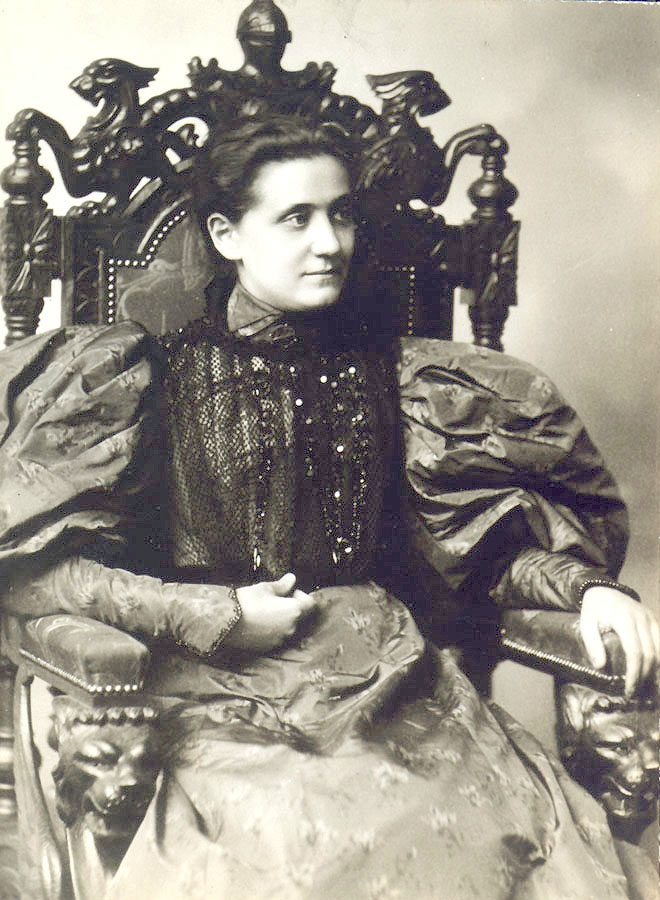
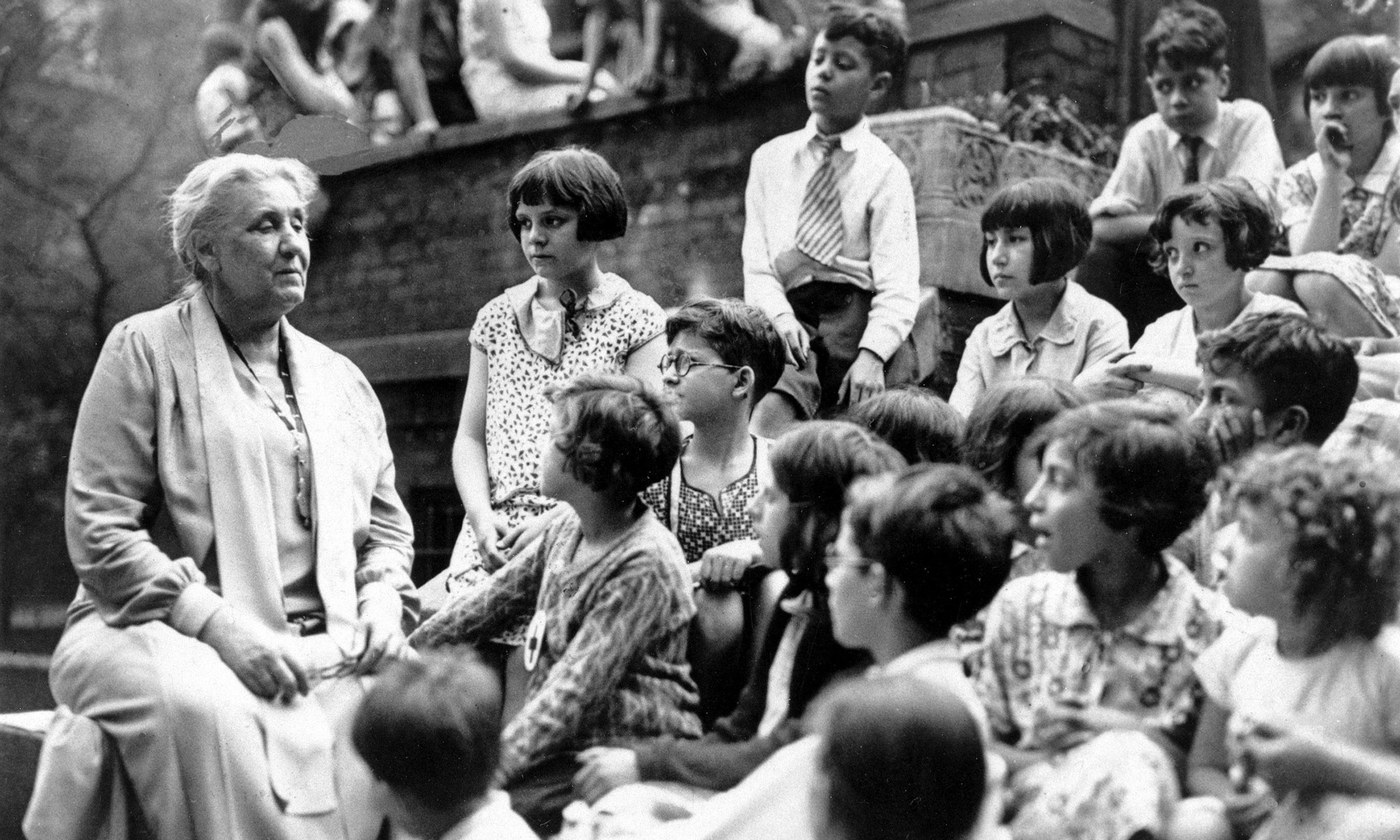
In the mid-1890s Jane Addams became a municipal employee. Exasperated by the refuse that overflowed the wooden garbage boxes of Chicago’s Nineteenth Ward, she had put in a bid for the ward’s collection contract. The bid was thrown out on a technicality, and the mayor appointed her garbage inspector instead, at a salary of a thousand dollars a year. In Twenty Years at Hull-House she recalls getting up at six in the morning to see that the men were at work, following the loaded wagons to the dump and taking careless landlords to court. She tells the story with some humor, and it usually appears in accounts of her reform work; here I read it as part of another history, that of how knowledge about the city was produced.
Children played in and around the garbage boxes, and Addams judged the results of her work by the ward’s death rate, which she reports falling from third to seventh among the city’s wards. Knowing whether city services actually reached a given block meant being on that block, often at six in the morning.
Histories of urban sociology usually begin a few miles south, at the University of Chicago, with Robert Park, Ernest Burgess and the essays collected in The City in 1925. The volume turned a hundred in 2025, and Sociologia Urbana e Rurale, an Italian journal of urban and rural sociology, marked the anniversary with a special issue on the legacy of the Chicago School, edited by Alfredo Agustoni. In my contribution to that issue I asked what urban sociology might have looked like if the forms of urban knowledge developed by Jane Addams and the women around Hull-House had occupied a more central place in the discipline’s formative canon. The question is counterfactual and has to be handled carefully. It does not assume that Addams was a misunderstood founder waiting to be restored, or that the men at the University were detached theorists while the women on Halsted Street did the real work. The Chicago tradition was more mixed than that. John Dewey and George Herbert Mead, for instance, were close to Hull-House for years. What I argue is more specific. A disciplinary canon selects ways of knowing along with authors. Since the 1980s Mary Jo Deegan has documented how thoroughly the women of Hull-House were written out of the history of sociology, and with them, I suggest, went a particular way of studying the city.
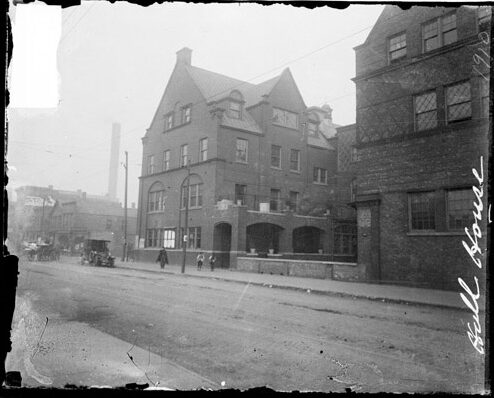
Hull-House opened in 1889, founded by Addams and Ellen Gates Starr in an old mansion on Halsted Street, in one of the most crowded immigrant districts of Chicago. It is remembered above all as a place of service, with its kindergarten and day nursery, its clubs and classes, its baths and, later, a playground. It also worked as an infrastructure for studying the city, though this side of it is less often noticed. Residents stayed for years and knew their neighbors’ wages, rents and illnesses from daily contact.
The best-known product of that work is Hull-House Maps and Papers, published in 1895. In 1893 Florence Kelley, then living at Hull-House, directed the Chicago part of a federal investigation of city slums conducted under the U.S. Commissioner of Labor, Carroll D. Wright. Agents went door to door across a third of a square mile just east of the settlement, and residents copied the schedules each evening before they were sent to Washington. Agnes Sinclair Holbrook, a recent Wellesley graduate living in the house, turned the figures into color-coded maps of nationalities and weekly wages, building by building, adapting the scheme of Charles Booth’s maps of London. Residents then wrote essays to accompany the maps, on the sweating system, child labor, the cloakmakers’ household budgets, the district’s Jewish, Bohemian and Italian communities, the county charities, and art and labor.
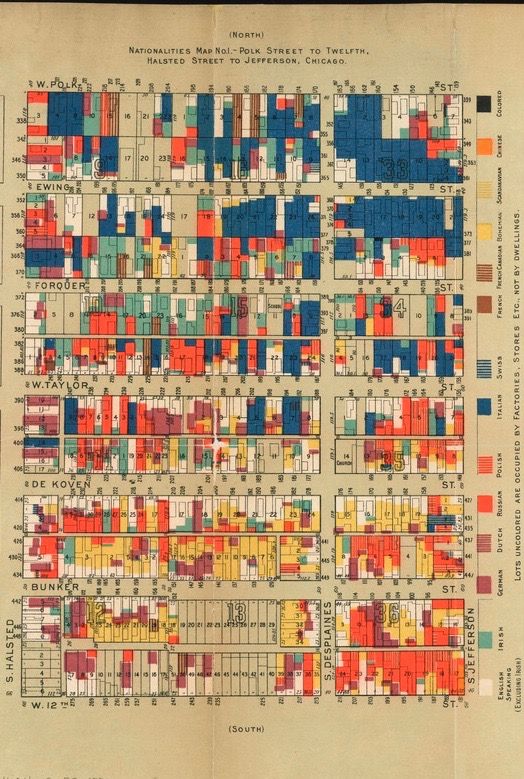
Addams’s prefatory note is modest. The residents offered the volume as recorded observations rather than exhaustive treatises, valuable, she wrote, because they were “immediate, and the result of long acquaintance.” She added that the settlement’s energies went chiefly to constructive work rather than to sociological investigation, and her own description of herself should be taken seriously. The book nonetheless pointed to practices that urban research would return to, often without acknowledging where they had first been tried. It set counts and maps beside essays by people who knew the streets, and it addressed a public that could act on the results. A present-day reader may see in it an early form of mixed methods, or of social cartography. These are retrospective labels, useful for comparison and nothing more.
In 1893, the year of the survey, Kelley was appointed Illinois’s first chief factory inspector, charged with enforcing a new law on sweatshops and child labor that she and other Hull-House women had helped to bring about. Addams took on the garbage a little later. From 1908 Edith Abbott and Sophonisba Breckinridge, both then living at Hull-House, directed long-running investigations of Chicago’s tenement districts that informed housing debates for decades. The settlement movement’s “three R’s,” residence, research and reform, describe this cycle well. Louise Wade, writing in 1967, attributed the phrase to an unnamed settlement worker. Historians of social welfare such as Walter Trattner have used it since, and Raffaele Rauty has made it a key to reading Addams’s work in his study of the settlements and the making of social analysis. It captures how Hull-House expected knowledge gathered close at hand to feed into public and institutional action.
Read with today’s eyes, the Hull-House way of working brings three aspects of urban life into focus, which I will call the body in the city, the inequalities built into urban infrastructure, and care as a public question.
The first is the body in the city. The settlement women gathered much of their knowledge through bodies, their own and other people’s. Kelley’s inspectors entered rooms where garments were finished alongside the sick. When typhoid swept the ward in 1902, Alice Hamilton, a physician living at Hull-House, looked for its causes in the neighborhood’s privies and in the flies that bred there, and Addams, as we have seen, followed the garbage wagons. Behind these practices lay the conviction that urban conditions are experienced physically, in the air people breathe and the work that exhausts them, and that a researcher who keeps her distance will miss some of them.
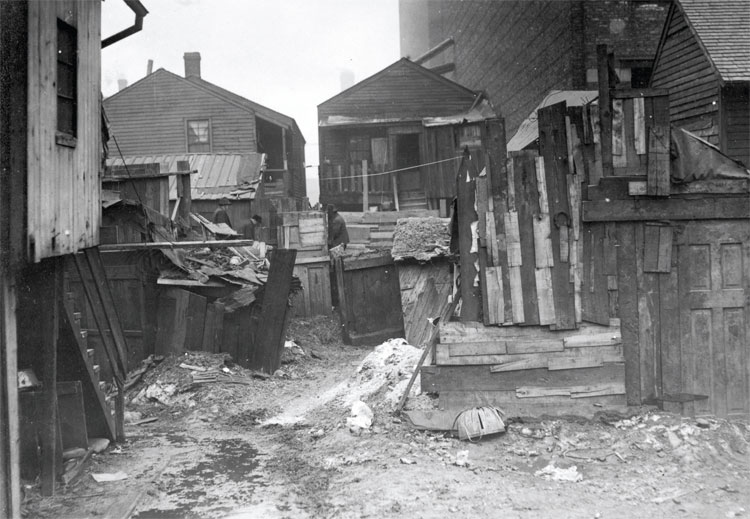
The second concerns inequalities built into urban infrastructure. Long before the Chicago sociologists of the 1920s wrote about “natural areas,” the Hull-House maps and essays had shown low wages, crowded tenements and sweated work concentrated among neighbors who were poor, foreign-born, very often women and children, and frequently all of these at once. The residents did not have the vocabulary of intersectionality, and lending it to them would be anachronistic. Their work nonetheless made visible overlapping forms of disadvantage, of class, nationality, gender and age, that later theories would conceptualize more explicitly. It also tied that disadvantage to tenements, workshops and garbage collection as much as to individual lives.
The third is care as a public question. In her suffrage writings, among them “Why Women Should Vote” in 1910, Addams argued that a modern city was in large part an enlarged household. Clean streets, decent schools and sanitation were housekeeping carried out at urban scale, yet the women traditionally held responsible for them had no vote over how they were done. In a 1911 newspaper series she wrote that Chicago women needed the municipal vote to secure clean milk for tenement-house babies. The argument belongs to its period and leans on a conventional idea of women’s sphere even as it uses that idea to bring women into public life. Its effect was to move care out of the private home and into municipal responsibility. The day nursery, the Jane Club for working women, the playground and the baths at Hull-House can be read as small working versions of it.
Addams’s distance from academic sociology was partly her own doing. In an undated letter that the Papers Project places around 1913, Albion Small, head of the sociology department, asked her whether she would consider a professorship carrying half the usual teaching load. Addams turned it down, as she turned down other offers of a university post, preferring to keep her independence. She was nonetheless a charter member of the American Sociological Society and gave papers at its meetings. The rest of the story concerns a young discipline that sought scientific authority partly by distancing itself from reformers. Robert Park, who joined the department around the same time, had come out of journalism with serious doubts about the motives and effects of reform. Deegan, who writes that Park’s work was shaped by social reform but that “he despised this association,” argues that he and Burgess worked to keep sociology clear of it. Some historians of Park contest her reading, though the institutional outcome is clear even without it. In 1920 Abbott and Breckinridge brought the Chicago School of Civics and Philanthropy, which they had shaped and led for years, into the University as the School of Social Service Administration. The new school gave social work a prestigious place in the University, separate from the sociology department. Research and theory stayed on one side and social work and reform went to the other, a division that also followed gender lines. Along with a group of women, the idea that studying a city could mean living in it and answering for what happened next ended up on the far side.
Similar concerns have resurfaced in recent urban policy, and they touch the same three aspects. Vienna offers the earliest and most sustained case. After a 1991 exhibition on women’s everyday life in the city, the municipality opened a Women’s Office in 1992, headed by the planner Eva Kail, and gender-sensitive criteria gradually entered its housing, public space and transport planning, as the city’s manual on gender mainstreaming in urban planning documents. Seoul’s Women-Friendly City project, launched in 2007, made women’s everyday experience of streets, transport and public facilities, including their safety, a concern of urban policy, though critics at the time faulted some of its measures for leaning on gender stereotypes. In 2019 Barcelona published a manual for planning the city around everyday life with a gender perspective, which treats the times and places of daily routines, care among them, as matters of urban design. The Nineteenth Ward would have recognized the problem. All three programs come out of feminist planning and geography since the 1970s and have no direct line to Hull-House. What they share with it is a starting point in bodies moving through the city and an attention to how unevenly infrastructure and care are distributed.
Recovering Jane Addams, then, is not simply about adding a forgotten woman to the list of founders. It requires asking what forms of urban knowledge were marginalized when her work, and that of the settlement women around her, was pushed to the edges of the discipline. Read again today, that knowledge held together attention to the body in the city, to the inequalities built into its infrastructure and to care as a public responsibility, three concerns that the discipline’s canon would long treat as peripheral, or frame in other terms. It came from studying the city from within, through long residence, counting and mapping, with an eye to what would happen next, and it was filed under charity or activism instead of theory.
The question still bears on the present. Cities today are measured far more intensively than the Nineteenth Ward ever was, through sensors and digital platforms, and much of that data is held by private companies, out of reach of the people it describes and of the public institutions that answer to them. The residents of Hull-House copied the federal schedules each evening before sending them to Washington, and that copy is what made their maps possible. Whether today’s urban knowledge resembles the work done on Halsted Street will depend on who is close enough to see, who holds the data, and what the knowledge is meant to change. In that sense the city that could have been remains a question about the cities, and the kinds of urban knowledge, we choose to produce today.
Selected Sources
Abbott, Edith. The Tenements of Chicago, 1908–1935. Chicago: University of Chicago Press, 1936.
Addams, Jane. Twenty Years at Hull-House. New York: Macmillan, 1910.
Addams, Jane. “Why Women Should Vote.” Ladies’ Home Journal 27 (January 1910): 21–22. Jane Addams Digital Edition, https://digital.janeaddams.ramapo.edu/items/show/6155
Addams, Jane. “Why Women Should Vote.” Chicago American, March 27–30, 1911. Jane Addams Digital Edition, https://digital.janeaddams.ramapo.edu/items/show/7319
Agustoni, Alfredo, ed. “Il lascito della scuola di Chicago. Rileggere The City cent’anni dopo.” Special issue, Sociologia Urbana e Rurale 140 (2026). https://www.francoangeli.it/riviste/rivista-fascicolo?IDRivista=54&lingua=It&anno=2026
Ajuntament de Barcelona. Manual d’urbanisme de la vida quotidiana. Urbanisme amb perspectiva de gènere. Barcelona, 2019. https://ajuntament.barcelona.cat/usosdeltemps/en/actuacio/everyday-life-urban-planning-manual-urban-planning-gender-perspective
Bernardi, Monica. “The City That Could Have Been: Urban Theory through the Women of the Chicago School.” Sociologia Urbana e Rurale 140 (2026): 92–120. https://doi.org/10.3280/SUR2026-140005
Booth, Charles. Life and Labour of the People. Vol. 1. London: Williams and Norgate, 1889.
Bulmer, Martin. “Robert Park’s Journey into Sociology.” In The Anthem Companion to Robert Park, edited by Peter Kivisto, 37–50. London: Anthem Press, 2017.
Deegan, Mary Jo. Jane Addams and the Men of the Chicago School, 1892–1918. New Brunswick: Transaction, 1988.
Christian Science Monitor. “What Do South Korean Women Really Want?” October 27, 2009. https://www.csmonitor.com/World/Asia-Pacific/2009/1027/p06s10-woap.html
Hamilton, Alice. Exploring the Dangerous Trades. Boston: Little, Brown, 1943.
Lynn, Stacy. “Battling a Ward Boss: Addams vs. Powers.” Jane Addams Papers Project, 2017. https://janeaddams.ramapo.edu/?p=939
MacLean, Vicky M., and Joyce E. Williams. “‘Ghosts of Sociologies Past’: Settlement Sociology in the Progressive Era at the Chicago School of Civics and Philanthropy.” The American Sociologist 43, no. 3 (2012): 235–263. https://doi.org/10.1007/s12108-012-9158-1
Park, Robert E., Ernest W. Burgess, and Roderick D. McKenzie. The City. Chicago: University of Chicago Press, 1925.
Rauty, Raffaele. Il tempo di Jane Addams. Sviluppo dei settlements e costruzione dell’analisi sociale. Napoli: Orthotes, 2017.
Residents of Hull-House. Hull-House Maps and Papers. New York: Thomas Y. Crowell, 1895. https://archive.org/details/hullhousemapspap00newy
Seoul Metropolitan Government. “Women Friendly City Project.” Seoul Solution. https://seoulsolution.kr/en/node/2058
Sklar, Kathryn Kish. Florence Kelley and the Nation’s Work. New Haven: Yale University Press, 1995.
Small, Albion W. Letter to Jane Addams, ca. 1913. Jane Addams Digital Edition, https://digital.janeaddams.ramapo.edu/items/show/5745
Trattner, Walter I. From Poor Law to Welfare State: A History of Social Welfare in America. 5th ed. New York: Free Press, 1994.
Wade, Louise C. “The Heritage from Chicago’s Early Settlement Houses.” Journal of the Illinois State Historical Society 60, no. 4 (1967).
Wright, Carroll D. The Slums of Baltimore, Chicago, New York, and Philadelphia. Seventh Special Report of the Commissioner of Labor. Washington, DC: Government Printing Office, 1894.