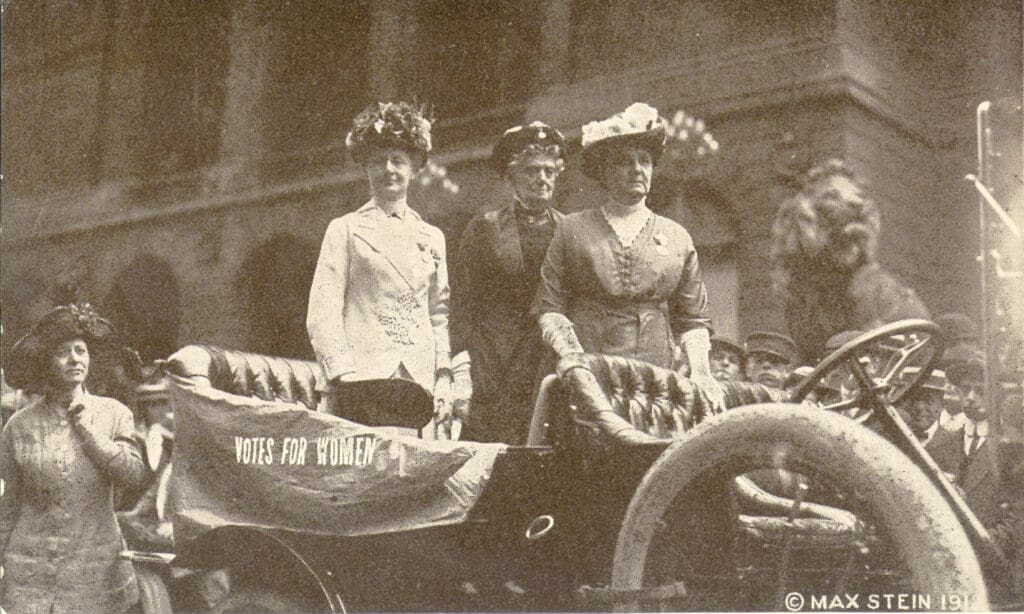
Jane Addams, the Imperialist?! by Sheryl Gordon

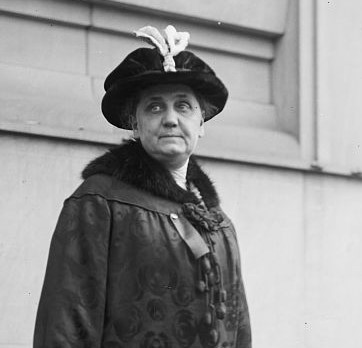
A woman wearing a dark, patterned coat with a fur collar and a decorative hat stands in front of a building, looking slightly to the side.

Sheryl Gordon is an Assistant Professor in the History and Political Science Department at Molloy University on Long Island, NY. Her research has centered on peace history and international relations in the early twentieth century. She published โ€œThe Limits of Labels: Jane Addams and Her Views on Self-determination and Imperialism, 1899โ€“1923,โ€ in Peace & Change: A Journal of Peace Research in 2024. She has book in press with Bloomsbury Academic entitled Marian P. Whitney and the Problem of Being a Prominent Person in the Progressive Era.

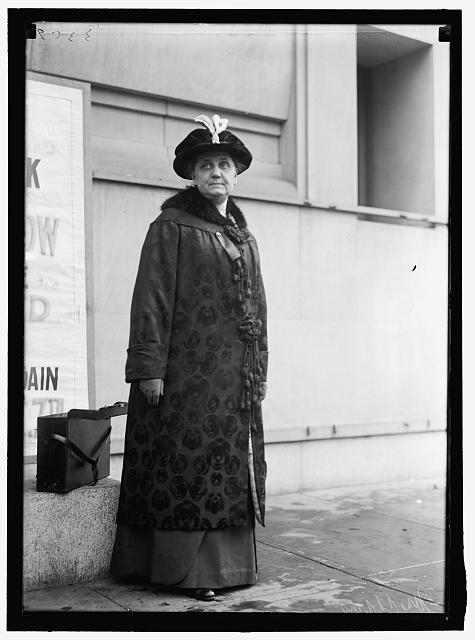
A woman in early 20th-century clothing, including a long patterned coat with a fur collar and decorative hat, stands on a sidewalk next to a case and a wall with a partial poster visible.
Jane Addams (1913) – Library of Congress

I started researching Jane Addams a few years ago for a course on women in American history I was preparing to teach. She seemed to fit well within the scope of my research interests as well, which are on peace history and the World War I era. After all, in addition to her social work, Addams was one of the best-known pacifists in America. She was even labeled โ€œthe most dangerous woman in Americaโ€ because of her national stature and her pacifist views. As I read through her published works, her dedication to peace and humanitarianism were clear. Then I came across a brief article she wrote in 1921 titled โ€œThe Potential Advantages of the Mandate System.โ€[1] The article seemed completely opposed to her other work and worldview. The mandate system was created as a provision of the League of Nations after World War I that gave Western European nations control of the economic resources of the defeated nations and former colonies of Germany. For much of the twentieth and twenty-first centuries, the mandate system has been viewed as imperialist.

Was Jane Addams really promoting imperialism, a system linked to militarism and war?

Had her views changed since 1899, when she opposed the U.S. annexation of the Philippines in the aftermath of the Spanish-American War? Or had she been misunderstood by her contemporaries and scholars in some ways?

I could not find much in the secondary sources to help explain her views on imperialism or the mandate system. Addams was labeled generally an anti-imperialist. Marilyn Fischer, Professor Emerita at the University of Dayton and scholar on Addams, provided valuable guidance on Addamsโ€™s motivations and outlook. In the Jane Addams Digital Edition, I saw how Addams maneuvered through events and issues with peace as her north star. 

I searched the digital edition to see if Addams expressed any thoughts to her colleagues in the Womenโ€™s International League for Peace and Freedom (WILPF), family members, or friends about her views on imperialism and the mandate system. Looking through various letters and material, I examined her views towards the Anglo-Irish War, or Irelandโ€™s campaign for independence from imperialist England. It began in 1919 and ended with a truce in 1921 that divided Ireland into a free state and parts controlled by England. I also found the archive useful for understanding her views on the League of Nations and mandate system.

โ€œJumping into Boiling Oil:โ€ Addams and the Anglo-Irish War

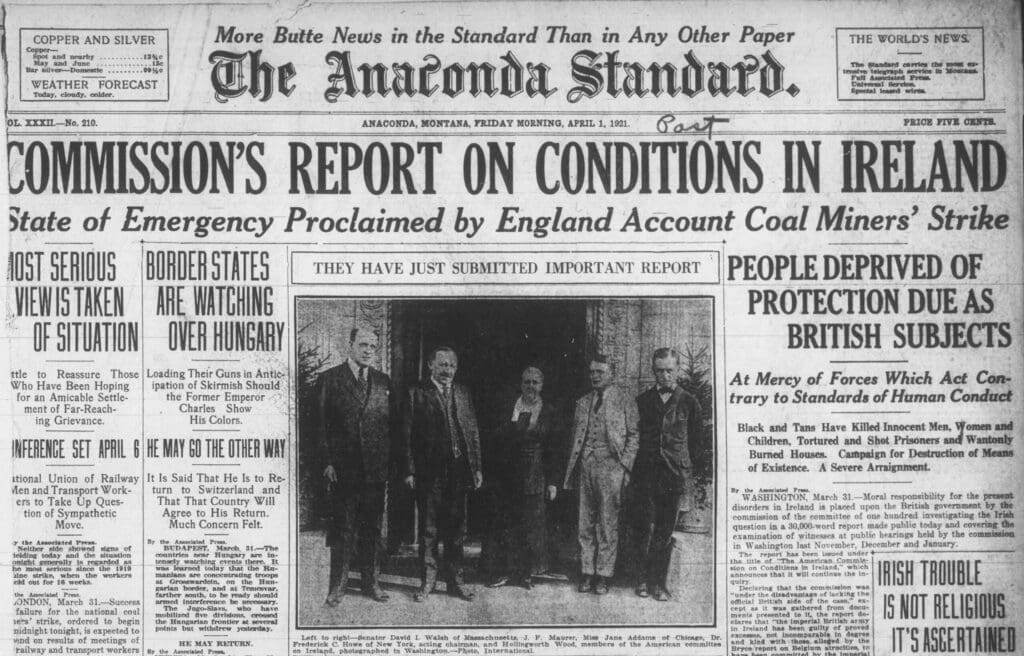
Opinion in America about the Anglo-Irish War was extremely divisive. Anti-British sentiments in America intensified as reports circulated of atrocities committed in Ireland by British soldiers. Addams was part of a group of 150 politicians, selected individuals, and clergy to examine the situation in Ireland. She even served as temporary chair of this group, known as the American Commission on Ireland. A letter written to Emily Greene Balch, International Secretary-Treasurer of WILPF, shows how dedicated Addams was to pursuing peace in this conflict. Addams wrote to Balch in 1920 about becoming involved with the Commission, โ€œI quite realize that it is jumping into boiling oil as it were, but it may be useful and even afford a chance for our old idea of continuous mediation.โ€[2] In a letter to her English friend and WILPF colleague, Henrietta Octavia Barnett, Addams explained she was involved with the Commission to lessen the chance for military escalation.[3]

Addams viewed the Commission as a way to help England and Ireland arrive at a resolution. What was not in the digital edition was also meaningful. Addams expressed sympathy for the suffering of Irish civilians and helped how she could. In her correspondence, though, Addams did not express support for Irelandโ€™s right to choose a government supported by the majority. In her published and unpublished writings, Addams prioritized food security for nations. For Addams, it was more important to avoid a war, which would further endanger the population in Ireland.  

Black and white 1921 newspaper front page with bold headline about Ireland, several articles, and a photo of seven men in suits standing outside a building.
Headline of the Anaconda Standard with image of Jane Addams and other Commissioners, April 1, 1921.

Addams and the Mandate System

Reading through her unpublished letters in the digital edition, I understood better her support of the League of Nations and views of the mandate system. The thinkers she corresponded with discussed the mandate system as the path to peace in a world uprooted by war. Since the control over nations would be temporary, transparent, and supervised, they did not view the mandate system as imperialism. These thinkers reasonably influenced her views.

Addams began to envision a different pathway to permanent peace. Before the war, Addams was optimistic that citizens could work together to pressure their governments to create conditions necessary for peace. These conditions meant having enough food and resources. After the war, Addams viewed governments incapable of creating these conditions. Several governments had collapsed and economies were in shambles. For Addams, the League of Nations would be able to balance the worldโ€™s economic resources to provide humanitarian aid for immediate suffering and to help countries regrow their economies. Only then could the conditions for lasting peace be created. Addams expressed confidence that the League of Nations would be able to minimize nations from being exploited in this process.

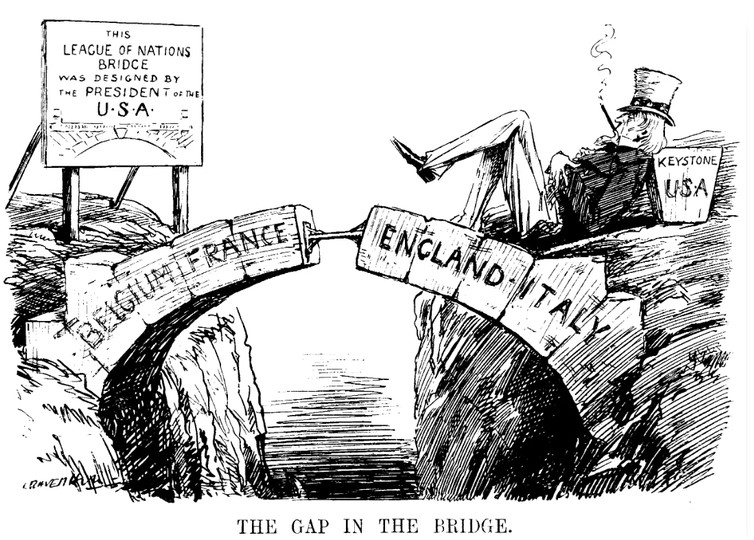
Addams wanted America to join the League of Nations to help with this humanitarian aid. She had worked for the government during the war helping with international food relief efforts. She wrote to Balch after the war that famine relief was โ€œthe most useful thing that can be done just now.โ€[4] The digital edition contains several newspaper articles summarizing her various talks across the nation and abroad. The articles reveal how she tailored her message to each group to convey her message most effectively. Letters with Balch and Anna Garlin Spencer, the president of the U.S. Section of WILPF, indicate they had a different priority.[5] Undeterred, even when the U.S. did not join the League of Nations, Addams focused on bringing her message to the public. She continued to advocate humanitarian relief as a pathway to peace.

Political cartoon of a man in a top hat, labeled USA, sitting on a missing keystone between two bridge halves labeled Europe/France and England/Italy, with a sign about the League of Nations Bridge. Text: The Gap in the Bridge.
Cartoon highlighting the United States refusal to join the League of Nations (Punch, December 1919).

So, was Addams promoting imperialism?

After countless focused searches and fulfilling falls through rabbit holes in the Jane Addams Digital Edition and re-reading her published works, I had an answer to my original question. Addams was not promoting imperialism. However, she was not focused on refuting it, either. Addams was an independent thinker. She supported causes based on the consequences she foresaw. She theorized the Philippine population would not benefit from U.S. annexation in 1899, so supported the anti-imperialist side. She believed the Anglo-Irish War would lead to military escalation and endanger the population in Ireland. So, she did not promote Irelandโ€™s right to self-determination. She deemed the League of Nations able to provide large-scale economic and humanitarian relief. So, she promoted it, providing certain guardrails were placed on Western nations. Embedded in her pacifism was the concept of food and resource security.

From examining her unpublished writings, we can get a better sense of the relationship between pragmatism, imperialism, and peace. Her writings reveal that anti-imperialism and pacifism are not always tied together. This understanding can be used in how we understand the womenโ€™s rights movement, international peace movement, and political landscape in the decade following World War I. We also gain a better understanding of Jane Addams. Her actions, a testament to her humanitarian and peace-focused worldview, speak louder than labels.


[1] Jane Addams, โ€œThe Potential Advantages of the Mandate System,โ€ The Annals of the American Academy of

Political and Social Science 96, no. 1 (July 1921): 70โ€“74, https://doi.org/10.1177/000271622109600115.  

[2] Jane Addams to Emily Greene Balch, October 26, 1920, Jane Addams Digital Editionโ€”Ramapo College f New Jersey (JADE), https://digital.janeaddams.ramapo.edu/items/show/21045.

[3] Jane Addams to Henrietta Octavia Barnett, April 22, 1921, JADE, https://digital.janeaddams.ramapo.edu/items/show/21984.

[4] Jane Addams to Emily Greene Balch, March 20, 1920, JADE, https://digital.janeaddams.ramapo.edu/items/show/28643.

[5] Anna Garlin Spencer to Jane Addams, February 23, 1920, JADE, https://digital.janeaddams.ramapo.edu/%20items/show/19973

Scholar’s Corner: Patricia Shields

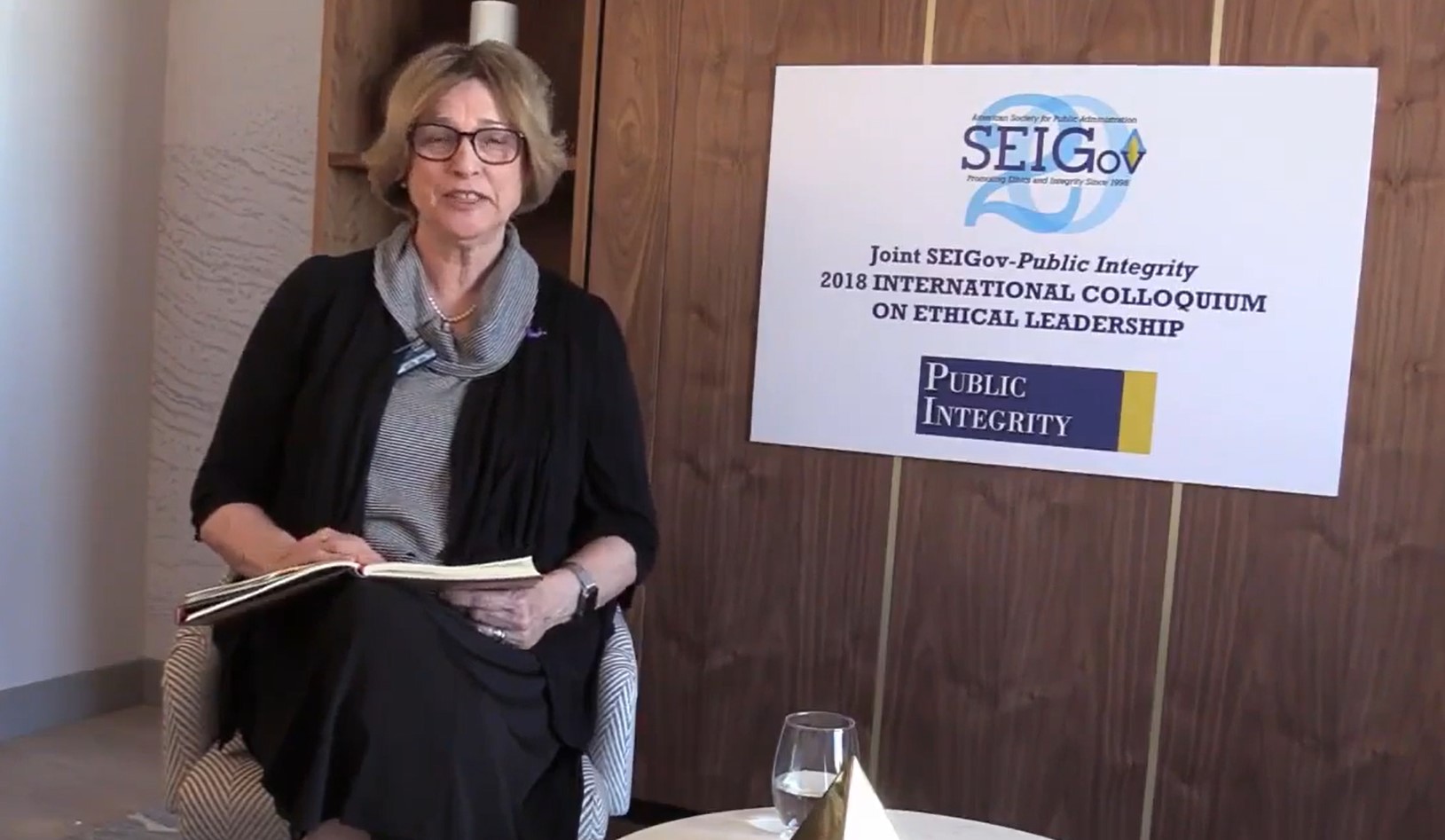
Patricia Shields sits holding a notebook, next to a sign reading 2018 International Colloquium on Ethical Leadership, Public Integrity, with SEIGov and Public Integrity logos visible behind her.

We want to thank Patricia Shields for sharing some of her research on Jane Addams!


Jane Addams’s Social Ethics (Video)

Patricia Shields on Jane Addams’s Social Ethics, April 24, 2018

https://hdl.handle.net/10877/8366

Patricia Shields sits holding a notebook, next to a sign reading 2018 International Colloquium on Ethical Leadership, Public Integrity, with SEIGov and Public Integrity logos visible behind her.
Patricia Shields, 2018


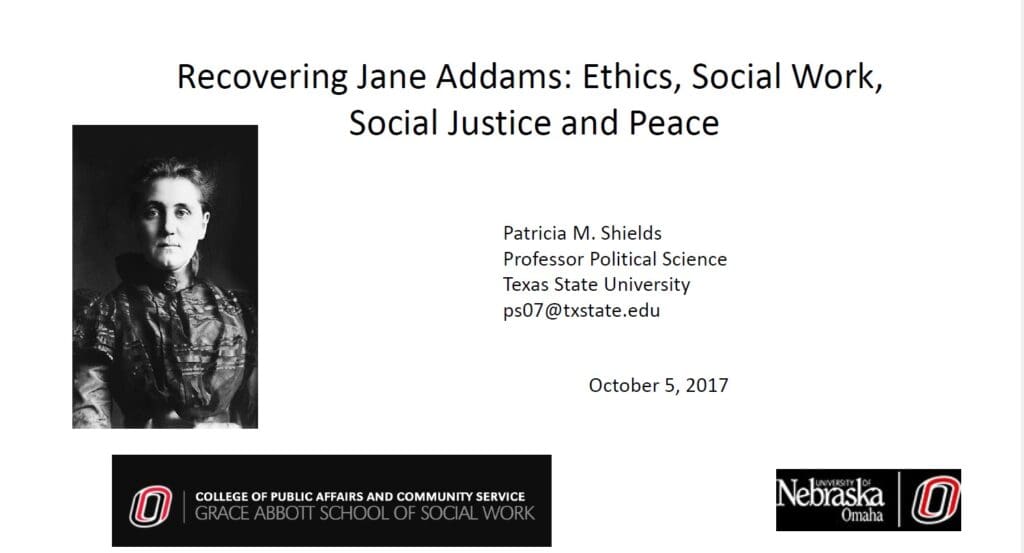
Recovering Jane Addams: Ethics, Social Work, Social Justice and Peace (PDF)

Patricia M. Shields, Recovering Jane Addams: Ethics, Social Work, Social Justice and Peace, Grace Abbott School of Social Work, University of Nebraska Omaha, October 2017.

Presentation slide titled โ€œRecovering Jane Addams: Ethics, Social Work, Social Justice and Peaceโ€ with a black and white photo of Jane Addams, event details, and logos of the University of Nebraska Omaha and Grace Abbott School of Social Work.


Jane Addams and the Women’s Peace Movement (Video)

Patricia Shields on Jane Addams and the Women’s Peace Movement, from Save Texas History Symposium on Texas and the Great War, September 16, 2017.


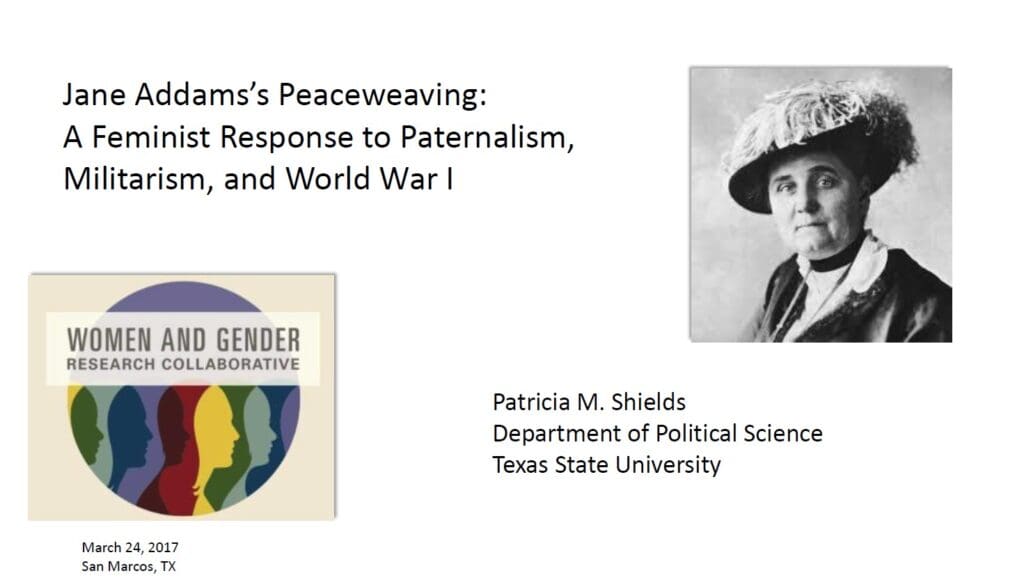
Jane Addams’s Peaceweaving: A Feminist Response to Paternalism, Militarism, and World War I

Patricia M. Shields, Jane Addams’s Peaceweaving: A Feminist Response to Paternalism, Militarism, and World War I, Women and Gender Research Collaborative, March 24, 2017.ย  (PDF)

Presentation slide titled Jane Addamsโ€™s Peaceweaving: A Feminist Response to Paternalism, Militarism, and World War I with Jane Addamsโ€™s photo, a Women and Gender Research Collaborative logo, and event details for Patricia M. Shields.

Womenโ€™s Activism Before the Second Wave: The Case of Florence Scalaโ€™s Leadership in the Working Class Neighborhood of Hull-House

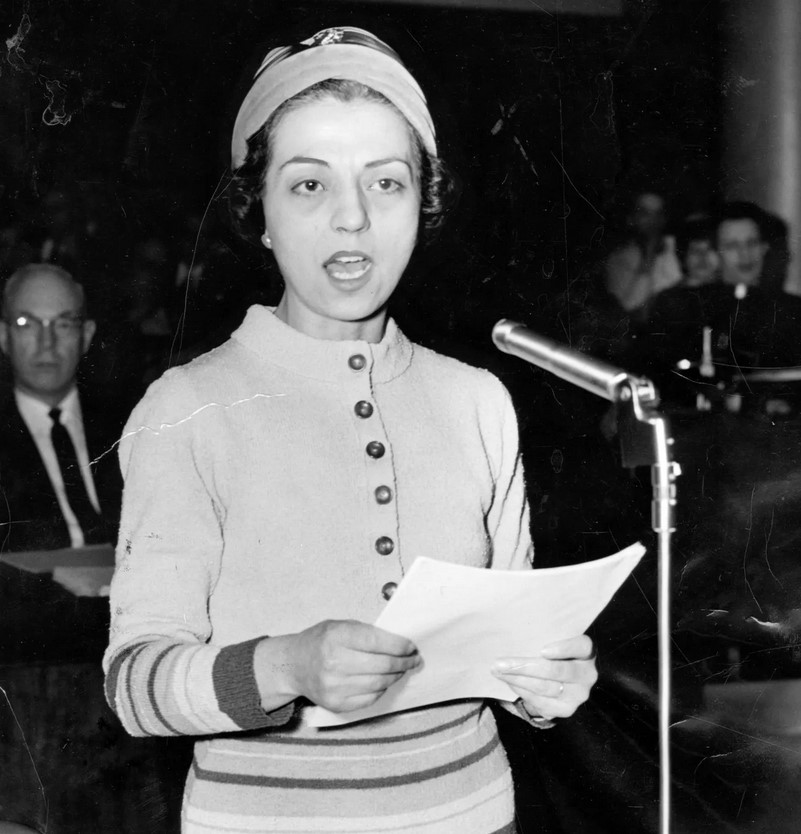
A woman in a striped dress and headscarf speaks into a microphone while holding papers, addressing an audience in a formal setting. People are seated in the background, listening attentively.

By Rima Lunin Schultz

A woman in a striped dress and headscarf speaks into a microphone while holding papers, addressing an audience in a formal setting. People are seated in the background, listening attentively.
Florence Scala speaking at City Hall in 1961 (Chicago Tribune).

In 1963, as Ann Keating recounted in her prior blog, Florence Scala had already been engaged as a social activist for several decades in the neighborhood made famous by Jane Addams. She had participated as a leader in the grassroots organization of her community on the Near West Side, had brought the various groups of people together in herย  working-class neighborhood to develop a plan to improve the community and remain residents.ย  This challenged the pattern of urban renewal that had emerged after World War II in American cities, where working-class residents were being moved or were moving themselves into suburban locationsย  away from their original neighborhoods close to the central city and the cultural and social institutions that they as immigrants had built. Here was a different attempt to live in urban space in an integrating and economically and socially mixed community that supported working-class culture.ย  Scalaโ€™s neighborhood was not characterized as a strong hold of feminist militancy.ย  Rather it was a place filled with religious and cultural institutions, ethnic shops

Florence had run for political office by 1963, twice. She hadn’t succeeded in winning, but she had given the city politicalย  organization, the political machine in Chicago, a scare. They had noticed her and worried about the spread of the democratic ideas and self-governing philosophy represented by her campaigns and her leadership.

When we look at the Scala’s story, it differs from the idea of a narrative of retreat, flight, and private life depicted by middle-class feminists of the second wave, when they began to develop a narrative of the origins of what they believed was a new and unique social movement of women who were being awakened from a kind of passivity and even apolitical consumerism as homemakers separated from the public events and public issues of the 40s and 50s and even early 60s. Remember 1963 is the publication date of Betty Friedanโ€™s The Feminine Mystique. ย  Florence Scala and the women of the near west side who joined her in the Harrison Halstead Street community group were not passive. They were not living private lives, disconnected from public issues. They were not separated from the challenges of urban life. Their narrative is very different.

Historians have begun the reclaiming or rediscovery of the working-class history in neighborhoods of urban America from the 1930s through the 1970s, and have begun to understand more fully that one of the major themes of the second half of the 20th century has been the transformation of cities by the intentional breakup of working-class neighborhoods. This was accomplished by the clearance of working class neighborhoods and the construction of upper and middle class housing in their place.

These working-class neighborhoods we have found in our research were never considered final or permanent parts of American urban life by the social reformers who cared deeply for the well-being of individual families, children, women, and men of the working classes but did not see the answer in working-class culture itself but only in the transformation of that working-class culture into something that resembled the middle class. It is not an accident then that we have failed to write the history of social activism of women of the working class.

We haven’t paid enough attention to the activities, daily life, and resistance and resilience of neighborhoods, the mixture of people and ideas that made up the social fabric of these neighborhoods and the value that the heterogeneity of these neighborhoods held for American democracy. Florence’s story becomes even more significant when we link it to the activities and efforts in cities across industrial America and when we begin to gather the biographies of women whose efforts to construct solutions for their communities brought them into public life alongside the men in the community just as they had joined the workforce at the beginning of the 20th century, even earlier, and had been visibly part of public life in working-class neighborhoods all along. They were never absent.

They were never isolated. They were connected and they were part of the social fabric of these communities. More than being part of the social fabric, they were builders of that social fabric along with male leadership and of course they had disabilities because of their sex.

How much credit should weย  give for Scalaโ€™s activismย  to Jane Addams and women of Hull-House? Florence is our best guide in evaluating the factors influencing her formation as a civic minded and ethically engaged community leader.

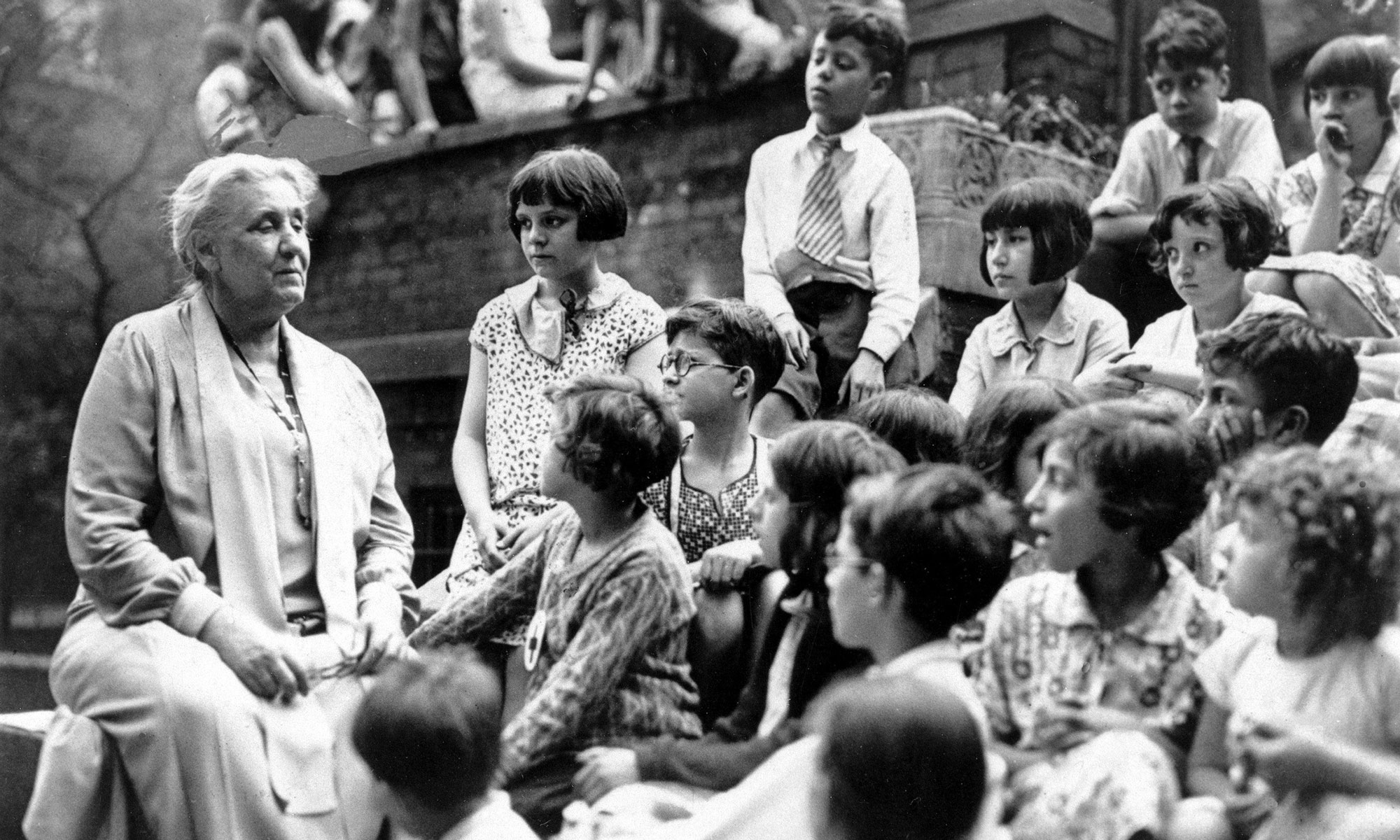
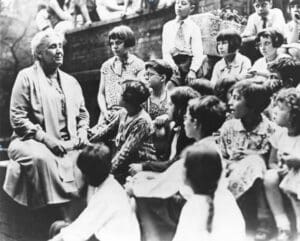
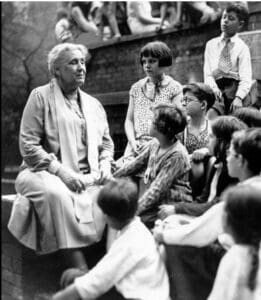
Jane Addams sits outdoors surrounded by a group of children, attentively listening to her. The scene appears historical, with everyone dressed in early 20th-century clothing.
Jane Addams and children on the steps of terrace in front of the resident’s dining hall. (University of Illinois, Chicago , Jane Addams Memorial Collection).

What Florence tells us in her talk to the teachers at Andrew Jackson Elementary School in 1994 is an important message. She tells the teachers how meaningful their role was in the neighborhood. They were guides and models of some of the best things about being American. Florence tells us something additionally about them. She says, they were able to understand us, meaning the children of immigrants, because they were themselves the children of immigrants.

These Irish American school teachers who taught Florence and her brothers at the Andrew Jackson School were themselves the products of this experience of becoming American. They modeled a kind of civic life, a public life, as educated women whose standing in the community at that time was important. They were respected and they were leaders.

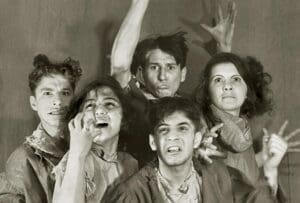
Five people in tattered clothing make dramatic, animated facial expressions and gestures, with arms raised and eyes wide, conveying intense emotion against a plain background. The photo is black and white.
Hull-House production of a Tale of Two Cities. Florence Scala is second from left. (Wallace Kirkland. University of Illinois at Chicago).

In an interview Florence recounted that the Irish American teachers were catalytic in bridging her family to the Social Settlement.ย  Florence remembered that her parents were not that eager to let their children go to Hull-House as they were wary ofย  sending her away from their gaze, their supervision. We can speculate further about the complicated social fabric of the neighborhood and the various opportunities for social growth.ย  Many of the first and second generation American teachers had been educated in the Roman Catholic schools in working class neighborhoods.

But Florenceโ€™s parents listened to the school teachers and she went to Hull-House, where women likeย  Jane Addams and Julia Lathrop, stood out as exemplars of women who supported educational opportunities for immigrant and working class children.

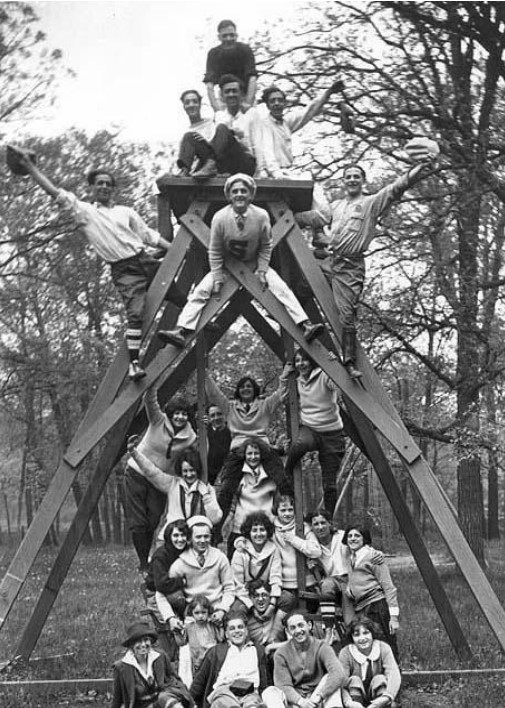
A group of people, mostly young adults, pose cheerfully on a large wooden playground structure in a park, smiling and waving. The structure is pyramid-shaped, and some people are sitting while others are standing or climbing.
Hull-House resident Edith de Nancrede (bottom left) and her social drama club. (University of Illinois at Chicago)

More than offering classes in the arts and in practical subjects, as well as history and civics, through clubs and summer camp Hull-House infused the working class children with a belief in their own value.ย  Scala explored her own interests and she realized there were possibilities for her own growth.ย  Florence made that connection and these women at Hull-House became models, models of independent, educated leadership of womanhood that could have a career, that could change the world. Florence was especially interested in dramatics.

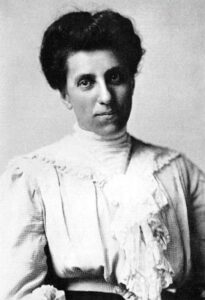
Black and white portrait of a Julia Lathrop wiith dark hair styled up, wearing a high-necked, long-sleeve light-colored blouse with ruffles and lace details, looking slightly to the side with a neutral expression.
Julia C. Lathrop, Hull-House resident and director of the Federal Children’s Bureau from 1912-1921. (Twenty Years at Hull-House).

The neighbors knew that Jane Addamsย  traveled abroad, that she spoke with important leaders in other countries, that she was for peace and opposed war, that she was for certain kinds of reforms in the United States. They had this idea of her and she was a model and she was real to them in the sense of showing, demonstrating how you could be a leader, a force in the public arena, a person of influence, who could encourage presidents and prime ministers to adopt certain programs. Julia Lathrop, went to Washington, D.C., to head the Children’s Bureau.ย  They were women who modeled women of service.

But it was not just Hull-House that demonstrated social activism and women participation in the social fabric of life. The women religious, who were the teaching sisters in the Roman Catholic schools in the neighborhood,ย  the women who were part of the congregational life of the parish churches, they had a degree of autonomy and agency that belies the fact that they were part of a religious institutional structure that was hierarchical, patriarchal, and in many ways conservative, and certainly not feminist. Yet, in the context of parish life and of the parochial schools that were set up and run independently of the male diocesan hierarchy, they had independence to some degree.

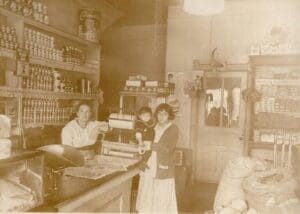
They were outspoken, independent women religious, like the guardian angel woman religious, Sister Filibert (Spizirri), who was a major supporter for the work that Florence and her activist women were doing in the neighborhood. Again, demonstrating a model of womanhood in a working class community that defied the stereotype of an obedient and passive nun who was under the thumb of the male clergy. Beyond this, or even before this, Florence had her mother and a grandmother and other mothers and grandmothers in the neighborhood who were part of the entrepreneurial journey that had taken them from Europe to America, to Chicago, to the neighborhood where they had found a way to own a store, a bit of property, to have made their way into the comfortable working class that lived in this near west side neighborhood of very mixed economic outcomes.

Sepia photo of an old-fashioned grocery store with shelves of cans and goods. A woman stands behind the counter, another woman holds a child in front. Various products and sacks are visible throughout the cozy shop.
Genarosa Napolitano and Mary Marinello holding Rose Marinello at 13 months old, in the family grocery store on Polk Street. (Courtesy of Father Steven Giovangelo).


Property ownership, home ownership, retail proprietorship flourished and we can see how women worked outside the home in these family businesses, holding their babies with them. These were family businesses and the community supported this kind of entrepreneurship. They worked alongside their husbands.

One of the things we learn about the Giovangelo family is that Florence’s mother worked alongside her father in the tailor shop. She ironed, she worked alongside his craft as a tailor.ย  The household was integrated into an economic unit that allowed the children to be near their mother and father, to have the mother and father have a partnership that sustained the family business.

So women were working. Then of course there were the women in the neighborhood who were working in factories, were taking homework back to their apartments andย  toiling,ย  on night shifts, were part of the trade unions.ย  They also were out on strike, were part of the picket lines. This was the working class neighborhood that Florence Scala inhabited.

There was no lack of female models of womanhood that projected engagement with the real world, engagement with public life, engagement with the economic realities of daily life and of the cultural and social institutions that made up the religious and cultural and ethnic activities of the neighborhood.ย  Florence and other working class women could readily see themselves in these women and dream of getting more education, of following new pathways and making decisions about their lives. What is interesting about the middle class version of working class life, which is the story of the men and women in the neighborhood that Jane Addams tells us, in her famous Twenty years at Hull-House and in other writings that she did in her lifetime, is how different her narrative about immigrant women in the neighborhood is from the one that I am describing. In the beginning, Jane Addams did not understand the immigrant women in her neighborhood very well. She thought of them as being isolated, disconnected, not just from the life of the city itself, but disconnected even from their own children who were going to become Americans very fast, very rapidly.

She saw that the Italian women, the Jewish women, Greek women, were not able to have the same relationships with their children that they had had prior to moving to America. They were disconnected, isolated. She tells a number of stories in Twenty Years at Hull-House that identify this situation (Jane Addams, โ€œFirst Days At Hull-House,โ€ Chapter 5 in Twenty Yearsย  at Hull-House with Autobiographical Notes (New York: Macmillan, 1910), 110-111).

Women who don’t know much more than what they can learn from the small place they live in, the block they live in. They don’t know about the world outside. They can’t connect.

She sees them as she worries about them, she cares about them, but she does not see them as a source of strength, a source of activism. She does not see them as participating in a social life, she says they have no social life (Jane Addams, โ€œForeign-Born Children in the Primary Grades,โ€ National Educational Association Journal of Proceeding and Addresses of the Thirty-Sixth Annual Meeting Held at Milwaukee, Wis., July 6-9, 1897 (University of Chicago Press, 1897), 106).

She means not that they don’t go to parties and that kind of social life. She means they have no relationship to the social structure in society. This is a sociological observation on her part, that they’re not connected and even if they could vote at that time, they have no relationship to a public opinion.

A sense of civic-mindedness has to develop.ย  She would not look to them necessarily as being capable of developing the kind of leadership role in the community of a Florence Scala. It’s not surprising to me when I read how the director of Hull-House at the time of Florence’s major leadership in the neighborhood, a man by the name of Russell Ballard, is happy for what Florence is doing in her political life, but would not have imagined her doing anything like that or being capable because he has his perspective, like Jane Addams’, even though he has worked closely, as Jane Addams did, with the neighbors.

Ballard has even worked more closely with neighbors, in the 1950s when he was director, was involved with the Near West Side Planning Board. He has seen the capacity of the neighbors to be their own leaders and organizers. He still retains this stereotype of working-class life and of working-class women and is hard-pressed to see Florence as something more than an energetic and well-intentioned housewife.

Addams later developed a deeper understanding of what the women in the neighborhood were really all about and she began to see that their activities, which she could not have defined initially as being a form of social activism, were indeed examples of a challenge to the conditions of life and to the patriarchy. They were a form of resilience, resistance, and in many ways a kind of feminist consciousness that she had missed in her descriptions done earlier. This realization that the women were part of a social movement that had more in common with radical feminism than she had understood before was the revelation that she writes about in The Long Road of Women’s Memory in 1916, an important book that deserves more attention (Jane Addams, The Long Road of Woman’s Memory (Urbana & Chicago: University of Illinois Press, 2002). In this, she began to understand that the working class women in the neighborhood were engaged in challenges to the system that oppressed them and their families at the same time that they were community builders developing cultural and social space for themselves and their group in very positive leadership roles.

By the 1940s, women in working-class neighborhoods were participating in movements to improve the schools, to deal with race relations, to provide daycare and healthcare for children, and to develop affordable housing. They were standing up for their rights and the rights of minorities in the state legislature and they were fighting for representation in the unions of the AFL that were traditionally resistant to women’s participation and the empowerment of women trade unionists. This was happening at the same time that other women were developing community life in suburbia, creating new religious institutions, joining PTAs, developing school boards, working for bond issues to pay for libraries, beginning to attack the major polluters who were poisoning the air and the food supply, worrying about nuclear war.

All of this was going on in this period and when we begin to examine working-class life in more complicated gendered ways and in the context of resistance to urban renewal as a form of social activism that was more than simply a reaction to the migration of blacks to northern cities, but had to do with a more complicated set of issues stemming from the failure of social reform to accept and value heterogeneous working-class districts as permanent parts of urban America.

Working class women were on a different timetable then their middle class sisters. Working class women continued to navigate family businesses, low paying jobs, and maintainย  devotional and cultural affiliations and kinship relations locally and internationally.ย  This differed from the stereotype of the American suburban housewife after World War II.ย  This paper cannot begin to dislodge that stereotype.ย  Here we are focusing on the social activism of a working class woman and her allies in a period in which womenโ€™s activism had been considered minimal.


Rima Lunin Schultz is an academic historian who has written articles and books on Jane Addams, Chicago women in Catholic and Protestant faith traditions and the culture of urban elites. She serves as a member of the Project’s Advisory Board.ย 

Florence Giovangelo Scala, Hull-House and Neighborhood Planning

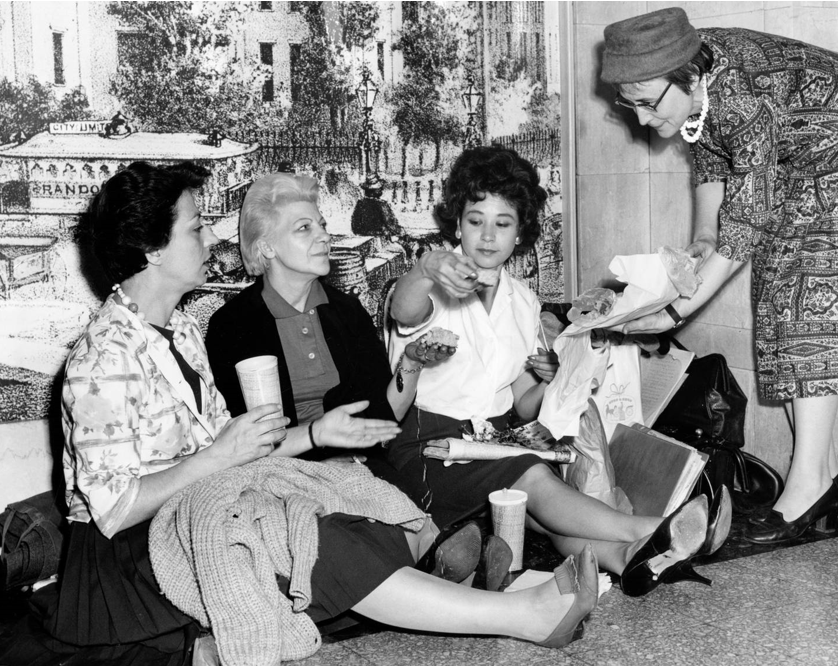
Three women sit on the ground eating and drinking, while a fourth woman, standing, hands them food. They are indoors, beside a wall with a mural. The women appear to be engaged in conversation and sharing a meal.

By Ann Keating.

Note by the author: Rima Lunin Schultz and I have been working for six years on a manuscript entitled: In the Shadow of Jane Addams: Planning in a Working-Class Neighborhood, 1889-1963.ย  We have encountered many interesting characters, including Florence Scala.ย  Scala is famous for leading the unsuccessful fight against construction of the University of Illinois in the early 1960s (she was in favor of a Chicago campus but not the Near West Side location).ย  Less well known was her strong connection to Hull-House and neighborhood planning efforts.

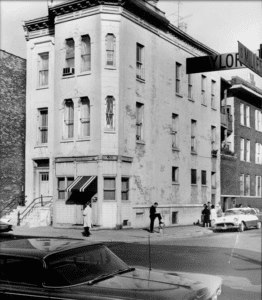
Black-and-white photo of a three-story corner building with worn walls and a striped awning over the entrance. People walk on the sidewalk, cars are parked, and a street sign reads Taylor and S. Miller St.
Giovangelo residence at 1030 West Taylor Street (Chicago Tribune, October 19, 1962).

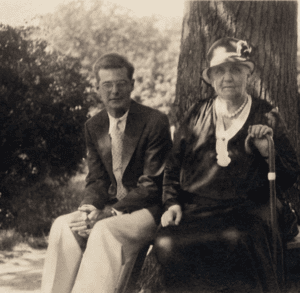
Florence Giovangelo Scala was born on September 17, 1918, to Italian immigrants Alex and Teresa (Scardepane) Giovangelo. She grew up with her younger brothers in an apartment above her parentsโ€™ tailor shop at 1030 W. Taylor on Chicagoโ€™s Near West Side. The Giovangelo children attended local public schools but also participated in programs at nearby Holy Guardian Angel Catholic Church and at Hull-House both before and after the 1935 death of Jane Addams. The settlement offered the siblings a place to go for sports, recreation, arts, and crafts activities.ย They particularly enjoyed theater productions under the direction of Edith de Nancrede and Eri Hulbert. In the early 1930s, Florence and her brother Ernie developed a close relationship with Hulbert, the grandnephew of Jane Addams.ย  Scala remembered that they were โ€œhis kids,โ€ and took many adventures with him.

A young man in a suit and glasses sits next to an elderly woman in a hat and dress, holding a cane, under a large tree outdoors. Both are looking at the camera with neutral expressions.
Jane Addams and grand-nephew Eri Hulbert, August 1932 (Jane Addams Papers, University of Illinois at Chicago).

On her high school graduation, Scala worked for the Federal Theater Project (WPA) at Hull-House, contributed to a local newspaper, and worked for the draft board.ย  She took college classes, got married, and lived in the same building as her parents on Taylor Street just west of Hull-House. During and after World War II, Scala, her brother Ernie (after attending the University of Illinois), and a group of their neighbors saw the threats to their neighborhood from plans for major expressways and slum clearance.ย  They found a staunch ally in Eri Hulbert who worked tirelessly to create the Near West Side Planning Board with the support of Hull-House. ย ย Scala remembered that Hulbert โ€œtorpedoed me into a big world of ideasโ€”the search for knowledge and understanding of people. To me he was a teacher and a persistent pioneer in this new idea that the people themselves must participate in the planning of their own communities.โ€[1] [2]

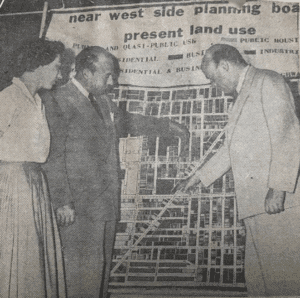
While her brother took a paid position with the Near West Side Planning Board, Scala volunteered as secretary and treasurer of the group between 1949 and 1958. An inveterate dog walker, Scala often had a camera in hand, taking photographs of her changing neighborhood. Scalaโ€™s photographs became a critical part of the reframing of the neighborhood not as a slum, but as a vibrant working-class district that needed rehabilitation and improvements.[3] The Planning Board undertook a survey of the Near West Side. Anita Villarreal, a thirty-six-year-old mother of six and active voice in the local Mexican community, created a seven-foot map of the area, while Scala continued to take photographs โ€œof the neighborhood, so that when we ha[d] our meetings, we could show these slides.โ€ Driving the area streets in her large car, she took candid color shots of everyday life that showed a working-class neighborhood with manageable problems. She developed and framed fifty of these images to create an illustrated lecture about the Near West Side, which she delivered to dozens of groups around the neighborhood with her brother. The siblings were central to creating an alternative to the idea that the neighborhood was blighted.[4]

Three people stand in front of a large planning board map labeled present land use, discussing and pointing to areas on the map as part of a planning meeting. The image appears to be from a newspaper.
Florence Scala, J. Ross Humphreys, and William Deknatel study a land use map. (Private collection of Father Steve Giovangelo).

Scalaโ€™s photographs, Villarealโ€™s map, and the raw survey data created a narrative to combat the idea that the whole neighborhood should be cleared. Instead, the Planning Board identified areas to be conserved, as well as some areas that would require slum clearance and redevelopment. That redevelopment could take several formsโ€”private housing, public housing, industrial renewal, and commercial revitalization. Their ideas came together in the groundbreaking 1950 NWSPB plan where, for the first time, a working-class community had developed its own plan for rehabilitation and renewal.

What followed was nearly a decade of delays and disappointments with little forward movement on the 1950 Plan.ย  Eri Hulbert died in 1955, the same year that Mayor Richard J. Daley began his long tenure at City Hall. Downtown interests had the ear of the new mayor, and they wanted new middle-class redevelopment to ring the central business district. They advocated the mass clearance of the working-class neighborhood around Hull-House. When the University of Illinois went looking for a Chicago location, Mayor Daley and those downtown interests endorsed a Near West Side location.

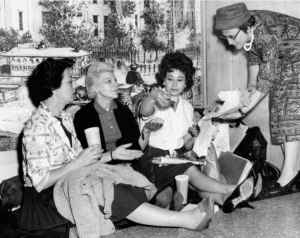
Three women sit on the ground eating and drinking, while a fourth woman, standing, hands them food. They are indoors, beside a wall with a mural. The women appear to be engaged in conversation and sharing a meal.
Florence Scala, left, during overnight sit in at Mayor Richard J. Daley’s office on October 11, 1962. (Frederick Giese / Chicago Tribune).

It is at this juncture, in 1961, that Florence Scala became a household name in Chicago. Her long years with the Planning Board and at Hull-House prepared her for the challenge ahead.ย  Well-known in the Near West Side for her unswerving support of planning initiatives, her neighbors pressed her to become their spokesperson. Scala quickly helped organize the Harrison-Halsted Community Group (HHCG) to protest the proposed campus site.[5]ย  She targeted the City Council and Mayor Daley in marches and sit-ins at City Hall that were well covered in local newspapers, radio, and emerging TV news. In 1963, sheย ran as an independent campaign for alderman; she criticized Chicago’s political “machine” and hoped to defend the interests of ordinary voters in her district. Scalaย endured ridicule, threats, and several bombingย attempts, but remained outspoken. But her campaign was not successfully and on March 5, 1963, the Hull-House trustees accepted $875,000.00 from the City of Chicago for their Near West Side properties.

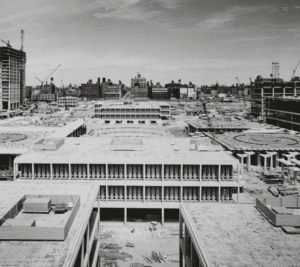
A black-and-white photo of a large urban construction site, with multiple modernist buildings in progress, cranes in the background, and a city skyline visible under a partly cloudy sky.
Construction of the University of Illinois, Chicago campus, 1964 (College Archives, University of Illinois, Chicago).

Scala, who had for long years been a part of the Hull-House community, was bitter when the settlement turned its back on its neighbors. With the closure of Hull-House and the opening of the University of Illinois campus, the Near West Side was irrevocably changed. It was no longer a working-class neighborhood centered on industrial sites, religious institutions, local parks, and Hull-House. The university now shaped who lived and worked there. Scala lived in the same building at 1030 W. Taylor Street until her death in 2007, but her working-class neighborhood was gone.

Dr. Ann Keating is the Dr. C. Frederick Toenniges Professor of History at North Central College. She is a co-editor of the Encyclopedia of Chicago, and author of several books on Chicago’s buildings and development.ย 


[1] Remarksย byย  Florenceย Giovangeloย Scala,โ€ Eri Hulbert Memorial Meeting, Hull House Garden, May 19, 1955, pgs. 19-20, Eri Baker Hulbert III Papers, Box 1, Folder 39

[2]Sandro Corso, โ€œFlorence Scala: A Disowned Community Leader,โ€ Italian Americana, 37, 2 (Summer 2019), 100-101; Eastwood, Near West Side Stories, 140โ€“141; and Florence Scala interview transcript, 4, Folder 69, Box 4, Hull-House Oral History Collection, Special Collections, University of Illinois at Chicago. See also โ€œMore Unpublished Reminiscences Steven Giovangelo,โ€ January 29, 2014, in possession of Rima Schultz.

[3]โ€œFlorence Scala, 47โ€ in Studs Terkel, Division Street: America (Pantheon Books, 1967), 5.

[4]Florence Scala quoted in Eastwood, Near West Side Stories, 154; NWSPB executive committee meeting, January 26, 1950, Box 39, Hull House Collection. See also Sandro Corso, โ€œFlorence Scala: A Disowned Community Leader,โ€ Italian Americana, 37, 2 (Summer 2019), 99-118.

[5]Scala in Eastman, Near West Side Stories, 154.

Democratic Ensembles: Spoken Art and Politics at Chicago Settlement Houses, 1890-1920

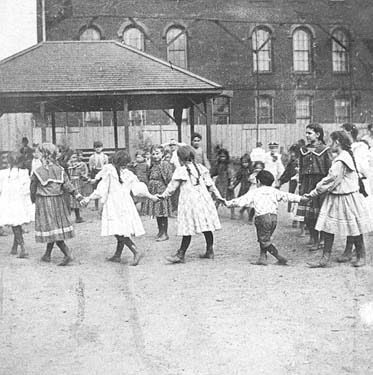
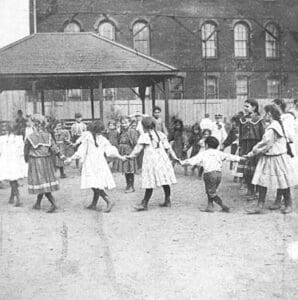
A group of children holding hands in a circle, playing outdoors on a dirt playground near a building with arched windows and a covered area in the background. The children are wearing old-fashioned clothes.

By Fiona Maxwell, PhD Candidate, Department of History, University of Chicago.

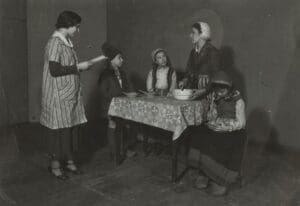
Four children in period costumes stand or sit around a table with bowls, while an adult woman in an apron stands beside them holding a book, possibly directing or reading to them in a staged setting.
Hull-House staffer Nicolette Malone working with actors for a dramatic performance (Hull-House Photograph Collection, University of Illinois Chicago).

In the Chicago settlement house movement, performance and sociability supplied a means and a metaphor for reimagining democracy as a collective project in service of the common welfare. My recently completed PhD dissertation, โ€œDemocratic Ensembles: Spoken Art and Politics at Chicago Settlement Houses, 1890-1920,โ€ takes self-governing settlement house clubs as a case study for exploring how Progressive Era concepts of social democracy unfolded in everyday practice. The project underscores the role of artistic collaboration in envisioning and bringing about desired political futures, and it introduces a more extensive dramatis personae to the history of Progressive reform.

Although a work of history, โ€œDemocratic Ensemblesโ€ has its origins not merely in writerly imagination and archival holdings, but in the actorโ€™s craft. I began studying at the Piven Theatre Workshop in Evanston, Illinois as a child, working my way through their performance ensembles and eventually joining the teaching staff. The Piven approach to actor trainingโ€”rooted in theatre games and story theatre adaptation, and defined by values of process, improvisation, and ensembleโ€”descends from the work of Neva Boyd and Viola Spolin at Hull-House during the 1920s and 1930s. While honing my skills as a performer and pedagogue, I kept hearing tantalizing whispers about a fabled prehistory of our approach.

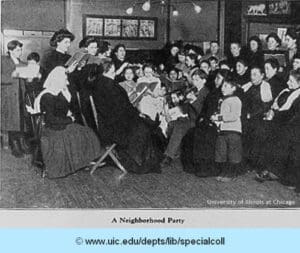
A black-and-white photo of a large group of women and children gathered indoors for a community event, labeled A Neighborhood Party. Some women appear to be reading or singing from papers.
A Neighborhood Party (Hull-House Yearbook Photos, University of Illinois Chicago)

When it came time to write a BA thesis as a History and Theatre major at Northwestern University, my mind immediately gravitated to Hull-House. I determined to learn as much as I could about the working-class Chicagoans who enrolled in settlement house arts education programs to further their educations, find like-minded peers, and exercise their creative imaginations. In this early stage, my research focused on the community reception of childrenโ€™s dramatics at Hull-House, with the goal of tracing the social and cultural history of early, pre-Spolin theatre education while foregrounding the perspectives of youth participants. I immersed myself in the Hull-House Collection at the University of Illinois at Chicago, as well as a burgeoning wealth of published and online resources, including the Jane Addams Papers Project. Wading through thousands of documents, I encountered Hull-Houseโ€™s dauntless cadre of reform-minded residents, as well as countless neighbors determined to realize their individual and collective aspirations. Reluctant to return home from this time travel expedition, I realized that pursuing a PhD was in order.

My early years of graduate school at the University of Chicago coincided with an explosion of public and scholarly discourse on democracy. During the late 2010s and early 2020s, historians began to revisit late nineteenth- and early twentieth-century reformers and theoristsโ€”particularly Jane Addams and John Deweyโ€”with renewed appreciation for their idea that democracy could be strengthened by social interaction across political and cultural divides and by prioritizing group welfare over individual gain. I embarked on my dissertation research paying close attention to how settlement workers articulated their theory of social democracy. I discovered that the language they used to describe their political philosophy mirrored the language that is still in practice today in ensemble-based theatreโ€”conceptual gifts from Progressive Era politics to contemporary artistic practice. Recognizing the broader political significance of the settlement story, I expanded my earlier focus on Hull-House theatre to embrace the โ€œspoken artsโ€โ€”including storytelling, group games, dramatic reading, oratory, and debateโ€”at settlement houses across Chicago, and I moved from children to โ€œchildren plus,โ€ examining how young people refined and implemented their artistic and political agendas as they aged and tracking how childrenโ€™s involvement catalyzed the participation of adult family members. I was lucky enough to discover a surfeit of underutilized materials in settlement club archives. At settlement houses across Chicago, working-class โ€œneighborsโ€ organized self-governing clubs that left plentiful records of their daily activities, in the form of constitutions and meeting minutes, neighborhood news and club gossip, and the occasional script, poem, joke, or lyric.[1] Piecing these fragments together recasts settlement houses, not merely as gathering places for the reform-minded middle and upper classes, but as genuinely grassroots centers of community education and local organizing.

A group of children holding hands in a circle, playing outdoors on a dirt playground near a building with arched windows and a covered area in the background. The children are wearing old-fashioned clothes.
Hull-House Circle Games

In its current iteration, โ€œDemocratic Ensemblesโ€ investigates the ways in which settlement volunteers and participants used the spoken arts to bridge social boundaries and develop a collaborative approach to democratic participation. Generations of scholars have explored the ways in which Chicago settlement leaders codified neighborhood service into new academic and professional fields, claimed a role for women in federal policymaking, and contributed to pragmatist philosophy and democratic theory. This dissertation uncovers the full โ€œensemble castโ€ of Chicago Progressivism by introducing two previously unexamined settlement constituencies: student volunteers from local universities, who drew on their interdisciplinary training in the arts, humanities, and social sciences to facilitate settlement pedagogy; and, most significantly, the neighborhood families who embraced settlement programming and made it their own. It joins an interdisciplinary scholarly conversation concerning how political, social, and artistic speaking genres have generated theories and practices of democracy, and it applies analytical frameworks drawn from book history, rhetoric, and theatre and performance studies. Combining archival research, interdisciplinary methods, and process-oriented theatre pedagogy, this project constructs a social and political history of spoken arts education, which adds to scholarly inquiry in urban history, gender history, and the history of childhood and youth and offers an actionable model for current practice. The dissertation tells the story of enfranchisement through cultural experiences and, in doing so, contributes a new conception of the role of the spoken arts in civic life.

The story begins with early settlement house founders diagnosing the lack of communal gathering spaces in industrial Chicago as a threat to the viability of democratic self-governance. The early chapters explore how settlement workers adapted traditional forms of domestic sociability and artistry to create a new piece of social infrastructure that invited equal participation from men, women, and children of all classes and cultural backgrounds. To explain how and why the spoken arts achieved such primacy in settlement programming, I analyze the formative experiences of a key yet previously unexamined subset of volunteer club and class leaders: students and graduates of Northwestern Universityโ€™s Cumnock School of Oratory, who organized settlement programs with a conviction that through performance and pedagogy, they could speak a more inclusive and collaborative public sphere into being.[2]

The remaining chapters conduct an in-depth analysis of on-the-ground settlement programming, tracking the transition from arts education to political organizing from the perspectives of school-aged children, working young people, and whole families. The ability of working-class, immigrant, and Black schoolgirls and boys to engage in collective deliberation and semi-autonomous artistic production inspired settlement workers to theorize childrenโ€™s club work as an apprenticeship for civic engagement. Working adolescents and young adults, meanwhile, utilized their skills in persuasive speech and organizational leadership to assert their voices in settlement administration and local reform. Experience with shared governance and extensive training in verbal expression enabled young people to transition from planning parties and staging plays to mobilizing in service of political change.[3] The participation of adult family members solidified the civic influence of the settlement project. When settlements inaugurated all-ages, mixed-gender governing bodies, fathers and sons were compelled to recognize their wives, sisters, and daughters as effective public actors. With the advent of municipal suffrage in 1913, neighborhood families began working to extend the vision of an activist, welfare-oriented local government they had devised in settlement clubs into formal electoral channels.

The idealism that accompanied whole-family politics shattered with the declaration of war in Europe in 1914. Global warfare abroad and racial violence at home exposed the challenges of bringing club ideals and methods into the world beyond settlement doors. โ€œDemocratic Ensemblesโ€ concludes by identifying postwar trends in settlement work and gesturing towards the subsequent evolution of settlement artistic methodologies, particularly their codification and widespread dissemination by mid-twentieth-century Chicago theatre practitioners and educators. Amidst the continued struggle to bring collaborative values and social consciousness into formal politics, Chicagoansโ€™ persistent commitment to neighborhood arts programs as a force for grassroots change has emerged as one of the most hopeful legacies of the Progressive Era.

Although the dissertation phase of this project is ending, it is only the beginning for โ€œDemocratic Ensembles.โ€ In the months and years to come, I intend to transform the dissertation into a book that has crossover appeal for scholars, practitioners, and the wider public. I look forward to continuing to mine settlement archives and sharing the stories they contain in a variety of formats, from academic writing to public performance.[4] The questions posed by settlement workers and participants over a century ago remain relevant today: as we continue to work towards more inclusive and equitable futures, how can engaging in everyday acts of cultural production help to foster common understanding, celebrate diversity, and provide the framework for an ensemble-based politics?

Fiona Maxwell is a final-year PhD Candidate in History at the University of Chicago. Her research and creative practice explore the connections between spoken performance and democratic social movements, with a focus on Progressive Era Chicago. In addition to her own writing and performance activities she collaborates with museums and arts organizations on content and program development. You can reach her at fmaxwell@uchicago.edu.


[1] I detail a key facet of this archiveโ€”club newspapersโ€”in Fiona Maxwell, โ€œClub Newspapers and Civic Collaboration at Chicago Settlement Houses,โ€ย C19: The Society of Nineteenth-Century Americanists Podcast,ย Season 8, Episode 3 (October 21, 2024).ย https://on.soundcloud.com/FY7sAtBt6ePA84pZ7

[2] For an article-length study of the gender dynamics of oratorical pedagogy at the Cumnock School, see Fiona Maxwell, โ€œโ€˜Expression is powerโ€™: Gender, residual culture and political aspiration at the Cumnock School of Oratory, 1870โ€“1900,โ€ Gender & History (2024): 1-18. https://doi.org/10.1111/1468-0424.12786

[3] For an example of this process, as illustrated by the Home Culture Club of young workingwomen, see Fiona Maxwell, โ€œโ€˜Talking lowd and laughing gay, Everyone has so much to sayโ€™: Working Girlsโ€™ Clubs, Spoken Art and Political Organising at Chicago Settlement Houses, 1890โ€“1920,โ€ Lilith: A Feminist History Journal (2025): 109-130. http://doi.org/10.22459/LFHJ.30

[4] I perform original, semi-fictional storytelling pieces based on settlement archival materials at universities, public history sites, and storytelling venues. Select appearances include Open House Chicago at the Jane Addams Hull-House Museum (2024) and Chicago Storytelling in Bughouse Square at the Newberry Library (2022).

Guest Post: Hearing Addams Speak

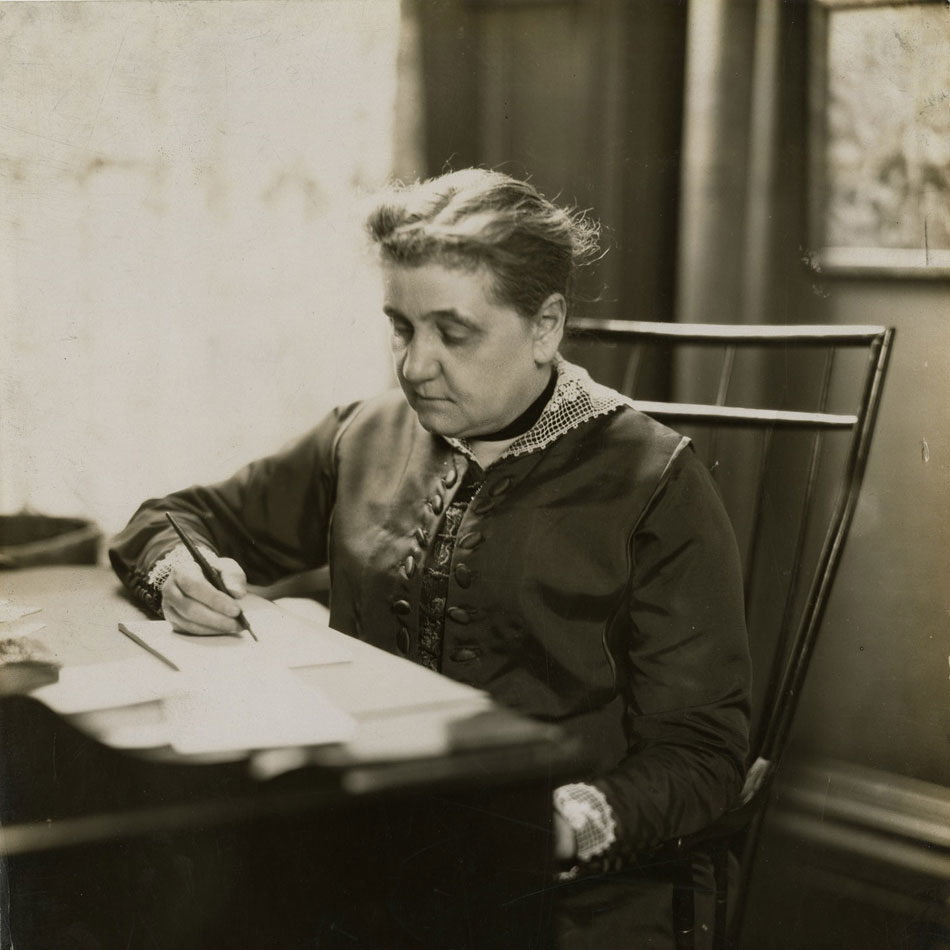
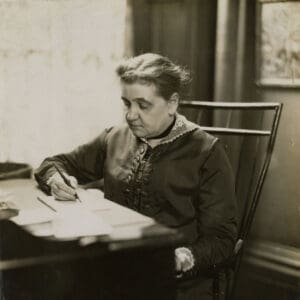
Jane Addams with neatly styled hair sits at a desk, writing on paper with a pen. She wears a dark dress with a lace collar and cuffs, and appears focused on her work in a softly lit room.

This is a guest post by Marilyn Fischer, Professor Emerita at the University of Dayton, who specializes in political philosophy and American pragmatism. She has edited Jane Addams’s writings on peace and is the author of Jane Addams’s Evolutionary Theorizing: Constructing Democracy and Social Ethics (2019). She is currently working onย  two additional volumes that examine Jane Addams’s writings. She is a member of the Jane Addams Papers Advisory Board.

Jane Addams with neatly styled hair sits at a desk, writing on paper with a pen. She wears a dark dress with a lace collar and cuffs, and appears focused on her work in a softly lit room.If you want to know how Addams wrote her books, ask her relatives. Her nephew, James Weber Linn, tells us Addams would begin with her speeches, and then revise, expand, or contract the material into a coherent whole.[1] Addamsโ€™s niece, Marcet Haldeman-Julius, reminisced, โ€œI can still hear my motherโ€™s infectious laugh as she watched Aunt Jane initiate me into her method of โ€˜pins-and-scissorsโ€™ writing.โ€[2] Addams would have loved word processing software. Copy and paste is so much simpler than scissors and pins.

Does it matter how Addams wrote her books? There are many ways to interpret a text. One can compare Addamsโ€™s ideas to those of John Dewey or Charlotte Perkins Gilman or even Dorothy Day. One can ask if Addamsโ€™s ideas are still relevant today to solving environmental problems, revitalizing democracy, ending discrimination against women, immigrants, the poor, or the disabled. These are all worthy uses of Addamsโ€™s ideas, and have been carried out without considering how Addams constructed her texts. Yet, knowing the characteristics of Addamsโ€™s speech-making can also shift readersโ€™ interpretations of her written texts, and is thus worth examining.

Addams gave thousands of speeches in Chicago and on lecture tours throughout the country and abroad. Her public reputation rested in large part on her speeches.[3] Manuscripts of some of her speeches are in the digital archives and the Jane Addams Papers Microfilm edition. From early in her career, Addamsโ€™s speeches were widely covered in the national press and throughout the English-speaking world. This was a world on which the sun never set, as the British Empire was at its height. News coverage typically included lengthy excerpts of what she said. Sometimes Addams spoke for up to an hour; often she shared the platform with multiple speakers who were each allotted a mere ten minutes. Addamsโ€™s challenge was to engage the audience so they didnโ€™t fall asleep or walk out, while saying something substantive enough to provoke new ways of thinking and imagining. Here I focus on three characteristics of Addamsโ€™s speech-making with which she engaged her audiences: orality, compression, and โ€œcircling round and spiraling out.โ€ She carried these techniques into her written articles and books.

Orality: Consider how Addamsโ€™s initial audiences heard her and the spaces in which she spoke. These ranged from intimate gatherings of a few dozen, to packed auditoriums that seated thousands. At the time, before radio and television, commentators spoke of the power of public addresses as โ€œa mystical form of electricity.โ€[4] The electricity began with the speaker, whose diction, movements, and tones amplified her wordsโ€™ meanings. Its power went out to the audience who felt its voltage reverberate in othersโ€™ murmurs, cleared throats, cheers, or hoots.[5] Hearing is intimate, as anotherโ€™s voice enters oneโ€™s own body.[6] As a result, speaker and audience think and feel and respond together, all at once.

The age of eloquence and oratory had not yet closed.[7] Public addresses educated, entertained, and builtโ€”or maybe fracturedโ€”communities, all at the same time. Addamsโ€™s audiences took part in many of these practices. They participated in religious revivals, attended politiciansโ€™ hours-long debates, and cheered or booed labor agitators. They were practiced at listening to and absorbing eloquent speech. Students memorized poetry and great speeches; their repertoire could include thousands of lines of poetry and orations.[8] Addams was ready for them. She had studied oratory and rhetoric in college, when, as historian Carolyn Eastman notes, โ€œtraining in oratory was indistinguishable from training as an actor.โ€[9] In college, Addams was on the debate team and participated in oratory contests.[10] Because Addams constructed her books around her speeches, we can think of her books as โ€œundelivered speeches,โ€ best approached through the ear, as well as the eye.[11]

Addamsโ€™s audiences felt her power. Of her talk, โ€œPhilanthropy Wonโ€™t Do,โ€ the reporter for the Indianapolis Journal wrote, โ€œMiss Addamsโ€™s personality is an immediate bid for the interest of an audience; and the sympathy in her face, voice and manner would warm the cockles of the most unaltruistic heart.โ€[12] The Times of Oswego, New York reported that no one was bored by Addamsโ€™s hour-long talk on settlements, stating, โ€œShe is a fluent speaker, with a crisp, vigorous, incisiveness of style that makes her speech a delight; and her broad culture, warm humanitarianism and keen insight into social problems impart a most convincing air to her words.โ€[13] Addams used her presence on stage to create relations with her audiences that would engage their emotions and imaginations, as well as their intellects.[14]

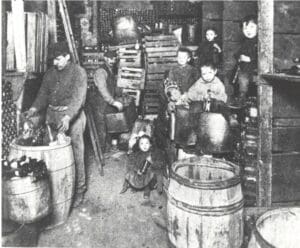
Speech is more powerful when it is vivid and concrete. Addams used stories to accomplish this. Now she could cite statistics as well as any sociological data-collector, and she usually tucked several of them into her texts. But statistics send little electricity from speaker to audience. Addams clothed the data with faces and bodies in particular situations. Addams did not begin her speech, โ€œChild Labor and Pauperism,โ€ with a catalog of data, or even with scenes inside exploitive workplaces. She began by placing her listeners where they often were, on the streetcar at six p.m., as men, women, and children poured out of factories at end of shift. Addams remarked, โ€œThe boys and girls have a peculiar hue, a color so distinctive that any one meeting them on the street even on Sunday in their best clothes and mixed up with other children who go to school and play out of doors, can distinguish almost in an instant the children working in factories. There is also on their faces a something indescribable, a premature anxiety and sense of responsibility which we should declare pathetic if we were not used to it.โ€[15] Her audience members had likely seen these children often, without ever really seeing them. The story startled them into recognizing that evidence of child exploitation was all around them, written on the faces of children they saw.

Black-and-white photo of children and adults working in a crowded cellar, filling and handling bottles near large barrels and wooden crates. The environment appears busy and cluttered with bottles and supplies.
Young children working in a bottle factory in Chicago– https://dp.la/primary-source-sets/theodore-dreiser-s-sister-carrie-and-the-urbanization-of-chicago/sources/1639

Addams aimed deeper than to increase her audiencesโ€™ sense of duty toward others. She aimed to change their fundamental moral and perceptual sensibilities, their ways of perceiving the world and themselves, and of their sense of relationship with others. These sensibilities are the soil out of which opinions and duties grow, or wither. Commenting on a speech by suffragist Anna Howard Shaw, Addams said, โ€œIt was a wonderful lesson in speech-making, not to desire to make an exposition of what you believed or did not believe, but absolutely to persuade your audience from one point of view, if you possibly could, to another point of view.โ€[16] For Addams to do this, she needed to enter each audienceโ€™s mode of perception, and use what they knew and valued and believed, so as to open them to others ways of knowing, valuing and believing. Appealing to their emotions, their sympathies, and imaginations was just as important as appealing to moral codes or their capacities for logical reasoning.

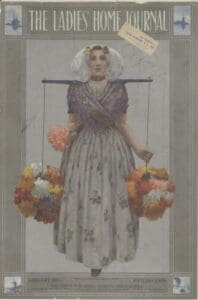
A woman in a floral dress with a white bonnet carries colorful flower baskets on a pole across her shoulders. The cover reads The Ladies Home Journal, January 1910, price fifteen cents.
Cover of the January 1910 Ladies Home Journal issue in which “Why Woman Should Vote” appeared.

Knowing all this complicates the interpretive task for scholars today. We read Addamsโ€™s writings to find out what she thought. Her writings contain her thoughts, but not directly. A good example is the opening paragraph of her widely read essay on suffrage, โ€œWhy Women Should Vote.โ€[17] Addams begins by stating how people had long believed that a womanโ€™s โ€œparamount obligationโ€ was to the home, and that was unlikely to change.[18] Recent scholars have used that statement to locate Addams in the maternalist, conservative wing of suffrage advocates.[19] However, good rhetor that she was, Addams began her talks by identifying common ground with her audience, and using that as a springboard to lead them to different ways of imagining the world. Addams wrote โ€œWhy Women Should Vote,โ€ for the Ladies Home Journal, the most widely read magazine in the U.S. at the time. Its primary audience was middle and lower-middle class women, generally homemakers, and likely opposed to womenโ€™s suffrage, who saw womenโ€™s place as in the home, not in the dirty world of politics.[20] Addams didnโ€™t lie; but she made her opening statement capacious enough that most everyone could find room for themselves inside it.[21] She then led her readers step by step into the lived realities of women like her immigrant neighbors who desperately needed the vote in order to provide their families with clean water, untainted food, and streets that were not fouled with garbage.

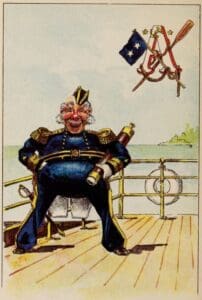
Compression: The second characteristic of Addamsโ€™s speech-making and writing, is compression. When speakers have only a short time to be substantive, what do they do? They leave out whatever they can, and rely on the audience to fill in the gaps. Because Addams and her audiences lived at the same time and place, they shared a great number of associations. The briefest mention could bring all that to mind. When Addams addressed an anti-imperialism protest rally in April 1899, she could simply say, โ€œWe suddenly find ourselves bound to an international situation.โ€[22] She did not need to tell the audience that the U.S. was deep in the muck of the Philippine-American War, or that the U.S. economy and their own economic well-being were deeply dependent on international trade, or that the navies of the European imperial powers were hungrily circling the Philippines, in case the U.S. should pack up and leave.[23] To Addams, these facts made the typical response of others in the American Anti-Imperialist League untenable, as they counseled the U.S. to just pull out.[24] Regardless of what the U.S. did with the Philippines, it would still be entangled in the international situation. And when Addams threw in the line, โ€œGovernment is not something extraneous, consisting of men who wear gold lace,โ€ her audience immediately knew she was mocking British and American imperialism.[25] At the time, the amount of gold lace on a military uniform marked the wearerโ€™s rank. This was a sign of hierarchy and on order maintained by force, rather than through democratic egalitarianism. Addamsโ€™s image, now obscure, was a potent element in her protest against the U.S. becoming an imperial power.

A cartoon-style drawing of a grinning navy officer in a blue uniform stands on a ship deck, holding a telescope. A flag and crossed sabers appear in the top right corner. The background shows water and distant land.
โ€œA is an Admiral. observe his gold lace. He is fond of good things, you can tell by his face.โ€ (The Comic Military Alphabet: Army, Navy, National Guard, by DeWitt C. Falls, 1894 (Hathi Trust).

Compression gives space for the audience to think along with the speaker. Alexander Bain, author of Addamsโ€™s college rhetoric and composition text, praised brevity and devoted a whole chapter to how to achieve it.[26] He included the pointer that โ€œthings well-known [can be] recalled by brief allusion.โ€[27] Bain also stressed the power of indirect speech noting, โ€œThe device of suggesting, instead of openly expressing, . . . give[s] a starting-point to the thoughts.โ€[28] Compression engages listenersโ€™ and readersโ€™ imaginations to fill in what is omitted. They become active participants in the event, rather than passive receptors. In effective speech-making, โ€œnailing it downโ€ is a weakness, not a strength.

Compression is a technique used by literary writers and especially by poets, the most aural of literary artists. Addamsโ€™s writings were considered poetic. A portrait of Addams in Collierโ€™s National Weekly notes, โ€œShe writes hardly a paragraph but is shot through with poetry.โ€[29] Settlement resident, Mary Kingsbury Simkhovitch, wrote in her review of The Spirit of Youth and the City Streets for Political Science Quarterly, โ€œMiss Addamsโ€™s recent book continues the note of realism suffused with imagination which characterizes all her utterances, whether oral or written. . . . [It] is her most lucid and poetical expression.โ€[30] If this be true, then Addamsโ€™s writings should be approached as works of art, as much as works of philosophical and sociological analysis.

Circling Round: The final characteristic of how Addams spoke and wrote Iโ€™ll call โ€œcircling round and spiraling out.โ€ The image comes from William Hard, a journalist with the Chicago Tribune who heard Addamsโ€™s convocation address at the University of Chicago. He wrote to her,ย โ€œI seemed to stand in the center of the subject and to revolve slowly round with a philosopher at my side.โ€[31] James Weber Linn, Addamsโ€™s nephew, commented that among the clashing opinions held by the many strong characters residing at Hull House, โ€œonly Jane Addams, perhaps, [could see] everything from everybodyโ€™s point of view.โ€[32]

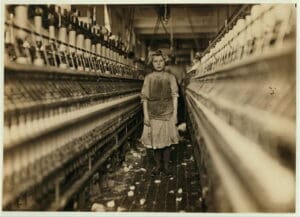
A young girl stands between long rows of spinning machines in a textile mill, wearing a dress and apron, with loose cotton scattered on the floor in a dimly lit industrial setting.
Girl working at the Globe Cotton Mill in Augusta, GA. (National Child Labor Committee, Lewis Hine Photographs, Library of Congress)

Addams turned circling round into a style of speaking and writing. She could circle round multiple viewpoints in a brief paragraph, a chapter, or an entire book. Because Addams primarily addressed white, middle-class audiences, the demographic to which she herself belonged, she did not have the credibility, or โ€œethos,โ€ as Aristotle called it, to denounce white, middle-class conventions as Ida B. Wells-Barnett or Frederick Douglass did, both of whom were born enslaved.[33] By circling round, though, Addams could spell out the hypocrisies of the people she was addressing. She demonstrates this in her speech, โ€œChild Labor and Pauperism,โ€ mentioned above. Addams uses this topic to charge her middle-class audiences with grotesque levels of moral irresponsibility. The cumulative weight of her circlings is far heavier and more densely layered than saying, โ€œThose poor children. Letโ€™s help them.โ€

Addams does this by identifying herself with the audience, โ€œweโ€ do this, โ€œweโ€ neglect that. On each circling round, she inserts personal stories and research data to demonstrate the following stack of conclusions: 1) Child labor robs the future of what belongs to itโ€”the potential future strength and capacities of todayโ€™s children. 2) Todayโ€™s child laborers are tomorrowโ€™s paupersโ€”adults incapable of holding a job who must depend on agencies and local governments to support them. Addams reinforces her claim with the salvo, โ€œNo horse trainer would permit his colts to be so broken down.โ€ 3) By allowing industries to underpay children and adults, you allow your industries to be โ€œparasitic on the future of the community,โ€ creating โ€œthe pauperization of society.โ€ 4) Finally, child labor โ€œpauperizes the consumerโ€ (i.e., her audience members), by flipping the roles of giver and recipient of charity. For, as she states in the most personal of tone: โ€œIf I wear a garment . . . for which the maker has not been paid a living wage . . ., then I am in debt to the woman who made my cloak. I am a pauper and I permit myself to accept charity from the poorest people of the community.โ€ All of this, Addams charges, โ€œdebauches our moral sentiment, it confuses our sense of values.โ€[34] By noting Addamsโ€™s circling round, one sees that Addamsโ€™s speeches say less about the ostensible topic of child labor and pauperism, than builds a case, step by step, for middle-class Americansโ€™ utter failure to take responsibility for the kind of society they live in.

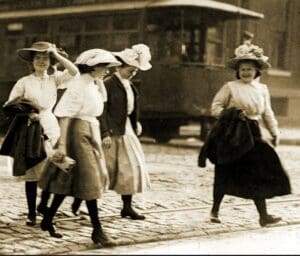
Four women in early 20th-century clothing and hats walk together on a cobblestone street, smiling and chatting, with a vintage streetcar in the background.
Young girls leaving a shoe factory in Chicago, 1910.

In some passages the compressing and the circling round happen so fast, todayโ€™s readers hardly see it. In The Spirit of Youth and the City Streets, a book largely derived from speeches, Addams gives a vivid portrait of young adolescent girls giggling as they walk down the street, wearing โ€œpreposterous clothing.โ€ One has on a โ€œhuge hat, with its wilderness of bedraggled feathers.โ€[35] Why, one might ask, is Addams bothering about adolescent fashion? Why is she being so stuffy and moralistic? First, the compression: Addams omits to say what her readers already knew, that concerned citizens immediately identified the huge hat as advertising the girlโ€™s sexual availability, and the fact that she walked down the street unchaperoned was a sure sign she was looking for johns.[36] Instead of sharing the moralistic concerns of these citizens, Addams uses the hat as a device to lay a heavy charge against them.

Immediately before describing the girl with the hat, Addams mentions the โ€œunrestrained jollities of restoration Londonโ€ that broke out as soon as โ€œthe soldiers of Cromwell shut up the peopleโ€™s pleasure palaces.โ€[37] She didnโ€™t need to tell her readers that the mid-seventeenth century โ€œjollitiesโ€ were disastrous days of chaos and disorder that broke out just after Oliver Cromwell (literally) lost his head. Addams immediately followed her description of the hat with its bedraggled feathers, saying, โ€œthe variation from the established type is at the root of all change,โ€ an allusion to Darwinโ€™s theory of how new species are generated. She quickly adds, โ€œIt is only the artists who see these young creatures as they areโ€”the artists who are themselves endowed with immortal youth.โ€[38]ย  This was a common trope, that artists have privileged access to realityโ€™s underlying truth.

Addams, without being pedantic, uses the girl with the hat to celebrate adolescent sexual energy as a fount of renewal for a society grown weary. By circling round the hat, she uses the collective weight of history, biology, and artistry to chastise concerned citizens for wanting to suppress a vital source of life. By leaving her texts incomplete, Addams invites her readers to construct them with her. And theyโ€”the texts and the readersโ€”are more powerful because of it.

Does all of this matter? To better interpret Addams should we start listening to audiofiles of Addamsโ€™s speeches and writings, uncompress her passages, and map her circlings round? I think it does matter, though more for some questions than others. To begin with, following these patterns reveals Addamsโ€™s character. She had a rapier wit, a delicious sense of irony, and at times was blazingly sarcastic. All of that is right there, on the page, though seldom seen.

Many people today are interested in Addams because they see her activism and her ideas as resources for bringing about social change. Addams was a first-rate public intellectual. Addamsโ€™s attention to selecting her vocal register, vocabulary, images, and examples so as to communicate most effectively with each specific audience she addressed is a worthy model to emulate.

Finally, attending to Addamsโ€™s use of orality, compression, and circling round leads to profound interpretations of Addamsโ€™s thought that are otherwise missed. Hearing Addams speak as well as studying what she wrote will enable us to enter into her thought and life more deeply.

—Marilyn Fischer

——————-

[1] Linn, Jane Addams, 116.

[2] Marcet Haldeman-Julius, Jane Addams as I Knew Her, 16.

[3] Louise W. Knight, โ€œAn Authoritative Voice,โ€ 221; Linn, Jane Addams, 242.

[4] Eastman, โ€œConclusion: Placing Platform Culture,โ€ 187.

[5] Eastman, โ€œConclusion: Placing Platform Culture,โ€ 187.

[6] John Dewey made this point, writing, โ€œThe connections of the ear with vital and out-going thought and emotion are immensely closer and more varied than those of the eye. Vision is a spectator; hearing is a participatorโ€ (The Public and Its Problems, 371.)

[7] See Stob, William James and the Art of Popular Statement, Chapter 1.

[8] Eastman, โ€œConclusion: Placing Platform Culture,โ€ 190-191.

[9] Eastman, โ€œConclusion: Placing Platform Culture,โ€ 191.

[10] Knight, Citizen, 87, 95, 98.

[11] The notion of an โ€œundelivered speechโ€ comes from Arnold, โ€œOral Rhetoric, Rhetoric, and Literature,โ€ 170.

[12] โ€œPhilanthropy Wonโ€™t Do.โ€

[13] โ€œSettlement Work and Its Results.โ€

[14] In other words, Addams made use of ethos, pathos, and logos, as called for in classical rhetoric.

[15] Addams, โ€œChild Labor and Pauperism,โ€ 115.

[16] Addams, โ€œAddress on Anna Howard Shaw,โ€ 7.

[17] A google search for โ€œWhy Women Should Voteโ€ shows that it is still widely read today, as it is posted on many history websites and academic websites.

[18] Addams, โ€œWhy Women Should Vote,โ€ 21.

[19] For scholars who regard Addams as a maternalist, and among the more conservative of the suffrage advocates, see Schultz, โ€œIntroduction,โ€ xli; Mink, The Wages of Motherhood, 1-13. Nackenoff claims that Addams used maternalist rhetoric for strategic reasons (โ€œNew Politics for New Selves,โ€ 131). Hamington regards โ€œWhy Women Should Voteโ€ as โ€œthe most conservative of her appeals for womenโ€™s enfranchisementโ€ (The Social Philosophy of Jane Addams, 69).

[20] Waller-Zuckerman, โ€œโ€˜Old Homes, in a City of Perpetual Change,โ€™โ€ 717.

[21] Addams was following the principle articulated by Bain, โ€œAs in argument, so in oratory generally, there must be some common ground to work uponโ€ (English Composition and Rhetoric, 214). Addamsโ€™s introduction and line of argument in โ€œWhy Women Should Voteโ€ is startlingly different from the ones she used in suffrage addresses to very different audiences. See โ€œWomenโ€™s Clubs and Public Policies,โ€ an address to the General Federation of Womenโ€™s Clubs; and โ€œThe Larger Aspects of the Womanโ€™s Movement,โ€ for the American Academy of Political and Social Science.

[22] Addams, โ€œDemocracy or Militarism,โ€ 35-36.

[23] For a succinct summary of the Spanish-American War and the war in the Philippines, see Herring, The American Century and Beyond, 11-31; Trask, โ€œIntroductionโ€; see also Jacobson, Barbarian Virtues, 97, 221-234, 241-247.

[24] For a discussion of the Anti-Imperialist movement see Tompkins, Anti-Imperialism in the United States. For transcripts of the speeches given with Addamsโ€™s address, see The Chicago Liberty Meeting. Addamsโ€™s address, โ€œDemocracy or Militarism,โ€ is on pp. 36-39.ย 

[25] Addams, โ€œDemocracy or Militarism,โ€ 38.

[26] Bain, English Composition and Rhetoric, 66-73.

[27] Bain, English Composition and Rhetoric, 67.

[28] Bain, English Composition and Rhetoric, 62.

[29] โ€œPortrait of a Woman,โ€ 11.

[30] Simkhovitch, Review of The Spirit of Youth and the City Streets, 555.

[31] William Hard to Jane Addams, January 15, 1905.

[32] Linn, Jane Addams, A Biography, 135.

[33] Bryan, Slote, and Angury, The Jane Addams Papers: A Comprehensive Guide, 95; Knight, โ€œLooking In from the Outside.โ€

[34] Addams, โ€œChild Labor and Pauperism.โ€

[35] Addams, The Spirit of Youth and the City Streets, 8.

[36] The Chicago Vice Commission included several examples of girls engaging in sexual acts in order to buy hats costing many times their weekly salaries. See Vice Commission of Chicago, The Social Evil in Chicago, 78, 204, 210.

[37] Addams, The Spirit of Youth and the City Streets, 7.

[38] Addams, The Spirit of Youth and the City Streets, 8, 9.

References

References

Addams, Jane. โ€œAddress on Anna Howard Shaw,โ€ Nov 13, 1919, typed manuscript, digital edition.

Addams, Jane. โ€œChild Labor and Pauperism.โ€ National Conference of Charities and Correction, Proceedings (1903): 114-21. Digital edition.

Addams, Jane. โ€œDemocracy or Militarism,โ€ in The Chicago Liberty Meeting, 35-39. Chicago: Central Anti-Imperialist League, 1899.

Addams, Jane. โ€œThe Larger Aspects of the Womanโ€™s Movement.โ€ American Academy of Political and Social Science, Annals 56 (1914): 1-8. Digital edition.

Addams, Jane. The Spirit of Youth and the City Streets. New York: Macmillan, 1909.

Addams, Jane. โ€œWhy Women Should Vote.โ€ Ladies Home Journal 27 (January 1910): 21-22. Digital edition.

Addams, Jane. โ€œWomenโ€™s Clubs and Public Policies,โ€ General Federation of Womenโ€™s Clubs. Biennial Convention Official Report (1914):ย  24-30. Digital edition.

Arnold, Carroll C. โ€œOral Rhetoric, Rhetoric, and Literature.โ€ Philosophy and Rhetoric 40 (2007): 170-187.

Bain, Alexander. English Composition and Rhetoric, a Manual. American Edition, Revised. New York: D. Appleton, 1867.

Bryan, Mary Lynn McCree, Nancy Slote, and Maree De Angury, editors. The Jane Addams Papers: A Comprehensive Guide. Bloomington: Indiana University Press, 1996.

Chicago Liberty Meeting. Chicago: Central Anti-Imperialist League, 1899.


Dewey, John. The Public and Its Problems. 1927. In John Dewey: The Later Works: 1925-1953: vol. 2, edited by Jo Ann Boydston. 235-372. Carbondale: Southern Illinois University Press, 1988.

Eastman, Carolyn. โ€œConclusion: Placing Platform Culture in Nineteenth-Century American Life.โ€ Thinking Together: Lecturing, Learning, and Difference in the Long Nineteenth Century, edited by Angela G. Ray and Paul Stob. 187-201. University Park, PA: The Pennsylvania State University, 2018.

Haldeman-Julius, Marcet. Jane Addams as I Knew Her. Girard, KS: Haldeman-Julius Publications, 1936.

Hamington, Maurice. The Social Philosophy of Jane Addams. Urbana: University of Illinois Press, 2009.

Hard, William to Jane Addams, January 15, 1905. Digital edition

Herring, George C. The American Century & Beyond: U.S. Foreign Relations, 1893-2014. New York: Oxford University Press, 2008.

Jacobson, Matthew Frye. Barbarian Virtues: The United States Encounters Foreign Peoples at Home and Abroad, 1876-1917. New York: Hill and Wang. 2000.

Knight, Louise W. โ€œAn Authoritative Voice: Jane Addams and the Oratorical Tradition.โ€ Gender & History 10 (August 1998): 217โ€“251.

Knight, Louise W. โ€œLooking In from the Outside, or A Few Angles on Rhetoric and Change.โ€ Rhetorics Change/Rhetoricโ€™s Change, edited by Jenny Rice, Chelsea Graham, and Eric Detweiler. Anderson, SC: Parlor Press and Intermezzo, 2018. (an ePub; no pagination)

Knight, Louise W. Citizen: Jane Addams and the Struggle for Democracy. Chicago: University of Chicago Press, 2005.

Linn, James Weber. Jane Addams: a Biography. 1935. Urbana: University of Illinois Press, 2000.

Mink, Gwendolyn. The Wages of Motherhood: Inequality in the Welfare State, 1917-1942. Ithaca, New York: Cornell University Press, 1995.

Nackenoff, Carol. “New Politics for New Selves: Jane Addams’s Legacy for Democratic Citizenship in the Twenty-First Century.” in Jane Addams and the Practice of Democracy, edited by Marilyn Fischer, Carol Nackenoff, and Wendy Chmielewski, 119-142. Urbana: University of Illinois Press, 2009.

โ€œPhilanthropy Wonโ€™t Do.โ€ Indianapolis Journal, July 5, 1900, p. 3.

โ€œPortrait of a Woman,โ€ Collierโ€™s: The National Weekly 43 (April 10, 1909): 11.

Schultz, Rima Lunin. โ€œIntroduction.โ€ In Women Building Chicago, 1790-1990: A Biographical Dictionary edited by Rima Lunin Schultz and Adele Hast. xix-lx. Bloomington: Indiana University Press, 2001.

โ€œSettlement Work and Its Results.โ€ Times (Oswego, New York), March 28, 1905, Jane Addams Papers Microfilm, reel 55, frame 1306.

Simkhovitch, Mary Kingsbury. โ€œReview of The Spirit of Youth and the City Streets. Political Science Quarterly 25 (Sept 1910): 555-556.

Stob, Paul. William James and the Art of Popular Statement. East Lansing: Michigan State University Press, 2013.

Tompkins, E. Berkeley. Anti-Imperialism in the United States: The Great Debate, 1890-1920. Philadelphia: Univ. of Pennsylvania Press. 1970.

Trask, David F. โ€œIntroduction.โ€ The Encyclopedia of the Spanish-American and Philippine-American Wars, edited by Spencer C. Tucker. xxix-xxxiii. Santa Barbara, CA: ABC-Clio, 2009.

Vice Commission of Chicago. The Social Evil in Chicago: A Study of Existing Conditions with Recommendations by The Vice Commission of Chicago. Chicago: The Vice Commission of Chicago, Inc., 1911.

Waller-Zuckerman, Mary Ellen. โ€œโ€˜Old Homes, in a City of Perpetual Changeโ€™: Womenโ€™s Magazines, 1890-1916.โ€ The Business History Review 63 (Winter, 1989): 715-756.

Guest Post: What B. R. Ambedkar Wrote to Jane Addams

Black and white portraits of two people side by side: on the left, an older woman with short hair and a serious expression; on the right, a man with glasses in a suit and tie, looking to the side.

This is a guest post by Scott R Stroud, an associate professor in the Department of Communication Studies at the University of Texas at Austin. He is the author of The Evolution of Pragmatism in India: Ambedkar, Dewey, and the Rhetoric of Reconstruction (2023), which has also been published by HarperCollins India as The Evolution of Pragmatism in India: An Intellectual Biography of B.R. Ambedkar (2023). This post was originally published on August 3 by the South Asian American Digital Archive and we thank them for permission to reprint here.

Black and white portraits of two people side by side: on the left, an older woman with short hair and a serious expression; on the right, a man with glasses in a suit and tie, looking to the side.
Portrait photographs of Jane Addams and Dr. B. R. Ambedkar

The Indian politician and anti-caste activist Bhimrao Ambedkar (1891-1956) was heavily influenced by his experiences in the U.S. and England. He was partially shaped by his expansive education there, studying at institutions such as Columbia University, London School of Economics, and Grayโ€™s Inn. Of this set of institutions, his time in New York perhaps had the most influence on him. It was at Columbia that he was exposed to a range of progressive thinkers, not the least of which was the American pragmatist, John Dewey. While there are many ways that Deweyโ€™s pragmatism mattered for Ambedkarโ€™s thought over the following decades, there is another figure in the pragmatist tradition that has an overlooked connection to Ambedkar: Jane Addams (1860-1935).

It is often thought that Ambedkar left New York in the summer of 1916 for London and that he did return to the U.S. until much later in his lifeโ€”in 1952 when Columbia bestowed upon him an honorary degree. This is not accurate, however. On December 5, 1931, a few days after the conclusion of the second Round Table Conference, Ambedkar left London and sailed for New York. The exact purpose of this visit is hard to divine, but he ended up spending much of his time near Columbia University until he left for London on January 4, 1932.1

It was during this month in New York that Ambedkar penned a letter to Jane Addams on December 15, 1931.2 The letter is written on Ambedkarโ€™s own stationary, and its return address reveals that Ambedkar was staying at the International House at 500 Riverside Drive near the Columbia campus he roamed as a student. This building was constructed in 1924 with the funding of John D. Rockefeller Jr. to create a diverse learning and living environment for the growing numbers of international students at Columbia. In all likelihood, Ambedkar was able to stay there for the duration of his short visit given his status as an international alumnus.


Image used with permission of Prakash Ambedkar and the Jane Addams Papers Project.

Why did Ambedkar write Addams in 1931? His ostensible purpose was to wish her โ€œa full and speedy recovery from your distressful illness.โ€ Perhaps Ambedkar was reminded of her importance to causes parallel to his own given that she had been awarded the Nobel Peace Prize on December 10, 1931. On the day of her receiving this award, she was also admitted to a hospital in Baltimore, Maryland, to deal with her continuing ill health. She had been battling to regain her health ever since she suffered a heart attack in 1926. Both news of her health and her award made the papers around the globe, so Ambedkar surely heard of Addams through the media.

Ambedkar also knew of Addams from John Deweyโ€™s classes at Columbia. In John Deweyโ€™s 1915-1916 classes, Philosophy 131-132 โ€œMoral and Political Philosophy,โ€ Ambedkar and his fellow students (including the Chinese reformer, Hu Shih) heard their professor praise Addamsโ€™ 1902 book, Democracy and Social Ethics, in support of his claim that democracy implicated a wide range of community relationships beyond the political.3 Addams was an important part to the diverse tradition of American pragmatism, and she was set apart by the unique endeavor of running the settlement Hull House in Chicago. Settlement houses were part of a social movement that started around 1890 to alleviate poverty and suffering brought on by rapid industrialization. Social workers and activists would establish community centers in which they lived side-by-side with poor local residents and tried to improve the living conditions of the surrounding community. Addamโ€™s Hull House is one of the most successful American instances of this movement. It was when Dewey was in Chicago that he became friends with Addams and familiar with Hull House. Addams was not simply working for the improvement of the condition of women, immigrants, the poor, and those who might suffer from the violence of war; she also wrote and thought about the philosophy that stands behind such activism.4 Addamsโ€™ thoughts on nonviolence and democracy influenced Dewey, as Deweyโ€™s ever-growing body of work influenced Addams in turn.

When Dewey left Chicago for Columbia University in 1904, he remained friends with Addams and a supporter of the settlement movement. Addams continued with her work and expanded into international peace advocacy. Her decades-long efforts against international conflict, as unpopular as they were during the Great War, earned her the Nobel recognition in 1931.

Ambedkarโ€™s letter, however, focuses on her illness and makes no overt mention of her award. It does seem implied however, since he tells Addams โ€œYour life of devotion to the submerged of the world has been the inspiration and encouragement for us all even in darkest India.โ€ Ambedkar seems aware of her settlement work to alleviate the burdens of the poor in Chicago at Hull House, as well as the care for those in other nations evinced by her peace-building work in America and Europe. Perhaps he also knew of her trip to India in 1923, a visit where Addams was largely exposed to the figures and movements fixating on Indian self-rule, and not on the battle against untouchability. Addams was a friend and correspondent of Gandhiโ€™s, but the two were unable to meet on this trip because he was imprisoned at the time.

Addams did not seem to prioritize, or even know much about, the social evils of caste. Ambedkar seemed motivated in his letter to not only wish her improved health, but to introduce himself and his anti-caste cause. Indeed, he starts the letter referring to himself โ€œas a representative of the sixty-millions of downtrodden untouchables in India.โ€ Ambedkar seemed motivated to put the social issue of caste on Addamsโ€™ mind with his references to the size and state of the mass of humans oppressed by these long-rooted and oppressive matters of social custom. Caste limited and dehumanized most of those caught in the grips of its hierarchy, but this function was often missed by Americans like Addams.

What do we make of this letter? In archives in the U.S. and in India, I have found no evidence that Addams sent a reply to Ambedkarโ€™s letter of December 15. Nor is there any record of future correspondence between these two thinkers. Addams, of course, was deluged with congratulatory letters and telegraphs after her receipt of the Nobel Prize; combined with her uncertain health and hospitalization, itโ€™s no surprise that she did not write back to the Indian civil rights leader.

From this letter, however, we can see something of Ambedkarโ€™s motivation. He not only introduced himself and his cause in the letter, he hoped for a personal audience with Addams. โ€œI devoutedly [sic] hope,โ€ he writes at the end of the letter, โ€œthat your recovery will come within the limits of my short stay in America to permit me to present my humble respects in person.โ€ Thereโ€™s no evidence that they ever met, and Addamsโ€™ health and residence elsewhere lead us to think she did not meet Ambedkar in New York. But we can guess that Ambedkar sought a meeting with Addams not only to congratulate her, but also to build bridges between her settlement and peace work and his struggle against untouchability and caste oppression. We know that Ambedkar would later (in the 1940s) try to build similar bridges to leaders in the civil rights movement such as W.E.B. Du Bois.

Perhaps Ambedkar wanted to convince Addams that eradicating untouchability was an overlooked part to the Gandhian quest for Indian self-rule or swaraj that she was so taken by.5 Or perhaps Ambedkar wanted to compare strategies on settlement houses and their use in the Indian context. After all, he had most likely long known about settlement housesโ€”the settlement house figure, Mary Kingsbury Simkhovitch, was married to Ambedkarโ€™s economics professor, Vladimir Simkhovitch. Mary Simkhovitch directed Greenwich House in New York and was friends with Addams. She and Vladimir lived at the Greenwich Village settlement during the week, and often brought Vladimirโ€™s students to visit it. Ambedkar may have heard about her settlement activities or even visited it during his enrollment in one of his five courses from Vladimir at Columbia. In any case, we see Ambedkar initiate a series of hostels and educational organizations that similarly aimed to educate and support the lower classes (and castes) in India upon his return in the 1920s. Like Addams and Simkhovitch, as well as Dewey, Ambedkar saw the power in a holistic education that involved classes, books, as well as edifying social activities outside of formal education.

The pragmatists are a diverse lot. But one of the themes that drives Addams, Simkhovitch, and Dewey is vitally important: life was educative and intelligent action could further shape the course of experience to maximize its effects on our habits and communities. Ambedkar felt the power in this commitment, and he would often argue in his writings for a view of democracy as a way of life or a matter of our habits of associated living with our fellow humans. Addamsโ€™ ideas of social reform were a noteworthy attempt to refine harmful social habits and customs, and Ambedkar surely saw her as a fellow traveler. This overlooked letter to Addams highlights Ambedkarโ€™s drive to internationalize his mission and to connect the battle of caste to the oppression of women, the poor, and to peace-making in general.

ยงยงยง
The author would like to thank Prakash Ambedkar, Kishor Walanju, Cathy Moran Hajo, and Marilyn Fischer for their assistance with this article.

Footnotes
1. These dates are derived from the account in K. N. Kadam, Dr Babasaheb Ambedkar and the Significance of His Movement (Bombay, Popular Prakashan, 1991) and Vijay Mankar, Life and the Greatest Humanitarian Revolutionary Movement of Dr B.R. Ambedkar: A Chronology (Nagpur, Blueworld Series, 2009). I have found no evidence of meetings between Ambedkar and his Columbia contacts (including Dewey) during this time.
2. This letter can be found in the Jane Addams Papers. It was brought to my attention by the Addams scholar, Marilyn Fischer, who knows this massive set of documents very well. No biographies note the existence of this letter.
3. For information on the courses with John Dewey and their content, see Scott R. Stroud, The Evolution of Pragmatism in India (University of Chicago Press & HarperCollins India, 2023).
4. For more on Addams as a philosopher, see Marilyn Fischer, Jane Addams’s Evolutionary Theorizing: Constructing โ€œDemocracy and Social Ethicsโ€ (Chicago, University of Chicago Press, 2019).
5. Addams would continue to advocate for Gandhiโ€™s movement in her correspondence and writings after 1923, and Gandhi would write her about various matters. Gandhi reprinted some of her work in edited volumes. For more on the relationship between these two thinkers, see Elizabeth N. Agnew, โ€œJane Addams, Mohandas Gandhi, and the Promise of Soul Force,โ€ Peace & Change, 45 (4), 2020, 481-512 and Tim Gilsenan, โ€œPeacemakers & Friends: Jane Addams & Gandhi,โ€ October 6, 2013.

Guest Post: A Tale of Many Cultures: Clara Landsberg’s Experiences at Hull House

Black and white portrait of a woman with dark hair pulled back, wearing a light-colored top. Above her head is a large handwritten signature that reads Clara Landsberg.

This article in its entirety was published in Volume 46, No. 3 Summer 2022 edition of Chicago Jewish History, a quarterly publication of the Chicago Jewish Historical Society and is being reprinted with the permission of the Society.

A Tale of Many Cultures:ย  Clara Landsbergโ€™s Experiences at Hull House with Eastern European Jewish Immigrants and White Anglo-Saxon Protestant Social Workers

by Cynthia Francis Gensheimer

A sepia-toned photo of Clara Landsberg as a young woman sitting on the grass, smiling and reaching toward a small white animal, with trees and bushes in the background.Clara Landsberg, a Jewish-born teacher, social worker, and pacifist, lived at Hull House in the room directly adjacent to Jane Addamsโ€™s for roughly 20 years and made significant contributions to the Chicago settlement house. However, scholars have paid scant attention to her story until now, perhaps because she never sought prominence during her lifetime.[1] While researching her connection with Bryn Mawr College as part of a larger project on early Jewish women students at the Seven Sisters schools, I have discovered that shortly after graduating in 1897, Landsberg left Judaism to become Episcopalian. Afterward, she maintained ties with her influential Jewish parents but also became a member of the nationโ€™s Protestant elite and of an international sisterhood of pacifists. Like many leading women intellectuals and social workers of her day, Landsberg lived with her lifelong partnerโ€”a womanโ€”in a predominantly female world. This article will provide an overview of Landsbergโ€™s biography, with a focus on her role at Hull House.

Clara was the daughter of a Jewish power couple: Rabbi Max Landsberg and Miriam (Isengarten) Landsberg, leading Jewish intellectuals and nationally known experts on charity administration, with 30 years of hands-on experience in helping the less fortunate in Rochester, New York.[2] Claraโ€™s parents had close working relationships with luminaries Jewish and non-Jewish, including Chicagoโ€™s Rabbi Emil G. Hirsch, Hannah Greenebaum Solomon, and Jane Addams.[3] Closer to home, Susan B. Anthony attended the Landsberg congregationโ€™s annual interfaith Thanksgiving services and, in 1892, recommended Miriam Landsberg for a statewide positionโ€”although that position was ultimately filled by Anthony herself.[4] The Landsbergs helped lead efforts for social good in Rochester with their closest friends: the Unitarian minister William Gannett and his wife, Mary T. L. Gannett. Clara Landsberg followed her parentsโ€™ example in many ways.

Clara can be taken as a case study in the difficulties that many Jewish women of her generation would have faced in attempting to achieve the Landsbergsโ€™ highest ideals. Clara graduated from the most intellectually rigorous womenโ€™s college on the East Coast and, through her partner, Margaret Hamilton, became a member of one of the countryโ€™s most elite Protestant families. Yet even after graduating from college and becoming Episcopalian, she was denied a job at a girlsโ€™ preparatory school because she was still considered Jewish. This discrimination against Jews, even those who had left the faith, was leveled against a young woman of eminent qualifications and impeccable manners. It belied her own parentsโ€™ fervent wish that Judaism should be considered only a religion, not a race, and that Jews should find full acceptance in American society.

Born in Rochester in 1873, Claraโ€”and her two younger sisters, Rose and Graceโ€”attended Miss Cruttendenโ€™s School for Girls, which offered a rigorous college preparatory curriculum, but also equipped its students for lives of simple refinement. Although their social world was predominantly Jewish, they had Christian friends as well. At Roseโ€™s confirmation, Rabbi Landsberg enjoined the teenagers coming of age in his Reform congregation to take a rational approach to religion and to determine their beliefs for themselves without feeling bound by tradition.[5] As the Landsberg children would have known, Susan B. Anthony and Mary T. L. Gannett had done exactly that by becoming Unitarians after growing up as Quakers.

A black-and-white portrait of Rabbi Max Landsberg, a bearded man in a suit, looking to the side. The caption identifies him as an esteemed clergyman from Rochester, New York.At Bryn Mawr College, Clara met her future life partner: Margaret Hamilton, daughter of an upper-class WASP family in Fort Wayne, Indiana.[6] Clara also became acquainted with Margaretโ€™s sisters: Alice Hamilton, who would later establish the field of industrial medicine, and Edith Hamilton, who would famously popularize classical Greek and Roman mythology.[7] Bryn Mawr, founded by Quakers, advertised itself as โ€œpervaded by a simple and practical Christianityโ€ and required daily chapel attendance.[8] Clara, the only Jew of the nearly 50 students in her graduating class, lived on campus and studied classical and modern languages, with a concentration in Latin and Greek.[9] After their 1897 graduation, Clara and Margaret studied abroad at the Sorbonne and the University of Munich.[10]

Around 1900, Clara Landsberg moved to Hull House, where she would room with Alice Hamilton for the next two decades.[11] By the time Clara arrived, three-quarters of Hull Houseโ€™s clientele consisted of Jews from Chicagoโ€™s Near West Side and other neighborhoods.[12] These Jewsโ€”mostly immigrants from Eastern Europeโ€”came to learn English, attend lectures and concerts, and participate in drama, music, and debate clubs.[13] Despite their apprehensions with respect to Christian proselytizing, they predominated among the 9,000 people who visited Hull House each week.[14] Clara Landsberg earned her living by teaching German and history at a local girlsโ€™ school; in her free time, she taughtโ€”and later supervisedโ€”the evening classes at Hull House.[15]

Jane Addams mentored Clara, who was initially in the unique position of being the only resident who had been born and raised Jewish. Jane Addams called her the โ€œdean of our educational departmentโ€โ€”in other words, supervisor of one of the settlementโ€™s core activities.[16] In 1908, a paragraph in the Bryn Mawr Alumnรฆ Quarterlyโ€”likely written by Clara herselfโ€”reported that she was living at Hull House to familiarize herself with the problems of immigrants living in โ€œcrowdedโ€ quarters. Rather than describing her students as Catholic or Jewish, Clara identified them by their various nationalities: โ€œItalian, Greek, Russian, Roumanian, Polish, Armenian, and German.โ€[17] She explained that they wanted to learn English not only to get good jobs, but also to โ€œstudy subjects more or less remote from their daily work for much the same reasons that induce people of more fortunate neighborhoods to study Browning, Shakespeare, Ibsen, or Bernard Shaw.โ€[18] During her early years at Hull House, Clara introduced her studentsโ€”primarily Eastern European Jewsโ€”to some of the classic works of English literature.[19] According to Jane Addams, Clara possessed โ€œan unusual powerโ€ as a knowledgeable teacher with an unassuming, quiet presence.[20] In addition, Landsberg had โ€œmany friends among the poor people of the neighborhood who are devotedly attached to her.โ€[21] Two of those friends were Hilda Satt and Morris Levinson.

Hilda Sattโ€™s life was transformed through her long association with the settlement and its residents. Hilda, who had first visited Hull House as a young teenager in 1895, later became a member of one of Clara Landsbergโ€™s reading groups. Certain her mother would disapprove, Hilda had initially declined an Irish friendโ€™s invitation to attend that yearโ€™s Hull House Christmas party. In her posthumously published autobiography, Hilda recalled her fear that she would be killed if she attended, because in Poland it had been dangerous for Jewish children to play outside on Christmas. She later wrote, โ€œThere were children and parents โ€ฆ from Russia, Poland, Italy, Germany, Ireland, England, and many other lands, but no one seemed to care where they had come from, or what religion they professed โ€ฆ I became a staunch American at this party.โ€[22]

A vintage sepia photo of Clara Landsberg in a graduation gown and cap, standing and looking slightly to her right. Handwritten text at the bottom reads Clara Landsberg, 97.In one of the first reading groups Clara conducted at Hull House, she ignited a love of English literature in Hilda, who spoke Yiddish at home and had left school after fifth grade to work days sewing shirt cuffs. In addition to the books Clara assigned, Hilda was soon reading โ€œevery book I could borrow.โ€[23] Only a few years earlier, Hildaโ€™s English vocabulary had been so limited that she did not yet know the word โ€œmushroom.โ€ During a meal at Hull House, she had been served a mushroom omelet, of which she would later recall, โ€œI was tortured with the question of whether the mushrooms were kosher.โ€[24] Soon, however, Hilda counted authors like Dickens and Louisa May Alcott among her friends. Months after meeting Hilda, Clara presented her with a Christmas gift of a copy of Elizabeth Barrett Browningโ€™s Sonnets from the Portuguese. Hilda would later recall this as her fondest memory of โ€œMiss Landsberg, โ€ฆ a fragile, ethereal, gentle woman โ€ฆ [who] opened new vistas in reading for me.โ€[25] With Clara Landsbergโ€™s help, Hilda Satt became an exemplar of the path to Americanization and upward mobility that the settlement aimed to encourage.[26]

Another of Claraโ€™s students, Morris Levinson, was, like many immigrants, eager to learn English and become an American citizen in the cultural as well as the political sense of the word. With Clara Landsberg as his mentor, he aspired to learn much more than basic skills of vocabulary, grammar, and usage.[27] Landsberg saved two letters that he wrote to her in 1905, while she was home in Rochester convalescing after a serious illness. In broken English, Morris expressed his concern that โ€œMiss Landsbergโ€ was โ€œtoo sweet, and delicate, to be confind to bed of illness [sic],โ€ reassured her that Ellen Gates Starr had taken him on as a pupil, and told her that he was studying a book she had given him to read: The Boys of 76, a collection of first-hand accounts of soldiers in the American Revolution:

I bolive I should have to know the history of this Country โ€ฆ I have resolved to read it over agan, so that I will remember everything better โ€ฆ Miss Landsberg, I bolive this history will make me a throught citesin.[28]

Morris also confided in Clara. He planned not to live solely seeking fun, โ€œas a great many of people do,โ€ but rather to โ€œtry to egicat [him]self as much as posebleโ€ in order to โ€œsee the mining of this beautiful world and of the real uman life.โ€[29] Clara was not only a teacher but a role model for Morris Levinson: someone he admired and to whom he felt a deep sense of gratitude.

Although Hilda, Morris, and Clara had all been raised in Jewish homes, their similarities ended there. Claraโ€™s highly educated, German-born parents spoke fluent English and shunned Yiddish. Like other Reform rabbis, Rabbi Landsberg jettisoned โ€œsuperstitious forms and antiquated dogmas,โ€ eliminating rituals he considered outmoded, such as Bar Mitzvah.[30] He endorsed the principles adopted by the Reform movement in its Pittsburgh Platform of 1885, but, like Rabbi Emil G. Hirsch of Chicagoโ€™s Sinai Congregation, he saw them as only the beginning rather than the end. In 1893, Rabbi Landsberg spoke in Chicago at the World Parliament of Religions, endorsing an expanded role for Jewish women in congregational life.[31]

Claraโ€™s approach to Judaism was virtually the antithesis of that of many of the Jewish immigrants at Hull House. Her father decried Orthodoxy as well as Jewish nationalism. The Jewish immigrantsโ€”familiar and comfortable only with Orthodox Judaismโ€”rejected Reform Judaism. Even those atheists, anarchists, and socialists who spurned all religion felt a connection to Yiddishkeit and Jewish peoplehood,ย concepts rejected by theย Landsbergs and most Reform Jews. Did these immigrant Jews nonetheless recognize Clara Landsberg as ethnically Jewish, or did they see her as one of many Protestant residents of Hull House? Might they have accepted her precisely because they had no idea she was Jewish?

Addams and her cohort respected religious differences and tried hard to make Hull House welcoming to all.[32] Yet Jane Addams was motivated by her Protestant faithโ€”especially by the literature and culture of social Christianity, which she described as a โ€œrenaissance of the early Christian humanitarianism โ€ฆ with a bent to express in social service and in terms of action the spirit of Christ.โ€[33] Addams has been criticized for failing to grasp that for many Eastern European Jewish immigrants, Judaism was far more than a religion. On the other hand, features of Hull House that Orthodox Jews would have found off-puttingโ€”the Chi-Rho cross Addams always wore, the Christian artwork on display, the lack of kosher foodโ€”would not have offended the most liberal Reform Jews such as Clara Landsberg or her mother, Miriam Landsberg.[34]

Portrait of a middle-aged woman with glasses, short curly hair, and a serious expression, wearing a dark dress with a lace collar and beaded embellishments. The photo appears historical and formal.Miriam Landsberg, Hannah G. Solomon, and other German Jews mirrored mainstream Americaโ€™s adulation of Addams. One of these Jewish admirers, Sara Hart, called Addams โ€œthe single, most influential citizen of my generation.โ€[35] Miriam Landsberg visited Hull House frequently and helped spearhead efforts among affluent Jews to establish a settlement in Rochester. In 1905, after spending several weeks at Hull House, she wrote: โ€œI do not wonder that any one who has ever lived at Hull House cannot bear to go back to ordinary life.โ€ She described the 21 residents (including her daughter Clara) as a โ€œfamilyโ€ composed of โ€œpeople of the finest mindsโ€ and life at Hull House as โ€œsimple, practical, โ€ฆ ideal.โ€[36]

Settlement work was popular among graduates of Bryn Mawr and similar colleges. Even so, it was not Claraโ€™s first career choice. She and Margaret had wanted to teach at the Bryn Mawr School in Baltimore, but two of the schoolโ€™s most influential trustees, Mary Garrett and M. Carey Thomas (then president of Bryn Mawr College), refused to hire her because she was Jewish.[37] In 1899, Edith Hamilton (then headmistress of the Bryn Mawr School) wrote to M. Carey Thomas to apprise her of Claraโ€™s conversion:

My sister has just written me that Miss Landsberg is about to become a member of the Episcopal church, and I have wondered whether this would make a difference in your and Miss Thomasโ€™ opinion that we could not offer her a position because she is a Jewess.[38]

Clara Landsbergโ€™s conversion made โ€œnot the least difference,โ€ either to Mary Garrett or to M. Carey Thomas, as Garrett explained in her response to Edith Hamilton:

Our objection is one of policy and very few Jews employed in schools or colleges are Jews by religion; it never had occurred to us that Miss Landsberg was really an orthodox Jew. We are wholly unwilling to connect with the school in any capacity a Jew by race, and in view of our feeling of the financial unwisdom of such a step we think that Jews ought to be ruled out of court for the future in consideration of possible appointments.[39]

Yet Clara persisted. In 1900, M. Carey Thomas wrote to Mary Garrett saying, โ€œThe Jews enrage me. Is nothing in the world settled? Have Miss Landsberg & the Jews to come up perpetually. It is awfully bad policy.โ€[40]

Clara remained at Hull House until 1920, when a Quaker organization sponsored her to travel to Vienna to perform postwar humanitarian relief work. Two letters of recommendation finally qualified her as a WASP and (therefore) fit to represent the U.S. abroad. Jane Addams provided a ringing endorsement, and Mary T. L. Gannett was careful to specify: โ€œAs a matter of information, Miss Landsberg, during her college course joined the Episcopal Church โ€“ and as far as I know is still a loyal member of that Communion.โ€[41]

When Addams and her partner, Mary Rozet Smith, learned that Clara Landsberg had been accepted to the Quaker program, they both wrote letters of congratulation and farewell. Addams wrote, โ€œI canโ€™t bear to think of H.H. [Hull-House] next winter without either Alice [Hamilton] or yourself.โ€[42] Mary Rozet Smith wrote: โ€œโ€ฆ no words will express โ€ฆ [our] sense of desolation โ€ฆ when we think of the year without you. โ€ฆ J.A. and I have decided that it is like losing a mother and a child at once. โ€ฆ With Alice in Boston and you in Vienna what will Hull-House be! It is too depressing to face.โ€[43]

Did Max and Miriam Landsberg know that their daughter was no longer Jewish? In the 1899 letter announcing Clara Landsbergโ€™s conversion, Edith Hamilton had written, โ€œUnder the circumstances her family would prefer her not to be at home.โ€[44] Yet there is no proof that Claraโ€™s parents did learn of her conversion. To all appearances, she maintained a positive relationship with her mother and father throughout their lives. In his final instructions to his children, Max Landsberg wrote, โ€œ[M]y life has been one of uniform happiness. The only serious trouble in my whole life has been the loss of my dear wife, your good mother.โ€[45]

As tolerant as Miriam was toward other beliefs, however, it is likely she would have cared deeply that Clara had left Judaism. At a national conference, as chair of the National Council of Jewish Womenโ€™s Committee on Religion, she worried that many German Jews were โ€œgiven over entirely to materialism and indifference to all Jewish affairs.โ€ She warned Jewish mothers that children raised without religion could โ€œfall prey to โ€ฆ pious sharks โ€ฆ eager for souls.โ€[46] A few years later, she implored mothers to transmit a love of Judaism to their children โ€œto preserve to our posterity that Judaism which gave Religion to the world.โ€[47] Despite Miriamโ€™s fears, it is doubtful her daughter would have fallen prey to โ€œpious sharks.โ€ Rather, through exposure to Christianity at school and through her closest friends and role models, Clara rejected the most modern version of Judaism, one carefully crafted by her own parents, in favor of the Episcopal Church, which her father had criticized for what he saw as its strict adherence to ritual and creed.[48]

Part Two of this article will discuss Clara Landsbergโ€™s becoming godmother to Jane Addamsโ€™ grandniece, Claraโ€™s travels with Addams, and Claraโ€™s own work as a pacifist, which was deeply informed by her connection with Addams. It will also document her retaining ties to her birth family, even as she joined the Hamilton family as well. And it will describe Landsbergโ€™s trip to Germany with Alice Hamilton just after Hitler had come to power. In a letter to herself documenting the onset of the Holocaust, Landsberg would write, โ€œI am a Jewess.โ€

Our thanks to Cynthia Francis Gensheimer and the Chicago Jewish History for allowing us to share this article with you.


[1] Even one of Clara Landsbergโ€™s fellow residents, Francis Hackett, seemingly forgot her surname: โ€œMiss Clara, of Bryn Mawr vintage, valiant, tense, souffrante, at once impatient and remorseful, indefatigable and worn-out.โ€ Francis Hackett, โ€œHull-House: A Souvenir,โ€ 100 Years at Hull-House, eds. Mary Lynn McCree Bryan and Allen F. Davis (Bloomington: Indiana University Press, 1969), 69.

[2] Max Landsberg, born in Berlin in 1845, was a rabbiโ€™s son and a protรฉgรฉ of Abraham Geiger. American Jewish Year Book 1903โ€“1904, 72; http://www.ajcarchives.org/AJC_DATA/Files/1903_1904_3_SpecialArticles.pdf. When Miriam Landsberg, who was born in Hanover in 1847, died, the American Israelite called her death a โ€œloss to American Jewry.โ€ American Israelite, April 25, 1912. Peter Eisenstadt, Affirming the Covenant: A History of Temple Bโ€™rith Kodesh, Rochester, New York, 1848โ€“1998 (Rochester: Temple Bโ€™rith Kodesh, 1999), ch. 2 and 3; Stuart E. Rosenberg, The Jewish Community in Rochester, 1843โ€“1925 (New York: Columbia University Press, 1954). At a 1910 meeting of the National Conference of Jewish Charities, during Miriam Landsbergโ€™s term as vice-president, Jane Addams gave the opening address, and Rabbi Landsberg served as delegate representing the Jewish Orphan Asylum of Western New York, which he had co-founded and led for decades. Sixth Biennial Session of the National Conference of Jewish Charities in the United States Held in the City of St. Louis, May 17th to 19th, 1910 (Baltimore: Kohn & Pollock, 1910). American Israelite, February 5, 1914, 3. Rabbi Landsberg was elected president of the New York State Conference on Charities and Correction in 1910, when Miriam Landsberg was the outgoing vice-president. โ€œConference of Charities Holds Three Busy Sessions,โ€ Democrat and Chronicle, November 17, 1910, 17.

[3] As chair of the Committee on Religion of the National Council of Jewish Women, Miriam Landsberg worked closely with Hannah G. Solomon, the organizationโ€™s founder. Susan B. Anthony wrote to Miriam Landsberg giving instructions for a meeting of the National Council of Women in Washington, D.C. and letting her know that Hannah G. Solomon and Sadie American had already arrived. Susan B. Anthony to Miriam Landsberg, February 12, 1899, University of Rochester Archives. After Hannah G. Solomonโ€™s daughter, Helen, visited the Landsbergs in 1902, Rabbi Landsberg wrote to Hannah telling her what a โ€œgreat treatโ€ it had been to have her visit: โ€œHelen reminds me so much of you, although she looks more like the best husband on earth.โ€ He signed the letter, โ€œWith love for your husband and all the sisters within your reach.โ€ Max Landsberg to Hannah G. Solomon, April 2, 1902. Helen Solomon Wellesley Correspondence, Hannah G. Solomon Family Collection, MC 749, American Jewish Archives. For the working relationship among Rabbi Hirsch, Hannah G. Solomon, and Jane Addams, see Rina Lunin Schultz, โ€œStriving for Fellowship: Sinaiโ€™s Rabbi Emil G. Hirsch and Hull-Houseโ€™s Jane Addams, A Not-So-Odd Couple,โ€ unpublished manuscript, February 24, 2015.

[4] Ida Husted Harper, The Life and Work of Susan B. Anthony (Indianapolis: Bowen-Merrill, 1898), 2:730. In 1891, Susan B. Anthony, Rabbi Landsberg, and Rev. William C. Gannett spoke at the annual Thanksgiving service. โ€œThe Benefits of Unrest,โ€ Democrat and Chronicle, November 27, 1891, 6.

[5] โ€œRochester, N.Y.,โ€ American Israelite, June 20, 1889, 2.

[6] For background on Bryn Mawr College, see Helen Lefkowitz Horowitz, Alma Mater: Design and Experience in the Womenโ€™s Colleges from Their Nineteenth-Century Beginnings to the 1930s (New York: Alfred A. Knopf, 1984) and Horowitz, The Power and Passion of M. Carey Thomas (New York: Alfred A. Knopf, 1994).

[7] For a significant biographical work on the nature of Clara Landsbergโ€™s relationship with Margaret Hamilton, as well as Edithโ€™s connection to Bryn Mawr College and the Bryn Mawr School, see Judith P. Hallett, โ€œEdith Hamilton,โ€ The Classical World ย 90, nos. 2/3, Six Women Classicists (November 1996โ€“February 1997): 107โ€“147.

[8] Bryn Mawr College Program 1892 (Philadelphia: Sherman & Co., 1892), 77.

[9] Clara Landsbergโ€™s student transcript, Bryn Mawr College Archives. Religious affiliations researched by the author.

[10] Clara Landsbergโ€™s alumna record, Bryn Mawr College Archives. Sandra L. Singer,ย Adventures Abroad: North American Women at German-speaking Universities, 1868โ€“1915 (Westport, Connecticut: Praeger Publishers, 2003), 75, 212.

[11] Presumably by the time that Clara Landsberg moved to Hull-House, she had become a member of the Episcopal church, but evidence surrounding the conversion is scanty, and that surrounding the exact dates of Clara Landsbergโ€™s tenure at Hull-House is contradictory. For Alice Hamiltonโ€™s experience at Hull-House, see Alice Hamilton, Exploring the Dangerous Trades (Fairfax, Virginia: American Industrial Hygiene Association, 1995), ch. 4 and 5; Barbara Sicherman, Alice Hamilton: A Life in Letters (Cambridge, Massachusetts: Harvard University Press, 1984), 3โ€“4, 5, 115โ€“136, 139โ€“141, 144โ€“152, 182, 244. Both Hamiltonโ€™s and Sichermanโ€™s books are valuable resources that contain references to Clara Landsberg throughout.

[12] Hannah G. Solomon, introducing Jane Addams as a speaker at a national convention of the National Council of Jewish Women. โ€œGeneral Council of Hebrew Women Meets,โ€ The Washington Times, December 3, 1902, 2.

[13] Philip Davis, โ€œEducational Influences,โ€ in The Russian Jew in the United States, ed. Charles S. Bernheimer (Philadelphia, Pennsylvania: The John C. Winston Co., 1905), 217.

[14] Hull-House was not the only center serving immigrant Jews in its neighborhood. German Jews in Chicago organized their own institutions, and in fact Jane Addams mediated between the German and eastern European Jews when the Jewish-run Maxwell Street settlement was established a few blocks from Hull-House. The first organizational meeting, held at Hull-House in 1892, nearly disbanded due to the terrible arguing between the immigrants and the German Jews who convened the meeting. In an essay titled โ€œA Resented Philanthropy,โ€ one of the immigrants at the meeting later credited Addams with reestablishing civility. He said, โ€œThe โ€˜cultureโ€™ which was to emanate from the settlement and permeate all corners of the Ghetto was conspicuously absent from the heated discussion of the โ€˜enlightenedโ€™ benefactors.โ€ In 1907, 150 people visited Hull-House weekly to lecture, teach, or supervise clubs. For Hull-Houseโ€™s purpose, the names of its residents, and its weekly attendance, see Hull-House Year Book 1907, 5โ€“6 (Archive.org, https://archive.org/details/hullhouseyearboo1906hull/page/38/mode/2up?q=jewish).

[15] Claraโ€™s work evolved over time. She worked full-time at Hull-House for one year, but, finding that too difficult, she eventually taught at the University School for Girls (Miss Haireโ€™s). Alice Hamilton to Agnes Hamilton, [mid-June? 1902], in Sicherman, Alice Hamilton, 142โ€“143. Clara Landsbergโ€™s alumna record, Bryn Mawr College.

[16] Jane Addams, Twenty Years at Hull-House (New York: Macmillan, 1912), 437 (A Celebration of Women Writers, ed. Mary Mark Ockerbloom, https://digital.library.upenn.edu/women/addams/hullhouse/hullhouse.html).

[17] Italians came to predominate during Claraโ€™s second decade. In 1902, the Chicago Tribune reported on a โ€œHebrew invasionโ€ in the โ€œcrowded west side districtโ€: โ€œAs soon as a Jewish family gets a foothold in a tenement other occupants vacate.โ€ โ€œRaces Shift Like Sand,โ€ย Chicago Tribune,ย September 26,ย 1902, 13.

[18] Bryn Mawr Alumnรฆ Quarterly Vol. 1โ€“2 1907โ€“1909 (Bryn Mawr, PA: Bryn Mawr Alumnรฆ Association, 1907โ€“1909) (https://core.ac.uk/download/pdf/214021114.pdf).

[19] Francis Hackett wrote in his memoir: โ€œRussian Jews and Jewesses came in great numbers to the classes at Hull House, and had special leanings toward literatureโ€ (72). Some English classes were composed entirely of Jews. Philip Davis, โ€œIntellectual Influences,โ€ in The Russian Jew in the United States, ed. Charles S. Bernheimer (Philadelphia, Pennsylvania: The John C. Winston Co., 1905), 217.

[20] Jane Addams to Anita McCormick Blaine, June 29, 1901, Anita McCormick Blaine Correspondence and Papers, 1828โ€“1958, Wisconsin Historical Society (Jane Addams Papers Project, https://digital.janeaddams.ramapo.edu/items/show/1015).

[21] Jane Addams, American Friendsโ€™ Service Committee (AFSC) letter of recommendation for Clara Landsberg, May 1, 1920. AFSC Archives.

[22] Hilda Satt Polacheck, I Came a Stranger: The Story of a Hull-House Girl (Urbana: University of Illinois Press, 1991), 51โ€“52, 66.

[23] Polacheck, I Came a Stranger, 66.

[24] Polacheck, I Came a Stranger, 66.

[25] Polacheck, I Came a Stranger, 66โ€“67.

[26] In 1905, Hilda Satt took over supervision of the evening classes in Claraโ€™s absence. In 1906โ€“07, she taught beginnersโ€™ English at Hull-House. Jane Addams to Clara Landsberg, July 4, 1905, Clara Landsberg Papers, University of Illinois at Chicago Library (Jane Addams Papers Project, https://digital.janeaddams.ramapo.edu/items/show/840); Hull-House Year Book 1906โ€“1907, 8.

[27] Addams noted the frequency with which young Jewish men who had patronized Hull-House also graduated from high school with help from their parents and then managed on their own to go on to college. Twenty Years at Hull-House, 346.

[28] Morris Levinson to Clara Landsberg, May 26, 1905, Additional Papers of the Hamilton Family, 1850โ€“1994, box 13, 83-M175-94-M77, Schlesinger Library. Levinsonโ€™s letters are quoted as written, without corrections as to spelling, grammar, or usage.

[29] Morris Levinson to Clara Landsberg, n/d, Additional Papers of the Hamilton Family, 1850โ€“1994, box 13, 83-M175-94-M77, Schlesinger Library.

[30] โ€œDr. Landsbergโ€™s Closing Lecture,โ€ Jewish Tidings, March 30, 1888, 19.

[31] Max Landsberg, โ€œThe Position of Woman Among the Jews,โ€ World Parliament of Religions, Chicago, Illinois, 1893 (GoogleBooks, https://books.google.com/books?id=q2U-AAAAYAAJ&pg=PA241&dq=%22max+landsberg%22+%22The+Position+of+Woman+among+the+Jews%22&hl=en&sa=X&ved=0ahUKEwi-3aifgMLPAhUk_4MKHRbLCOIQ6AEIIDAA#v=onepage&q=%22max%20landsberg%22%20%22The%20Position%20of%20Woman%20among%20the%20Jews%22&f=false). When virtually no other rabbi in America would perform an interfaith marriage, both Hirsch and Landsberg did so. Rosenberg, The Jewish Community in Rochester, 93โ€“94. Tobias Brinkmann, Sundays at Sinai (Chicago, Illinois: University of Chicago Press, 2012), 136.

[32] In Twenty Years at Hull-House, Addams explained that over time, she and the other residents abandoned Protestant evening prayer, and their demographic composition at least in part reflected the make-up of the neighborhood, including Catholics and Jews, โ€œdissenters and a few agnostics.โ€ Addams, Twenty Years at Hull-House, 448โ€“449. Rivka Shpak Lissak has claimed that although many traditional Jews avoided Hull-House, it โ€œhad a closer relationship with the marginal Jewish elements, the assimilationists and the radicals.โ€ Lissak, Pluralism and Progressives: Hull House and the New Immigrants, 1890โ€“1919 (Chicago, Illinois: University of Chicago Press, 1989), 80.

[33] Rima Lunin Schultz wrote: โ€œFor Addams, who affixed a Chi-Rho Cross to her bodice, her work at Hull-House was religious; yet by establishing her settlement as an independent association without ties to any religious organization, university, or other agency, and by not requiring religious worship or religious education, she set out to spread a Christian humanism that she envisioned as cosmopolitan and democratic, inclusive and tolerant. Did this mean that she resolved to exclude religious ideas from Hull-House? I would argue that this has been an area of misunderstanding about Addamsโ€™s intentions.โ€ Rina Lunin Schultz, โ€œJane Addams, Apotheosis of Social Christianity,โ€ Church History 84, no. 1 (March 2015): 207.

[34] Many eastern European Jewish immigrants were strongly attached to Jewish culture and Zionism, even as they lost their connection to Jewish worship. Jane Addams wanted children of immigrants to respect their parents, yet she also saw that many old customs and religious traditions made no sense to the younger generation and in some cases held them back. Addams, Twenty Years at Hull-House, 247โ€“248; Rivka Shpak Lissak, Pluralism and Progressives, 80โ€“94. In contrast, on a family trip to Germany when Clara was ten years old, the Landsbergs had appreciated the aesthetic value of medieval Christian architecture such as the Hildesheim cathedral. Clara Landsberg, โ€œLeaves from my Diary,โ€ 1887, 1โ€“4, Additional Papers of the Hamilton Family, 1850โ€“1994, 83-M175-94-M77, box 13, folder 81, Schlesinger Library.

[35] Sara Hart wrote of Jane Addams, โ€œIt was my pleasure to know her intimately for more than thirty years.โ€ Sara L. Hart, The Pleasure is Mine: An Autobiography (Chicago, Illinois: Valentine-Newman, 1947), 82. Hannah G. Solomon considered Jane Addams a leader of โ€œall humanityโ€ andย  โ€œthe greatest woman of our century.โ€ Jane Addams inspired Jewish women at the NCJWโ€™s third biennial in 1902, which Solomon attended as president and Miriam Landsberg as vice-president (Hannah G. Solomon, โ€œCouncil Welfare Work Forty Years Ago and Today,โ€ 4, n/d, Hannah G. Solomon Collection, Library of Congress, box 11, folder 5).

[36] โ€œSings Praises of Hull House,โ€ Democrat and Chronicle, March 17, 1905, 10.

[37] To understand Mary Elizabeth Garrett and the early history of Bryn Mawr School, see Kathleen Waters Sander, Mary Elizabeth Garrett: Society and Philanthropy in the Gilded Age (Baltimore: Johns Hopkins Press, 2008).

[38] Edith Hamilton to Mary Garrett, April 18, 1899, Bryn Mawr College Archives, Papers of M. Carey Thomas, reel 214.

[39] I am indebted to Helen Lefkowitz Horowitz, who cites this letter and gives a good overview of M. Carey Thomasโ€™s antisemitism in M. Carey Thomas, 230โ€“32, 267, 486. Mary Garrett to Edith Hamilton, April 24, 1899, Bryn Mawr College Archives, Papers of M. Carey Thomas, reel 214.

[40] M. Carey Thomas to Mary Garrett, September 26, 1900, Bryn Mawr College Archives, Papers of M. Carey Thomas, reel 23, nos. 37โ€“39.

[41] Mary T. L. Gannett, letter of recommendation, May 4, 1920, Clara Landsbergโ€™s personnel file, AFSC Archives.

[42] Jane Addams to Clara Landsberg, August 7, 1920, Hamilton Family Collection, 84-M210, box 1, folder 7, Schlesinger Library. Alice Hamilton had just been appointed the first woman professor at Harvardโ€™s School of Medicine.

[43] Mary Rozet Smith to Clara Landsberg, August 7, 1920, Hamilton Family Collection, 84-M210, box 1, folder 7, Schlesinger Library.

[44] Edith Hamilton to Mary Garrett, April 18, 1899.

[45] Max Landsberg to his children, January 16, 1918, Max Landsberg SC 6602, American Jewish Archives.

[46] โ€œThe Councilโ€™s Report on โ€˜Religion,โ€™ โ€ The Reform Advocate, March 24, 1900, 167 (The National Library of Israel, https://www.nli.org.il/en/newspapers/?a=d&d=refadv19000324-01.1.11&e=——-en-20–1–img-txIN%7ctxTI-%22miriam+landsberg%22————-1).

[47] Miriam Landsberg, โ€œReport of Committee on Religion,โ€ The Reform Advocate, January 3, 1903, 452 (The National Library of Israel, https://www.nli.org.il/en/newspapers/refadv/1903/01/03/01/article/29/?srpos=12&e=——190-en-20–1–img-txIN%7ctxTI-landsberg+committee+on+religion————-1).

[48] Max Landsberg criticized Episcopalians for requiring members to โ€œbelieve in the forty-nine articles of faithโ€ and Presbyterians for the Westminster catechism. โ€œWhat is Judaism?โ€ Democrat and Chronicle, November 22, 1899, 11. The Hamilton sisters, whose family Clara Landsberg joined, had been reared in the Presbyterian congregation founded by their grandfather, but, as children, they preferred the small Episcopal church on Mackinac Island, where they spent their summers. For a thorough discussion of the Hamilton sistersโ€™ religious upbringing, see The Education of Alice Hamilton, eds. Matthew C. Ringenberg, William C. Ringenberg, and Joseph D. Brain (Bloomington: Indiana University Press, 2019), esp. 13โ€“14, 23โ€“24. For a discussion of religion among the residents of Hull-House, see Eleanor J. Stebner, The Women of Hull House: A Study in Spirituality, Vocation, and Friendship (Albany: State University of New York Press, 1997).


ย 

Guest Post: Jane Addams and the Great War

A group of women on a shipโ€™s deck hold a large banner that reads PEACE. Some are labeled, and all are dressed in early 20th-century clothing, wearing hats and flowers, smiling for the photo.

By Neil Lanctot

Book cover featuring sepia-toned portraits of three individuals with glasses. Bold text reads: The Approaching Storm: Roosevelt, Wilson, Addams and Their Clash Over Americaโ€™s Future by Neil Lanctot.The onset of a brutal global war in the summer of 1914 shocked Jane Addams and other American pacifists who were certain their cause was gaining widespread acceptance.ย  “Nobody who was not a mature personโ€ฆcan realize now how remote, how unbelievable, a European war then seemed,” her friend Alice Hamilton later wrote. “Believing as we did then in the slow but sure progress of the human race, we looked forward to nothing worse than sporadic outbursts in such unknown regions as the Balkans or South America, never in the highly civilized countries of the Europe which we knew so well.โ€

For Addams, a war of this scope (โ€œan insane outburst,โ€ she called it) meant โ€œa changed world,โ€ a world where the rising tide of militarism would undermine the cherished progressive social reforms she had tirelessly advocated over the prior two decades.ย ย  โ€œIt will be years before these things are taken up again,โ€ she told a reporter, โ€œThe whole social fabric is tortured and twisted.”

Almost immediately, Addams concluded that the war was likely to be a watershed event in human history and America would have an enormous role to play.ย  ย But military involvement, she believed, was not the answer.ย  Americaโ€™s job, as she saw it, was to find a way to bring the belligerent nations to the peace table, alone or with the assistance of other neutral powers.ย  “The United States,โ€ she observed, โ€œwith all neutral nations, should throw every bit of its power into the scale for peace.”

Her activities to achieve this goal in the months ahead were both remarkable and extensive: leadership of an unprecedented female-run organization โ€“ the Womanโ€™s Peace Party; a fascinating journey through Europe in 1915 meeting with the heads of state of Germany, France, England, and other belligerent powers; and involvement with the โ€œPeace Shipโ€ scheme of the eccentric mogul Henry Ford.ย  But she would pay a price for her pacifism as the war raged on.ย ย  The onetime most beloved woman in the nation, the so-called โ€œAmerican saint,โ€ would find herself viciously criticized for daring to question American foreign policy and the need for a military buildup at home. ย ย Letters and editorials denounced her as an โ€œancient spinster,โ€ a โ€œcrack-brain old creature who ought to be restrained in some institution,โ€ and a โ€œfoolish, garrulous womanโ€ who was โ€œbadly overrated.โ€

Theodore Roosevelt, her old friend and colleague in the Progressive or Bull Moose Party, also soured on Addams.ย  To TR, the nationโ€™s rather modest defenses needed to be drastically strengthened if the United States wished to be a global force for good.ย  ย Any peace efforts at present, he believed, were terribly misguided if not dangerous. As for Miss Addams and her female supporters who had journeyed abroad in 1915 to participate in an international womenโ€™s peace congress, they were a โ€œdisgrace to the women of America.โ€

Rooseveltโ€™s hated enemy, President Woodrow Wilson, appeared more sympathetic.ย  ย Wilsonโ€™s determination to avoid war with Germany despite repeated provocations (most notably the sinking of the Lusitania in May 1915) cheered Addams immensely in the early years of the conflict.ย  He was also willing to keep in regular contact with her, so much so that Addams and other pacifists truly believed they had a real friend in the White House.ย ย  Privately, Wilson was not especially receptive to her constant urging that America should act now to bring about peace.ย  Still, as a skilled politician, he was careful not to show his hand.ย  His advisor and close friend Colonel Edward House well understood the importance of Addams.ย  โ€œHer following,โ€ he admitted in his diary, โ€œis large and influential.โ€

By the fall of 1916, Wilson was finally ready to act.ย  Germany, he knew, was eager to resume unrestricted submarine warfare, even if it meant embroiling the United States in the war.ย ย  Wilsonโ€™s peace move that December, though it accomplished nothing, delighted Addams, as did his โ€œPeace Without Victoryโ€ speech to the Senate a few weeks later.ย ย  But his attitude soon changed once the Germans decided they could wait no longer.ย  Hoping to win the war in 1917, they planned to unleash their submarines to their full potential as of February 1.

To many Americans, the new submarine policy and subsequent diplomatic split with Germany suggested that war was now inevitable.ย  Addams believed otherwise.ย  After all, Wilson had repeatedly told the pacifists he did not want war.ย  โ€œThank God Woodrow Wilson is President,โ€ one enthused.ย  When Addams and her peace colleagues went to see Wilson in late February, she still thought he could be reached.ย  But the President was uninterested in any of their proposals to avoid war and seemed convinced that his own participation in the peace process was absolutely essential.ย  โ€œI found my mind challenging his whole theory of leadership,โ€ Addams later wrote. โ€œWas it a result of my bitter disappointment that I hotly and no doubt unfairly asked myself whether any man had the right to rate his moral leadership so high that he could consider the sacrifice of the lives of thousands of his young countrymen a necessity?โ€

A disillusioned Addams watched Wilson take the country into war a few weeks later.ย  She rejected the popular belief that the war was a necessary evil to achieve a better world or prevent future wars.ย  Nor could she understand why Wilson refused to seriously consider alternatives such as the conference of neutrals or โ€œcontinuous mediationโ€ proposals she had championed.ย  It was, in her nephew James Weber Linnโ€™s words, โ€œthe only defeat that she could not forget.โ€ โ€œIt seemed to me quite obvious,โ€ Addams later wrote, โ€œthat the processes of war would destroy more democratic institutions than he could ever rebuild however much he might declare the purpose of war to be the extension of democracy.โ€

During the years of American involvement, she found herself increasingly outside of the mainstream, now worked into a war-fueled patriotic frenzy. ย Not surprisingly, most Americans were now openly hostile to anything โ€œthat womanโ€ had to say, especially what they interpreted as โ€œpro-German twaddle.โ€ย  The vitriol dissipated somewhat after she began making speeches for the Food Administration, a new agency which emphasized production and conservation of food for the war effort.ย  Still, the American public remained suspicious of her pacifist activities throughout the war and the decade that followed.ย ย  Addams, some still believed, was the โ€œmost dangerous woman in the country.โ€

By the 1930s, when many Americans began to see involvement in World War I as a tragic mistake, Addamsโ€™ pacifist activities no longer seemed so threatening. ย ย Praise and accolades were showered upon her, ranging from selection to Good Housekeepยญingโ€™s list of the twelve โ€œgreatest living womenโ€ in 1931 to the Nobel Peace Prize that same year.ย ย ย  Much to her credit, she never distanced herself from her unpopular wartime stance.ย  ย โ€œWe of course never imagined that we could bring the war in Europe to an end,โ€ she explained to journalist Mark Sullivan in 1933, โ€œbut we did hope that a body of neutrals with no diplomatic power of course, sitting continuously, might be able to make suggestions for peace which would shorten the conflict.โ€

That such proposals had only a slim chance of success during World War I never deterred Jane Addams.ย ย  โ€œShe felt,โ€ her niece Marcet Haldeman later wrote, โ€œthat any gestures, any proposals of a pacific nature were infinitely more sensible than such mass murder.โ€

For more info or to order this new book, see The Approaching Storm‘s publisher’s page.


Democratizing the Arts and Crafts Movement: Jane Addams and Hull-House as A Lever for Social reform

A sepia-toned portrait of a woman with short hair, gazing thoughtfully at the camera, her hand resting under her chin. She wears dark clothing and appears pensive against a plain background.
Jane Addams by Eva Watson Schutze,

Jane Addams was one of the most well-known and influential women reformers of the late nineteenth and early twentieth centuries. She founded the Hull-House, a social settlement that became a leader in the new field of social work; she won the Nobel Prize for Peace in 1931 redeeming her reputation which had been attacked because of her pacifism during World War I; and she was a prominent suffragist representing politically organized women nationwide . She advised presidents Theodore Roosevelt, William Howard Taft, Woodrow Wilson, Herbert Hoover and Franklin Delano Roosevelt.  As a writer of ten books and co-author of two more, hundreds of magazine and journal articles, as a lecturer and campaigner, what Addams said about democracy, the labor question, and international affairs had weight. One of the less known contributions of Addams, however, is in the field of cultural work. And that is our subject today. When we urge friendship and inclusion of newcomers to the American shores, when we valorize the contributions of diverse cultural backgrounds and admire traditional crafts, when we speak about making the motto: “one out of many” a fact of life, when we campaign for art and music in our public schools, we are validating the ideas and cultural pedagogy of Addams and her colleagues at Hull-House.

Today I want to tell you something about the history of Hull-House from 1889 to 1935, a settlement house located on Chicago’s Near West Side, a dense, industrial neighborhood populated by immigrant workers.  Our focus is on the role of arts and crafts.  Many of you will have an image of the Lower East Side of New York —as a congested tenement and sweatshop neighborhood filled with newly arrived immigrants. Hull-House was in Chicago’s “port of entry” neighborhood where immigrants found cheap accommodations having arrived at the railroad depots nearby. These photos make the point that Addams made when she thought that housing reform would be easier in Chicago than in New York, where tenements were taller and denser.

Historic black-and-white photo showing people walking on a snowy city street, with several buildings in the background, including the Hull-House settlement and a saloon. Likely taken in 1909 during winter.
Black-and-white photo of people outside an Italian pharmacy and drugstore on a street corner, with signs for cigars and newspapers. Early 1900s urban setting with surrounding buildings and a man sitting on a bench.

Settlement houses were community centers unlike charities or welfare bureaus.  They were run by educated middle-to-upper-middle-class women and men who believed they could attack the worst aspects of industrialism and the chaos and ugliness of slum neighborhoods by bringing culture to the people in these neighborhoods.

The movement grew in American cities where by 1911 there were 400 settlement houses.  By developing friendships with their neighbors, offering art and music classes, lectures and exhibitions they would lift up the masses” and inspire an awakening that would have political and social transformative power. Soon Hull-House became a laboratory for teacher training, offered medical clinics, pioneered community and little theatre productions and became a think-tank initiating sociological and public health research projects. It lent its influence for the suffrage movement, to campaigns to outlaw child labor, and to efforts at mediating disputes between labor and capital.  

Overall, the cultural programs remained the constant and most all-engrossing of the settlement’s offerings.  Specifically, arts and crafts were made accessible to the neighborhood and the initial impulse of bringing art to the people turned into  a much more complicated exchange where the people’s art and the canonical European heritage of art were brought together. A sign of this effort to re-think cultural production in an industrial democracy heavily influenced by the different traditions of its immigrants is the event that occurred in 1904 at the Annual arts and crafts exhibition held at the Art Institute of Chicago. It may well have gone unnoticed by many who visited the Art Institute.  It may have had greater effect back in the neighborhood from whence the exhibited object derived: it was the inclusion into a prestigious exhibition of the work of highly trained artisans worldwide of a textile designed and handmade on a traditional loom by an Irish immigrant who came to Hull-House’s weaving room to practice her craft. This was noted quite simply in the show’s catalogue that listed Mrs. Brosnahan as the creator of a textile on display.

Left: A large room with several spinning wheels and chairs. Right: An older woman in period clothing using a spinning wheel in front of a brick fireplace.

Honora Brosnahan was a housewife in the neighborhood; she frequently displayed her skill in Irish spinning to visitors from among the neighbors and others from far and wide who flocked to the settlement house on Saturday evenings where in the workrooms they encountered neighborhood people, often dressed in the clothing of their native lands, performing ancient crafts.[1]

They might hear a lecture on the history of the techniqueโ€”spinning, weaving, woodworking–or the history of the materials used. There might be accompanying music –folk or classic that spoke to the plight of workers such as “The Sweat-shop Song” composed by Eleanor Smith, head of the settlement’s Music School; and on the workshop walls there would be additional displays of handicrafts, tools, and even reproductions of genre paintings by European masters depicting artisans. at work or farmers in the fields chosen by Enella Benedict, artist-in-residence and head of the Art School at Hull-House.  

For Addams it must have been a satisfying moment to enter Mrs. Brosnahan’s textile into the exhibit, a moment that she could relish as a realization of a major goal of the settlement. She had managed to create cultural space in which an immigrant woman’s skills were affirmed in her adopted homeland; her craft was valorized and included in a serious exhibition in the major museum of the Middle West. Her children and neighbors could see her valued in this downtown context as well as in the neighborhood space thereby knitting together the generations that had been upheaved by transplantation. This quiet cultural event spoke volumes and was key to Addams’s prescription for the social healing she believed was necessary for the growth of a new social ethic and a new respect for difference, for history, and for progress and the interconnectedness of humanity. This was happening at a time when fear of the stranger, the rise of race theories and the rhetoric of a nativist politics of exclusion was spreading in the land. 

 At Hull-House, the major settlement in the U. S. and the first to open in Chicago, two groups developed and interacted through art:

The first group was the colony of American-born and privileged women and men led by Jane Addams and Ellen Gates Starrโ€”college friends. They had visited Toynbee Hall, the first social experiment of its kind, in the East London slum and in their minds their desires to find ethically useful work, to share culture with those less fortunate, and to live democratically among the people cohered in the example of the Oxford college men who had joined Canon Samuel Barnett and his wife Henrietta to work among London’s most disadvantaged.

Jane and Ellen decided they would use the former’s inheritance and the latter’s Chicago social and cultural connectionsโ€”and open an American version of the English Toynbee Hall. The two young women were a sensation in Chicago, heralded by the city’s cultural and philanthropic elites and in less than five years of existence, Hull-House was on the list of attractions visitors to the Columbian Exposition in 1893 were told to view.  Englishman William T. Steadโ€”maverick journalist, moralist, and critic of industrialization famously wrote at the conclusion of the World’s Fair, that If Christ Came to Chicago (in a book by that title)โ€”he would be most comfortable in the colony of humanitarians that had gathered at Hull-House to live among the poorest and most oppressed.[2]

Two black-and-white portraits: left, Jane Addams in 1889 with hair tied back; right, Ellen Gates Starr circa 1889 with curly hair, both wearing high-collared dresses. Text identifies them as Hull-House founders.

This brings us to the second group at Hull-House: The second group were the neighbors, in the beginning those Irish and German immigrant families already English-speaking, then Italians, Jews, and Greeks.  Among them were Honora Brosnahan, Michael Gamboney, Jose Torres, and Nick Fosco and many others —– The two groups interacted and learned from each other in many positive ways.  Yet the urban planning goals of transforming the neighborhood never materialized. However, the settlement “ideal” of a democratic cosmopolitanism and neighborliness represented best through the arts and cultural work succeeded in reaching many neighbors. As one Hull-House “boy,” now grown-up put it: “Hull-House showed us another way of living.” Jane Addams, in one of her more critical reflections, thought she had reached mostly “the transfigured few” not the masses.[3]

Three black-and-white photos: a teacher guides a child at pottery, a man shapes clay at a pottery wheel, and another man focuses on sculpting clay, each captioned with their journey in the Hull-House Art School.
Left: A woman holding bundles of garments stands outside a building. Right: An elderly woman sits in a chair indoors, surrounded by framed photos and art on the wall.

In a larger sense there were other successes. One of the major accomplishments is the acceptance of the importance of the arts in public schools, the acknowledgement that children need creative play and exposure to art, music, performanceโ€”and not just the children of the privileged in society, but those from all neighborhoods, all cultures, all economic classes. These ideas that we take for granted today, even when we fail to fully fulfill them, have become the measure of a compassionate, humane society. In addition, and equally important, the narrative told by Jane Addams in her writings, which are still in print and read, interpret the immigration story in a positive light and we learn how important immigrant’s cultural contributions have been to the American culture. Scholars have identified Addams and Hull-House with significant innovations of our educational institutions, our ideas about child development, art and occupational therapy, recreational therapy, criminology, and the field of social work.

Art and Labor

Chicago noticed the transformation of the interior space of the old Hull homestead where Jane and Ellen were launching their settlement house. Allen B. Pond, of Pond & Pond Architects, had aided the two women in locating the once-stately building as an ample place to begin their cultural work.  His pen and ink drawing is one of the earliest images we have and shows the initial two-story additional building, known as the Butler Building, that Pond designed. The interior images illustrate the influences of Ruskin and Morris, and others we associate with the movement that argued for a moral aesthetic accessible to the working classes. T. C. Horsfall’s experiments with loaning art reproductions to the working classes of Manchester, England, would be tried here at Hull-House.

Four black-and-white photos of Hull-House interiors: a nursery with children, a parlor with a piano, a library, and a reception area, with descriptive text on the right side.

Allen Pond recognized kindred spirits in Addams and Starr. He remained their faithful architect for the twelve additional buildings of the settlement complex and he served as a trustee of the Hull-House Association until his death. It goes without saying that he is one of the Chicago Arts and Crafts Society.

Two men in suits stand side by side in an old black-and-white photo. They are indoors with framed pictures on the wall behind them. Both look at the camera, with one slightly blurred.

At the same time that the two women enticed Edward Butler, wealthy businessman, art collector, and a trustee of the Art Institute of Chicago, to donate $5,000 for the construction of  the new building architect Pond was planning to adjoin the old settlement house for  art exhibits, art studios, and a library, the colony of Hull-House residents had gotten deeply involved in the anti-sweatshop movement in Illinois. A cross-class campaign had been mounted when sensational articles exposed sweatshop conditions where women and children were working. There were demands for legislation to clean up the horrible tenement workshops and impose an 8-hour workday for women workers. Labor leaders, socialists, clubwomen, and religious leaders found in Addams, Starr, and a new Hull-House resident, Florence Kelley, inspiration and organization. This seemed to thrust the group far from the cultural evenings in which Ellen Starr read George Eliot’s Romola or lectured on art history or the work of the Chicago Public School Art Society of which she was President.

Watercolor rendering of early Hull-House and Butler Art Gallery, circa 1890. Street scene with people walking and horse-drawn carriage. Buildings have detailed architecture and fencing.

Starr asks rhetorically in her contribution to the settlement’s first publication, Hull-House Maps & Papers, (and I paraphrase here) is it ethical and practical to launch an expensive art gallery building in the midst of this struggle for survival among the garment workers in the neighborhood?  She argues that there is a connection between the two movements, what later union women would sing out poetically in the phrase “give us bread and give us roses”—and that a society that has no justice for workers has no foundation to produce authentic art.

Black-and-white photo of an art gallery room with sculptures, paintings, wooden chairs, and a table at Hull-House Settlement, circa 1895.

From the beginning Starr and Addams determined to involve themselves in the art and the politics of social change. This dual approach was possible because of the dedication of the group of cultural workers who joined them, some living and working at Hull-House for four decades. In this manner, Addams and Starr were constructing a non-elitist, differently gendered version of the artist in her or his studio. One example is Artist Enella Benedict, wealthy daughter of a manufacturer and real estate developer, had studied in Europe and taught at the art school of the Art Institute of Chicago. She chose to run an art school in the settlement and paint in a studio she shared with aspiring artists who lived in the neighborhood. She remained with Addams until her death, also teaching from time to time at the Art Institute, but deeply imbedded in the collaborative cultural work of the settlement where she designed and painted theater scenery and tableaux vivants that depicted classical Western religious art themes. She received no salary. Of course she could escape for vacations to the New England coast or Europe. But her paintings reflected the pull of the immigrant neighborhood she called her own. Two slides show paintings done by Benedict: one, the portrait of “Edith” a local Irish Catholic girl; and the misty pastel-like line of workers waiting.

Black-and-white photo of a woman with glasses reading a book, wearing a light blouse. Next to her is an Art School Hull House Chicago logo and text: Enella Benedict, head of the Art School.
Left: A painted portrait of a woman in a yellow dress. Right: A black-and-white photo of an art studio, easels, chairs, and artwork, including a portrait in progress matching the painting.

Addams and Starr were joined by artists, musicians, craftspeople, radicals and socialists who foresaw a soulless society with the deskilling of craft workers and the alienation of the masses into wage slaves. These bright, engaged women and men were disciples of John Ruskin, William Morris; some were Christian Socialists, others were influenced by Marx and Engels. From the start they performed a cultural pedagogy heavily tied to ideas of the trans-Atlantic arts and crafts movement.  It is surprising that it took them eight years to launch the Chicago Society of Arts and Crafts in 1897, for from the start cultural work was at the very center of the enterprise.

The society’s aims were wide ranging: cultivating in its members and others a sense of beauty, encouraging beauty in articles produced for everyday use, influencing the manual-training movement and the design and decoration of both useful and ornamental objects, encouraging handicrafts, studying factory conditions with a view to reducing the dominance of the machine, and holding exhibits and founding centers for crafts activities.  The society sponsored lectures on topics such as art education, the Arts and Crafts movement, the role of art in society, and specific crafts and held an annual exhibit, usually in November. Perhaps the society’s best-known lecturer was member Frank Lloyd Wright, who spoke March 6, 1901, on “Art and the Machine,” concluding that art was needed to give a soul to the machine.  Charles Ashbee was prescient in seeing Chicago’s unique approach to arts and crafts in the acceptance of the machine and the attempt to humanize the product and the production so that worker and consumer would benefit rather than suffer from technology.

Membership in the society included wealthy businessmen Edward B. Butler and William R. Hutchinsonโ€”both trustees of the Art Institute of Chicago as well as trustees of the Hull-House settlement. Allen B. Pond with his brother Irving, participated in that cross-over between aesthetic and social reform that characterized the Chicago society’s approach. Frank Hazen [Hazenplug] was a staff artist at Stone & Kimball who designed for both the Chapbook and the Hull House shops. He also worked with the Hull-House Theater and taught metalwork. He later headed the metalwork at the Byrdcliffe Arts and Crafts Colony in Woodstock, New York. Byrdcliffe had a strong connection to the Hull-House arts and crafts group.[4] Artist Carl Eric Lindin, born in Sweden, [5] emigrated to Chicago and studied painting at the Art Institute and in Paris, became a resident artist at Hull-House where he met the Photo-secessonist photographer Eva Watson-Schutze and the Byrdcliffe, artists and craftsmen who overlapped with many of the Hull House group.[6] George Herbert Twose of Hull-House, was an Englishman who taught manual training in the public schools and woodworking at the Hull House shops, and was the first president of the Society.[7]

Black-and-white sketch of a seated woman in profile, holding a small child. The woman wears a headscarf, and both figures are rendered in soft, gentle lines, evoking a sense of care and contemplation.

Strongly influenced by the arts and crafts movement, the New England artist Jessie Luther began her crafts career as director of the Labor Museum at Hull House, Chicago, at the invitation of Addams.[8]  Adeline Titsworth worked in the Labor Museum and taught weaving classes.[9]

With the help of Eleanor Smith, the founder and director of the Hull-House Music School, Myrtle French, founder and director of the Hull-House Kilns, Edith de Nancrede, director of children’s drama and dance, and Laura Dainty Pelham, director of the Hull-House Players, one of the first Little Theatre Groups in the country,ย  and Enella Benedict, head of the Art Schoolย  at the settlement Addams and Starrย  experimented and evolved cultural pedagogies. They did so with the goal of developing a democratic and cosmopolitan ethos that unified cultural, religious, and socio-economic differences. I mention these women because it was no coincidence that the Hull-House model of cultural production was gendered differently from the membership and leadership of the Chicago Society of Arts and Crafts, which was from the start overwhelmingly male.ย  The goals of the Chicago Society of Arts and Crafts and the departments of the settlement overlapped. Perhaps it was the marginalization of women in the arts that drove the Hull-House women to establish innovative institutional structures from which to launch themselves in order to be “eligible” in the eyes of the male custodians of culture to lead the society.

A sepia-toned painting shows a line of men in hats and coats waiting outside a building in an urban setting, conveying a somber mood of economic hardship.

Forty years later, Hull-House itself had been transformed into a place of production—a pottery and ceramics business employing the Mexicans now living in the neighborhood. The dishware provided the model for the commercially successful and popular Fiesta dinnerware.[10]  Industrial shops and workrooms, a school that taught textile weaving; dressmaking; a printing press, and with the infusion of New Deal monies, expanded studios and workshops teaching arts and crafts and industrial vocations. The machine was a reality but Hull-House attempted to contextualize its usage visually and performatively in the unique Labor Museum. This evolution reflects Addams’s and Starr’s goal of democratizing arts and craftsโ€”an evolution that can be expressed as a transformation of the concept of bringing art to the people to the implementation of creating cultural space where the people had a direct role as cultural workers for themselves.

From 1895 until 1900, when the Labor Museum was opened, there was a progression toward creating space at Hull-House for neighborhood people to work in industrial shops and at handicrafts while the colony of resident artists also flourished.[11] This was the heyday of the Chicago Arts and Crafts Society at Hull-House. The society’s aims were wide ranging: cultivating in its members and others a sense of beauty, encouraging beauty in articles produced for everyday use, influencing the manual-training movement and the design and decoration of both useful and ornamental objects, encouraging handicrafts, studying factory conditions with a view to reducing the dominance of the machine, and holding exhibits and founding centers for crafts activities.ย 

The society sponsored lectures on topics such as art education, the Arts and Crafts movement, the role of art in society, and specific crafts and held an annual exhibit, usually in November. Perhaps the society’s best-known lecturer was member Frank Lloyd Wright, who spoke March 6, 1901, on “Art and the Machine,” concluding that art was needed to give a soul to the machine.  Charles Ashbee was prescient in seeing Chicago’s unique approach to arts and crafts in the acceptance of the machine and the attempt to humanize the product and the production so that worker and consumer would benefit rather than suffer from technology.

Searching for a Way to Democratize Arts and Crafts

Jane Addams and Ellen Starr were never satisfied with the programs Hull-House had established in the humanities, the fine, arts, and the performing arts. The major goal was to democratize culture as a necessary stage in the evolution of society. This meant devising ways to transmit quality humanities education outside of universities to the working people in their neighborhoods and to the public schools.[12]

Black-and-white sketch of a workshop corner with a stove, shelves of books, framed art, and various tools. Caption describes it as Ellen Gates Starrโ€™s book bindery at Hull-House Labor Museum, around 1902.

Ellen Gates Starrโ€™s evolving pursuits in the labor movement and in the shops modeled this conception more than any of the other resident artists. She was also the resident who experienced the most inner turmoil and conflict over the relationship of art and labor. Initially Starr followed the arts and crafts movement closely. She began bookbinding “with the goal of unifying mental and manual labor and contributing in some small way to the beauty of objects” and in pursuit of this goal she spent a total of 15 monthsโ€”12 in 1897 and 3 in 1899โ€”at Doves Bindery in England, where she was one of the few American women to apprentice with T. J. Cobden-Sanderson.”[13]

Ellen Starr was a discordant voice from the start. She did not agree completely with the direction that Hull-House settlement was taking. It seemed Starr almost immediately felt the contradictions that Addams later alluded to when she wrote “how difficult it . . . [was] to put a fringe of art on the end of a day spent in a factory.”[14] Ironically, the contradictions were to become most obvious to Starr in the way her own work in the Labor Museumโ€™s book bindery seemed at times irrelevant to her actual labor union activities and socialist politics. She rationalized that her work provided opportunity, albeit limited, to illustrate products of unalienated work and that in her bindery she was demonstrating work done in the โ€œโ€™spirit of the futureโ€™โ€”that is, in a spirit allowing for self-expression.โ€ [15] In 1892, Starr had accused Hull-House of being merely “an excuse for the things we ought to do and be and don’t and aren’t.”[16] She worried about the contradictions of offering bourgeois culture to workers but not sharing power with them. “If we don’t wish working people to stand upon the same ground with us, if we believe that there is an eternal distinction, if we believe in caste, no matter how we disguise it, then why shouldn’t we let them alone? Why insult people by saying to them, ‘you are different, you will be different always, you can never be as we, knowing false and true, beautiful and ugly, but we wish to be kind to you, we want you to enjoy in your poor capacity, what you are capable of enjoying, and so we come and give you this and this.'”[17]

Four black-and-white photos: Ellen Starrs campaign card; Starr at a desk being booked by Chicago Police; Starr working in a bindery; Mary Kelly, her apprentice, also in the bindery.

Starr’s 1895 contribution, “Art and Labor,” discussed earlier, was anti-capitalist and anti-modernist in tone.  Starr had warned that it was not enough to fight for wages, you had also to fight for the soul of man against the commercial and industrial world that was crushing him. She was uncomfortable with an elitist argument that an educated and cultivated class should guide the tastes of the uncultivated but succumbed to such an arrangement. The Chicago Public School Art Society, born out of Starrโ€™s determination to bring objects of beauty into all the places she could, was a top-down organization that assumed the role of arbiter of taste and disseminator of bourgeois art. The activities in the Labor Museum, the arrangement of artifacts, and the interpretation of the presentations were controlled by Hull-House residents and staff.

Two black-and-white photos show old workshop rooms with wooden beams, chairs, and worktables, displaying equipment and tools. Caption reads: The Labor Museum and Industrial Shops.

Starr’s own complicated feelings about her loyalties surfaced as she began to feel a closer relationship to the working class and to those bright, ambitious young men and women who were attempting to better themselves. One of the great differences between Addams and Starr was that of their class positions. Issues of financial dependence had plagued Starr from her college days when she was able to complete only one year while Addams remained to finish college. Starr taught school and dreamt of more ambitious plans living on her own in the big city of Chicago.  Jane always had the upper hand as a young woman of wealth and superior rank. The imbalance and dependency between them was understood by both women.โ€[18]

Addams drifted toward institution-building, an interest not shared by Starr whose bindery room seemed to offer scant comfort but, rather, felt incomplete as she imagined a socialist cooperative workshop buzzing with activity. Starrโ€™s frustrations with teaching bookbinding and with the slow progress made in advancing the overall cultural and economic interests of the working class were further exacerbated by her basic disagreement with Addams about the need for revolutionary change in the social system. For Starr, nothing short of a religiously-inspired radical conversion to communitarian or socialist values would address the deep injustices caused by capitalism. Like her hero, William Morris, Starr married her own artistic expression and belief in socialism only to find that the contradictions were too dramatic.  Expensive materials and long yearsโ€™ training achieved great art at a cost beyond the means of workers. Ultimately, Starr was only able to train a handful of students in the craft[19] and the cultural world inhabited by artists and artisans in which she traveled and in which she exhibited her decorative and expensive rare books was becoming increasingly more remote from the picket lines she also inhabited in support of striking garment workers and waitresses.[20] 

A collage shows people spinning and weaving in a textile room with various traditional machines. The central photo is a large workshop; surrounding images show individuals using spinning wheels and looms.

Starrโ€™s discomfort with the contradictions that were expressed in the way the settlement movement developed did not cause her to break with Addams, or to give up fine art book binding or even change her ideas about cultural pedagogy.[21] As historian Suellen Hoy informs us “Until she closed her bindery in the 1920s, Starr earned a good part of her living by binding and ornamenting books.” [22]

At the same time her radicalism was becoming more public. On March 6, 1914, at age fifty-five, Starr was arrested and brought to trial on a charge of disorderly conduct stemming from her behavior on the picket line at a waitresses’ strike in Chicago.[23] She had shouted at the police, who she believed had unjustly arrested three waitresses on picket duty, “I am a citizen and as such protest this arrest.”  The crowd became excited and it was reported that they shouted: “Kill the police.”  After eight hoursโ€™ deliberation, a jury found her innocent.[24]

Starrโ€™s plunge into a deeper and more catholic devotional life that served to pull her out of recurring emotional depressions, was also an expression of her lifelong search for fellowship and salvation.[25] In contrast to Addams, Starr was searching for something close to a sacramental community, a version of “social holiness” beyond “personal holiness” that would also reconcile her individuality as an artist with her desire to identify with workers.[26] Shortly after the Garment Workers’ Strike in 1910 Starr had joined the Socialist Party, and fit in with the Marxist, hard-line, predominantly immigrant organization. Although middle-class social workers were discouraged from joining, by 1915 Starr was serving on the Cook County Socialist Party’s executive committee.[27]

She did this even while deepening her commitment to Christianity. For Starr, her labor union radicalism seemed to draw her more deeply into her faith, or perhaps, the arduous task of standing up for the workers against the wealthy and powerful could only be endured by her through the strength of her religious convictions. It was her vision of the implementation of the social gospel here on earth that continued to inspire and sustain her as much as the realities of oppressive conditions stirred her rebellion. She ran unsuccessfully for alderman of the Nineteenth Ward as a socialist in 1916.

Jane Addams and Industrial Education: Contextualizing Factory Work and Elevating Craft at the Labor Museum

Starr remained conflicted about the craftsman ideal and attempts at cultural expression by working people in the top-down and controlled atmosphere of Hull-House and moved further into the trenches of class warfare. Addams moved toward institutionalizing cultural production and the settlement ideal of social amelioration as the answer to industrial conflict. She identified this as much more than the conflict between labor and capital in the workplace. Addams saw the disintegration of traditional family life, especially among immigrants, as intergenerational conflict exacerbated by the too-early employment of children and adolescents, and further negatively impacted by the attractions of popular culture. The museumโ€™s workrooms and classes became models she used in advocating industrial and vocational education.

Addams was critical of the public schools and she questioned whether anything had been done to give boys who stayed in school until the required age of fourteen a consciousness of their social value. Instead she envisioned public schools as social centers that dealt with the larger issue of socializing work. She lobbied for curriculum to bridge the gap between traditional customs and youthโ€™s embrace of popular culture by valorizing craftsmanship, folk music and dance, and theater of the immigrant generation and developing historical perspective while at the same time learning science, hygiene, and household skills for urban living. [28]

Work was at the center of the Labor Museum not as an antiquarian obsession with craft, as latter-day pro-labor New Dealers[29] would contend, but as an approach to socialize and humanize industrial occupations.  Addams had become aware of the realities of workersโ€™ familiesโ€™ lives just as Starr. Central to her concern was the woeful inadequacy of educational preparation for workersโ€™ children.[30] Workersโ€™ children rarely attended high schools and for students who had no intention of attending college, high schools offered little in the way of training for jobs anyway. At the same time, families encouraged their post-grammar school sons and daughters to find whatever work was available. To Addams the long-range outcomes of this custom were dire, consigning young people to lives of insecure employment, low wages, and the sort of hollowness of spirit that led to negative habits and even criminal activity as the culture of the streets provided gratification.[31]

Three black-and-white photos of people weaving on looms, illustrating younger generations engaging in traditional weaving practices from diverse cultures.
A woman operates a spinning wheel while a man stands beside a large loom with woven fabric, in a workshop with patterned textiles hanging on the wall.

Classes and apprenticeship training became important pieces of the programs offered at Hull-House, part of a complicated equation that balanced demonstrations by immigrants โ€œperformedโ€ to develop intergenerational understanding and respect of old world customs with the new vocational knowledge that aided first and second generation daughters and sons to enter the American economic system. Addamsโ€™s views of vocational guidance and industrial curriculum differed from both the plans put forward by business interests and those developed by organized labor precisely in this idea of connecting current skill learning with the history and art of craft. [32] 

 Instead Addams incorporated the immigrant women and men who regularly “performed” their artistry and crafts in the Labor Museum, in the education of young boys and girls. This was an innovation pedagogically. The elders took on young men and women as “apprentices.”  The products of the work were made available for sale, with the same split between the House and the artisan.  There are no statistics to measure how much any artisan “earned” or how many students transitioned into a permanent industrial job.  The dissemination of the craftsman ideal to the youth of the neighborhood was much more important to Addams than running industrial shops that saw a profit or adapting youth to fit the specific employment needs of industry. [33]

Three black and white photos show people engaged in hands-on industrial and arts education, with a quote highlighting Jane Addams support for vocational learning and crafts in the humanities context.

The Labor Museum and Industrial Shops were inaugurated by Addams at the peak of the arts and crafts movement in Chicago and at a time when โ€œexhibitionโ€ to educate the public on industrial conditions, model housing, and municipal planning was a key strategy of reformers and practitioners of the new fields of sanitation, urban planning, and public health.[34] It was also a period in which middle-class native born Americans were not convinced that the โ€œNew Immigrantsโ€ were assimilable. The charts that demonstrated the continuity and similarity of craft in the history of industry also depicted universality among the different ethnic groups whose techniques were both culturally specific and part of the universal story. There was a positive response from middle-class visitors, a key piece in Addamsโ€™s agenda.  Addams expanded programs, added classes, and collected more artifacts and encouraged the collaboration of all the other departments of the settlement house in this pursuit of an educational medium that would successfully connect immigrants and their children in a positive way to the long history of industrialism, and as well, connect Americans with their new neighbors.

Two people place bricks into a large kiln at Hull-House, preparing it for production. Stacks of bricks are in front of the kiln, and one person is looking inside while the other hands over a brick.

Hull-House used art to advocate for democratic principles, to teach democratic values by living up to the highest standards of conduct with respect to the rights of others; and to encourage the broadest, most inclusive cultural as well as civic engagement of the whole community.  Long before the New Deal programs for theater and art inaugurated a period of intense public support for the arts in a democracy, Addams critiqued the narrow eighteenth century notion of democracy as being equated almost entirely with representation through voting, and sought to make democracy relevant to the cultural needs of the masses.

A man stands behind a table displaying handcrafted pottery, including bowls and a decorative plate, in a workshop. Text below describes Mexican artisans teaching pottery at Hull-House in 1927.
Assorted colorful ceramic bowls and pots are arranged in a group. A caption explains their origin and connection to Fiesta Ware.

[1] Here I have not the time to interrogate the authenticity of traditional craftwork of the neighbors. In my chapters in Eleanor Smith’s Hull House Songs: The Music of Protest and Hope in Jane Addams’s Chicago co-authored with Graham Cassano and Jennifer Payette (Chicago: Haymarket,  2020), I deal with the more complicated performance of craft that went on. I called it constructed craftsmanship. See, Eleanor Smith, 278.

[2] William T. Stead, If Christ Came to Chicago: A Plea for the Union of All who Love in the Service of All who Suffer (Review of Reviews: 1894).

[3] Graham Cassano, Rima Lunin Schultz, and Jessica Payette, Eleanor Smith’s Hull House Songs: The Music of Protest and Hope in Jane Addams’s Chicago (Chicago: Haymarket, 2020), 170.

[4] Nancy E. Green, Byrdcliffe: An American Arts and Crafts Colony. Ithaca, New York: Herbert F. Johnson Museum of Art, Cornell University, 2004 catalog, 231.

[5] โ€œFrom Sweden to Woodstock: The Art and Career of Carl Eric Lindinโ€ by Tom Wolf. Catalogue: David Cook Fine Art, Denver, Colorado, 2005, 5.

[6] “From Sweden to Woodstock” 5-10. In 1904 Lindin exhibited thirty-two paintings at the Art Institute of Chicago. He married Louise Hastings in 1911; she was the daughter of a wealthy banker and civil engineer and was part of the Hull-House circle. She learned bookbinding from Ellen Starr. Carl and Louise wed at Hull-House. (Wolf, 10.) Louise Lindin worked on her bookbinding as well as weaving and sewing. (Wolf, 11.)โ€œIn 1911 he [Lindin] had an exhibition at the Art Institute of Chicago consisting of thirty-eight paintings, all landscapes.โ€ (12) In 1923 and 1924 Carl and Louise spent the winters in Ojai, California, where they taught at the Ojai Valley School, founded by their old Hull-House friend, Ed Yeomans.  (Wolf, 16.) Note: Lindin painted a portrait of Jane Addams and also one of Hervey White.

[7] Listed “In Memoriam,” Hull-House Residents 1889-1929. Note: Bruce Robert Kahler, “Art and Life: The Arts and Crafts Movement in Chicago, 1897-1910,” Ph.D. Dissertation, Purdue University, August 1986, lists Twose as the secretary of the Arts and Crafts Society. However, Eileen Boris, Art and Labor, says that George Twose was the society’s first president (pp. 45-46) and that its secretary was Ellen [Ella Raymond] Waite.

[8] In 1906, she was recruited by Dr Wilfred Grenfell, the medical missionary, to teach weaving to women at St Anthony, a small community at the northern tip of Newfoundland, and for four years she painstakingly laid the groundwork for a variety of craft industries. Jessie Luther at the Grenfell Mission is an annotated edition of a travel journal that Luther wrote from 1906 to 1910. Edited by Ronald Rompkey, author of the most authoritative biography of Grenfell, Luther’s journal provides an unusually intimate account of Wilfred Grenfell during these four years.

[9] “Occupations of the Residents of Hull-House,” 1935-36. She is listed in Hull-House Yearbook Forty-Fifth Year.

[10]

[11] Vincent L. Michael, “Recovering the Layout of the Hull House Complex,” Urban Experience in Chicago: Touring the Buildings: Inside The Complex, http://www.uic.edu/jaddams/hull/urbanexp (Urban Experience in Chicago: Hull-House and Its Neighborhoods, 1889-1963, Jane Addams Hull-House Museum website, UIC.

[12] Jane Addams, โ€œLabor Museum at Hull House,โ€ Current Literature Oct. 1900, Vol. XXIX, No. 4; American Periodicals Online, p. 423.

[13] Mary Ann Stankiewiez, “Art at Hull House, 1889-1901: Jane Addams and Ellen Gates Starr.” Woman’s Art Journal (Spring-Summer 1989), vol. 10, No. 1, 37.

[14] Jane Addams, Twenty Years, 375. Addams, however, proudly displayed the arts and crafts produced in the shops at the 3rd annual exhibit of arts and crafts held at the Chicago Art Institute: Catalogue, Third Annual Exhibition of Original Designs for Decorations and Examples of Art Crafts having Distinct Artistic Merit, The Art Institute of Chicago, December 6 to December 21, 1904, 53-55.

[15] Starr quoted in Eileen Boris, Art and Labor: Ruskin, Morris, and the Craftsman Ideal in America (Philadelphia: Temple University Press, 1986), 180.

[16] Elizabeth Palmer Carrell, “Reflections in a Mirror: The Progressive Woman and the Settlement Experience,” Ph.D. dissertation, The University of Texas at Austin, 1981, 30.

[17] “Chicago’s Hull House.” Report on an Address by Ellen Starr, 1895, Hull-House Scrapbook, III, JAMC, Spec. Col. Daley Library, UIC.

[18] โ€œI have thought of the possibility of my dying [before] the experiment [Hull-House settlement] is in full sway,โ€ Addams wrote her sister Alice. โ€œAs Ellen has given up her regular teaching and trusts all her future to the affair, I should like her to be given $1500.00 enough to support her for a year or more until she could get back into her regular work. I have now made a will and . . . know you would see to that for me.โ€[18] Jane Addams to Sarah Alice Addams Haldeman, August 31, 1889, JAP reel 2-1079-1080.

[19] In 1904 Starrโ€™s pupils Peter Verburg and Mary Kelley exhibited bound volumes: Catalogue, Third Annual Exhibition of Original Designs for Decorations and Examples of Art Crafts having Distinct Artistic Merit, The Art Institute of Chicago, December 6 to December 21, 1904, 53-55.

[20] Starr was one of the founding members of the Chicago Society of Arts and Crafts. Eileen Boris, Art and Labor: Ruskin, Morris, and the Craftsman Ideal in America (Philadelphia: Temple University Press, 1986), 33, 45-46. When the arts and crafts community, Byrdcliffe, was established in Woodstock, New York, in 1902, Starr was a visitor. Nancy E. Green, โ€œByrdcliffe and the โ€˜Dream of Somewhere,โ€™โ€ The Journal of the Decorative Arts Society 1850 โ€“the Present. No. 28, ARTS & CRAFTS ISSUE (2004), pp. 56-81.

[21] Starr reconciled to her displacement by Mary Rozet Smith as Addamsโ€™s partner and remained in residence at Hull-House until 1930, when illness forced her to relocate. Even then Addams and Starr remained deeply attached. Rima L. Schultz, โ€œSmith, Mary Rozet,โ€ in Women Building Chicago, 817-819.

[22] “Fine Work in Binding Books,” Chicago Chronicle, Apr. 22, 1900, 19; Suellen Hoy, Ellen Gates Starr. Her Later Years (Chicago: Chicago History Museum, 2010,) 5-7.  Starr was a talented bookbinder and her work was exhibited along with the top artisans in the field. One of her best students, Peter Verburg, went on to have an outstanding career. Boris, 181.

[23] This was the Waitressesโ€™ union strikes against the downtown Chicago popular restaurant, Henriciโ€™s, that began in February of 1914: โ€œGirl Pickets Open Boycott Fight on 35 Cafes in Loop,โ€ Chicago Tribune, Feb. 6, 1014, pg. 13; โ€œEllen G. Starrโ€™s Trial on Today,โ€ Chicago Tribune, March 4, 1914, pg. 7. Suellen Hoy indicates Starrโ€™s public activism troubled her fellow Hull-House residents. Suellen Hoy, Ellen Gates Starr. Her Later Years (Chicago: Chicago History Museum, 2010), 16-17.

[24] Carrell, 357-358. Lila Weinberg, โ€œWilmarth, Mary J. Hawes, โ€œin Women Building Chicago, 982-986.

[25] Carrell, “Reflections in a Mirror,โ€ 398-400.  Starr to Wager, Hull-House, Feb. 12, 1917, Ellen Gates Starr Papers, Sophia Smith Collection, Box VIII, Smith College.  Among her periods of depression, in 1896, after a garment workersโ€™ strike, the first in which she was actively involved, Starr became exhausted and left for New York for a prolonged period. In 1907 she collapsed from nervous exhaustion, spent a month in a sanitarium, and spent 1908 abroad, living in relative isolation on a farm in Ireland. For her conversion to Roman Catholicism, see: Starr, “A Bypath into the Great Roadway,” Catholic World vol. 119, May 1924.

[26] Ellen G.  Starr, “College Settlement Work: Hull-House,โ€ 4th paper published by the Society of the Companions of the Holy Cross [Adelynrood, Byfield, Massachusetts: 1895], 1-3. Starr most likely was disappointed in the other group to which she attempted to meld art and labor: the Chicago Society of Arts and Crafts. Historian Eileen Boris found that “By 1910 it [the Chicago Society for Arts and Crafts] had dwindled to 26 members, who concentrated on running their own studio-shops rather than promoting cooperative ventures. Crafts workers increasingly were alumni of the School of the Art Institute, which had replaced Hull House as the center of the movement in Chicago. With this shift, the craftsโ€”while flourishing as profession, personal avocation, and part of an appealing lifestyleโ€”lost their more intimate relation to the reform impulse.” Boris, Art and Labor, p. 51.

[27] Carrell, 357.

[28] Elizabeth Fones-Wolf, โ€œThe Politics of Vocationalism: Coalitions and Industrial Education in the Progressive Era,โ€ The Historian, Vol. 46, No. 1 (November 1983), 43.

[29] Charlotte E. Carr, headed Hull-House from 1937 to 1942, at the height of the settlement houseโ€™s engagement with the New Deal Popular Front and Cultural Front movements. Discussion of these developments follows.

[30] Addams was so concerned about the fate of young girls, fourteen years and older, that in 1912 the Hull-House Trade School for Girls was opened and used the area of the industrial shops and other classrooms. Dressmaking was emphasized and girls were placed in dress-making shops after completing a summer course. By 1915 a new department, The Hull-House Design Shop, prepared girls to work in childrenโ€™s clothes shops. Anne S. Davis, โ€œThe Hull-House Trade School for Girls,โ€ The Educational Bi-monthly, 207-208.

[31] Jane Addams, The Spirit of Youth and the City Streets (New York: The Macmillan Company, 1909), 107.

[32] Washburne, 571.

[33] Washburne, 571. Eileen Boris, Art and Labor: Ruskin, Morris, and the Craftsman Ideal in America (Philadelphia: Temple University Press, 1986).

[34] The 1893 Columbian Exposition, the Tenement House Exhibit of 1900 (New York City), the Chicago Child Welfare Exhibit in 1911, just to name a few.  Addams was one of the jurors at the Paris Exposition of 1900 where she attended the lectures given by evolutionary sociologist Patrick Geddes, accredited with pioneering urban planning and took great interest in his exhibit. She had met him before and he had visited Hull-House during a lecture tour of the U.S.  Jane Addams to Mary Rozet Smith, Paris, France, June 14, 1900, Swarthmore College Peace Collection Jane Addams Papers Series 1, JAP reel 3-1585-1588; Jane Addams to Mary Rozet Smith, Paris, France, June 27, 1900, Swarthmore College Peace Collection Jane Addams Papers series 1, JAP reel 3-1597-1601; Geddes work was known to Addams. Iโ€™m not sure when they met for the first time.

Guest Post: Jane Addamsโ€™ Pragmatist Theories of Democracy and Education

A black-and-white photo of a large group of men and one woman seated at tables in a formal setting, possibly a classroom or meeting room, with papers and books in front of them.

This is a guest post, written by Parysa Mostajir, a Teaching Fellow in Conceptual and Historical Studies of Science at the University of Chicago. She is currently researching the role of experience in diverse human practices like science, art, and democracy, and setting up an academic blog, Woman is a Rational Animal,ย dedicated to diversifying syllabi in the history of ideas.


Jane Addams is deservedly well-known for her tireless activism, having spent her life engaged in efforts to improve her society: She served on the boards of national and international organizations like the International Association for Labor Legislation, she campaigned for the rights of women, children, and workers, and she offered educational, recreational, and organizational resources to the immigrant communities surrounding Hull House. Although she spent most of her time in the world of action rather than the world of ideas, fewer people (including philosophers) give Jane Addams due credit for her role in developing a philosophical movement called โ€˜pragmatism.โ€™

A man with glasses and a mustache sits in an armchair, holding a stack of papers on his lap. He rests his head on one hand, and a tall statue is visible behind him. The scene appears to be from an old photograph or painting.
John Dewey (Wikimedia Commons)

Jane Addams was admired by some of the most celebrated pragmatist philosophers of her time, including John Dewey, George Herbert Mead, and William James. The correspondence of these professors at the University of Chicago and Harvard University, show that they recognized Addams as an imposing intellect from whom they had much to learn. In a 1908 letter on the Jane Addams Paper Project Digital Edition, George Herbert Mead describes โ€œhow deep an impressionโ€ Addamsโ€™ speech on โ€˜War and Progressโ€™ made on him and others in the audience. In a 1902 letter, William James describes Addamsโ€™ Democracy and Social Ethics as โ€œone of the great books of our timeโ€ and claims he โ€œlearned a lotโ€ from it. Deweyโ€™s correspondence reveals years of extensive visits and engagements with Hull House, during which he exchanged ideas with Jane Addams, the latter of whom he described as โ€œthe most magnificent exhibition of intellectual & moral faith I ever sawโ€ [1894.10.10 (00206): John Dewey to Alice Chipman Dewey]. He even attributed to Addams the first definite statement of the pragmatist thesis โ€œthat democracy means certain types of experience,โ€”an interest in experience in its various forms and typesโ€ [Volume 1: Political Philosophy, Logic, Ethics p. 2379].

An older woman in a dress sits outdoors on a ledge, surrounded by a group of children who are listening attentively. Other children sit in the background on a brick wall. The image is in black and white.
Jane Addams with Hull House children (ca. 1930)

So what is pragmatism, and how does Jane Addamsโ€™ work fit in? Pragmatism is a tradition of philosophy that began in the United States in the late 19th century and was characterized by several core beliefs to do with action and experience. Addamsโ€™ major contributions to the tradition of pragmatism were her theories of democracy and education, which contained substantial developments on these core principles of pragmatist philosophy. Pragmatists believed that knowledge and theories should be based on our practical experiences, and be constructed in such a way as to take our practical experiences into account. Most striking about Addamsโ€™ writings in philosophy is the extent to which she adhered to the pragmatist conviction that knowledge and theories should be consistent with practice. While other pragmatists were involved in practical applications of their theories, such as John Deweyโ€™s founding of the Laboratory School in Chicago, none of them were quite so embedded in everyday society as Jane Addams was at Hull House. Addamsโ€™ theories were derived from her practical activities at Hull House, instead of becoming lost in philosophical speculation. It was appropriate and inevitable, she wrote, that her experiences at Hull House would affect her convictions (Twenty Years, p. 308).

Pragmatists believed not only that theories should be derived from practical experiences, but that they should be applied to practical experiences in attempts to improve, enrich, and make sense of our lives. Unlike many contemporary philosophers who engaged in highly abstract theories having no relationship to the everyday world, pragmatists believed that theories gained their value by serving as instruments for empowering us to successfully take action in the worldโ€”this is the practical aspect of โ€˜pragmatism,โ€™ from which the tradition derives its name. As a pragmatist, Jane Addams therefore rejected the idea, popular among sociologists of her time, that settlements like Hull House were โ€˜laboratoriesโ€™ from which to derive pure theory (Deegan 1988, pp. 34-5; Twenty Years, p. 308). She wrote that her energies were directed โ€œnot towards sociological investigation, but to constructive workโ€ (Hull House Maps and Papers, pp. vii-viii). Her pragmatist goal was to use the knowledge she gained from her experiences at Hull House in the application of practical changes and improvements to society and the lives of the people she served, not to derive knowledge for its own sake or out of pure curiosity.

These core pragmatist convictions concerning knowledge, practice, and experience are evident in Addamsโ€™ theories of democracy and education. To begin with her theory of democracy, Addams did not believe that democracy was a matter of ticking a ballot box once every few years. In her celebrated book on Democracy and Social Ethics, she argued that democracy was not just โ€œa sentimentโ€ or โ€œa creed,โ€ but โ€œa rule of living,โ€ which needed to be integrated practically with peopleโ€™s everyday lives (Democracy and Social Ethics, p. 6). Many failures of contemporary democracy, she claimed, could be linked to the isolation of different sectors of society from each other, preventing familiarity with each otherโ€™s experiences. In order to resolve them and make our democracy more robust, we needed to ensure the connectedness of diverse types of people who shared the same society. For that reason, democracy could not be compartmentalized as a handful of remote political institutions, with the citizensโ€™ democratic participation reduced to a single act of casting a vote. Democracy had to be an active practice for all citizens, embedded in their lived experience as a way of life. This would only be achieved by โ€œmixingโ€ the diverse members of society together and giving them โ€œa wider acquaintance with and participation in the life about themโ€ (Democracy and Social Ethics, p. 5). Addams argued that it was through exposure to the different ways of life, struggles, and needs of the many people with whom we share our society that we can develop attitudes of sympathy, respect, and a democratic sense of moral obligation towards each other. For example, she mentioned the importance of newspaper and literature in giving people the chance โ€œto know all kinds of lifeโ€ (Democracy and Social Ethics, p. 8). This kind of โ€œdiversified human experience and resultant sympathyโ€ were, for Addams, โ€œthe foundation and guarantee of Democracyโ€ (Democracy and Social Ethics, p. 7).

Black and white scanned page titled A Modern Lear by Jane Addams, featuring an image of Pullman buildings before the 1894 strike, with decorative initials and text discussing the social climate in Chicago in 1894.
Jane Addams described her views of the Pullman Strike in her 1912 article, A Modern Lear.”

As a true pragmatist, concerned with the connection between theory and action, Addams based her theory of democracy on what she encountered in her practical experiences, and applied her theory of democracy to suggest resolutions to the problems she encountered. For example, Addams was involved in mediating the 1894 Pullman Strike in Chicago, in which the workers of a large factory went on strike to demand better wages. What Jane Addams saw in this conflict was a failure of the democratic practice of connecting with the experiences of others. Pullman, the owner of the factory, had built a town for the use of his factory employees, with parks and recreational facilities, believing that he was acting generously. The factory workers, on the other hand, resented the extension of Pullmanโ€™s control into the private lives. When the workers went on strike, Pullman was confused by their anger, and he felt that the factory workers were being ungrateful for the resources he had given them. In her philosophical work, Democracy and Social Ethics, Addams wrote that the โ€œgood deedsโ€ Pullman thought he was conducting were in fact incomplete, because they were not conducted democratically. By not โ€œcalling upon the workmen either for self-expression or self-government,โ€ he ended up lacking any familiarity with the experiences and desires of the workers (Democracy and Social Ethics, p. 143-4), and had operated undemocratically in making his decisions. โ€œTo attempt to attain a social morality,โ€ Addams wrote, โ€œwithout a basis of democratic experience results in the loss of the only possible corrective and guideโ€ for actionsโ€”the daily experiences of other human beings (Democracy and Social Ethics, p. 176).

Addamsโ€™ theory of education was also deeply pragmatist in its commitment to connecting educational experiences to the practices and experiences of the individuals being educated. At that time, it was common for people to assume that manual laborers had no need of general education. When education was sometimes offered as part of universitiesโ€™ charitable effortsโ€”for example, University Extension Programs which sent professors to give general courses to the working class on topics like evolution, astronomy, psychology (Twenty Years, Chapter XVIII), or philanthropists who supported children in receiving clerical educationโ€”the idea was that such education either gave laborers a temporary mental escape from the mundanity of their work, or gave them the opportunity to leave their lives as factory workers and enter into more respected professions. Such educators did not consider education as having any possible genuine connection to the ordinary lives of factory workers.

A black-and-white photo of a large group of men and one woman sitting at tables in a formal classroom or meeting room, looking toward the camera, with books and papers on the tables.
Hull House class on immigration, held at the Coffee House, 1920s (Wallace Kirkland, Jane Addams Memorial Collection, University of Illinois at Chicago)

Addams, unsurprisingly, rejected these assumptions. Her pragmatist theory of education was based on extensive practical experience providing educational resources to the working-class neighborhood surrounding Hull House. In Democracy and Social Ethics, she insisted that factory workers could, and should, be provided with education on topics like history and economics which directly connected to their everyday practical experiences. Because of the division of labor, industrial workers spent most of their waking life operating machinery and manufacturing products to which they had no connection. They had no opportunities to understand the history of the invention and development of the machines they operated; they did not know the uses to which the products were put; and they did not understand the sales and distribution aspects of the businesses they worked for. Addams argued that this contributed to the poor quality of life of industrial laborers, and that education in how they fit into the workings of society would help to improve and enrich their daily experiences of manual labor. If educators, the state, and business owners were to take the value of their employees seriously, they needed to provide them with opportunities to connect their own experiences with the wider social, economic, and historical processes of which their manual labor was an important part. Such education would allow workers to make sense of the significance, purpose, and utility of their work, and would positively alter their sense of self, and their estimation of their own worth. In this way, education could be used not as an escape (either as temporary mental relief from monotony, or as an opportunity to move into a different line of work), but as a way of connecting to the ordinary lives of factory workers in such a way as to improve, enrich, and make sense of their everyday practical experience.

Sepia-toned portrait of Jane Addams, circa 1910, showing her with short, wavy hair, a serious expression, and wearing a high-collared dress. Text in the bottom right corner reads, Jane Addams, ca. 1910.
Jane Addams, ca. 1910

Amidst her extensive social, political, and community work, Addams found time to write several books threaded with innovative philosophical ideas and play a key role in establishing the new, pragmatist philosophical tradition in the United Statesโ€”a tradition which was characterized by its beliefs in the importance of connecting knowledge with action, enriching individual experience, and solving social problems. Because Addams had so much experience taking action in the world, her philosophical writings are, more than any other pragmatist, threaded with connections to social, political, and economic problems, and filled with practical suggestions for how to ameliorate those problems. She remains one of the greatest examples of how our philosophical ideas can impact the practical approach we take to politics, economics, and culture, and how politics, economics, and culture can influence the development of ideas. In a time like ours, when universities are highly specialized and losing touch with the needs of wider society, we can look to Addams as a model public philosopher, who put her theories into action and let her real-life experiences guide her theories.

References:

Addams, Jane. Democracy and Social Ethics. New York, London: The Macmillan Company, 1907.

Addams, Jane. Twenty Years At Hull-house: With Autobiographical Notes. New York: The Macmillan Company, 1911.

Deegan, Mary Jo. Jane Addams and the Men of the Chicago School, 1892-1918. New Brunswick: Transaction Books, 1988.

Dewey, John. Lectures, Volume 1: Political Philosophy, Logic, Ethics. Ed. Koch, Donald F., and The Center for Dewey Studies, 2016.

Guest Post: “From Hull-House to Herland”

A black-and-white portrait of a woman with dark hair parted in the middle, wearing a dress with a lace collar, looking over her shoulder toward the camera.

I had the pleasure of asking Lorraine Krall McCrary about her new article “From Hull-House to Herland: Engaged and Extended Care in Jane Addams and Charlotte Perkins Gilman,” (Politics & Gender, August 2018, 1-21). She examines the writings and activities of Jane Addams and Charlotte Perkins Gliman and how the two activists’ opinions on the roles women have in politics, society, and family differed. Continue reading “Guest Post: “From Hull-House to Herland””

Guest Post by Taylor Mills on The New Women of Chicagoโ€™s Worldโ€™s Fairs (1893-1934)

A black-and-white photo of a large domed building by a reflective pool, with a statue holding a staff and a figure raised in one hand in the foreground, at the Worldโ€™s Columbian Exposition in Chicago, 1893.

I was fortunate enough to get in contact with Taylor Mills, current curator at the Chisholm Trail Museum and recent graduate of the University of Central Oklahoma, who wrote her MA thesis on the women of the Chicago’s World’s Fairs from 1893-1934. She spoke of her interest in the topic, what her research focuses on, and her thesis process. Continue reading “Guest Post by Taylor Mills on The New Women of Chicagoโ€™s Worldโ€™s Fairs (1893-1934)”

Guest Post: Addamsโ€™ Rhetoric on Home, City, and World

A black-and-white photo of an old weaving workshop with large looms, spinning wheels, and a person seated in the center, surrounded by tools and weaving equipment, with large windows letting in natural light.

Dr. Liane Malinowski is a Visiting Assistant Professor of English at Marist College. Her research explores Hull House residentsโ€™ rhetoric as it relates to their planning of domestic and urban spaces. This post derives from her recently-completed dissertation titled Civic Domesticity: Rhetoric, Women, and Space at Hull House, 1889-1910. Find her on Twitter @lianemalinowski.

My recent research on Addams and her Hull House colleagues focuses on how they reimagined urban space through visual, verbal, and material means. I was particularly interested in how women at Hull House claimed the authority to speak and write about urban space to local and national audiences, especially in the late-nineteenth century when women were not conferred the status of citizen, and rhetorical convention discouraged women from speaking in public.

I was motivated to take up this project in part because I think of Addams as an important but understudied speaker, writer, and theorist of concepts important to rhetorical studies, such as democracy, ethics, and memory. After surveying published and archival sources, I found that Addams and colleagues were prolific producers of experimental and hybrid texts that drew from parlor rhetoric traditions, domestic literature, social science genres, and city planning discourses. The Jane Addams Papers Project was a wonderful resource for studying documents related to Addams, Hull House, other residents, and the interconnected web of social welfare organizations in Chicago and beyond.

Regarding Hull House residentsโ€™ rhetorics of urban space, I argue Addams, along with Ellen Gates Starr, Julia Lathrop, Florence Kelley and others represented city spaces at a variety of scales as cosmopolitan, or nationally-diverse. These spaces included their West Side neighborhood and Hull House itself. An obvious example of this kind of representation is Florence Kelleyโ€™s โ€œNationalities Map,โ€ in the collaboratively-written Hull House Maps and Papers, in which she visually locates families of varying national backgrounds in Hull Houseโ€™s neighborhood.

Not only did residents represent urban space as cosmopolitan in documents, they also curated cosmopolitan spaces for rhetorical purposes. For example, upon founding Hull House, Addams and Starr curated it to reflect a cosmopolitan aesthetic through its artwork and artisan-made furniture and wares. They were motivated to do this in order to establish common ground with their immigrant neighbors with whom they believed they shared an interest in European art, music, and literature.[1]

Black-and-white photo of three women working in a textile workshop with large weaving looms, spinning wheels, and quilts hanging on the walls. The room has large windows and rustic wooden beams.
Hull House Labor Museum

Residents who represented spaces as cosmopolitan, however, did so with troubling political implications because they often spoke about and for their immigrant neighbors, and in so doing, flattened the specificity of their neighborsโ€™ national identity in favor of emphasizing diversity. As part of this problematic history of claiming authority over cosmopolitan geographies, residents often extended their representations of urban space to include nationally-diverse people as objects of display. For example, in the early 20th century, Hull House residents curated a Labor Museum that displayed local immigrants performing artisan labor such as spinning textiles and weaving baskets. Residents also disseminated texts about the museum, such as the First Report of the Labor Museum in 1902. In this report, Addams argued that the Labor Museum presented an evolutionary narrative of work to audiences, and showed manual, pre-industrial labor as preceding industrial labor. She hoped younger people in the neighborhood would learn to appreciate their parentsโ€™ and grandparentsโ€™ artisan skills that were rendered obsolete by the industrial economy in Chicago. At the same time the museum performed this teaching function, I argue it also objectified immigrant artisans and their cultural artifacts by reinscribing older, neighborhood artisans as outside the contemporary moment by placing them and their labor prior to present industrial conditions. And, while Addams constructed herself as an authority over the entire museum and its message in the First Report of the Labor Museum, neighborhood women were figured as objects of display through photographs, captioned to suggest they are representatives of different kinds of foreign womanhood (the captions read โ€œItalian Woman,โ€ โ€œSyrian Woman,โ€ and โ€œIrish Woman,โ€ for example). Through the museum itself, and also texts such as the First Report, Addams and other residents participated in a trend of American women asserting their privilege to claim knowledge over foreign places and people as a way to join in public discourse about civic space and identity.[2]

After researching Hull House residentsโ€™ representations of cosmopolitan spaces in the 1890s and 1900s, I appreciate there is still much to explore about Addamsโ€™ rhetoric, especially surrounding her theorizing of how culture and class identities play a role in enabling and constraining communication. Based on my research experiences, I would encourage others undertaking study of Addamsโ€™ rhetoric to look across the JAPP Microfilm Edition, the JAPP Digital Edition, and traditional archives dedicated to Addams and Hull House in libraries. Each of these resources is organized in different ways, which can help researchers make new connections between documents. For example, some of the traditional, library archives file documents organized by author name, whereas the JAPP Microfilm Edition is largely filed by the kind of text produced at Hull House (letters, meeting minutes, financial records, etc), and the JAPP Digital Edition gets even more specific because it tags documents by key terms. Triangulating my search for documents across these resources was incredibly generative for my reading of Addamsโ€™ rhetoric.


[1] To gain a sense of Hull Houseโ€™s cosmopolitan aesthetic, see Nora Marksโ€™s “Two Women’s Work: The Misses Addams and Starr Astonish the West Siders,” Chicago Tribune. 19 May 1890, or the photographs included in Hull House Maps and Papers.1895. Urbana: UI Press, 2007.

[2] Kristin Hogansonโ€™s Consumers’ Imperium: The Global Production of American Domesticity, 1865-1920. Chapel Hill: UNC Press, 2007, helped me understand the broader contours of American womenโ€™s claims to cosmopolitan geographies.

Guest Post: Jane Addams and Christian Primitivism

Dr. Kyle Crews is an Assistant Professor at Saint Louis University where he also directs a program in interdisciplinary studies. His research explores the relationship between literature, theology, and culture. This post on Addams derives from his work on the theological roots of American literary anti-imperialism. You can contact Dr. Crews atย kyle.crews@slu.edu.

My recent work on Jane Addams explores the moral imagination or theological vision that animated her commitment to social reform. She was an outspoken critic of corrupt politicians, avaricious capitalists, and city officials who colluded against the working class, immigrants, and other disenfranchised peoples to maintain their political and economic control. She may be most notable for establishing Hull-House in Chicago, but Addamsโ€™ activism was far more robust, particularly her peace advocacy. For instance, she co-founded the Central Anti-Imperialist League in 1899 and the Womenโ€™s International League for Peace and Freedom in 1915. In fact, Addams exerted considerable influence as a female leader in the anti-imperialist movement.[1]

Black and white portrait of a woman with light hair pulled back, wearing a high-collared dress with a brooch at her neck, looking directly at the camera with a neutral expression.Addamsโ€™ writings also captured her moral vision. Like Walter Brueggemannโ€™s depiction of the Hebrew prophets, Addams nurtured, nourished, and evoked โ€œa consciousness and perception alternative to the consciousness and perception of the dominant cultureโ€ through her social activism and literary production.[2] She challenged existing power structures with the artistโ€™s โ€œresistant intellectual consciousness.โ€[3] In language similar to Brueggemann, Katherine Joslin describes Addamsโ€™ artistry in this way: โ€œHer imagination ranged beyond creativity for its own sake into dense moral thickets that confounded her generation and continue to vex us today: the social and economic disparity between rich and poor; the cultural ramifications of migration; the lure of the capitalist marketplace; the politics of fair play, especially in cities; and the strains of nationalism on world peace.โ€[4] Addamsโ€™ moral consciousness or imagination propelled her social activism; it empowered her desire to solve some of the โ€œdenseโ€ social problems that confounded her generation.

Scholars typically associate Addamsโ€™ moral imagination or theological vision with a popular current in American Christianity at the turn of the nineteenth century: the Social Gospel.[5] The association is not without merit since many of Addamsโ€™ progressive theological perspectives did align with social gospel teaching. My exploration into Addamsโ€™ moral imagination, however, revealed a more profound connection to Christian primitivism.[6] In fact, I would argue that Addams constructed a social imaginary through her writings and activism that was nourished by a fascination with earliest Christianity.[7] It was her attraction to the simplicity, pacifism, and social humanitarianism of the early Christians that energized her social-theological vision. She imagined her work as a participation in the purest form of Christianity exemplified by the pre-Constantinian church.

A few examples will demonstrate Addamsโ€™ fascination with this period in Christian history, and its popularity in American religious thought. Her interest in early Christianity began with a second trip to Europe from 1887 to 1888. During her travels she encountered Christian paintings and sculptures, admired Byzantine Cathedrals and mosaics in Ravenna, and experienced an epiphany in the Roman catacombs. These embodied forms of Christian teaching cast a vision of the earliest Christians that charmed Addams and guided her social reform efforts and critique of American militarism. She came to believe โ€œthat pre-institutionalized, underground Christianity, the faith shared by the early Roman poor before it became a symbol of power under Constantine, represented the most authentic form of Christianity.โ€[8]

The experience that really fomented Addamsโ€™ enthusiasm for early Christianity was her visit to the Roman catacombs. She prepared for her visit in early February by reading several studies of the cavernous graveyards decorated with Christian frescoes. In a 22 March 1888 letter to her sister, Sarah Alice Addams Haldemann, Addams described her initial impression of the catacombs:

The catacomb of St Agneseโ€™s is one of the best preserved in Rome and although it has not paintings as St Calixtus has, it is one of the most interesting in Rome.ย  The inscriptions are quite undisturbed and there are fewer graves of martyrs which have become shrine & hence chapels.ย  The early Christian symbols are so beautiful and attractive, as if they could scarcely find anything joyous and pe[a]ceful enough to express their eagerness for death and belief in immortality.[9]

A simple, carved Chi Rho symbolโ€”formed by overlapping the Greek letters X (chi) and P (rho)โ€”is inscribed on a rough, brown stone surface.
Chi Rho in Catacomb of St. Callixtus

Her interest in the iconography in the catacombs fueled her admiration for the earliest Christians. She was particularly influenced by one image imprinted on walls and ceilings: the Chi-Rho symbol. Chi and Rho are the Greek letters X and P, the first two letters of the word for โ€œChristโ€ in Greek.ย  The early Christians overlaid these two letters to fashion a symbol for the religion that actually predated the later popularity of the cross. At some point during her visit to Rome, Addams purchased a Chi-Rho pin, which she frequently wore during the 1890s.ย  According to Victoria Brown, the Chi-Rho pin โ€œannounced Janeโ€™s identification with that early moment in Christian history when, in Janeโ€™s mind, followers of Jesusโ€™ teachings comprised a democratic countercultureโ€ฆFor her, the brooch was symbolic of the pre-Constantinian era, as well as a pre-crucifix era, when Jesus was a guide to peaceful love in this life, not disembodied salvation in the next.โ€[10] The Chi-Rho pin signified Addamsโ€™ solidarity with the Christians of the first three centuries of the church as she worked for social justice and peace.

Addams continued to believe that a restoration of early Christianity could serve as a panacea for social injustice and war.ย  After opening the doors of Hull-House in 1889 she was invited to speak to The School of Applied Ethics in Plymouth, Massachusetts in 1892 to explain the necessity for social settlements and the motives underlying the movement.ย  The social reformer identified three motivating factors behind the settlement movement: the desire to โ€œextend democracy,โ€ the โ€œimpulse to share race life,โ€ and โ€œa certain renaissance of Christianity, a movement toward its early humanitarian aspects.โ€[11] Addamsโ€™ use of โ€œrenaissanceโ€ to describe the growing popularity of early Christian humanitarianism among social settlement advocates reflected the language of American theologians who promoted the โ€œrestorationโ€ of the early church.ย  American restorationism descended from Christian humanists and Protestant reformers in the sixteenth-century who viewed antiquity, and especially the primitive church, as the normative standard for all subsequent Christian faith and practice. In their study of Protestant primitivism, Richard Hughes and C. Leonard Allen explain how the restoration perspective has impacted American life:

Some Americans have enshrined first times as an ideal to be approximated and even as a kind of transcendent norm that stands in judgment on the ambiguities of the present age. In this case, the myth of first times has been a beacon summoning Americans to perfection.ย  On the other hand, some Americans have fully identified their religious denomination or even their nation itself with the purity of first times.ย  The allusion thereby fostered in the minds of these Americans is that they are an innocent and fundamentally natural people who, in effect, have stepped outside of history, thereby escaping the powerful influences of history, culture, and tradition.ย  These Americans therefore have often confused the historic particularities of their limited experience with universal norms that should be embraced, they have thought, by all people in all cultures and all times.[12]

Addamsโ€™ emphasis on the โ€œrenaissanceโ€ of early Christian humanitarianism mirrors at least two aspects of Hughesโ€™ and Allenโ€™s description of American restorationism: she undoubtedly โ€œenshrined first timesโ€ as the โ€œtranscendent norm,โ€ and she identified the social settlement movement with โ€œthe purity of first times.โ€ย  She was โ€œcertainโ€ that the renaissance of early Christian humanitarianism was โ€œgoing on in America, in Chicagoโ€; it was, indeed, the โ€œspiritual forceโ€ at work in the success of any settlement.[13] As far as Addams was concerned Hull-House restored the true character of the early church where people from every ethnicity and socio-economic condition lived together in peace, love, and unity; it stood โ€œon something more primitive than either Catholicism or Protestantism.โ€[14] Chicagoโ€™s first settlement was a light to the world, a beacon pointing xenophobic, corrupt, and violent Americans to the pure humanitarianism of the early church.

It may be tempting to dismiss Addamsโ€™ idealization of earliest Christianity as hagiography, but one cannot deny the formative influence of Christian primitivism on her social thought and peacemaking. She imagined her social activism as a recapitulation of the humanitarianism of the first Christians. The moral imagination that shaped her autobiography, speeches, and books on social reform and peace was enlivened by the mythology of Christian primitivism that other American religious reformers used to promote their vision of the restored faith.[15]


[1] For a fuller discussion of gender politics within the anti-imperialist movement see Erin L. Murphy, โ€œWomenโ€™s Anti-Imperialism, โ€˜The White Manโ€™s Burden,โ€™ and the Philippine-American War: Theorizing Masculinist Ambivalence in Protest,โ€ Gender and Society 23, no. 2 (April 2009): 244-270.

[2] Walter Brueggemann, The Prophetic Imagination (Minneapolis: Fortress, 2001), 3.

[3] Edward Said, Representations of the Intellectual (New York: Vintage, 1994), 16.

[4] Katherine Joslin, Jane Addams: A Writerโ€™s Life (Urbana: University of Illinois Press, 2004), 5.

[5] For one example, see Ronald White, Jr. and C. Howard Hopkins, The Social Gospel: Religion and Reform in Changing America (Philadelphia: Temple University Press, 1976), 102.

[6] There were primitivist elements in the Social Gospel. For instance, see Matthew Bowman, โ€œSin, Spirituality, and Primitivism: The Theologies of the American Social Gospel, 1885-1917,โ€ Religion and American Culture 17, no. 1 (Winter 2007). Nonetheless, the type of primitivism that attracted Addams was more closely associated with earlier movements in American Christianity like those identified by Leonard Allen and Richard Hughes in Illusions of Innocence: Protestant Primitivism in America, 1630-1875 (Chicago: University of Chicago Press, 1988).

[7] I rely here on Charles Taylorโ€™s definition of โ€œsocial imaginaryโ€: โ€œBy social imaginary, I mean something much broader and deeper than the intellectual schemes people may entertain when they think about social reality in a disengaged mode. I am thinking, rather, of the ways people imagine their social existence, how they fit together with others, how things go on between them and their fellows, the expectations that are normally met, and the deeper normative notions and images that underlie these expectations.โ€ See Charles Taylor, Modern Social Imaginaries (Durham: Duke University Press, 2004), 23.

[8] Victoria Bissell Brown, The Education of Jane Addams (Philadelphia: University of Pennsylvania Press, 2004), 194.

[9] Jane Addams, โ€œLetter to Sarah Alice Addams Haldeman 22 March 1888,โ€ in The Selected Papers of Jane Addams: Venturing into Usefulness, 1881-1888, eds. Mary Lynn McCree Bryan, Barbara Bair, and Maree De Angury (Urbana: University of Illinois Press, 2009), 2:586.

[10] Brown, 264.

[11] Jane Addams, โ€œThe Subjective Necessity for Social Settlements,โ€ in Philanthropy and Social Progress (New York: Thomas Y. Crowell & Company, 1893), 2.

[12] Allen and Hughes, xiii.

[13] Addams, โ€œThe Subjective Necessity for Social Settlements,โ€ 20.

[14] Jane Addams, โ€œThe Settlement as a Factor in the Labor Movement,โ€ in Hull-House Maps and Papers, a Presentation of Nationalities and Wages in a Congested District of Chicago, Together with Comments and Essays on Problems Growing Out of the Social Conditions by Residents of Hull-House, a Social Settlement (New York: Thomas Y. Crowell & Co., 1895), 194.

[15] See Richard Hughes, ed., The American Quest for the Primitive Church (Urbana: University of Illinois Press, 1988).

The “Real” and the “Imagined” Neighborhood: The Hull-House Maps and the Progressive Narrative of Urbanism

This post was given by Rima Lunin Schultz at the Urban History Association Eighth Biennial Conference, on October 13-16, 2016.

Urban historians have been rethinking the relationship between urban space and religion in late nineteenth-century cities.[1] The work of Jane Addams and her fellow reformers at Hull-House, visualized in the 1895 Hull-House nationalities and wages maps[2], has cast a long shadow over scholarsโ€™ understanding of urban immigrant neighborhoods. The maps began a trend that identified maladjustment and pathology in these neighborhoods.[3] In selecting the thirty or so blocks east of Halsted Street to make the best “worst” case of bad housing and sweatshop conditions during their anti-sweatshop political campaign, Hull-House residents, with the leadership of Jane Addams and Florence Kelley, shaped the neighborhood in a lasting way in the public mind. Ironically, those unmapped blocks in the vicinity of Hull-House (including the settlement itself) ย which had better housing and cultural and religious institutions of value, were also “imagined” as a slum area and, eventually, deemed suitable for land clearance projects.

By the time that Hull-House resident Edith Abbott, now dean of the School of Social Work Administration at the University of Chicago, completed Tenements of Chicago 1908-1935, ย the images of the Near West Side slums had become iconic.[4]ย  In this narrative, workers were not seen as community builders; working-class homeownership, if noted, ย was seen as a trap, an illusion of progress.

The intellect driving the maps and papers project was Florence Kelley, who had become a socialist during her graduate studies in Europe, and had worked with Frederick Engels in England, absorbing his methods ofย  using government statistics. She was prepared to study Chicago’s sweatshops and factories.[5] As State Factory Inspector, Kelley and her assistants were already collecting data on tenements when in 1893 she was asked by Carroll D. Wright, Commissioner of Labor and statistician, to select the local area to be canvassed by census men for a federal study of slums in Chicago, Baltimore, New York, and Philadelphia.[6] Kelley was influenced by Charles Booth’s maps of poverty in London; she saw the opportunity to use the data from the canvass to create maps that would dramatically demonstrate sweatshop workers’ deplorable conditions.[7]ย 

The thirty or so blocks selected were on the east sideย  of ย the Nineteenth Ward. For many, this was the Holy Family parish, settled by Catholics before the Civil War. ย In 1893 it was one of the largest Irish Catholic parishes in the United States. Hull-House, founded in 1889, was a scrappy newcomer to the neighborhood, its institutional footprint puny in comparison to the Catholic streetscape.[8] In 1893, twelve Catholic schools existed in the Hull-House neighborhood.[9]

Addams’s Protestant mindset ย imagined ย immigrants “mov[ing] constantly from one wretched lodging to another;” as she told the Chicago Women’s Club, “they live for the moment side by side, many of them without knowledge of each other, without fellowship, without local tradition, or public spirit; without social organization of any kind.โ€[10]

The maps, (and the major papers in the volume) by focusing on the ย sweatshop conditions of that one segment of the economy, ignored how local people actually defined where they lived, who they were, what they owned. Addams, in her preface, ย and Agnes Holbrook, who worked with the data to construct the maps and wrote the notes and comments for the maps, ย know how inadequate the representations are and they stress the transitory quality. It is a snapshot of a moment, captured in one dimension, and it is just a piece of a much more complex social fabric.ย ย 

The religious factor actually loomed large in the consciousness of Progressive reformers who were overwhelmingly Protestant.ย  Urban historians in neglecting the religious factor have ignored the anti-Catholic bias in the Hull-House maps. Implicit in the nationalities map is anxiety about the Catholic presence in the neighborhood.ย  The nationalities mapped are actually classes or categories constructed from a “mental map” about race, religion, ย and ethnicity.[11]

Briefly, the color white represents English-speaking people, including English, English-Canadians, Scotch, all Americans of native parentage, and children born in this country of foreign parents who were over ten years of age, or, if younger, were in attendance in public schools.[12] Children under the age of ten of foreign parents who attended parochial schools were still aggregated as foreign. This reflected the Progressive Era’s anxiety about the influence of Catholicism in the formation of new citizens and ย the use of foreign languages in some parochial schools.[13]

Two other English speaking groups were placed in separate categories: “Negroes”[14] and the Irish (green) ย “form[ing] so distinct and important an element in our politics and civic life that a separate representation has been accorded them.”[15] The Hull-House political battles against the ward boss had already begun.[16] Imagine if the Irish and their children in parochial schools were “white” in the maps—-the neighborhood would not seem so “foreign.” Were Italians “white” on arrival? Could Irish Catholics assimilate into American culture even after many generations of citizenship in this country?

The wages map, covers the same blocks; the colors now indicate income by dwelling place.[17] The largest class in the district was colored blue and represented families earning from $5 to $10 a week, or in today’s equivalency, $125 to $250 a week. 

The papers argue against blaming the victims of economic inequality and social injustice for their deplorable living conditions, instead portray them as hard working[18] underestimate the private associational strength of immigrants, and do not include a chapter on the Irish and Holy Family parish, the heart of the community.[19]ย 

Had the project mapped the west side of the Nineteenth Ward, starting with the block where the settlement house was located (yes, the settlement does not get “mapped”) the narrative would have been dramatically different showing a more “mixed” neighborhood economically, with prosperous sections and brick residences, prosperous shops owned by immigrants, and lots of parochial schools and churches.

Even the east side, the area mapped, was not all of one piece. ย Italian families who lived in this congested “slum” did not describe it that way. The Tarsitano Italian family did not feel “poor” or characterize their living conditions as substandard. Three generations remained in the old neighborhood. In 1901 Leopoldo Tarsitano had settled in the east end around the Italian parish of Holy Guardian Angel. The Tarsitano family lived for several years in a flat and Leopoldo worked as a grocery cart peddler but by 1907 the family had saved enough money to buy their own two-story store front brick home located just west ofย  Holy Guardian Angel Church, which was at 717 Forquer. Located east of Halsted Street, the church and school were in the area “mapped” as one of the worst industrial districts in Chicago. The Tarsitano store was on the first floor with the family living in the upper levels.ย 

The Tarsitano children and grandchildren all participated in the cultural and recreational opportunities offered by Hull-House and were devotees of the summer camp in Waukegan. They attended church and parish school and, ย all of Leopoldo’s four granddaughters attended St. Mary High School in the vicinity. One became a physician, after graduating from Mundelein, the Catholic women’s college run by the Sisters of Charity Blessed Virgin Mary (BVMs),ย  and Loyola University Medical School; two became school teachers, graduating from Northern Illinois University;ย  and another sister married and had children. Two of Leopold’s grandsons attended St. Ignatius Jesuit High School and Our Lady of Pompeii High School, the former attending the University of Illinois briefly and ending up with a business career at the managerial level; the latter graduated from Loyola University, did graduate work at De Paul and at the University of Nebraska and became a political science professor at the College of Du Page.[20]ย 

The Italians in the Holy Guardian Angel parish were a stable, hard working people. They built the working class church of brick–more squat than tall. By 1910 its Sunday School claimed to be “one of the largest in the world”ย  and in 1920 the congregation raised money for a new school building. ย Finding themselves located in the path of the Dan Ryan Expressway, in 1959 the old parish planned a new combination church and school structure at 860 West Cabrini, near Hull-House. The neighborhood was in a state of flux, but the parishioners had received assurances from the Mayor’s office as well as the chancery of the Archdiocese of Chicago that they had moved to a safe block that would not be part of any urban renewal plan.ย  Urban politics in Chicago is not known for transparency or integrity. Hardly “settled in,” the new school and convent was demolished in 1963 to make way for the University of Illinois.

My argument here is that an unexpected outcome of the housing surveys was the conceptualization ofย  working-class neighborhoods as one-dimensional places. The Tarsitano narrative is one of many similar stories of immigrant entrepreneurship, property ownership, intergenerational progress, and communal investments building neighborhoods ofย  rich religious infrastructures.

There were plenty of problems in the Forquer and Halsted environs, including poverty and crime. Housing varied. The “imagined” neighborhood of the Protestant lady reformers” of good character” as community activist Florence Scala’s mother defined them[21], ย however, had made slum images iconic and had relegated the communal and social life of Forquer Street off of the map.[22]ย  Florence Scala led the fight to save her neighborhood. As her nephew Father Steve Giovangelo explained: “Churches and Hull House co-existed and were at the center of social life.”

A remarkable, but missed opportunity, of Edith Abbott’s work was her use of parish histories for data and her acknowledgement thatย  “these parochial histories provide some interesting and neglected source materials for the study of the social history of our American cities.[23] My research, and that of others in the field, aims to bring the religious factor back in: This Da Prato map of Chicago clearly identifies the religious factor in urban life as ubiquitous.ย 


[1] Maureen Fitzgerald, Habits of Compassion: Irish Catholic Nuns and the Origins of New York’s Welfare System, 1830-1920 (Urbana: University of Illinois Press, 2006); Suellen Hoy, Good Hearts: Catholic Sisters in Chicago’s Past (Urbana: University of Illinois Press, 2006); Ellen Skerrett, Born in Chicago: A History of Chicago’s Jesuit University (Chicago: Loyola Press, 2002);ย  Rima Lunin Schultz and Ellen Skerrett, “‘Sister Builders’ in Chicago,” American Catholic Studies Newsletter, Vol. 42, Number 1 (Spring 2015). ย ย 

[2] The Residents of Hull-House, Hull-House Maps and Papers. A Presentation of Nationalities and Wages in a Congested District of Chicago, Together with Comments and Essays on Problems Growing Out of the Social Conditions. Introduction by Rima Lunin Schultz (Urbana: University of Illinois Press, 2007; facsimile reprint 1895 edition). The maps reflect data gathered by government men in April 1893.ย  There are 10 essays, and an appendix that describes Hull-House and its work, and includes photographs of Hull-House’s exterior and interior space. There are no photographs or illustrations of the neighborhood. Five of the essays are about sweatshops, garment workers, and the state of public charity;ย  three describe the Italians; the Jews; and the Bohemians respectively;ย  Ellen Gates Starr and Jane Addams, co-founders in 1889, describe their ideas about art and labor, and the settlement house as a factor in the labor movement in two separate essays.

[3] Florence Kelley and Alzina Parsons Stevens contributed “Wage-earning Children” in Hull-House Maps and Papers which includes charts of the measurements of defective Chicago factory-children that were made by Dr. Bayard Holmes, from measurements taken in 1893-94, in the office of Florence Kelley, State Factory Inspector of Illinois, 87-88.

[4] Edith Abbott, The Tenements of Chicago. 1908-1935 (Chicago: University of Chicago Press, 1936), ix-x.

[5] Kathryn Kish Sklar, Florence Kelley and the Nation’s Work (New Haven & London: Yale University Press, 1995), 102-03.

[6] Carroll D. Wright, “Introduction,” in Wright, The Slums of Baltimore, Chicago, New York, and Philadelphia (1894 reprint, New York: Arno Press, 1970) explains the federally funded projects. Four government men came to Chicago and conducted the door-to-door canvass supplied by Wright; Kelley selected the blocks to be surveyed.ย 

[7]The area selected to be “mapped” is located across the street from the Hull-House settlement– between Harrison on the north and Roosevelt Road (12th Street) on the south; from the east side of Halsted on the west, to the south Loop–the area around Clark Street and Plymouth Court. It is an area of residences–cottages, tenements, two-and-four-flats–, factories, warehouses, railroad yards, stores, and brothels.  Most of the people lived in various grades of housing in about thirty small blocks between Halsted and the river. East of the river the five residential blocks, crowded with people of color, were adjacent to the vice or brothel district.

[8]  โ€œThe Little Sisters of the Poor,โ€ Chicago Times (August 26, 1877): 8. Ironically, the first old age home run by the Little Sisters was in Charles Hull’s residence. The Hull family had moved out of the neighborhood during the Civil War period. The Little Sisters outgrew the Hull house soon after and moved to as larger institutional location they had built on Harrison Street, still in the neighborhood.

[9] Historian Ellen Skerrett documents twelve Catholic schools in the Hull-House neighborhood in 1892: Convent Academy of the Sacred Heart, opened fall 1860, 485 [1258] W. Taylor Street ; A free school at the northwest corner of Taylor and Lytle streets for girls of Holy Family parish, 1860; additional buildings for the Sacred Heart Academy complex wereย  constructed in 1864 and 1886; Holy Family Boys School, new building at 462 [approx. 1231] S. Morgan Street] opened 1865; St. Ignatius College, 413 [1076] W. 12th Street [Roosevelt Road]ย  opened 1870 (also enrolled young boys);St. Aloysius School, new building at 210 [631] W. Maxwell Streetย  opened 1870; Holy Guardian Angel School, 168 [ 711] W.ย  Forquer Street [Arthington Street]ย  opened 1874;St. Joseph School, on W. 13th Street near Loomis Street [1413 W. 13th Street]ย ย  opened 1876 ;St. Agnes School, 530 [approx. 1361] S. Morgan Streetย  opened 1887; Ephpheta School for the Deaf, 409 [1100] S. May Street in operation by 1890 (see attached Tribune article on Eliza Allen Starr, March 16, 1890);St. Francis of Assisi School, new building at southwest corner of 12th and Newberry Avenueย  opened 1884 ;Notre Dame [French] School, new building at Oregon [Flournoy] and Sibley Street [approx. 1338 W. Flournoy] opened 1885; St. Wenceslaus [Bohemian] School, new building at 185 [710] W. DeKoven Street opened in 1893. Sources: โ€œProvince of Chicago,โ€ [1890 statistics compiled on the Archdiocese of Chicago], in James J. McGovern, Souvenir of the Silver Jubilee in the Episcopacy of His Grace The Most Rev. Patrick Augustine Feehan, Archbishop of Chicago, 1890 (Privately printed, 1891), 242-253; Brother Thomas M. Mulkerins, S.J., Holy Family Parish Chicago: Priests and People, ed. Joseph J. Thompson (Chicago: Universal Press, 1923); Rev. Msgr. Harry C. Koenig, ed., A History of the Parishes of the Archdiocese of Chicago 2 vols. (Chicago: the Archdiocese of Chicago, 1980).

[10] โ€œThey move constantly from one wretched lodging to another; they live for the moment side by side, many of them without knowledge of each other, without fellowship, without local tradition, or public spirit; without social organization of any kind.โ€ [46-0481] And she also repeats that โ€œ[p]ractically nothing is done to remedy this.โ€ [46-0481]She calls on those who have the โ€œsocial tact and training, the large houses and traditions of custom and hospitality [who] live in other parts of the cityโ€ to stop the โ€œfatal drifting apartโ€ another phrase that is going to be repeated. Jane Addams, โ€œOutgrowths of Toynbee Hall,โ€ December 3, 1891, [address delivered to the Chicago Womanโ€™s Club], in JAMC (reel 46-0480-0496), Special Collections, Daley Library, UIC.


[12] Holbrook explains that “it would be misleading to include children under ten years living in a foreign colony, not in attendance upon schools where English is sure to be used, speaking a foreign language, and, although born in this country, ignorant of American life, manners, people, and of the English tongue.” Ibid., 15.

[13] “It would be misleading,” Holbrook writes, “to include children under ten years of age living in a foreign colony, not in attendance upon schools where English is sure to be used, speaking a foreign language, and, although born in this country, ignorant of American life, manners, people, and of the English tongue.” Holbrook, “Map Notes and Comments,” 15.

[14] Ibid., 16-17.

[15] Holbrook, “Map Notes and Comments,” 16.

[16] Jane Addams’s experiences at the local ward level first as garbage inspector and then as a leading voice opposing Alderman Powers in 1899-1898 were eye-opening; by 1900 Addams could critique the reformers as well as the ward politicians, seeing the issue of local politics in a more complex way than had been possible when she first encountered the “boss.” “Jane Addams Wears a Star: Appointed to the Force of Garbage Inspectors by Commissioner Kent,” Chicago Record (April 25, 1895), 6; Jane Addams to Henry Demarest Lloyd, December 22, 1895, State Historical Society of Wisconsin, Henry Demarest Lloyd Papers in JAMC (Reel 2-1829-1830), Special Collections, The University Library, UIC; “Two Women and A Manโ€”Jane Addams, Amanda Johnson and John Powers: Remarkable Results Achieved by Womanly Influence Against Overwhelming Odds in the Nineteenth Ward,” Chicago Times-Herald (January 30, 1898), 25; Jane Addams, “Why the Ward Boss Rules,” Outlook 58, no. 14 (April 2, 1898), 881-882.

[17] Six categories ranging from less than $5 a week to over $20 were depicted: most of the households fell in the $5 to $10 range (blue); the poorest category (black) represented an average weekly family income of $5 or less. In today’s dollars approximately, households $5 or less a week are making under $125 per week; households making from $5 to $10 per week were making from $125 to $250 dollars a week in todayโ€™s dollars. (formula is $1 = $25)

[18] Humpal-Zeman, โ€œThe Bohemians of Chicago,โ€ in HHM&P, 118.

[19]In โ€œHull House, Chicago: An Effort Toward Social Democracy,” Forum, October 1892, Jane Addams states that: โ€œThere are seven churches and two missions in the [Nineteenth] ward.ย  All of these are small and somewhat struggling, save the large Catholic church [Holy Family] connected with the Jesuit College [St. Ignatius] on the south boundary of the ward and the French Catholic church [Notre Dame de Chicago] on the west boundary.ย  There are but three out of these nine religious centres in which the service is habitually conducted in English.โ€ย  The fact that English is only spoken in three out of the nine religious institutions is particularly upsetting to Addams. Addams also ignores the twelve Catholic schools in the Nineteenth Ward already established by 1892. โ€œProvince of Chicago,โ€ [1890 statistics compiled on the Archdiocese of Chicago], in James J. McGovern, Souvenir of the Silver Jubilee in the Episcopacy of His Grace The Most Rev. Patrick Augustine Feehan, Archbishop of Chicago, 1890 (Privately printed, 1891), 242-253; Brother Thomas M. Mulkerins, S .J., Holy Family Parish Chicago: Priests and People, ed. Joseph J. Thompson (Chicago: Universal Press, 1923); Rev. Msgr. Harry C. Koenig, ed., A History of the Parishes of the Archdiocese of Chicago 2 vols. (Chicago: the Archdiocese of Chicago, 1980).ย 

[20] Rima Lunin Schultz, “Public School ‘Secularists’ vs. Women Religious: Competing Visions for Educating Catholic Immigrants in Jane Addams’s Progressive Era Chicago, 1890-1925,” chapter in Crossings and Dwellings, edited by Kyle Roberts and Steven Schloesser, (Netherlands: Brill Publishing, forthcoming 2016-17).

[21] Father Steven Giovangelo, “Memo to Rima Lunin Schultz,” June 30, 2013, in author’s possession.

[22] Edith Abbott, The Tenements of Chicago. 1908-1935 (Chicago: University of Chicago Press, 1936), ix-x.

[23] Edith Abbott, The Tenements of Chicago 1908-1935 (Chicago: University of Chicago Press, 1936), xi.

Guest Post: Six Remarkable Hull-House Women

Six Remarkable Hull-House WomenWhat stood out in my research about “six remarkable Hull-House women”–Jane Addams, Julia Lathrop, Florence Kelley, Alice Hamilton, and Grace and Edith Abbott–was the crucial role they played in the reform of America’s industrial system. Equally striking was the Supreme Court’s resistance to regulating it.

When the first generation of college educated women discovered that established professions like the law, government, higher education and the church were reserved for men, they sought alternative occupations. As caregiving had long been a female responsibility, reformers responded to the plight of poor immigrant workers and their families by creating “social settlements,” aย Consumer’s League, a federal Children’s Bureau, and the field of Social Work.ย  In turn, their service-oriented programs opened up career opportunities for women, and provided a supporting network of female organizations that fought for social justice from the Progressive Era to the New Deal.

Before proceeding from Hull-House in Chicago onto the national scene, Lathrop devoted her efforts to the reform of state charities, Kelley to an anti-sweatshop campaign, Hamilton to industrial medicine, Grace Abbott to protectingย  immigrants, and her sister Edith to social research. As the settlement’s head resident, Addams united them in pursuing common goals, and in pressing for labor legislation. But suchย hard-won laws as prohibiting child labor, limiting a woman’s workday, and establishing a minimum wage, were all-too-often declared unconstitutional in Supreme Court decisions setting an individual’s “freedom of contract,” above a state’s right to “promote its citizens’ welfare.”

In 1914 with Europe plunged into World War I–and America’s entry in 1917–the progressive period drew to a close. Early on, women activists had mobilized a peace party in Washington, which met with its European counterparts in Holland in 1915 to protest the fighting. Jane Addams presided over the conference, and after the war was elected president of the Women’s International League for Peace and Freedom that evolved from it. During her remaining years, she shared her time between settlement work and the cause of peace–for which she received a Nobel Prize in 1931.

Of Quaker descent on her father’s side and a pacifist during the war, she toured a devastated Germany following its surrender; and gave speeches back home to raise funds for Quaker relief of the defeated enemy. As much as anyย woman of her day, she was able to transcend national boundaries in the hope of alleviating human suffering.

–Ruth Bobick

Jane Addamsโ€™s โ€œCultural Fablesโ€: Neighborsโ€™ Narratives as Political Rhetoric in Progressive-Era America.

ย This paper looks at how Jane Addams’s stories about her neighbors, what I am calling her “Cultural Fables,” are linked to the radical branch of the oral history tradition in American culture. I have no documentation that there are direct causal links. However, many decades after her death in 1935, a new interest in Jane Addams’s writings and her use of social justice stories of her neighbors resonated with a new breed of young historians. They were dedicated to “history from the bottom up,” including investigators who had begun to do oral histories to document the struggles of “ordinary” people.[1]ย  Not only were Addams’s books filled with stories about workers and immigrants who had been voiceless, but her approach to reform linked social knowledge and advocacy in direct and unapologetic ways.ย  So, in the use of narratives (as an effort to bring her subjects into direct dialogue), and in her social activist agenda, I argue that Jane Addams is an example of a literary and historical tradition that is related to the radical oral history tradition. Acknowledging these roots offers perspective and historical context for an exploration of the methodologies, claims, and goals of current work.

Story telling was significant for Jane Addams. Her international success, one can argue, was in large part because of her skill as a writer, and what was special about her talent was her gift for interposing stories while advancing social policy.[2]ย ย ย ย ย ย ย ย ย  Katherine Joslin writes that Addamsโ€™s books “are dialogic in nature, have much in common with novels”ย  and “brought voices from . . . [the] street into conversations with the [reformers’] voices from Hull-House.”[3]

How Addams came upon the idea to use stories about her immigrant neighbors to write about the most profound social issues of her day may be simply an outcome of her own saturation in the novels and literature that she gobbled up in her youth. The whole canon of Western tradition–biblical, mythological, and poetic– had made an enormous impression on her.

The “cultural fablesโ€ were meant to be understood as real, not fictional accounts, however– because they embodied a deeper truth.[4] So convincing are these cultural fables that many have taken these stories to be historical accounts.[5] ย 

Here is an example of how Addams wrote about the conditions of single working mothers and the crisis of childcare at the turn of the 20th Century. ย Addams tells us the story of a little boy who came to the Hull-House nursery “wrapped up in his mother’s shawl, [who] always had his hair filled with the down and small feathers from the feather brush factory where she worked” and because of this, the children called him “Goosie.”[6]ย 

“One March morning,” Addams writes, “Goosie’s mother was hanging out the washing on a shed roof at six o’clock, doing it thus early before she left for the factory. Five-year-old Goosie was trotting at her heels handing her clothespins, when he was suddenly blown off the roof by the high wind into the alley below. His neck was broken by the fall and as he lay piteous and limp on a pile of frozen refuse, his mother cheerily called him to “climb up again,” so confident do overworked mothers become that their children cannot get hurt.”

Then Addams continues: “After the funeral, as the poor mother sat in the nursery postponing the moment when she must go back to her empty rooms, I asked her, in a futile effort to be of comfort, if there was anything more we could do for her. The overworked, sorrow stricken woman looked up and replied, ‘If you could give me my wages for to-morrow, I would not go to work in the factory at all. I would like to stay at home all day and hold the baby. Goosie was always asking me to take him and I never had any time.'”

Addams then explained: “This statement revealed the condition of many nursery mothers who are obliged to forego the joys and solaces which belong to even the most poverty-stricken. The long hours of factory labor necessary for earning the support of a child leave no time for the tender care and caressing which may enrich the life of the most piteous baby.”[7]

For the middle classes and rich in America, and for many of the country’s leading intellectuals[8], Addams became the interpreter of the working class and immigrant populations allowing her to engage in a difficult portrayal of controversial and often divisive social questions such as poverty and labor conflict. All make a moral point and, in many cases, illustrate that the subject of the fable has experienced a change of heart, a new attitude or understanding of the world. There is the clear suggestion that the reader, too, can come to a new and evolved ethical position. In political terms, they have become Progressive and their politics have been socialized.[9]

Addams’s early descriptions ofย  Italian immigrant mothers illustrated her argument that public schools should become centers to socialize the children of immigrants.[10] Addams had posited a primitive or socially isolated immigrant mother whose love of her children could not overcome her disabilities to be a constructive force for their socialization into American society.ย  Immigrant ย families had โ€œno social life in any structural form, and can supply none to the childโ€[11] she told educators.ย  The Italian mother who feeds her infant bread dipped in wine, the Italian immigrant woman who is shocked to see fresh roses on display at Hull-House because for six years she has not experienced more than her own two-block stretch of neighborhood, have become Addams’s political narrative.[12]

So rich and complex is Addams’s woven tapestry, that it is difficult for the reader to imagine that there are untold stories which might complicate and upset the weave or question the wisdom or the politics. ย Yet numerous Italian families who lived in the congested “slum” near Hull-House included Italian women who were proprietors of store front groceries and community leaders.[13] Modern oral histories of neighborhood people capturing intergenerational stories illustrate positive themes of economic and social mobility and the encouragement of Italian girls to achieve education and careers.[14] ย 

Addams was aware of the thin line between exploiting the misery of the poor and using stories to promote constructive advocacy for the cause of social reform. “Perhaps Nothing is More Unfair than to know the poor only during a crisis,” she wrote. “I remember one family in which the father had been out of work for this same winter, most of the furniture had been pawned, and as the worn-out shoes could not be replaced the children could not go to school and could scarcely leave the house. The mother was ill and barely able to come for the supplies and medicines.” ย The second half of the story becomes very important: “She came to see me two years afterward to invite me to Sunday supper in the little home which had been completely restored,” Addams recounts, ” and she gave as one reason for the invitation that she couldnโ€™t bear to have me remember them as they had been during that one winter, which she insisted had been unique in her twelve years of married life. She said quite simply that it was as if she had met me, not as I am ordinarily, but as I should appear during a siege of illness, when I might be misshapen with rheumatism or present a face distorted by neuralgic pain; that it wasnโ€™t fair to judge poor people that way. She perhaps unconsciously illustrated the difference between the relief-station relation to the poor and the settlement relation to its neighbors, the latter wishing to know them through all the varying conditions of life, to stand by when they are in distress, but by no means to drop intercourse with them when normal prosperity had returned and enables the relation to become more social and free from the economic disturbance.”[15]

Addams was committed to the proposition that poverty did not define her neighbors. Telling stories about them, such as the Goosie fable, sought to establish a truth about the humanity of the bereaved mother. Addams assumed that readers would follow her argument and understand that the best way to redress such human tragedies was to reform the wage labor system, provide dependent mothers with adequate pensions to remain at home with young children, and so forth. Photographers like Lewis Hine and investigative journalists followed a similar logic. What distinguished Addams was her claim that the people she was telling stories about were not passing frames in a camera’s eye, or background for a newspaper story. They were the stories of her neighbors with whom she had deeper, sustained relationships and in an almost mystical way, by the end of the story telling, the cultural fable is as much Addams’s story as it is her neighbor’s.

Addams comes closest to melding herself with her neighbors, ironically, with the ” Devil Baby story.”[16] For a period of six weeks in the fall of 1913, thousands of people appeared at Hull-House demanding to see a “Devil Baby” who was rumored to be hidden in the settlement’s living quarters. Each immigrant group had its own version of the tale. The Italian version involved an atheist husband who tells his pregnant wife that he would rather have the devil in his house than her religious pictures on the wall. His wish is granted when the baby turns out to be the devil himself. In the Jewish version the devil appears as the seventh child of a husband who had threatened his wife not to add another daughter to the six they already had. The commotion caused by this event was even reported in the city’s newspapers. Neighbors insisted that the “Devil Baby” had been brought to Hull-House where the resident ladies were keeping it and no amount of insistence on the part of Addams that there was no such baby at Hull-House seemed to make any headway in quelling the rumor and ending the inquiries.

The “Devil Baby” story was a turning point in Addams’s understanding of her neighbors’ and her own relationship to memory, to custom and tradition, and to women’s coping mechanisms in the struggle of survival. Addams writes or talks about this story and the neighborhood incident that brought it to her attention in several venues–a sociological journal, an important speech to a woman’s club, in her 1916 book, The Long Road of Woman’s Memory, and finally, in 1930, with ย The Second Twenty Years At Hull-House. In the process of living with the story, as she had “lived” more than forty years with her neighbors, Addams had forged an approach to life that had started with the shape and tradition of high Western culture; she had “collected” her neighbors’ superstitious tales as the folk culture she believed must be interwoven with the Western canon, and thus transmuted. This was not just a literary process. It was Addams’s journey toward self-discovery through the memories and stories of the immigrant women and their children.ย 

The “Devil Baby” also became part of her narrative of Progressive politics and her explanation of the residual ancient myths and superstitions inhabiting space alongside modern progress. This, after all, had become the nature of her neighborhood as she and her social reform allies had introduced a world of modern ideas and institutions.ย  Addams reasoned that the story had persisted because of its usefulness in “taming recalcitrant husbands and fathers”[17] and had “evolved in response to imperative needs of anxious wives and mothers.”[18]ย ย ย ย ย 

Addams acknowledged the social usefulness of so-called “primitive” or isolated immigrant women, who cling to tradition yet, in her new understanding, can be seen as examples of self-advocacy and survival.ย  “Only through words [in the Devil Baby tale] could they hope to arouse the generosity of strength,” Addams explained, “to secure a measure of pity for themselves and their children, so to protect the life they had produced.” Addams realized they had “embodied their memories in a literature of their own”[19] that had “something of social value . . . forced out of oppression through the centuries.”[20] Her mind was opened to the fact that “humble women are still establishing rules of conduct as best they may, to counteract the base temptations of a man’s world.”[21]

Addams shares the inspiration and motivation of radical oral history.ย  She intended for us to know her working-class and immigrant neighbors in all their complexity and humanity. She attempted to treat her interactions and investigations along ethical guidelines, refusing to see her neighborhood as a sociological laboratory. Such clinical words as “clients” or “patients” or “interviewees” didn’t fit her idea of the transaction that was occurring. Her activities were framed in the language of domesticity and friendship and the stories were gathered informally and simply through the experiences of living alongside. And finally, ย Addams wrote about her neighbors narratively because she wanted her readers to understand the social reality of other peoples’ lives–people who lived world’s apart from the comfortable bourgeois lives in other parts of the city. She wanted to use the stories to advocate for social change. The impulse to collect the voices of the silenced or marginalized is strong in the radical branch of modern oral history. Addams’s interest in the stories of her immigrant neighbors resembles these values and goals, if not the actual literary structure of modern oral histories.

In conclusion, using the stories of her neighbors, Addams’s melding her political story with them was an innovative,ย  if imperfect, beginning to documenting their lives. ย As a form of writing, her books represent Addams’s effort to democratize the American narrative. In her challenge to the hegemonic American narrative of her day, we find the boy Goosie and his mother, and other neighbors, mostly unnamed, in the pages of Twenty Years At Hull-House. Yet the narrative remains in Addams’s voice as she tells her neighbors’ stories through the lens of the social reformer as interpreter.


[1] The literature on the “new social history” is voluminous. The explosion of new scholarship in women’s, labor, African American, and ethnic histories is well known. The landscape today is vastly different although the outcomes for revising the Master Narrative of American history have been slower in happening, and history from the top down has had a stronger grip. At the same time we have to acknowledge the difficulties of writing the new synthesis that has plagued the subspecialties. In terms of the vast field of oral history, such projects as Elizabeth Balanoff’s Oral History Project in Labor History, 1970-, Roosevelt University, Chicago, Illinois, is an example of the currents in the field. My personal experience using Balanoff’s collection is instructive: without this collection my biographical project, which resulted in Women Building Chicago 1790-1990: A Biographical Dictionary (Indiana University Press, 2001) would have faltered in its efforts to “discover” and include labor women activists of and working-class women of color from the Great Depression thru the 1950s. The documentation of lives  of pioneering women in the steel industry, the laundry unions, the Chicago Federation of Labor were known to our project almost entirely as a result of Balanoff’s efforts. Coming from a steel worker union family, “Betty” Balanoff wrote a breakthrough dissertation, “A History of the Black Community of Gary, Indiana, 1906-1940” (Ph.D. diss. U. of Chicago, 1974) and oral histories were part of her work. I would be remiss in not mentioning Studs Terkel and his working-class oral interviews that became Division Street (1968), Hard Times interviews (1971) and Working (1974).

[2] Historian Victoria Brown correctly acknowledges that an important “key to understanding Jane Addams’s reform career lies in recognizing that she was the most effective and prolific writer of her generation of reformers.” Victoria Bissell Brown, โ€œJane Addams,โ€ in Women Building Chicago 1790-1990: A Biographical Dictionary, ed. Rima Lunin Schultz and Adele Hast (Bloomington & Indianapolis: Indiana University Press, 2001): 14.

[3] Katherine Joslin, Jane Addams A Writer’s Life (Urbana & Chicago: University of Illinois Press, 2004), 16.

[4] Addams’s most successful book, Twenty Years at Hull-House, which has never been out of print since its publication in 1910, has been analyzed by scholars interested in the fictive aspects of this autobiography. See:  Rima Lunin Schultz, “Questions and Comments on Reading Twenty Years at Hull-House: How Two Addams Biographers View Twenty Years” in Urban Experience in Chicago: Hull-House and Its Neighborhoods 1889-1963, Rima Lunin Schultz, editor, http://tigger.uic.edu/htbin/cgiwrap/bin/urbanexp/main.cgi?file=new/show_doc.ptt&doc=902&chap=137.

[5]  Addams, who often demonstrates a modern sensibility about the grey areas of narrative,  was aware and careful to note in her most widely read work, Twenty Years at Hull-House with Autobiographical Notes, that she was not writing an historical account: โ€œIt has been hard to determine what incidents and experiences should be selected for recital,โ€ Addams explained. โ€œI have found,โ€ she goes on, โ€œthat I might give an accurate report of each isolated event and yet give a totally misleading impression of the whole, solely by the selection of the incidents.โ€ [italics added] Jane Addams, Twenty Years At Hull-House, vii. 

[6] Jane Addams, Twenty Years at Hull-House with Autobiographical Notes (New York: Macmillan Co., 1910), 173-175.

[7] Jane Addams, โ€œProblems of Poverty,โ€ Chapter 8 in Twenty Years at Hull-House with Autobiographical Notes (New York: Macmillan, 1910). 173-175.

[8] Middle-class Protestants who flocked to Chautauqua lectures are a representative group who saw Addams as the great interpreter.  When Twenty Years came out, a detailed guide to the book was printed in the societyโ€™s house organ, The Chautauquan, and members were encouraged to form study groups. These were her people: American born, white, liberal Protestant, middle-class, educated, citizens ready to be enlightened in the morally righteous causes of progressivism. In 1905 Addams, with hopes of shaping civic consciousness to support progressive educational reforms, and trusting in the basic good will of educated, liberal Protestants, told her Chautauqua audience that they were โ€œthe ones who will most readily understand this great demand [to understand working class  and immigrant childrenโ€™s needs] which is coming to us adult Americans that they will come to understand the peoples from all parts of the world and to find out what it is that they have that will be of benefit to us. . . until we are all ashamed of ourselves when we are separated by differences of language or differences of dress and manner, or when we are content to go along day by day and say no word of fellowship.โ€ Jane Addams, โ€œWork and Play as Factors in Education,โ€ The Chautauquan, A Weekly Newsmagazine; Nov. 1905; 42, 3; American Periodicals Series Online, pg. 251. John Dewey and William James were just two of the many intellectuals at the time who looked to Addams for guidance when it came to understanding “the people” in the neighborhoods. William James wrote Addams after reading her  Newer Ideals of Peace, a badly named book that actually delves into the politics and social relations of her immigrant neighborhood as the basis for her ideas on national and global issues: “I am just back from a fortnight in New York, where, after in the intervals of โ€œenergizingโ€ in the rhythm of that active city (or trying to), I soothed myself by the perusal of your book. I find it hard to express the good it has done me in opening new points of view and [end 5-0063]annihilating old ones. New perspectives of hope! I donโ€™t care about this detail or thatโ€”it is the new setting of questions. Yours is a deeply original mind, and all so quiet and harmless! yet revolutionary in the extreme, and I should suspect that this very work would act as a ferment thru long years to come. I read precious little sociological literature, and [end 5-0064] my opinions in that field are worth nothingโ€”but I am willing to bet on you. William James to Jane Addams, Cambridge, MA, Feb. 12, 1907, Swarthmore College Peace Collection Jane Addams Papers Series 1, Jane Addams Papers Microfilm Reel 5-0063-0066.

[9] Eldon J. Eisenach, The Lost Promise of Progressivism (Lawrence, Kansas: The University Press of Kansas, 1994).

[10] The School as a Social Center is a major contribution of reformers in the Progressive Era. Jane Addams, โ€œEducational Methods,โ€ Democracy and Social Ethics (New York: The Macmillan Company, 1902; Urbana and Chicago: University of Illinois Press, 2002): 80-97 (2002 edition);  John Dewey, โ€œThe School as Social Center,โ€ National Education Association Proceedings (Chicago: University of Chicago Press, 1902): 373-83.

 John Dewey, โ€œThe School as Social Center,โ€ National Education Association Proceedings (Chicago: University of Chicago Press, 1902): 373-83; Clarence Arthur Perry, “School Center History in Chicago: Some Beginnings and Their Significance,” The Journal of Social Forces 3 (January 1925): 291-93. For a different “take” on public versus parochial schools, see: Rima Lunin Schultz, “Jesuits, Catholic Women Religious and Public School “Secularists”: Competing Visions For Educating Immigrant Catholics in Jane Addams’s Progressive Era Chicago, 1890-1925,” in Crossings and Dwellings: Restored Jesuits, Women Religious, American Experience, 1814-2014, edited by Kyle Roberts and Stephen Schloesser (Leiden: Brill Publishing, forthcoming 2016).

[11] Jane Addams, โ€œForeign-Born Children in the Primary Grades,โ€ National Educational Association Journal of Proceeding and Addresses of the Thirty-Sixth Annual Meeting Held at Milwaukee, Wis., July 6-9, 1897 (University of Chicago Press, 1897), 106.

[12] These are gathered from Twenty Years at Hull-House and there are others of a similar vein, 102; 110-111; 253-255. Although Irish and Jewish immigrant women have found their “voices,” the revisionist histories about Italians are more recent. See: Jennifer Guglielmo, “Donne Ribelli: Recovering the History of Italian Women’s Radicalism in the United States,” 113, in The Lost World of Italian-American Radicalism edited by Philip V. Cannistraro and Gerald Meyer (Westport, Conn. & London: Praeger , 2003); Donna Gabaccia, editor,  Seeking Common Ground: Multidisciplinary Studies of Immigrant Women in the United States (Westport, Conn. & London: Praeger, 1992).

[13] Stephen Giovangelo, nephew of community activist Florence Giovangelo Scala,  donated photos and other memorabilia for my research. A photo of his great grandmother behind the counter of her grocery store: “Here’s a terrific one of my GREAT grandmother,  Rose Napolitano (mother’s side) behind the counter of her Chicago west side grocery store.  My mother Rose (named after her grandmother) is the baby in the arms of the woman, my [maternal] grandmother, Mary [nee Napolitano] Marinello, who grew up on Miller Street.  She was the first American born of the family, in the 800 block of South Miller Street, about half a block from our old family building.  She said half the buildings back then (ours was there when she was little) had a small barn with a horse and a few laying-chickens in a coop.  Her father had one of those behind the house, Grandma said and he called the horse ‘Maria.”

[14] Perhaps it is a function of “selection”–the neighbors who faired well in life tend to become available for oral interviews. The Hull-House Oral History Collection has more than 200 interviews. The majority tell stories of early poverty, experiences of refinement and education at Hull-House, and trajectories of upward social mobility. See: Sadie Garland Dreikurs Oral Interview transcript, OH-024; Eleanor Carroll Farwell Oral History transcript, OH-052; Esperanza and James McNeilly Oral Interview transcript, OH-093; Dorothy Sigel Oral Interview transcript, OH-071; Nicolette Malone Oral Interview transcript, OH-076; Mrs. Nate (Goldie Newman) Kahn Oral Interview transcript, OH-073; Alex Elson Oral Interview transcript, OH-074. Francine Tarsitano Underdown Oral Interview Transcript OH-114, Hull-House Oral Interviews, Spec. Collections, Daley Library, University of Illinois at Chicago; Barbara Dobschuetz, “Research Notes From Tarsitano Family Interviews,” Urban Experience in Chicago: Hull-House and Its Neighborhood Project, 2002-2005, Hull-House Museum, University of Illinois at Chicago.

[15] โ€œJane Addamsโ€™s Own Story of Her Work: How the Work at Hull-House Has Grown,โ€ The Ladies Home Journal 23 (May 1906): 11-12, 48.

[16] An interesting essay on The Long Road of Woman’s Memory are: Charlene Haddock Seigfried, “Introduction to the Illinois Edition,” The Long Road of Woman’s Memory by Jane Addams (Urbana & Chicago: University of Illinois Press, 2002).

[17] Jane Addams, The Long Road of Woman’s Memory (Urbana & Chicago: University of Illinois Press, 2002), 17.

[18] The Long Road, 18.

[19] The Long Road, 19.

[20] The Long Road, 55.

[21] The Long Road, 19.

Jane Addamsโ€™s Dilemma: American Catholic Education in the Progressive Era, 1890-1925

Historian Carol Coburn’s keynote address Thursday eveningย  has deepened our understanding of the crucial role Catholic sisters have played in building and shaping Catholic culture and American life over the last 200 years. You donโ€™t have to look far for examples: right around the corner at the Loyola Museum of Art in the โ€œCrossings and Dwellingsโ€ exhibit is visual evidence of the contributions of the Religious of the Sacred Heart and the Sisters of Charity of the Blessed Virgin Mary (BVMs) to the social infrastructure of Chicago and to the development of an American Catholic middle class.ย  Many of the BVMs were immigrants themselves or the daughters of immigrants and they understood that Catholic schools could play a central role in shaping American democratic life. Their schools gained a reputation for excellence and grew steadily, enrolling more than 5,000 students in Chicago by the time of the 1893 Worldโ€™s Fair. At the turn of the 20th Century, BVMs were in the vanguard among American Catholic educators in planning high schools and colleges for the great industrial cities where working-class Catholic immigrants had settled. St. Mary High School on Chicago’s Near West Side, followed by The Immaculata on the city’s North Side, were modern central high schools where Catholic girls from across the metropolitan area were educated for academic, religious, and commercial careers.ย  The BVM vision of a comprehensive educational system for women took physical shape in 1930 with the opening of Mundelein College. Not only did the Art Deco skyscraper reflect a modern sensibilityโ€”with a curriculum to matchโ€”but the commuter college provided opportunities for a new generation of American-born Catholics.

In the last fifty years historians have documented the contributions of American women to the social, cultural, political, and economic life of the nation in the transformative years of nation-building at the turn of the 20th Century.ย  We now know that a robust womenโ€™s political culture existed decades before women won the vote and there is extensive scholarship describing and critiquing the contributions of women to the formation of the modern welfare state.ย  Jane Addams is one of the well-studied women in this great narrative of American women’s social history and while progress has been made, historians of gender and women’s history continue to grapple with the problem of integrating gender and women’s history into the master narrative.

To complicate our work, I want to introduce the problem of where American women’s Catholic history fits into American women’s history, and, implicitly, where it fits into the national narrative, a narrative that has been dominated for the past two hundred year or more, by the Protestant worldview and has been told largely through Protestant male voices. This morning I am using Jane Addams and her relationship to Catholics to examine this historiographic problem. Addams was a self-proclaimed democratic cosmopolitan who regarded her Hull-House settlement as a positive force to uplift her immigrant neighbors but, like many middle class Protestants, she regarded their neighborhood as a slum, devoid of the leadership necessary to form a higher life for men, women, and children. In London, the social settlement was a recent effort by an Anglican priest and his wife and a group of Oxford University graduates to overcome the widening gap between the people who ran English society and the masses who lived and worked separated from culture and privilege.ย  Addams regarded Toynbee Hall, and her own work, as an outgrowth of a humanitarian impulse in a new generation of educated Protestants who found the traditional approaches of their denominational churches inadequate to the problems of industrial life.ย  It was a kind of missionary endeavor of a new, non-sectarian sort. Addams understood that the English model didn’t fit the needs and conditions in American cities and one of the most obvious differences was that in Chicago, where she and Ellen Gates Starr โ€œsettledโ€ in 1889, the population was overwhelmingly immigrant and Catholic.

My revisionist work on Jane Addams and Hull-House has led me to reconsider the contributions of Catholic sisters and to question why Hull-House continues to be regarded as the norm against which Catholic institutions are compared.ย  Neither Addams nor historians writing about her acknowledge that Catholic parishes and schools functioned as social centers that performed many of the same functions as the settlement. On the whole, Addams scholars have not been terribly concerned that she interpreted urban problems without any reference to the parish system and the work of Catholic Sisters teaching in the Hull-House neighborhood. Far from critiquing Addamsโ€™ basic sociological views on the subject of Catholic immigrants and their adjustment to American life, the opposite has occurred. The trend in Addams scholarship has been to argue for her inclusion as a major American sociologist and as a pragmatic philosopher.

On the other hand there has been a new effort to understand the historiographic problem of the Protestant bias in the writing of American history, to which I applaud.ย  Until we are able to de-center the implicit Protestant hegemonic view of American history we will continue to have problems integrating new knowledge of Catholics in American history, and, more pointedly, we will continue to write the narrative of Addams and Hull-House without acknowledging the dilemma she had in her work with Catholics.

ย We must carefully distinguish Addams’s positive attitudes toward immigrants and her sympathetic concern for their rights and welfare from her attitudes about the serious issue of religious pluralism in democracy. Simply put, Addams loved the people but disliked and distrusted their churches, their priests, their schools and the Sister-teachers who ran them. When we study her evaluation of immigrants we have to understand this dimension of her deeply rooted world-view. ย 

The paradox of Addams’s thinking about her immigrant neighbors is most apparent in her agenda for the educational needs of foreign-born children and children born in the United States of immigrant parents. For Addams and other social feminists and progressive reformers the public schools were the only sure route to a harmonious and effective democracy. Immigrants and their children could be good citizens if they didn’t go to parochial schools. More than this, Addams and her colleagues called for reform of the public schools to address the special needs of these immigrant children.ย 

The Roman Catholic teaching sisters, the BVMs and the Jesuits who taught young men in St. Ignatius College, just a few blocks from Hull-House, believed they could establish a system of Catholic schools that would promote a wholesome Americanism as well as traditional Catholic religious values. They intended for their graduates to enrich the national civic life not imperil it.ย  They also had definite ideas about the kind of instruction and curriculum their students required.ย 

The Hull-House settlement and the Holy Family parish schools competed for control of the education of the neighborhood children. It was a political battle that was waged in the City Council, on the School Board of the Chicago Public Schools, at the State level where compulsory education legislation was debated, and “on the ground” in the competition in the neighborhoods for students.ย  It was self-conscious, on both sides. Jesuit priests begged the BVMs to open their schools in August before the public schools.ย  There was a rush to keep up with the Catholic student population and make certain no families were kept from placing their children in parochial schools. Public school policy was shaped in the context of this battle royal; Catholicsย  as a beleaguered minority shaped their American church identity and their individual identities in the heat of the discourse over the schools.

The debate over the role of the State in the education of children in a democracy that has many cultures, races, and ethnicities attending a variety of school systems was important at the turn of the 20th Century and continues to be important in the 21st Century. If we have time in the Q & A section this morning, it might be interesting to think about how inner-city Catholic schools are viewed in our present education crisis and how they were viewed about one hundred and twenty years ago! Today and yesterday the relationship of education to citizenship and to the stability and success of the economy and the social system elevates debates about pedagogy, social control, and curricula choices to the highest levels of social policy.

In the 19th and 20th centuries, non-Catholics saw the public schools as “good schools” and the parochial schools as “bad schools.”ย  This certainly was the attitude of Jane Addams and the reformers in the Hull-House circle.ย  This fits in with Tracy Fessenden’s interesting analysis of Protestantism and Catholicism in American culture and literature. ย Fessenden describes how anti-Catholic Protestants created a myth of good religion and bad religion that they masked with notions of secularism in public life. Good religion is associated with freedom and enlightenment, bad religion with coercion and constraint, and this scheme, Fessenden says, has become implicit in the “progress narrative of democracy.”[1] Now Catholics also had ideas about good and bad religion. This was the whole point about avoiding the public schools, which Catholics continued to believe were really a cover for protestantizing efforts. When Hull-House was accused by one of the principals at St. Mary High School as not being a “Christian institution,” this was really a statement about the settlement house’s anti-Catholic (and implicitly pro-Protestant) approach.

Most troubling to me as an historian is that Addams fails to give a fair accounting of the religious and educational institutions in the neighborhood after claiming that only through the experience of living in the neighborhood could educated Americans like herself uplift the people in these working class and immigrant districts. ย By 1892, twelve Catholic schools existed in the Hull-House neighborhood.[2] I have found no documentation that she approached these institutions, to which so many of the children and youth who participate in the settlement house, were enrolled, with any openness or interest even as she had pledged herself to engage with the common lot of people. The families in her neighborhood, including many who sent their children to Hull-House programs after school and in the summer, also enrolled their sons and daughters in the Catholic school system. Addams knew these children and could see their talents and their maturation, even with the influence of the religious sisters and the priests.ย  And the teaching sisters were well aware of the influence of Hull-House. The children knew there was a conflict.ย  Francine Tarsitano, a 1954 graduate of St. Mary High School, identified this tension when she recounted the disapproval her BVM teachers expressed when she came to school wearing a special Hull-House club jacket:

Well, we were called into the principalโ€™s office about these jackets.ย  โ€œWhere is this club? What is this club?โ€ย  โ€œThis is a Hull-House club.โ€ย  We were so proud to say that, that it was from Hull-House.ย  She said, โ€œYou cannot wear those jackets here.ย  And we advise you not to go to Hull-House anymore because it is not a Christian organization.โ€ย  So I went home and I told my mother and father that and they said, โ€œA Christian organization.ย  We never even thought of it as that.โ€ย  But you know, my father went to . . . [St. Mary’s]and said, โ€œTheyโ€™re going to Hull-House. She is going to Hull-House. Theyโ€™ve only done good things for our family.โ€ย  Well we were never allowed to wear the jackets anymore, that was it.ย  Couldnโ€™t wear it to St. Maryโ€™s. [3]

For Addams, who affixed a Chi-Rho Cross to her bodice, her work at Hull-House was religious[4]; yet by establishing her settlement as an independent association without ties to any religious organization, university, or other agency, and by not requiring religious worship or religious education, she set out to spread a Christian humanism that she envisioned as cosmopolitan and democratic, inclusive, and tolerant. ย In this way she envisioned Hull-House as a “cathedral of humanity,” a place where people of all religious persuasions could learn about each other and engage in a kind of civic or democratic fellowship. ย Did this mean that she resolved to exclude religious ideas from Hull-House?ย  Not really. In a letter to a college settlement colleague, Addams spoke candidly: “We find each year that it is more possible to discuss frankly religious problems and differences, because our neighbors have constantly less fear that we will proselyte them.”[5] Frannie Tarsitano’s father, the son of Italian immigrants, was comfortable sending his children to Hull-House where they had “done good things for the family.”ย 

The Hull-House approach to Catholic schools really begins before Addams located her new experiment in the Nineteenth Ward, otherwise known as Holy Family parish. She was already convinced that immigrants needed to attend public schools and was pleased when her new friend and guide to Italian neighborhoods, Alessandro Maestro Valerio, reported to her that he had in three months time “sent five hundred Italian children to [public] school.” [6] Addams shared Valerio’s goal to place as many Italian children in public schools as possible; he, like the liberal Protestant social feminists who worked with Addams on school reform, were saving children from the dangers of indoctrination in papal-controlled classrooms.ย  This fear by the hegemonic Protestant culture of Catholic indoctrination in the formation of new citizens was so strong that for the Hull-House residents, imbued with these ideas, children in the elementary parochial schools could not be counted as properly “schooled”; this is indicated in the famous Hull-House Maps & Papers volume published in 1895. Children of immigrants who attended parochial schools, even though they were born in the United States and most likely were English speaking, were counted in the Nationalities Maps along with their parents as foreigners.

The campaign for more public schools in the Nineteenth Ward was led by the Hull-House reformers who claimed that there were 5,000 children in need of seats in new classrooms and demanded the board of education begin construction immediately. This happened to be the exact number of children enrolled in the Catholic elementary schools taught by the Sisters of Charity of the Blessed Virgin Mary (BVMs).[7] ย In the Hull-House view, American born children of immigrants who had not been influenced by the public schools were more truly designated “second-generation immigrants than first- generation Americans.”[8]

In 1897, Jane Addams, addressing the influential National Educational Association (NEA) on the needs of foreign-born children, or the American-born children of immigrants, explained that their families had โ€œno social life in any structural form, and can supply none to the child.โ€[9] Addams is not making a derogatory comment about immigrants, who she asserts have very strong family values and love their children very much. Rather, she is expressing a sociological concept. For John Dewey, Chicago educator and superintendent of schools Ella Flagg Young, Addams and others in the progressive education movement, schools had to become social centers to supply the kind of guidance, training, and information that immigrant families were unable to provide.ย  What the Hull-House maps demonstrate is the lack of public schools in the thirty or so blocks most distressed. In fact, a larger project of the Hull-House education reformers was to develop a decent public school system which did not yet exist, although Addams and others felt justified in their claims of its inherent superiority.

When Addams and Starr arrived in the Nineteenth Ward, the public schools had quite a bit of catching up to do. ย Addams and Starr ultimately chose a location for their settlement house that placed it at the intersection of two Catholic neighborhoods: to the east of Halsted Street there were about thirty city blocks of Chicago-style tenements, filled with immigrants of many nationalities, but predominantly Roman Catholic and Italian; here in the river wards, industrial and commercial businesses had mushroomed after the Great Chicago Fire in 1871, and the housing stock accommodated increasing numbers of immigrant workers’ families. To the west (and including Hull-House itself) was a more prosperous neighborhood of more seasoned immigrants and of older residents, who Addams called “old settlers” and invited to the settlement house just as she invited the newcomers;ย  in America for many generations,ย  they had settled originally in the Near West Side when they, like Charles J. Hull, himself a real estate developer and evangelical Christian who built his homestead in 1856, imagined their homes would increase in value. Relatively undeveloped before the Civil War, this western edge of urban growth also attracted the Rev. Arnold J. Damen, S.J. who founded the Holy Family parish one year after Hull built his house. Addams coveted relationships with the neediest newest immigrants, the Italians, but the earliest efforts at Hull-House could not have gotten off the ground without the cooperation and engagement of the Irish Americans and “Old Settlers” who lived west of the settlement house. ย 

Addams tended to underestimate the private associational strength of the Nineteenth Ward as if the developments at her settlement had no antecedent or parallel institutions with which to have social intercourse. This was particularly true of the underestimating of the Catholic strength and contribution.[10]ย 

Had the Hull-House Maps & Papers project mapped the west side of the Nineteenth Ward, their narrative would have been dramatically different.ย  We are not talking about immense space, just four or five blocks south, north, or west of Halsted Street and Hull-House would have given the neighborhood a different cast; it would have appeared “mixed” economically, with prosperous sections and brick residences, prosperous shops owned by immigrants, and lots of parochial schools and churches. Even the east side, the area mapped, was not all of one piece.ย  Italian families who lived in this congested “slum” did not describe it that way. Francine Tarsitano, who told the story of her Hull-House jacket and the reaction of the BVM principal of St. Mary High School, was the youngest of a large Italian family.ย  In 1901, her grandfather Leopoldo Tarsitano had settled in the east end of the Nineteenth Ward, on a block in the densely populated blocks earlier depicted in the Hull-House Maps. Leopoldo had been in the Italian Calvary before coming to the U. S. With his wife Rosario and son Gabriel, the Tarsitano’s lived for several years in a flat and Leopoldo worked as a grocery cart peddler but by 1907 the family had saved enough money to buy their own two-story store front brick home located just west ofย  Holy Guardian Angel Church, an Italian parish. The store was on the first floor with the family living in the upper levels.ย  The Tarsitano’s children and grandchildren all participated in the cultural and recreational opportunities offered by Hull-House, and they were devotees of the summer camp in Waukegan, a place where the daughters and sons of immigrants had the taste of life outside the neighborhood. They all attended Holy Guardian Angel Church, the parish schools and all of Leopoldo’s four granddaughters attended St. Mary High School; one became a physician, after graduating from Mundelein and Loyola University Medical School; two became school teachers, graduating from Northern Illinois University; ย and another sister married and had children but did not work outside the home; two grandsons attended St. Ignatius Jesuit High School and Our Lady of Pompeii High School, the former attending the University of Illinois briefly and ending up with a business career at the managerial level; the latter graduated from Loyola University, did graduate work at De Paul and at the University of Nebraska and became a political science professor at the College of Du Page. ย 

One cannot judge whether the successes were mostly the result of the Hull-House connection or the extensive connection with Catholic schools. The more complete genealogy of the family indicates that the trends towards secularization in religion and society can be seen in the family as well as a lasting ethnic and culturally Catholic identity. There has been some intermarriage with non-Catholics and geographical mobility outside of the neighborhood, to be sure. There are also lasting remnants of the imprint of both Hull-House and the values of the teaching sisters.

The St. Mary High School experience was critically important for the Italian girls. They may not have fully understood how unique the experience was for the daughters of working class and immigrant families in the inner city.ย  St. Mary’s had already drawn attention to itself when by 1915 social feminist Ella Flagg Young, superintendent of Chicago’s public schools voiced her concerns that there was a disproportionate numbers of Catholic high school grads enrolled in the Chicago Normal School. They had done so well on the entrance exams that Young was quoted as accusing the Catholics of running “cramming schools” to inflate their numbers entering the teachers’ college. There was anxiety about having too many Catholics from the catholic system end up as public school teachers. The issue had been brewing for some time. ย As early as 1903, Chicago school boards had openly strategized to limit the numbers of Catholics entering the teaching profession.[11] Superintendent of Schools Young, testifying in 1915 before a state committee investigating the Chicago School Board, “proposed a quota system by which the board would assign to each high school, both public and private , a fixed number of places in the Normal School. The Catholic newspaper the New World saw this as one more bigoted effort to limit the number of Catholic teachers in the public schools.”[12]

Such a proposal and others that followed in subsequent years were not successful, but they had a bearing on the Catholic school culture and the responses made by administrators in the Catholic high schools. [13]

This is a crucial part of the Catholic narrative of education that, unfortunately, is often not known in Catholic circles either. What provoked the Progressive social feminists was the great progress made by the BVM-run St. Mary High School for Girls.ย  Located a stone’s throw from Hull-House, St. Mary High School was inaugurated at the height of the debate over urban education. ย Both the public system and the Catholic began the twentieth century with inadequate secondary institutions. At the turn of the century, when St. Mary’s was opened, secondary education remained an option for only a small segment of the population, whether Americanโ€‘born or immigrant. ย St. Mary High School immediately identified college and careers in education as the major goal for its students, many of whom were the daughters of Irish immigrant women who had worked as laundresses, seamstresses, and domestics.ย  BVM schools already had pioneered commercial programs for boys and girls in the 1890s,[14] so when commercial courses were introduced in 1902, they realistically prepared St. Mary’s students for the sector of the economy where jobs for women were expanding rapidly: the commercial office.ย  Courses in bookkeeping, typing, business arithmetic, and soon,ย  stenography, set the tone, with the goal for many graduates of attending a business college. [15]ย 

ย The young women also studied laboratory sciences including physics and chemistry, and biological sciences including botany, zoology, and physiology.ย  Music, drawing, manual training, and domestic science courses were also available.ย  Textbooks used were the standard ones assigned in the public schools.ย  Significantly, St. Mary’s was the first catholic girlโ€™s high school to offer advanced academic work in the form of college extension courses taught by the Jesuits.[16]

ย โ€œThe object of the social settlement,โ€™ Addams had outlined, โ€˜is the uplifting of the peopleโ€”the word people representing the working classesโ€”and this can best be accomplished by the poor acting as their own missionaries. No doubt the working people could be raised if they could be made to feel their power as citizens, because they are nearer to the needs of the poorest, while those who live in more comfortable parts of the town only hear of their needs remotely and know little practically about them.โ€[17] This statement by Addams paradoxically could have been written by the BVMs, simply changing “social settlements” to “Catholic schools.”ย  ย The BVM sister-teachers came from immigrant backgrounds, some were the first women in their families to achieve literacy. They were, indeed, “the poor acting as their own missionaries.” The young women who were educated at St. Mary High School included many who came from the thirty or so blocks east of Halsted Street, mapped by the Hull-House residents in 1895 and designated as a “slum” neighborhood.

In innumerable cases, neighborhood boys and girls of talent and potential found Hull-House to be a school of opportunity and refinement, a bridge out of the neighborhood. In delving into their backgrounds, however, one can draw this surprising conclusion: many of the best and brightest stars who, as one of them put it, “bit the apple” of the settlement ideology about civic engagement, had been educated in the American Catholic parochial system. The Hull-House neighbors did not make an “either/or” choice but as children and later as young adults, many immigrants and their children and grandchildren found ways to benefit from religious, family, and social settlement networks in ways that were not imagined by either the social reformers or the Catholic hierarchy.

More than most mainline Protestants, Addams challenged her own biases and consciously pursued an openness to her immigrant neighbors. She opposed immigration restriction, and upheld the rights of aliens, including their freedom to dissent and criticize the government. She insisted that Hull-House not proselytize its Jewish and Roman Catholic neighbors, and she took pride in the Greek plays, the Italian and German social get-togethers, and the exhibits of old-world arts and crafts displayed in the Hull-House Labor Museum.ย  She handled religious and cultural differences through the “performance” of religious pageantry without worship, religious art without prayer, and enactments of ethnic plays in the context of ethnically mixed audiences.[18]ย  But the heavy-duty lifting educationally in the neighborhood remained in the hands of Catholic women, the teaching Sisters whose recent flight from poverty and illiteracy in their crossings gave their commitment to educate Catholics an urgency and a wisdom as they prepared the poor to “be their own missionaries.”


[1] Tracy Fessenden, Culture and Redemption: Religion, the Secular, and American Literature. Princeton and Oxford: Princeton University Press, 2007, 3.

[2] Historian Ellen Skerrett documents twelve Catholic schools in the Hull-House neighborhood in 1892: Convent Academy of the Sacred Heart, opened fall 1860, 485 [1258] W. Taylor Street ; A free school at the northwest corner of Taylor and Lytle streets for girls of Holy Family parish, 1860; additional buildings for the Sacred Heart Academy complex were  constructed in 1864 and 1886; Holy Family Boys School, new building at 462 [approx. 1231] S. Morgan Street] opened 1865; St. Ignatius College, 413 [1076] W. 12th Street [Roosevelt Road]  opened 1870 (also enrolled young boys);St. Aloysius School, new building at 210 [631] W. Maxwell Street  opened 1870; Holy Guardian Angel School, 168 [ 711] W.  Forquer Street [Arthington Street]  opened 1874;St. Joseph School, on W. 13th Street near Loomis Street [1413 W. 13th Street]   opened 1876 ;St. Agnes School, 530 [approx. 1361] S. Morgan Street  opened 1887; Ephpheta School for the Deaf, 409 [1100] S. May Street in operation by 1890 (see attached Tribune article on Eliza Allen Starr, March 16, 1890);St. Francis of Assisi School, new building at southwest corner of 12th and Newberry Avenue  opened 1884;Notre Dame [French] School, new building at Oregon [Flournoy] and Sibley Street [approx. 1338 W. Flournoy] opened 1885;St. Wenceslaus [Bohemian] School, new building at 185 [710] W. DeKoven Street opened in 1893. Sources: โ€œProvince of Chicago,โ€ [1890 statistics compiled on the Archdiocese of Chicago], in James J. McGovern, Souvenir of the Silver Jubilee in the Episcopacy of His Grace The Most Rev. Patrick Augustine Feehan, Archbishop of Chicago, 1890 (Privately printed, 1891), 242-253; Brother Thomas M. Mulkerins, S.J., Holy Family Parish Chicago: Priests and People, ed. Joseph J. Thompson (Chicago: Universal Press, 1923); Rev. Msgr. Harry C. Koenig, ed., A History of the Parishes of the Archdiocese of Chicago 2 vols. (Chicago: the Archdiocese of Chicago, 1980).

[3] Francine Tarsitano Underdown Oral Interview Transcript OH-114, Hull-House Oral Interviews, Spec. Collections, Daley Library, University of Illinois at Chicago.

[4] The simple Chi-Rho Cross she prominently affixed to the collar of her dress can be seen in all the surviving photographs of Addams from the 1890s. It can be seen in the famous photo that has come to symbolize the determined young woman in her inaugural year as co-founder of Hull-House. The Chi-Rho Cross is visible in the 1892 charcoal drawing of Jane Addams by Alice Kellogg Tyler; it is in the famous portrait of Addams that appeared in New England Magazine, July 1898, in an article about Hull-House by Florence Kelley. It is visible in the portrait of Jane Addams that is on the cover of Victoria Bissell Brownโ€™s new edition of Twenty Years at Hull-House (1999) and in the majestic photo portrait of Jane Addams seated in an elaborate Victorian chair that graces the front cover of Allen F. Davisโ€™ American Heroine: The Life and Legend of Jane Addams reprinted in 2000. Preparing to open a settlement house, Addams compared her intentions with the goals of the College Settlement Association in New York City: “I will inclose [sic] the circular of a similar thing in New York,” she wrote her sister. “We are modest enough to think that ours is better, is more distinctively Christian, and less Social Science.”

 Jane Addams to Mary Catherine Addams Linn, March 13, 1889, Stephenson County Historical Society, in JAMC (reel 2-1043-1048), Special Collections, The University Library, The University of Illinois at Chicago.

[5] Jane Addams to Katherine Coman, Chicago, Dec. 7, 1891, JAP Microfilm Reel 2-1283.

[6] Jane Addams to Mary Catherine Addams Linn, March 13, 1889, Stephenson County Historical Society, in JAMC (reel 2-1043-1048), Special Collections, The University Library, The University of Illinois at Chicago.

[7] Rima Lunin Schultz, “Introduction,” 20, Hull-House Maps & Papers by the Residents of Hull-House (Urbana& Chicago: University of Illinois Press, 2007; reprint of original 1895 edition). 

[8] Hull-House Maps & Papers, 59.

[9] Jane Addams, โ€œForeign-Born Children in the Primary Grades,โ€ National Educational Association Journal of Proceeding and Addresses of the Thirty-Sixth Annual Meeting Held at Milwaukee, Wis., July 6-9, 1897 (University of Chicago Press, 1897), 106.

[10]In โ€œHull House, Chicago: An Effort Toward Social Democracy,”Forum, October 1892, Jane Addams states that: โ€œThere are seven churches and two missions in the [Nineteenth] ward.  All of these are small and somewhat struggling, save the large Catholic church [Holy Family] connected with the Jesuit College [St. Ignatius] on the south boundary of the ward and the French Catholic church [Notre Dame de Chicago] on the west boundary.  There are but three out of these nine religious centres in which the service is habitually conducted in English.โ€  The fact that English is only spoken in three out of the nine religious institutions is particularly upsetting to Addams. Addams also ignores the twelve Catholic schools in the Nineteenth Ward already established by 1892. โ€œProvince of Chicago,โ€ [1890 statistics compiled on the Archdiocese of Chicago], in James J. McGovern, Souvenir of the Silver Jubilee in the Episcopacy of His Grace The Most Rev. Patrick Augustine Feehan, Archbishop of Chicago, 1890 (Privately printed, 1891), 242-253; Brother Thomas M. Mulkerins, S.J., Holy Family Parish Chicago: Priests and People, ed. Joseph J. Thompson (Chicago: Universal Press, 1923); Rev. Msgr. Harry C. Koenig, ed., A History of the Parishes of the Archdiocese of Chicago 2 vols. (Chicago: the Archdiocese of Chicago, 1980).

[11] Sanders, 28.

[12] Sanders, 28.

[13] “Bishop Muldoon Denies Charges of Mrs. Young,” Chicago Tribune, Aug. 6, 1915, 13;  P. L. B[lakely], “High Winds in Chicago,” America, Vol. 13, No. 21, Sept. 4, 1915, 525-526. It is perfectly clear that the Roman Catholic hierarchy was in competition with public schools in Chicago and did not wish them “success”; rallying around a common enemy stirred up support among Catholics to support their own schools. It was a strange predicament, however, since graduates of Catholic schools found employment in public schools and this was used to defend Catholic education.

[14] Callan, “The Sisters of Charity of the Blessed Virgin Mary and Their Schools in Chicago, 1867-1940,” Master’s Thesis Paper 607, Loyola University Chicago, 1941, Loyola eCommons, 60, establishes that The BVMs had experimented successfully with commercial programs.

[15] William H. Chafe, The Paradox of Change: American Women in the 20th Century Oxford University Press, 1991, 68.

[16] St. Mary’s Herald, vol. I, no. 4, January 1931 includes historical material about the early years. St. Mary High School and Center for Learning papers, Richard J. Daley Library, Special Collections, University of Illinois at Chicago. The BVMs had experimented successfully with commercial programs earlier:

[17] โ€œOutlines A New Creed.โ€ Chicago Tribune, Nov. 7, 1898, pg. 10.

[18] The role of Hull-House theater โ€œin negotiating immigrant difference,โ€ as Shannon Jackson puts it, is too large a topic to discuss in this paper. See Stuart J. Hecht,  โ€œHull-House Theatre: An Analytical and Evaluative History,โ€ Ph.D. dissertation, Northwestern University, 1983; also: Elizabeth C. Barrows, โ€œThe Greek Play at Hull-House,โ€ Commons (January 1904); Shannon Jackson, Lines of Activity: Performance, Historiography, Hull-House Domesticity (University of Michigan Press, 2000.) Such performances could also be seen as Addams’s efforts to simulate a “cathedral of humanity.” Jenkin Lloyd Jones, Unitarian minister and ally of Addams, who often invited the settlement leader to lecture from his pulpit, called her โ€œthe unordained minister of the unecclesiastical church of human helpfulness that is to be.โ€  โ€œJenkin Lloyd Jones Memorial,โ€ Unity, vol. LXXXII, No. 12 (November 28, 1918), 148.

Jane Addamsโ€™s Dilemma: American Catholic Education in the Progressive Era, 1890-1925

Historian Carol Coburn’s keynote address Thursday evening  has deepened our understanding of the crucial role Catholic sisters have played in building and shaping Catholic culture and American life over the last 200 years. You donโ€™t have to look far for examples: right around the corner at the Loyola Museum of Art in the โ€œCrossings and Dwellingsโ€ exhibit is visual evidence of the contributions of the Religious of the Sacred Heart and the Sisters of Charity of the Blessed Virgin Mary (BVMs) to the social infrastructure of Chicago and to the development of an American Catholic middle class.  Many of the BVMs were immigrants themselves or the daughters of immigrants and they understood that Catholic schools could play a central role in shaping American democratic life. Their schools gained a reputation for excellence and grew steadily, enrolling more than 5,000 students in Chicago by the time of the 1893 Worldโ€™s Fair. At the turn of the 20th Century, BVMs were in the vanguard among American Catholic educators in planning high schools and colleges for the great industrial cities where working-class Catholic immigrants had settled. St. Mary High School on Chicago’s Near West Side, followed by The Immaculata on the city’s North Side, were modern central high schools where Catholic girls from across the metropolitan area were educated for academic, religious, and commercial careers.  The BVM vision of a comprehensive educational system for women took physical shape in 1930 with the opening of Mundelein College. Not only did the Art Deco skyscraper reflect a modern sensibilityโ€”with a curriculum to matchโ€”but the commuter college provided opportunities for a new generation of American-born Catholics.

In the last fifty years historians have documented the contributions of American women to the social, cultural, political, and economic life of the nation in the transformative years of nation-building at the turn of the 20th Century.  We now know that a robust womenโ€™s political culture existed decades before women won the vote and there is extensive scholarship describing and critiquing the contributions of women to the formation of the modern welfare state.  Jane Addams is one of the well-studied women in this great narrative of American women’s social history and while progress has been made, historians of gender and women’s history continue to grapple with the problem of integrating gender and women’s history into the master narrative.

To complicate our work, I want to introduce the problem of where American women’s Catholic history fits into American women’s history, and, implicitly, where it fits into the national narrative, a narrative that has been dominated for the past two hundred year or more, by the Protestant worldview and has been told largely through Protestant male voices. This morning I am using Jane Addams and her relationship to Catholics to examine this historiographic problem. Addams was a self-proclaimed democratic cosmopolitan who regarded her Hull-House settlement as a positive force to uplift her immigrant neighbors but, like many middle class Protestants, she regarded their neighborhood as a slum, devoid of the leadership necessary to form a higher life for men, women, and children. In London, the social settlement was a recent effort by an Anglican priest and his wife and a group of Oxford University graduates to overcome the widening gap between the people who ran English society and the masses who lived and worked separated from culture and privilege.  Addams regarded Toynbee Hall, and her own work, as an outgrowth of a humanitarian impulse in a new generation of educated Protestants who found the traditional approaches of their denominational churches inadequate to the problems of industrial life.  It was a kind of missionary endeavor of a new, non-sectarian sort. Addams understood that the English model didn’t fit the needs and conditions in American cities and one of the most obvious differences was that in Chicago, where she and Ellen Gates Starr โ€œsettledโ€ in 1889, the population was overwhelmingly immigrant and Catholic.

My revisionist work on Jane Addams and Hull-House has led me to reconsider the contributions of Catholic sisters and to question why Hull-House continues to be regarded as the norm against which Catholic institutions are compared.ย  Neither Addams nor historians writing about her acknowledge that Catholic parishes and schools functioned as social centers that performed many of the same functions as the settlement. On the whole, Addams scholars have not been terribly concerned that she interpreted urban problems without any reference to the parish system and the work of Catholic Sisters teaching in the Hull-House neighborhood. Far from critiquing Addamsโ€™ basic sociological views on the subject of Catholic immigrants and their adjustment to American life, the opposite has occurred. The trend in Addams scholarship has been to argue for her inclusion as a major American sociologist and as a pragmatic philosopher.

On the other hand there has been a new effort to understand the historiographic problem of the Protestant bias in the writing of American history, to which I applaud.ย  Until we are able to de-center the implicit Protestant hegemonic view of American history we will continue to have problems integrating new knowledge of Catholics in American history, and, more pointedly, we will continue to write the narrative of Addams and Hull-House without acknowledging the dilemma she had in her work with Catholics.

We must carefully distinguish Addams’s positive attitudes toward immigrants and her sympathetic concern for their rights and welfare from her attitudes about the serious issue of religious pluralism in democracy. Simply put, Addams loved the people but disliked and distrusted their churches, their priests, their schools and the Sister-teachers who ran them. When we study her evaluation of immigrants we have to understand this dimension of her deeply rooted world-view. ย 

The paradox of Addams’s thinking about her immigrant neighbors is most apparent in her agenda for the educational needs of foreign-born children and children born in the United States of immigrant parents. For Addams and other social feminists and progressive reformers the public schools were the only sure route to a harmonious and effective democracy. Immigrants and their children could be good citizens if they didn’t go to parochial schools. More than this, Addams and her colleagues called for reform of the public schools to address the special needs of these immigrant children.ย 

The Roman Catholic teaching sisters, the BVMs and the Jesuits who taught young men in St. Ignatius College, just a few blocks from Hull-House, believed they could establish a system of Catholic schools that would promote a wholesome Americanism as well as traditional Catholic religious values. They intended for their graduates to enrich the national civic life not imperil it.ย  They also had definite ideas about the kind of instruction and curriculum their students required.ย 

The Hull-House settlement and the Holy Family parish schools competed for control of the education of the neighborhood children. It was a political battle that was waged in the City Council, on the School Board of the Chicago Public Schools, at the State level where compulsory education legislation was debated, and “on the ground” in the competition in the neighborhoods for students.ย  It was self-conscious, on both sides. Jesuit priests begged the BVMs to open their schools in August before the public schools.ย  There was a rush to keep up with the Catholic student population and make certain no families were kept from placing their children in parochial schools. Public school policy was shaped in the context of this battle royal; Catholicsย  as a beleaguered minority shaped their American church identity and their individual identities in the heat of the discourse over the schools.

The debate over the role of the State in the education of children in a democracy that has many cultures, races, and ethnicities attending a variety of school systems was important at the turn of the 20th Century and continues to be important in the 21st Century. If we have time in the Q & A section this morning, it might be interesting to think about how inner-city Catholic schools are viewed in our present education crisis and how they were viewed about one hundred and twenty years ago! Today and yesterday the relationship of education to citizenship and to the stability and success of the economy and the social system elevates debates about pedagogy, social control, and curricula choices to the highest levels of social policy.

In the 19th and 20th centuries, non-Catholics saw the public schools as “good schools” and the parochial schools as “bad schools.”ย  This certainly was the attitude of Jane Addams and the reformers in the Hull-House circle.ย  This fits in with Tracy Fessenden’s interesting analysis of Protestantism and Catholicism in American culture and literature. ย Fessenden describes how anti-Catholic Protestants created a myth of good religion and bad religion that they masked with notions of secularism in public life. Good religion is associated with freedom and enlightenment, bad religion with coercion and constraint, and this scheme, Fessenden says, has become implicit in the “progress narrative of democracy.”[1] Now Catholics also had ideas about good and bad religion. This was the whole point about avoiding the public schools, which Catholics continued to believe were really a cover for protestantizing efforts. When Hull-House was accused by one of the principals at St. Mary High School as not being a “Christian institution,” this was really a statement about the settlement house’s anti-Catholic (and implicitly pro-Protestant) approach.

Most troubling to me as an historian is that Addams fails to give a fair accounting of the religious and educational institutions in the neighborhood after claiming that only through the experience of living in the neighborhood could educated Americans like herself uplift the people in these working class and immigrant districts. ย By 1892, twelve Catholic schools existed in the Hull-House neighborhood.[2] I have found no documentation that she approached these institutions, to which so many of the children and youth who participate in the settlement house, were enrolled, with any openness or interest even as she had pledged herself to engage with the common lot of people. The families in her neighborhood, including many who sent their children to Hull-House programs after school and in the summer, also enrolled their sons and daughters in the Catholic school system. Addams knew these children and could see their talents and their maturation, even with the influence of the religious sisters and the priests.ย  And the teaching sisters were well aware of the influence of Hull-House. The children knew there was a conflict.ย  Francine Tarsitano, a 1954 graduate of St. Mary High School, identified this tension when she recounted the disapproval her BVM teachers expressed when she came to school wearing a special Hull-House club jacket:

Well, we were called into the principalโ€™s office about these jackets.  โ€œWhere is this club? What is this club?โ€  โ€œThis is a Hull-House club.โ€  We were so proud to say that, that it was from Hull-House.  She said, โ€œYou cannot wear those jackets here.  And we advise you not to go to Hull-House anymore because it is not a Christian organization.โ€  So I went home and I told my mother and father that and they said, โ€œA Christian organization.  We never even thought of it as that.โ€  But you know, my father went to . . . [St. Mary’s]and said, โ€œTheyโ€™re going to Hull-House. She is going to Hull-House. Theyโ€™ve only done good things for our family.โ€  Well we were never allowed to wear the jackets anymore, that was it.  Couldnโ€™t wear it to St. Maryโ€™s. [3]

For Addams, who affixed a Chi-Rho Cross to her bodice, her work at Hull-House was religious[4]; yet by establishing her settlement as an independent association without ties to any religious organization, university, or other agency, and by not requiring religious worship or religious education, she set out to spread a Christian humanism that she envisioned as cosmopolitan and democratic, inclusive, and tolerant. ย In this way she envisioned Hull-House as a “cathedral of humanity,” a place where people of all religious persuasions could learn about each other and engage in a kind of civic or democratic fellowship. ย Did this mean that she resolved to exclude religious ideas from Hull-House?ย  Not really. In a letter to a college settlement colleague, Addams spoke candidly: “We find each year that it is more possible to discuss frankly religious problems and differences, because our neighbors have constantly less fear that we will proselyte them.”[5] Frannie Tarsitano’s father, the son of Italian immigrants, was comfortable sending his children to Hull-House where they had “done good things for the family.”ย 

The Hull-House approach to Catholic schools really begins before Addams located her new experiment in the Nineteenth Ward, otherwise known as Holy Family parish. She was already convinced that immigrants needed to attend public schools and was pleased when her new friend and guide to Italian neighborhoods, Alessandro Maestro Valerio, reported to her that he had in three months time “sent five hundred Italian children to [public] school.” [6] Addams shared Valerio’s goal to place as many Italian children in public schools as possible; he, like the liberal Protestant social feminists who worked with Addams on school reform, were saving children from the dangers of indoctrination in papal-controlled classrooms.ย  This fear by the hegemonic Protestant culture of Catholic indoctrination in the formation of new citizens was so strong that for the Hull-House residents, imbued with these ideas, children in the elementary parochial schools could not be counted as properly “schooled”; this is indicated in the famous Hull-House Maps & Papers volume published in 1895. Children of immigrants who attended parochial schools, even though they were born in the United States and most likely were English speaking, were counted in the Nationalities Maps along with their parents as foreigners.

The campaign for more public schools in the Nineteenth Ward was led by the Hull-House reformers who claimed that there were 5,000 children in need of seats in new classrooms and demanded the board of education begin construction immediately. This happened to be the exact number of children enrolled in the Catholic elementary schools taught by the Sisters of Charity of the Blessed Virgin Mary (BVMs).[7] ย In the Hull-House view, American born children of immigrants who had not been influenced by the public schools were more truly designated “second-generation immigrants than first- generation Americans.”[8]

In 1897, Jane Addams, addressing the influential National Educational Association (NEA) on the needs of foreign-born children, or the American-born children of immigrants, explained that their families had โ€œno social life in any structural form, and can supply none to the child.โ€[9] Addams is not making a derogatory comment about immigrants, who she asserts have very strong family values and love their children very much. Rather, she is expressing a sociological concept. For John Dewey, Chicago educator and superintendent of schools Ella Flagg Young, Addams and others in the progressive education movement, schools had to become social centers to supply the kind of guidance, training, and information that immigrant families were unable to provide.ย  What the Hull-House maps demonstrate is the lack of public schools in the thirty or so blocks most distressed. In fact, a larger project of the Hull-House education reformers was to develop a decent public school system which did not yet exist, although Addams and others felt justified in their claims of its inherent superiority.

When Addams and Starr arrived in the Nineteenth Ward, the public schools had quite a bit of catching up to do. ย Addams and Starr ultimately chose a location for their settlement house that placed it at the intersection of two Catholic neighborhoods: to the east of Halsted Street there were about thirty city blocks of Chicago-style tenements, filled with immigrants of many nationalities, but predominantly Roman Catholic and Italian; here in the river wards, industrial and commercial businesses had mushroomed after the Great Chicago Fire in 1871, and the housing stock accommodated increasing numbers of immigrant workers’ families. To the west (and including Hull-House itself) was a more prosperous neighborhood of more seasoned immigrants and of older residents, who Addams called “old settlers” and invited to the settlement house just as she invited the newcomers;ย  in America for many generations,ย  they had settled originally in the Near West Side when they, like Charles J. Hull, himself a real estate developer and evangelical Christian who built his homestead in 1856, imagined their homes would increase in value. Relatively undeveloped before the Civil War, this western edge of urban growth also attracted the Rev. Arnold J. Damen, S.J. who founded the Holy Family parish one year after Hull built his house. Addams coveted relationships with the neediest newest immigrants, the Italians, but the earliest efforts at Hull-House could not have gotten off the ground without the cooperation and engagement of the Irish Americans and “Old Settlers” who lived west of the settlement house. ย 

Addams tended to underestimate the private associational strength of the Nineteenth Ward as if the developments at her settlement had no antecedent or parallel institutions with which to have social intercourse. This was particularly true of the underestimating of the Catholic strength and contribution.[10]ย 

Had the Hull-House Maps & Papers project mapped the west side of the Nineteenth Ward, their narrative would have been dramatically different.ย  We are not talking about immense space, just four or five blocks south, north, or west of Halsted Street and Hull-House would have given the neighborhood a different cast; it would have appeared “mixed” economically, with prosperous sections and brick residences, prosperous shops owned by immigrants, and lots of parochial schools and churches. Even the east side, the area mapped, was not all of one piece.ย  Italian families who lived in this congested “slum” did not describe it that way. Francine Tarsitano, who told the story of her Hull-House jacket and the reaction of the BVM principal of St. Mary High School, was the youngest of a large Italian family.ย  In 1901, her grandfather Leopoldo Tarsitano had settled in the east end of the Nineteenth Ward, on a block in the densely populated blocks earlier depicted in the Hull-House Maps. Leopoldo had been in the Italian Calvary before coming to the U. S. With his wife Rosario and son Gabriel, the Tarsitano’s lived for several years in a flat and Leopoldo worked as a grocery cart peddler but by 1907 the family had saved enough money to buy their own two-story store front brick home located just west ofย  Holy Guardian Angel Church, an Italian parish. The store was on the first floor with the family living in the upper levels.ย  The Tarsitano’s children and grandchildren all participated in the cultural and recreational opportunities offered by Hull-House, and they were devotees of the summer camp in Waukegan, a place where the daughters and sons of immigrants had the taste of life outside the neighborhood. They all attended Holy Guardian Angel Church, the parish schools and all of Leopoldo’s four granddaughters attended St. Mary High School; one became a physician, after graduating from Mundelein and Loyola University Medical School; two became school teachers, graduating from Northern Illinois University; ย and another sister married and had children but did not work outside the home; two grandsons attended St. Ignatius Jesuit High School and Our Lady of Pompeii High School, the former attending the University of Illinois briefly and ending up with a business career at the managerial level; the latter graduated from Loyola University, did graduate work at De Paul and at the University of Nebraska and became a political science professor at the College of Du Page. ย 

One cannot judge whether the successes were mostly the result of the Hull-House connection or the extensive connection with Catholic schools. The more complete genealogy of the family indicates that the trends towards secularization in religion and society can be seen in the family as well as a lasting ethnic and culturally Catholic identity. There has been some intermarriage with non-Catholics and geographical mobility outside of the neighborhood, to be sure. There are also lasting remnants of the imprint of both Hull-House and the values of the teaching sisters.

The St. Mary High School experience was critically important for the Italian girls. They may not have fully understood how unique the experience was for the daughters of working class and immigrant families in the inner city.ย  St. Mary’s had already drawn attention to itself when by 1915 social feminist Ella Flagg Young, superintendent of Chicago’s public schools voiced her concerns that there was a disproportionate numbers of Catholic high school grads enrolled in the Chicago Normal School. They had done so well on the entrance exams that Young was quoted as accusing the Catholics of running “cramming schools” to inflate their numbers entering the teachers’ college. There was anxiety about having too many Catholics from the catholic system end up as public school teachers. The issue had been brewing for some time. ย As early as 1903, Chicago school boards had openly strategized to limit the numbers of Catholics entering the teaching profession.[11] Superintendent of Schools Young, testifying in 1915 before a state committee investigating the Chicago School Board, “proposed a quota system by which the board would assign to each high school, both public and private , a fixed number of places in the Normal School. The Catholic newspaper the New World saw this as one more bigoted effort to limit the number of Catholic teachers in the public schools.”[12]

Such a proposal and others that followed in subsequent years were not successful, but they had a bearing on the Catholic school culture and the responses made by administrators in the Catholic high schools. [13]

This is a crucial part of the Catholic narrative of education that, unfortunately, is often not known in Catholic circles either. What provoked the Progressive social feminists was the great progress made by the BVM-run St. Mary High School for Girls.ย  Located a stone’s throw from Hull-House, St. Mary High School was inaugurated at the height of the debate over urban education. ย Both the public system and the Catholic began the twentieth century with inadequate secondary institutions. At the turn of the century, when St. Mary’s was opened, secondary education remained an option for only a small segment of the population, whether Americanโ€‘born or immigrant. ย St. Mary High School immediately identified college and careers in education as the major goal for its students, many of whom were the daughters of Irish immigrant women who had worked as laundresses, seamstresses, and domestics.ย  BVM schools already had pioneered commercial programs for boys and girls in the 1890s,[14] so when commercial courses were introduced in 1902, they realistically prepared St. Mary’s students for the sector of the economy where jobs for women were expanding rapidly: the commercial office.ย  Courses in bookkeeping, typing, business arithmetic, and soon,ย  stenography, set the tone, with the goal for many graduates of attending a business college. [15]ย 

The young women also studied laboratory sciences including physics and chemistry, and biological sciences including botany, zoology, and physiology.ย  Music, drawing, manual training, and domestic science courses were also available.ย  Textbooks used were the standard ones assigned in the public schools.ย  Significantly, St. Mary’s was the first catholic girlโ€™s high school to offer advanced academic work in the form of college extension courses taught by the Jesuits.[16]

โ€œThe object of the social settlement,โ€™ Addams had outlined, โ€˜is the uplifting of the peopleโ€”the word people representing the working classesโ€”and this can best be accomplished by the poor acting as their own missionaries. No doubt the working people could be raised if they could be made to feel their power as citizens, because they are nearer to the needs of the poorest, while those who live in more comfortable parts of the town only hear of their needs remotely and know little practically about them.โ€[17] This statement by Addams paradoxically could have been written by the BVMs, simply changing “social settlements” to “Catholic schools.”ย  ย The BVM sister-teachers came from immigrant backgrounds, some were the first women in their families to achieve literacy. They were, indeed, “the poor acting as their own missionaries.” The young women who were educated at St. Mary High School included many who came from the thirty or so blocks east of Halsted Street, mapped by the Hull-House residents in 1895 and designated as a “slum” neighborhood.

ย In innumerable cases, neighborhood boys and girls of talent and potential found Hull-House to be a school of opportunity and refinement, a bridge out of the neighborhood. In delving into their backgrounds, however, one can draw this surprising conclusion: many of the best and brightest stars who, as one of them put it, “bit the apple” of the settlement ideology about civic engagement, had been educated in the American Catholic parochial system. The Hull-House neighbors did not make an “either/or” choice but as children and later as young adults, many immigrants and their children and grandchildren found ways to benefit from religious, family, and social settlement networks in ways that were not imagined by either the social reformers or the Catholic hierarchy.

More than most mainline Protestants, Addams challenged her own biases and consciously pursued an openness to her immigrant neighbors. She opposed immigration restriction, and upheld the rights of aliens, including their freedom to dissent and criticize the government. She insisted that Hull-House not proselytize its Jewish and Roman Catholic neighbors, and she took pride in the Greek plays, the Italian and German social get-togethers, and the exhibits of old-world arts and crafts displayed in the Hull-House Labor Museum.ย  She handled religious and cultural differences through the “performance” of religious pageantry without worship, religious art without prayer, and enactments of ethnic plays in the context of ethnically mixed audiences.[18]ย  But the heavy-duty lifting educationally in the neighborhood remained in the hands of Catholic women, the teaching Sisters whose recent flight from poverty and illiteracy in their crossings gave their commitment to educate Catholics an urgency and a wisdom as they prepared the poor to “be their own missionaries.”


[1] Tracy Fessenden, Culture and Redemption: Religion, the Secular, and American Literature. Princeton and Oxford: Princeton University Press, 2007, 3.

[2] Historian Ellen Skerrett documents twelve Catholic schools in the Hull-House neighborhood in 1892: Convent Academy of the Sacred Heart, opened fall 1860, 485 [1258] W. Taylor Street ; A free school at the northwest corner of Taylor and Lytle streets for girls of Holy Family parish, 1860; additional buildings for the Sacred Heart Academy complex were  constructed in 1864 and 1886; Holy Family Boys School, new building at 462 [approx. 1231] S. Morgan Street] opened 1865; St. Ignatius College, 413 [1076] W. 12th Street [Roosevelt Road]  opened 1870 (also enrolled young boys);St. Aloysius School, new building at 210 [631] W. Maxwell Street  opened 1870; Holy Guardian Angel School, 168 [ 711] W.  Forquer Street [Arthington Street]  opened 1874;St. Joseph School, on W. 13th Street near Loomis Street [1413 W. 13th Street]   opened 1876 ;St. Agnes School, 530 [approx. 1361] S. Morgan Street  opened 1887; Ephpheta School for the Deaf, 409 [1100] S. May Street in operation by 1890 (see attached Tribune article on Eliza Allen Starr, March 16, 1890);St. Francis of Assisi School, new building at southwest corner of 12th and Newberry Avenue  opened 1884;Notre Dame [French] School, new building at Oregon [Flournoy] and Sibley Street [approx. 1338 W. Flournoy] opened 1885;St. Wenceslaus [Bohemian] School, new building at 185 [710] W. DeKoven Street opened in 1893. Sources: โ€œProvince of Chicago,โ€ [1890 statistics compiled on the Archdiocese of Chicago], in James J. McGovern, Souvenir of the Silver Jubilee in the Episcopacy of His Grace The Most Rev. Patrick Augustine Feehan, Archbishop of Chicago, 1890 (Privately printed, 1891), 242-253; Brother Thomas M. Mulkerins, S.J., Holy Family Parish Chicago: Priests and People, ed. Joseph J. Thompson (Chicago: Universal Press, 1923); Rev. Msgr. Harry C. Koenig, ed., A History of the Parishes of the Archdiocese of Chicago 2 vols. (Chicago: the Archdiocese of Chicago, 1980).

[3] Francine Tarsitano Underdown Oral Interview Transcript OH-114, Hull-House Oral Interviews, Spec. Collections, Daley Library, University of Illinois at Chicago.

[4] The simple Chi-Rho Cross she prominently affixed to the collar of her dress can be seen in all the surviving photographs of Addams from the 1890s. It can be seen in the famous photo that has come to symbolize the determined young woman in her inaugural year as co-founder of Hull-House. The Chi-Rho Cross is visible in the 1892 charcoal drawing of Jane Addams by Alice Kellogg Tyler; it is in the famous portrait of Addams that appeared in New England Magazine, July 1898, in an article about Hull-House by Florence Kelley. It is visible in the portrait of Jane Addams that is on the cover of Victoria Bissell Brownโ€™s new edition of Twenty Years at Hull-House (1999) and in the majestic photo portrait of Jane Addams seated in an elaborate Victorian chair that graces the front cover of Allen F. Davisโ€™ American Heroine: The Life and Legend of Jane Addams reprinted in 2000. Preparing to open a settlement house, Addams compared her intentions with the goals of the College Settlement Association in New York City: “I will inclose [sic] the circular of a similar thing in New York,” she wrote her sister. “We are modest enough to think that ours is better, is more distinctively Christian, and less Social Science.”

 Jane Addams to Mary Catherine Addams Linn, March 13, 1889, Stephenson County Historical Society, in JAMC (reel 2-1043-1048), Special Collections, The University Library, The University of Illinois at Chicago.

[5] Jane Addams to Katherine Coman, Chicago, Dec. 7, 1891, JAP Microfilm Reel 2-1283.

[6] Jane Addams to Mary Catherine Addams Linn, March 13, 1889, Stephenson County Historical Society, in JAMC (reel 2-1043-1048), Special Collections, The University Library, The University of Illinois at Chicago.

[7] Rima Lunin Schultz, “Introduction,” 20, Hull-House Maps & Papers by the Residents of Hull-House (Urbana& Chicago: University of Illinois Press, 2007; reprint of original 1895 edition). 

[8] Hull-House Maps & Papers, 59.

[9] Jane Addams, โ€œForeign-Born Children in the Primary Grades,โ€ National Educational Association Journal of Proceeding and Addresses of the Thirty-Sixth Annual Meeting Held at Milwaukee, Wis., July 6-9, 1897 (University of Chicago Press, 1897), 106.

[10]In โ€œHull House, Chicago: An Effort Toward Social Democracy,”Forum, October 1892, Jane Addams states that: โ€œThere are seven churches and two missions in the [Nineteenth] ward.  All of these are small and somewhat struggling, save the large Catholic church [Holy Family] connected with the Jesuit College [St. Ignatius] on the south boundary of the ward and the French Catholic church [Notre Dame de Chicago] on the west boundary.  There are but three out of these nine religious centres in which the service is habitually conducted in English.โ€  The fact that English is only spoken in three out of the nine religious institutions is particularly upsetting to Addams. Addams also ignores the twelve Catholic schools in the Nineteenth Ward already established by 1892. โ€œProvince of Chicago,โ€ [1890 statistics compiled on the Archdiocese of Chicago], in James J. McGovern, Souvenir of the Silver Jubilee in the Episcopacy of His Grace The Most Rev. Patrick Augustine Feehan, Archbishop of Chicago, 1890 (Privately printed, 1891), 242-253; Brother Thomas M. Mulkerins, S.J., Holy Family Parish Chicago: Priests and People, ed. Joseph J. Thompson (Chicago: Universal Press, 1923); Rev. Msgr. Harry C. Koenig, ed., A History of the Parishes of the Archdiocese of Chicago 2 vols. (Chicago: the Archdiocese of Chicago, 1980).

[11] Sanders, 28.

[12] Sanders, 28.

[13] “Bishop Muldoon Denies Charges of Mrs. Young,” Chicago Tribune, Aug. 6, 1915, 13;  P. L. B[lakely], “High Winds in Chicago,” America, Vol. 13, No. 21, Sept. 4, 1915, 525-526. It is perfectly clear that the Roman Catholic hierarchy was in competition with public schools in Chicago and did not wish them “success”; rallying around a common enemy stirred up support among Catholics to support their own schools. It was a strange predicament, however, since graduates of Catholic schools found employment in public schools and this was used to defend Catholic education.

[14] Callan, “The Sisters of Charity of the Blessed Virgin Mary and Their Schools in Chicago, 1867-1940,” Master’s Thesis Paper 607, Loyola University Chicago, 1941, Loyola eCommons, 60, establishes that The BVMs had experimented successfully with commercial programs.

[15] William H. Chafe, The Paradox of Change: American Women in the 20th Century Oxford University Press, 1991, 68.

[16] St. Mary’s Herald, vol. I, no. 4, January 1931 includes historical material about the early years. St. Mary High School and Center for Learning papers, Richard J. Daley Library, Special Collections, University of Illinois at Chicago. The BVMs had experimented successfully with commercial programs earlier:

[17] โ€œOutlines A New Creed.โ€ Chicago Tribune, Nov. 7, 1898, pg. 10.

[18] The role of Hull-House theater โ€œin negotiating immigrant difference,โ€ as Shannon Jackson puts it, is too large a topic to discuss in this paper. See Stuart J. Hecht,  โ€œHull-House Theatre: An Analytical and Evaluative History,โ€ Ph.D. dissertation, Northwestern University, 1983; also: Elizabeth C. Barrows, โ€œThe Greek Play at Hull-House,โ€ Commons (January 1904); Shannon Jackson, Lines of Activity: Performance, Historiography, Hull-House Domesticity (University of Michigan Press, 2000.) Such performances could also be seen as Addams’s efforts to simulate a “cathedral of humanity.” Jenkin Lloyd Jones, Unitarian minister and ally of Addams, who often invited the settlement leader to lecture from his pulpit, called her โ€œthe unordained minister of the unecclesiastical church of human helpfulness that is to be.โ€  โ€œJenkin Lloyd Jones Memorial,โ€ Unity, vol. LXXXII, No. 12 (November 28, 1918), 148.

Reading History in Twenty Years at Hull-House: Jane Addamsโ€™s Narrative Choices

This post was written by Dr. Rima Lunin Schultz and given at the Centennial Symposium on Twenty Years at Hull-House, at the Chicago History Museum, November 13, 2010.

Most people, if they have read anything by Jane Addams, have read Twenty Years.ย  It has become the basis of our popular understanding and knowledge of the life of Jane Addams and it has become the standard source for readers interested in the history of Hull-House, the settlement Addams established with Ellen Gates Starr in 1889.ย  Much of the urban folklore of the Hull-House neighborhood and the mythology about Addams also originates in Twenty Years.

At age forty-nine and already well-known in the United States for her work in the social settlement field, Jane Addams published “Autobiographical Notes Upon Twenty Years at Hull-House,” in a series of six installments in American Magazine (April, May, June, July, August, and September, 1910). Twenty Years at Hull-House appeared in book form later that year (November) and immediately became a best seller going through six printings and nearly 17,000 copies in the first year– it has never gone out of print. Addams did not write a history of Hull-House, nor a traditional autobiography, but a work that incorporated aspects of both genres without following the conventions of either.ย  Perhaps the label โ€œpersonal narrativeโ€ approximates its genre.ย  For a long time scholars have treated her memoir as a historically accurate work. Lately, as a result of new research that utilizes the vast correspondence of Addams and other archival sources, Twenty Years at Hull-House is now regarded as a self-conscious construction rather than a work of history.

Addams identified two reasons for writing it: she wanted to set the record straight on the origins and motivations of the social settlement movement; and she hoped to โ€œstart a backfireโ€ to โ€œextinguishโ€ two biographies of herself; one had been submitted to Addams in outline form and she was dismayed because it โ€œmade life in a Settlement all too smooth and charming.โ€ (viii) ย Addams facetiously dubbed the former reason โ€œworthyโ€ and the latter โ€œunworthy.โ€ย  Her explanations for writing Twenty Years as she approached her fiftieth year are not very persuasive.ย  Addams had been dedicated to โ€œsetting the record straightโ€ about social settlements from the moment she opened the doors of Hull-House.

Planting publicity in the press, encouraging journalists to visit Hull-House and write about the scheme, as she labeled the initial settling efforts undertaken with Ellen Starr, and taking every opportunity to accept speaking engagements were part of the strategy for getting the settlement off the ground. Letters written by Jane and Ellen at this time to relatives and close friends reveal how ambitious and how calculating the women were as they sought to assemble residents to populate the settlement and form the new community, and volunteers to assist with the work. By 1892 Addams had assumed the position of leadership of the new social settlement movement and her two maiden addresses given at a conference in Plymouth, Massachusetts, described the subjective necessity for settlements, [chapter six in Twenty Years at Hull-House] the major philosophical statement for the movement, and reported on the initial projects begun at Hull-House. The two addresses appeared in the 1893 edited publication Philanthropy and Social Progress, which was followed in 1895, by the co-authored Hull-House Maps and Papers volume; better known for the colorful and innovative maps, the volume ended with an outline sketch by Addams on Hull-House activities and programs, illustrated with photographs, and dedicated to setting the record straight about settlements. Another article in Maps & Papers by Addams, โ€œThe Settlement As ย A Factor in the Labor Movement,โ€ was an effort to clarify and define. ย The more autobiographical focus begins to appear in early 1906 with โ€œSome Childhood experiences of Jane Addamsโ€ in the March 1st Unity. Three articles combining autobiography with her story of Hull-House, which prefigured Twenty Years were published by Ladies Home Journal in March, April, and May of 1906. ย I think the pattern is clear.

In searching for the reason why Addams in 1909 would begin to think about a writing project that would tell, once again, the story of her life at Hull-House, one is impressed with the encouragement she was getting for this project from publishers, magazine editors, and people in the progressive network. Ida Tarbell, the muckracking journalist, was one of these people who took an interest in encouraging Addams to write her autobiography. I am speculating here that Tarbell and others in the progressive network wanted to gain momentum from the interest and publicity the story of Jane Addams would ignite. This was a sure way to influence the political climate and inspire a great army of voters– and potential women voters waiting in the wings– to get on the band wagon. There was a buzz about Addams: she was held in great esteem by this progressive network that since the 1890s was growing in numbers, gathering women and men who wanted to uplift and purify American politics, protect women and children from the worst abuses of the industrial system, and bring about a whole constellation of reforms to modernize and perfect the American nation.

It suited Addams because she wanted as broad an audience for her writings as possible, as indicated by her choice of serialization in popular magazines and publication of hardcover editions almost at the same time.ย  Most of what she published in hardcover had started as a lecture and/or a magazine or journal article. Typical was the way she worked the networks of liberal, educated folk who congregated annually at summer encampments run by the Chautauqua Society. Addams had been a regular lecturer at Chautauqua, choosing topics that she was developing as articles or books; she frequently spoke about social settlements, spreading the ideas of the movement. When Twenty Years came out, a detailed guide to the book was printed in the societyโ€™s house organ, The Chautauquan, and members were encouraged to form study groups. These were her people: American born, white, liberal Protestant, middle-class, educated, citizens ready to be enlightened in the morally righteous causes of progressivism. In 1905 Addams, with hopes of shaping civic consciousness to support progressive educational reforms, and trusting in the basic good will of educated, liberal Protestants, told her Chautauqua audience that they were โ€œthe ones who will most readily understand this great demand [to understand working classย  and immigrant childrenโ€™s needs] which is coming to us adult Americans that they will come to understand the peoples from all parts of the world and to find out what it is that they have that will be of benefit to us. . . until we are all ashamed of ourselves when we are separated by differences of language or differences of dress and manner, or when we are content to go along day by day and say no word of fellowship.โ€ [1] In hopes of encouraging their activism, Addams told her audience โ€œYou have come together here and marched together, not because you happened to live next door to each other, but because you are moved by a great common impulse, because you have studied the great masterpieces of literature, and have read together some of the great studies in science. You have discovered in what fellowship consists,โ€ complimenting them Addams then delivered her punch line: โ€œIt would be a great human achievement if you could bring that into the life about us, into our citiesโ€ and support efforts to bring recreation and play into the lives of children before they become part of the industrial system.[2] Whether or not they shared the totality of Addamsโ€™s vision of social democracy, these were the people who would march to โ€œOnward Christian Soldiersโ€ at the Progressive Party convention in Chicago in 1912, where Addams seconded the nomination of Theodore Roosevelt for president of the United States. Addams was the interpreter of the world of immigrants, poverty, sweatshops and the traffic in white slaves to this vast aggregation of Americans. ย This audience was eager to know as much as they could about Jane Addams. They found her storytelling appealing and her ideas about social ethics and democracy palatable in the personal narrative in which they were wrapped. ย A fan letter from the principal of a New York City high school called Twenty Years โ€œthe biggest inspiration of the year to us.โ€ His faculty, of two hundred and eleven teachers had shared the book, marked passages in it, and quoted from it at meetings. How much the book resonated for them is apparent in his observation: โ€œThe oneness of the race gets startling proof when we find you, as for instance, in the sixth chapter, โ€˜subjective necessity,โ€™ saying things that so many of us have mightily thought and felt but never formulated. Itโ€™s a great book, madam, a tonic.โ€ [3]

Addams did not want to be led by the groundswell of reform, or overwhelmed by it as it grew. She wanted to lead and to have influence in setting the goals and defining the direction. One way that Twenty Years can be viewed, I am suggesting, is as Addamsโ€™s attempt to revive the original spirit of the social movement of the late 1880s and early 1890s and bring it to bear in the political climate of 1910.ย  If Twenty Years had been written by a man with the reputation and following of Jane Addams we might well call it a political testament in preparation for a campaign in the not-too-distant future.

Addams captures the early vigor, the risk-taking, and the open discourse on social problems that typified the opening years at Hull-House when the settlement began the โ€œWorking Peopleโ€™s Social Science Club.โ€ โ€œSo far as I have been able to reproduce this earlier period,โ€ Addams explains, โ€œ it must reflect the essential provisionality [sic] of everything; โ€˜the perpetual moving on to something future which shall supersede the present,โ€™ that paramount impression of life itself, which affords us at one and the same time, ground for despair and for endless and varied anticipation.โ€ (196-197)

If this is, indeed, a personal narrative, perhaps even a political testament, how should we treat the information we find in Twenty Years At Hull House? If we are teachers, what approach to the material should we encourage our students to take? Is it believable? Did things happen the way Addams describes? Has she left out people, events, conflicts?ย  Does that matter? Twenty Years needs to be treated in the way that memoirs are read: as fictive or creative constructions. We are in an age of criticism in which, someone might say to me, well, there is no objectivity in historical writing anyway, whatโ€™s the difference? Addams offers a rather modern (or should I say postmodern?) observation about the subjectivity of historical narrative: โ€œIt has been hard to determine what incidents and experiences should be selected for recital,โ€ Addams explained. โ€œI have found,โ€ she goes on, โ€œthat I might give an accurate report of each isolated event and yet give a totally misleading impression of the whole, solely by the selection of the incidents.โ€ (vii.) ย Without going into a theoretical discussion of the nature of historical narrative, letโ€™s agree that just as the autobiographical first four chapters of Twenty Years have been understood as closer to the genre of fiction, the last fourteen chapters of the book warrant similar scrutiny and have, however, often been taken at face value as the real story of what actually happened at Hull-House.

Another reason why we must treat Twenty Years in total as closer to fiction than to historical writing, is that Addams makes no effort to separate her personal story or autobiography from the story of Hull-House. If there is any โ€œhistoryโ€ here at all, it is entirely from the perspective of Addams: she is Hull-House; Hull-House is Addams.ย  In many ways this approach of Addams gives us a book that, after the age of twenty-nine, when she arrives at Hull-House, the personal is left out, for once Addams begins the story of the settlement, her private life disappears from view (thus we know nothing personal about Mary Rozet Smith and Ellen Gates Starr and their relationships with Addams excepting those pieces of information needed in reference to a particular story of Hull-House that Addams has selected to tell.) Addamsโ€™s reluctance or refusal to write about her closest and most important colleagues in the development of the settlement, which she makes clear in the preface she will not be able to do, gives the book its strangest characteristic: the reader feels almost overwhelmed by the details of daily life at the settlement. Addams regales us with one story after another, threading them together with more lofty observations about the social philosophy underpinning the efforts of the residents, sometimes named, and other times remaining anonymous. My, you say to yourself, this is great stuff, this is insider information. But upon reflection, learning from other sources more about Hull-House, you are struck by what has been missing in Twenty Years. To begin with, where is Ellen Gates Starr? She is the โ€œweโ€ of the chapter, โ€œFirst Days At Hull House,โ€ but in no way is the force of her personality and her passion for social justice revealed, nor do we understand the substantial role she plays in the formation of relationships with working-class and Catholic neighbors, or in her charismatic ability to engage young women from the upper classes who she had taught for almost a decade at the Kirkland School in Chicago, and bring them to Hull-House to volunteer in the nursery, the kindergarten, the art rooms.ย  The four pillars upon which the whole enterprise was carried out: Enella Benedict, head of the art school; Edith de Nancrede, head of the childrenโ€™s social clubs and theatrical performances, including an ambitious dance program; Eleanor Smith, head of the music school; and Louise deKoven Bowen, treasurer of Hull-House and, with Addams, a partner in fund-raising, a lifelong trustee, and, with Helen Culver, the major benefactor of the place, all are MIAโ€”missing in action. These women are mentioned almost in passing. Each of them remained at Hull-House for about four decades — Bowen actually longer — and a reading of the oral interviews of men and women who grew up attending Hull-House illustrates how much they were the backbone of the settlement house as an institutional entity. ย This, once more, points to Addamsโ€™s goal in writing Twenty Years: it is not to give an accounting of the institutional development of the settlement house but to recall, instead, the spirit of the place when groundbreaking events were taking place and the political climate seemed in tune with the โ€œrenaissanceโ€ in religious or humanitarian sentiment that had spurred individuals with a variety of reform ideas to coalesce together.ย  Jane Addams had entered into this crusade in 1889 wearing the Chi-Rho Cross of early Christianity: emboldened as the early band of religious idealists in their pre-institutional efforts to heal an ailing world. Her personal and political dilemma was to find ways to re-invigorate herself and the movement that she had come to lead.

Jane Addamsโ€™s approach to telling the story of twenty years at the settlement was to tell good fables or parables, Addams urban folktales awaken our moral indignation and leave us with an indelible picture, for example, of child labor by telling a tale on herself and the Hull-House residents.ย  It is one of the many times throughout Twenty Years that Addams wants us to know that the book is a story of the possibility of personal change in which individualism and isolation from the realities of our common life can be overcome. The moral awakening of the residents to the horror of the exploitation of children comes through in the wonderfully told story of the very first Christmas at Hull-House, that begins Chapter X: โ€œOur very first Christmas at Hull-House, when we as yet knew nothing of child labor, a number of little girls refused the candy which was offered them as part of the Christmas good cheer, saying simply that they โ€˜worked in a candy factory and could not bear the sight of it.โ€™ We discovered that for six weeks they had worked from seven in the morning until nine at night, and they were exhausted as well as satiated. The sharp consciousness of stern economic conditions was thus thrust upon us in the midst of the season of good will.โ€ (198) ย This urban folktale โ€œworksโ€ because Addams frames it as a moment of discovery and a point in which the moral imagination has been stirred among the Hull-House residents, herself included, who โ€œas yet knew nothing of child labor.โ€ย  Readers who do not know the history of campaigns for reform of labor conditions and the outlawing of child labor in Chicago might assume from the text that such initiatives and grassroots social activism were awaiting the leadership of Addams.ย  As eager new members of the Chicago Womanโ€™s Club, Addams and Starr knew women who were already working with the Illinois Womanโ€™s Alliance, on the problem of child labor. Established in the summer of 1888 after the Chicago Times ran a series of investigative reports entitled “City Slave Girls” — these exposes on the city’s sweatshops dramatically revealed the degrading and dangerous conditions in which women and children worked for long hours obtaining pitiably low wages. The Alliance campaigned for factory inspection, new schools, compulsory education, sweatshop regulation, public baths, an end to child labor, and no more police victimization of prostitutes, all agenda items soon to be taken up by the Hull-House residents, who within a short time would first join in with the Illinois Womanโ€™s Alliance and, then, under Florence Kelleyโ€™s dynamic leadership, reorganize the movement to abolish sweatshops and end child labor.

Addamsโ€™s words provide the emotional truth of the event through the juxtaposition of the cozy glow of fellowship and celebration of Christmas with the realization that the party for the children had been planned without connection to their lives.

As I have indicated already, instead of writing in depth about her closest associates, Addams makes the unique narrative choice to focus on two internationally known figures: Abraham Lincoln and Leo Tolstoy who take center stage in chapters named for them. This is an intriguing set of narrative choices that begs for interpretation and, I hope, provokes all of you today to participate in the discussion section of our program.ย  Why did Addams chose this route in the organization of her book? In her rambling, anecdotal account of a variety of activities and experiences for the purposes of reviving the original impulse of settling, Lincoln and Tolstoy fit as serious influences in her life who also, conveniently, had instantaneous recognition with her audience. Their iconic value in the popular culture of the time meant that they were in the vocabulary of the intended audience for her book. Todayโ€™s readers have some sense of the importance of the Lincoln mythology in American politics and in the national narrative. Addams use of anecdotes to tie her father to the Lincoln myth also binds the generations of Americans born, as she had been in the era of the Civil War, to her story.ย  โ€œThousands of children in the sixties and seventies, in the simplicity which is given to the understanding of a child, caught a notion of imperishable heroism when they were told that brave men had lost their lives that the slaves might be free,โ€ Addams intones. [30] Scholars have noted how Addams insinuates herself into the male journey theme by associating herself so closely to her father and to Lincoln. Addams brings the promise of American equality and justice to her personal narrative by linking herself to the American eagle called โ€œOld Abeโ€ who lives in the sacred civic space of the state capitol dome in Madison, Wisconsin. With her family she traveled to Madison, โ€œthe entire journey to the veteran war eagle . . . itself symbolized that search for the heroic and perfect which so persistently haunts the youngโ€ she recalls, and describes how at the state capitol she โ€œstood under the great white dome of Old Abeโ€™s stately home … [and] dimly caught a hint of what men have tried to say in their world-old effort to imprison a space in so divine a line that it shall hold only yearning devotion and high-hearted hopes.โ€ [28-29] Then, in a feat of great writing, Addams becomes part of the great American narrative: โ€œCertainly the utmost rim of my first dome was filled with the tumultuous impression of soldiers marching to death for freedomโ€™s sake, of pioneers streaming westward to establish self-government in yet another sovereign state.โ€ [29] She โ€œcaught the notion of the martyred President as the standard bearer to the conscience of his countrymen.โ€ [29] In England she heard the philosopher Edward Caird describe how Lincoln โ€œโ€™was content merely to dig the channels through which the moral life of his countrymen might flowโ€™โ€ [40].ย  As a storyteller Addams has fashioned a wonderful tale of her journey from childhood to adulthood in which she traveled accompanied by the moral influence of Lincoln. โ€œIs it not Abraham Lincoln who has cleared the title to our democracy?โ€ she asks rhetorically at the chapterโ€™s end.ย  [42] In the emancipation of the slaves Lincoln had saved democratic government for Addamsโ€™s generation.

There were many influences in her life but to claim Abraham Lincoln as a singular influence (and to respectfully subsume her father in this story of formative influence) was to craftily elevate her own story and merge it with the story of the American nation.ย  We need to remind ourselves that Addams was writing at a crucial moment in the national narrative: The NAACP, of which Addams was a founding member, started, as W.E.B.ย  Du Bois recalled, โ€œwith a lynching 100 years after the birth of Abraham Lincoln, and in the city, Springfield, Illinois, which was his long time residence.โ€ [4] Nowhere in Twenty Years does Addams relate to the reader how by 1910 the nationโ€™s failure to live up to the promise of the emancipation had informed her life or, perhaps, filled her with a sense of urgency to move the country toward a progressive agenda; the opposite prospect was real to her, the failure to live up to the second chance that Lincoln had given the nation, was all too real.

A second bold narrative choice was to confess great interest and admiration, but ultimately not discipleship, with Leo Tolstoy. Tolstoy was very popular among educated American Protestants in late nineteenth-century; that was why Addamsโ€™s Chautauqua lectures on Tolstoy were sought after; writing about Tolstoy and Lincoln assured Addams an audience because they were such popular figures.ย  In 1896 Addams traveled to Tolstoyโ€™s estate outside of Moscow โ€œwith the hope of finding a clew [sic]to the tangled affairs of city poverty.โ€ She wrote, โ€œI was but one of thousands of our contemporaries who were turning towards this Russian, not as to a seerโ€”his message is much too confused and contradictory for thatโ€”but as to a man who has had the ability to lift his life to the level of his conscience, to translate his theories into action.โ€ [262] Addams rejected Tolstoyโ€™s admonition to only live by your own labor and to cast off property and wealth, ย and consequently offered her middle- class audience a way to translate good Christian ideals into action without extremism. Her message was not against property, but was a plea that each citizen realize the interdependence of all, and work to develop a sense of social obligation and take responsibility for the common good.ย  That common good could be achieved, in fact in a heterogeneous industrial society, could only be achieved, through the mediation of conservatives and radicals, workers and employers, women and men, believers and unbelievers.ย  Social settlements were the instrument to teach this message; and they were the civic space or centers where such mediation would occur.

These narrative choices were not simply literary devices, although they certainly resonated well in the context of American popular culture. They reflected an idealization of life at Hull-House. Addams believed in the power of art to provide moral uplift and spiritual healing; she was never without a portrait of Leo Tolstoy near her desk or in her room; Lincolnโ€™s birthday was celebrated regularly in the early days of the settlement.ย  Two iconic murals , one of Tolstoy and one of Lincoln were painted by resident artists on the walls of the auditorium of the Hull-House Theater to, as Addams explained, โ€œportray those cosmopolitan heroes who have become great through identification with the common lot, in preference to the heroes of mere achievement.โ€ ย (396) ย Addamsโ€™s personal narrative of Twenty Years at Hull-House remains a powerful literary document of her faith in democracy.


[1] Jane Addams, โ€œWork and Play as Factors in Education,โ€ The Chautauquan, A Weekly Newsmagazine; Nov. 1905; 42, 3; American Periodicals Series Online, pg. 251.] An article in Outlook, Dec. 9, 1905, describes Chautauqua culture & offers insights for understanding Addamsโ€™s audience. โ€œThe Spectator,โ€ Outlook,, Dec. 9, 1905; 81, 15; American Periodical Series Online, pgs. 860-863.

[2] Addams, โ€œโ€Work and Play as Factors in Education,โ€ 253.

[3] McAndrew, William to JA, New York, NY, 1913 Oct 20, Swarthmore College peace Collection, Jane Addams Papers, Series 1, JAP Reel 7-1148.

[4] The Autobiography of W.E.B. Du Bois (New York: International Publishing Co., 1968), 254.

Charlotte Carrโ€™s Hull-House: Labor Activism, Cultural Production, and Race Relations, 1937-42

Introduction

She was to remain at Hull-House for only five years, but Charlotte Carr led the famous settlement through an uncertain but innovative moment in its history. Carr was a big enough personality to shake things up at Hull-House following the death of Jane Addams, a figure whose posthumous โ€œpresenceโ€ loomed large. In 1937, Carr left her position as executive director of the New York City emergency relief bureau after having dealt successfully with New Deal critics and local community rebellion. She accepted the challenge to direct the famous settlement even though she did not come out of the settlement movement because Hull-House still offered her, as a pro-labor public administrator with an urgent message in support of workers, one of the most important โ€œpulpitsโ€ to which an American woman could ascend.[1] Described in the press as a female John L. Lewis,[2] she brought her hard driving, take-charge style of leadership to Chicago to advocate workersโ€™ rights.

Not since the days of the anti-sweatshop campaign in the 1890s led by Florence Kelley in coalition with female trade union leaders and clubwomen, and the period of Ellen Gates Starrโ€™s labor activism with clothing workers and waitresses in the 1910s, had Hull-House been so actively engaged in a labor reform movement as the settlement was during the Carr years. Carrโ€™s allies were New Dealers and labor leaders in Chicago, Washington, D.C., and New York. Kelleyโ€™s and Starrโ€™s era was identified with the rise of the American Federation of Labor (AFL), the Amalgamated Clothing Workers, and the National Womenโ€™s Trade Union League (NWTUL); Carrโ€™s New Deal is identified with the rise of the Congress of Industrial Organizations (CIO) and the protests of the Unemployed Workersโ€™ Councils. Not since its support of aldermanic reform candidates and Theodore Rooseveltโ€™s presidential campaign on the Progressive Party ticket had Hull-House appeared as politically partisan as it became when Carr and her staff directly challenged hegemonic capitalism with workersโ€™ education classes and with support for union organization in the neighborhood and in the settlement house itself.

Carr sought to bring together workers of all backgrounds, including African Americans who were becoming more numerous in the neighborhood, to assert their basic human rights to decent jobs with wages and hours that were negotiated not dictated by bosses. She opened Hull-House to African Americans in the neighborhood, she said, โ€œnot necessarily from the point of view of the racial question, but from the point of view of the lowest wage group.โ€[3] Rejecting cultural and arts and crafts activities that had dominated the Hull-House settlement and that stressed ethnic and racial identity, Carr was prepared to take up the challenge of the greatest historical movement of the mid to late twentieth century: the migration of African Americans from the South to the urban North. But she did so in the context of working-class organization and politics.

Hull-House during the Carr years was revitalized by the New Deal and by the involvement of its residents in the kind of cultural experimentation and political expression associated with the Popular Front and the Cultural Front.[4] There is much to learn from Hull-Houseโ€™s experience during the New Deal. In framing the settlementโ€™s activities in the context of  new ideas generated by the Cultural Front nationwide, we also have an opportunity to see by comparison the original vision of the settlement idea as practiced at Hull-House.

Carr had to win the support of trustees and residents who had been devoted to Addams, especially Louise deKoven Bowen, president of the Hull-House Association, who had been a trustee and treasurer of Hull-House from 1903 and a great financial benefactor. Addams had a unique relationship with Bowen and the trustees and financial contributors (often one and the same) that supported her work. Unlike Carr, who was a career woman, Addams, one of the trusteesโ€™ class,[5] had established the settlement with her own funds, initially, and they backed her โ€œexperimentโ€ and accepted her leadership. Since Addams was a volunteer who invested her own money in the settlement, she fit a model of womanly benevolence not one of professionalism. Addams, then, had a great deal of personal discretion and her initiatives and decisions about settlement policy were almost completely unchallenged by the close-knit group of trustees, a situation Carr could not duplicate.[6]

Creating a unified and spirited agenda was Carrโ€™s first order of business. Even before Carr could venture out to the community and revitalize the settlementโ€™s connection to the neighborhood, she had to bring together the staff and residents who were already at the settlement, including old-timers who had lived there for decades, with her new staff and residents who identified with her and her agenda. Although many of the older residents were badly bruised over the internal conflicts in Hull-House leadership that had precipitated the resignation of Adena Miller Rich,[7] whose short-lived and part-time efforts to sustain an original model of โ€œhead residentโ€ failed, there was a desire on the part of the whole settlement community for change.

The change seemed instantaneous: many residents and staff exchanged their frustrations for a feeling of intense anticipation and excitement. โ€œI cannot remember anymore what she[Carr] said [at first meeting with the residents] but I can remember how I felt,โ€ Hull-House resident Donna Hodgman wrote. โ€œI felt . . . that I could doโ€”why anything at all. My mind was full of exclamation points.โ€[8]   The infusion of new people Carr gathered included journalists and writers on the Left and Workersโ€™ Education specialists. They were interested in the little magazines of the 1930s, experimental theater, and the cooperative movement. Many of them had been involved in New Deal programs elsewhere and seemed to be part of a nation-wide effort. Hull-House had participated in New Deal programs before, but Carr and her staff appeared to be connected in a fuller, more encompassing way.[9]

This chapter focuses on three areas of activities at the settlement in an effort to understand race, politics, and culture during the Carr years. The first area is that of race relations and community organization; the second is cultural production; and the third, political and labor activism.

These three areas of activity were interrelated, of course, since they stemmed from an overall approach to social change and to experimenting with expanding democracyโ€™s social component that had been embraced by residents under Addamsโ€™s leadership but seemingly had lost direction at some point with the decline of the political edge that had characterized the settlementโ€™s Progressive Era history. During the Carr years these areas of activity were brought into focus once more, but now defined by Carr and her staff in the context of New Deal social movements.

Race Relations and Community Organizing

In 1937 Carr immediately noted the absence of African Americans at Hull-House. Except for those houses established in black neighborhoods, the overwhelming majority of social settlements had been established in immigrant neighborhoods and had remained through the 1930s as all-white institutions. As African Americans from the South began to migrate to northern industrial cities and settle in deteriorating neighborhoods that had served immigrant populations, settlements in these communities had to decide whether or not to integrate programs and staff, remain in the neighborhood, or move to another location; to support public housing or give in to the local prejudices against blacks and whites living together.[10] Hull-House in the mid-1930s embraced a policy of integration and, in its programs, staffing, residency, and summer camp, achieved a greater degree of integration than has been acknowledged by any historians to this date.[11] Not to overstate the successes of the program, the efforts that were made were rather exceptional in the context of heightened violence against African Americans when residential boundaries to enforce segregation were transgressed, and where openly defiant whites bullied the small number of African American families who attempted to integrate public housingโ€”housing built by the federal government.[12]

Charlotte Carr used her ties to the New Deal, the labor movement (and its Left-leaning CIO), and to pro-integrationist activism in the Northeast.[13] Carrโ€™s approach to the race issue as administrator of emergency relief in New York had impressed Dorothy Height, the civil rights leader who had witnessed Carrโ€™s fairness toward blacks during the March 1935 riot in Harlem. The situation in March of 1935 was desperate for African Americans. While African Americans were only eight percent of New York Cityโ€™s population, they made up forty-two percent of the unemployed on welfare. They were even denied positions on work projects set up by the welfare system, and there was not a single person of color in a position of authority on the management staff of the Welfare Administration. Carr remedied the problem by appointing Height to be personnel supervisor in the central office of the Home Relief Bureau.[14]

Her involvement with civil rights leaders was authenticโ€”race men and women trusted Carr, and when she was about to leave New York for Chicago, a farewell dinner was given in her honor by the African American leadership in New York.[15] The African American community in Chicago, aware of this relationship of trust, anticipated her move to the city.

Carr found that the Hull-House settlement appeared to interact with African Americans in the neighborhood through a womenโ€™s club that had been meeting at Hull-House for over a decade. Named the Hull-House Community Club, its members remained a separate (and segregated) club in the settlement house from the late 1920s.[16] Their children were kept separate rather than encouraged to join in the myriad of clubs and activities available for white children.

In the more than forty-five years that Hull-House provided cultural, educational, and recreational activities, there had been two strategies for membership. There were ethnically separate clubs for adults and children that had their origins in the early years when a common language was often not available; there were also activities where cross-ethnic experiences were promoted, and even built into the structure of the settlement through the workings of inter-club councils. Yet the persistence of ethnically separate activities at Hull-House in the 1930s and 1940s points to deeper and more complex cultural and racial issues.[17] โ€œI believe we social workers made a great mistake in the early days in organizing racial groups as suchโ€”Bohemian Mothers, Polish Mothers, Italian Mothers and so forth,โ€ Carr reflected. โ€œPerhaps it was necessary. They came here friendless and unable to speak English; naturally they turned to others of their own tongue. But the time for all that has passed. The second generation has learned English in the public schools, and it is now most important for all these residents to realize their mutual interdependence as Americansโ€”to learn that Bohemians, Poles, Italians, Mexicans and Negroes must live together as neighbors and partners in the economic struggle.

Integrating Hull-House was possible during Carrโ€™s tenure in part because radicals like Harvey and Jessie Lloyd Oโ€™Connor, and Alexander Saxton, who was studying at the University of Chicago, brought a new spirit to Hull-House. Harvey was formerly editor of The People’s Press; he had written Steel Dictator, The Guggenheims, and Mellon’s Millions. The new group did not displace the Old Guardโ€”dedicated, but limited, women like Nesta Smith, who taught string instruments at Hull-House and revealed her distress when โ€œmost of our old reliable European families were moving out.โ€[18] But for a very crucial, catalytic moment, Leftist New Dealers provided the courage and the context for a new politics and an enthusiasm for integration. Popular Front artists and writers identified as cultural workers; and as white radicals, they wanted to engage with African American cultural workers on the South Side and at Hull-House, where race barriers were being chipped away. It was at the South Side Community Center (SSCC), one of these places of interracial cooperation, that Jessie Lloyd Oโ€™Connor, Harveyโ€™s wife, joined the Better Housing League (BHA) movement. The BHA fought restrictive covenants in Chicagoโ€™s housing market and advocated non-discrimination policies in public housing projects.[19]

Carr sought out journalist Dewey E. Jones, and his family, and invited them to be the โ€œfirstโ€ black residents in Hull-House history.[20] Jones needed a salary in order to pay room and board, so Carr engineered a Rosenwald Fund stipend for him and announced that he was going to investigate the conditions of poverty in the neighborhood of Hull-House.

Jones, his wife, Faith Jefferson Jones, a social worker, and their toddler, Dewey E. Jones, Jr., moved into the settlement in 1938. His coming to Hull-House was a public event, fully acknowledged by the Chicago Defender as newsworthy.[21] Jones, who had been an advisor to Harold Ickes in Washington, D.C.,[22] was a good, but in many circles, a controversial choice as the first African American resident at the House. One of the โ€œNew Crowdโ€ of more militant civil rights activists,[23] Jones associated with the Left-wing National Negro Congress (NNC), and while resident at Hull-House, he was elected president of the Chicago chapter of NNC. Carrโ€™s choice of Jones was in keeping with her own militancy regarding the advancement of African Americans.

To give greater credence to the argument that Carr was interested in alliances with pro-labor, Left-wing Race men and women, was the appointment of George McCray, also an NNC activist, as a Rosenwald Fellow in the Workersโ€™ Education Department at Hull-House in 1940. Additionally, social worker Lillian Summers, who was elected president of the Chicago NNC after the untimely death of Dewey Jones in April of 1939, became a Hull-House resident in July, 1939.[24] Faith Jones remained at Hull-House after the death of her husband; she served as vice-president of the Chicago NNC.[25] NCC militants were willing to work with white radicals and at Hull-House in the Carr years the two groups were able to make the first real progress toward integrating staff, residents, and programs in the settlementโ€™s history.

What remains less obvious is why Jones would be interested in leaving the national scene and coming back to Chicago and the Near West Side neighborhood.[26] In part, the explanation lies in the international reputation of Hull-House which gave an otherwise local jobโ€”research fellow โ€”social and political capital. And partly the reason for Jonesโ€™s return to Chicago may well have been the place that city (and the near West Side neighborhood nearby Hull-House) would play in the public housing movement. Jones had been one of the key players in efforts to launch a public housing program in the United States under the auspices of Harold Ickesโ€™ housing division of the Public Works Administration. There was considerable opposition to public housing and its adherents had made slow gains for the cause. For those visionaries who saw the potential for public housing to end slums and reconfigure urban space so that segregation as well as poverty could be eradicated, a federally funded program seemed to fulfill the larger agenda. There was a hitch, however. โ€œPerhaps wishing to make the novel federal presence in urban America as unobtrusive as possible, it was Ickes who promulgated the โ€˜neighborhood composition rule,โ€™ which prevented government projects from altering the racial composition of their host neighborhoods.โ€[27] Chicagoโ€™s slums, housing shortage, and location as one of the primary cities receiving African Americans from the Southโ€”first to work in the war industries and soon after as the destination for the Second Great Migrationโ€”made it an ideal place to experiment with public housing. The Near West Side neighborhood associated with Jane Addamsโ€™s Hull-House settlement, would offer a test case for interracial public housing projects that could enlist the leadership of the settlement and utilize its reputation as a leader in cutting-edge programs first introduced in the local arena. The reason this was possible, was that there had been a black presence in the neighborhood along with a mix of ethnicities. Thus the projected public housing project could include black and white families under the constraints of the neighborhood composition rule, a situation almost unique in the city of Chicago.[28]

Even before Carrโ€™s arrival at Hull-House, the settlement had looked forward to the placement of public housing in its neighborhood. Hull-House participated with leaders from the Chicago Urban League, the Council of Social Agencies of Chicago, and liberal elements of the real estate industry at the Chicago Urban Leagueโ€™s annual conference in September 1937, which was held at Hull-Houseโ€™s Bowen Country Club camp in Waukegan, Illinois.[29] On the agenda were topics including public housing, education, and neighborhood renewal issues. Participants at this conference were part of what can be loosely described as a pro-public housing, urban renewal coalition. Dewey Jones had come to the conference from Washington, D.C. Having roots in the Chicago black community, he was an important link between the national housing scene and the local; although Charlotte Carr was not at the meeting, (she would be arriving in Chicago from New York on October 1st) she had been planning how Hull-House could offer leadership in this coalition for public housing.[30]

Hull-House could not offer leadership in urban renewal and public housing if it did not accomplish substantial achievements in the integration of the settlement, its staff, its residents, and in the clubs, classes, programs, and camp that it ran. Dewey Jones was a key staff member in efforts to integrate the settlement.  In the short amount of time that Jones lived at Hull-House he was able to both critique the past record of the settlement on race relations and through his role as an editor and writer for Hull-House publications, introduce a new rhetoric that served to inspire staff, residents, and neighbors to idealize interracialism as an articulated goal. In doing the work of de-mythologizing an iconic institution, while at the same time producing new Hull-House publications that exuded interracial values and images, Jones leaves a complicated legacy in need of contextualization. Reporting to the Welfare Council of Metropolitan Chicago one year after his appointment to the Hull-House staff, Jones found that the settlement had โ€œnot done very much in an interracial sense as far as Negroes are concerned.โ€ He did not believe โ€œthis was because of any policy of the House or any decision on anyoneโ€™s part but just because of a sort of taking for granted that if an institution was in the heart of the community and had facilities, everyone who needed them would take advantage of them.โ€[31] Hull-House, purportedly a โ€œmelting potโ€ institution known for welcoming people of all ethnicities and background, even after the arrival of Charlotte Carr, had trouble integrating life at the settlement, and African American participation remained negligible. โ€œIt has been my experience,โ€ Jones concluded, โ€œthat a very large part of the difficulty that Negroes have in trying to fit into these programs is traceable directly to those people in charge of the programs who assume there will be trouble if they attempt to bring about integration.โ€ [32] He asserted โ€œwherever we have found it possible to break down that idea among the leaders we have found that 90 per cent of the problem was solved and that there was no trouble after the people understood that the leaders wanted it done that way.โ€

One of the ways that Jones and other integrationists on Carrโ€™s staff challenged the status quo at the settlement was through the vehicle of settlement publications that constructed an integrated Hull-House through images and text. During the Jane Addams years, the annual yearbooks offered basic information about clubs and classes, sometimes with up-dates, and even re-used photographs.[33] They were a formal representation of the philosophy of the settlement house entirely through the lens of the colony of women who, with Addams, ran it, and, most likely, these publications were seen as an organ of publicity and dissemination to a broad readership of potential and actual supporters outside the neighborhood. Rarely are the individuals depicted in the undated photographs named; this anonymity of participants (the neighbors), coupled with the re-use of the images, ironically gives the yearbooks, a genre marking time, a timeless quality.  After 1933 the annual publication of a yearbook was discontinued until 1939, when Carr asked Dewey Jones to edit the first annual in six years;[34] Jones, whose formal education in journalism at the University of Michigan and the School of Journalism, Columbia University, and his career as a journalist in the Negro press (Amsterdam News, New York, and the Chicago Defender) more than qualified him to take on the role of journalist-at-large while he was resident at Hull-House,[35] used the opportunity to advance an agenda of interracialism which he shared with Carr and others of her staff.

The 1939 Yearbook appears to have had two major goals; one was to portray Hull-House as an integrating institution, and the other was to identify Hull-House as an agency of the community, deeply committed to renewal of the neighborhood, but also committed to working with community leadership. The first goal was achieved with the placement of Yearbook images that for the first time included African Americans: a photograph of the Benedict Art Gallery featured paintings that have African American subject matter; an image of one of the Hull-House reception rooms (parlor) included a portrait on the wall of an African American. A photograph of a scene from โ€œMarching Song,โ€ a labor play by John Howard Lawson, depicted racial content. There was a winter scene of the Hull-House courtyard accompanied by this text: โ€œIt was in this courtyard that thousands of persons of all races, creeds and ages stood on that day in May, 1935, when final rites were held for the founder of Hull-House, Miss Jane Addams.โ€ (Tellingly, there was no portrait of Jane Addams in this revival of the annual yearbook.) Similarly, the text that accompanied a photo spread of the annual Mexican Festival ran: โ€œAll races, all creeds, all nationalities enjoy the facilities of Hull-House. An explanation of Christmas at Hull-House, accompanied by four pictures of newly created tableaux depicted the Italian conception of the birth of Christ; the Blessing of Christ in the Church according to Greek tradition; โ€˜Pasada,โ€™ the Entrance into Bethlehem, according to the Mexican conception and โ€œthe Adoration of the Magi from the Negro point of view.โ€ Finally, the yearbook section on Bowen Country Club camp showed several images where African American children were part of the group, including a swimming pool image of black and white children that was shocking in an era in which segregation of municipal pools and beaches in the North as well as the South was a symbol of the widespread acceptance of the separation of the races and where any crossing of boundaries could incite violence by whites against blacks. These scenes portrayed an ideal which Dewey Jones knew was still not fully realized at Hull-House, but they were a dramatic statement of the new direction undertaken by the settlement. โ€œAs far as the inter-racial problem goes at Hull House[36],โ€ Jones concluded, โ€œsome definite steps have been taken toward bringing about a kind of melting pot, the kind of agency the [Hull] House has stood for in theory all these years.โ€[37]

A section, โ€œOur Neighbors,โ€ accompanied by photographs of community groups, introduced the reader to the notion that Hull-House was changing and that the new Community Relations Department โ€œstarted as an experimentโ€ but โ€œhas more than justified itself by the response it has received from the neighbors.โ€ The text explained: โ€œIt is now obvious that no Settlement House is really complete without its direct contact with the community, and that establishing such contact is a full-sized departmental job in itself.โ€ The story line emphasized that Hull-House was actively supporting a program for better houses, cleaner streets and alleys, better schools, and more playgrounds. Readers were also told that new community clubs have been formed to act as โ€œoutposts for Hull-House in its program of slum eradication.โ€ Photographs of the Tay-Mor (Taylor and Morgan streets) Neighborhood Club and the Sholto-Eleventh (Sholto and Eleventh streets), the two community organizations set up as neighborhood outposts for the Hull-House Community Relations Program depicted neighbors and Hull-House staff.

Another example of how Hull-House under Carrโ€™s direction re-framed the relationship between the settlement and the community is in the narrative that developed surrounding the first interracial Hull-House benefit dance held in a downtown Chicago hotel in 1941. According to the Chicago Tribune, no advocate of integration, the nationality clubsโ€”โ€œthe Greek, Negro, Italian, and Mexican Mothersโ€™ Clubsโ€โ€”meeting at the settlement had come together and planned a benefit dance at a downtown hotel to raise money for their activities.[38] Donna Hodgman, a resident at Hull-House from 1936, provides an insiderโ€™s account of how the event came about as an interracial affair: โ€œOne day a committee from the [Hull-House] Womenโ€™s Club, [the oldest womenโ€™s group in the settlement and one composed entirely of white English-speaking women] had a meeting with Miss Carrโ€ Hodgman wrote. They told Carr they were thinking about a new way to raise money for the clubs. They proposed renting the ballroom of one of the downtown hotels. Everyone would wear evening clothes and maybe even liquor would be served.[39] Carr thought the plan โ€œambitiousโ€ and wondered if they really meant that everybody would be invited: โ€œI suppose the Mexicans will be in on it?โ€ she asked. Hodgman wrote that the women replied โ€œCertainly, Miss Carr. We donโ€™t have race prejudice, you know.โ€ Carr countered, โ€œHow about the Negroes?โ€ Hodgman recalled โ€œAt that remark the faces of the committee looked surprised and uneasy.โ€[40] Carr suggested to the women that they probably had not thought about that aspect yet; she told them โ€œBut you and I know that we have Negroes in this house. They are represented in our Interclub Council.โ€ And she went on to say that she could not see how they could give the party without โ€œthis important group . . . left out of the plans.โ€ Carr left the decision to them. โ€œOf course, this is your party. You have to work it out yourselves. But I guess you know how I would feel about leaving out the Negroes.โ€[41] The committee did not answer Carr right away; several days later, after discussions, they told Carr, โ€œWe want the Negroes.โ€  Once the all-white Hull-House Womenโ€™s Club had made their decision to integrate the party, the next hurdle was to find a hotel willing to accommodate an interracial group, a difficult task in the segregated America of 1941. The committee found two hotels, but the manager of one was not sure his waiters would be polite to the guests. The other hotel, The Stevens, was selected. A politician in the neighborhood told Carr that people in the neighborhood did not like the idea of an integrated party: โ€œCourse it may be all right to be in the same room with Negroes,โ€ the politician admitted, โ€œBut I wouldnโ€™t sit down at the table and eat with one.โ€ Carr told him they were not planning to serve food. But, according to Hodgman, she was quite disturbed. โ€œWhat if the Italians, who constituted the largest part of our population, bought tickets [to the event] out of politeness but did not come? A party said to be given by all who used Hull-House but attended only by the Negroes and the Mexicans would be a worse blow to the minority groups than if we had admitted in the first place that the plan would not work.โ€[42]

The night of the dance, called the Lilac Ball, lilacs were brought from the Bowen Country Club to decorate the hotel ballroom. The Hull-House residents dressed in evening clothes and worried about what might happen. Carr was visibly nervous: โ€œI wish to Heaven they were going to sell liquor,โ€ she remarked.[43]  This part of the plan had been dropped because some of the Hull-House trustees had objected. Hodgman described the scene at the hotel as the event got underway:

The Mexicans came, and the Greeks, and the Negroes. A Chinese boy and girl came, and one Armenian and one Japanese. The Italians came and Miss Carr came wearing an orchid . . . . The Mexicans were the fanciest dancers and had their pictures taken for the most newspapers. But the Italians were most at home and specialized in making people comfortable. The Negroes basked in unaccustomed warmth. Pretty soon it was crowded. Pretty soon someone told Miss Carr we had a thousand people.[44]

Carr had pushed the envelope of interracial activities at Hull-House further than almost any other agency in Chicago with the Jane Addams Memorial Lilac Ball. The African American newspaper the Chicago Defender acknowledged the eventโ€™s uniqueness and ran a picture with the caption: โ€œNegroes, Mexicans, Chinese, Italians, Poles, Irish, Greeks, Jews, Protestants, Catholics and almost every other racial and religious group were represented in the hundreds of guests who crowded the ballroom of the worldโ€™s largest hotel. The spectacle would have pleased the late Jane Addams and given Uncle Sam a good demonstration of real democracy.โ€[45]

Carr did not hesitate to threaten the deployment of Hull-House connections against instances of discrimination. Louise Gaines (Daugherty), an African American Bowen Country Club (BCC) counselor, relates one striking example. One day Gaines and an integrated group of girl campers walked perhaps five miles north to what is now Illinois Beach State Park. The area then was in private hands but open to the public. Refused entrance by security personnel, Gaines and the campers returned to BCC where, as it happened, the BCC Committee was meeting. Unaware of the beach debacle, Carr invited her to come and brief them. Gaines tells of Carrโ€™s response upon hearing the story:

Charlotte Carr got on the telephone. She wanted to know who owned [the land]. She got hold of somebody who said he was a lawyer. She said, โ€œWell, then Iโ€™ll talk to you, because this is a terrible case.โ€ So he said, โ€œWell, Iโ€™m just a lawyer. I only serve them when they call on me.โ€ And she said, โ€œWell, if you donโ€™t call on them and tell them about this, they will not be calling you anymore. Because we know that those people who own that [land], hope to sell it to the state. And we have friends in Springfield. If you think that our friends in Springfield are going to let the state buy that, you just think again. And youโ€™ll be out of a job too.โ€ She said, โ€œOne more thing. We have friends in Waukegan who are ministers. And if you think that thereโ€™s going to be a stream of cars in there after the ministers on Sunday morning say what your philosophy is, there wonโ€™t be two cars that come in there tomorrow morning.โ€ The next day, a man came down and they called me and I donโ€™t know whether he was the lawyer, but he apologized to me.[46]

This was an instance when Carr used the power of leadership by example at a time when the actual numbers of African Americans   enrolled in the four sessions of the summer camp were small.

The problems of neighborhood racial tensions on the Near West Side were more difficult to address. Carr established a community relations department at Hull-House in 1939 to reach the groups that lived in areas of demographic change who did not yet interact with the settlement house. Under the sponsorship of this department, two small neighborhood centers were started and operated by parents and a staff of neighborhood leaders who were made available by WPA funds. One center was in the African American district south of the settlement and filled a need that had long been recognized by the Hull-House Community Club. As mentioned above, the Community Club had met since the 1920s, but members had not been incorporated fully into settlement life. Carr did not force the Hull-House Womenโ€™s Club (white) and the Hull-House Community Club (black) to merge; such decisions in the voluntary associational context of private social settlements in the 1930s were outside the possibilities of even pro-interracialists like Carr. Instead, she focused on empowering the African American women who were club members to run this new center located in their own neighborhood, with WPA and Hull-House funds. The women also reached out to African American businessmen who helped with funding. Activities within the center included a morning pre-school play group, afternoon game periods for school children, weekly dances and English classes for adults, with WPA leadership supervised by the Recreation staff of Hull-House. A motherโ€™s club had been organized and was sponsored by members of the Hull-House Community Club. Carr felt that this center represented an activity where neighborhood leaders were making plans for themselves and carrying them out, with minimum guidance from Hull-House.[47]

Further attempting to enable authentic grass roots activism, Carr met with representative leaders of the African American community to โ€œdiscuss the future program of Hull-House with regard to the development of the West Side Negro Community.โ€[48] The meeting was held in the residentsโ€™ dining room. Those present were an impressive group, including representatives of the Chicago Urban League, the Joint Council of the Dining Car Employees, the National Negro Congress (NNC), the South Parkway Branch of the YMCA, the Chicago Defender, the Northern District Association of Colored Women, and the Study of the Chicago Negro Community.[49] By pulling together labor activists, clubwomen, social scientists, community activists, and religious leaders, Carr made it clear to the black community that she acknowledged their organizational strength and respected their local leaders. Sociologist Horace R. Cayton, Jr., who, with W. Lloyd Warner, was co-director of the Study of the Chicago Negro Community, chaired the meeting.[50] As a Popular Front activist, Carr saw the race question in the context of the larger industrial crisis; she easily cooperated with African Americans on the Leftโ€”Ishmael Flory, a labor leader with ties to the Communist Party, and George McCray, mentioned earlier, who was executive secretary of the National Negro Congress.[51]

Carr continued to advocate antidiscrimination legislation in housing and jobs when she testified before the Illinois State Commission on the Condition of the Urban Colored Population in 1941; she served on the Chicago Advisory Committee to the Commission.[52] Her engagement with radicals in the black community, and her outspoken advocacy of integrated public housing and integrated trade unions, placed her in the Left wing of the New Deal Democrats.

Cultural Production

The change in the Hull-House aesthetic after the arrival of Charlotte Carr reflected an ideological position that privileged interracialism on the one hand, and authentic working class cultural expression on the other. This twin agenda was possible because key personnel changes that occurred between 1935 and 1937[53] prepared the way for the more dramatic changes in the settlementโ€™s approach to art. One of the major changes can be seen in the approach to drama and tableaux, both in content and presentation. An examination of the material culture and programs of Hull-House reveals surprising evidence of the significant place of Western Christian religious art and music in the settlementโ€™s yearly calendar in its first forty-five years. The high point was the annual Christmas tableaux, an interdisciplinary pageant depicting the traditional story of the child in the manger. Photographs of the traditional Christmas tableaux compared with images of the outdoor crรจche display produced by people from the neighborhood during Charlotte Carrโ€™s years at Hull-House illustrate a radical departure under Carr in cultural production at the settlement. Viewing the staging of the Christmas tableaux in the Bowen auditorium at Hull-House reveals at a glance the formalism of cultural production during the Addams years. With an audience of neighborhood families, Hull-House residents, trustees, and wealthy supporters, the annual Christmas performance reinforced the concept that the interchange between rich and poor, Americans and immigrants, Catholics, Protestants and Jews, socialists and capitalists could be enriching for all; such experiences were designed to teach the unity of humanity and promote a civic life in a democracy that โ€œnaturalizedโ€ differences by equating the hegemonic Christian tradition with universal human values. Children from the neighborhood, including those from Jewish families, participated in the Christmas plays as actors and also took part in choral singing.[54] The pageants and plays were not meant to be a religious service or ritual, but a cultural experience.

From the perspective of late-nineteenth century American ruling elites, Jane Addams was an innovator, in the vanguard of a pro-immigrant cosmopolitanismthat was a minority position in an increasingly racialized world. So powerful, however, was the hegemonic message of universal humanism at Hull-House, regardless of its packaging in the cultural representation of Christian art, that one immigrant Jew minimized the Christian doctrine implied in the tableaux by interpreting it as โ€œa sort of folklore tradition.โ€[55]

Starr and Addams were grounded in the moral writings of the nineteenth century, the concept that the awakening of the childโ€™s reasoning and moral senses required exposure to ideals of the good, beauty, virtue, and truth that were imbedded in the aesthetic of Western religious art. In Hull-House this meant Madonnas in the crรจche and childrenโ€™s rooms and religious tableaux and reproductions of the great Renaissance artists as moral parables. In a democracy, Addams contended, there needed to be a cultural space in which to experience this โ€œmoralโ€ art that was separate from sectarian [religious] space.

The introduction in 1938 of ethnically specific religious expression, a turning away from the artificial unity of Christian moral art separated from worship, in the Christmas tableaux was dangerously close to incorporating the religious observance of each group. What it may have risked in terms of appearing to promote specific religious practice it gained in the sense of authenticity and empowerment ethnic and racial groups experienced when they were able to demonstrate their particular faith in a public place alongside others from related religious traditions. Neighbors responded positively to this new acceptance of unity through diversity of expression. Mrs. Koulla Konomidas, president of the recently revitalized Greek Mothersโ€™ Club at Hull-House โ€œthought the idea of Italians, Greeks, Mexicans, and Negroes working together on one program was โ€˜Good for us all,โ€™โ€ and she felt the tableaux โ€œโ€™were very beautiful.โ€™โ€[56]

Photographs of the traditional Christmas tableaux compared with images of the outdoor crรจche display โ€œproducedโ€ by people from the neighborhood during Charlotte Carrโ€™s years at Hull-House further illustrate a radical departure under Carr in cultural production at the settlement. The outdoor crรจche is the work of neighborhood artists without the intervention or direction of teachers.

There was also a subtle shift in the approach to childrenโ€™s theater. The educative function of theatrical performances was noted by Addams and her colleague Edith de Nancrede.[57] The proliferation of childrenโ€™s clubs that performed plays was part of a concerted effort to socialize neighborhood children; club members remained affiliated as young adults and retained friendships. Children were taught dancing before they evolved to taking on more ambitious stage performances; dancing was orderly, formal, and taught students etiquette, and made them receptive to instruction that once imprinted, translated to acceptable social behavior for daily life. From a young age club members were introduced to literary form, historical content, and were taught diction, projection, elocution, and movement.[58] While children were given choices within a supervised and well-guided program, there was less emphasis on spontaneity, improvisation, and creativity.[59]

Other changes in the art programs during the Carr years are significant. The retirement or death of key residents in the art, music, and drama departments occurred at the same time that government-sponsored art programs under the New Deal brought new opportunities to re-tool Hull-House art programs; initially, a new group of art teachers and resident artists opened up graphic arts workshops at the settlement through the Graphic Arts Division of the Illinois Art Project (IAP) that was supervised by artist Carl Hoeckner from 1935 to 1938.[60]

More ambitious, however, was the effort to create an art center at Hull-House. Part of the broader effort to support the peopleโ€™s art, the art center movement rejected superimposing โ€œpreconceived ideas of art,โ€ in favor of finding, developing and broadening โ€œthe indigenous culture of the community.โ€[61] Charlotte Carr and forward-thinking architect and city planner William F. Deknatel[62] with close ties to the settlement, began a negotiation with the Illinois Art Project that satisfied the guidelines of the federal program and also advanced Hull-Houseโ€™s interests in revitalizing and modernizing its facilities and programs. George Thorp, who became head of the IAP in 1938, pushed community art centers and childrenโ€™s art programs, two initiatives overlooked by the unpopular and conservative former IAP director, Increase Robinson.[63] Deknatel consulted with Thorp in the summer of 1939 and worked out an arrangement:[64] the IAP would participate in โ€œdirectorship and supplying staff and helpers whereas the supplying of plant, equipment, materials and general administration is Hull-House responsibility.โ€

The settlement had a good deal of space but a very small budget and Deknatelโ€™s solution was to โ€œenlist enough private assistance to enable us to put our plant on a more modern basisโ€ and he convinced Frank Lloyd Wright, who was critical of federal programs, to chair a sponsoring committee to raise funds.[65] Carr had been concerned about the Hull-House contribution to an expanded art program and also was aware in 1939 that all the federal art programs risked cancellation or budget cuts. Reassured by Deknatelโ€™s efforts to develop private resources, the newly named Hull-House Art Center began its collaboration with the Illinois Art Project in October 1939. Emily Edwards became the Hull-House Art Center director,[66] and William B. Fyfe of the IAP supervisor of the department.[67] By 1940 Hull-House was calling the new art department โ€œThe Hull-House Center & Design Workshop and listed among its staff artists Macena Barton, Todros Geller, Edward Millman, Bernece Berkman, Julio de Diego, Carl Hoeckner, and Emily Edwards. Deknatel, who was responsible for the focus on design, envisioned developing community-based planning initiatives thru classes and workshops held at the center.[68]

The cultural production agenda merged with the new politics of interracialism when African American art was exhibited in the Benedict Art Gallery at the settlement. The gallery, which opened in May 1938, exhibited โ€œartwork by Chicago Negro artistsโ€ July 6th to 24th.[69] We have virtually no information about this exhibition which was arguably the first one of its kind at the settlement house.[70] Over a year later, however, an exhibition of seventy-two paintings and sculpture by African American artists, again at the Benedict Art Gallery, received wide publicity in the black and mainstream press. Conservative art critic Eleanor Jewett mentioned the event in her Chicago Tribune column without critical comment; noted Chicago Daily News critic C. J. Bulliet reviewed the show and deemed it โ€œwell-chosenโ€, but found the paintings โ€œlargely โ€˜derivative,โ€™ and of about the same caliber of work by white artists of leftist tendencies who over concern themselves with the woes of the downtrodden race.โ€[71]

Bulliet focused on the โ€œrace melancholyโ€ he found in most of the paintings and the sculpture, although he acknowledged that Nate Thomas โ€œha[d] avoided screeching melodramaโ€ in his figure of โ€œa nude young Negro lashed to a tree stump,โ€ the victim of a lynching. Bulliet compared โ€œthe presentation of suffering now passedโ€ in the Thomas depiction of a southern lynching with the emotional content found in some medieval sculpture of Christ being taken from the cross. Bulliet found the paintings expressive, and admitted that โ€œoccasionally the Negro artists . . . put into their pictures something genuinely racial without being maudlin.โ€ But he was disturbed that โ€œthe show never gets quite happy,โ€ a remark revealing more about the critic than the art on display.[72]

Only African American journalist Willard Motley, who featured the exhibit in the National Urban Leagueโ€™s magazine, Opportunity, saw real talent and the promise of greatness in the art.[73]

The artists included sculptors Nate Thomas and Olivia Caldwell; and painters Charles White, Eldzier Cortor, Bernard Goss, Charles Davis, William Carter, Henry Avery, Ramon Gabriel, Charles Sebree, Earl Walker, and Fred Hollingsworth. This was an impressive array of young talent, a new generation following โ€œthe trail blazed . . . by William E. Scott, Archibald J. Motley, Charles G. Dawson and William Farrow.โ€[74] Motley was enthusiastic about the new group โ€œallowed to express itself through the assistance of the Federal Art Projectโ€ and he argued that โ€œmost of the canvases have a decisive, finished appearanceโ€”disproving the opinion of many white critics who feel that the Negro artist should have something primitive in his soul that should find its way to the canvasโ€; For Motley, the paintings by Charles White (โ€œLust for Bread,โ€ โ€œGussie,โ€ and โ€œEvangelistโ€)were โ€œpowerfulโ€; Eldzier Cortor, โ€œperhaps the most original of the groupโ€ showed โ€œremarkable versatilityโ€ in such paintings as โ€œBrother and Sister,โ€ โ€œAnd So To Bed,โ€ and โ€œWhere Once A Dwelling Stood.โ€ He thought Charles Davis had โ€œa number of outstanding canvases, chief among them โ€˜Low Cost of Living,โ€™โ€ which Motley thought was โ€œhandled in almost a Utrillo tone.โ€ Rejecting the idea that some white critics heldโ€”that Negro art work should be crude and unfinishedโ€”Motley chose, instead, to define this new group of black artists in the cosmopolitanism of the large city in which they lived and painted and view them alongside white artists who were also working with an urban vocabulary. Of the painters, Motley considered Fred Hollingsworth โ€œthe lone primitiveโ€ and judged Davis, Cortor, and White the strongest of the group. They, with Goss and possibly Carter, โ€œseem[ed] to have the best chance to really โ€˜arriveโ€™ [in the art world] some day.โ€[75]

In its efforts to showcase local African American artists, Hull-House settlementโ€”as a white institutionโ€”had taken the lead in an acknowledgement of the achievements of black visual artists and had broken the color line that had kept African American artists out of the galleries and museums of the city. It is curious that none of the reviews or news articles of the exhibit, including mentions in the Chicago Defender, comment on this dimension of the event. Perhaps the venue, outside the rooms and halls of high culture in downtown Chicago, allowed reviewers/viewers to see the work as cultural artifact and not necessarily as โ€œprofessionalโ€ art. This argument about the nature of African American cultureโ€”its primitiveness; its folk quality; its lack of completion as an art formโ€”was exactly what Alain Locke and others attacked in the effort to redefine black culture. Willard Motleyโ€™s review in Opportunity makes clear that the artists are authentic and must be judged like any other artists as well as in terms of their particular experiences. Motleyโ€™s review is influenced by the viewpoint he has taken as a writer who places himself in an interracial urban milieu and refuses to be limited by an ethnic or racial category.

The 1939 Benedict Gallery exhibit of African American artists was held less than a year before the American Negro Exposition opened at the Chicago Coliseum on the cityโ€™s Near South Side. The Art Exhibition of the Negro Exposition included work by Charles White, Eldzier Cortor, Henry Avery, Charles Davis, Bernard Goss, and Charles Sebreeโ€”all artists whose work had been shown at the settlement.[76] The American Negro Exposition, planned to commemorate the seventy-fifth Anniversary of the Emancipation Proclamation, and funded partly by the Illinois State Legislature, was an implicit rebuff of the Jim Crow policy of the gallery and museum world of Chicago.[77] The Hull-House settlement embraced this rejection of cultural Jim Crow and, instead, saw itself in the vanguard of creating interracial cultural space.

Carr also encouraged new literary productions by residents and neighbors which reflected the settlementโ€™s embrace of cultural production from the bottom up. This was in keeping with earlier attempts to encourage cultural production by the neighborhood people. During Adena Miller Richโ€™s short tenure as Head Resident, the Hull-House Octagon appeared.  Nicely printed by young men from the neighborhood in the Hull-House print shop, Octagon had a traditional format with headlines, and news stories about activities at the settlement. The writers were also neighborhood young adultsโ€”perhaps high school ageโ€”whose Italian surnames indicated they came from families with deep connections to Hull-House. Florence Giovangelo would in the 1950s and early 1960s emerge as a community leaderโ€”Florence Scalaโ€”in the politics of urban renewal. Noteworthy about Octagon was its production solely by young people from the neighborhood. They included items about their social life and even teasing references to personality quirks and romantic foibles, which seemed to indicate that Octagon was a publication for their consumption. This distinguished it from the bulletins and yearbooks Hull-House had produced with a different audience in mind during Jane Addamsโ€™s tenure. The annual yearbooks, for example, repeated basic information about clubs and classes, sometimes with up-dates, and even re-used photographs.[78] They were a formal representation of the philosophy and programs of the settlement house entirely through the lenses of the colony of women who, with Addams, ran it, and, most likely, these publications were seen as an organ of publicity and dissemination to a broad readership of potential and actual supporters outside the neighborhood. Rarely are the individuals depicted in the undated photographs named; this anonymity of participants (the neighbors), coupled with the re-use of the images, ironically gives the yearbooks, a genre marking time, a timeless quality.  Unfortunately there are few, if any, traces of publications written by the groups who came to Hull-House regularly over multiple years, until we get to the Octagon.[79]  

Block News, an informal mimeographed newspaper edited by Dewey E. Jones, was a new departure for the settlement.  During 1939 it appeared weekly and contained news articles covering music, art, and theater, publicizing upcoming events and encouraging residentsโ€™ and neighborsโ€™ participation; it emphasized events related to progressive political causes and performances that reflected the values of multiculturalism and inter-racialism. 

Above all there was a blurring of the boundaries between the settlement house and the community. There were the insidersโ€”among the residents and the neighborsโ€”who knew the new lingo and the personalities. Expanding on the human interest notes that began appearing in the Octagon, Block News stories weaved information about individual neighbors and broke down the barriers between those who offered the community service through the programs and activities of the settlement, and those who came to the 13-building complex to partake of educational, social, recreational, and cultural opportunities.

Carr also endorsed the efforts of a group of writers who were in residence at the settlement when they planned to start a literary magazine on the style of the โ€œlittle magazinesโ€ that had cropped up outside of mainstream publishing houses during the 1920s and 1930s. Hull-House Magazine, edited by William P. Schenk, with Alexander Saxton and Willard Motley as associate editors, first appeared in November of 1939. There were a total of three issues between 1939 and 1940.[80]  Schenk and Saxton were residents at the settlement; the former โ€œwas an enormous admirer and friend of Carl Sandburgโ€ and the latter was a University of Chicago student with literary ambitions.[81] An African American from an educated and talented middle-class family, Motley was raised on Chicagoโ€™s South Side in the almost all-white Englewood neighborhood. His father, Archibald Motley, Sr., was a Pullman porter, and his brother, Archibald, Jr., eighteen years older than Willard, was well-known as an artist.[82] In this household Motley had been encouraged to follow his interest in writing; he published his stories and articles from the age of thirteen and through his column in the Defender, had become a local personality.[83] Motley attended the Englewood High School at a time when just a small minority of African American students was in attendance.[84]

After graduation in 1929, Motley turned away from his middle-class background in pursuit of a literary career. He was influenced by novelists Nelson Algren and James T. Farrell, as well as โ€œDepression-era road reportageโ€[85] and spent years traveling in the United States before he moved, in 1938, to the Maxwell Street neighborhood of Chicago near Hull-House.[86]

Little is known about how the Hull-House Magazine came to be (or why, for that matter, it only produced three issues). The moment was ripe for such a literary collaboration under Charlotte Carrโ€™s warm embrace of activism, cultural expression, and interracial exchange.  Several themes dominated the three issues of the magazine. One was the identification of the contemporary social struggle as a class struggle, with the writers and editors situating themselves as workers; they felt no contradiction in identifying their struggle for personal recognition as producers of culture with the struggle for transformation of the capitalist system.   They chose to end economic and social inequality by unleashing the power of democracy itself. Democracy was at risk in the neighborhood and in the world; the masses were inherently good, but needed awakening, education, organization, but this process could not be imposed from on high by professional social workers. The writers generally supported New Deal programs, trade unions, experiments in the cooperative movement and public housing; they were critical of the rich, large corporations, politicians who were on the take, and bourgeois culture. Overall, their faith in โ€œthe peopleโ€ would have appeared hopelessly simplistic, but was saved by the social realism that portrayed the magazineโ€™s major subject matterโ€”the world of the Hull-House neighborhoodโ€”with all its blemishes, inconsistencies, and even its criminal elements. 

From the editors and writers standpoint, in its sympathetic, but realistic, portrayal of โ€œthe peopleโ€ (three years after the publication of Carl Sandburgโ€™s The People, Yes, the Great Depressionโ€™s epic poem), The Hull-House Magazine unequivocally and unabashedly promoted democracy in a world where democratic institutions were imperiled. The short stories, reportage on the people along Halsted Street and the Near West Side, and art work of the magazine reveled in common place activities, marveled at the diversity of peoples and their cultures, and sang the praises of the natural generosity of the working class who were willing to share whatever modest resources they had with needy neighbors.

Writers included experienced and inexperiencedโ€”published and those who hoped to be published. Alice E. Treleaven, Don Morris, Harvey Oโ€™Connor, Milton S. Mayer, Lawrence Hodges, Beatrice Schenk, John Oโ€™Connell, Morris Mitchell signed articles in addition to the three editors. Mitchell lived in the neighborhood and gave guided tours at Hull-House; Oโ€™Connell did not live at Hull-House; he was formerly employed as a receptionist at the Illinois Research Hospital and, in 1940, was unemployed. Milton S. Mayer was a Hull-House resident, a writer, and on the staff of the University of Illinois in the office of the president. Don Morris lived at Hull-House and was a publicity writer at the University of Chicago. Beatrice Schenk, Williamโ€™s wife, was a social worker. Alice Treleaven lived at Hull-House where she taught citizenship and English courses and chaired the United Conference on the High Cost of Living. Lawrence Hodges was a Hull-House resident.  He had worked in co-operative stores and was with the Railroad Retirement Board. Harvey Oโ€™Connor was, at the time, the most published of the group.

The most striking feature of Hull-House Magazine is the fascination with the neighborhood, which is portrayed in black and white graphics by William Jacobs, who during this period was a WPA artist, and by Alexander Saxton. Using varied genresโ€”short story, parable, sociological or ethnographic sketch, journalismโ€”the writers and editors devoted the majority of the space to portrayals of the local scene. For example, in the first issue, an article by Willard Motley, โ€œHull-House Neighborhood,โ€ describes the street: โ€œPeople come out on the street. A formless, rabble rank of shapeless bodies, hunched shoulders, hard faces. A scare-crow parade of battered felts, baggy pants, ragged coats.โ€[87] One shift of steel mill and factory workers come home, back โ€œto their cavern shacksโ€ while another heads out for work as milk trucks circle the dairy, ready for morning deliveries. He notes the synagogue on Union Avenue, with ancient Hebrew script on its walls; the frame convent on Newberry where โ€œthrough the soft-lit window one sees the sisters in their gentle black as they kneel at prayerโ€”their hands like the spreading wings of doves. St. Francisโ€™ bell blesses the neighborhood; Halstedโ€™s angelus calling a sparse flock.โ€[88]

The short piece ends as the morning has arrived fully. โ€œThe sun now puts a gold-plate on the streets. And even Maxwell is a charming lane, sunny and bright…This neighborhood in early morning has a beauty all its own. And somehow these are clean streets, fresh streets, hopeful streets.โ€[89]

Just as the neighborhood itself is a physical presence replete with contradictionsโ€”ugliness and beauty; despair and hopeโ€”the people, too, offer up their contradictions. Beyond this, the neighborhood while local, also stands for universal truths. The second issue of the magazine is even more focused than the first in developing the street as metaphor for larger political and social ideas. Editor Schenk introduces the contents with a short prose-poem, โ€œThis Our Neighborhoodโ€ that intimates this local space can stand for โ€œother cities in all directions everywhere.โ€[90]

There is a sense that โ€œthe peopleโ€ of the neighborhood are quiet at the moment, but they are potential agents of social change. Motleyโ€™s โ€œPavement Portraitsโ€ is made up of short pieces: The Street; Crap Shooters; Lady in the Half-Light of A Doorway; and A Handful. These describe prostitutes, preachers, petty criminals, gamblers and alcoholics. The street is local and global, โ€œa small hub around which a little world revolvesโ€ connected to Jerusalem, Africa, Mexico, Italy, and Greece. The people are humanized, not judged; they are found to be surprisingly intelligent, generous to one another, even though living in poverty, accepting and tolerant. Motley describes the ecology of poverty with these portraits on the pavement: the bums pick through the garbage behind the restaurant; thrifty individuals collect pieces of wood, old lumber, broken orange crates to use for fuel during the cold winter. Trying not to romanticize the neighbors, Motley ends: โ€œYes, they live here. The weary men, the haggard women, the ragged children. They live hereโ€”portraits in pavement.โ€[91] Characteristic of his writing style and his loner stanceโ€”Motley never conformed to the worker writer modelโ€”there is no specific political message here. Nor do his characters voice a political message. Again in Motleyโ€™s โ€œHandfulsโ€ stories that appear in the last volume of the magazine, the working class and poor peopleโ€™s generosity to each other is iterated, followed by a quote from Jane Addams: โ€œIn every neighborhood where poorer people live, because rents are supposed to be cheaper there, is an element which, although uncertain in the individual, in the aggregate can be counted upon.โ€[92]

Schenkโ€™s โ€œAchilles of Halsted Street,โ€ a biography of a local Greek immigrant, unlike Motleyโ€™s stories, demonstrates the politics of the main character in a talky manner. The piece is about the realized and the unfulfilled promise of America. Schenk quotes his subjectโ€™s words: โ€œโ€™Whatโ€™s wrong with this country? You want to know whatโ€™s wrong? I tell you. Itโ€™s the rich people. Theyโ€™re wrong. They have a sickness thatโ€™s the wrong with this country. They have the sickness to make more, always to get more and more. Thatโ€™s their sickness. Thatโ€™s whatโ€™s wrong with this country.โ€™โ€[93] Two neighborhood parables by Milton S. Mayer continue on this anti-capitalist theme; Mayerโ€™s rich men live unhappy lives. In โ€œCabrini Street Fablesโ€ a very unhappy rich man is made happy, ironically, when presented with a blueprint presented of a shroud with pockets. Hull-House Magazine, November 1939, Vol. 1, No. 1, 16. โ€œCabrini Street Fables: IIโ€ is a moral tale about whether or not a man who lost his money and who stole food for his children was good or bad; in heaven, God determines that the man who stole bread and cheese to feed his family because he was a victim of circumstances, was a good man; but that the so-called upstanding man who owned eighty-six utility companies and made profits even when the companies went sour, was not a good man. Hull-House Magazine, December 1939, Vol. I, No. II, 13..

Alice Treleaven has an article on consumer cooperatives or organizations as they are called. She describes a variety of efforts that consumers are making. There are no specifics given, nor are any local organizers mentioned; no report on what Hull-House per se is doing about consumer organizations or even if they have one. Hull-House Magazine, November 1939, Vol. 1, No. 1, 8. On the other hand, Lawrence Hodgesโ€™s article about โ€œCo-operation at Hull-Houseโ€ had not much to report, since the Halsted Street Co-operative Society โ€œis as yet only beginning to attain the ends desired. It plans many things to make social and economic organization more effective.โ€ Hull-House Magazine, November 1939, Vol. 1, No. 1, 18.

Harvey Oโ€™Connor in his โ€œTo Break the Charmed Circle,โ€ proposed a plan to provoke political awareness and action among the vast majority of apathetic citizens in Chicago. The vehicle for the provocation was to be a four-page monthly publicationโ€”short on text, long on illustrations, imagesโ€”to be written by the politically savvy, published for distribution by about 10,000 willing participants who pledge to hand out 10 copies; and a thousand of the 10,000 will pledge to distribute 100 copies. The content of the four-page monthly will be the basic facts of life that informed citizens need to know in order to be energized to participate intelligently in the political process as voters. Oโ€™Connor reflected the political doldrums that so many progressives were feeling at the end of 1939. His idea was not to create a political organization duplicating present parties and groups, but to serve as an auxiliary to all progressive civic groups, interested either in one or in all subjects. This process of identifying important facts that John Q. Public needed to know so that engagement and activism or participation in the political process would follow, was a way to get rid of the bewilderment and apathy Oโ€™Connor believed was paralyzing progressives; it gave progressives a focus and a way to harness themselves for a simple, productive task. (Hull-House Magazine, November 1939, Vol. 1, No. 1, 12-13.)

Beatrice Schenkโ€™s โ€œThe Childrenโ€™s Group Theatreโ€ reported on the childrenโ€™s drama programs at the settlement under the direction of Viola Sills and Ed Spolin. Schenk highlighted the underlying agenda of the childrenโ€™s drama work: it was to unleash the creativity of each child rather than to perfect a theatrical production. โ€œIn Sillsโ€™ group,โ€ Schenk explained, โ€œit doesnโ€™t matter whether or not the kids know the linesโ€”but they have to know the meaning of the lines and of the play; and they have to develop characters that have meaning.โ€ Hull-House Magazine, November 1939, Vol. 1, No. 1, 19. At Hull-House โ€œthe children exercise their inalienable right to create. They are learning to be intelligent audiences. Honesty of subject matter and presentation are expected of them in their own work….โ€ (Hull-House Magazine, November 1939, Vol. 1, No. 1,20-21).

Alexander Saxtonโ€™s โ€œThe Road to Damascusโ€ is a consideration of the ethical value, comparatively, of saloons and religious missions. Halsted Street had an abundance of both. Saxton was not original in his sociological observations; residents at Hull-House had realized that there were positive functions served by saloons; and they were predisposed to being analytical and skeptical about conversions at missions. Hull-House Magazine, December 1939, Vol. I, No. II,18.

John Oโ€™Connell writes an article โ€œClinical Sketchesโ€ about his experience working in the dispensary of a large hospital one mile west of Hull-House. These are very short paragraphs about individual cases and are impressionistic glimpses rather than exhaustive case studies. Hull-House Magazine, December 1939, Vol. I, No. II, 26.

Morris Mitchell, a volunteer non-resident, was paid by the WPA to serve as a guide at Hull-House. He was hired in 1938. Mitchellโ€™s article evokes the language and ideas of Carr, her staff, and residents. โ€œMiss Carr was very democratic and consulted my wishes about every detail. She imposed no regulations as to what I was to say or how I was to say it. I would be put in possession of the necessary sources of information. The rest was up to me. Here was liberty and democracy enoughโ€”and no chance for an alibi in case of failure.โ€

(Morris Mitchell, โ€œOn Being A Guide at Hull-House,โ€ Hull-House Magazine, January 1940, Vol. I, No. III, 3). But then Mitchell contradicted himself when he explained how HH resident John Kennicott Brenton trained him: โ€œWe visited every place to which sightseers are taken, and he told me what to say, and occasionally what not to say, at each point. Did I know what a settlement house was?โ€ (Morris Mitchell, โ€œOn Being A Guide at Hull-House,โ€ Hull-House Magazine, January 1940, Vol. I, No. III, 3). After this process Mitchell said โ€œHull-House and its residents, I was glad to discover, bore no resemblance to my former vague ideas of reforms and reformers. Hull-House was a poor manโ€™s schoolโ€”a meeting place and a university for the people. And here lived intelligent persons, thoughtful people, men and women who cared. Here they had erected an oasis of tolerance and intelligence and light in that desert of self-seeking, of often reckless and irresponsible self-seeking, as it seemed to me, called Chicago.โ€ (Morris Mitchell, โ€œOn Being A Guide at Hull-House,โ€ Hull-House Magazine, January 1940, Vol. I, No. III, 4.)

John Kennicott Brenton, 67 [in 1953], member of a pioneer Chicago family and active for many years in social work, died yesterday in Billings, Montana, where he had lived since 1947. From 1935 to 1947 he was a resident in Hull-House. He moved to Billings to become supervisor of social work for the bureau of Indian Affairs. (“J. Kennicott Brenton.” Chicago Tribune, Sept. 14, 1953, pg. B10.) Kennicott Brenton was chair of the residentsโ€™ committee at Hull-House. (โ€œTribute Paid An Old Friend of Hull House,โ€ Chicago Tribune, Dec. 3, 1943, pg. 22.)

Since visitors came from all over the country, and from foreign countries, too, Mitchell found that his work as a guide allowed him โ€œto have his finger on the pulse of Americaโ€”even of the whole world.โ€ Morris Mitchell, โ€œOn Being A Guide at Hull-House,โ€ Hull-House Magazine, January 1940, Vol. I, No. III, 7. โ€œAnother one [of the advantages of being a guide] is the opportunity, ass part of this organization, to do oneโ€™s bit for tolerance, democracy, personal liberty and enlightenment in this changing world, let us say, to help democracy solve some of her new problemsโ€”problems that must be solved if she is to hold her place, or to advance in these times.โ€ Morris Mitchell, โ€œOn Being A Guide at Hull-House,โ€ Hull-House Magazine, January 1940, Vol. I, No. III, 7.

This third number, and probably what is the last issue of the magazine, had an appeal for submissions by others to the editors. The editors saw themselves as โ€œmiddle-men between two groupsโ€ the one writing and other reading.โ€ What they needed was writers submitting articles or essays, short stories or poems, notes about experiences โ€œwhich you have had in Hull-House or in the neighborhood: anything significant, or funny, or peculiar, written up in one or two paragraphsโ€; letters; criticism; Hull-House Magazine, January 1940, Vol. I, No. III,8.  In this same issue Harvey Oโ€™Connorโ€™s โ€œMansion On Earthโ€ supports public housing and details the support for public housing put forward by Ed Konomidus, a member of the Greek Olympic Club; Konomidus, says Oโ€™Connor, find the โ€œโ€™only trouble about the Jane Addams Housesโ€™โ€ is that โ€œโ€™there ought to be a hundred of them all over the city, or a thousand. Why should people have to live in dark houses where children get sick?โ€™โ€ Harvey Oโ€™Connor, โ€œMansion On Earth,โ€ Hull-House Magazine, January 1940, Vol. I, No. III,15. As Oโ€™Connor puts it, โ€œto thousands who live there, these Houses are not so much the Chicago of Tomorrow as paradise today.โ€ Harvey Oโ€™Connor, โ€œMansion On Earth,โ€ Hull-House Magazine, January 1940, Vol. I, No. III,12. Oโ€™Connor quotes from Mrs. Konomidis and also Salvatore Grieco and Ed Konomidis in what almost sound like testimonials. Oโ€™Connor draws in wonderful detail the way in which these individuals had interacted with Hull-House: โ€œMrs. Konomidis herself has taught weaving at the [Jane Addams] Houses. โ€˜You learned in the old country?โ€™ โ€˜Oh no, I learned at Hull-House, and Miss Edwards helped us to get started over here.โ€™ She showed work that she had done herselfโ€”beautiful drapes that would grace a Gold Coast home but which actually hung in her own rooms. Although the Houses have plenty of clubs, Mrs. Konomidis still comes over to Hull-House for meetings of the Greek Mothersโ€™ Club.โ€ Harvey Oโ€™Connor, โ€œMansion On Earth,โ€ Hull-House Magazine, January 1940, Vol. I, No. III,13.

โ€œSalvator Grieco and Ed Konomidis were both pioneers at the Jane Addams Houses. Grieco lived on Racine, just opposite from where they were building the new Houses; he and his wife used to look in to see how the work was getting on. But he hesitated about moving. โ€˜I was on WPA then, and you know how that is. I didnโ€™t know whether we could keep up the rent regularly, and people were saying that if you didnโ€™t pay on the first, youโ€™d be kicked out on the fifth, and that investigators would always be  snooping around.โ€™ Harvey Oโ€™Connor, โ€œMansion On Earth,โ€ Hull-House Magazine, January 1940, Vol. I, No. III,13.

โ€œโ€™And were they?โ€™ โ€˜Oh no. The only investigator who ever came into our apartment was an inspector who wanted to see if the rooms had been painted properly. And the management has a heartโ€”people arenโ€™t kicked out if they [  ]to pay and have any prospect of paying. I guess these rumors were the work of the landlords.โ€™โ€ Harvey Oโ€™Connor, โ€œMansion On Earth,โ€ Hull-House Magazine, January 1940, Vol. I, No. III,13.

How reliable were the people? How far could political and social activists count on โ€œthe peopleโ€? Alex Saxtonโ€™s article in the first issue argued that democracy was being challenged by the power of big business. He questioned England and Franceโ€™s argument that the coming war was necessary to defend democracy. Instead he saw France and England fighting to defend their world dominance as colonial powers. In 1939 Saxton, along with many on the Left, was anti-war and identified the real enemy facing the United States not in Germany or Russia, but in the domestic troubles of industrial capitalism in the U.S. These economic problems, Saxton feared, would not be solved by the U.S.โ€™s entrance into a world war and, instead, would threaten democracy because of the concomitant consolidation of power that such an undertaking would necessitate. As much as he championed โ€œthe people,โ€ he was concerned that in a war mode, it was possible that the country โ€œmay accept government for the people by big businessโ€ which would be the end of democracy.[94] Historically, when confronted with serious challenges, Saxton noted โ€œthe people turns back to answers that were adequateโ€ at an earlier time. โ€œIt shuts its eyes to actual conditions, and trusts in ritual phrasesโ€”free competition, due process of law, land of the free, always room at the top. It is the people which becomes emotionally attached to old institutions, and which with the highest motives resists all efforts to keep democracy functioning.โ€[95] 

It was in the theater department that change under Carr most resembled the style and ideology of the Cultural Front. Jess Ogden described the manner in which theater functioned to bring “about a harmony of the various groups with which the settlement must work.” He noted that there was a large Mexican group that had three factions composed respectively of Catholics, Communists, and liberals. Someone in the Hull-House staff came up with the idea of having a real Mexican fiesta. This became an opportunity to unite the various factions. Hull-House during the Addams’s years scheduled an Italian night or a German night, but never attempted to incorporate the Italian street festa as a vehicle for promoting mutuality and understanding between the various factions within the Italian community. Ogden explained how Hull-House used the Mexican fiesta: “The older people of all factions were invited to recall traditions and customs and to help with the planning of the carnival. The younger people went to work on pageants and plays, each faction planning something in which it was especially interested. The help of other actors were enlisted and three episodes in the history of Mexico were finally produced before an audience composed of the entire community in carnival mood. Not only did the factions forget their differences in admiring each other’s contributions, but also there resulted a better understanding on the part of other groups in the community.” Both Ogden and Helen Tieken Geraghty, who also worked on the carnival, believed that the change wrought by the fiesta was not merely temporary but had lasting value.[96]

Halsted Street is the best example of how Carr and Ogden used the arts to foster racial and ethnic integration and cooperation. Hodgman said Ogden wanted the play “to have guts” and believed it had the power to pull together “all the existing dramatic groups” and, in addition, “dozens of others” including “neighborhood people as well as residents.”[97] She quoted Ogden as saying, “I’d like to tie up all these little crotchety groups we’ve got here at Hull House, get ’em to work together on one big project that is as socially significant as all Hell. Get a lot of residents in on it too. Be good for ’em.”[98]

One of the residents who joined the project was Donna Hodgmanโ€™s husband, Crosby, who was asked by Ogden to take the part of the streetcar conductor.[99] “All Hull House now waited, breathless and highโ€”and I too,” Donna wrote. A week before the preview performance, the whole concept clicked for Donna: “Now at last I saw the stage with five levels . . . and the blackouts. I heard the music and the speech chorus. I saw little short skits on all sorts of subjects because all subjects belonged to Halsted Street[,] the longest street in Chicago.”[100]

Donna repeated the choral lyrics: “All races . . . all creeds . . . all colors . . . all degrees. Halsted Street was everything and everybody: Chicago and the world. Love was on Halsted Street, and fighting, and stealing, and dirt, and joy, and nobility.”[101]

The chorus of Halsted Street sang out: “Jane Addams saw and faced and met/These things that are to show/Hull-House must see, and face, and strive to meet. There’s a keener fire under the melting pot right now/ Than culture. It is common need.”[102] The message of the play is that the issues of industrial democracy have immediacy in this era of the Great Depression and provide the experience all share: “This is our living, all around us/ This is neither Negro Mexican nor Greek/ Nor Jew, Italian, nor Irish.โ€[103] Halsted Street previewed on May 19, 1939, to an audience of Hull-House Associates, a group that Charlotte Carr had put together to develop national support for the settlement. Robert Morss Lovett, a Hull-House resident mentioned earlier for his support of radical unemployed councils, was the main speaker at the dinner that evening, followed by the production of the play.[104] Following the preview for an audience who could pay one dollar for a ticket, the play was scheduled for the neighborhood, with tickets priced at fifteen cents.[105]

For Donna Hodgman, the play was a success: “Hundreds of people acted the parts of their own lives; hundreds of others saw, and could not avoid the knowledge that they saw themselves.”[106] She counted the success in the fact that “the warring factions of Hull House had learned to work together on a single project with unprecedented success. We knew that Mexicans, Negroes, Italians, Greeks, and just plain Americans had, for a little while, stood shoulder to shoulder.”[107] Yet a play is never the panacea for what ailed an institution like Hull-House in 1939. Three years later the Hodgmans left. Donna had been completely exhausted by her Hull-House job as House Manager.[108]

Jess Ogden, who felt that with Halsted Street they had “reached the saturation point” on pushing issues of social significance, turned once more to using the stage as a way of “getting all those warring groups working together.”[109] His production of The Pirates of Penzance included “almost everyone who had anything to do with Hull House” and was a triumph in cooperation “all the more significant” since Ogden left the settlement in 1941, one month before the opera was produced.[110] His leaving was the result of continuing budget problems. It signaled the end of Hull-House’s engagement with the rhetoric and style of the New Deal experiment with theater for the people. It also indicated that Carrโ€™s program for Workersโ€™ Education was at risk because of federal budget cuts.

Political and Labor Activism

Charlotte Carr did not simply protect the radicals who found Hull-House a welcoming place. Carr and the new staff that she immediately put together at Hull-House politicized the residents already at the house, and made them feel as if they were part of a social movement. Carrโ€™s politics were a matter of public record[111] and were in agreement with many activist social workers and settlement leaders nationwide who saw the benefits of the New Deal programs in their neighborhoods and who fought to maintain or increase the appropriations against mounting criticism of the FDR administration.[112] Bowen, who was personally involved in the hiring process, was also well aware of Carrโ€™s โ€œvery strong personalityโ€ and her deep interest in working-class issues. She supported hiring Carr as the first director (the former title of head resident was retired) who would receive a salary.[113] Later on, however, Bowen would find Carrโ€™s leadership unacceptable.

In many ways, Charlotte Carr picked up where Jane Addams had ended and renewed the settlementโ€™s commitment to offering political leadership for social movement causes. On the political front the new director immediately made herself known. Early in 1938, she convinced the trustees to agree to allow the Chicago Civil Liberties Committee to rent Bowen Hall to have a meeting on the policing of industrial disputes with a showing of the controversial Paramount newsreel of the 1937 Memorial Day Massacre in South Chicago near the Republic Steel Plant.[114] She endorsed the Gutknecht, a municipal judge who was running in the Democratic primary for stateโ€™s attorney.[115] A quote from Carr was prominently displayed in a campaign brochure that included endorsements from Eleanor Roosevelt; Dr. John Lapp, leading Catholic layman and chair of the Civil Liberties Committee; and Dr. Preston Bradley, pastor of the Peopleโ€™s Church, a progressive congregation in Chicago known for its social justice activism.[116]

By the end of the year, Carr was one of a group of New Dealers, academics, and labor leaders who had sent a telegram to Secretary of the Interior Harold Ickes asking him to run for mayor of Chicago.[117] The effort failed, but Carr had involved herself in the sectarian affairs of the Democratic Party of Cook County. She also revealed that her sympathies were with the Left-wing of the New Deal coalition. Carr liked Ickesโ€™ approach to unions and public housing (he supported expansion of both) and agreed with his efforts to end discrimination against African Americans in employment and housing.

A political pragmatist, Carr then used her name and the reputation of the Hull-House settlement to advance the cause of the Democratic candidate for mayor, Edward J. Kelly who would cooperate with New Deal programs. In a classic Carr move, she made sure that Mayor Fiorello La Guardia, her former boss in New York, stopped at Hull-House en route to San Francisco where he was visiting that cityโ€™s exposition. La Guardia held a news conference at the settlement, where he predicted that Kelly would win against the Republican candidate Dwight H. Green, saying, โ€œโ€˜If the major issue is the New Deal, the New Deal must win in a city like Chicago.โ€™โ€[118] Kellyโ€™s opponent, a mugwump-type high-minded Republican, most likely was a candidate far more acceptable to Louise Bowen, a lifelong Republican.[119] Bowen looked with alarm at the popularity of FDR and, on the local level, found the strengthening of machine politics that appeared to go hand-in-hand with the New Deal a frightening prospect. Carr, on the other hand, was ready and willing to deal with machine politicians and Left-leaning labor leaders to reach the goal of putting Americans back to work.  There was Bowenโ€™s anxiety, too, about whether or not traditional financial contributors to Hull-House would continue to support the settlement if Carrโ€™s pro-New Deal politics were too pronounced. โ€œI hope she will not be too violently for Roosevelt because almost all the money which supports the [Hull] House comes from [Wendell] Willkie supporters and they would not like our endorsing Rooseveltโ€ Bowen wrote in 1940.[120]           

Carr also brought a New Deal โ€œpoliticsโ€ to the internal organization of the settlement house. Here she was breaking new ground. She wanted residents and staffโ€”social workers, cooks, engineers, waiters and janitorsโ€”to be organized and to know their rights. In the old days the โ€œresidentsโ€[121] of the settlement, who were mainly affluent and well-educated young women and men following the volunteer example set by Jane Addams, had included radicals, socialists, labor leaders, and social reformers. Residents practiced self-government and made decisions about the daily details of group living as well as policy. After a period of probation, those already in residence voted a newcomer โ€œinโ€ or โ€œout.โ€ Residents paid room and board and agreed to volunteer their time in Hull-House activities. Some residents worked at jobs during the day. The majority of the residents were single women, but single men as well as married couples, occasionally with children, also lived at the settlement.[122]

Carr brought a new perspective to Hull-House as a result of her background in the field of labor.[123] It matched changes already occurring in the settlement movement where volunteerism was on the wane by the 1920s.[124] At Hull-House traditional residency continued to have a significant role in the settlement until 1963, but increasingly there were residents who served as โ€œstaffโ€ and received salaries, and staff who did not live at Hull-House. During the Carr years, the number of residents increased to around one hundred, with a greater proportion of residents functioning as paid staff, including many Works Progress Administration (WPA) workers.[125] For Carr, industrial democracy required that workers, including white-collar workers, join organizations. โ€œI donโ€™t know why it is thought shocking that social workers should be in a union,โ€ she wrote. โ€œTo me it is shocking that they are not.โ€ This was not primarily about better wages: โ€œThe need for organization among social workers is secondarily to better our own conditions. . . . [W]e need organization in order to have enough political power to go to our legislatures or to Washingtonโ€ since โ€œin a democracy we get action only as we work in an organized way, representing a certain number of votes.โ€[126] Carr reported strong interest among different groups at Hull-House to enter into union contracts; a group planned to join an AFL union for engineers.

More controversial was the desire, on the part of other staff membersโ€”social workers, coffee house workers, service workers, office workersโ€”to join the Social Service Employees Union (SSEU), a CIO affiliate. There were three unions in the social work field at the time: the union of public employees; the American Association of Social Workers (AASW) and the SSEU. The AASW was really a professional organization that became, with the National Conference of Social Work, โ€œthe countryโ€™s major organizational spokespeople for federal welfare.โ€[127] Carr was willing to negotiate with the SSEU, perceived as a new, militant union that did not have the respect of the established social work profession.[128] The trustees voiced concern over the SSEU, and even Edith Abbott, a valued former Hull-House resident and professor of public welfare of the University of Chicagoโ€™s School of Social Service Administration, feared that โ€œif Hull-House signed such a [SSEU] contract it would give great impetus to the organization [sic] movement, the usefulness of which has not been demonstrated, and would definitely align Hull-House with one faction in the dispute.โ€[129] Carr was given the authority to continue talks with the union groups and was successful in getting the approval of the trustees for the SSEU, the union that staff had organized. Essie Soffen, a Hull-House resident who began as Carr’s secretary but eventually became her administrative secretary, was elected chair of the union.[130] Leah Dickinson, an administrator under Carr, was also a SSEU member. This mix of waitresses and secretaries with individuals like Soffen and Dickinson, who were โ€œexecutives,โ€ caused another resident, Donna Hodgman, to observe that โ€œone had the feeling that the majority of those at the [SSEU] meetings were equipped with two masks, which they changed to fit the needs of the moment. One of course expressed loyalty and sense of responsibility to Miss Carr, to Mrs. Bowen . . . [and] the other mask, equally obviously, expressed our devotion to the welfare, particularly the economic welfare, of The People . . . the maids and janitors plus a very few office workers.โ€[131] Hodgman felt that the white-collar workers identified chiefly with the administration seldom seemed to feel that they had any problems; instead, โ€œit was the maids and janitors whose problems were usually under discussion.โ€[132]

Carr was eager to move quickly to implement a new approach to the education and support of workers. Hull-House had been influential in the early days of trade union organization, especially among garment workers. Addams, Julia Lathrop, Florence Kelley, and Edith and Grace Abbott championed protective legislation for women and children; they advocated a variety of welfare measures to establish what they believed was a humane standard of living for workers in the United States. Addams also was concerned about the psychological and intergenerational problems of immigrants, who she perceived experienced a combination of alienation, loss of parental authority, and inability to control the damaging influences to their children from the popular culture. Carr had a different approach to working-class culture, one that was expressed by the Leftโ€™s embrace of worker-initiated cultural production.

Carr caused conflict when she took aim at an iconic Hull-House institution: the Labor Museum. Established by Jane Addams in 1900, the Labor Museum was an attempt to present industrialization in an historic light for the benefit of workers in the neighborhoodโ€”factory laborers and immigrants whose European crafts were no longer relevant. Live

demonstrations of crafts by neighbors who were encouraged to wear the dress of their native lands, classes in crafts offered in an effort an intergenerational understanding and sharing, and displays on the walls and in cabinets illustrating sequential stages of production, were all part of the settlementโ€™s effort to historicize and valorize working-class experiences. To Carr these performances were antiquated and had little to do with the realities of working-class life. When Carr suggested that the looms and other equipment in the textile or weaving room โ€œbe put in some institution or museum, and the space used as a center for working men,โ€ the old guard trustees had to agree that the weaving room was not used very much. Carr, however, had to negotiate this change with the residents, who seemed more attached to the old weaving room, which had been the center of the Labor Museum.[133] Carr was anxious to use the space to provide specialized labor and legal aid service. A digest of labor law had been prepared by one of the Hull-House residents and was being reviewed by the Department of Labor. Carr hoped to distribute it as part of the legal aid service.

The major workersโ€™ project under Carr was Workers’ Education, which was a new department. It included citizenship, English, and workers’ education courses, and its program offered seventy-two classes with an attendance of 1,456. A weekly forum was established and two persons were employed to do industrial research work, to gather factual material and statistics as ammunition for civic campaigns. Clearly, Carr saw the department as having a significant political role in advocating for workersโ€™ rights and benefits.

In addition to creating more space for workersโ€™ education of a political nature, during Carrโ€™s administration the industrial shops were retooled and technical education updated. For example, in 1937, the National Youth Administration (NYA) established a machine-work class Hull-House, equipped with machines and lathes, and supervised by NYA and WPA people. In return for furnishing electricity, space, and materials, Hull-House would have the benefit of whatever work was done.[134]

Carr gathered an impressive staff to develop the Workersโ€™ Education department. Jess Ogden was committed to the idea that permeated the Federal Theatre Project and Workers’ Education in the 1930sโ€”using theater for workers’ education and for social change. Alice Treleavan, who had been employed by the Adult Education Project of the WPA teaching workers’ education at Chicago Commons, had left that position to work at Hull-House.

Residents at Hull-House eagerly awaited her arrival: “I heard that soon [1937] we were going to have a wonderful teacher, the best anyone had ever seen, Alice Treleavan, on our new staff,โ€ Hodgman wrote. โ€œShe would show us how to teach. If it were possible she would put life into our dull, staid brains so we would teach the people how to help themselves. Or, at any rate, we would teach them all about trade unions.”[135] Jerry Ingersoll, a Dartmouth College graduate, developed classes in civics and labor problems. Mary Wing assisted the Workersโ€™ Education Program as Research Assistant and Librarian. Leah Dickinson, an organizer for the Amalgamated Clothing Workers who had six years’ experience in settlementsโ€”Kinsley House in Pittsburgh, and Christadora and Union settlements in New Yorkโ€”was Charlotte Carr’s assistant.[136]

Carrโ€™s tenure with Hull-House ended in December 1942, after only five years; according to Carr, she had been fired.[137] There were charges of budget extravagance under Carrโ€™s administration, and in a newspaper interview, Louise Bowen, president of the board, admitted that Carrโ€™s political activities were a problem.[138] Another unnamed board member pointed out that the budget at the end of 1942 had been balanced for the first time in six years, with larger contributions than ever before[139] and the record indicates that there was no budget crisis.[140] Bowen did not articulate what arguably was Carrโ€™s real sin: successful efforts at organization and empowerment of the neighborhood. This would have been threatening in itself, but Carr believed that the neighborhood people must participate fully in the affairs of the settlement. She saw Hull-House as the communityโ€™s organization. This effort to curtail the authority of Charlotte Carr marked a turning point in the settlementโ€™s role in the neighborhood. โ€œMiss Carrโ€™s departure, it was learned today,โ€ a newspaper article reported, was the signal for a long-standing controversy between the Hull House directorate and the Hull House customers to come to focus in the form of these three demands on the former by the latter:

1. Representation by bona fide residents of the neighborhood where [sic] the historic old settlement house does business on the board.

2. Recognition of a management committee made up of church, businessmenโ€™s and similar groups in the neighborhood.

3. A voice in the selection of Miss Carrโ€™s successor.[141]

None of the demands was met.

Carrโ€™s boldness in attempting to bring the residents of the neighborhood into the settlement as partners in determining the direction of Hull-House, political columnist Sydney J. Harris argued, โ€œoften antagonized some board members, as did her insistence upon entering political controversies when she felt the welfare of โ€˜the little people was at stake.โ€™โ€[142] Carr believed that she, as director of Hull-House, represented the little people against the special interests.

While many people who agreed with her approach liked to say she was carrying out the legacy of Jane Addams, Carr was attempting something very different from the kind of social relations Addams established with the neighborhood. Commenting on the departure of Carr, a member of the West Side Community Committee, who had spent his life in the neighborhood, said the fundamental issue was โ€œwho shall formulate the policies of Hull House? Does Hull House belong to the people it serves, or to the trustees? Shall it be an โ€˜agencyโ€™ superimposed from above; or shall it be an instrument of the people themselves? Only by involving the people significantly in the management of Hull House can it ever become a real part of the attitudes, sentiments and thinking of the people.โ€[143] He continued: โ€œBecause Charlotte Carr was thoroughly familiar with conditions as they are, and was in complete accord with our aspirations for democracy, we consider her resignation an irreparable loss to our community. And we hope that the trustees will reconsider it.โ€[144]

The trustees were not ready to transform the settlement into the kind of community organization envisioned by Carr and elements of the community who were ready to take on a leadership role in the neighborhoodโ€™s future.

During Charlotte Carrโ€™s short tenure as Hull-House director there was a shift toward a more conservative board that interfered in the details of settlement life more and more.[145] Perhaps the changes reflected efforts to address the increasingly difficult task of raising money for the settlement, or from a sense that the board had to assume the responsibility of policy-making now that the director was โ€œhired help.โ€ There were also the new pressures from Chicagoโ€™s Council of Social Agencies and the reality that Hull-House had become less financially independent and even began applying for funds from the Community Fund of Chicago for a small, but sought-after portion of its budget.[146] Bowen, who was the president and treasurer of the Hull House Association, frequently found herself consulting with the Council of Social Agencies of Chicago. The group assessed how social agencies were performing and, while separate from the Community Fund, was influential in whether or not an agency obtained requested funds. These consultations included discussions about whether or not the director at the settlement should be part or full-time, paid or volunteer; on the state of programs and staffing; and on its annual budget. Shortfalls were to be funded, if approved by the Council, by the Community Fund. The budget committee of the Council reviewed whether private fundraising by the trustees was adequate or should be increased.[147] This new world of regulations and boundaries differed vastly from the earlier time when Addams had tried to avoid formalism of any kind and had balked at the insistence by a major donor that the loosely organized association become a not-for-profit entity under state law.[148]

The Community Fund allocations were never so substantial that control by the Hull-House board was ever in jeopardy. But for many years the settlementโ€™s investments and endowments had been โ€œlootedโ€ to pay for operating costs and repairs of the old buildings. This practice worried the business-minded trustees. At the same time, the aging Bowen personally felt the pressures to continue fundraising and probably sought other wealthy folk whom she knew to help shoulder the burden. To facilitate this effort, in January of 1942 the number of trustees was increased to twenty-five.[149] Bowenโ€™s influence in who came on the board was key here. When old-timers died, they had been replaced by other family members or individuals well known to Bowen and those on the board. Charles Hull Ewing โ€œreplacedโ€ his cousin, Helen Culver; Bowen added her daughter Helen Bowen Blair in 1929. That year the by-laws were revised to allow an increase of trustees from seven to nine.[150] This tradition of balancing any โ€œnew bloodโ€ on the board with a safe amount of โ€œold bloodโ€ continued well into the 1960s. The old blood included good old boy investment bankers and businessmen[151] with close social or kinship relations to Bowen and her daughter, and a sprinkling of Hull-House โ€œfamilies.โ€ The latter included individuals whose connections went back to the Jane Addamsโ€™s years, such as Charles P. Schwartz, her attorney, and William F. Deknatel whose father, Frederick, had been at Hull-House in the 1900s. Trustees also included Professor Harrison Dobbs, Dr. Arthur Todd, and Wayne C. McMillenโ€”academics who represented the social policy and social work establishment; and a sprinkling of social feminists like Grace Abbott and Adena Miller Rich who, in the Progressive Era had dominated the leadership ranks of Hull-House as independent-minded residents but, in the New Deal Era, did not appear to hold the balance of power. There were also a number of clubwomen from Chicagoโ€™s North Shore elite communities, but these women were not like the social activists of the womenโ€™s political culture during the Progressive Era. Marshall Field, III, joined the board in 1941. His progressive politics and funding of radical causes, including PM, the innovative Leftist tabloid, distinguished him from the other businessmen on the board. Samuel Levin, who came on the board at the end of 1942โ€”but too late to save Charlotte Carrโ€”was one of the founders of the Amalgamated Clothing Workers Union and, in the 1940s, was head of the Illinois CIO.[152]

In addition, the board of trustees had attempted to limit Carrโ€™s powers to develop programs and define policy. The Hull-House trustees publicly claimed that the reason for Carrโ€™s โ€œresignationโ€ was a conflict over the budget. Carr, they contended, was unwilling to accept the budget cuts the trustees insisted were necessary and she was unwilling to accept any changes in policy or programs.[153] But there was more involved. Bowen and a group of trustees were attempting to rein in Carr and have control over the direction of the settlement. A pro-Carr trustee, Mary Wing, had offered to take care of the budget shortfall and to pay the salary of a fundraiser, as well as to pay a pro-rated amount of the current deficit at any time within the year that the budget was exceeded, if she was given the assurance that Carr would have control of policy and program decisions. After initially accepting Wingโ€™s offer at the board meeting December 1, 1942, the personnel and budget committee, seemingly on its own initiative, sent all the trustees a resolution that accepted Wingโ€™s underwriting offer but also included the condition โ€œthat no changes in personnel or activities involving other or different money expenditures than those provided for in the budget, be made by the Director without the approval of the [board] president or the chairman of the budget and personnel committee being first obtained.โ€ Wing protested this resolution and threatened to rescind her offer and submit her resignation if it was passed. She questioned the power of the personnel and budget committee to submit resolutions counter to the action the board had previously taken and considered the substitute resolution to be a vote of no confidence in Carr. The substitute resolution passed at the next board meeting, December 21, and Wing resigned, precipitating Carrโ€™s resignation.[154] Alex Elson, a lawyer who was a newly elected trustee (and who had attended Hull-House as a youngster and young adult) found Bowenโ€™s board to be โ€œvery controlled.โ€ After his initial term, he was not asked back, but โ€œwas elected again after the Warโ€ when Bowen had retired as president.[155]

Without the influence of the social reform agenda initiated by the womenโ€™s political culture of the Progressive Era to provide a framework, and in the absence of her great mentor Jane Addams, Bowen seemed unable to make the change that others made when they saw the New Deal as the fulfillment of many of the goals of the earlier reform era. These individuals included Hull-House former residents Grace and Edith Abbott, Adena Miller Rich, Dr. Alice Hamilton, and Sophonisba Breckinridge; Frances Perkins, FDRโ€™s Secretary of Labor who had ties to Hull-House and the settlement movement; Helen Hall of New Yorkโ€™s Henry Street Settlement, and Lea Taylor of Chicago Commons.[156] The New Deal revitalization under Charlotte Carr did not launch a second rebirth of the social settlement movement nationwide,[157] nor did it solve the problems that Hull-House faced after World War II. Carr did revamp the settlement at a low moment and renewed its connection to political activism, racial justice, and labor advocacy. After Carr, Hull-House never lost its zeal for making a pluralistic, interracial democracy work, or its advocacy of improving the economic, educational, and cultural conditions of workers and eliminating poverty. Nor were Carrโ€™s efforts to integrate Hull-House and to use the settlement to catalyze a new political power with the neighborhood people, abandoned. These goals were shared by Russell Ballard, who served as Hull-House director from 1943 to 1963, in a time of increased racial tensions in American cities, including Chicago. Then, however, with the demise of the New Deal and the solidification of a Cold War politics, there were fewer avenues to pursue progressive policies of racial liberalism and community redevelopment.

As this chapter has shown, by 1939, concerns about the political activities of Carr were coming from inside the settlement community and were being voiced by Hull-House trustees.[158] Carr clashed with Bowen when she used the reputation of the Hull-House settlement to advance the cause of the Democratic candidate for mayor, Edward J. Kelly.

The trustees were reflecting the growing polarization in politics that the liberal wing of the New Deal provoked from the defenders of capitalism who saw the specter of socialism in every relief or federal program proposed by Franklin Delano Roosevelt. There were more capitalists than either social workers or reformers on the Hull-House board, and, with the beginning of the United States involvement in World War II, there was a rejection of those who offered critiques of the American market system and supported a militant working class. The CIO signaled a form of radical labor organization, the vision of one big union, distinctly activist and embracing of the unskilled as well as the skilled, and black as well as white workers. As an ardent New Dealer and CIO-sympathizer, Carrโ€™s politics took on a distinctly threatening tint to a number of trustees who may have taken their cues from Bowen, president of the board of trustees, who was an ardent supporter of Wendell Willkieโ€™s candidacy for president in 1940.[159] Bowen led the opposition to Carr, arguing privately that the directorโ€™s public support of FDR and other politicians had cost Hull-House the loss of contributions from wealthy donors who no longer were willing to donate to the settlement because of its embrace of the New Deal.[160] Political columnist Sidney J. Harris summed up the dispute: โ€œ[W]hile some board members believed that as a โ€˜hired employeeโ€™ of Hull House, Miss Carr should reduce her political efforts in controversial issues. She, on the other hand, insisted that Hull House must take an active part in political affairs in order to obtain social and economic benefits for the neighborhood.โ€[161]

There were critics who did not understand how the settlementโ€™s avowed claim to be nonsectarian, nonpartisan, and independent jibed with the actions of residents, including those who openly joined sides, advocated candidates, signed petitions and took controversial public stands. โ€œGuilt by associationโ€ began long before the McCarthy Era; it was used against Hull-House and Addams in the 1900s, during the โ€œRed Scareโ€ after World War I, and in the assault against New Deal programs in the 1930s. But in the 1940s and 1950s, the chilling effects of loyalty oaths and Cold War diplomacy after the Atom bomb added a new dimension to the hysteria. Liberals and progressives internalized the fear and went along with the anti-Communism crusade. Charlotte Carrโ€™s involvement with the CIO and the Left-wing elements of the old New Deal coalition that joined the Union for Democratic Action [later Americans for Democratic Action (ADA)] became, by the end of 1942, unacceptable.[162] The Cold War era had not officially begun. The House Un-American Activities Committee never summoned Carr, although the FBI kept a file on her. After leaving Hull-House, she became the assistant to the vice chairman of the War Manpower Commission in 1943 and, one year later, served as New York regional director of the Congress of Industrial Organizations Political Action Committee.[163] Active in welfare, housing, childrenโ€™s and workersโ€™ rights until the end of her life, her belief in a workerโ€™s democracy never wavered.


[1]Carr received $6,000 a year at Hull House. She came to Hull House in 1937 from a $10,000 a year position with the New York City emergency relief bureau. โ€œDeny Miss Carrโ€™s Politics Caused Hull House Rift. Trustees Say Budget Row Led to Resignation.โ€ Chicago Tribune, 4 January 1943, p. 11. Charlotte Carr, director of Hull-House, 1937-1942, graduated from Vassar in 1915 and pursued post-graduate studies in economics for three years at Columbia University. She held important positions with the New York State Charities Aid Association, the New York Charity Organization Society and other welfare groups. For six years she was in charge of personnel work in factories. In the New York State Department of Labor Carr worked with Frances Perkins, later Secretary of Labor under Franklin Delano Roosevelt. She was in charge of research work relating to problems of women and children in industry, also problems arising from the administration and extension of the Workmenโ€™s Compensation Law. Many of the results of surveys made by Carr were incorporated in the legislative programs of Governor Alfred E. Smith of New York, and President Roosevelt when the latter was Governor of New York. The reputation Carr won by her work caused Gifford Pinchot, while Governor of Pennsylvania, to request Perkins to lend Miss Carr to the Pennsylvania State Department of Labor. While she was serving the State of Pennsylvania Carrโ€™s leave was extended several times. She established in the Pennsylvania Labor Department a bureau of women and children similar to the New York bureau, and later became its director. Miss Carr returned to New York City in 1929 to become industrial consultant of the Charity Organization Society, with which she remained until 1930. She also was appointed to the Commission on Unemployment Relief set up by Governor Lehman, with Allen Wardwell as chairman. Mr. Knauth and Mr. Corsi induced Mr. Wardwell to permit Miss Carr to serve as assistant director of the Home Relief Division.โ€ โ€œCorsi Gets Post As Aide To Hodson,โ€ New York Times, 20 July 1935, p. 3.

[2]S. J. Woolf, “Miss Carr Takes a Social Ideal to Hull House,” New York Times Magazine (August 8, 1937): 5.

[3] Trusteesโ€™ Meeting Minutes, January 21, 1938, 4, Folder 5, Hull House Collection, Special Collections & University Archives, University of Illinois at Chicago Library (hereafter, HHC).

[4] Michael Denning, The Cultural Front: The Laboring of American Culture in the Twentieth Century (New York & London: Verso, 1997).

[5] Addams, the daughter of an Illinois State Senator and businessman who died in 1881, inherited a portion of his estate and was able to restore the old Hull homeโ€™s interior and contribute to the settlement budget, albeit with contributions from others, until about 1895. Addams was clearly a privileged woman who did not need to work; she was not, however, rich, as attested to the small amount of property and outright cash she had at the time of her death. See: โ€œ3 Share $11,933 Divided In Will of Jane Addams.โ€ Chicago Tribune, 26 October 1937, p. 20.

[6] The one exception to this is the relationship she had with Helen Culver; the incorporation of Hull-House in 1895 was a condition imposed by Culver before she would make a permanent relationship with Addams who, from 1889, had leased the house and had negotiated for each new lot for the expansion of the complex. Allen B. Pond to Helen Culver, April 18, 1906. JAMC Reel 4-1331. See also: Jane Addams Memorial Collection correspondence, 1889, reel 2. Letters to landlord Helen Culver from Jane Addams in March 1890. Through the early years Addams struggles to get Culver to donate rent and eventually more buildings, finally convincing her after several years to offer some of the lots on the block for sale. See especially letter from Jane Addams to โ€œDearestโ€ (Mary Rozet Smith) March 23, 1898, JAMC reel 2.

[7] John F. Lyons, โ€œAdena Miller Rich,โ€ Women Building Chicago, 743.  Residents Eileen Duggan, Clara Stahl, and Esther Kokn, who was chair of the residents, asked for a joint meeting with the Hull-House board of trustees to defer action on Richโ€™s resignation that had been submitted March 19, 1937. Duggan, Stahl & Kohn to Louise Bowen, March 29, 1937.

[8] โ€œPeople Live at Hull-House, Part 2: Paint It White,โ€ 2.

[9] John F. Lyons, โ€œAdena Miller Rich,โ€ Women Building Chicago, 743.

[10] Elisabeth Lasch-Quinn, Black Neighbors: Race and the Limits of Reform in the American Settlement House Movement, 1890-1945 (Chapel Hill: University of North Carolina Press, 1993); Judith Trolander, Professionalism and Social Change: From the Settlement House Movement to Neighborhood Centers 1886 to the Present(New York: Columbia University Press, 1987).

[11] Lasch-Quinn, Trolander, and Bryan and Davis treat this period but have an incomplete understanding of the 1930s and 1940s at Hull-House.

[12] Arnold R. Hirsch, Making the Second Ghetto: Race and Housing in Chicago 1940-1960 (Chicago: University of Chicago Press, 1983).

[13] There is no biography of Carr and she left no personal papers. See: (โ€œCharlotte Carr, Relief Aide, Dies,โ€ New York Times, 13 July 1956, p. 19; โ€œHits Fear Motive In Training Young,โ€ New York Times, 13 June 1930; Commonwealth of Pennsylvania, Department of Labor and Industry, Charlotte E. Carr, secretary, Report to Governor Gifford Pinchot by the Commission on Special Policing in Industry. Harrisburg, Pennsylvania, 1934, in Folder 543, Hull House Collection, Spec. Coll., Daley Library, UIC.

[14] Dorothy Height, Open Wide The Freedom Gates (New York: Public Affairs Books, 2003) 54.

[15] โ€œFriends Give Farewell Fete for New Hull House Head,โ€ Chicago Defender, 2 October 1937, p. 7. The invited guests included Robert Elzy, founder of the Urban League in Brooklyn, New York; Dr. Channing Tobias, an executive with the YMCA, Bessye Beardon, Harlem civic leader and mother of the artist Romare Beardon; James B. Hubert of the New York Urban League, A. Philip Randolph, and T. Arnold Hill.

[16] Articles in the Chicago Defender about the club never identify its being all black as a problem and there were also reports that when national associations of African American women held their meetings in Chicago, the Hull-House settlement was a sought-after venue for part or all of the programs. This brings up the whole question of how in a segregated society a White institution like Hull-House could promote respect and acceptance of a black-only group; in this case anti-discrimination meant being willing to let African American community groups share space with Whites.

[17] Hull-House Year Book Forty-Second Year, 1931-32, 43; โ€œOne afternoon a month all of the women who have afternoon classes at the House and in periods of unemployment the men as well, have an afternoon social at which refreshments are served and a special program is carried out. The last celebration of Washingtonโ€™s Birthday was especially successful both for its historical presentation and its air of jollity. The group of women represented Mexicans, Italians, Greeks, Bohemians, Germans and Lithuanians.โ€ (Hull-House Year Book, Fortieth Year, 1930, 27;Hull-House Year Book, Forty-Fifth year, 44, 35; Donna Hodgman, โ€œWide Interest Shown In Revival of Greek Club,โ€ Hull-House Block News, Jan. 27, 1939, Vol. II, no. 7, 2; HHA Records, Scrapbooks-Press Clippings, Folder 523, West Side Times, 9-13-51; โ€œNext Fifty Years at Hull House Are Mapped by Charlotte Carr,โ€ New York Herald Tribune, 18 March 1940.

[18] Nesta Smith, who taught string instruments at Hull-House let slip that โ€œthese new groups [Mexicans, blacks] that came in were culturally of a much lower level to work with. You see, they didnโ€™t come with the kind of culture back of them that the Italians and the Jewish people and the Greeks did. Besides the blacks that we got mostly were the southern blacks that migrated . . . and, morally and culturally and everything, they didnโ€™t have back of them what these other groups did. So it was quite a turn over . [when] . . . most of our old reliable European families were moving out.โ€ Nesta Smith,, OH-019, p. 10, [interviewed by Babette E. Munson], January 19, 1982] Box 5, Folder 76, Special Collections & University Archives, University of Illinois at Chicago Library.

[19] Jessie Lloyd O’Connor, โ€œOutlaw Restrictive Covenants.โ€ Hull-House Block News, 2, no. 22 (May 12, 1939): 4-5.

[20] In searching the records to verify whether or not Dewey E. Jones and his family were truly the first African Americans in residence at Hull-House, I want to mention two findings: the first is the โ€œinformalโ€ residence of Harriet Rice in the 1890s and 1900s. Rice, an African American physician, is never formally listed as a resident, yet there is considerable correspondence that indicates she participated in the settlement, was a physician in the clinic, worked in the branch library and the coffee-house, briefly, and presented a worrisome problem for Addams and her intimate friend, Mary Rozet Smith. See: Louise Knight, โ€œRice, Harriet Alleyne,โ€ in Women Building Chicago 1790-1990: A Biographical Dictionary, edited by Rima Lunin Schultz and Adele Hast (Bloomington: Indiana University Press, 2001), 741. The artist Lawrence Arthur Jones, when he was attending the School of the Art Institute of Chicago (SAIC), lived at Hull-House and taught art classes, probably in one of the WPA programs. This was probably for no more than a year or two. Records of residents are so incomplete that it is not that surprising to not find him listed. No one at Hull-House contradicted Carr when she claimed that Dewey E. Jones was the first resident who was African American, even though there were residents around who must have known that Lawrence Jones lived at Hull-House. My guess is that he really did not engage fully, for whatever reasons, in the residential community, but lived at the settlement, taught some classes, and was a student at SAIC. February 26, 1937 report, pp. 1-2, Adena Miller Rich Papers, Folder 13, Special Collections, UIC; Cheryl R. Ganz, โ€œShaping Clay, Shaping Lives: The Hull-House Kilnsโ€ in Pots of Promise 75. On the other hand, Lawrence Jones is credited with designing the logo for the new Hull-House newspaper, Octagon, launched during the head residency of Adena Miller Rich.

[21] โ€œDewey Jones to Join Hull House Staff.โ€ Chicago Defender, March 19, 1938, pg. 2.

[22] Harold Ickes, a Chicagoan with close ties to Hull-House and Jane Addams, had served as president of the local chapter of the NAACP. The Left-leaning New Deal networks had begun to include the black bourgeoisie; Hull-House was one of the connecting links in this new infrastructure, bringing blacks and whites together. Later on Robert E. Weaver, who also worked with Ickes, would live at Hull-House while he served as director of Community Services of the American Council on Race Relations in Chicago. Russell W. Ballard to the Board of Trustees, HHA, January 27, 1947, Welfare Council Papers Box 330, Folder 2, Chicago History Museum.

[23] Beth Tompkins Bates, Pullman Porters and the Rise of Protest Politics in Black America 1925-1945. Chapel Hill: The University of North Carolina Press, 2001, 126-142.

[24] Chicago Defender, Feb. 24, 1940, 15; Mrs. Lillian Summers became a HH resident in July 1939. She was the district superintendent of the Family Service Bureau, United Charities, at the South Central District office. She was very well known in civic and social work circles in Chicago and actively participated in a number of community organizations. She was the president of the Chicago Council of the National Negro Congress; the Negro Peopleโ€™s Theatre; she was part of the Public Relations Committee of the American Association of Social Workers; she participated in the National Youth Congress, Chicago Urban League, Chicago Civil Liberties Committee, the Citizens School Committee and was on the board of directors of the Good Shepherd Community Center. She lived in the womenโ€™s quarters at Hull-House. Hull-House Block News, vol. III, no. 4, June 23, 1939, 5.

[25] โ€œSocial Worker Succeeds Late Dewey Jones.โ€ Chicago Defender, May 27, 1939, 19.

[26]

[27] Arnold R. Hirsch, Making the Second Ghetto: Race and Housing in Chicago, 1940-1960. Chicago & London: The University of Chicago Press, 1998, 14.

[28] Hirsch, Making the Second Ghetto, 14.

[29] โ€œThe Chicago Urban League Holds Annual Conference.โ€ Chicago Defender, Sept. 25,  1937, 19.

[30]  Other leaders involved in the Bowen Country Club conference included Lillian Summers, Robert R. Taylor, Saul D. Alinsky, Horace Cayton, Dr. Curtis Reese, Jessie Binford, Faith Jones, Dr. Rachel Yarros, Ferd Krammer, Wilfred Reynolds, and Mary Herrick. โ€œThe Chicago Urban League Holds Annual Conference.โ€ Chicago Defender,   Sept. 25,  1937, 19.

[31] โ€œDewey E. Jones Report, Minutes, March 15, 1939, Executive Committee, Division on Education and Recreation, TMs, 7-9, Welfare Council of Metropolitan Chicago Papers. Box 145, Folder 1: Minorities. Chicago History Museum, quoted in Bryan and Davis, 100 Years At Hull-House, 230-231.

[32] Dewey E. Jones Report, quoted in Bryan and Davis, 232.

[33] See Hull-House Collection, Series X. Publications, Folders 434-442, Spec. Coll. & UA, ULUIC.

[34] Jonesโ€™s editorship of the Hull-House Yearbook was noted by the Black press: โ€œThen there is the first [sic] annual Year Bookof Hull House, in the preface of which Miss Charlotte Carr, headworker, gives complete credit to Dewey Roscoe Jones, former managing editor of the Chicago Defender, for editing the book. It is a masterpiece of production and informationโ€”and laurels to Miss Carr for knowing her staff talent, using it, and giving credit where credit is due. I know some establishments that would not have given the opportunity; and others, if the opportunity had been given would have hidden the facts. America needs more Charlotte Carrs . . . . โ€œ (Nahum Daniel Brascher,โ€ A Little Light Along the Way. Random Thoughts.โ€ Chicago Defender, April 8, 1939, pg. 15.)

[35] Jones received his A.B. degree in journalism from the University of Michigan; in 1923 he became a reporter for the Chicago Defender, then city editor, and later managing editor of that paper. He had a column, โ€œLights and Shadowsโ€ for many years. With A Rosenwald Fellowship, Jones studied journalism at Columbia University, and obtained a M.S. degree. While in NYC he wrote for the Amsterdam News. Frank L. Hayes, โ€œDewey R. Jones Dies; Assistant at Hull House,โ€ Chicago Daily News, April 11, 1939, 6; David W. Kellum, โ€œDeath Claims Dewey R. Jones; Journalist is Buried After Simple Rites; Loses Fight With Death After Illness of Nine Days,โ€ Chicago Defender, April 15, 1939, 1.

[36] Dewey E. Jones Report, Minutes, March 15, 1939, Executive Committee, Division on Education and Recreation, TMs, 7-9, Welfare Council of Metropolitan Chicago Papers. Box 145, Folder 1: Minorities. Chicago History Museum, quoted in Bryan and Davis, 232.

[37] Dewey E. Jones Report, quoted in Bryan and Davis, 232.

[38] โ€œSpring Festival at Hull House To Open May 16,โ€ Chicago Tribune, May 4, 1941, pg. W5.

[39] D. Hodgman, โ€œPart 4: The People,โ€ 23. Liquor was not served at Hull-House before the Carr administration.  Addams and Bowen remained unchanging in their support of prohibition. Carr, on the other hand, enjoyed her martinis and smoked cigarettes in the residentsโ€™ dining room and her private quarters.

[40] D. Hodgman, โ€œPart 4. The People,โ€ 23.

[41] D. Hodgman, โ€œPart 4. The People,โ€ 23-24.

[42] D. Hodgman, โ€œPart 4. The People,โ€ 25.

[43] D. Hodgman, โ€œPart 4. The People,โ€ 25.

[44] D. Hodgman, โ€œPart 4. The People,โ€ 26.

[45] โ€œNo Color Line Here,โ€ Chicago Defender, 7 June 1941, p. 11; coverage of the same event in the Chicago Tribune did not mention the interracial nature of the event. โ€œSpring Fete, Tribute to Jane Addams, to Be Opened Today,โ€ Chicago Tribune, 16 May 1941, p. 23.

[46]Gaines transcript

[47] Hull-House At the Fiftieth Year, May 1940.

[48] โ€œMiss Carr Meets With Representative Leaders,โ€ Hull-House Block News, 2, no. 22 (May 12, 1939): 3-4.

[49] Those present were Carr; Earl Dickerson, Alderman of the Second Ward and chairman of the Board of Directors of the Chicago Urban League; S.B. Danley, District Manager of the Illinois State Employment Service; Dean Smith, director of the Chicago Baptist Institute; Ishmael Floury, secretary-treasurer of the Joint Council of the Dining Car Employees; George McCray, Executive Secretary of the National Negro Congress, Chicago Council, and Rosenwald Fellow; St. Clair Drake, Research Assistant on the Study of the Chicago Negro Community, directed by Horace C. Cayton and W. Lloyd Warner; Miss Pauline Redmond, director of Youth Work for the Chicago Urban League; Mrs. Faith Jones, of the Chicago Relief Administration; Horace R. Cayton, Co-director of the Study of the Chicago Negro Community; Dr. Walter Adams, psychiatrist at Provident Hospital; Miss Mary Wing, research secretary at Hull-House; A.L. Foster, executive secretary of the Chicago Urban League; Mrs. Helen Howard, Industrial Secretary of the South Parkway Branch of the YWCA; John A. Sengstacke, manager, the Chicago Defender; Mrs. Irene McCoy Gaines, president, Northern District Association of Colored Women; Sydney Jones, chair of the South Side Forum; the Reverend Harold M. Kingsley, pastor of Good Shepherd Congregational Church; Joy Schultz, research assistant on the Study of the Chicago Negro Community.

[50] Cayton is an important figure. An African American who had one foot in academe and the other in social activism as the director of the South Parkway Branch of the YMCA, he links the emerging social work community, the settlement houses, and the City of Chicagoโ€™s race relations commissions & committees. See: Jeffrey Helgeson, โ€œStriving in Black Chicago: Migration, Work, and the Politics of Neighborhood Change 1935-1965,โ€ Ph.D. dissertation, University of Illinois at Chicago, 2008, 130-191. Cayton, with St. Clair Drake, authored Black Metropolis (1945), the now-classic account of the black community in Chicago.

[51] Beth Tompkins Bates, Pullman Porters and the Rise of Protest Politics in Black America 1925-1945 (Chapel Hill: University of North Carolina Press, 2001), 140-41;138-42.

[52] โ€œHearings on Raceโ€™s Status Set Jan. 3, 4,โ€ Chicago Defender, 28 December 1940, p. 15.

[53] With the death of childrenโ€™s drama director Edith de Nancrede in 1936, the retirement of Enella Benedict in 1937, who had directed the art school from its beginnings in the 1890s, and the closing of the Hull-House Kilns that same year (a project directed by Myrtle Merritt French from 1927 to 1937), the stage was set for significant changes.[53] See biographies of Enella Benedict and Edith de Nancrede in Women Building Chicago 1790-1990: A Biographical Dictionary edited by Rima Lunin Schultz and Adele Hast.(Bloomington: Indiana University Press, 2001), and Ganz and Strobel, Pots of Promise, 55-86, for a discussion of Myrtle Merritt French. For an assessment of Nancredeโ€™s significance as well as the affection her students felt for her see: Nicolette Malone Oral Interview transcript, OH-076, [interviewed by Stuart J. Hecht, March 10, 1980, Part I,11.

[54] Amalie Hannig, โ€œChristmas at Hull-House,โ€ The Ladies Home Journal 28, no. 17 (December 1911): 31.

[55] Hilda Satt Polacheck, I Came a Stranger: The Story of a Hull-House Girl (Urbana: University of Illinois Press, 1989),103.

[56] Donna Hodgman, โ€œWide Interest Shown in Revival of Greek Club,โ€ Hull-House Block News, Jan. 27, 1939, vol. II, no. 7, 2. Chicago Commons continued to present Dickensโ€™ โ€œA Christmas Carol,โ€ but began to plan a โ€œnationalityโ€ Christmas custom program in addition that would portray Italian, Polish, Mexican and Greek Christmases. โ€œMinutes,โ€ January 14, 1939, Folder 235, Graham Taylor Papers, Newberry Library.

[57] Madge C. Jenison, โ€œA Hull House Play,โ€ The Atlantic Monthly 98 (July 1906): 83-92; Edith de Nancrede. โ€œDramatic Work at Hull-House,โ€ Neighborhood 1, no. 1 (January 1928): 23-28.

[58] Shannon Jackson, โ€œCivic Play-Housekeeping: Gender, Theatre, and American Reform,โ€ Theatre Journal, Vol. 48, No. 3, Enacting America(n)s (Oct. 1996), 353. This article reflects on the socialization and reform aspects of the drama/social clubs at Hull-House.

[59] We are fortunate to have oral interviews from several individuals who spent many years actively engaged in the social clubs/drama productions at Hull-House. Their comments reveal the degree of socialization and preparation for achievement and assimilation in American society provided by the Hull-House program in theater. Ida Werner Oral Interview transcript, OH-012 [Interviewed by Evelyn Crawford Smith] April 23, 1982, 15; Eleanor Carroll Farwell Oral History transcript, OH-052 [Interviewed by Mary Ann Johnson] July 14, 1981, 51; Dorothy Sigel Oral Interview transcript, OH-071 [interviewed by Stuart J. Hecht] July 12, 1981, 6.

[60] George J. Mavigliano and Richard A. Lawson, The Federal Art Project in Illinois 1935-1943 (Carbondale and Edwardsville: Southern Illinois University Press, 1990), 22.

[61] Commemorative booklet, Eleanor Roosevelt dedication of the South Side Community Art Center, May 7, 1941, William McBride Papers, Box 3, Chicago Public Library.

[62] William F. Deknatel is a central figure in the post-1935 history of Hull-House. He was the son of Frederick H. Deknatel, a prosperous hardware manufacturer, who had come to the settlement around 1900 after the death of his first wife. Devoting himself to the community, he met Wilfreda Brockway, who was teaching in the kindergarten. They married and lived together at the settlement. William was their son. As a young man William was one of Frank Lloyd Wrightโ€™s students. Later on he taught design in the Hull-House Art School, and, during the Carr years served as a trustee and close advisor, a position he continued when Russell Ballard became director. In the crucial years from 1947 to 1963 he was the most influential trustee serving as chairman of the Near West Side Planning Board, as president of the Hull-House board of trustees. โ€œWilliam F. Deknatel,โ€ Chicago Tribune, 18 February 1973, p. B18.) HHA Records 9 November 1909; Minutes, April 29, 1949, Folder 13, Series 1 Hull-House Collection.

[63] See. Mavigliano and Lawson, The Federal Art Project in Illinois.

[64] William F. Deknatel to Charlotte Carr, July 7, 1939, Folder 37, Hull House Collection.

[65] Emily Edwards to Miss Norma K. Stahle, General Secretary, Association of Arts & Industries, January 23, 1940, Folder 37, Hull House Collection.

[66] Edwards, Deknatelโ€™s cousin, had studied under Enella Benedict at SAIC and at that time (1906) taught art classes at Hull-House; in the 1920s she studied with Diego Rivera, became expert in the Mexican mural tradition, writing on the subject, but returned to Chicago in the late 1930s, joined the HH art school staff in 1937, and resided in the settlement. Hull House Octagon, 2, no. 1 (December 20, 1936),2.

[67] Charlotte Carr to William Deknatel, Baymeath, Bar Harbor, Maine, July 10, 1939, Folder 37, Hull House Collection; Melting Pot, April 1941, vol. 1, No. 2, pg. 2, Folder 471, Hull House Collection.

[68] Minutes of Hull-House Art Center Staff Meeting, Friday October 3, 1941, Hoeckner in attendance and listed as the Chairman of the Committee on Teaching Personnel; William Deknatel, untitled typed manuscript, n.d., pg.1. Hull House Collection, Folder 386; Correspondence from February 1940 that lists Edward Millman as Senior Staff at Hull-House Center and Design Workshops; Bernece Berkman is listed under attendance for a meeting at the Hull-House Art Center Staff Meeting, Friday, October 3, 1940.

[69] โ€œOutdoor Lights Help Programs at Hull-House.โ€ Chicago Tribune, June 19, 1938, pg. W2.

[70] In an article describing a Negro Art Exhibit at Howard University, Washington, D.C., there is mention in the description of artist Eldzier Cortor that he had exhibited his work at the Hull-House gallery, as well as other places. โ€œHoward Art Gallery Exhibits Works of Nationally Known Young Artists,โ€ Chicago Defender, April 29, 1939, 5. This may be referring to the Benedict Gallery exhibit of July 1938.

[71] Eleanor Jewett, โ€œReview Books; art critic reads about herself.โ€ Chicago Tribune, Oct. 29, 1939, pg. F4; C. J. Bulliet, โ€œAround the Galleries.โ€ Chicago Daily News, Nov. 4, 1939, n.p.

[72] Bulliet, โ€œAround the Galleries.โ€

[73] Willard F. Motley, โ€œNegro Art in Chicago.โ€ Opportunity: Journal of Negro Life, January, 1940, Vol. XVIII, No. 1, 19;  Motley had moved into the Near West Side neighborhood in 1938 and was one of three aspiring writers who launched the Hull-House Magazine in November 1939.

[74]  Motley, โ€œNegro Art In Chicago.โ€ Opportunity: Journal of Negro Life, January, 1940, Vol. XVIII, No. 1, 19.

[75]  Motley, โ€œNegro Art In Chicago,โ€ 19.

[76] Bill V. Mullen, Popular Fronts: Chicago and African-American Cultural Politics, 1935-46 (Urbana & Chicago: University of Illinois Press,1999),75.

 [77] Mullen, Popular Fronts, 80.

[78] See Hull-House Collection, Series X. Publications, Folders 434-442, Spec. Coll. & UA, ULUIC.

[79] It is intriguing to note that between 1933 and 1939, no bulletins or yearbooks are published; the Octagon has a short lifeโ€”only a few issues exist. .

[80] Hull-House Magazine, vol. 1, nos. 1-3, 1939-1940, Hull House Collection, Series X, Folder 469, Spec. Coll. & UA, ULUIC.

[81] Alexander Saxton, OH-095, 4.

[82] Willard Motleyโ€™s biographer Robert Fleming writes that Archibald Motley, Jr., was Willardโ€™s brother; Amy M. Mooney more recently claims that Willard and Archibald Motley, Jr., were cousins. In the forward to Mooneyโ€™s book, Art historian David C. Driskell refers to Willard Motley as Archibald Motley, Jr.โ€™s nephew. Robert E. Fleming, Willard Motley (Boston: Twayne Publishers, 1978), 15; Amy M. Mooney, Archibald J. Motley Jr (San Francisco: Pomegrante,2004), 83; vi.

[83]  See the discussion of the young Willard Motleyโ€™s career in Bill V. Mullen, Popular Fronts: Chicago and African-American Cultural Politics, 1935-46 (Urbana & Chicago: University of Illinois Press,1999), 137. 

[84] Motley (1909-1965) published his first short story, โ€œSister and Brother,โ€ in the Chicago Defender in 1922 when he was thirteen. He wrote short articles for the Childrenโ€™s Page of the Chicago Evening Post, in 1923, and from 1922 he edited Bud Billiken columns for the Chicago Defender. (Bud Billiken was the young Willard Motleyโ€™s pen name and developed into a public persona Motley graduated from Englewood High School, Chicago, in 1929; he rode to New York City on a bicycle that year. Attempting to launch his career as a writer, for the next five years he submitted short stories to Colliers, Liberty, Chicago Times, New York Daily News, but none were accepted for publication. Between 1936 and 1938 he made two trips West by automobile, spending a month in jail in Cheyenne, Wyoming. These adventures were the grist for travel articles which he published between 1938 and 1940. In 1939, Motley moved to an apartment at Fourteenth and Union streets, Chicago, the old Maxwell Street neighborhood that was located south and east of the Hull-House settlement. That year he began his association with a group of residents at the settlement. Motley, Alexander Saxton, and William Schenk edited three issues of the Hull-House Magazine. In 1940 Motley began working on the novel, โ€œLeave Without Illusionsโ€ which was published in 1947 as Knock on Any Door. In 1940 Motley began to write for the Federal Writersโ€™ Project. Motley published three more books: We Fished All Night (1951) and Let No Man Write My Epitaph (1958) and Let Noon Be Fair, published posthumously in 1966. Motley had moved to Mexico in 1951 and died there in 1965.  Robert E. Fleming, Willard Motley (Boston: Twayne Publishers, 1978), 13-14.

[85] Mullen, Popular Fronts, 136.

[86] Bill V. Mullen, Popular Fronts: Chicago and African-American Cultural Politics, 1935-46 (Urbana and Chicago: University of Illinois Press, 1999), 136. Mullen writes: โ€œEager to document the conditions of the Depression poor, Motley merged his fledgling short story techniques with reportageโ€ and he published โ€œIn All the World, No Trip Like This!, his experience in a Laramie, Wyoming county jail after stealing gas for his car; and โ€œReligion and the Handoutโ€ in Commonweal, about experiences in a soup kitchen; in 1938 & 1939 he published โ€œThe Boyโ€ and โ€œThe Boy Grows Up,โ€ in The Ohio Motorist. These were โ€œnonfiction accounts of his encounters with Joe, a young Mexican American who was the inspiration for Nick Romano, Italian-American protagonist of Knock on any Door,โ€ his first novel.

[87] Hull-House Magazine, November 1939, Vol. 1, No. 1, 6.

[88] Hull-House Magazine, November 1939, Vol. 1, No. 1, 7.

[89] Hull-House Magazine, November 1939, Vol. 1, No. 1, 7.

[90] Hull-House Magazine, December 1939, Vol. I, No. II, 1.

[91] Hull-House Magazine, December 1939, Vol. I, No. II, 6.

[92] Hull-House Magazine, January 1940, Vol. I, No. III,9; 11.

[93] Hull-House Magazine, December 1939, Vol. I, No. II, 11.

[94] Hull-House Magazine, November 1939, Vol. 1, No. 1, 5.

[95] Hull-House Magazine, November 1939, Vol. 1, No. 1, 5.

[96] Jean Carter and Jess Ogden, Everyman’s Drama: A Study of the Noncommerical Theatre in the United States (New York: American Association for Adult Education, 1938), 66-67.

[97] D. Hodgman, “Paint It White,” 15.

[98] D. Hodgman, “Paint It White,” 15.

[99] D. Hodgman, “Paint It White,” 15.

[100] D. Hodgman, “Paint It White,” 15.

[101] D. Hodgman, “Paint It White,” 17.

[102] Halsted Streettypescript, 7.

[103] Halsted Streettypescript, 7.

[104] Minutes, April 19, 1939, Board of Trustees, HHA Records,

[105] D. Hodgman, “Paint It White, 17.

[106] D. Hodgman, “Paint It White, 18.

[107] D. Hodgman, “Paint It White, 19.

[108] Christopher Hodgman, M.D., “At Hull-House As A Boy, 1936-1942,” unpublished memoir, 2003.

[109] D. Hodgman, “The People,” 18.

[110] Ibid., p. 19. Ogden joined the Extension Program of the University of Virginia and worked in the field of Adult Education. He was also active in the community theatre movement.

[111] โ€œDeny Miss Carrโ€™s Politics Caused Hull House Rift. Trustees Say Budget Row Led to Resignation,โ€ Chicago Tribune, 4 Jan. 1943, p. 11; โ€œCharlotte Carr Will Head Hull House On Oct. 1,โ€ Chicago Tribune, 16 July 1937, p. 20.

[112] Lea Taylor to Miss Helen Hall, Henry Street, April 14, 1939, Folder 2335, Graham Taylor Papers, The Newberry Library. See Michael Reisich and Janice Andrews, The Road Not Taken: A History of Radical Social Work in the United States (New York & London: Routledge, 2001), 39-60.

[113] Bowen to Reynolds, August 11, 1937, Welfare Council Papers Box 330, Folder 2, Chicago History Museum.

[114] Trusteesโ€™ Minutes January 21, 1938, HHC.

[115] Gutknect was known for his pro-labor attitude. Robert Morss Lovett, All Our Years. New York: The Viking Press, 1948, 234.

[116] Campaign Brochure: Vote for Gutknecht, Democratic Candidate for Stateโ€™s Attorney, Primary, April 9, n.d, Folder 543, HHC.

[117] โ€œIckes Is Pressed To Run.โ€ New York Times, 3 December 1938, p. 2. Among the score of signers were Professor Paul Douglas of the University of Chicago; G. L. Quilici, president of the Chicago Lawyers Guild; Lillian Herstein of the Chicago Teachers Union; W. E. Rodriquez and Henry Dwyer of the City Manager Committee; Abraham Plotkin of the International Ladies Garment Workers union; and Dr. Erich von Schroetter of the German-American League for Culture.

[118] โ€œLa Guardia Finds Chicago โ€˜New Deal,โ€™โ€ New York Times, 12 March 1939, p. 20.

[119] Bowen, as a member of an independent nonpartisan committee, did endorse Democrat Anton Cermak as the Chicago mayoral candidate in 1931. Years later, as an independent thinking Republican, Bowen supported Illinois Governor Adlai Stevenson, the newly nominated Democratic presidential candidate. Alter, โ€œLouise deKoven Bowen,โ€ In Women Building Chicago, 105.

[120]  Quoted in Sharon Alter, โ€œLouise deKoven Bowen,โ€ Women Building Chicago, 105.

[121] Residency was a major function of the settlement house movement. It was a program that socialized hundreds of women and men from privileged and educated backgrounds and promoted ideas that we now associate with the liberal welfare state. Hull-house records on residency are incomplete, but minimally, there were 350 residents by 1930. My own research of residency at Hull-House from 1889 to 1963 lists more than 750 names, with varying amounts of biographical information. In 1935 there were 65 residents, of whom 45 were women and 20 were men, two were children; thirteen had arrived that fall; in 1939 there were over 100 residents; in 1943 there were 86 adults and 7 children; in 1946 there were 102 adults and 8 children. Hull-House Residents 1889-1929, Hull-House Collection, folder 294, Special Collections, Daley Library, UIC; Hull-House Year Book Forty-Fifth Year, 1934; “Report to Hull-House Trustees,” November 27, 1935, Adena Miller Rich Papers, Folder 17, Special Collections, Daley Library, UIC; Russell W. Ballard to the Board of Trustees, HHA, January 27, 1947, Welfare Council Papers Box 330, Folder 2, Chicago History Museum.

[122] See the following works to get an idea of settlement life: Francis Hackett, “Hull-Houseโ€”A Souvenir,”Survey (June 1, 1925): 275-79; Alice Hamilton, Exploring the Dangerous Trades: The Autobiography of Alice Hamilton (1943; reprint, with introduction by Jean Spencer Felton. OEM Press, 1995); Mary Lynn McCree Bryan and Allen F. Davis, eds., One Hundred Years at Hull-House [Revised, expanded edition of Eighty Years at Hull-House, 1969], Bloomington: Indiana University Press, 1990); Helen L. Horowitz, โ€œHull House as Womenโ€™s Space,โ€ Chicago History, 12 (1983): 40-55; Shannon Jackson, Lines of Activity: Performance, Historiography, Hull-House Domesticity (Ann Arbor: University of Michigan Press, 2000); Kathryn Kish Sklar, โ€œHull House in the 1890s: A Community of Women Reformers,โ€ Signs: Journal of Women in Culture and Society 10 (Summer): 658-77; Eleanor J. Stebner, The Women of Hull House: A Study of Spirituality, Vocation, and Friendship (Albany: State University of New York Press, 1997).

[123] In 1923 she became assistant director of the State Labor Departmentโ€™s bureau of women and industry (New York State); in 1925 she started a similar bureau for Pennsylvania. Dropped in 1929 for refusing to pay political assessments, she returned under Gov. Gifford Pinchot in 1931 as Deputy Secretary of Labor and Industry of Pennsylvania. In July 1933 she became Secretary, and served until the end of 1934. โ€œCharlotte Carr, Relief Aide, Dies,โ€ New York Times, 13 July 1956, p. 19.
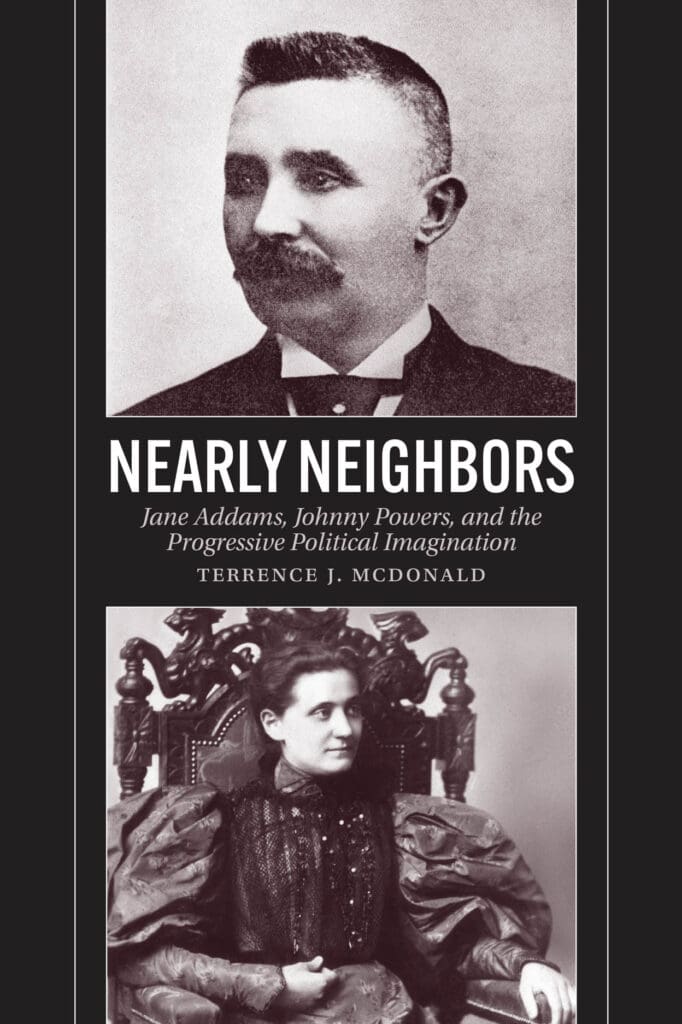
[124] Trolander writes that at Hull-House after Jane Addams’s death, the settlement capitalized on its prestige by turning residence into a money-making program. Hull-House had an unusually large physical plant (it covered two city blocks), which included twenty-six apartments and at least twenty-seven rooms for residents. Rents ranged from $40 to $65 for apartments and $15 for rooms. These rentals supplied Hull-House with one-third of its income. Without Jane Addams to raise money, it became imperative to have as many people as possible living at the settlement. Hull-House began to solicit residents more openly and dropped the six-month probationary period. These efforts were successful; residence at Hull-House increased from around sixty-five in 1935, the year of Miss Addams’s death, to more than 100 in 1939. This businesslike approach attracted a more passive type of resident compared to those who initiated innovative programs in earlier years.” (Trolander, Settlement Houses, 45-46.)

[125] Trusteesโ€™ Meeting Minutes, February 24, 1938, Folder 5, Hull House Collection; Trusteesโ€™ Minutes, October 27, 1938. See also: Donna Hodgman, “People Live At Hull-House,” 1943, typescript, Jane Addams Memorial Collection (JAMC), Special Collections, Daley Library, UIC, to get a sense of the changing of the guard.

[126] Charlotte E. Carr, โ€œProblem Communities.โ€ Child Welfare Pamphlets, No. 74 (Iowa City: University of Iowa, February 24, 1940), 7-8, Folder 543, Hull House Collection.

[127] Linda Gordon, Pitied but Not Entitled: Single Mothers and the History of Welfare 1890-1935(Cambridge: Harvard University Press, 1994), 218-19.

[128] Trusteesโ€™ Minutes October 27, 1938.

[129] Trusteesโ€™ Minutes October 27, 1938.

[130] Donna Hodgman, “People Live at Hull-House: Paint It White,” (1943 typescript), 6. 13. Hull House Collection, Series VIII, Box 1, Folder557, Spec. Coll. & UA, ULUIC.

[131] Donna Hodgman, “People Live at Hull-House: The People,” 7-8.

[132] D. Hodgman, โ€œThe People,โ€ 7-8.

[133] Trusteesโ€™ Minutes, January 21, 1938,

[134] HHA Trusteesโ€™ Meeting Minutes, December 10, 1937, Hull House Collection, Folder 5, Spec. Coll. Daley Library, UIC.

[135] D. Hodgman, “Paint it White,” p. 4.

[136] D. Hodgman, “Paint it White,” 4.

[137] http://tigger.uic.edu/htbin/cgiwrap/bin/urbanexp/main.cgi?file=new/subsub_index.ptt&chap=130. Accessed 2 July 2009. This is an article written by Alexander Gourse for Urban Experience: Hull-House and Its Neighborhoods 1889-1963, an educational and research website edited by Rima Lunin Schultz for the Jane Addams Hull-House Museum and the University of Illinois at Chicago.

[138] โ€œJane Addams Spirit in Carr Background,โ€ American, 26 December 1942, Folder 543, HHC.

[139] Sydney J. Harris, โ€œCharlotte Carr Resigning From Hull House Job,โ€ Chicago Daily News, 23 December 1942, p. 1; 4, Folder 543, HHC.

[140] Actually had a surplus, but still were faced with essential repairs; endowment was somewhat over $500,000; during 1943 they did not liquidate any endowment securities for current expenses. The increase in the value of the endowment fund came from higher market quotations for their railroad bonds and common stocks not because there were additions to the endowment in 1943. โ€œFinancial Statement Year Ended December 31, 1943,โ€HHA Trusteesโ€™ Annual Meeting, January 28, 1944, HHC.

[141] Hazel MacDonald, โ€œResidents Ask for a Voice in Hull House,โ€ Chicago Times, n.d., Near West Side Community Committee Records, Box 30, Folder 410, Spec. Coll. Daley Library, UIC.

[142] Sydney J. Harris, โ€œCharlotte Carr Resigning From Hull House Job,โ€ Chicago Daily News, 23 December 1942, p. 1; 4, Folder 543, HHC.

[143] Harris, โ€œCharlotte Carr Resigning.โ€

[144] Howard Vincent Oโ€™Brien, โ€œAll Things Considered,โ€ Chicago Daily News, n.d., but copyright at bottom of article says 1943, Folder 543, HHC.

[145] Trolander contends that the settlement houses in Chicago and New York were able to retain their political independence from the pressures of conservative boards for a longer time than other cities: “The important difference is that both New York and Chicago settlements housed leaders with radical political philosophies. In addition there was no Chest or welfare federation to regulate the activities of these settlements, thus radicals were free to organize. As a rule, the boards of the major settlements in these two cities did not interfere with settlement activities.” Trolander, Settlement Houses, 106.

[146] Trusteesโ€™ Minutes, Jan 8, 1937, Box 1, Folder 5, HHC.

[147] Bowen to Elizabeth H. Webster, May 3, 1937, Welfare Council Papers Box 330, Folder 2, Chicago History Museum; Webster to Bowen, May 4, 1937, Welfare Council Papers Box 330, Folder 2; Trusteesโ€™ Minutes, January 27, 1939; March 24, 1939; December 20, 1940;

[148] See: Peggy Glowackiโ€™s Helen Culver biographical entry in Women Building Chicago 1790-1990: A Biographical Dictionary edited by Rima Lunin Schultz and Adele Hast (Bloomington: Indiana University Press, 2001) USE SHORT FORM FOR BOOK; Jane Addams to Mary Rozet Smith, March 26, 1895, ser. 1 Swarthmore College Peace Collection, JAC.

[149] Trusteesโ€™ Minutes, January 20, 1942.

[150] This data has been gathered primarily from the Minutes of the Hull-House Association, the Hull-House Year Books and Bulletins: April 25, 1895, March 14, 1903; April 14, 1903; October 15, 1907; January 27, 1908; April 14, 1908: October 30, 1928; November 1, 1928; April 9, 1929; June 18, 1929; October 29, 1929; April 29, 1930;May 27, 1935, Board of Trusteesโ€™ Minutes, Hull-House Collection, Dept. of Spec. Collections, Daley Library, University of Illinois at Chicago (UIC);Hull-House Bulletin 3, no. 12 (November and December 1899): 4. Biographical information on Sewell Avery: Marquis,Whoโ€™s Who Chicago and Illinois, 1945; for Helen Bowen Blair: Marquis, Whoโ€™s Who Chicago and Illinois, 1945; โ€œHelen Culver Funeral To Be Held Saturday,โ€ Chicago Tribune, 20 August 1925, p. 10; โ€œHelen Culver Leaves U. of C. $600,000,โ€ Chicago Tribune, 14 November 1925, p. 1; โ€œC.L. Hutchinson, Banker, Is Dead. Long Active in Civics, Art, and Charities.โ€ Chicago Tribune, 8 October 1924, p. 1. See biographies of Mary Rozet Smith, Mary Wilmarth, Louise deKoven Bowen and Helen Culver in Women Building Chicago 1790-1990: A Biographical Dictionaryedited by Rima Lunin Schultz and Adele Hast (Bloomington: Indiana University Press, 2001). USE SHORT FORM FOR BOOK

[151] Thomas H. Beacom Jr., lawyer & trust officer, First National Bank; Edward McCormick Blair [Louise Bowenโ€™s grandson], investment banker; Homer Buckley, advertising & direct marketing; Lawrence D. Smith, mining company official; Purcell L. Smith, public utilities; John E. Blunt, III, investment banker; Wallace Flower, executive with William Blair, brokerage house on the N.Y. Stock Exchange and in-laws of the Bowens; William H. Regnery, textile manufacturer were the trustees Louise Bowen brought to the board in the late 1930s and 1940s.

[152] See: Paul Milkman, PM: A New Deal in Journalism, 1940โ€“1948 (New Brunswick, N.J.: Rutgers University Press. 1997), for a discussion of this experiment in Left-leaning journalism that was financed mostly by Field. ; in 1944 Levin was on the personnel practices committee of the HH Board of Trustees. Minutes, March 24, 1944, Folder 7, Series 1, Hull-House Collection.

[153] โ€œDeny Miss Carrโ€™s Politics Caused Hull House Rift. Trustees Say Budget Row Led to Resignation,โ€ Chicago Tribune, 4 January 1943, p. 11; Trusteesโ€™ Minutes, December 1, 1942; Trusteesโ€™ Minutes, December 21, 1942, Hull House Collection.

[154] Trusteesโ€™ Minutes, December 1, 1942; Trusteesโ€™ Minutes, December 21, 1942, Hull House Collection. According to a newspaper account, โ€œthe trustees met in special executive session Monday and voted to accept Miss Carrโ€™s resignation. Only nine of the boardโ€™s 22 members were present.โ€ Sydney J. Harris, โ€œCharlotte Carr Resigning From Hull House Job,โ€ Chicago Daily News, 23 December 1942, p. 1; 4, Folder 543, Hull House Collection.

[155] Alex Elson Oral Interview transcript, OH-074 [interviewed by Stuart J. Hecht] October 12, 1980, 13, Hull House Collection. Elson described how โ€œan issue arose as to whether or not Japanese children from the internment camps should be permitted to come to Bowen Country Club and to Hull House activities and I took a very strong position that they should. This was after Pearl Harbor, and general anti-Japanese feeling . . . Mrs. Bowen, chair of the Board, was a super patriot, and blind in her patriotism and was opposed to this, but I spoke up at the Board Meeting and got some support from Marshall Field, who was then the editor of the Sun-Times, the old Sun. It didnโ€™t do much good. I lost the battle.โ€

[156] Gordon, Pitied But Not Entitled, traces the involvement of progressives like Grace Abbott in the establishment of social security under FDR. For our purposes here I indicate the overlap of the first group of reformers in the New Deal and do not take up Gordonโ€™s more important critique of the role of maternalism in the outcome of a two-tier welfare system in the U.S.

[157] It would be interesting to find out how settlement houses worked with the new community organizations that emerged in the post-World War II decades, from 1947 to 1963.

[158] Sydney J. Harris, โ€œCharlotte Carr Resigning From Hull House Job,โ€ Chicago Daily News, 23 December 1942, p. 1; 4, Folder 543, Hull House Collection; โ€œJane Addams Spirit in Carr Background,โ€ American, 26 December 1942, Folder 543, Hull House Collection; Louise Bowen to Alma Petersen, March 30, 1949. Russell Ballard Papers, Supplement II, Folder 36. Special Collections.

[159] Sydney J. Harris, โ€œCharlotte Carr Resigning From Hull House Job.โ€ NEED REST OF THE CITE.

[160] Louise Bowen to Alma Petersen, March 30, 1949. WHERE?

[161] Sydney J. Harris, โ€œCharlotte Carr Resigning From Hull House Job.โ€

[162] โ€œJane Addams Spirit in Carr Background,โ€ American, December 26, 1942, Folder 543, Hull House Collection, Spec. Coll., UIC. The Union for Democratic Action ironically was established by people on the left who were attempting to create an independent left that was separate from the American Communist Party and organizations perceived as CP fronts. The conservative press never bought this distinction.

[163] โ€œCharlotte Carr, Relief Aide, Dies,โ€ New York Times, 13 July 1956, p. 19.
The Challenge of Community-Based Planning for Urban Renewal: The Case of Hull-House and the American Reform Tradition, 1930-1963,

After the death of its legendary co-founder Jane Addams in 1935, Hull-House trustees had to determine what role, if any, the old thirteen-building complex could play in the neighborhood that was being transformed by super highways, public housing, and the loss of population. They did so in the context of two historical movements: the migration of African Americans from the south to the urban North, that more than any other issue in the 1940s and 1950s challenged the deepest felt values and goals of the social settlement movement; and, the rising demand in local communities to democratize community organizations or agencies.

These two movements intersected in urban neighborhoods in the United States where the possibility of large-scale urban redevelopment threatened the status quo, especially the racial composition of communities. Hull-House, situated in such a neighborhood on Chicagoโ€™s Near West Side, decided to integrate and democratize its programs and staff, to remain in the neighborhood[1]; to support public housing; and to work with the neighborhood to develop a community-based plan for urban renewal.

The major tool to accomplish the goals of integration,  democratization, and community renewal, was an entity called the Near West Side Planning Board, an agency that was to be separately incorporated and independent of the settlement, but initially received staff and financial support. With this Planning Board, Hull-House hoped to create a process that would lead to vastly different outcomes from the typical model of urban renewal where land clearance and private development ignored the population being displaced. Instead, evoking the innovative spirit of the settlement movement as a vanguard of new social relationships in a democracy, Hull-House sponsored what it hoped would be an open and democratic process that could be used throughout the United States.  It was to include all elements of the community with the result that redevelopment would occur without displacement. The people of the neighborhood would be able to reap the rewards of the renewal rather than be forced out by rising real estate values and dispersed to other low-rent neighborhoods. This paper uses the case study of this community-based planning experiment to ask broader questions about community re-building in late twentieth-century and early twenty-first century American cities.

 Without spending too much time on background, it seems important to comment on how the Hull-House settlement actually functioned in the neighborhood. [2] In 1935, The Hull-House settlement had existed for forty-five years as a private, not-for-profit association governed by a board of seven trustees, including Jane Addams who called herself โ€œhead residentโ€ and did not take a salary. She was, until 1907, both the president and the treasurer of this board. The majority of the trustees had held their positions from the 1890sโ€”when the system was put into placeโ€”until Jane Addamsโ€™s death in 1935, or, if they preceded her, their own death. The trustees, during the Addamsโ€™s years, were women and men who overall can be described as wealthy civic-minded progressives who were responding to the evils of the industrial city. Addams, one of their class,[3] had established the settlement with her own funds and they backed her โ€œexperimentโ€ and accepted her leadership. Since Addams was a volunteer who invested her own money in the settlement, she fit a model of womanly benevolence not one of professionalism. The trustees were there to offer advice and counsel, not to supervise or to develop policy, unless asked directly. Addams, then, had a great deal of personal discretion and reigned almost completely unchallenged by the close-knit group of trustees.[4] In addition, Hull-House was not affiliated with a religious denomination or a university so had an enviable independent position. The meteoric rise to international prominence that Addams and the settlement achieved also gave her a protected status.[5] After her death, there were no head residents (now called directors) of equal stature or, obviously, whose relationship to the trustees had an equivalency.[6] This was very empowering for Addams and, I would argue, gave her the ability to speak out on many controversial stands without fear of reprisal, and to defend the rights of political dissidents worldwide. It allowed her to personally ally herself with unpopular causes and individuals, to establish radical organizations such as the Womenโ€™s International League for Peace and Freedom, and to maintain a large degree of freedom for the individual residents who came to live in the Hull-House complex. [7]

Hull-House was also a meeting place for unpopular groups from the neighborhood. Yet there was no thought that an individual who lived in the neighborhood and was active in the settlement should take a place on the board of trustees until 1943 when Alex Elson, who had grown up in the neighborhood and participated in Hull-House as a youngster, was selected by the board of trustees.[8]

The trustees had traditionally been among the settlementโ€™s major contributors: multi-millionaire heiress and leading civic reformer Louise Bowen, who continued to dominate the trustees until her death in 1953; Mary Rozet Smith, Janeโ€™s life partner and daughter of Smith Bragner, one of the countryโ€™s paper manufacturers ; Helen Culver, the heir of the Charles Hull real estate empire, and owner of the Hull homestead[9] and the property surrounding it; Mary Wilmarth[10], a feminist clubwoman and one of Hull-Houseโ€™s earliest supporters; Julius Rosenwald, who owned Sears Roebuck, Co., and was a leading philanthropist known for his support of education for African Americans in the South and his sponsorship of the NAACP; and Sewell Avery, president of the U.S. Gypsum Company and Chairman of the Board of Montgomery Ward & Company. Completing the list of trustees were the philosopher John Dewey, wealthy businessmen and art patrons Edward B. Butler and Charles L. Hutchinson, and Allen B. Pond, architect.

When old-timers died, they were replaced by other family members or individuals well-known to those on the board. Charles Hull Ewing โ€œreplacedโ€ his cousin, Helen Culver; Louise Bowen added her daughter Helen Bowen Blair in 1929 when the number of trustees increased from seven to nine.[11]

In the 1940s, when the number of actual trustee slots increased to 25, the categories of people who served expanded to include individuals who were prominent in the social welfare field as practitioners or professors, often who had been Hull-House residents in their younger years; less than a handful [four] of prominent African Americans [Robert R. Taylor, president of the Chicago Housing Authority; the Rev. Nathan A. Scott, professor of theology at the University of Chicago Divinity School; Dr. Lloyd A. Hall, chemist;  and journalist Era Bell Thompson] and a group of businessmen and their wives, primarily real estate developers, who held prominent roles in metropolitan Chicagoโ€™s planning circles (James C. Downs, Jr.; Anthony Downs; Ruth Camp, wife of J. Beidler Camp; Harry Goldstine; Mrs. Ferd Kramer); and prominent liberals including Adlai Stevenson and Marshall Field, III. 

The original โ€œresidentsโ€[12] of the settlement -โ€“young women and men-โ€”mainly affluent and well-educatedโ€”following the example set by Jane Addams, had included radicals, socialists, labor leaders and social reformers. The cross-class, cross-cultural relationships that were forged with the neighbors were intended to be cooperative rather than paternalistic, friendly rather than officious, and, at best, democratic in spirit.

Yet from the beginning, the neighborhood became a laboratory and the studies produced by the residents launched reform campaigns that would eventually transform the neighborhood, but for the first forty-five years or more, without neighborhood-led participation in the development of social policy. [13]

Under Charlotte Carrโ€™s administration, serious efforts were made to reverse this pattern and to democratize Hull-House within itself as well as in its relationships with the community. Of course, a large aspect of that effort was to change race relations within the settlement itself and in the neighborhood. Arriving in October 1937, Carr, who had been the executive director of the New York City emergency relief bureau, openly advocated New Deal-style cultural expression and workersโ€™ education, as well as civil rights.  Carrโ€™s approach to the race issue as administrator of emergency relief in New York had impressed Dorothy Height, the civil rights leader who had witnessed Carrโ€™s fairness toward blacks during the March 1935 riot in Harlem. The situation in March of 1935 was desperate for African Americans. While blacks were only 8 percent of New York Cityโ€™s population, they made up 42 percent of the unemployed on welfare. They were even denied positions on work projects set up by the welfare system and there was not a single person of color in a position of authority on the management staff of the Welfare Administration. Carr remedied the problem by appointing Height to be personnel supervisor in the central office of the Home Relief Bureau.[14]

 The African American community in Chicago anticipated her move to the city. Carrโ€™s network of labor and civil rights leaders and her friendships with these leaders were comparable to the kinds of inter-racial networks Jane Addams had formed at the high point of her influence, the difference being, of course, that Addams was a charismatic leader and that Carr never achieved that kind of recognition or influence. Jane Addams by 1912 had forged relationships with the black leadership and Hull-House was one of those places in a segregated world where African American women and men felt welcome. Addams co-existed with the contradictions that were part and parcel of Jim Crowism, was one of the founding members of the NAACP, but was unable to integrate Hull-House. Instead the work done by Hull-House among blacks, who by 1925 had settled in significant, although small numbers, south of the settlement[15], was carried out through the medium of the Hull-House Community Club, an organization of women affiliated with the State and National Federation of Colored Womanโ€™s Clubs.[16] The Hull-House Community Clubโ€™s members remained a separate [and segregated] club in the settlement house from the late 1920s thru the early 1950s.[17] Their children were kept separate rather than encouraged to join in the myriad of clubs and activities available for White children. The persistence of ethnically separate activities at Hull-House in the 1930s and 1940s points to deeper and more complex cultural and racial issues.[18]

One of Carrโ€™s first moves to integrate was to invite the first African American to Hull-House as a resident. She sought out Chicago Defender journalist Dewey E. Jones and his family, got a Rosenwald Fund stipend to cover his salary, and announced that Jones was going to investigate the conditions of African Americans in the neighborhood of Hull-House. Jones, who had been an advisor to Harold Ickes in Washington, D.C.,[19] was a good choice as the first African American resident at the House. Jones, his wife, Faith Jefferson Jones, a social worker; and their toddler, Dewey E. Jones, Jr., moved into the settlement in 1938.  Jonesโ€™s sudden death in April 1939, ended his work at Hull-House.[20]

Carr combined her efforts to integrate with community organization initiatives. Carr established a community relations department in 1939. Under the sponsorship of this department, two small neighborhood centers were started and operated by parents and a staff of neighborhood leaders who were made available by the Works Project Administration. One center was in the African American district south of the settlement and filled a need that had long been recognized by the Hull-House Community Club. As mentioned above, the Community Club had met since the 1920s, but had not been incorporated into the settlement life. Carr reversed this by empowering the African American women who were club members to run this new center located in their own neighborhood, with WPA and Hull-House funds. The women also reached out to African American businessmen who helped with funding. Activities within the center included a morning pre-school play group, afternoon game periods for school children, weekly dances and English classes for adults, with WPA leadership supervised by the Recreation staff of Hull-House. A motherโ€™s club had been organized and was sponsored by members of the Hull-House Community Club. Carr felt that this center represented an activity where neighborhood leaders were making plans for themselves and carrying them out, with minimum guidance from Hull-House.[21]

Carrโ€™s tenure with Hull-House ended in December 1942, after only five years, and, according to Carr, she had been fired.[22] There were charges of budget extravagance under Carrโ€™s administration, but the record indicates that there was no budget crisis.[23] Bowen was offended by Carrโ€™s politics, did not articulate what I believe was Carrโ€™s real sin: successful efforts at organization and empowerment of the neighborhood. This would have been threatening in itself, but Carr believed that the neighborhood people must participate fully in the affairs of the settlement. She saw Hull-House as the communityโ€™s organization.  Her boldness in this direction, political columnist Sydney J. Harris argued, โ€œoften antagonized some board members, as did her insistence upon entering political controversies when she felt the welfare of โ€˜the little people was at stakeโ€™โ€[24] since she believed that she, as director of Hull-House, represented the little people against the special interests.

While many people who agreed with her approach liked to say she was carrying out the legacy of Jane Addams, Carr was attempting something very different from the kind of social relations Addams established with the neighborhood. Commenting on the departure of Carr, a member of the West Side Community Committee [different from the West Side Community Organization], who had spent his life in the neighborhood, said the fundamental issue was โ€œwho shall formulate the policies of Hull House? Does Hull House belong to the people it serves, or to the trustees? Shall it be an โ€˜agencyโ€™ superimposed from above; or shall it be an instrument of the people themselves? Only by involving the people significantly in the management of Hull House can it ever become a real part of the attitudes, sentiments and thinking of the people.โ€ [25] 

Other social settlements faced the same challenges in the 1930s and 1940s, but few actively pursued a policy of integration or of democratization. Newer kinds of community organizations, like Anthony Sorrentinoโ€™s West Side Community Organization, developed out of University of Chicago sociologist Clifford Shawโ€™s Chicago Area Project, emerged to challenge the hegemony of established settlements like Hull-House. The West Side Community Organization was a group predominantly of neighborhood people of Italian background that emerged in the late 1930s as an alternative to the โ€œtraditionalโ€ top-down social agency approach. What is interesting about Hull-House settlement in this period is how the directors, staff, and residents attempted to move away from the top-down model while still retaining controls that resembled the top down model of a social agency.

One of the Hull-House residents who advocated for community organization was Eri Baker Hulbert, III, the grandnephew of Jane Addams.  From 1937-1940, he was counselor and head of tenant selection for Jane Addams Homes for the Chicago Housing Authority. The Homes were located in the Near West Side neighborhood less than a half mile west of the settlement complex.

It was Eri Hulbert who was given the task in 1947 of working with the other community organizations in the neighborhood. The major one was Sorrentinoโ€™s West Side Community Organization, mentioned above. This organization, rather than a club that came out of Hull-House, initiated discussions with the settlement about ways to cooperate in a community planning effort. While the West Side Community Organization clearly satisfied the agenda of democratization and had well-developed neighborhood leadership that would become significant for the effort to employ community-based planning for urban renewal when the Near West Side was challenged by large-scale land clearance plans, the organization also promoted a narrow vision of what constituted the neighborhood and ultimately made inter-racial cooperation, in response to the migration of African Americans from the South untenable.

The years of the experiment with community-based planning occurred during the directorship of Russell W. Ballard. With Carr gone, and with her the majority of the residents and staff who sided with her, also departed[26], Hull-House returned to its former traditions, with minor revisions.[27] The trustees regrouped, appointed an interim director, and carefully sought out the next permanent director.[28] The board ignored the communityโ€™s demands to have input in the selection of the next Hull-House director.[29] The 25-member trustee board had become more of a policy-generating group; there was much more bureaucracy and officers of the โ€œcorporationโ€ now included a president, three vice-presidents, a secretary, a treasurer, and an assistant treasurer. The director was more formally scrutinized by the board and was increasingly treated as a paid employee in the corporate model. Louise Bowen was president and treasurer.[30] 

Russell Ballard, a civil rights advocate who easily fit the Hull-House boardโ€™s qualification that the director of Hull-House โ€œdefend the rights of all racial, religious and economically disadvantaged groups as Hull-House has done in the past,โ€[31] succeeded Carr and continued to push for improved race relations in the neighborhood and for greater progress in the integration of the settlement and its programs. His ability to speak out, however, and to initiate programs was hampered by the boardโ€™s committee system. The conservative tendencies of the board were strengthened in the cold war anti-communism and red-baiting that accelerated in the post-World War II decades. These trends were apparent during Charlotte Carrโ€™s administration and she, like many pragmatic Left-leaning New Dealers attempted to distance herself from Communist-front groups and the Communist Party.[32]

Additionally, Ballard functioned in an atmosphere of increased racial tension in the United States. For Chicagoans and others in urban centers in the North, the Detroit race riot of 1943 was a frightening example of what might happen locally. Chicagoโ€™s Mayor Edward Kelley appointed a Mayorโ€™s Committee on Race Relations [later the Chicago Commission on Human Relations] immediately after the events in Detroit. Ballard and his assistant director, Elaine Switzer, were active in the expanded work on race relations undertaken by the Council of Social Agencies of Chicago.[33]  It was, however, in the day-to-day activities that Ballard, Switzer, and Robert Mulligan were immediately responsible that the work of race relations found its practical expression. โ€œBecause people attend a settlement house voluntarily, working with any group in an interracial setting calls for statesmanship of the highest order,โ€ Ballard wrote.[34] Ballard and his staff had to combat the withdrawal of Whites from programs as the neighborhood became increasingly influenced by the rumor that โ€œHull-House was โ€˜being ruined by the Mexicans and Negroes.โ€™โ€[35]

One of the Hull-House staff, Arthur Ferrell, had been stabbed when he was escorting a group of African American boys to their homes after a Hull-House activity. Occurring in 1952, it was the first incident of an attack on a member of the Hull-House staff.  Hull-House trustee Robert R. Taylor, an African American who was president of the Chicago Housing Authority board, encouraged Ballard to deal with the incident through the Mayorโ€™s Commission on Human Relations since the commission โ€œhad stepped in quietly in other areas at early signs of tension and had been able to help the local agencies work out constructive programs which appeared to allay unrest and lessen the tensions.โ€  The trustees also urged Ballard to press the police for a thorough investigation.[36]

Two years later, after more than fifty years of ethnic and race segregation, a new formula was tried out with the teams in the gymnasium. Each team was made up of boys from all racial groups in an effort to secure integration of all groups in the neighborhood.  Later reports indicated the progress was slow.[37] Out of frustration with the slow pace of interracial progress, Russell Ballard suggested that Hull-House begin to follow the lead of other settlement houses and extend their work directly into public housing projects where the need for service was so great.[38]

Eri Hulbert was well aware of the racial tensions in the Near West Side long before he agreed to take the staff position of executive director of the Near West Side Planning Board. The Italians did not want the African American community that was south of Roosevelt Road, a major racial boundary, to move into the area they saw as their own turf. The public housing projects were a potential source of racial change in the neighborhood, so while affordable public housing was a reasonable alternative for the blighted housing on the Near West Side, it was an unacceptable solution for the Whites that lived in the neighborhood and were the potential participants in community-based planning.  Attempting to bring together individuals from all sections and elements of the Near West Side community so that a planning board could begin with solid commitment behind it, his past involvement with the Jane Addams Homes in the neighborhood, and Hull-Houseโ€™s advocacy of public housing, worked against him. Father Barton, parish priest at Holy Family Church, a key institution in the neighborhood, disseminated blatantly hostile stories in his parish newsletter indicting Hulbert and Hull-House for their Left-wing politics and their advocacy of more public housing in the neighborhood. (Barton called it socialized housing.) In 1938 Barton had stopped the CHA from extending the Jane Addams Homes, an effort that Hulbert, as service director of the Homes, and Hull-House, as a willing intermediary for the CHA in the neighborhood, had favored.[39]

Hulbert produced a brochure to introduce the community planning board idea to the neighborhood. It indicates his grasp of the problems involved with creating an organization from scratch; of offering new and relatively technical information to people from all educational backgrounds and viewpoints; of the inherent structural problems of dealing with the new local, federal, and state bureaucracies pertaining to planning; and of the difficult distinction between creating a vehicle for the community to talk out and reconcile its differences over planning, constructing the planning board itself;, and finally, presenting a plan that would be implemented by other private and public partnerships. It was a very big meal for the community to digest.

The brochure tantalizingly explained that the private investors who could receive land from the Land Clearance Commission might be a neighborhood redevelopment corporation, an insurance company, or any individual, association or corporation set up legally to invest in housing in Illinois, including cooperatives and veteransโ€™ groups. In essence, it could be the community itself. The brochure enumerated the funds available for redevelopment from state, federal, and city sources, and concluded: โ€œThese laws and this money plus private capital can result in new homes, more parks and schools, better business and industrial facilities on the Near West Side. They offer a unique opportunity for the pioneering of a new frontier in city building.โ€[40]

In the next seven years, Hulbert and a core group that functioned as an executive committee did a monumental job of getting the concept of community-based planning on the table. Hulbert was able to gain the attention of the public agencies involved in the urban renewal process and while there were no agreements written in stone, all along the way the Near West Side Planning Board felt that it had general approval of its overall direction. [41]  This was an overly optimistic view.[42]

The process of interacting with the agencies was difficult for large-scale developers and, for a semi-professional group, as the Near West Side Planning Board was, having only limited support from local foundations, and a modest allocation annually from the Hull-House Association, the task was formidable.[43] In truth, the Planning Board had put off dealing with the really complicated problem of private capital once a plan was put in place. What made that an even more serious concern was the fact that in reality approval for a plan from the public agencies was based in large part on whether or not it was deemed realistic that the proposed project could be financed. The inability of the Planning Board to collect significant funds from the businesses in the redevelopment area was a sign of its weakness.[44]    

Perhaps the most disconcerting outcome in 1950 of the two years of organizing and after โ€œ75 meetings, which had been attended by 248 different people and by a total of 778, exclusive of innumerable small conferences, exclusive of hours of volunteer time  . . . exclusive of meetings called by other agencies in which the Planning Board participated and exclusive of a few Planning Board meetings of which accurate record was not made,โ€[45] was the realization that most people in the neighborhood were not interested in planning beyond their own block, or even their own piece of property.

The persistence of racism was undoubtedly the central problem in any kind of community planning in an area like the Near West Side. Hulbert and the core group[46] of Hull-House affiliated Planning Board members had to start the planning process in the place in which they found the community. While it was possible to include one or two African Americans, the other major interest group was the Italians. The reality was that the push from the Italian-dominated West Side Community Organization, and the churches in the neighborhood, was to focus on the much smaller area whose population was overwhelmingly Italian.[47]

Eri Hulbert was caught in a dilemma. He wanted to expand the horizons of the neighborhood and educate the people about the opportunities of planning, but he first had to gain their trust. The neighborhood felt that large-scale clearance was about to happen. So much of the neighborhood had become vacant already that this was not an unreasonable worry. Stimulated by this anxiety, a survey of property owners in the area was made with the help of a staff of local people hired and trained for the purpose. The information was to be mapped.

For the first time in two years, Eri Hulbert was energized and although he had pointed out the lack of money, lack of membership, and lack of action, and the persistence of racial tensions, he saw accomplishments: they were organizing the Planning Board itself; they had gotten industry, business, agencies and residents started in working together. Possibly the most important single concrete fact was the changed policy of the Central National Bank toward loans for home repair and home rebuilding.[48] Suddenly, in the face of the threat of losing the neighborhood, there was energy and hope for rehabilitation block by bloc, for conservation in selected blocks, for redevelopment.

Of course, this was putting the cart before the horse. There was no overall plan. How could any homeowner or business owner rely on the information from the various agencies when the City Council had not voted on a comprehensive plan for the city and the metropolitan area?[49]

To meet the insecurity that lurked underneath the frenzied activity to get maps readied and to showcase selected blocks where rehabilitation/conservation had been accomplished, the alderman of the ward introduced an ordinance into the City Council, the Pistilli Ordinance, bearing his name. The ordinance transformed the area bounded by Harrison Street, Halsted Street, Roosevelt Road, and Ashland Avenue from its blighted designation to be reclassified with certain exceptions as a proper area for rehabilitation of existing structures. [This eventually became the site of the Chicago branch of the University of Illinois.] The exceptions were the several blocks within the area where the structures were in such condition that it was economically unsound to undertake rehabilitation.[50]  Hulbert and others on the Near West Side Planning Board had questions about how the Pistilli Ordinance would be implemented and worried about residents of the neighborhood investing in rehabilitation without real guarantees.[51]

More profoundly, the Hull-House trustees and their core supporters on the Near West Side Planning Board believed the motivation for the Pistilli Ordinance was anti-democratic. It was a way to keep out private projects that might allow interracial housing or even African American families to live in public housing along with White families. Ironically, Eri Hulbert found himself engaged in a โ€œdemocraticโ€ process in the development of the community-based planning board that was, in the final analysis badly flawed.

The Hull-House trustees were reluctant to sponsor or advocate measures that allowed for a kind of local option to impede the civil rights of minorities. [52] This tension between the will of the local people and the values of open housing and anti-discrimination as a non-negotiable part of public policy in the rebuilding of American cities has been the subject of many works in the field of urban history and urban studies. 

By 1953-54, the Hull-House trustees were far less enamored with the possibilities of the Near West Planning Board. Rather than abandon their commitment to community planning, they sought for other ways to cultivate it. After years of involvement with the community, the trustees and staff of Hull-House returned to the drawing board and put together a citizen participation grant that was funded by the Schwarzhaupt Foundation; initially the grant was to be administered through the Near West Side Planning Board but, with the sudden and unexpected death of Eri Hulbert[53], the trusteesโ€™ discomfort with elements of the Near West Side Planning Board came to a head. Not being able to find among the Planning Board leadership anyone to replace Hulbert (who the trustees trusted and believed in) they moved to sidestep the group. A reorganized structure for the implementation of money from Schwarzhaupt for the development of citizen participation was accomplished and the Near West Side Planning Board officially severed its relationship with the Hull-House settlement in 1956. The new entity, the Citizen Participation Project, controlled entirely by the Hull-House Association, began anew; after hiring a professional community organizer, a series of community meetings to promote citizen participation were inaugurated![54]  Hull-Houseโ€™s commitment to community-based planning was to go on, but this time in a more controlled and focused approach.

These developments paralleled the change of direction for the neighborhood that was coming from the outside. In 1954, William Deknatel reported that James W. Follin, U.S. director of slum clearance and urban redevelopment, had been in Chicago during the past week talking with the Near West Side Planning Board, the Chicago Plan Commission and the Chicago Land Clearance Commission. It looked as if a firm commitment would result for the Hull House area to be one of two pilot urban renewal projects in the area when the housing bill now in Congress passed. Deknatel further reported that Mr. Follin was fairly sanguine about the prospects of the billโ€™s passage.โ€[55]

In 1956 the Harrison-Halsted area, the 55.5 acre tract of land that became in 1963 the campus of the University of Illinois at Chicago, was designated an urban renewal area. Reversing the agreements made locally through the City Council [Pistilli Ordinance] regarding the possibility of conservation and rehabilitation, the Chicago Land Clearance Commission now said that the project area was a slum and blighted area and eligible for redevelopment. [56]

Between 1957 and 1961, when it was first learned that the Harrison-Halsted area was being considered as the Chicago campus of the University of Illinois, several initiatives for redevelopment were on the table. The site conservation report for Harrison-Halsted could be read two ways: from the point of view of big-picture urban planning, the finding that โ€œmost of the structures in the project area and the living units contained in the structures have deteriorated to a degree where rehabilitation or conservation would not be an economic procedureโ€[57] opened up all kinds of possibilities; from the viewpoint of the local residents who had been the most ardent supporters and participants in the Near West Side Planning Board, and who had been working under the assumption that many of them could rehabilitate their own homes and remain in the neighborhood, it was the beginning of a series of betrayals. There were also property owners in the neighborhood who saw a chance for financial gains as they contemplated the rise in property values that were outside of, but close to the area designated for large-scale redevelopment. But this was possible only if public housing was kept out.

Ultimately, the Hull-House trustees who were increasingly representative of a real-estate industry-led redevelopment of post-World War II metropolitan Chicago (reflecting the Richard J. Daley plan for urban rebirth) found that the role for Hull-House was to help federal, state, and municipal authorities demolish the neighborhood[58] that had been the focus and the context of the settlement experience between 1889 and 1959. James C. Downs, Jr., who served as president of the Hull-House Association in 1959,1960, and 1961, the crucial years in which the fate of the neighborhood was decided, was a downtown realtor who had also made a name for himself as the head of Real Estate Research Corporation, the firm that had done the original site studies for the proposed Chicago-area campus of the University of Illinois. He began his association with Hull-House sometime in the mid-1950s. He had become one of Mayor Richard J. Daleyโ€™s closest advisors.ย The other trustees in 1957-1960 included: the wives of realtors Jay Beidler Camp and Ferd Kramer. (Kramer, who was involved in some capacity in almost every major redevelopment project in Chicago, served as president of the Metropolitan Housing and Planning Commission and in 1941 with Holman Pettibone, and Newton Farr, helped guide Chicagoโ€™s early renewal efforts. Kramer managed Lake Meadows, a project funded by New York Life, and developed Prairie Shores.) By the end of the 1950s, the Hull-House Trustees were reinventing the settlement by contemplating its removal from its historic site and its transformation into a social agency that served multiple constituencies in locations throughout the metropolitan area. The vision of settling as a bridge-building act undertaken to create cross-class and cross-ethnic and racial harmony and understanding had fallen away, replaced by strategies of delivering services in decentralized settings.

Deknatel, an architect whose widowed father, businessman Frederick Deknatel had become a resident of Hull-House in the 1900s, represented the ambivalent relationship the settlement had for a long time with the neighborhood. Deknatel played an increasingly significant role as a trustee and, finally, as president of the board of trustees of the Hull-House Association. He was intimately involved with the creation of the Temporary Organizing Committee, which became the Near West Side Planning Board. Deknatel was refreshingly transparent in a speech he made to the Hull-House trustees in 1947, as he explained the role that Hull-House would play:

With the beginning of planning there will be a series of battles. There will be inevitably serious disagreements about planning matters, both small and large. . . it will be you at Hull house who will be most capable of arbitrating these differences, because Hull House is the most disinterested agency in this community. It is the most disinterested because if our effort succeeds largely, it will put Hull House out of business, and I think that we can sincerely say that that would be a perfect conclusion to our efforts.[59]

This โ€œdisinterestednessโ€ from the neighborhood was inherent from the beginning. From public baths to reformation of the juvenile court system, progressive reformers with deep roots in neighborhood settlements like Hull-House began the process of urban renewal in American cities in the 1890s when they first moved into neighborhoods like the Near West Side. One of the first playgrounds in Chicago was opened under the auspices of the Hull House settlement; it was โ€œbuiltโ€ across the street from the settlement in a space created by the demolition of several slum flats owned by William Kent, a second-generation Chicago entrepreneur whose property holdings included badly maintained buildings in the slums. There is no record where the families moved who had lived in the hovels owned by Kent.[60] The expansion of the Hull-House settlement was an eighteen-year project in which slum buildings were demolished and replaced by the twelve additional structures that together made up the settlement complex. In creating this new neighborhood space that served educational, cultural, and recreational needs for thousands of families, the settlement added positive value to the district. It did not, however, add housing for the neighbors.[61] Nowhere in the process of โ€œslum clearanceโ€ and replacement with new buildings that had new functions, did the settlement consult with neighbors.

Deknatel also indicated that Hull-House was not wedded to fighting for a plan that the neighborhood people endorsed but was deemed unacceptable by planning experts, or did not fit with a better, more comprehensive and metropolitan plan. When the possibility of rebuilding the neighborhood by eliminating it and establishing the Chicago branch of the University of Illinois in its place, Deknatel and others on the board of trustees of the settlement could argue that this was an acceptable outcome of urban renewal as the university plan had merit in a larger conceptualization of metropolitan planning and, furthermore, in its โ€œdisinterestedness,โ€ the trustees could envision Hull-House Association providing services somewhere else. It was not tied to the neighborhood.

Two points should be made here. The first is that the Near West Side Planning Board, while unsuccessful ultimately, had positive outcomes as well. The Planning Board continued its work after 1955 because the heirs of Eri Hulbert had โ€œboughtโ€ the concept of community-based planning. A number of the neighborhood leaders who had cut their teeth on the Planning Boardโ€™s activities, were in place to participate in other councils and commissions where places for community representation needed to be filled. The Planning Board continued to include individuals who were Hull-House residents and/or lifelong participants in the settlement. Ernest Giovangelo, his sister Florence Giovangelo Scala, and Jessie Binford were examples of the social citizenship and new social relations Jane Addams had hoped would evolve from the disinterested, neighborly and open-ended role of the settlement. Inspired by the reform spirit associated with Hull-House, Binford came to the settlement as a resident in 1902, from Marshalltown, Iowa. She became involved with the workings of the new system of juvenile justice and movement of prevention of juvenile delinquency and, in her capacity as head of the Juvenile Protective League (a Hull-House affiliate located in the settlement), she became an adviser and advocate for neighborhood families. Troubled by the professionalization of child welfare during the 1940s and the eclipse of the community work approach, Binford retired in 1952 but remained a resident of Hull-House.

In 1961, Binford joined Florence Scala to co-chair the Harrison-Halsted Community group in opposition to the clearance of the neighborhood for the construction of the Chicago branch of the University of Illinois. Binford wanted people to know that it wasnโ€™t the Hull-House settlement that she was trying to save, but the neighborhood itself. [62]

The Giovangelos had grown up in the neighborhood with close ties to Hull-House, even though they also belonged to the Roman Catholic parish. Florence had a talent for acting and made close relationships with Hull-House residents who ran the theater arts department. It was with the Planning Board, however, that Scala fully realized her individual potential and began to understand the potential of democratic participation in social change. โ€œTo me,โ€ she explained, [Hulbert] was a teacher and a persistent pioneer in this new idea that the people themselves must participate in the planning of their own communities.[63]

Florenceโ€™s brother, Ernest, became a community organizer and participated closely with Hulbert. Some considered Ernie the obvious choice as the new director of the Planning Board after the unexpected death of Hulbert. There were clear biases against Ernie from the settlement side, where it became clear that fear of loss of control of the Planning Board, with the appointment of a real community leader as the executive director, outweighed faith in community-based planning.[64]

Teaching that โ€œthe people themselves must participate in the planning of their own communitiesโ€ was dangerous; by bolstering up the self-confidence of local leaders and supporting the neighborhoodโ€™s aspirations, Hull-House created a dilemma of major proportions. And this brings us to the second important point about the post-1955 planning process. Among the trustees of the settlement there was a split over what position to take when concrete proposals began to surface for the Harrison-Halsted site.

When they first heard that the neighborhood was considered as a site for the university, many trustees were shocked and greatly disturbed by the lack of a democratic process in making this proposal. This proposal came from left field; there had been numerous sites for the Chicago branch of the university proposed, vetted, and rejected, and there was still the possibility of a site near the central downtown that required the reorganization of railroad terminals. It had been touted as the best site. The sudden introduction of Harrison-Halsted was shocking since the Cityโ€™s department of urban renewal, the Chicago Plan Commission, the Chicago Land Clearance Commission, and the Chicago Housing Authority had all had innumerable conversations with the community councils, including the Near West Side Planning Board, that envisioned some kind of project for Harrison-Halsted that combined clearance of slums, rehabilitation and conservation of viable structures, and a staged re-location and then return of displaced neighborhood people into residences they could afford.

Even the Hull-House trustees like James C. Downs, Jr., who were โ€œinsidersโ€ in the urban renewal/planning circles of the City, had participated, seemingly in good faith, with the community.[65] As late as January 1960, Downs and the trustees were involved in developing a plan for a new cooperative housing development in the cleared land near Hull-House.[66] There had never been any talk about the possibility of the site as a campus for the Chicago branch of the University of Illinois.

All of this involvement with the community was interrupted when in April of 1960, leaks in local newspapers revealed plans to use the Harrison-Halsted site for a university campus. Confidential meetings were held in Downsโ€™s downtown office with trustees from the settlement. [67] Between April and October of 1960, while James C. Downs, Jr., held the position of president of the Hull-House board of trustees and was a senior advisor to Mayor Richard J. Daley on urban renewal projects and clearly a participant in the inner circles of power surrounding the mayor, Hull-House trustees brooded and debated what position they should take regarding the proposal to build the University of Illinois campus on the Harrison-Halsted site and thereby destroy the residential community with whom the settlement had been engaged in active planning for improvements for more than a decade. Downs, who stepped down from the presidency at the crucial moment of the public announcement of the plan to build the university in the neighborhood, remained an active trustee, as did his son, Anthony.[68] Downs and his son, pushed for the board to remain neutral during the crucial months of negotiations between the City and the University of Illinois over the final resolution of site selection.[69]

In February 1961, pressure from trustees and staff to oppose the University of Illinois campus plan had gathered, as had the opposition from the neighborhood to both the plan and to the lack of leadership from Hull-House. A special committee was appointed from the board; it deliberated and came back with a resolution to oppose the university plan that ended with this statement:

For decades Hull House has been standing for democratic processes and has been endeavoring to teach them to the thousands of new Americans who have passed through its doors. In the tradition of Jane Addams, Hull house cannot stand by while a project is undertaken which, however worthy in itself, completely ignores these processes, and must oppose governmental actions which fail to consider the rights of the people affected.[70]

This resolution never got out of the boardroom; divided, the trustees negotiated their internal differences by continuing a public position of neutrality.[71] Hull-House resident Robert Mulliganย despaired at the refusal of the Board to release the statement. He stated to the board that the people feel that part of the โ€˜greater goodโ€™ of the City of Chicago is good democratic government. They say they are not cattle or colonials, but people, and should be treated that way.โ€[72]

This board stance of taking no position on the proposed Chicago campus of the university was understood by the community as a betrayal of neighborhood interests and of the hard work of community-based planning that they had engaged in because, in part, they trusted Hull-House.  The Hull-House staff, who continued to have close ties with the neighbors (and in many cases sided with the community against the trusteesโ€™ neutrality) considered the board, in the best reading of it, indecisive, and in the worst, betrayers and hypocrites.[73]

The settlement had been instrumental in organizing the neighborhood to accept the concept of planning; it had been the agent of change, of modernization, and ironically, the agent of an urban renewal project that destroyed rather than rebuilt the neighborhood. It was not that the neighbors had resisted change; they had played by the rules, worked with City officials and urban renewal agencies. Hull-House, from this point of view, was demonstrating that democracy did not work. On the other hand, the plans that were acceptable to the neighborhood leaders of the Harrison-Halsted area, did not work if your goal was to provide affordable and decent housing for the people who lived just a few blocks south across the race boundary of Roosevelt Road.

This leads to a consideration of whether or not community-based planning is an effective means for solving the problems of urban neighborhoods. The question of the unit of planning is very important. For Anthony Downs and his father, James C., and for William Deknatel and many others on the board of trustees of Hull-House, the neighborhood was not the defining unit. The well-being or common good of the metropolitan area, the more realistic measure for modern planners, required a broader universe of people, institutions, and resources than that which could be addressed in a neighborhood of a city. Were these men the villains of the tale? Initially in my research I found the juxtaposition of the real estate interests on the board of trustees and the self-consciously integrationist positions of Russell Ballard to be inexplicable. Why didnโ€™t they fire him? What was going on? After unearthing the names of key civil rights leaders who were resident or trustee at Hull-House in the late 1930s thru 1950s, at the same time that James C. Downs Jr., and other real estate redevelopment/urban renewal promoters also served on the board, it hit me that this was, in fact, one of the โ€œaccomplishmentsโ€ of cold war liberalism as practiced by Ballard and the trustees at Hull-House. They were more on the same page than one might think. The essence of this liberal coalition was its accommodation to the private market; the integrationists like Ballard had nowhere to go but in the direction of men like Downs and Ferd Kramer of the Metropolitan Housing and Planning Commission. He and his wife, who served as a Hull-House trustee, were a new breed of liberals willing to work for managed integration and who advocated private market solutions like Lake Meadows and Prairie Shores in Chicago to reconfigure what had been blighted communities. They did not solve the public housing dilemma, but they created the market for middle-class professionals of both races to have greater choices in the post-World War II housing market. These liberals, who would be awarded human relations commendations from the Mayorโ€™s Commission on Human Rights do not look very much like civil rights leaders to me; yet the other side of the private market, the real estate block-busters and red-lining mortgage agents, were betting on racism to win out.

At Hull-House the race relations specialists, the reformers and idealists, and the liberals who believed in an interracial society inhabited public space in an often polarized, violent urban landscape. Those individuals, idealists like Russell Ballard and Eri Hulbert, who gave their energies to creating vehicles for the development of community leaders and who placed their hopes on the democratic process had to question what went wrong in the Hull-House neighborhood that produced racism rather than tolerance and cloaked this racism in community-based planning processes. This is not to say that all of the participants in the Near West Side Planning Board were opposed to breaking down the color line. That would be a gross overstatement. Yet in the overly narrow focus on a block- by- block approach to conservation and rehabilitation, they selected a small subsection of the Near West Side as their universe. They were aided by federal and state legislation that had built-in local control at crucial stages of redevelopment to satisfy the political forces who fought to keep the racial status-quo. And here again the Hull-House case is instructive. As a settlement house that had a long history of opening its doors to all, it had dealt with the race and ethnic conflicts in the neighborhood by not forcing integration; clubs were self-perpetuating โ€œblocksโ€ in the neighborhood, first because of barriers of languages, but then by the persistent weight of old fashioned prejudices. To counter this, Hull-House had a great variety of programs and activities where there was a mix of the smaller homogeneous groups.

These opportunities for cross-race, cross-ethnic interactions led to friendships and a greater understanding of the importance of respect for all people. Certainly, these experiences made it possible for the neighborhood to value itself and seek a plan to remain a community rather than leave for suburbia. But it also made it possible for old identities to be valorized and for community-based planning to be hampered by the legacy of racism. This paper could only begin to explore the possibilities and limits of community-based planning in an urban neighborhood that encapsulated in its space almost all the fault lines and tensions of American society.  It is a cautionary tale to consider when we assume that โ€œpower to the peopleโ€ can lead to better planning processes than those framed by technocrats and professional planners.


[1] The trustees demonstrated ambivalence on this issue. On the one hand, although there had been discussions at different times from the 1930s regarding the future of the settlement house, the records of the Hull-House Association make it clear that investment in the old buildings and efforts to develop new programs and to adapt to the changing demography of the area continued unabated until the decision to clear 55 acres of land, including the land in which the thirteen Hull-House buildings stood to make way for construction of the Chicago branch of the University of Illinois, had been made by the University and the City of Chicago. On the other hand, influential board leaders like William Deknatel and James C. Downs, Jr., did not identify Hull-House with the neighborhood.

[2] We need to separate the settlement from its founder, the legendary American heroine, Jane Addams, who is depicted as the quintessential social philosopher of democracy by many recent scholars. Jean Bethke Elshtain, Jane Addams And the Dream of American Democracy. Basic Books, 2002; Charlene Haddock Seigfried. Pragmatism and Feminism: Reweaving the Social Fabric. The University of Chicago Press, 1996; Louise W. Knight, Citizen: Jane Addams and the Struggle for Democracy (Chicago & London: University of Chicago Press, 2005).

[3] Addams, the daughter of an Illinois State Senator and businessman who died in 1881, inherited a portion of his estate and was able to restore the old Hull homeโ€™s interior and contribute to the settlement budget, albeit with contributions from others, until about 1895. Addams was clearly a privileged woman who did not need to work; she was not, however, rich, as attested to the small amount of property and outright cash she had at the time of her death.                                                 

[4] The one exception to this is the relationship she had with Helen Culver; the incorporation of Hull-House in 1895 was a condition imposed by Culver before she would make a permanent relationship with Addams who, from 1889, had leased the house and had negotiated for each new lot for the expansion of the complex. Allen B. Pond to Helen Culver, April 18, 1906. JAMC Reel 4-1331, Spec. Coll., Daley Library, UIC.  See also: Jane Addams Memorial Collection correspondence, 1889, reel 2.  Letters to landlord Helen Culver from Jane Addams in March 1890.  Through the early years Addams struggles to get Culver to donate rent and eventually more buildings, finally convincing her after several years to offer some of the lots on the block for sale.  See especially letter from Jane Addams to โ€œDearestโ€ (Mary Rozet Smith) March 23, 1898, JAMC reel 2.

[5] There were always critics, but Addams did not experience serious and sustained criticism until her pacifism during World War I. This was a difficult period for her personally but in an extraordinary demonstration of loyalty, Louise deKoven Bowen, a pro-war Progressive, stood by Addams and continued to fund the settlement as well as raise money from others, defending her friend and colleague at every turn. Louise deKoven Bowen, โ€œLetter About Hull House,โ€ in volume 2 of Speeches, Addresses, and Letters of Louise deKoven Bowen, ed. Mary Humphreys (Ann Arbor, Michigan: Edwards Brothers, 1937): 789-92.See Allen F. Davis, American Heroine: The Life and Legend of Jane Addams. (Chicago: Ivan Dees, 2000), pp. 251-281, for a discussion of the attacks on Addams.

[6] Adena Miller Rich is the exception that proves the pattern. As the immediate successor to Addams, this Hull-House resident who headed the Immigrantsโ€™ Protective League, an affiliated agency at the settlement that had a national reputation in the field, Rich reluctantly agreed to takeover after Addamsโ€™s death, but insisted that she be a part-time, unpaid head resident The Welfare Council of Chicago urged the trustees to find a full-time paid professional as this was becoming the trend in settlements. Charlotte Carr and Russell Ballard called themselves directors and received executive salaries. HHA Minutes of Special Meeting of Trustees, August 2, 1935; HHA Minutes, Jan 8, 1937, HHA Box 1, Folder 5; 

[7] For example, no one dared suggest that Professor Robert Morss Lovett, of the University of Chicago,t and his wife, Ida, leave Hull-House, where they had resided for many years, when the American Legion accused him of disloyalty. Trolander, Settlement Houses and the Great Depression, 104-105.

[8] Alex Elson Oral Interview transcript, OH-074 [interviewed by Stuart J. Hecht] October 12, 1980, 13, Spec. Coll. Daley Library, UIC.

[9] The Hull homestead was the building where Jane Addams and Ellen G. Starr opened the settlement house in 1889. For a good biography of Helen Culver see: Rima Lunin Schultz and Adele Hast, editors, Women Building Chicago: A Biographical Dictionary 1790-1990 (Bloomington: Indiana University Press, 20010.

[10] See the biographical entry of Wilmarth in Women Building Chicago. Wilmarth, among other distinctions, was the mother-in-law of Harold Ickes, a young Chicago lawyer who later went to Washington D.C.

[11] This data has been gathered primarily from the Minutes of the Hull-House Association, the Hull-House Year Books and Bulletins: April 25, 1895, March 14, 1903; April 14, 1903; October 15, 1907; January 27, 1908; April 14, 1908: October 30, 1928; November 1, 1928; April 9, 1929; June 18, 1929; October 29, 1929;  April 29, 1930;May 27, 1935, Board of Trusteesโ€™ Minutes, Hull-House  Collection, Dept. of Spec. Collections, Daley Library, University of Illinois at Chicago (UIC); Hull-House Bulletin 3, no. 12 (November and December 1899): 4. Biographical information on Sewell Avery: Marquis, Whoโ€™s Who Chicago and Illinois, 1945; for Helen Bowen Blair: Marquis, Whoโ€™s Who Chicago and Illinois, 1945; โ€œHelen Culver Funeral To Be Held Saturday.โ€ Chicago Tribune, Aug. 20, 1925, pg. 10; โ€œHelen Culver Leaves U. of C. $600,000.โ€ Chicago Tribune, Nov. 14, 1925, pg. 1; โ€œC.L. Hutchinson, Banker, Is Dead. Long Active in Civics, Art, and Charities.โ€ Chicago Tribune, Oct. 8, 1924. pg. 1. See biographies of Mary Rozet Smith, Mary Wilmarth, Louise deKoven Bowen and Helen Culver in Women Building Chicago: A Biographical Dictionary 1790-1990 edited by Rima Lunin Schultz and Adele Hast (Bloomington: Indiana University Press, 2001).

[12] Residency was a major function of the settlement house movement. It was a program that socialized hundreds of women and men from privileged and educated backgrounds and promoted ideas that we now associate with the liberal welfare state. Hull-house records on residency are incomplete, but minimally, there were 350 residents by 1930. My own research of residency at Hull-House from 1889 to 1963 lists more than 750 names, with varying amounts of biographical information. In 1935 there were 65 residents, of whom 45 were women and 20 were men, two were children; thirteen had arrived that fall; in 1943 there were 86 adults and 7 children; in 1946 there were 102 adults and 8 children. Hull-House Residents 1889-1929, Hull-House Collection, folder 294, Special Collections, Daley Library, UIC; Hull-House Year Book Forty-Fifth Year, 1934; “Report to Hull-House Trustees,” November 27, 1935, Adena Miller Rich Papers, Folder 17, Special Collections, Daley Library, UIC; Russell W. Ballard to the Board of Trustees, HHA, January 27, 1947, Welfare Council Papers Box 330, Folder 2, Chicago History Museum.

[13] [Residents of Hull-House] Hull-House Maps and Papers: A Presentation of Nationalities and Wages in a Congested District of Chicago, Together With Comments and Essays On Problems Growing Out of the Social Conditions [HHM&P] (New York and Boston: Thomas Y. Crowell & Co., 1895); Mary Jo Deegan argues that the Chicago School of Sociology at the University of Chicago in its early days was influenced by the work undertaken at Hull-House and that the early men of the Chicago school  had the “same ideal, to bring sociological knowledge to everyday life to enable people to make intelligent decisions. . . .”  Deegan, Jane Addams and The Men of the Chicago School, 41. Hull-House residents continued to use the settlement neighborhood as a field of study: Breckinridge, Sophonisba P. and Edith Abbott.  โ€œChicago Housing Conditions: The West Side Revisited.โ€ American Journal of Sociology, Vol. 17, no. 1 (July 1911): 1-34. Hull-House residents along with Jane Addams inspired the establishment of the City Homes Association in Chicago which sponsored research, again using the neighborhood and other districts of Chicago, and published Robert. Hunter, Tenement Conditions in Chicago. City Homes Association, 1901. At the time Hunter, who continued his career in New York City, was a Hull-House resident. Hull-House resident Edith Abbott revisited the neighborhood and other districts in Chicago in Abbott, Edith. The Tenements of Chicago: 1908-1935. University of Chicago Press, 1936. Recent sociological studies refer to both the neighborhood and the literature that has emerged about it: Gerald D. Suttles, The Social Order of the Slum: Ethnicity and Territory in the Inner City. University of Chicago Press, 1973, 1968.

Hunter, Albert.  Symbolic Communities: The Persistence and Change of Chicagoโ€™s Local Communities. University of Chicago Press, 1974; Gregory D. Squires, Larry Bennett, Kathleen McCourt, and Philip Nyden.  Chicago: Race, Class, and the Response to Urban Decline. Temple University Press, 1987; Carla Cappetti, Writing Chicago: Modernism, Ethnography, and the Novel. Columbia University Press, 1993.

[14] Dorothy Height, Open Wide The Freedom Gates (New York: Public Affairs Books, 2003) 54.

[15] Hull-House Year Book, 1925, 23: โ€œIn recent years there has been a rather large influx of colored people into the neighborhood. While this club is relatively new it has made an excellent beginning. Its program includes sewing, cooking, wax-work and recreational activities.โ€ Italians made up twenty-six percent of the Near West Side population while African Americans represented eight percent of the population in 1930. Louis Wirth and Margaret Furez, eds. “Near West Side,” Local Community Fact Book 1938 (Chicago: Chicago Recreation Commission, 1938.

[16] Hull-House Year Book, Fortieth Year, 1930, 27; Hull-House Year Book, Forty-second Year, 44; Donna Hodgman, โ€œHull-House Community Club Believes in Work As Well As Play.โ€ HH Block News, vol. 2, No. 9, Feb. 10, 1939, 2-3.

[17] Articles in the Chicago Defender about the club never identify its being all black as a problem and there were also reports that when national associations of African American women held their meetings in Chicago, the Hull-House settlement was a sought-after venue for part or all of the programs. This brings up the whole question of how in a segregated society a White institution like Hull-House could promote respect and acceptance of a black-only group; in this case anti-discrimination meant being willing to let African American community groups share space with Whites.

[18] Hull-House Year Book Forty-Second Year, 1931-32, 43; : โ€œOne afternoon a month all of the women who have afternoon classes at the House and in periods of unemployment the men as well, have an afternoon social at which refreshments are served and a special program is carried out. The last celebration of Washingtonโ€™s birthday was especially successful both for its historical presentation and its air of jollity. The group of women represented Mexicans, Italians, Greeks, Bohemians, Germans and Lithuanians.โ€ (Hull-House Year Book, Fortieth Year, 1930, 27; Hull-House Year Book, Forty-fifth year, 44, 35; Donna Hodgman, โ€œWide Interest Shown In Revival of Greek Club,โ€ Hull-House Block News, Jan. 27, 1939, Vol II, no. 7, 2; HHA Records, Scrapbooks-Press Clippings, Folder 523, West Side Times, 9-13-51;

[19] Harold Ickes, a Chicagoan with close ties to Hull-House and Jane Addams, had served as president of the local chapter of the NAACP. The Left-leaning New Deal networks had begun to include the black bourgeoisie; Hull-House was one of the connecting links in this new infrastructure, bringing blacks and whites together. Later on Robert E. Weaver, who also worked with Ickes, would live at Hull-House while he served as director of Community Services of the American Council on Race Relations in Chicago. Russell W. Ballard to the Board of Trustees, HHA, January 27, 1947, Welfare Council Papers Box 330, Folder 2, Chicago History Museum.

[20] David W. Kellum, โ€œDeath Claims Dewey R. Jones; Journalist is Buried After Simple Rites; Loses Fight With Death After Illness of Nine Days,โ€ Chicago Defender, April 15, 1939, 1.

[21] Hull-House At the Fiftieth Year. May 1940.

[22] http://tigger.uic.edu/htbin/cgiwrap/bin/urbanexp/main.cgi?file=new/subsub_index.ptt&chap=130. This is an article written by Alexander Gourse for Urban Experience: Hull-House and Its Neighborhoods 1889-1963, an educational and research website edited by Rima Lunin Schultz for the Jane Addams Hull-House Museum and the University of Illinois at Chicago.

[23] Actually had a surplus, but still were faced with essential repairs; endowment was somewhat over $500,000; during 1943 they did not liquidate any endowment securities for current expenses. The increase in the value of the endowment fund came from higher market quotations for their railroad bonds and common stocks not because there were additions to the endowment in 1943. โ€œFinancial Statement Year Ended December 31, 1943,โ€HHA Trusteesโ€™ Annual Meeting, January 28, 1944, Hull House Collection.

[24] Sydney J. Harris, โ€œCharlotte Carr Resigning From Hull House Job.โ€ Chicago Daily News, Dec. 23, 1942, 1; 4, Folder 543, Hull House Collection, Spec. Coll. Daley Library, UIC.

[25] Sydney J. Harris, โ€œCharlotte Carr Resigning From Hull House Job.โ€ Chicago Daily News, Dec. 23, 1942, loc. cit.

[26] Some of the break-up of the New Deal group at Hull-House can be attributed to the loss of WPA funds as the New Deal came to an end.

[27] One of the most telling reversals was the return of the weaving room. Carr had taken a real dislike to the arts and crafts-type approach to workers in the neighborhood and had removed much of the Labor Museum arts and crafts and utilized the space for industrial skills training and meeting rooms for groups of men who were unemployed. The weaving room after her departure was revitalized. Esther Wendel Oral Interview Transcript [interviewed by Mary Ann Johnson], July 11, 1984, page 2., Spec. Coll. Daley Library, UIC.

[28] โ€œMrs. Ruth Camp To Act As Head of Hull House.โ€ Chicago Tribune, May 29, 1943, pg. 18; HHA Trusteesโ€™ Minutes, July 23, 1943, Hull House Collection; Council of Social Agencies report by Lucy P. Carner, sec. of Division on Education and Recreation, reported on Hull House June 16, 1943, Welfare Council Papers Box 330, Folder 2, Chicago History Museum.

[29] Hazel MacDonald, โ€œResidents Ask for a Voice in Hull House,โ€ Chicago Times, n.d., Near West Side Community Committee Records, Box 30, Folder 410.

[30] HHA Annual Meeting Minutes, March 26, 1943, Hull House Collection.

[31] This is from a statement of qualifications for the director of Hull-House, which was written by Dr. Wayne McMillen in 1943 for the personnel committee. McMillen was a University of Chicago sociologist who had become a trustee in 1939 on the suggestion of Charlotte Carr. HHA Trusteesโ€™ Special Meeting, March 27, 1961, Hull House Collection, Folder 25, Spec. Coll. Daley Library, UIC; HHA Trusteesโ€™ Meeting, September 22, 1939.

[32] Sydney J. Harris, โ€œCharlotte Carr Resigning From Hull House Job.โ€ Chicago Daily News, Dec. 23, 1942, 1; 4, Folder 543, Hull House Collection; โ€œJane Addams Spirit in Carr Background.โ€ American, December 26, 1942, Folder 543, Hull House Collection

[33] A Brief History of the Committee on Minority Group Relationships, Division of Education and Recreation, Welfare Council of Metropolitan Chicago.โ€ October 1950, 1, Welfare Council Papers, Box 145, Folder 13, Chicago Historical Museum; HHA Trusteesโ€™ Minutes, September 24, 1943, Hull House Collection;

[34] Russell W. Ballard, โ€œHull-House Association Community Fund Service Report,โ€ October 1951, Hull House Collection, Folder 10.)

[35] Russell W. Ballard, โ€œHull-House Association Community Fund Service Report,โ€ October 1951, Hull House Collection, Folder 10.

[36]  HHA Trusteeโ€™ Minutes, March 28, 1952, Hull House Collection, Folder 16; Russell W. Ballard, Hull-House Association Service Report, October 1952. Prepared for the Welfare Council and Community Fund, Folder 41, Hull House Collection.

[37] HHA Trusteesโ€™ Minutes, January 28, 1955, page 2 of Minutes, Hull House Collection.

[38] Russell W. Ballard, โ€œThe Directorโ€™s Report,โ€ January 1957,โ€ Hull House Collection, Folder 21.

[39] HHA Trusteeโ€™ Meeting, May 27, 1938, Folder 5, Hull House Collection; Eri Hulbert to William Deknatel, Feb. 21, 1949, Hull House Collection, Folder 383.

[40] โ€œWho Will Plan to Rebuild the Near West Side?โ€ [brochure], n.d. [October 1948] Near West Side Community Committee Records, Box 30. Folder 403.

[41] Near West Side Planning Board Meeting with Chicago Land Clearance Commission, November 22, 1949, Near West Side Community Committee, Box 41, Folder 564, Spec. Coll. Daley Library, UIC; Executive Committee Meeting, Near West Side Planning Board, April 20, 1950, Near West Side Community Committee records, Box 41, Folder 565; William Deknatel, โ€œThe Near West Side Planning Board,โ€ pg. 6, typescript, December 18, 1950, Folder 388, Hull House Collection. Note that in this typescript Deknatel writes: โ€œIt was [also] realized at once that there were numerous city agencies whose planning in broad aspects affects the future of the Near West Side in detailed application. [the Plan Commission, the Land Clearance Commission, the Chicago Housing Authority, the Department of Subways and Superhighways] It was important to establish working relationships with the city agencies, with a dual purpose: the first to learn from them, and in turn to inform the people, what plans they are making which affect the community; and the other to transmit to the city agencies an expression of needs developed through the Planning Board.โ€ Also see: Eri Hulbert, executive director, to Ira Bach, Chicago Land Clearance Commission, June 6, 1951, Folder 389, Hull House Collection; Frederick T. Aschman, Chicago Plan Commission, to Ira J. Bach, Executive Director, Chicago Land Clearance Commission, January 11, 1954, Folder 395, Hull House Collection.

[42] Frederick T. Aschman, Chicago Plan Commission, to Ira J. Bach, Executive Director, Chicago Land Clearance Commission, January 11, 1954, Folder 395, Hull House Collection. 

[43] HHA Trusteesโ€™ Minutes, Sept. 26, 1952, Hull House Collection, Folder 16; Minutes, HHA trusteesโ€™ minutes, January 25, 1952, Hull House Collection, Folder 16; HHA  trusteesโ€™ minutes, December 3, 1954, Folder 18

[44] HHA Trusteesโ€™ Minutes, December 3, 1954, Folder 18, Hull House Collection; Near West Side Planning Board Meeting with Chicago Land Clearance Commission, November 22, 1949, Near West Side Community Committee, Box 41, Folder 564.

[45] Council Meeting, near West Side Planning Board, May 2, 1950, Near West Side Community Committee records, Box 41, Folder 566, Spec. Coll. Daley Library, UIC.

[46] In 1948 six subcommittees were authorized by the Temporary Organizing Committee for the redevelopment of the Near West Side, the precursor of the Near West Side Planning Board. They were: 1. Sub-Committee on Purpose, Policy and By-laws chaired by Russell Ballard and its members included Russellโ€™s son John; HH residents Ruth Austin, Robert Mack, Helen Springer and Clara Stahl. Also HH resident and executive director of the Mayorโ€™s Commission on Human Relations, Thomas Wright. Two โ€œoutsidersโ€ were Fred Rosenberg, who was from the West Side Community Organization, and Ethel Clark, who was from the Newberry Center, a social settlement in the African American district south of Hull-House.  The second sub-committee, On Industrial Contacts, was chaired by HH trustee Wallace Flower, a downtown investment banker, and had on its committee HH trustees Edward Blair, J. Biedler Camp and Bernard Schaar [all were either downtown or neighborhood-based businessmen]; Anthony Sorrentino was from the West Side Community Organization, but had grown up as the son of immigrants in the neighborhood; however, was employed by CAP after becoming a sociologist and graduating from U of Chicago. The other member was Walter Van Bergen.  The sub-committee on mailings and records [a fancy name for secretarial???] was, unsurprisingly, composed of three women, with Florence Scala, who had roots in both the neighborhood and Hull-House. The other two women, Rosemary Horn and Constance Varelis were residents at Hull-House. The fourth sub-committee, on Studies in the Area, was chaired by William Jones, professional social worker and African American; the other members were Russell Ballardโ€™s wife, Katherine; Ernest Giovangelo, brother of Florence Scala. HH resident Mary Gleason and a Pauline Lewis, who lived in the neighborhood were the other members. The fifth sub-committee, on materials, was chaired by Nick Taccio, one of the leaders of the West Side Community Organization and had on it the other members were Russell Ballardโ€™s wife, Katherine; and Eleanor Wright, HH resident Thomas Wrightโ€™s wife. The sixth sub-committee, on Personnel, was chaired by Joseph Rovai, community leader; HH resident Jessie Binford; HH resident-staff & community person Frances Molinaro; Frank Gabit; Frank Paz, a leader of the Mexican community with long ties to Hull-House; William Ray and Lucy Solano. Of the entire group, the majority were Hull-House connected; the second group related to the West Side Community Organization, and most of them were Italians. โ€œTemporary Organizing Committee for the Redevelopment of the Near West Side,โ€ typed list, n.d. Near West Side Community Committee records, Box 30, Folder 403, Spec. Coll. Daley Library, UIC.

[47] Even after public meetings and major efforts to bring in other groups, the elected council of the Near West Side Planning Board was not very different from the core group at the start of the process.

[48] Council meeting minutes, Near West Side Planning Board, Inc., November 8, 1949, Near West Side Community Committee Records, Box 41, Folder 564, Spec. Coll. Daley Library, UIC.

[49] Declaration of Housing Policy for rehabilitation of An Area of the Near West Side, Nov. 18, 1949, Near West Side Community Committee Records, Box 41, Folder 564, Spec. Coll., Daley Library, UIC.

[50] Special meeting of the Planning Committee of the near West Side Planning Board, March 9, 1950, Near West Side Community Committee records, Box 41, File 565, Spec. Coll., Daley Library, UIC.

[51] Executive Committee Meeting, Near West Side Planning Board, April 20, 1950, Near West Side Community Committee records, Box 41, Folder 565, Spec. Coll., Daley Library, UIC.

[52] William F. Deknatel letter to Senator Robert McClory, Springfield, Illinois, April 16, 1953, Folder 41, Hull House Collection.

[53] I could find no evidence of the cause of death. I donโ€™t have evidence of suicide, either, but in cases where letters, obituaries, memorial tributes, etc., absolutely are silent about cause or illness, accident or sudden hospitalization, it is not too remote a thought that this sensitive, overworked, incredibly idealistic, and very disappointed man would have taken his own life. “Eri Hulbert.” Chicago Tribune, May 6, 1955, pg. C10; See the Memorial Brochure in the Eri Baker Hulbert, III Papers, Spec. Coll., Daley Library, UIC.

[54] Minutes, HHA Trusteesโ€™ Minutes, December 3, 1954, Folder 18; Minutes, HHA board of trustees, April 29, 1955, Hull House Collection, Folder 19; Staff Chicago Land Clearance Commission, Site Designation Report for Slum and Blighted Area Redevelopment Project Harrison-Halsted,โ€ September 12, 1956, pg. 3, Folder 394, Hull House Collection UIC; Minutes, HHA Board of trustees, October 26, 1956, Hull House Collection, Folder 20; Schwarzhaupt Committee Meeting Minutes, Dec. 19, 1956, Folder 392, Hull House Collection UIC; Bernard E. Schaar, โ€œComment on the Objectives of Schwarzhaupt Project,โ€ January [7], 1957, Folder 392, Hull House Collection, UIC.

[55] HHA Trusteesโ€™ Minutes, April 30, 1954, Hull House Collection, Folder 18.

[56] Staff Chicago Land Clearance Commission, Site Designation Report for Slum and Blighted Area Redevelopment Project Harrison-Halsted,โ€ September 12, 1956, pg. 3, Folder 394, Hull House Collection UIC.

[57] Staff Chicago Land Clearance Commission, Site Designation Report for Slum and Blighted Area Redevelopment Project Harrison-Halsted,โ€ September 12, 1956, pg. 3, Folder 394, Hull House Collection UIC.

[58] โ€œHull House Eases Urban Renewal Fear.โ€ Chicago Tribune, May 22, 1958, pg. E4

[59] William Deknatel, untitled typed manuscript, n.d., pg. 2. Hull House Collection, Folder 386, Spec. Coll. Daley Library, UIC.

[60] Jane Addams, Twenty Years at Hull-House, 168-169

[61]  The Jane Club had rooms for thirty young women. Helen Campbell, โ€œThe Jane Club and its Meaning.โ€ The Interior (September 17, 1903).

[62] Florence Scala and Jessie Binford to Mrs. Emmett Dedmon, Paul Jans, HH Board of Trustees, March 27, 1961, Hull House Collection, Folder 27, Spec. Col., Daley Library, UIC; Jessie Binford to Mr. Jans, Marshalltown, Iowa, June 12, 1964, Folder 297, Hull House Collection.

[63] Remarks by Florence Giovangelo Scala, loc. cit.

[64] Minutes, HHA board of trustees, April 29, 1955, Hull House Collection, Folder 19 make it clear, even before Hulbertโ€™s death, that the citizen participation aspect of the Planning Board was troublesome and needed intervention by professionals; a committee to supervise the original Schwarzhaupt grant for citizen participation was created so that Hull-House had control.

[65] Erwin Bach, โ€œPush For U.S. Urban Aid in W. Side Area. Defense Mapped By Leaders.โ€ Chicago Tribune, Oct. 13, 1957, W1; Minutes, HHA board of trustees, September 26, 1957, Hull House Collection, Folder 22;

[66] William F. Deknatel to James C. Downs, Jr., January 6, 1960, Folder 49, Hull House Collection.

[67] Minutes, HHA board of trustees, April 28, 1960, Folder 49, Hull House Collection.

[68] James C. Downs, Jr., to Mrs. Claire Dedmon, Secretary, February 10, 1961, Hull House Collection, folder 25; Minutes, Special Meeting HHA trustees, Feb. 13, 1961, Hull House Collection, Folder 25; Minutes, HHA trustees, February 23, 1961, Hull House Collection, Folder 25;

[69] โ€œThe answer of Hull-House to all inquiries about the position in this matter will be that so far the idea is only a proposal; and that when it becomes a definite plan the Hull-House board will take action and make its position known.โ€  Minutes, HHA board of trustees, Sept. 29, 1960, Hull House Collection, Folder 24.

[70] Resolution Prepared by the Committee of the HHA Board of Trustees, February 10, 1961, Eri Baker Hulbert III Papers, Box 1, Folder 45.

[71] There were some trustees who opposed the โ€œprocessโ€ but thought the university plan a good one; others felt an obligation or responsibility to side with the neighbors; others wanted to salvage parts of the 13-building complex and hoped for leverage in negotiating with the university, should it be built, for inclusion of these buildings and also social work programs. These last mentioned trustees worried that taking a stance against the university prematurely would weaken Hull-Houseโ€™s ability to negotiate.

[72] Minutes, HHA trustees, February 23, 1961, Hull House Collection, Folder 25.

[73] Minutes, HHA trustees, February 23, 1961, loc. cit.


 [RS1]This has to be corrected

 [RS2]Now know the connection.

 [RS3]

After Jane Addams: Life at Hull-House from New Deal to Great Society, 1930-1963

This post is by Rima Lunin Schultz and was first given at theย Urban History Seminar, at the Chicago History Museum, onย November 8, 2007

The three decades immediately following the death of its legendary co-founder Jane Addams in 1935 are generally viewed as a period of chaos and decline, followed by a period in which Hull-House became more of a community center with professional social work replacing the social activism of reform-minded residents. In this narrative of decline, boards of trustees became less interested in innovation and more concerned with what role, if any, the old thirteen-building complex could play in the neighborhood that was being transformed by super highways, public housing, and the loss of population. New research challenges that characterization and this evening I hope to outline the beginnings of a revisionist account.

The untold story of Hull-House in the Charlotte Carr and Russell Ballard eras is the story of how the most famous settlement house in the United States responded to the greatest historical movement of the mid to late twentieth century: the migration of African Americans from the south to the urban North. More than any other issue, the Secondย Great Migration to Chicago in the 1940s and 1950s challenged the deepest felt values and goals of the social settlement movement. With a contradictory legacy on the race question from the Progressive Era, Hull-House had to decide whether or not to integrate its programs and staff, remain in the neighborhood or move to another location; support public housing or give in to the local prejudices against blacks and whites living together. Other social settlements faced the same challenge and there are no examples, to my knowledge, where a policy of integration was chosen and, more importantly, that it was achieved to any degree. Abraham Lincoln Center, the Unitarian-affiliated social settlement begun by progressive era radical Jenkin Lloyd Jones, a close and valued friend of Jane Addams.ย  Abraham Lincoln Center was strategically placed in the in-between space of black and white Chicago and from its beginnings promoted interracial democracy. It struggled to remain integrated, however, and by the 1930s had pretty much lost the battle.

While not perfect, Hull-House in the mid-1930s embraced a policy of integration and, in its programs, staffing, residency, and camp, achieved a greater degree of integration than has been acknowledged by any historians to this date. I am walking on egg shells here in my efforts to not overstate the successes of the program, but the efforts that were made were rather exceptional in the context of heightened violence against blacks when residential boundaries to enforce segregation were transgressed, and where openly defiant whites bullied the small number of black families who attempted to integrate public housingโ€”housing built by the federal government.

Charlotte Carr, head resident from 1937 to 1942, was at first glance an unusual choice to lead in the post-Addams era.ย  As the first full-time, paid head of the settlement she brought her experience as director of the Department of Labor under Governor Gifford Pinchot of Pennsylvania, a Left-of-center New Dealer, and as administrator of emergency relief in New York under Mayor Fiorello La Guardia. An outsider to the social settlement network, she was not an outsider to circles of women activists. A graduate of Vassar, Carrโ€™s early career brought her into contact with the womenโ€™s political culture of the Progressive Era. When she worked for Pinchot, she made a devoted friend of his wife, a radical feminist who encouraged Carrโ€™s investigations in the coal mining regions of Pennsylvania and, when Carr was criticized, defended her; Carr also worked under Frances Perkins in New York State. Perkins had been in Illinois long enough to spend time at Hull-House and become part of the network of activist women that spanned two reform erasโ€”from the 1890s through the New Deal. Such connections were valuable and made up for Carrโ€™s lack of social settlement experience. Carr had ties to the New Deal, the labor movement (and its Left-leaning C.I.O.), and to pro-integrationist activism in the Northeast.

Carrโ€™s approach to the race issue as administrator of emergency relief in New York had impressed Dorothy Height, the Civil Rights leader who had witnessed Carrโ€™s fairness toward blacks during the March 1935 riot in Harlem. The situation in March of 1935 was desperate for African Americans. While blacks were only 8 percent of New York Cityโ€™s population, they made up 42 percent of the unemployed on welfare. They were even denied positions on work projects set up by the welfare system and there was not a single person of color in a position of authority on the management staff of the Welfare Administration. Carr remedied the problem by appointing Height to be personnel supervisor in the central office of the Home Relief Bureau.

Her involvement with civil rights leaders was authenticโ€”Race men and women trusted Carr, and when she was about to leave New York for Chicago, a farewell dinner was given in her honor. The invited guests included Robert Elzy, founder of the Urban League in Brooklyn, New York; Dr. Channing Tobias, an executive with the YMCA, Bessye Beardon, Harlem civic leader and mother of the artist Romare Beardon; James B. Hubert of the New York Urban League, A. Philip Randolph, and T. Arnold Hill. [1] The event was reported in the Chicago Defender and the African American community in Chicago anticipated her move to the city. Carrโ€™s network of labor and civil rights leaders and her friendships with Frances Perkins, Eleanor Roosevelt, and Fiorello La Guardia were comparable to the kinds of networks Jane Addams tapped into at the high point of her influence. Jane Addams by 1912 had forged relationships with the black leadership and, when disgruntled after the Progressive Party convention they decided to caucus, they convened at Hull-House. It was one of those places in a segregated world where African American women and men felt welcome. This is not a declaration that progressive-era Hull-House was an integrated settlementโ€”by no means was that the case. Jenkin Lloyd Jones wrote Addams a deeply critical letter in which he questioned whether he still recognized the Jane Addams he had come to admire and respect: how could she support Theodore Roosevelt, a racist, militarist? But Addams co-existed with the contradictions that were part and parcel of Jim Crowism. She managed to push a progressive agenda on TR, albeit lacking real assurances about suffrage and equality issues; at the same time to have high level policy discussions with W.E.B.ย  DuBois.ย  She was one of the founding members of the NAACP, wrote for The Crisis, engaged in debates with Ida B. Wells Barnett over the lynching issue, tried in 1902, unsuccessfully, but very publicly, to integrate the General Federation of Womenโ€™s Clubs; visited the South frequently and stunned whites in Memphis when she invited twelve leading clubwomen to a luncheon. Such a breach of Jim Crow in 1899 was reported and one White Memphis paper informed Addams: โ€œShe must be one thing or the other. If, on her next visit, she is given a less cordial reception, there will be no reason why she should be surprised.”

Yet Addams was unable to integrate Hull-House. Instead the work done by Hull-House among blacks, who by 1925 had settled in significant numbers near the Maxwell Street Market, was carried out through the medium of the Hull-House Community Club, an organization of women affiliated with the State and National Federation of Colored Womanโ€™s Clubs. In Addamsโ€™s mind this arrangement must have resembled the setups Hull-House had developed with Greek and Italian womenโ€™s clubs. I caution us to not jump to conclusions about this stage of race relations in urban America but understand the โ€œaccommodationโ€ that both sides engaged in.

When Charlotte Carr arrived in 1937 she immediately announced that Hull-House had to integrate. She sought out Dewey Jones and his family, got a Rosenwald Fund stipend to cover his salary, and announced that Jones was going to investigate the conditions of African Americans in the neighborhood of Hull-House. Jones was anything but an accommodationist and in his report to the Welfare Council of Chicago was blunt in his criticism of the Hull-House Community Club.ย  Hull-House, he said, had not made it clear to blacks that they were welcome (admittedly HH had not said they werenโ€™t, and that stance wasnโ€™t good enough anymore. I am reminded of the statement Eugene Kinckle Jones, advisor on Negro affairs to the United States Department of Commerce, made to a gathering of social workers at the time of Jane Addamsโ€™s death: โ€œJane Addams made no special effort to lead the Negro to the Promised Land but by no act or thought did she eliminate this race from the classes or groups most in need. At Hull house they had no set place but they were eliminated from no place. In her condemnation of crime, she condemned lynching. In her belief in the extension of suffrage to all, she included the Negro in her all.

โ€˜In her advocacy of a living wage and the shortening of hours of the toilers of the land, she not only knew that the protection of the interests of white workers demanded that Negro workers be removed from the role of competitors and scabs against white workers, but for their own well-being she demanded that justice be meted out to this group.โ€[2]

Charlotte Carr, then, was a known quantity to the personnel committee of the Hull-House Associationโ€™s Board of Trustees. Even Louise Bowen understood that the social, economic, and racial issues of the late 1930s required an experienced executive to head Hull-House. Bowen was so influential in financial and policy matters after the death of Addams, it is hard to imagine that anyone could have been hired for the position of Head Resident without Bowenโ€™s approval; Charlotte Carr visited with Bowen at her summer home in Maine on several occasions. Then the deal was made. It was a deal that reflected the pressures that Bowen, as president of the Hull-House Association, was feeling from the Welfare Council and the National Federation of Settlements. Everyone told her that she must have a full-time, paid Head Resident. Adena Miller Rich, who had served as Interim Head Resident, had refused to take a salary, and had insisted on continuing with her directorship of the Immigrantsโ€™ Protective League. Such an arrangement was no longer possible: professional standards were taking over and not even Hull-House, the place where all of this had been invented, could ignore the new canon.

Openly advocating New Deal-style cultural expression and workersโ€™ education, as well as civil rights, Carr shifted gears at the settlement.ย  Dewey R. Jones, a journalist, who had been an advisor to Harold Ickes in Washington, D.C., was a good choice as the first African American resident at the House. Jones; his wife, Faith Jefferson Jones, a social worker; and their toddler, Dewey R. Jones, Jr., moved into the settlement in 1938.ย  Harold Ickes, a Chicagoan with close ties to Hull-House and Jane Addams, had served as president of the local chapter of the NAACP. The Left-leaning New Deal networks had begun to include the black bourgeoisie; Hull-House was one of the connecting links in this new infrastructure, bringing blacks and whites together.

During Carrโ€™s years, additional WPA workers joined staff and residents. Jesse Ogden and Jean Carterโ€”specialists in workersโ€™ education and peopleโ€™s theatre productionsโ€”coordinated a theatre production, โ€œHalsted Street,โ€ that engaged residents and neighbors in a free-wheeling and politically engaged process that paralleled the spirit and politics of the Hull-House Magazine. ย Conceived and driven largely by the cohort of William Schenk, Alexander Saxton, and Willard Motley, Hull-House Magazine arrived on the scene in 1939โ€”well after the advent of more widely known little magazines such as Anvil and New Massesโ€”and lasted for only three issues. Regardless of its short production, it was an important break with the past. All cultural production representing the Hull-Houseโ€”bulletins, yearbooks, invitations, even scenery and costumes for playsโ€”was designed. Of course children and adults produced ceramics and other crafts in great profusion and these had the imprint of their individuality. But the stage performances, musical programs, and yearbooks and bulletins were done under the guidance and supervision of the staff and residents. Edith de Nancrede, beloved drama teacher, was a stern disciplinarian. One of her former drama students remembered: โ€œI think casting was pretty much a unilateral decision that Edith de Nancrede made based on her knowledge of various people and where they fit into the parts of a play. There was no democratic aspect whatsoever.โ€[3] โ€œShe made the decisions on casting and I would say also pretty much on the selection of plays.โ€ Miss Nancrede suggested [the name of our club] and then we voted on it. And we liked it so much. I think she probably suggested every name of every club, because she was that talented that she knew justโ€”her suggestions were always met unanimously. Everybody enjoyed what she offered, you know. She said, โ€˜Do you think we should do this?โ€™ and then weโ€™d vote on it. * * * * * Everybody voted that way [yes]. No one voted against it.โ€[4] Nesta Smith, who taught string instruments at Hull-House let slip that โ€œthese new groups [Mexicans, blacks] that came in were culturally of a much lower level to work with. You see, they didnโ€™t come with the kind of culture back of them that the Italians and the Jewish people and the Greeks did. Besides the blacks that we got mostly were the southern blacks that migrated . . . and, morally and culturally and everything, they didnโ€™t have back of them what these other groups did. So it was quite a turn over . [when]. ย most of our old reliable European families were moving out.โ€ [5]

Integrating Hull-House was possible during Carrโ€™s tenure because Communists like Harvey and Jessie Lloyd Oโ€™Connor, and Alexander Saxton, brought a new spirit to Hull-House. They didnโ€™t displace the Old Guardโ€”dedicated, but limited, women like Nesta Smith, but for a very crucial, catalytic moment, the Cultural Front provided the courage and the context for a new politics and an enthusiasm for integration: Cultural Front artists and writers identified as cultural workers; and as white radicals, they wanted to be part of the creative explosion of the Chicago Black Renaissance that was bubbling up all over the South Side and, in some few sites like Hull-House where the Race barriers were being torn down. You could see the change in the magazines and wood cuts and paintings that were being produced, and the integration not only of races, but of residents and neighbors who would now intermingle in a different social interaction from the more formal and deferential exchange that had existed for forty years. Addams and her generation had gone to the limits of their cultural and social experience in the act of settling. Addams, especially had worked to redefine the basic human relationships between the classes in society, desiring to socialize connections.

The process of cultural production changed radically after 1937 โ€“ there was a freedom of expression, a spontaneity, a level of risk-taking; and the mimeographed newsletters that followed the Hull-House Magazines were filled with stories and tidbits about people and ideas, unrehearsed as if some spigot of creativity had been opened. Of course it was a different time period and these changes were part of deeper cultural transformations nationally. The Hull-House Block News, started by Dewey Jones, was an example of this new trend.

Carr found the whole concept of a Labor Museum, one of the legacies of the Addamsโ€™s years,ย  archaic, and she wanted no part of it. The Labor Museum was one of those ideas that Jane Addams held onto. Conceived as a way to accomplish a variety of goals, it was a product of the arts and crafts movement and the progressive era fascination with exhibition and performance as a way to educate. These images of the work rooms that became the Labor Museum on the weekends, when neighbors would dress the part and perform traditional forms of weaving, spinning, rug-making, wood working, and so forth. On one level it was a device to give respect and status to adult immigrants whose children looked askance at the old world skills. It was also an opportunity for women and men in the neighborhood to earn money by making products that were sold in Hull-House shops located in downtown Chicago. And finally, the museum-quality objects that Hull-House borrowed from the Field Museum, along with charts and other educational materials, were used by lecturers to connect industrial workers with the history of the technology of craft. Addams held this theory that contextualizing present-day work would somehow help men and women deal with the repetition and dullness of the daily grind. She remained very proud of the Labor Museum. Carr was horrified. Donna Hodgman, a resident during the Carr years, left an unpublished memoir that describes the tensions between the received authority of Jane Addams via the Old Guard, and the urgency with which Carr worked to smash those things, like the Labor Museum, that made absolutely no sense to her. Instead she instituted Workersโ€™ Education, a form of targeted, consciousness-raising adult learning that gave workers the information they needed in order to fight for their rights. One of the first projects was the publication of a digest of labor laws. Carr wanted to clear out the weaving room and make a meeting place for unemployed men, where they could get advice, perhaps even learn new skills. She wanted to retool the industrial shops and update what was taught. And, she was positively disposed to unionization of the workers at Hull-House and soon after she arrived, she began talks with an A.F.L. union for the engineers and the Social Service Employees Union, a CIO affiliate, for the rest of the staff. Many of the Hull-House kitchen staff and waitresses were already unionized; but Carr had taken the idea of unionization in a new direction. Carr was forceful and proceeded with union negotiations, but she had begun to alarm Mrs. Bowen and other more cautious trustees.

At the same time that the Cultural Front artists, writers, and activists were settling in, the whole climate in the United States against radicals and Communists had turned even uglier, if that was possible, then the Red Scare days following World War I. Among the Left-leaning New Dealers were individuals, like Carr, who began to feel the squeeze from the Left and the Right. There is no time to go into the sectarian issues that choked the energies of the CIO and other Left-leaning organizations, or to compile the evidence for the mounting anti-red baiting that was cutting off debate in the United States. Here I want to indicate how much what happens to Carr at Hull-House comes out of the larger political situation in which the Roosevelt administration and the whole nation became embroiled in. Unfortunately we have no private correspondence written by Carr, or memos, or anything that might reveal her state of mind before she decided that the trustees had made a vote of โ€œno-confidenceโ€ when they instructed her about how she would, in future, deal with budget decisions. Carr believed that she was fired from Hull-House because of her politics, and I donโ€™t think she was mistaken. It wasnโ€™t her politics in the ordinary use of the word, however. She did support candidates and take political positions, but so had Jane Addams, and everyone knew that, although Bowen in a very revealing newspaper interview downplayed Addamsโ€™s political activities. Bowen put it succinctly when she said โ€œMiss Addams seldom appeared at gatherings outside of Hull House. Labor and other forces came to Hull House. Miss Carr goes out of Hull House. She goes to labor and other groups. She takes Hull House to the masses.โ€[6] Bowen, once again, was remembering a sanitized and safe version of Jane Addams, but she had pinpointed the change in attitude that New Dealers and labor leaders embraced. The unions were no longer coming to the table with hats in hand.

By placing Charlotte Carr’s tenure at the center of a narrative of decline or dissolution, it negatively frames the two innovations with which she is most associated: the literal desegregation of the Hull-House residence and all of its programs, and, secondly, the reimagining of Hull-Houseโ€™s future as a kind of labor college. In similar ways, her institution of a much more aggressive agenda of consumer education, her cultivation of new relationships with labor unions, and her recruitment of other workers (Jess Ogden and Jean Carter, Mary Wing, Alice Treleaven, and many others, all of whom had connections to activist worker education projects) signaled her new and ambitious hopes for the social settlement.ย  Instead of situating the Carr years in the shadow of a charismatic leader, we should be thinking about her leadership as part of a large-scale reorganization of American life that includes higher education reform, the emergence of mass media, new forms of labor organization, and civil rights agitation.

If Carr embraced the challenge of integration head-on, Russell Ballardโ€™s tenure at Hull-House was really shaped by the Second Great Migration of African Americans from the South in the 1940s and 1950s. The First Great Migration of African Americans from the Southern United States impacted the neighborhood around Hull-House only peripherally. The Second Great Migration of the 1940s and 1950s, however, reconfigured the spatial, cultural, and political map of Chicago, creating a challenge for all the social settlements including Hull-House. This is the context for understanding the twenty-year tenure of Russell Ballard (1943-1963), who was, like Charlotte Carr, keenly interested in race relations in the United States, and committed to policies of integration and anti-discrimination. Demographic and economic changes coupled with slum clearance, highway building, and plans for urban renewal began to change the old neighborhood.

As early as 1940, trustee William Deknatel, a close ally of the settlement, was critical of Charlotte Carrโ€™s emphasis on neighborhood initiatives in a fundraising letter she had drafted. โ€œHull-House, I feel needs a broader basis of appeal. Further, we must face the fact that the Hull-House neighborhood is solving its problem by disappearing.โ€[7]

The changing nature of social work also added to the challenge faced by the Hull-House Association as it asked itself about the nature of its present role and future identity.ย  Under the two decades of leadership of Ballard, the first professionally trained social worker and first male to direct the settlement, the freewheeling and spontaneous quality of experimentation that had characterized Hull-House and its residents in prior eras diminished and retreated.

The loss of financial autonomy as Hull-House became one of many social agencies regulated by foundations and governmental bodies, the emergence of a culture of professionalism that challenged the older model of volunteer resident-activist, and the demise of Progressive-Era and the Cultural Front-New Deal reformist politics and the rise of Cold War liberalism were among the factors that led to its changing social status and presence. Ballard was a liberal and a civil rights advocate who lacked the personal standing and reputation of a Jane Addams. He also lacked the political network of progressivism and the ascendant womenโ€™s political culture of the late nineteenth and early twentieth centuries that had been so important to Addamsโ€™s success.

Hull-House continued to be a significant site of cultural expression but increasingly was unable to function as a sanctuary for unpopular and marginal views.

The high artistic cultural expressions that had been the basis of the conversation between Hull-House residents and their neighbors had been dislodged during the period of the Cultural Front, only to re-emerge in the conservative aftermath of World War II and this time without the patina of uplift.ย  Ballard and his staff utilized and rehearsed the rhetoric of democracy and brotherhood but found the racial tensions mounting in the neighborhood and the nation difficult to counter. Instead of innovative programs for African American migrants from the South, Hull-House invested in outreach to the numerically smaller group of Puerto Ricans who had moved into the neighborhood west of the settlement. Integration efforts were carefully controlled in the off-site summer camp run by the settlement in Waukegan, Illinois. The efforts to organize the neighborhood for progressive change undertaken by the cooperative councils during the Cultural Front days now were carried out by a professional staff, with foundation grants, under the supervision of the Hull-House Association. Without a powerful progressive political network engaged in municipal, state, and federal negotiations with which to coalesce, Ballardโ€™s advocacy of integrated public housing projects, community-based and controlled urban renewal plans, and progressive labor legislation had little success.

The Hull-House trustees who were increasingly representative of a real-estate industry-led redevelopment of post-World War II metropolitan Chicago (reflecting the Richard J. Daley plan for urban rebirth) ultimately found that the role for Hull-House was to help federal, state, and municipal authorities demolish the neighborhood that had been the focus and the context of the settlement experience between 1889 and 1959. James C. Downs, Jr., who served as president of the Hull-House Association in 1959,1960, and 1961, the crucial years in which the fate of the neighborhood was decided, was a downtown realtor who had also made a name for himself as the head of Real Estate Research Corporation, the firm that had done the original site studies for the proposed Chicago-area campus of the University of Illinois. He began his association with Hull-House sometime in the mid-1950s. He had become one of Mayor Richard J. Daleyโ€™s closest advisors. The other trustees in 1960 included: the wives of realtors Jay Beidler Camp and Ferd Kramer. Kramer, who was involved in some capacity in almostย  every major redevelopment project in Chicago,ย  served as president of the Metropolitan Housing and Planning Commission and in 1941 with Holman Pettibone, and Newton Farr, helped guide Chicagoโ€™s early renewal efforts. Kramer managed Lake Meadows, a project funded by New York Life, and developed Prairie Shores. Trustees also included: two African Americans,ย  Nathan A. Scott, an Episcopal priest and journalist Era Bell Thompson; former Hull-House residents (William Deknatel, Mrs. William F. Byron, Wayne McMillen); Mrs. Wm. McCormick Blair, Louise Bowenโ€™s daughter; Adlai E. Stevenson, U.S. Senator and former Governor; Charles P. Schwartz, a lawyer and former advisor to Jane Addams; George Consoer, a partner in an engineering firm; Mrs. W. Press Hodgkins, a Lake Forest socialite and philanthropist; investment bankers John E.ย  Blunt and Wallace Flower; Mrs. Alma Petersen, a close ally of Louise Bowenโ€™s who had served as president of the HHA board when Mrs. Bowen retired; Thomas Beacom, a trust officer with First National Bank; Mrs. Theodore Askounes Ashford, a Greek immigrant active in Greek-American organizations. Russell Ballard had lobbied for fourteen years to get the trustees to accept qualified neighborhood people as trustees. Mrs. Ashford was one of his small victories in democratizing the power structure within the settlement association.[8]

Bernard E. Schaar, an industrialist, also served as a trustee. His wife, Sarah Schaar was a social worker with the United Jewish Federation and had worked with Addams.[9]

By the end of the 1950s, the Hull-House Trustees were reinventing the settlement by contemplating its removal from its historic site and its transformation into a social agency that served multiple constituencies in locations throughout the metropolitan area. The vision of settling as a bridge-building act undertaken to create cross-class and cross-ethnic and racial harmony and understanding had fallen away, replaced by strategies of delivering services in decentralized settings.

Recent scholarship on the 1940s and 1950s suggests that underneath the veneer of a consensus and conformist society, and in contradistinction from the Cold War liberalism that was dominant, womenโ€™s organizations, peace and anti-nuclear proliferation groups, and groups working for better race relations gained ground. In its last years at Halsted and Polk, the Hull-House settlement dealt with race relations on a daily basis. It was a site where pro-integrationists and civil rights advocates who were connected at the federal and local levels kept a vision of a multi-racial and multicultural democracy as a goal to be achieved. The narrative of Hull-House and race in the 1940s and 1950s has been submerged. The recovery of the names of Robert C. Weaver, Robert R. Taylor, Dewey Jones, and Lillian Summers, a social worker who โ€œreplacedโ€ Dewey Jones, whose untimely death in 1939 shortened his stay at Hull-House, are the main actors of this new narrative. Thomas H. Wright, who may also have been African American, lived at Hull-House in late 1940s early 1950s; he was the executive director of the mayor’s commission on human rights from 1945 and he died June 18, 1952. He was a teacher, a minister, and a federal official before heading the human relations group, and he was a columnist for the Chicago Defender. [10] Elaine Switzer, a social worker and head of the minorities committee of the Welfare Council, was Russell Ballardโ€™s assistant in charge of race relations among the Italians and African Americans who came in groups to activities at Hull-House, at carefully calculated different times of the day (and night). It remains to be researched how their presence at Hull-House related to national policies and politics and neighborhood affairs. The other dimension of this period that cannot be overlooked is the spectre of red-baiting that reaches a high point with Joseph McCarthy. All the civil rights work undertaken by social settlements and other sites of efforts to establish multi-racial and multi-ethnic democracy occurred in the context of accusations and threats:

As Alex Gourse has written, for the Urban Experience website: โ€œThe tension between anti-Communism and liberalism that climaxed during the early 1950s with Joseph McCarthy and the House Un-American Activities Committee was not new to institutions like Hull-House. Jane Addams, Alice Hamilton, Edith Abbott, and Charlotte Carr, among other Hull-House personalities, had all been singled out for their political views and activities. The Cold War brought the specter of radical subversion back to the center of American political culture, and avowedly โ€œliberalโ€ public figures like Russell Ballard were often branded as Communist sympathizers. As Ballard struggled to define the settlementโ€™s role in a rapidly changing political landscape, his involvement with certain reform issues and groups drew criticism not only from outside the Hull-House organization, but also from within.โ€ Ballard agreed with the position of organizations like Americans for Democratic Action — he was committed to social change and democracy, but definitely anti-communist, and not only because Joe McCarthy was out there. As with many Left-leaning New Dealers like Charlotte Carr, Ballard had been burned by the manipulations of Communist Party operatives who he felt tried to use Hull-Houseโ€™s good name. There were many others who fell into the same category as Ballard.ย  But it was a hard row to hoe when requests from internationalists and womenโ€™s organizations, including the Womenโ€™s International League for Peace and Freedom, were unwilling to purge themselves of subversive elements. In this climate, and with these constraints both self and externally imposed, Russell Ballardโ€™s leadership style appeared muted in comparison to Carr.

A last thought — initially I found the juxtaposition of the real estate interests on the board of trustees and the self-consciously integrationist positions of Russell Ballard to be inexplicable. Why didnโ€™t they fire him? What was going on? After unearthing the names of key civil rights leaders who were resident or trustee at Hull-House in the late 1930s thru 1950s, at the same time that James C. Downs and other real estate redevelopment/urban renewal promoters also served on the board, it hit me that this was, in fact, one of the โ€œaccomplishmentsโ€ of cold war liberalism as practiced by Ballard at Hull-House. The essence of this liberalism was its accommodation to the private market; the integrationists had nowhere to go but in the direction of men like Downs and Kramer. These men, who would be awarded human relations commendations from the Mayorโ€™s Commission on Human Rights do not look very much like civil rights leaders to me; yet the other side of the private market, the real estate block-busters and red-lining mortgage agents, were betting on racism to win out. At Hull-House the good realtors, the race relations specialists, and the liberals who believed in an interracial society and democratically-based local planning inhabited public space in an often polarized, violent urban landscape.

[1]โ€œFriends Give Farewell Fete for New Hull House Head.โ€ Chicago Defender, Oct. 2, 1937, pg. 7.)

[2] (โ€œE.K. Jones Pays Tribute to Hull House Founder.โ€ Chicago Defender, June 29, 1935, pg. 3.)

[3] (Alex Elson Oral Interview transcript, OH-074 [interviewed by Stuart J. Hecht] October 12, 1980, 16.)

[4](Eleanor Carroll Farwell Oral History transcript, OH-052 [Interviewed by Mary Ann Johnson] July 14, 1981,51-53.)

[5] ย (Nesta Smith Oral Interview transcript, OH-019 [interviewed by Babette E. Munson], January 19, 1982, 10.)

[6] ย โ€œJane Addams Spirit in Carr Background.โ€ American, December 26, 1942, Folder 543, Hull House Collection.

[7] Deknatel to Carr, March 2, 1940, Folder 37, Hull House Collection.

[8] Ballard to Mrs. Byron, HH Trustee, Feb. 7, 1946, Hull-House Association 1936-55, Folder 2, Box 330, Welfare Council Papers, CHS.

[9] RWBallard, โ€œThe Hull House Experience.โ€ Typescript Ms., 3-4. March 4, 1978 Un edited. RWB Folder 26, Box 3, Supplement V.

[10] T.H.Wright Dies; Aid to Mayor On Race Relations.” Chicago Tribune, June 19, 1952, pg.B9.

Break The Box: Redefining Urban Space: Jane Addams and The Experiment at Hull-House, 1889-1915.

This post was written by Dr. Rima Lunin Schultz onย March 3, 2007.

After seven years of searching for a way to live her life constructively, democratically, and autonomously, at age twenty-nine Jane Addams broke out of the traditional domestic box that society had constructed for women of her wealth and status. โ€œI have been looking up different โ€˜slums,โ€™โ€ Jane Addams wrote to her sister before she and Ellen Gates Starr selected the dilapidated old homestead on Halsted Street that had once been owned by Charles J. Hull, a real estate developer, as the site for a social settlement they planned to establish. In 1889 Chicago was a city of contradictions and class conflict.ย  Hullโ€™s house was situated in one of the worst slums in Chicago. There Addams and co-founder Ellen Gates Starr opened the first social settlement in Chicago with high hopes of developing lines of communication and activity with people from different class, ethnic, and religious backgrounds. This was 1889.Twenty years later, the Hull-House settlement had grown into a world- renowned establishment of thirteen buildings, and Jane Addams had become an international figure known for her advocacy of social justice and peace. Ellen Gates Starr was recognized for her passionate support of striking women workers in the garment trades and was cited by Sydney Hillman as a great friend of labor. She was a leading figure in the Socialist Party in Chicago.

The two women had no reputation or political power when they first came to Chicago โ€“Starr had worked as a schoolteacher in a preparatory school where Chicagoโ€™s wealthiest young ladies attended โ€“ and Jane was the daughter of a state senator who had known Abraham Lincolnโ€”Ellen had no money, coming from an educated but not very prosperous family; Jane Addams had her inheritance (and between 1889 and 1895 she had spent it all with the Hull-House work). What is remarkable about them is that they were able, in a short amount of time, to become public figures in a growing reform movement with worldwide connections.

Addams–more than any other woman in the United States–engaged with both the male and female political cultures as a theoretician of democracy and as a political activist. Hers was an authoritative voice at the intersection of the great social movements for social justice, peace, and women’s rights long before women could vote in the United States. Such intellectual heavy weights as John Dewey, Richard T. Ely, William James, Henry Demarest Lloyd, W. E. B. Du Bois, and William Dean Howells considered her books worth reading, and her ideas valuable. At the high tide of the progressive movement Addams wielded influence and, yes, power. Progressive politicians wanted to use her name, as did Social Gospel ministers.

What I want to set before you today is an account of what I believe gave Addams the power to become this great public intellectual: in the theme of this lecture series, I suggest that it was her ability to โ€œbreak the boxโ€ of conventional female roles โ€“the domestic boxโ€” and to turn womenโ€™s traditional care-giving role into an argument for the expansion of government as the protector of women and children and the regulator of social and economic conflicts in industrial society. In short, her greatest contribution was to be a leading voice in the development of the modern welfare state.

Addams became an international figure because of her writings; these, she insisted, were based on a new kind of sociological knowledge. Addams, argued that she could learn about what the neighbors’ reality consisted of through lived experience and she claimed her work was scientific: she and other residents offered their studies “not as exhaustive treatises, but as recorded observations which may possibly be of value, because they are immediate, and the result of long acquaintance.” Addams makes it clear that the authority for her political activism comes from having lived in the neighborhood not as a theoretician or scholar but as an activist engaged in constructive work. This manner of knowing the neighborhood is valorized by Addams and is the hallmark of the sociological investigation undertaken by settlement houses independently of universities or government agencies.

Thus Addams creates a new role for herself (and for other activist women) without being a professor at a university, a government official, an elected politician, or a captain of industry: she breaks the box by situating the production of social science knowledge in the neighborhood — a think tank on Halsted street, and authorizes herself and her associates as experts who should be listened to precisely because of her location within the โ€œbelly of the beastโ€ — the labor and political crises of the late nineteenth century. She does this by establishing this new institution, which she insists is not an agency or a society, but simply a household of educated women who want to be good neighbors. In creating this new urban space, she allows the actors of the urban dramaโ€”workers, anarchists, immigrants, upper-class reformers, artists, childrenโ€”to perform their roles.

Re-Defining Class and Gender Relationships

In 1889, Jane Addams and Ellen Gates Starr, co-founders of the Hull-House settlement, approached “settling” in the spirit of experimentation. Starr and Addams were urban pioneers and as idealists, hoped that they could do something meaningful to help adjust the serious imbalances that they knew existed between rich and poor in urban areas. They had grown up in the aftermath of the American Civil War and were shocked by the excesses of Gilded Age corruption in politics and business; they were disturbed by the hypocrisy of organized religion, the disregard of people who called themselves Christians but were not offended by the poverty that workers and their families endured even though hours were long.ย  They were disturbed to see the increase in child labor and the neighborhood in which Hull-House was situated happened to be the largest sweat-shop district in Chicago. As college-educated women they were unwilling to ignore their own talents and accept a limited, private role within the family; they wanted to engage in the โ€œreal worldโ€ and learn about life from life itself. In order to do this, they had to break the box of traditional middle-class behavior, ignore the vast literature that argued women belonged in subordinate roles in society; they were aware of the terrible contradiction of middle-class values in a society where working class mothers could not afford to care for their babies, where children as young as five or six were doing piece work along with their mothers and fathers in tenement sweatshops.

Using the trappings of domesticity — Addams and Starr set up โ€œhousekeepingโ€ in the old Hull homestead just like any married women might have done with their first home. They invited in their โ€œneighborsโ€ for tea and conversation; they visited their neighbors and helped with illnesses, brought food and clothing, and slowly began to learn about the true facts of life in the industrial slum that was expanding on the Near West Side. To their neighbors, who couldnโ€™t quite figure them out to begin with, they seemed somewhat like nuns, but not exactlyโ€”and certainly people you could come to with a problem; to the wealthy clubwomen and liberal businessmen who had a vague sense of wanting reform, they appeared more and more as authorities who could explain what was happening in working-class neighborhoods. And as the Hull-House residents became more informed about the needs of the community around them, they began to experiment with new enterprises such as day care, baths, a place for reading, classes for learning English, a room where a neighborhood political organization could hold a debate, and before long, the space around the original house began to fill up with new structures to address the needs of the community.

The physical development of the Hull-House complexโ€”beginning with the interior transformation of the original Charles Hull residence in 1889โ€”and ending when the last or thirteenth structure of the complex was completed in 1907, is a dramatic metaphor for the social experiment in which they and other women and men residents engaged. In the context of Victorian society, they had to overcome conventional boundaries and remake the traditional sphere defined for women’s and men’s activities. Women had to expand their nurturing values beyond the home and into the public sphere: the settlement house took domestic space and turned it into a social center where public policy would be debated and political organization and citizenship would be encouraged. The male residents at Hull-House were able to express cultural and social values and to engage in politics outside of the dominant political machines and the competitive market system.

Key to Addams’s vision of the social settlement was her theory of the subjective necessity of the project in which she and Ellen Gates Starr embarked. In her now-famous essay, “The Subjective Necessity of the Social Settlement” and in other essays, Addams identified her central concern to encourage women and men of her class and education to engage in relationships with city dwellers vastly different in background and social conditions from them. Some might say that for Addams the needs of privileged and educated Americans to know first-hand the social conditions of immigrants and workers in crowded urban neighborhoods was more crucial than any assistance these primarily college-educated men and women could provide to the “disadvantaged” or “the newcomers.”

Addams argued that political democracy was only the first stage in the development of a democratic society.ย  Civic life had to be developed and knowledge of the needs of the working class and immigrants could not be acquired without personal experience. Residency was crucial in Addamsโ€™s concept of social democracy, that is, her expanded understanding of democracy that was a way of living, a process, not just a system of voting. Therefore from its inception a major goal of Hull-House was to attract the right kind of residents. The most striking “qualification” of a potential resident was her or his ability to donate time to Hull-House and to pay for room and board. The assumption was that residents would have another source of incomeโ€”a “day job” so to speakโ€”and would volunteer at Hull-House. Out of the daily experiences, residents acquired an authoritative voice: Addams and the Hull-House residents became interpreters of working class and immigrant life; they began to write about the neighborhood, study it through surveys and, innovatively, they actually โ€œmappedโ€ the wages and nationalities of the immigrant quarter directly to the east of the settlement house. Such studies were used to lobby for new laws and regulations to humanize the industrial system and protect women and children from the worst abuses of the factory system.

Constructing Space for Same Sex Partnerships and Family Life for Social Activists

At Hull-House Addams was able to reject heterosexual marriage and find love and support through a same sex relationship with Mary Rozet Smith.ย  To live as they pleased, creating their own relationships away from kinship ties was extraordinarily difficult in the Victorian era. The settlement house offered a solution to the marriage problem by allowing residents to make their own choices about personal relationships in the safety of community life. In her own life Jane Addams craved acceptance and affirmation of her choice to “settle” rather than marry. Left motherless at the age of two, Jane Addams’s father remarried Anna Haldeman when Jane was eight years old.ย  Jane Addams’s concern, love, and acceptance of responsibility for her siblings, including her stepbrothers, and for her nieces and nephews went deep and lasted until her own death, but these sentiments and feelings of responsibility did not keep her from escaping the grasp of the family claim. Her negotiation of the family claim remained an on-going tribulation as she both mediated the negative aspects of her own family’s ambivalence about her life choices and increasing fame, and at the same time, “adopted” the complicated network of extended family relations of Mary Rozet Smith, the woman who became her life partner. For some, the social settlement became a surrogate family;[ Slides 55-66] [offered an oasis of calm for neighbors & residents, Slides 67-69] for married couples interested in forging a lifetime of social activism, the settlement house provided childcare, communal meals, and a release from the day-to-day chores and responsibilities that plagued women who generally have had the major burden of family living.

ย The Construction of Cultural Space

By 1910 there were about 400 settlement houses in the United States (Allen Davis, Spearheads For Reform [1967], p. 12). Of these, many were purposefully designed by architects, allied with reformers, who shared a philosophy about the significance of architecture and arts and crafts in the lives of urban inhabitants. In the process of constructing settlements, they also designed bathhouses, gymnasiums, recreation buildings and field houses they were creating a new kind of urban space in working-class neighborhoods. They were pioneers in the use of adaptive space, and in the construction of cultural space. The Butler Art Gallery building, designed by the firm of Allen B. and Irving K. Pond, was one of the earliest examples of a museum located in a neighborhood where immigrants lived in contrast to the typical central-city location generally reserved for museums and libraries. The Butler Art Gallery and the other buildings that followed were an expression of the Hull-House settlement’s development of a new kind of social space by providing a built environment for interactions among neighbors and residents of different generations, and from a variety of ethnic, class, and religious backgrounds.

Jane Addams met architect Allen Pond just before she selected the old Charles J. Hull mansion as the site of her settlement. Pond, already interested in ways to ameliorate the adverse social conditions resulting from industrialization, was attracted to both the arts and crafts movement and the awakening of a multitude of literary and artistic enterprises in Chicago. He was a member of the Little Room group, as was his brother, Irving K. Pond, partner in their architecture firm, Pond & Pond.

Gendered Philanthropy and Social Space

Jane Addams began Hull-House with money from her own inheritance. From the start, however, she accepted that one of her roles was to fundraise. Seven months before they opened the doors of the Hull mansion to their neighbors, Ellen Starr wrote her sister Mary that they were not obliged to ask for money to begin their undertaking, but once “the thing is . . . under way” they would approach individuals. Starr was excited to report that Dr. Gunsaulus, a prominent Protestant minister, knew “one very wealthy girl, heiress to millions” that they could contact. (Starr to Mary Houghton Starr Blaisdell, February 23, 1889.) Volunteerism was another way in which privileged women indirectly financed Hull-House. The college educated women and men who arrived at Hull-House eager to participate as residents were required to volunteer their services and to pay for room and board. The assumption was that residents either had independent wealth or held professional jobs separate from their endeavors at the settlement.

There were also many volunteers at Hull-House. The volunteers and residents were overwhelmingly women. Characteristic of female philanthropists who supported Hull-House was that they combined a hands-on volunteer participation in the settlement with generous personal financial contributions. This was the hallmark of Louise deKoven Bowen and Mary Rozet Smith. On the other hand, businesswoman Helen Culver developed her own philanthropy style, more akin to a businessman’s approach. While there were male philanthropists who gave money to Hull-House, the key women donors–Bowen, Smith and Culver–provided the preponderance of funding. Two men who gave extensively to Hull-House–Charles Mather Smith and Joseph T. Bowen–were the father and husband respectively of Mary Rozet Smith and Louise deKoven Bowen. In addition, Louise Bowen and Addams engaged in fundraising campaigns for Hull-House. They used their social and political connections including the sizeable women’s reform infrastructure to secure funding through private donations. Bowen and Addams preferred private funding and were reluctant to accept contributions from foundations or charities or from government sources

Constructing Social Space

Before long Hull-House had a full schedule of clubs, lectures, associations, classes and activities. Residents and volunteers led groups. The concept of social space was tied to the original idea of establishing a comfortable, safe and aesthetically inspiring environment in which educated and privileged women and men would develop reciprocal relationships with neighborhood people. Jane Addams envisoned the clubs as opportunities for such exchanges and was more concerned about the quality and spirit of socializing than in the skills or information being disseminated, the training being offered, or the games or dramas in which children and adults engaged. There were exceptions, however; music lessons were given to children whose potential was evidenced. Youth with promise were encouraged to take courses at the University of Chicago, for example, and given scholarships. The multitude of drama clubs supervised by Edith de Nancrede are the best example of how the settlement or socializing spirit trumped any elitist model. Often young children began their drama experiences doing children’s plays and continued to be part of the drama club system into their young adult years.

Constructing Space for Multi-Cultural Expression

The choice to co-found the Hull-House settlement at Halsted and Polk streets was made in large part because the neighborhood was becoming increasingly populated with the most recent immigrants to the United States, people from southern and eastern Europe. Jane Addams and Ellen Gates Starr wanted to develop new avenues of social intercourse between middle class and wealthy Americans and the working poor who were largely immigrants and the children of immigrants. Dismayed by what they perceived to be the isolation of immigrants from any kinds of cultural and civic institutions, Addams and Starr hoped that by establishing a social settlement they could create a new kind of urban space. Initially, the parlors of Hull-House were transformed into this new space where educated and privileged young women and men who were residents or volunteers at Hull-House, would offer musicales, social evenings, reading clubs, and lectures to the immigrant neighbors. Problems of language and custom were in part mitigated by the settlement offering โ€œethnicโ€ nights so that immigrants could partake of social life at Hull-House with their own country people.

Soon Hull-House was offering different groups in the neighborhood โ€œspaceโ€ to engage in ethnic theater, to join social, athletic, and political clubs that were composed of their country people, to take citizenship and English classes, to enroll their children in clubs and activities, or to take music or art lessons. Hull-House also offered community associations space to meet. There were clubs, classes, and activities that were multi-ethnic in composition. The settlement encouraged, but did not force, the mixing of races and nationalities during its first fifty years of existence. Instead, through its cultural and social activities, Hull-House attempted to model a new kind of citizenship and patriotism. It was based on the idea that immigrants brought to America the gifts of their traditional cultures and instead of seeing them as potentially dangerous to American institutions, Addams claimed that newcomers would become better Americans if they did not throw out the art and craft of their past experiences.

Constructing A New Citizenship For Women

Addams was a strong advocate for the organization of women into a system of clubs that promoted social reform. It was in this network of activist women’s clubs that Addams saw females attain their highest calling in the performance of duties beyond family responsibilities. Here in the “woman’s sphere” women assumed their social responsibilities, what Addams referred to as the “social claim.” It comes as no surprise that Addams and her colleagues in the settlement movement formed women’s clubs. The proliferation of local women’s clubs in late-nineteenth century America was part of the social transformation of the role of women in the workplace and in public life. Beginning in the 1870s, women in Chicago, Boston, New York, and Philadelphia formed clubs. Initially for literary and cultural studies, women’s self-education soon turned to public or civic affairs. The Chicago Women’s Club was established in 1876; by 1896, it had changed its name to the Chicago Woman’s Club, signifying its support of woman suffrage and its interest in an ambitious agenda of reform initiatives including a prohibition of child labor, anti-sweatshop legislation, and protective legislation for women workers. The club’s committees sponsored art in the public schools, school nurses, milk inspection and a juvenile court system. Jane Addams and other Hull-House residents were members of the Chicago Woman’s Club, the premier network of social activist women in Chicago and a model for the national movement of women’s clubs in the neighborhoods where their settlement houses were located in an effort to spread the structure and philosophy of organized womanhood. [Show slides 97 and 98] These slides make clear how much of the work of social settlements, not just Hull-House but others in American cities, reflected the divisions of race, ethnicity, religion, and class โ€“ even as there was an attempt to find ways to create a public square where interactions across these divides could happen — even at Hull-House, where radicals and nonconformists, homosexuals and artistic bohemians had freedom of expression, a de facto racism persisted.

Breaking Out of the Box — But Perhaps Constructing Another Box for Women

By turning domesticity on its head, so to speak, and redefining urban space through the construction of innovative institutions like the settlement house, women were empowered and gained an authoritative voice in the public square as an interest group. They did not, however, subdue the male dominated political culture that, in the last analysis, won the day. This final slide speaks volumes: Here Alderman John Powers — the bad boy of the neighborhood (and the most powerful of the alderman in Chicago during the first twenty years of Hull-House history) is shown throwing a brick at the settlement house. โ€œHe Wonโ€™t Be Reformedโ€ is a familiar phrase in Chicago politics. Jane Addams and the political clubs at Hull-House challenged Powers in three successive elections — and they lost.ย  We can discuss how much has stayed the same and how much of the vision that Addams and her colleagues shared has materialized — how much has urban America been redefined by the social reform vision first expressed by the urban visionaries of the social settlement movement.

Art For the People, Art By the People: The Visual Arts at Hull-House, 1893-1945

This post was written by Rima Lunin Schultz and presented at the Teacherโ€™s Workshop at the Terra Museum of Art, on August 3, 2004

Today I want to tell you something about the history of Hull-House and the role of the visual arts in its programs and philosophy.ย  Before I do that, however, I need to talk briefly about the reform movement that gave birth to settlement houses all over the world, and to attempt a definition of what a settlement house is.ย  It is easier to begin by establishing what a settlement house is not.ย  It isn’t a charity organization, or a relief bureau, or an unemployment center, though at different times settlements provided direct relief and helped the unemployed.ย  It isn’t a recreation center or a day care center, although settlement houses have sports and recreation programs and often have day care and nursery facilities.ย  The settlement house, an approach to social reform with roots in religious, scientific and economic ideas in the mid-nineteenth century, was a method for serving the poor in urban areas by living among them and serving them directly.ย  Settlement houses initially attempted to bring art and culture to the industrial districts of cities, areas where working class people struggled to survive as they dealt with the new factory system: low wages, long hours, cyclical unemployment and no insurance or healthcare.ย  Child labor became a necessity for the majority of families.ย  Women and children often worked in sweatshops or did piecework in their congested tenement apartments.

The early leaders of the settlement movement were motivated by a deep concern for the spiritual and emotional well-being of the working class as well as their material needs.ย  How could human beings survive without art, without any beauty in their lives, without the opportunity for leisure? There was also a concern for the growing gap between the social conditions and experiences of the poor and working classes and the rising standards of living for the middle and privileged classes.ย  The settlement movement adherents began to critique the traditional Christian charity organizations and the church establishment who held the poor personally responsible for their condition.

There was a growing sentiment among elements of the privileged classes that demanded a new understanding of the social and economic inequality of society.ย  In religion reformers talked about a “social gospel” and began to reinterpret the Sermon on the Mount as a call to action to change society.ย  The new field of social science called for the study of society in scientific terms.ย  In the arts there were writers who questioned whether or not industrialism was really progress.ย  They saw the new technology changing the traditional relationship of labor and craft or art and in the deskilling and dehumanizing work experienced by factory laborers, they believed that humanity was being alienated and denigrated.ย  The consequences of having masses of industrial workers, dehumanized and severed from art and culture, the sources for civilization and moral values, was a frightening specter that haunted many of the thinkers of the age.

The educated young men and women who joined the settlement movement believed that they had to find the answers to the industrial and labor questions not in universities or in bookish pursuits, but experientially.ย  They had to learn about life from life itself.ย  Yet they also understood how key working class literacy was in developing the shared social goals for transforming the economic system along social justice lines. ย Sharing the life of the neighborhood was the key to the settlement housesโ€™ developing vision. Dispensing art and culture was quickly supplemented by the task of meeting more obviously pressing needs: providing childcare, kindergartens, and classes for adultsโ€” homemaking, parenting, vocational training, and the English language for immigrants. Workers who saw children playing in streets and alleys every day began to campaign for city parks, and helped create the first public playgrounds.

But the path led deeper stillโ€”to the economic and political roots of certain social problems. Hull-House residents were astonished one Christmas when local children refused offered candy, till they learned the children worked long hours in a candy factory. Workers investigated living and factory conditions; they gathered statistics about child labor, housing, tuberculosis, and documented the circumstances that drove young women into prostitution. Jane Addams found herself riding with the garbage trucks, mapping their routes and keeping notes on their performance. (She eventually got herself elected garbage inspector for her ward.) Settlement workers aroused public opinion, teaching their neighbors to demand more from those running for political office.

What motivated Addams and Starr to live among the poor?ย  Addams and Starr were college friends; both were born at the start of the American Civil War and came from families whose roots went back to New England.ย  Their fathers had migrated to Illinoisโ€”John Huy Addams became a wealthy, influential civic leader, a state senator and friend of Abraham Lincoln.ย  Caleb Starr never acquired wealth and as a farmer and small-town proprietor of a pharmacy, had participated in agrarian protest politics after the Civil War.ย  Both men favored abolition, political rights for freed slaves, and education for women.ย  Addams graduated from Rockford Female Seminary in 1881 and for the next eight years searched for a way to escape the domestic boundaries of upper-class Victorian family life; Starr, from an economically more modest but cultured family, only completed the first year at Rockford and, for financial reasons, took a job as a schoolteacher.

In 1888, the old school friends who had maintained an engrossing and complex relationship largely through letter writing, traveled to Europe together and, in the process of visiting cathedrals, museums, and finally, Toynbee Hall, a social settlement located in a London slum, began to imagine a life together as residents of a similar establishment in Chicago.

Coming out of rural, small town backgrounds, Addams and Starr were raised on ideals of democracy and Christianity; college educated, they had read widely in the humanities including the classics, the works of the romantics, and the critiques by men like John Ruskin and William Morris of the industrial age. They were dismayed by the excesses of Gilded Age materialism and political corruption, protested the conventional values that kept educated women dependent and subordinate to family claims, and had become aware of the deep social and economic inequalities that had emerged among the different classes in industrial cities.ย  They had come to believe that traditional Christian charity was useless when it came to dealing with social injustice.ย  They also had absorbed a Ruskinian sensibility of how labor and art were connected.ย  You are familiar with the song “Bread and Roses” in which union girls demand not only sustenance for the body, but food for the soul.ย  This, really, was the basis of all the efforts at Hull-House to support their neighbors; it meant that Hull-House residents worked in the arenas of politics and trade unionism in support of better material and working conditions at the same time that efforts had to be made to provide the opportunity for soul nourishment and this latter goal in a variety of ways, was expressed through activities with the arts.

Hull-House grew from its opening in 1889 in a shabby, but once elegant home in the heart of a working-class district, to, by 1907, a thirteen building complex. At Hull-House the visual arts took center stage from day one.

Addams wrote: “The attempt of Hull-House to make the aesthetic and artistic a vital influence in the lives of its neighbors, and a matter of permanent interest to them, inevitably took the form of a many-sided experiment” and thatย  “the first furnishings of Hull-House were therefore pictures. They were hung upon all the wall spaces and were largely selected from photographs”[1] which Addams and co-founder Ellen Gates Starr had purchased in Europe the previous year.ย  The first building erected for Hull-House, the Butler Art Gallery Building, Addams wrote, “contained a little art-exhibit room, carefully planned with a high, dark wainscoting and a north light, that fifty pictures might be exhibited to the best advantage.”[2]ย  Opened in 1891, one and a half years after the settlement had been established, it had shown, by 1895, eight loan exhibits: five of oil paintings, one of old prints and engravings, one of water-colors, and another of photography.

The construction of the Butler building for the purpose of bringing great art to a working-class immigrant neighborhood was such an unusual event that the opening art show was reported in great detail in the Chicago press.ย  Chicago writers called Hull-House the “Chicago Toynbee Hall”[3] indicating the link between the local experiment in settlement house work and the pioneering work of London’s Toynbee Hall settlement.ย  American journalists knew that Addams and Starr were part of a larger social reform movement that was gaining adherents in industrial cities in Western Europe and the United States.ย  They also realized that one of the central convictions of this new experiment in working with the poor was the idea that the arts had a crucial role in the lives of the “have nots” as well as the “haves” in society, that the privileged in society had an obligation to bring art to the masses.ย  The list of wealthy Chicagoans who attended the opening of the Butler Gallery, and who had loaned works of art from their own collections for the exhibit, was a mirror image of Chicago’s leading art patrons and trustees of the Art Institute of Chicago.[4]

All of the interior spaces at Hull-House can be considered informal galleries.ย  This was true of the public areas of the Hull-House complex in which activities and programs were open to the neighborhood and generally were free of charge, as was the Butler gallery.

It was also true of the areas where the Hull-House residents lived.ย  These residents were women and men, mostly college educated, who came to Hull-House to live for from six months to several years or, in the case of Enella Benedict, the head of the Hull-House Art School, from 1892 until her death in 1942, a half century.ย  They came not as social workers or teachers who received salaries, but as volunteers who paid room and board for the privilege of experiencing the settlement house community life.ย  Often they held “day jobs” and were able to volunteer in evenings and on weekends, assisting in the social clubs and classes that proliferated.ย  Benedict, for example, the daughter of wealthy Lake Forest, Illinois, merchant and civic leader Amzi Benedict, studied at the Art Institute of Chicago and in France.ย  She shared with Addams and Starr their โ€œvision of the interdependence of art and society and the role of the arts in improving the lives of the urban poor while renewing the dignity of labor.โ€[5]ย  Benedict taught drawing, painting, and anatomy at the Art Institute of Chicago in the morning and then attended to her duties at Hull-House and, like the other residents, paid for her room and board and participated in many Hull-House activities besides the studio arts that she taught and supervised.

In the early years women artists and crafts persons including Benedict, Ellen Gates Starr, Alice Kellogg Tyler, and Norah Hamilton taught art at Hull-House at the same time that they were artists-in-residence.ย  Their works included neighborhood scenes, portraits of each other and of neighbors.ย  Domestic and public spaces were loosely defined in the Hull-House complex and the genre art produced there reflects this aspect of the social settlement.ย  One of the outcomes of this interrelationship between the neighbors and the residents was an art that reflected the immigrant quality of the neighborhood

Here again Benedict serves as an interesting example.ย  Her landscape paintings were in the style of the impressionists and the subject matter reflected scenes away from the urban life at Hull-House.ย  Two paintings demonstrate the influence of the neighborhood.ย  The first, the portrait of Edith, is an example of how the women artists painted what was familiar.ย  Edith was a neighborhood girl yet she is painted in this instance in the style of impressionism and just as Benedict might paint her own niece.ย  The second example is a pastel of men walking rather somberly along a city street.ย  Although there is no date for this drawing, it clearly shows the influence of urbanism and the plight of the unemployed.ย  Benedict, along with the other residents who lived at Hull-House during the economic depression of 1893 and 1894, and witnessed the unemployment lines in the neighborhood began to paint the poverty that she saw.ย  .

From the earliest days artists and photographers became interested in Hull-House and its neighbors.ย  By the time that Addams published Twenty Years at Hull-House with Autobiographical Notes, in 1910, photographs by the famous social photographer Lewis Hine and by the illustrator, Norah Hamilton, a Hull-House resident, were graphic representations indelibly etched in the consciousness of countless Americans.ย  In general, the images of immigrants produced by Hull-House residents were humanistic and constructive rather than derogatory and dehumanizing.ย  Although they did not avoid all the pitfalls of immigrant stereotyping, in the context of the national debate on immigration policy that was characterized by a pseudo-scientific and erroneous racial theories, Hull-House treated immigrants as individuals deserving of respect and protection whose traditions should be preserved even as adaptation to new American conditions was encouraged.ย  These images, of course, were also viewed by the immigrant neighbors themselves and were part of the visual experience of Hull-House.

One particular immigrant woman was depicted by artists and photographers at Hull-House.ย  Her image by Lewis Hine was included in the serial version of Jane Addamsโ€™ Twenty Years at Hull-House with Autobiographical Notes in 1910.ย  That was the same year that the book length Twenty Years appeared and in it the immigrant womanโ€”I have called her a โ€œneighborhood Madonnaโ€ appears in a drawing by Norah Hamilton.ย  A photograph of the Hull-House art studio shows our โ€œneighborhood Madonnaโ€ at rest, perhaps awaiting the moment when she will pose for an artist.

For Ellen Gates Starr, providing art within the buildings of the Hull-House complex was not enough.ย  What about the child in the crowded and unadorned schoolroom in the neighborhood public school? Or the family that lived in a tenement flat that had no objects of beauty?ย  Two programs emerged almost simultaneously: lending pictures to the poor and providing pictures for the public schools.ย  Starr initiated these programs at Hull-House but realized that one settlement house could never meet the needs of a city like Chicago.ย  The program of lending pictures to the poor spread to other settlement houses that had been established in other immigrant and working-class districts and were influenced by ย Hull-House.ย  For example, a Chicago newspaper reported that โ€œThe success of the circulating picture gallery at Hull-House, Chicago, induced the promoters of the Friendly Aid House, which is under the guardianship of All Soulsโ€™ Unitarian Church, to introduce such a featureโ€[6] at its settlement.

Starr was concerned about the school children, especially those in cities like Chicago where the culture of the streets seemed to take away a childโ€™s innocence just as the need for child labor sapped the young and turned them prematurely old.ย  She wrote that the nourishment to life of one good picture to supplant in interest vicious story-papers and posters; of one good song to take the place of vulgar street jingles, cannot, I believe, be estimated or guessed. A good picture for every household seems unattainable until households can produce, or at least select, their own; but certainly a good one in every schoolroom would not be unattainable, if the public should come to regard it as a matter of moment that the rooms in which the children of the land spend their most impressionable days be made beautiful and suggestive, instead of barren and repellent.โ€[7]ย  Starr was able to enlist the cooperation of a committee of women from the Chicago Womanโ€™s Club, one of the key social reform organizations of women in the city, to form the Chicago Public School Art Society in 1894.

At Hull-House formal art education for children achieved a high priority, again because of the belief that childrenโ€™s moral and spiritual development depended upon exposure to transcendent ideals, especially in a world so rooted in materialism and so lacking in places of beauty.ย  The Hull-House Art School for children emerged from the original art studios in the Butler building.ย  It moved from that location to the top floor of the Smith or Childrenโ€™s Building in 1910; there after years of working by gas light, the artists were delighted to have natural lighting from above.ย  Children proceeded in their art education along a systemic line of study and were exposed to a variety of media, starting in beginner classes for the very young to more advanced classes in technique and composition for older children.ย  A pottery program in the art studio appealed to older children.ย  Children were encouraged to sketch out of doors, whether the outside consisted of the neighborhood in the vicinity of Hull-House, or on the grounds of the Bowen Country Club, the summer camp in Waukegan, Illinois, operated by the Hull-House Association.ย  As the pictures illustrate, the Hull-House complex created an environment where reading, sketching, designing a piece of pottery or painting on an easel were normal activities for working-class kids from the neighborhood.

Starr and Addams were interested in art for adults as well as children because they associated it with the development of a collective spirit in a people.ย  Art had spiritual and civilizing power and therefore was crucial in the character formation of young people and in the resurgence of ethical behavior among adults whose labor in dehumanizing ย ย ย ย industrial jobs alienated and demoralized them.ย  This worked two ways at Hull-House.ย  On the one hand, the realities of industrial life forced an enlightened citizenry to meet the challenge by examining the conditions under which most immigrants lived and worked and, finding them wanting, make the appropriate changes.ย  For the Hull-House residents, immigrants presented the United States with a challenge to live up to the ideals of democracy; the way to teach immigrants about democratic values was to work with them in political and labor alliances to reform American society and, in the process, strengthen democracy.ย  There was also the challenge of providing opportunities for immigrants to engage in arts and crafts, to attend good theater and listen to great music, to have objects of beauty close at hand, and, for the children, to provide opportunities for education in the visual and performing arts.ย  Hull-House became known for its music and art schools; children had to show potential talent or aptitude to take individual music classes and they also had to pay a fee for lessons, albeit a minimal one.ย  There were always scholarships available.ย  Indeed, children with talent were cultivated.ย  Music and art teachers took students in small groups or individually to symphony hall or to the opera or a theatrical production downtown.ย  Addams sought scholarships to private schools and the University of Chicago in cases where a young person from the neighborhood exhibited outstanding promise.

We now come to the final portion of my talk today.ย  We turn to the concept of art by the people and examine its manifestation in the Labor Museum, conceived more by Jane Addams than by Ellen Starr, but out of a shared concern for the denigration of craft and the isolation of labor from art.ย  The ideas that informed the Labor Museum were partly from the arts and crafts movement.ย  But Addams ignored certain key aspects of the art and labor theories.ย  For one thing, she never attempted to create an arts and crafts shop that was owned and managed cooperatively by the workers.ย  I do not have time to talk about the Hull-House Kilns and the Mexican pottery production that was supervised by Myrtle and Beals French from 1927 to 1937, but there is much information about this aspect of art at Hull-House on the Urban Experience websiteโ€”but my understanding of the structure of ownership and authority in terms of creation and distribution of the ceramics and pottery produced there, is that the work was done under very conventional lines, with the workers being subordinate both in terms of creativity and in outright ownership.ย  The ideas of the arts and crafts movement, sans the communitarian or worker-controlled shops, informed many of the programs incorporated into the daily life of the settlement as well as the way in which the settlement evolved architecturally and decoratively.ย  Addams had observed how the children of immigrants seemed to devalue the traditions and crafts of their parentsโ€™ homeland.ย  Children did not like to see their parents wearing ethnic-looking clothing, for example.ย  Addams also observed older women and men who never quite adjusted to American society.ย  Often she found out that an individual who had had a talent for woodworking and had expressed himself through a folk art that had no purpose in America.ย  The Labor Museum, which opened in 1900, was conceived to address these issues of displacement, intergenerational conflict, and deskilling.

Hull-House used art to advocate for democratic principles, to teach democratic values by living up to the highest standards of conduct with respect to the rights of others; and to encourage the broadest, most inclusive cultural as well as civic engagement of the whole community.ย  Long before the New Deal programs for theater and art inaugurated a period of intense public support for the arts in a democracy, Addams critiqued the narrow eighteenth century notion of democracy as being equated almost entirely with representation through voting, and sought to make democracy relevant to the cultural needs of the masses.

[1] Jane Addams, “The Art-Work Done by Hull-House, Chicago,” Forum 19 July 1895, p. 614.

[2] Ibid.

[3] “A Local Toynbee Hall,” Chicago Inter-Ocean (April 24, 1892): 4.

[4] http://tigger.uic.edu/htbin/cgiwrap/bin/urbanexp/main.cgi?file=cultural.ptt&id=857 (link no longer works)

[5]Cheryl R. Ganz, “Enella Benedict,” in Women Building Chicago 1790-1990: A Biographical Dictionary, ed. Rima Lunin Schultz and Adele Hast (Bloomington & Indianapolis: Indiana University Press, 2001): 75-6.

[6]“Pictures Lent to the Poor,” (unidentified March 1896 clipping) Hull-House Association Records, Scrapbook III, Folder 508, 71; JAMC, Special Collections, The University Library, The University of Illinois at Chicago.

[7] Ellen Gates Starr, “Art and Labor,” Hull-House Maps and Papers: A Presentation of Nationalities and Wages in a Congested District of Chicago, Together with Comments and Essays on Problems Growing Out of the Social Conditions (New York: Thomas Y. Crowell, 1895), 165-166.

What Role Did Jane Addams Conceive for the Settlement as an Educational Institution?

Jane Addams gives us no indication that she planned to establish a major educational institution when, with Ellen Gates Starr, she founded the Hull-House settlement; indeed, they shied away from any kind of institutional identification when they opened their “home” to their neighbors. Later Jane would recall that she and her close associates boldly thought their settlement was like a college in some ways, and also like a universityโ€”and by 1907 the settlement had grown to thirteen buildings and had the feeling of a campus; it was substantial and contained classrooms, dormitories, communal eating spaces, libraries, gymnasiums and theaters, art exhibit rooms, a music school and an art school, buildings for clubs and social activities. At its high point, there are estimates that nine thousand children and adults used the facilities annually. One gets dizzy thinking about the activities that were offered and the flow of human beings through the reception room and into the various buildings. Photographs show clusters of children climbing on the stone walls and gathering in alcoves, romping through the courtyard, piling up on the stairs and porches. By the 1930s, all reports about the place indicate how shabby and used up it had become. The people had been invited in, and they had come.ย 

In the early years, social activities and neighborly receptions were followed by all kinds of educational programs and classes; these initiatives were followed by research projects that might well have been undertaken at a university; articles and books were published, leading thinkers and social critics found Hull-House to be one of the most intellectually stimulating places. Before long an art gallery and library opened in the second building in what would become a thirteen-building campus. The informal and formal classes, lectures, and entertainments were targeted to the whole community. Jane Addams hoped that the mix of people who came to Hull-House would provide another kind of education; this was, after all, the initial conception of the settlement. The social geography of Hull-House could be complex; for example, the Hull House Woman’s Club was dedicated to community improvement, but it was also a stage for cross-class social and political interactions. Sometimes the neighborhood women would be invited to the home of a wealthy suburban clubwoman; on other occasions limousines brought downtown clubwomen to Hull-House’s Bowen Hall. It was an experience that was so rare in real life that the Chicago newspapers reported the comings and goings of the Hull-House Woman’s Club as if they were members of the social elite. On another level, a kind of cultural education was taking place as individuals from different ethnic groups came into contact with each other. Hull-House provided the setting for ethnic plays and exhibits of ethnic crafts, folkdances, and music. Here was a common ground where Italians could see the finest cultural expressions of Greeks and Jews, and Greeks and Jews could see performances of Italian opera.  The idea was to inculcate respect and intercultural understanding. The Labor Museum was the crystallization of this philosophy.

The most ambitious and continuous effort at education across class lines derived from the residency program that was at the heart of the settlement experience. College educated women and men, generally single, but also as married couples, came to Hull-House to live for at least one year; some remained for two or three, others for a lifetime. Residents paid for room and board and volunteered their services to the settlement, finding some way to participate and be useful. During Jane Addams’s lifetime, there were hundreds of residents who participated in the programs at Hull-House and who were educated about working class and immigrant life and industrial conditions. The residency program comes closest, in my mind, to a definition of Hull-House as a kind-of-college. It may have been the most successful of the approaches to education initiated by the settlement movement; many generations of professional social workers, teachers, businessmen, artists, writers, and lawyers, among others, were touched by the settlement spirit and informed by a vision of the possibilities of democracy.

Hull-House opened up the world of art, literature, travel, drama, history and politics to immigrants and working-class people. I have often wondered about the audience for this great array of intellectual and cultural offerings.  Who were the members of the famous Shakespeare Club? Who attended the series of lectures on evolutionary theory that were taught by a University of Chicago professor? Who were the members of the Social Science Club and the Plato Club?  Unfortunately, there are no “student” records to analyze and quantify but the record of life at Hull-House, through images, letters, newspaper accounts, memoirs and oral histories is richer than previously thought. Residents did develop important relationships with talented youngsters from the neighborhood who came to Hull-House for music lessons or art classes, who took part in the drama clubs; and the clubs created social worlds of lasting importance to the young people themselves. There were also community leaders, and intellectuals and artists who lived in the neighborhood and found a home at Hull-House. This was all positive affirmation Hull-House had connected with the neighbors and that at least a part of the original mission had been accomplished. 

But what about the ordinary working-class inhabitants? What relationship did Hull-House have with the workers? What role did the settlement play in the formation of a working-class culture that broke down ethnic and racial barriers in the neighborhood? What role did Hull-House play in the education of the working class?  I ask these questions because a good part of the conference today and tomorrow is about civic engagement—- about finding ways to engage as broad a group of community people with university people in ways that will empower ordinary people and develop their participation in the democratic process..

We are attracted to Jane Addams because of her vision, her dream of an American democracy that is inclusive and based on mutual respect and justice for all. This vision required, above all else, according to Jane Addams, a new kind of education; schools and settlement houses had to forge educational methods that would bring more and more people into the circle of civic participation. In addition, she was committed to providing education to working people that would offer them full opportunity for personal development and a way of connecting themselves with a broader community. Addams was a realist; she assumed that there would be a steady increase in technology and the use of machines that further separated humankind into specialized occupations. She understood that capitalism was global and would seek its resolution without regard to the welfare of workers or nations, unless democracies organized to restrain and regulate industry. She accepted the fact that the majority of workers would find no inherent meaning or craft in their work, even as they improved their wages.  The industrial worker, Addams wrote, needed education about his purpose and role in the larger scheme of things.

            In re-reading Democracy and Social Ethics in order to prepare for today’s discussion, I found myself taken aback at the depressing account of attempts at reaching the working class through educational methods.  Addams published this book in 1902. In it she confesses that among the many disappointments that the settlement experiment has brought to its promoters, perhaps none is keener than the fact that they have as yet failed to work out methods of education, specialized and adapted to the needs of adult working people. Addams, it should be noted, is writing about the failures to reach the working class men in her neighborhood right at the time that she has also conceded failure in the local political arena where the male voters of the ward repeatedly had rejected the Hull-House endorsed candidates. Addams admits that settlements in general had succeeded in reaching only a select few from the neighborhoodโ€”these individuals were of the academic type of mind to begin with, and while these classes might have been valuable, they left quite untouched the great mass of the factory population in the neighborhood.

            In 1930 Addams returned to the issue of worker involvement. “We came rather slowly to the conviction that the effort [to incorporate the worker in educational programs] could best be done through the use of the current event” she writes. Addams realized that the role of the settlement as an educational institution was to engage with the larger community in the work of interpreting what she called “the contemporaneous situation”โ€” and to make it usable to large numbers of people. It was an acknowledgement that ultimately the educational process was (and is) a political process.  

Re-Thinking Jane Addamsโ€™s Religious Beliefs

ย Jane Addams, founder of Hull-House, social reformer, suffragist, and pacifist, is one of the most admired women in American history.ย  She has been called an โ€œAmerican Heroineโ€ by her biographer, Allen F. Davis, who has done more than any other historian thus far, to separate the legend from the reality of her life story. Remembered as the first woman to receive the Nobel Prize for Peace in 1931 and as the founder of Hull-House, the social settlement located on Halsted Street in Chicagoโ€™s Near West Side immigrant neighborhood, popular images of Addams include that of โ€œSaint Jane,โ€ in combat against the corrupt political ward boss; but a โ€œsaintโ€ who more resembled a Protestant missionary who chose to live in the slum of a great city rather than remain in the privileged world of her upper-middle class family.ย  Images of her surrounded by boys and girls, a grandmotherly protector of childrenโ€™s rights, are familiar. The social work field proudly claims her as a foremother.ย  Her controversial anti-war position during World War I, her support of freedom of speech for radical dissenters, and her lifelong partnership with another woman are the stuff of academic articles and books but have not spilled out into the popular legend.ย  The historical Jane Addams and the legendary have both become part of the historical narrative defining who we are as Americans in the same way that both the legendary and the historical Abraham Lincoln, or George Washington, has become part of the story of the American past.ย  Many of the images that were cultivated by Addams in an interesting collaboration with the media stemmed from the gendered politics of the Progressive Era, a time when women challenged the status quo but did so from the model of domesticity, making the argument that women could protect the American family best by obtaining the vote and purifying corrupt municipal politics.

Rethinking Jane Addamsโ€™s private beliefs and public religious expressions has outcomes for the narratives of progressivism, American Protestantism, and the rise of the gendered welfare state.ย  Jane Addams has held a pivotal role in historianโ€™s explanations of the reform movement from 1880 to 1920.ย  She has been viewed as a proponent of the expanded welfare state and as a leading figure in the transformation of the role of women in the civic or public sphere. She participated in the womanโ€™s political culture in the Progressive Era and developed a new social space for women through the settlement movement.ย  Hull-House, which was nonsectarian and independent of any religious organization, pioneered in investigation in industrial conditions and advocacy of social reform.ย 

There is considerable evidence that the role of religion for Jane Addams is far more complicated than Addams let on. Unsuspecting readers accept the narrative of Addamsโ€™s religious faith contained in Twenty Years At Hull-House With Autobiographical Notes (1910)[1]: it begins with her early years as the daughter of a prominent businessman and Illinois state senator, who was a โ€œHicksite Quakerโ€ and, as a leading figure in Cedarville, Illinois, a supporter of the Protestant denominations in the town, although he did not join any one of them, but taught Sunday School and made certain that his children attended classes.ย  John Addams, a trustee of Rockford Female Seminary, by her own recollection in Twenty Years sent a less-than enthusiastic Jane Addams to the school that her older sisters had attended. Jane resisted the evangelical Christian message of the seminary and remained unconverted, though torn about religious faith. Her correspondence with her seminary friend, Ellen Gates Starr, is filled with adolescent and young adult musings on the themes of faith, salvation, and whether or not belief in Jesus is possible, intertwined with self-doubts and expressions for a life of service and meaning in some yet-to-be-found (and nontraditional) career path. After graduation from Rockford, Addamsโ€™s plans are sideswiped by the sudden death of her beloved father; what follows is a period (1881-1889) in which Addams flounders. Towards the end of that period of indecision, illness, travels in Europe (Rome and the catacombs; Spain and a bullfight; London and Toynbee Hall), and a brief enrollment in medical school in Philadelphia and charity work in Baltimore, Addams joins the Presbyterian Church in Cedarville and, with her friend Ellen, plans to establish a social settlement in some foreign quarter of industrial Chicago. Hull-House, on Chicagoโ€™s Near West opens its doors in September of 1889, and takes off like a meteor. By the opening of the Worldโ€™s Columbian Exposition in 1893, Addams and Hull-House are so well-known that distinguished religious and cultural visitors to the Fair also visit Hull-House and William T. Stead, the English journalist, finds Jane Addams and her settlement house, one of the few places that Jesus Christ would feel comfortable, If Christ Came To Chicago.ย  The popular narrative then, takes up the story of the secular Jane Addams. Pointing out that Hull-House prides itself on its independency from any religious, educational, or corporate sponsorship, Addams herself is perceived as a social reformer with little or no connections to religious institutions or crusades. Her interest in peace and her pacifism is sometimes linked to her familyโ€™s purported Quakerism.ย 

My revisionist narrative about the role of religion in the life and work of Jane Addams starts by asserting that the question of denominational affiliation or personal religious practice adhered to by Addams is of far less importance than the involvement she had with the emerging movement of liberal religions and the ideas of evolutionary theory, the new social sciences, and the works of pragmatic philosophers and educators.  Addams was one of a group of intellectualsโ€”religious leaders, college professors, social reformers and cultural criticsโ€”who offered a new interpretation of the relationship of religion, ethics, morality, and democracy to the first generation of Americans faced with the impact of industrialism, urbanization, and immigration. Coming just after the early criticism voiced by such radicals as Henry Demarest Lloyd, Henry George, and Edward Bellamy of the downside of the โ€œprogressโ€ produced by the new technology and industrialization, and influenced by the English critics John Ruskin and William Morris, there was a trans-Atlantic movement to adapt traditional Christianity to the modern age.  Addamsโ€™s closest full-blown expression of this liberalism can be found in Democracy and Social Ethics (1902), but it was less in its theoretical articulation and more in the way in which Hull-House was an example of a new approach to democracy that Addams made her most convincing statements. Addams success in bringing a new narrative of democratic citizenship to middle class Americans began even before Hull-House opened. At a time when many Americans worried about the ability of the American system of governance to withstand the transformations of economic and social life because of industrialization, immigration, and urbanization, Addamsโ€™s message was a positive affirmation of the agency of middle-class, Protestant, American-born citizens to make democracy work. Through articles in the press, lectures to womenโ€™s groups, churches, and as a Chautauqua lecturer Addams hammered away at the potential for industrial harmony; she told women and men that the solution to the social and economic dislocations in urban areas was within their own reach.

Addamsโ€™s essay, โ€œThe Subjective Necessity of Social Settlements,โ€ delivered at a summer conference sponsored by the Ethical Culture Societies at Plymouth, Massachusetts, in 1892, was published in 1893.[2] Addams addressed her generation in this essay. She began with the idea that educated young people wanted to find an outlet for the feeling of disconnect that they experienced between their ideals and a practical way to implement these values. She assumed that they, like her associates in the new social movement, were dismayed by the corruption of politics, turned off by the industrial districts of cities, and anxious about the conflict between workers and employers, between Americans and new immigrants that seemed to challenge the future of the nation

These young men and women, longing to socialize their democracy, are animated by certain hopes. These hopes may be loosely formulated thus: that in a  in a democratic country nothing can be permanently achieved save through the masses of the people, it will be impossible to establish a higher political life than the people themselves crave; that it is difficult to see how the notion of a higher civic life can be fostered save through common intercourse; that the blessings which we associate with a life of refinement and cultivation can be made universal and must be made universal if they are to be permanent; that the good we secure for ourselves is precarious and uncertain, is floating in mid-air, until it is secured for all of us and incorporated into our common life.[3]

Where did this impulse to do good originate? Again, speaking to the American-born, college educated, Protestant men and women of her generation, Addams places the spirit of the new social movement in the context of Christianity: โ€œThe impulse to share the lives of the poor, the desire to make social service irrespective of propaganda, express the spirit of Christ, is as old as Christianity itself.โ€[4] The importance of the Christian context for Addamsโ€™s invitation for civic engagement for her generation cannot be overstated. Addamsโ€™s autobiographical construction of her early years living in a Christian environment allows her readers to identify with their own backgrounds. Hers was a generation that came of age at a time when questions about the inerrancy of the biblical text were undermining orthodoxy and a new theology of liberal Protestantism was in the ascendancy.[5] Historian Gary Dorrien argues that American theological progressivism in the nineteenth century created โ€œa modernist Christian third way between a regnant orthodoxy and an ascending โ€˜infidelism.โ€™ Culturally and religiously . . . the American pastors and academics who pioneered the liberal tradition in American theology were earnest Victorians. All of them conceived of religion as a civilizingโ€”and thus personally and socially savingโ€”power of spirit over the bestial forces of nature. As modernists of a distinctive kind, the founders of American theological liberalism were always concerned to find a progressive Christian way between the religious conservatism that they discarded and the rationalistic radicalism they dreaded.โ€[6]

Addams, influenced by the new biblical scholarship, and by her study of early Christianity, argues:

we have no proof from the records themselves that the early Roman Christians, who strained their simple art to the point of grotesqueness in their eagerness to record a โ€˜good newsโ€™ on the walls of the catacombs, considered this good news a religion. Jesus had no set truths labeled โ€˜Religious.โ€™ On the contrary, his doctrine was that all truth is one, that the appropriation of it was freedom. His teaching had no dogma to mark it off from truth and action in general. He himself called it a revelationโ€”a life.[7]

To buttress my argument that Addams was actively reinterpreting the establishment denominational Protestantism of the status quo into a more egalitarian and democratic vision of Christianity that emphasized the social message of the early Church, I offer two pieces of evidence that have been ignored by most scholars, including those that have used the images I describe below. So convinced that by 1889 and the founding of Hull-House, that religion was not important to Addamsโ€™s vision of the social settlement, historians have actually failed to recognize  the Chi-Rho cross she prominently affixed to the collar of her dress in the famous photo that has come to symbolize the determined young woman in her inaugural year as co-founder of Hull-House. The Chi-Rho cross is visible in the 1892 charcoal drawing of Jane Addams by Alice Kellogg Tyler; it is in the famous portrait of Addams that appeared in New England Magazine, July 1898, in an article about Hull-House by Florence Kelley. It is visible in the portrait of Jane Addams that is on the cover of Victoria Bissell Brownโ€™s new edition of Twenty Years at Hull-House (1999) and in the majestic photo portrait of Jane Addams seated in an elaborate Victorian chair that graces the front cover of Allen F. Davisโ€™ American Heroine: The Life and Legend of Jane Addams reprinted in 2000.[8]  In Brownโ€™s recent biography of Addams, she explains why she believes Addams wore the Chi-Rho cross as a brooch in most of the surviving photographs from the 1890s:

This aesthetic representation of the first two Greek letters in Christโ€™s name, known as a Chi-Rho cross, announced Janeโ€™s identification with that early moment in Christian history when, in Janeโ€™s mind, followers of Jesusโ€™ teachings comprised a democratic counterculture. The starkly simple Chi-Rho that Jane wore did not incorporate the alpha omega symbol, a later assertion of Jesusโ€™s divinity. Nor did her Chi-Rho cross gesture to Constantine, who carried the symbol into battle as a sign of conquest. As a student of Tolstoy, Jane regarded Constantineโ€™s legalization of Christianity, and his violent use of it, as a tragic distortion of โ€˜the spirit of the whole doctrineโ€™ which Jesus meant to convey. For her, the brooch was symbolic of the pre-Constantinian era, as well as a pre-crucifix era, when Jesus was a guide to peaceful love in this life, not disembodied salvation in the next.[9]

ย In addition to this visual evidence that suggests her revisionist interpretation of Christianity, Addams was quite public in her interest in the pre-Constantinian era. Between 1889 and 1896, Addamsโ€™s taught at the Chicago Methodist Deaconess Training School for City, Home and Foreign Missions, run by Lucy Rider Meyer.[10] Addams is identified as non-resident teacher, teaching Kindergarten principles & clay modeling in 1889-90 and in 1890-91. Also in 1890-91, she is listed for two courses: Industrial art: form study with color, drawing & clay-modeling, study with paper cutting; and Early Christian Art: โ€œEarliest Christian painting and mosaic; churches of Ravenna and Clemente of Rome. Catacombs of St. Calixtus and St. Agnes.โ€ From 1891-92 thru 1896 Addams taught the course in Early Christian Art.[11]

Addams interest in early Christian art may well have begun during her European travels probably between 1883 and 1885. She had first seen Rome in 1884 and vowed to return โ€œto spend a winter there and to carry out a great desire to systematically study the Catacombs.โ€[12] Victoria Brown relates that Addams, when she was a student at Rockford, told โ€œEllen [Gates Starr] that her spiritual quest was to โ€˜get back of it all,โ€™ beyond the layers of orthodoxy, to find what she [Jane] imagined as an essential spiritual truth. She continued that effort in Europe, especially in Italy, where she consciously elbowed her way past the pomp and โ€˜glamourโ€™ of the Catholic Church and examined Catholic art for the โ€˜secretโ€™ of Christ and his most holy followers.โ€[13] Addams returned to Rome during her travels to Europe with Ellen Starr in 1887-88.

This spiritual quest to get at an essential spiritual truth about Christianity was related to Addamsโ€™s pursuit of fellowship. It is not an accident, I would argue, that Addamsโ€™s discussion of her interest in Rome and early Christian art is interrupted in Twenty Years by her account of her baptism and membership of the Presbyterian church in Cedarville, an event that she misremembers as occurring when she is twenty-five (it occurs three years later, actually). โ€œI was conscious of no change from my childish acceptance of the teachings of the Gospels,โ€ Addams wrote in explanation of her conversion, โ€œbut at this moment something persuasive within made me long for an outward symbol of fellowshipโ€ and she identified her willingness to be baptized with her growing devotion โ€œto the ideals of democracy.โ€[14]

One of the reasons why Twenty Years At Hull-House has had such success is that Addams constructed her autobiography in such a way that it resonates with other narratives of American history. It is the story of the loss of an agrarian past; it resembles the conversion narrative but has a modern sensibility in its personal saga of the loss of orthodox faith and the substitution of an ethic of practical good works, indeed, a civil religion for a democracy; it is a tale that celebrates the triumph of democracy over slavery, and the human spirit over personal tragedy and loss. It is a story that revises the tragic narrative of Orthodox Protestant declension and the loss of Protestant hegemony in urban America by positing that these developments were necessary and progressive aspects in the evolution of a truly democratic society. This society would correct its problems by applying more, not less, democracy in its urban centers; by making certain that the opportunities of education and culture were available to all conditions of people; and that the sharing of human experiences would make it possible for Americans to rise above the divisions of class, ethnicity, and narrow sectarian religion with its emphasis on personal salvation rather than social ethics. What will emerge in place of sectarian religions remains undefined in Addamsโ€™s writings. Yet she continues to encourage religious training for young people and sees religious experience as critical for moral growth.ย 

Addamsโ€™s lack of conviction or acceptance of traditional Trinitarian Protestantism should not be interpreted as an indication that she abandoned religion, either personally, or as an important aspect of human experience. Her autobiographical notes created a narrative that makes religious experience possible for herself and the first generation of Americans who confronted modernity and the contradictions of progress and blight in the new industrial and urban nation that had emerged by the 1880s. Addams naturalizes her inability to accept traditional Protestantism and redefines the nature of religious experience rejecting the need for the acceptance of creeds and emphasizing that a personโ€™s religious or moral growth can be known only by his deeds. Righteousness is not a matter of adherence to specific dogma but is a result of acts of socially ethical value. Addamsโ€™s use of the word โ€œsocialโ€ is important. For example, social ethics are juxtaposed to personal ethics.  The latter involve the individual in terms of his personal piety or salvation. Social ethics are those having to do with an expanded understanding of responsibility beyond oneโ€™s self and family. She redefines stewardship to encompass more than an individualโ€™s responsibility to his local community church; and citizenship is now understood as having to do with the provision of opportunities for education, recreation, culture, religion, and health, not just the right to a vote.

It is difficult to place Jane Addams in one or the other of the two categories delineated by historians of American religion who have divided Protestant Americans during the period 1880-1920 into a โ€œliberalโ€ and a โ€œconservative camp in response to industrialism, urbanism, immigration, and modernity. These two separate religious responses to industrialism and the rise of immigrant-dominated American cities figure in the Protestant narrative of declension. The conservative response attempts to sustain traditional biblically based, pre-millennial Christianity. Evangelicalism to the โ€œunchurchedโ€ (read โ€œnot converted to Evangelical Christianityโ€) in American cities, and to missions in foreign lands is the major thrust. Charitable and relief agencies based on traditional ideas of Christian stewardship continue, and to them are added institutions like the Young Menโ€™s Christian Association, that create evangelical Christian environments adapted to social conditions in cities. Presbyterians, Congregationalists, Methodists and Baptists established mission chapels and institutional churchesย  in urban areas where immigrant populations had recently settled.

Jane Addams and other progressive reformers are not associated with these evangelical efforts, although the overlap of Social Gospelers and Evangelicals in the field of foreign missions is striking. The programs of liberal Protestants in the โ€œforeign quartersโ€ of American cities, including those who โ€œsettledโ€ in these neighborhoods like Jane Addams, Graham Taylor and Mary E. McDowell in Chicago, and Robert A. Woods and Helena Dudley in Boston, and Mary Kingsbury Simkovitch in New York City often share cultural assumptions (implicit or explicit) with conservative Protestants of the superiority of Western Christian values of English-speaking groups, i.e., the Anglo-Saxon experience.

The other response to the social conditions caused by industrialism and the rise of immigrant-dominated cities is a post-millennial and liberal theological approach typified by the Social Gospel ministers who called for Christianityโ€™s adaptation to modernity. The process of adaptation, however, in the context of the Protestant narrative, is often perceived as one of the contributing factors in the secularization of American society and the decline of traditional Protestant denominations.

 Jane Addams had close ties to the Social Gospel movement but did not join it; her relationship with the Reverend Graham Taylor, founder and director of Chicago Commons Settlement, was cooperative and supportive. His Social Gospel message, delivered as a seminary professor, as a head resident of an influential settlement house, and as one of the faculty of the School of Civics and Philanthropy more closely represented the ideology of the social settlement movement than did that offered by the more famous and frequently quoted Jane Addams. 

Jane Addams does not fit neatly into either broad category described above. Nor does the settlement she co-founded. In comparison to Chicago Commons or to Toynbee Hall, the East London settlement that initiated the transnational movement in the 1880s, Hull-House was, indeed, an example of a settlement without any formal religious affiliation. It held no religious services, was affiliated with no mission or chapel, and asked no questions about oneโ€™s religious beliefs. Jane Addams and Ellen Gates Starr, its co-founders, did not agree about religion in either their personal lives or, after the early years of the settlementโ€™s existence, the role religion or the religious impulse was to play in the daily life of the settlement community. It would be a mistake, however, to view Addamsโ€™s nonsectarian policy as either an anti-Christian message or a pro-secular humanist position.

I think the difficulty with placing Jane Addams in either the Social Gospel movement, the Ethical Culture Society, the Christian Socialists, or with any specific denominational church has encouraged the notion that she had no religion or was a secular humanist. Jane Addams was not an architect of a secular humanism that displaced traditional Protestantism, but a pioneer in the adaptation of Protestantism to the conditions of modernity. This paper makes the case that Addams sought to solve what she believed to be the crisis in contemporary democracy not by abandoning religion but through the transformation of religious thinking. It traces the development of Jane Addamsโ€™s thinking on the topics of democracy and religion and of their interdependence.  It does so in the context of Addamsโ€™s published writings, her private correspondence, and her public policy about religion as demonstrated in her dealings with Hull-House and its neighbors. Addams persisted in sustaining the category of religious thinking as fundamental to social ethics. She rejected materialist philosophy of all brands and revised Social Darwinist evolutionary concepts by rejecting the concept of survival of the fittest in human affairs and asserting that race progress depended on intervention in the evolutionary process of society along cooperative and ethical lines.

Sharing each otherโ€™s doubts and confusions about religion alone could not have kept the relationship between Starr and Addams vital. The key to it was the connection they forged over a more compelling confusion: how to deal with personal ambition and a growing interest in issues of social justice.  Starr and Addams conform to a larger pattern of female dissatisfaction with both the opportunities society believed were legitimate expressions of Christian womanhood, and the related concern that there were serious social needs brought about by industrial conditions that were not being addressed by the traditional leadership in civic and in religious circles. College women (and men) did not invent such issues as โ€œthe woman question,โ€  โ€œthe labor question,โ€ or the unchristian divide of industrial cities into the โ€œhavesโ€ and the โ€œhave-nots.โ€  They โ€œgraduatedโ€ into a world where class struggle, poverty, disease and disorder were part of the urban experience and in which social thinkers had begun to register their critique of industrial society. The settlement movement is one of the ways that this impressionable generation responded to the industrialization of society.[15]

The abundant print literature of the dayโ€”novels, magazines, newspapers, serious essays, tracts, and commentariesโ€”brought the โ€œrealitiesโ€ of life to impressionable young women and men. Yet Addams and Starr were drawn to certain themes and writers and not others. What Addams leaves out in her accounting of the social and intellectual influences significant for her generation is as interesting as what she selects to emphasize. For example, Addams appears to have no connection with the struggle for woman suffrage and names no โ€œheroinesโ€ like Susan B. Anthony or Elizabeth Cady Stanton in her list of influences in her life. She mentions, in passing, when discussing the debate society in which she is a participant at Rockford, that when she was finally selected as an orator in the intercollegiate oratorical contest of Illinois, โ€œI was somewhat dismayed to find that, representing not only one school but college women in general, I could not resent the brutal frankness with which my oratorical possibilities were discussed by the enthusiastic group who would allow no personal feelings to stand in the way of progress, especially the progress of Womanโ€™s Cause.โ€[16] She does read George Eliot, but does not indicate that she has read Mary Wollstonecraft or any of the American women writing in the suffrage journals in this country. There was an international womanโ€™s movement active and connected with the clubwomen Addams and Starr visit during the period of preparation in late 1888 and 1889 before they launch Hull-House. These women were already engaged in womenโ€™s rights issues. Yet their names and suffrage activity do not appear in Twenty Years at Hull-House.

 What I am suggesting here is that Addamsโ€™s creative self-construction could have been organized in several narratives: the womenโ€™s rights struggle having the most potential. That Addams chose a religious context in which to situate herself is strong evidence that her inner struggle about whether or not she could be an authentic Christian was, indeed, a real struggle. The Christian message, especially her reading of the social message of the historical Jesus set the context for her identity crisis as a young adult.

Addams later described the intellectual atmosphere her generation absorbed; she chose a religious context to explain the phenomenon of social awakening of her peers, and of herself: โ€œI believe that there is a distinct turning among many young men and women toward this simple acceptance of Christโ€™s message. They resent the assumption that Christianity is a set of ideas that belong to the religious consciousness, whatever that might be.  They insist that it cannot be proclaimed and instituted apart from the social life of the community and that it must seek a simple and natural expression in the social organism itself. The Settlement movement is only one manifestation of that wider humanitarian movement which throughout Christendom, but preeminently in England, is endeavoring to embody itself, not in a sect, but in society itself.โ€[17] (38)

She continued: โ€œI believe that this turning, this renaissance of the early Christian humanitarianism, is going on in America, in Chicago, if you please, without leaders who write or philosophize, without much speaking, but with a bent to express in social service and in terms of action the spirit of Christ. Certain it is that spiritual force is found in the Settlement movement, and it is also true that this force must be evoked and must be called into play before the success of any Settlement is assured. There must be an overmastering belief that all that is noblest in life is common to men as men, in order to accentuate the likenesses and ignore the differences that are found among the people whom the Settlement constantly brings into juxtaposition. It may be true, as the Positivists insist, that the very religious fervor of man can be turned into love for his race, and his desire for a future life into content to live in the echo of his deeds; Paulโ€™s formula of seeking for the Christ which lieth in each man and founding our likenesses on him, seems a simpler formula to many of us.โ€[18]

Addamsโ€™s Christian upbringing (even as unsystematic and โ€œliberalโ€ as she perceived her fatherโ€™s approach to be) left her with contradictory messages. She was inculcated with the need to be of service; she took the social message of the Gospel with great seriousness; she had ambition and drive that, had she settled on a different religious understanding might have led to an embrace of holiness or perfectionism.  Addams writes about her admiration of Abraham Lincoln, Guiseppe Mazzini, and her own father. She reads heroic interpretations of history. She has no female model from which to mold herself. That is a great struggle. The absence of any discussion of her stepmother, Anna Haldeman Addams, in Twenty Years at Hull-House is instructive. Anna Haldeman Addams supervised her household servants, traveled a great deal, worried about her family connections, but took no interest in religious benevolence work, civic volunteerism, or the new kind of womenโ€™s club activities sprouting up all over the country.[19]  

For Addams, her search for religious identity is tied to her quest for personal autonomy. She would not settle for a traditional female Christian role for would she accept a traditional secular construction for her life. She depicts her search for โ€œauthorityโ€ to engage in a manโ€™s world in her speech titled โ€œCassandraโ€ which she gives at her graduation from the Rockford Female Seminary. In a manner similar to how feminists   have interrogated history to find examples of female authority, she chose Cassandra, the Trojan woman who was given the power of prophecy and who predicted the victory of the Greeks and the destruction of her fatherโ€™s city, for her topic. (40) The speech continued: โ€œBut the brave warriors laughed to scorn the beautiful prophetess and called her mad. The frail girl stood conscious of Truth but she had no logic to convince the impatient defeated warriors, and no facts to gain their confidence, she could assert and proclaim until at last in sooth she became mad.โ€™ This was the tragedy of Cassandra, and implicitly of all women, โ€˜to be right and always to be disbelieved and rejected.โ€™โ€ (41) โ€œIt was a feminine trait of mind, she [Addams] maintained, to have โ€˜an accurate perception of Truth and Justice which rests contented in itself and will make no effort to confirm itself, or even in England culture had effected in him because of the โ€˜divisions by way of isolation of self from the world, of soul from body, of nature from Godโ€™ that it produced.โ€ (42)

Starr and Addams continued to correspond with each other on the topics of religious faith and meaningful work. Starr, who had planned to take the entrance exam for the Radcliffe Annex, as the womanโ€™s college was referred to at the time, missed her change to take it. She joined the Episcopal Church and reported this to Addams, who continued to search for her own religious path. Jane wrote Ellen about becoming an Episcopalian, โ€œYou have found the Peace which passeth understanding my friend, and showed it in every line you wrote . . . . โ€œ (51) In the summer of 1885 Addams and Starr had a reunion. That winter Addams wrote Starr, โ€œI am always floundering when I deal with religious nomenclature or sensations simply because my religious life has been so small;–for many years it was my ambition to reach my fatherโ€™s moral requirements and now when I am needing something more, I find myself approaching a crisisโ€”& looking wistfully to my friends for help.โ€(52)

Starr continued to teach in Chicago, supporting herself and living independently of her family. Refined and cultivated, but without an inheritance like Jane had, Starrโ€™s class position in American society gave her a different perspective from Addams.ย  She had connections to both the elite Protestant world of St. James (Episcopal) Church and the society families whose girls attended the Kirkland School, where she taught, and the cultivated Roman Catholic intellectual circles where her aunt, Eliza Allen Starr, held court, but she did not belong completely in either group. (53) Eliza Allen Starrโ€™s model of independent womanhood, her embrace of Roman Catholicism (she was a convert from Unitarianism in the antebellum era), and her championing of high catholic culture for rich and poor had important outcomes for her niece, Ellen, and for the development of Hull-House. Starrโ€™s development at times coincides with Addamsโ€™s, but also is divergent in important ways.

Pointing out the differences allows us to see how Addamsโ€™s autobiographical writings universalize her own experience but makes no allowance for the differences that must have been so apparent to her in the life of her best friend, Ellen. (54) Starr, unlike Jane, is forced to be independent because her family can not support her, and is employed as a teacher from the time she leaves Rockford Female Seminary in 1879 until she moves in with Jane Addams, first in an apartment they take in February 1889 in preparation for finding a suitable location to start a social settlement.

In 1886, Ellen wrote Jane that she was reading Cardinal Newmanโ€™s Apologia,ย  and that she had attended Catholic services with her Aunt Elizaโ€™s maid on Easter Sunday and โ€œstruggled to subdue her own class-consciousness. โ€˜I thought of Cardinal Newman,โ€™ she confessed to Jane, โ€˜as I sat in the midst of that sea of unimpressed, common faces, and said to myself <what is it?> There must be something for a man like him besides what one sees.โ€™ Afterwards she went to services at the Episcopal Church of St. James and observed that for the first time, โ€˜the respectability chilled me just a little.โ€™โ€ (55) Jane, who was in Baltimore during the winter of 1886, wrote Ellen, โ€œThe finest minister in the city whom I have heard is a Unitarian, the church is near us, and I am rather afraid that I shall settle down to it. The sermon is more to me than the service.โ€ (56)

During their European tour (1887-1888), Addams and Starr continue to collect more knowledge about religious experience and social conditions. They are attracted to monastic sites, visit Catholic shrines, and in April 1888 Starr takes girls from Miss Kirklandโ€™s School on a tour of Venice and Florence while Addams goes to London to study the British reform movements. Addams, in Twenty Years at Hull-House, says that her stop at Toynbee Hall was unplanned, but historian Elizabeth Carrell says that from her correspondence at this time it is clear that Addams โ€œintentionally went to London to study the British reform movements. The meeting with Canon Barnett may have been largely accident . . . but the exposure to the first great settlement house proved decisive in shaping her future commitments.โ€ย  (57)ย  Addams was impressed with the way the college men at Toynbee Hall lived among the poor not as professional do-gooders or as missionaries but in a sincere effort to share their lives. Canon Samuel A. Barnettโ€™s Toynbee Hall and Walter Besantโ€™s Peopleโ€™s Palace, both East London institutions that pioneered in bringing the cultural advantages of English society to the working-classes and poor in the cityโ€™s worst slum neighborhoods, appealed to many Americans who, like Addams and Starr, had concerns about the widening gap between the rich and the poor.ย  When plans were announced by Addams and Starr about Hull-House, the Chicago settlement, even before its opening, was compared with Toynbee Hall. (58) Interest in Toynbee Hall and in the Peopleโ€™s Palace was high among Americans from the mid-1880s through the 1890s. (59)

Addams admits that โ€œIt is hard to tell just when the very simple plan which afterward developed into the Settlement began to form itself in my mind. It may have been even before I went to Europe for the second time, but I gradually became convinced that it would be a good thing to rent a house in a part of the city where many primitive and actual needs are found, in which young women who had been given over too exclusively to study, might restore a balance of activity along traditional lines and learn of life from life itself . .  . .โ€ (60) She goes on to say, โ€œI do not remember to have mentioned this plan to any one until we reached Madrid in April, 1888.โ€ (p. 51.)

Back in the States, Addams quickly turns to the other side of her dilemma. She had, as indicated above, determined she would open a social settlement. So the problem of what meaningful work to undertake had been โ€œsettledโ€ in the idea of โ€œsettlingโ€ in an appropriate urban industrial and immigrant neighborhood. In the summer of 1888, Addams joined the Presbyterian Church in Cedarville.ย  She was not conscious of any โ€œemotional conversion,โ€ but joined with โ€œhumility and sincerityโ€ as she had come to respect the outward expressions of religious community. She thought the faith required of the laity by her minister โ€œalmost early Christian in its simplicity.โ€ (61)

In Twenty Years at Hull-House, Addams turns her personal religious experience in joining her local Presbyterian Church into an act of universal fellowship. She writes, โ€œThere was also growing within me an almost passionate devotion to the ideals of democracy, and when in all history had these ideals been so thrillingly expressed as when the faith of the fisherman and the slave had been boldly opposed to the accepted moral belief that the well-being of a privileged few might justly be built upon the ignorance and sacrifice of the many? Who was I, with my dreams of universal fellowship, that I did not identify myself with the institutional statement of this belief, as it stood in the little village in which I was born, and without which testimony in each remote hamlet of Christendom it would be so easy for the world to slip back into the doctrines of selection and aristocracy?โ€ (62)

Wearing the Chi-Rho Cross came to symbolize for Jane Addams, the  โ€œfellowship,โ€ where โ€œunity of spirit might claim right of way over all differences,โ€ and it was at this time that she began to wear the Christogram. Along with this notion of an egalitarian Christianity, Addamsโ€™s had absorbed ideas about Positivism, the philosophy that advocated a religion of humanity. Addams was impressed and influenced by Frederic Harrison and the Positivists whom she heard in Newton Hall, London, because they offered a modern way out of sectarianism. โ€œI was enormously interested in the Positivists during these European years; I imagined that their philosophical conception of manโ€™s religious development might include all expressions of that for which so many ages of men have struggled and aspired. I vaguely hoped for this universal comity when I stood in Stonehenge, on the Acropolis in Athens, or in the Sistine Chapel in the Vatican.  But never did I so desire it as in the cathedrals of Winchester, Notre Dame, [and] Amiens.  One winterโ€™s day I traveled from Munich to Ulm because I imagined from what the art books said that the cathedral horded a medieval statement of the Positivistsโ€™ final synthesis, prefiguring their conception of a โ€˜Supreme Humanity.โ€™โ€ (63)

At the Cathedral at Ulm, she believed she had found the external art work that depicted what she hoped for, a โ€œcathedral of humanityโ€ which should be โ€œcapacious enough to house a fellowship of common purpose,โ€ and which should be โ€œbeautiful enough to persuade men to hold fast to the vision of human solidarity.โ€ (64) What had excited Addams at Ulm was that religious history had been carved on the choir stalls that contained the Greek philosophers, the Hebrew prophets, and the disciples and saints of Christianity. However, there was also a jarring note of recognition: โ€œEven then I was startled, forgetting for the moment the religious revolutions of south Germany, to catch sight of a window showing Luther as he affixed his thesis on the door at Wittenberg, the picture shining clear in the midst of the older glass of saint and symbol.โ€ (65)

These two ideas about religionโ€”the first symbolized by Addamsโ€™s wearing of the Chi-Rho Cross, and the second, by her establishment of a social settlement that is nonsectarian but has a religious spirit (the Cathedral of Humanity)โ€” are present, then, in 1889. In thinking about the partnership between Ellen Starr and Jane Addams, one is struck by the basic disagreement they share from the onset of the social settlement scheme. Ellen writes that she would prefer to combine her religious faith and her social justice work in one place, the Church. But that since the Church in this time in history is deeply flawed and unable to admit of its twin obligationsโ€”the personal holiness of the faithful and social holiness in collective and corporate ways in societyโ€”she is forced to divide herself. (66) For Starr, Hull-House was a temporary home of a loyal child of the Church, who would have preferred to do her settlement work connected with the Church.ย  She believes that the โ€œcultivation of personal holiness has been the chief aim of the Church, and can never cease to be a great part of her care.โ€ (67) โ€œBut there is another great aim, the pursuit of social holiness, which it more and more behooves us to keep in view.โ€ (68)ย  But the Churchโ€™s weakness in dealing with social needs forces Christians to attempt to mend the state of affairs, and to do so wherever it is possible to make progress. Starr feels that โ€œThe weak side of the settlement [Hull-House] is unquestionably in the absence of . . . religious atmosphere. Were the strong and genuine social life of the settlement wholly pervaded by the spirit of faith, these friendships [among residents] might bear rich fruit of spiritual life. Because it is not so pervaded shall we, as Christian women, leave the field to the apostles of pure ethics?โ€ (69)

Addams has no interest in preserving a liturgical tradition embodied in the concept of the one, holy, apostolic Church, a belief that Ellen Starr increasingly needs to embrace. Addams is, in 1889, already moving away from traditional ideas about religion. The lack of dogma and doctrine that Addams brings to Hull-House is not expedient, as suggested by Starr, but an ideal to work toward. In keeping with Addamsโ€™s religious ideas was her vision โ€œthat [the settlement ] . . . should unite in the fellowship of the deed those of widely differing religious beliefs.โ€ (70)

One of the seeming contradictions in the months leading up to opening the settlement is how much effort is made by Addams and Starr to interact with traditional churches and traditional missions. These activities seem to contradict Jane Addamsโ€™s goal of establishing a non-sectarian settlement. However, โ€œuniting in the fellowship of the deed those of widely differing religious beliefsโ€ required Addams to gather volunteers and residents from the many traditional denominations and missions in the city. The strategy Addams and Starr employed was to garner the support of religious leaders and to learn as much as they could about hands-on work with the poor. Jane Addams and Ellen Starr talked about the settlement idea with liberal and conservative religious leaders in Chicago. (71)

ย At the same time that they learned about missions and industrial schools for the poor, Addams began to โ€œteachโ€ a model of religious experience that harkened back to the democratic practices of the early Church. Addams taught at the Methodist Deaconess Training School run by Lucy Rider Meyer; she gave a course of six lectures based on her modest study of the Catacombs and their lore, clearly in keeping with her interest in the democratic Christianity of ancient Rome.ย  Lucy Rider Meyer accepted Janeโ€™s lecture that interpreted early Christianity as being composed of the poor and that it was the poor who took the wonderful news to the more prosperous Romans. Jane Addams wrote: โ€œThe open-minded head of the school gladly accepted the lectures, arranging that the course should be given each spring to her graduating class of Home and Foreign Missionaries, and at the end of the third year she invited me to become one of the trustees of the school. I accepted and attended one meeting of the board, but never another, because some of the older members objected to my membership on the ground that โ€˜no religious instruction was given at Hull-House.โ€™โ€ย  (72)

Hull-House and Religion

While โ€œno religious instructionโ€ in the traditional Sunday school manner occurred at Hull-House it is not true that religious ideas were excluded. How this distinction was translated into actual programs and activities is an important aspect of the way in which religion at Hull-House promoted Addamsโ€™s ideas about traditional sectarianism, the role of religious education, and the evolution of a higher moral behavior in society. An examination of the material culture and programs of Hull-House reveals surprising evidence of the significant place of religious art and music in the settlementโ€™s yearly calendar. The high point was the annual Christmas tableaux, an interdisciplinary pageant depicting the traditional story of the child in the manger. An article in the January 1897, Hull-House Bulletin describes one of the religiously inspired theatricals that was offered to the public, as well as the scenes from the miracle play:

โ€œThe Christmas play this year, โ€˜Longfellowโ€™s Golden Legend,โ€™ was given three times to various audiences and the scenes from the miracle play oftener. The latter consisted of the Annunciation; the Angels of the Seven Planets, bringing their characteristic virtues to earth and forming the Natal Star; and of the Nativity. They were done with a great deal of care and artistic merit. The scenes of the โ€˜Golden Legendโ€™ were laid in Germany in the 14th century. The piety of the peasant Gottlieb and his wife, the unselfishness and devotion of the beautiful Elsa, the struggle of the prince to overcome his weakness and self-absorption ought to remain with us as helpful experience and remind us that the object of the early medieval plays was to give religious instruction.โ€ (73)

Children from the neighborhood, including those from Jewish families, participated in the Christmas plays as actors and also took part in choral singing. A great deal of preparation and thought went into the productions with Eleanor Smith, the head of the music department, Edith de Nancrede, the head of the childrenโ€™s drama clubs, and Enella Benedict, head of the art school, who worked on set design, bringing their professional skills to the event. The pageant was not meant to be a religious service or ritual, but a cultural experience. In our contemporary world in which multiculturalism rules, public schools and recreational centers might meet with resistance from citizens who opposed the focus on one tradition as a form of hegemonic domination by a Christian leadership. From the perspective of Jane Addams, theater at Hull-House was  an opportunity for a cosmopolitanism that would lead to something approaching a trans-national concept of American identity rather than a forced assimilation into one mold. This fit with the notion that immigrant neighborhoods were political and social spaces where universal values could emerge instead of xenophobic feelings based on religious and ethnic differences.  Choices of plays were based on the potential they had for socialization of differences and for moral uplift. (74)

We have one โ€œeyewitnessโ€ account to how Jewish neighbors viewed the Christmas activities at Hull-House. Hilda Satt Polacheck left her memoirs that were published posthumously by her daughter, Dena J. Polacheck Epstein. Hilda and her immigrant Jewish family lived in the neighborhood. She writes how โ€œseveral days before Christmas 1896 one of my Irish playmates suggested that I go with her to a Christmas party at Hull-House.โ€ (75) Hilda explained that she never went anywhere on Christmas Day because she was afraid that she โ€œmight get killed.โ€ (76) She then asked her Irish friend if there would be any other Jewish children at the party and she was assured that there had been Jewish children at the parties every year and that no one ever got hurt.  Hilda came to the party and realized that the kind of religious intolerance and bigotry, including violence, that Jews experienced in Poland during the Christmas and Easter seasons did not occur in the United States, at least not at Hull-House. She described her fellow Hull-House participants: โ€œWe were all poor. Some of us were underfed. Some of us had holes in our shoes. But we were not afraid of each other. What greater service can a human being give to her country than to banish fear from the heart of a child? Jane Addams did that for me at that party.โ€ (77) Hilda also said โ€œWhile I felt that I had done nothing wrong or sinful by going to the Christmas party, I still hesitated telling Mother where I had been. I was glad that she did not ask me,โ€ an indication that Addamsโ€™s goal of providing a space where people of differing religious faiths could unite would take a long time to become a reality.  (78)

 What is also interesting about Hilda Polacheckโ€™s memories of Christmas at Hull-House is what she leaves out. She writes, โ€œAt Hull-House no religion was introduced into any of the clubs or classes, with the one exception of the annual Christmas party, which became a sort of folklore tradition. The religious side of Christmas was left to the various churches. The feature of the Hull-House Christmas party centered around the trees and the songs and the candy and popcorn balls.โ€ (79) The tableaux with its religious iconography, in her mind, had been transformed to a folklore tradition. Jane Addams would have endorsed this interpretation! Hilda Polacheck, a working-class Jew interested in socialism, appreciated the freedom of Hull-House and could not recall โ€œany time when anyone was denied the use of the [Hull-House] hall for a meeting on political grounds.โ€(80) What remained in her memory more vividly than the scene of the Christ Child in the manger was โ€œthe time when a group of young anarchists arranged for a meeting at which Emma Goldman was to be the speaker. When the owners of the hall found out who the speaker was to be, they canceled the use of the hall. A committee came to see Miss Addams and asked if the meeting could be held at Hull-House. I will never forget her reply.โ€ (81)

 โ€œOf course you may hold the meeting if there is a vacant room,โ€ she said. โ€œI will see if there is a room.โ€

โ€œThere was a room and permission was granted for the meeting.โ€

โ€œAfter the committee left, she turned and said to me: โ€œI do not believe in anarchy, but I do not think it can be stopped by silencing its advocates. It will eventually die of its own inadequacy.โ€ (82)

This is a positive take on how the Hull-House staff handled religious and cultural differences. Other accounts are critical of Addams and accused her of undermining the religious traditions of immigrants in the Hull-House neighborhoods. For the local Roman Catholic hierarchy in the neighborhood, Hull-House was a den of secularity that they perceived was anti-Catholic and anti-clerical. They feared the influence the settlement might have on recent Italian immigrants, especially those from different regions in Italy where local religious fetes took the place of diocesan or parish support or where anticlericalism had strong footholds. 

Addams was not disinterested in the religious experiences of her Roman Catholic neighbors. Her approach, however, confused the local Catholic clergy, especially her interest in Giordano Bruno. Bruno, a sixteenth-century Dominican priest whose theological and philosophical writings challenged the Church Fathers, was burned at the stake on the Campo deโ€™Fiori on February 17, 1600.  Jane Addams was among a group of religiously liberal Americans who saw Bruno as a great hero because of his rationalism and his perceived anti-clericalism. Addams had met Thomas Davidson, a Bruno scholar, at the home of Mary H. Wilmarth just months before September 1889. Wilmarth, an influential clubwoman in Chicago immediately became an important supporter of Addams and Starr and the Hull-House experiment. Although Davidson at the time was skeptical about the plan for cooperative living in a social settlement, he and Addams shared an interest in Bruno and maintained an acquaintanceship.  Addams was influenced by Davidsonโ€™s interpretation of Bruno.

 Applauding Brunoโ€™s proto-modern science positions and religious rationalism, the Dominican martyr was a perfect model of a heroic thinker who broke with the Church in order to embrace a pure religion that was the essence of Christianity without its sectarianism. That it was anti-papal did not escape the attention of American reformers who, with few exceptions, feared the influence on the papacy and saw the contemporary Roman Church as corrupt, superstitious, and interested in spreading its control worldwide. (83)

The neighborhood was split over Bruno: some Italians saw him as a great anti-clerical hero; others saw the lionization of this heretic as a slap in the face of traditional Catholicism. Hull-House wavered and finally in 1907 asked the Bruno Club to withdraw from Hull-House. There are several points about this incident that I want to make.  The first is how her approach to religion might have biased Addamsโ€™s judgment with regard to the Bruno clubโ€™s affiliation with Hull-House. Meeting routinely at the settlement put the club on a different status than a one-time speech by a controversial figure like Emma Goldman. This was more than a matter of free speech. It was an implicit endorsement that the club offered a worthwhile service to elements of the community.  Bruno was a historical figure whose life and martyrdom resonated for Addams in her construction of the evolution of religious experience.  Ahead of his time, he seemed to embody in his ideas the kind of democratic spirit of the ancient Christians before the followers of Jesus even thought of themselves as a religion.  Addams had written, โ€œWe have no proof from the records themselves that the early Roman Christians, who strained their simple art to the point of grotesqueness in their eagerness to record a โ€˜good newsโ€™ on the walls of the catacombs, considered this good news a religion. Jesus had no set of truths labeled Religious. On the contrary, his doctrine was that all truth is one, that the appropriation of it is freedom. His teaching had no dogma to mark it off from truth and action in general. He himself called it a revelationโ€”a life. These early Roman Christians received the Gospel message, a command to love all men, with a certain joyous simplicity.โ€(84)

Ironically, Addams hoped to provide space where debate about religious ideas would bring people together, not divide them. In this case her actions created serious dissension in the community and reflected her lack of understanding of how complicated and intertwined were political and religious identities among Italians. After the unification of Italy in 1870 good Italian patriots were bound to be anti-clerical, and good Catholics were bound to look upon the Italian state with unfriendly eyes. Nor did unification bring about regional harmony; differences between northern and southern Italy did not disappear after 1870.  The reform culture in which Jane Addams participated held up as heroes European liberals like Guiseppe Mazzini, whose nationalism included a secular state. The disestablishment of religion in unified Italy made faith a matter for personal conscience for the first time in the nationโ€™s history.  Jane Addamsโ€™s admiration for Guiseppe Mazzini began, so she tells us, when she was not yet twelve years old, at her fatherโ€™s knees. Her father admired Mazzini and this affection was transmitted to his daughter. Whether or not she acknowledged it, Jane Addams had taken sides on questions of great moment for the Italian community. 

And finally, Jane Addams, in her writings, seems strangely unaware of the way in which the Italian Catholics in the Hull-House neighborhood had established their own cultural, social, and religious institutions. (85) The local societies were not dominated by the archdiocese. Rather the archdiocesan representatives competed for the loyalty and participation of the Italian immigrants with Protestant evangelicals and their missions, and with Hull-House.  Addams, however, saw the Italians in the Nineteenth Ward where Hull-House was located as discrete families that had โ€œno social life in any structural form, and can supply none to the child.โ€ (86) She uses the word โ€œsocialโ€ in a specific way. Addams believed that the structure of the private family as well as traditional religion that emphasized personal salvation was a stage in human evolution; that industrialization and urban life required the family to extend itself beyond its own claims and to interact with the claims of the larger society, i.e., its โ€œsocialโ€ claims. She looks to the public school or American institutions as the arenas where social claims develop but does not consider the sense of neighborliness, which she acknowledges in other writings as the cornerstone of community interactions, often amongst those of different nationalities, the same as the social claim.  That quality of connection is reserved for interactions and knowledge of the larger public or civic sphere beyond the neighborhood.

There were other ways in which religious ideas were transmitted at Hull-House without reference to denominational creeds and without prayer.  One significant way was through the use of art and literature that had religious themes.  Paintings of the Madonna and Child adorned the walls of the crรจche and the childrenโ€™s rooms; plays and books on moral and religious themes were part of settlement life.  Addamsโ€™s goal in offering this cultural and aesthetic environment was not to โ€œpreachโ€ a specific religious doctrine or evangelize, but to demonstrate โ€œthe conception of life which the settlement group holds. The demonstration is made not by reason, but by life itself.โ€ (87) Art was used to express the meaning of life โ€œin terms of life itself, in forms of activity.โ€ (88)

From Addamsโ€™s point of view, as she contemplated the neighborhoods in the Hull-House vicinity, there was โ€œa complete absence of art.โ€ The settlement saw โ€œpeople working laboriously without that natural solace of labor which art gives; they have no opportunity of expressing their own thoughts to their fellows by means of that labor.โ€ (89) She goes on to write that the settlement โ€œfinds the ambitious members of the neighborhood over-anxious and hurried.โ€ (90) Yet we know that the ethnic groups in these neighborhoods attended religious services in churches filled with Christian art. They created street pageantry in their festivals and parades. They played music and organized bands for their fraternal organizations, and they created and participated in family and social circles where music and food and traditional ritual were cultural expressions. For some reason Addams could not relate these activities as a form of art used to express the meaning of life in terms of life itself. Perhaps she believed that the modern and corrupt Roman Catholic Church was authoritarian and its formalism precluded its congregants from experiencing art by living it, since they had not โ€œcreatedโ€ it through their own craftsmanship. The same could not be said for the festas and other communal activities.

Nor does Addams appear to recognize the โ€œartโ€ contained in the homes of the immigrants in her neighborhood. Ellen Starr, in contrast, did. In her essay โ€œArt and Labor,โ€ published in Hull-House Maps and Papers (1895), โ€œI have never seen in a city anything in the way of decoration upon the house of an American citizen which he had himself designed and wrought for pleasure in it. In the house of an Italian peasant immigrant in our own neighborhood, I have seen wall and ceiling decorations of his own design, and done by his own hand in colors. The designs were very rude, the colors coarse; but there was nothing of the vulgar in it, and there was something of hope.โ€(91) It was the substitution by the immigrant, of cheap American goods, Starr thought, that was vulgar. (92) Starrโ€™s critique of industrial society came out of her adherence to Ruskin and Morris. In this essay she concludes โ€œwhen life reaches a point at which it can furnish no more material for art, we cannot look to it for an artistic people.โ€ (93) Starr, then, worried about the effects living in industrial America held for immigrants and feared that the factory workโ€”meaningless, repetitious, unskilled, and separated completely from the art of craftโ€”would destroy the connection between art and labor.

Addams appears to be writing specifically about industrial labor and its effects on the worker. In her analysis she, too, exhibits the kind of romanticism about art and labor that is found in Starrโ€™s essay and in the theories of the Arts and Crafts movement. Addams, however, is more realistic and considers the Chicago Arts and Crafts Society as a valiant effort but thinks their protest of industrial society is ultimately feeble and ineffective. (94)

All of this theorizing about art and labor relates to the role of religion at Hull-House. Starr and Addams were grounded in the moral writings of the nineteenth century and could not think about or imagine the development of character in the human being without there being available an aesthetics that would lead or motivate inspiration and idealism.  This aesthetics was religiously based in most representations of Western art and culture. The awakening of the childโ€™s reasoning and moral senses required exposure to ideals of the good, beauty, virtue, and truth that were imbedded in the aesthetic of Western religious art.  This necessitated an early experience with art that embodied these ideals.  In Hull-House this meant Madonnas in the crรจche and childrenโ€™s rooms.  It meant religious tableaux and reproductions of the great Renaissance artists. It naturally followed that religious themes would be instructive, not for their specific doctrine, but for their embodiment of moral parables. True to the nineteenth-century sensibility, Starr and Addams could not imagine that such visual representations could offend non-Christians and traditional Christians for different reasons. To many conservative Protestants, social settlements were not Christian enough. (95) Many Roman Catholics believed settlements were engaging in Protestant proselytizing. (96) โ€œAs a way to offset the predominantly Protestant involvement in social settlements, Roman Catholics began to engage in such work themselves. In Chicago, the Catholic Womenโ€™s National League developed and supported the work of three Catholic settlements, St. Anneโ€™s, St. Elizabethโ€™s, and All Saints, located in the West, North, and South areas of the city, respectively.โ€ (97) Addams believed that there was no contradiction in the appropriation of Christian art in a settlement identified as independent of any denominational religious affiliation.  What is curious is that Addams seemed also to believe that it was important for the socialization of the immigrants that they experienced the moral parables in the context of the settlement house rather than their own parish churches. In this she was implicitly arguing that for religious art to reflect ethical and moral themes there needed to be a cultural space in which to experience the art that was separate from sectarian space.

Religion and Jane Addams Beyond Hull-House

Allen Davis makes the interesting observation that โ€œTime eroded the religious atmosphere of Hull House and altered Jane Addamsโ€™s personal faith until she became an agnostic. . . . โ€œ (98) He does not elaborate or give any references to something specific that Addamsโ€™s wrote identifying herself as an agnostic.  I have found that in terms of the residentsโ€™ participation in collective prayer or Bible reading, that occurred in the early years at Hull-House, it is true that such activities ceased. There was a time in the 1890s when Social Gospel ministers and spiritual leaders like Father Huntington, an Episcopalian version of the Social Gospel, visited Hull-House frequently.  As Hull-House broadened its interests and programs and became part of the Progressive Movement there was an emphasis on legislative initiatives and national politics. The Hull-House complex, by 1907 a massive campus of thirteen buildings, reflected the institutionalization of the settlementโ€™s work and, as a consequence, its resemblance to secular institutions. (99)

There is no question that in the debate over the role of religion in social settlements that transpired during the 1890s and into the 1900s that Jane Addams stood on the secular end of the spectrum. (100) A comparison with Graham Taylorโ€™s identification with the Social Gospel movement and is espousal of a progressive evangelical Christianity, Jane Addams appears agnostic and her settlement downright secular. Graham Taylorโ€™s goal at Chicago Commons Settlement was โ€œTo fraternize the conditions of life and labour, to Christianize the framework and spirit of the community, and to humanize religion for the promotion of these endsโ€ฆ.โ€ (101) His hope was โ€œto realize the democracy of religion and the religion of democracy.โ€(102) (p. viii.) Taylor concluded that without religion human beings, who he identified as essentially religious animals, could not face the most tremendous of all problemsโ€”the achievement of social justice. (103) A theologian and ordained minister, Taylor connected sociology and religion in his kingdom theology: โ€œThe gospel of the Kingdom is sociology with God left in it, with the Messianic spirit as the bond of unity, with the new birth of the individual for the regeneration of society, and the dynamic spirit of religion as the only power adequate to fulfil its social ideals. Sociology may yet be claimed as having derived its birthright from Judaism and Christianity as the science of โ€˜the kingdomโ€™ which fulfils the covenants of promise in both Testaments.โ€ (104)

Jane Addams did not share the kingdom theology; a blunt letter sent to her by a Christian social worker who had heard Addams in Osaka, Japan, makes the point. She had heard Addams speak to a conference of social workers at the Osaka Hotel in 1923. She wrote that she was deeply disappointed because Addams โ€œgave no testimony to the underlying power of Christianity in social workโ€ and that the great lady had โ€œfailed to mention Christ, the one and only solution to every social problem.โ€(105)

Jane Addams did not want to throw religion out the window, however, and searched for the origins of moral power in the world. Through the 1900s, a period of time in which Addams published her major works that addressed juvenile delinquency, prostitution, political corruption, inequalities in the economic order, and the search for a moral equivalent to war she found herself searching for a way to rouse women and men from their moral malaise and bring them to โ€œan acute consciousness of unredressed [sic] wrongs.โ€ (106) In the 1880s she had turned to the social settlement movement begun in England because it afforded her generation of educated women and men a place wherein they could translate their convictions into service through daily deeds. She had criticized the traditional denominational churches for not providing avenues to unleash moral power and active energy and to adapt Christianity to the needs of modern times. (107) She criticized religious educators and ministers for ignoring the needs young college graduates had to be of service. In 1910 she wrote that โ€œThe Christianity of the twentieth century must gather to itself, as did the Christianity of the early centuries, both the learning of the wise and the virtues of the simpleโ€ and she emphasized the interdependence of the spirit and the world, the doctrine and the will, the clue she believed that Jesus gave his followers. (108) In her book, A New Conscience and An Ancient Evil (1911), Addams made clear the economic conditions that forced women into prostitution but looked to the development of a โ€œnew conscienceโ€ to uproot an โ€œancient evilโ€ in the same way that the moral necessity of uprooting slavery in the United States had emerged from the development of a change in the minds and hearts of thousands of Christians. The implication here was that change would not come about with new laws or even after there were transformationsย  in the conditions of wage labor, but had to evolve out of a new moral position. She held up the example of the abolitionists whose convictions were translated into deeds.

Addams matured in her thinking about the nature of knowledge in a modern society. She quoted John Dewey: โ€œKnowledge is no longer its own justification, the interest in it has at last transferred itself from accumulation and verification to its application to life.โ€ She also quoted William James: โ€œBeliefs, in short, are really rules of action, and the whole function of thinking is but one step in the production of habits of action,โ€ or โ€œthe ultimate test for us of what a truth means is indeed the conduct it dictates or inspires.โ€ (109) She saw the settlement as a group of individuals that had consciously formed for the purpose of the application of knowledge to life.  โ€œThe settlement stands for application as opposed to research; for emotion as opposed to abstraction, for universal interest as opposed to specialization.โ€ (110) โ€œThis, then, will be my definition of the settlement: that it is an attempt to express the meaning of life in terms of life itself, in forms of activity. There is no doubt that the deed often reveals when the idea does not, just as art makes us understand and feel what might be incomprehensible and inexpressible in the form of an argument.โ€ (111)

 For Addams, an ideal settlement could not be measured in terms of commerce or even professional gains. โ€œI have in mind,โ€ she wrote, โ€œan application to a given neighborhood of the solace of literature, of the uplift of the imagination, and of the historic consciousness which gives its possessor a sense of connection with the men of the past who have thought and acted, an application of the stern mandates of science, not only to the conditions of sewers and the care of alleys, but to the methods of life and thought; the application of the metaphysic not only to the speculations of the philosopher, but to the events of the passing moment; the application of the moral code to the material life, the transforming of the economic relation into an ethical relation until the sense that religion itself embraces all relations, including the ungodly industrial relation, has become common property.โ€(112) How was change to come about? An appeal had to be made to the moral sense of the entire community.

In 1907 Addams published Newer Ideals of Peace. Anne Firor Scott says that this book built upon  โ€œWilliam Jamesโ€™s idea of a moral substitute for war.  [Addams] developed again her theory of the nascent social morality to be found in the crowded immigrant quarters, and argued that when this development was encouraged and directed, made really operative in society, the need for war would gradually disappear. (113) It is something of a surprise, in view of the title, to turn to the book and find chapter headings such as โ€˜Immigrants in City Government,โ€™ โ€˜Industrial Legislation,โ€™ and โ€˜Group Morality.โ€™ It is in fact an extension and expansion of Democracy and Social Ethics, with the difference that it projects the idea of social morality upon the world scene.โ€ (114)

Addams chastises religious education programs and says they have failed either because they have been perfunctory in nature or they have been too detached from life. Teachers must understand that the young are ever impatient of creeds, which do not inspire them to conduct.  โ€œWe may either feed the divine fire of youth or we may smother it.โ€ (115) โ€œIt seems sometimes as if the church and the school, because they are so reluctant to admit that conduct is the supreme and efficient test of religious validity, had turned over to commercialism itself the teachings upon our most vexed social problems.โ€ (116)

Addams was not concerned with the particular faith from which we preach to children, but that youth should be given the best resources. If Jewish, she writes, tell him of that God of Justice, that it is necessary to translate justice into the social order and that Jews have done this; if a Christian, โ€œtell him that manโ€™s heart-breaking adventure to find justice in the order of the Universe, moved the God of Heaven Himself to send a Mediator in order that the justice which men crave and the mercy by which alone they can endure their weaknesses, might be reconciled.โ€ (117) She questions church leaders: โ€œDo we lack moral adventure or have we lost faith in the supremacy of spiritual forces in the affairs of men?โ€

 Addams enumerates what other Western European (Christian) nations have done to protect women from all night work, from excessive labor by day, and designate the weeks before and after childbirth, during which women may be permitted to work in factories. โ€œThese paternalistic governments prize the strength of women for the bearing and rearing of healthy children to the state. And yet, in a republic, it is the citizens themselves who must be convinced of the need of this protection unless they would permit industry to maim the very mothers of the future republic.โ€ (118) She says we will have to โ€œbestir ourselves if we would care for the victims of the industrial order as well as other nations do, and it ought to be easy to exhort a care for the widow and fatherless from the point of view of all religions.โ€ (119)

Addams calls upon religious leaders; โ€œIt would seem obvious that in order to secure relief in a community dominated by commercial ideals, that an appeal must be made to the old religious sanctions for human conduct, that we must reach motives more substantial and enduring than the mere fleeting experiences of one phase of modern industry which vainly imagines that its growth would be curtailed if the health of its employees were guarded by the state.โ€ (120)

Addams says the problem is that when we attempt to appeal to these old sanctions, we find out that they have not been ingrained in the present generation. This is the most materialistic period of all history, she points out.  We need to revolutionize our conception of public morality and national righteousness the way that Charles Darwin revolutionized the study of science. (121) She looks to the image of Lincoln: โ€œLincoln was not a religious individualist, the championship of the oppressed came to be a spiritual passion not for himself but for the nation, he saw the promise of religion, not for one man, but in the broad reaches of national affairs and in the establishment of social justice.โ€ (122)

At a large gathering in Washington, D.C., in 1935, to honor Jane Addams, the Nobel Prize winner โ€œdescrib[ed ]the contemporary crisis. . . [and] used a phrase very reminiscent of Democracy and Social Ethics: โ€˜The source of our difficulties lies in a lack of moral enterprise.โ€™ A few days later she died, and was honored in death as few private citizens have been.โ€(123)

Addams was not turning away from religion. She was evolving or developing what she believed was a modern and more productive approach to how religion would educate for โ€œsocial holiness.โ€ 

โ€œBut indeed Conviction, were it never so excellent, is worthless till it converts itself into Conduct. Nay properly Conviction is not possible till then; inasmuch as all Speculation is by nature endless, formless, a vortex amid vortices: only by a felt indubitable certainty of Experience, does it find any center to revolve around, and so fashion itself into a system. More true it is, as a wise man teaches us, that Doubt of any sort cannot be removed except by Action.โ€ (124)


ย 1 Roger Finke and Rodney Stark, The Churching of America 1776-1990: Winners and Losers in Our Religious Economy. New Brunswick, New Jersey: Rutgers University Press, 1992.

2 Jon Butler, Awash in a Sea of Faith: Christianizing the American People. Cambridge: Harvard University Press, 1990, p. 293.

3 Butler, p. 293.

4 Butler, p. 294.

5 Butler, p. 294.

6 Leila G. Bedell, โ€œA Chicago Toynbee Hall,โ€ [Boston] Womanโ€™s Journal 20, no. 21 (May 25, 1889); 162; David Swing, โ€œA New Social Movement,โ€ Chicago Evening Journal, June 8, 1889; โ€œTo Meet on Common Ground: A Project to Bring the Rich and the Poor Closer Together,โ€ Chicago Tribune, March 8, 1889.

7 Allen F. Davis, American Heroine: The Life and Legend of Jane Addams (Chicago: Ivan R. Dee, 2000 [reprint 1973 edition, with new introduction], p. 157; see Victorian B. Brown, โ€œIntroduction,โ€ Twenty Years at Hull-House by Jane Addams, edited with an Introduction by Victoria Bissell Brown. Bedford/St. Martinโ€™s 1999, pp. 11-15.

8   Brown, โ€œIntroduction,โ€pp. 11-15; James Hurt, โ€œIntroduction and Notes,โ€ Twenty Years At Hull-House with Autobiographical Notes by Jane Addams. (University of Illinois Press, 1990, pp. xiv-xv.) For an interesting feminist reading of Addamsโ€™s autobiographical writing see Jill Ker Conway, When Memory Speaks: Reflections on Autobiography. Alfred A. Knopf, 1998.)

9 Davis, Heroine, p. 6.

10 Davis, p. 4.

11 Davis, p. 6.

12 See Ryan K. Smith, โ€œThe Cross: Church Symbol and Contest in Nineteenth-Century America,โ€ Church History, vol. 70, No. 4 (December 2001): 705-734, for a discussion of the changing attitudes Protestants held toward the cross, its usage in Reformed churches, and its association with Roman Catholicism.

 13 Jane Addams, TwentyYears At Hull-House with Autobiographical Notes edited by James Hurt, (University of Illinois Press, 1990 reprint), p. 12.

14  Twenty, 1990 reprint, 11-12.

15 Twenty, reprint 1990, 10.

16 American Heroine, 4; Jean Bethke Elshtain, Jane Addams and the Dream of American Democracy (New York: Basic Books, 2002), p. 35, writes, โ€œAddamsโ€™s youthful engagement with religious belief is instructive. She was not reared doctrinally. Her father called himself a Hicksite Quaker. In line with the generic liberal Protestantism of her day, Addams professed more interest in Jesus as a moral hero than in Jesus the Son of God.โ€ Elshtain is incorrect on the specifics but captures the flavor of religion in the family environment. 

17 Victoria Brown e-mail to Rima Lunin Schultz, October 28, 2002 includes the reference to this letter, JA to Linn, Feb. 2, 1935. Linnโ€™s biography includes both the following passage from Twenty Years at Hull-House, which has John Addams identified as a Hicksite Quaker and also the information that this was not the case, with no explanation of why Jane had written the passage. Linn, Jane Addams: A Biography. University of Illinois Press, 2000; reprint of the 1935 edition; Brownโ€™s e-mail also references a letter Jane Addams wrote to Professor William I. Hull, a Swarthmore College professor and her close colleague in the peace movement. Hull had written to Jane inquiring about whether to include her name on a roster of famous Quakers. She wrote back that she wished โ€œwith all my heartโ€ that she could trace Quaker heritage, but regarded her one Quaker grandmother on her motherโ€™s side as โ€œtoo slight a claim.โ€ JA to William I. Hull, January 16, 1916. Brown writes in her e-mail: โ€œThis letter is, in my view, the strongest testimony to her father not being a Quaker.โ€

18 Twenty Years, reprint 1990, p. 10.

19 Twenty Years, reprint 1990, p. 4.

20 Victoria Brown e-mail communication to Rima Lunin Schultz, October 28, 2000.

21 Allen Davis, American Heroine, p. 11.

22 Davis, p. 16.

23 Twenty, p. 31.

24 Twenty, pp. 34-35.

25 Davis, American Heroine, p. 12.

26 Elizabeth Carrell, โ€œReflections in a Mirror: The Progressive Woman and the Settlement Experience,โ€ The University of Texas at Austin, Ph.D. dissertation, 1981, p. 53.

27 Carrell, diss., pp. 86-87

28 Carrell, diss.

29 Davis, American Heroine, p. 17.

30 Davis, American Heroine, p.18.

31 Ellen Starr does not return to Rockford after completing her freshman year. Lack of finances ends her formal education. While Jane continues in school, Ellen begins her teaching career in 1878, and is employed as a teacher, first in a rural village and then at the Kirkland School in Chicago. โ€œI have a bit of information which may surprise you,โ€ Ellen writes Jane. โ€œMy unsanctified feet will not pollute the walks of R.F.S. [Rockford Female Seminary] for the year 1878-9.โ€ (EGS to JA, August 11, 1878, Ellen Gates Starr Papers, Sophia Smith Collection, Box I.

32 Davis, p. 13.

33 JA to EGS, August 11, 1879, EGS/SSC.

34 JA to EGS, November 22, 1879, EGS/Sophia Smith Collection.

35 Addams to Starr, Rockford, May 15, 1880, EGS/SSC, Box I.

36 For example, Vida Scudder, โ€œThe Educated Woman as a Social Factorโ€ Christian Union, vol. 35, No. 16 (April 21, 1887), suggests that a framework for college women be provided which would allow them to put their education and their compassion to work in the great immigrant cities. Scudder, who was already teaching at Wellesley College, is one of the founders of the College Settlements Association (CSA). CSA opens a settlement house on Rivington Street in the fall of 1889, about the same time as the launching of Hull-House. According to Elizabeth Carrell, a journalist who prepared an article on Hull-House in its early days contended that the CSA plans had been in the air since 1887 and that Jane Addams knew this. See Carrell, โ€œReflections in a Mirror,โ€ diss., pp. 192-193, footnote 10.

37 Twenty Years at Hull-House, 1990 edition, 33-34.

38 Twenty Years at Hull-House, 1990 reprint, p. 74.

39 Ibid.

40 Gerda Lerner, The Creation of Feminist Consciousness (Oxford University Press, 1993; Rima L. Schultz, โ€œDoggett, Kate Newell,โ€ in Women Building Chicago 1790-1990: A Biographical Dictionary, Rima Lunin Schultz and Adele Hast, editors (Indiana University Press, 2001).

41 Quoted in Davis, 22.

42 Martin E. Marty, The Irony of It All 1893-1919 (Chicago: The University of Chicago Press, 1986, p. 86.

43 Twenty Years at Hull-House, 1990 edition, p. 39.

44 Twenty Years, 1990 reprint, p. 4.

45 Twenty Years, 1990 reprint, pp. 4-5.

46 Davis, American Heroine, p. 30.

47 Twenty Years, 1990 edition, p. 46; pp. 50-51.

48 Twenty Years, 1990 reprint, 47.

49 Jane Addams to Sarah Alice Addams Haldeman, February 12, 1888, JAMC.

50 Twenty Years, 1990 reprint, p. 42.

51 JA to EGS, June 22, 1884.

52 JA to EGS, December 6, 1885.

53 โ€œEliza Allen Starr: Career of the Well-Known Pioneer Art Teacher of Chicago,โ€ Chicago Evening Post, July 5, 1890; โ€œAutobiographical Sketches,โ€ The Life and Letters of Eliza Allen Starr, ed. Rev. James J. McGovern (1904).

54 Jane Addams to Sarah Alice Addams Haldeman, August 31, 1889, in which Addams worries about her own health and plans to make provisions for Ellen Starr, should she not survive.

55 Quoted in Carrell, diss., p. 108.

56 JA to EGS, February 7, 1886.

57 Carrell, diss., p. 115.

58 Leila G. Bedell, โ€œA Chicago Toynbee Hall,โ€ [Boston] Womanโ€™s Journal, 20, no. 21 (May 25, 1889).

59 Robert A. Woods, โ€œThe Social Awakening in London,โ€ Scribnerโ€™s Magazine 11, No. 4 (April 1892); Jane Addams letter to Ellen Gates Starr, January 24, 1889, on their โ€œschemeโ€ and the literature about the settlement movement. Jane Addams letter to Sarah Alice Addams Haldeman, July 1888, regarding Besantโ€™s novels, All Sorts and Conditions of Men and The Children of Gibeon; โ€œChicagoโ€™s Toynbee Hall,โ€ Chicago Tribune, June 21, 1891.

60 Twenty Years at Hull-House, 1990 reprint, p. 51.

61 Twenty Years at Hull-House, 1990 reprint, p. 48.

62 Twenty Years, 1990 reprint, p. 48.

63 Twenty Years, 1990 reprint, p. 50.

64 Twenty Years, 1990 reprint, p. 50.

65 Twenty Years, 1990 reprint, p. 50.

66 Ellen G. Starr, โ€œCollege Settlement Work: Hull-House,โ€ 4th paper published by the Society of the Companions of the Holy Cross [1895].

67 โ€œCollege Settlement Work,โ€ p. 1.

68 Ibid.

69 โ€œCollege Settlement Work,โ€ p. 3.

70 Twenty Years, 1990 reprint, p. 50.

71 Jane Addams to Ellen Gates Starr, January 24, 1889, briefly discusses Addamsโ€™s connections with the Armour Mission and its philanthropists in her quest for information and support from leading Protestant organizations in the city; Jane Addams to Mary Catherine Addams Linn, February 12, 1889, and February 19, 1889, describes contacts and meetings with the Clybourn Mission, the Armour Mission, Dr. Simon J. McPherson, pastor of Second Presbyterian Church, Dwight L. Moodyโ€™s Industrial School. Jane Addams to Ellen Gates Starr, June 4, 1889, mentions the Rev. Swingโ€™s article in support of Hull-House. David Swing, โ€œA New Social Movement,โ€ Chicago Evening Journal, June 8, 1889.

72 Twenty, 1990 reprint, p. 51.

73 Hull-House Bulletin, January 1897, p. 6.

74  The role of Hull-House theater โ€œin negotiating immigrant difference,โ€ as Shannon Jackson puts it, is too large a topic to discuss in this paper. See Stuart J. Hecht,  โ€œHull-House Theatre: An Analytical and Evaluative History,โ€ Ph.D. dissertation, Northwestern University, 1983; also: Elizabeth C. Barrows, โ€œThe Greek Play at Hull-House,โ€ Commons (January 1904); Shannon Jackson, Lines of Activity: Performance, Historiography, Hull-House Domesticity (University of Michigan Press, 2000.)

75 Hilda Satt Polacheck, I Came A Stranger: The Story of a Hull-House Girl, edited by Dena J. Polacheck Epstein (University of Illinois Press, 1989, p. 51.)

76 Ibid.

77 Ibid., p. 52; for a different take on how Jewish immigrants experienced Hull-House see Rivka Shpak Lissak, Pluralism & Progressives: Hull-House and the New Immigrants, 1890-1919 (University of Chicago Press, p.  198.)

78 Polacheck, p. 52.

79 Polacheck, p. 103.

80 Polacheck, p. 103.

81 Ibid.

82 Ibid.

83 Daniel G. Brinton and Thomas Davidson, Giordano Bruno: Philosopher and Martyr. Two Addresses (1890); โ€œDr. Lorimer on Giordano Bruno: He Discusses in Boston the Proposed Conquest of America by the Holy See,โ€ Chicago Tribune, November 18, 1889; for a view of Jane Addamsโ€™s anti-papist bias see Jane Addams to Sarah Alice Addams Haldeman, February 12, 1888, on her impressions of a beatification ceremony at St. Peterโ€™s Basilica in Rome. She found herself finding it โ€œabsurdโ€ โ€œto connect all this pageant and pride with the religion which Christ himself taught.โ€

84 “In February 1908, the [Chicago] archdiocesan organ, The New World, publicized thebrutal murder of Denver priest Leo Heinrich by a member of the Giordano Bruno Club, an Italian anarchist society, The New World used the crime to expose Hull House’s support of the Chicago chapter of the Giordano Bruno Club and attempted to force Jane Addams to halt the club’s use of her facility. When Addams refused to be bullied, The New World responded by attacking Hull House’s programs and the role of the settlement house movement.” (McCarthy dissertation, I, 123.)

85 For a view that privileges Italian agency, see Kate Gertrude Prindiville, โ€œItaly in Chicago,โ€ Catholic World, July 1903.

86 Addams, โ€œForeign-Born Children in the Primary Grades,โ€ National Educational Association, Journal of Proceedings and Addresses of the Thirty-Sixth Annual Meeting Held at Milwaukee, Wis., July 6-9, !897 (University of Chicago Press, 1897), p. 106.

87 Addams, โ€œA Function of the Social Settlement,โ€ American Academy of Political and Social Science, Annals 13(May 1899), p. 327.)

88 Addams, โ€œA Function of the Social Settlement,โ€ American Academy of Political and Social Science, Annals 13(May 1899), p. 326.

89 โ€œA Function of the Settlement,โ€ p. 331-332.

90 โ€œA Function of the Settlement,โ€ p. 332.

91 Ellen G. Starr,โ€œArt and Labor,โ€ Hull-House Maps and Papers (1895), p. 169.

92 Starr, โ€œArt and Labor,โ€ pp. 169-170.

93 Starr, โ€œArt and Labor,โ€ p. 175.

94 Addams, โ€œA Function of the Settlement,โ€ pp. 333-334.

95  Eleanor Stebner, The Women of Hull-House: A Study in Spirituality, Vocation, and Friendship (State University of New York Press, 1997), pp. 34-35.

96 Stebner, pp. 36-37.

97 Stebner,  p. 37.

98 Allen F. Davis, American Heroine: The Life and Legend of Jane Addams. (Chicago: Ivan R. Dee, reprint 2000; originally published in 1973), p. 74.

99 Jane E. Robbins, M.D., โ€œChautauquaโ€™s Social Settlement Week,โ€ Commons, Vol. VII, No. 73 (August 1902), 5. โ€œIn one of the private meetings a warning note was uttered against the danger to the Settlement movement of having big buildings and much organization. It was pointed out that the administration of a large work takes the time and strength that ought to go to โ€˜folks,โ€™ and that it would not take long for institutionalism to kill out all the good that is in the Settlements.โ€

100 Dean George Hodges, โ€œReligion in the Settlement,โ€ National Conference of Charities and Correction, Proceedings, ed. Isabel  C. Barrows (1896); Graham Taylor, Religion in Social Action (Dodd, Mead and Company, 1913).

101Taylor, Religion in Social Action, p. viii.

102 Taylor, p. viii.

103 Taylor, pp. 255-256.

104 Religion in Social Action, p. 104; See Eleanor J. Stebner, The Women of Hull House: A Study in Spirituality, Vocation, and Friendship. State University of New York Press, 1997, for a discussion of the religious roots of settlements.

105 Evalyn A. Camp to Jane Addams, Osaka, Japan, June 22, 1923, JAMC.

106 Jane Addams, โ€œA Book that Changed My Life,โ€ Christian Century 44, no. 41 (October 13, 1927), p. 1196.

107 Jane Addams, โ€œObligation of the Woman College Student to Christianity To-day,โ€ typescript, August 8, 1910, JAMC.

108 โ€œObligation of the Woman College Student to Christianity To-day,โ€ p. 7.

109 โ€œThe Function of a Settlement,โ€ p. 324.

110 โ€œThe Function of a Settlement,โ€ p. 325.

111 โ€œThe Function of a Settlement,โ€ p. 326.

112 Italics mine; โ€œThe Function of a Settlement,โ€ p. 330.

113 Anne Firor Scott, โ€œIntro,โ€ p.lxi,  Democracy and Social Ethics, Belknap/Harvard University Press, 1964, p.lxi.

114 Scott, Intro, p. lxii.

115 Jane Addams, โ€œThe Reaction of Modern Life Upon Religious Education,โ€ Religious Education 4 (April 1909): 23-33.pp. 23-24.

116 โ€œThe Reaction of Modern Life Upon Religious Education,โ€ p. 26.

117 โ€œThe Reaction of Modern Life Upon Religious Education,โ€ p. 26.

118 โ€œThe Reaction of Modern Life Upon Religious Education,โ€ p. 28.

119 โ€œThe Reaction of Modern Life Upon Religious Education,โ€ p. 28.

120 โ€œThe Reaction of Modern Life Upon Religious Education,โ€ p. 29.

121 โ€œThe Reaction of Modern Life Upon Religious Education,โ€ p. 29.

122 โ€œThe Reaction of Modern Life Upon Religious Education,โ€ p. 29.

123  Scott, Intro, lxx.

124 Jane Addams, โ€œA Book That Changed My Life,โ€ Christian Century, 44: 1196-1198 October 13, 1927.


[1] As Allen F. Davis writes, โ€œTwenty Years at Hull-House, like all autobiographies, bears a close resemblance to fiction.โ€ Allen F. Davis, American Heroine: The Life and Legend of Jane Addams (Chicago: Ivan R. Dee, 2000 [reprint 1973 edition, with new introduction], p. 157. Victoria Brown writes, โ€œReaders of Twenty Years at Hull-House are often disconcerted to learn that the โ€˜autobiographical notesโ€™ Jane Addams provides do not fit precisely with the life record her biographers have been able to reconstruct.โ€ Victoria B. Brown, โ€œIntroduction,โ€ Twenty Years at Hull-House by Jane Addams, edited with an Introduction by Victoria Bissell Brown. Bedford/St. Martinโ€™s 1999, pp. 11-15. James Hurt in his introduction to the University of Illinois Press reprint of Twenty Years (1990) comments: โ€œWhat are we to make of these considerable disparities between Addamsโ€™s early life and her account of it, between the historical and the autobiographical views? The conclusion is perhaps obvious: that Twenty Years at Hull-House is a vivid illustration of a point that recent critics of autobiography have made repeatedly, that autobiography is never a simple recording of facts about oneself but rather an act of self-creation, a retrospective selection of facts about oneโ€™s life that give it a coherence that it lackedโ€”that in the nature of things it had to lackโ€”in the actual living.โ€ James Hurt, โ€œIntroduction and Notes,โ€ Twenty Years At Hull-House with Autobiographical Notes by Jane Addams (University of Illinois Press, 1990), pp. xiv-xv. For an interesting feminist reading of Addamsโ€™s autobiographical writing see Jill Ker Conway, When Memory Speaks: Reflections on Autobiography. Alfred A. Knopf, 1998.)

[2] Jane Addams, โ€œThe Subjective Necessity for Social Settlements,โ€ Philanthropy and Social Progress: Seven Essays by Jane Addams, Bernard Bosanquet, Franklin H. Giddings, J.O.S. Huntington and Robert A. Woods. (Boston: Thomas Y. Crowell Company, 1893).

[3] Ibid., 7.

[4] Ibid., 17.

[5] Gary Dorrien, The Making of American Liberal Theology: Imagining Progressive Religion 1805-1900 (Louisville, Kentucky: Westminster John Knox Pres, 2001).

[6] Ibid., xiv.

[7] Addams, โ€œThe Subjective Necessity For Social Settlements,โ€ loc. cit., 17.

[8] Victoria Bissell Brown, The Education of Jane Addams (Philadelphia: University of Pennsylvania Press, 2004), 264; in footnote 77, 390, Brown writes: โ€œI am indebted to Rima Schultz and Ellen Skerrett for bringing the Chi-Rho to my attention.โ€

[9] Victoria Bissell Brown, The Education of Jane Addams, 264.

[10] See: Annual Reports, Chicago Training School and Methodist Deaconess Home, 1889-1896, Lucy Rider Meyer Papers, Garrett Theological School Library, Evanston, Illinois. These are part of the unprocessed Meyer Papers and I am grateful to The Rev. Elaine Caldbeck, archivist at Garrett, who was willing to allow me access to these papers.

[11] Annual Reports, 1891-92-1896, Lucy Rider Meyer Papers, loc. cit.

[12] Jane Addams, Twenty Years At Hull-House With Autobiographical Notes (New York: The Macmillan Company, 1910), 77.

[13] Victoria Bissell Brown, Education of Jane Addams, loc. cit., 138.

[14] Addams, Twenty Years, 78, 79.

[15] For example, Vida Scudder, โ€œThe Educated Woman as a Social Factorโ€ Christian Union, vol. 35, No. 16 (April 21, 1887), suggests that a framework for college women be provided which would allow them to put their education and their compassion to work in the great immigrant cities. Scudder, who was already teaching at Wellesley College, is one of the founders of the College Settlements Association (CSA). CSA opens a settlement house on Rivington Street in the fall of 1889, about the same time as the launching of Hull-House. According to Elizabeth Carrell, a journalist who prepared an article on Hull-House in its early days contended that the CSA plans had been in the air since 1887 and that Jane Addams knew this. See Carrell, โ€œReflections in a Mirror,โ€ diss., pp. 192-193, footnote 10.

[16] Twenty Years at Hull-House, 1990 edition, 33-34.

[17] Twenty Years at Hull-House, 1990 reprint, p. 74.

[18] Twenty Years, 74.

[19] In a letter to his stepmother in 1890, Addams displays her interest in having Anna Haldeman Addams visit Hull-House & approve of the place.

                “I hope very much indeed that you will come for a visit in Sept. I have invited Mamie and Fred Greenleaf for the first week and I know you would enjoy being here with them.. . . I was quite horrified that I had not sent you one of my pictures, which I had meant to do from the first. I do not think they are particularly good and they are certainly too smiling. ”  [2-1199] Addams signs the letter  “your loving daughter” [JA to Anna Haldeman Addams, Chicago, August 11, 1890, University of Illinois at Chicago Jane Addams Memorial Collection in JAPP Reel 2-1198-1199.] Jane Addans’s niece Marcet wrote years later: “Although years later there was a complete reconciliation, the estrangement while it lasted was so intense on both sides that Aunt Jane, having her own resentment at grandmother’s criticism, would not visit the homestead but when she came to Cedarville stayed with her brother Weber, who then owned the old Addams mill.” Marcet Haldeman-Julius, Jane Addams As I Knew Her (Girard, Kansas: Haldeman-Julius Publications, 1936), 5. 

The Social Gospel of Ellen Gates Starr, 1880-1920

This post was written by Dr. Rima Lunin Schultz in June 1997, and presented at the Episcopal Church and Archives Conference, “Mine Eyes Have Seen the Glory: Anglican Visions of Apocalypse and Hope.”

Hull-House, the social settlement Jane Addams founded with Ellen Gates ย Starr in 1889, has come to symbolize one of the most successful and creative responses to the problems of industrial society ever undertaken. Much of what happened there is credited to Addams’ leadership and she remains a figure of national and international importance in the fields of social reform and peace.ย  In comparison, Ellen Gates Starr remains a supporting character whose claim to fame is that she was there at the beginning. Indeed, for Starr, the settlement was only the start of a lifelong journey to translate her radical idealism into everyday practice; it was the first of many initiatives Starr tried out in her quest to make her professed faith in Christianity a living, breathing organic part of herย existence. The following is the story of the way in which Starr’s religious convictions formed her radical consciousness and emboldened her to take great risks for her ideals.

Ellen Gates Starr was born in 1859 to an abolitionist family from New England, who had settled in Illinois.ย  As a young girl her father’s involvement with the local grange and his advocacy of a cooperative system over the vicious competition in America sensitized her to view the individual in the social context. Intellectual freedom prevailed in the household as well as strong support of women’s equality; her sister Mary became an artist, her brother William a sculptor; two cousins were art photographers and another cousin, Beatrice Starr Jenkins, became anย architect in Chicago. (1)

Her father’s sister, Eliza Allen Starr, had a profound influence also.ย  A New England Unitarian spinster who converted to Roman Catholicism in 1854 and became the leading exponent of Catholic Art and literature in the Midwest, her art studio near the Cathedral church in downtown Chicago, was one of the few places where books and reproductions of medieval and renaissance religious art were available. Eliza Starr advocated the social purpose of art in modern society fearing that the human spirit was at risk in the industrial environment. Supporting herself as a writer and lecturer on art and religion, she ran an art school. (2)

Thus Starr already had an appreciation and sympathy for catholic liturgy and art when she arrived at Rockford Seminary where she was required to attend daily chapel services and weekly prayer meetings in preparation for a traditional Protestant conversion experience. Immediately Starr knew this was not her route to religion. With family resources limited, Starr remained at Rockford for only one year, planning to reenter another college later.ย  She began teaching school, first in a small country town near her family home and in 1879, in Chicago. The next four years wereย difficult ones; she grappled with her religious feelings, in 1881 attempted to prepare for the Harvard Annex (Radcliffe College), and that same summer, ย suffered a nervous breakdown that forced her into inactivity for several weeks.ย  This was a period of experimentation with visits to a variety of churches, wide reading in English literature (Dickens and George Eliot), history and philosophy (Carlyle and Ruskin), and studies in Anglicanism including Maurice and Kingsley. In 1883 Starr joined the Episcopal Church with some hesitancy but profoundly desirous of getting on with her life. (3) She looked to her friend, Jane Addams, to sort out what that futureย might hold.

Ellen Starr had met Jane Addams the year she studied at Rockford College. The friendship continued largely through letters in which the two discussed politics, literature, religion and what was the major preoccupation of them both, the quest for useful, morally significant work. This quest for a vocation, not just employment, was fraught with a variety of concerns.ย  Both women were in their mid-to-late twenties; they were not interested in marriage.ย  Well-read, consumed by intellectual ideas about life rather than by experience, they formed a bond with each other in their desire to chart a new, unconventional course. (4)

In 1887 Addams invited Starr to accompany her to Europe and Ellen accepted Addams’ offer to pay her expenses. (5) An intense experience, Starr loved European art and traveled to religious shrines including Monte Cassino and Assisi. She was inspired by what she observed about the Benedictine Rule when she visited Monte Cassino. The idea of work as prayer captured her attention as dramatically as Jane Addams’ attention was captured when she visited Toynbee Hall settlement in the East London slum. After their return from Europe the two women began to plan a similar venture in Chicago. The two saw Toynbee as the answer to both personal and reform goals: they could create a “home” for themselves and also do meaningful work. “Jane’s idea which she puts very much to the front and on no account will give up,” Starr wrote, “is that it is more for the benefit of the people who do it [settlement work] than for the other class [the poor in the slums].ย  She has worked that out of her own experience and ill health.” (6)

While Starr and Addams agreed that they both “needed” the settlement as much or more than the people in the neighborhood “needed” such a place, it is not clear whether or not they held the same vision about what the settlement would actually do.ย  Or, perhaps at this early stage neither one had a clear sense. At age thirty-one Starr was already more preoccupied with working out the message of the social gospel she embraced in her desire to be a good Christian. In her mind the settlement would be a place where a religiously grounded fellowship addressed her concern for social as well as personal holiness. This difference in motivation was significant and within three years it was clear to both women that they had different goals for the settlement and themselves. As a practical matter, the two divided up the work of the settlement with Starr devoting herself to art, literature, and crafts, a result of her interest in Ruskin and Morris and the Arts and Crafts movement and Addams became the public spokesperson for the idea of the settlement as well as its fund-raiser.

On the personal level Starr and Addams distanced themselves from the emotional bond they had initially forged. How much their clash over Starr’s emphasis on the religious aspects of the settlement idea brought about this wedge is difficult to measure. Addams’ friendship with Mary Rozet Smith, who assumed the role of Jane’s closest and most intimate friend signaled the change that had taken place on the personal level. (7)

With the arrival of Julia Lathrop in 1890 and Florence Kelley in December 1891, Hull-House embarked on the road of social science. (8) Jane Addams and Julia Lathrop were already exploring this direction and Kelley’s knowledge of European Marxism and her university training in economics fostered a turn away from the Christian socialism expressed in Starr’s approach. Kelley and trade union leader Alzina Parsons Stevens began to collect statistics for the Illinois Bureau of Labor on the sweatshops that proliferated in the Hull-House neighborhood. (9) The factory inspection act passed in 1893 gave credibility to the investigative approach, although in the long run it would take decades before the courts outlawed sweatshops.

Lathrop and Kelley constructed moral arguments on behalf of less privileged social groups, immigrants, workers exposed to industrial hazards, women and men working more than ten hours a day, poor families generally, and child laborers, and they appealed to the State to become more activist in the protection of these groups. (10) Hull-House Maps and Papers, published in 1895 exemplified the way in which the new science of human relations was used by Hull-House women reformers with articles reporting research results on sweatshop labor, child labor, and labor organizations for working women.

Starr’s contribution, “Art and Labor” was a contrast: anti-capitalist and anti-modernist, Starr warned that it was not enough to fight for wages, you had also to fight for the soul of man against the commercial and industrial world that was crushing him. Her writing is starkly different than what develops as a maternalist-social science argument for the State assuming the protection of those who are weak.ย  Starr, unlike the majority of women progressive reformers, did not base her social justice arguments on maternalist reasoning.ย  She neither singled women out for special protection nor did she believe that women’s differences came out of essential nurturing qualities that, when expanded to societal problems, enhanced their capacity to bring about social transformation. (11)

In contrast to the others, she was searching for something close to a sacramental community that men and women settlement workers and poor people would share together, but both the church and the settlement were neglecting the religious function in modern society: the settlement in its increasing secularism; and the church in its neglect of “social holiness” in favor of “personal holiness.” (12)

Remaining a resident at Hull-House, Starr carved out her own space and developed a support system in Chicago and elsewhere to sustain her sense of a community of social holiness. (13) Even her room at Hull-House was more like a monastic cell than a bedroom in a Victorian home. She rose early every morning and either attended religious services at a neighborhood Catholic church or had private prayer and meditation. (14) Jane Addams, Starr reported, had accused her of “running after strange doctrines.”(15) She had her local chapter of the Society of the Companions of the Holy Cross, (SCHC) a lay order of Episcopal women dedicated to social justice. It provided a corporate intellectual and spiritual life, a sisterhood, that included her friend Vida Scudder and others.ย  Starr missed this at Hull House where, by the 1890s, the earlier custom of group prayer inaugurated by Starr had been replaced by a women’s political culture that had little place for corporate forms of worship and barely tolerated Starr’s religious activities.

Starr was drawn to Vida Scudder and her writings on St. Francis. Starr and Scudder became leading exponents of a self-consciously and openly religious approach to reform. They saw the settlement as a model for an alternative value system which spurned the material rewards of American society for a new ‘Franciscanism.’ Starr, Scudder, Social Gospel theologian George Herron, Episcopalian priests W. D. P. Bliss, R. Heber Newton, and James O. S. Huntington believed that a reordering of society had to take place and those who controlled wealth and property had to recognize their sins of greed and selfishness.ย  They had to see that their luxury depended on the misery and privation of oppressed workers. (16)

By the 1890s Starr had found solace and support at Denison House in Boston with Scudder and Helen Dudley and spent time in Boston away from Hull-House affairs.ย  The Denison group was influenced by Huntington, whose spiritual counsel could be seen in the development of the Companions and in the maturation of Starr’s religious ideas. (17) Huntington was a frequent guest at Hull-House prior to 1892 when the direction of the settlement was still malleable, although Starr’s request for his appearances met resistance from the more secular residents.ย  What was missing, obviously, was the cross-class alliance: a community of believers that was not class segregated. (18)

Reality and the opportunity to create this community of believers entered Hull-House with the arrival of neighborhood garment workers who were encouraged by the settlement residents to use the meeting rooms for union meetings. Trade unionist Mary Kenney became a resident.ย  In 1896 Starr participated in her first garment workers’ strike. Immediately demonstrating her desire to identify with the strikers, Starr organized relief for the workers and with Mary Kenney rushed ahead to St. Louis, Missouri, to meet a train headed for Chicago with scabs brought in to break the strike.ย  Starr and Kenney boarded the train in the middle of the night and at breakfast lectured the men on the conditions that led to the strike. ย Persuaded, the men joined the union and offered their support.ย  The strike was lost and Starr turned her attention to relocating blacklisted strikers and exhorting tailors to keep the union intact despite their losses. (19)

This was her first real engagement with the violence of labor disputes.ย  Frazzled and exhausted, she left for New York for a prolonged period. She had operated so differently from Jane Addams who had been approached by the Chicago Civic Federation to call for arbitration for the strike. (20) This was the beginning of a lifelong pattern for Starr: she rejected roles of arbitrator, mediator, or negotiator between the classes just as she had rejected the role of social science observer and institutional bureaucrat. Her radical idealism interpreted the social gospel message rather literally.ย  She determined that her fate would be with the oppressed and the downtrodden. Starr had no trouble identifying which side to join and she did so with religious zeal.

These involvements, however were exhausting and somewhat artificial. Starr not only identified with the cause of the worker, she wanted to be a artisan herself. In the summer of 1898 Starr sailed to England for a fifteen-month apprenticeship with Arts and Crafts bookbinder Thomas James Cobden-Sanderson. (21) She had decided to become a worker and teacher, to identify more closely with the poor by taking up manual labor, and to teach others to find joy andย  dignity in the simple life of a craftsman.ย  This way she would protest the economic arrangements of modern industrial capital.ย  When she returned wealthy Hull-House patron Mary Wilmarth provided Starr with funds to set up a bindery. Unfortunately, only two or three students a year were able to study, the materials were costly, and Starr was forced to work on commissions for wealthy patrons. (22) It was a terrible irony not missed by Starr.

Starr turned to what appeared a more fruitful agenda: organizing women for the Women’s Trade Union League (WTUL).ย  Other non-workingclass reformers and settlement residents had searched for ways to help American workingwomen.ย  The traditional male craft unions were reluctant to organize women, assuming that they were unreliable, transitory workers who would leave work to marry.ย  In addition, immigrant women had filled the sweatshops and, in the eyes of the male artisans, had contributed to the deskilling of the garment industry. (23) Young women, on the other hand, found it difficult to enter the world of male trade unionism because of the masculine culture of the union hall; often meeting rooms were above saloons.ย  Ellen Starr and other settlement reformers saw a need to come to the aid of working-class girls who they knew were exploited at work and ignored by the labor movement. The WTUL was organized in 1903 to assist in the organization of women wage workers into trade unions.ย  With the cooperation of Samuel Gompers and the AFL, the organization was permitted and actually encouraged, membership of non-wage-earners.ย  WTUL branch chapters agreed to affiliate with AFL central labor committees. The first slate of officers in 1903 included: Mary Morton Kehew, a socially Bostonian, president; Jane Addams, vice-president; Mary Kenney (O’Sullivan), secretary. (24) In Chicago the local chapter of the WTUL organized at Hull-House. (25) Tensions between the wealthy and middle-class allies and the trade union women existed from the beginning. The allies advocated investigation of factory conditions, legislative lobbying, and educational classes, activities many trade union women considered derivative from a focus on direct organizing.ย  On the national level, Gompers’ ambivalence about the role of non-workers in the union continued to plague the allies in the WTUL. (26)

Starr continued to work through the Episcopal Church for social change in these years, primarily with the Companions. Among the mainline denominations, the Episcopal Church was the most visionary in its rethinking of the conventional economic theories of laissez-faire capitalism and the application of Jesus’ social gospel to the contemporary wage labor system was a radical departure, even when conceived in the context of a non-violent system of mediation between labor and capital rather than a revolutionary end to private property.ย  Yet the church continued to be an exclusive community of wealthy parishioners whose connections to the ruling class were undeniable.ย  Here was a church able not only to produce James Huntington and Vida Scudder and, in its capacity to allow differences to flourish, gave these Christian Socialists the space to grow.ย  But the church was also one of the major institutional strongholds of private property.ย  It represented wealth and the power wealth had to shape the society.

Ellen Starr heard Charles Palmerston Anderson, bishop of Chicago during the garment workers’ strikes, tell propertied Episcopalians that when men used the might of money to stand out against organized and disorganized women and children over the principle of collective bargaining, they were taking a position not endorsed by the Christian church. “I believe in God,” he told his flock, “therefore I believe in the right of bargaining.” (27) The same Bishop Anderson was adept at businessmen back to Christian activism and encouraging them to join the Laymen’s Missionary Movement; at home in Chicago he set the tone for an activist, red-blooded and masculine Christianity by incorporating the leading capitalists who were members of Episcopal congregations in decision-making at the highest diocesan-wide level. Anderson, like social gospelers Walter Rausenbusch and Washington Gladden, had not called revolution or the end to private property.ย  They had accepted the need to include associations of workers at the table with capitalists and, along general Christian ethical principles, negotiate from within the system to benefit labor and capital alike. (28)

For Starr this was too conservative an answer. “How can we tolerate it that life should go on so–all the suffering of little children, all the waste and squalor and brutality and misery of a system which might be changed,” she wrote a friend. “Nothing is worth thinking of at all in comparison to that.” (29)

Mainline Protestants were in general agreement by 1900 that the church and religion were about “here and now.”ย  “We are beginning to realize,” wrote an Episcopal churchman in the diocesan newspaper, “that the Church and religion are concerned chiefly with men and women in this life, with their daily duties and obligations; that if we live as God would have us live in this world we need not be anxious about the world to come.” (30)

What continued to depress Ellen Starr, however, was the failure of the social gospel message to ignite a radical transformation inside the churches and, without that, there was little hope for change in society as a whole. Most laborers worked in oppressive conditions and lived substandard housing.ย  With seasonal layoffs and economic depressions children and women as well as men worked to survive. The churches were doing enough because their members, the wealthy and powerful, were not motivated to change the way the economy actually worked. When Starr returned from the Society for the Companions of the Holy Cross summer conference in 1909 she felt the gap between the words that were spoken at the highest levels of ecclesiastical institutions and the conditions of the poor.ย  Attending services with other Episcopalians became increasingly difficult as she felt surrounded by privilege and social pretension.ย  She had written earlier, “The Ancient Egyptian priests had one religion for themselves and another for the people, and how like them we often are.” (31) It hurt her the way civil rights activists were hurt and resented theย segregated churches they attended, especially when lip service was given to the movement for racial equality.

Starr began to attend Catholic parish churches in the Hull-House neighborhood because she identified with the poor. (32) Now she decided to look closely at what Roman Catholicism might offer her.ย  In her case, this transition was not out of character; she was drawn to the ceremony, the mystery, the symbolism of Catholicism.ย  In 1907 she collapsed from nervous exhaustion and spent a month in a sanitarium followed by weeks of recuperation. ย Struggling with depression, she was disappointed in her failure to expand the bindery at Hull-House into a successful employmentย venture. At age forty-nine having had her application rejected for residence in a communitarian experiment in Tennessee run by Huntington’s Order of the Holy Cross, she went abroad to live in relative isolation on a farm in Ireland. She came back to the States in 1909 to begin a new life. “I… went to pieces and decided I was a failure.ย  But I did have the vitality left to ask God to give me another chance–an eleventh hour chance to serve.” (33) But she continued to wander from church group to labor union, from Socialist Party politics to private tutoring from a Roman Catholic priest who gently, persistently, patiently counseled her and deflected her abusive criticism of the Roman Catholic hierarchy until she was ready to convert. ย (34)

In all this, Starr continued to actively participate in the labor struggle. In 1910 when a group of courageous women walked out of their shop at Hart, Schaffner & Marx in Chicago, they ignited the spark caused the unorganized workers in Chicago’s male-dominated establishments to rise in rebellion against their employers.ย  Starr, as a member of the WTUL picket committee, promptly joined strikers on the picket lines, patrolled the streets, and served as a witness in court for strikers arrested without due cause. (35) As the strike dragged on Starr appealed everywhere for support of the strike, including the Christian evangelical community where she successfully obtained endorsement for the strike from the Laymen’s Evangelistic Council. The Episcopal Diocese of Chicago also endorsed the strike. (36)

Shortly after the Garment Workers’ Strike Starr joined the Party, and while it was a far cry from the genteel utopian visions of William Morris or the Fabians, Ellen Starr had come a long way from the inexperienced dreamer who had begun Hull-House in 1889.ย  Starr fit in with the Marxist, hard-line, predominantly immigrant organization and although middle-class social workers were discouraged from joining, by 1915 she was serving on the Cook County Socialist Party’s executive committee. (37) She was able to do this even while deepening her commitment to Christianity. For Starr, her labor union radicalism seemed to draw her more deeply into her faith, or perhaps, the arduous task of standing up for the workers, against the wealthy and powerful, could only be endured by her through the strength of her religious convictions. It was her vision of the implementation of the social gospel here on earth that continued to inspire and sustain her as much as the realities of oppressive conditions stirred her rebellion. When she ran for alderman of the Nineteenth Ward as a socialist she explained her credo: “I became a Socialist because I was aย Christian.ย  The Christian religion teaches that all men are to be regarded as brothers, that no one should wish to profit by the loss or disadvantages of others…that none should enjoy ‘two coats’ while others are coatless. Civilized life is in grotesque contrast to all this.ย  Only socialism promised to put down the mighty from their seats and to exalt the humble and meek; to fill the hungry with good things and to send the rich, if not quite ’empty away,’ at least relieved of some of their unnecessary and arrogant fulness [sic].” (38)

In the textile strike of 1913, Starr battled the manufacturers to help the workers secure sixty percent of their demands. It was her first successful strike and buoyed her for her next foray into the eye of the storm.ย  On March 6, 1914, at age fifty-five, Starr was brought to trial on a charge of disorderly conduct stemming from her behavior on the picket line at a waitresses’ strike in Chicago. She had shouted at the police, who had unjustly ย arrested three waitresses on picket duty, “I am a citizen and as such protest this arrest.”ย  The crowd became excited and it was reported that they shouted “Kill the police.”ย  Bail was provided by Mary Wilmarth longtime friend and patron of Starr and Hull-House; her son-in-law, Harold Ickes, served as Starr’s trial attorney and, after eight hours deliberation at its conclusion, a jury found her innocent. (39) Within a few months of her trial she sailed to Europe to make another tour of the medieval shrines, revisiting Assisi and the Benedictine monastery at Monte Cassino.

The Amalgamated Clothing Workers of America (ACWA) strike of 1915 was a different experience, and placed Ellen Starr in the difficult position of disagreeing with almost everyone but the strikers themselves and a few radical friends. This strike, unlike earlier ones, did not receive the support of the Women’s Trade Union League (WTUL) or the American Federation of Labor (AFL), two of the strongest labor organizations in the nation and, in times past, allies with Starr.ย  AFL president Samuel Gompers urged his followers not to support the garment strikers led by Sidney Hillman’s ACWA because it had seceded from the AFL-affiliated United Garment Workers 1914. Gompers argued that Hillman’s defection threatened union unity. During the course of the strike, from October to December, over 1,700 strikers were arrested and two were killed.ย  Starr herself was arrested several times for “inciting a riot” and insisted on a jury trial to bring the facts to the public. (40)

In the end neither side won a decisive victory. The manufacturers’ association created to oppose the ACWA signed no agreements and refused to submit its differences with the strikers to arbitration.ย  The centrist head of the American Federation of Labor and one of, if not the most powerful, labor leaders in the United States, Samuel Gompers, debated Ellen Starr in the pages of the New Republic. Distrustful of middle-class allies whose interests could never be the same as the working class, and increasingly hostile to socialists, he told Starr to stay out of labor’s business. Starr blamed the loss on the “heavy hand of Mr. Gompers.”ย  Without AFL support the strikers had to depend upon middle-class allies. (41)

The strike had been a failure but out of it, radical union leaders of the two leading garment unions, the International Ladies’ Garment Workers’ Union and the Amalgamated Clothing Workers of America had won control from conservative union officials. The new union leaders, as well as the rank and file, demanded that their union reflect their own special vision of society, a cooperative commonwealth in which justice and equal opportunity provided the guiding principles.ย  Women union leaders especially called for programs to expand the cultural, intellectual, and social horizons of their members.ย  Starr, praised by its president, Sidney Hillman, was made an honorary member of the ACWA for her role in the union’s success. (42)

Ellen Starr’s battle with the Episcopal Church most likely was more difficult that going against Samuel Gompers.ย  In some ways Gompers, who did well with the conservative social gospel churchmen, (43) was more like the propertied leadership than the rank and file strikers she had met on the picket lines.ย  At any rate, tired and reluctant to attend General Convention in 1919, she had been persuaded by her longtime friend Vida Scudder to attend. Nineteen-nineteen was the year the church launched its nation-wide campaign as part of its organizational restructuring.ย  In the 1880s Christians hoped to apply the Golden Rule to the social problems of industrial America to save society.ย  In the 1920s, business methods were brought to the church to save Christianity.ย  Like other corporations, the church had become nationalized; social gospel work was now coordinated in a department of social service. A fund was created to operate the new bureaucracy. (44)

Starr was sixty-one at the time of her conversion to Roman Catholicism. Becoming part of a Catholic intellectual community in Chicago, she joined a circle of educated Catholics who shared her interest including Jacques Maritain and Etienne Gilson, both in residence at the University of Chicago, hardly the common folk in the parish churches, but in many ways the closest intellectual relatives to the Anglo-Catholics of her youth. ย Always the maverick, she defended Lenin and the Russian Revolution, read Gerard Manley Hopkins, and made appeals for Sacco and Vanzetti’s commutation from their death sentences.ย  Increasingly, ill health and simple old age kept Ellen Starr from more activist involvements

She affiliated herself, finally, with a Benedictine monastery and became an oblate in the third order of St. Benedict. (45) She died in Suffern, New York in 1940.

By 1920, a conservative, non-socialist “social gospel” had been incorporated into mainstream Protestantism as the institutions of Christianity began to take on the organizational structure of the business corporation itself.ย  The “social gospel” of the twentieth-century church recognized religion’s social service responsibility to a broad public but no longer pitted itself against the social injustices of industrialism.ย  In essence, the social gospel had become a generalized acceptance of institutional religion’s connection with the social life of the nation. By 1920 Ellen Starr saw little hope in organized religion’s revolutionary potential.

Starr was uncompromising, self-critical, and ultimately, a minority voice who saw in the successes of progressive social reform the death of the revolutionary gospel spirit that had awakened her conscience and whole generation of idealists in the 1880s and 1890s. In 1892, only three years after its opening, Starr accused Hull-House of being merely “an excuse for the things we ought to do and be and don’t and aren’t.” (46)

“We” was not a figure of speech; Starr was self-critical and uncompromising in the demands she made of herself.ย  She was also prophetic.ย  Few of her generation remained true to the radical idealism inherent in the social gospel message; the majority became convinced that social legislation, collective bargaining and the expansion of political rights could make the economic system more democratic and alleviate the worst abuses of industrial capitalism.ย  Theirs was a quest for a social ethic that would mediate between the classes, not end the class structure; would negotiate among the competitive elements in society, not end competition; and would apply a secularized social gospel message as a civic platform.

Starr held fast to the conviction that a fundamental reordering society must take place. This reordering could not come without a spiritual renewal of the individual leading to the restructuring of society to a collectivist and religious social ethic. Starr found all the institutional structures to which she gave her devotion and commitment ultimately incapable of bringing about this reordering–neither the settlement house, the Socialist Party, the labor movement, or the Episcopal Church were able to give the kind of leadership and support Starr had hoped to find.

Endnotes:

(1) Polly H. Ullrich, “Women in the Arts and Crafts Movement of Chicago: 1877-1915,” M.A. Thesis, Department of Art History, Theory, and Criticism, School of the Art Institute of Chicago, 1994.

(2) Archibald J. Byrne, “Eliza Allen Starr,” Notable American Women 1607-1950. A Biographical Dictionary. Edward T. James, Janet Wilson James, and Paul S. Boyer, editors. Harvard University Press, 1971, vol. III, 350-351; the Rev. James McGovern, The Life and Letters of Eliza Allen Starr. 1904.

(3) Elizabeth Palmer Carrell, “Reflections in a Mirror: The Progressive Woman and the Settlement Experience,” Ph.D. dissertation, The University of Texas at Austin, 1981, 92, 100-101.

(4) Jane Addams, Twenty Years at Hull-House. New York: Macmillan, 1910. See Starr-Addams Correspondence in Ellen Gates Starr Papers, Sophia Smith Collection (EGS/SSC), Smith College. See: Jennifer Lynne Bosch, “The Life of Ellen Gates Starr, 1859-1940,” Ph.D. dissertation, Miami University of Ohio, 1990.

(5) Carrell, 109.

(6) Ellen Starr to Mary Blaisdell, Feb. 23, 1889, EGS/SSC.

(7) Jennifer Bosch, “The Life of Ellen Gates Starr,” 76; Carrell, diss., 177-178.

(8) Kathryn Kish Sklar, “Hull-House Maps and Papers: Social Science as Women’s Work in the 1890s” in Martin Bulmer, Kevin Bales, and Kathryn Kish Sklar, eds., The Social Survey in Historical Perspective 1880-1940. New York: Cambridge University Press, 1991.

(9) Carolyn Daniel McCreesh, Women in the Campaign to Organize Garment Workers, 1880-1917. Garland Publishing, 1985, 65; Residents of Hull-House, Hull-House Maps and Papers. Arno Press & The New York Times, 1970 reprint.

(10) Sklar, 117-118.

(11) I come to this conclusion because the absence of writings or activities between 1880 and 1920 on the part of Starr in relation to women’s organizations or the suffrage question.ย  Addams takes on major leadership roles in the suffrage battle after 1900 and writes important popular arguments in the maternalist vein in favor of women voting. Starr appears not to have been involved. Female social gospelers such as Frances E. Willard, a Christian Socialist and the president of the Woman’s Christian Temperance Union, linked their arguments for the coming kingdom on earth with a special role for morally superior women.ย  Starr makes no arguments of this nature.

(12) Ellen Starr, “Settlement Life,” 1896, Society of the Companions of the Holy Cross. She describes an almost mystical relationship in which settlement workers enter into the life of the community.

(13) Looking at “List of Members,” S.C.H.C., in 1884, 1887, 1888, 1890, 1892, 1894, Ellen Gates Starr is listed for the first time in 1894.

(14) Carrell, 134-135; Mary Prentice Lillie Barrows, “God and My Mother,” mss., 312, Box 3, Frances Crane Lillie Papers, Chicago Historical Society.

(15) Ellen Starr to Mary Allen, c. 1894/95, EGS/SSC, Box VII.

(16) Vida Scudder, On Journey. New York: E. P. Dutton & Co., 1937, 240-241; Carrell, 3; Ellen Starr, “A Bypath into the Great Roadway,” Catholic World vol. 119, May 1924, 179.

(17) Ellen Starr, “A Bypath into the Great Roadway,” 179.

(18) Huntington had great difficulty balancing the demands of his contemplative life with settlement work. In 1892 the Order of the Holy Cross left the East Side of New York and settled in rural Maryland. D.G. Paz, “Monasticism and Social Reform,” Historical Magazine of the Protestant Episcopal Church, vol. XLVIII, #1, March 1979, pp. 56-57.

(19) Carrell, 233-234.

(20) Ibid.

(21) See Eileen Boris, Art and Labor: Ruskin, Morris, and the Craftsman Ideal in America. Philadelphia: Temple University Press, 1986.

(22) Carrell, 301-305.

(23) Elizabeth Payne, Reform, Labor, and Feminism: Margaret Dreier Robins and the Women’s Trade Union League, University of Illinois, 1988. This book discusses the Chicago league and its relationship to Hull-House residents.

(24) McCreesh, Women in the Campaign to Organize Garment Workers, 86-88.

(25) Payne.

(26) McCreesh, 66-67; 125-127.

(27) Charles L. Street quoting Bishop Charles P. Anderson, Memorial Sermon, The Diocese of Chicago, 1936.

(28) Rima Lunin Schultz, “The Making of An American Church: Cathedral Ideal and Parish Realities. The Episcopal Church in Illinois, 1834-1946,” unpublished mss., 1986. Archives, Episcopal Diocese of Chicago. See especially chapters eight and nine.

(29) Carrell, 343.

(30) The Diocese of Chicago, April 1910, 10.

(31) “Chicago’s Hull-House,” Report on the Address by Ellen Starr, 1895, Hull-House Scrapbook, III, JAMC.

(32) Carrell, 344.

(33) Starr to Wager, Hull-House, February 12, 1917, EGS/SSC, Box VIII.

(34) Carrell, 398-400.

(35) Women’s Trade Union League of Chicago, Official Report ofย the Strike Committee, 10.

(36) Official Report of the Strike Committee, Garment Workers’ Strike, Oct. 29, 1910-February 1911, Women’s Trade Union League, Microfilm, Chicago Historical Society.ย  Thekla Ellen Caldwell, “Women, Men, and Revival: The Third Awakening in Chicago,” Ph.D. dissertation, University of Illinois at Chicago, 1991.

(37) Carrell, 357.

(38) Clipping, “Why I am A Socialist: Miss Starr to Stick in Race,” February 10, 1916, Ellen Gates Starr Biographical File, Chicago History Museum.

(39) Carrell, 357-358.

(40) McCreesh, 218-220. The exchange of letters between Gompers and Starr were published in the New Republic January 1916- March 1916.

(41) Ibid.

(42) Carrell, 364.

(43) Elizabeth and Kenneth Fones-Wolf, “Trade-Union Evangelism: Religion and the AFL in the Labor Forward Movement, 1912-1916” in Working-Class America: Essays on Labor, Community, and American Society. Michael H. Frisch and Daniel J. Walkowitz, eds., University of Illinois Press, 1983.

(44) Schultz, “Making of An American Church,” 561-562.

(45) Carrell, 412-413.

(46) Carrell, 30.