This post was given by Rima Lunin Schultz as a lecture at the University of Chicago in 2005.
In my work with the biographies of Chicago women associated with the first wave of feminism, roughly from the 1870s thru the 1920s, it struck me that there was a relationship that needed to be defined between the larger woman’s movement in society and the rise of the new social science disciplines (political science, sociology, psychology, anthropology). There was also a related development of new practical schools for training in social work, public health, occupational and recreational therapy, and pedagogy. Women had a significant role in creating these institutions. In addition, social science research appeared not to be limited to academics at universities but was conducted by independent scholars, civil servants, and both male and female social reformers employed in new federal and state agencies, and private research institutes. This seemed to give women more authority in the new fields. Helene Silverberg writes that by the 1920s this opportunity for women began visibly to break apart. “The prestigious academic social sciences, under the firm control of their male practitioners, had fortified their boundaries through their commitment to a technocratic vision of social science modeled on the natural sciences. Women had achieved an enduring role in the other, lower-status forms of social science, housed elsewhere in the university as well as in federal and state agencies and private research institutes. But the range and scope of their participation even within this realm had been reduced and narrowed to such female-dominated fields as home economics, social work, and school-based guidance counseling” (Silverberg, editor, Gender and American Social Science: The Formative Years, 3). This rise and fall of women’s innovation in the field of social science appears to coincide with the rise and fall of the first wave of feminism.
In examining Hull-House where alternative, gender-based social analysis flourished during the first wave of feminism, we may be able to identify those historical conditions in which women were leaders in establishing a research agenda that addressed their needs and aided in the implementation of programs designed to advance women’s causes.
The Hull-House social settlement was connected to the larger women’s movement and the women’s political culture; the settlement was controlled by women where the production of knowledge about gender and women was utilized to implement a woman’s reform agenda. Starting with the Hull-House maps and papers study, it functioned like a social policy think tank, a special-interest group (except its women’s agenda interests gave it a multifaceted orientation), and a social network of influential women whose overlapping memberships in other clubs and associations further strengthened the women’s movement in the city.
Julia Lathrop, for example, launched her career as a child advocate and social reformer out of her experiences as trustee of the Illinois State Charities Board. Here is where she obtained the data used in her article in Maps & Papers; and it was her connection to the infrastructure of charities, her first-hand knowledge of the institutional structures and their failures to deliver adequate services that gave her the context for her analysis and for her agenda to change the whole nature of public charity services, to depoliticize these systems, and to demand new education of personnel to run these public agencies. The powerful network of women’s organizations made the reform-minded Governor of Illinois, John Peter Altgeld aware of the need for change and it was his appointment of Lathrop that created the opportunity for the kind of exploration of these institutions and her subsequent leadership in the fight for reform of them.
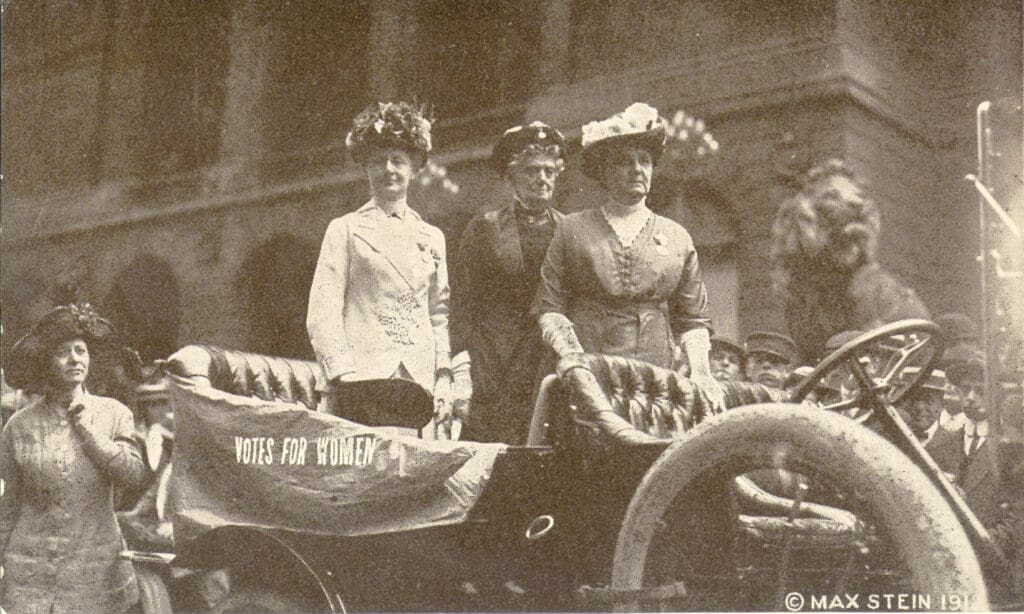
Fundamental to the woman’s agenda was the battle for suffrage; out of the Chicago Woman’s Club came the Chicago Political Equality League, a city-wide suffrage organization; this photo of Jane Addams with Mary J. Hawes Wilmarth in the 1912 suffrage parade illustrates the continuity that the struggle for suffrage gave to the first wave of feminism. Wilmarth had been one of the earliest members of the Chicago Woman’s Club in 1876; she was one of the first to embrace the cause of Hull-House when Jane Addams and Ellen Starr announced their plans for a settlement in 1889; Wilmarth was on the Hull-House board, and contributed funds. She with Jane Addams were on the platform of the Bull Moose party convention in Chicago in 1912 and as leaders of Progressive reform, endorsed Teddy Roosevelt’s third party candidacy.
Jane Addams and the Hull-House women were the “daughters” specifically or figuratively, of the first generation of organized womanhood, of women like Mary Wilmarth and Lucy Flower; while some like Addams personally fought the “family claim,” the women of her generation who sought careers and a different, more expanded relationship with public affairs were not necessarily in opposition to their mother’s generation. Addams and her generation, however, wanted to express their commitment to social justice and religious values in new ways; these new ways required carving out new institutions where women could legitimate their interests and lifestyles outside of traditional family arrangements. Addams and Starr wanted to make an impact on the industrial and political problems of their society; in the context of Victorian society, they had to overcome conventional boundaries and leave the traditional sphere defined for women’s activities. Among many other aspects of the Hull-House experience, historians including Kathryn Kish Sklar, Helen Horowitz, and Robyn Muncy have indicated how this settlement became this new space for women.
Addams and Starr were soon joined by Julia Lathrop, and Florence Kelley. After 1900, Edith Abbott, Alice Hamilton, Sophonisba Breckinridge and Grace became residents. Lathrop and Kelley were, like Addams and Starr, educated women without professional jobs or affiliations. Kelley had graduated from Cornell University but had to go to Europe to pursue graduate studies; Lathrop graduated from Vassar College, returned home, and informally read law in her father’s office. At Hull-House they functioned the way social policy specialists interested in gender and class issues might operate out of a university-affiliated institute, a government agency, or perhaps, a foundation or not-for-profit interest group. Hull-House provided the collective authority to do very innovative things. Abbott, Hamilton, and Breckinridge later brought the Hull-House point of view back to the university and, as a result of the historical conditions present there, were reasonably successful in creating “institutional space” for the production of research and scholarly books noteworthy for their focus on women’s issues. But they were forced to do so in separate women’s departments such as household economy (home economics) rather than in the economics and political science departments where they had been awarded doctorates. Yet much of what we know about women in the labor market, women’s legal disabilities as immigrants, comes from the work of Abbott and Breckinridge. Hamilton developed the field of occupational medicine and industrial toxicology, and was the first woman on the faculty of Harvard University. One could make the case, however, that it was Hull-House and its climate of research combined with social activism rather than the medical school community that was most influential in Hamilton’s understanding of the relationship of the environment to disease. While conducting research on antibodies and on scarlet fever and other diseases, at Hull-House she concentrated on public health efforts that allied her with progressive medical and proto-public health circles. In 1909 she studied 1600 working-class families and found that high infant mortality rates correlated with high birth rates. Hamilton worked in the initial phase of the Chicago Birth Control movement, led by gynecologist Rachel Yarros, also a Hull-House resident. These experiences provided the context for Hamilton’s growing awareness of the environmental causes of disease.
Breckinridge and Abbott received their advanced degrees at the University of Chicago; the former received the Ph.D. in political science in 1901 and the J.D. degree in 1904; the latter, completed her dissertation, “The Wages of Unskilled Labor in the United States, 1850-1900,” and received the Ph.D. with honors in 1905. Alice Hamilton studied science at the Fort Wayne College of Medicine and in 1893 received her M.D. from the University of Michigan. In 1897 Hamilton moved to Chicago to take up work as professor of pathology at the Woman’s Medical School of Northwestern University and residence at Hull-House.
Despite Breckinridge’s graduating summa cum laude in both political science and law, no academic position was offered to her, while male students went to positions on college or university faculties. Her opportunity for research and teaching came first through Hull-House where the new Chicago School of Civics and Philanthropy (CSCP), an early social work school, (later the School of Social Service Administration at the University of Chicago) was housed. It was funded in 1907 by an annual grant of $10,000 obtained from the Russell Sage Foundation. In 1908 it moved to larger quarters that adjoined the Immigrants Protective League office, another Hull-House spin-off, and had a connecting door. This arrangement facilitated interaction as well as collaborative research between the two agencies. Julia Lathrop, temporarily the director of research at the Chicago School of Civics and Philanthropy, asked Breckinridge in 1907 to take that position.
Edith Abbott accepted their offer to be the assistant director of research at the CSCP. In the early years of Abbott’s career, she too received support from social settlements in Boston and New York, and from the Carnegie Institute, a research foundation.
In these early years, Hamilton, Abbott and Breckinridge needed Hull-House. They would move back and forth between the settlement/women’s movement arena and the new places they were carving out for themselves and for scholarly work in the academy, but Hull-House remained a major influence. Hull-House was a place where women trade unionists, suffragists, and social reformers of many stripes advocated social activism on behalf of women’s protection, equality, and advancement.
Another way of looking at this is that universities did not have a monopoly on social science research in the 1890s and first two decades of the twentieth century. Hull-House, for example, was able to produce an extraordinarily successful work of scholarship in 1895 with the publication of the historic Hull-House Maps and Papers. Sklar has called the book a work of “female social science” since it was the product of the Hull-House women and reflected the new women’s agenda. In it the social feminist women of Hull-House began to define an agenda for social science as well as a plan of social activism that overlapped with women social activists in women’s civic organizations; but they were doing something new. They were staking out a new realm for the production of knowledge in society; twenty years later, the existence of this alternative place for the development of social policy initiatives would have influence on the shaping of academic departments and professional schools at the University of Chicago. They also implicitly established the value, indeed the necessity of a relationship between the realm of knowledge and of politics and practical activity. Five of the ten articles in Hull-House Maps and Papers focused on what might be called female-specific issues: sweatshop labor; Cook County charities; child labor; labor organizations for working women; a description of the work of Hull-House residents. The maps themselves were based on data collected by agents employed by the U.S. Department of Labor under the direction of Florence Kelley.
The fact that this work emanated from Hull-House gave it independence from the male-dominated departments at the University of Chicago and allowed for a focus on women and children. At the end of her career, Edith Abbott said, “Some of our social science friends are afraid that we cannot be scientific because we really care about what we are doing and we are even charged with being sentimental . . . This does not frighten me [either], for I know that a great physician also cares about the human beings he is taking care of and, like him, we can be kind without being sentimental” (quoted in Nancy Folbre, “The ‘Sphere of Women’ in Early-Twentieth-Century Economics,” Gender and American Social Science: The Formative Years, edited by Helene Silverberg, 35). The Hull-House settlement believed, with Edith Abbott, that research was done to serve those in need and to heal social problems. The opposite, pure research removed from any social content would not have been valorized by Addams and the other residents who commented negatively about those who did not have “the settlement spirit” and worked individualistically, or for personal gain, or who construed a model of objectivity as the hallmark of knowledge, as if that were either possible or ethical.
Here was a place for women who remained marginalized in the university environment. But Hull-House was not the full extent of the connection university women maintained with organized womanhood and the woman’s movement. Women were better educated by the late nineteenth century, but they remained underemployed. The discrimination against women physicians, lawyers, and Ph.D.’s and their virtual exclusion from employment in male-controlled institutions meant that college graduates and professionals continued to participate in the agencies of organized womanhood such as the Chicago Woman’s Club, and to be involved in the politics of the woman’s movement. The Chicago Woman’s Club’s activist members ranged from birth control advocate and physician Rachelle Yarros to the first woman elected judge in Cook County, Mary Bartelme, was president of the Chicago Suffrage Club in 1907, nine years after her appointment as public guardian of Cook County. Julia Lathrop retained her membership in separate woman’s organizations before and after she was appointed the first director of the U.S. Children’s Bureau in 1912, and she was one of the founders of the League of Women Voters. Jane Addams and other prominent settlement leaders, were active; and university-attached women such as Sophonisba Breckinridge and Edith Abbott retained memberships in the separate woman’s movement organizations long after they were professors at the University of Chicago.
Hull-House continued to support the research its women residents undertook; it also grew institutionally as an outcome of the implementation of social policy derived from the research. The Immigrants’ Protective League and the Juvenile Protective Association were special interest agencies designed to deliver services. They were also part of the system of investigation, policy formation and advocacy that characterized Hull-House enterprises. National legislation on immigration policy was influenced by the Immigrants’ Protective League and the Juvenile Protective Association spoke authoritatively on juvenile delinquency and its prevention.
Hull-House’s encouragement of research into new areas literally enlarged the physical campus; the first building in the the early years was adequate for readings in literature and the establishment of clubs, but soon the opening of a kindergarten, interest in art, theater, and music all required new space. The original Hull mansion was joined by a series of buildings that made up a complex of educational and philanthropic enterprises. When Addams and Starr moved in, they had occupied only the second floor of the old building and had the use of the drawing room on the first floor. By the spring they were able to lease the whole house; in 1891, they erected the Butler Art Gallery on adjacent property to the south. It was a two-story structure which housed a branch of the public library, an art gallery, and had space for clubs and classes. In 1892, the donation of dilapidated buildings in the immediate vicinity of Hull-House, made it possible to demolish the structures and construct the first public playground in Chicago, which was opened on May 1, 1892. In 1893 a second building was constructed with a coffee house below and a gymnasium above. A third story was added to the Butler Art Gallery building to provide rooms for men in residence in 1896; in 1898 a special building was erected for the Jane Club, the cooperative residence for working girls. A new coffeehouse, with a theater above it, was built in 1899 while the old coffeehouse and gymnasium were moved and remodeled. The next year the hull-House Labor Museum was established. In 1907, the dining hall which still stands, the last of the thirteen Hull-House buildings, opened. Included in this complex were the offices of the Immigrants Protective League and the Juvenile Protective Association; their “construction” illustrates more than the physical expansion of the settlement in the neighborhood for these “institutions” reflect the degree to which Hull-House initiated new areas of social enterprise, were part of a modernization and nation-building project that had national consequences. The Mary Crane Building was a concrete expression of the agenda of the maternalist welfare state: it housed health clinics fostering prevention; early childhood education facilities and teacher training, with mothers’ groups to socialize the migrant, the immigrant, and the poor into best practices of motherhood; its psychopathic institute pioneered research on abnormal behavior and juvenile delinquency; its play groups and music and art instruction tied the latest theories of the importance of the play instinct to child development.
An in-direct product of Hull-House activism and investigation is the published scholarship of its major residents. Abbott and Breckinridge’s collaborative efforts included The Delinquent Child and the Home (1912), which documented the problems faced by urban youth, and The Tenements of Chicago, 1908-1935 (1936), a study based upon house-to-house canvasing of 151 Chicago blocks with some of the research done by students of the two women.
Breckinridge’s first major book on women, New Homes for Old (1921), was a fascinating account of the difficulties facing immigrant women in American society. Family Welfare Work in a Metropolitan Community (1924) examined strains on the modern family, such as widowhood and illness, and Social Work and the Courts (1934) showed how law shapes the definition and resolution of social problems. These studies were part of the University of Chicago Social Service Series in which Abbott and Breckinridge selected materials to reveal the social construction of community issues. The first in this series was Abbott’s Immigration, Select Documents and Case Records (1924). Finally, Marriage and The Civic Rights of Women (1931), a classic statement in the sociology of law, discussed the relationship between marital status and citizenship.
Hull-House also made a lasting contribution to the University of Chicago: in 1920, when the Chicago School of Civics and Philanthropy completed its final grant from Russell Sage, (then phasing out its funding of social work training schools) Breckinridge and Abbott, who were convinced that a university was the proper place for a professional social work school, took the opportunity and negotiated to move their school to the University of Chicago. In 1924, the new School of Social Science Administration (SSA) became a permanent entity of the University of Chicago, with Edith Abbott appointed as dean.
In 1927, Abbott and Breckinridge initiated the social work profession’s first scholarly journal, Social Science Review, that published articles on social policy, social work research, and advances in social programs.
Other Hull-House contributions included Alice Hamilton’s work in the field of occupational diseases. Hamilton stayed on at the settlement for nearly four decades, becoming one of Addams’s closest colleagues. In 1908, Governor Charles S. Deneen appointed her to the Illinois Commission on Occupational Diseases; in March 1910 Hamilton became medical director of a nine-month survey, the first to combine modern laboratory investigation with field work. Her meticulous study of lead poisoning documented more than 70 industrial processes that used lead and 578 cases of lead poisoning, many of them severely disabling. The study prompted passage of a state occupational disease law in 1911, the year Hamilton became president of the Chicago Pathological Society.
Between 1890 and 1920, social feminists in Chicago accomplished a significant list of reforms to benefit women and children including the establishment of the juvenile court system, minimal protection for women in industrial jobs; the introduction of recreational and occupational therapy for inmates of institutions; they also produced some of the first works of research on gender topics. They had a permanent influence in the academy through the incorporation of the original School of Civics and Philanthropy into the School of Social Service Administration at the University of Chicago and through their insistence on the necessity of a research component for the study of social work. They did not, however, bring the study of gender and women into the core social science departments of the university or re-arrange any of the humanities curriculum; such an assault on the male-dominated disciplines of higher learning remained for Second Wave Feminists to confront.
Historian Nancy Folbre asks, “What would have happened if more women graduate students had found academic jobs, or if Edith Abbott and Sophonisba Breckinridge had received academic appointments in political economy?” She answers, “It seems likely that research on women in general, and gender inequality in particular, would have proceeded further and faster than it did” (Folbre, 54). I am not certain I can agree with this conclusion. There is evidence to argue the other way. What would have happened to Alice Hamilton without Hull-House? Would she have been motivated to seek environmental or occupational reasons for diseases without the spirit of the settlement to guide her toward medicine with a social content?