This post was written by Rima Lunin Schulz as a chapter for an unpublished book about Hull-House after Jane Addams ca. 2007-2009.
Introduction
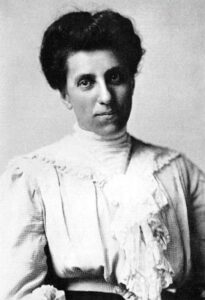
She was to remain at Hull-House for only five years, but Charlotte Carr led the famous settlement through an uncertain but innovative moment in its history. Carr was a big enough personality to shake things up at Hull-House following the death of Jane Addams, a figure whose posthumous “presence” loomed large. In 1937, Carr left her position as executive director of the New York City emergency relief bureau after having dealt successfully with New Deal critics and local community rebellion. She accepted the challenge to direct the famous settlement even though she did not come out of the settlement movement because Hull-House still offered her, as a pro-labor public administrator with an urgent message in support of workers, one of the most important “pulpits” to which an American woman could ascend.[1] Described in the press as a female John L. Lewis,[2] she brought her hard driving, take-charge style of leadership to Chicago to advocate workers’ rights.
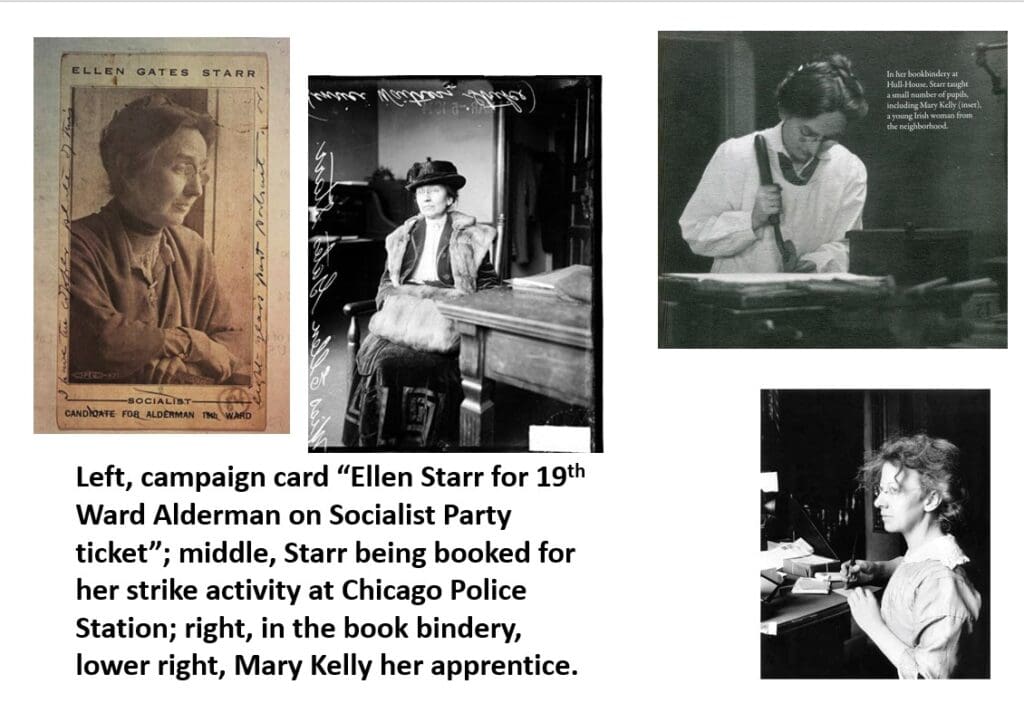
Not since the days of the anti-sweatshop campaign in the 1890s led by Florence Kelley in coalition with female trade union leaders and clubwomen, and the period of Ellen Gates Starr’s labor activism with clothing workers and waitresses in the 1910s, had Hull-House been so actively engaged in a labor reform movement as the settlement was during the Carr years. Carr’s allies were New Dealers and labor leaders in Chicago, Washington, D.C., and New York. Kelley’s and Starr’s era was identified with the rise of the American Federation of Labor (AFL), the Amalgamated Clothing Workers, and the National Women’s Trade Union League (NWTUL); Carr’s New Deal is identified with the rise of the Congress of Industrial Organizations (CIO) and the protests of the Unemployed Workers’ Councils. Not since its support of aldermanic reform candidates and Theodore Roosevelt’s presidential campaign on the Progressive Party ticket had Hull-House appeared as politically partisan as it became when Carr and her staff directly challenged hegemonic capitalism with workers’ education classes and with support for union organization in the neighborhood and in the settlement house itself.
Carr sought to bring together workers of all backgrounds, including African Americans who were becoming more numerous in the neighborhood, to assert their basic human rights to decent jobs with wages and hours that were negotiated not dictated by bosses. She opened Hull-House to African Americans in the neighborhood, she said, “not necessarily from the point of view of the racial question, but from the point of view of the lowest wage group.”[3] Rejecting cultural and arts and crafts activities that had dominated the Hull-House settlement and that stressed ethnic and racial identity, Carr was prepared to take up the challenge of the greatest historical movement of the mid to late twentieth century: the migration of African Americans from the South to the urban North. But she did so in the context of working-class organization and politics.
Hull-House during the Carr years was revitalized by the New Deal and by the involvement of its residents in the kind of cultural experimentation and political expression associated with the Popular Front and the Cultural Front.[4] There is much to learn from Hull-House’s experience during the New Deal. In framing the settlement’s activities in the context of new ideas generated by the Cultural Front nationwide, we also have an opportunity to see by comparison the original vision of the settlement idea as practiced at Hull-House.
Carr had to win the support of trustees and residents who had been devoted to Addams, especially Louise deKoven Bowen, president of the Hull-House Association, who had been a trustee and treasurer of Hull-House from 1903 and a great financial benefactor. Addams had a unique relationship with Bowen and the trustees and financial contributors (often one and the same) that supported her work. Unlike Carr, who was a career woman, Addams, one of the trustees’ class,[5] had established the settlement with her own funds, initially, and they backed her “experiment” and accepted her leadership. Since Addams was a volunteer who invested her own money in the settlement, she fit a model of womanly benevolence not one of professionalism. Addams, then, had a great deal of personal discretion and her initiatives and decisions about settlement policy were almost completely unchallenged by the close-knit group of trustees, a situation Carr could not duplicate.[6]
Creating a unified and spirited agenda was Carr’s first order of business. Even before Carr could venture out to the community and revitalize the settlement’s connection to the neighborhood, she had to bring together the staff and residents who were already at the settlement, including old-timers who had lived there for decades, with her new staff and residents who identified with her and her agenda. Although many of the older residents were badly bruised over the internal conflicts in Hull-House leadership that had precipitated the resignation of Adena Miller Rich,[7] whose short-lived and part-time efforts to sustain an original model of “head resident” failed, there was a desire on the part of the whole settlement community for change.
The change seemed instantaneous: many residents and staff exchanged their frustrations for a feeling of intense anticipation and excitement. “I cannot remember anymore what she[Carr] said [at first meeting with the residents] but I can remember how I felt,” Hull-House resident Donna Hodgman wrote. “I felt . . . that I could do—why anything at all. My mind was full of exclamation points.”[8] The infusion of new people Carr gathered included journalists and writers on the Left and Workers’ Education specialists. They were interested in the little magazines of the 1930s, experimental theater, and the cooperative movement. Many of them had been involved in New Deal programs elsewhere and seemed to be part of a nation-wide effort. Hull-House had participated in New Deal programs before, but Carr and her staff appeared to be connected in a fuller, more encompassing way.[9]
This chapter focuses on three areas of activities at the settlement in an effort to understand race, politics, and culture during the Carr years. The first area is that of race relations and community organization; the second is cultural production; and the third, political and labor activism.
These three areas of activity were interrelated, of course, since they stemmed from an overall approach to social change and to experimenting with expanding democracy’s social component that had been embraced by residents under Addams’s leadership but seemingly had lost direction at some point with the decline of the political edge that had characterized the settlement’s Progressive Era history. During the Carr years these areas of activity were brought into focus once more, but now defined by Carr and her staff in the context of New Deal social movements.
Race Relations and Community Organizing
In 1937 Carr immediately noted the absence of African Americans at Hull-House. Except for those houses established in black neighborhoods, the overwhelming majority of social settlements had been established in immigrant neighborhoods and had remained through the 1930s as all-white institutions. As African Americans from the South began to migrate to northern industrial cities and settle in deteriorating neighborhoods that had served immigrant populations, settlements in these communities had to decide whether or not to integrate programs and staff, remain in the neighborhood, or move to another location; to support public housing or give in to the local prejudices against blacks and whites living together.[10] Hull-House in the mid-1930s embraced a policy of integration and, in its programs, staffing, residency, and summer camp, achieved a greater degree of integration than has been acknowledged by any historians to this date.[11] Not to overstate the successes of the program, the efforts that were made were rather exceptional in the context of heightened violence against African Americans when residential boundaries to enforce segregation were transgressed, and where openly defiant whites bullied the small number of African American families who attempted to integrate public housing—housing built by the federal government.[12]
Charlotte Carr used her ties to the New Deal, the labor movement (and its Left-leaning CIO), and to pro-integrationist activism in the Northeast.[13] Carr’s approach to the race issue as administrator of emergency relief in New York had impressed Dorothy Height, the civil rights leader who had witnessed Carr’s fairness toward blacks during the March 1935 riot in Harlem. The situation in March of 1935 was desperate for African Americans. While African Americans were only eight percent of New York City’s population, they made up forty-two percent of the unemployed on welfare. They were even denied positions on work projects set up by the welfare system, and there was not a single person of color in a position of authority on the management staff of the Welfare Administration. Carr remedied the problem by appointing Height to be personnel supervisor in the central office of the Home Relief Bureau.[14]
Her involvement with civil rights leaders was authentic—race men and women trusted Carr, and when she was about to leave New York for Chicago, a farewell dinner was given in her honor by the African American leadership in New York.[15] The African American community in Chicago, aware of this relationship of trust, anticipated her move to the city.
Carr found that the Hull-House settlement appeared to interact with African Americans in the neighborhood through a women’s club that had been meeting at Hull-House for over a decade. Named the Hull-House Community Club, its members remained a separate (and segregated) club in the settlement house from the late 1920s.[16] Their children were kept separate rather than encouraged to join in the myriad of clubs and activities available for white children.
In the more than forty-five years that Hull-House provided cultural, educational, and recreational activities, there had been two strategies for membership. There were ethnically separate clubs for adults and children that had their origins in the early years when a common language was often not available; there were also activities where cross-ethnic experiences were promoted, and even built into the structure of the settlement through the workings of inter-club councils. Yet the persistence of ethnically separate activities at Hull-House in the 1930s and 1940s points to deeper and more complex cultural and racial issues.[17] “I believe we social workers made a great mistake in the early days in organizing racial groups as such—Bohemian Mothers, Polish Mothers, Italian Mothers and so forth,” Carr reflected. “Perhaps it was necessary. They came here friendless and unable to speak English; naturally they turned to others of their own tongue. But the time for all that has passed. The second generation has learned English in the public schools, and it is now most important for all these residents to realize their mutual interdependence as Americans—to learn that Bohemians, Poles, Italians, Mexicans and Negroes must live together as neighbors and partners in the economic struggle.
Integrating Hull-House was possible during Carr’s tenure in part because radicals like Harvey and Jessie Lloyd O’Connor, and Alexander Saxton, who was studying at the University of Chicago, brought a new spirit to Hull-House. Harvey was formerly editor of The People’s Press; he had written Steel Dictator, The Guggenheims, and Mellon’s Millions. The new group did not displace the Old Guard—dedicated, but limited, women like Nesta Smith, who taught string instruments at Hull-House and revealed her distress when “most of our old reliable European families were moving out.”[18] But for a very crucial, catalytic moment, Leftist New Dealers provided the courage and the context for a new politics and an enthusiasm for integration. Popular Front artists and writers identified as cultural workers; and as white radicals, they wanted to engage with African American cultural workers on the South Side and at Hull-House, where race barriers were being chipped away. It was at the South Side Community Center (SSCC), one of these places of interracial cooperation, that Jessie Lloyd O’Connor, Harvey’s wife, joined the Better Housing League (BHA) movement. The BHA fought restrictive covenants in Chicago’s housing market and advocated non-discrimination policies in public housing projects.[19]
Carr sought out journalist Dewey E. Jones, and his family, and invited them to be the “first” black residents in Hull-House history.[20] Jones needed a salary in order to pay room and board, so Carr engineered a Rosenwald Fund stipend for him and announced that he was going to investigate the conditions of poverty in the neighborhood of Hull-House.
Jones, his wife, Faith Jefferson Jones, a social worker, and their toddler, Dewey E. Jones, Jr., moved into the settlement in 1938. His coming to Hull-House was a public event, fully acknowledged by the Chicago Defender as newsworthy.[21] Jones, who had been an advisor to Harold Ickes in Washington, D.C.,[22] was a good, but in many circles, a controversial choice as the first African American resident at the House. One of the “New Crowd” of more militant civil rights activists,[23] Jones associated with the Left-wing National Negro Congress (NNC), and while resident at Hull-House, he was elected president of the Chicago chapter of NNC. Carr’s choice of Jones was in keeping with her own militancy regarding the advancement of African Americans.
To give greater credence to the argument that Carr was interested in alliances with pro-labor, Left-wing Race men and women, was the appointment of George McCray, also an NNC activist, as a Rosenwald Fellow in the Workers’ Education Department at Hull-House in 1940. Additionally, social worker Lillian Summers, who was elected president of the Chicago NNC after the untimely death of Dewey Jones in April of 1939, became a Hull-House resident in July, 1939.[24] Faith Jones remained at Hull-House after the death of her husband; she served as vice-president of the Chicago NNC.[25] NCC militants were willing to work with white radicals and at Hull-House in the Carr years the two groups were able to make the first real progress toward integrating staff, residents, and programs in the settlement’s history.
What remains less obvious is why Jones would be interested in leaving the national scene and coming back to Chicago and the Near West Side neighborhood.[26] In part, the explanation lies in the international reputation of Hull-House which gave an otherwise local job—research fellow —social and political capital. And partly the reason for Jones’s return to Chicago may well have been the place that city (and the near West Side neighborhood nearby Hull-House) would play in the public housing movement. Jones had been one of the key players in efforts to launch a public housing program in the United States under the auspices of Harold Ickes’ housing division of the Public Works Administration. There was considerable opposition to public housing and its adherents had made slow gains for the cause. For those visionaries who saw the potential for public housing to end slums and reconfigure urban space so that segregation as well as poverty could be eradicated, a federally funded program seemed to fulfill the larger agenda. There was a hitch, however. “Perhaps wishing to make the novel federal presence in urban America as unobtrusive as possible, it was Ickes who promulgated the ‘neighborhood composition rule,’ which prevented government projects from altering the racial composition of their host neighborhoods.”[27] Chicago’s slums, housing shortage, and location as one of the primary cities receiving African Americans from the South—first to work in the war industries and soon after as the destination for the Second Great Migration—made it an ideal place to experiment with public housing. The Near West Side neighborhood associated with Jane Addams’s Hull-House settlement, would offer a test case for interracial public housing projects that could enlist the leadership of the settlement and utilize its reputation as a leader in cutting-edge programs first introduced in the local arena. The reason this was possible, was that there had been a black presence in the neighborhood along with a mix of ethnicities. Thus the projected public housing project could include black and white families under the constraints of the neighborhood composition rule, a situation almost unique in the city of Chicago.[28]
Even before Carr’s arrival at Hull-House, the settlement had looked forward to the placement of public housing in its neighborhood. Hull-House participated with leaders from the Chicago Urban League, the Council of Social Agencies of Chicago, and liberal elements of the real estate industry at the Chicago Urban League’s annual conference in September 1937, which was held at Hull-House’s Bowen Country Club camp in Waukegan, Illinois.[29] On the agenda were topics including public housing, education, and neighborhood renewal issues. Participants at this conference were part of what can be loosely described as a pro-public housing, urban renewal coalition. Dewey Jones had come to the conference from Washington, D.C. Having roots in the Chicago black community, he was an important link between the national housing scene and the local; although Charlotte Carr was not at the meeting, (she would be arriving in Chicago from New York on October 1st) she had been planning how Hull-House could offer leadership in this coalition for public housing.[30]
Hull-House could not offer leadership in urban renewal and public housing if it did not accomplish substantial achievements in the integration of the settlement, its staff, its residents, and in the clubs, classes, programs, and camp that it ran. Dewey Jones was a key staff member in efforts to integrate the settlement. In the short amount of time that Jones lived at Hull-House he was able to both critique the past record of the settlement on race relations and through his role as an editor and writer for Hull-House publications, introduce a new rhetoric that served to inspire staff, residents, and neighbors to idealize interracialism as an articulated goal. In doing the work of de-mythologizing an iconic institution, while at the same time producing new Hull-House publications that exuded interracial values and images, Jones leaves a complicated legacy in need of contextualization. Reporting to the Welfare Council of Metropolitan Chicago one year after his appointment to the Hull-House staff, Jones found that the settlement had “not done very much in an interracial sense as far as Negroes are concerned.” He did not believe “this was because of any policy of the House or any decision on anyone’s part but just because of a sort of taking for granted that if an institution was in the heart of the community and had facilities, everyone who needed them would take advantage of them.”[31] Hull-House, purportedly a “melting pot” institution known for welcoming people of all ethnicities and background, even after the arrival of Charlotte Carr, had trouble integrating life at the settlement, and African American participation remained negligible. “It has been my experience,” Jones concluded, “that a very large part of the difficulty that Negroes have in trying to fit into these programs is traceable directly to those people in charge of the programs who assume there will be trouble if they attempt to bring about integration.” [32] He asserted “wherever we have found it possible to break down that idea among the leaders we have found that 90 per cent of the problem was solved and that there was no trouble after the people understood that the leaders wanted it done that way.”
One of the ways that Jones and other integrationists on Carr’s staff challenged the status quo at the settlement was through the vehicle of settlement publications that constructed an integrated Hull-House through images and text. During the Jane Addams years, the annual yearbooks offered basic information about clubs and classes, sometimes with up-dates, and even re-used photographs.[33] They were a formal representation of the philosophy of the settlement house entirely through the lens of the colony of women who, with Addams, ran it, and, most likely, these publications were seen as an organ of publicity and dissemination to a broad readership of potential and actual supporters outside the neighborhood. Rarely are the individuals depicted in the undated photographs named; this anonymity of participants (the neighbors), coupled with the re-use of the images, ironically gives the yearbooks, a genre marking time, a timeless quality. After 1933 the annual publication of a yearbook was discontinued until 1939, when Carr asked Dewey Jones to edit the first annual in six years;[34] Jones, whose formal education in journalism at the University of Michigan and the School of Journalism, Columbia University, and his career as a journalist in the Negro press (Amsterdam News, New York, and the Chicago Defender) more than qualified him to take on the role of journalist-at-large while he was resident at Hull-House,[35] used the opportunity to advance an agenda of interracialism which he shared with Carr and others of her staff.
The 1939 Yearbook appears to have had two major goals; one was to portray Hull-House as an integrating institution, and the other was to identify Hull-House as an agency of the community, deeply committed to renewal of the neighborhood, but also committed to working with community leadership. The first goal was achieved with the placement of Yearbook images that for the first time included African Americans: a photograph of the Benedict Art Gallery featured paintings that have African American subject matter; an image of one of the Hull-House reception rooms (parlor) included a portrait on the wall of an African American. A photograph of a scene from “Marching Song,” a labor play by John Howard Lawson, depicted racial content. There was a winter scene of the Hull-House courtyard accompanied by this text: “It was in this courtyard that thousands of persons of all races, creeds and ages stood on that day in May, 1935, when final rites were held for the founder of Hull-House, Miss Jane Addams.” (Tellingly, there was no portrait of Jane Addams in this revival of the annual yearbook.) Similarly, the text that accompanied a photo spread of the annual Mexican Festival ran: “All races, all creeds, all nationalities enjoy the facilities of Hull-House. An explanation of Christmas at Hull-House, accompanied by four pictures of newly created tableaux depicted the Italian conception of the birth of Christ; the Blessing of Christ in the Church according to Greek tradition; ‘Pasada,’ the Entrance into Bethlehem, according to the Mexican conception and “the Adoration of the Magi from the Negro point of view.” Finally, the yearbook section on Bowen Country Club camp showed several images where African American children were part of the group, including a swimming pool image of black and white children that was shocking in an era in which segregation of municipal pools and beaches in the North as well as the South was a symbol of the widespread acceptance of the separation of the races and where any crossing of boundaries could incite violence by whites against blacks. These scenes portrayed an ideal which Dewey Jones knew was still not fully realized at Hull-House, but they were a dramatic statement of the new direction undertaken by the settlement. “As far as the inter-racial problem goes at Hull House[36],” Jones concluded, “some definite steps have been taken toward bringing about a kind of melting pot, the kind of agency the [Hull] House has stood for in theory all these years.”[37]
A section, “Our Neighbors,” accompanied by photographs of community groups, introduced the reader to the notion that Hull-House was changing and that the new Community Relations Department “started as an experiment” but “has more than justified itself by the response it has received from the neighbors.” The text explained: “It is now obvious that no Settlement House is really complete without its direct contact with the community, and that establishing such contact is a full-sized departmental job in itself.” The story line emphasized that Hull-House was actively supporting a program for better houses, cleaner streets and alleys, better schools, and more playgrounds. Readers were also told that new community clubs have been formed to act as “outposts for Hull-House in its program of slum eradication.” Photographs of the Tay-Mor (Taylor and Morgan streets) Neighborhood Club and the Sholto-Eleventh (Sholto and Eleventh streets), the two community organizations set up as neighborhood outposts for the Hull-House Community Relations Program depicted neighbors and Hull-House staff.
Another example of how Hull-House under Carr’s direction re-framed the relationship between the settlement and the community is in the narrative that developed surrounding the first interracial Hull-House benefit dance held in a downtown Chicago hotel in 1941. According to the Chicago Tribune, no advocate of integration, the nationality clubs—“the Greek, Negro, Italian, and Mexican Mothers’ Clubs”—meeting at the settlement had come together and planned a benefit dance at a downtown hotel to raise money for their activities.[38] Donna Hodgman, a resident at Hull-House from 1936, provides an insider’s account of how the event came about as an interracial affair: “One day a committee from the [Hull-House] Women’s Club, [the oldest women’s group in the settlement and one composed entirely of white English-speaking women] had a meeting with Miss Carr” Hodgman wrote. They told Carr they were thinking about a new way to raise money for the clubs. They proposed renting the ballroom of one of the downtown hotels. Everyone would wear evening clothes and maybe even liquor would be served.[39] Carr thought the plan “ambitious” and wondered if they really meant that everybody would be invited: “I suppose the Mexicans will be in on it?” she asked. Hodgman wrote that the women replied “Certainly, Miss Carr. We don’t have race prejudice, you know.” Carr countered, “How about the Negroes?” Hodgman recalled “At that remark the faces of the committee looked surprised and uneasy.”[40] Carr suggested to the women that they probably had not thought about that aspect yet; she told them “But you and I know that we have Negroes in this house. They are represented in our Interclub Council.” And she went on to say that she could not see how they could give the party without “this important group . . . left out of the plans.” Carr left the decision to them. “Of course, this is your party. You have to work it out yourselves. But I guess you know how I would feel about leaving out the Negroes.”[41] The committee did not answer Carr right away; several days later, after discussions, they told Carr, “We want the Negroes.” Once the all-white Hull-House Women’s Club had made their decision to integrate the party, the next hurdle was to find a hotel willing to accommodate an interracial group, a difficult task in the segregated America of 1941. The committee found two hotels, but the manager of one was not sure his waiters would be polite to the guests. The other hotel, The Stevens, was selected. A politician in the neighborhood told Carr that people in the neighborhood did not like the idea of an integrated party: “Course it may be all right to be in the same room with Negroes,” the politician admitted, “But I wouldn’t sit down at the table and eat with one.” Carr told him they were not planning to serve food. But, according to Hodgman, she was quite disturbed. “What if the Italians, who constituted the largest part of our population, bought tickets [to the event] out of politeness but did not come? A party said to be given by all who used Hull-House but attended only by the Negroes and the Mexicans would be a worse blow to the minority groups than if we had admitted in the first place that the plan would not work.”[42]
The night of the dance, called the Lilac Ball, lilacs were brought from the Bowen Country Club to decorate the hotel ballroom. The Hull-House residents dressed in evening clothes and worried about what might happen. Carr was visibly nervous: “I wish to Heaven they were going to sell liquor,” she remarked.[43] This part of the plan had been dropped because some of the Hull-House trustees had objected. Hodgman described the scene at the hotel as the event got underway:
The Mexicans came, and the Greeks, and the Negroes. A Chinese boy and girl came, and one Armenian and one Japanese. The Italians came and Miss Carr came wearing an orchid . . . . The Mexicans were the fanciest dancers and had their pictures taken for the most newspapers. But the Italians were most at home and specialized in making people comfortable. The Negroes basked in unaccustomed warmth. Pretty soon it was crowded. Pretty soon someone told Miss Carr we had a thousand people.[44]
Carr had pushed the envelope of interracial activities at Hull-House further than almost any other agency in Chicago with the Jane Addams Memorial Lilac Ball. The African American newspaper the Chicago Defender acknowledged the event’s uniqueness and ran a picture with the caption: “Negroes, Mexicans, Chinese, Italians, Poles, Irish, Greeks, Jews, Protestants, Catholics and almost every other racial and religious group were represented in the hundreds of guests who crowded the ballroom of the world’s largest hotel. The spectacle would have pleased the late Jane Addams and given Uncle Sam a good demonstration of real democracy.”[45]
Carr did not hesitate to threaten the deployment of Hull-House connections against instances of discrimination. Louise Gaines (Daugherty), an African American Bowen Country Club (BCC) counselor, relates one striking example. One day Gaines and an integrated group of girl campers walked perhaps five miles north to what is now Illinois Beach State Park. The area then was in private hands but open to the public. Refused entrance by security personnel, Gaines and the campers returned to BCC where, as it happened, the BCC Committee was meeting. Unaware of the beach debacle, Carr invited her to come and brief them. Gaines tells of Carr’s response upon hearing the story:
Charlotte Carr got on the telephone. She wanted to know who owned [the land]. She got hold of somebody who said he was a lawyer. She said, “Well, then I’ll talk to you, because this is a terrible case.” So he said, “Well, I’m just a lawyer. I only serve them when they call on me.” And she said, “Well, if you don’t call on them and tell them about this, they will not be calling you anymore. Because we know that those people who own that [land], hope to sell it to the state. And we have friends in Springfield. If you think that our friends in Springfield are going to let the state buy that, you just think again. And you’ll be out of a job too.” She said, “One more thing. We have friends in Waukegan who are ministers. And if you think that there’s going to be a stream of cars in there after the ministers on Sunday morning say what your philosophy is, there won’t be two cars that come in there tomorrow morning.” The next day, a man came down and they called me and I don’t know whether he was the lawyer, but he apologized to me.[46]
This was an instance when Carr used the power of leadership by example at a time when the actual numbers of African Americans enrolled in the four sessions of the summer camp were small.
The problems of neighborhood racial tensions on the Near West Side were more difficult to address. Carr established a community relations department at Hull-House in 1939 to reach the groups that lived in areas of demographic change who did not yet interact with the settlement house. Under the sponsorship of this department, two small neighborhood centers were started and operated by parents and a staff of neighborhood leaders who were made available by WPA funds. One center was in the African American district south of the settlement and filled a need that had long been recognized by the Hull-House Community Club. As mentioned above, the Community Club had met since the 1920s, but members had not been incorporated fully into settlement life. Carr did not force the Hull-House Women’s Club (white) and the Hull-House Community Club (black) to merge; such decisions in the voluntary associational context of private social settlements in the 1930s were outside the possibilities of even pro-interracialists like Carr. Instead, she focused on empowering the African American women who were club members to run this new center located in their own neighborhood, with WPA and Hull-House funds. The women also reached out to African American businessmen who helped with funding. Activities within the center included a morning pre-school play group, afternoon game periods for school children, weekly dances and English classes for adults, with WPA leadership supervised by the Recreation staff of Hull-House. A mother’s club had been organized and was sponsored by members of the Hull-House Community Club. Carr felt that this center represented an activity where neighborhood leaders were making plans for themselves and carrying them out, with minimum guidance from Hull-House.[47]
Further attempting to enable authentic grass roots activism, Carr met with representative leaders of the African American community to “discuss the future program of Hull-House with regard to the development of the West Side Negro Community.”[48] The meeting was held in the residents’ dining room. Those present were an impressive group, including representatives of the Chicago Urban League, the Joint Council of the Dining Car Employees, the National Negro Congress (NNC), the South Parkway Branch of the YMCA, the Chicago Defender, the Northern District Association of Colored Women, and the Study of the Chicago Negro Community.[49] By pulling together labor activists, clubwomen, social scientists, community activists, and religious leaders, Carr made it clear to the black community that she acknowledged their organizational strength and respected their local leaders. Sociologist Horace R. Cayton, Jr., who, with W. Lloyd Warner, was co-director of the Study of the Chicago Negro Community, chaired the meeting.[50] As a Popular Front activist, Carr saw the race question in the context of the larger industrial crisis; she easily cooperated with African Americans on the Left—Ishmael Flory, a labor leader with ties to the Communist Party, and George McCray, mentioned earlier, who was executive secretary of the National Negro Congress.[51]
Carr continued to advocate antidiscrimination legislation in housing and jobs when she testified before the Illinois State Commission on the Condition of the Urban Colored Population in 1941; she served on the Chicago Advisory Committee to the Commission.[52] Her engagement with radicals in the black community, and her outspoken advocacy of integrated public housing and integrated trade unions, placed her in the Left wing of the New Deal Democrats.
Cultural Production
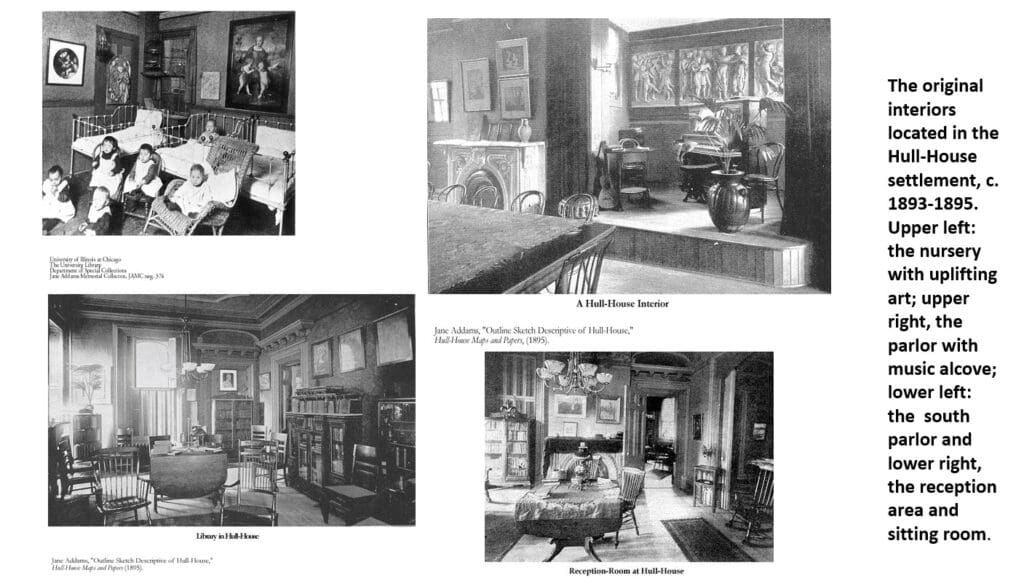
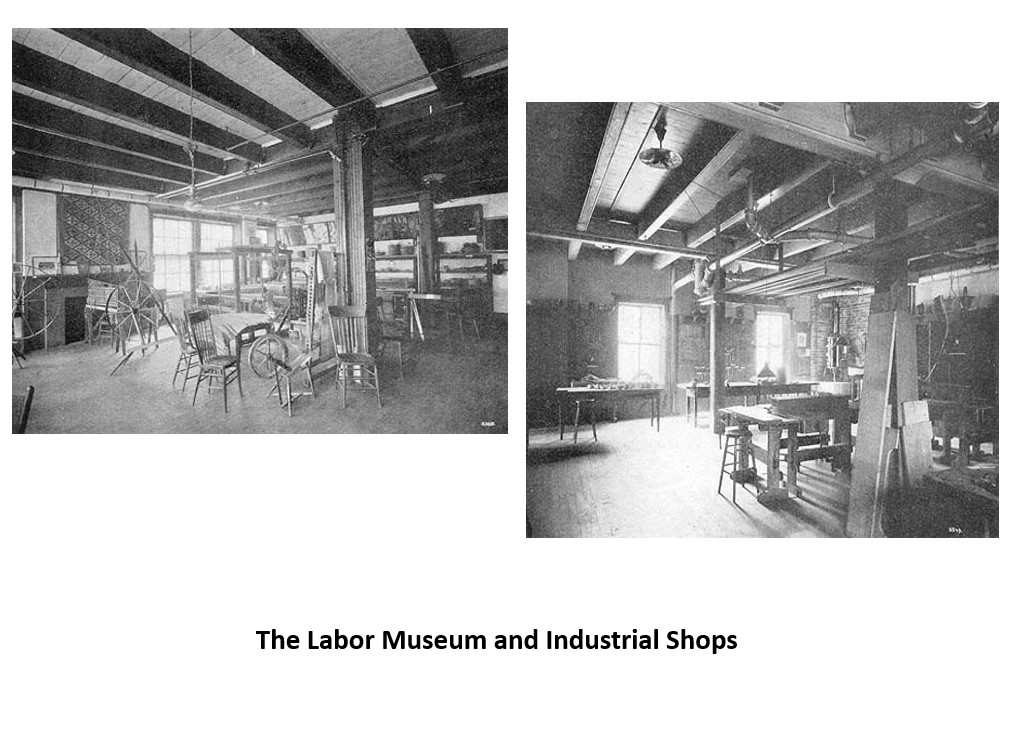
The change in the Hull-House aesthetic after the arrival of Charlotte Carr reflected an ideological position that privileged interracialism on the one hand, and authentic working class cultural expression on the other. This twin agenda was possible because key personnel changes that occurred between 1935 and 1937[53] prepared the way for the more dramatic changes in the settlement’s approach to art. One of the major changes can be seen in the approach to drama and tableaux, both in content and presentation. An examination of the material culture and programs of Hull-House reveals surprising evidence of the significant place of Western Christian religious art and music in the settlement’s yearly calendar in its first forty-five years. The high point was the annual Christmas tableaux, an interdisciplinary pageant depicting the traditional story of the child in the manger. Photographs of the traditional Christmas tableaux compared with images of the outdoor crèche display produced by people from the neighborhood during Charlotte Carr’s years at Hull-House illustrate a radical departure under Carr in cultural production at the settlement. Viewing the staging of the Christmas tableaux in the Bowen auditorium at Hull-House reveals at a glance the formalism of cultural production during the Addams years. With an audience of neighborhood families, Hull-House residents, trustees, and wealthy supporters, the annual Christmas performance reinforced the concept that the interchange between rich and poor, Americans and immigrants, Catholics, Protestants and Jews, socialists and capitalists could be enriching for all; such experiences were designed to teach the unity of humanity and promote a civic life in a democracy that “naturalized” differences by equating the hegemonic Christian tradition with universal human values. Children from the neighborhood, including those from Jewish families, participated in the Christmas plays as actors and also took part in choral singing.[54] The pageants and plays were not meant to be a religious service or ritual, but a cultural experience.
From the perspective of late-nineteenth century American ruling elites, Jane Addams was an innovator, in the vanguard of a pro-immigrant cosmopolitanismthat was a minority position in an increasingly racialized world. So powerful, however, was the hegemonic message of universal humanism at Hull-House, regardless of its packaging in the cultural representation of Christian art, that one immigrant Jew minimized the Christian doctrine implied in the tableaux by interpreting it as “a sort of folklore tradition.”[55]
Starr and Addams were grounded in the moral writings of the nineteenth century, the concept that the awakening of the child’s reasoning and moral senses required exposure to ideals of the good, beauty, virtue, and truth that were imbedded in the aesthetic of Western religious art. In Hull-House this meant Madonnas in the crèche and children’s rooms and religious tableaux and reproductions of the great Renaissance artists as moral parables. In a democracy, Addams contended, there needed to be a cultural space in which to experience this “moral” art that was separate from sectarian [religious] space.
The introduction in 1938 of ethnically specific religious expression, a turning away from the artificial unity of Christian moral art separated from worship, in the Christmas tableaux was dangerously close to incorporating the religious observance of each group. What it may have risked in terms of appearing to promote specific religious practice it gained in the sense of authenticity and empowerment ethnic and racial groups experienced when they were able to demonstrate their particular faith in a public place alongside others from related religious traditions. Neighbors responded positively to this new acceptance of unity through diversity of expression. Mrs. Koulla Konomidas, president of the recently revitalized Greek Mothers’ Club at Hull-House “thought the idea of Italians, Greeks, Mexicans, and Negroes working together on one program was ‘Good for us all,’” and she felt the tableaux “’were very beautiful.’”[56]
Photographs of the traditional Christmas tableaux compared with images of the outdoor crèche display “produced” by people from the neighborhood during Charlotte Carr’s years at Hull-House further illustrate a radical departure under Carr in cultural production at the settlement. The outdoor crèche is the work of neighborhood artists without the intervention or direction of teachers.
There was also a subtle shift in the approach to children’s theater. The educative function of theatrical performances was noted by Addams and her colleague Edith de Nancrede.[57] The proliferation of children’s clubs that performed plays was part of a concerted effort to socialize neighborhood children; club members remained affiliated as young adults and retained friendships. Children were taught dancing before they evolved to taking on more ambitious stage performances; dancing was orderly, formal, and taught students etiquette, and made them receptive to instruction that once imprinted, translated to acceptable social behavior for daily life. From a young age club members were introduced to literary form, historical content, and were taught diction, projection, elocution, and movement.[58] While children were given choices within a supervised and well-guided program, there was less emphasis on spontaneity, improvisation, and creativity.[59]
Other changes in the art programs during the Carr years are significant. The retirement or death of key residents in the art, music, and drama departments occurred at the same time that government-sponsored art programs under the New Deal brought new opportunities to re-tool Hull-House art programs; initially, a new group of art teachers and resident artists opened up graphic arts workshops at the settlement through the Graphic Arts Division of the Illinois Art Project (IAP) that was supervised by artist Carl Hoeckner from 1935 to 1938.[60]
More ambitious, however, was the effort to create an art center at Hull-House. Part of the broader effort to support the people’s art, the art center movement rejected superimposing “preconceived ideas of art,” in favor of finding, developing and broadening “the indigenous culture of the community.”[61] Charlotte Carr and forward-thinking architect and city planner William F. Deknatel[62] with close ties to the settlement, began a negotiation with the Illinois Art Project that satisfied the guidelines of the federal program and also advanced Hull-House’s interests in revitalizing and modernizing its facilities and programs. George Thorp, who became head of the IAP in 1938, pushed community art centers and children’s art programs, two initiatives overlooked by the unpopular and conservative former IAP director, Increase Robinson.[63] Deknatel consulted with Thorp in the summer of 1939 and worked out an arrangement:[64] the IAP would participate in “directorship and supplying staff and helpers whereas the supplying of plant, equipment, materials and general administration is Hull-House responsibility.”
The settlement had a good deal of space but a very small budget and Deknatel’s solution was to “enlist enough private assistance to enable us to put our plant on a more modern basis” and he convinced Frank Lloyd Wright, who was critical of federal programs, to chair a sponsoring committee to raise funds.[65] Carr had been concerned about the Hull-House contribution to an expanded art program and also was aware in 1939 that all the federal art programs risked cancellation or budget cuts. Reassured by Deknatel’s efforts to develop private resources, the newly named Hull-House Art Center began its collaboration with the Illinois Art Project in October 1939. Emily Edwards became the Hull-House Art Center director,[66] and William B. Fyfe of the IAP supervisor of the department.[67] By 1940 Hull-House was calling the new art department “The Hull-House Center & Design Workshop and listed among its staff artists Macena Barton, Todros Geller, Edward Millman, Bernece Berkman, Julio de Diego, Carl Hoeckner, and Emily Edwards. Deknatel, who was responsible for the focus on design, envisioned developing community-based planning initiatives thru classes and workshops held at the center.[68]
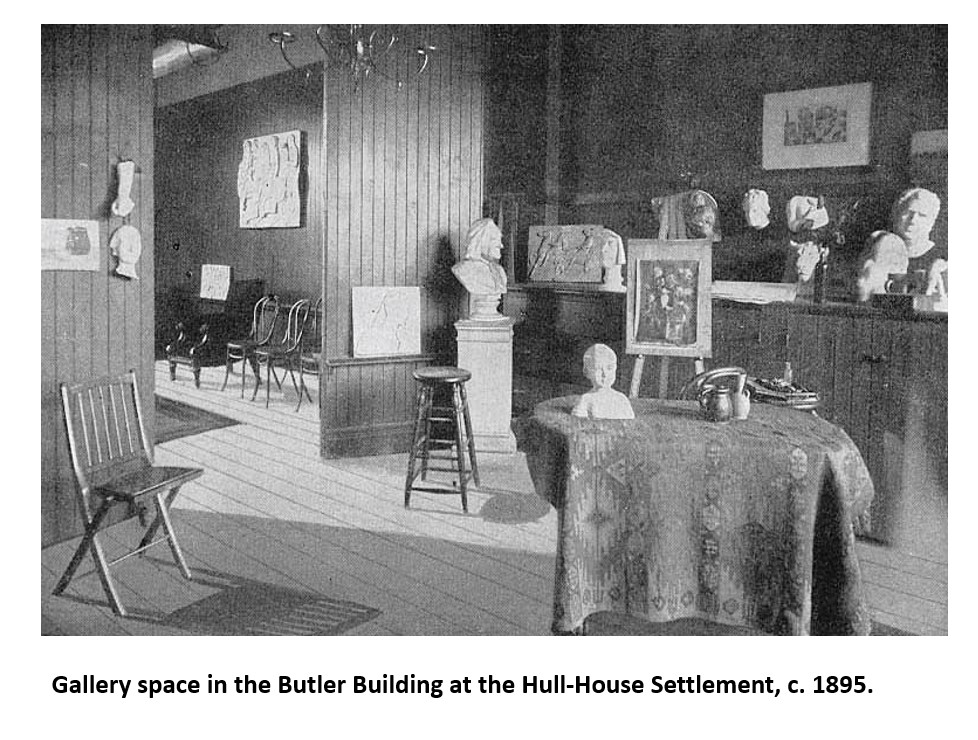
The cultural production agenda merged with the new politics of interracialism when African American art was exhibited in the Benedict Art Gallery at the settlement. The gallery, which opened in May 1938, exhibited “artwork by Chicago Negro artists” July 6th to 24th.[69] We have virtually no information about this exhibition which was arguably the first one of its kind at the settlement house.[70] Over a year later, however, an exhibition of seventy-two paintings and sculpture by African American artists, again at the Benedict Art Gallery, received wide publicity in the black and mainstream press. Conservative art critic Eleanor Jewett mentioned the event in her Chicago Tribune column without critical comment; noted Chicago Daily News critic C. J. Bulliet reviewed the show and deemed it “well-chosen”, but found the paintings “largely ‘derivative,’ and of about the same caliber of work by white artists of leftist tendencies who over concern themselves with the woes of the downtrodden race.”[71]
Bulliet focused on the “race melancholy” he found in most of the paintings and the sculpture, although he acknowledged that Nate Thomas “ha[d] avoided screeching melodrama” in his figure of “a nude young Negro lashed to a tree stump,” the victim of a lynching. Bulliet compared “the presentation of suffering now passed” in the Thomas depiction of a southern lynching with the emotional content found in some medieval sculpture of Christ being taken from the cross. Bulliet found the paintings expressive, and admitted that “occasionally the Negro artists . . . put into their pictures something genuinely racial without being maudlin.” But he was disturbed that “the show never gets quite happy,” a remark revealing more about the critic than the art on display.[72]
Only African American journalist Willard Motley, who featured the exhibit in the National Urban League’s magazine, Opportunity, saw real talent and the promise of greatness in the art.[73]
The artists included sculptors Nate Thomas and Olivia Caldwell; and painters Charles White, Eldzier Cortor, Bernard Goss, Charles Davis, William Carter, Henry Avery, Ramon Gabriel, Charles Sebree, Earl Walker, and Fred Hollingsworth. This was an impressive array of young talent, a new generation following “the trail blazed . . . by William E. Scott, Archibald J. Motley, Charles G. Dawson and William Farrow.”[74] Motley was enthusiastic about the new group “allowed to express itself through the assistance of the Federal Art Project” and he argued that “most of the canvases have a decisive, finished appearance—disproving the opinion of many white critics who feel that the Negro artist should have something primitive in his soul that should find its way to the canvas”; For Motley, the paintings by Charles White (“Lust for Bread,” “Gussie,” and “Evangelist”)were “powerful”; Eldzier Cortor, “perhaps the most original of the group” showed “remarkable versatility” in such paintings as “Brother and Sister,” “And So To Bed,” and “Where Once A Dwelling Stood.” He thought Charles Davis had “a number of outstanding canvases, chief among them ‘Low Cost of Living,’” which Motley thought was “handled in almost a Utrillo tone.” Rejecting the idea that some white critics held—that Negro art work should be crude and unfinished—Motley chose, instead, to define this new group of black artists in the cosmopolitanism of the large city in which they lived and painted and view them alongside white artists who were also working with an urban vocabulary. Of the painters, Motley considered Fred Hollingsworth “the lone primitive” and judged Davis, Cortor, and White the strongest of the group. They, with Goss and possibly Carter, “seem[ed] to have the best chance to really ‘arrive’ [in the art world] some day.”[75]
In its efforts to showcase local African American artists, Hull-House settlement—as a white institution—had taken the lead in an acknowledgement of the achievements of black visual artists and had broken the color line that had kept African American artists out of the galleries and museums of the city. It is curious that none of the reviews or news articles of the exhibit, including mentions in the Chicago Defender, comment on this dimension of the event. Perhaps the venue, outside the rooms and halls of high culture in downtown Chicago, allowed reviewers/viewers to see the work as cultural artifact and not necessarily as “professional” art. This argument about the nature of African American culture—its primitiveness; its folk quality; its lack of completion as an art form—was exactly what Alain Locke and others attacked in the effort to redefine black culture. Willard Motley’s review in Opportunity makes clear that the artists are authentic and must be judged like any other artists as well as in terms of their particular experiences. Motley’s review is influenced by the viewpoint he has taken as a writer who places himself in an interracial urban milieu and refuses to be limited by an ethnic or racial category.
The 1939 Benedict Gallery exhibit of African American artists was held less than a year before the American Negro Exposition opened at the Chicago Coliseum on the city’s Near South Side. The Art Exhibition of the Negro Exposition included work by Charles White, Eldzier Cortor, Henry Avery, Charles Davis, Bernard Goss, and Charles Sebree—all artists whose work had been shown at the settlement.[76] The American Negro Exposition, planned to commemorate the seventy-fifth Anniversary of the Emancipation Proclamation, and funded partly by the Illinois State Legislature, was an implicit rebuff of the Jim Crow policy of the gallery and museum world of Chicago.[77] The Hull-House settlement embraced this rejection of cultural Jim Crow and, instead, saw itself in the vanguard of creating interracial cultural space.
Carr also encouraged new literary productions by residents and neighbors which reflected the settlement’s embrace of cultural production from the bottom up. This was in keeping with earlier attempts to encourage cultural production by the neighborhood people. During Adena Miller Rich’s short tenure as Head Resident, the Hull-House Octagon appeared. Nicely printed by young men from the neighborhood in the Hull-House print shop, Octagon had a traditional format with headlines, and news stories about activities at the settlement. The writers were also neighborhood young adults—perhaps high school age—whose Italian surnames indicated they came from families with deep connections to Hull-House. Florence Giovangelo would in the 1950s and early 1960s emerge as a community leader—Florence Scala—in the politics of urban renewal. Noteworthy about Octagon was its production solely by young people from the neighborhood. They included items about their social life and even teasing references to personality quirks and romantic foibles, which seemed to indicate that Octagon was a publication for their consumption. This distinguished it from the bulletins and yearbooks Hull-House had produced with a different audience in mind during Jane Addams’s tenure. The annual yearbooks, for example, repeated basic information about clubs and classes, sometimes with up-dates, and even re-used photographs.[78] They were a formal representation of the philosophy and programs of the settlement house entirely through the lenses of the colony of women who, with Addams, ran it, and, most likely, these publications were seen as an organ of publicity and dissemination to a broad readership of potential and actual supporters outside the neighborhood. Rarely are the individuals depicted in the undated photographs named; this anonymity of participants (the neighbors), coupled with the re-use of the images, ironically gives the yearbooks, a genre marking time, a timeless quality. Unfortunately there are few, if any, traces of publications written by the groups who came to Hull-House regularly over multiple years, until we get to the Octagon.[79]
Block News, an informal mimeographed newspaper edited by Dewey E. Jones, was a new departure for the settlement. During 1939 it appeared weekly and contained news articles covering music, art, and theater, publicizing upcoming events and encouraging residents’ and neighbors’ participation; it emphasized events related to progressive political causes and performances that reflected the values of multiculturalism and inter-racialism.
Above all there was a blurring of the boundaries between the settlement house and the community. There were the insiders—among the residents and the neighbors—who knew the new lingo and the personalities. Expanding on the human interest notes that began appearing in the Octagon, Block News stories weaved information about individual neighbors and broke down the barriers between those who offered the community service through the programs and activities of the settlement, and those who came to the 13-building complex to partake of educational, social, recreational, and cultural opportunities.
Carr also endorsed the efforts of a group of writers who were in residence at the settlement when they planned to start a literary magazine on the style of the “little magazines” that had cropped up outside of mainstream publishing houses during the 1920s and 1930s. Hull-House Magazine, edited by William P. Schenk, with Alexander Saxton and Willard Motley as associate editors, first appeared in November of 1939. There were a total of three issues between 1939 and 1940.[80] Schenk and Saxton were residents at the settlement; the former “was an enormous admirer and friend of Carl Sandburg” and the latter was a University of Chicago student with literary ambitions.[81] An African American from an educated and talented middle-class family, Motley was raised on Chicago’s South Side in the almost all-white Englewood neighborhood. His father, Archibald Motley, Sr., was a Pullman porter, and his brother, Archibald, Jr., eighteen years older than Willard, was well-known as an artist.[82] In this household Motley had been encouraged to follow his interest in writing; he published his stories and articles from the age of thirteen and through his column in the Defender, had become a local personality.[83] Motley attended the Englewood High School at a time when just a small minority of African American students was in attendance.[84]
After graduation in 1929, Motley turned away from his middle-class background in pursuit of a literary career. He was influenced by novelists Nelson Algren and James T. Farrell, as well as “Depression-era road reportage”[85] and spent years traveling in the United States before he moved, in 1938, to the Maxwell Street neighborhood of Chicago near Hull-House.[86]
Little is known about how the Hull-House Magazine came to be (or why, for that matter, it only produced three issues). The moment was ripe for such a literary collaboration under Charlotte Carr’s warm embrace of activism, cultural expression, and interracial exchange. Several themes dominated the three issues of the magazine. One was the identification of the contemporary social struggle as a class struggle, with the writers and editors situating themselves as workers; they felt no contradiction in identifying their struggle for personal recognition as producers of culture with the struggle for transformation of the capitalist system. They chose to end economic and social inequality by unleashing the power of democracy itself. Democracy was at risk in the neighborhood and in the world; the masses were inherently good, but needed awakening, education, organization, but this process could not be imposed from on high by professional social workers. The writers generally supported New Deal programs, trade unions, experiments in the cooperative movement and public housing; they were critical of the rich, large corporations, politicians who were on the take, and bourgeois culture. Overall, their faith in “the people” would have appeared hopelessly simplistic, but was saved by the social realism that portrayed the magazine’s major subject matter—the world of the Hull-House neighborhood—with all its blemishes, inconsistencies, and even its criminal elements.
From the editors and writers standpoint, in its sympathetic, but realistic, portrayal of “the people” (three years after the publication of Carl Sandburg’s The People, Yes, the Great Depression’s epic poem), The Hull-House Magazine unequivocally and unabashedly promoted democracy in a world where democratic institutions were imperiled. The short stories, reportage on the people along Halsted Street and the Near West Side, and art work of the magazine reveled in common place activities, marveled at the diversity of peoples and their cultures, and sang the praises of the natural generosity of the working class who were willing to share whatever modest resources they had with needy neighbors.
Writers included experienced and inexperienced—published and those who hoped to be published. Alice E. Treleaven, Don Morris, Harvey O’Connor, Milton S. Mayer, Lawrence Hodges, Beatrice Schenk, John O’Connell, Morris Mitchell signed articles in addition to the three editors. Mitchell lived in the neighborhood and gave guided tours at Hull-House; O’Connell did not live at Hull-House; he was formerly employed as a receptionist at the Illinois Research Hospital and, in 1940, was unemployed. Milton S. Mayer was a Hull-House resident, a writer, and on the staff of the University of Illinois in the office of the president. Don Morris lived at Hull-House and was a publicity writer at the University of Chicago. Beatrice Schenk, William’s wife, was a social worker. Alice Treleaven lived at Hull-House where she taught citizenship and English courses and chaired the United Conference on the High Cost of Living. Lawrence Hodges was a Hull-House resident. He had worked in co-operative stores and was with the Railroad Retirement Board. Harvey O’Connor was, at the time, the most published of the group.
The most striking feature of Hull-House Magazine is the fascination with the neighborhood, which is portrayed in black and white graphics by William Jacobs, who during this period was a WPA artist, and by Alexander Saxton. Using varied genres—short story, parable, sociological or ethnographic sketch, journalism—the writers and editors devoted the majority of the space to portrayals of the local scene. For example, in the first issue, an article by Willard Motley, “Hull-House Neighborhood,” describes the street: “People come out on the street. A formless, rabble rank of shapeless bodies, hunched shoulders, hard faces. A scare-crow parade of battered felts, baggy pants, ragged coats.”[87] One shift of steel mill and factory workers come home, back “to their cavern shacks” while another heads out for work as milk trucks circle the dairy, ready for morning deliveries. He notes the synagogue on Union Avenue, with ancient Hebrew script on its walls; the frame convent on Newberry where “through the soft-lit window one sees the sisters in their gentle black as they kneel at prayer—their hands like the spreading wings of doves. St. Francis’ bell blesses the neighborhood; Halsted’s angelus calling a sparse flock.”[88]
The short piece ends as the morning has arrived fully. “The sun now puts a gold-plate on the streets. And even Maxwell is a charming lane, sunny and bright…This neighborhood in early morning has a beauty all its own. And somehow these are clean streets, fresh streets, hopeful streets.”[89]
Just as the neighborhood itself is a physical presence replete with contradictions—ugliness and beauty; despair and hope—the people, too, offer up their contradictions. Beyond this, the neighborhood while local, also stands for universal truths. The second issue of the magazine is even more focused than the first in developing the street as metaphor for larger political and social ideas. Editor Schenk introduces the contents with a short prose-poem, “This Our Neighborhood” that intimates this local space can stand for “other cities in all directions everywhere.”[90]
There is a sense that “the people” of the neighborhood are quiet at the moment, but they are potential agents of social change. Motley’s “Pavement Portraits” is made up of short pieces: The Street; Crap Shooters; Lady in the Half-Light of A Doorway; and A Handful. These describe prostitutes, preachers, petty criminals, gamblers and alcoholics. The street is local and global, “a small hub around which a little world revolves” connected to Jerusalem, Africa, Mexico, Italy, and Greece. The people are humanized, not judged; they are found to be surprisingly intelligent, generous to one another, even though living in poverty, accepting and tolerant. Motley describes the ecology of poverty with these portraits on the pavement: the bums pick through the garbage behind the restaurant; thrifty individuals collect pieces of wood, old lumber, broken orange crates to use for fuel during the cold winter. Trying not to romanticize the neighbors, Motley ends: “Yes, they live here. The weary men, the haggard women, the ragged children. They live here—portraits in pavement.”[91] Characteristic of his writing style and his loner stance—Motley never conformed to the worker writer model—there is no specific political message here. Nor do his characters voice a political message. Again in Motley’s “Handfuls” stories that appear in the last volume of the magazine, the working class and poor people’s generosity to each other is iterated, followed by a quote from Jane Addams: “In every neighborhood where poorer people live, because rents are supposed to be cheaper there, is an element which, although uncertain in the individual, in the aggregate can be counted upon.”[92]
Schenk’s “Achilles of Halsted Street,” a biography of a local Greek immigrant, unlike Motley’s stories, demonstrates the politics of the main character in a talky manner. The piece is about the realized and the unfulfilled promise of America. Schenk quotes his subject’s words: “’What’s wrong with this country? You want to know what’s wrong? I tell you. It’s the rich people. They’re wrong. They have a sickness that’s the wrong with this country. They have the sickness to make more, always to get more and more. That’s their sickness. That’s what’s wrong with this country.’”[93] Two neighborhood parables by Milton S. Mayer continue on this anti-capitalist theme; Mayer’s rich men live unhappy lives. In “Cabrini Street Fables” a very unhappy rich man is made happy, ironically, when presented with a blueprint presented of a shroud with pockets. Hull-House Magazine, November 1939, Vol. 1, No. 1, 16. “Cabrini Street Fables: II” is a moral tale about whether or not a man who lost his money and who stole food for his children was good or bad; in heaven, God determines that the man who stole bread and cheese to feed his family because he was a victim of circumstances, was a good man; but that the so-called upstanding man who owned eighty-six utility companies and made profits even when the companies went sour, was not a good man. Hull-House Magazine, December 1939, Vol. I, No. II, 13..
Alice Treleaven has an article on consumer cooperatives or organizations as they are called. She describes a variety of efforts that consumers are making. There are no specifics given, nor are any local organizers mentioned; no report on what Hull-House per se is doing about consumer organizations or even if they have one. Hull-House Magazine, November 1939, Vol. 1, No. 1, 8. On the other hand, Lawrence Hodges’s article about “Co-operation at Hull-House” had not much to report, since the Halsted Street Co-operative Society “is as yet only beginning to attain the ends desired. It plans many things to make social and economic organization more effective.” Hull-House Magazine, November 1939, Vol. 1, No. 1, 18.
Harvey O’Connor in his “To Break the Charmed Circle,” proposed a plan to provoke political awareness and action among the vast majority of apathetic citizens in Chicago. The vehicle for the provocation was to be a four-page monthly publication—short on text, long on illustrations, images—to be written by the politically savvy, published for distribution by about 10,000 willing participants who pledge to hand out 10 copies; and a thousand of the 10,000 will pledge to distribute 100 copies. The content of the four-page monthly will be the basic facts of life that informed citizens need to know in order to be energized to participate intelligently in the political process as voters. O’Connor reflected the political doldrums that so many progressives were feeling at the end of 1939. His idea was not to create a political organization duplicating present parties and groups, but to serve as an auxiliary to all progressive civic groups, interested either in one or in all subjects. This process of identifying important facts that John Q. Public needed to know so that engagement and activism or participation in the political process would follow, was a way to get rid of the bewilderment and apathy O’Connor believed was paralyzing progressives; it gave progressives a focus and a way to harness themselves for a simple, productive task. (Hull-House Magazine, November 1939, Vol. 1, No. 1, 12-13.)
Beatrice Schenk’s “The Children’s Group Theatre” reported on the children’s drama programs at the settlement under the direction of Viola Sills and Ed Spolin. Schenk highlighted the underlying agenda of the children’s drama work: it was to unleash the creativity of each child rather than to perfect a theatrical production. “In Sills’ group,” Schenk explained, “it doesn’t matter whether or not the kids know the lines—but they have to know the meaning of the lines and of the play; and they have to develop characters that have meaning.” Hull-House Magazine, November 1939, Vol. 1, No. 1, 19. At Hull-House “the children exercise their inalienable right to create. They are learning to be intelligent audiences. Honesty of subject matter and presentation are expected of them in their own work….” (Hull-House Magazine, November 1939, Vol. 1, No. 1,20-21).
Alexander Saxton’s “The Road to Damascus” is a consideration of the ethical value, comparatively, of saloons and religious missions. Halsted Street had an abundance of both. Saxton was not original in his sociological observations; residents at Hull-House had realized that there were positive functions served by saloons; and they were predisposed to being analytical and skeptical about conversions at missions. Hull-House Magazine, December 1939, Vol. I, No. II,18.
John O’Connell writes an article “Clinical Sketches” about his experience working in the dispensary of a large hospital one mile west of Hull-House. These are very short paragraphs about individual cases and are impressionistic glimpses rather than exhaustive case studies. Hull-House Magazine, December 1939, Vol. I, No. II, 26.
Morris Mitchell, a volunteer non-resident, was paid by the WPA to serve as a guide at Hull-House. He was hired in 1938. Mitchell’s article evokes the language and ideas of Carr, her staff, and residents. “Miss Carr was very democratic and consulted my wishes about every detail. She imposed no regulations as to what I was to say or how I was to say it. I would be put in possession of the necessary sources of information. The rest was up to me. Here was liberty and democracy enough—and no chance for an alibi in case of failure.”
(Morris Mitchell, “On Being A Guide at Hull-House,” Hull-House Magazine, January 1940, Vol. I, No. III, 3). But then Mitchell contradicted himself when he explained how HH resident John Kennicott Brenton trained him: “We visited every place to which sightseers are taken, and he told me what to say, and occasionally what not to say, at each point. Did I know what a settlement house was?” (Morris Mitchell, “On Being A Guide at Hull-House,” Hull-House Magazine, January 1940, Vol. I, No. III, 3). After this process Mitchell said “Hull-House and its residents, I was glad to discover, bore no resemblance to my former vague ideas of reforms and reformers. Hull-House was a poor man’s school—a meeting place and a university for the people. And here lived intelligent persons, thoughtful people, men and women who cared. Here they had erected an oasis of tolerance and intelligence and light in that desert of self-seeking, of often reckless and irresponsible self-seeking, as it seemed to me, called Chicago.” (Morris Mitchell, “On Being A Guide at Hull-House,” Hull-House Magazine, January 1940, Vol. I, No. III, 4.)
John Kennicott Brenton, 67 [in 1953], member of a pioneer Chicago family and active for many years in social work, died yesterday in Billings, Montana, where he had lived since 1947. From 1935 to 1947 he was a resident in Hull-House. He moved to Billings to become supervisor of social work for the bureau of Indian Affairs. (“J. Kennicott Brenton.” Chicago Tribune, Sept. 14, 1953, pg. B10.) Kennicott Brenton was chair of the residents’ committee at Hull-House. (“Tribute Paid An Old Friend of Hull House,” Chicago Tribune, Dec. 3, 1943, pg. 22.)
Since visitors came from all over the country, and from foreign countries, too, Mitchell found that his work as a guide allowed him “to have his finger on the pulse of America—even of the whole world.” Morris Mitchell, “On Being A Guide at Hull-House,” Hull-House Magazine, January 1940, Vol. I, No. III, 7. “Another one [of the advantages of being a guide] is the opportunity, ass part of this organization, to do one’s bit for tolerance, democracy, personal liberty and enlightenment in this changing world, let us say, to help democracy solve some of her new problems—problems that must be solved if she is to hold her place, or to advance in these times.” Morris Mitchell, “On Being A Guide at Hull-House,” Hull-House Magazine, January 1940, Vol. I, No. III, 7.
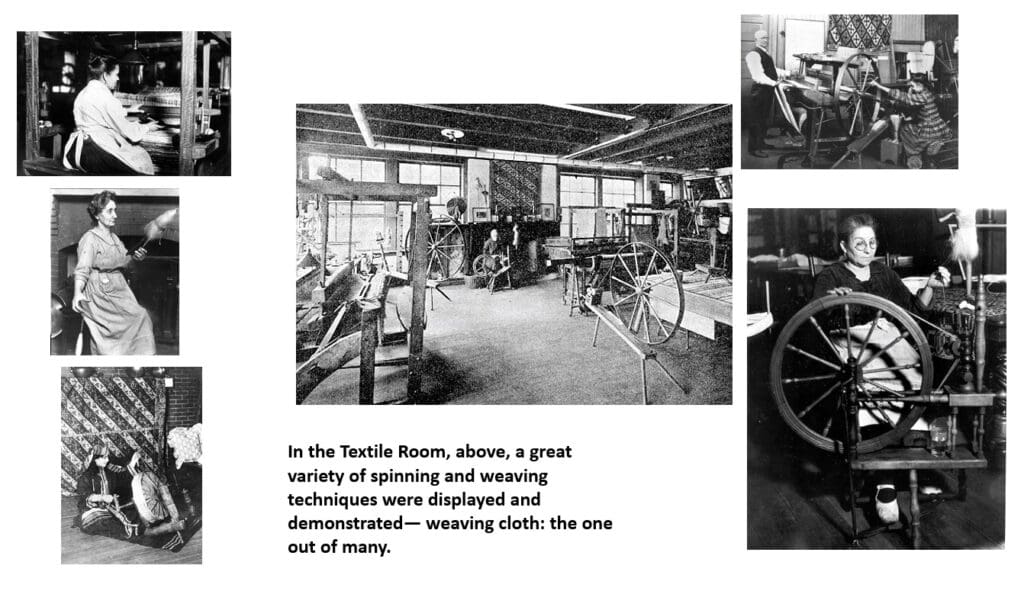
This third number, and probably what is the last issue of the magazine, had an appeal for submissions by others to the editors. The editors saw themselves as “middle-men between two groups” the one writing and other reading.” What they needed was writers submitting articles or essays, short stories or poems, notes about experiences “which you have had in Hull-House or in the neighborhood: anything significant, or funny, or peculiar, written up in one or two paragraphs”; letters; criticism; Hull-House Magazine, January 1940, Vol. I, No. III,8. In this same issue Harvey O’Connor’s “Mansion On Earth” supports public housing and details the support for public housing put forward by Ed Konomidus, a member of the Greek Olympic Club; Konomidus, says O’Connor, find the “’only trouble about the Jane Addams Houses’” is that “’there ought to be a hundred of them all over the city, or a thousand. Why should people have to live in dark houses where children get sick?’” Harvey O’Connor, “Mansion On Earth,” Hull-House Magazine, January 1940, Vol. I, No. III,15. As O’Connor puts it, “to thousands who live there, these Houses are not so much the Chicago of Tomorrow as paradise today.” Harvey O’Connor, “Mansion On Earth,” Hull-House Magazine, January 1940, Vol. I, No. III,12. O’Connor quotes from Mrs. Konomidis and also Salvatore Grieco and Ed Konomidis in what almost sound like testimonials. O’Connor draws in wonderful detail the way in which these individuals had interacted with Hull-House: “Mrs. Konomidis herself has taught weaving at the [Jane Addams] Houses. ‘You learned in the old country?’ ‘Oh no, I learned at Hull-House, and Miss Edwards helped us to get started over here.’ She showed work that she had done herself—beautiful drapes that would grace a Gold Coast home but which actually hung in her own rooms. Although the Houses have plenty of clubs, Mrs. Konomidis still comes over to Hull-House for meetings of the Greek Mothers’ Club.” Harvey O’Connor, “Mansion On Earth,” Hull-House Magazine, January 1940, Vol. I, No. III,13.
“Salvator Grieco and Ed Konomidis were both pioneers at the Jane Addams Houses. Grieco lived on Racine, just opposite from where they were building the new Houses; he and his wife used to look in to see how the work was getting on. But he hesitated about moving. ‘I was on WPA then, and you know how that is. I didn’t know whether we could keep up the rent regularly, and people were saying that if you didn’t pay on the first, you’d be kicked out on the fifth, and that investigators would always be snooping around.’ Harvey O’Connor, “Mansion On Earth,” Hull-House Magazine, January 1940, Vol. I, No. III,13.
“’And were they?’ ‘Oh no. The only investigator who ever came into our apartment was an inspector who wanted to see if the rooms had been painted properly. And the management has a heart—people aren’t kicked out if they [ ]to pay and have any prospect of paying. I guess these rumors were the work of the landlords.’” Harvey O’Connor, “Mansion On Earth,” Hull-House Magazine, January 1940, Vol. I, No. III,13.
How reliable were the people? How far could political and social activists count on “the people”? Alex Saxton’s article in the first issue argued that democracy was being challenged by the power of big business. He questioned England and France’s argument that the coming war was necessary to defend democracy. Instead he saw France and England fighting to defend their world dominance as colonial powers. In 1939 Saxton, along with many on the Left, was anti-war and identified the real enemy facing the United States not in Germany or Russia, but in the domestic troubles of industrial capitalism in the U.S. These economic problems, Saxton feared, would not be solved by the U.S.’s entrance into a world war and, instead, would threaten democracy because of the concomitant consolidation of power that such an undertaking would necessitate. As much as he championed “the people,” he was concerned that in a war mode, it was possible that the country “may accept government for the people by big business” which would be the end of democracy.[94] Historically, when confronted with serious challenges, Saxton noted “the people turns back to answers that were adequate” at an earlier time. “It shuts its eyes to actual conditions, and trusts in ritual phrases—free competition, due process of law, land of the free, always room at the top. It is the people which becomes emotionally attached to old institutions, and which with the highest motives resists all efforts to keep democracy functioning.”[95]
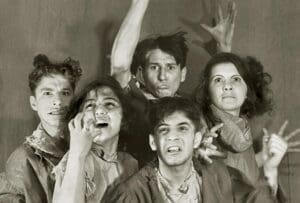
It was in the theater department that change under Carr most resembled the style and ideology of the Cultural Front. Jess Ogden described the manner in which theater functioned to bring “about a harmony of the various groups with which the settlement must work.” He noted that there was a large Mexican group that had three factions composed respectively of Catholics, Communists, and liberals. Someone in the Hull-House staff came up with the idea of having a real Mexican fiesta. This became an opportunity to unite the various factions. Hull-House during the Addams’s years scheduled an Italian night or a German night, but never attempted to incorporate the Italian street festa as a vehicle for promoting mutuality and understanding between the various factions within the Italian community. Ogden explained how Hull-House used the Mexican fiesta: “The older people of all factions were invited to recall traditions and customs and to help with the planning of the carnival. The younger people went to work on pageants and plays, each faction planning something in which it was especially interested. The help of other actors were enlisted and three episodes in the history of Mexico were finally produced before an audience composed of the entire community in carnival mood. Not only did the factions forget their differences in admiring each other’s contributions, but also there resulted a better understanding on the part of other groups in the community.” Both Ogden and Helen Tieken Geraghty, who also worked on the carnival, believed that the change wrought by the fiesta was not merely temporary but had lasting value.[96]
Halsted Street is the best example of how Carr and Ogden used the arts to foster racial and ethnic integration and cooperation. Hodgman said Ogden wanted the play “to have guts” and believed it had the power to pull together “all the existing dramatic groups” and, in addition, “dozens of others” including “neighborhood people as well as residents.”[97] She quoted Ogden as saying, “I’d like to tie up all these little crotchety groups we’ve got here at Hull House, get ’em to work together on one big project that is as socially significant as all Hell. Get a lot of residents in on it too. Be good for ’em.”[98]
One of the residents who joined the project was Donna Hodgman’s husband, Crosby, who was asked by Ogden to take the part of the streetcar conductor.[99] “All Hull House now waited, breathless and high—and I too,” Donna wrote. A week before the preview performance, the whole concept clicked for Donna: “Now at last I saw the stage with five levels . . . and the blackouts. I heard the music and the speech chorus. I saw little short skits on all sorts of subjects because all subjects belonged to Halsted Street[,] the longest street in Chicago.”[100]
Donna repeated the choral lyrics: “All races . . . all creeds . . . all colors . . . all degrees. Halsted Street was everything and everybody: Chicago and the world. Love was on Halsted Street, and fighting, and stealing, and dirt, and joy, and nobility.”[101]
The chorus of Halsted Street sang out: “Jane Addams saw and faced and met/These things that are to show/Hull-House must see, and face, and strive to meet. There’s a keener fire under the melting pot right now/ Than culture. It is common need.”[102] The message of the play is that the issues of industrial democracy have immediacy in this era of the Great Depression and provide the experience all share: “This is our living, all around us/ This is neither Negro Mexican nor Greek/ Nor Jew, Italian, nor Irish.”[103] Halsted Street previewed on May 19, 1939, to an audience of Hull-House Associates, a group that Charlotte Carr had put together to develop national support for the settlement. Robert Morss Lovett, a Hull-House resident mentioned earlier for his support of radical unemployed councils, was the main speaker at the dinner that evening, followed by the production of the play.[104] Following the preview for an audience who could pay one dollar for a ticket, the play was scheduled for the neighborhood, with tickets priced at fifteen cents.[105]
For Donna Hodgman, the play was a success: “Hundreds of people acted the parts of their own lives; hundreds of others saw, and could not avoid the knowledge that they saw themselves.”[106] She counted the success in the fact that “the warring factions of Hull House had learned to work together on a single project with unprecedented success. We knew that Mexicans, Negroes, Italians, Greeks, and just plain Americans had, for a little while, stood shoulder to shoulder.”[107] Yet a play is never the panacea for what ailed an institution like Hull-House in 1939. Three years later the Hodgmans left. Donna had been completely exhausted by her Hull-House job as House Manager.[108]
Jess Ogden, who felt that with Halsted Street they had “reached the saturation point” on pushing issues of social significance, turned once more to using the stage as a way of “getting all those warring groups working together.”[109] His production of The Pirates of Penzance included “almost everyone who had anything to do with Hull House” and was a triumph in cooperation “all the more significant” since Ogden left the settlement in 1941, one month before the opera was produced.[110] His leaving was the result of continuing budget problems. It signaled the end of Hull-House’s engagement with the rhetoric and style of the New Deal experiment with theater for the people. It also indicated that Carr’s program for Workers’ Education was at risk because of federal budget cuts.
Political and Labor Activism
Charlotte Carr did not simply protect the radicals who found Hull-House a welcoming place. Carr and the new staff that she immediately put together at Hull-House politicized the residents already at the house, and made them feel as if they were part of a social movement. Carr’s politics were a matter of public record[111] and were in agreement with many activist social workers and settlement leaders nationwide who saw the benefits of the New Deal programs in their neighborhoods and who fought to maintain or increase the appropriations against mounting criticism of the FDR administration.[112] Bowen, who was personally involved in the hiring process, was also well aware of Carr’s “very strong personality” and her deep interest in working-class issues. She supported hiring Carr as the first director (the former title of head resident was retired) who would receive a salary.[113] Later on, however, Bowen would find Carr’s leadership unacceptable.
In many ways, Charlotte Carr picked up where Jane Addams had ended and renewed the settlement’s commitment to offering political leadership for social movement causes. On the political front the new director immediately made herself known. Early in 1938, she convinced the trustees to agree to allow the Chicago Civil Liberties Committee to rent Bowen Hall to have a meeting on the policing of industrial disputes with a showing of the controversial Paramount newsreel of the 1937 Memorial Day Massacre in South Chicago near the Republic Steel Plant.[114] She endorsed the Gutknecht, a municipal judge who was running in the Democratic primary for state’s attorney.[115] A quote from Carr was prominently displayed in a campaign brochure that included endorsements from Eleanor Roosevelt; Dr. John Lapp, leading Catholic layman and chair of the Civil Liberties Committee; and Dr. Preston Bradley, pastor of the People’s Church, a progressive congregation in Chicago known for its social justice activism.[116]
By the end of the year, Carr was one of a group of New Dealers, academics, and labor leaders who had sent a telegram to Secretary of the Interior Harold Ickes asking him to run for mayor of Chicago.[117] The effort failed, but Carr had involved herself in the sectarian affairs of the Democratic Party of Cook County. She also revealed that her sympathies were with the Left-wing of the New Deal coalition. Carr liked Ickes’ approach to unions and public housing (he supported expansion of both) and agreed with his efforts to end discrimination against African Americans in employment and housing.
A political pragmatist, Carr then used her name and the reputation of the Hull-House settlement to advance the cause of the Democratic candidate for mayor, Edward J. Kelly who would cooperate with New Deal programs. In a classic Carr move, she made sure that Mayor Fiorello La Guardia, her former boss in New York, stopped at Hull-House en route to San Francisco where he was visiting that city’s exposition. La Guardia held a news conference at the settlement, where he predicted that Kelly would win against the Republican candidate Dwight H. Green, saying, “‘If the major issue is the New Deal, the New Deal must win in a city like Chicago.’”[118] Kelly’s opponent, a mugwump-type high-minded Republican, most likely was a candidate far more acceptable to Louise Bowen, a lifelong Republican.[119] Bowen looked with alarm at the popularity of FDR and, on the local level, found the strengthening of machine politics that appeared to go hand-in-hand with the New Deal a frightening prospect. Carr, on the other hand, was ready and willing to deal with machine politicians and Left-leaning labor leaders to reach the goal of putting Americans back to work. There was Bowen’s anxiety, too, about whether or not traditional financial contributors to Hull-House would continue to support the settlement if Carr’s pro-New Deal politics were too pronounced. “I hope she will not be too violently for Roosevelt because almost all the money which supports the [Hull] House comes from [Wendell] Willkie supporters and they would not like our endorsing Roosevelt” Bowen wrote in 1940.[120]
Carr also brought a New Deal “politics” to the internal organization of the settlement house. Here she was breaking new ground. She wanted residents and staff—social workers, cooks, engineers, waiters and janitors—to be organized and to know their rights. In the old days the “residents”[121] of the settlement, who were mainly affluent and well-educated young women and men following the volunteer example set by Jane Addams, had included radicals, socialists, labor leaders, and social reformers. Residents practiced self-government and made decisions about the daily details of group living as well as policy. After a period of probation, those already in residence voted a newcomer “in” or “out.” Residents paid room and board and agreed to volunteer their time in Hull-House activities. Some residents worked at jobs during the day. The majority of the residents were single women, but single men as well as married couples, occasionally with children, also lived at the settlement.[122]
Carr brought a new perspective to Hull-House as a result of her background in the field of labor.[123] It matched changes already occurring in the settlement movement where volunteerism was on the wane by the 1920s.[124] At Hull-House traditional residency continued to have a significant role in the settlement until 1963, but increasingly there were residents who served as “staff” and received salaries, and staff who did not live at Hull-House. During the Carr years, the number of residents increased to around one hundred, with a greater proportion of residents functioning as paid staff, including many Works Progress Administration (WPA) workers.[125] For Carr, industrial democracy required that workers, including white-collar workers, join organizations. “I don’t know why it is thought shocking that social workers should be in a union,” she wrote. “To me it is shocking that they are not.” This was not primarily about better wages: “The need for organization among social workers is secondarily to better our own conditions. . . . [W]e need organization in order to have enough political power to go to our legislatures or to Washington” since “in a democracy we get action only as we work in an organized way, representing a certain number of votes.”[126] Carr reported strong interest among different groups at Hull-House to enter into union contracts; a group planned to join an AFL union for engineers.
More controversial was the desire, on the part of other staff members—social workers, coffee house workers, service workers, office workers—to join the Social Service Employees Union (SSEU), a CIO affiliate. There were three unions in the social work field at the time: the union of public employees; the American Association of Social Workers (AASW) and the SSEU. The AASW was really a professional organization that became, with the National Conference of Social Work, “the country’s major organizational spokespeople for federal welfare.”[127] Carr was willing to negotiate with the SSEU, perceived as a new, militant union that did not have the respect of the established social work profession.[128] The trustees voiced concern over the SSEU, and even Edith Abbott, a valued former Hull-House resident and professor of public welfare of the University of Chicago’s School of Social Service Administration, feared that “if Hull-House signed such a [SSEU] contract it would give great impetus to the organization [sic] movement, the usefulness of which has not been demonstrated, and would definitely align Hull-House with one faction in the dispute.”[129] Carr was given the authority to continue talks with the union groups and was successful in getting the approval of the trustees for the SSEU, the union that staff had organized. Essie Soffen, a Hull-House resident who began as Carr’s secretary but eventually became her administrative secretary, was elected chair of the union.[130] Leah Dickinson, an administrator under Carr, was also a SSEU member. This mix of waitresses and secretaries with individuals like Soffen and Dickinson, who were “executives,” caused another resident, Donna Hodgman, to observe that “one had the feeling that the majority of those at the [SSEU] meetings were equipped with two masks, which they changed to fit the needs of the moment. One of course expressed loyalty and sense of responsibility to Miss Carr, to Mrs. Bowen . . . [and] the other mask, equally obviously, expressed our devotion to the welfare, particularly the economic welfare, of The People . . . the maids and janitors plus a very few office workers.”[131] Hodgman felt that the white-collar workers identified chiefly with the administration seldom seemed to feel that they had any problems; instead, “it was the maids and janitors whose problems were usually under discussion.”[132]
Carr was eager to move quickly to implement a new approach to the education and support of workers. Hull-House had been influential in the early days of trade union organization, especially among garment workers. Addams, Julia Lathrop, Florence Kelley, and Edith and Grace Abbott championed protective legislation for women and children; they advocated a variety of welfare measures to establish what they believed was a humane standard of living for workers in the United States. Addams also was concerned about the psychological and intergenerational problems of immigrants, who she perceived experienced a combination of alienation, loss of parental authority, and inability to control the damaging influences to their children from the popular culture. Carr had a different approach to working-class culture, one that was expressed by the Left’s embrace of worker-initiated cultural production.
Carr caused conflict when she took aim at an iconic Hull-House institution: the Labor Museum. Established by Jane Addams in 1900, the Labor Museum was an attempt to present industrialization in an historic light for the benefit of workers in the neighborhood—factory laborers and immigrants whose European crafts were no longer relevant. Live
demonstrations of crafts by neighbors who were encouraged to wear the dress of their native lands, classes in crafts offered in an effort an intergenerational understanding and sharing, and displays on the walls and in cabinets illustrating sequential stages of production, were all part of the settlement’s effort to historicize and valorize working-class experiences. To Carr these performances were antiquated and had little to do with the realities of working-class life. When Carr suggested that the looms and other equipment in the textile or weaving room “be put in some institution or museum, and the space used as a center for working men,” the old guard trustees had to agree that the weaving room was not used very much. Carr, however, had to negotiate this change with the residents, who seemed more attached to the old weaving room, which had been the center of the Labor Museum.[133] Carr was anxious to use the space to provide specialized labor and legal aid service. A digest of labor law had been prepared by one of the Hull-House residents and was being reviewed by the Department of Labor. Carr hoped to distribute it as part of the legal aid service.
The major workers’ project under Carr was Workers’ Education, which was a new department. It included citizenship, English, and workers’ education courses, and its program offered seventy-two classes with an attendance of 1,456. A weekly forum was established and two persons were employed to do industrial research work, to gather factual material and statistics as ammunition for civic campaigns. Clearly, Carr saw the department as having a significant political role in advocating for workers’ rights and benefits.
In addition to creating more space for workers’ education of a political nature, during Carr’s administration the industrial shops were retooled and technical education updated. For example, in 1937, the National Youth Administration (NYA) established a machine-work class Hull-House, equipped with machines and lathes, and supervised by NYA and WPA people. In return for furnishing electricity, space, and materials, Hull-House would have the benefit of whatever work was done.[134]
Carr gathered an impressive staff to develop the Workers’ Education department. Jess Ogden was committed to the idea that permeated the Federal Theatre Project and Workers’ Education in the 1930s—using theater for workers’ education and for social change. Alice Treleavan, who had been employed by the Adult Education Project of the WPA teaching workers’ education at Chicago Commons, had left that position to work at Hull-House.
Residents at Hull-House eagerly awaited her arrival: “I heard that soon [1937] we were going to have a wonderful teacher, the best anyone had ever seen, Alice Treleavan, on our new staff,” Hodgman wrote. “She would show us how to teach. If it were possible she would put life into our dull, staid brains so we would teach the people how to help themselves. Or, at any rate, we would teach them all about trade unions.”[135] Jerry Ingersoll, a Dartmouth College graduate, developed classes in civics and labor problems. Mary Wing assisted the Workers’ Education Program as Research Assistant and Librarian. Leah Dickinson, an organizer for the Amalgamated Clothing Workers who had six years’ experience in settlements—Kinsley House in Pittsburgh, and Christadora and Union settlements in New York—was Charlotte Carr’s assistant.[136]
Carr’s tenure with Hull-House ended in December 1942, after only five years; according to Carr, she had been fired.[137] There were charges of budget extravagance under Carr’s administration, and in a newspaper interview, Louise Bowen, president of the board, admitted that Carr’s political activities were a problem.[138] Another unnamed board member pointed out that the budget at the end of 1942 had been balanced for the first time in six years, with larger contributions than ever before[139] and the record indicates that there was no budget crisis.[140] Bowen did not articulate what arguably was Carr’s real sin: successful efforts at organization and empowerment of the neighborhood. This would have been threatening in itself, but Carr believed that the neighborhood people must participate fully in the affairs of the settlement. She saw Hull-House as the community’s organization. This effort to curtail the authority of Charlotte Carr marked a turning point in the settlement’s role in the neighborhood. “Miss Carr’s departure, it was learned today,” a newspaper article reported, was the signal for a long-standing controversy between the Hull House directorate and the Hull House customers to come to focus in the form of these three demands on the former by the latter:
1. Representation by bona fide residents of the neighborhood where [sic] the historic old settlement house does business on the board.
2. Recognition of a management committee made up of church, businessmen’s and similar groups in the neighborhood.
3. A voice in the selection of Miss Carr’s successor.[141]
None of the demands was met.
Carr’s boldness in attempting to bring the residents of the neighborhood into the settlement as partners in determining the direction of Hull-House, political columnist Sydney J. Harris argued, “often antagonized some board members, as did her insistence upon entering political controversies when she felt the welfare of ‘the little people was at stake.’”[142] Carr believed that she, as director of Hull-House, represented the little people against the special interests.
While many people who agreed with her approach liked to say she was carrying out the legacy of Jane Addams, Carr was attempting something very different from the kind of social relations Addams established with the neighborhood. Commenting on the departure of Carr, a member of the West Side Community Committee, who had spent his life in the neighborhood, said the fundamental issue was “who shall formulate the policies of Hull House? Does Hull House belong to the people it serves, or to the trustees? Shall it be an ‘agency’ superimposed from above; or shall it be an instrument of the people themselves? Only by involving the people significantly in the management of Hull House can it ever become a real part of the attitudes, sentiments and thinking of the people.”[143] He continued: “Because Charlotte Carr was thoroughly familiar with conditions as they are, and was in complete accord with our aspirations for democracy, we consider her resignation an irreparable loss to our community. And we hope that the trustees will reconsider it.”[144]
The trustees were not ready to transform the settlement into the kind of community organization envisioned by Carr and elements of the community who were ready to take on a leadership role in the neighborhood’s future.
During Charlotte Carr’s short tenure as Hull-House director there was a shift toward a more conservative board that interfered in the details of settlement life more and more.[145] Perhaps the changes reflected efforts to address the increasingly difficult task of raising money for the settlement, or from a sense that the board had to assume the responsibility of policy-making now that the director was “hired help.” There were also the new pressures from Chicago’s Council of Social Agencies and the reality that Hull-House had become less financially independent and even began applying for funds from the Community Fund of Chicago for a small, but sought-after portion of its budget.[146] Bowen, who was the president and treasurer of the Hull House Association, frequently found herself consulting with the Council of Social Agencies of Chicago. The group assessed how social agencies were performing and, while separate from the Community Fund, was influential in whether or not an agency obtained requested funds. These consultations included discussions about whether or not the director at the settlement should be part or full-time, paid or volunteer; on the state of programs and staffing; and on its annual budget. Shortfalls were to be funded, if approved by the Council, by the Community Fund. The budget committee of the Council reviewed whether private fundraising by the trustees was adequate or should be increased.[147] This new world of regulations and boundaries differed vastly from the earlier time when Addams had tried to avoid formalism of any kind and had balked at the insistence by a major donor that the loosely organized association become a not-for-profit entity under state law.[148]
The Community Fund allocations were never so substantial that control by the Hull-House board was ever in jeopardy. But for many years the settlement’s investments and endowments had been “looted” to pay for operating costs and repairs of the old buildings. This practice worried the business-minded trustees. At the same time, the aging Bowen personally felt the pressures to continue fundraising and probably sought other wealthy folk whom she knew to help shoulder the burden. To facilitate this effort, in January of 1942 the number of trustees was increased to twenty-five.[149] Bowen’s influence in who came on the board was key here. When old-timers died, they had been replaced by other family members or individuals well known to Bowen and those on the board. Charles Hull Ewing “replaced” his cousin, Helen Culver; Bowen added her daughter Helen Bowen Blair in 1929. That year the by-laws were revised to allow an increase of trustees from seven to nine.[150] This tradition of balancing any “new blood” on the board with a safe amount of “old blood” continued well into the 1960s. The old blood included good old boy investment bankers and businessmen[151] with close social or kinship relations to Bowen and her daughter, and a sprinkling of Hull-House “families.” The latter included individuals whose connections went back to the Jane Addams’s years, such as Charles P. Schwartz, her attorney, and William F. Deknatel whose father, Frederick, had been at Hull-House in the 1900s. Trustees also included Professor Harrison Dobbs, Dr. Arthur Todd, and Wayne C. McMillen—academics who represented the social policy and social work establishment; and a sprinkling of social feminists like Grace Abbott and Adena Miller Rich who, in the Progressive Era had dominated the leadership ranks of Hull-House as independent-minded residents but, in the New Deal Era, did not appear to hold the balance of power. There were also a number of clubwomen from Chicago’s North Shore elite communities, but these women were not like the social activists of the women’s political culture during the Progressive Era. Marshall Field, III, joined the board in 1941. His progressive politics and funding of radical causes, including PM, the innovative Leftist tabloid, distinguished him from the other businessmen on the board. Samuel Levin, who came on the board at the end of 1942—but too late to save Charlotte Carr—was one of the founders of the Amalgamated Clothing Workers Union and, in the 1940s, was head of the Illinois CIO.[152]
In addition, the board of trustees had attempted to limit Carr’s powers to develop programs and define policy. The Hull-House trustees publicly claimed that the reason for Carr’s “resignation” was a conflict over the budget. Carr, they contended, was unwilling to accept the budget cuts the trustees insisted were necessary and she was unwilling to accept any changes in policy or programs.[153] But there was more involved. Bowen and a group of trustees were attempting to rein in Carr and have control over the direction of the settlement. A pro-Carr trustee, Mary Wing, had offered to take care of the budget shortfall and to pay the salary of a fundraiser, as well as to pay a pro-rated amount of the current deficit at any time within the year that the budget was exceeded, if she was given the assurance that Carr would have control of policy and program decisions. After initially accepting Wing’s offer at the board meeting December 1, 1942, the personnel and budget committee, seemingly on its own initiative, sent all the trustees a resolution that accepted Wing’s underwriting offer but also included the condition “that no changes in personnel or activities involving other or different money expenditures than those provided for in the budget, be made by the Director without the approval of the [board] president or the chairman of the budget and personnel committee being first obtained.” Wing protested this resolution and threatened to rescind her offer and submit her resignation if it was passed. She questioned the power of the personnel and budget committee to submit resolutions counter to the action the board had previously taken and considered the substitute resolution to be a vote of no confidence in Carr. The substitute resolution passed at the next board meeting, December 21, and Wing resigned, precipitating Carr’s resignation.[154] Alex Elson, a lawyer who was a newly elected trustee (and who had attended Hull-House as a youngster and young adult) found Bowen’s board to be “very controlled.” After his initial term, he was not asked back, but “was elected again after the War” when Bowen had retired as president.[155]
Without the influence of the social reform agenda initiated by the women’s political culture of the Progressive Era to provide a framework, and in the absence of her great mentor Jane Addams, Bowen seemed unable to make the change that others made when they saw the New Deal as the fulfillment of many of the goals of the earlier reform era. These individuals included Hull-House former residents Grace and Edith Abbott, Adena Miller Rich, Dr. Alice Hamilton, and Sophonisba Breckinridge; Frances Perkins, FDR’s Secretary of Labor who had ties to Hull-House and the settlement movement; Helen Hall of New York’s Henry Street Settlement, and Lea Taylor of Chicago Commons.[156] The New Deal revitalization under Charlotte Carr did not launch a second rebirth of the social settlement movement nationwide,[157] nor did it solve the problems that Hull-House faced after World War II. Carr did revamp the settlement at a low moment and renewed its connection to political activism, racial justice, and labor advocacy. After Carr, Hull-House never lost its zeal for making a pluralistic, interracial democracy work, or its advocacy of improving the economic, educational, and cultural conditions of workers and eliminating poverty. Nor were Carr’s efforts to integrate Hull-House and to use the settlement to catalyze a new political power with the neighborhood people, abandoned. These goals were shared by Russell Ballard, who served as Hull-House director from 1943 to 1963, in a time of increased racial tensions in American cities, including Chicago. Then, however, with the demise of the New Deal and the solidification of a Cold War politics, there were fewer avenues to pursue progressive policies of racial liberalism and community redevelopment.
As this chapter has shown, by 1939, concerns about the political activities of Carr were coming from inside the settlement community and were being voiced by Hull-House trustees.[158] Carr clashed with Bowen when she used the reputation of the Hull-House settlement to advance the cause of the Democratic candidate for mayor, Edward J. Kelly.
The trustees were reflecting the growing polarization in politics that the liberal wing of the New Deal provoked from the defenders of capitalism who saw the specter of socialism in every relief or federal program proposed by Franklin Delano Roosevelt. There were more capitalists than either social workers or reformers on the Hull-House board, and, with the beginning of the United States involvement in World War II, there was a rejection of those who offered critiques of the American market system and supported a militant working class. The CIO signaled a form of radical labor organization, the vision of one big union, distinctly activist and embracing of the unskilled as well as the skilled, and black as well as white workers. As an ardent New Dealer and CIO-sympathizer, Carr’s politics took on a distinctly threatening tint to a number of trustees who may have taken their cues from Bowen, president of the board of trustees, who was an ardent supporter of Wendell Willkie’s candidacy for president in 1940.[159] Bowen led the opposition to Carr, arguing privately that the director’s public support of FDR and other politicians had cost Hull-House the loss of contributions from wealthy donors who no longer were willing to donate to the settlement because of its embrace of the New Deal.[160] Political columnist Sidney J. Harris summed up the dispute: “[W]hile some board members believed that as a ‘hired employee’ of Hull House, Miss Carr should reduce her political efforts in controversial issues. She, on the other hand, insisted that Hull House must take an active part in political affairs in order to obtain social and economic benefits for the neighborhood.”[161]
There were critics who did not understand how the settlement’s avowed claim to be nonsectarian, nonpartisan, and independent jibed with the actions of residents, including those who openly joined sides, advocated candidates, signed petitions and took controversial public stands. “Guilt by association” began long before the McCarthy Era; it was used against Hull-House and Addams in the 1900s, during the “Red Scare” after World War I, and in the assault against New Deal programs in the 1930s. But in the 1940s and 1950s, the chilling effects of loyalty oaths and Cold War diplomacy after the Atom bomb added a new dimension to the hysteria. Liberals and progressives internalized the fear and went along with the anti-Communism crusade. Charlotte Carr’s involvement with the CIO and the Left-wing elements of the old New Deal coalition that joined the Union for Democratic Action [later Americans for Democratic Action (ADA)] became, by the end of 1942, unacceptable.[162] The Cold War era had not officially begun. The House Un-American Activities Committee never summoned Carr, although the FBI kept a file on her. After leaving Hull-House, she became the assistant to the vice chairman of the War Manpower Commission in 1943 and, one year later, served as New York regional director of the Congress of Industrial Organizations Political Action Committee.[163] Active in welfare, housing, children’s and workers’ rights until the end of her life, her belief in a worker’s democracy never wavered.
[1]Carr received $6,000 a year at Hull House. She came to Hull House in 1937 from a $10,000 a year position with the New York City emergency relief bureau. “Deny Miss Carr’s Politics Caused Hull House Rift. Trustees Say Budget Row Led to Resignation.” Chicago Tribune, 4 January 1943, p. 11. Charlotte Carr, director of Hull-House, 1937-1942, graduated from Vassar in 1915 and pursued post-graduate studies in economics for three years at Columbia University. She held important positions with the New York State Charities Aid Association, the New York Charity Organization Society and other welfare groups. For six years she was in charge of personnel work in factories. In the New York State Department of Labor Carr worked with Frances Perkins, later Secretary of Labor under Franklin Delano Roosevelt. She was in charge of research work relating to problems of women and children in industry, also problems arising from the administration and extension of the Workmen’s Compensation Law. Many of the results of surveys made by Carr were incorporated in the legislative programs of Governor Alfred E. Smith of New York, and President Roosevelt when the latter was Governor of New York. The reputation Carr won by her work caused Gifford Pinchot, while Governor of Pennsylvania, to request Perkins to lend Miss Carr to the Pennsylvania State Department of Labor. While she was serving the State of Pennsylvania Carr’s leave was extended several times. She established in the Pennsylvania Labor Department a bureau of women and children similar to the New York bureau, and later became its director. Miss Carr returned to New York City in 1929 to become industrial consultant of the Charity Organization Society, with which she remained until 1930. She also was appointed to the Commission on Unemployment Relief set up by Governor Lehman, with Allen Wardwell as chairman. Mr. Knauth and Mr. Corsi induced Mr. Wardwell to permit Miss Carr to serve as assistant director of the Home Relief Division.” “Corsi Gets Post As Aide To Hodson,” New York Times, 20 July 1935, p. 3.
[2]S. J. Woolf, “Miss Carr Takes a Social Ideal to Hull House,” New York Times Magazine (August 8, 1937): 5.
[3] Trustees’ Meeting Minutes, January 21, 1938, 4, Folder 5, Hull House Collection, Special Collections & University Archives, University of Illinois at Chicago Library (hereafter, HHC).
[4] Michael Denning, The Cultural Front: The Laboring of American Culture in the Twentieth Century (New York & London: Verso, 1997).
[5] Addams, the daughter of an Illinois State Senator and businessman who died in 1881, inherited a portion of his estate and was able to restore the old Hull home’s interior and contribute to the settlement budget, albeit with contributions from others, until about 1895. Addams was clearly a privileged woman who did not need to work; she was not, however, rich, as attested to the small amount of property and outright cash she had at the time of her death. See: “3 Share $11,933 Divided In Will of Jane Addams.” Chicago Tribune, 26 October 1937, p. 20.
[6] The one exception to this is the relationship she had with Helen Culver; the incorporation of Hull-House in 1895 was a condition imposed by Culver before she would make a permanent relationship with Addams who, from 1889, had leased the house and had negotiated for each new lot for the expansion of the complex. Allen B. Pond to Helen Culver, April 18, 1906. JAMC Reel 4-1331. See also: Jane Addams Memorial Collection correspondence, 1889, reel 2. Letters to landlord Helen Culver from Jane Addams in March 1890. Through the early years Addams struggles to get Culver to donate rent and eventually more buildings, finally convincing her after several years to offer some of the lots on the block for sale. See especially letter from Jane Addams to “Dearest” (Mary Rozet Smith) March 23, 1898, JAMC reel 2.
[7] John F. Lyons, “Adena Miller Rich,” Women Building Chicago, 743. Residents Eileen Duggan, Clara Stahl, and Esther Kokn, who was chair of the residents, asked for a joint meeting with the Hull-House board of trustees to defer action on Rich’s resignation that had been submitted March 19, 1937. Duggan, Stahl & Kohn to Louise Bowen, March 29, 1937.
[8] “People Live at Hull-House, Part 2: Paint It White,” 2.
[9] John F. Lyons, “Adena Miller Rich,” Women Building Chicago, 743.
[10] Elisabeth Lasch-Quinn, Black Neighbors: Race and the Limits of Reform in the American Settlement House Movement, 1890-1945 (Chapel Hill: University of North Carolina Press, 1993); Judith Trolander, Professionalism and Social Change: From the Settlement House Movement to Neighborhood Centers 1886 to the Present(New York: Columbia University Press, 1987).
[11] Lasch-Quinn, Trolander, and Bryan and Davis treat this period but have an incomplete understanding of the 1930s and 1940s at Hull-House.
[12] Arnold R. Hirsch, Making the Second Ghetto: Race and Housing in Chicago 1940-1960 (Chicago: University of Chicago Press, 1983).
[13] There is no biography of Carr and she left no personal papers. See: (“Charlotte Carr, Relief Aide, Dies,” New York Times, 13 July 1956, p. 19; “Hits Fear Motive In Training Young,” New York Times, 13 June 1930; Commonwealth of Pennsylvania, Department of Labor and Industry, Charlotte E. Carr, secretary, Report to Governor Gifford Pinchot by the Commission on Special Policing in Industry. Harrisburg, Pennsylvania, 1934, in Folder 543, Hull House Collection, Spec. Coll., Daley Library, UIC.
[14] Dorothy Height, Open Wide The Freedom Gates (New York: Public Affairs Books, 2003) 54.
[15] “Friends Give Farewell Fete for New Hull House Head,” Chicago Defender, 2 October 1937, p. 7. The invited guests included Robert Elzy, founder of the Urban League in Brooklyn, New York; Dr. Channing Tobias, an executive with the YMCA, Bessye Beardon, Harlem civic leader and mother of the artist Romare Beardon; James B. Hubert of the New York Urban League, A. Philip Randolph, and T. Arnold Hill.
[16] Articles in the Chicago Defender about the club never identify its being all black as a problem and there were also reports that when national associations of African American women held their meetings in Chicago, the Hull-House settlement was a sought-after venue for part or all of the programs. This brings up the whole question of how in a segregated society a White institution like Hull-House could promote respect and acceptance of a black-only group; in this case anti-discrimination meant being willing to let African American community groups share space with Whites.
[17] Hull-House Year Book Forty-Second Year, 1931-32, 43; “One afternoon a month all of the women who have afternoon classes at the House and in periods of unemployment the men as well, have an afternoon social at which refreshments are served and a special program is carried out. The last celebration of Washington’s Birthday was especially successful both for its historical presentation and its air of jollity. The group of women represented Mexicans, Italians, Greeks, Bohemians, Germans and Lithuanians.” (Hull-House Year Book, Fortieth Year, 1930, 27;Hull-House Year Book, Forty-Fifth year, 44, 35; Donna Hodgman, “Wide Interest Shown In Revival of Greek Club,” Hull-House Block News, Jan. 27, 1939, Vol. II, no. 7, 2; HHA Records, Scrapbooks-Press Clippings, Folder 523, West Side Times, 9-13-51; “Next Fifty Years at Hull House Are Mapped by Charlotte Carr,” New York Herald Tribune, 18 March 1940.
[18] Nesta Smith, who taught string instruments at Hull-House let slip that “these new groups [Mexicans, blacks] that came in were culturally of a much lower level to work with. You see, they didn’t come with the kind of culture back of them that the Italians and the Jewish people and the Greeks did. Besides the blacks that we got mostly were the southern blacks that migrated . . . and, morally and culturally and everything, they didn’t have back of them what these other groups did. So it was quite a turn over . [when] . . . most of our old reliable European families were moving out.” Nesta Smith,, OH-019, p. 10, [interviewed by Babette E. Munson], January 19, 1982] Box 5, Folder 76, Special Collections & University Archives, University of Illinois at Chicago Library.
[19] Jessie Lloyd O’Connor, “Outlaw Restrictive Covenants.” Hull-House Block News, 2, no. 22 (May 12, 1939): 4-5.
[20] In searching the records to verify whether or not Dewey E. Jones and his family were truly the first African Americans in residence at Hull-House, I want to mention two findings: the first is the “informal” residence of Harriet Rice in the 1890s and 1900s. Rice, an African American physician, is never formally listed as a resident, yet there is considerable correspondence that indicates she participated in the settlement, was a physician in the clinic, worked in the branch library and the coffee-house, briefly, and presented a worrisome problem for Addams and her intimate friend, Mary Rozet Smith. See: Louise Knight, “Rice, Harriet Alleyne,” in Women Building Chicago 1790-1990: A Biographical Dictionary, edited by Rima Lunin Schultz and Adele Hast (Bloomington: Indiana University Press, 2001), 741. The artist Lawrence Arthur Jones, when he was attending the School of the Art Institute of Chicago (SAIC), lived at Hull-House and taught art classes, probably in one of the WPA programs. This was probably for no more than a year or two. Records of residents are so incomplete that it is not that surprising to not find him listed. No one at Hull-House contradicted Carr when she claimed that Dewey E. Jones was the first resident who was African American, even though there were residents around who must have known that Lawrence Jones lived at Hull-House. My guess is that he really did not engage fully, for whatever reasons, in the residential community, but lived at the settlement, taught some classes, and was a student at SAIC. February 26, 1937 report, pp. 1-2, Adena Miller Rich Papers, Folder 13, Special Collections, UIC; Cheryl R. Ganz, “Shaping Clay, Shaping Lives: The Hull-House Kilns” in Pots of Promise 75. On the other hand, Lawrence Jones is credited with designing the logo for the new Hull-House newspaper, Octagon, launched during the head residency of Adena Miller Rich.
[21] “Dewey Jones to Join Hull House Staff.” Chicago Defender, March 19, 1938, pg. 2.
[22] Harold Ickes, a Chicagoan with close ties to Hull-House and Jane Addams, had served as president of the local chapter of the NAACP. The Left-leaning New Deal networks had begun to include the black bourgeoisie; Hull-House was one of the connecting links in this new infrastructure, bringing blacks and whites together. Later on Robert E. Weaver, who also worked with Ickes, would live at Hull-House while he served as director of Community Services of the American Council on Race Relations in Chicago. Russell W. Ballard to the Board of Trustees, HHA, January 27, 1947, Welfare Council Papers Box 330, Folder 2, Chicago History Museum.
[23] Beth Tompkins Bates, Pullman Porters and the Rise of Protest Politics in Black America 1925-1945. Chapel Hill: The University of North Carolina Press, 2001, 126-142.
[24] Chicago Defender, Feb. 24, 1940, 15; Mrs. Lillian Summers became a HH resident in July 1939. She was the district superintendent of the Family Service Bureau, United Charities, at the South Central District office. She was very well known in civic and social work circles in Chicago and actively participated in a number of community organizations. She was the president of the Chicago Council of the National Negro Congress; the Negro People’s Theatre; she was part of the Public Relations Committee of the American Association of Social Workers; she participated in the National Youth Congress, Chicago Urban League, Chicago Civil Liberties Committee, the Citizens School Committee and was on the board of directors of the Good Shepherd Community Center. She lived in the women’s quarters at Hull-House. Hull-House Block News, vol. III, no. 4, June 23, 1939, 5.
[25] “Social Worker Succeeds Late Dewey Jones.” Chicago Defender, May 27, 1939, 19.
[26]
[27] Arnold R. Hirsch, Making the Second Ghetto: Race and Housing in Chicago, 1940-1960. Chicago & London: The University of Chicago Press, 1998, 14.
[28] Hirsch, Making the Second Ghetto, 14.
[29] “The Chicago Urban League Holds Annual Conference.” Chicago Defender, Sept. 25, 1937, 19.
[30] Other leaders involved in the Bowen Country Club conference included Lillian Summers, Robert R. Taylor, Saul D. Alinsky, Horace Cayton, Dr. Curtis Reese, Jessie Binford, Faith Jones, Dr. Rachel Yarros, Ferd Krammer, Wilfred Reynolds, and Mary Herrick. “The Chicago Urban League Holds Annual Conference.” Chicago Defender, Sept. 25, 1937, 19.
[31] “Dewey E. Jones Report, Minutes, March 15, 1939, Executive Committee, Division on Education and Recreation, TMs, 7-9, Welfare Council of Metropolitan Chicago Papers. Box 145, Folder 1: Minorities. Chicago History Museum, quoted in Bryan and Davis, 100 Years At Hull-House, 230-231.
[32] Dewey E. Jones Report, quoted in Bryan and Davis, 232.
[33] See Hull-House Collection, Series X. Publications, Folders 434-442, Spec. Coll. & UA, ULUIC.
[34] Jones’s editorship of the Hull-House Yearbook was noted by the Black press: “Then there is the first [sic] annual Year Bookof Hull House, in the preface of which Miss Charlotte Carr, headworker, gives complete credit to Dewey Roscoe Jones, former managing editor of the Chicago Defender, for editing the book. It is a masterpiece of production and information—and laurels to Miss Carr for knowing her staff talent, using it, and giving credit where credit is due. I know some establishments that would not have given the opportunity; and others, if the opportunity had been given would have hidden the facts. America needs more Charlotte Carrs . . . . “ (Nahum Daniel Brascher,” A Little Light Along the Way. Random Thoughts.” Chicago Defender, April 8, 1939, pg. 15.)
[35] Jones received his A.B. degree in journalism from the University of Michigan; in 1923 he became a reporter for the Chicago Defender, then city editor, and later managing editor of that paper. He had a column, “Lights and Shadows” for many years. With A Rosenwald Fellowship, Jones studied journalism at Columbia University, and obtained a M.S. degree. While in NYC he wrote for the Amsterdam News. Frank L. Hayes, “Dewey R. Jones Dies; Assistant at Hull House,” Chicago Daily News, April 11, 1939, 6; David W. Kellum, “Death Claims Dewey R. Jones; Journalist is Buried After Simple Rites; Loses Fight With Death After Illness of Nine Days,” Chicago Defender, April 15, 1939, 1.
[36] Dewey E. Jones Report, Minutes, March 15, 1939, Executive Committee, Division on Education and Recreation, TMs, 7-9, Welfare Council of Metropolitan Chicago Papers. Box 145, Folder 1: Minorities. Chicago History Museum, quoted in Bryan and Davis, 232.
[37] Dewey E. Jones Report, quoted in Bryan and Davis, 232.
[38] “Spring Festival at Hull House To Open May 16,” Chicago Tribune, May 4, 1941, pg. W5.
[39] D. Hodgman, “Part 4: The People,” 23. Liquor was not served at Hull-House before the Carr administration. Addams and Bowen remained unchanging in their support of prohibition. Carr, on the other hand, enjoyed her martinis and smoked cigarettes in the residents’ dining room and her private quarters.
[40] D. Hodgman, “Part 4. The People,” 23.
[41] D. Hodgman, “Part 4. The People,” 23-24.
[42] D. Hodgman, “Part 4. The People,” 25.
[43] D. Hodgman, “Part 4. The People,” 25.
[44] D. Hodgman, “Part 4. The People,” 26.
[45] “No Color Line Here,” Chicago Defender, 7 June 1941, p. 11; coverage of the same event in the Chicago Tribune did not mention the interracial nature of the event. “Spring Fete, Tribute to Jane Addams, to Be Opened Today,” Chicago Tribune, 16 May 1941, p. 23.
[46]Gaines transcript
[47] Hull-House At the Fiftieth Year, May 1940.
[48] “Miss Carr Meets With Representative Leaders,” Hull-House Block News, 2, no. 22 (May 12, 1939): 3-4.
[49] Those present were Carr; Earl Dickerson, Alderman of the Second Ward and chairman of the Board of Directors of the Chicago Urban League; S.B. Danley, District Manager of the Illinois State Employment Service; Dean Smith, director of the Chicago Baptist Institute; Ishmael Floury, secretary-treasurer of the Joint Council of the Dining Car Employees; George McCray, Executive Secretary of the National Negro Congress, Chicago Council, and Rosenwald Fellow; St. Clair Drake, Research Assistant on the Study of the Chicago Negro Community, directed by Horace C. Cayton and W. Lloyd Warner; Miss Pauline Redmond, director of Youth Work for the Chicago Urban League; Mrs. Faith Jones, of the Chicago Relief Administration; Horace R. Cayton, Co-director of the Study of the Chicago Negro Community; Dr. Walter Adams, psychiatrist at Provident Hospital; Miss Mary Wing, research secretary at Hull-House; A.L. Foster, executive secretary of the Chicago Urban League; Mrs. Helen Howard, Industrial Secretary of the South Parkway Branch of the YWCA; John A. Sengstacke, manager, the Chicago Defender; Mrs. Irene McCoy Gaines, president, Northern District Association of Colored Women; Sydney Jones, chair of the South Side Forum; the Reverend Harold M. Kingsley, pastor of Good Shepherd Congregational Church; Joy Schultz, research assistant on the Study of the Chicago Negro Community.
[50] Cayton is an important figure. An African American who had one foot in academe and the other in social activism as the director of the South Parkway Branch of the YMCA, he links the emerging social work community, the settlement houses, and the City of Chicago’s race relations commissions & committees. See: Jeffrey Helgeson, “Striving in Black Chicago: Migration, Work, and the Politics of Neighborhood Change 1935-1965,” Ph.D. dissertation, University of Illinois at Chicago, 2008, 130-191. Cayton, with St. Clair Drake, authored Black Metropolis (1945), the now-classic account of the black community in Chicago.
[51] Beth Tompkins Bates, Pullman Porters and the Rise of Protest Politics in Black America 1925-1945 (Chapel Hill: University of North Carolina Press, 2001), 140-41;138-42.
[52] “Hearings on Race’s Status Set Jan. 3, 4,” Chicago Defender, 28 December 1940, p. 15.
[53] With the death of children’s drama director Edith de Nancrede in 1936, the retirement of Enella Benedict in 1937, who had directed the art school from its beginnings in the 1890s, and the closing of the Hull-House Kilns that same year (a project directed by Myrtle Merritt French from 1927 to 1937), the stage was set for significant changes.[53] See biographies of Enella Benedict and Edith de Nancrede in Women Building Chicago 1790-1990: A Biographical Dictionary edited by Rima Lunin Schultz and Adele Hast.(Bloomington: Indiana University Press, 2001), and Ganz and Strobel, Pots of Promise, 55-86, for a discussion of Myrtle Merritt French. For an assessment of Nancrede’s significance as well as the affection her students felt for her see: Nicolette Malone Oral Interview transcript, OH-076, [interviewed by Stuart J. Hecht, March 10, 1980, Part I,11.
[54] Amalie Hannig, “Christmas at Hull-House,” The Ladies Home Journal 28, no. 17 (December 1911): 31.
[55] Hilda Satt Polacheck, I Came a Stranger: The Story of a Hull-House Girl (Urbana: University of Illinois Press, 1989),103.
[56] Donna Hodgman, “Wide Interest Shown in Revival of Greek Club,” Hull-House Block News, Jan. 27, 1939, vol. II, no. 7, 2. Chicago Commons continued to present Dickens’ “A Christmas Carol,” but began to plan a “nationality” Christmas custom program in addition that would portray Italian, Polish, Mexican and Greek Christmases. “Minutes,” January 14, 1939, Folder 235, Graham Taylor Papers, Newberry Library.
[57] Madge C. Jenison, “A Hull House Play,” The Atlantic Monthly 98 (July 1906): 83-92; Edith de Nancrede. “Dramatic Work at Hull-House,” Neighborhood 1, no. 1 (January 1928): 23-28.
[58] Shannon Jackson, “Civic Play-Housekeeping: Gender, Theatre, and American Reform,” Theatre Journal, Vol. 48, No. 3, Enacting America(n)s (Oct. 1996), 353. This article reflects on the socialization and reform aspects of the drama/social clubs at Hull-House.
[59] We are fortunate to have oral interviews from several individuals who spent many years actively engaged in the social clubs/drama productions at Hull-House. Their comments reveal the degree of socialization and preparation for achievement and assimilation in American society provided by the Hull-House program in theater. Ida Werner Oral Interview transcript, OH-012 [Interviewed by Evelyn Crawford Smith] April 23, 1982, 15; Eleanor Carroll Farwell Oral History transcript, OH-052 [Interviewed by Mary Ann Johnson] July 14, 1981, 51; Dorothy Sigel Oral Interview transcript, OH-071 [interviewed by Stuart J. Hecht] July 12, 1981, 6.
[60] George J. Mavigliano and Richard A. Lawson, The Federal Art Project in Illinois 1935-1943 (Carbondale and Edwardsville: Southern Illinois University Press, 1990), 22.
[61] Commemorative booklet, Eleanor Roosevelt dedication of the South Side Community Art Center, May 7, 1941, William McBride Papers, Box 3, Chicago Public Library.
[62] William F. Deknatel is a central figure in the post-1935 history of Hull-House. He was the son of Frederick H. Deknatel, a prosperous hardware manufacturer, who had come to the settlement around 1900 after the death of his first wife. Devoting himself to the community, he met Wilfreda Brockway, who was teaching in the kindergarten. They married and lived together at the settlement. William was their son. As a young man William was one of Frank Lloyd Wright’s students. Later on he taught design in the Hull-House Art School, and, during the Carr years served as a trustee and close advisor, a position he continued when Russell Ballard became director. In the crucial years from 1947 to 1963 he was the most influential trustee serving as chairman of the Near West Side Planning Board, as president of the Hull-House board of trustees. “William F. Deknatel,” Chicago Tribune, 18 February 1973, p. B18.) HHA Records 9 November 1909; Minutes, April 29, 1949, Folder 13, Series 1 Hull-House Collection.
[63] See. Mavigliano and Lawson, The Federal Art Project in Illinois.
[64] William F. Deknatel to Charlotte Carr, July 7, 1939, Folder 37, Hull House Collection.
[65] Emily Edwards to Miss Norma K. Stahle, General Secretary, Association of Arts & Industries, January 23, 1940, Folder 37, Hull House Collection.
[66] Edwards, Deknatel’s cousin, had studied under Enella Benedict at SAIC and at that time (1906) taught art classes at Hull-House; in the 1920s she studied with Diego Rivera, became expert in the Mexican mural tradition, writing on the subject, but returned to Chicago in the late 1930s, joined the HH art school staff in 1937, and resided in the settlement. Hull House Octagon, 2, no. 1 (December 20, 1936),2.
[67] Charlotte Carr to William Deknatel, Baymeath, Bar Harbor, Maine, July 10, 1939, Folder 37, Hull House Collection; Melting Pot, April 1941, vol. 1, No. 2, pg. 2, Folder 471, Hull House Collection.
[68] Minutes of Hull-House Art Center Staff Meeting, Friday October 3, 1941, Hoeckner in attendance and listed as the Chairman of the Committee on Teaching Personnel; William Deknatel, untitled typed manuscript, n.d., pg.1. Hull House Collection, Folder 386; Correspondence from February 1940 that lists Edward Millman as Senior Staff at Hull-House Center and Design Workshops; Bernece Berkman is listed under attendance for a meeting at the Hull-House Art Center Staff Meeting, Friday, October 3, 1940.
[69] “Outdoor Lights Help Programs at Hull-House.” Chicago Tribune, June 19, 1938, pg. W2.
[70] In an article describing a Negro Art Exhibit at Howard University, Washington, D.C., there is mention in the description of artist Eldzier Cortor that he had exhibited his work at the Hull-House gallery, as well as other places. “Howard Art Gallery Exhibits Works of Nationally Known Young Artists,” Chicago Defender, April 29, 1939, 5. This may be referring to the Benedict Gallery exhibit of July 1938.
[71] Eleanor Jewett, “Review Books; art critic reads about herself.” Chicago Tribune, Oct. 29, 1939, pg. F4; C. J. Bulliet, “Around the Galleries.” Chicago Daily News, Nov. 4, 1939, n.p.
[72] Bulliet, “Around the Galleries.”
[73] Willard F. Motley, “Negro Art in Chicago.” Opportunity: Journal of Negro Life, January, 1940, Vol. XVIII, No. 1, 19; Motley had moved into the Near West Side neighborhood in 1938 and was one of three aspiring writers who launched the Hull-House Magazine in November 1939.
[74] Motley, “Negro Art In Chicago.” Opportunity: Journal of Negro Life, January, 1940, Vol. XVIII, No. 1, 19.
[75] Motley, “Negro Art In Chicago,” 19.
[76] Bill V. Mullen, Popular Fronts: Chicago and African-American Cultural Politics, 1935-46 (Urbana & Chicago: University of Illinois Press,1999),75.
[77] Mullen, Popular Fronts, 80.
[78] See Hull-House Collection, Series X. Publications, Folders 434-442, Spec. Coll. & UA, ULUIC.
[79] It is intriguing to note that between 1933 and 1939, no bulletins or yearbooks are published; the Octagon has a short life—only a few issues exist. .
[80] Hull-House Magazine, vol. 1, nos. 1-3, 1939-1940, Hull House Collection, Series X, Folder 469, Spec. Coll. & UA, ULUIC.
[81] Alexander Saxton, OH-095, 4.
[82] Willard Motley’s biographer Robert Fleming writes that Archibald Motley, Jr., was Willard’s brother; Amy M. Mooney more recently claims that Willard and Archibald Motley, Jr., were cousins. In the forward to Mooney’s book, Art historian David C. Driskell refers to Willard Motley as Archibald Motley, Jr.’s nephew. Robert E. Fleming, Willard Motley (Boston: Twayne Publishers, 1978), 15; Amy M. Mooney, Archibald J. Motley Jr (San Francisco: Pomegrante,2004), 83; vi.
[83] See the discussion of the young Willard Motley’s career in Bill V. Mullen, Popular Fronts: Chicago and African-American Cultural Politics, 1935-46 (Urbana & Chicago: University of Illinois Press,1999), 137.
[84] Motley (1909-1965) published his first short story, “Sister and Brother,” in the Chicago Defender in 1922 when he was thirteen. He wrote short articles for the Children’s Page of the Chicago Evening Post, in 1923, and from 1922 he edited Bud Billiken columns for the Chicago Defender. (Bud Billiken was the young Willard Motley’s pen name and developed into a public persona Motley graduated from Englewood High School, Chicago, in 1929; he rode to New York City on a bicycle that year. Attempting to launch his career as a writer, for the next five years he submitted short stories to Colliers, Liberty, Chicago Times, New York Daily News, but none were accepted for publication. Between 1936 and 1938 he made two trips West by automobile, spending a month in jail in Cheyenne, Wyoming. These adventures were the grist for travel articles which he published between 1938 and 1940. In 1939, Motley moved to an apartment at Fourteenth and Union streets, Chicago, the old Maxwell Street neighborhood that was located south and east of the Hull-House settlement. That year he began his association with a group of residents at the settlement. Motley, Alexander Saxton, and William Schenk edited three issues of the Hull-House Magazine. In 1940 Motley began working on the novel, “Leave Without Illusions” which was published in 1947 as Knock on Any Door. In 1940 Motley began to write for the Federal Writers’ Project. Motley published three more books: We Fished All Night (1951) and Let No Man Write My Epitaph (1958) and Let Noon Be Fair, published posthumously in 1966. Motley had moved to Mexico in 1951 and died there in 1965. Robert E. Fleming, Willard Motley (Boston: Twayne Publishers, 1978), 13-14.
[85] Mullen, Popular Fronts, 136.
[86] Bill V. Mullen, Popular Fronts: Chicago and African-American Cultural Politics, 1935-46 (Urbana and Chicago: University of Illinois Press, 1999), 136. Mullen writes: “Eager to document the conditions of the Depression poor, Motley merged his fledgling short story techniques with reportage” and he published “In All the World, No Trip Like This!, his experience in a Laramie, Wyoming county jail after stealing gas for his car; and “Religion and the Handout” in Commonweal, about experiences in a soup kitchen; in 1938 & 1939 he published “The Boy” and “The Boy Grows Up,” in The Ohio Motorist. These were “nonfiction accounts of his encounters with Joe, a young Mexican American who was the inspiration for Nick Romano, Italian-American protagonist of Knock on any Door,” his first novel.
[87] Hull-House Magazine, November 1939, Vol. 1, No. 1, 6.
[88] Hull-House Magazine, November 1939, Vol. 1, No. 1, 7.
[89] Hull-House Magazine, November 1939, Vol. 1, No. 1, 7.
[90] Hull-House Magazine, December 1939, Vol. I, No. II, 1.
[91] Hull-House Magazine, December 1939, Vol. I, No. II, 6.
[92] Hull-House Magazine, January 1940, Vol. I, No. III,9; 11.
[93] Hull-House Magazine, December 1939, Vol. I, No. II, 11.
[94] Hull-House Magazine, November 1939, Vol. 1, No. 1, 5.
[95] Hull-House Magazine, November 1939, Vol. 1, No. 1, 5.
[96] Jean Carter and Jess Ogden, Everyman’s Drama: A Study of the Noncommerical Theatre in the United States (New York: American Association for Adult Education, 1938), 66-67.
[97] D. Hodgman, “Paint It White,” 15.
[98] D. Hodgman, “Paint It White,” 15.
[99] D. Hodgman, “Paint It White,” 15.
[100] D. Hodgman, “Paint It White,” 15.
[101] D. Hodgman, “Paint It White,” 17.
[102] Halsted Streettypescript, 7.
[103] Halsted Streettypescript, 7.
[104] Minutes, April 19, 1939, Board of Trustees, HHA Records,
[105] D. Hodgman, “Paint It White, 17.
[106] D. Hodgman, “Paint It White, 18.
[107] D. Hodgman, “Paint It White, 19.
[108] Christopher Hodgman, M.D., “At Hull-House As A Boy, 1936-1942,” unpublished memoir, 2003.
[109] D. Hodgman, “The People,” 18.
[110] Ibid., p. 19. Ogden joined the Extension Program of the University of Virginia and worked in the field of Adult Education. He was also active in the community theatre movement.
[111] “Deny Miss Carr’s Politics Caused Hull House Rift. Trustees Say Budget Row Led to Resignation,” Chicago Tribune, 4 Jan. 1943, p. 11; “Charlotte Carr Will Head Hull House On Oct. 1,” Chicago Tribune, 16 July 1937, p. 20.
[112] Lea Taylor to Miss Helen Hall, Henry Street, April 14, 1939, Folder 2335, Graham Taylor Papers, The Newberry Library. See Michael Reisich and Janice Andrews, The Road Not Taken: A History of Radical Social Work in the United States (New York & London: Routledge, 2001), 39-60.
[113] Bowen to Reynolds, August 11, 1937, Welfare Council Papers Box 330, Folder 2, Chicago History Museum.
[114] Trustees’ Minutes January 21, 1938, HHC.
[115] Gutknect was known for his pro-labor attitude. Robert Morss Lovett, All Our Years. New York: The Viking Press, 1948, 234.
[116] Campaign Brochure: Vote for Gutknecht, Democratic Candidate for State’s Attorney, Primary, April 9, n.d, Folder 543, HHC.
[117] “Ickes Is Pressed To Run.” New York Times, 3 December 1938, p. 2. Among the score of signers were Professor Paul Douglas of the University of Chicago; G. L. Quilici, president of the Chicago Lawyers Guild; Lillian Herstein of the Chicago Teachers Union; W. E. Rodriquez and Henry Dwyer of the City Manager Committee; Abraham Plotkin of the International Ladies Garment Workers union; and Dr. Erich von Schroetter of the German-American League for Culture.
[118] “La Guardia Finds Chicago ‘New Deal,’” New York Times, 12 March 1939, p. 20.
[119] Bowen, as a member of an independent nonpartisan committee, did endorse Democrat Anton Cermak as the Chicago mayoral candidate in 1931. Years later, as an independent thinking Republican, Bowen supported Illinois Governor Adlai Stevenson, the newly nominated Democratic presidential candidate. Alter, “Louise deKoven Bowen,” In Women Building Chicago, 105.
[120] Quoted in Sharon Alter, “Louise deKoven Bowen,” Women Building Chicago, 105.
[121] Residency was a major function of the settlement house movement. It was a program that socialized hundreds of women and men from privileged and educated backgrounds and promoted ideas that we now associate with the liberal welfare state. Hull-house records on residency are incomplete, but minimally, there were 350 residents by 1930. My own research of residency at Hull-House from 1889 to 1963 lists more than 750 names, with varying amounts of biographical information. In 1935 there were 65 residents, of whom 45 were women and 20 were men, two were children; thirteen had arrived that fall; in 1939 there were over 100 residents; in 1943 there were 86 adults and 7 children; in 1946 there were 102 adults and 8 children. Hull-House Residents 1889-1929, Hull-House Collection, folder 294, Special Collections, Daley Library, UIC; Hull-House Year Book Forty-Fifth Year, 1934; “Report to Hull-House Trustees,” November 27, 1935, Adena Miller Rich Papers, Folder 17, Special Collections, Daley Library, UIC; Russell W. Ballard to the Board of Trustees, HHA, January 27, 1947, Welfare Council Papers Box 330, Folder 2, Chicago History Museum.
[122] See the following works to get an idea of settlement life: Francis Hackett, “Hull-House—A Souvenir,”Survey (June 1, 1925): 275-79; Alice Hamilton, Exploring the Dangerous Trades: The Autobiography of Alice Hamilton (1943; reprint, with introduction by Jean Spencer Felton. OEM Press, 1995); Mary Lynn McCree Bryan and Allen F. Davis, eds., One Hundred Years at Hull-House [Revised, expanded edition of Eighty Years at Hull-House, 1969], Bloomington: Indiana University Press, 1990); Helen L. Horowitz, “Hull House as Women’s Space,” Chicago History, 12 (1983): 40-55; Shannon Jackson, Lines of Activity: Performance, Historiography, Hull-House Domesticity (Ann Arbor: University of Michigan Press, 2000); Kathryn Kish Sklar, “Hull House in the 1890s: A Community of Women Reformers,” Signs: Journal of Women in Culture and Society 10 (Summer): 658-77; Eleanor J. Stebner, The Women of Hull House: A Study of Spirituality, Vocation, and Friendship (Albany: State University of New York Press, 1997).
[123] In 1923 she became assistant director of the State Labor Department’s bureau of women and industry (New York State); in 1925 she started a similar bureau for Pennsylvania. Dropped in 1929 for refusing to pay political assessments, she returned under Gov. Gifford Pinchot in 1931 as Deputy Secretary of Labor and Industry of Pennsylvania. In July 1933 she became Secretary, and served until the end of 1934. “Charlotte Carr, Relief Aide, Dies,” New York Times, 13 July 1956, p. 19.
[124] Trolander writes that at Hull-House after Jane Addams’s death, the settlement capitalized on its prestige by turning residence into a money-making program. Hull-House had an unusually large physical plant (it covered two city blocks), which included twenty-six apartments and at least twenty-seven rooms for residents. Rents ranged from $40 to $65 for apartments and $15 for rooms. These rentals supplied Hull-House with one-third of its income. Without Jane Addams to raise money, it became imperative to have as many people as possible living at the settlement. Hull-House began to solicit residents more openly and dropped the six-month probationary period. These efforts were successful; residence at Hull-House increased from around sixty-five in 1935, the year of Miss Addams’s death, to more than 100 in 1939. This businesslike approach attracted a more passive type of resident compared to those who initiated innovative programs in earlier years.” (Trolander, Settlement Houses, 45-46.)
[125] Trustees’ Meeting Minutes, February 24, 1938, Folder 5, Hull House Collection; Trustees’ Minutes, October 27, 1938. See also: Donna Hodgman, “People Live At Hull-House,” 1943, typescript, Jane Addams Memorial Collection (JAMC), Special Collections, Daley Library, UIC, to get a sense of the changing of the guard.
[126] Charlotte E. Carr, “Problem Communities.” Child Welfare Pamphlets, No. 74 (Iowa City: University of Iowa, February 24, 1940), 7-8, Folder 543, Hull House Collection.
[127] Linda Gordon, Pitied but Not Entitled: Single Mothers and the History of Welfare 1890-1935(Cambridge: Harvard University Press, 1994), 218-19.
[128] Trustees’ Minutes October 27, 1938.
[129] Trustees’ Minutes October 27, 1938.
[130] Donna Hodgman, “People Live at Hull-House: Paint It White,” (1943 typescript), 6. 13. Hull House Collection, Series VIII, Box 1, Folder557, Spec. Coll. & UA, ULUIC.
[131] Donna Hodgman, “People Live at Hull-House: The People,” 7-8.
[132] D. Hodgman, “The People,” 7-8.
[133] Trustees’ Minutes, January 21, 1938,
[134] HHA Trustees’ Meeting Minutes, December 10, 1937, Hull House Collection, Folder 5, Spec. Coll. Daley Library, UIC.
[135] D. Hodgman, “Paint it White,” p. 4.
[136] D. Hodgman, “Paint it White,” 4.
[137] http://tigger.uic.edu/htbin/cgiwrap/bin/urbanexp/main.cgi?file=new/subsub_index.ptt&chap=130. Accessed 2 July 2009. This is an article written by Alexander Gourse for Urban Experience: Hull-House and Its Neighborhoods 1889-1963, an educational and research website edited by Rima Lunin Schultz for the Jane Addams Hull-House Museum and the University of Illinois at Chicago.
[138] “Jane Addams Spirit in Carr Background,” American, 26 December 1942, Folder 543, HHC.
[139] Sydney J. Harris, “Charlotte Carr Resigning From Hull House Job,” Chicago Daily News, 23 December 1942, p. 1; 4, Folder 543, HHC.
[140] Actually had a surplus, but still were faced with essential repairs; endowment was somewhat over $500,000; during 1943 they did not liquidate any endowment securities for current expenses. The increase in the value of the endowment fund came from higher market quotations for their railroad bonds and common stocks not because there were additions to the endowment in 1943. “Financial Statement Year Ended December 31, 1943,”HHA Trustees’ Annual Meeting, January 28, 1944, HHC.
[141] Hazel MacDonald, “Residents Ask for a Voice in Hull House,” Chicago Times, n.d., Near West Side Community Committee Records, Box 30, Folder 410, Spec. Coll. Daley Library, UIC.
[142] Sydney J. Harris, “Charlotte Carr Resigning From Hull House Job,” Chicago Daily News, 23 December 1942, p. 1; 4, Folder 543, HHC.
[143] Harris, “Charlotte Carr Resigning.”
[144] Howard Vincent O’Brien, “All Things Considered,” Chicago Daily News, n.d., but copyright at bottom of article says 1943, Folder 543, HHC.
[145] Trolander contends that the settlement houses in Chicago and New York were able to retain their political independence from the pressures of conservative boards for a longer time than other cities: “The important difference is that both New York and Chicago settlements housed leaders with radical political philosophies. In addition there was no Chest or welfare federation to regulate the activities of these settlements, thus radicals were free to organize. As a rule, the boards of the major settlements in these two cities did not interfere with settlement activities.” Trolander, Settlement Houses, 106.
[146] Trustees’ Minutes, Jan 8, 1937, Box 1, Folder 5, HHC.
[147] Bowen to Elizabeth H. Webster, May 3, 1937, Welfare Council Papers Box 330, Folder 2, Chicago History Museum; Webster to Bowen, May 4, 1937, Welfare Council Papers Box 330, Folder 2; Trustees’ Minutes, January 27, 1939; March 24, 1939; December 20, 1940;
[148] See: Peggy Glowacki’s Helen Culver biographical entry in Women Building Chicago 1790-1990: A Biographical Dictionary edited by Rima Lunin Schultz and Adele Hast (Bloomington: Indiana University Press, 2001) USE SHORT FORM FOR BOOK; Jane Addams to Mary Rozet Smith, March 26, 1895, ser. 1 Swarthmore College Peace Collection, JAC.
[149] Trustees’ Minutes, January 20, 1942.
[150] This data has been gathered primarily from the Minutes of the Hull-House Association, the Hull-House Year Books and Bulletins: April 25, 1895, March 14, 1903; April 14, 1903; October 15, 1907; January 27, 1908; April 14, 1908: October 30, 1928; November 1, 1928; April 9, 1929; June 18, 1929; October 29, 1929; April 29, 1930;May 27, 1935, Board of Trustees’ Minutes, Hull-House Collection, Dept. of Spec. Collections, Daley Library, University of Illinois at Chicago (UIC);Hull-House Bulletin 3, no. 12 (November and December 1899): 4. Biographical information on Sewell Avery: Marquis,Who’s Who Chicago and Illinois, 1945; for Helen Bowen Blair: Marquis, Who’s Who Chicago and Illinois, 1945; “Helen Culver Funeral To Be Held Saturday,” Chicago Tribune, 20 August 1925, p. 10; “Helen Culver Leaves U. of C. $600,000,” Chicago Tribune, 14 November 1925, p. 1; “C.L. Hutchinson, Banker, Is Dead. Long Active in Civics, Art, and Charities.” Chicago Tribune, 8 October 1924, p. 1. See biographies of Mary Rozet Smith, Mary Wilmarth, Louise deKoven Bowen and Helen Culver in Women Building Chicago 1790-1990: A Biographical Dictionaryedited by Rima Lunin Schultz and Adele Hast (Bloomington: Indiana University Press, 2001). USE SHORT FORM FOR BOOK
[151] Thomas H. Beacom Jr., lawyer & trust officer, First National Bank; Edward McCormick Blair [Louise Bowen’s grandson], investment banker; Homer Buckley, advertising & direct marketing; Lawrence D. Smith, mining company official; Purcell L. Smith, public utilities; John E. Blunt, III, investment banker; Wallace Flower, executive with William Blair, brokerage house on the N.Y. Stock Exchange and in-laws of the Bowens; William H. Regnery, textile manufacturer were the trustees Louise Bowen brought to the board in the late 1930s and 1940s.
[152] See: Paul Milkman, PM: A New Deal in Journalism, 1940–1948 (New Brunswick, N.J.: Rutgers University Press. 1997), for a discussion of this experiment in Left-leaning journalism that was financed mostly by Field. ; in 1944 Levin was on the personnel practices committee of the HH Board of Trustees. Minutes, March 24, 1944, Folder 7, Series 1, Hull-House Collection.
[153] “Deny Miss Carr’s Politics Caused Hull House Rift. Trustees Say Budget Row Led to Resignation,” Chicago Tribune, 4 January 1943, p. 11; Trustees’ Minutes, December 1, 1942; Trustees’ Minutes, December 21, 1942, Hull House Collection.
[154] Trustees’ Minutes, December 1, 1942; Trustees’ Minutes, December 21, 1942, Hull House Collection. According to a newspaper account, “the trustees met in special executive session Monday and voted to accept Miss Carr’s resignation. Only nine of the board’s 22 members were present.” Sydney J. Harris, “Charlotte Carr Resigning From Hull House Job,” Chicago Daily News, 23 December 1942, p. 1; 4, Folder 543, Hull House Collection.
[155] Alex Elson Oral Interview transcript, OH-074 [interviewed by Stuart J. Hecht] October 12, 1980, 13, Hull House Collection. Elson described how “an issue arose as to whether or not Japanese children from the internment camps should be permitted to come to Bowen Country Club and to Hull House activities and I took a very strong position that they should. This was after Pearl Harbor, and general anti-Japanese feeling . . . Mrs. Bowen, chair of the Board, was a super patriot, and blind in her patriotism and was opposed to this, but I spoke up at the Board Meeting and got some support from Marshall Field, who was then the editor of the Sun-Times, the old Sun. It didn’t do much good. I lost the battle.”
[156] Gordon, Pitied But Not Entitled, traces the involvement of progressives like Grace Abbott in the establishment of social security under FDR. For our purposes here I indicate the overlap of the first group of reformers in the New Deal and do not take up Gordon’s more important critique of the role of maternalism in the outcome of a two-tier welfare system in the U.S.
[157] It would be interesting to find out how settlement houses worked with the new community organizations that emerged in the post-World War II decades, from 1947 to 1963.
[158] Sydney J. Harris, “Charlotte Carr Resigning From Hull House Job,” Chicago Daily News, 23 December 1942, p. 1; 4, Folder 543, Hull House Collection; “Jane Addams Spirit in Carr Background,” American, 26 December 1942, Folder 543, Hull House Collection; Louise Bowen to Alma Petersen, March 30, 1949. Russell Ballard Papers, Supplement II, Folder 36. Special Collections.
[159] Sydney J. Harris, “Charlotte Carr Resigning From Hull House Job.” NEED REST OF THE CITE.
[160] Louise Bowen to Alma Petersen, March 30, 1949. WHERE?
[161] Sydney J. Harris, “Charlotte Carr Resigning From Hull House Job.”
[162] “Jane Addams Spirit in Carr Background,” American, December 26, 1942, Folder 543, Hull House Collection, Spec. Coll., UIC. The Union for Democratic Action ironically was established by people on the left who were attempting to create an independent left that was separate from the American Communist Party and organizations perceived as CP fronts. The conservative press never bought this distinction.
[163] “Charlotte Carr, Relief Aide, Dies,” New York Times, 13 July 1956, p. 19.