What’s in a Name? The Jane Addams of. . .

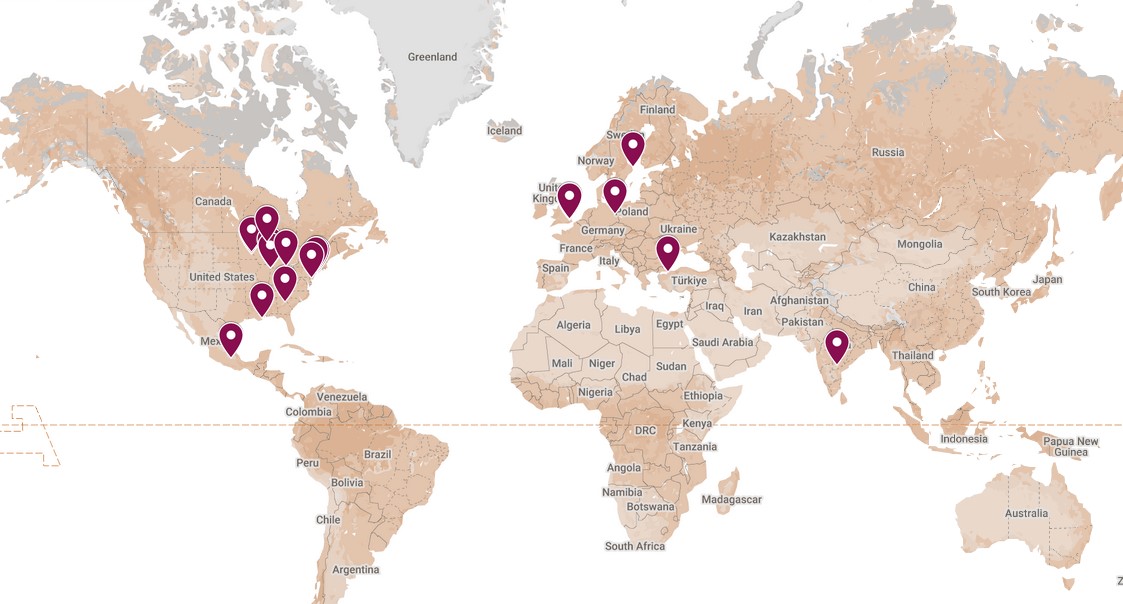
A world map with pink location pins marking various cities in North America, Europe, and South Asia, including the United States, Canada, Mexico, Germany, Norway, Turkey, and India.

You know that you have made it when your name becomes an adjective. In the course of our research on Jane Addams, we regularly come across people in all walks of life who are described as “the Jane Addams of India,” or “the Jane Addams of Northern Michigan,” or even “the Jane Addams of Social Work.” That last one seems a bit odd — as Jane Addams was clearly the Jane Addams of Social Work!

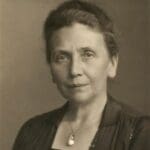
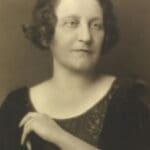
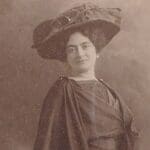
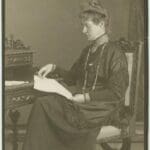
Because Jane Addams was engaged in so many reforms, her namesakes vary as well. Some are social workers and settlement women, such as  Lillian D. Wald (New York), Constance Currie (Minnesota) or Muriel Lester (London). Others were peace activists, like Halide Edib Adivar (Turkey), Alice Salomon (Germany) or María Elena Landázuri Gil (Mexico).

I’ve built an interactive map of those we have found so far with short biographies that you can explore (see in full screen) .

Who is the Jane Addams of Today?

Seeing the impact that Addams had on the lives of her contemporaries begs the question, Who is the Jane Addams of today? What problems do we face today that need someone of her character and care? Settlement houses faded away for the most part in the mid-20th century, but neighborhood organizing is still a vital movement. Immigrants still need help navigating American society. Even child labor, the reform Addams achieved in her lifetime, does not seem so settled. War still ravages the world, and its great expense hampers our ability to fund social services, education and health care.

Is she (or he) out there?  — working quietly to better their neighborhood, protesting for peace and social justice, or helping improve the lives of individuals through sympathy and social work? Time will tell!

Presenting at the Chicago Women’s History Conference

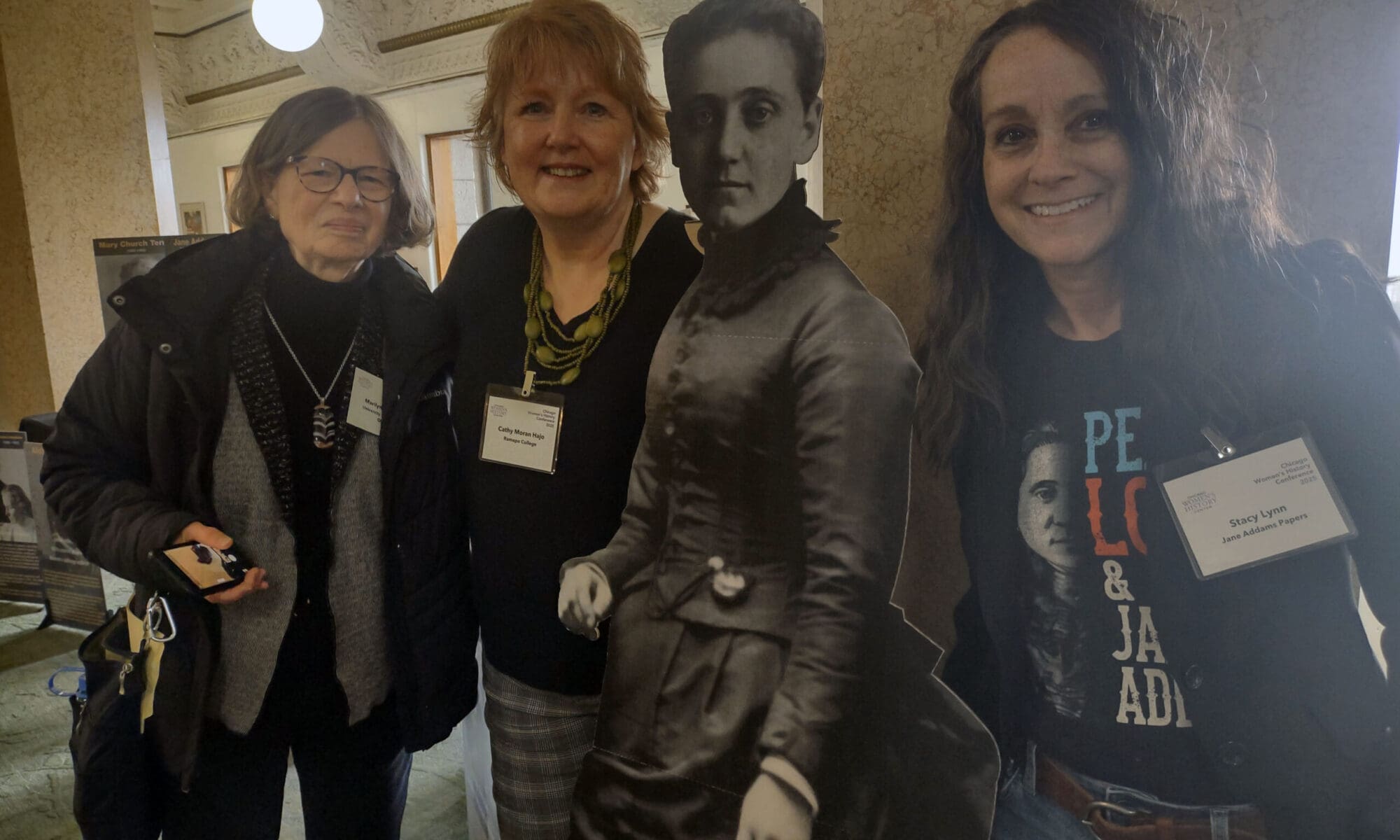
Three smiling women stand indoors next to a life-size black-and-white cutout of a historical woman; two women wear name badges and one wears a shirt with a printed image. Ornate architecture is visible in the background.
Marilyn, Cathy, Jane, and Stacy at the Chicago Women’s History Conference, March 22, 2025.

The Jane Addams Papers Project represented at the Chicago Women’s History Conference this past Saturday. Cathy Moran Hajo, Stacy Lynn, and advisory board member Marilyn Fischer led a workshop devoted to the importance of Jane Addams, the digital edition, and how scholars and teachers can use it. Stacy talked about how influential Addams and the women of Hull-House were, and Cathy demonstrated the digital edition, while Marilyn discussed how she uses the digital edition to trace Addams’s word use in her three part book series about Addams as an evolutionary philosopher.

Our workshop was just one session in a day filled with really interesting work. The biggest challenge was choosing between them! And Jane Addams was everywhere! From the cardboard cutout at the Women’s International League for Peace and Freedom’s booth, to morning presentations by Sherryl Engstrom on Hull House Performs: A Description and Evaluative Study of the Performing Arts at Hull House, 1920-1937 and Fiona Maxwell on “We Women Would Rule the World of Politics”: Women’s Oratory and Activism at Chicago Settlement Houses, 1890-1920. In the afternoon, we delighted to Ann Keating and advisory board member Rima Lunin Schultz’s presentation, “Beyond the Second Wave: Working Class Women Activists and City Planning: Florence Scala and Chicago’s Near West Side.”

Keynote speaker Jamila Woods was inspiring and plenary session with Pinqy Ring and her amazing students ended with an emotional bang. What an amazing time.


Jane Addams on Television

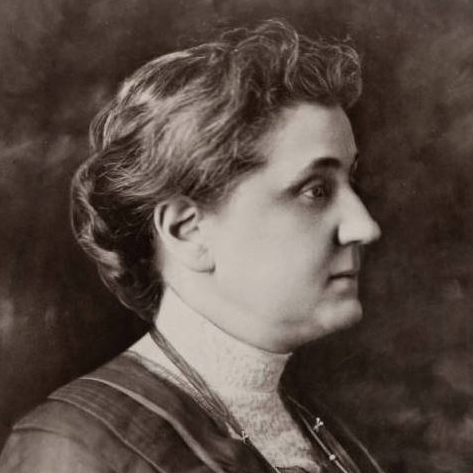
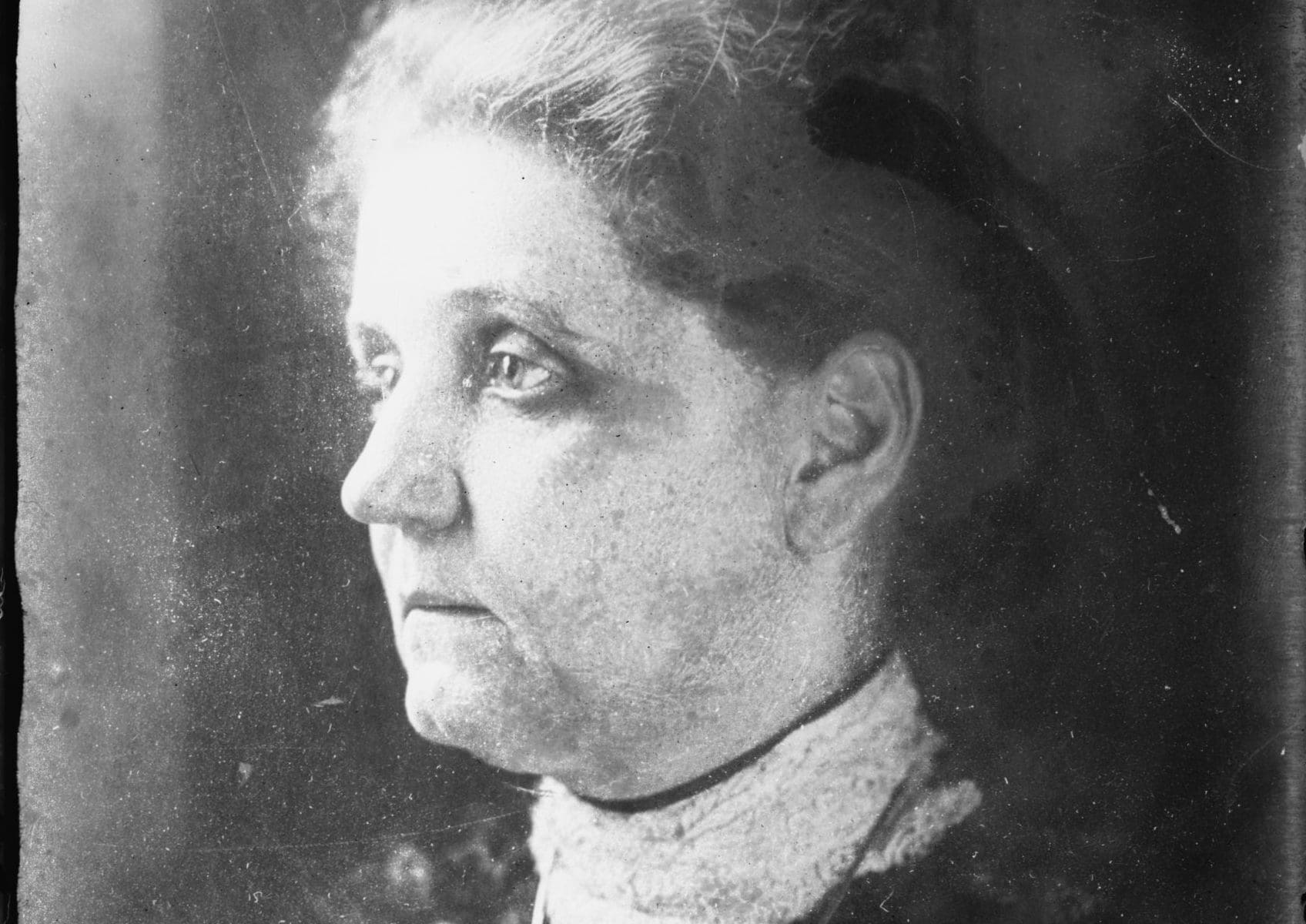
Black and white portrait of a woman in profile with short, wavy hair, wearing a high-collared blouse and a dark dress, looking to the right against a plain background.

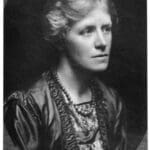
Black and white portrait of a woman in profile with short, wavy hair, wearing a high-collared blouse and a dark dress, looking to the right against a plain background.During her lifetime, Jane Addams was famous throughout the United States and around the world. Known for Hull-House and as the leader of the American social settlement movement, respected for her wide-ranging reform activities, and beloved for her commitment to economic, political, and social justice for all, Addams became a household name. Reformers, educators, politicians, and the public looked to her for inspiration and for answers to the social and economic problems of the Progressive Era.

However, although she won the Nobel Peace Prize, published eleven books and hundreds of articles, and led consequential movements to restrict child labor, gain suffrage for women, improve the lives of immigrants, and change America ideas about poverty and the role of government in the protection of society’s most vulnerable people, she is grossly underappreciated today. I have stopped counting the number of people who ask me who Jane Addams was when I tell them I edit her papers and study her life. Although I take these opportunities to tell them about her or share a great story about her work, it makes me sad that Jane Addams is not a household name today. It is depressing that Americans can name the Kardashian sisters but have never heard of Jane Addams.

In our time of increasing inequality, rising hostility toward immigrants, and rampant civil discord, we need Jane Addams. We need inspirational figures who live or have lived in the service of others, not to themselves. Every day as I edit her papers, I am struck by how applicable the work and words of Jane Addams are today. Her dedication to equality and peace and her philosophical understanding of the connection of democracy and humanitarianism are still relevant, as is her talent to see need and suggest solutions, to mediate vast distances between cultures and ideas, and to inspire people to join her efforts to make a city, a country, or the world a better place. Her world view and ideas and her commitment to democracy are still imperative. As Charlene Haddock Seigfried writes: “The need to make democracy a vital way of life was a constant theme for Addams and one that challenges us yet again.”

The words of Jane Addams are still relevant:

Like what she wrote in defense of Russian Jews in Chicago in a 1908 article in Charities and the Commons: “In fact the more excited and irrational public opinion is, the more recklessly newspapers state mere surmises as facts and upon these surmises arouse unsubstantiated prejudices against certain immigrants, the more necessary it is that some body of people should be ready to put forward the spiritual and intellectual conditions of the foreign colony which is thus being made the subject of inaccurate surmises and unjust suspicion.”

Like the question she asked in 1913 of white Americans about what they had done or failed to do in pursuance of equality for Black Americans: “How far are we responsible that their civil rights are often rendered futile, their political action curtailed or frustrated, their equality before the law denied in fact, business and industrial opportunities withheld from them and, above all, that for twenty-five years they have been exposed to the black horrors of lynching?”

And the alarmed observation she shared in a speech at an American Sociological Society meeting in Chicago in 1919: “… for there is no doubt that at the present moment one finds in the United States the same manifestation of the world-wide tendency towards national dogmatism, the exaltation of blind patriotism above intelligent citizenship, as that evinced elsewhere.”

I do not meet historians of American history who are ignorant of her wide-ranging reform work. Illinois school children learn about Jane Addams when they study the state’s history; and Jane Addams is a popular subject for history students who participate in National History Day. The Jane Addams Papers Project is making her correspondence and writings freely available (Jane Addams Digital Edition) and has created Jane Addams lesson plans for high school teachers as well as AP history and National History Day resources (Jane Addams Exhibits). All of Jane Addams’s books are in print and/or available online. There is also a growing number of books about her life and her work, written from myriad perspectives, most notably Erik Schneiderhan’s The Size of Others’ Burdens: Barack Obama, Jane Addams, and the Politics of Helping Others (2015); Neil Lanctot’s The Approaching Storm: Roosevelt, Wilson, Addams and Their Clash over America’s Future (2021); and The Oxford Handbook of Jane Addams (2023).

There is no excuse to be ignorant of Jane Addams.

Especially now.

Because Jane Addams is now on television.

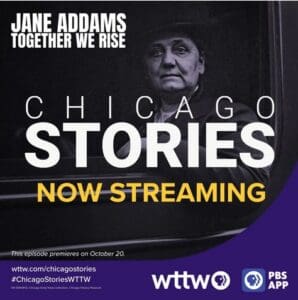
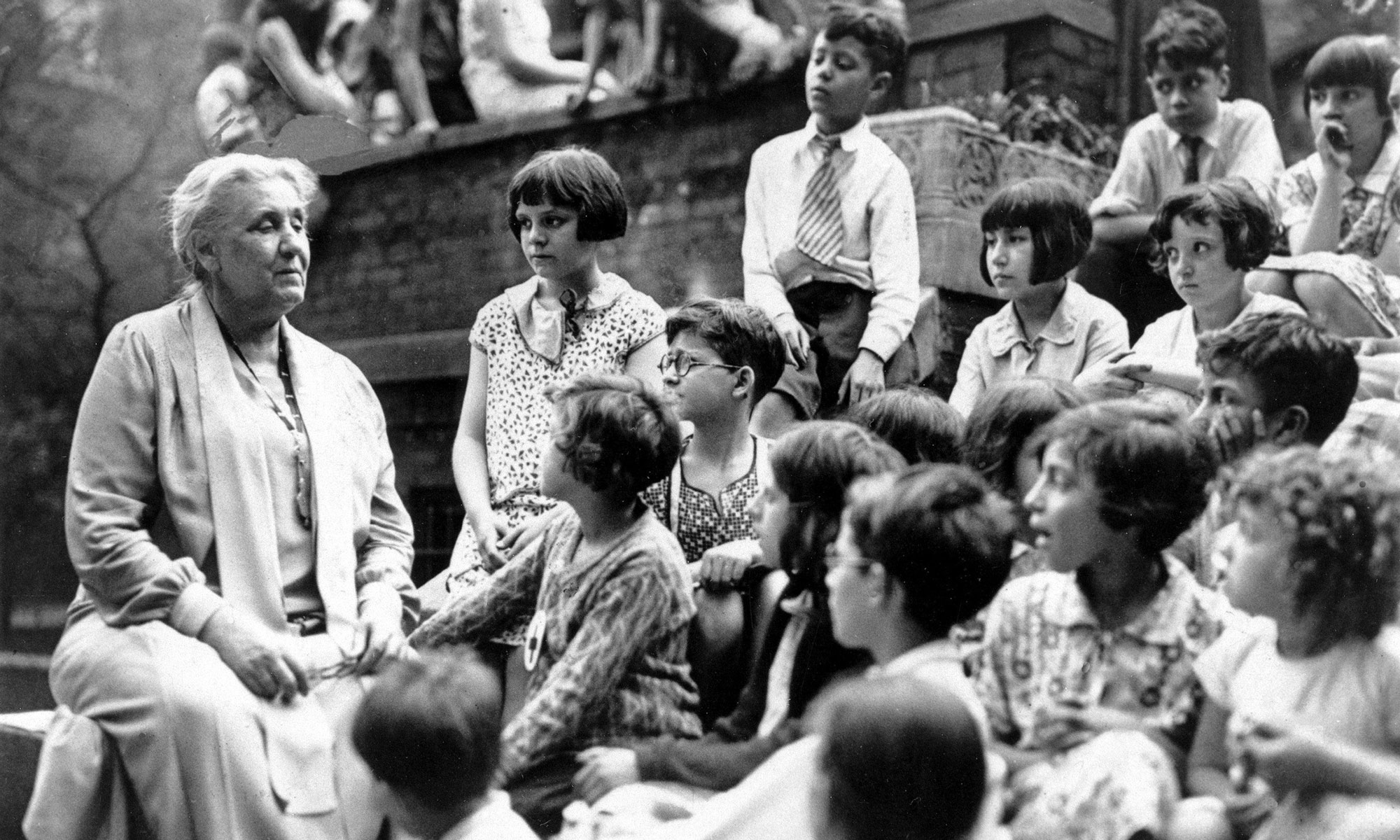
Black and white photo of Jane Addams looking out a window. Text reads: Jane Addams Together We Rise. Chicago Stories Now Streaming. PBS, WTTW, and app logos are in the bottom right corner.In October, WTTW, a PBS member television station in Chicago, premiered a Chicago Stories episode on Jane Addams. Jane Addams: Together We Rise examines the importance of Jane Addams in Chicago and of Hull-House as a laboratory for reform. It also chronicles the significance of Jane Addams as the leader of an incomparable group of women who became leaders in their own rights of a variety of Progressive Era organizations and activities to improve the lives of children, women, immigrants, and the working poor. When the producer Rachel Ruiz contacted the Jane Addams Papers Project about the documentary, we were thrilled and happy to assist. Our Project is based in New Jersey, but I live in Illinois and work remotely. It made sense for me to be the editor on camera for the film, although I was, at first, apprehensive.

Jane Addams was shy about having her picture taken, and I am shy about appearing on camera.

As an editor of historical documents, I spend much of my professional life in solitude, reading letters and speeches, straining over handwriting, solving the mysteries of vague references, and contextualizing the words of my subjects. I do not teach and have little interaction with students. And, since Jane Addams is under appreciated, there are few opportunities for me to interact with the general public. During the twenty years I edited Abraham Lincoln’s papers, I gave numerous public presentations every year, hosted a long parade of visiting scholars, attended untold Lincoln events, and appeared in several Lincoln documentaries. It was often a bit much, especially in February for Lincoln’s birthday. I cannot lie. I prefer the quiet and the anonymity of my life as an editor of the Jane Addams papers.

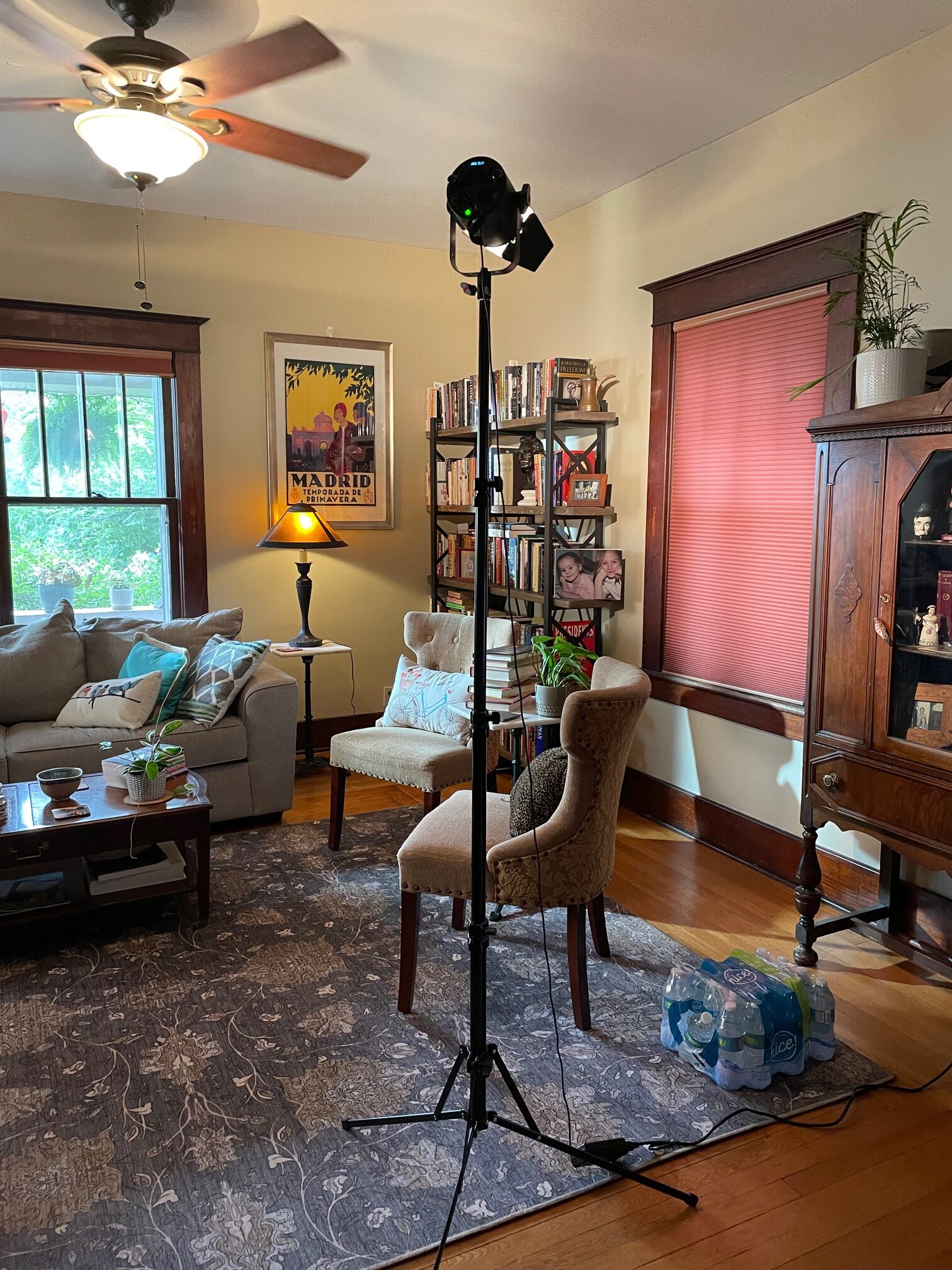
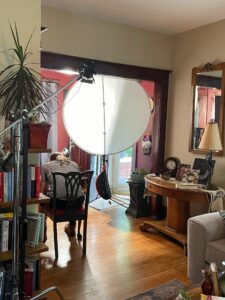
A living room with a sofa, chairs, and bookshelves, featuring a large window and framed art. A photography light on a stand is set up near the center, with a ceiling fan and indoor plants visible.

But because I cannot lie, I also have to admit it was pretty cool to have a film crew in my Jane-Addams-era bungalow and spend the day talking about Jane Addams. The novelty of the experience for me (and my two little dogs, one of whom made it into the film!) calmed my nerves about being under the blazing (unflattering) lights in front of a camera. Although it was terrifying a year later to preview the documentary the day before it aired, I am so proud and honored to have been part of it.

Jane Addams allowed photos of herself to be taken and dispersed for the good of her causes; and so, I was happy to participate in a documentary about her life for the good of our cause at the Jane Addams Papers Project: to make her work and her words accessible to a society that needs her now more than ever. Jane Addams’s life was consequential, her work was historically significant, and she still matters. Her extraordinary example of compassion, tolerance, civility, and the belief in the promise of democracy to lift up all people, is still relevant nearly eighty years after her death. We need American heroes right now, and few are more perfect for our troubled times than Jane Addams.

A person sits with their head down at a table in a cozy living room, with a large circular photography reflector and lighting equipment set up near sliding glass doors, bookshelves, and assorted home decor.Therefore, dear readers who already know the worth of Jane Addams, go forth and spread the Jane Addams word. Watch the documentary, read her books, and tell your friends, family members, teachers, students, and community leaders to do the same.

Stacy Lynn, Associate Editor


Books by Jane Addams (with links to first and early editions of them online)

Democracy and Social Ethics (New York: Macmillan, 1902); reprinted with introduction by Charlene Haddock Seigfried. Urbana and Chicago: University of Illinois Press, 2002.

Newer Ideals of Peace (New York: Macmillan, 1907); reprinted with introduction by Berenice A. Carroll and Clinton F. Fink. Urbana and Chicago: University of Illinois Press, 2007.

The Spirit of Youth and the City Streets (New York: Macmillan, 1909); reprinted with introduction by Allen F. Davis. Urbana and Chicago: University of Illinois Press, 2001.

Twenty Years at Hull-House with Autobiographical Notes (New York: Macmillan, 1910); reprinted with original illustrations by Norah Hamilton and introduction and notes by James Hurt. Urbana and Chicago: University of Illinois Press, 1990.

A New Conscience and an Ancient Evil (New York: Macmillan, 1912); reprinted with introduction by Katherine Joslin.  Urbana and Chicago: University of Illinois Press, 2002.

The Long Road of Woman’s Memory (New York: Macmillan, 1916); reprinted with introduction by Charlene Haddock Seigfried. Urbana and Chicago: University of Illinois Press, 2002.

Peace and Bread in Time of War (New York: Macmillan), 1922); reprint with introduction by Katherine Joslin. Urbana and Chicago: University of Illinois Press, 2002.

The Second Twenty Years at Hull-House. (New York: Macmillan, 1930).

The Excellent Becomes the Permanent (New York: Macmillan, 1932).

My Friend, Julia Lathrop (New York: Macmillan, 1935); reprinted with introduction by Anne Firor Scott. Urbana and Chicago: University of Illinois Press, 2004.

Forty Years at Hull-House; being “Twenty Years at Hull-House” and “The Second Twenty Years at Hull-House. (New York: Macmillan, 1935).

Sources: Charlene Haddock Seigfried, “Foreword,” in Patricia M. Sheilds, Maurice Hamington, and Joseph Soeters, eds., The Oxford Handbook of Jane Addams (New York: Oxford University Press, 2023), xvi; Neil Lanctot, “Jane Addams and the Great War,” Jane Addams Papers Blog, Dec. 21, 2021; from the Jane Addams Digital Edition: Jane Addams, “Chicago Settlements and Social Unrest,” Charities and the Commons, 20 (May 2, 1908): 155-66; Jane Addams, “Has the Emancipation Act Been Nullified by National Indifference,” The Survey, 29 (Feb. 1, 1913): 565-66; Jane Addams, “Americanization,” Dec. 29, 1919.
Get a Clew: Changes in Word Spelling

A classical painting of a woman in a flowing dress sitting and gesturing toward a man in ornate armor and a red cape; they appear to be in conversation next to a large window with a distant landscape.

I have always been a prolific reader, engrossed in anything from a geometry text book, fantasy novel, or whatever I could get my hands on. After absorbing so many words, I think it only natural that I eventually wondered where our words began, how they must have evolved, and when they could have changed. My yearning to explore this new fascination and my need to spend as little money possible on this endeavor culminated in the discovery of my long-time favorite podcast: The History of English Podcast (THEP), written, produced, and hosted by Kevin Stroud.

Stroud, a practicing attorney, began THEP in 2012 by discussing Indo-European, a language that would branch off and evolve into many European languages, including modern English, spoken before any alphabets were created to express its unique set of sounds and grammar. This was the perfect recreational listening for me; not only was I surrounded by words, but learning the complex history behind those words gave me a feeling of appreciation for the English language I had not previously known. The podcast successfully guided me away from my work day, filling me with knowledge about a topic so far removed from Jane Addams and 20th century Progressive politics that I could only be amused when Episode 12 pulled me right back to her papers.

Just a week prior to listening to Episode 12, I had come across Pleads for Suffrage, April 17, 1906, an article written by Addams in support of women’s suffrage. Near the end of this article, she states:

“So many of the stumbling blocks against which we fall are the opportunities to which we have not adjusted ourselves. We keep hold of a convention which no longer squares with our genuine insight into life and we are slow to follow a [clue] which might enable us to solace and improve the life about us because it shocks an obsolete ideal.”

In this paragraph, we the editors have bracketed the word “clue” to express an effort to regularize unusual spelling for the sake of readability and searchability in our digital edition; the word was originally spelled “clew.” At the time I read this article, I bracketed the unorthodox spelling without a second thought. Addams incorporated several unconventional spellings in her correspondence and other writings, such as “inclosed” instead of “enclosed”, or “altho” instead of “although”, and I believed this instance to be another drop in this bucket of the quirky, irregular 20th century spellings she employed.

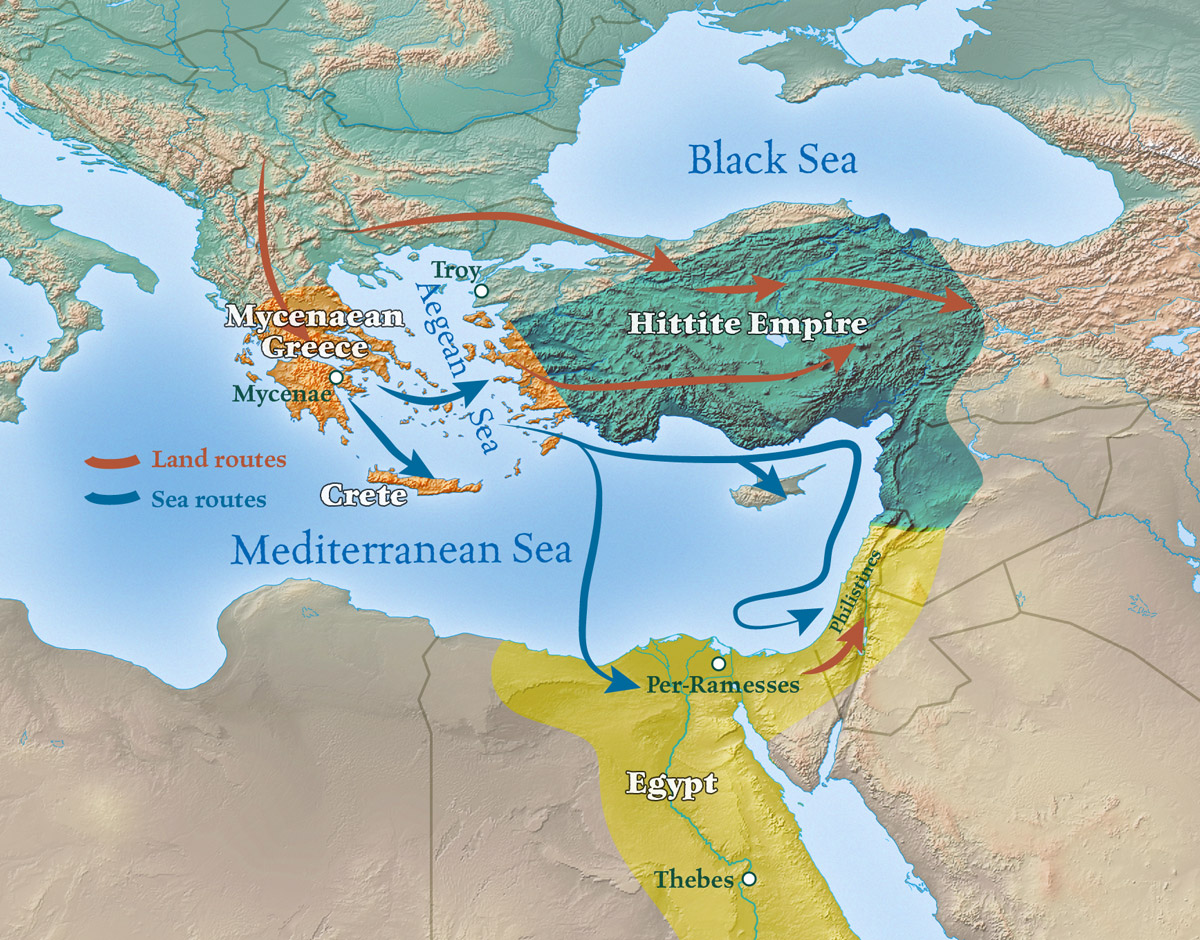
Map showing the Eastern Mediterranean during the Late Bronze Age, with land and sea trade routes connecting Mycenaean Greece, Crete, Troy, the Hittite Empire, and Egypt, labeled with major cities and regions.
Map Prepared by Louis Henwood for The History of English Podcast, Episode 12. This map shows the flow of renewed migration of Indo-European tribes in the region north of Greece in and around the Balkans.

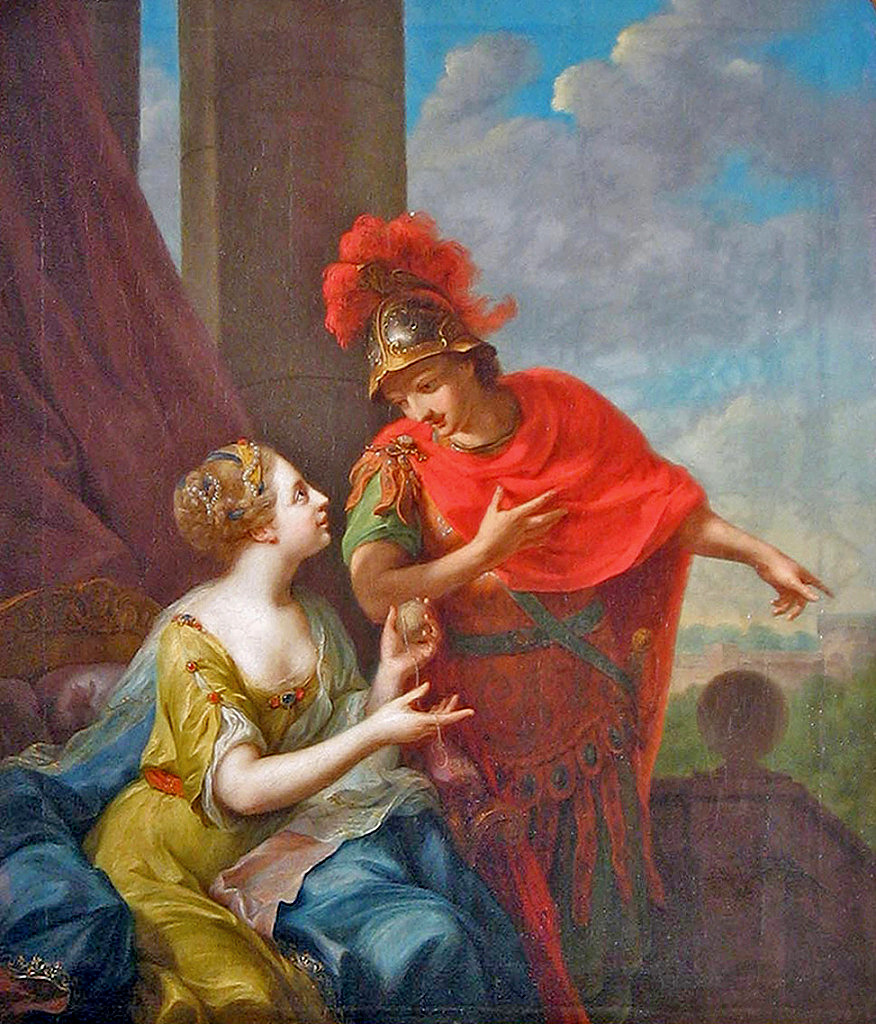
Episode 12: Early Greek, Hittite and the Trojan War of THEP, originally released in August of 2013, set out to discuss the Minoan civilization living on the island of Crete, just south of modern day Greece, and their mythical king, Minos, for whom the society was named after. According to legend, Minos was in possession of a powerful half man, half bull creature called a Minotaur which he kept in a purposefully complicated cave, or labyrinth, as a prison. Eventually, a Greek prince, Theseus, offered to kill the beast. In order to avoid becoming lost in the maze of the labyrinth, he used a ball of thread, given to him by King Minos’ daughter, Ariadne, and tied one end to the cave’s door. After defeating the Minotaur in the center of the maze, Theseus used the thread to find his way back to its entrance, left Crete without Ariadne, and sailed back to his home in Athens. This thread used by Theseus to escape the labyrinth, or any ball of thread or yarn, was historically called a “clew.”

A classical painting of a woman in a flowing dress sitting and gesturing toward a man in ornate armor and a red cape; they appear to be in conversation next to a large window with a distant landscape.
Ariadne Helping Theseus by Giving him a Ball of Thread. Johann Heinrich Tischbein, 1779. oil on canvas.

According to Stroud, this story became wildly popular in the Middle Ages, during the time Old English was spoken. Authors used the idea of a “clew” being employed to solve a maze or a puzzle so often, eventually the word could mean either a ball of thread or yarn, or a figurative hint or guide depending on the context. In modern English, beginning around the late 16th century, two separate spellings emerged for the seemingly unrelated definitions, with writers eventually substituting the Middle English ending of “ew” with the French associated ending of “ue” for the latter meaning. Today, the word “clue” has lost its figurative status, and fully refers to an actual hint to a solution of a problem.

Looking back at Addams’s usage of the word “clew” with this newfound knowledge, we can make some guesses as to her choice of spelling. According to the Oxford English Dictionary, the spelling “clew” was being used to refer to a figurative hint or guide as late as 1855. There is a real possibility that Addams, born only five years later in 1860, may have picked up the word’s earlier usage and incorporated it into her lexicon. In either case, the meaning of the word leans heavily toward a hint or guide, no matter how figurative it may be, leading editors to choose “clue” over “clew.”

The battle editors face between fidelity and accuracy when transcribing a text is often fought on a delicate rope. We can only hope that the choices we make help bring Addams’s ideas to a larger audience, and give some kind of [clue] into the world of Progressive era activism.

By Victoria Sciancalepore
Assistant Editor

Sources: About the Host, The History of English Podcast; Episode 12: Early Greek, Hittite and the Trojan War, The History of English Podcast; Jane Addams to Miss Leppo, December 28, 1907, Jane Addams Papers Project; Jane Addams to Mary Rozet Smith, May 19, 1902, Jane Addams Papers Project; Pleads for Suffrage, April 17, 1906, Jane Addams Papers Project

Powering the Jane Addams Papers!

Black and white portrait of Jane Addams with light hair pulled back, wearing a high-neck lace blouse. Text at the top reads Jane Addams copyright by E.F. Waters 12-2-22.

We are delighted beyond words to announce that the Jane Addams Papers has received two major grants.

Black and white logo of the National Archives featuring a stylized eagle wing above the words “NATIONAL ARCHIVES” and “National Historical Publications & Records Commission.”.

The National Historical Publications and Records Commission awarded us $160,000 in support for 2022-2023. The NHPRC’s program in Publishing Historical Records in Collaborative Editions has been a stalwart supporter of the Project and has published many papers projects that document the lives of women.  Funds from this grant help support the salaries of editors working on the Jane Addams Digital Edition.


The official seal of the National Endowment for the Humanities, featuring a bald eagle with a shield, olive branch, and arrows, above the text National Endowment for the Humanities.The National Endowment for the Humanities awarded us a three-year $300,000 grant (2022-2025). The NEH’s program in Scholarly Editing aids in the publication of the Selected Papers of Jane Addams as well as our work on the digital edition. The NEH’s support for historical editions has enriched the study of our nation’s heritage tremendously.
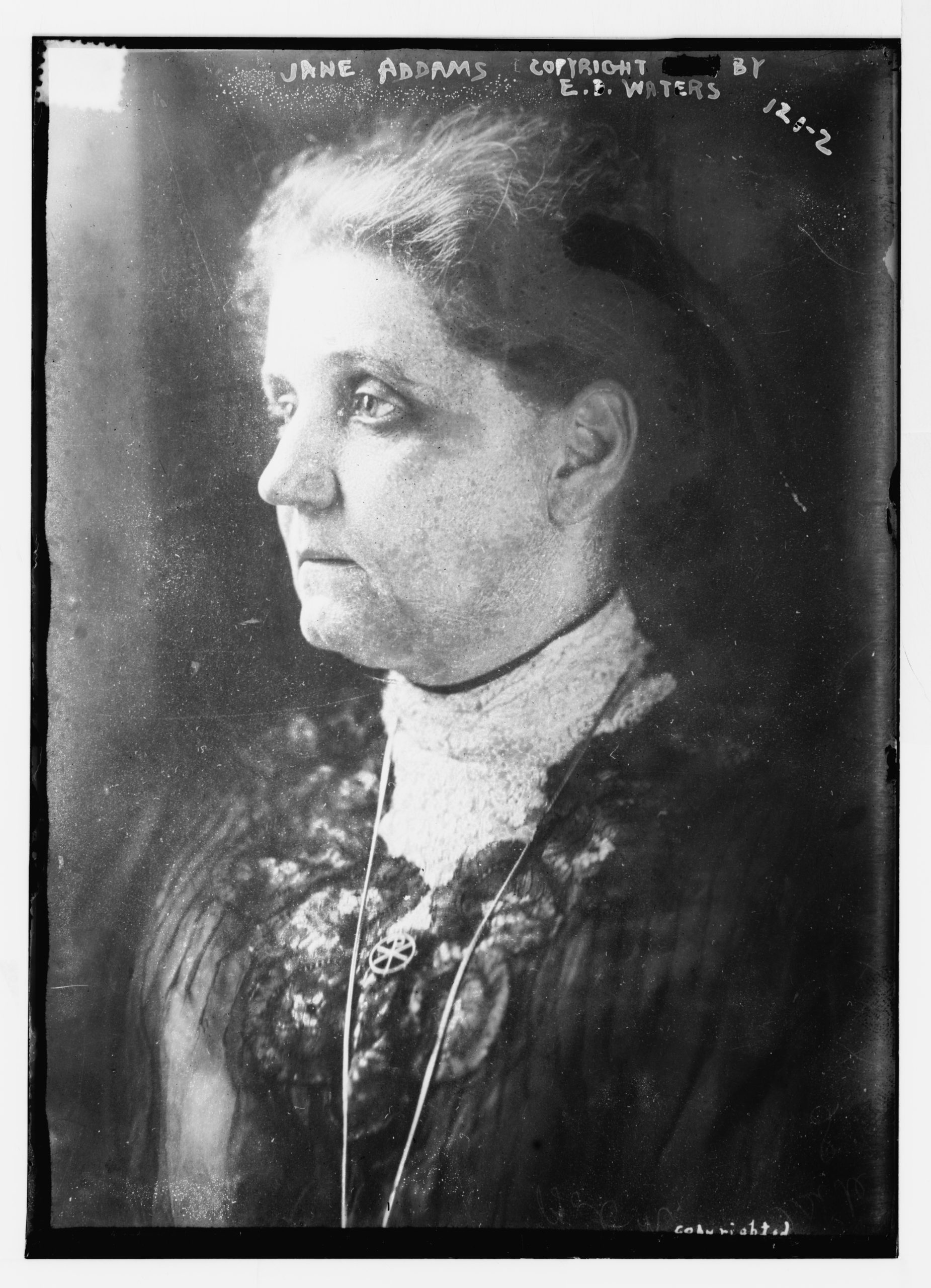

 

Black and white portrait of Jane Addams with light hair pulled back, wearing a high-collared lace blouse and a dark dress, looking to the left. The photo appears vintage and formal.
E. B. Waters portrait of Jane Addams (1902) Library of Congress

A Challenge: How You Can Help

Our new NEH Grant offers a way for you to help power the Addams Papers. The NEH will provide us with an additional $150,000 in matching funds if we can raise $150,000 from private sources. These much needed funds are needed to support the salaries of our student workers, research costs, and the editorial salaries that aren’t covered by the NEH and NHPRC.

We are currently short-staffed, with fewer student assistants than usual. Your support will ensure that we meet our goals for 2022-2023:

  • Entering over 1,000 new Addams documents with descriptive metadata in the Jane Addams Digital Edition.
  • Transcribing over 1,000 new Addams documents for the digital edition.
  • Proofreading student work to ensure quality before publication.
  • Submitting Volume 4 of the Selected Papers of Jane Addams to the University of Illinois Press.
  • Continuing research on Volume 5 of the Selected Papers of Jane Addams.
  • Working with high school teachers to develop AP resources.
  • Researching and writing biographies and descriptions of the people, organizations, events and publications mentioned in the Jane Addams Digital Edition.

A large red rectangular button with a white arrow pointing right and the words DONATE NOW in bold white letters.So, if you can, please donate now. Your contributions will be matched dollar-for-dollar by the NEH and will power the students whose work makes all of this possible.

Thanks for your support! A blue ink, cursive signature written on white paper.


Reviews in Digital Humanities

Circular logo with a portrait of a woman in a large hat at the center. The words Jane Addams Papers Project are written around the border on a red and black background.

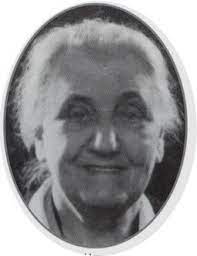
Black and white portrait of an older woman with light hair pulled back, wearing a collared shirt, and smiling gently at the camera. The photo is framed in an oval shape.Thanks to Núria Sara Miras Boronat for her review of the Jane Addams Papers Project, published in the most recent release of Reviews in Digital Humanities (Vol. 3, No. 2, Feb. 14, 2022).

We particularly appreciated the kudos, below:

JADE is one of the most important interventions that has occurred in the last decade for not only Addams’ work but also for pragmatist scholarship. It provides very valuable information about the intertextual and contextual references of her writings, which are not obvious to contemporary readers, especially if those readers are not from the U.S. or are not English native speakers. It also informs readers about the density of connections and affections of one of the greatest thinkers and activists of the progressive era. Finally, it has a strong value as a project for teaching digital humanities.

We are happy to address one issue that Núria pointed out, the relative difficulty in locating our blog posts. We are on it, and hope to have a easy way to find all posts up and running soon.

Fidelity, Accuracy, and the Delicate Balance

A person typing on a laptop at a wooden desk with headphones, handwritten notes, a cup of coffee, and a smartphone nearby.

A documentary editor’s top priority is unwavering accuracy to their collection’s text.

Wait, that doesn’t sound right.

A documentary editor’s goal should be the regularizing of words and writing styles so as to be easily read and searched by a reader.

But that doesn’t sound quite right, either.

These are the two schools of thought that a documentary editor grapples with when deciding on an editing style early in a project’s life. Fidelity: digitally representing an object exactly how it was created. Accuracy: changing characters or words to standardize and correct mistakes for various purposes. Humans are imperfect beings, leading us to make mistakes every so often, but also giving every person their own unique form of expression. But when someone’s written work, along with the imperfections it will undoubtedly have, is being prepared for increased access by being digitized and transcribed, how faithful should we be to their exact pen strokes?

For an example, take this salutation by W. E. B. Du Bois:

A greeting from a letter from W. E. B. Du Bois.
W. E. B. Du Bois to Jane Addams, April 19, 1905.

A common mistake made by over 400 authors in our digital edition so far, Du Bois spells Addams with a single D. In this case, as per our transcription guidelines, an editor would place [brackets] around the misspelled word and correct it. Our practices lean more toward accuracy than fidelity in this case, and would be applied to any incorrectly spelled name or word. After lengthy discussion, we felt this rule would aid with online searches . We also know that the spelling written above is factually wrong, and feel that correcting the mistake lessens confusion with names that may have been spelled 10 different ways across 10 different documents.

But what about another rule we have, concerning abbreviations:

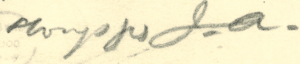
A closing from a letter to Mary Rozet Smith.
Jane Addams to Mary Rozet Smith, August 24, 1906.

Here, in a closing of the letter to Mary Rozet Smith, Addams writes, “Always yrs J. A.” which is exactly as we have transcribed the line. But wait, “yrs” is decidedly not how you spell “yours” in which case it should be bracketed and corrected, right? In this case we are leaving the spelling as is, arguing that expanding and regularizing abbreviated words changes the tone of the writing too intrusively. By leaning more toward fidelity rather than accuracy here, we hope to retain the unique style of writing that an author may have had.

Our transcription guidelines include dozens of rules about how to treat difficult to read texts or irregularities in spelling and punctuation. With each rule, editors hope to keep the delicate balance between fidelity and accuracy in transcriptions. One rule that is visible across the site is the use of brackets. By using brackets around changed words, editors can easily inform readers that something about the text may be different than the original, and by providing an image the reader can quickly check the spot that the change took place.

The bright side to editors working on a digital edition is the ability to easily change project guidelines. If, for some reason, we decide to change any of our rules, it would be entirely possible, though perhaps time consuming. This allows our relationship with our transcriptions to continue to grow as our editors develop a deeper connection with our texts.

This blog post was inspired by Ben Brumfield’s blog post “The Transcription Quality Balancing Act”.

For further examples of different transcription practices, see the National Archives’ Transcription Tips and Family Search’s “How should I index incorrect records?”

— Victoria Sciancalepore, Assistant Editor

Jane Addams and the Long 19th Amendment Project

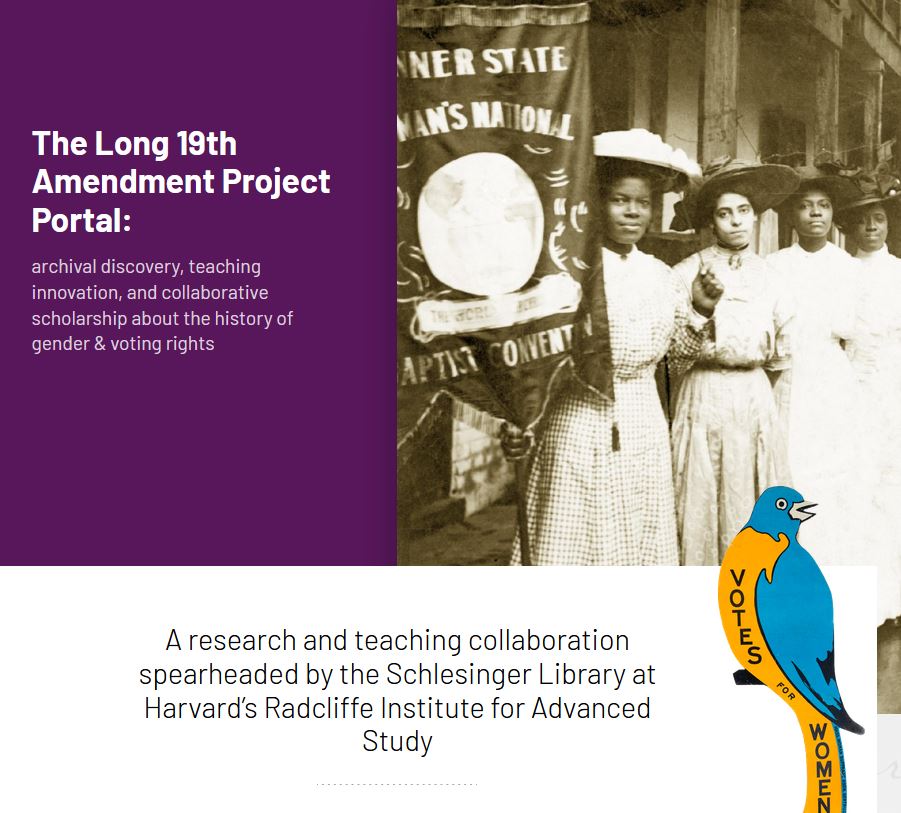
Historic black-and-white photo of women suffragists holding a banner, with text about Harvards Long 19th Amendment Project Portal and a cartoon blue bird with a yellow Votes for Women sash.

Historic black-and-white photo of women suffragists holding a banner, with text about Harvards Long 19th Amendment Project Portal and a cartoon blue bird with a yellow Votes for Women sash.I am very pleased to announce that the Jane Addams Digital Edition has shared content from our site with the Schlesinger Library’s Long 19th Amendment Project, an amazing digital portal that revolves around archival discovery, teaching innovation and collaborative scholarship on the history of gender and women’s rights.

This project, supported by the Schlesinger Library and the Andrew W. Mellon Foundation, seeks to build collaboration by including digitized materials from  well-known archives like the Papers of Susan B. Anthony and the Papers of Alice Paul at Schlesinger Library, but also includes materials from more than 40 contributing repositories.

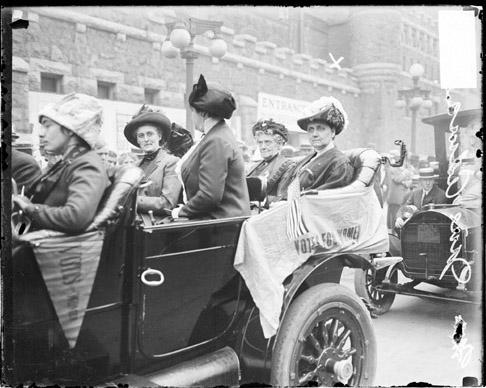
A group of women in early 20th-century clothing sit in an open car during a suffrage parade, with Votes for Women banners draped over the vehicle. A large stone building and more marchers are visible in the background.When we were approached by the Long 19th Amendment team, we were excited to participate for two reasons. Jane Addams isn’t known primarily for her work for woman suffrage. She is often mentioned in lists, or gets a small part in the larger history, but in her day, Addams was a leading suffragist. She was a vice president of the National Woman Suffrage Association and used her considerable fame to promote the movement. She gave frequent speeches on woman suffrage, especially on its impact for working women, spoke on college campuses, and testified before Congress in 1912 to make her argument.
The other reason that we were eager to participate, is that the Long 19th Amendment Portal offered the opportunity to fulfill one of our long-term project aims regarding data and data sharing. We want to be able to export our Dublin Core-based data from our Omeka content management system so that it can be repurposed and shared with other scholars. This project demonstrated that with just a little effort on our part, we could share more than 500 documents.

Looking at the Jane Addams Digital Edition in terms of woman suffrage, we had several options.

  • To share documents that have been tagged with Woman Suffrage
  • To share biographies of people tagged with Woman Suffrage

Working with the Portal team, we decided to share documents written between 1901-1920 in the first contribution.As we proofread more texts, we will update the data shared to include additional years. Our biographical collection will be included as a linked collection that researchers can locate and consult directly.

This is just the first in what we hope will be other collaborations with scholars working on related collections. If you are interested in accessing data from the digital edition, please do not hesitate to get in touch!


Excavating the History of Women and the Peace Movement

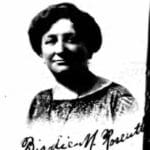
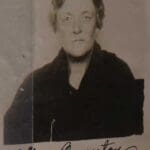
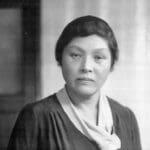
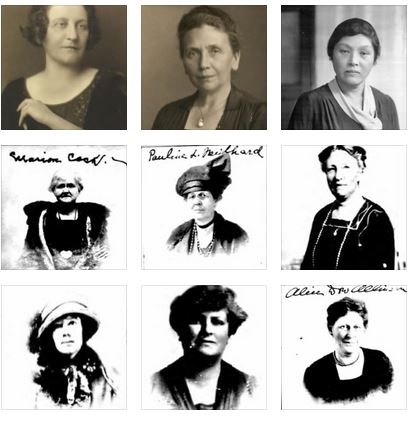
A grid of nine black-and-white portraits of women, some formal and some casual, with a few containing handwritten names above or beside the images.

The peace movement dominates Jane Addams’s work from 1914 until her death in 1935. Working through the Woman’s Peace Party, the International Committee of Women for Permanent Peace, and the Women’s International League for Peace and Freedom, Addams worked with her counterparts in many nations in a global movement to bring about peace, social justice, and equality.  She also served as the de facto leader of the American women’s peace movement.

Our detailed focus on the content of the documents and our efforts to identify the people mentioned in them yields a different kind of history than one that only focuses on the leaders of movements.  As we have begun publishing WILPF documents from both the United States and abroad, we are finding the names of early adherents, donors, and activists and adding them to the project’s database.

We know about Emily Greene Balch, Crystal Eastman, and Lucy Biddle Lewis, who were Addams’s coworkers for peace in the United States. But what about the rank and file? The women whose dollar donations funded the work of the WILPF? It turns out that within Jane Addams’s correspondence, we can learn about them too.

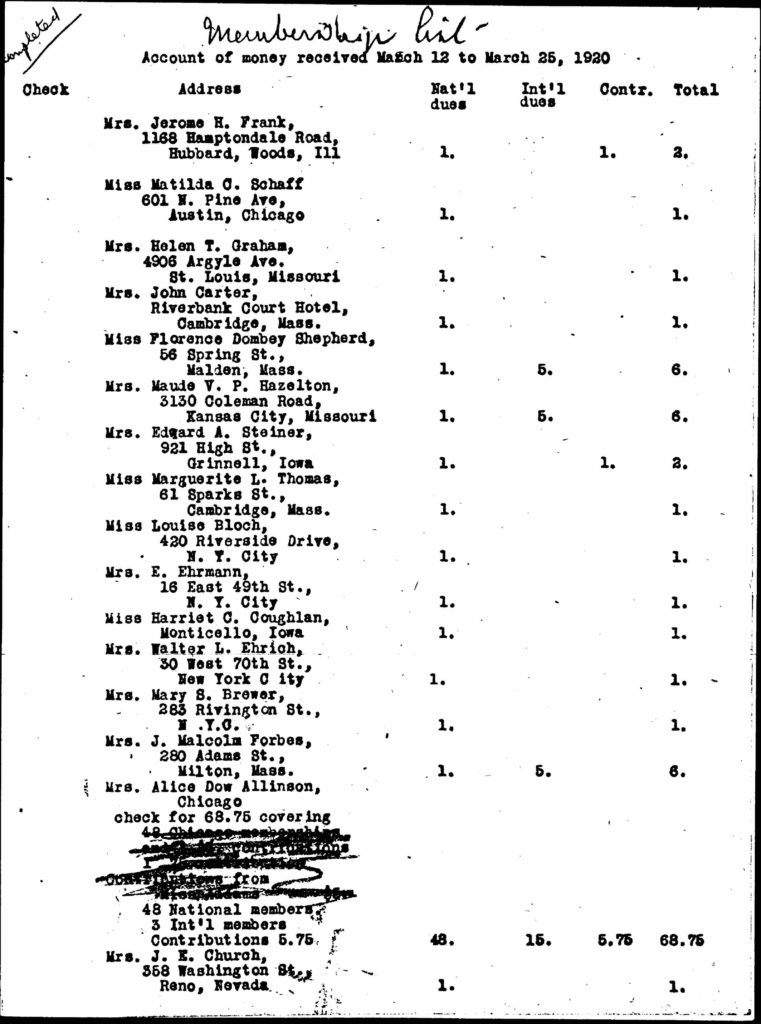
Typed list titled Membership Oil, detailing names, addresses, and amounts paid in National and International dues from March 12-25, 1920. Totals are calculated at the bottom of the typewritten page.

Eleanor Daggett Karsten, the secretary of the Woman’s Peace Party and then the United States Section of the WILPF, updated Addams every few weeks in 1920 with information about the women joining the new league, founded in 1919 at the International Congress of Women. As a document to add to our edition, I have to admit that each time I saw one of these multi-page columnar lists, I sighed, knowing that this one document might take a week or more to completely enter into our system due to the number of names. Thankfully, most of these lists contained street addresses, which made it easier (though not always easy!) to identify the women.

It didn’t take long to realize that instead of drudgery, adding the names of the early members of the WILPF was historical excavation of the best kind. Our biographical work is carried out in two steps. First the student or editor who enters the document into our system tries to link the name on the document to an existing name in our database. We use an Omeka-based system and a plug-in called Item Relations, to search the more than 12,0000 names in the system. When the person is not there, we add them. In this stage, the goal is to simply identify the person so that we are sure they are not duplicated and that we have verified their basic information.

We strive to add birth and death dates, full names, and a short biography, which we don’t publish until the second stage, when a student researcher does more in-depth work and drafts a full biography. Our goal is to then create relationships between the people in the edition and the organizations and events they participated in. This social network of Addams’s world being built slowly document by document, is one of the results of the project that we are most excited about. It will take time to build the data up, but it is time well spent.

For women, that means that “Mrs. Jerome H. Frank on 168 Hamptondale Road in Hubbard Woods, Illinois,” becomes “Florence Kiper Frank (1887?-?)” A draft biography, that isn’t publicly available yet notes that she was a member of the United States Section of the WILPF and was married to lawyer Jerome H. Franks and had a daughter named Barbara. Much of this comes from census records (having a street address on these lists is an enormous help),  local newspapers, and other web-based resources to get accurate information.  We create a bibliography pointing to the sources used so that others can follow our trail.

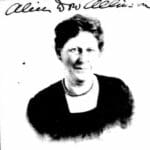
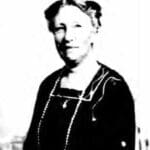
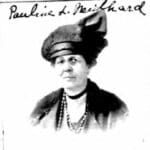
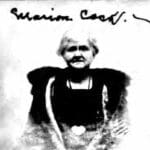
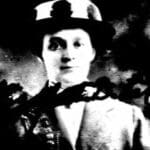
It is extremely exciting to find a photograph of the women, often in the U.S. Passport Applications that we access via Ancestry.com. Though the images are not of the best quality, hopefully we can add scanned originals at some point in the future.  We have also found that having even these short biographical stubs accessible on the web means that family members can find the project and see the associations that their ancestors had with Addams and peace. We have already received some photographs and biographical information from family members and hope that this will increase as we add more names.

Some of the more challenging research revolves around women who worked for peace outside the United States. There are many complicating factors—misspelled or partial names, the lack of genealogical resources for most non-English speaking countries, lack of language skills among our staff to read and search foreign-language resources (Google Translate only helps so much!), and often a lack of detailed geographical  information about where they lived.  Many of these peace activists are hard to trace through World War II, as records of pacifists and peace organizations often did not survive the war.

But adding them, even with partial names and limited dates, accomplishes something. As we enter more documents and move into the 1920s and 1930s, we uncover the names of those who participated in the Women’s International League for Peace and Freedom, and in time we will learn more about their lives as well.

Teaching Jane Addams in High School AP Classes

Text logo reading New Jersey Council for the Humanities in bold, dark blue letters at a diagonal angle on a white background.

Text logo that reads: New Jersey Council for the Humanities in bold, dark blue letters slanted diagonally upwards to the right on a white background.We are delighted to announce that, with a grant from the New Jersey Council for the Humanities, we will be working with a group of New Jersey high school  teachers and an educator from the Jane Addams – Hull-House Museum to explore ways to use the Jane Addams Digital Edition in high school AP classes.

The award, Developing Digital Educational Modules for High School AP Courses, will support a series of virtual meetings between Addams Project staff, and a select group of high school teachers from around the state. We are especially excited to also be working with Michael Ramirez, the Education Manager at the Jane Addams – Hull-House Museum in Chicago.

Two Ramapo College teacher-education students, Allie Cheff and Marina Kaiafas, will work with the teachers and Addams staff to develop primary-source-based educational materials that draw from the digital edition.

A black and white portrait of a woman with short, wavy hair wearing a high-collared blouse and a dark dress, looking directly at the camera with a neutral expression.Jane Addams’s work during the Progressive Era and early 20th century was wide-ranging, and available topics range from her work in establishing social settlements, professionalizing social work, fighting against child labor and the persecution of immigrants and African-Americans, working to win support for woman suffrage, and her efforts for peace and social justice through the Woman’s Peace Party and the Women’s International League for Peace and Freedom.

We will hold a virtual symposium at the end of the grant to talk about what we learned and make publicly available to the materials on the project’s Education hub. We will also develop a guide for archives and other editing projects to help them create similar resources based on their holdings.

Teachers invited to participate are from all over the state and have extensive teaching experience. They are: Staci Anson (Ramapo High School), Yvonne Beatrice (Mahwah High School, ret.), Katherine DeVillasanta (Clearville Regional High School), Joseph Dobis (Franklin High School), Joseph Dwyer (Nutley Public Schools), Angela Funk (Indian Hills High School), Keri Giannotti (Bloomfield High School), Scott Kercher (Sparta High School), Faye Johnson Brimm Medical Arts High School), Allison McCabe Matto (Red Bank Regional High School), Louis Moore (Red Bank Regional High School), Frank Romano, Jr. (Perth Amboy Public School), Robert Schulte (Neptune High School), and Patricia Yale (Hillsborough High Schoo).

This grant builds on work that we did a few years back, also funded by the NJ Council for the Humanities, that developed National History Day guides and lesson plans using the digital edition for middle school students. Renee Delora, who led that effort, has joined this project to provide support to the student workers.