Generation Sangfroid

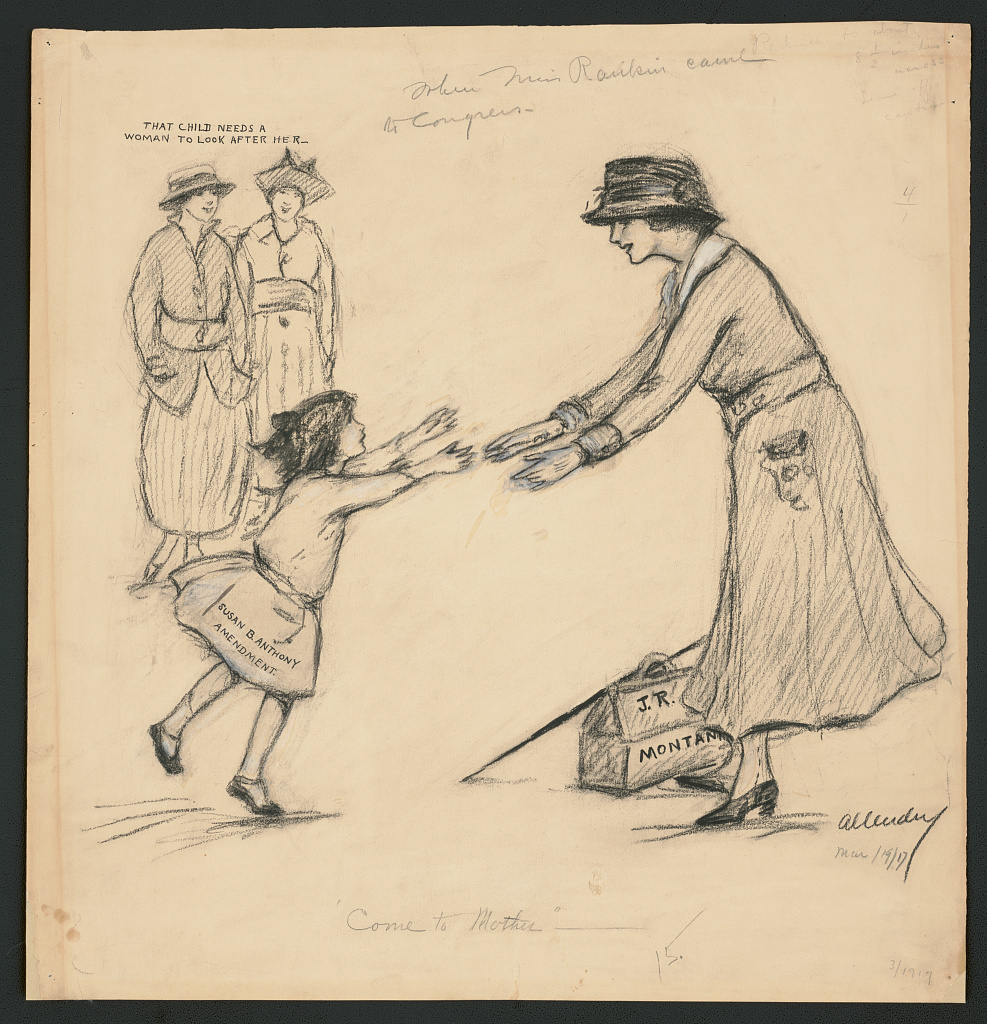
A woman with outstretched arms welcomes a young girl running toward her; two women watch in the background. A suitcase labeled Montana sits nearby. Text reads: That child needs a woman to look after her.

Currently, I am editing documents in the Jane Addams Papers from the 1920s. Jeannette Rankin, the first woman elected to the United States Congress, has been popping up a lot in my daily work. Rankin went to Europe with Addams in 1919 to attend the International Congress of Women in Zurich. She was a field secretary for the Women’s International League for Peace and Freedom (WILPF), of which Jane Addams was president. And in 1924, she lived and worked at Hull-House.

Of course, I had known about Rankin since I was an undergraduate studying women’s history, but I never had any depth of knowledge about her or her life. For a blog post I thought I would explore what led her to Hull-House, suspecting that Jane Addams was that gravitational pull. But those plans went almost immediately off the rails when I read a description of Rankin as exhibiting considerable sangfroid—sang-froid, from the French, literally “cold blood”—self-possession, coolness, or, as Merriam-Webster defines it, someone who is “cool as a cucumber,” possessing “imperturbability especially under strain.”

Wow, what a word, sangfroid, I thought (after I looked it up). And the more I kept reading the more I agreed with the description of Jeannette Rankin, the tough nut from Montana. This woman dared to run for a seat in the U.S. House of Representatives in 1916, just two years after women earned the right to vote there. She was a woman who unapologetically campaigned on a platform of equal suffrage for all American women, child protection legislation, and preparedness for peace instead of preparedness for war, while all of Europe was at war.
A woman with outstretched arms welcomes a young girl running toward her; two women watch in the background. A suitcase labeled Montana sits nearby. Text reads: That child needs a woman to look after her.
In this cartoon, Rankin’s bag is packed for Washington, as the Susan B. Anthony Amendment for woman suffrage reaches out for her. Nina Allender, “Come to Mother,” 1917, Library of Congress, Prints and Photographs, Washington, DC.

Cool as a cucumber, indeed, this 35-year-old Republican woman who won her Congressional seat despite Democrats sweeping up nearly all the others in Montana that year. This unrepentant pacifist Congresswoman voted NO in 1917 to declare war on Germany. “I want to stand by my country,” she said, “but I cannot vote for war.” Her vote won her praise in Montana, within the peace movement, and among Quakers, but she had been one of only a handful of dissenters in Congress and there was not much praise coming from anywhere else. Interestingly, Rankin had the historic opportunity to vote against world war again during her second term in the U.S. House of Representatives on December 8, 1941. On that day she cast the single, lonely, dissenting voice of Congress on the resolution to declare war against Japan. Defending her position, which was widely condemned and made her reelection impossible, she said: “As a woman I can’t go to war, and I refuse to send anyone else.”

And guess what? Jeannette Rankin lived long enough to protest the Vietnam War, too. On January 15, 1968, she led the Jeannette Rankin Brigade and several thousand marchers protesting the war in Washington. When a reporter asked her if she wanted her country to surrender in Vietnam, 87-year old Rankin said: “Surrender is a military idea. When you’re doing something wrong, you stop.”
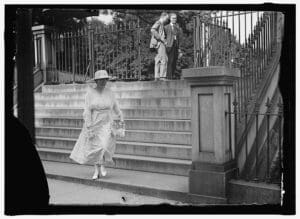
A woman in a long white dress and wide-brimmed hat descends outdoor stone steps, holding her skirt. Two men in suits stand at the top of the steps, watching her. Wrought iron railings line the stairs.
Rankin leaving the White House in 1917. Photograph by Harris & Ewing, Library of Congress, Prints and Photographs, Washington, DC.

Through all of it, Rankin was true to her principles, unwavering under tremendous pressure.

I kept reading about Rankin because she is fascinating, but I was no longer interested in her time at Hull-House (at least for now). Now I was intrigued by the qualities of Rankin’s character, particularly as compared with those of Jane Addams. I saw the common traits of quiet determination, commitment to personal values, and self-confidence. You see, at the Addams Papers we sometimes grumble a little bit about the stoicism of our dear subject. We sometimes long to discover chinks in the armor of her curated public personal. Jane Addams didn’t write much of anything at all about how hard it was to be a woman trying to save the world in the Progressive Era. We are sometimes frustrated that her composure even during the most stressful periods of her life makes it hard to know her. But as I kept reading about Rankin, I wondered if that biographer was onto something. Sangfroid, that curious new word, was pounding in my head as I continued reading.

Born in Montana in 1880, nine years before it gained statehood, Rankin was educated at Montana State University and the New York School of Philanthropy. Rankin’s interest in reform and social work mirrored the perspectives and paths of other educated and reform-minded women of her generation, but unlike most of them her priorities of suffrage, reform, and pacifism veered her directly into politics. Rankin’s term in Congress brought her fame and much respect and she rendered good service to her constituency, but she failed to be reelected in 1918. However, she seemed unphased by the defeat and just moved forward open to the next opportunity. After she left office in 1919, she joined the pacifist movement, went to Zurich with Addams, and became an active WILPF member. After Zurich, she worked with the formidable Florence Kelley at the National Consumers’ League. Then after she left Hull-House in 1924, she bought a small farm in Georgia, living a simple life there without plumbing and electricity. She kept her home in Montana, perhaps always thinking she might return to politics, and served nine years as a lobbyist for the National Council for the Prevention of War. She won her second term in Congress in 1940, beating out her antisemitic incumbent opponent. No matter what she was doing or where she was, she lived with intention and on her own terms.

The surface reading I was doing to write a short piece about her life was making it easy to see why Jane Addams took a shine to Jeannette Rankin. She was an intriguing woman, principled, fair-minded, and strong-willed. As if I needed more proof to believe that Jeannette Rankin was self-possessed, an example of Sangfroid right out of the Oxford English Dictionary, I came across the official portrait of the 65th Congress., the first in which she served.

A large group of men and one woman in formal attire pose on the steps of a government building; one person near the center (the woman!) is circled in yellow. Numbers are marked above each individual.
The 65th Congress, 1917, Library of Congress, Prints and Photographs, Washington, DC. Click to see the full photograph in all its panoramic glory.

There is Congresswoman Jeannette Rankin, sitting nearly dead center, the central portico of the U.S. Capital right behind her. The only hat and the only skirt. A woman in a sea of men.  Uncrossed legs and upright posture, she commands her space. There is a quiet, determined expression on her face. She is far more dignified than many of her fellows near her in the front row, slouching, legs splayed, arms crossed, and one shielding his eyes from the sun as he gazes into the distance at something he deems more interesting than the capturing of this historic photograph. Congresswoman Jeannette Rankin is sitting in that portrait like she belonged there because, of course, she knew she belonged there.

Yep.
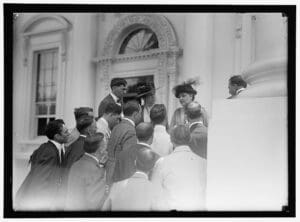
A group of men in suits gather around Jane Addams and Lillian Wald in hats, one with a feather, outside a large building with ornate windows and columns.
Sangfroid on display. Jane Addams (with Lillian Wald to her right) cool as a cucumber with an all-male group of journalists asking questions. (Image courtesy Library of Congress).

Sangfroid.

Unflappable is a word I have frequently used to describe Jane Addams. It is an apt word for a woman who stuck to her principles no matter the pressure. A woman who over and over and over again  kept making informed arguments in Springfield before the Illinois General Assembly about the evils of child labor against the manufacturing lobby who did not care one whit that factories were stealing the futures of children. Jane Addams, unflappable in the face of attacks that she was un-American, a Bolshevik, a traitor, because she dared to exercise her constitutional right to speak out against war and to promote peace for the benefit of humanity.

Unflappable works, but at every turn Jane Addams also exhibited considerable Sangfroid. Yes. Sangfroid is better. Unflappable sounds like a stiff brimmed, oversized, Edwardian hat on the windy city streets of Chicago. Sangfroid is a mighty oak standing against an impossible and exasperating Prairie tempest.

Yes. Sangfroid is better, so much so that I am beginning to consider the idea that what we have here is a generation of Sangfroid. Jeannette Rankin and Florence Kelley and Julia Lathrop and Jane Addams and so many members of that reforming generation of women were unperturbed, especially under strain. They had to be.

Rankin was the only woman in Congress when she served that first term in Congress. Everything she did and said was under a microscope. America was watching. The press was watching. History was watching. Jeannette Rankin stood up tall against all of that scrutiny. Sangfroid.

When Florence Kelley became the chief factory inspector for Illinois in 1893, she had to enter factories run by men to tell them that they were in violation of the law. She had to report her findings to a legislature of men at a time when women had no political power at all. Not surprisingly, men fought her tooth and nail, but still she kept walking into those factories and writing reports that led to the enacting of child labor legislation that changed lives and the future. Sangfroid.

When Julia Lathrop became the director of the U.S. Children’s Bureau in 1912, she was the favorite choice of many progressive men in Washington. However, many believed her task was woman’s work, not real work, and her budget to protect children was a fraction of the budget the U.S. government spent on the protections of livestock. Still, Lathrop did her work, spearheaded revelatory research studies, educated an entire generation about the needs of America’s most vulnerable children, and changed how Americans defined childhood despite an economic and political system that chafed at every suggestion of reform. Sangfroid.

Jane Addams was the first woman to do so many things I cannot name them all here but will give you a few examples: she was the first woman garbage inspector in Chicago, first woman president of the National Conference of Charities and Corrections, first woman to receive an honorary degree from Yale University, first woman to deliver a commencement address at the University of Chicago, and the first American woman to win the Nobel Peace Prize. She served on numerous boards and committees in which she was the sole woman. She boldly took her seat on panels of male scholars.  She lobbied before male-dominated state legislatures and the U.S. Congress and met with the most important religious, business, and political leaders in the United States and around the globe to make her arguments for a better world. For much of the time she had no political power, but she exerted her will anyway. She couldn’t even vote for president until 1916, but long before that she commanded audiences with presidents and sat down with them as an equal. Sangfroid.

This reform generation of American women was smart and compassionate and they had bold and brilliant ideas about how to make the world a better place. But perhaps even more important than their empathy and their ideas was the nature of their steely nerve. Men had all the power, and if women wanted to change the world they had to sit down at the table with disagreeable and disinterested and dismissive men and make them see the light. These women expected the chorus of doubt from those men (and some women, as well), but doubt for themselves was not an option. They had to open the doors and let themselves in, stand in extremely uncomfortable spaces, and hold their ground. Although they possessed warm hearts for the betterment of humanity, they had to be a little cold blooded.  Self-possessed. Cool as damned cucumbers.

In 1906, President Theodore Roosevelt wrote Jane Addams: “Will you let me say a word of very sincere thanks to you for the eminent sanity, good-humor and judgment you always display in pushing matters you have at heart? I have such awful times with reformers of the hysterical and sensational stamp, and yet I so thoroughly believe in reform, that I fairly revel in dealing with anyone like you.”

Jane Addams, Jeannette Rankin, and all of those reform women were up against thousands of patronizing Theodore Roosevelts as well as thousands more men who didn’t have Roosevelt’s bent toward reform and general interest in interesting women like Jane Addams. I’m now thinking about the bold women who organized female workers through the Women’s Trade Union League, Mary McDowell who worked her entire life in the impossibly tough Union Stockyards of Chicago, and suffragists, yes, all the suffragists. Alice Paul certainly exhibited imperturbability under strain! Sangfroid. All of them. Sangfroid.

I’ve written before about how Jane Addams developed a particular persona she found politically effective, a voice that would be heard in a public arena that in many ways was unattuned to women’s voices. I stand by my previous arguments that Jane Addams was guarded, deliberate, and dispassionate because, for her, the changes she wanted to see in her world were more important than any one person doing the work. She set her inner self aside, displayed a resolute dispassion, and made many of the tough Theodore Roosevelts of the world respect her, hear her, and listen to her ideas.

But now I have to wonder. Maybe it wasn’t so hard for Jane Addams to construct a demeanor of calm. Maybe Jane Addams was born exhibiting considerable sangfroid, like Jeannette Rankin’s biographer said she was born. Perhaps Jane Addams succeeded in her work and became the icon of the Progressive Era she became because imperturbability was innate in her character. I certainly would have slugged many of the fools Jane Addams had to face down, because I am, naturally, not even unflappable. I wonder, if we did a personality study of the all of the women who were first to do all kinds of stuff we wouldn’t find that each and every one of them possessed considerable sangfroid. Perhaps the historical circumstances didn’t effect such a demeanor but rather the demeaner itself, deep in their bones, made these women capable of opening all those doors and calmly standing in the fire on the other side.

By Stacy Lynn, Associate Editor

Sources: Nancy C. Unger, “Rankin, Jeannette Pickering,” American National Biography; Biographical Directory of Congress; “Jeannette Rankin: ‘I Cannot Vote for War,’” U.S. House of Representatives, blog; Martha G. Stapler, ed., The Woman Suffrage Year Book (National American Woman Suffrage Association, 1917), 14; from the Jane Addams Digital Edition: Theodore Roosevelt to Jane Addams, January 24, 1906; Congratulatory Telegram for Jeannette Rankin, November 12, 1916; Vachel Lindsay to Jane Addams, April 9, 1917; Romain Rolland to Johannes Vilhelm Jensen, May 15, 1917; Alice Thacher Post to Jane Addams, December 17, 1918 Jane Addams to Mary Rozet Smith, April 18, 1919; Alice Hamilton to Mary Rozet Smith, May 12, 1919; Contributions Received in National Office in Response to Miss Addams’ Letter, March 20, 1924.
 

The Politician and the Old Women of Hull House

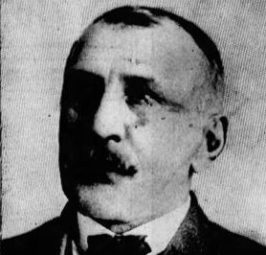
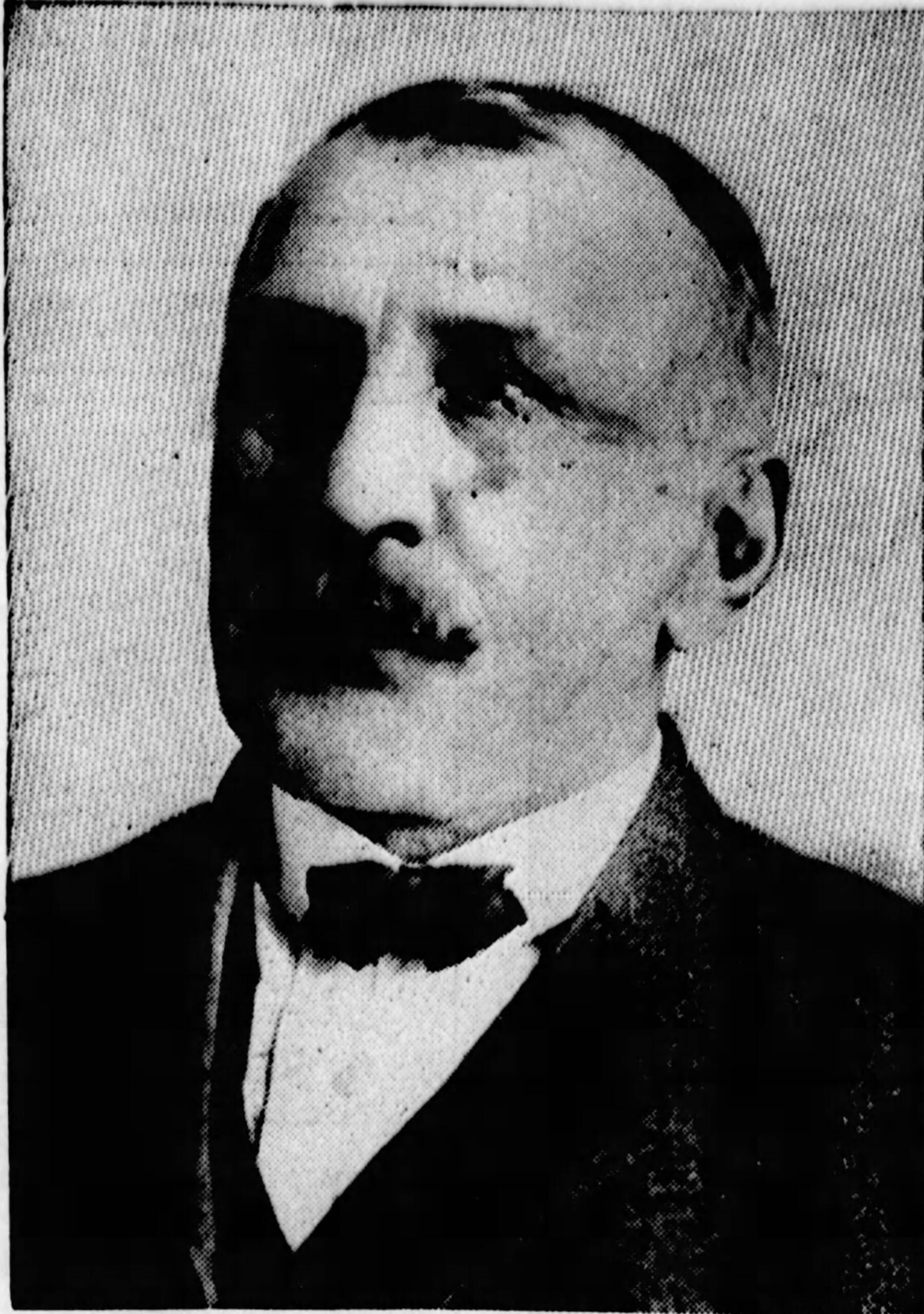
Black and white portrait of an older man with short hair, a mustache, and wearing a suit with a bow tie. The image appears vintage and slightly grainy.

Once upon a time in Chicago, there was an ambitious little politician who decided to make a name for himself by picking a fight with the women of Hull-House. For a man who built things for a living, perhaps he should have known better than to employ a political strategy of burning down the house. But he was new to politics, and he did not know better. He saw his path to power in the persona of “Battling Peter,” who would rattle the foundations of the city’s social reform structures to raise his voice above the progressive din. His political strategy was to attack social reformers in the city, particularly the female ones, and the institutions they supported.

Black and white portrait of an older man with short hair, a mustache, and wearing a suit, bow tie, and collared shirt. The background is plain and light colored.Peter Bartzen, a 61-year-old proprietor of a mason and carpentry business, was that politician. The office he sought was President of the Cook County Board of Commissioners. During the fall of 1910, the fiery Democrat campaigned for that office by denouncing what he called the “hypocritical horde of reformers,” particularly the women of Hull-House. Politically ambitious with his eyes on a future gubernatorial run, Bartzen was a political novice. His only political experience was a four-year stint as an appointed building commissioner. To be governor, he needed a political victory and a message to launch his political career. With an “aggressive personality,” Bartzen decided to make a name for himself by whipping up foment against his city’s “child savers” and meddling do-gooders.

Bartzen was not a popular candidate, but the incumbent he hoped to unseat was not all that popular, either. Bartzen, who was not widely known, won the election on the coattails of a historic Democratic sweep, the county Democrats upsetting Republicans who had held power for sixteen years. The women Bartzen had maligned during his campaign for office had no direct say in the election, because women in Chicago, in Illinois, and in most states across the country, could not vote. No doubt that is precisely why Bartzen was so comfortable in his attacks against them. But when Bartzen took his seat, many prominent women reformers in Chicago set their watchful eyes upon the pesky, provocative politician.

During his first year in office, Bartzen did much to earn the disdain of Chicago reformers. For instance, he took aim at many of the county’s social service institutions, arguing that they were doing more harm than good to the county’s children and their families. In particular, he launched a full-scale investigation of the Chicago Juvenile Court in July 1911 in an effort to dismantle it. At the same time, Bartzen wholeheartedly embraced the long Chicago tradition of the spoils system by appointing his political allies to various posts under his authority, including some within the court itself. When Bartzen removed the juvenile court’s chief probation officer John Witter, a professional hired through the civil service system, he renewed his personal attacks against Hull-House, as well. In a public statement about Witter’s firing, Bartzen said: “It looks as if Mr. Witter has been under the influence of Hull-House. He ought not to be listening to a bunch of old women all the time.”

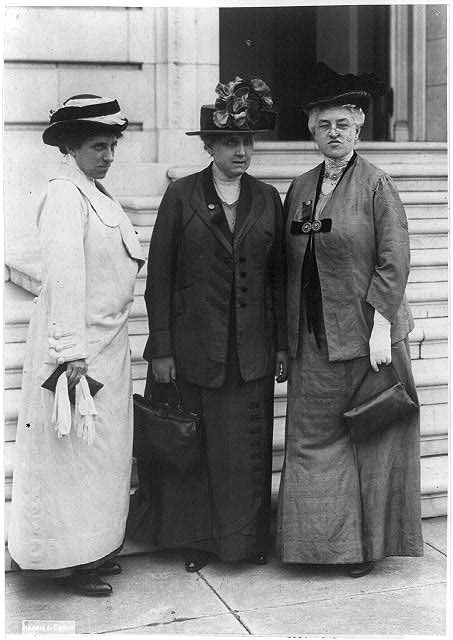
Three women in early 20th-century clothing and hats stand together in front of a stone staircase, posing for a photograph. One woman holds gloves, another has a floral hat, and the third carries a small bag.
The “Old” Women of Hull-House (Julia Lathrop and Jane Addams with friend Mary Wilmarth, who was, actually, kind of old, but she didn’t live at Hull-House)

That bunch of old women was led by the 51-year-old Jane Addams, a nationally respected and beloved social reformer, and the 53-year-old Julia Lathrop, who helped found the influential Chicago School of Civics and Philanthropy and was one of the city’s most prominent proponents of the Chicago Juvenile Court. Both of the women were a decade younger than Bartzen, but he dismissed them as members of the weaker sex, with no right to their opinions let alone their influence.  Bartzen’s position was a powerful one. He presided over a fifteen-member board that controlled some $10 million and managed much of the county’s infrastructure and its public institutions, including its civil service system. But the city’s community of social reformers was also powerful, and Bartzen underestimated the women who led them.

In September 1911, Bartzen’s fight with the women of Hull-House escalated. When he made a particular play to discredit the work of the Chicago Juvenile Court and the Illinois Industrial School for Girls, Julia Lathrop fired back. In a public speech, Lathrop responded: “Both attacks have been made for the purposes of political capital…The noble minded women who have been working for the salvation of Chicago’s children made some errors. They were not serious errors, but they were enough to give politicians a peg on which to hang an investigation.” The court had suffered some growing pains, but the court’s founders and supporters were willing to recognize problems and work to correct them. As well, the Chicago Woman’s Club and the Juvenile Protective Association, which included some very well-heeled and outspoken women, loudly reaffirmed their support of the institution in the wake of what they believed were unwarranted, politically motivated attacks against it.

Reformers in Chicago were eager to defend the court and its mission to help disadvantaged youth escape the harsh justice of the criminal courts. They were growing particularly concerned about Bartzen replacing qualified probation officers working with the juvenile court with political hacks. Just days after Lathrop’s defensive stand against Bartzen, Dr. James A. Britton, the chief medical officer of the city’s juvenile home, resigned his post in protest. He charged that Bartzen was thumbing his nose at civil service law, which provided qualified professional probation officers to the juvenile court, and that Bartzen was “loading up the county service with political friends.” Britton was a Hull-House resident and the husband of Gertrude Howe Britton, another Hull-House resident, who was also affiliated with the Juvenile Protective Association. Mrs. Britton was just 43-years-old, but Bartzen no doubt dismissed her, and likely her husband, too, as meddling Hull-House do-gooders. Bartzan was leaving in his political wake a long list of scorned old women at Hull-House.

During the next year, Bartzen did not change his colors, and neither did the old women of Hull-House. Bartzen continued to undermine the civil service system and threaten the life of the city’s social institutions; and the city’s reformers grew increasingly certain Bartzen was a dangerous political incumbent. In the fall of 1912, Jane Addams decided to beat Bartzen at his own game: politics. She led a group of the city’s reform-minded citizens, most of them men with political clout, to select a candidate to defeat Bartzen in the November 1912 election. The committee chose Alexander A. McCormick, a former newspaper editor and progressive thinker. In August, Addams sent a telegram home to Chicago while she was vacationing in Maine, indicating the reformers’ choice: “Social workers have much to do in persuading A A McCormick to run for president of county board.” Addams believed a failure to defeat Bartzen would spell the “destruction of juvenile court.”

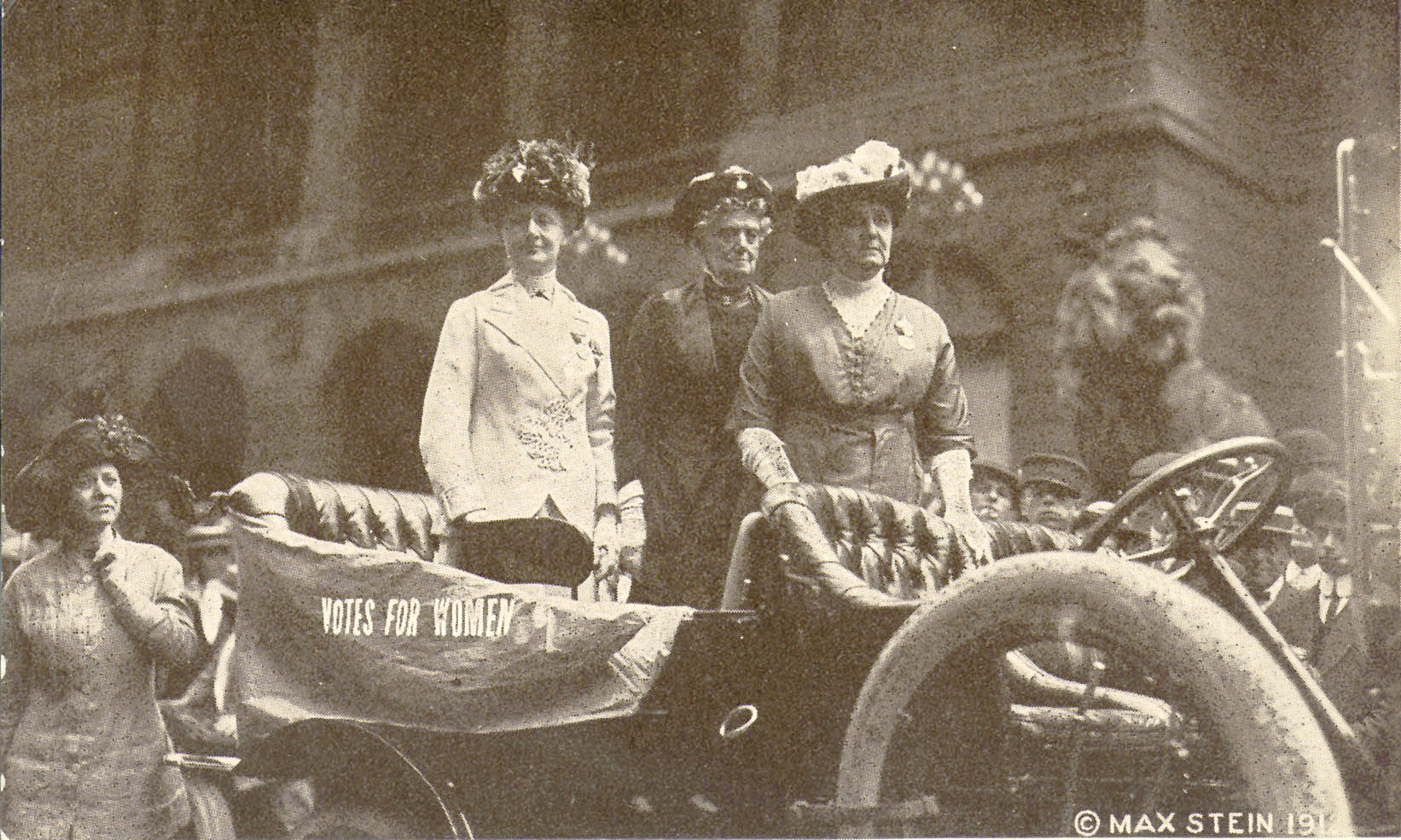
Three women, dressed in early 20th-century clothing and hats, stand in an open car during a suffrage parade. A banner reading “Votes for Women” is draped on the side of the car. Crowds are visible in the background.
Jane Addams (at right) in a parade for woman suffrage.

McCormick agreed to run on a Progressive Party ticket, and Addams’s political committee went to work. The campaign against Bartzen was ruthless, focused as it was on exposing him as a danger to the county’s most vulnerable citizens. Women led the charge, giving speeches and writing letters. On Nov. 2, 1912, on the Saturday just before the election, Addams and her committee behind McCormick published in the Chicago newspapers a signed circular entitled “Call to Public Service in the Interest of the Poor, Sick, Aged and Injured, and the Helpless Children of Chicago and Cook County.” The document skewered Bartzen’s policies, accused him of wasting public funds, asserted his guilt in “crimes of neglect and mismanagement of the Cook County Hospital,” and called his attack on the juvenile court “misleading and fraudulent.” In summary, the circular cautioned readers: “A vote for Peter Bartzen means a vote for the continued demoralization of all the public service institutions of the county, on which Bartzen and his henchmen have feasted while the dependents of the county have starved and been neglected.”

It is true that 1912 was a weird political year, with the role of a spunky third party mixing things up at the local, state, and national levels. The “Bull Moose” factor definitely influenced the Cook County elections. However, Bartzen’s particular reelection chances appeared to have lost traction on the heels of Chicago’s old women weighing in so loudly on his political record. Bartzen’s political strategy of picking a fight with Hull-House and Chicago’s most respected citizen backfired, and he lost the election.

The ambitious little politician had underestimated the old women at Hull-House and the political power they could garner, even without the right to vote for themselves. Bartzen not only lost this election, but he did not become the governor of Illinois, either. Even his obituary in 1933 dismissed his brief political career as minor, remembering his tenure as “anything but peaceful.” In the end, “Battling Peter” lost his battle against the battle-tested old women of Hull-House. While those women continued to make their positive marks on the history of Chicago, history resigned Bartzen to the political dustbin.

In 1914, Jane Addams published an article in the Ladies’ Home Journal in which she hailed the value of women over the age of fifty. “The weariness and dullness, which inhere in both domestic and social affairs when they are carried on by men alone, will no longer be a necessary attribute of public life when such gracious and gray-haired women become a part of it,” she wrote. “Ever-widening channels are gradually being provided through which woman’s increasing moral energy may flow, and it is not too much to predict that in the end public affairs will be amazingly revivified from those new fountainheads fed in the upper reaches of woman’s matured capacity.”

In the article, Addams shouted praise to “old” women like Ella Flagg Young, the Chicago Superintendent of Schools; novelist Edith Wharton; and Dr. Anna Howard Shaw, the long-running president of the National-American Woman Suffrage Association. Jane Addams knew the fight that resided in the hearts of experienced, capable, older women. She understood the beautiful extent of possibilities for women who used their talents for the betterment of their communities and the world. Peter Bartzen probably didn’t read that Ladies’ Home Journal article, and he may have never admitted to himself or to anyone else that he had been undone by women. Who knows if he harbored any regrets about his brief political career or the choices he made to conduct it.

The story of the politician and the old women of Hull-House is not a fairytale in which the villains are defeated and heroes in the story live happily ever after. Real life is more complicated than that. But this story is, perhaps, a fable Aesop himself may have written if he had lived in Chicago during the Progressive Era, when Jane Addams and scores of smart, capable, and commanding older women roamed the city’s dirty streets in order to clean them up. The moral of that fable is this: Beware the people you look past in your blind ambition; beware the people who seem to be precisely what you assume, unthreatening and unworthy of your respect. They might just turn out to be the clever, unrelenting, powerful force that becomes the fatal obstacle you never expected.

By Stacy Lynn, Associate Editor

Notes: David S. Tanenhaus, Juvenile Justice in the Making (New York: Oxford University Press, 2004), 82-110; Albert Nelson Marquis, ed., Book of Chicagoans, 1911 (Chicago: A. N. Marquis & Co., 1911), 42-43; Illinois, Deaths and Stillbirths Index, 1916-1947; Witter v. County Commissioners, 256 Ill. 616 (1912); “Editorial Musings,” The Daily Herald (Arlington Heights, IL), Nov. 4, 1910, p. 1;  Letter, Nov. 5, 1910, “Busse-Deneen Ring Is Smashed in Cook County by Democratic Victory,” Nov. 9, 1910, p. 1; “Would End Juvenile Court,” Chicago Tribune, July 30, 1911, p. 7; “Fight New Child Court Idea,” Chicago Tribune, Aug. 1, 1911, p. 4; “Bartzen Scored by Julia Lathrop,” Chicago Tribune, Sep. 24, 1911, p. 5; “Physician Quits Bartzen Regime,” Chicago Tribune, Sep. 26, 1911, p. 3; “Call to Public Service,” Nov. 2, 1912, p. 5; “Sociologists Say Bartzen Is Menace,” The Inter Ocean (Chicago), Nov. 2, 1912, p. 5; “Chicago Women, In Humane Plea, Flay Bartzen,” The Inter Ocean, Nov. 2, 1912, p. 1; “Save the Helpless From Bartzen,” The Inter Ocean, Nov. 4, 1912, p. 6; “Old and New County Board Presidents Shake Hands,” Chicago Tribune, Dec. 1, 1912, p. 3; “Peter Bartzen, Old Political Battler, Dead,” Chicago Tribune, Apr. 8, 1933, p. 1; Jane Addams to Julia Clifford Lathrop, August 7, 1911; Endorsement for Alexander McCormick for Cook County Board of Commissioners, 1912; Jane Addams to Alexander Agnew McCormick, August 21, 1912; Jane Addams to Charles E. Merriam, August 21, 1912; Jane Addams to Raymond Robins, August 21, 1912; Raymond Robins to Jane Addams, August 22, 1912; Need a Woman Over Fifty Feel Old?, October, 1914, all in Jane Addams Digital Edition.

Each for Equal: International Women’s Day 2020

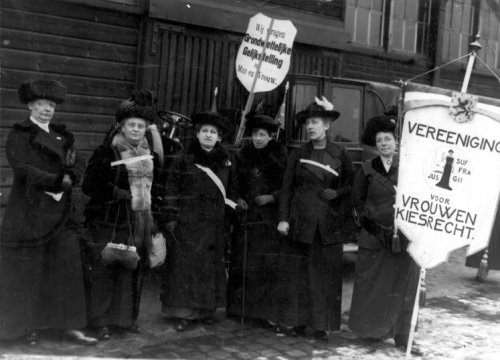
A group of six women in early 1900s attire stand on a cobblestone street holding signs and a banner advocating for womens suffrage, with buildings and a car in the background.

Each for Equal

This year’s International Women’s Day theme is #EachforEqual; an equal world is an enabled world. There are many women we could discuss today: Jane Addams, of course, for her work in the immigrant communities of Chicago, among many other areas she championed in the name of equality. Carrie Chapman Catt, who heavily campaigned for women’s suffrage rights. Lillian D. Wald, who taught women valuable skills out of the Henry Street Settlement. And Emily Greene Balch, a staunch supporter of peace as a central leader in the Women’s International League for Peace and Freedom. But there is, I believe, a group of women whom we often forget to include when discussing Addams, especially her work for peace — the women who aided Addams outside the United States.

It is easy to forget that many of Addams’s contemporaries were

A group of six women in early 1900s attire stand on a cobblestone street holding signs and a banner advocating for womens suffrage, with buildings and a car in the background.
Vereeniging voor Vrouwenkiesrecht (Society for Women’s Suffrage) Officers, 1914. Aletta Henriëtte Jacobs, third from left.

located outside the United States. Dr. Aletta Henriëtte Jacobs, a Dutch physician and suffrage activist, had multiple achievements to her name, including her life-long struggle for women’s equality. Jacobs was the first woman to attend a Dutch university, inspired by her father, physician Abraham Jacobs. Jacobs became a pharmacy assistant, continuing on to University of Groningen. In 1879, Jacobs set up a practice in Amsterdam, offering free appointments to poor residents, struggling to maintain large families. In a controversial move, in 1882 Jacobs offered birth control advice at her clinic, the first clinic ever to do so in the world. She paved the way for Dutch women to seek an education outside finishing school, and control the size of their families, lowering the infant mortality rate and improving women’s health in the process.

Chrystal Macmillan was a British pioneer, one of the first woman to graduate from the University Edinburgh in 1896 then finishing her studies in Berlin and Edinburgh. MacMillan fought for women’s rights at Edinburgh University. When World War I began, Macmillan threw her energies into providing food for Belgian refugees. Her staunch pacifist views made her a leader in

the English movement against war, and brought her into the international drive to end war. Macmillan was one of only three British women who attended the 1915 International Congress of Women and throughout the war worked for peace and a negotiated settlement. In March of 1919, Macmillan attempted to lessen the surrender terms to be implemented for Germany in the Treaty of Versailles, but no changes were made. Chrystal Macmillan dedicated her life to the equality and fair treatment of women and oppressed peoples, regardless of their country of origin.

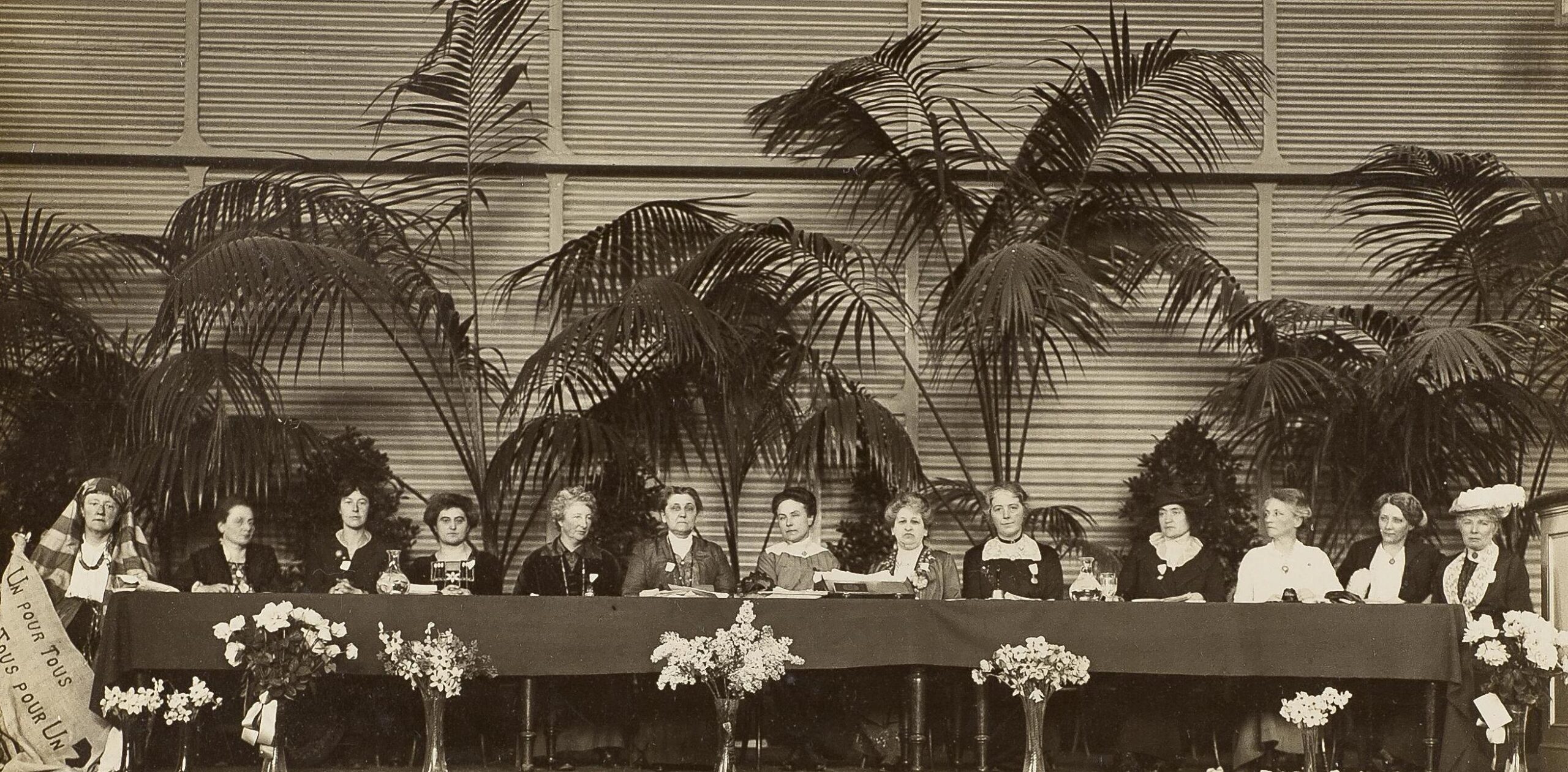
A group of women sit at a long table covered with a cloth and flowers, with large palm plants behind them, suggesting a formal gathering or conference.
International Congress of Women, 1915. Library of the London School of Economics and Political Science

Rosika Schwimmer, a Jewish-Hungarian activist, was a powerhouse in the peace movement; her unswerving belief in peace and women’s equality were seen by some as abrasive and they found her difficult to work with. Before becoming a peace activist, Schwimmer worked as a governess, and bookkeeper, a correspondence clerk, and finally became president of the Nőtisztviselők Országos Egyesülete (National Association of Women Office Workers), in 1901. After an international mentorship with American suffragist Carrie Chapman Catt, Schwimmer returned to Hungary, founding the Hungarian Feministák Egyesülete (Feminist Association). Their goals included equality for women in education, employment, and healthcare. Schwimmer was a driving force in the efforts to stop World War I. She convinced Henry Ford to mount a peace mission in 1915, and attended meetings to the Women’s Peace Party and the International Congress of Women in 1915. Schwimmer fought against anti-Semitism and sexism during the early twentieth century to secure better living conditions for Hungarian women and beyond.

With so much history right here in the United States, it’s easy to push international affairs out of our minds, preferring to learn about our own country’s struggles. But, as Jane Addams and her contemporaries have shown, the fight for equality for women encompasses is an international fight and women need to keep working until equality has been secured for all. As Addams wrote: “The good we secure for ourselves is precarious and uncertain until it is secured for all of us and incorporated into our common life.” This International Women’s Day, we remember the women working abroad for the equality of women worldwide.

— Victoria Sciancalepore, Assistant Editor

Further Reading:

International Women’s Day 2020 #EachforEqual

Women in Medicine: An Encyclopedia, Laura Lynn Windsor

Women at the Hague: The International Congress of Women and its Results; Jane Addams, Emily Greene Balch, Alice Hamilton

Rosika Schwimmer, SNAC


Guest Post: Striving for Social Justice: Jane Addams and Sophonisba Breckinridge

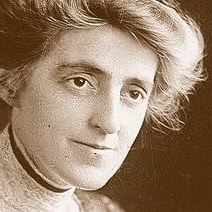
Sepia-toned portrait of a woman with light-colored, wavy hair styled back, wearing a high-collared patterned blouse, and looking slightly to the side with a neutral expression.

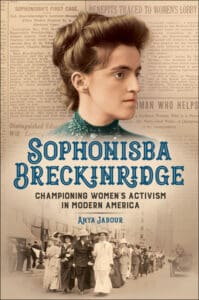
Book cover for Sophonisba Breckinridge: Championing Women’s Activism in Modern America by Anya Jabour, featuring a portrait of Breckinridge over a vintage newspaper background and a photo of a women’s march.

By Anya Jabour, Regents Professor of History, University of Montana

The subject of my new book, Sophonisba Breckinridge: Championing Women’s Activism in Modern America, worked closely with Jane Addams for decades. The two women, along with other reformers affiliated with Hull House, championed labor legislation, provided services to immigrants, promoted woman suffrage, and advocated for world peace. Together, they were a powerful force for social justice.

Born and raised in Kentucky, Breckinridge came to Chicago to pursue higher education at the coeducational University of Chicago. After earning her M.A. (1897) and Ph.D. (1901) in political science, she graduated with her J.D. (1904) at the top of the Law School’s first graduating class.  After completing her coursework, Breckinridge taught a pioneering course on “The Legal and Economic Position of Women” that brought her into contact with the Second City’s labor organizers and social reformers.

Breckinridge’s concern about the plight of working women initiated her long association with Hull House and its head resident, Jane Addams. In 1905, at Addams’s suggestion, she accepted an appointment as Inspector of Yards, investigating the working conditions of women in Chicago’s infamous stockyard district. Breckinridge spent more than four months inspecting the facilities and interviewing the employees of “Packingtown,” mostly immigrant girls and young women between the ages of 16 and 22.  Working in cold, windowless rooms and standing on “dirty, blood-soaked, rotting wooden floors” for ten hours a day, the workers “toil[ed] without relief in a humid atmosphere heavy with the odors of rotten wood, decayed meats, stinking offal,” and human waste from the doorless privies that vented directly into the workrooms.  Breckinridge found her task exhausting, both physically and emotionally.  To Addams, she confessed, “I was getting where I could not sleep—the vision of the day’s work presses in so!  Not my own day’s work—but that of the crews of girls I see marching past me now.”

Breckinridge translated her emotional response to women workers’ abysmal working conditions into social scientific scholarship and policy recommendations. In addition to publishing her study on women workers in the stockyards, she reported her findings to the U.S. Labor Department. With the support of settlement house workers, clubwomen, and trade unionists, she helped persuade the department to provide funding for a full-scale investigation. Ultimately, the nineteen-volume report on the working conditions of wage-earning women and children, published between 1910 and 1913, provided the basis for the establishment of two new federal bureaus, the U.S. Children’s Bureau and the U.S. Women’s Bureau.  These government agencies would advocate for a ban on child labor and better working conditions for women for decades to come.

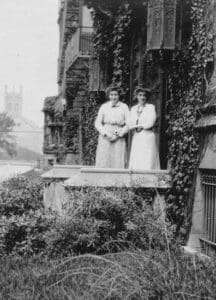
Two women in long dresses stand on an ivy-covered building’s porch, surrounded by plants. In the background, a large church or university tower is visible across a lawn. The photo is black and white.
Breckinridge (right) with Julia Clifford Lathrop (left) University of Chicago Photographic Archive, [apf1-02244], Special Collections Research Center, University of Chicago Library.
Breckinridge’s work with Addams on behalf of working women soon led to an invitation to live and work at Hull House. As Russell Ballard, one of the few male residents of Hull House, expressed it, “a brilliant company of women were drawn to the settlement to pioneer in the promotion of social change. The scholarly and talented Sophonisba Breckinridge joined the company in 1907 to become one of Miss Addams’ closest friends and most helpful associates.” Although her responsibilities at the University of Chicago prevented her from living at Hull House full-time, Breckinridge spent all of her vacation quarters—and much of her limited free time—at Hull-House, where she was listed as an official “resident” from 1907 until 1921.

Breckinridge became one of Addams’s closest colleagues. She helped to raise funds for the settlement, served as a substitute speaker when Addams was unavailable, and assisted Addams with her correspondence.  Breckinridge’s papers are filled with hastily scrawled notes from Addams, invariably beginning with the exclamatory greeting “Dear Lady!” and closing, “Hastily yours, Jane Addams.” In response to such letters, Breckinridge assisted Addams in innumerable ways, both large and small, leading Addams to close one typical letter asking Breckinridge to perform a task, “I do hope that I am not putting too many things ‘off’ on you.” Breckinridge always came through for Addams, signing one letter, “Yours to command always.”

Soon after Breckinridge took up residence at Hull House, she joined a special committee investigating the conditions confronting young single immigrant women who arrived in the city, lost and alone and vulnerable to both sexual and economic exploitation.  A typical case was that of Bozena, “a nice young Bohemian immigrant girl” who was “so eager for work . . . that she had taken the first job she could find—in a saloon.”  As fellow Hull House resident Edith Abbott, Breckinridge’s colleague at the University of Chicago, explained: “The saloonkeeper had abused her shamefully and then turned her out when he found that she was to become the mother of his illegitimate child.”

Hull House residents helped Bozena file charges, obtain childcare, learn English, gain citizenship, and find work. But Breckinridge and Addams soon realized that the problem of “lost immigrant girls”—as well as the difficulties confronting immigrant men and children—was too widespread for existing service agencies to address.  As Addams explained the problem:

Every year we have heard of girls who did not arrive when their families expected them, and although their parents frantically met one train after another, the ultimate fate of the girls could never be discovered; we have constantly seen the exploitation of the newly arrived immigrant by his shrewd countrymen in league with the unscrupulous American; from time to time we have known children detained in New York and even deported whose parents had no clear understanding of the difficulty.

With Addams’s enthusiastic support, Breckinridge proposed the creation of a new organization, and the Immigrants’ Protective League was established in 1908.  As Abbott recalled: “This problem of the unaccompanied girls proved to be challenging; but nothing that ought to be done seemed impossible to Miss Breckinridge!”

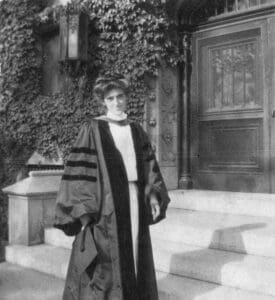
A woman in academic regalia stands on stone steps in front of a large wooden door, with ivy-covered walls in the background. She wears a long robe with dark stripes on the sleeves and a cap.
Breckinridge at Green Hall at the University of Chicago. (Courtesy of University of Chicago Photographic Archive, [apf1-02252], Special Collections Research Center, University of Chicago Library.)
The Immigrants’ Protective League provided essential assistance to Chicago’s immigrants—women, men, and children. One of the League’s first major accomplishments was establishing “a kind of immigration station” to welcome new arrivals.  Immigrants who arrived in Chicago by train met with League agents—chosen to represent the nationalities and speak the languages of their clients— who helped orient newcomers to the city.  Agents provided new arrivals with information about employment opportunities, social services, and evening classes. One of the principal goals of the League was to protect immigrants from exploitation.  At the welcome station, agents helped new arrivals steer clear of unscrupulous cab drivers, fraudulent employment agents, and the ever-present “cadets” who recruited young women into prostitution.  Breckinridge also persuaded local women’s clubs to provide funds for the League to provide temporary lodging for young immigrant women.  In only four years, the League served close to 80,000 immigrants at its welcome station.

Breckinridge and Addams continued to team up to advance social reform. In 1911, they were elected vice-presidents of the National American Woman Suffrage Association (NAWSA). Under their leadership, the Second City quickly became a “stronghold for the cause.” However, internal dissension caused both women to dread meetings of the national board, which Addams compared to being immersed in “boiling oil.”

Tensions came to a head in Fall 1912, when Breckinridge and Addams, in defiance of the suffrage organization’s traditional commitment to non-partisanship, declared their support for Progressive Party presidential candidate Theodore Roosevelt. Addams, Breckinridge, and other activists not only convinced the third-party candidate to support woman suffrage, but also helped to shape the Progressive Party’s agenda. The third-party platform, known as the “Contract with the People,” was modeled on the “Platform of Industrial Minimums” adopted at the 1912 National Conference of Charities and Corrections, where both Breckinridge and Addams played prominent roles. The platform included demands for a “living wage,” unemployment insurance, and workers’ compensation for all workers, as well as special protections for women and children in the workforce.

However, Breckinridge and Addams failed to convince NAWSA leadership that the suffrage movement should use party politics to promote either women’s rights or social welfare. Instead, president Anna Howard Shaw publicly denounced “party ties.” This uncomfortable situation led both Addams and Breckinridge to resign their posts after only a year in office.

Although they remained active in the suffrage movement, after leaving office, Breckinridge and Adams shifted their focus away from NAWSA and toward the Woman’s Peace Party, which they co-founded in 1915 in response to armed conflict in Europe—what would later become known as World War I. The Woman’s Peace Party was the first U.S. pacifist group to treat “peace as a women’s issue.” Many members believed that women had a special responsibility to protect life and thus to prevent war. The party preamble and platform called on women, as “the mother half of humanity,” to oppose the “reckless destruction” of human life resulting from warfare.  At the same time that they emphasized women’s special responsibility for peace work, feminist pacifists also demanded equal political rights for women.  Believing that women’s full participation in the political process was essential to ending global conflict, members of the Woman’s Peace Party worked for both women’s rights and world peace.

As chairperson and treasurer of the Woman’s Peace Party, respectively, Addams and Breckinridge represented the new organization at an international feminist-pacifist gathering known as the International Congress of Women and held at The Hague in 1915. The Congress enthusiastically adopted many of the measures proposed by the U.S. representatives, calling for the creation of an international peacekeeping body, national self-determination for all countries, and equal political participation for women. Following the Congress, two delegations visited political and religious leaders of both neutral and belligerent nations.  When Addams, who participated in the visits, returned home, she did so as the first president of the new International Committee of Women for Permanent Peace.

Addams, Breckinridge, and other members of the Woman’s Peace Party took the lead in attempts to find a peaceful solution to the ongoing war.  After Addams returned to the United States, she and Breckinridge worked with both male and female pacifists in Chicago and New York to pressure President Woodrow Wilson to intervene in the European conflict as a neutral intermediary. Addams hand-picked Breckinridge for a special committee assigned to consult with other pacifists within and beyond the U.S. on strategies to “make propositions to the belligerenets [sic] in the spirit of constructive internationalism.”

Throughout the war, Addams, Breckinridge, and other members of the Woman’s Peace Party pressured President Wilson to intervene in the war to produce a “negotiated peace.” Wilson had made initial overtures in this direction at the war’s outset, but his offer was rebuffed. Thereafter, Wilson adopted a pose of watchful waiting.  Although he steadfastly maintained his intention to offer mediation when the time seemed propitious, that time never arrived. However, Wilson’s willingness to meet with pacifist delegations, his cordial relationship with Addams, and his assurances that he considered the women’s proposals at The Hague “by far the best formulation” for world peace, encouraged the pacifist women to continue their efforts.


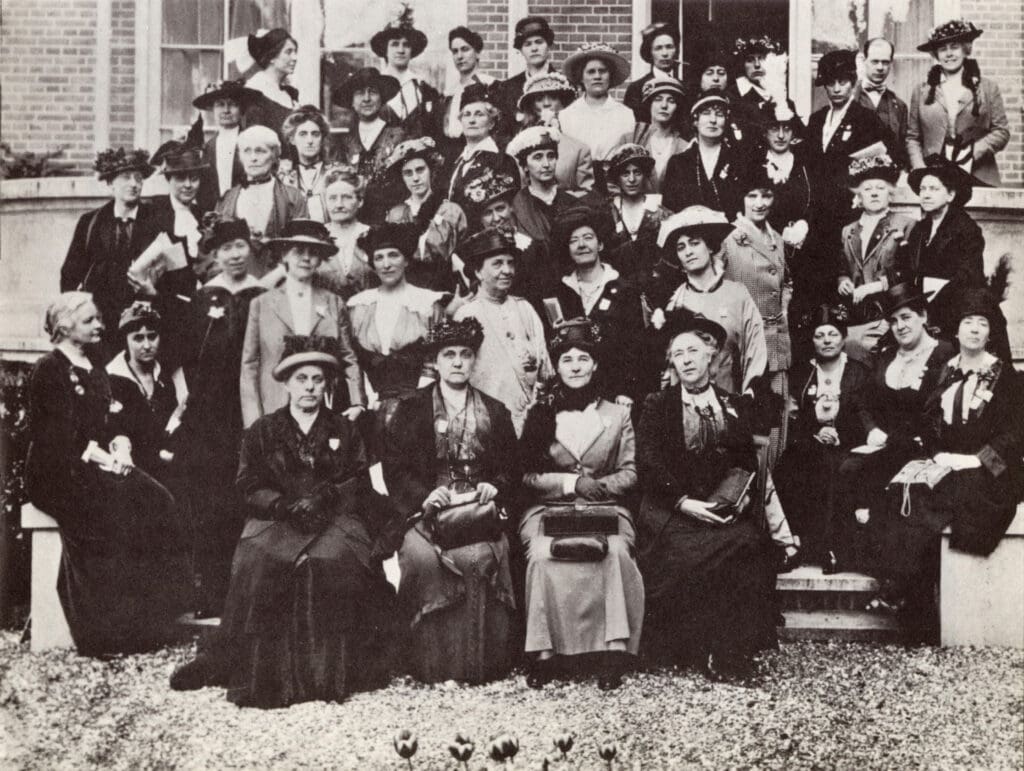
A black and white photo of a large group of women in early 20th-century attire, many wearing hats and coats, gathered on the steps outside a brick building for a formal group portrait.
Addams and Breckinridge co-founded the Woman’s Peace Party, later to become the U.S. chapter of the Women’s International League for Peace and Freedom, in 1915. (Courtesy Women’s International League for Peace and Freedom Collection, Special Collections, University of Illinois at Chicago Library)

Addams and Breckinridge continued their search for ways to prevent U.S. entry into the conflict, to end the war, and to prevent future wars. In the aftermath of the Lusitania episode, they urged President Wilson to steer clear of what they called “a preposterous ‘preparedness’ against hypothetical dangers” and instead to provide “the epochal service which this world crisis offers for the establishment of permanent peace”—that is, to offer his services to mediate the ongoing conflict. Subsequently, they appeared before the U.S. House of Representatives’ Committee of Foreign Affairs to express their support for a House Joint Resolution proposal to establish a “Commission for Enduring Peace.”

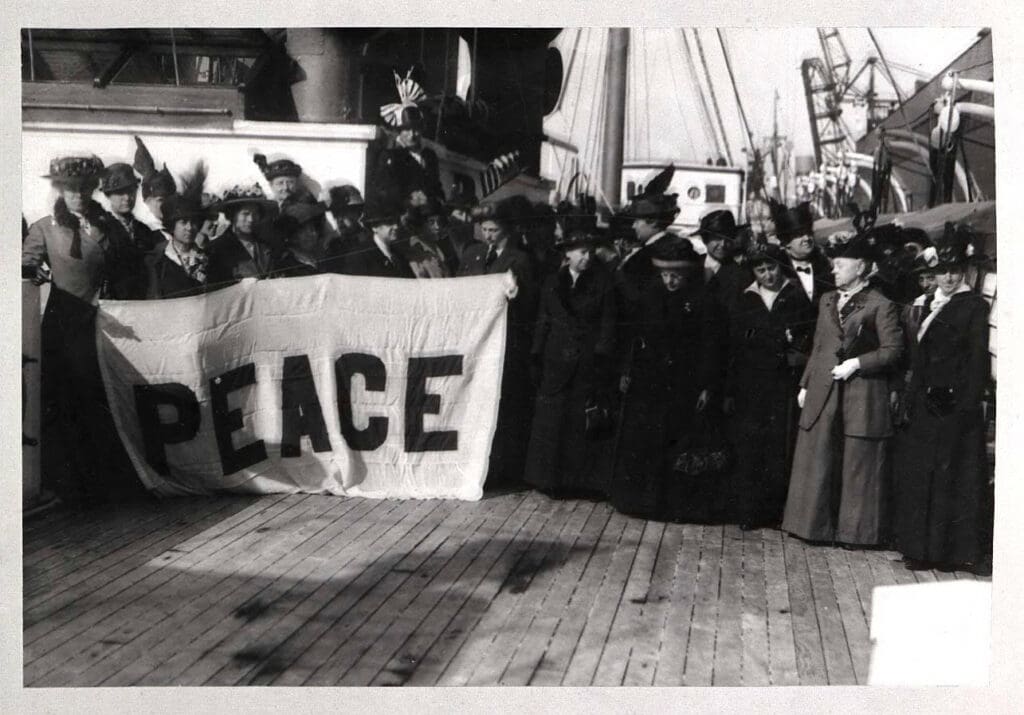
A group of women in early 20th-century clothing stands on a wooden deck, holding a large banner reading PEACE. Some wear hats with plumes, and ship structures are visible in the background.
The U.S. delegation to the International Congress of Women in 1915 on board the Noordam. Jane Addams in center behind the banner, Breckinridge is on the far right. (Courtesy Swarthmore College Peace Collection)

Despite their best efforts, American pacifists were unable either to halt the ongoing war or to prevent the United States’ entry into it.  Once hostilities ceased, Breckinridge and Addams—now part of the Women’s International League for Peace and Freedom—sought new routes to “enduring peace.” They achieved a partial victory in the establishment of the League of Nations, which incorporated many of the principles adopted at the International Congress of Women. Although the U.S. failed to join the new organization, Addams and Breckinridge persisted in promoting their vision of a peaceful postwar world.  In 1923, they discussed submitting “our” set of principles for the American Peace Award.  The plan that Breckinridge and Addams proposed called for the United States to join the World Court and the League of Nations. They also demanded that the U.S. military refrain from defending the interests of private businesses abroad, that the U.S. end both the production and the sale of armaments, and that the U.S. cooperate with other nations in a process of universal disarmament.  Finally, they recommended “cancelling or reducing debts due to the United States” from the other Allied countries in return for an agreement to “divide the costs of commissions hitherto charged against Germany alone equally between Germany and the former allies” and offering “a long moratorium to Germany” to allow that nation “eventually to pay the balance on her reparations debt as estimated by an impartial commission of experts to be constituted for the purpose.” Addams’s and Breckinridge’s joint plan thus called for the United States to promote peace not only by agreeing to abide by arbitration in future disputes and participating in a process of universal disarmament, but also by removing the reasons for rising resentment in Germany that would soon allow Adolf Hitler to rise to power. Sadly, their plan was never implemented. Nonetheless, in the years after the Second World War, many of their ideas would be adopted by the United Nations.

Addams and Breckinridge were not always fully successful in their efforts to promote social justice, but they shared a passion for justice that allowed them to persist in the face of difficulties and setbacks. Their collaboration with one another and with fellow reformers also enabled them to meet challenges with strong resolve and good cheer. Together, Addams and Breckinridge were a powerful force for social justice.

Coda: Because Breckinridge’s own papers, while extensive, are comparatively scant for the Progressive Era, to conduct my research on these decades of her life, I relied heavily on the 82-reel microfilmed edition of the Jane Addams Papers and the accompanying “Pink Bible,” the 674-page guide to the microfilm collection, created with the guidance of Jane Addams Papers Project founder Mary Lynn Bryan. I am delighted that future researchers’ work will be facilitated by the next generation of the Jane Addams Paper Project, spearheaded by Cathy Moran Hajo, which will make the Jane Addams Papers accessible in a digital format.


Anya Jabour is Regents Professor of History at the University of Montana. Her books include Topsy-Turvy: How the Civil War Turned the World Upside Down for Southern Children and Scarlett’s Sisters: Young Women in the Old South

Sources:

Abbott, Edith, and Breckinridge, Sophonisba P. “Women in Industry: The Chicago Stockyards,” Journal of Political Economy, Vol. 19, No. 8 (October 1911), 632-654.

Addams, Jane. “Woman’s Suffrage and the Progressive Party,” Chicago Tribune, October 28, 1912, pg. 9.

Addams, Jane, Balch, Emily G., and Hamilton, Alice. Women at the Hague: The International Congress of Women and Its Results (New York: Macmillan Company, 1915).

Alonso, Harriet Hyman. Peace as a Women’s Issue: A History of the U.S. Movement for World Peace and Women’s Rights (Syracuse, NY: Syracuse University Press, 1993).

Ballard, Russell. “The Years at Hull House,” Social Service Review, Vol. 22, No. 4 (Dec. 1948), 432-433.

Brush, Mary Isabel. “Society Leaders Will Promote Suffrage Cause in Chicago’s Fashionable Circles: National Association to Open Branch,” Chicago Daily Tribune, December 24, 1911, pg. 13.

Bryan, Mary Lynn McCree, et al., eds., The Jane Addams Papers: A Comprehensive Guide (Bloomington: Indiana University Press, 1996)

Buroker, Robert L. “From Voluntary Association to Welfare State: The Illinois Immigrants’ Protective League, 1908-1926,” Journal of American History, Vol. 58, No. 3 (December 1971), 643-660.

“Charity Honors for Chicago,” Chicago Tribune, June 20, 1912, pg. 13.

Commission for Enduring Peace: Hearing Before the Committee on Foreign Affairs, House of Representatives, Sixty-Fourth Congress, First Session, on H.R. 6921 and H.J. Res. 32, Statement of Miss Jane Addams and Others, January 11, 1916 (Washington, D.C.: Government Printing Office, 1916),10-12.

“Conditions in Stockyards Described in the Neill-Reynolds Report,” Chicago Tribune, June 5, 1906, pg. 4

Costin, Lela B. “Feminism, Pacifism, Internationalism, and the 1915 International Congress of Women,” Women’s Studies International Forum, Vol. 5, No. 3-4 (1982), 300-315.

Gonzalez, Suronda. “Complicating Citizenship: Grace Abbott and the Immigrants’ Protective League, 1908-1921,” Michigan Historical Review, Vol. 24, No. 2 (Fall 1998), 56-75.

Hull House Collection, Special Collections, Richard J. Daley Library, University of Illinois at Chicago, Chicago, Illinois.

Jane Addams Papers, 1860-1960 (microfilm edition).

Leonard, Henry B. “The Immigrants’ Protective League of Chicago, 1908-1921,” Journal of the Illinois State Historical Society, Vol. 66, No. 3 (Autumn 1973), 271-284.

“Meet of Suffrage Chiefs: Chicago Women to Attend Executive Committee Session Today: Officers Will Be Chosen: Members Enthusiastic in Praise of the Progressive Party,” Chicago Tribune, October 1, 1912, pg. 5.

Patterson, David S. The Search for a Negotiated Peace: Women’s Activism and Citizen Diplomacy in World War I (New York: Routledge, 2008).

Records of the Immigrants Protective League, Special Collections, Richard J. Daley Library, University of Illinois at Chicago, Chicago, Illinois.

Sophonisba Preston Breckinridge Papers (microfilm), Breckinridge Family Papers, Library of Congress, Washington, D.C.

Sorensen, John, ed., A Sister’s Memories: The Life and Work of Grace Abbott, From the Writings of Her Sister, Edith Abbott (Chicago and London: University of Chicago Press, 2015).

“Urge Home for Immigrants,” Chicago Tribune, March 19, 1911, p. 5.

Wade, Louise C. “The Heritage from Chicago’s Early Settlement Houses,” Journal of the Illinois State Historical Society, Vol. 60, No. 4 (Winter 1967), 411-441.

“Warns Women of Illinois: Dr. Anna H. Shaw Advises Suffragists to Avoid Party Ties,” Chicago Tribune, September 25, 1912, p. 5.

“Will Ask Parties for Living Wage,” Chicago Tribune, June 14, 1912, pg. 7.

“Woman Puts O.K. on Neill Report,” Chicago Tribune, June 11, 1906, pg. 2.


Jane Addams, Mary Rozet Smith, and the Disappointments of One-Sided Correspondence

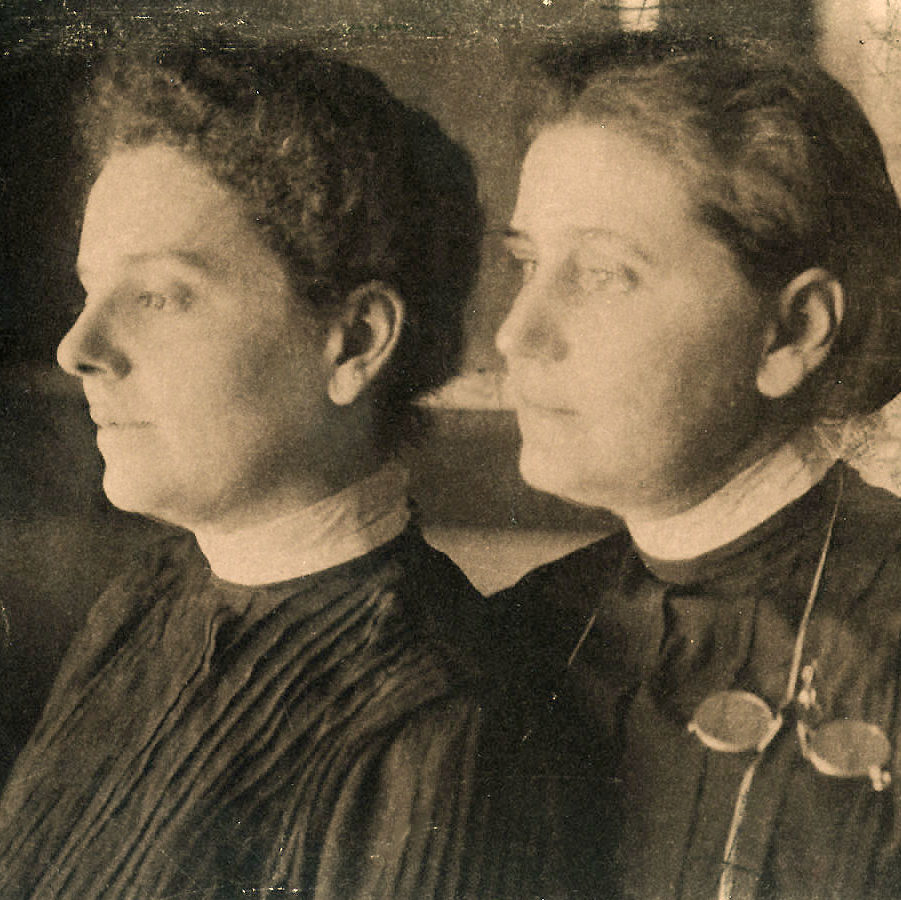
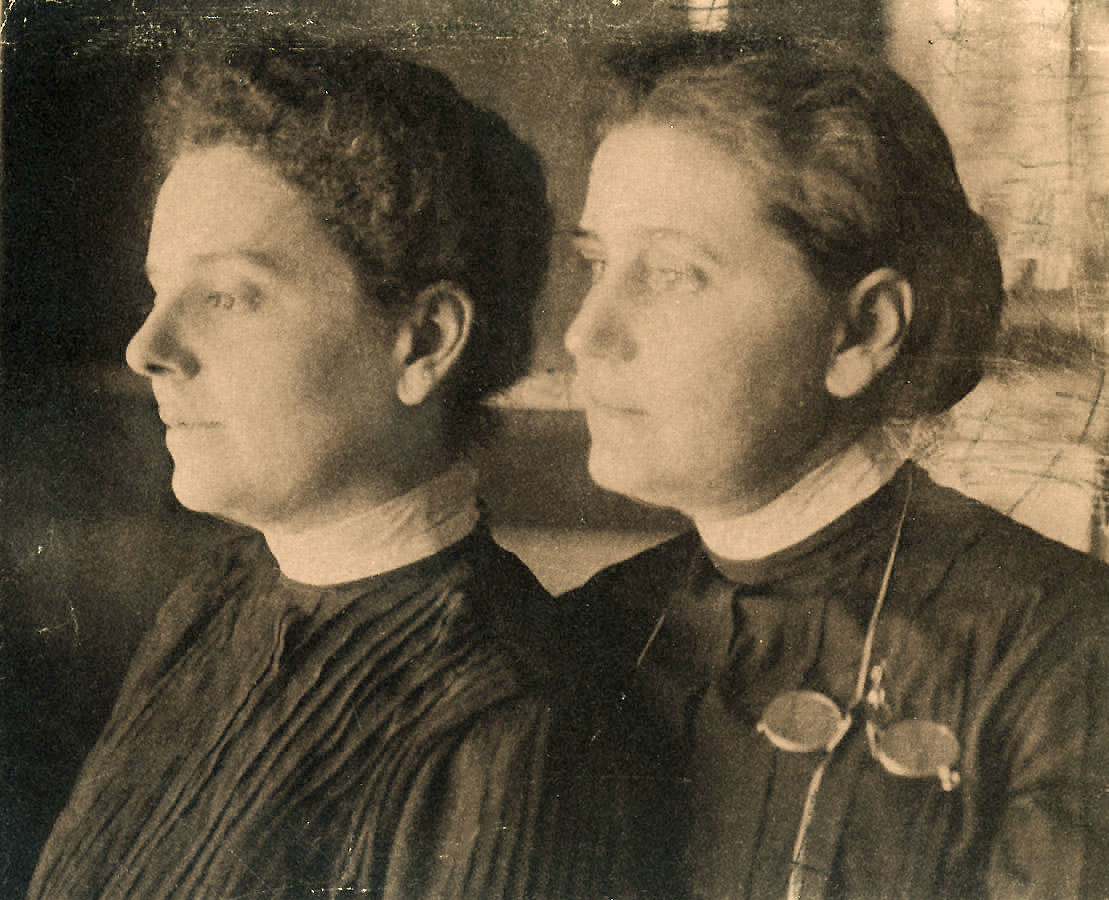
Two women with light skin, wearing high-collared dark dresses, sit closely side by side in soft light. One woman has curly hair; the other wears glasses hanging from a chain around her neck. Both gaze thoughtfully to the left.

Mary Rozet Smith was well-loved by a long list of extraordinary, historically important women who came through the doors of Hull-House in Chicago. From 1889, when she first visited the settlement and met its young, then unknown founder Jane Addams, until 1934, when she died suddenly of pneumonia at the age of sixty-five, Smith was an unwavering supporter of Hull-House, its residents, and its activities. She became, along with her wealthy and generous family, one of Hull-House’s most important donors. She was also for nearly forty years the dearest friend and most intimate companion of the incomparable Jane Addams. Yet Mary Rozet Smith remains something of a mystery.

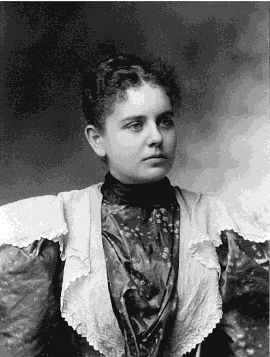
Black and white portrait of a young woman with curly hair, wearing a high-necked Victorian dress with puffed sleeves and lace details, looking slightly to her right.
Mary Rozet Smith, c. 1880s (image: Ellen Gates Starr Papers, Smith College)

Despite her importance to the story of Hull-House and to the personal life of Jane Addams, Mary Smith is an elusive wisp of a historical figure. She was, apparently, content in the shadows, wanting nothing more, or so it seems, than to be generous, to be a devoted daughter, to be a cherished friend, and to be a special confidant of Jane Addams. Mary Smith’s proximity to the most famous social experiment in American history could have made her a valuable witness and informant of that history. Instead, she left historians very few clues about her life, and the loss of her letters to Jane Addams deprive us not only of her voice in that relationship but also of her own importance as a Chicago philanthropist. As Jane Addams’ nephew James Linn wrote in his biography of his beloved aunt: “the interests of [Hull-House] remained the center of her own interests, and the friendship of Mary Smith soon became and always remained the highest and clearest note in the music of Jane Addams’s personal life.”

Just after Mary Smith died, long-time Hull-House resident Dr. Alice Hamilton wrote her sister from Chicago: “I can’t look at my grief over Mary because I should lose my grip. When I came out here I told Mary that she must get well, that she could live on without J. A., but J. A. could not live without her.” Jane Addams had suffered a second heart attack and died just thirteen months after Smith, so the statement was, perhaps, prophetic. But more importantly, what resonates in Hamilton’s words and in Linn’s words, too, is the centrality of Mary Rozet Smith to the Hull-House universe. She was embedded in the heartbeat of the institution and its women, and to one woman in particular, Jane Addams, she offered quiet domestic solace to balance the chaos of public life. However, we cannot truly know who Mary Rozet Smith was, because there is so little evidence of her activities found in newspapers, pubic documents, and organizational records; and, most unfortunately, very few of her own words survive her.

As I work on the annotation for Vol. 4 of the Selected Papers of Jane Addams, covering the years 1901-1913, and as I research and write the more than 100 footnotes about Mary Rozet Smith that will appear in the volume, I am missing her voice. When I read any of the seventy-three letters Jane Addams wrote to her during that period, I mourn the loss of her letters to Addams. Not a single letter of hers to Addams survives from those years, and I sometimes curse Jane Addams for destroying correspondence which would, I suspect, provide rich context not only for their relationship but also for Smith’s engagement as a sister of Hull-House. I am editing Addams’ papers and not Smith’s, I know, but I also know we are impoverished in our ability to fully contextualize Addams’ letters without Smith’s corresponding letters. One-sided correspondence is always a disappointment to the historian, who is left by the absent voice of one of the correspondents to answer the historical questions they raise and to ponder the important historical contexts they inspire with half of the pieces of the puzzle missing.

We have selected thirty of Addams’ letters to Smith for Vol. 4, and on their own they are rich, filled with the details of Addams’ reform activities, her writing habits, her ideas, her public speaking, and her daily life. They are also filled with details of the travels of Addams and Smith, of their health, of their shared concern for each other’s families, of their shared network of friends, and of their frequent separations from each other, due to Smith’s illnesses and Addams’ extensive lecturing and involvement in national and international organizations. However, without Smith’s letters, we are left wanting more to fill in the details, gaps, and silences that are an unfortunate characteristic of one-sided correspondence.

When Addams wrote to her “Dearest,” her “Darling,” sometimes her feelings of love and longing for Smith are clear. In a 1902 letter she wrote: “You must know, dear, how I long for you all the time—and especially during the last three weeks. There is reason in the habit of married folk keeping together. Forever yrs.” In a 1904 letter, she opined: “Your letters are the most cheerful things that I have and you must know that I am mightily empty hearted without you.” And in a 1909 letter she offered three little words that she offered to no other correspondent: “I love you.”

Two women with light skin, wearing high-collared dark dresses, sit closely side by side in soft light. One woman has curly hair; the other wears glasses hanging from a chain around her neck. Both gaze thoughtfully to the left.
Mary Rozet Smith and Jane Addams (c. 1896) (image: Swarthmore Peace Collection, Swarthmore College)

Jane Addams’ letters to other women among her close circle of friends and Hull-House residents, such as Lillian Wald and Julia Lathrop, were filled with affection. Addams wrote with the intimate language that was the natural and ordinary way of letters between women during this period in American history, when half of all college-educated women did not marry and the kinship of female friends was loving and strong. In a precious few letters, the reader cannot help but to see Addams’ particular tenderness for Smith. However, in most of her letters, Addams’ language is more muted, her tone more guarded, and the content merely practical and informative, many the hasty missives of a busy woman. In those less intimate letters, Addams almost always addressed Smith as “Dearest,” a moniker of affection she reserved for her alone, and she closed all letters with very tender words, but these letters offer far fewer clues about the relationship between the two women and the various contexts of their lives together.

I wonder if the language Smith employed in her letters to Addams mirrored the language Addams used. Was there a tonal difference in her letters to Addams than what she employed in letters she wrote to their mutual friends? What words did she use to express her feelings for Addams? What terms of endearment did she choose to begin her letters to Addams, and did she often write “I love you.”? When Addams shared with Smith her doubts and fears about a book manuscript or an important speech, did Smith respond with a pep talk, a gentle critique, or some soothing, emotional refrain? Did Smith share her own doubts and fears with Addams in her letters, and did she share her hopes and dreams and opinions on the reform topics that occupied the minds of Jane Addams and other Hull-House residents? Did she provide details of her asthma attacks and nervous anxiety and other philanthropies, as well and her travels, and did she offer gossip or news that might explain a vague reference we cannot define and may never define without her letters? What was the character of the letters Smith sent that Addams reported as “a great comfort,” and what were the words Smith offered to soothe that others could not?

Maybe Jane Addams destroyed Smith’s letters because they were too intimate or too emotionally embarrassing. Or maybe she destroyed them because she was a private person, despite her celebrity, and she wished to keep her special relationship with Smith from the prying eyes of the modern world that was pressing in on Hull-House in the early 1930s. I don’t really care what her reason was, but I am quite mad at her for doing it. I can’t help it, but it makes me sad to know so little about the woman to whom Jane Addams spent so much of her personal life.

I do not bemoan the loss of Smith’s letters to Addams simply because I think they would for certain answer the big question about their relationship. Maybe they would, maybe they wouldn’t, and then again if they did we would still have to be very careful about projecting our modern notions of female sexuality onto women of the past. As an editor, who contextualizes historical documents as windows to the past, it is not for me to interpret the nature of the relationship that existed between Jane Addams and Mary Rozet Smith. Whether they were the dearest of platonic friends or enjoyed a sexual relationship is not for me to decide. No matter, besides, because in the historical record of their relationship, there are far more questions than answers. That fact is, after all, the frustrating reality of one-sided correspondence.

I am missing Smith’s voice and her words for what they might have brought to the big Jane-Addams-Hull-House party. If we had Smith’s letters to Jane Addams, I would use Smith’s words to answer Addams’ words, to balance Addams’ particularly romantic phrases, to provide our readers with the dialogue between two women who were emotionally close to each other for four decades. But I would also use them to better understand Smith’s role in the Hull-House community, to glean some clues about who she was as a person, what she believed in, what intrigued her, and what made her smile. I would employ them to understand for myself why she was so dear to all of the extraordinary women who knew and loved her.

From Hull-House financial records, we know the scope of Smith’s contributions to the settlement and its activities. From the correspondence and personal accounts of her friends, we know something of her kindness, deportment, gentle nature, and the various physical and emotional illnesses from which she suffered. And from the extant letters Jane Addams wrote to her, we can understand a little bit about her emotional importance to the woman who is the subject of our documentary edition. Ah, but alas, there is so much of whom Mary Rozet Smith was which is lost to us because her letters to Jane Addams are lost to us. Mary Rozet Smith may well have been the “highest and clearest note in the music of Jane Addams’s personal life,” but why she was and who she was as a person will likely remain elusive. She is a woman whom historians have defined entirely by her relationship to Hull-House, and that is all well and good, I suppose, because Hull-House needed her thrive.

But darnit, I wish Jane Addams would have allowed us the chance to know her dear friend better. I wish we had Mary’s words to tell us a little bit more about Jane, and to tell us a little bit about herself, as well. I wish I had thirty or ten or even two of Smith’s letters to Addams to enhance the thirty letters to her we have chosen to annotate. They would not likely answer all of the questions I have, nor would they likely fill in all of the gaps and silences in Addams’ letters; but I suspect they would fill in a whole lot of missing details and offer a nuance or two. I know they would enlighten, enrich, and contextualize, because back-and-forth correspondence usually does. And I bet they may even offer some evidence of those highest and clearest notes in the music.

By Stacy Lynn, Associate Editor

Sources: Allen F. David, American Heroine: The Life and Legend of Jane Addams (New York: Oxford University Press, 1973), 85-91; Gioia Diliberto, A Useful Woman: The Early Life of Jane Addams (New York: Scribner, 1999), 182-87; Jean Bethke Elshtain, Jane Addams and the Dream of American Democracy (New York: Basic Books, 2002), 23-24; Louise W. Knight, Citizen: Jane Addams and the Struggle for Democracy (Chicago: University of Chicago Press, 2005), 217-18; James Weber Linn, Jane Addams: A Biography (New York: D. Appleton-Century Co., 1935, 147; Rima Lunin Schultz and Adele Hast, eds., Women Building Chicago, 1790-1990: A Biographical Dictionary (Bloomington: Indiana University Press, 2001), 817-19; Barbara Sicherman, Alice Hamilton: A Life in Letters (Cambridge, MA: Harvard University Press), 346-47; Eleanor J. Stebner, The Women of Hull House: A Study in Spirituality, Vocation and Friendship (Albany: State University of New York Press, 1997), 158-66; Jane Addams to Mary Rozet Smith, May 26, 1902; Jane Addams to Mary Rozet Smith, August 13, 1904; Jane Addams to Mary Rozet Smith, October 5, 1904; Jane Addams to Mary Rozet Smith, February 12, 1909, all in Jane Addams Digital Edition.

The Addams Papers Goes International!

A scenic landscape with a large lake, grassy hills, mountains in the background, and a stone house on the right. Several people stand near the house under a partly cloudy sky.
Connemara, Ireland.

The Third Women’s History in the Digital World conference was held on July 6-7, 2017 at Maynooth University in Ireland and the Jane Addams Papers presented a panel on our digital edition. Editor Cathy Moran Hajo, Assistant Editor Victoria Sciancalepore, and our web developer Anneliese Dehner combined to present three aspects of “Editing Jane Addams.”

Cover of the 2017 Women’s History in the Digital World conference programme, featuring a black-and-white photo of women in historical clothing working with scientific equipment. Bold pink and white text appears at the top.Cathy led off the panel talking about the “Big Picture: Conceiving a Digital Edition of  Jane Addams’ Papers,” providing a short history of the Addams Papers microfilm and book projects, and the process that went into deciding to digitize the microfilm edition. The decisions to be made involved thinking through the audience for the edition and what kinds of tools and resources they needed. In addition, Cathy discussed the decision to use the Omeka database-driven platform for the digital edition rather than using text encoding using XML. Going with a web-publishing friendly system allowed the Addams Papers to design a site that not only provides deep metadata, but also manages the project’s internal workflow, tracking information on each document as it passes through our permissions and copyright checks, metadata and transcription, and proofreading. Cathy also talked about her desire to see the Addams Papers edition be flexible enough that scholars and students can use its materials to build their own research projects.
A group of people sit around a conference table in a meeting room, listening to a speaker at the front. A presentation with a black-and-white portrait is displayed on a screen behind the speaker.
Cathy talking about biographical resources.

Tori’s talk, “The Nuts and Bolts: How an Omeka-based Digital Edition Works,” brought us into the back end of the project, showing how we defined the metadata and relations between the 21,000 eventual documents, and the entries on people, organizations, publications, and events that are discussed in them. She described the use of the Items Relations Omeka plugin, which we tweaked some, to build an edition that lets users move flexibly between drafts and final versions, letters written by and to a person, and individuals who were members of an organization, or participated in an event.  She also talked about how we decided on a transcription policy.  Because we make the images of the documents available on the site, we wanted our transcriptions to be more useful as a search mechanism. We decided to standardize our transcriptions  (converting British spellings, archaic spellings, and misspellings) as long as we used brackets to signal that the editors had changed the text. Readers who want to see the original need only click to see the manuscript image. She also discussed our student workers at the Addams Papers–the engine that keeps the project moving. With editors focused on training and quality control, it is a cadre of 10-15 Ramapo College undergraduates that are entering and transcribing documents and researching and writing identifications.

Three women stand close together indoors, smiling at the camera. The woman in the middle has red hair, while the other two have brown hair and wear glasses. There is a stone wall and another person in the background.
Anneliese, Cathy, and Tori after the session at Kilmainham Gaol Museum

Anneliese discussed “Designing a User Interface for a Digital Edition.” Coming from the perspective of a digital library developer, Anneliese talked about her experiences working on the Jane Addams Papers and the Kentucky Civil War Governors Papers, also an Omeka site. Discussing the different values that the project had, she walked through the way that developers work with editors to configure their sites, looking at who the intended users of the site will be, the kinds of searching they will need, and how much metadata should be used for site navigation. Anneliese noted that the Addams site was interested in exposing metadata, developing spatiotemporal context for documents, and creating branching paths through the edition. The Kentucky Governors project looked to create a more linear path through documents, but were more interested in presenting transcriptions alongside images of documents.

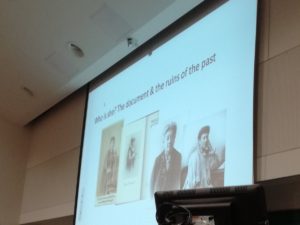
A classroom projector screen displays four old photographs of women with the title, “Who is she? The document & the ruins of the past,” above the images. Part of a computer monitor is visible at the bottom.
Liz Stanley gave a keynote talk on the Olive Schreiner Letters Online

In addition to our panel session, we were able to learn about some extremely interesting projects in women’s history, both here in the U.S. and abroad. Rachel Love Monroy, Lauren N. Haumesser and Melissa Gismondi discussed the Founding Women project that seeks to build a federated documentary edition of a variety of women’s papers. Eric Pumroy spoke about Collegewomen.org, which seeks to build an inclusive resource about late 19th and early 20th century college experiences for women. Cécile Gotdon spoke about Ireland’s Military Pension Project, a fascinating look at detailed records of men and women involved in the Irish military between 1916-1923.  And Alvean E. Jones’ work to provide access of the history of St. Mary’s School for Deaf Girls in a way that makes it accessible to deaf scholars, by translating digitized material into Irish Sign Language videos. Helena Byrne discussed a project to gather a digital history of Irish women’s indoor football leagues in the 1960s. And Liz Stanley gave a wonderful presentation on the Olive Schreiner Letters Online and the difficulty of representing a person from the things left behind.

Thanks to all who attended for a fascinating time!