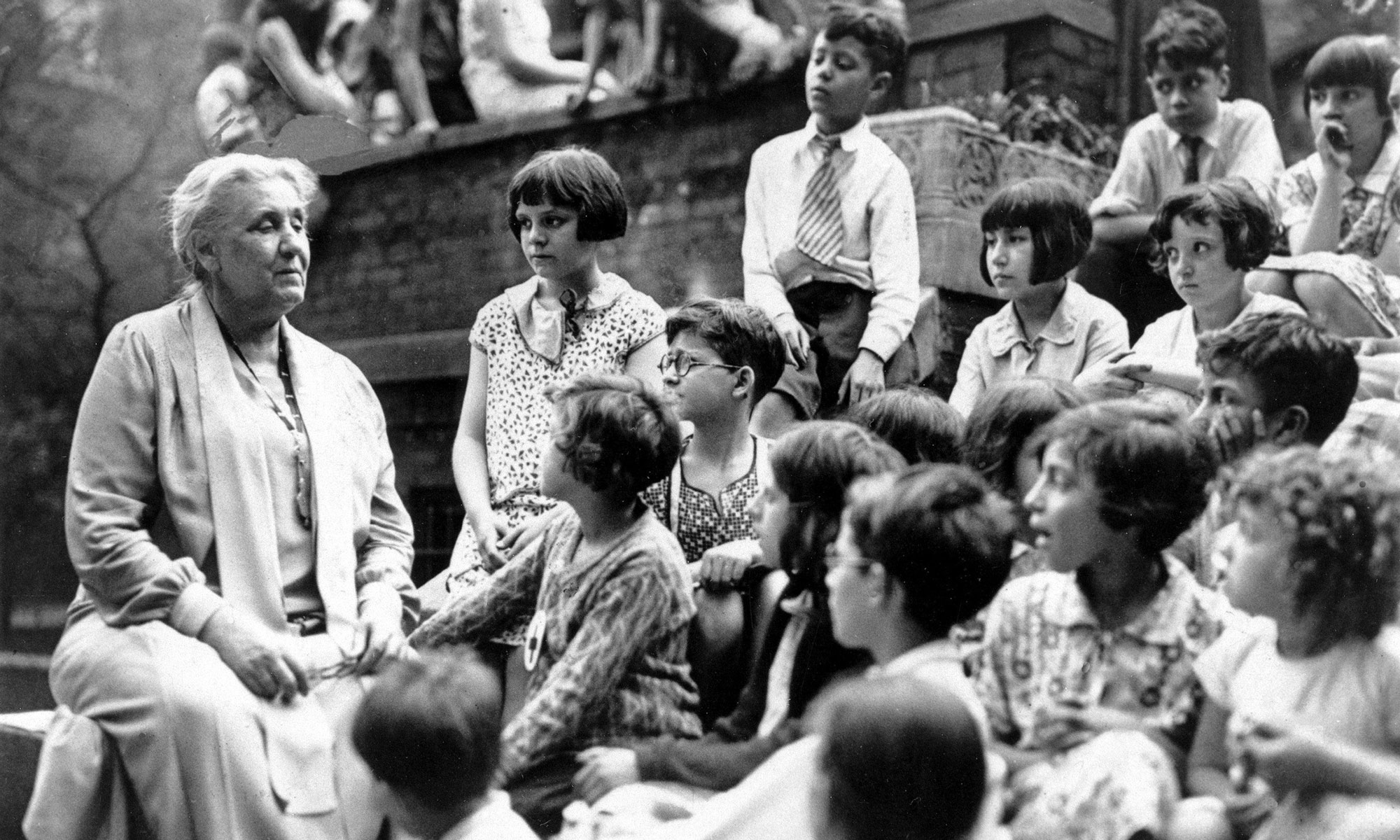

Currently, I am editing documents in the Jane Addams Papers from the 1920s. Jeannette Rankin, the first woman elected to the United States Congress, has been popping up a lot in my daily work. Rankin went to Europe with Addams in 1919 to attend the International Congress of Women in Zurich. She was a field secretary for the Women’s International League for Peace and Freedom (WILPF), of which Jane Addams was president. And in 1924, she lived and worked at Hull-House.
Of course, I had known about Rankin since I was an undergraduate studying women’s history, but I never had any depth of knowledge about her or her life. For a blog post I thought I would explore what led her to Hull-House, suspecting that Jane Addams was that gravitational pull. But those plans went almost immediately off the rails when I read a description of Rankin as exhibiting considerable sangfroid—sang-froid, from the French, literally “cold blood”—self-possession, coolness, or, as Merriam-Webster defines it, someone who is “cool as a cucumber,” possessing “imperturbability especially under strain.”
Wow, what a word, sangfroid, I thought (after I looked it up). And the more I kept reading the more I agreed with the description of Jeannette Rankin, the tough nut from Montana. This woman dared to run for a seat in the U.S. House of Representatives in 1916, just two years after women earned the right to vote there. She was a woman who unapologetically campaigned on a platform of equal suffrage for all American women, child protection legislation, and preparedness for peace instead of preparedness for war, while all of Europe was at war.
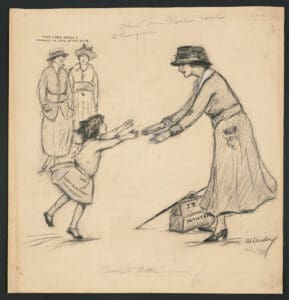
Cool as a cucumber, indeed, this 35-year-old Republican woman who won her Congressional seat despite Democrats sweeping up nearly all the others in Montana that year. This unrepentant pacifist Congresswoman voted NO in 1917 to declare war on Germany. “I want to stand by my country,” she said, “but I cannot vote for war.” Her vote won her praise in Montana, within the peace movement, and among Quakers, but she had been one of only a handful of dissenters in Congress and there was not much praise coming from anywhere else. Interestingly, Rankin had the historic opportunity to vote against world war again during her second term in the U.S. House of Representatives on December 8, 1941. On that day she cast the single, lonely, dissenting voice of Congress on the resolution to declare war against Japan. Defending her position, which was widely condemned and made her reelection impossible, she said: “As a woman I can’t go to war, and I refuse to send anyone else.”
And guess what? Jeannette Rankin lived long enough to protest the Vietnam War, too. On January 15, 1968, she led the Jeannette Rankin Brigade and several thousand marchers protesting the war in Washington. When a reporter asked her if she wanted her country to surrender in Vietnam, 87-year old Rankin said: “Surrender is a military idea. When you’re doing something wrong, you stop.”
Through all of it, Rankin was true to her principles, unwavering under tremendous pressure.
I kept reading about Rankin because she is fascinating, but I was no longer interested in her time at Hull-House (at least for now). Now I was intrigued by the qualities of Rankin’s character, particularly as compared with those of Jane Addams. I saw the common traits of quiet determination, commitment to personal values, and self-confidence. You see, at the Addams Papers we sometimes grumble a little bit about the stoicism of our dear subject. We sometimes long to discover chinks in the armor of her curated public personal. Jane Addams didn’t write much of anything at all about how hard it was to be a woman trying to save the world in the Progressive Era. We are sometimes frustrated that her composure even during the most stressful periods of her life makes it hard to know her. But as I kept reading about Rankin, I wondered if that biographer was onto something. Sangfroid, that curious new word, was pounding in my head as I continued reading.
Born in Montana in 1880, nine years before it gained statehood, Rankin was educated at Montana State University and the New York School of Philanthropy. Rankin’s interest in reform and social work mirrored the perspectives and paths of other educated and reform-minded women of her generation, but unlike most of them her priorities of suffrage, reform, and pacifism veered her directly into politics. Rankin’s term in Congress brought her fame and much respect and she rendered good service to her constituency, but she failed to be reelected in 1918. However, she seemed unphased by the defeat and just moved forward open to the next opportunity. After she left office in 1919, she joined the pacifist movement, went to Zurich with Addams, and became an active WILPF member. After Zurich, she worked with the formidable Florence Kelley at the National Consumers’ League. Then after she left Hull-House in 1924, she bought a small farm in Georgia, living a simple life there without plumbing and electricity. She kept her home in Montana, perhaps always thinking she might return to politics, and served nine years as a lobbyist for the National Council for the Prevention of War. She won her second term in Congress in 1940, beating out her antisemitic incumbent opponent. No matter what she was doing or where she was, she lived with intention and on her own terms.
The surface reading I was doing to write a short piece about her life was making it easy to see why Jane Addams took a shine to Jeannette Rankin. She was an intriguing woman, principled, fair-minded, and strong-willed. As if I needed more proof to believe that Jeannette Rankin was self-possessed, an example of Sangfroid right out of the Oxford English Dictionary, I came across the official portrait of the 65th Congress., the first in which she served.

There is Congresswoman Jeannette Rankin, sitting nearly dead center, the central portico of the U.S. Capital right behind her. The only hat and the only skirt. A woman in a sea of men. Uncrossed legs and upright posture, she commands her space. There is a quiet, determined expression on her face. She is far more dignified than many of her fellows near her in the front row, slouching, legs splayed, arms crossed, and one shielding his eyes from the sun as he gazes into the distance at something he deems more interesting than the capturing of this historic photograph. Congresswoman Jeannette Rankin is sitting in that portrait like she belonged there because, of course, she knew she belonged there.
Yep.
Sangfroid.
Unflappable is a word I have frequently used to describe Jane Addams. It is an apt word for a woman who stuck to her principles no matter the pressure. A woman who over and over and over again kept making informed arguments in Springfield before the Illinois General Assembly about the evils of child labor against the manufacturing lobby who did not care one whit that factories were stealing the futures of children. Jane Addams, unflappable in the face of attacks that she was un-American, a Bolshevik, a traitor, because she dared to exercise her constitutional right to speak out against war and to promote peace for the benefit of humanity.
Unflappable works, but at every turn Jane Addams also exhibited considerable Sangfroid. Yes. Sangfroid is better. Unflappable sounds like a stiff brimmed, oversized, Edwardian hat on the windy city streets of Chicago. Sangfroid is a mighty oak standing against an impossible and exasperating Prairie tempest.
Yes. Sangfroid is better, so much so that I am beginning to consider the idea that what we have here is a generation of Sangfroid. Jeannette Rankin and Florence Kelley and Julia Lathrop and Jane Addams and so many members of that reforming generation of women were unperturbed, especially under strain. They had to be.
Rankin was the only woman in Congress when she served that first term in Congress. Everything she did and said was under a microscope. America was watching. The press was watching. History was watching. Jeannette Rankin stood up tall against all of that scrutiny. Sangfroid.
When Florence Kelley became the chief factory inspector for Illinois in 1893, she had to enter factories run by men to tell them that they were in violation of the law. She had to report her findings to a legislature of men at a time when women had no political power at all. Not surprisingly, men fought her tooth and nail, but still she kept walking into those factories and writing reports that led to the enacting of child labor legislation that changed lives and the future. Sangfroid.
When Julia Lathrop became the director of the U.S. Children’s Bureau in 1912, she was the favorite choice of many progressive men in Washington. However, many believed her task was woman’s work, not real work, and her budget to protect children was a fraction of the budget the U.S. government spent on the protections of livestock. Still, Lathrop did her work, spearheaded revelatory research studies, educated an entire generation about the needs of America’s most vulnerable children, and changed how Americans defined childhood despite an economic and political system that chafed at every suggestion of reform. Sangfroid.
Jane Addams was the first woman to do so many things I cannot name them all here but will give you a few examples: she was the first woman garbage inspector in Chicago, first woman president of the National Conference of Charities and Corrections, first woman to receive an honorary degree from Yale University, first woman to deliver a commencement address at the University of Chicago, and the first American woman to win the Nobel Peace Prize. She served on numerous boards and committees in which she was the sole woman. She boldly took her seat on panels of male scholars. She lobbied before male-dominated state legislatures and the U.S. Congress and met with the most important religious, business, and political leaders in the United States and around the globe to make her arguments for a better world. For much of the time she had no political power, but she exerted her will anyway. She couldn’t even vote for president until 1916, but long before that she commanded audiences with presidents and sat down with them as an equal. Sangfroid.
This reform generation of American women was smart and compassionate and they had bold and brilliant ideas about how to make the world a better place. But perhaps even more important than their empathy and their ideas was the nature of their steely nerve. Men had all the power, and if women wanted to change the world they had to sit down at the table with disagreeable and disinterested and dismissive men and make them see the light. These women expected the chorus of doubt from those men (and some women, as well), but doubt for themselves was not an option. They had to open the doors and let themselves in, stand in extremely uncomfortable spaces, and hold their ground. Although they possessed warm hearts for the betterment of humanity, they had to be a little cold blooded. Self-possessed. Cool as damned cucumbers.
In 1906, President Theodore Roosevelt wrote Jane Addams: “Will you let me say a word of very sincere thanks to you for the eminent sanity, good-humor and judgment you always display in pushing matters you have at heart? I have such awful times with reformers of the hysterical and sensational stamp, and yet I so thoroughly believe in reform, that I fairly revel in dealing with anyone like you.”
Jane Addams, Jeannette Rankin, and all of those reform women were up against thousands of patronizing Theodore Roosevelts as well as thousands more men who didn’t have Roosevelt’s bent toward reform and general interest in interesting women like Jane Addams. I’m now thinking about the bold women who organized female workers through the Women’s Trade Union League, Mary McDowell who worked her entire life in the impossibly tough Union Stockyards of Chicago, and suffragists, yes, all the suffragists. Alice Paul certainly exhibited imperturbability under strain! Sangfroid. All of them. Sangfroid.
I’ve written before about how Jane Addams developed a particular persona she found politically effective, a voice that would be heard in a public arena that in many ways was unattuned to women’s voices. I stand by my previous arguments that Jane Addams was guarded, deliberate, and dispassionate because, for her, the changes she wanted to see in her world were more important than any one person doing the work. She set her inner self aside, displayed a resolute dispassion, and made many of the tough Theodore Roosevelts of the world respect her, hear her, and listen to her ideas.
But now I have to wonder. Maybe it wasn’t so hard for Jane Addams to construct a demeanor of calm. Maybe Jane Addams was born exhibiting considerable sangfroid, like Jeannette Rankin’s biographer said she was born. Perhaps Jane Addams succeeded in her work and became the icon of the Progressive Era she became because imperturbability was innate in her character. I certainly would have slugged many of the fools Jane Addams had to face down, because I am, naturally, not even unflappable. I wonder, if we did a personality study of the all of the women who were first to do all kinds of stuff we wouldn’t find that each and every one of them possessed considerable sangfroid. Perhaps the historical circumstances didn’t effect such a demeanor but rather the demeaner itself, deep in their bones, made these women capable of opening all those doors and calmly standing in the fire on the other side.
By Stacy Lynn, Associate Editor
Sources: Nancy C. Unger, “Rankin, Jeannette Pickering,” American National Biography; Biographical Directory of Congress; “Jeannette Rankin: ‘I Cannot Vote for War,’” U.S. House of Representatives, blog; Martha G. Stapler, ed., The Woman Suffrage Year Book (National American Woman Suffrage Association, 1917), 14; from the Jane Addams Digital Edition: Theodore Roosevelt to Jane Addams, January 24, 1906; Congratulatory Telegram for Jeannette Rankin, November 12, 1916; Vachel Lindsay to Jane Addams, April 9, 1917; Romain Rolland to Johannes Vilhelm Jensen, May 15, 1917; Alice Thacher Post to Jane Addams, December 17, 1918 Jane Addams to Mary Rozet Smith, April 18, 1919; Alice Hamilton to Mary Rozet Smith, May 12, 1919; Contributions Received in National Office in Response to Miss Addams’ Letter, March 20, 1924.