Data Visualizations and Jane Addams

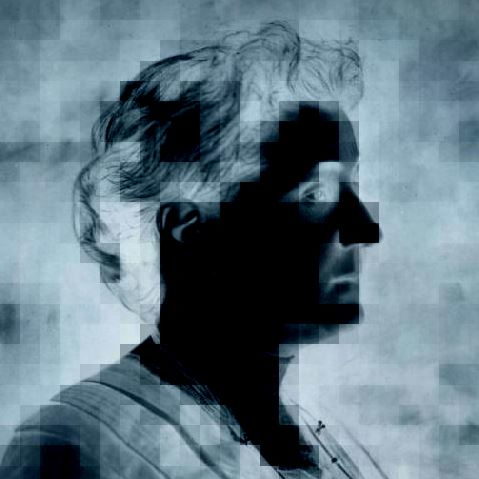
Artistic, pixelated portrait of a person in profile view, rendered in grayscale with dark and light square blocks obscuring details, creating a digital, abstract effect.

Artistic, pixelated portrait of a person in profile view, rendered in grayscale with dark and light square blocks obscuring details, creating a digital, abstract effect.Last spring I had the pleasure of working with two undergraduate students, Taylor Lundeen and  Catie Olson, enrolled in the University of Michigan’s School of Information. They worked on a capstone project on data visualization, using our Jane Addams digital edition databases.  Anneliese Dehner, our web developer, helped out with the some technical aspects of the collaboration.

One of the many great things about digital publication is that the information we create can be reused and repurposed in ways that we might not have thought of. Making our data available to researchers to explore has been one of our goals from the start of our work on Jane Addams, and with this investigation we have learned what we can do fairly easily, and what is more complex.

 Accessing the Data

Our first step was to get a copy of our data exported out so that Taylor and Catie could work on it. What they found worked the best was an Omeka plugin (Omeka Rest API) that allowed them to export data in a format that worked well with data manipulation software.

Our ultimate goal is to have a utility on the digital edition that will enable users to download all or parts of the data for investigation.

One problem that reared its head immediately is that we have a very large dataset, and it is growing larger every day. This made it difficult, using the tools they had available to work with the whole set.

Natural Language Processing

One of the approaches, which Catie worked on, was seeing what we could learn from analyzing the “Text” field in our database, where transcriptions are stored. This kind of analysis can track the frequency of words, or compare word usage over time. Eventually it could be used for topic modeling, where a digital tool tries to make sense of words that appear together. These groupings can uncover connections that we sometimes don’t expect.

An important step in working with our texts was data cleaning, the process by which HTML and special characters were cleaned out and text was split word by word. Then Catie built bar charts that displayed the most common words. She built a separate chart for each year to allow us to compare years to see what Addams was thinking and writing about.

The most obvious finding to me, was that we needed to think about stop words — words that are excluded in the results because they are too common or have no analytical meaning. Articles, like “a” and “the” are common stop words– we also had to consider “page” which we use to signify the next page in our transcriptions, and, gulp, even “Hull House” because we transcribed the letterhead that Jane Addams used. Other words like “Mrs,” “Mr.” and “Miss” and salutations like “Dear” are candidates for being pulled from the analysis.

We also got to see the frequency of that nemesis of editors – “illegible.” This comes up far more frequently than I would like, but I was gratified to see that in the years where we have proofread the texts, the frequency is much lower.

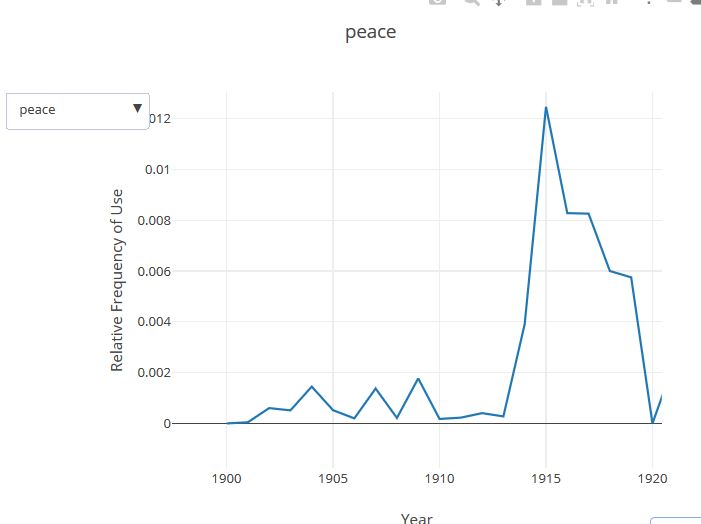
It will surprise no one that “peace” and “war” shot to the top in 1915.
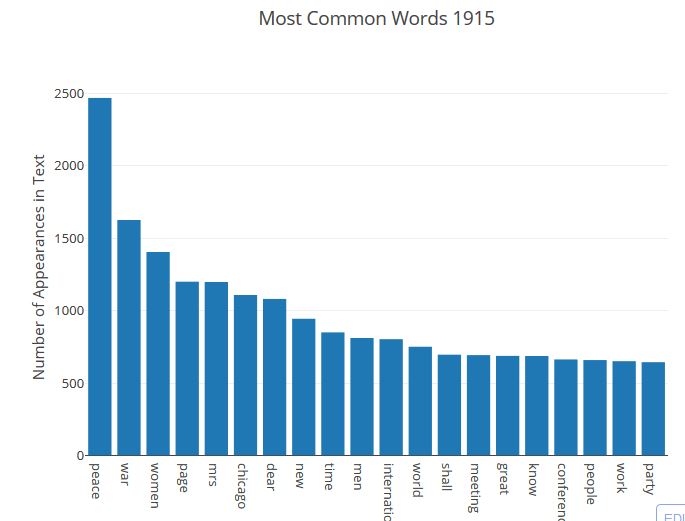
Bar chart titled “Most Common Words 1915” showing “peace” as the most frequent word, followed by “war,” “women,” “page,” and others. Bars indicate the number of appearances in text, ranging from 500 to 2500.
Frequency of words in 1915.

In 1905, the most frequent words deal more with the plight of children and represent Addams’ work on child labor and welfare in Chicago.
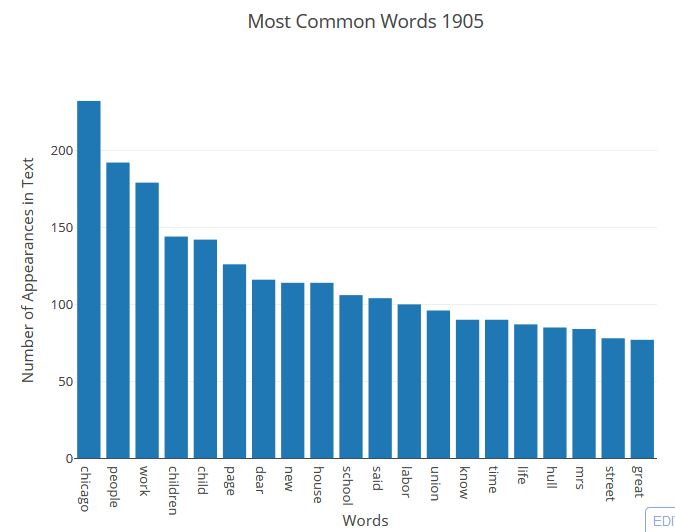
Bar chart titled Most Common Words 1905 showing Chicago and people as the most frequent words, followed by work, children, great, need, clear, and others, based on their number of appearances in text.
Frequency of words in 1905.

Catie also worked on another way to show the content of Addams’ writings, plotting the frequency of a word over time. Similar to the Google n-gram viewer that can compare the frequency of words in Google Books over time, this gives you a sense of the chronology.  We did not have the capacity at this point to allow users to type the words they want, but were able to produce n-grams for some of the most popular words.

Seen together, it is a little frightening, but on the live version on the site, you can select a single word to analyze.
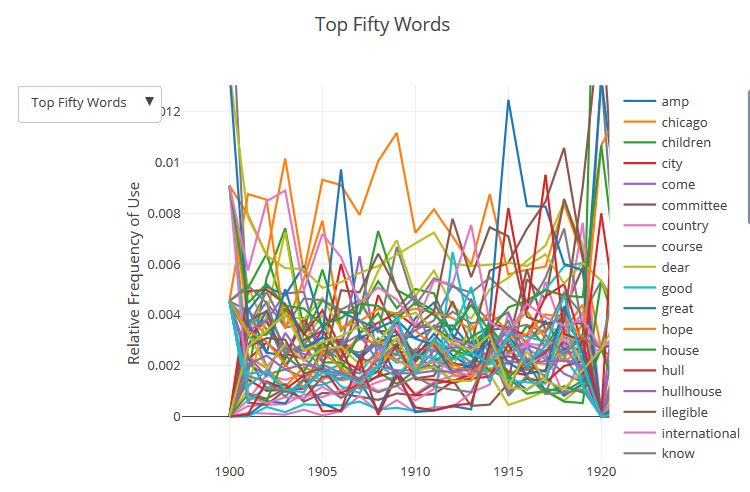
A colorful line graph titled Top Fifty Words shows the relative frequency of various words over time from 1890 to 1920. Each line represents a different word, with a legend on the right identifying the words.
The Top 50 Words, all in one place!
Line graph showing the relative frequency of the word peace from 1900 to 1920, with a sharp spike peaking around 1918, then a rapid decrease by 1920. The y-axis represents frequency; the x-axis represents years.
Tracking “peace” from 1901-1917.

The n-gram for “Illegible” shows the power of proofreading! When the data was downloaded for use, we had just finished proofreading 1915!
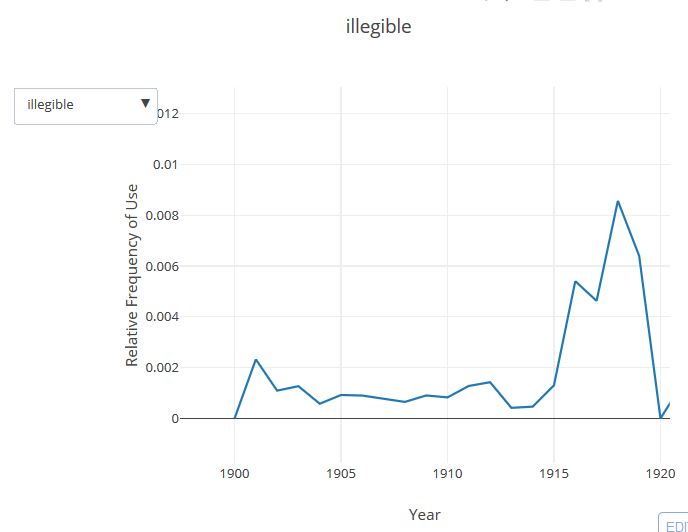
A line graph shows the relative frequency of the word illegible from 1900 to 1920, with a sharp increase around 1915 and a steep decline just before 1920.
An n-gram of words we could not read.

Social Network Analysis

Another approach was to see what we could learn from social network analysis. Using Omeka’s Item Relations plugin, we have been tracking relationships — mostly between documents and the people, organizations, and events that are mentioned in them. We also are building connections between people and organizations, tracking which people were members of which organizations, for example, or who participated in a specific event.  We wondered whether the relationships between people and organizations might yield some interesting insights, or whether we could find other connections between people and the metadata gathered about them. Taylor was responsible for this project.

Our large dataset proved to be problematic for developing a meaningful social network based on shared connections. We think there is promise for this in future by controlling which people are included in the network, but the sheer number of people and the amount of common tags produced a daunting graph.
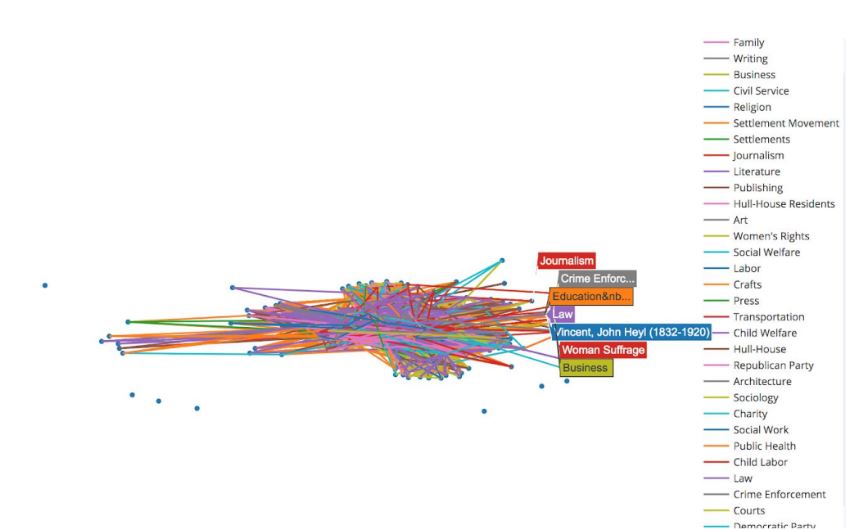
A colorful network graph with labeled nodes connected by lines, representing various professions and fields linked to Hull-House, with a legend listing categories like Journalism, Law, and Woman Suffrage on the right.
This plot includes only 270 Addams connections associated with Chicago. The full data on 8,000 names was too complex to load.

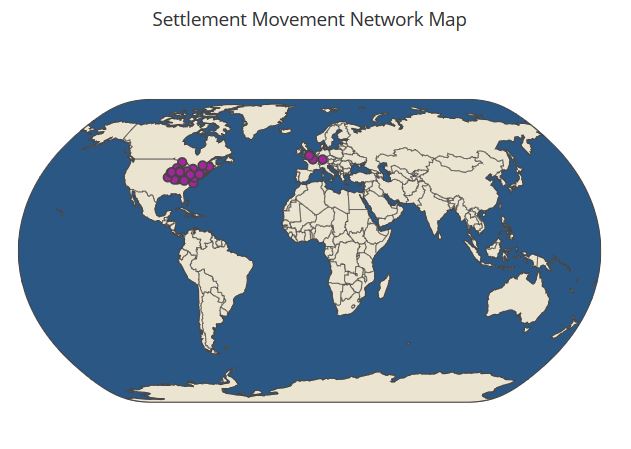
Instead, Taylor created a geographical visualization of Addams’s social networks related to several topics. We used our tags for movements like “Woman Suffrage,” “Child Labor,” and “Peace” and plotted their geographic locations.  Compare Addams’ Settlement Movement network and her Peace network below to see the expansion of her work internationally.
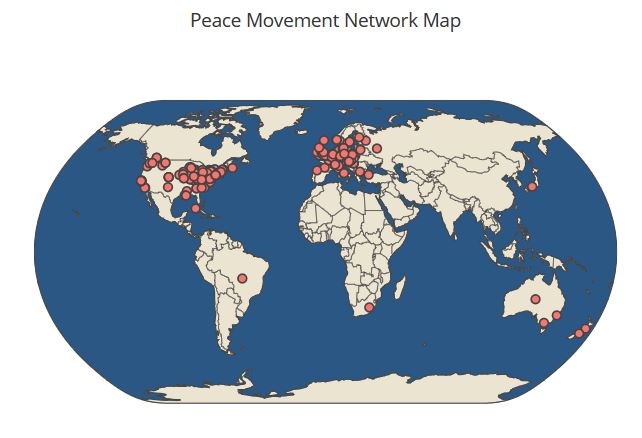
World map titled Peace Movement Network Map with red dots marking locations across North America, Europe, parts of Asia, Australia, and a few in Africa and South America.

On the live version of these maps, you can zoom in and out and mouse over each dot to reveal the name of the activist.

Going Forward

It was amazing to see what two talented students could do in such a short period of time!  The experience has helped us think more about how we want to make our data accessible, and has uncovered challenges that we need to think about. Our database is large and complex and developing means to limit the queries is going to be important.

We are looking forward to working with other UMSI students and any digital humanists interested in advancing this work.
“Peace, War and World Order”- Dr. James Marquardt’s Web-based Timeline

The influence Jane Addams had on society is no secret; we still talk about her beliefs, achievements and historical footprint today. Jane Addams has done so much in her life that Dr. James Marquardt, Associate Professor of Politics and the Chair of International Relations Program at Lake Forest College, and his students have created an online timeline of her achievements. The timeline is called Jane Addams- Peace, War and World Order: A Web-based timeline.

The abstract of the timeline acknowledges her strides to improve the lives and living conditions for immigrants and the poor, but this timeline focuses more on her “peace advocacy,” during World War I. After looking over numerous primary and secondary sources Dr. Marquardt and his students have completed their timeline, successfully illustrating Jane Addams’ pacifist beliefs and opposition to international armament and war.

“I started digging into her primary writings on the war,” said Dr. Marquardt, “and I decided that I wanted to do this a little more elaborately so I offered a course called Jane Addams Peace Advocate. It mostly focused on her international peace advocacy before, during and after the war.”

After Lake Forest College received a grant for the school to develop digital pages and Chicago-related events, phenomena and historical developments in the humanities and social sciences, Dr. Marquardt then applied for a grant to build a page dedicated to Jane Addams peace advocacy and her historical significance, which he received and then began hiring students. Together they began studying, analyzing and building the Jane Addams – Peace, War and World Order timeline.

The timeline focuses mostly on Addams’ involvement in WWI and her opposition of the war, but Dr. Marquardt plans to continue to study Addams with the hopes of continuing to expand the timeline from her involvement in the Peace Movement with it ending when Addams received the Nobel Peace Prize. He plans on taking all of his knowledge about Addams and writing a book entitled “Jane Addams: The Great War and Her Quest to Transform National Relations.”

He’s not the only one who feels passionate about Addams; Dr. Marquardt explained that his students are very passionate about her as well. “They’re really into [the project]. Addams is such an inspirational figure that they’re a little too generous towards her, in terms of their writing and their public presentations that they’ve made about her.”

Since the timeline highlights Jane Addams’ peace advocacy I had to ask Dr. Marquardt to define peace advocacy in his own words.

“I would define it as actions, writings, ideas related to efforts to end war. That’s my thinking about it, but my students have a much more generous viewing of peace advocacy, they see peace as not simply something we ought to strive for in our international relations in our social relations generally.”  

Dr. Marquardt has learned a lot from his students during this process. “Their understanding was that advocating for peace is not simply a global issue but an issue of interpersonal relations. It’s about the end of violence along racial lines, it’s about the end of violence against women, violence against children, hunger, deprivation, unemployment.” They share the same vision and beliefs that Jane Addams did and they carry on Addams’ beliefs and visions for a brighter future for everyone.  

The website went live last week and for those interested in viewing Dr. Marquardt and his students work the link is here: http://digitalchicago.lakeforest.edu/exhibits/show/jane-addams/our-purpose.

Ardent Girls and Amy Merrill’s Passion for Addams


An older woman with short gray hair smiles while sitting in a chair. She is wearing a dark patterned top and a gold necklace. There are orange tulips and a window with sunlight in the softly blurred background.
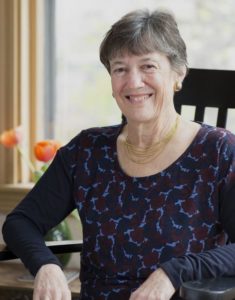
Amy Merrill (https://www.amymerrillplays.com)

Amy Merrill, playwright of ARDENT GIRLS, has an upcoming reading of her play on February 22. The play is about Jane Addams, the sisterhood at Hull House and Addams’ 1896 encounter with Leo Tolstoy. She was willing to talk to me about her project, her work and her passion for Jane Addams.

Merrill was inspired to write her play once she read about Jane Addams’ encounter with Leo Tolstoy.  She read an excerpt from the “Second Twenty Years at Hull House,” where Addams traveled to Russia and Tolstoy could not stop staring at her sleeves. Merrill explained that this encounter gave Addams a lot to think about because Addams admired Tolstoy. But the experience gave Merrill “leeway to sort of come up with my own idea about what happened and how she felt about it and how the impact of the visit had on the rest of her life.”

In her play, Merrill depicts her idea of the Addams-Tolstoy encounter. She’s always been attracted to encounters by different types of people. Addams and Tolstoy are very idealistic, high-minded people, but they’re both different types of people. “It’s also fun to write the scene because it takes place in Russia at the Tolstoy Estate whereas most of the place takes place in Chicago. So it’s kind of fun to sort of transport everybody to Russia. So it’s the improbable, real-life encounter with Leo Tolstoy.”

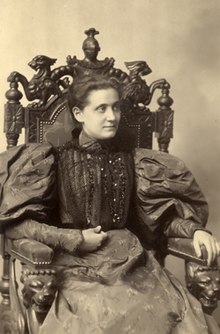
A woman in a Victorian-era dress with puffed sleeves sits on an ornate chair with carved griffins, looking slightly to the side. The photo is black and white, with a formal, historical atmosphere.
These are rather large sleeves! (Jane Addams, 1898, in the gown she wore to visit Tolstoy).

Not only Tolstoy and Addams, but Merrill also paints the picture of Florence Kelley and Mary Rozet-Smith competing for Addams’ attention. She explains the two as an “effective duo” with Florence Kelley being very passionate with an interesting background and Jane Addams as a moderator. Mary Rozet-Smith was fun for Merrill because she’s not as flamboyant as the other women are, and writing all three of them in “ARDENT GIRLS.”

Addams was a “fighter for people having better lives and it’s inspiring.” With all of the sexual harassment cases and accusations coming out today, it’s important to remember Addams’ legacy. Amy Merrill admires Addams work and legacy and truly enjoyed writing a play about her. “To know Jane is to love her.” People have been thinking about her legacy and wish that she could be with us today.

For those in the Waltham, MA area, the public reading of “ARDENT GIRLS” will be held at the Merrick Theatre (Spingold Building) on February 22 at 7:30 pm at Brandeis University, Waltham, M.A.

How Did You Find Me? Copyright Research at a 20th Century Edition

Write on Jane! Because she died in 1935, all Addams’ unpublished works are in the public domain.

One of the challenges that face 20th century editing projects, especially digital ones, is the need to obtain copyright permission. We are in the midst of researching and contacting heirs to the authors of letters in the Jane Addams Digital Edition. It is a complicated process, but one that is essential for historians, archivists and editors who publish materials online.

The Basics

  • Documents published before 1926 are in the public domain. That means newspaper articles, journal articles, books, and other materials.
  • Documents published after 1926 may be in public domain, but you will need to determine whether the copyright has been renewed.
  • Unpublished documents are in public domain if the author died more than 70 years ago. If the author was a company, they are in public domain if the document was written more than 120 years ago. That means letters, unpublished reports, articles and speeches.

The Numbers

We have identified over 4,500 individuals and 600 organizations thus far in our work for the digital edition. Not all of these people wrote letters — some received the letter and others were merely mentioned in it. We do not need to clear permission for those individuals and organizations.

The Process

The Jane Addams Digital Edition tracks all mentions of people in documents. As our editorial assistants enter each document, they create links to the people already in the edition. For example, in a letter written to Jane Addams by Vida Dutton Scudder, we might record eight personal names — the author (Scudder), the recipient (Addams) and the names of four people mentioned.

If one or more of these people are new to the digital edition, the editorial assistant creates a new record for that person. While we don’t do a lot of research at this point on that person, we do try to secure birth and death dates. This year, the magic number is 1947. If our person died before 1947, we can mark their rights as public domain. Any documents written by them are all set for publication.

If, however, we cannot locate a death date, or we locate a date after 1947, we need to conduct some research. Editorial assistants flag the person’s record as copyright permission “pending.”  We do this for all new names, whether or not they are authors.

As we move toward proofreading metadata and transcriptions for publication, we generate a list of all the documents in a given year that are not ready to publish. When we were not able to locate a death date, the editor will make another attempt to find it, and hopefully clear the documents. We are then left with a list of authors that are not in the public domain.

Our copyright research squad consists of two people, researcher Ellen Skerrett and project assistant Nina Schulze get down to the nitty gritty of copyright research.

Research

There are a number of ways to try to locate the copyright holder of a deceased author.

  • If the person’s papers are stored at an archive, you can contact them. Often times they will have some information about the person who donated the papers, or have contact with family members. A good site to search for archival holdings is Archive Grid.
  • If the person is a published author, you may be able to contact their publisher, who may know who controls the copyright on the book, or who gets royalty payments. That can lead you to the next link in the chain.
  • Otherwise, we hope to find the children, grandchildren, great-grandchildren, or more distant relatives. Many people never dedicated their literary rights in a will, but they are assumed to fall to the heirs.

We use the genealogy site Ancestry.com and the digital newspaper site Newspaper.com, among other resources, to try to locate heirs. We look for the names of children in the available U.S. Census records, newspaper articles and obituaries, and other web-based resources. Obituaries are an invaluable resource because they update the names, especially of daughters who might have married, and in many cases provide the city or state where those survivors. We then use internet directories and phone books to try to locate current addresses.

Some people are easier to find than others. People with common surnames can be all but impossible, especially those who lived in large cities. When a person left no children, we try to go up the family tree. looking for a brother or sister, to find nephews, nieces, or cousins.  It is usually easier to locate famous people’s families — the chances are better of finding a long and detailed obituary.

We then write a letter, hoping that we have gotten the right person, and wait for a result. These letters are fun to receive, often enclosing a letter written by an ancestor to Jane Addams that opens up a new story a family’s history. Family members are often amazed and intrigued to know how we were able to find them.

Good faith efforts

We are allowed to publish without securing copyright if we make a good faith effort to locating the heirs. For us, this means following all leads that we can find, tracking all known children. One of the ways that we keep looking after we have exhausted all leads is to post the names of people we still seek on our website. The hope is that you might Google an ancestor and find the project’s site, even if we can’t find you!

If you think your (great) grandmother knew Jane Addams….

We are still searching for more Jane Addams letters. If your family history involves an late 19th or early 20th century social reformer, peace activist, or settlement worker, or if your family had roots in Chicago or worked for woman suffrage, we would love to hear from you. We can check to see whether we have any letters in the archives we have searched, and would be delighted to include any letters your family might still hold.


Addams Papers Joins SNAC

I am pleased to announce that the Jane Addams Papers will be joining the Social Networks and Archival Context (SNAC) Cooperative in its final phase of work. SNAC has been hosted by the University of Virginia’s Institute for Advanced Technology in the Humanities and the University Library and funded by the National  Endowment for the Humanities (2010-2012) and the Andrew Mellon Foundation (2012-2017). The Cooperative seeks to improve the economy and quality of archival processing and description, and build a global social-document network using both computational methods and human curation.

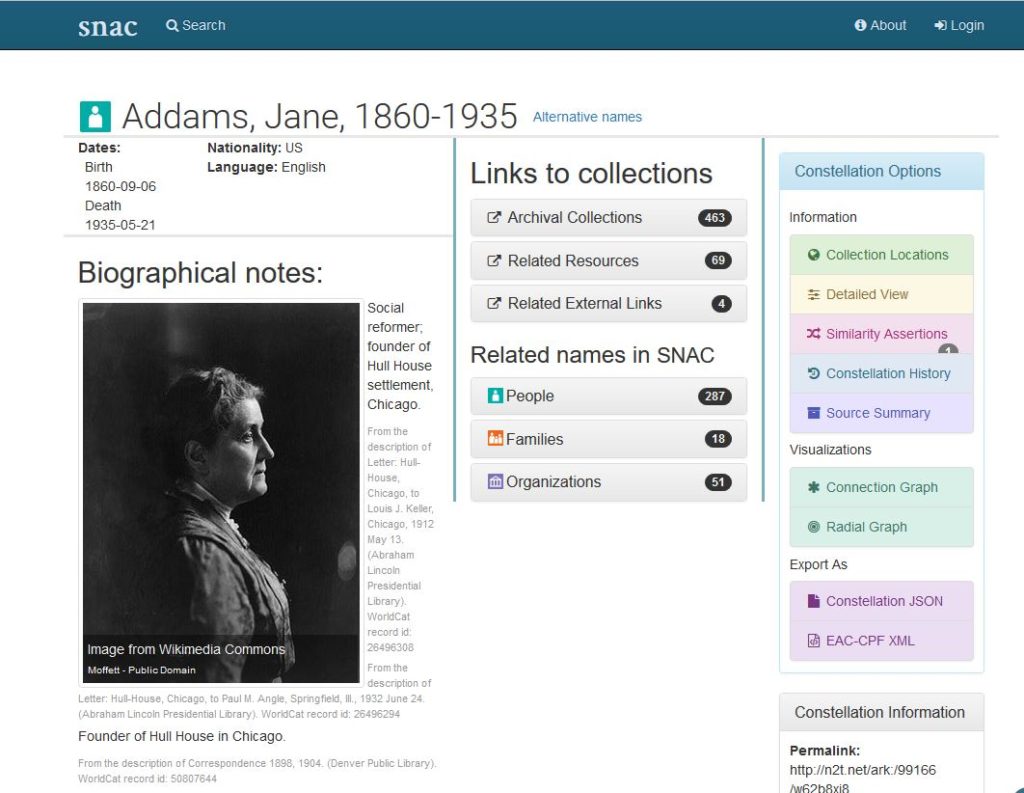
I first came across the SNAC web portal when doing research for biographies for our digital edition. SNAC provides biographical information, links to archival collections, and to related people, families and organizations.

Screenshot of Jane Addams’s SNAC profile, showing her photo, brief biography, birth and death dates, links to archives, related names, constellation options, and visualization tools on a structured webpage.

I decided that we would make SNAC one of our go-to resources for our biographies. We link all our biographies to the SNAC record to enable our researchers to locate an ever expanding list of resources on that person. SNAC imports data from finding aids, Wikipedia entries, and other sources. As we made links between our biographies and theirs, I started to wonder whether we might be able to contribute materials as well. I reached out to Daniel Pitti, the project director.

The Jane Addams Papers is not an archive, but an edition, and I wasn’t exactly certain how what we we would interact with SNAC. With only two years of work under our belts, we have identified over 4,500 individuals, who wrote letters to Jane Addams, received letters from her, or were mentioned in the documents. Our individuals range from historical figures, like Plato and Wat Tyler, to Chicago police George Shippy and John McWeeny. We have over 100 suffrage activists, including Catherine Karaveloff, Carrie Chapman Catt, and Zofia Golińska-Daszyńska. There are philosophers, criminals, homemakers, and union leaders, and over 200 social workers and welfare activists. About 60% of the names we have linked thus far are men and 40% are women.

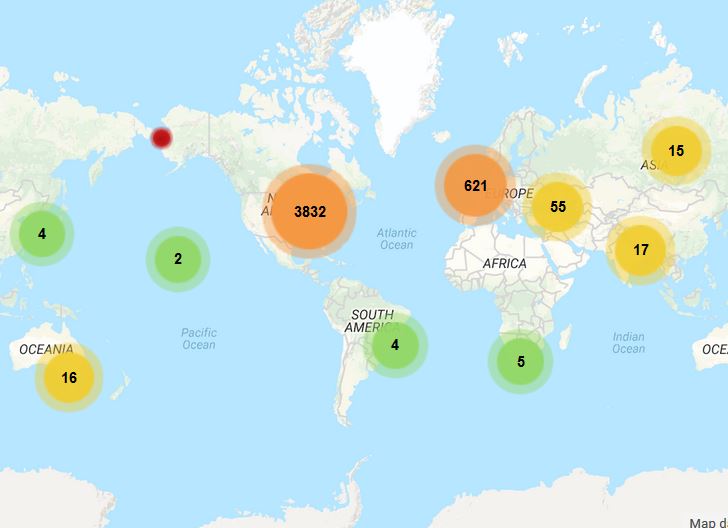
The people who come up in Addams’  documents are primarily American, but we have increasing numbers associated with Europe and Asia as Addams broadened her reach and networks. The screen shot below of our map view of individuals will change as we deal with more of Addams’s international peace work.

A world map displaying colored circles with numbers, representing data clusters by region. Larger red and orange circles appear in North America and Europe; smaller green and yellow circles spread globally.


We are looking forward to seeing how SNAC can work with data coming from our Omeka-based digital edition.  We will not be the only editing project joining at this time, the Walt Whitman Archive is also coming on board.

I will keep you posted as the work begins.


Jane Addams: Taking a Stand

This spring, the Jane Addams Papers Project was delighted to help fund two eighth grade students, Lucy Roberts and Lindsey Alexander, from Chamblee Middle School in Georgia present their ten-minute performance on Jane Addams at the National History Day competition.  The students advanced through their regional and state competitions and needed some help funding their trip to Maryland and the national contest.  When preparing for the competition, they relied on the Jane Addams Digital Edition to provide primary source materials.

“National History Day requires projects to have a variety of sources, both primary and secondary,” said Lucy Roberts, who portrayed Jane Addams in the performance. “The Jane Addams Papers was so organized and helpful to help with primary sources. As far as the actual sources themselves, we used her letters and speeches to learn about her thoughts and political views.”  The girls used excerpts from Addams’s autobiographies, which they found on the digital edition, as well as her opinions on immigration and labor to make their performance more historically accurate.Silhouettes of people holding signs stand behind bold text reading Taking a Stand in History. Below, it says National History Day 2017 on a blue background.

“What I think was the most interesting thing about Addams was her work as the city’s garbage collector. To me that was not only pretty surprising but admirable as well,” added Lucy.

National History Day invites students between sixth and twelfth grade to research a historical topic based on an annual theme and present their findings in a creative style manner as documentaries, research papers, exhibits, performances, or websites.  With this year’s theme called “Taking a Stand in History,” Lucy and Lindsey were assigned to research Addams in class.

Lucy and Lindsey’s performance, “Jane Addams: Taking a Stand,”  opened at Addams’s funeral in Hull-House in 1935.  Lindsey, portraying a resident, passionately recited a eulogy about Addams and her life.  Then, the play took the audience back in time by dramatically portraying Addams’s most significant accomplishments, such as becoming valedictorian at Rockford Seminary, co-founding the Hull-House, opposing World War I, and winning the Nobel Peace Prize.  As Addams, Lucy used direct quotes from Addams’s letters and speeches, and Lindsey acted as a variety of Addams’s associates, such as Ellen Gates Starr, a Chicago Tribune reporter, and a poor immigrant, providing context for Addams’ views.

“Performing was much more difficult than I expected,” said Lucy. “There are a billion things you need to think about: facing the audience, speaking clearly, remembering your lines, blocking, props, etc. That’s why I enjoyed it so much. Not only do I love a challenge, but I got to see an idea turn into something tangible and real.”

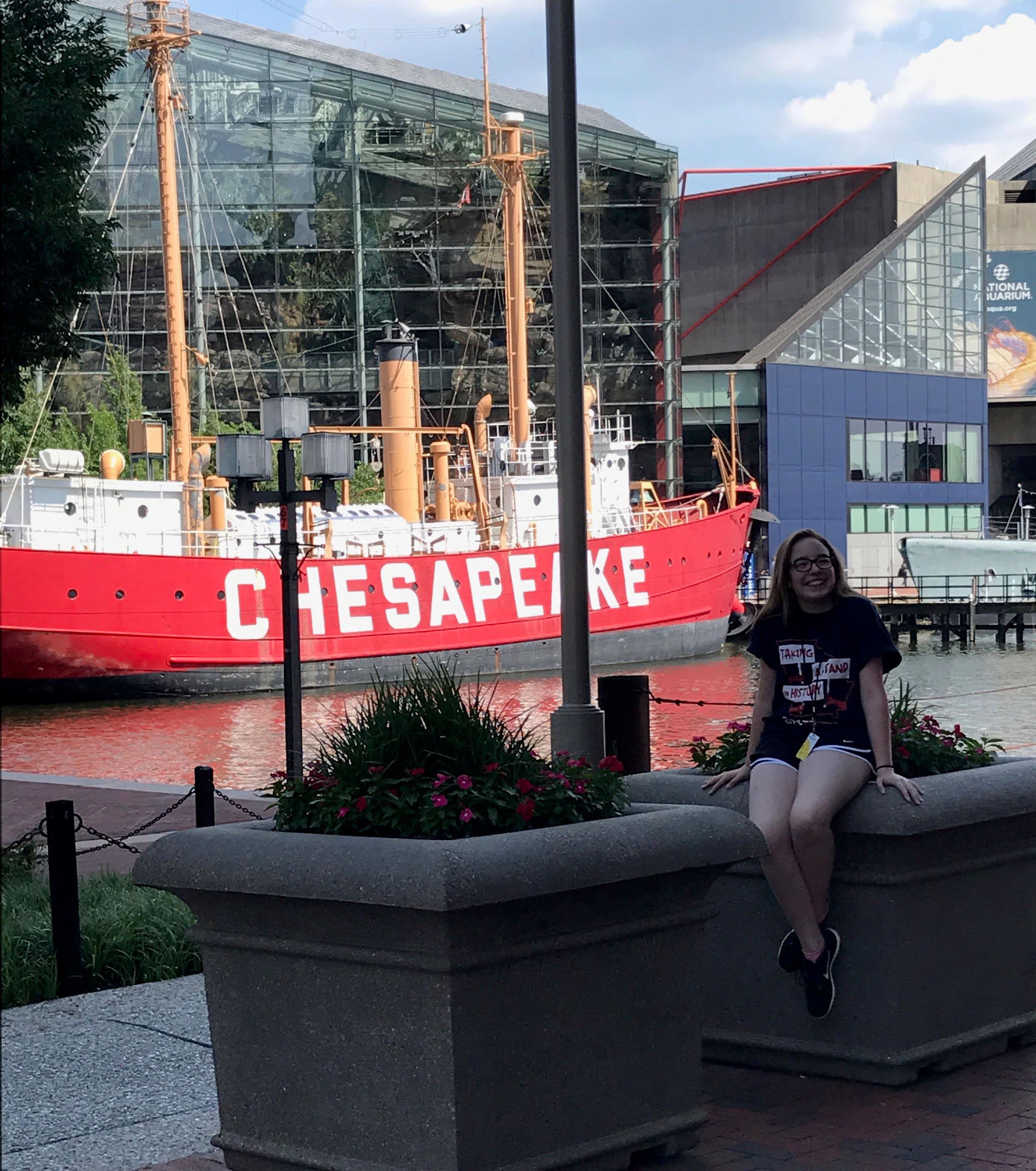
A smiling person sits on a planter in front of red ship CHESAPEAKE docked by a modern glass building, with flowers and greenery in the foreground.
Lucy enjoying time in Baltimore

Lucy and Lindsey did not win the national award, but thoroughly enjoyed the experience and their sightseeing in Baltimore. They visited Inner Harbor, the National Aquarium, and Hard Rock Café. “I really enjoyed that because the hard work was over and we could finally relax and enjoy the city,” said Lucy.

We are glad to have been able to help the girls have such a rewarding experience and congratulate them on their success.

The theme for 2018 is: Conflict and Compromise in History.

NJ Council for the Humanities Awards Jane Addams Papers Funds to Enhance Use of the Digital Edition by Students

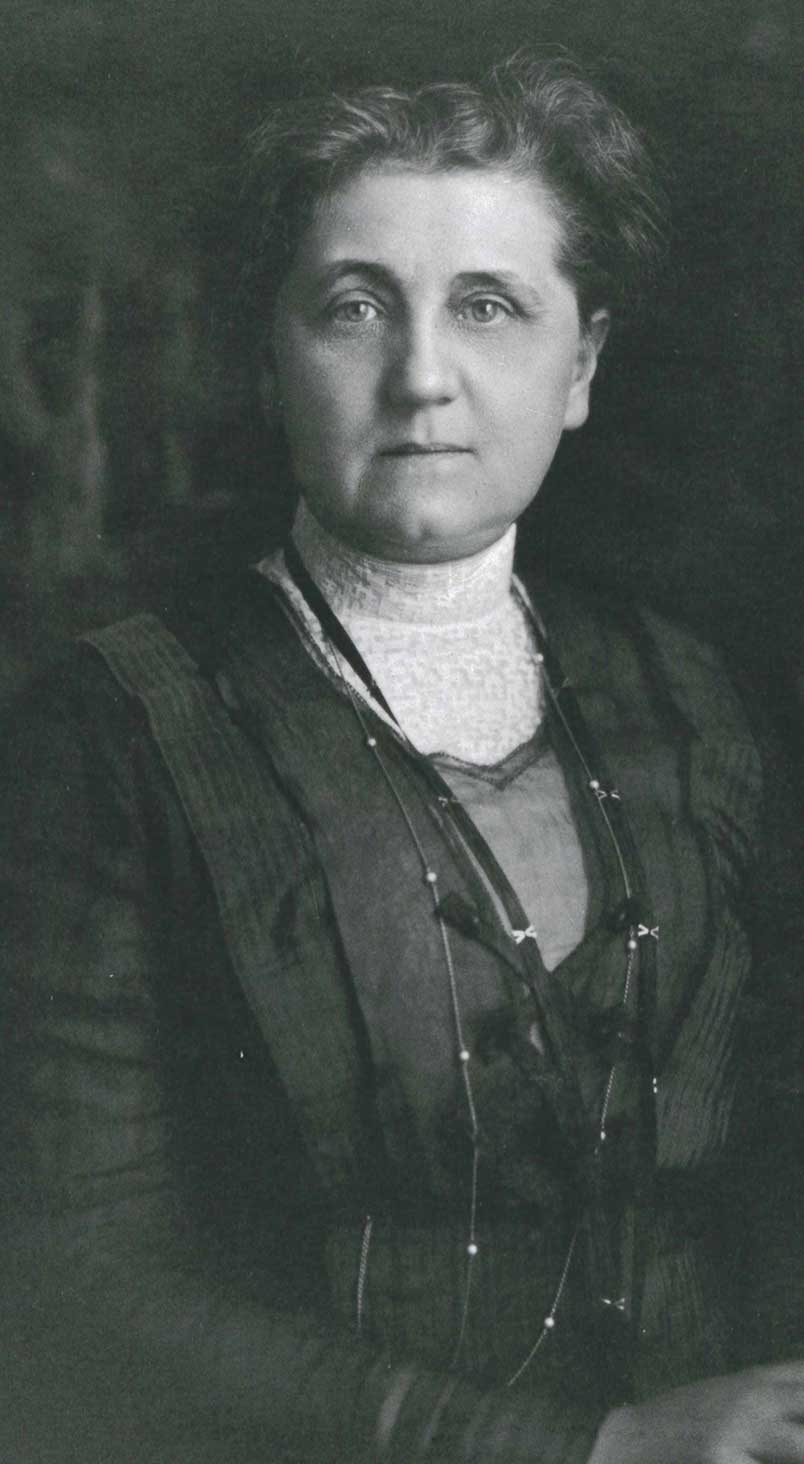
A black and white portrait of a woman with short, wavy hair wearing a high-collared blouse and a dark dress, looking directly at the camera with a neutral expression.We are delighted to announce that the New Jersey Council for the Humanities has awarded the Jane Addams Papers a grant of $11,400 for our “Expanding Audience Participation with the Jane Addams Papers” project.

This project aims to encourage use of the digital edition among students, teachers, and the general public. We will  build a crowdsourcing site where members of the public can engage with documents, create transcriptions, and rate the documents to build a new search option to highlights the most useful documents. We also want to encourage students to work with the digital edition, and will create guides for high-school and grammar school students working on National History Day projects and school projects. These tutorials will introduce topics, provide suggestions for the best texts and search strategies for that topic, and suggest sources for further research.

We will be collaborating with students in Ramapo’s Teacher Education program, with the New Jersey National History Day coordinators, and local middle and high school teachers to develop these new resources on our digital edition site.

The Jane Addams Papers’ mission is to digitize and describe the documents, and create historical context for them by identifying the people, organizations, and events mentioned in the texts. We have received funding from Ramapo College, the National Historical Publications and Records Commission, the National Endowment for the Humanities, the Gladys Krieble Delmas Foundation, and the Ruth McCormick Tankersley Charitable Trust  to undertake this work.  But we want to do more than build a site and hope that people will use it. Scholars and advanced students will find our site, but this outreach project will advance our mission by reaching out to students, teachers and the general public.

We think the best way to do that is to provide crowdsourcing opportunities and offer guides for using the documents in the classroom. National History Day is a very popular program that challenges students in middle and high school to interpret history through one of twelve general themes.  For this year’s theme “Conflict and Compromise in History,” we advised students to look at Addams’ opposition to World War I, or her decision to open the Hull-House settlement, pointing them to the best documents and providing them with context. We will continue to expand the guides by adding more suggestions as we mount more material on the site. We also want to create topic guides for other issues, such as child labor, woman suffrage, and recreation.

We are looking forward to getting started on this exciting collaboration and will keep you posted on the results.


The Addams Papers Goes International!

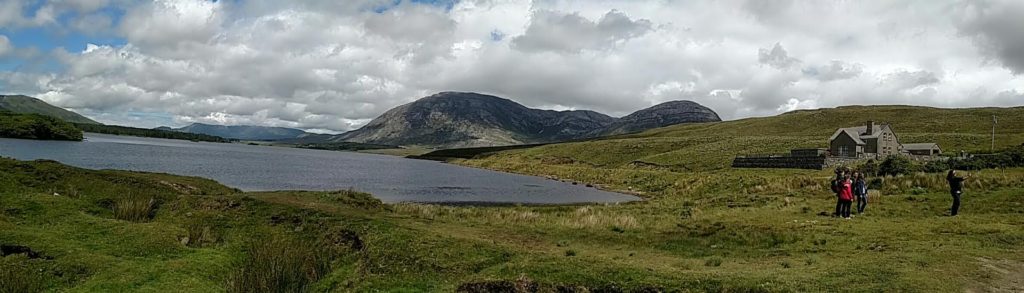
A scenic landscape with a large lake, grassy hills, mountains in the background, and a stone house on the right. Several people stand near the house under a partly cloudy sky.
Connemara, Ireland.

The Third Women’s History in the Digital World conference was held on July 6-7, 2017 at Maynooth University in Ireland and the Jane Addams Papers presented a panel on our digital edition. Editor Cathy Moran Hajo, Assistant Editor Victoria Sciancalepore, and our web developer Anneliese Dehner combined to present three aspects of “Editing Jane Addams.”

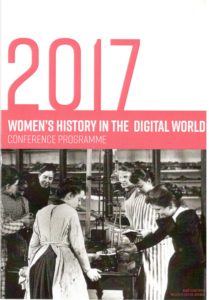
Cover of the 2017 Women’s History in the Digital World conference programme, featuring a black-and-white photo of women in historical clothing working with scientific equipment. Bold pink and white text appears at the top.Cathy led off the panel talking about the “Big Picture: Conceiving a Digital Edition of  Jane Addams’ Papers,” providing a short history of the Addams Papers microfilm and book projects, and the process that went into deciding to digitize the microfilm edition. The decisions to be made involved thinking through the audience for the edition and what kinds of tools and resources they needed. In addition, Cathy discussed the decision to use the Omeka database-driven platform for the digital edition rather than using text encoding using XML. Going with a web-publishing friendly system allowed the Addams Papers to design a site that not only provides deep metadata, but also manages the project’s internal workflow, tracking information on each document as it passes through our permissions and copyright checks, metadata and transcription, and proofreading. Cathy also talked about her desire to see the Addams Papers edition be flexible enough that scholars and students can use its materials to build their own research projects.
A group of people sit around a conference table in a meeting room, listening to a speaker at the front. A presentation with a black-and-white portrait is displayed on a screen behind the speaker.
Cathy talking about biographical resources.

Tori’s talk, “The Nuts and Bolts: How an Omeka-based Digital Edition Works,” brought us into the back end of the project, showing how we defined the metadata and relations between the 21,000 eventual documents, and the entries on people, organizations, publications, and events that are discussed in them. She described the use of the Items Relations Omeka plugin, which we tweaked some, to build an edition that lets users move flexibly between drafts and final versions, letters written by and to a person, and individuals who were members of an organization, or participated in an event.  She also talked about how we decided on a transcription policy.  Because we make the images of the documents available on the site, we wanted our transcriptions to be more useful as a search mechanism. We decided to standardize our transcriptions  (converting British spellings, archaic spellings, and misspellings) as long as we used brackets to signal that the editors had changed the text. Readers who want to see the original need only click to see the manuscript image. She also discussed our student workers at the Addams Papers–the engine that keeps the project moving. With editors focused on training and quality control, it is a cadre of 10-15 Ramapo College undergraduates that are entering and transcribing documents and researching and writing identifications.

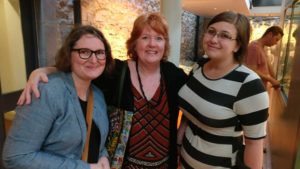
Three women stand close together indoors, smiling at the camera. The woman in the middle has red hair, while the other two have brown hair and wear glasses. There is a stone wall and another person in the background.
Anneliese, Cathy, and Tori after the session at Kilmainham Gaol Museum

Anneliese discussed “Designing a User Interface for a Digital Edition.” Coming from the perspective of a digital library developer, Anneliese talked about her experiences working on the Jane Addams Papers and the Kentucky Civil War Governors Papers, also an Omeka site. Discussing the different values that the project had, she walked through the way that developers work with editors to configure their sites, looking at who the intended users of the site will be, the kinds of searching they will need, and how much metadata should be used for site navigation. Anneliese noted that the Addams site was interested in exposing metadata, developing spatiotemporal context for documents, and creating branching paths through the edition. The Kentucky Governors project looked to create a more linear path through documents, but were more interested in presenting transcriptions alongside images of documents.

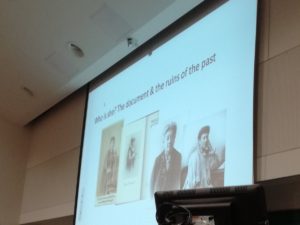
A classroom projector screen displays four old photographs of women with the title, “Who is she? The document & the ruins of the past,” above the images. Part of a computer monitor is visible at the bottom.
Liz Stanley gave a keynote talk on the Olive Schreiner Letters Online

In addition to our panel session, we were able to learn about some extremely interesting projects in women’s history, both here in the U.S. and abroad. Rachel Love Monroy, Lauren N. Haumesser and Melissa Gismondi discussed the Founding Women project that seeks to build a federated documentary edition of a variety of women’s papers. Eric Pumroy spoke about Collegewomen.org, which seeks to build an inclusive resource about late 19th and early 20th century college experiences for women. Cécile Gotdon spoke about Ireland’s Military Pension Project, a fascinating look at detailed records of men and women involved in the Irish military between 1916-1923.  And Alvean E. Jones’ work to provide access of the history of St. Mary’s School for Deaf Girls in a way that makes it accessible to deaf scholars, by translating digitized material into Irish Sign Language videos. Helena Byrne discussed a project to gather a digital history of Irish women’s indoor football leagues in the 1960s. And Liz Stanley gave a wonderful presentation on the Olive Schreiner Letters Online and the difficulty of representing a person from the things left behind.

Thanks to all who attended for a fascinating time!

Support Federal Funding for the Humanities

A bookshelf filled with old, ornate books in black and white. Overlay text reads #NEHMatters in large, white script letters with a small green emblem below.The Jane Addams Papers Project would not be possible if not for the support of the federal government, in our case, the National Historical Publications and Records Commission (NHPRC) and the National Endowment for the Humanities (NEH). The work that we do, bringing rare archival documents to broad audiences, serves a wide range of the public–from a scholar working on an interpretation of Addams’ philosophy, to a college student writing a thesis on the impact of women on the Progressive Era, or a high school freshman creating a National History Day performance on Hull House. (National History Day, by the way, is also funded by the NEH).

At the Addams Papers, support provided by these two agencies has funded:

  • The microfilming of the Jane Addams Papers in the 1980s, which serves as the basis for our digital edition. Without the work done finding, copying and microfilming materials, identifying dates and authors in a detailed index, our work would be much more difficult.
  • The scanning of the Addams microfilm to build our digital edition.
  • The salaries of eight students who describe and transcribe documents and conduct research. This is an added boon, because federal dollars spent on student workers pay twofold. Besides the help we get on the project, it provides the students with unique experience in historical research and digital humanities work that helps them stand out whether applying for a job or going on to graduate school.
  • The salary of an assistant editor who helps supervises student work and training, and insures quality control over their work through proofreading and verification. She also conducts research, transcribes documents, and works on clearing permissions so that we can publish the documents.
  • The salary of a part-time assistant editor who manages work on our book edition. She selects the initial pool of documents to be published as a fully annotated scholarly print edition. She also helps with proofreading and verification.
  • The work of our Chicago researcher who gathers newly found Addams documents, helps us with difficult transcriptions, and conducts research on Chicago-area topics.
  • The efforts of two web developers who have customized and designed the functionality of the Jane Addams Digital Edition and designed a beautiful site.

Our goal is to provide free public access to Jane Addams’ correspondence and writings, via a digital edition. You don’t have to be a scholar who can travel to an archive, or a student at a large research library to access these documents. The site is also building a unique resource of identifications of the people, organizations, events, and publications discussed in the documents that will provide students of the Progressive Era with a rich resource.

The Addams Papers is but one of the many projects supported by the NHPRC and the NEH that help enrich our understanding of the past.

What you can do

Once a year, the National Humanities Alliance focuses support and attention for federal funding for the humanities. Advocates from every state come to Washington on Humanities Advocacy Day (Tuesday, March 14) to talk to their representative and senators about the importance of this work and its value to all Americans. It is especially important this year due to rumors that funds for the NEH may be eliminated from the President’s budget.

You can help!

  • Take a few minutes to look at the work supported in your state by the NHPRC and explore NEH-funded projects to get a sense of the breadth and depth of the work.
  • Call or write your congressmen and ask them to support funding for the NEH and NHPRC.
  • Share the call for help among your friends on social media. Use hashtags #SaveNEH  #NEHMatters.