Volume 4 is Available!

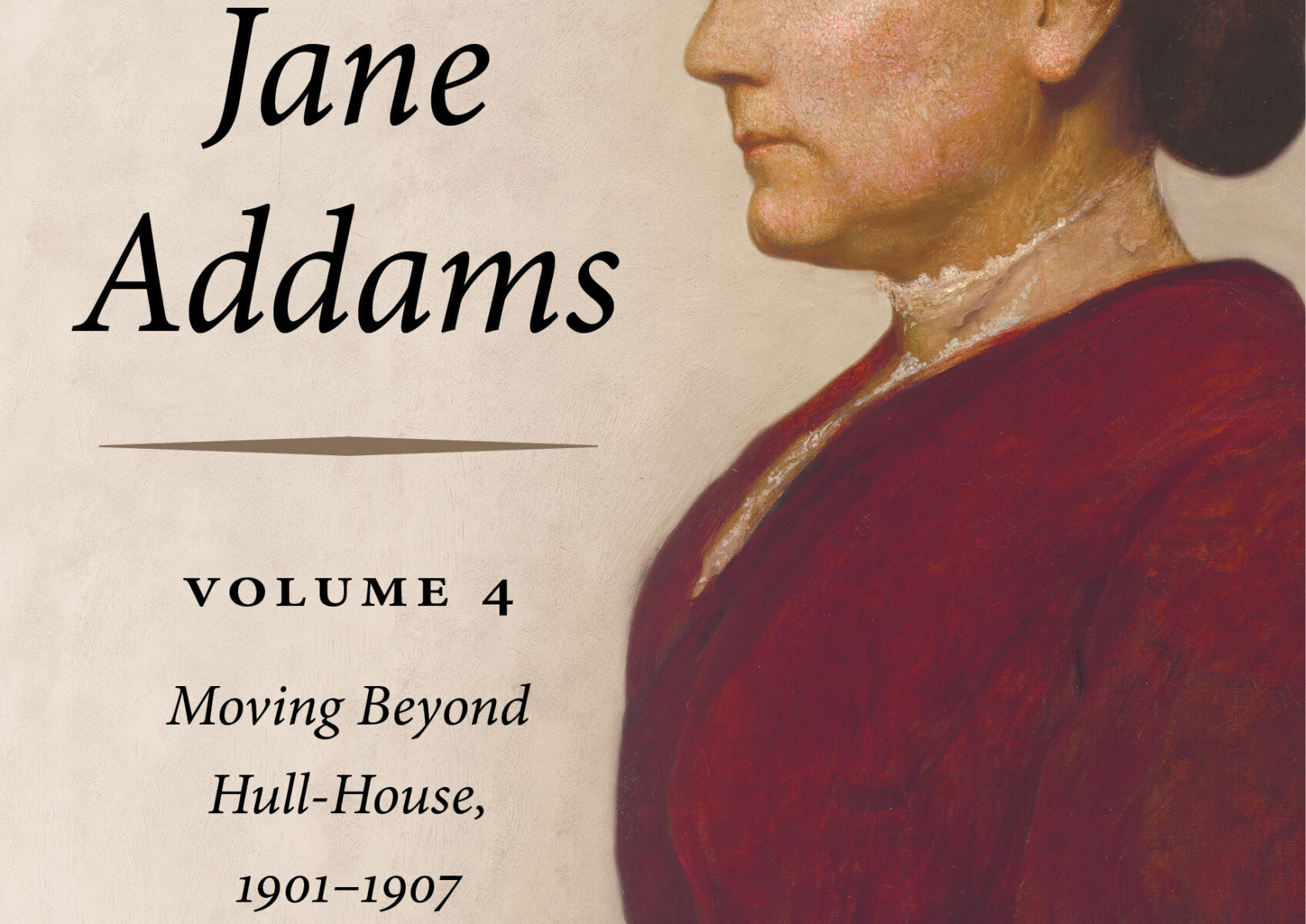
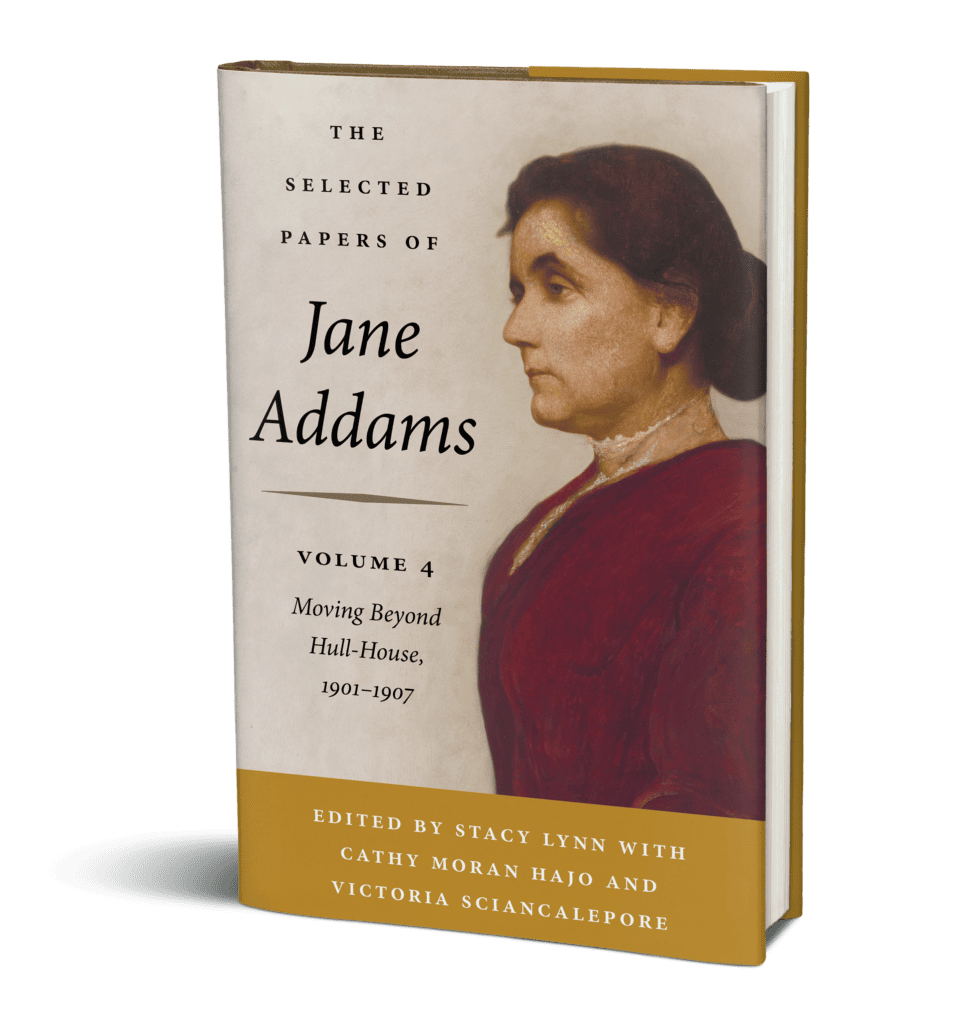
Book cover for "The Selected Papers of Jane Addams, Volume 4: Moving Beyond Hull‑House, 1901–1907, edited by Stacy Lynn with Cathy Moran Hajo and Victoria Sciancalepore. The design features a 1906 painting of Jane Addams by the artist George de Forest Brush.

We are delighted to announce the publication of Volume 4 of the Selected Papers of Jane Addams. Edited by Stacy Lynn, with Cathy Moran Hajo and Victoria Sciancalepore, it is the first volume published by the new editorial team.

This volume presents a selection of Jane Addams’s writings from 1901 to 1907, a period of significant growth in her influence as a reformer, writer, and public intellectual. The front matter provides editorial method, transcription policies, and historical context. Part 1, Progress Belongs to Us Altogether, 1901-1903, explores Addams’s expansion of Hull-House, advocacy for immigrants, child labor legislation, and engagement with political leaders. Part 2, Making All Life Fuller and Better, 1904-1905, highlights her role as a member of the Chicago Board of Education, and growing interest in international peace. Part 3, In the Hands of Women, 1906-1907, examines her deepening commitment to the woman suffrage movement and continued activism in labor and child welfare. Throughout this period, Addams’s prominence grew as she connected settlement work with broader social and political reforms. She balanced activism with writing, publishing Democracy and Social Ethics (1902) and Newer Ideals of Peace (1907), positioning herself as a leading voice in Progressive Era thought. This volume captures her evolving philosophy, expanding national presence, and enduring commitment to social justice, illustrating her transition from a local settlement leader to an influential advocate for systemic change.

Jane Addams entered 1901 as a confident voice in the American settlement movement and pioneer in many of its methods. The period that followed marked the dramatic expansion of the Hull-House campus and its reach even as Addams increasingly devoted more time to lecturing, lobbying, and building bridges of reform in Chicago, Washington, D.C., and beyond.

The fourth volume in the series follows Addams’s increasingly busy life. Her activities included greater participation in the women’s suffrage movement and speaking tours of twenty-five states and the District of Columbia to discuss child labor, settlement work, and women’s issues. At the same time, she maintained relationships with an intimate circle of female friends, her extended family, the Hull-House community, and most importantly her companion Mary Rozet Smith. The editors provide an extensive collection of documents on this side of Addams’s life while rooting her in the unique time and place of an era of fast and far-reaching change.

Image showing a book titled The Selected Papers of Jane Addams with a promo for 30% off using code S26UIP at University of Illinois Press until December 31, 2027.

This volume is available from the University of Illinois Press and other resale outlets.

It’s Women’s History Month at the Jane Addams Papers!

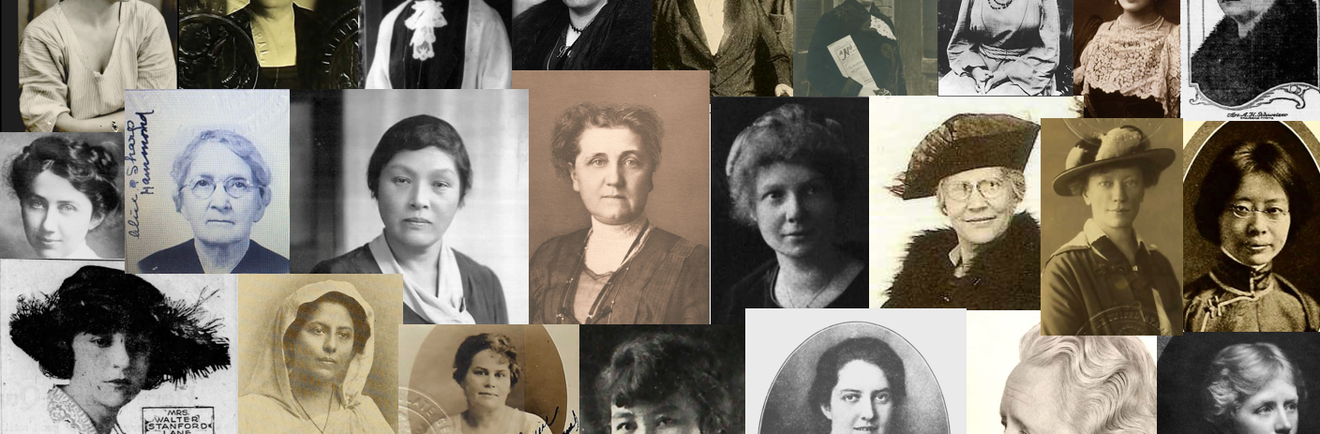
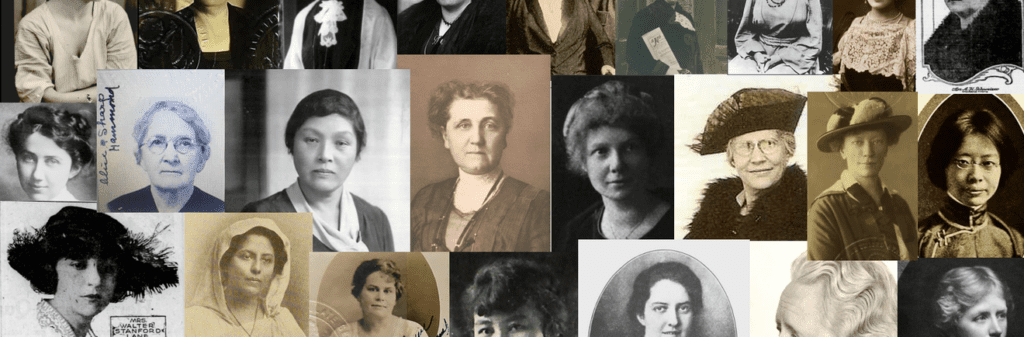
A collage of historical black-and-white and sepia portraits of women, each photographed individually, showcasing a variety of hairstyles, clothing, and expressions from different eras.

A collage of historical black-and-white and sepia portraits of women, each photographed individually, showcasing a variety of hairstyles, clothing, and expressions from different eras.

At the Jane Addams Papers Project every month is women’s history month, but in March we take the time to officially recognize it! Addams is an icon of women’s history, famous in her time as a social worker, social reformer, philosopher and advocate for peace, equality, and social justice. If we have learned anything while working on her papers, it has been the sheer breadth of her work — the connections that she had with women from every continent as they tried to better the world through cooperation, community, and charity.

The Jane Addams Papers tells the story not just of Jane Addams, but the women who worked with her, who were inspired by her, and who opposed her. It offers a deep understanding of the wide variety of women’s experiences in a pivotal time in world history. Over 9,000 women have been named in Addams’s papers, ranging from rank and file members of the Women’s International League for Peace and Freedom, settlement workers in New Orleans and Minnesota, and child labor activists in Chicago and New York. They include Japanese and Chinese feminists, Italian peace workers, Mexican social workers, and Dutch suffragists.

Please support the Jane Addams Papers Project!

The National Endowment for the Humanities will match donations dollar-for-dollar to the Project! The past year has been a challenging one financially for the project. Funding for the humanities is in short supply, and for projects that document the work of women, especially those who worked for equality and social justice, support has been tough to find. We lost an editor in 2025 due to federal funding cuts and have been short-staffed as we try to stay on task. Private support is needed in order to meet the costs of student researcher salaries, research, and web development. For that we need you!

Our goal is to raise $5,000 during this Women’s History Month. Can you help?  

A large red rectangular button with a white arrow pointing right and the words DONATE NOW in bold white letters.

Transcribing the Addams Papers!

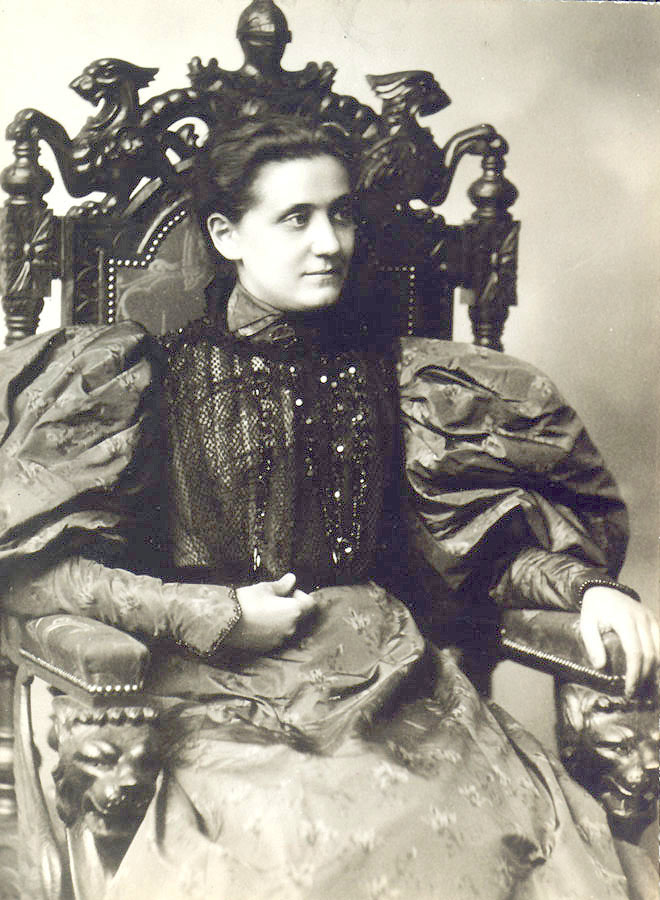
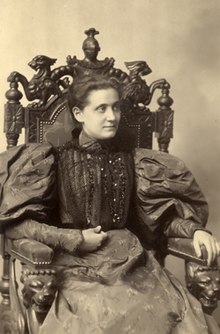
A woman in a formal, ornate dress with puffed sleeves sits on a large, intricately carved chair with lion heads on the armrests and decorative figures on the backrest. She looks to the side, holding her hands in her lap.

We have partnered with From the Page to invite the public to transcribe Addams documents from 1877 to 1899. Using this innovative platform, you can transcribe Addams’s speeches, articles and other writings, transcribe her incoming letters, and if you are feeling brave, tackle Jane Addams’s handwriting yourself!

Screenshot of a digital archive webpage displaying a handwritten letter from 1887. The left side shows the letter, while the right side has a typed transcript and options to edit, save, and mark the text as complete.
Transcription interface on From the Page.

When the Project came to Ramapo College ten years ago, our two goals were to complete the Selected Papers of Jane Addams and to create the digital archive. We started our work with the year 1901, where Volume 4 of the Selected Papers began. As we are getting close to completing the years 1901-1935, we are turning back to the first three reels of correspondence and to Addams’s early writings. These years include, Addams’s college years, her travels abroad as a young woman, and the first ten years of Hull-House.

A woman in a formal, ornate dress with puffed sleeves sits on a large, intricately carved chair with lion heads on the armrests and decorative figures on the backrest. She looks to the side, holding her hands in her lap.
Jane Addams in 1896 (Swarthmore College Archives)

Crowdsourcing is a great way to engage those interested in Addams’s life and work, and by transcribing you get an experience of close reading unlike any other.  Puzzling out the names, finding archaic terms and spellings brings us closer to the authors and gives a real sense of what it was like to be alive in the late 19th century.

From the Page’s interface is easy to use. All you need to do is create an account and then find the Jane Addams Papers. You will see documents that need to be transcribed and can select any that interest you, or you can press the Start Transcribing button and get a random page!

We started adding documents to the portal last month, and even before a day was out, volunteers hooked on transcription rolled up their sleeves and got to work.  As of this morning, 360 pages of material have already been transcribed, from 71 of the 868 works we mounted. We haven’t even advertised it yet!

Once these are transcribed we will import them into our digital archive and students working the the project will attach metadata and link the names of people, organizations and events to the text, just as we have done with those created by project staff. The work of volunteers will make it easier for us to make these documents freely accessible to the public.

So if you would like to try your hand at transcription, dive on in!

A red oval button with white text that says, Start Transcribing!.


What’s in a Name? The Jane Addams of. . .

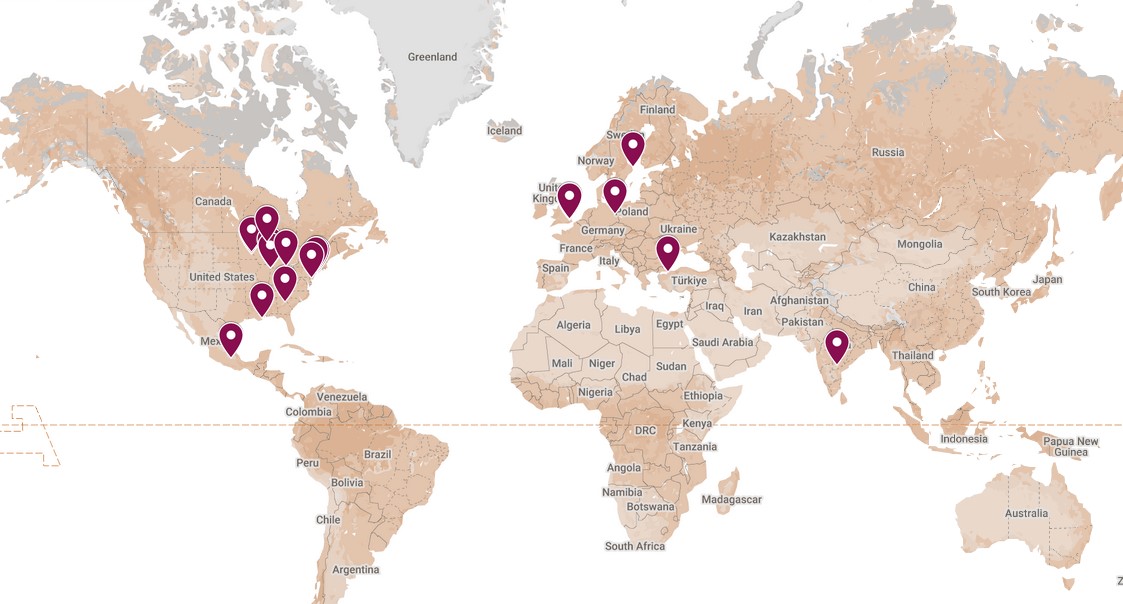
A world map with pink location pins marking various cities in North America, Europe, and South Asia, including the United States, Canada, Mexico, Germany, Norway, Turkey, and India.

You know that you have made it when your name becomes an adjective. In the course of our research on Jane Addams, we regularly come across people in all walks of life who are described as “the Jane Addams of India,” or “the Jane Addams of Northern Michigan,” or even “the Jane Addams of Social Work.” That last one seems a bit odd — as Jane Addams was clearly the Jane Addams of Social Work!

Because Jane Addams was engaged in so many reforms, her namesakes vary as well. Some are social workers and settlement women, such as  Lillian D. Wald (New York), Constance Currie (Minnesota) or Muriel Lester (London). Others were peace activists, like Halide Edib Adivar (Turkey), Alice Salomon (Germany) or María Elena Landázuri Gil (Mexico).

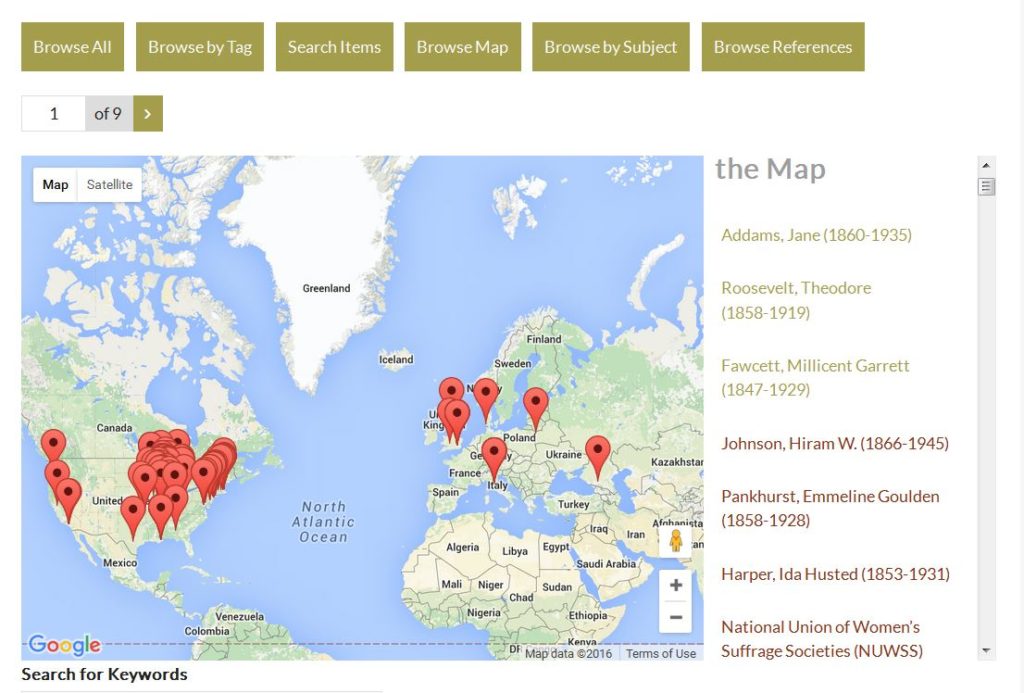
I’ve built an interactive map of those we have found so far with short biographies that you can explore (see in full screen) .

Who is the Jane Addams of Today?

Seeing the impact that Addams had on the lives of her contemporaries begs the question, Who is the Jane Addams of today? What problems do we face today that need someone of her character and care? Settlement houses faded away for the most part in the mid-20th century, but neighborhood organizing is still a vital movement. Immigrants still need help navigating American society. Even child labor, the reform Addams achieved in her lifetime, does not seem so settled. War still ravages the world, and its great expense hampers our ability to fund social services, education and health care.

Is she (or he) out there?  — working quietly to better their neighborhood, protesting for peace and social justice, or helping improve the lives of individuals through sympathy and social work? Time will tell!

Presenting at the Chicago Women’s History Conference

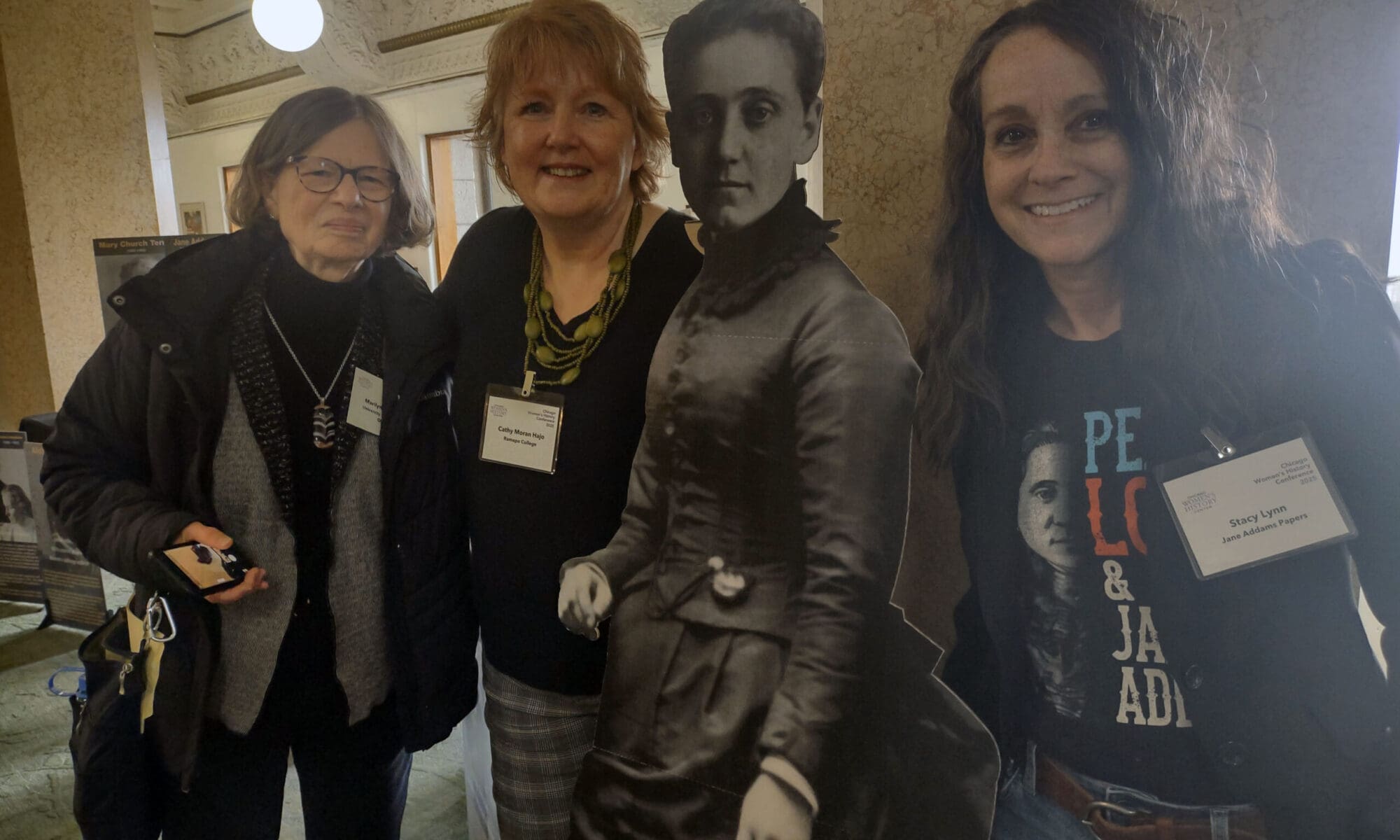
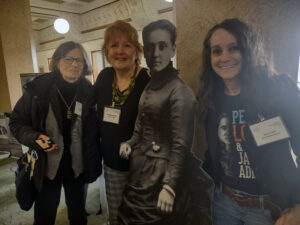
Three smiling women stand indoors next to a life-size black-and-white cutout of a historical woman; two women wear name badges and one wears a shirt with a printed image. Ornate architecture is visible in the background.

Three smiling women stand indoors next to a life-size black-and-white cutout of a historical woman; two women wear name badges and one wears a shirt with a printed image. Ornate architecture is visible in the background.
Marilyn, Cathy, Jane, and Stacy at the Chicago Women’s History Conference, March 22, 2025.

The Jane Addams Papers Project represented at the Chicago Women’s History Conference this past Saturday. Cathy Moran Hajo, Stacy Lynn, and advisory board member Marilyn Fischer led a workshop devoted to the importance of Jane Addams, the digital edition, and how scholars and teachers can use it. Stacy talked about how influential Addams and the women of Hull-House were, and Cathy demonstrated the digital edition, while Marilyn discussed how she uses the digital edition to trace Addams’s word use in her three part book series about Addams as an evolutionary philosopher.

Our workshop was just one session in a day filled with really interesting work. The biggest challenge was choosing between them! And Jane Addams was everywhere! From the cardboard cutout at the Women’s International League for Peace and Freedom’s booth, to morning presentations by Sherryl Engstrom on Hull House Performs: A Description and Evaluative Study of the Performing Arts at Hull House, 1920-1937 and Fiona Maxwell on “We Women Would Rule the World of Politics”: Women’s Oratory and Activism at Chicago Settlement Houses, 1890-1920. In the afternoon, we delighted to Ann Keating and advisory board member Rima Lunin Schultz’s presentation, “Beyond the Second Wave: Working Class Women Activists and City Planning: Florence Scala and Chicago’s Near West Side.”

Keynote speaker Jamila Woods was inspiring and plenary session with Pinqy Ring and her amazing students ended with an emotional bang. What an amazing time.


Assistant Editor for the Jane Addams Papers Project Job Listing

Illustration of a woman in a large hat, shown in grayscale on a red background, with the words Jane Addams Papers Project in a circular border around the image.

Illustration of a woman in a large hat, shown in grayscale on a red background, with the words Jane Addams Papers Project in a circular border around the image.We are hiring! The Project seeks a full-time, grant-funded Assistant Editor to join our work on the Project’s digital edition and on the Selected Papers of Jane Addams. Please share this opportunity with potential candidates in your networks.
The successful candidate will work in-person at Ramapo College of New Jersey, in Mahwah, NJ. This position is not eligible for remote work. The assistant editor’s responsibilities will primarily support work on the Jane Addams Digital Edition. Under the supervision of the Project Director, the Assistant Editor verifies transcriptions and metadata, supervises and trains student employees, conducts research, and assists in all phases of implementing editorial practice at the project. The Assistant Editor also assists with grants and project promotion.

For more information about the position see the posting linked below or email Cathy Moran Hajo chajo@ramapo.edu.

Application information: https://www.schooljobs.com/careers/ramapo/jobs/4583980/assistant-editor-jane-addams-papers-project?pagetype=jobOpportunitiesJobs

Powering the Jane Addams Papers!

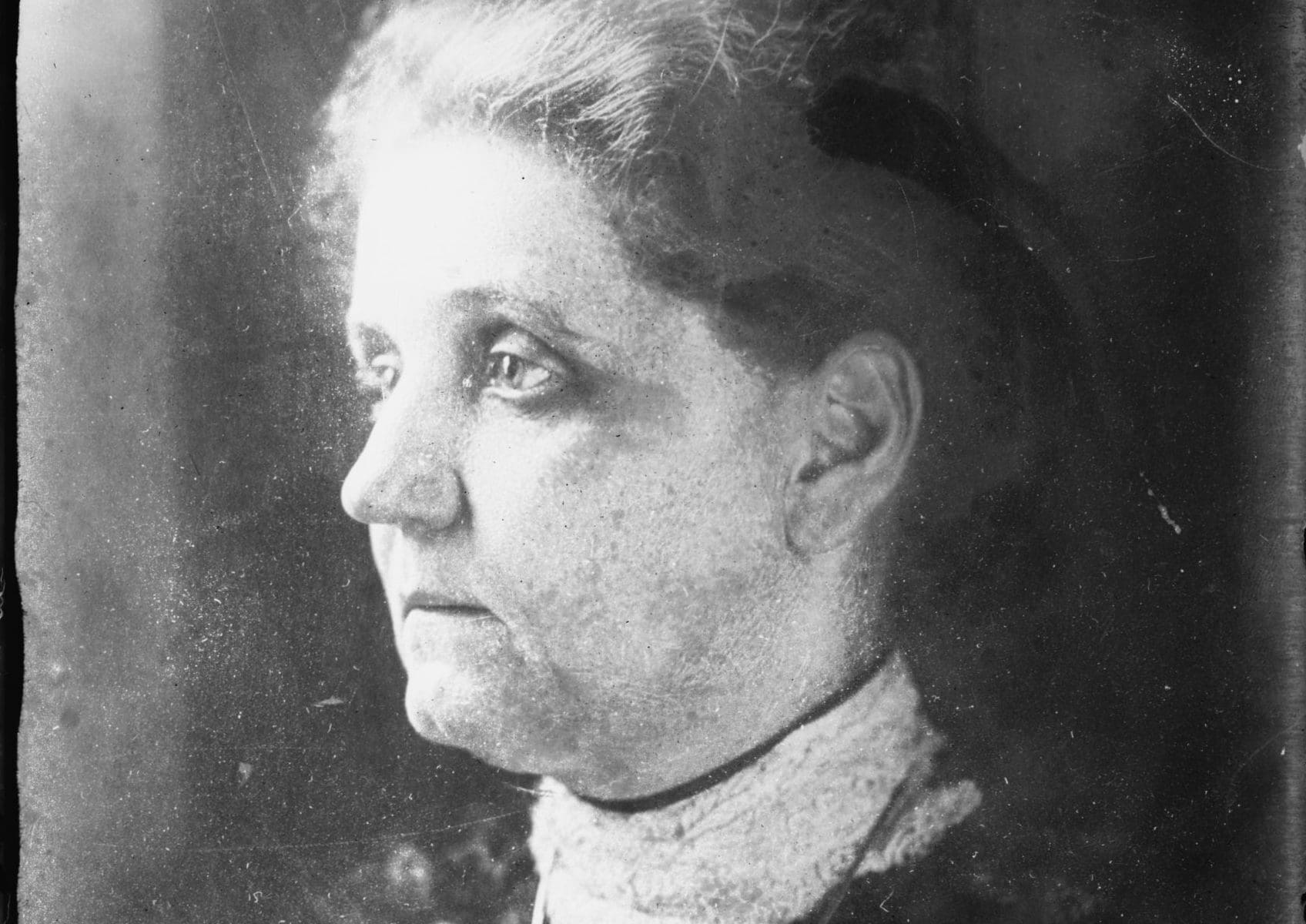
Black and white portrait of Jane Addams with light hair pulled back, wearing a high-neck lace blouse. Text at the top reads Jane Addams copyright by E.F. Waters 12-2-22.

We are delighted beyond words to announce that the Jane Addams Papers has received two major grants.

Black and white logo of the National Archives featuring a stylized eagle wing above the words “NATIONAL ARCHIVES” and “National Historical Publications & Records Commission.”.

The National Historical Publications and Records Commission awarded us $160,000 in support for 2022-2023. The NHPRC’s program in Publishing Historical Records in Collaborative Editions has been a stalwart supporter of the Project and has published many papers projects that document the lives of women.  Funds from this grant help support the salaries of editors working on the Jane Addams Digital Edition.


The official seal of the National Endowment for the Humanities, featuring a bald eagle with a shield, olive branch, and arrows, above the text National Endowment for the Humanities.The National Endowment for the Humanities awarded us a three-year $300,000 grant (2022-2025). The NEH’s program in Scholarly Editing aids in the publication of the Selected Papers of Jane Addams as well as our work on the digital edition. The NEH’s support for historical editions has enriched the study of our nation’s heritage tremendously.
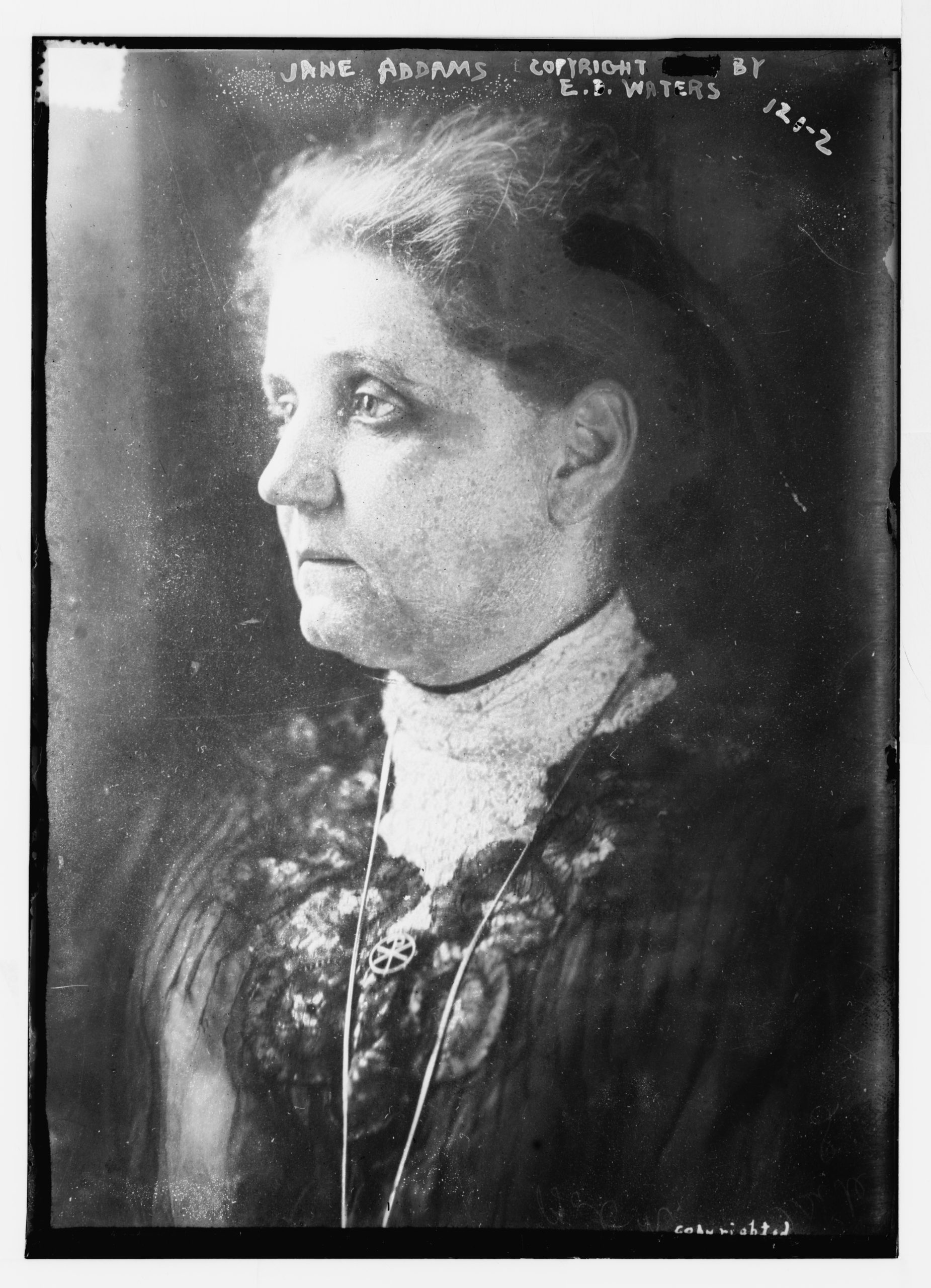

 

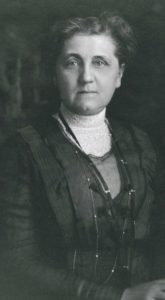
Black and white portrait of Jane Addams with light hair pulled back, wearing a high-collared lace blouse and a dark dress, looking to the left. The photo appears vintage and formal.
E. B. Waters portrait of Jane Addams (1902) Library of Congress

A Challenge: How You Can Help

Our new NEH Grant offers a way for you to help power the Addams Papers. The NEH will provide us with an additional $150,000 in matching funds if we can raise $150,000 from private sources. These much needed funds are needed to support the salaries of our student workers, research costs, and the editorial salaries that aren’t covered by the NEH and NHPRC.

We are currently short-staffed, with fewer student assistants than usual. Your support will ensure that we meet our goals for 2022-2023:

  • Entering over 1,000 new Addams documents with descriptive metadata in the Jane Addams Digital Edition.
  • Transcribing over 1,000 new Addams documents for the digital edition.
  • Proofreading student work to ensure quality before publication.
  • Submitting Volume 4 of the Selected Papers of Jane Addams to the University of Illinois Press.
  • Continuing research on Volume 5 of the Selected Papers of Jane Addams.
  • Working with high school teachers to develop AP resources.
  • Researching and writing biographies and descriptions of the people, organizations, events and publications mentioned in the Jane Addams Digital Edition.

A large red rectangular button with a white arrow pointing right and the words DONATE NOW in bold white letters.So, if you can, please donate now. Your contributions will be matched dollar-for-dollar by the NEH and will power the students whose work makes all of this possible.

Thanks for your support! A blue ink, cursive signature written on white paper.


Reviews in Digital Humanities

Circular logo with a portrait of a woman in a large hat at the center. The words Jane Addams Papers Project are written around the border on a red and black background.

Black and white portrait of an older woman with light hair pulled back, wearing a collared shirt, and smiling gently at the camera. The photo is framed in an oval shape.Thanks to Núria Sara Miras Boronat for her review of the Jane Addams Papers Project, published in the most recent release of Reviews in Digital Humanities (Vol. 3, No. 2, Feb. 14, 2022).

We particularly appreciated the kudos, below:

JADE is one of the most important interventions that has occurred in the last decade for not only Addams’ work but also for pragmatist scholarship. It provides very valuable information about the intertextual and contextual references of her writings, which are not obvious to contemporary readers, especially if those readers are not from the U.S. or are not English native speakers. It also informs readers about the density of connections and affections of one of the greatest thinkers and activists of the progressive era. Finally, it has a strong value as a project for teaching digital humanities.

We are happy to address one issue that Núria pointed out, the relative difficulty in locating our blog posts. We are on it, and hope to have a easy way to find all posts up and running soon.

Our Thanks to the Gladys Krieble Delmas Foundation

“Thank You” is written in bold, stylized letters with a vintage decorative frame and floral designs featuring white flowers and leaves around the text.

Black and white portrait of an older woman with light hair pulled back, wearing a collared shirt, and smiling gently at the camera. The photo is framed in an oval shape.I am delighted to announce that the Jane Addams Papers Project has been awarded a grant by the Gladys Krieble Delmas Foundation! We are extremely grateful to the Foundation for their support of our work and their support for humanities research.

The award for Making the Jane Addams Papers Accessible to the Public
will support the work of undergraduate student assistants who are currently entering Addams documents in 1924 into our system. Our students analyze the digitized texts, creating descriptive metadata that makes them easier to locate and understand, and transcribe the texts. This makes text searches possible and helps readers unfamiliar or unable to read cursive.  The Delmas grant will also fund the work of a student to help us create educational materials for high school AP and honors curriculum.

The grant will also be matched by the National Endowment for the Humanities. A win-win!

If you are able to help support the work of the Jane Addams Papers Project, please click on the donate link to keep our student workers typing away!


Jane Addams and the Long 19th Amendment Project

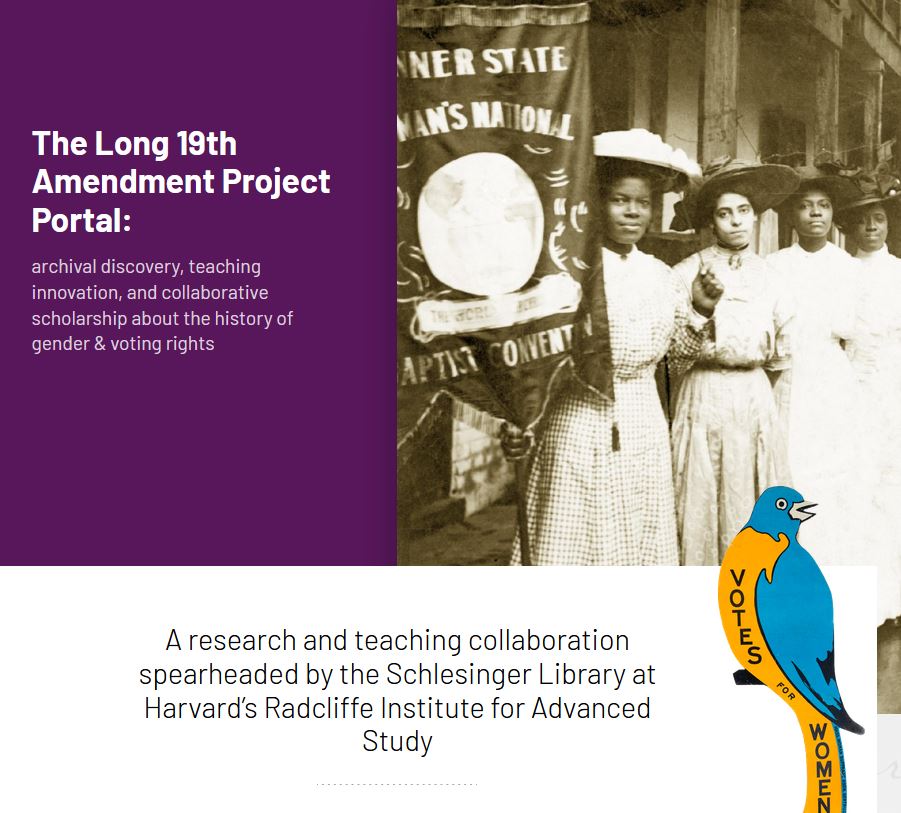
Historic black-and-white photo of women suffragists holding a banner, with text about Harvards Long 19th Amendment Project Portal and a cartoon blue bird with a yellow Votes for Women sash.

Historic black-and-white photo of women suffragists holding a banner, with text about Harvards Long 19th Amendment Project Portal and a cartoon blue bird with a yellow Votes for Women sash.I am very pleased to announce that the Jane Addams Digital Edition has shared content from our site with the Schlesinger Library’s Long 19th Amendment Project, an amazing digital portal that revolves around archival discovery, teaching innovation and collaborative scholarship on the history of gender and women’s rights.

This project, supported by the Schlesinger Library and the Andrew W. Mellon Foundation, seeks to build collaboration by including digitized materials from  well-known archives like the Papers of Susan B. Anthony and the Papers of Alice Paul at Schlesinger Library, but also includes materials from more than 40 contributing repositories.

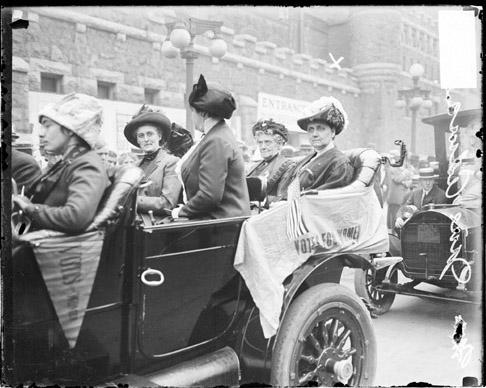
A group of women in early 20th-century clothing sit in an open car during a suffrage parade, with Votes for Women banners draped over the vehicle. A large stone building and more marchers are visible in the background.When we were approached by the Long 19th Amendment team, we were excited to participate for two reasons. Jane Addams isn’t known primarily for her work for woman suffrage. She is often mentioned in lists, or gets a small part in the larger history, but in her day, Addams was a leading suffragist. She was a vice president of the National Woman Suffrage Association and used her considerable fame to promote the movement. She gave frequent speeches on woman suffrage, especially on its impact for working women, spoke on college campuses, and testified before Congress in 1912 to make her argument.
The other reason that we were eager to participate, is that the Long 19th Amendment Portal offered the opportunity to fulfill one of our long-term project aims regarding data and data sharing. We want to be able to export our Dublin Core-based data from our Omeka content management system so that it can be repurposed and shared with other scholars. This project demonstrated that with just a little effort on our part, we could share more than 500 documents.

Looking at the Jane Addams Digital Edition in terms of woman suffrage, we had several options.

  • To share documents that have been tagged with Woman Suffrage
  • To share biographies of people tagged with Woman Suffrage

Working with the Portal team, we decided to share documents written between 1901-1920 in the first contribution.As we proofread more texts, we will update the data shared to include additional years. Our biographical collection will be included as a linked collection that researchers can locate and consult directly.

This is just the first in what we hope will be other collaborations with scholars working on related collections. If you are interested in accessing data from the digital edition, please do not hesitate to get in touch!


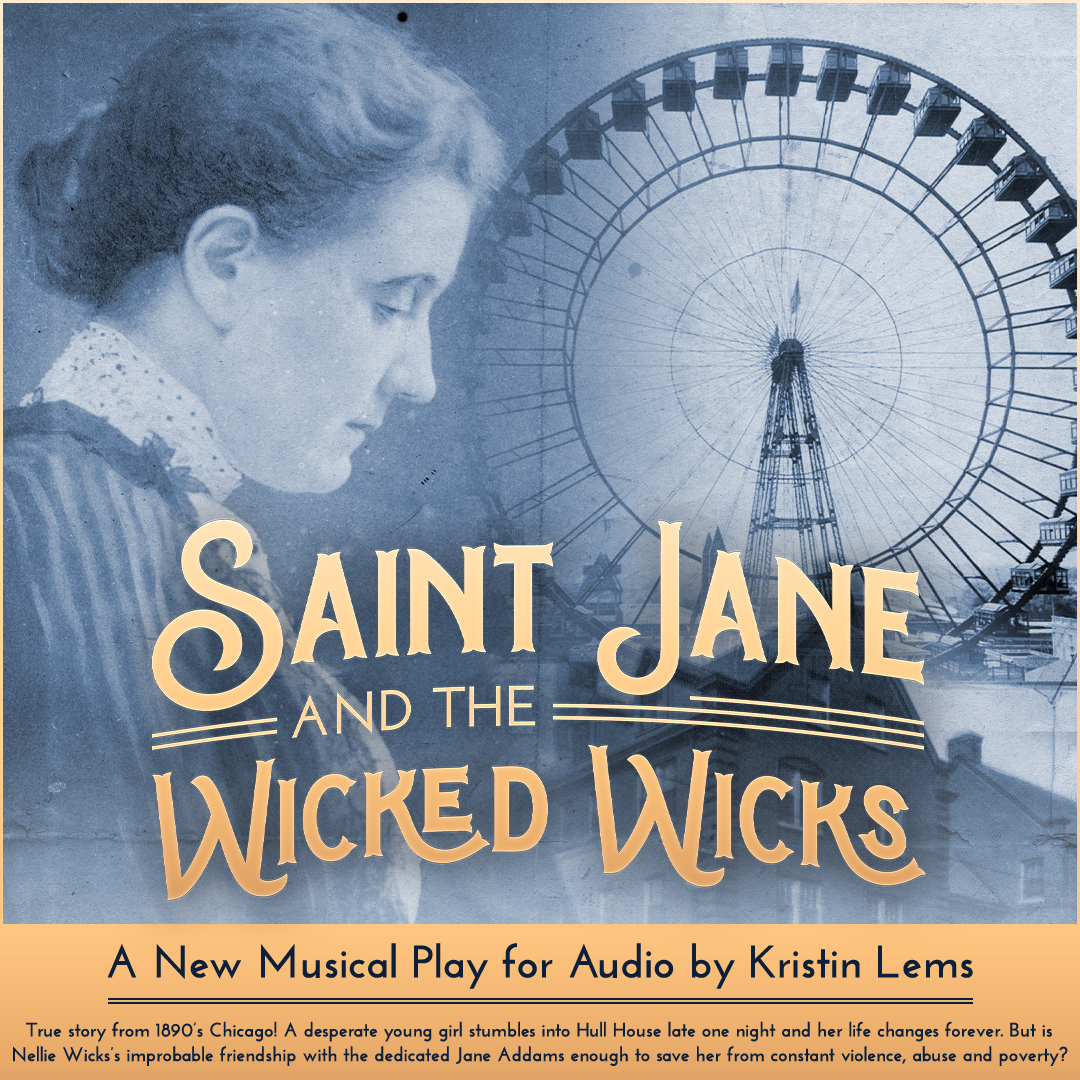
Saint Jane and the Wicked Wicks –An Audio Musical

A sepia-toned image of a woman looking down is overlaid with the title Saint Jane and the Wicked Wicks, a Ferris wheel, and text about a new musical play set in 1890s Chicago by Kristin Lems.

A sepia-toned image of a woman looking down is overlaid with the title Saint Jane and the Wicked Wicks, a Ferris wheel, and text about a new musical play set in 1890s Chicago by Kristin Lems.Exciting news! On Thursday, August 26 at 8 pm CST, Saint Jane and the Wicked Wicks, an audio musical  written and composed by Evanston playwright Kristin Lems, will open to the public at the  website www.SaintJanePlay.com. The two-hour musical play, which can be enjoyed in one  sitting or in four separate installments, is free, asking for a voluntary donation with a suggested  sliding scale. After the site goes live, listeners may attend the show any time on demand.

Saint Jane and the Wicked Wicks is set in Chicago in the decade of the 1893 World’s  Fair. It is about the friendship between Hull House founder Jane Addams and Nellie Wicks,  Kristin’s great grandmother, in the years 1890-1905, during the early years of Hull House.

Prize-winning Chicago dramatist Douglas Post is the director, with musical direction by  Diana Lawrence and mixing and editing by Dan Dietrich. Piano arrangements and performances were created by Tom Cortese of Champaign, Illinois.

The cast consists of well-known area actors and singers, including Kathy Cowan as Jane  Addams, Rebecca Keeshin as Nellie Wicks, Monica Szaflik as Ellen Gates Starr, Maddie Sachs  as Julia Lathrop, Patrick Byrnes as George Wicks and John Dewey, Frankie Leo Bennett as Gene  Wicks, John B. Leen as Jim Wicks and Sol Friedman, Kingsley Day as Richard Crane, and  Therese Harrold as Addie Wicks. The professional, non-equity cast was auditioned and selected  in December 2020 and recorded in the early months of 2021.

The “audio musical” is a new genre. The singer-actors rehearse their parts together on  zoom, but record and upload them individually to a single destination without being in a  recording studio. Then, the scenes and songs are reviewed, mixed, and edited by the director and  recording engineer. The final product is similar to an audiobook or radio play, but there are also  songs, in this case, 17 original songs including “The Hull House Rag,” “Straight to Hell in Chicago,” and other memorable numbers. The new genre enables artists to release entertaining  musical theatre work while keeping both performers and audience safe.

The musical will open on Women’s Equality Day, August 26, to celebrate the 101st anniversary of American women winning the right to vote. Jane Addams was active in the  suffrage movement 10 years after the time of the play, along with many activist women of Hull  House. Two key organizers, Ellen Gates Starr and Julia Lathrop, are characters with key roles in  the show.

Kristin Lems has won many accolades as a writer, composer, and performing artist, but  this is her first full-length musical. Lems was inspired by stories about the unusual friendship between the two women, told by her mother, musician Carol Lems-Dworkin (1924-2019), and  along with primary materials, including a handwritten diary by Nellie Wicks, two full length  unpublished novels written by Nellie’s eldest daughters, recorded oral histories, and an  autographed picture given to Nellie by Jane Addams shortly before Addams died. Lems also  researched Jane Addams, Hull House, and Chicago history with a 2017 sabbatical from her  employer, National Louis University, where she is a professor.

Many other outstanding talents helped design the trailer, iconic poster, website, video  product, and script, and many people deserve thanks and praise for moving this ambitious project forward to this day. For information about the cast, members of the pre-production, production,  or post-production team, or to contact Kristin Lems, please email saintjane2021@gmail.com.

Thanks to the Ramapo College Foundation!

A historic red stone archway stands over a paved path, surrounded by green trees and a low brick wall on a sunny day.

A historic red stone archway stands over a paved path, surrounded by green trees and a low brick wall on a sunny day.We would like to thank the Ramapo College Foundation for awarding the Jane Addams Papers a grant of $2,200 to support student work on the project in the 2021-2022 academic year.

These funds will support the salary of one of our excellent student workers, who process documents, transcribing the texts, creating metadata, and identifying the people, events, organizations and publications mentioned in them.

Ramapo College and the Ramapo College Foundation have been extremely generous to the project and their support has been critical to keeping our work on schedule.

We are still seeking funding to support additional student workers. If you can help, please donate to the project!

Segregation At Hull-House: A Closer Look

A group of twelve boys of diverse backgrounds, some shirtless, sit and stand closely together in a room with wooden walls, smiling and posing for the camera.

In June, Addams biographer and Project Advisory Board member Lucy Knight got in touch with a query regarding a claim that Hull-House was a segregated space until the 1930s. The claim first made by Thomas Lee Philpott in his 1978 work: The Slum and the Ghetto: Housing Reform and Neighborhood Work in Chicago, 1880-1930.  It  was repeated by Khalil Gibran Muhammed’s Condemnation of Blackness (2010), and then repeated by me in a 2015 blog post reporting on Khalil Muhammed’s talk at Ramapo College. Lucy wanted to know more, because the claim had begun appearing all over the web. Since then she has gathered evidence that refutes the statement.

I wrote that blog post a few weeks after launching the project at Ramapo and did not question the statement. I probably should have, but assumed that given the time and the place it was likely true. Today I want to give the question a little more light and attention.

There is no smoking gun document — one in which a policy of segregation was clearly established. Without that it can be extremely difficult to prove whether or not African-Americans were welcome at Hull-House or in its programs and sponsored clubs. A majority of the records of Hull-House have not survived, which makes it unlikely that we will ever be able to definitively confirm or debunk the statement.

There are a couple of layers to the question. First, was Hull-House itself a segregated space? To that question, the answer is clear. It was not.  Dr. Harriet Alleyne Rice (1866-1958), a Black physician and graduate of Wellesley College, started working at Hull House as early as  1893, working with the Hull-House branch of the Chicago Bureau of Charities and tending to the poor.

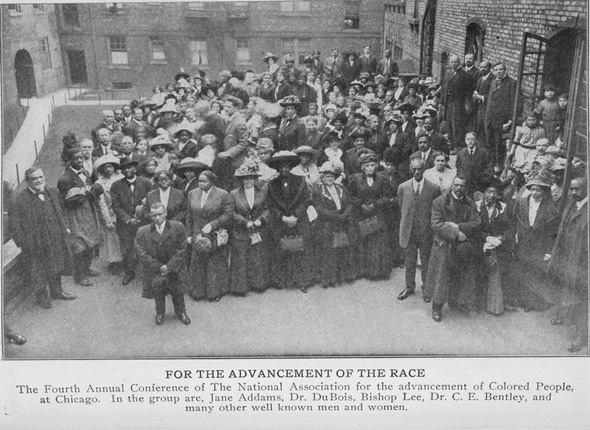
Addams invited Black speakers to Hull-House, including prominent figures such as W. E. B. Du Bois, who gave the speech “The Souls of Black Folk” at Hull-House on Lincoln’s birthday 1907 (Hull-House Year Book, 1906-1907). A year earlier, Atlanta newspaperman J. Max Barber spoke about the Atlanta race riot to a Hull House “audience mostly composed of negroes.” (Chicago Tribune, October 8, 190-6,. p. 3).  Addams invited  Ida B. Wells to visit and dine at Hull-House. And in 1912, Addams hosted a meeting of the interracial National Association for the Advancement of Colored People on the Hull-House grounds.

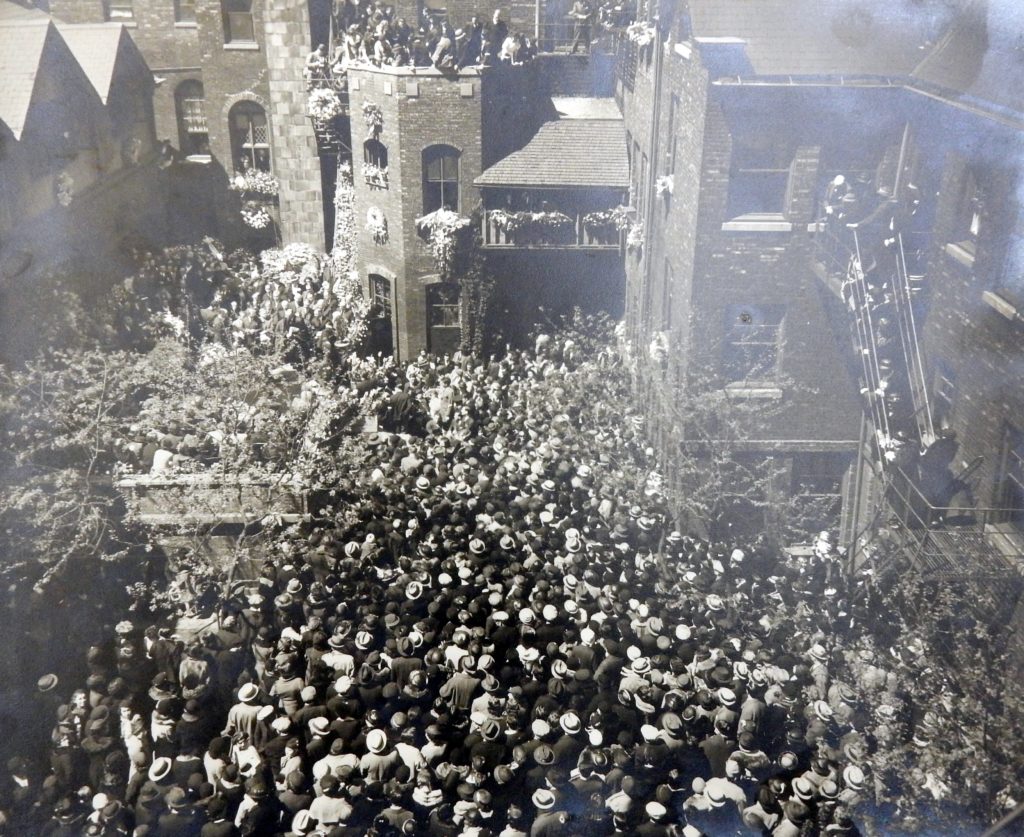
A large group of men and women, many wearing hats and formal attire, gathered outdoors between brick buildings at the Fourth Annual Conference of the NAACP in Chicago, 1912. A sign below lists notable participants.
Hull-House hosted a reception for the delegates of the NAACP meeting in Chicago on April 30, 1912.

A more complicated question was whether Hull-House’s clubs and groups welcomed people of all races. Few if any spaces in Chicago were integrated during Jane Addams’s life.  By 1910, the vast majority of African-Americans lived in Chicago’s South Side in what was known as the “Black Belt.” They formed their own organizations to empower their communities, much as other ethnic and religious groups did. African-Americans who came to Chicago during the Great Migration found opportunity, but also oppression.

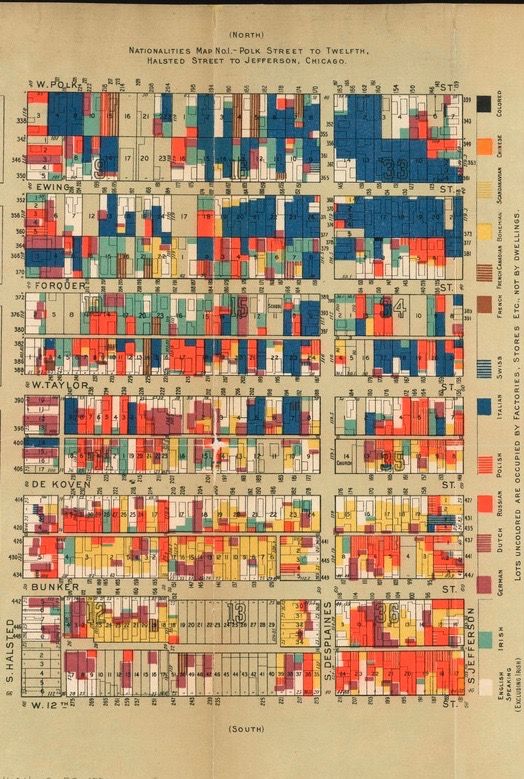
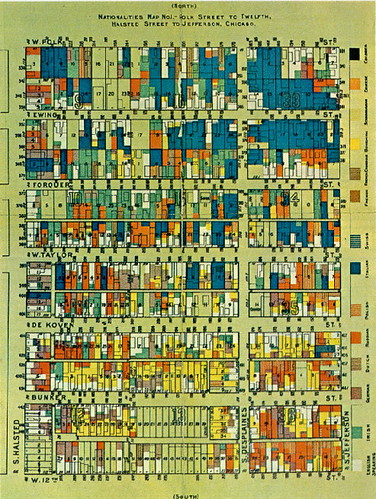
Hull-House was located in the Near West Side, a overcrowded community that featured a wide range of European immigrants. The area was filled with ever changing languages and customs as Irish, German, Czech, and French immigrants were replaced by Jews from Russia and Poland, Italians and Greeks. In 1895, Hull-House workers surveyed the area showing the cultural (if not racial) diversity. It was not until the 1930s and 1940s that African-Americans and Mexican became a more significant presence in Hull-House’s neighborhood.

A detailed, color-coded map of Chicago blocks from Polk to Twelfth and Halsted to Jefferson, showing the distribution of various nationalities in 1895 through colored rectangles representing individual buildings.
Nationalities Map of Polk Street to 12th Street in the Near West Side (Hull House Maps and Papers, 1895).

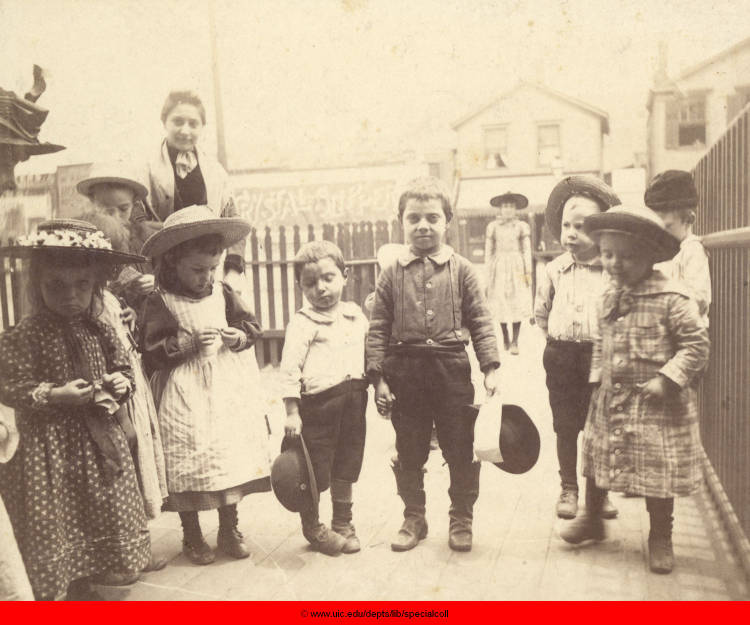
As a neighborhood-based settlement, Hull-House represented its surroundings, which meant that in its early years, the majority of its clientele were white immigrants. Photographs of early activities show this clearly.

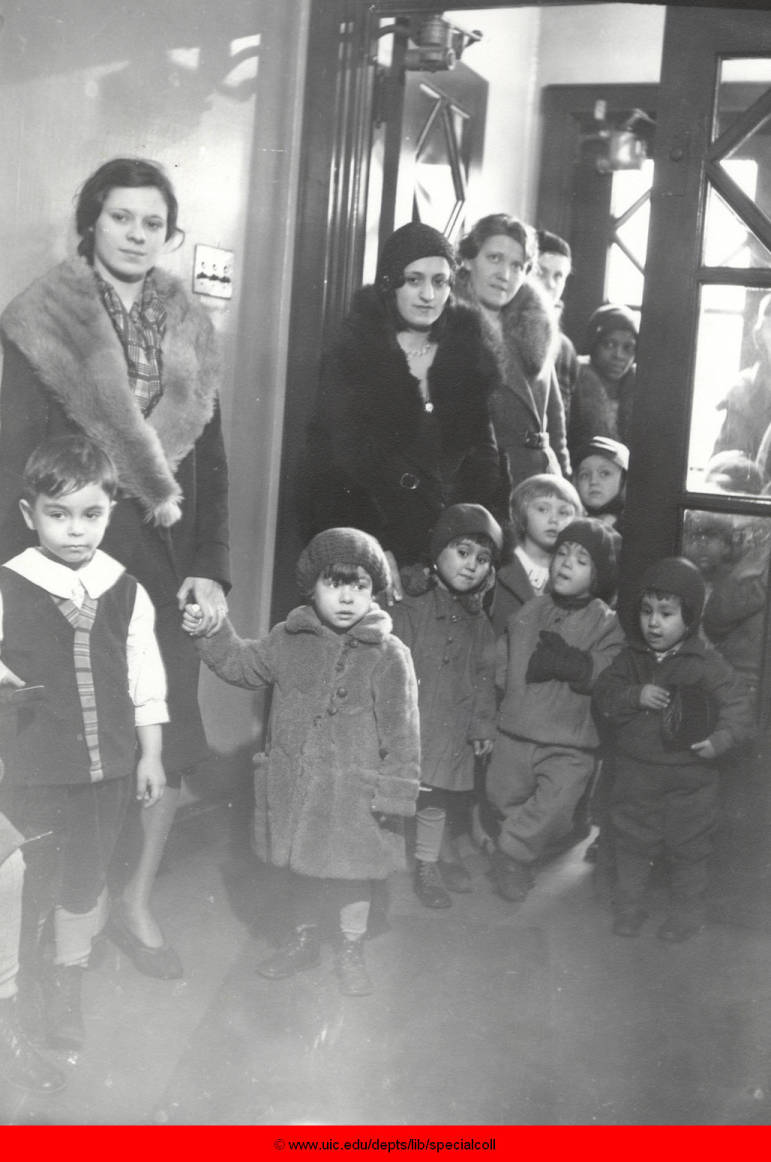
A vintage black-and-white photo shows a group of young children in old-fashioned clothing and hats standing outdoors, with an adult woman behind them and buildings visible in the background.
A group of toddlers outside Hull-House in the 1890s. At this point the neighborhood was predominately comprised of Southern and Eastern European immigrants. (Seven Settlement Houses — Database of Photos, University of Illinois at Chicago)

Many of clubs and associations that operated out of Hull House were developed around ethnic affiliations, which was a way to retain community and customs in a time of rapid change and Americanization. The range of clubs at Hull-House was vast, and the numbers of people in and out of the Hull-House grounds reached nine thousand per week between 1906 and 1916. The clubs and associations were organized and operated by their members, some, like the “Greek Olympic Athletic Club,” were made up of Greek immigrants interested in athletics; others like the Hull-House Electrical Club, was made up of men who worked in electrical occupations. There were Greek and Russian social clubs, a 19th Ward Socialist Club, and the Jane Club, which was a co-operative boarding club for young women that operated its own house with thirty bedrooms. There were also general Men and Women’s Clubs, Boys and Girls’ Clubs, and educational programs in art, practical employment skills, and English language classes.

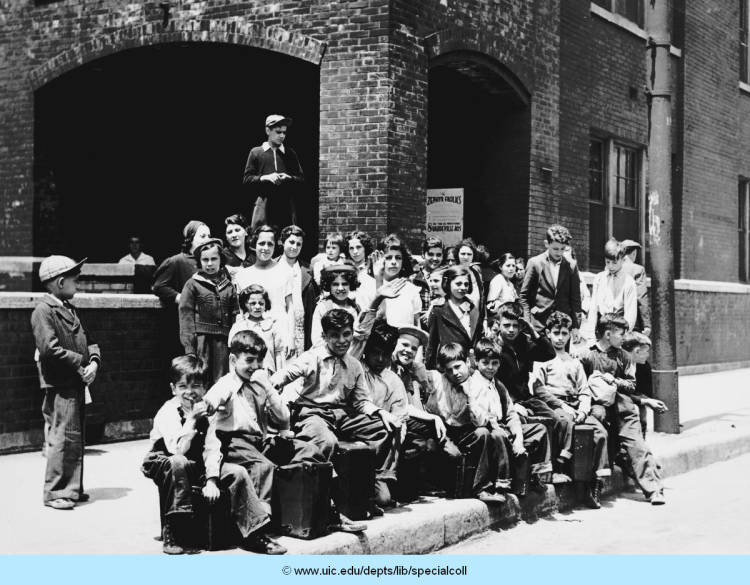
I find it unlikely that many of these clubs or programs were multi-racial in the first decades of Hull-House’s existence. Among the photographs of Hull-House activities located in archives at the University of Illinois at Chicago, photos from before 1920 depict what appear to be white groups.

A large group of children and a few adults pose for a photo on a city sidewalk in front of a brick building, with some children sitting on the curb and others standing behind them.
This photograph, dated only “ca. 1920s” by Wallace Kirkland, shows a group of neighborhood children preparing to leave for the Bowen Country Club. (Hull-House Photograph Collection,University of Illinois at Chicago)

There is some evidence of Black participation in clubs and groups at Hull-House before the 1930s.  In 1913, the Chicago Defender wrote an obituary of George Williams, “the only Negro boy connected with Hull House as a member. He was a member of the band and took part in all the active branches of the settlement. Miss Jane Addams praised him to the highest. The day of his funeral the full band was out and his casket was borne by three Italians and one Jewish boy.” (Chicago Defender, September 20, 1913.)

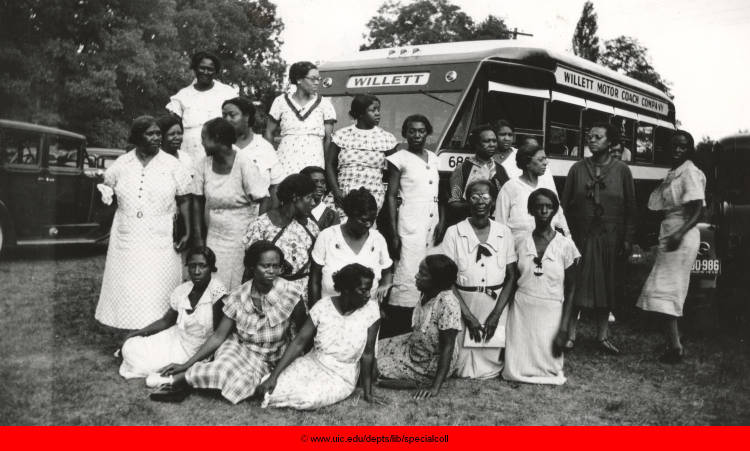
An African-American women’s club was formed at Hull-House in 1925, first called “The Colored Mothers’ Club,” and later the “Community Club.” They met on Monday evenings and held monthly interracial meetings which the Chicago Defender characterized as “not only harmonious and satisfactory, but very helpful.”

A group of Black women in dresses pose in front of a bus labeled “Willett Motor Coach Company” in a grassy outdoor setting, with vintage cars and trees visible in the background.
This photo from around 1927 depicts the Hull House Community Club, composed of African-American women. (Hull-House Photograph Collection, University of Illinois, Chicago).

The Defender continued:

In and around Hull House a large number of the foreign population moved into other neighborhoods, and their places have been taken up by our group. The residents of the famous social settlement are still living up to their ideals of helping the people in the neighborhood to adjust themselves, and our boys and girls are urged to join all of the classes, and with their elders are cordially invited to take part in all the activities of the place. (Chicago Defender, December 11, 1926, p. 5.)

But, does this one newspaper article tell the whole story? By 1937, the Defender characterized the Community Club as the medium through which Hull-House worked among the African-American community. The club was affiliated with the National Federation of Colored Women and its focus was on bettering conditions for African-Americans in their community. (Chicago Defender, September 25, 1937, p. 19.) Did Hull-House push African-American activity off to the side into one or two clubs? Did African-Americans feel welcome in the late 1930s when they walked into the settlement?

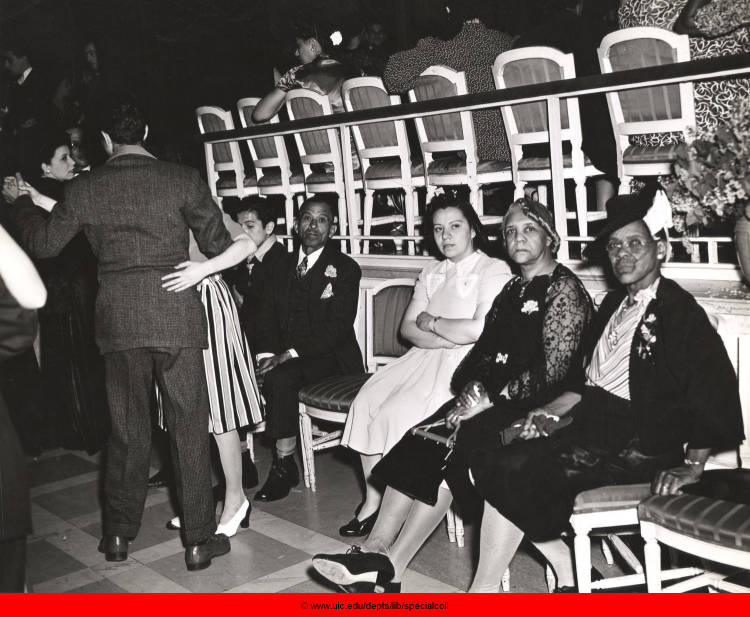
Dewey Jones, the Assistant Director of Hull-House in 1938 reported during a 1939 speech that one long-time member of the Community Club had complained that its members were not invited to take part in general community events. In 1941 a caption on a photograph depicting Black women at the Jane Addams Memorial Lilac Ball on May 24, 1941 noted that “Director Charlotte Carr insisted that African Americans be invited to the Ball.” The fact that Carr’s action was noted, makes it appear that it was not the norm.

Four people sit in a row of chairs watching a dance, while two couples dance nearby. The setting appears to be a formal event with women in dresses and men in suits. Some seats in the background are empty.
The Jane Addams Memorial Lilac Ball was held May 24, 1941 at the Stevens Hotel in Chicago. (Hull-House Photograph Collection, University of Illinois, Chicago).

Florence  Scala (1918-2007), an Italian-American resident of the West Side  and a volunteer at Hull-House from 1934 to 1954, recalled that though the Near West Side had a great mix of ethnic groups, “there were no blacks, blacks were not active in the Hull-House programs when I was going there.” (Carolyn Eastwood, Near West Side Stories: Struggles for Community in Chicago’s Maxwell Street Neighborhood (2002), p. 139.)

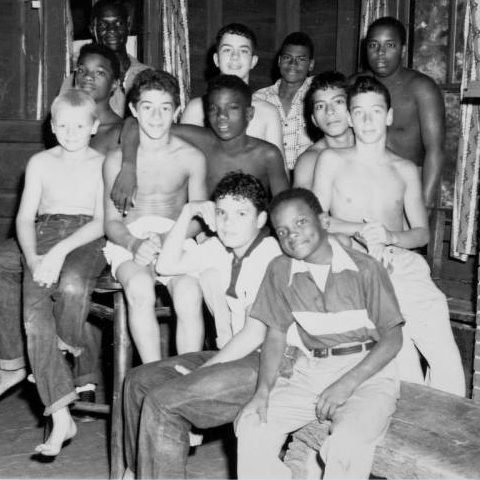
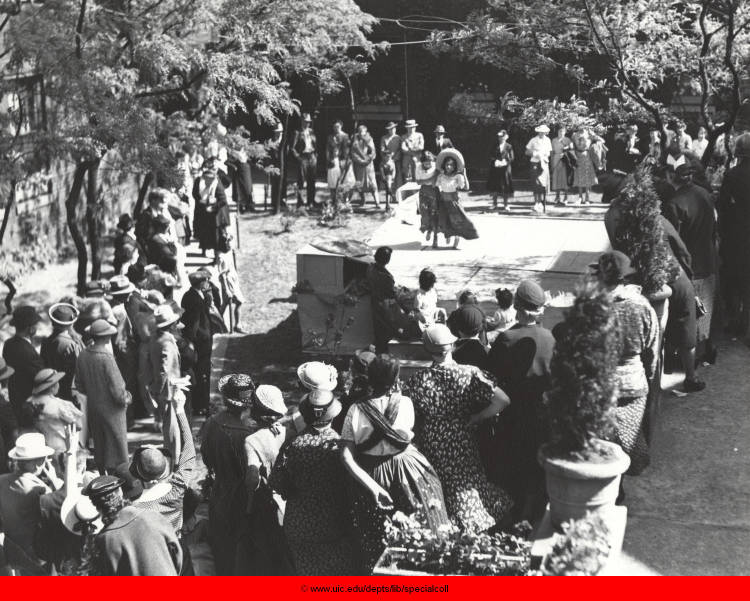
By the 1930s and especially by the early 1940s, photographs of Hull-House activities show the changing composition of the neighborhood.  There were Mexican fiestas, and pottery classes, and photographs of integrated children’s activities at the Joseph T. Bowen Country Club.

A Mexican fiesta was held at  Hull-House on June 13, 1941 for the purpose of bettering relationships between Mexicans and American in s the Chicago area. (Chicago Tribune, June 8,. 1941, p. 41. Hull-House Association Photograph Collection, University of Illinois, Chicago).

A group of twelve boys of diverse backgrounds, some shirtless, sit and stand closely together in a room with wooden walls, smiling and posing for the camera.
Boys at the Bowen Country Club camp run by Hull-House, ca. 1946. (Hull-House Photograph Collection, University of Illinois, Chicago).

A group of children in winter clothing stand in a hallway, some holding hands, accompanied by a few adults. The children appear to be waiting or lined up near a doorway.
Photos like these, with no clear date, save the “1920s-1930s” offer evidence of Black families participating in Hull-House programming, but not enough detail.  (Hull-House Photograph Collection, University of Illinois, Chicago).

So we are left with conflicting recollections and reporting. Did Florence Skala have a very different experience at Hull-House than the children who attended the Bowen camp in the 1940s? Were the adult activities more racially divided, broken into clubs that kept to their own kind? Without additional documentation, it is hard to make a determination that includes all the voices we have.

We can close with a look at what African-American reporters said at the death of Jane Addams in 1935.  In an obituary written of Addams in 1935, Thyra Edwards of the Pittsburgh Courier focused on Addams and Hull-House with regard to race.

Jane Addams had no ‘attitude’ toward the Negro. To her he was just one of the citizenship, one part of the whole. She recognized that the distinction of color exposed him more easily to attack and discrimination at the same time, adding a moral responsibility upon Americans to work against extraordinary exploitation because of color.

When Negroes moved into Hull House, there was no ‘consultant’ as to whether they should be accepted and in what proportions. Quite simply, new neighbors had come to Hull House and they found their way into whatever classes or groups they chose. (Pittsburgh Courier, June 1, 1935, p. 9.)

Another tribute to Addams was published in the Chicago Defender, where Eugene Kinckle Jones remarked:

Jane Addams made no special effort to lead the Negro to the Promised Land but by no act or thought did she eliminate this race from the classes or groups most in need.’ At Hull House, they had no set place but they were eliminated from no place. In her condemnation of crime, she condemned lynching. In her belief in the extension of suffrage to all, she included the Negro in her ‘all.’ (Chicago Defender, June 29, 1935, p. 3.)


Thanks to Louise Knight for her research into the question which she graciously provided.

Moving House

When the Jane Addams Papers Project came to Ramapo College in September 2015, space was a concern. The project was designed with the idea that undergraduate student workers would be an integral part of our work and in the early years, we were not quite sure where we would be able to fit them. Ramapo College has been a great partner to the project, giving us new space and increased capacity as the project has grown.

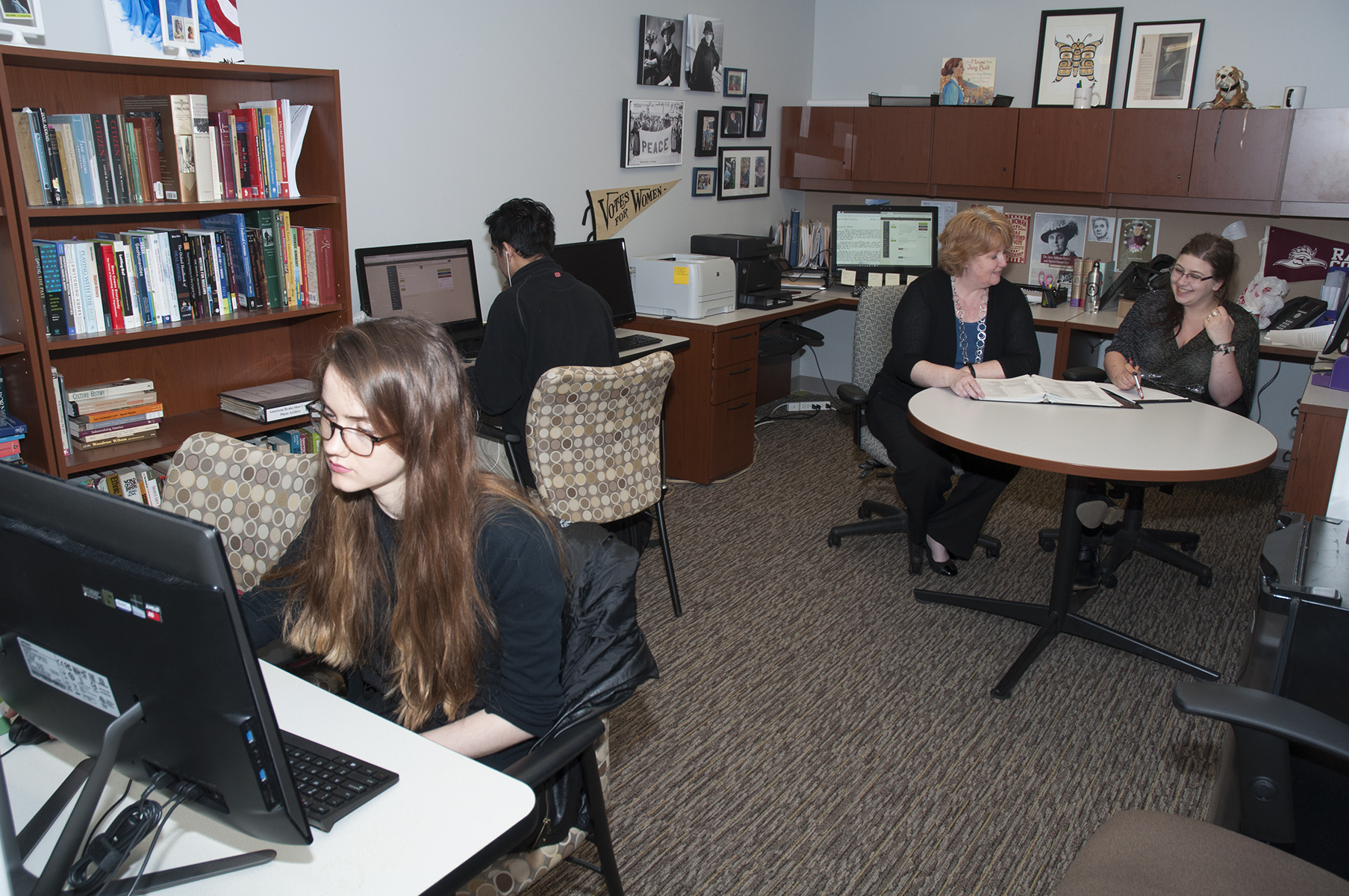
Four people work in an office. A woman uses a computer at the front, another person works at a desk with a computer, and two women sit together at a round table having a discussion. Shelves and office decor are visible.
Our current space. Students work at computers while Cathy and Tori discuss a document.

Our first office was a small faculty office, into which we squeezed three computer stations — one for Cathy, one for me, and one for a student.  A short time later, Ramapo provided me with an office next door. We squeezed in three more computer stations and were now able to have four (or sometimes five) students working with us.  We had to stagger schedules to make it work, and it got a little tight sometimes, but we built great camaraderie at close quarters. When we had too many students to fit, the Dean allowed them to use a conference room and sometimes we flowed out into the Library or student lounges. 

In 2018, with the Project hiring between 8-10 students per semester, Ramapo upgraded our space. We moved into a Project office, a large space where up to six students and two staff can work together. This space has become a hub of activity and attracts attention from faculty and students alike who pass in the hall. Working from home during the pandemic meant missing the collaboration that goes on in the office every day.

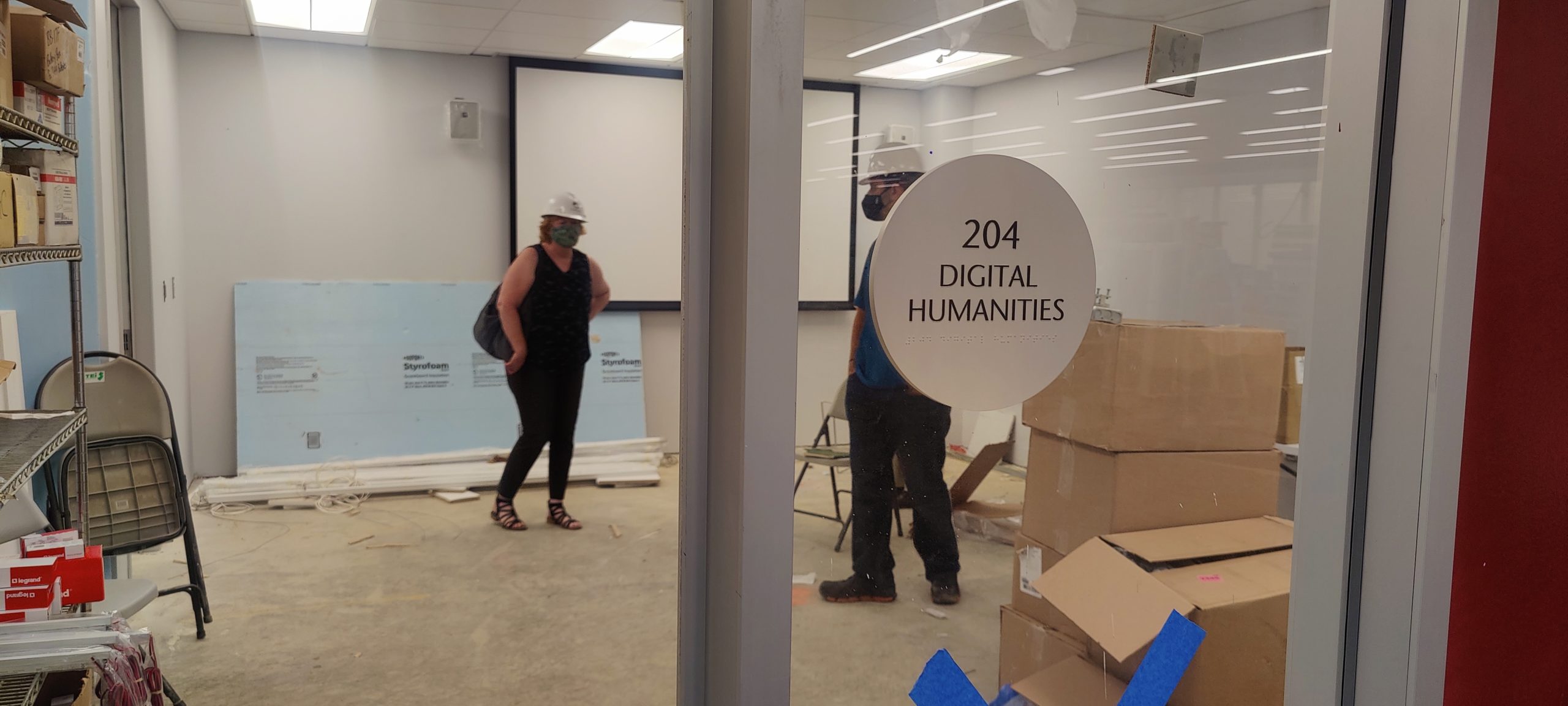
Two people wearing masks and hard hats stand in a room under construction behind a glass door labeled 204 Digital Humanities. The room has boxes, construction materials, and exposed floors.
Cathy discusses details of the office while standing in the unfinished space.

When the construction is finished, we will have a new home at the Peter P. Mercer Learning Commons. Ramapo’s newest building, an expansion and enhancement of the George Potter Library, has been under construction since 2019. While it seemed the project would never end, and we feared that the pandemic would slow construction, the end is in sight: Fall 2021.

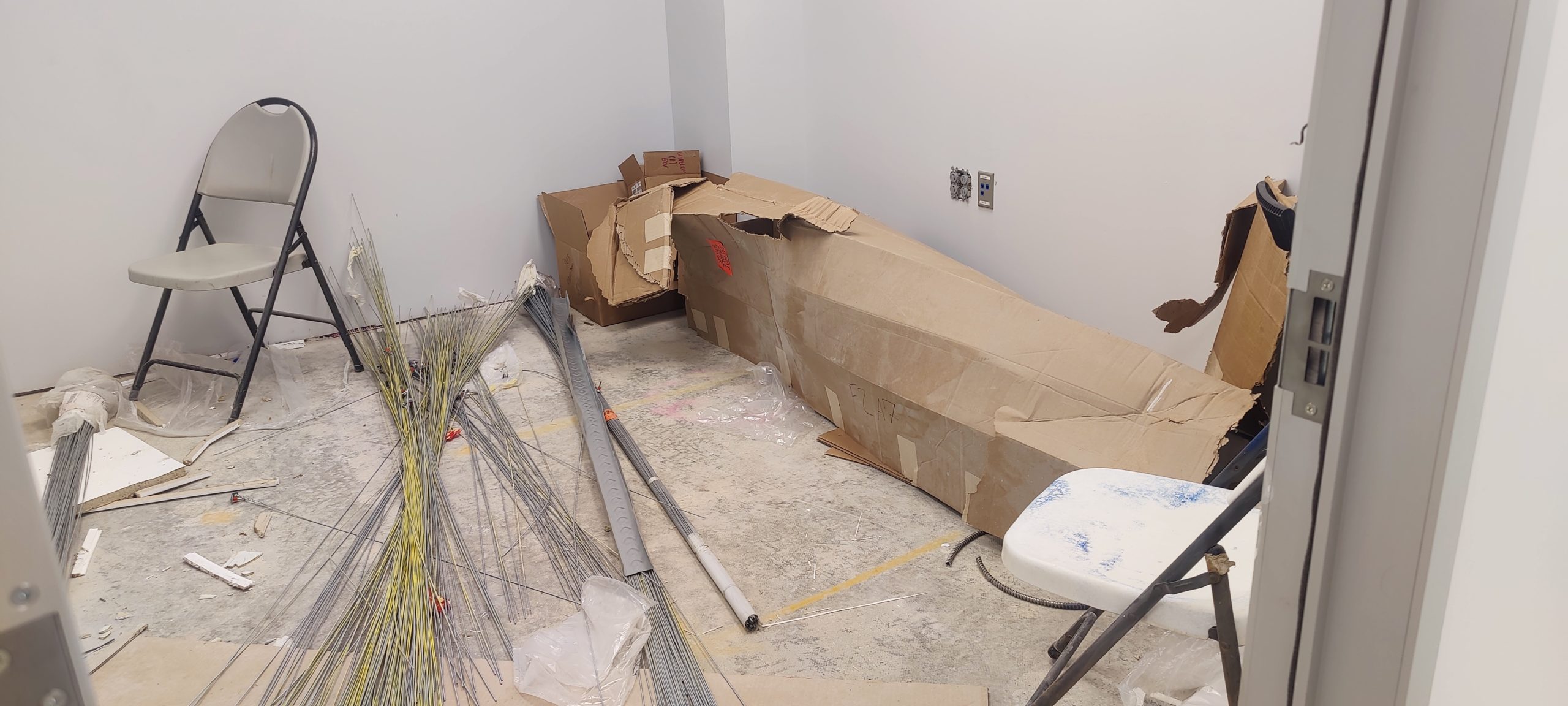
A small room with two folding chairs, cardboard boxes, scattered wires, metal rods, and debris on a bare concrete floor, giving the appearance of ongoing construction or storage.
Inside Cathy’s office, still very much a work in progress.

The Jane Addams Papers will occupy the Library’s Digital Humanities suite, with a large workspace that can fit eight or more students at a time, as well as space for my desk, files, and books, and a separate attached office for Cathy. We will be located on the Learning Commons’s second floor, close to the College Archives. All around us will be a brand new, four story library with abundant private and group study areas, smart classrooms and conference rooms, a café, outdoor seating, and a maker space. The hope is that this new lively space will become the heart of the campus and we are delighted to have a place there.

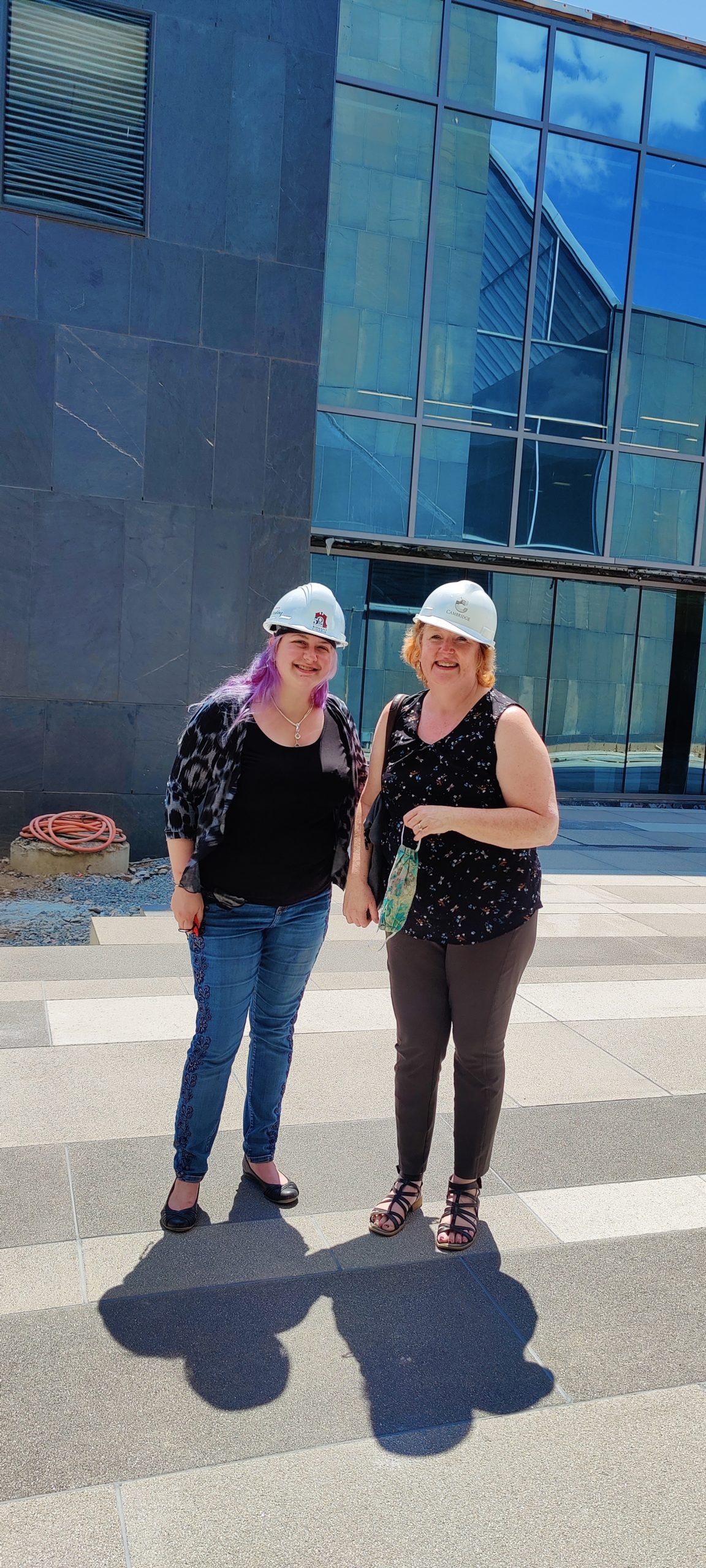
Cathy and I were recently given a hardhat tour of the construction site so that we could see our new space. Guided by Ramapo’s Director of Capital Planning, Daniel Roche, and Ramapo’s Construction Project Manager, Kosta Svarnas, we finally saw our new space! We are so happy that Ramapo gave us exactly what we wanted and needed in our new offices, and we could see all the possibilities of the space even while still under construction. Cathy’s office,

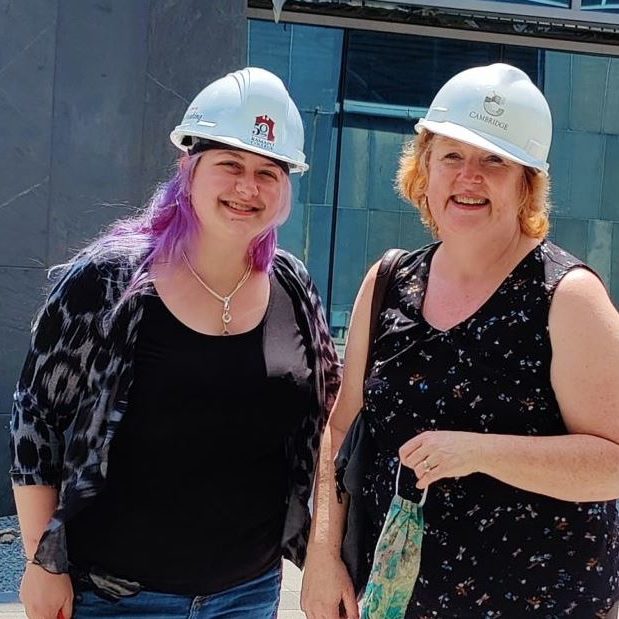
Two women in hard hats stand outside a modern glass building on a sunny day. One has purple hair and wears jeans, the other has short blonde hair and wears dark pants. Both are smiling and facing the camera.
Tori and Cathy stand outside the Peter P. Mercer Learning Commons.

connected to the main workspace, will allow her easy access to the staff while also being able to conduct private meetings with students and others. My space, just outside her office, will allow close work with both the students and Cathy, and we will finally have enough space to store our document images in our offices. We have an overhead projector and screen which will help train students and give presentations about the project.  And we will have a neat graphic presence that we will reveal once we are in the space.

While we don’t have an exact move in date, we are extremely excited about the future of the Project at the College and in this new space. And that, I think, is what really excites us the most.

Excavating the History of Women and the Peace Movement

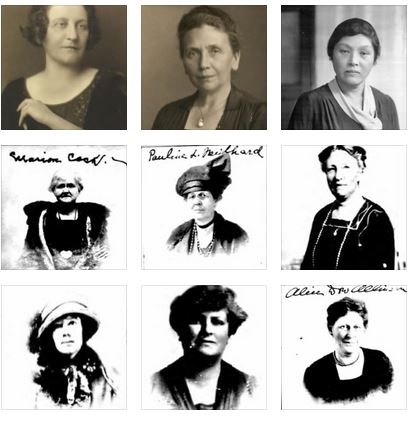
A grid of nine black-and-white portraits of women, some formal and some casual, with a few containing handwritten names above or beside the images.

The peace movement dominates Jane Addams’s work from 1914 until her death in 1935. Working through the Woman’s Peace Party, the International Committee of Women for Permanent Peace, and the Women’s International League for Peace and Freedom, Addams worked with her counterparts in many nations in a global movement to bring about peace, social justice, and equality.  She also served as the de facto leader of the American women’s peace movement.

Our detailed focus on the content of the documents and our efforts to identify the people mentioned in them yields a different kind of history than one that only focuses on the leaders of movements.  As we have begun publishing WILPF documents from both the United States and abroad, we are finding the names of early adherents, donors, and activists and adding them to the project’s database.

We know about Emily Greene Balch, Crystal Eastman, and Lucy Biddle Lewis, who were Addams’s coworkers for peace in the United States. But what about the rank and file? The women whose dollar donations funded the work of the WILPF? It turns out that within Jane Addams’s correspondence, we can learn about them too.

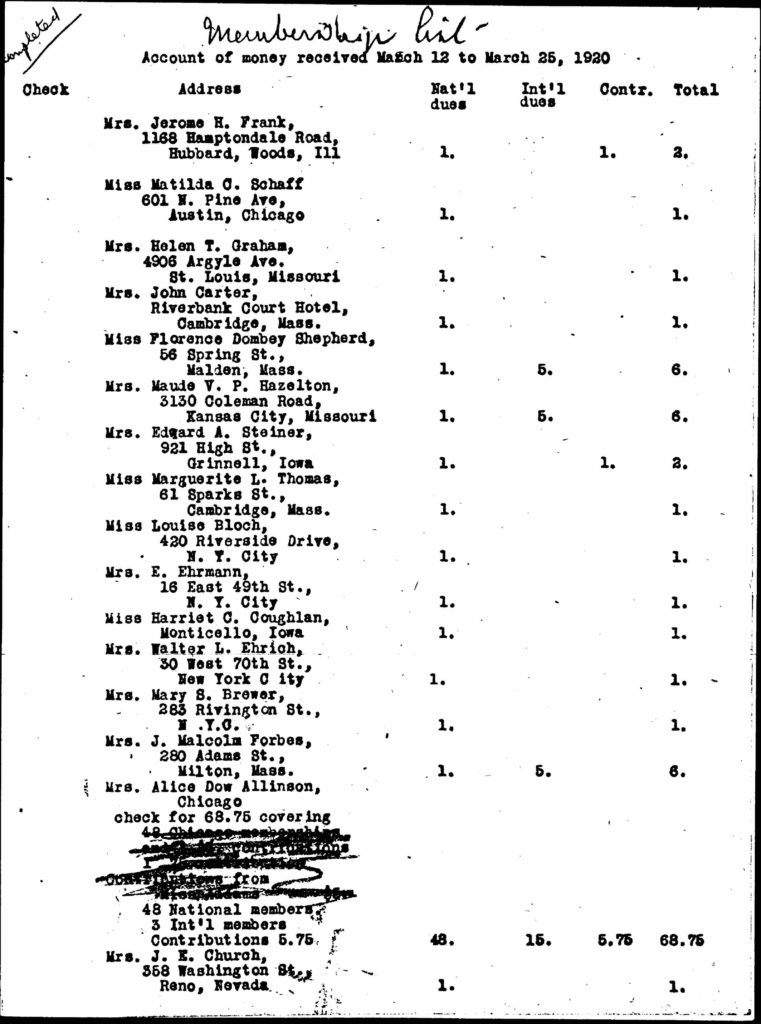
Typed list titled Membership Oil, detailing names, addresses, and amounts paid in National and International dues from March 12-25, 1920. Totals are calculated at the bottom of the typewritten page.

Eleanor Daggett Karsten, the secretary of the Woman’s Peace Party and then the United States Section of the WILPF, updated Addams every few weeks in 1920 with information about the women joining the new league, founded in 1919 at the International Congress of Women. As a document to add to our edition, I have to admit that each time I saw one of these multi-page columnar lists, I sighed, knowing that this one document might take a week or more to completely enter into our system due to the number of names. Thankfully, most of these lists contained street addresses, which made it easier (though not always easy!) to identify the women.

It didn’t take long to realize that instead of drudgery, adding the names of the early members of the WILPF was historical excavation of the best kind. Our biographical work is carried out in two steps. First the student or editor who enters the document into our system tries to link the name on the document to an existing name in our database. We use an Omeka-based system and a plug-in called Item Relations, to search the more than 12,0000 names in the system. When the person is not there, we add them. In this stage, the goal is to simply identify the person so that we are sure they are not duplicated and that we have verified their basic information.

We strive to add birth and death dates, full names, and a short biography, which we don’t publish until the second stage, when a student researcher does more in-depth work and drafts a full biography. Our goal is to then create relationships between the people in the edition and the organizations and events they participated in. This social network of Addams’s world being built slowly document by document, is one of the results of the project that we are most excited about. It will take time to build the data up, but it is time well spent.

For women, that means that “Mrs. Jerome H. Frank on 168 Hamptondale Road in Hubbard Woods, Illinois,” becomes “Florence Kiper Frank (1887?-?)” A draft biography, that isn’t publicly available yet notes that she was a member of the United States Section of the WILPF and was married to lawyer Jerome H. Franks and had a daughter named Barbara. Much of this comes from census records (having a street address on these lists is an enormous help),  local newspapers, and other web-based resources to get accurate information.  We create a bibliography pointing to the sources used so that others can follow our trail.

It is extremely exciting to find a photograph of the women, often in the U.S. Passport Applications that we access via Ancestry.com. Though the images are not of the best quality, hopefully we can add scanned originals at some point in the future.  We have also found that having even these short biographical stubs accessible on the web means that family members can find the project and see the associations that their ancestors had with Addams and peace. We have already received some photographs and biographical information from family members and hope that this will increase as we add more names.

Some of the more challenging research revolves around women who worked for peace outside the United States. There are many complicating factors—misspelled or partial names, the lack of genealogical resources for most non-English speaking countries, lack of language skills among our staff to read and search foreign-language resources (Google Translate only helps so much!), and often a lack of detailed geographical  information about where they lived.  Many of these peace activists are hard to trace through World War II, as records of pacifists and peace organizations often did not survive the war.

But adding them, even with partial names and limited dates, accomplishes something. As we enter more documents and move into the 1920s and 1930s, we uncover the names of those who participated in the Women’s International League for Peace and Freedom, and in time we will learn more about their lives as well.

Teaching Jane Addams in High School AP Classes

Text logo reading New Jersey Council for the Humanities in bold, dark blue letters at a diagonal angle on a white background.

Text logo that reads: New Jersey Council for the Humanities in bold, dark blue letters slanted diagonally upwards to the right on a white background.We are delighted to announce that, with a grant from the New Jersey Council for the Humanities, we will be working with a group of New Jersey high school  teachers and an educator from the Jane Addams – Hull-House Museum to explore ways to use the Jane Addams Digital Edition in high school AP classes.

The award, Developing Digital Educational Modules for High School AP Courses, will support a series of virtual meetings between Addams Project staff, and a select group of high school teachers from around the state. We are especially excited to also be working with Michael Ramirez, the Education Manager at the Jane Addams – Hull-House Museum in Chicago.

Two Ramapo College teacher-education students, Allie Cheff and Marina Kaiafas, will work with the teachers and Addams staff to develop primary-source-based educational materials that draw from the digital edition.

A black and white portrait of a woman with short, wavy hair wearing a high-collared blouse and a dark dress, looking directly at the camera with a neutral expression.Jane Addams’s work during the Progressive Era and early 20th century was wide-ranging, and available topics range from her work in establishing social settlements, professionalizing social work, fighting against child labor and the persecution of immigrants and African-Americans, working to win support for woman suffrage, and her efforts for peace and social justice through the Woman’s Peace Party and the Women’s International League for Peace and Freedom.

We will hold a virtual symposium at the end of the grant to talk about what we learned and make publicly available to the materials on the project’s Education hub. We will also develop a guide for archives and other editing projects to help them create similar resources based on their holdings.

Teachers invited to participate are from all over the state and have extensive teaching experience. They are: Staci Anson (Ramapo High School), Yvonne Beatrice (Mahwah High School, ret.), Katherine DeVillasanta (Clearville Regional High School), Joseph Dobis (Franklin High School), Joseph Dwyer (Nutley Public Schools), Angela Funk (Indian Hills High School), Keri Giannotti (Bloomfield High School), Scott Kercher (Sparta High School), Faye Johnson Brimm Medical Arts High School), Allison McCabe Matto (Red Bank Regional High School), Louis Moore (Red Bank Regional High School), Frank Romano, Jr. (Perth Amboy Public School), Robert Schulte (Neptune High School), and Patricia Yale (Hillsborough High Schoo).

This grant builds on work that we did a few years back, also funded by the NJ Council for the Humanities, that developed National History Day guides and lesson plans using the digital edition for middle school students. Renee Delora, who led that effort, has joined this project to provide support to the student workers.

Monuments vs. Documentary Editions: How Best to Remember the Past

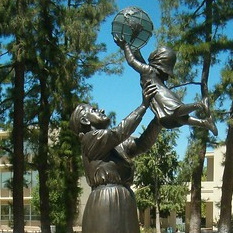
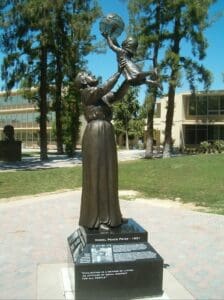
Bronze statue of a woman lifting a young girl who is reaching toward a globe, set outdoors among tall trees and buildings in the background.

A toppled statue lies on its side on a sidewalk, with people standing and walking in the background, some photographing the scene.
A statue of Christopher Columbus outside the Minnesota State Capitol was taken down by American Indian Movement members on June 10, 2020.

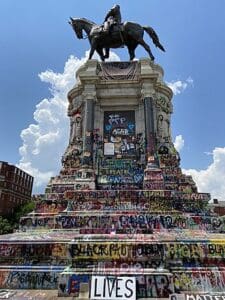
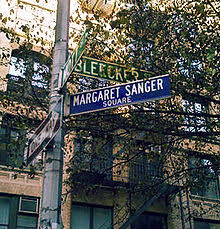
We have all been thinking and talking about monuments, about how they are created, what they mean,  and when or whether they should come down.  Whether it is the toppling of the likeness of Christopher Columbus in Minnesota, efforts to remove the Robert E. Lee statue in Richmond, or the removal of Margaret Sanger’s name from Planned Parenthood of New York’s downtown clinic, the meaning of monuments and our understanding of the past is being challenged. Monuments are a problematic way to understand history. They are a one-note, simplistic way of claiming that a person  mattered to the people that put them up. Over time, they become something else, icons of the cities in which they are located, and a shorthand guide to a history that glorified mostly male and mostly white political and military leaders. They offer a simple message — hey, this guy was great! We understand the danger of this kind of simplification when talking about living people. We even have a phrase to warn us about the risks of doing it — putting someone on a pedestal — or to believe or behave as if someone  is perfect  to the extent that one ignores that person’s flaws or faults.

A statue of a person on horseback atop a large pedestal covered in colorful graffiti and messages, including Black Lives Matter, against a blue sky with clouds.
The Robert E. Lee Monument in Richmond has been defaced with graffiti. The governor announced plans to take it down on June 4, 2020, but this has been challenged in court.

And it is the faults and the flaws of the people we have honored with monuments that are being exposed now.  It is past time. No one, now or then, is perfect. How can we reconcile honoring an individual who owned slaves, or who fought against the Union, or who held racist, sexist, or eugenic views? On the flip side, how can we ignore the context of the times they lived in? Is it right to hold people to ahistorical standards of behavior? We have to place people in historical context, based on an understanding of what the world was like when they lived. This isn’t just making excuses or becoming an apologist for figures from the past.  We have to stop seeing people as either good or evil, heroes or villains, and instead be able to see the grey, to praise what they did well and condemn what they did that was intolerable. We have to stop putting them on pedestals.

A Better Way to Learn About the Past

A street sign reading Margaret Sanger Square at the intersection with Bleecker St, with trees and a brick building in the background.
A name on a sign or a building, or a statue doesn’t tell much about the person, for good or ill.

If a monument is too simplistic — too one-note — to convey the complexity of a human life and the historical times they lived in, what is the alternative? I would argue that it is the documentary edition, made freely available, that brings understanding of the complexities of the past. My career as a historian has been as a documentary editor, first with the Margaret Sanger Papers, and now with the Jane Addams Papers, so I may be biased, but I also speak from experience.

A documentary edition is not a film, it is a compilation of historical documents, prepared by scholars, on a theme of historical importance. It is usually centered around a single person’s life, but occasionally describes a group, such as the Freedmen and Southern Society Project or the Yale Indian Project’s Native Northeast Portal.

We center the work around the words of the historical figure

Much of the work of the editor revolves around finding, selecting, and transcribing the letters, speeches, diaries, and other texts produced by a historical figure. We use our historical training and long hours of reading literally everything a person wrote to select documents that offer a nuanced and complex view of that person’s life and career.

We don’t shirk from the negative or controversial. When selecting documents for the Selected Papers of Margaret Sanger, we made sure that her views on race, on eugenics, and on abortion were included alongside her views on women’s rights, civil liberties,  and reproductive freedom. With the Selected Papers of Jane Addams, we look to highlight Addams’s views on race, poverty and immigration, just as much as her ideas about social work and peace.

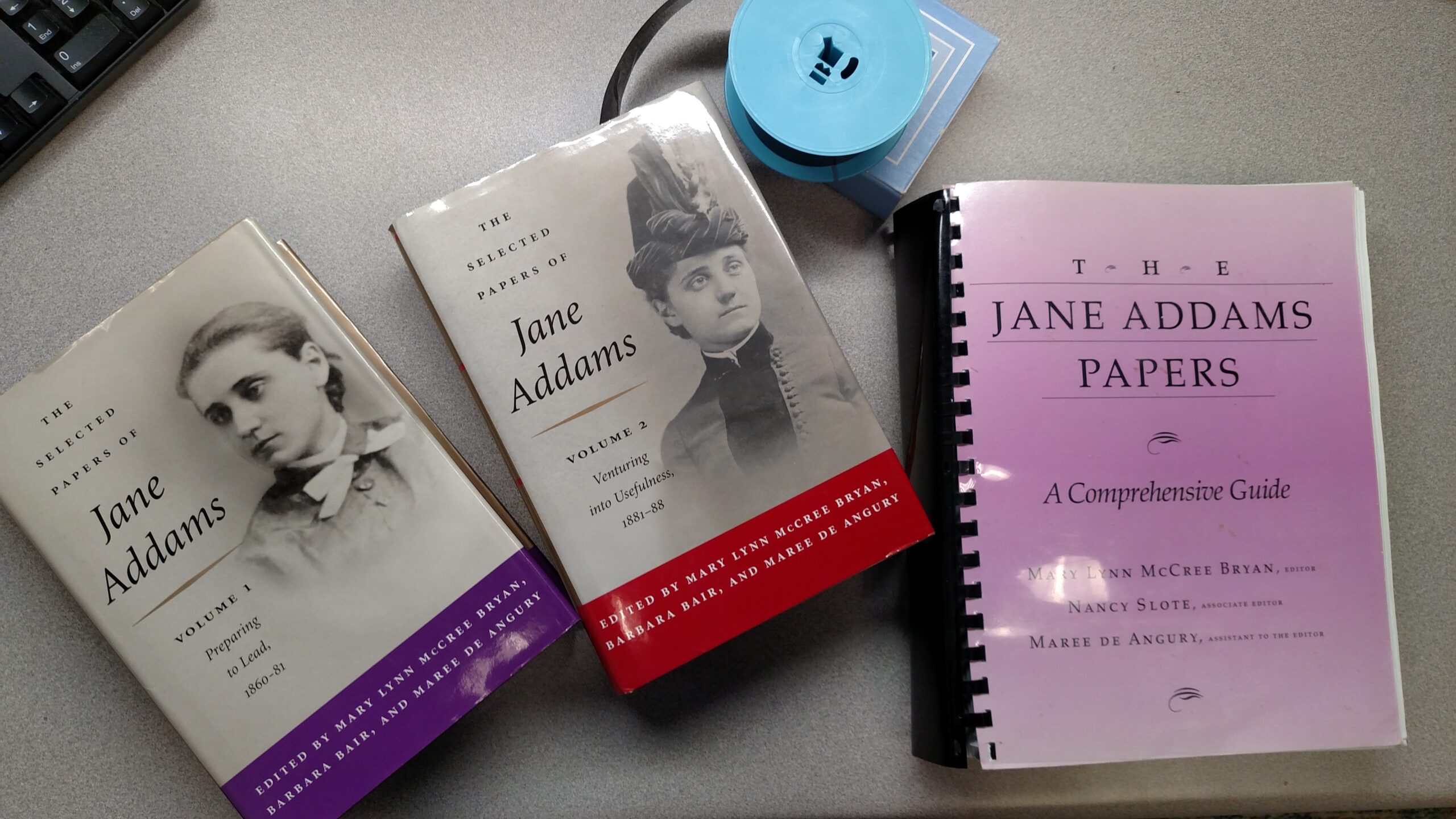
Three books titled “The Selected Papers of Jane Addams” and “The Jane Addams Papers: A Comprehensive Guide” are arranged on a desk near a keyboard and a roll of blue tape.
The Jane Addams Papers Project consists of a microfilm, print edition (6 volumes planned) and a digital edition based on the microfilm.

Many editions create two products. The first is a comprehensive edition, often digital nowadays, but in the past they were published on microfilm. These collections, resulting from years-long searches in archives and private collection, are extremely valuable for scholars because they bring together materials that were dispersed over the globe. The selected edition, often published in book form, though increasingly in digital form, takes the most historically significant materials and adds annotation, to create a readable series that tells a shorter, yet nuanced, story of the figure’s life.

We work really hard to make sure that the texts of the documents that you read in our editions are accurate and complete.  You won’t find snippets of texts removed or taken out of their context  in order to make an argument.  We proofread the transcriptions as many times as is needed to get a good, accurate text. The focus is on the document, and by reading them, one after another, you gain a deeper, personal understanding of the subject.

We provide historical context, but leave interpretation to you

Editions use annotation (headnotes, footnotes, and introductory texts) to give the reader a sense of the times, to fill in the gaps when the texts don’t do it. Editorial annotation is not the same as historical interpretation. This was brought to my attention when working on an early draft of my dissertation on birth control clinics, when my adviser, Linda Gordon, pointed out that I wasn’t disclosing what I thought about all the materials. My text was descriptive and it needed to be analytical and interpretive.  I was writing like an editor, carefully researching and describing situations, but not bringing my own views, ideas, and analysis to the foreground. Writing an interpretive narrative is a different animal, one in which your experiences and the times in which you live color the way that you approach a topic. Think about multiple biographies of the same person — the basics of their lives stay the same, but the questions we ask, the values we bring to the topic affect the way that we view and interpret the past. Editors aren’t immune to those same biases, but our approach is different.

Our annotation is document-driven. What I mean by that is that we look at the texts, written by our subjects, and explore their content. When a person or event or topic is mentioned, we add a footnote to explain who or what they are talking about. There is no better training than researching for a documentary edition.  You don’t get to decide that the topic is too hard and you can’t skip over things or change your research direction, like you might do in a monograph or term paper.  These notes are generally short and informational rather than interpretive, which teaches you to be precise and succinct. Reading the text with the footnotes helps the reader understand things that a contemporary reader would already know.  I liken it to reading with the town busybody standing over your shoulder, providing you with the backstory for each document.  Except that busybody is a historian.

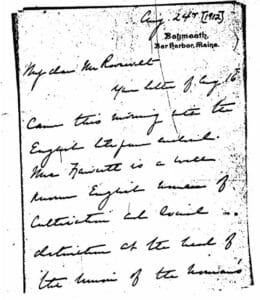
A scanned, handwritten letter dated 1913 from Bar Harbor, Maine. The writing is slightly slanted and cursive, and the paper shows signs of age with darkened edges and faint ink in some areas.
Jane Addams to Theodore Roosevelt, August 24, 1912.

Annotation can also fill gaps in documentation. The nature of a selected edition is that we have left many, many documents out.  For example, we selected a letter written to Theodore Roosevelt from Addams in 1912 about her role in winning women to the Progressive Party. This was not the first letter written about the topic, so we use annotation to summarize what already occurred before that document was written. It brings the reader up to the now.  We also use annotation to refer readers to material in archives and in our comprehensive microfilm or digital edition where they can go deeper.

Where does interpretation fit in all this? After reading so much and researching every bit of a person’s life, editors do form opinions and interpretations. They might turn up in the introduction to a volume, a conference paper, a blog post,  journal article, or monograph. The litmus test, for me, is whether a person who doesn’t like the subject can use our work with confidence. Will they trust that you haven’t hid or obscured documents or other materials that could make your subject look bad? My favorite review of the first volume of the Selected Papers of Margaret Sanger was from the Weekly Standard, where David Tell wrote:

Somewhere, amidst the sucker punches and cries of foul, the truth must reside. And “somewhere,” it turns out, is the enormous and altogether dazzling selection of public and private records just put out by the manuscript curators at New York University’s “Margaret Sanger Papers Project.” They too, like the earlier biographers, unambiguously admire the woman. But they have done their editing with scrupulous care, they have annotated the documents they reproduce with monk-like dispassion, and on the face of it they have held nothing back. (January 27, 2003)

History for the Masses

Digital scholarly editions, made freely available, are a far better monument to the life of a historical figure than statues or buildings could ever be. They provide a historically accurate, nuanced look at a life. They show the moments of weakness as well as moments of great strength and more than biographies or statues ever can, they render historical figures as real people. People with problems, people who have difficult family members, who follow fad diets, watch plays and movies, and fully lived in their times. They also foster critical thinking about historical figures and moments. While editions won’t fit easily into 140 characters or a 15-second TikTok video; neither does history.

Who we select to be the subjects of editions matters

Editions don’t stand outside society, and there has been a long history of privileging the papers of white male politicians and military leaders. Whether the founding fathers, presidents, or generals, the subjects of these editions sound much like the names on monuments, and the names we all learned in history books. The editions of these papers provide a more nuanced view of those lives, including co-workers, rivals, families, and in some cases, slaves.

A bronze statue of a woman lifting a child holding a globe, set outdoors on a pedestal. Buildings and tall trees are visible in the background under a clear blue sky.
A statue of Jane Addams lifting an immigrant child on the campus of Cal State Fresno.

In the 1970s, the field began to open up, adding a handful of projects featuring women and African-Americans. But it is not enough. We need to broaden the topics of editions to include the voices of marginalized peoples. And we need to broaden the range of people who become editors, because more voices will reveal a more vibrant story of America’s past. Smaller projects, based on intriguing people reveal lives and stories that have been erased from popular notions of history.  It is happening, albeit slower than we would like.

Thinking again about monuments, I wonder if there might be an “edition-worthy” check before you put up a monument. Could you devote years of research, funding, and scholarly effort to create the Papers of Edmund Pettus? And after you had done so, exploring his ideas and providing context for his military career, his political views, and his leadership in the Ku Klux Klan, would you build a statue or name a bridge after him?


Visualizing Jane Addams’ Social Networks

A network diagram showing names of historical figures, with lines connecting them. Addams, Jane (1860-1935) is centrally located in large text, indicating importance, with many lines radiating to other names.

I recently took a course on Gephi, an open-source network visualization tool offered by the Programming 4 Humanists group at Texas A&M University. This three-session Zoom-based course, taught by Katayoun Torabi was a great entry to a digital humanities topic that I have long been interested in.

One of our long-range goals at the Jane Addams Papers Project is to make the underlying data in the digital edition accessible so that digital humanists can use it for research. Having a chance to play around with network visualizations helped me to think through how we might use this tool to understand Jane Addams’s life and her causes in new and interesting ways. It also helped me better understand what we need to do to make data from our edition available.

A few ideas popped out immediately:

    • a visualization of Addams’s correspondence, modeled on the ideas used to create the Mapping Republic of Letters project at Stanford.
    • a visualization of how people in the Addams’ digital edition were connected via organizations, looking at for example, the interactions between women involved in the suffrage movement and the peace movement.

In this post we will look at correspondence networks.

Thinking About Data

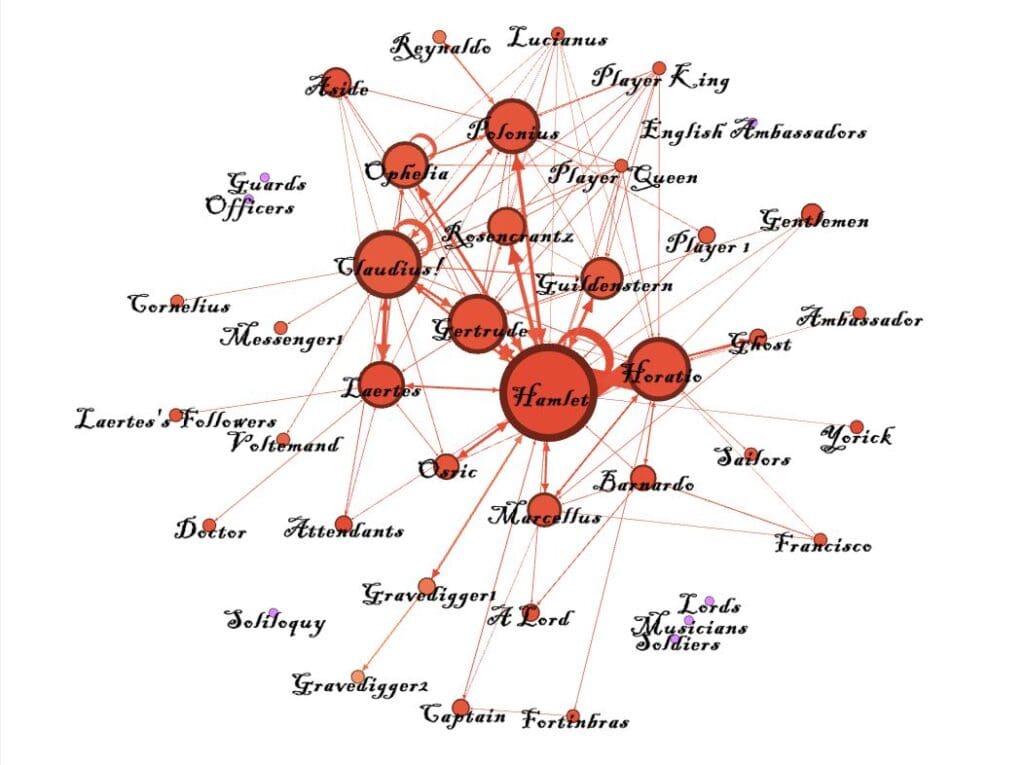
The examples that Katayoun used in our class were all drawn from literature. We mostly worked with data from Shakespeare’s Hamlet, looking at instances of speech between characters to create visualizations of how the characters related to one another.

A network diagram of Hamlet characters, with nodes sized by importance. Hamlet is central and largest, linked to others like Claudius, Gertrude, Horatio, and Polonius; smaller nodes represent minor characters.
Here is my visualization of Hamlet using Katayoun’s data set. Central characters have larger circles and appear in the center, while less important characters are further out, smaller and have fewer appearances.

What struck me almost immediately was that the difference between this kind of analysis and what I hoped to do, was that with a literary work (or any single historical record), this analysis can provide an accurate representation of that text. As I thought about how we could this tool to understand the Jane Addams Papers, the problem of incomplete data reared its ugly head.

We have to understand that any visualization of the Jane Addams papers cannot fully be a visualization of Jane Addams’ lifeAddams’s papers are incomplete. We are missing many of Addams’ most intimate letters between family members and her long-time companion, Mary Rozet Smith. At best, we might be able to visualize more of her professional life than her personal one. But we are also missing many, many letters sent to colleagues and acquaintances that never made it into archives and private collections. Many of the papers of Addams’s European counterparts did not survive World War II. So what we are left with is an impression, a partial glimpse into her world, but an imperfect one.

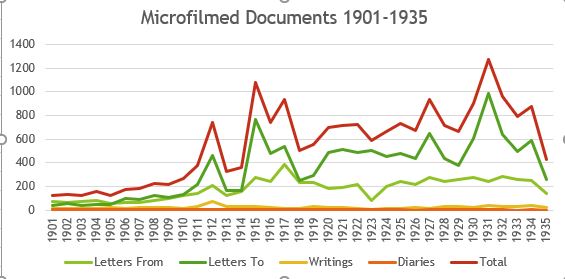
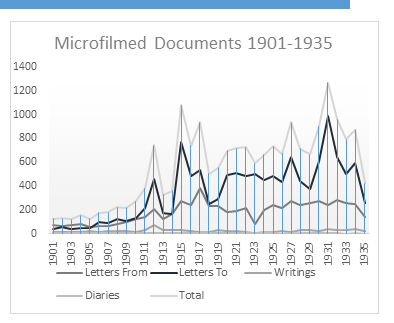
What can counts of letters tell us about Addams’ life? When I first took on editing the Addams Papers, I tried to estimate (by counting entries in the microfilm edition index) how many documents we had in the base collection so that we could estimate how long the project would take. Even as basic a visualization as the one below can help you see the broadening of Addams’s life as she moved from a local activist to one who operated on a global scale.  It can give a rough visualization of when things happened in her life.

Line graph showing the number of microfilmed documents from 1901-1935. Four colored lines track Letters From, Letters To, Writings, and Diaries, with total documents peaking around 1927-1932 before sharply declining.
Counts from the microfilm index.

This red line (total documents) gives us a good sense of scale, and also the  years where we could expect the heaviest number of documents. In the first ten years (1901-1910) we had low document counts, which rose dramatically in 1912 (Addams’s participation in the 1912 presidential election), 1915 (Addams’s establishment of a peace movement in the U.S. and international peace congresses). Her activity through the 1920s and early 1930s remains high, with peaks in 1927 and 1931 (Addams’s Nobel Prize).

Looking at the lighter green line (letters written by Addams), we see a fairly consistent output until the end of her life. The only outlier is 1923, a year in which Addams was on a tour of Asia and then suffered from serious illness.  It is possible she wrote fewer letters, or fewer of them survived. Most of the dramatic peaks come from increases in incoming letters.

Anneliese Dehner, our web developer prepared a spreadsheet that represented the Item Relations for people in our digital edition. I was able to work with that in a rudimentary way to explore Gephi.

Nodes and edges

In network visualization there are two tables of information, nodes, which are unique objects, and edges, which link nodes by some kind of action. The hard work of network visualization is gathering all this data so that it can be displayed by Gephi or any other tools.

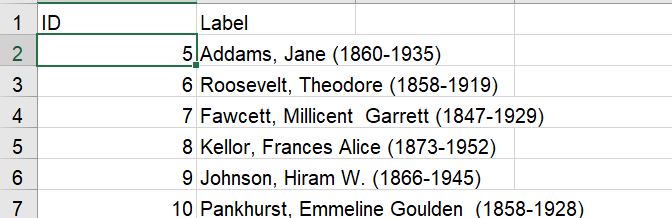
    • For a correspondence network, the NODES are the people in the database. They get an ID (in our case the Omeka ID number on our database) and a LABEL (the name of the person).

A spreadsheet showing two columns: ID and Label. IDs 5 to 10 are listed with names and birth-death years, including Jane Addams, Theodore Roosevelt, and Emmeline Pankhurst.
Here is a snippet from the Nodes table. Each name in the database is assigned a unique identifier.

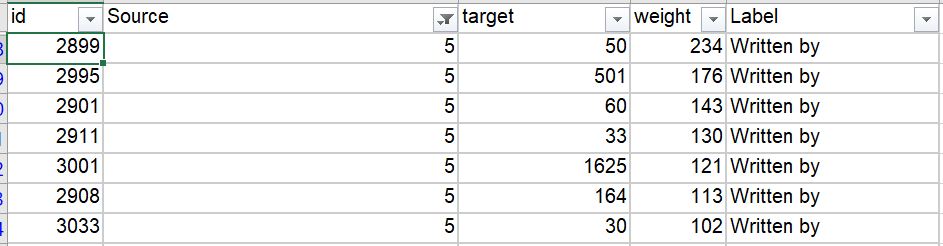
    • The EDGES represent the letter. They contain an unique ID, a SOURCE (the ID number of the author of the letter) a TARGET (the ID number of the recipient of the letter) and a WEIGHT (the number of times that that same combination appears). They can also have a LABEL (the relationship — in this case “Written by”). The most common recipient, with 234 letters, is Sarah Alice Addams Haldeman (#50), the sister of Jane Addams. In second place is Emily Greene Balch (#501), a co-worker in the peace movement, donor Anita Blaine McCormick (#60) in third place, and social worker and settlement founder Lillian Wald (#33) in fourth place.

A spreadsheet showing columns labeled id, Source, target, weight, and Label. Rows contain numerical values under each heading, with “Written by” appearing multiple times in the Label column.
This table of edges show author Jane Addams’ (#5) most frequent recipients.

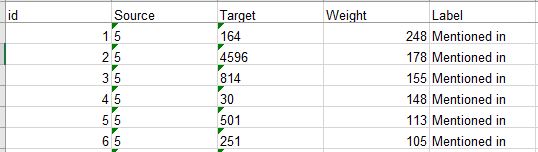
    • Another table of EDGES describes the people who were Mentioned in a document, not just the authors or recipients. This might get at a more representative understanding of Addams’s network because one could surmise that important people might be mentioned in letters even if the correspondence between those two people might be lost. And here we do see different results. On this table Mary Rozet Smith (#164), Addams’s companion comes out at the top, with Woodrow Wilson (#4596) coming in second, donor Louise DeKoven Bowen (#814) in third place, and Addams’s niece, Marcet Haldeman-Julius (#30) in fourth place.

Spreadsheet showing six rows and five columns with headers: id, Source, Target, Weight, and Label. Each row has numbers under the first four columns and the text Mentioned in under Label.
This table shows the most commonly mentioned people in letters written by Jane Addams (#5).

Basic Visualization

My first visualization of the mentions data was, to be frank, underwhelming, unless you like big black boxes of goop!

A list of names and dates is mostly obscured by a large black rectangle in the center, making the majority of the text unreadable. Only partial names and dates are visible at the edges.
There are simply too many points in this data!

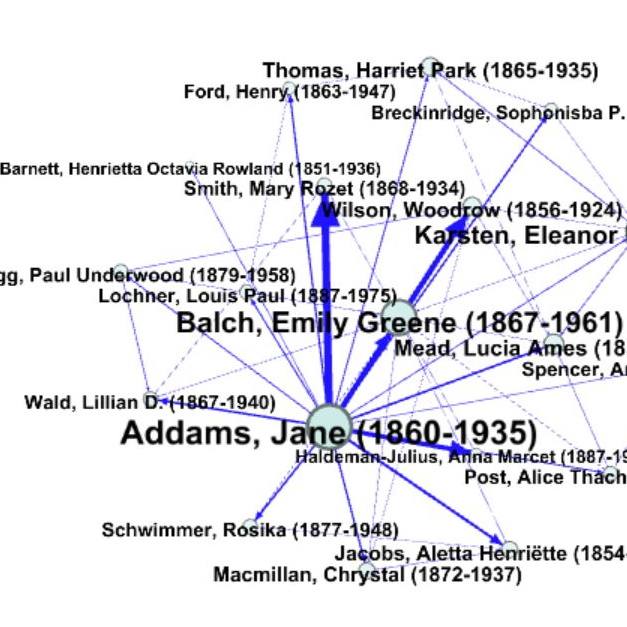
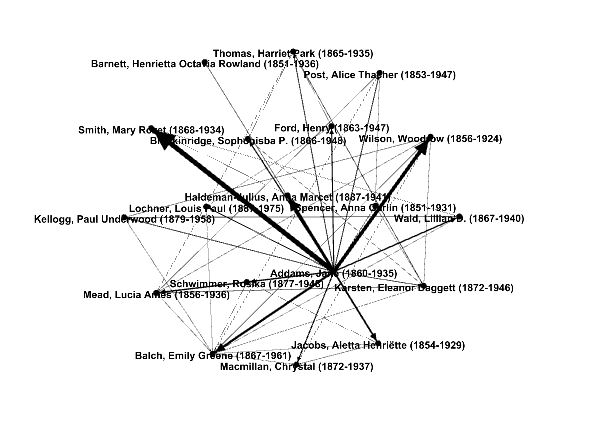
We have over 10,000 names in the NODES table. To get to a visualization that is more legible, I excluded edges with less than 10 mentions in the correspondence.  Now that is readable! The weight of the line indicates the number of mentions.

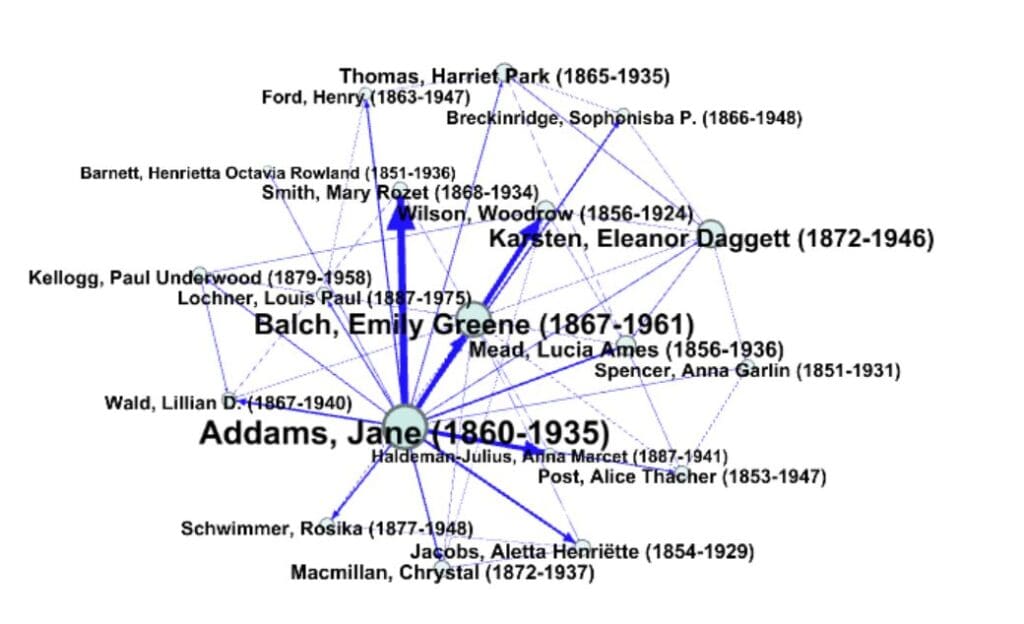
A network diagram showing connections between various women, each labeled with their name and lifespan, with lines indicating relationships or interactions among them. The central figure is Addams, Jane (1860-1935).
These are the people mentioned the most in the digital edition, thus far.

I played with the appearances of our networks to make them easier to understand. Making the labels and the circle sizes proportional to the number of mentions allows you do see things more clearly.

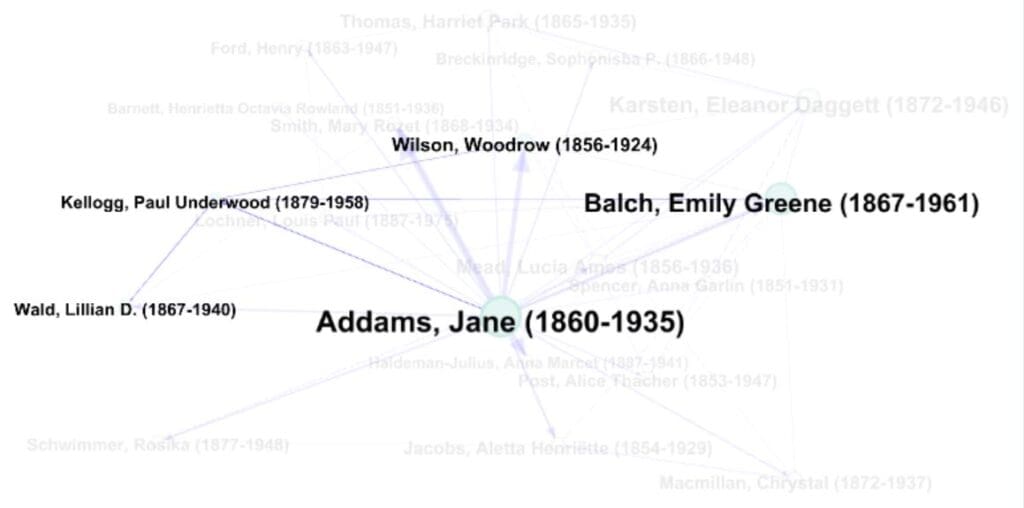
A network diagram showing connections between historical figures, with Jane Addams (1860-1935) at the center. Names and birth-death years are shown, connected by blue lines indicating relationships.

The visualization is interactive. If I click on Paul Kellogg’s circle, only those names associated with him are highlighted– in this case a small subset of the network.

Network diagram showing names of influential figures, with Addams, Jane (1860-1935) and Balch, Emily Greene (1867-1961) in bold and largest font, indicating prominence. Faint lines connect to other names.
Paul Kellogg of the Survey’s network.

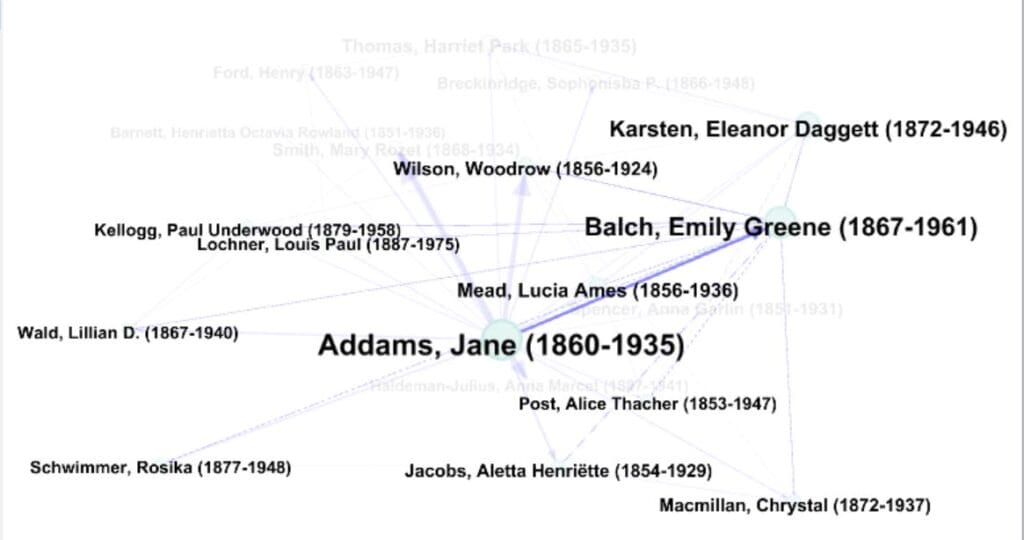
While Emily Greene Balch, a peace activist, is far more interconnected.


A network diagram with names and life spans of historical figures. Addams, Jane (1860-1935) is central and bold, with other names connected around her, including Balch, Emily Greene (1867-1961) and Karsten, Eleanor Daggett (1872-1946).
Emily Balch worked with Addams in the Woman’s Peace Party and the Women’s International League for Peace and Freedom.

The idea here is to explore the various networks that Addams built in her work for peace, social justice, social work, and other causes.

Next steps

Generating the data to build the NODES and EDGES tables requires some work, and filtering the data to get a meaningful result will be critical to creating data sets that the public can use. Our goal is to make this kind of data accessible to students and digital humanists to explore data visualization and Jane Addams.

We are still adding documents to the digital edition, so the first step may be building a dataset of correspondence for each year that we have completed.

In my next post, I’ll look at building a network using our data on people and organizational membership.

Survey on Digital Editions

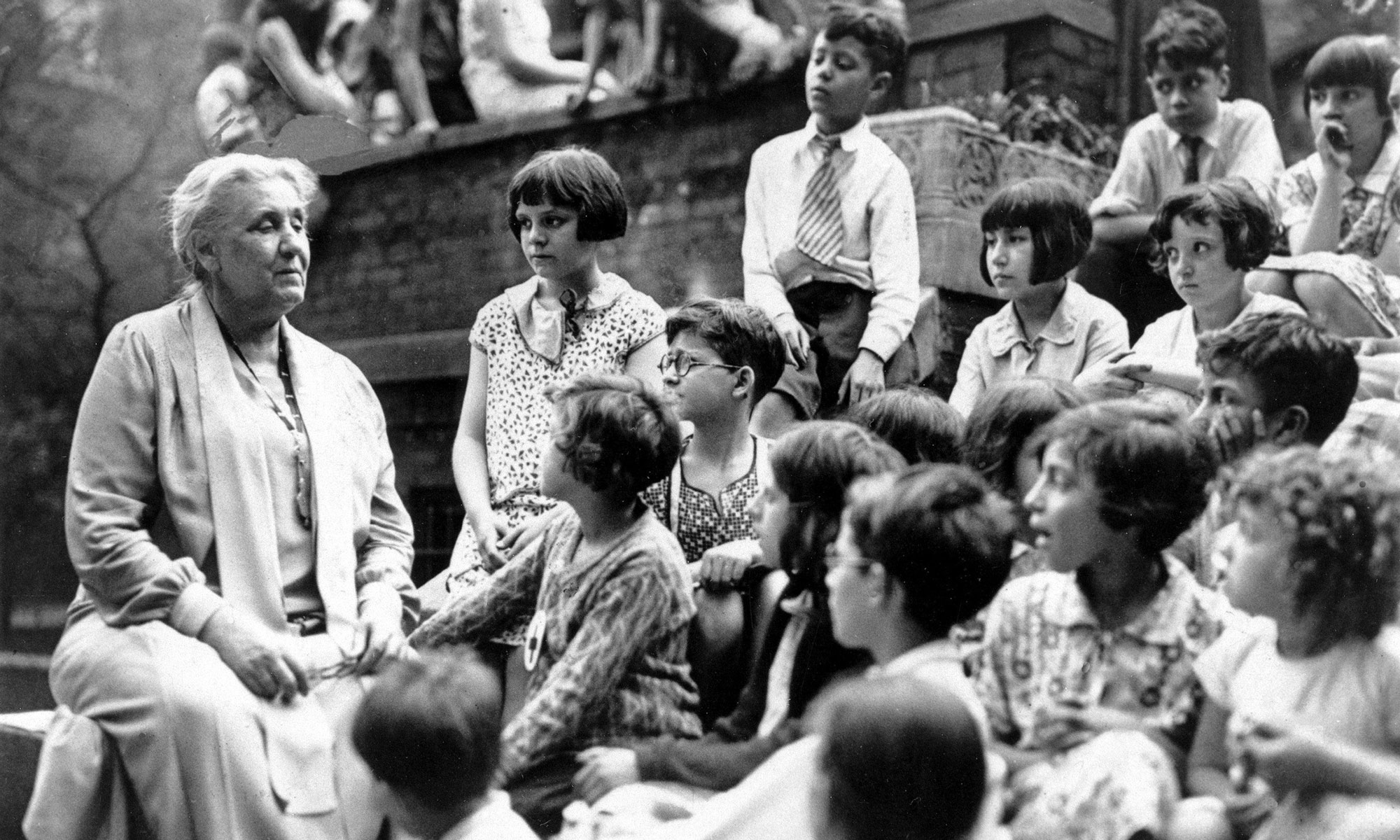
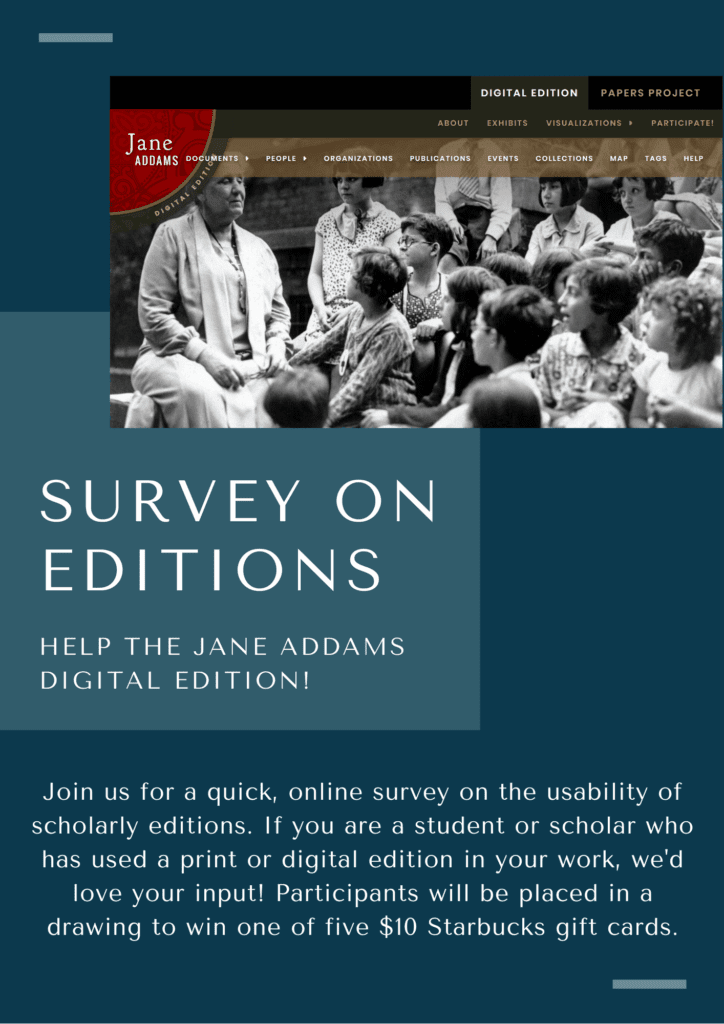
Black-and-white photo of Jane Addams sitting and speaking to a group of children. Text below reads: Survey on Editions. Help the Jane Addams Digital Edition! Website menu is visible above the photo.
Digital flyer promoting the Jane Addams Digital Edition survey, featuring a black and white photo of Jane Addams with a group, and offering a chance to win a $10 Starbucks gift card for survey participants.
 
 
The Jane Addams Papers Project, in partnership with the University of Michigan School of Information, is exploring the user experience for both the Jane Addams Digital Edition and scholarly digital editions in general. If you are a student or a scholar who has used at least one print or digital scholarly edition in the past, we would be grateful if you could take 5–10 minutes to participate. The survey will be open until Wednesday 3/18. Responses are anonymous, but we will gather your email address at the end to enter you in a drawing for a Starbucks gift card!

Standing on the Shoulders of Giants

A stack of U-Haul moving boxes and a Florida Citrus box are seen in front of a wall with a poster featuring a stylized face. A window with blinds is partially visible on the right.

When the Jane Addams Papers started work in 2015 at Ramapo College, in many ways it felt like a brand-new project. We were focused on the digital edition, developing metadata rules, learning how to read Addams’s charming handwriting, and immersing ourselves in turn of the century Chicago and the work of Hull-House.  But we were not a new project. We built our edition standing on the shoulders of the original Jane Addams Papers Project, founded by Mary Lynn Bryan in 1975.

Working with a team of dedicated editors, Mary Lynn produced an amazing microfilm that became the basis for our digital edition. We scanned that microfilm in 2015 and started working with the images, beginning in 1901, on our digital edition. The  microfilm edition represented decades of work; they  conducted an international search for Addams documents in archives,  private collections and published sources, organized the documents and indexed them. At the start of our project, they had published two volumes of the Selected Papers of Jane Addams (since then Volume 3 has been published).

The microfilm headers that her team created gave our undergraduates a real head start when working with the texts. A letter to “Alice” was in fact a letter to Addams’ sister “Sarah Alice Addams Haldeman,” carbon copies of letters that had no signatures were identified clearly in the targets. They also identified the place where the letter was written from and sometimes the correct date.

A scanned document with typed text at the top showing a date (1901 Jan 10), sender, recipient, and library information, above a handwritten letterhead from Hull-House, dated January 10, 1901, with cursive writing below.
We left the microfilm headers on the scans showing the work of the founding project.

And even more, we had the index to the microfilm. Unlike most other editing projects, the Jane Addams Papers Microfilm Index identified not just the authors and recipients of letters, but most time, the people mentioned in those letters, and in some cases the subjects. So, if “Edith” was mentioned in a letter and the students (or editors!) did not know who Addams was talking about, we could consult the microfilm index, and with a little adjustment, convert a microfilm reel and frame citation to our digital image files. This really helped in the early days of the project, when most of the correspondents and associates were not in our system.

This January, Assistant Editor Victoria Sciancalepore took a road trip to North Carolina to get some of the archives of the original Jane Addams Papers Project. We brought the precious boxes, filled with index cards, copies of the documents and targets that were used to create the microfilm, and archival search records. It was exciting to unpack them and fill our file cabinets (and then some!) with these records, which we immediately put to use.

While most of the scans from the microfilm are good quality, there are some that are difficult to read. In the past we identified documents with poor images with an “Onsite” tag. Slowly but surely we contacted or traveled to the archives to get a new image. Some were penciled originals or light blue carbon copies that had been copied, then microfilmed, and then scanned. To our delight, we were able to substitute the copy in the Addams Project files for a number of light scans, which will save us time and money.

Even more valuable, and appreciated by student transcribers, many of the files also included handwritten transcriptions for some of the more difficult to read handwritten documents. While the first three volumes of the Selected Papers only carry the story to 1900, these transcriptions are throughout the collection. It has helped clear up a lot of [illegible]s from our early transcriptions.

Our debt to the editors that went before us, finding, organizing, transcribing and editing these documents cannot be overstated, and we want to thank each and every one of them!


Data Visualizations and Jane Addams

Artistic, pixelated portrait of a person in profile view, rendered in grayscale with dark and light square blocks obscuring details, creating a digital, abstract effect.

Artistic, pixelated portrait of a person in profile view, rendered in grayscale with dark and light square blocks obscuring details, creating a digital, abstract effect.Last spring I had the pleasure of working with two undergraduate students, Taylor Lundeen and  Catie Olson, enrolled in the University of Michigan’s School of Information. They worked on a capstone project on data visualization, using our Jane Addams digital edition databases.  Anneliese Dehner, our web developer, helped out with the some technical aspects of the collaboration.

One of the many great things about digital publication is that the information we create can be reused and repurposed in ways that we might not have thought of. Making our data available to researchers to explore has been one of our goals from the start of our work on Jane Addams, and with this investigation we have learned what we can do fairly easily, and what is more complex.

 Accessing the Data

Our first step was to get a copy of our data exported out so that Taylor and Catie could work on it. What they found worked the best was an Omeka plugin (Omeka Rest API) that allowed them to export data in a format that worked well with data manipulation software.

Our ultimate goal is to have a utility on the digital edition that will enable users to download all or parts of the data for investigation.

One problem that reared its head immediately is that we have a very large dataset, and it is growing larger every day. This made it difficult, using the tools they had available to work with the whole set.

Natural Language Processing

One of the approaches, which Catie worked on, was seeing what we could learn from analyzing the “Text” field in our database, where transcriptions are stored. This kind of analysis can track the frequency of words, or compare word usage over time. Eventually it could be used for topic modeling, where a digital tool tries to make sense of words that appear together. These groupings can uncover connections that we sometimes don’t expect.

An important step in working with our texts was data cleaning, the process by which HTML and special characters were cleaned out and text was split word by word. Then Catie built bar charts that displayed the most common words. She built a separate chart for each year to allow us to compare years to see what Addams was thinking and writing about.

The most obvious finding to me, was that we needed to think about stop words — words that are excluded in the results because they are too common or have no analytical meaning. Articles, like “a” and “the” are common stop words– we also had to consider “page” which we use to signify the next page in our transcriptions, and, gulp, even “Hull House” because we transcribed the letterhead that Jane Addams used. Other words like “Mrs,” “Mr.” and “Miss” and salutations like “Dear” are candidates for being pulled from the analysis.

We also got to see the frequency of that nemesis of editors – “illegible.” This comes up far more frequently than I would like, but I was gratified to see that in the years where we have proofread the texts, the frequency is much lower.

It will surprise no one that “peace” and “war” shot to the top in 1915.

Bar chart titled “Most Common Words 1915” showing “peace” as the most frequent word, followed by “war,” “women,” “page,” and others. Bars indicate the number of appearances in text, ranging from 500 to 2500.
Frequency of words in 1915.

In 1905, the most frequent words deal more with the plight of children and represent Addams’ work on child labor and welfare in Chicago.

Bar chart titled Most Common Words 1905 showing Chicago and people as the most frequent words, followed by work, children, great, need, clear, and others, based on their number of appearances in text.
Frequency of words in 1905.

Catie also worked on another way to show the content of Addams’ writings, plotting the frequency of a word over time. Similar to the Google n-gram viewer that can compare the frequency of words in Google Books over time, this gives you a sense of the chronology.  We did not have the capacity at this point to allow users to type the words they want, but were able to produce n-grams for some of the most popular words.

Seen together, it is a little frightening, but on the live version on the site, you can select a single word to analyze.

A colorful line graph titled Top Fifty Words shows the relative frequency of various words over time from 1890 to 1920. Each line represents a different word, with a legend on the right identifying the words.
The Top 50 Words, all in one place!

Line graph showing the relative frequency of the word peace from 1900 to 1920, with a sharp spike peaking around 1918, then a rapid decrease by 1920. The y-axis represents frequency; the x-axis represents years.
Tracking “peace” from 1901-1917.

The n-gram for “Illegible” shows the power of proofreading! When the data was downloaded for use, we had just finished proofreading 1915!

A line graph shows the relative frequency of the word illegible from 1900 to 1920, with a sharp increase around 1915 and a steep decline just before 1920.
An n-gram of words we could not read.

Social Network Analysis

Another approach was to see what we could learn from social network analysis. Using Omeka’s Item Relations plugin, we have been tracking relationships — mostly between documents and the people, organizations, and events that are mentioned in them. We also are building connections between people and organizations, tracking which people were members of which organizations, for example, or who participated in a specific event.  We wondered whether the relationships between people and organizations might yield some interesting insights, or whether we could find other connections between people and the metadata gathered about them. Taylor was responsible for this project.

Our large dataset proved to be problematic for developing a meaningful social network based on shared connections. We think there is promise for this in future by controlling which people are included in the network, but the sheer number of people and the amount of common tags produced a daunting graph.

A colorful network graph with labeled nodes connected by lines, representing various professions and fields linked to Hull-House, with a legend listing categories like Journalism, Law, and Woman Suffrage on the right.
This plot includes only 270 Addams connections associated with Chicago. The full data on 8,000 names was too complex to load.

Instead, Taylor created a geographical visualization of Addams’s social networks related to several topics. We used our tags for movements like “Woman Suffrage,” “Child Labor,” and “Peace” and plotted their geographic locations.  Compare Addams’ Settlement Movement network and her Peace network below to see the expansion of her work internationally.

World map titled Peace Movement Network Map with red dots marking locations across North America, Europe, parts of Asia, Australia, and a few in Africa and South America.

On the live version of these maps, you can zoom in and out and mouse over each dot to reveal the name of the activist.

Going Forward

It was amazing to see what two talented students could do in such a short period of time!  The experience has helped us think more about how we want to make our data accessible, and has uncovered challenges that we need to think about. Our database is large and complex and developing means to limit the queries is going to be important.

We are looking forward to working with other UMSI students and any digital humanists interested in advancing this work.

“Peace, War and World Order”- Dr. James Marquardt’s Web-based Timeline

The influence Jane Addams had on society is no secret; we still talk about her beliefs, achievements and historical footprint today. Jane Addams has done so much in her life that Dr. James Marquardt, Associate Professor of Politics and the Chair of International Relations Program at Lake Forest College, and his students have created an online timeline of her achievements. The timeline is called Jane Addams- Peace, War and World Order: A Web-based timeline.

The abstract of the timeline acknowledges her strides to improve the lives and living conditions for immigrants and the poor, but this timeline focuses more on her “peace advocacy,” during World War I. After looking over numerous primary and secondary sources Dr. Marquardt and his students have completed their timeline, successfully illustrating Jane Addams’ pacifist beliefs and opposition to international armament and war.

“I started digging into her primary writings on the war,” said Dr. Marquardt, “and I decided that I wanted to do this a little more elaborately so I offered a course called Jane Addams Peace Advocate. It mostly focused on her international peace advocacy before, during and after the war.”

After Lake Forest College received a grant for the school to develop digital pages and Chicago-related events, phenomena and historical developments in the humanities and social sciences, Dr. Marquardt then applied for a grant to build a page dedicated to Jane Addams peace advocacy and her historical significance, which he received and then began hiring students. Together they began studying, analyzing and building the Jane Addams – Peace, War and World Order timeline.

The timeline focuses mostly on Addams’ involvement in WWI and her opposition of the war, but Dr. Marquardt plans to continue to study Addams with the hopes of continuing to expand the timeline from her involvement in the Peace Movement with it ending when Addams received the Nobel Peace Prize. He plans on taking all of his knowledge about Addams and writing a book entitled “Jane Addams: The Great War and Her Quest to Transform National Relations.”

He’s not the only one who feels passionate about Addams; Dr. Marquardt explained that his students are very passionate about her as well. “They’re really into [the project]. Addams is such an inspirational figure that they’re a little too generous towards her, in terms of their writing and their public presentations that they’ve made about her.”

Since the timeline highlights Jane Addams’ peace advocacy I had to ask Dr. Marquardt to define peace advocacy in his own words.

“I would define it as actions, writings, ideas related to efforts to end war. That’s my thinking about it, but my students have a much more generous viewing of peace advocacy, they see peace as not simply something we ought to strive for in our international relations in our social relations generally.”  

Dr. Marquardt has learned a lot from his students during this process. “Their understanding was that advocating for peace is not simply a global issue but an issue of interpersonal relations. It’s about the end of violence along racial lines, it’s about the end of violence against women, violence against children, hunger, deprivation, unemployment.” They share the same vision and beliefs that Jane Addams did and they carry on Addams’ beliefs and visions for a brighter future for everyone.  

The website went live last week and for those interested in viewing Dr. Marquardt and his students work the link is here: http://digitalchicago.lakeforest.edu/exhibits/show/jane-addams/our-purpose.

Ardent Girls and Amy Merrill’s Passion for Addams


An older woman with short gray hair smiles while sitting in a chair. She is wearing a dark patterned top and a gold necklace. There are orange tulips and a window with sunlight in the softly blurred background.
Amy Merrill (https://www.amymerrillplays.com)

Amy Merrill, playwright of ARDENT GIRLS, has an upcoming reading of her play on February 22. The play is about Jane Addams, the sisterhood at Hull House and Addams’ 1896 encounter with Leo Tolstoy. She was willing to talk to me about her project, her work and her passion for Jane Addams.

Merrill was inspired to write her play once she read about Jane Addams’ encounter with Leo Tolstoy.  She read an excerpt from the “Second Twenty Years at Hull House,” where Addams traveled to Russia and Tolstoy could not stop staring at her sleeves. Merrill explained that this encounter gave Addams a lot to think about because Addams admired Tolstoy. But the experience gave Merrill “leeway to sort of come up with my own idea about what happened and how she felt about it and how the impact of the visit had on the rest of her life.”

In her play, Merrill depicts her idea of the Addams-Tolstoy encounter. She’s always been attracted to encounters by different types of people. Addams and Tolstoy are very idealistic, high-minded people, but they’re both different types of people. “It’s also fun to write the scene because it takes place in Russia at the Tolstoy Estate whereas most of the place takes place in Chicago. So it’s kind of fun to sort of transport everybody to Russia. So it’s the improbable, real-life encounter with Leo Tolstoy.”

A woman in a Victorian-era dress with puffed sleeves sits on an ornate chair with carved griffins, looking slightly to the side. The photo is black and white, with a formal, historical atmosphere.
These are rather large sleeves! (Jane Addams, 1898, in the gown she wore to visit Tolstoy).

Not only Tolstoy and Addams, but Merrill also paints the picture of Florence Kelley and Mary Rozet-Smith competing for Addams’ attention. She explains the two as an “effective duo” with Florence Kelley being very passionate with an interesting background and Jane Addams as a moderator. Mary Rozet-Smith was fun for Merrill because she’s not as flamboyant as the other women are, and writing all three of them in “ARDENT GIRLS.”

Addams was a “fighter for people having better lives and it’s inspiring.” With all of the sexual harassment cases and accusations coming out today, it’s important to remember Addams’ legacy. Amy Merrill admires Addams work and legacy and truly enjoyed writing a play about her. “To know Jane is to love her.” People have been thinking about her legacy and wish that she could be with us today.

For those in the Waltham, MA area, the public reading of “ARDENT GIRLS” will be held at the Merrick Theatre (Spingold Building) on February 22 at 7:30 pm at Brandeis University, Waltham, M.A.

How Did You Find Me? Copyright Research at a 20th Century Edition

Write on Jane! Because she died in 1935, all Addams’ unpublished works are in the public domain.

One of the challenges that face 20th century editing projects, especially digital ones, is the need to obtain copyright permission. We are in the midst of researching and contacting heirs to the authors of letters in the Jane Addams Digital Edition. It is a complicated process, but one that is essential for historians, archivists and editors who publish materials online.

The Basics

  • Documents published before 1926 are in the public domain. That means newspaper articles, journal articles, books, and other materials.
  • Documents published after 1926 may be in public domain, but you will need to determine whether the copyright has been renewed.
  • Unpublished documents are in public domain if the author died more than 70 years ago. If the author was a company, they are in public domain if the document was written more than 120 years ago. That means letters, unpublished reports, articles and speeches.

The Numbers

We have identified over 4,500 individuals and 600 organizations thus far in our work for the digital edition. Not all of these people wrote letters — some received the letter and others were merely mentioned in it. We do not need to clear permission for those individuals and organizations.

The Process

The Jane Addams Digital Edition tracks all mentions of people in documents. As our editorial assistants enter each document, they create links to the people already in the edition. For example, in a letter written to Jane Addams by Vida Dutton Scudder, we might record eight personal names — the author (Scudder), the recipient (Addams) and the names of four people mentioned.

If one or more of these people are new to the digital edition, the editorial assistant creates a new record for that person. While we don’t do a lot of research at this point on that person, we do try to secure birth and death dates. This year, the magic number is 1947. If our person died before 1947, we can mark their rights as public domain. Any documents written by them are all set for publication.

If, however, we cannot locate a death date, or we locate a date after 1947, we need to conduct some research. Editorial assistants flag the person’s record as copyright permission “pending.”  We do this for all new names, whether or not they are authors.

As we move toward proofreading metadata and transcriptions for publication, we generate a list of all the documents in a given year that are not ready to publish. When we were not able to locate a death date, the editor will make another attempt to find it, and hopefully clear the documents. We are then left with a list of authors that are not in the public domain.

Our copyright research squad consists of two people, researcher Ellen Skerrett and project assistant Nina Schulze get down to the nitty gritty of copyright research.

Research

There are a number of ways to try to locate the copyright holder of a deceased author.

  • If the person’s papers are stored at an archive, you can contact them. Often times they will have some information about the person who donated the papers, or have contact with family members. A good site to search for archival holdings is Archive Grid.
  • If the person is a published author, you may be able to contact their publisher, who may know who controls the copyright on the book, or who gets royalty payments. That can lead you to the next link in the chain.
  • Otherwise, we hope to find the children, grandchildren, great-grandchildren, or more distant relatives. Many people never dedicated their literary rights in a will, but they are assumed to fall to the heirs.

We use the genealogy site Ancestry.com and the digital newspaper site Newspaper.com, among other resources, to try to locate heirs. We look for the names of children in the available U.S. Census records, newspaper articles and obituaries, and other web-based resources. Obituaries are an invaluable resource because they update the names, especially of daughters who might have married, and in many cases provide the city or state where those survivors. We then use internet directories and phone books to try to locate current addresses.

Some people are easier to find than others. People with common surnames can be all but impossible, especially those who lived in large cities. When a person left no children, we try to go up the family tree. looking for a brother or sister, to find nephews, nieces, or cousins.  It is usually easier to locate famous people’s families — the chances are better of finding a long and detailed obituary.

We then write a letter, hoping that we have gotten the right person, and wait for a result. These letters are fun to receive, often enclosing a letter written by an ancestor to Jane Addams that opens up a new story a family’s history. Family members are often amazed and intrigued to know how we were able to find them.

Good faith efforts

We are allowed to publish without securing copyright if we make a good faith effort to locating the heirs. For us, this means following all leads that we can find, tracking all known children. One of the ways that we keep looking after we have exhausted all leads is to post the names of people we still seek on our website. The hope is that you might Google an ancestor and find the project’s site, even if we can’t find you!

If you think your (great) grandmother knew Jane Addams….

We are still searching for more Jane Addams letters. If your family history involves an late 19th or early 20th century social reformer, peace activist, or settlement worker, or if your family had roots in Chicago or worked for woman suffrage, we would love to hear from you. We can check to see whether we have any letters in the archives we have searched, and would be delighted to include any letters your family might still hold.


Addams Papers Joins SNAC

I am pleased to announce that the Jane Addams Papers will be joining the Social Networks and Archival Context (SNAC) Cooperative in its final phase of work. SNAC has been hosted by the University of Virginia’s Institute for Advanced Technology in the Humanities and the University Library and funded by the National  Endowment for the Humanities (2010-2012) and the Andrew Mellon Foundation (2012-2017). The Cooperative seeks to improve the economy and quality of archival processing and description, and build a global social-document network using both computational methods and human curation.

I first came across the SNAC web portal when doing research for biographies for our digital edition. SNAC provides biographical information, links to archival collections, and to related people, families and organizations.

Screenshot of Jane Addams’s SNAC profile, showing her photo, brief biography, birth and death dates, links to archives, related names, constellation options, and visualization tools on a structured webpage.

I decided that we would make SNAC one of our go-to resources for our biographies. We link all our biographies to the SNAC record to enable our researchers to locate an ever expanding list of resources on that person. SNAC imports data from finding aids, Wikipedia entries, and other sources. As we made links between our biographies and theirs, I started to wonder whether we might be able to contribute materials as well. I reached out to Daniel Pitti, the project director.

The Jane Addams Papers is not an archive, but an edition, and I wasn’t exactly certain how what we we would interact with SNAC. With only two years of work under our belts, we have identified over 4,500 individuals, who wrote letters to Jane Addams, received letters from her, or were mentioned in the documents. Our individuals range from historical figures, like Plato and Wat Tyler, to Chicago police George Shippy and John McWeeny. We have over 100 suffrage activists, including Catherine Karaveloff, Carrie Chapman Catt, and Zofia Golińska-Daszyńska. There are philosophers, criminals, homemakers, and union leaders, and over 200 social workers and welfare activists. About 60% of the names we have linked thus far are men and 40% are women.

The people who come up in Addams’  documents are primarily American, but we have increasing numbers associated with Europe and Asia as Addams broadened her reach and networks. The screen shot below of our map view of individuals will change as we deal with more of Addams’s international peace work.

A world map displaying colored circles with numbers, representing data clusters by region. Larger red and orange circles appear in North America and Europe; smaller green and yellow circles spread globally.


We are looking forward to seeing how SNAC can work with data coming from our Omeka-based digital edition.  We will not be the only editing project joining at this time, the Walt Whitman Archive is also coming on board.

I will keep you posted as the work begins.


Jane Addams: Taking a Stand

This spring, the Jane Addams Papers Project was delighted to help fund two eighth grade students, Lucy Roberts and Lindsey Alexander, from Chamblee Middle School in Georgia present their ten-minute performance on Jane Addams at the National History Day competition.  The students advanced through their regional and state competitions and needed some help funding their trip to Maryland and the national contest.  When preparing for the competition, they relied on the Jane Addams Digital Edition to provide primary source materials.

“National History Day requires projects to have a variety of sources, both primary and secondary,” said Lucy Roberts, who portrayed Jane Addams in the performance. “The Jane Addams Papers was so organized and helpful to help with primary sources. As far as the actual sources themselves, we used her letters and speeches to learn about her thoughts and political views.”  The girls used excerpts from Addams’s autobiographies, which they found on the digital edition, as well as her opinions on immigration and labor to make their performance more historically accurate.Silhouettes of people holding signs stand behind bold text reading Taking a Stand in History. Below, it says National History Day 2017 on a blue background.

“What I think was the most interesting thing about Addams was her work as the city’s garbage collector. To me that was not only pretty surprising but admirable as well,” added Lucy.

National History Day invites students between sixth and twelfth grade to research a historical topic based on an annual theme and present their findings in a creative style manner as documentaries, research papers, exhibits, performances, or websites.  With this year’s theme called “Taking a Stand in History,” Lucy and Lindsey were assigned to research Addams in class.

Lucy and Lindsey’s performance, “Jane Addams: Taking a Stand,”  opened at Addams’s funeral in Hull-House in 1935.  Lindsey, portraying a resident, passionately recited a eulogy about Addams and her life.  Then, the play took the audience back in time by dramatically portraying Addams’s most significant accomplishments, such as becoming valedictorian at Rockford Seminary, co-founding the Hull-House, opposing World War I, and winning the Nobel Peace Prize.  As Addams, Lucy used direct quotes from Addams’s letters and speeches, and Lindsey acted as a variety of Addams’s associates, such as Ellen Gates Starr, a Chicago Tribune reporter, and a poor immigrant, providing context for Addams’ views.

“Performing was much more difficult than I expected,” said Lucy. “There are a billion things you need to think about: facing the audience, speaking clearly, remembering your lines, blocking, props, etc. That’s why I enjoyed it so much. Not only do I love a challenge, but I got to see an idea turn into something tangible and real.”

A smiling person sits on a planter in front of red ship CHESAPEAKE docked by a modern glass building, with flowers and greenery in the foreground.
Lucy enjoying time in Baltimore

Lucy and Lindsey did not win the national award, but thoroughly enjoyed the experience and their sightseeing in Baltimore. They visited Inner Harbor, the National Aquarium, and Hard Rock Café. “I really enjoyed that because the hard work was over and we could finally relax and enjoy the city,” said Lucy.

We are glad to have been able to help the girls have such a rewarding experience and congratulate them on their success.

The theme for 2018 is: Conflict and Compromise in History.

NJ Council for the Humanities Awards Jane Addams Papers Funds to Enhance Use of the Digital Edition by Students

A black and white portrait of a woman with short, wavy hair wearing a high-collared blouse and a dark dress, looking directly at the camera with a neutral expression.We are delighted to announce that the New Jersey Council for the Humanities has awarded the Jane Addams Papers a grant of $11,400 for our “Expanding Audience Participation with the Jane Addams Papers” project.

This project aims to encourage use of the digital edition among students, teachers, and the general public. We will  build a crowdsourcing site where members of the public can engage with documents, create transcriptions, and rate the documents to build a new search option to highlights the most useful documents. We also want to encourage students to work with the digital edition, and will create guides for high-school and grammar school students working on National History Day projects and school projects. These tutorials will introduce topics, provide suggestions for the best texts and search strategies for that topic, and suggest sources for further research.

We will be collaborating with students in Ramapo’s Teacher Education program, with the New Jersey National History Day coordinators, and local middle and high school teachers to develop these new resources on our digital edition site.

The Jane Addams Papers’ mission is to digitize and describe the documents, and create historical context for them by identifying the people, organizations, and events mentioned in the texts. We have received funding from Ramapo College, the National Historical Publications and Records Commission, the National Endowment for the Humanities, the Gladys Krieble Delmas Foundation, and the Ruth McCormick Tankersley Charitable Trust  to undertake this work.  But we want to do more than build a site and hope that people will use it. Scholars and advanced students will find our site, but this outreach project will advance our mission by reaching out to students, teachers and the general public.

We think the best way to do that is to provide crowdsourcing opportunities and offer guides for using the documents in the classroom. National History Day is a very popular program that challenges students in middle and high school to interpret history through one of twelve general themes.  For this year’s theme “Conflict and Compromise in History,” we advised students to look at Addams’ opposition to World War I, or her decision to open the Hull-House settlement, pointing them to the best documents and providing them with context. We will continue to expand the guides by adding more suggestions as we mount more material on the site. We also want to create topic guides for other issues, such as child labor, woman suffrage, and recreation.

We are looking forward to getting started on this exciting collaboration and will keep you posted on the results.


The Addams Papers Goes International!

A scenic landscape with a large lake, grassy hills, mountains in the background, and a stone house on the right. Several people stand near the house under a partly cloudy sky.
Connemara, Ireland.

The Third Women’s History in the Digital World conference was held on July 6-7, 2017 at Maynooth University in Ireland and the Jane Addams Papers presented a panel on our digital edition. Editor Cathy Moran Hajo, Assistant Editor Victoria Sciancalepore, and our web developer Anneliese Dehner combined to present three aspects of “Editing Jane Addams.”

Cover of the 2017 Women’s History in the Digital World conference programme, featuring a black-and-white photo of women in historical clothing working with scientific equipment. Bold pink and white text appears at the top.Cathy led off the panel talking about the “Big Picture: Conceiving a Digital Edition of  Jane Addams’ Papers,” providing a short history of the Addams Papers microfilm and book projects, and the process that went into deciding to digitize the microfilm edition. The decisions to be made involved thinking through the audience for the edition and what kinds of tools and resources they needed. In addition, Cathy discussed the decision to use the Omeka database-driven platform for the digital edition rather than using text encoding using XML. Going with a web-publishing friendly system allowed the Addams Papers to design a site that not only provides deep metadata, but also manages the project’s internal workflow, tracking information on each document as it passes through our permissions and copyright checks, metadata and transcription, and proofreading. Cathy also talked about her desire to see the Addams Papers edition be flexible enough that scholars and students can use its materials to build their own research projects.

A group of people sit around a conference table in a meeting room, listening to a speaker at the front. A presentation with a black-and-white portrait is displayed on a screen behind the speaker.
Cathy talking about biographical resources.

Tori’s talk, “The Nuts and Bolts: How an Omeka-based Digital Edition Works,” brought us into the back end of the project, showing how we defined the metadata and relations between the 21,000 eventual documents, and the entries on people, organizations, publications, and events that are discussed in them. She described the use of the Items Relations Omeka plugin, which we tweaked some, to build an edition that lets users move flexibly between drafts and final versions, letters written by and to a person, and individuals who were members of an organization, or participated in an event.  She also talked about how we decided on a transcription policy.  Because we make the images of the documents available on the site, we wanted our transcriptions to be more useful as a search mechanism. We decided to standardize our transcriptions  (converting British spellings, archaic spellings, and misspellings) as long as we used brackets to signal that the editors had changed the text. Readers who want to see the original need only click to see the manuscript image. She also discussed our student workers at the Addams Papers–the engine that keeps the project moving. With editors focused on training and quality control, it is a cadre of 10-15 Ramapo College undergraduates that are entering and transcribing documents and researching and writing identifications.

Three women stand close together indoors, smiling at the camera. The woman in the middle has red hair, while the other two have brown hair and wear glasses. There is a stone wall and another person in the background.
Anneliese, Cathy, and Tori after the session at Kilmainham Gaol Museum

Anneliese discussed “Designing a User Interface for a Digital Edition.” Coming from the perspective of a digital library developer, Anneliese talked about her experiences working on the Jane Addams Papers and the Kentucky Civil War Governors Papers, also an Omeka site. Discussing the different values that the project had, she walked through the way that developers work with editors to configure their sites, looking at who the intended users of the site will be, the kinds of searching they will need, and how much metadata should be used for site navigation. Anneliese noted that the Addams site was interested in exposing metadata, developing spatiotemporal context for documents, and creating branching paths through the edition. The Kentucky Governors project looked to create a more linear path through documents, but were more interested in presenting transcriptions alongside images of documents.

A classroom projector screen displays four old photographs of women with the title, “Who is she? The document & the ruins of the past,” above the images. Part of a computer monitor is visible at the bottom.
Liz Stanley gave a keynote talk on the Olive Schreiner Letters Online

In addition to our panel session, we were able to learn about some extremely interesting projects in women’s history, both here in the U.S. and abroad. Rachel Love Monroy, Lauren N. Haumesser and Melissa Gismondi discussed the Founding Women project that seeks to build a federated documentary edition of a variety of women’s papers. Eric Pumroy spoke about Collegewomen.org, which seeks to build an inclusive resource about late 19th and early 20th century college experiences for women. Cécile Gotdon spoke about Ireland’s Military Pension Project, a fascinating look at detailed records of men and women involved in the Irish military between 1916-1923.  And Alvean E. Jones’ work to provide access of the history of St. Mary’s School for Deaf Girls in a way that makes it accessible to deaf scholars, by translating digitized material into Irish Sign Language videos. Helena Byrne discussed a project to gather a digital history of Irish women’s indoor football leagues in the 1960s. And Liz Stanley gave a wonderful presentation on the Olive Schreiner Letters Online and the difficulty of representing a person from the things left behind.

Thanks to all who attended for a fascinating time!

Support Federal Funding for the Humanities

A bookshelf filled with old, ornate books in black and white. Overlay text reads #NEHMatters in large, white script letters with a small green emblem below.The Jane Addams Papers Project would not be possible if not for the support of the federal government, in our case, the National Historical Publications and Records Commission (NHPRC) and the National Endowment for the Humanities (NEH). The work that we do, bringing rare archival documents to broad audiences, serves a wide range of the public–from a scholar working on an interpretation of Addams’ philosophy, to a college student writing a thesis on the impact of women on the Progressive Era, or a high school freshman creating a National History Day performance on Hull House. (National History Day, by the way, is also funded by the NEH).

At the Addams Papers, support provided by these two agencies has funded:

  • The microfilming of the Jane Addams Papers in the 1980s, which serves as the basis for our digital edition. Without the work done finding, copying and microfilming materials, identifying dates and authors in a detailed index, our work would be much more difficult.
  • The scanning of the Addams microfilm to build our digital edition.
  • The salaries of eight students who describe and transcribe documents and conduct research. This is an added boon, because federal dollars spent on student workers pay twofold. Besides the help we get on the project, it provides the students with unique experience in historical research and digital humanities work that helps them stand out whether applying for a job or going on to graduate school.
  • The salary of an assistant editor who helps supervises student work and training, and insures quality control over their work through proofreading and verification. She also conducts research, transcribes documents, and works on clearing permissions so that we can publish the documents.
  • The salary of a part-time assistant editor who manages work on our book edition. She selects the initial pool of documents to be published as a fully annotated scholarly print edition. She also helps with proofreading and verification.
  • The work of our Chicago researcher who gathers newly found Addams documents, helps us with difficult transcriptions, and conducts research on Chicago-area topics.
  • The efforts of two web developers who have customized and designed the functionality of the Jane Addams Digital Edition and designed a beautiful site.

Our goal is to provide free public access to Jane Addams’ correspondence and writings, via a digital edition. You don’t have to be a scholar who can travel to an archive, or a student at a large research library to access these documents. The site is also building a unique resource of identifications of the people, organizations, events, and publications discussed in the documents that will provide students of the Progressive Era with a rich resource.

The Addams Papers is but one of the many projects supported by the NHPRC and the NEH that help enrich our understanding of the past.

What you can do

Once a year, the National Humanities Alliance focuses support and attention for federal funding for the humanities. Advocates from every state come to Washington on Humanities Advocacy Day (Tuesday, March 14) to talk to their representative and senators about the importance of this work and its value to all Americans. It is especially important this year due to rumors that funds for the NEH may be eliminated from the President’s budget.

You can help!

  • Take a few minutes to look at the work supported in your state by the NHPRC and explore NEH-funded projects to get a sense of the breadth and depth of the work.
  • Call or write your congressmen and ask them to support funding for the NEH and NHPRC.
  • Share the call for help among your friends on social media. Use hashtags #SaveNEH  #NEHMatters.

Stacy Lynn Joins the Jane Addams Papers!

stacymcdermottIt is with great pleasure that we welcome Stacy Lynn to the Jane Addams Papers team as our new Assistant Editor. Stacy comes to us with a wealth of over 20 years experience as a scholarly editor, gained at the Papers of Abraham Lincoln, where she most recently served as Associate Editor and Assistant Director.

Stacy holds a Ph.D. from the University of Illinois and is the author of two books that came out of her Lincoln research: Mary Lincoln: Southern Girl, Northern Woman (2015) and The Jury in Lincoln’s America (2012). In addition, she worked on four volumes of the The Papers of Abraham Lincoln: Legal Documents and Cases, 4 vols. (2008). She has written many articles and book reviews and given conference papers and presentations.

Stacy’s primary responsibility will be managing our work on the Selected Papers of Jane Addams, starting with Volume 1, which will cover 1901-1913, but we anticipate that she will also work on our social media outreach and other editorial tasks.

New Year’s and the Old Settlers’ Party

When I think of the holidays, I think of family and friends gathering around the fire and sharing stories and laughter with one another. Christmas time is a time for reminiscing, rejoicing, and rekindling relationships, something that Jane Addams knew very well: for her first New Year’s at Hull-House, Addams threw an “Old Settlers’ Party,” which soon became a beloved Hull-House holiday tradition. At this party, former Hull-House and neighborhood residents would return to Hull-House on New Years’ Day to share their stories, connect with old friends, and inspire current residents to create ambitious goals.

“Winter at Hull-House,” a watercolor painting by Chicago artist Jack Simmerling. One can imagine that this was what Hull-House looked like during the holidays.

Many of the “old settlers,” as they were called, had climbed very high on the social ladder compared to where they started, and part of the goal of the Old Settlers’ Party was for current neighborhood residents to hear the old settlers’ stories of advancement and desire to follow in their footsteps. Many impressive old settlers attended these parties; for example, in 1902, the tenth Old Settlers’ Party had a long list of successful guests. One such guest was E. O. Gale, who had just published his book Reminiscences of Early Chicago and shared his experience of arriving in Chicago in 1835; another was Fernando Jones, who told stories of his schooldays where he was constantly reprimanded by his schoolmaster, who later became President of the United States; and yet another was “ex-chief Swenie,” who served as Chicago’s Fire Department Chief for fifty-one years, and who gave a well-received speech.

catastropheAccording to Jane Addams in Twenty Years at Hull-House, the first old settlers to attend the first few Old Settlers’ Parties did not favor “foreigners,” blaming immigrants “for a depreciation of property and a general lowering of the tone of the neighborhood.” However, these views would slowly disappear as the night of celebration went on; Addams recalled one guest realizing that the immigrants were “buffeting the waves of a new development,” and that old settlers had also once felt this way, they themselves having been new settlers once. This New Year’s celebration at Hull-House was a way of bringing people together and bridging differences, and celebrating the old and the new, all while saying goodbye to the old year and welcoming the new one. The Old Settlers’ Party, much like any New Year’s party, would always end with everyone singing “Auld Lang Syne.”

One of my favorite things about the holiday season is how it brings everyone together in a spirit of celebration, and the Old Settlers’ Party was no exception to this. Jane Addams and Hull-House were truly able to celebrate the old and the new through this annual party, which, in my opinion, is the perfect way to welcome the New Year. From the Jane Addams Papers Project, we wish you a happy and healthy New Year!


For more details on the Old Settlers’ Party, see “First Days At Hull-House,” Chapter 5 in Twenty Years at Hull-House with Autobiographical Notes (New York: MacMillan, 1910): pp. 89-112; “Old Settlers’ Party,” Hull-House Bulletin, volume 5, no. 2, 1902, p. 15; Social Welfare Pioneers, 1986, p. 12.

Christmas at Hull-House

christmastree-2016

The Christmas holidays were a special time at Hull-House, where the residents and neighbors took time from their busy lives to celebrate and make the holiday a memorable one for the children. The settlement was “appropriately decorated with holly and greens and candles” and host to a number of celebrations and events.

eleanorsmith
Eleanor Smith (Hull House Songs)

The chief celebration was the annual children’s Christmas party, which included a concert by the Hull House Music School Choir, led by Eleanor Smith. The 1903 celebration described the lighting of a thousand tiny candles burning on a huge Christmas tree that occupied almost one entire end of the public coffee room.”  After the concert, the children, their parents, and the wealthy donors of Hull-House dined and mingled. The papers reported that over 15,000 gifts were given to the children of the poor in 1903 alone, distributed at parties throughout the week leading up to Christmas.

Hull-House clubs often presented performances and hosted celebrations as well. One popular event was a Christmas tableaux, the early 20th century version of the “mannequin challenge,” in which scenes from history were staged in costume.

hull-house-present-list
Hull House list of inexpensive gift suggestions. (Topeka Daily Capital, Dec. 25, 1905)

Hull-House residents preached the spirit of Christmas, one of generosity, rather than excess. In 1905, they wrote, “To observe Christmas in its true spirit, you do not have to buy expensive presents to show your friends that you think of them and wish them joy,” suggesting writing greetings, recipes, and telegrams were good options. In this way they ensured that all could participate, regardless of their income.

In 1902, Hull-House women urged Chicago street car riders to pay an additional penny, six cents total, for their ride, and to put the extra penny in the stockings of the conductors, who, Laura Dainty Pelham insisted, “are underpaid and have to be out of doors all day long on the day that finds most men in their home circle and by the side of the children’s Christmas tree.”

Children playing at Hull-House, ca. 1900 (Swarthmore Peace Collection)

In 1933, the Christmas Eve celebration saw more than 400 children, “little Czechs, Poles, Italians and Greeks,” sing carols, perform in plays, and feast on ice cream and cookies. Described in the newspapers as the children of “the humble homes of laborers, foreign born manual workers who constitute what is know as the ‘immigrant class,'” the holidays proved an apt time to show off the successes of Hull-House’s efforts to build a multicultural community. Unlike many charitable organizations of the time, the workers at Hull-House did not seek to bury cultural differences, but to highlight them in a spirit of education and acceptance. Each national group was welcome to tell their Christmas stories and traditions, play games, and perform traditional dances in native costume. Rather than divide, Hull-House sought to unify by focusing on the shared experiences of their immigrant neighbors, not on their differences.

Here at the Jane Addams Papers Project we wish you the best this holiday season and hope for a peaceful and prosperous New Year.


For details of Hull-House Christmas celebrations, see “Exercises at Hull House,” Chicago Inter-Ocean, Dec. 26, 1898; “Give Conductors 1 Cent,” Chicago Tribune, Dec. 21, 1902; “Hull House Fete for Little Ones,” Chicago Inter-Ocean, Dec. 21, 1903;  “A Universal Christmas,” Topeka Daily Capital, Dec. 25, 1905;  “Miss Pankhurst Praises Concert at Hull House,” Chicago Tribune, Dec. 21, 1914; “Hull House Holiday Sale Will be Opened Today,” Chicago Tribune, Dec. 1, 1932;  “Jane Addams’ Hull House Again Host to Melting Pot,” Bakersfield Californian, Dec. 25, 1933.)

Questions About Settlements? Ask Jane!

Hull-House-Door_UIC-JAMC Neg 557
The main entry to Hull House. (Jane Addams Memorial Collection, University of Illinois, Chicago).

How many people today know what settlements were? If you have heard of them, they conjure up black and white, or sepia images of large buildings in urban neighborhoods, operated by earnest men and women. Or images of immigrant children in classes or urban playgrounds.

When Jane Addams founded Hull-House in 1889 the idea was a new one and part of her work was in popularizing not only the settlement, but the ideas behind it. The first settlement, and the one that inspired Addams and Ellen Gates Starr to found Hull-House was Toynbee Hall, a British settlement located in London’s East End that was founded in 1884. The first settlement in the United States was Neighborhood house, established in 1886 by Stanton Coit.

The idea of the settlement was simple–to bring education and social welfare to the people who lived and worked in impoverished cities. In the United States, settlements were also known as places that helped stir the melting pot of immigration. What was unique about the settlement movement, compared with other Progressive Era charitable efforts, was that the settlement workers moved in to the slum neighborhoods they sought to help, and they sought to act as neighbors, not distant benefactors to the working poor. Addams and other settlement workers wanted to understand the lives of immigrants and the working-class not be analyzing them, but by living side-by-side and helping when they could.

In the December 5, 1905  Toledo Daily Capital, Addams’ theory was described as:

that every man is an individual and equally capable of good. The Hull House idea is to develop the individual. Miss Addams also stated that a much larger number of immigrants could be taken care of in this country and assimilated to advantage than was being done now.

When Addams lectured, she often answered questions about her work. Some questions that were reported included:

What about anarchy in the slums?

I think the cry of anarchy has been greatly exaggerated in America. There is not nearly as much of it as some people seem to think. Much of the violation of law in the slums and among the foreigners is due to ignorance of the law rather than the result of criminal intentions.

How many children are taken care of at the Hull House every day?

We have a day nursery and this takes care of an average of forty children a day.

Are there any day nurses or visitors in connection with Hull House who visit the homes of those in your district?

We never go to any house unless sent for or there is some good reason for our visit. We never make it a practice to invade the homes of the poor.

Is there any religious instruction at Hull House?

No, there are no religious exercises at Hull House on account of the different beliefs of those in the house. We have Roman and Greek Catholics and Jews in addition to other creeds and denominations.

What are the political opinions of the voters of the settlement district?

That depends entirely on which party gets hold of them first. Their political beliefs are easily subject to change. For instance the Italians formerly were almost entirely Republicans. Now, however, they are swimming over to Democracy. The Russian Jews are mostly socialists. Other nationalities have similar political principles. In Chicago there is so much intense interest in ward and city politics that national politics are entirely lost sight of in the shuffle.

Is there any drinking in the Hull House?

No, there is no drinking in Hull House, but there is a great deal of it among certain classes in the slums. Most of the Jews congregate in the shops and little stores instead of in the saloons. Formerly there was very little drunkenness among the Italians when they drank only light wines. Now they are learning to drink the American beer and whisky and drunkenness among them is on the increase.

What is being done to counteract drinking by the Hull House?

We try to counteract it mainly by means of amusements. The social feature of the saloon s what appeals to most of them and so we give Saturday evening parties, dances and socials. The saloon dance hall is one of the great pitfalls of the city and we try to oppose it in particular. We have a big coffee room but it is not a great success for the reason that only a few care for coffee in the evening.

Settlements were one solution proposed by progressive reformers to alleviate the social problems caused by increasing numbers of new immigrants and rapid urbanization. Rather than build walls to keep people out, or hem them into crowded slums, Addams and other social workers sought to learn about them, live with them, and understand their cultures; all in an effort to help them navigate American life.  She believed in treating her neighbors with respect and as intelligent and capable individuals who could contribute mightily to American society.


For more on settlement houses in Chicago, see the University of Illinois at Chicago’s photo exhibit, “Changing Neighborhoods: Photographs of Social Reform from 7 Chicago Settlement Houses.”


Documentary Editors at the Digital Humanities Summer Institute

(This post was originally published on the Association for Documentary Editing’s website.)

Since 2001, the Digital Humanities Summer Institute (DHSI), held annually in Victoria, B.C., Canada, has been an annual gathering of technologists, scholars, librarians, graduate and undergraduate students…and editors. For the past three years, Jennifer Stertzer and I, joined this year by Erica Cavanaugh (George Washington Financial Papers Project), have offered a course entitled “Conceptualising and Creating Digital Editions,” one of a rich slate of hands-on and theoretical week-long immersions into digital humanities.

A classroom with students seated at tables, some using laptops, others writing on paper. Water bottles, coffee cups, and bags are on the tables and floor. The setting appears focused and academic.
Students working on their website designs.

The twenty students who took our course came with some incredibly varied and fascinating projects. Just a few include Deanna Stover’s plan to create a digital edition of H.G. Wells’s Floor Games and Little Wars, a 1911 narrative set of gaming rules, Fiona Coll’s work on a digital editions of Morgan Robertson’s short works of fiction based on his sea-going experiences, and Elizabeth Honing’s plan to create a classroom module featuring a digital edition of Richard Hakluyt’s Principal Navigations (1598-1600). The breadth of topics spanned centuries, from Rachel Roberts’ work on Anne Dowriche’s The French Historie (1589) to Eric Rasmussen’s plan to create an online web resource for studying the artistic and social networks around the contemporary American writer Lynne Tillman, and Kate Sikloski’s project to create a digital companion to her critical biography of Tobagonian-Canadian poet M. NourbeSe Philip. Paula Johanson was seeking guidance on turning her guide to kayaking, Green Paddler, into a digital edition, while Ellen Malenas Ledoux investigated creating a critical edition of Mary Darby Robinson’s Memoirs. All the projects represented rich resources that will be greatly enhanced by the editorial work planned for them.

Three women smiling at an indoor event, standing near a table with food trays in the background. The women are wearing red or pink tops and the atmosphere is bright and social.
Jennifer with Rachel Roberts and Melinda Creech at the class showcase on Friday afternoon.

The four and a half day course covered a lot of ground, but was focused on introducing students to many of the editorial issues that arise when contemplating a digital edition. We discussed how the main tasks of editing, selection, transcription, annotation, and research are changed when the materials are presented in a digital platform. We spent time talking about the pros and cons of various digital edition platforms and the tactics editors need to use to adapt them, focusing on TEI/XML, Drupal, Omeka, WordPress and Scalar. Through description, demonstration, and analysis, we helped students decide between platforms by focusing on the goals of their edition and the nature of their documents.

Two women smiling and standing in front of a large wooden totem pole with intricate carvings and painted designs. Black curtains hang in the background.
Erica and I at the course showcase on the last day of DHSI.

Students used one of the tools, Omeka, to begin to craft plans for their digital projects. They drafted policies on selection, transcription, annotation, and searching, developed site maps to envision navigation, page appearance, and useability, and estimated the time and work hours that it would take to complete their projects. Students played with metadata by creating sample documents, transcriptions and descriptions of their materials. They had one on one time with Erica, Jennifer and I to ask for advice, to experiment with visualization tools such as text analysis, digital maps and timelines, and some created rough prototypes of their site plans using Drupal.

DHSI offers many other courses of interest to editors, from intensive work with TEI encoding to text analysis, and project management. Victoria is beautiful (we went whale watching!), and the immersion on hands-on work with other people passionate about documents, scholarship, and technology makes for an experience unlike any other.

A distant orca, also known as a killer whale, surfaces in the open ocean under a partly cloudy sky, with only its dorsal fin and part of its back visible above the water.
Whales!

A Nation in Mourning: The Death of Jane Addams

Jane Addams's funeral at Hull-House. Photographed by Wallace Kirkland. (Courtesy of the University of Illinois at Chicago, Department of Special Collections, Lea Demarest Taylor Papers).
Jane Addams’s funeral at Hull-House. Photographed by Wallace Kirkland. (Courtesy of the University of Illinois at Chicago, Department of Special Collections, Lea Demarest Taylor Papers).

On May 21, 1935, Jane Addams died, at the age of 74. Her funeral was held at Hull-House 81 years ago today.

Addams’ body was brought from the hospital and lay in state at Hull-House from 10am to 6pm on May 22nd and then from 9am to noon on May 23rd. A brief twenty-minute non-denominational funeral was held on May 23 at Hull-House. The papers reported that over 20,000 people pressed in to view and pay tribute to Addams at a rate of over one thousand an hour.

There was no demonstration. There was little conversation. The people stood about in little groups. They were waiting, and had been waiting for hours, just for a chance to pass rapidly through the hall inside and view for a second the peaceful face of their benefactor before she was taken to her girlhood home in Cedarville, Ill. to be buried in the tiny cemetery there. (Oshkosh Daily Northwestern, May 23, 1935)

Reporters talked to mourners, and noted the wide variety of people present. “Foreign-born men and women who claimed her as their best friend grieved beside millionaires and society matrons from the gold coast across town. Shiny limousines stood at the curb where several hundred Hull House “neighbors” waited, unable to find room in the court.” (DeKalb Daily Chronicle, Oct. 23, 1935).

There was no discrimination. A large wreath of orchids and lillies-of-the-valley sent by a wealthy man and his wife was no more prominently displayed than the blanket of bright red roses sent by one of the mothers’ clubs of Hull House.” (Chicago Daily Tribune, May 24, 1935.)

From the Adena Miller Rich Papers, Special Collections University of Illinois at Chicago.

Among the prominent mourners were Anita McCormick Blaine, a long-time supporter of Hull-House, Robert Maynard Hutchins, the president of the University of Chicago, Harold Ickes, the Secretary of the Interior, and Sophonisba Breckinridge, also from the University of Chicago. But there were many more people from the neighborhood, people who knew Addams by her deeds.

A Negro woman trailed by seven solemn children–four boys and three girls–waited hours to reach the casket and then dropped out, tears streaming from her eyes, as she entered the hall. “I’d rather remember her like the day she brought my Martha a doctor when she was dying,” she sobbed. (Oshkosh Daily Northwestern, May 23, 1935)

From Bellaire, Ohio, when she learned of Addams’s death, Eleanor Roosevelt commented, “I’m dreadfully sorry. America has lost a great source of inspiration.”  Katharine Lenroot noted, “America has lost her greatest woman, her greatest social worker and the people of America have lost their most understanding and compassionate friend.” (New York Times, May 22, 1935).


What Did Jane Write? Publishing Transcribed Documents in a Digital Edition

Slow down Jane!
Jane Addams, ca. 1915

I’ll be the first to admit it. Reading Jane Addams’ handwriting is difficult, and just when you think that you have gotten it down, you run across a letter that makes you question your profession.

Working on a digital edition with such challenging handwriting has been a bit different than working on a print edition.  With print it is essential to get the transcription as perfect as you can because it is unlikely that there will ever be a revised printing of your edition; the best you can usually hope for is an embarrassing errata page that highlights every  mistake that you have made (at least those that you have found!). With digital publication, we can seamlessly correct errors in transcription as soon as we discover them. And while this means there is less pressure on us to craft a perfect transcription, we do have to grapple with the question of how good our transcription should be in order to publish it.

From Jane Addams to Mary Rozet Smith, April 30, 1901
From Jane Addams to Mary Rozet Smith, April 30, 1901. Our current reading is: “P. S. I am much impressed with the Methodists. Anybody who says “Protestantism is dying out” [ought] to have seen them Sunday night raising $50000. for a clinical University & heard them sing out the [illegible]—”
 

First pass transcriptions generally have errors. Most of our draft transcriptions are done by students (amazing students!), who have made great strides in reading and transcribing Addams’ hand, but they are not perfect. Errors are made even when transcribing typed documents, which are sometimes long and have repetitive elements. In order to ensure that these errors are caught and corrected, we proofread each transcription at least once, in teams. What this means is that one editor reads from the document (reading punctuation and capitalization aloud as well) while the other follows along with the transcription. Whenever the two do not match, we stop and identify the discrepancy and correct it. It is not always the transcription–sometimes we read the document incorrectly. But this ensures that we have carefully proofread the original.

Problems arise when we cannot make out the words at the proofreading stage either. We mark the places where we are unsure of the meaning of the word with [square brackets], adding [question marks?] when the reading is a bit less certain that that, and we admit that the word or words are [illegible] when we just can’t make them out.  No editor likes to see [illegible words] in her edition–each one stabs at us, taunting us with our own inadequacies–no matter how hard that word really is to read!

hard-2
From Jane Addams to Sarah Alice Addams Haldeman, Nov. 18, 1902. Our current reading is: “I have given a long lecture. Esther’s baby is so pretty and dear. I spent Sunday in St. Louis and came away with a lot of [cherubic?] [illegible]”
For most editors, the decision of when to give up and publish a problem document’s transcription is a difficult one, and we review and revise our readings of the document over and over until we throw our hands up in frustration and let it go out with an [illegible]. When publishing a digital edition, this decision gets even harder.  Is it more useful for our readers that we publish a transcription of 99% of a document quickly, or that we wait and wait to get that last 1%? We have made the decision to publish the 99% and to invite help, both from experts on our Advisory Board, Addams scholars, but also from the general public, to help tease out that 1%.

Jane Addams to Richard T. Ely, November 27, 1902
Jane Addams to Richard T. Ely, November 27, 1902. Our current reading is: “Women [illegible] tending with the house–conventional [war]. [Women] entering into the commercial life & work industrial condition with its element of warfare, of competition of “racing” [piece] work withdraw the [illegible] in a certain sense.”
We’ve done this by creating a Help! tag for documents in the digital edition that have words that we cannot read. To get a look at them, follow this link, or select Browse Items, and then Browse by Tag. If you think you can read the [illegible words] that we couldn’t, drop us a line in the Comment box at the bottom of the document.  If this is something you enjoy doing, reach out to us; we would be delighted to have you check our problem documents before they are published.


Sneak Peek at the Jane Addams Papers Digital Edition!

JADE-home

I’m delighted to announce that we have begun publishing Jane Addams documents on our website — http://digital.janeaddams.ramapo.edu!  We are still in the early stages, and have lots of work yet to do, but the site is up and running.

JADE-doc

The digital edition is built on the Omeka content management system, with plugins built by programmer Daniel Berthereau in order to optimize it for operating a digital edition. Some of the features already in place for documents are:

  • Metadata–the Jane Addams Digital Edition provides detailed metadata on each document in its collection, helping you locate materials by date, type, subject, language, and description.
  • Images–the digital edition includes document images from the microfilm (and some scans from original documents as well).
  • Transcriptions–all documents will be transcribed so that they are text-searchable.

We are also building identifications of the people and organizations, and some events and places named in the documents. These short identifications will provide readers with some context for the documents, and will provide links to our sources and to open-access resources to help them in their research.

JADE-bio

  • Metadata–We are also building ways for readers to explore Jane Addams’ world by searching her correspondents and associates. You can search descriptions of people using tags to identify all social workers, all men or women, all politicians, or all family members, etc.
  • Images–When we can locate a rights-free image of the person, we will include it with a citation.

JADE-repo

We have gathered information on the repositories that contain Jane Addams material, starting by entering over 700 archival collections that appear in the Jane Addams Microfilm Edition, and adding new collections as we locate materials. Once documents from these collections are added to the digital edition, they will be linked to the archival collection.

JADE-Tags

The tag cloud allows readers to find everything on a set of large-scale topics. It also provides a good overview of the kinds of materials that are in the collection.

JADE-map

We are also using a map to plot people, organizations, events, and documents, producing another way to explore the materials. A search page below the map enables you to limit the items–looking at where Addams’ correspondents lived in 1903, or where settlement houses were located, etc.

Content

We began with the goal of publishing documents between 1901-1903 as our first installment. In order to publish a complete document, we need to:

  • Create and proofread the metadata
  • Create and proofread the transcription
  • Obtain permission to publish the image from the archive, library, or person that owns it.
  • Obtain copyright permission when needed.

We can only publish a document when all four steps have been completed. Fortunately, many of our document’s authors are in the public domain, which makes the process easier. We have received the cooperation of most of the archives and libraries that own the document, but obtaining permission is a cumbersome task. Proofreading our transcriptions of difficult-to-read documents has also been a slow process. This helps explain why not all of the documents between 1901-1903 are up yet. We are clearing them for publication as fast as we can, and will post them as soon as possible.

We have located over 1,000 individual people in our first six months of work, and while we have been creating entries as fast as we can, there are still many to go, and we haven’t proofread and checked all of them. As names go live, the links between documents and subjects will also go live.

What’s next?

This summer we will focus on getting more documents up, more identifications complete and developing the design of the site. Its an exciting time at the Jane Addams Papers Project.

Please let us know here, or by emailing me at chajo@ramapo.edu what you think of the work done so far.


An Untapped Resource: Seniors and the Jane Addams Papers

Jo Anne Zellers, Tori Sciancalepore and Cathy Moran Hajo at the presentation at Brandywine Senior Living, Feb. 2, 2016.

One of the goals of the Jane Addams Papers Project at Ramapo College is to make our documents available and accessible to a wide audience. We have a dedicated cadre of student workers and volunteers here at the project who are transcribing and indexing the documents for web-based publication. While we have been interested in using crowd-sourcing as a tool to help complete first drafts of Addams’ letters, we had been thinking about it largely in terms of building an it as an option on our website. Last week, however, we started a collaboration with the staff and residents of Brandywine Senior Living in Mahwah.

The idea came from a conversation I had with Jo Anne Zellers, Ramapo College’s  Director of Constituent Relations, about the difficulty that readers had with Jane Addams’ handwriting. Addams’ letters are daunting when you first look at them, hastily written, and filled with proper nouns and turns of phrase that are difficult for college students and all but impossible for younger readers. Providing transcriptions is critical to our mission, as they enable readers to make sense of the letters and enable text searches. Jo Anne surmised that older people might have an easier time of reading Addams and her contemporaries, and that led naturally to the idea of seeing whether there was interest from the seniors.

TranscriptionSlideWe met with Brienne Fuellhart, the Escapades Producer at Brandywine, and she was enthusiastic about the idea. On Wednesday, Tori Sciancalepore (Assistant Editor at the project), Jo Anne and I traveled to Brandywine and did a presentation on Jane Addams’ life and then a short introduction to transcription and Jane Addams’ hand. While the residents at first found Addams writing difficult, within a few minutes they were calling out their guesses. The next morning Brienne reported that “residents were excited and impressed and I think we should be able to put together a good group to help with this project.”

Our plan going forward is to share a folder of handwritten documents, via a share drive. Brienne will display them in the large screen movie room at Brandywine and residents will come and tease out the meaning of the documents in a transcription group. Brienne or another helper will type up their transcriptions and upload them to the shared drive, where we can access them and add them to our digital archive. Tori and I will proofread the transcriptions and make any corrections needed before we post them on the public site. We will visit Brandywine frequently, giving them some new pointers and introducing the project to residents who did not attend the initial meeting.

Engaging the public in this way is exciting and we feel certain that it will become a model for working with other community groups–schools, clubs, or anyone interested in historical documents. If you know of a group that would like to participate, whether in our neck of the woods, or at a distance, please contact me and we can set things up.

Collecting Jane

What does the new editor of the Addams Papers get for Christmas? Addams trading cards, of course, thanks to my sister! And that sent us down the rabbit hole of the Web, investigating other Addams memorabilia.  While nowhere as common as collectibles on the Founding Fathers, movie stars or athletes, these quirky mementos are evidence of efforts to popularize history, commemorate famous Americans, and separate history buffs from their hard earned cash. Enjoy the variety of Addams memorabilia below, and please let us know if you have or know of any other collectibles focused on Addams in the comments below.

Trading Cards

Jane Addams card from Topps' Heritage Heroes series (2009)

If you thought that baseball cards were just for, well, baseball, then you haven’t delved deep enough into the word of collectible cards. In 2009 Topps issued a 150-card collection in its Heritage series, called the American Heroes Edition. Topps identified people who were “the most courageous, valiant, progressive and enlightened American women and men in our nation’s history,” and created a series of cards with designs drawn from the company’s historic baseball card designs.

The Jane Addams card (#78 in the series) is one of the Humanitarian series, which also includes well-known figures like Florence Kelley, Helen Keller, Eleanor Roosevelt, Herbert Hoover, Clara Barton and Jimmy Carter. Other series include Heroes of Spaceflight, Authors and Journalists, Diplomatic Heroes and Civil Rights Heroes. It uses a photograph of Addams from 1914, colorized, and designed in the style of a Topps 1966 baseball card.

Peacemaker-card-back Peacemaker-card

Addams also appears in a smaller set of seven “Peacemakers” mini-cards issued in 2013 by Allen & Ginter, a Topps subsidiary. The others appearing are Mother Teresa, Nelson Mandela, Abraham Lincoln, Mohandas Gandhi, the Dalai Lama, and Jimmy Carter. The Peacemaker card uses an older vintage look, with the same photo, just colorized differently.


 Dolls

A cloth doll dressed as Jane Addams stands next to a row of vintage books, including several titled Twenty Years at Hull-House, on a wooden shelf with a framed portrait in the background.Historically significant women are not often made into commercial dolls, but there is a market for specialty dolls featuring historical figures. The Jane Addams-Hull-House Museum offers a nattily dressed Addams (currently out-of-stock) that we hope will grace our shelves one day! She carries a copy of Twenty Years at Hull-House and wears her Nobel Prize as a necklace.


Addams-dollSearching etsy.com brings up UneekDollDesigns’ page which offers a series of historical and cultural icons made into handcrafted dolls. Jane Addams’s doll is posed holding a replica Twenty Years at Hull-House. Photographed with a historical photograph in the background, this Jane seems a bit dour. Others in this series include actress Bette Davis, the Marx Brothers, and Sojourner Truth.


NAW-paperdollsIn 1979 Dover published the Notable American Women Paper Dolls book, by Tom Tierney, with 16 “accurately rendered” historical women, with a change of clothes. Addams appears along with Margaret Sanger, Emily Dickinson, Clare Booth Luce, Eleanor Roosevelt and Amelia Earhart. This book features short biographies of each woman and outfits that are based on historical photographs of the women.


Stamps

addams-stampIn 1940 the United States Postal Service issues a series on Famous Americans that was comprised of 35 stamps, issued in groups: Artists, Authors, Composers, Educators, Inventors, Poets, and Scientists. Jane Addams was included in the Scientist category, along with John James Audubon, Dr. Crawford W. Long, Luther Burbank and Dr. Walter Reed. A mint condition 10-cent Addams stamp goes for about $3.50 today.

Hull-House100thAnniversaryThe Post Office also commemorated the 100th anniversary of Hull-House in 1979, with a printed post-card. The example on the right, a first-day issue, is postmarked from Chicago and has a drawing of Addams, her neighbors, and Hull-House.


 Jewelry

addams-braceletJewelry-maker Sarah Wood crafts necklaces, earrings, and bracelets, using historic photographs under the slogan “History is Handmade.” She has a gallery on Women’s History and Feminism that includes Jane Addams pieces like the one shown to the left.  The designs are also available with images from a wide array of historical women, many lesser known, as well as a series of suffrage images.


 Off the Beaten Path….


Famous women on sugar packets? Sure, why not! Red & White Sugar released a set of sugar packets with the likenesses of Eleanor Roosevelt, Amelia Earhart, Pocahontas, Helen Keller, Margaret Sanger, Carrie Nation, Louisa May Alcott, Jane Addams, Annie Oakley, & Juliette Gordon Low.  These emptied packets go for a mere $17 on eBay.


shot-glassesThose who are over 21 can drink a toast to Jane Addams and others founders of sociology using a set of shot glasses featuring Jane Addams, Harriet Martineau, W. E. B. DuBois, and Marianne Weber offered by CalacaCreations, available along with a series of other printed items on etsy.com.

HullofaHouse

Finally, there are the puns!  You can get the slogan “Jane Addams Ran a Hull of a House” on nearly everything, from pacifiers and infant onesies, to iPhone cases, t-shirts, and coffee mugs. These are offered through zazzy.com.

The Spirit of Christmas at Hull-House

A festive Christmas wreath made of green holly leaves and red berries, adorned with a red ribbon bow at the bottom, on a light background.

For a look at how Jane Addams and the Hull-House residents celebrated the Christmas season, we have reproduced Amalie Hannig’s 1911 article “Christmas at Hull-House,” which was published in the Ladies Home Journal. Hannig was the co-founder and director at Hull-House’s Music School, which was opened in 1893.

Christmas at Hull-House

The activities at Hull-House cover a wide field at any time of the year. About nine thousand people come to us each week during the winter months. But when Christmas approaches Hull-House appears like a huge ant-hill where all the inhabitants are turning their efforts with great intensity into one channel–into making this particular Christmas better than any of its predecessors.

To begin with the small people: A Christmas play, performed by children for all the club children, is given in our theater and the same performance is presented three times before different audiences of at least two hundred and fifty wide-eyed and breathless children each time, and when the performance is again twice repeated for their parents there is no loss of interest. It is difficult to find a suitable children’s play that brings in good old Santa Claus and a Christmas tree. But usually this is done by using a fairy tale that is elastic enough to admit a Christmas touch at the end.

A man in uniform hands a package to a group of children and adults wearing winter clothing, standing in front of a large pile of wrapped parcels.
This photo shows a similar distribution of Christmas baskets to the poor–in the above image it is the Chicago Salvation Army’s 1906 Christmas distribution. (Chicago History Museum via Chicago Collections).

If anybody happens to see our large drawing-room on the day before Christmas he will be inclined to believe that he has accidentally dropped into a grocery store. His nostrils, too, will be greeted by all the characteristic odors. Rows of market-baskets fill the middle of the large space. In one corner of the rooms stand barrels filled with chickens, sacks of potatoes and onions, boxes of various groceries–as coffee, tea, sugar–boxes of apples, oranges and candy; another corner is stacked with small Christmas trees; and all these things send forth and mingle with their particular odors. On large tables and on all available chairs packages containing warm, comfortable wearing apparel, dress goods or shoes and an endless variety of toys are awaiting distribution. Soon many hands begin to sort and label, and by noon three hundred baskets are filled, varying according to the sizes of the families to whom they are addressed.

By the evening all baskets have disappeared; the little Christmas trees alone are still waiting. But at about nine o’clock a most delightful and mysterious activity begins. Each little tree, accompanied by candles, tinsel and all sorts of fascinating decorations, is brought forth and carried to some household in our neighborhood where an expectant, smiling mother is ready and waiting. The children are safely asleep; the small, and for the most part very poor, dwelling is clean and shiny and shows itself at its best; a table is ready to receive the tree and the presents. Quickly the tree is trimmed and the candles are put on the safe branches, and, after a friendly exchange of Christmas greetings, “Santa Claus” retires, leaving the rest to Mother. Back he goes to Hull-House to fetch another tree and place it in another home. Sometimes it happens that the last “Santa Claus” returns from his errand at about one or two o’clock in the morning. Twenty-eight trees were sent out last Christmas.

A postcard from 1910

Some of us remember how on one Christmas Eve a tree and some presents were taken to an Irish mother who supported her six children and three of her dead sister’s children by scrubbing day and night. Even on this evening she was not expected back in her three-roomed home until half-past twelve. When “Santa Claus” appeared at this late hour, loaded down with gifts for ten, he found six children sleeping peacefully in one bed–three at the foot and three at the top–in one room, and three others were in another room. Nine stockings were hanging up; and who would be surprised to learn that some of them showed holes so big that an orange was dropped in first so that other articles might not fall through? “Santa Claus” had to move on tiptoe, hardly daring to breathe, while he made his arrangements in the same room with the sleeping children.

Out Italian friends gladly receive the American “Santa Claus.” Their homes are made to look festive and bright. The freshly scoured floor, still damp, is covered with newspapers, a little altar adorns the wall, the lamp of devotion is lighted, and when the little tree, gaily trimmed, stands on the floor before the altar the Virgin and Child seem to crown it with their blessed presence.

One feast at Hull-House fills hosts and guests alike with deep satisfaction. The Friendly Club, consisting of whole families of our people, come to a Christmas dinner, a real turkey dinner where everything is “grand” and “delicious.” Here are parents and their children dining with a joy that might make the chief cook of a King envious. Such a precious fowl as a turkey is an event to all of the diners. Last year about two hundred and sixty guests were placed in our spacious coffee-house, and when thirty-five late comers found all seats occupied the children politely gave up their legitimate places to the older people and stood between the chairs.

An effort is made, however, to observe Christmas in such a way that is shall not consist solely of presents and dinners and parties, but that the spiritual side shall also be accentuated. Handel’s “MessiHull-House1911-Christmas1ah,” rendered every year through the courtesy of a chorus from Evanston, has been a source of great pleasure to our neighbors, to those of the Christian faith and to many of our Jewish friends. Perhaps the most spontaneous celebration of the birth of Jesus finds expression in our own Christmas concert, which has been given for eighteen years on the Sunday before Christmas. On this page is printed a recent program.

This concert consists of folk songs, carols and canons through which the people of many lands have for generations striven to express their joy and devotion, and is rendered by young people of the many nationalities represented in the Hull-House neighborhood. Possibly it is the spirit of Christmas, possibly it is the influence of music which holds together the souls of these people, but certain it is that, although most of the songs are of a religious character, Russian and Polish Jewish children participate with the consent of their parents.

An eminent author who has made a study of immigrants, especially of the Jews, said after he had listened to one of those concerts: “It is wonderful to see people, who in Russia would have died rather than speak the name of Christ, here singing these dongs, and their families in the audience enjoying this music.” Nobody who knows the principles of Hull-House will accuse us of trying to influence the religious convictions of our friends; but the fact that all these people are united in the true spirit of Christmas may perhaps be a genuine expression of “Peace on Earth and Good Will to Men.”

Hull-House1911-Christmas2This Christmas Carol was composed by one of the older pupils in the Music School, and, given for the first time at one of these concerts, was sung by a group of his younger brothers and sisters.

After the concert the children, with their families, take supper together in a spacious room lighted only by the tapers of a large Christmas tree. This “Music-School Tree” is always the same and unlike any of the others which flourish at Hull-House. It is a large fir tree which reaches from floor to ceiling and is fastened to a secure stand. To the top is tied a star made of silver tinsel wound around a frame of strong wire. Many “icicles” of glass are attached to conspicuous branches, and a large number of candle-holders are made of unpainted tin. Then we carefully spread soft fluffy asbestos or a new German non-combustible cotton over all the thicker and finer branches to make them look as if they were snow-covered. Twelve packages of plain silver-tinsel thread are also put on, starting at the top so that the tinsel covers the tree like a silver veil. The threads are laid on the branches almost singly and must not be in the least tangled. White candles are placed in the holders and holly is laid on the floor around the tree. After the candles have been lighted–beginning at the top–all lights in the room are turned out. There it stands in wonderful, mysterious, silent beauty, like the Spirit of Christmas, glittering softly in green, white and silver.

This perhaps is the climax of our Christmas celebration, although the holiday week is full of all sorts of jollifications, ending with the “Old Settlers” party on New Year’s Day.


Click here for a transcription of the entire article and the original image, mounted by the wonderful Urban Experience in Chicago site.

Jane Addams’ 1894 Thanksgiving Challenge

Art Nouveau-style Harpers Bazar 1894 cover. A woman in a flowing dress holds a platter of fruit; orange trees, swirling fields, and purple foliage fill the background. Thanksgiving appears in ornate lettering at the bottom.

Looking for a timely post on Thanksgiving, we came across a newspaper article that detailed a Thanksgiving banquet held at Chicago’s Union League Club on November 22, 1894, a week before the actual holiday on November 29. Jane Addams was one of the featured speakers at the event, which was given by the Life Underwriters’ Association of Chicago.

Setting the stage, the Inter Ocean reporter described tables adorned with:

“endless ferns dotted with chrysanthemums in cut-glass vases. . . fruit dishes heaped with red and yellow apples, the Vermont cheeses, and–not the least in flavor of ye olden time–candles in little bits of japanned candle-sticks. But the best decoration was of course the ladies, interspersed so thickly among the men.”

menuDescribing a menu decorated with two turkeys facing each other, comprised of foods from all over the country, including “Fresh echoes from the woods of Maine.” The diners wrote “Thanksgiving cards,” with whimsical notes about what they were thankful for, which mostly involved the items on the menu. Songs were sung, “My Last Cigar” (lyrics), “Welcome Song,” and “Sweetheart.” An address by the club president J. K. Stearns welcomed the women guests, including “one who is well known for good word and work and of whom it may be said, ‘Her step is music and her voice is song,’ whose life is devoted to neglected humanity and whose work is so nobly represented in the Hull House social settlement.”

Finally introduced as “one of the queens of Illinois,” Jane Addams took the podium, speaking of her interest in Chicago’s Seventeenth Ward, and then on the celebration of the holiday:

I sometimes think our patriotism is a little like our compunction of conscience–it is apt to run backward. After a thing has been done, and well done, we like to think about it; we like to think about how patriotic we have been, and how very well we did it altogether and how much we like the stars and stripes. Now I suppose in our thanksgiving and especially looking toward our thanksgiving of the future, it may be well if we bring to bear some of this patriotic feeling of emotion upon the present problems. I remember the last Fourth of July, which, as you know occurred in the midst of a strike, we were trying to arrange for a celebration when a workingman said: ‘Why should we celebrate when the whole country is so upset?’ I said to him: ‘It seems, on this Fourth, more fitting than ever to rally together–all of us–and bring to bear all our patriotism and unity of feeling upon the present condition, and see what we can do about it.

Addams, ca. 1895
Addams, ca. 1895

In other words, there was just as much need for common action then as there was among the Pilgrims fighting the Indians. We are no longer struggling to keep our conscience from outside interference, but we forget the equal demand that comes from the multiplied conditions of our modern life, especially the great poverty all about us. Hence I say that all of Chicago, all the business men and women so full of good will, if they would face together some of our problems, perhaps then we could have a rousing Thanksgiving dinner together afterward. I have very little advice to offer as to how this should be done. I have very little belief in the ready-made scheme of reform, but I do long every day that the good will which you know does exist in Chicago, that the good sense which you see exhibited all about you, should be brought to bear on these very pressing problems; that they should be held as a part of the patriotic citizenship; that they should be considered just as much of a duty as it was a duty years ago to fight Indians and go out with the musket to fight against the mother country.

Surely it is Christian altruism to say that we should be uncomfortable to have another Thanksgiving dinner unless some of the crooked place are made straighter than they are now. There are various schemes in my mind which I would like to suggest. I do not feel myself, as the old minister did, that nine-tenths will be damned. Many are doing very well, but they do need help, just as our early politics needed help. The heart of the nation needs to be brought to this modern problem in the same spirit of patriotic endeavor as it was brought to the early problem and we have no right to say all is well until we have made this effort. We are at least bound to give our minds to it, to give our endeavor to it, steadily and systematically as becomes patriotic men and women.

Addams’ speech was received to “much applause,” but the program turned again to the light-hearted and humorous, before the “assemblage sang a popular song and dispersed.”


“Call Back Old Times,” Inter-Ocean, Nov. 23, 1894, p. 4.


Did She Really Say That? Jane Addams Quotes on the Web

John Oliver gestures while sitting at a news desk with a nighttime cityscape backdrop. A large screen beside him displays three blue quotation marks. The Sky Atlantic logo appears in the top left corner.

A few weeks ago on Last Week Tonight,”  John Oliver lampooned the growing use of “historical” quotes as a means of legitimizing current political opinion. While this is by no means a new problem, it has gone viral through the use of memes, such that, as Oliver said, “If you have the right font and the right photo, any quote can seem real.” Oliver proceeded to put up a website (http://www.definitelyrealquotes.com/) with a set of historical photos randomly combined with dubious quotes.

While Jane Addams doesn’t appear on his site (Marie Curie and Amelia Earhart do), you can find many lists of Jane Addams’ quotes and illustrations, most noble-sounding and completely unattributed. How many of them are accurate? It can be difficult to be certain that someone did not say something, and until we are able to transcribe the entire corpus of Addams’ work, we can only offer initial results–but there are enough problems that you should be wary.


(Cheezburger.com)

 Searching for this text in Google Books, in quotes, results in a hit from James Weber Linn’s 1935 biography of Addams, Jane Addams (p. 104). He claims that it comes from an 1892 paper given at a Plymouth, Mass. summer institute on ethical culture, but provides no citation. Linn uses the quote two times in the biography, the first rendered: “The good we secure for ourselves is precarious and uncertain . . . until it is secured for all of us and incorporated into our common life.”  A few pages later Linn uses the quote again, this time without the ellipses.

What was missing from the quote? In this case, it wasn’t much. It came from “The Subjective Necessity of Social Settlements,” which was republished in Philanthropy and Social Progress (1893), p. 7. The excluded portion is not terribly significant, but by omitting it, it becomes harder to locate the source of the quote using search engines. We’ve highlighted the differences in orange:
The good we secure for ourselves is precarious and uncertain, is floating in mid-air,  until it is secured for all of us and incorporated into our common life.

The essence of immorality is the tendency to make an exception of myself.

 Jane Addams “sort of” wrote this one, in “The College Woman and Christianity,” an article published in the Independent (Vol. 53, No. 2749) from Aug. 8, 1901, on page 1853. The full quote is:
I once heard Father Huntington say that the essence of immorality is the tendency to make an exception of one’s self and I would like to add that to consider one’s self in any wise unlike the rank and file of human life is to walk straight toward the pit of self righteousness.”
Addams refers to Father James Otis Sargent Huntington (1854-1935), founder of the Order of the Holy Cross, a monastery near West Point in New York. So while Jane Addams “wrote” it, she credited the sentiment to another. Her own addition isn’t half bad though!

A quote on a black background reads: Civilization is a method of living, an attitude of equal respect for all men. Jane Addams. To the right is a black-and-white photo of an elderly woman in a dark hat and coat.
Jane Addams wrote this too, though the beginning of the sentence was removed. It is from A Second Twenty Years at Hull-House (1930), p. 101, and says:
As congress at Honolulu proceeded we felt that Oriental women had unique opportunities to stand free from the tyranny of mechanization and to act upon the assumption that civilization is a method of living, an attitude of equal respect for all men.
This is a good example of a specific sentence being turned to serve a far broader purpose.  Citations help us to determine whether or not the quote is being used properly when it is pulled from its context.

This one has been attributed to Sun Tzu, Machiavelli, and Michael Coreleone from the Godfather. And, per Goodreads, to Jane Addams as well!

 Accurate quotes

Jane Addams in 1935.

Many of the quotes out there are accurate, though few have citations. Below are some that have been verified.

Action indeed is the sole medium of expression for ethics.

This quote comes from Democracy and Social Ethics (1907), p. 273.


Unless our conception of patriotism is progressive, it cannot hope to embody the real affection and the real interest of the nation.
Jane Addams wrote this in Newer Ideals of Peace (1906) p. 216.

Social advance depends as much upon the process through which it is secured as upon the result itself.
Jane Addams wrote this in Peace and Bread in Time of War (1912), p. 133.

Old-fashioned ways which no longer apply to changed conditions are a snare in which the feet of women have always become readily entangled.
Jane Addams wrote this in Newer Ideas of Peace (1906), p. 186.

In his own way each man must struggle, lest the moral law become a far-off abstraction utterly separated from his active life.
Jane Addams wrote this in Twenty Years at Hull-House (1910), p. 66.

I am sure that anything we can do to widen the circle of enlightenment and self-development is quite as rewarding to those who do it as to those for whom it is done.
Jane Addams wrote this in “Widening the Circle of Enlightenment: Hull House and Adult Education” (Journal of Adult Education 2, no. 3 [June, 1930]: p. 279.

Private beneficence is totally inadequate to deal with the vast numbers of the city’s disinherited.
Jane Addams wrote this in Twenty Years at Hull-House (1910), p. 310.

If the meanest man in the republic is deprived of his rights,then every man in the republic is deprived of his rights.
Jane Addams wrote this in an address to the Union League Club of Chicago; it was published in Union League Club of Chicago, Exercises in Commemoration of the Birthday of George Washington (1903), p. 9.

A deeper and more thorough-going unity is required in a community made up of highly differentiated peoples than in a more settled and stratified one, and it may be logical that we should find in this commingling of many peoples a certain balance and concord of opposing and contending forces; a gravitation toward the universal.”
Jane Addams wrote this in Newer Ideals of Peace (1922), pp. 16-17.

We have learned to say that the good must be extended to all of society before it can be held secure by any one person or class; but we have not yet learned to add to that statement, that unless all men and all classes contribute to a good, we cannot even be sure that it is worth having.
 Jane Addams wrote this in Democracy and Social Ethics (1907), p. 220.

 When Quoting Jane Addams

White text on a blue-green gradient background reads: THIS GUY IS A BASTARD. HE TOOK ADVANTAGE OF MY DAUGHTER,. At the bottom, it credits Jane Addams, American social worker.
Really?! Google it–this one appears on more than one quotes site.

As most historians and students working on history papers know, you should not quote people without citing the source of your quote. And that does not mean the website where you saw the meme or the “Jane Addams Quotes” page you found on an anonymous website (see right).

Try to locate the quote in its original context. That means finding it in one of Jane Addams’ own writings, not on a website or secondary source.  A good tactic for locating a good source is to search one of the book sites that have full text for public domain books (Google Books, Internet Archive, Hathi Trust, to name a few). Most of Jane Addams’ books are in public domain, which makes things easier. Using the original texts will not only ensure that the quote is correct, but seeing it in its context will give you a better sense of what Addams meant.

You may find that your search turns up a huge number of hits. Just like on the web, book authors cite quotes from Jane Addams and other famous people, and many of them do not cite the source of their quote either! To get to Addams’ own works, you can limit the date of publication to between 1870 and 1940. You might be tempted to use searches that narrow the author as well, but you may miss documents from compilations with an editor or author.

Putting the text in quotes will narrow your search dramatically, but remember that it will only work if the quote you search for is accurate. If a word is wrong or missing, you may not be able to find it, though it is mostly accurate. So if the whole text does not come up, try a phrase that seems unique, like “precarious and uncertain” or “affection and the real interest of the nation.

Dig deeply, and if you have too much trouble verifying the quote, don’t use it!

The Spirit of (White) Youth in the City?

Khalil Gibril Muhammad (NYPL)
Khalil Gibran Muhammad (NYPL)

On Wednesday evening, the director of the Schomburg Center for Research in Black Culture, Khalil Gibran Muhammad, spoke to a group of students and faculty here at Ramapo College about the history behind the use of criminal justice as a system of racial control.

One part of the talk looked at the ideas about race and delinquency that came out of the turn-of-the-century Progressive movement, which used statistics about rates of imprisonment to characterize black youth as particularly violent and unlawful. (These kinds of statistics are still being cited uncritically.) The assumption was that the criminal justice system was even-handed when making arrests and thus the disparity between the percentage of blacks in prisons and the percentage in the general population reflected an unbiased truth about African-Americans. This led to calls for blacks, even from black intellectuals like W. E. B. DuBois, to regulate their own behavior and take responsibility for their actions. Black criminality and delinquency were perceived as moral failings, blamed either on the criminal or his or her parents.

An 1895 summary of nationalities in the Hull-House neighborhood of Chicago.

Muhammad tellingly contrasted this view with the way that many of the same Progressives, Jane Addams included, looked at white crime. Settlements were established in areas with high poverty and crime, but in the early years of the movement, most settlements were founded in urban immigrant neighborhoods.

Most either refused entry to African-Americans, or set up settlement houses in African-American neighborhoods to serve them. Despite Jane Addams’ support for racial equality, Hull-House was segregated until the 1930s, well after the neighborhood’s African-American population had increased. (Author’s note: When first published in 2015, I accepted this as fact, but further research has questioned it).  A recollection by Florence Scala, who attended Hull-House activities in the 1930s was that there was a great mix of ethnic groups there, “however, there were no blacks, blacks were not active in the Hull-House programs when I was going there.” (Near West Side, p. 139.)

A group of children holding hands in a circle, playing outdoors on a dirt playground near a building with arched windows and a covered area in the background. The children are wearing old-fashioned clothes.
Hull-House Circle Games

Hull-House workers did help found two African-American settlements in Chicago–the Frederick Douglas Center (1904), an integrated settlement located in an African-American neighborhood in the Second Ward, and the Wendell Phillips Settlement (1908), a segregated house also located in an African-American neighborhood in the west side of Chicago.

Addams’ views on the juvenile delinquency are found most clearly in her 1909 The Spirit of Youth in the City Streets. Addams chronicles the stories of Hull-House neighbors, who were overwhelmingly white immigrants, depicting the causes of crime in far more sympathetic terms:

“A certain number of the outrages upon the spirit of youth may be traced to degenerate or careless parents who totally neglect their responsibilities; a certain other large number of wrongs are due to sordid men and women who deliberately use the legitimate pleasure-seeking of young people as lures into vice. There remains, however, a third very large classes for which the community as a whole must be held responsible. . . traceable to a dense ignorance on the part of the average citizen as to the requirements of youth, and a persistent blindness on the part of educators as to youth’s most obvious needs.” (p. 51)

Delinquent youth, Addams argued, “are overborne by their own undirected and misguided energies.” Young minds were often too immature to avoid “an accidental combination of circumstances” that might entice a youth to crime. Addams argued that the environment of the city, “its thronged streets, its glittering shops, its gaudy advertisements of shows and amusements,” lead young men to seek “adventures,” which often turn into criminal charges.  Addams claims that other crimes could also be seen as “illustrating the spirit of adventure, for although stealing is involved in all of them, the deeds were doubtless inspired much more by the adventurous impulse than by a desire for the loot itself” (pp. 54-56).

This is not the way black crime was discussed.

When Progressives looked to immigrant neighborhoods, they saw society’s flaws acted out in juvenile delinquency–child labor, poor housing and education, poverty, and a lack of public entertainments.  Fixing the problems did not start with the individual or with the immigrant community itself. Addams called for education as the only means of:

organizing a child’s activities with some reference to the life he will later lead and of giving him a clue as to what to select and what to eliminate when he comes in contact with contemporary social and industrial conditions” (p. 109-110).

Addams and other Progressives saw that when groups of people had trouble adjusting to society, it might be that society had to change or adapt. We are undergoing another period in which we need to address the social problems of inequality and the lack of opportunity, especially with regard to race and the criminal justice system. The first step is understanding how we got here.


For more, see

Jane Addams, The Spirit of Youth and the City Streets, (1909)

Carolyn Eastwood, Near West Side Stories: Struggles for Community in Chicago’s Maxwell Street Neighborhood (2002), 139-40.

Khalil Muhammad’s “Playing the Violence Card,” New York Times, April 5, 2012.

Wanda A. Hendricks, Gender, Race, and Politics in the Midwest: Black Club Women in Illinois (1998), pp. 56-59.

Bill Moyers interview with Khalil Gibran Muhammad from 2012 on “Confronting the Contradictions of America’s Past.”

The Search is On (Again)!

Between 1976 and 1983 the original staff of the Jane Addams Papers Project, led by Mary Lynn Bryan, undertook a massive search for Addams documents, searching thousands of archival collections and locating documents in 574 of them. These documents, microfilmed in 1996, will serve as the base of the new Jane Addams Digital Edition. We estimate that they found almost 20,000 letters from the period between 1901 and 1935. They also found evidence that not everything had been preserved. Some documents were lost, but others were deliberately destroyed.

No historian likes to hear stories like this:

According to Ellen Starr Brinton, Curator of the Swarthmore Peace Collection, “A chance call on Jane Addams in Hull House, Chicago, just when she was burning personal papers on the fireplace was the beginning of the Swarthmore College Peace Collection.”(1)

or to see what Addams wrote to her nephew and biographer, James Linn shortly before her death:

Jane Addams in 1935.

I have been going over a box full of letters of mine to Mary Smith. They quite filled a drawer of her desk–all sorts of notes. I am destroying a good many and sending others–a lot in fact–on to you. Not that you will want to use them, I hope, but they will give you a certain ‘feel’ of the 1890s, etc. Among those am I destroying are the purely family ones–of her family or mine–but I am sending a few on to you that you may want to read first. Please ‘read–destroy.’ (March 8, 1935)(2)

We are grateful that Linn didn’t do it–what little correspondence remains between Mary Rozet Smith and Jane Addams survives because of Linn’s disobedience.

The Addams Papers editors searched archives and libraries, located private collections, found articles published in newspapers and locked away in attics and basements. As they did so, they identified other holes in the Addams archive, the most prominent being:

  • All but two of Hull-House’s complex was razed to build the University of Illinois at Chicago Circle in 1963.

    Some key Addams’ diaries are missing, including the ones that chronicled her visit to Toynbee Hall, where she and Ellen Gates Starr hit upon the idea to open Hull-House.

  • Manuscripts for many of her books have not been found.
  • Many of Hull-House’s records were destroyed accidentally when a basement they were stored in flooded during construction.
  • After Addams’ death, her family sold or donated various parts of her papers and the family papers to a number of archives, scattering the Addams archive.

As any researcher knows, you can never find everything. Even if you search all known collections for Addams materials, the day that you stop looking, a new collection will be deposited at an archive or an existing collection will finally be processed (described and organized by archivists) and reveal new Addams documents.

As we embark on building a digital edition of Jane Addams’ correspondence and writings, it is time to do another search.

A New World

The last Addams search was done 30 years ago and a world away when you think about it in terms of technological advances. As we begin our search, we have so many research tools that the editors in the 1970s and 1980s  did not.

We used to consult incomplete printed guides to locate archives and libraries that might have holdings. The NUCMC (National Union Catalog of Manuscript Collections) was organized by state and city, and editors used to tackle a few pages at a time, writing letters (yes, actual letters!) to them seeking information about their holdings. Smaller libraries might not even be listed. Now we can search the web to find libraries and archives and use databases like ArchiveGrid that provide information and links to specific archival collections, in many cases letting us see the finding aids that describe them. These guides are often so detailed that we can simply e-mail the archives and ask them to look in specific folders and send copies.

We actually had one like this at the Margaret Sanger Papers in the 1990s.

To locate newspaper articles written by Addams, or about her activities, editors had access to very few indexed newspapers, and often had to scan old newspapers on microfilm, hoping to find coverage.  Looking for journals was a bit easier, as many were indexed, but obtaining copies from them could take months as we relied on inter-library loans and letters (again!) to libraries and archives. Now many journals and newspapers, especially those published before 1923 are available online, through large sites like Google Books, the Digital Public Library of America, the Hathi Trust, or the Internet Archive. Old newspapers are becoming more easy to access, through sites like the Library of Congress’s Chronicling America, though many sites require subscriptions. The Addams Papers has access to ProQuest’s historical newspapers, Newspapers.com, and a number of other databases that we will be able to search, both for missing Addams documents, and for details on her life and travels.

Count of microfilmed correspondence

Some things have not changed. It is still a complex process, but one that technology helps us to master.  Creating visualizations, like the graph below, have shown us a new potential gap in the collection–the sudden reduction of documents written by Jane Addams in 1923. A serious decline in her usual production might mean a box of documents was lost or destroyed, perhaps she wrote less because she was traveling the world, or because she became ill. Using databases to enter all potential sources of new Addams documents allows us to track our progress in contacting them and obtaining materials.  In many cases, we will still have to do the leg work of visiting the archives, checking through boxes and boxes of material, and making copies and scans.

We have started by listing the archival collections that do not appear in the microfilm. We will search these, by e-mail and in person, and then check the documents found against what was filmed on the microfilm (some could be duplicates). We plan to search digitized newspaper sites and e-journals looking for Addams articles that might have slipped through the original search, and will also look to European archives, which are also far more accessible using digital tools than they ever were before. With luck, we can add to the substantial work done to build the Addams microfilm to make available even more of Jane Addams’s documents.


Sources:

(1) Mary McCree Bryan, The Jane Addams Papers: A Comprehensive Guide, (1996), p. 68.

(2) Mary McCree Bryan, The Jane Addams Papers: A Comprehensive Guide, (1996), p. 69.

Interest Meeting Held on September 16

Jane Addams Papers Poster-2015-16Sept-page-001Thanks to the students, faculty and staff who came to last night’s meeting about the work of the Jane Addams Papers. I was happy to provide some background on Jane Addams’ life and talk about the ongoing efforts to preserve, gather, and publish her papers, and about the goals of the Addams Papers here at Ramapo College.

Student participation will be key to the success of the Jane Addams Papers, and I was delighted with the numbers of students who came up to talk about joining the project. The Addams Papers is hiring student assistants right now, through our postings on Archway.

  • Editorial Assistant (Archway #9533) will anaylze and digitize documents, entering metadata about them in our online content management system. Students will read documents to assign them subjects, and note mentions of people, places, events and organizations. Students will transcribe documents according to project guidelines and help editors proofread transcriptions. Editorial assistants will be researching and writing blog posts about the project and Jane Addams, and researching and writing identifications for people and organizations. We have 2 open positions, for up to 15 hours per week.
  • Research Assistant (Archway #9543) will focus more on researching and writing identifications for the people, places, organizations and events mentioned in the documents, but will also work on transcribing the documents digitized by the editorial assistants. Research assistants will also help research and clear copyright and publication permissions for documents, and assist the editor in locating and obtaining new Addams documents from archives, newspapers, journals and other sources. We have 2 open positions, for up to 15 hours per week.
  • Publicity Assistant (Archway #9542) will design and implement a social media publicity and promotion campaign for the Jane Addams Papers. Working with the editors, the assistant will map out a strategy, schedule blog posts and social media updates, and help spread news about the project to related organizations, such as archives, museums, colleges, and activist groups. The assistant will also take part in transcribing documents, and will assist the editor with answering research queries, and attracting volunteers. This position is for up to 15 hours per week.

census-hull-house-jane-addams
Learn to research using the U.S. Census!

I also encouraged students to consider volunteer and internship opportunities at the Project. One of the goals for the project is that is serve as a research lab for humanities students and others across the College. We’d like to help you gain practical skills doing historical research, investigating digital humanities tools, and opportunities to get your writings and other creative work published on the web.

  • We can use more help transcribing documents, conducting research and writing up the results. If you don’t have the time to commit to a job, you can come in as a volunteer on your own schedule.
  • We are looking for guest bloggers.  If you have written a paper or essay using the Jane Addams Papers or focusing on Addams or her associates, write a blog summarizing your findings and we’ll publish it on our website. Or, if you enjoy writing about history, come volunteer to research and write blogs about the project or about Addams’ life.
  • We would love to involve graphics design students in helping us design logos and promotional materials and improve our website design.
  • If you are a computer science student with an interest in digital humanities or working with humanists to play with primary source materials, we would be happy to help you get a project or application started. We want to feature these kinds of collaborations on our website.
  • We welcome education students who might help us develop document-based lesson plans or guides for programs like National History Day.
  • We will be looking for translators to help with foreign language documents.
  • Have an idea for an interactive map, a digital chronology, or a digital exhibit about Addams, settlement house, the World War I peace movement, woman’s suffrage, education in Chicago or any of the many other activities Addams undertook? We’ll help you research and present it, and make it a part of our website.
  • Looking for a research topic for your coursework this semester? Consider the Jane Addams Papers.

We are looking forward to working with you!

Ramapo College Welcomes the Jane Addams Papers!

NEW DIGITAL HUMANITIES INITIATIVE ANNOUNCED! Dr. Stephen Rice, Dean of the Salameno School of Humanities and Global Studies, has announced that Ramapo College has received a major grant from the National Historical Publications and Records Commission (NHPRC) – the funding agency of the National Archives – that will enable us to launch the Jane Addams Papers Project this fall.

Jane Addams was a pioneer in the settlement house movement, having co-founded Hull House in Chicago in 1889. She was also a leader in the women’s suffrage and peace movements of the early twentieth century. In 1931 she received the Nobel Peace Prize for her efforts to end war.

The NHPRC has for a number of years supported the publication of her papers. With this grant the project will move from Duke University to Ramapo, and will take on a new direction as a digital humanities initiative. Starting in September Ramapo students will have opportunities to work on campus in all facets of a digital publication project, including the transcription and editing of documents, historical research, website design and maintenance, blogging, and software coding.

The project will be directed by Cathy Moran Hajo ’85, the former Associate Editor of New York University’s Margaret Sanger Papers Project. Dr. Hajo brings a wealth of expertise not only in documentary editing, but also in the techniques of digital humanities.

The Challenge of Community-Based Planning for Urban Renewal: The Case of Hull-House and the American Reform Tradition, 1930-1963,

After the death of its legendary co-founder Jane Addams in 1935, Hull-House trustees had to determine what role, if any, the old thirteen-building complex could play in the neighborhood that was being transformed by super highways, public housing, and the loss of population. They did so in the context of two historical movements: the migration of African Americans from the south to the urban North, that more than any other issue in the 1940s and 1950s challenged the deepest felt values and goals of the social settlement movement; and, the rising demand in local communities to democratize community organizations or agencies.

These two movements intersected in urban neighborhoods in the United States where the possibility of large-scale urban redevelopment threatened the status quo, especially the racial composition of communities. Hull-House, situated in such a neighborhood on Chicago’s Near West Side, decided to integrate and democratize its programs and staff, to remain in the neighborhood[1]; to support public housing; and to work with the neighborhood to develop a community-based plan for urban renewal.

The major tool to accomplish the goals of integration,  democratization, and community renewal, was an entity called the Near West Side Planning Board, an agency that was to be separately incorporated and independent of the settlement, but initially received staff and financial support. With this Planning Board, Hull-House hoped to create a process that would lead to vastly different outcomes from the typical model of urban renewal where land clearance and private development ignored the population being displaced. Instead, evoking the innovative spirit of the settlement movement as a vanguard of new social relationships in a democracy, Hull-House sponsored what it hoped would be an open and democratic process that could be used throughout the United States.  It was to include all elements of the community with the result that redevelopment would occur without displacement. The people of the neighborhood would be able to reap the rewards of the renewal rather than be forced out by rising real estate values and dispersed to other low-rent neighborhoods. This paper uses the case study of this community-based planning experiment to ask broader questions about community re-building in late twentieth-century and early twenty-first century American cities.

 Without spending too much time on background, it seems important to comment on how the Hull-House settlement actually functioned in the neighborhood. [2] In 1935, The Hull-House settlement had existed for forty-five years as a private, not-for-profit association governed by a board of seven trustees, including Jane Addams who called herself “head resident” and did not take a salary. She was, until 1907, both the president and the treasurer of this board. The majority of the trustees had held their positions from the 1890s—when the system was put into place—until Jane Addams’s death in 1935, or, if they preceded her, their own death. The trustees, during the Addams’s years, were women and men who overall can be described as wealthy civic-minded progressives who were responding to the evils of the industrial city. Addams, one of their class,[3] had established the settlement with her own funds and they backed her “experiment” and accepted her leadership. Since Addams was a volunteer who invested her own money in the settlement, she fit a model of womanly benevolence not one of professionalism. The trustees were there to offer advice and counsel, not to supervise or to develop policy, unless asked directly. Addams, then, had a great deal of personal discretion and reigned almost completely unchallenged by the close-knit group of trustees.[4] In addition, Hull-House was not affiliated with a religious denomination or a university so had an enviable independent position. The meteoric rise to international prominence that Addams and the settlement achieved also gave her a protected status.[5] After her death, there were no head residents (now called directors) of equal stature or, obviously, whose relationship to the trustees had an equivalency.[6] This was very empowering for Addams and, I would argue, gave her the ability to speak out on many controversial stands without fear of reprisal, and to defend the rights of political dissidents worldwide. It allowed her to personally ally herself with unpopular causes and individuals, to establish radical organizations such as the Women’s International League for Peace and Freedom, and to maintain a large degree of freedom for the individual residents who came to live in the Hull-House complex. [7]

Hull-House was also a meeting place for unpopular groups from the neighborhood. Yet there was no thought that an individual who lived in the neighborhood and was active in the settlement should take a place on the board of trustees until 1943 when Alex Elson, who had grown up in the neighborhood and participated in Hull-House as a youngster, was selected by the board of trustees.[8]

The trustees had traditionally been among the settlement’s major contributors: multi-millionaire heiress and leading civic reformer Louise Bowen, who continued to dominate the trustees until her death in 1953; Mary Rozet Smith, Jane’s life partner and daughter of Smith Bragner, one of the country’s paper manufacturers ; Helen Culver, the heir of the Charles Hull real estate empire, and owner of the Hull homestead[9] and the property surrounding it; Mary Wilmarth[10], a feminist clubwoman and one of Hull-House’s earliest supporters; Julius Rosenwald, who owned Sears Roebuck, Co., and was a leading philanthropist known for his support of education for African Americans in the South and his sponsorship of the NAACP; and Sewell Avery, president of the U.S. Gypsum Company and Chairman of the Board of Montgomery Ward & Company. Completing the list of trustees were the philosopher John Dewey, wealthy businessmen and art patrons Edward B. Butler and Charles L. Hutchinson, and Allen B. Pond, architect.

When old-timers died, they were replaced by other family members or individuals well-known to those on the board. Charles Hull Ewing “replaced” his cousin, Helen Culver; Louise Bowen added her daughter Helen Bowen Blair in 1929 when the number of trustees increased from seven to nine.[11]

In the 1940s, when the number of actual trustee slots increased to 25, the categories of people who served expanded to include individuals who were prominent in the social welfare field as practitioners or professors, often who had been Hull-House residents in their younger years; less than a handful [four] of prominent African Americans [Robert R. Taylor, president of the Chicago Housing Authority; the Rev. Nathan A. Scott, professor of theology at the University of Chicago Divinity School; Dr. Lloyd A. Hall, chemist;  and journalist Era Bell Thompson] and a group of businessmen and their wives, primarily real estate developers, who held prominent roles in metropolitan Chicago’s planning circles (James C. Downs, Jr.; Anthony Downs; Ruth Camp, wife of J. Beidler Camp; Harry Goldstine; Mrs. Ferd Kramer); and prominent liberals including Adlai Stevenson and Marshall Field, III. 

The original “residents”[12] of the settlement -–young women and men-—mainly affluent and well-educated—following the example set by Jane Addams, had included radicals, socialists, labor leaders and social reformers. The cross-class, cross-cultural relationships that were forged with the neighbors were intended to be cooperative rather than paternalistic, friendly rather than officious, and, at best, democratic in spirit.

Yet from the beginning, the neighborhood became a laboratory and the studies produced by the residents launched reform campaigns that would eventually transform the neighborhood, but for the first forty-five years or more, without neighborhood-led participation in the development of social policy. [13]

Under Charlotte Carr’s administration, serious efforts were made to reverse this pattern and to democratize Hull-House within itself as well as in its relationships with the community. Of course, a large aspect of that effort was to change race relations within the settlement itself and in the neighborhood. Arriving in October 1937, Carr, who had been the executive director of the New York City emergency relief bureau, openly advocated New Deal-style cultural expression and workers’ education, as well as civil rights.  Carr’s approach to the race issue as administrator of emergency relief in New York had impressed Dorothy Height, the civil rights leader who had witnessed Carr’s fairness toward blacks during the March 1935 riot in Harlem. The situation in March of 1935 was desperate for African Americans. While blacks were only 8 percent of New York City’s population, they made up 42 percent of the unemployed on welfare. They were even denied positions on work projects set up by the welfare system and there was not a single person of color in a position of authority on the management staff of the Welfare Administration. Carr remedied the problem by appointing Height to be personnel supervisor in the central office of the Home Relief Bureau.[14]

 The African American community in Chicago anticipated her move to the city. Carr’s network of labor and civil rights leaders and her friendships with these leaders were comparable to the kinds of inter-racial networks Jane Addams had formed at the high point of her influence, the difference being, of course, that Addams was a charismatic leader and that Carr never achieved that kind of recognition or influence. Jane Addams by 1912 had forged relationships with the black leadership and Hull-House was one of those places in a segregated world where African American women and men felt welcome. Addams co-existed with the contradictions that were part and parcel of Jim Crowism, was one of the founding members of the NAACP, but was unable to integrate Hull-House. Instead the work done by Hull-House among blacks, who by 1925 had settled in significant, although small numbers, south of the settlement[15], was carried out through the medium of the Hull-House Community Club, an organization of women affiliated with the State and National Federation of Colored Woman’s Clubs.[16] The Hull-House Community Club’s members remained a separate [and segregated] club in the settlement house from the late 1920s thru the early 1950s.[17] Their children were kept separate rather than encouraged to join in the myriad of clubs and activities available for White children. The persistence of ethnically separate activities at Hull-House in the 1930s and 1940s points to deeper and more complex cultural and racial issues.[18]

One of Carr’s first moves to integrate was to invite the first African American to Hull-House as a resident. She sought out Chicago Defender journalist Dewey E. Jones and his family, got a Rosenwald Fund stipend to cover his salary, and announced that Jones was going to investigate the conditions of African Americans in the neighborhood of Hull-House. Jones, who had been an advisor to Harold Ickes in Washington, D.C.,[19] was a good choice as the first African American resident at the House. Jones, his wife, Faith Jefferson Jones, a social worker; and their toddler, Dewey E. Jones, Jr., moved into the settlement in 1938.  Jones’s sudden death in April 1939, ended his work at Hull-House.[20]

Carr combined her efforts to integrate with community organization initiatives. Carr established a community relations department in 1939. Under the sponsorship of this department, two small neighborhood centers were started and operated by parents and a staff of neighborhood leaders who were made available by the Works Project Administration. One center was in the African American district south of the settlement and filled a need that had long been recognized by the Hull-House Community Club. As mentioned above, the Community Club had met since the 1920s, but had not been incorporated into the settlement life. Carr reversed this by empowering the African American women who were club members to run this new center located in their own neighborhood, with WPA and Hull-House funds. The women also reached out to African American businessmen who helped with funding. Activities within the center included a morning pre-school play group, afternoon game periods for school children, weekly dances and English classes for adults, with WPA leadership supervised by the Recreation staff of Hull-House. A mother’s club had been organized and was sponsored by members of the Hull-House Community Club. Carr felt that this center represented an activity where neighborhood leaders were making plans for themselves and carrying them out, with minimum guidance from Hull-House.[21]

Carr’s tenure with Hull-House ended in December 1942, after only five years, and, according to Carr, she had been fired.[22] There were charges of budget extravagance under Carr’s administration, but the record indicates that there was no budget crisis.[23] Bowen was offended by Carr’s politics, did not articulate what I believe was Carr’s real sin: successful efforts at organization and empowerment of the neighborhood. This would have been threatening in itself, but Carr believed that the neighborhood people must participate fully in the affairs of the settlement. She saw Hull-House as the community’s organization.  Her boldness in this direction, political columnist Sydney J. Harris argued, “often antagonized some board members, as did her insistence upon entering political controversies when she felt the welfare of ‘the little people was at stake’”[24] since she believed that she, as director of Hull-House, represented the little people against the special interests.

While many people who agreed with her approach liked to say she was carrying out the legacy of Jane Addams, Carr was attempting something very different from the kind of social relations Addams established with the neighborhood. Commenting on the departure of Carr, a member of the West Side Community Committee [different from the West Side Community Organization], who had spent his life in the neighborhood, said the fundamental issue was “who shall formulate the policies of Hull House? Does Hull House belong to the people it serves, or to the trustees? Shall it be an ‘agency’ superimposed from above; or shall it be an instrument of the people themselves? Only by involving the people significantly in the management of Hull House can it ever become a real part of the attitudes, sentiments and thinking of the people.” [25] 

Other social settlements faced the same challenges in the 1930s and 1940s, but few actively pursued a policy of integration or of democratization. Newer kinds of community organizations, like Anthony Sorrentino’s West Side Community Organization, developed out of University of Chicago sociologist Clifford Shaw’s Chicago Area Project, emerged to challenge the hegemony of established settlements like Hull-House. The West Side Community Organization was a group predominantly of neighborhood people of Italian background that emerged in the late 1930s as an alternative to the “traditional” top-down social agency approach. What is interesting about Hull-House settlement in this period is how the directors, staff, and residents attempted to move away from the top-down model while still retaining controls that resembled the top down model of a social agency.

One of the Hull-House residents who advocated for community organization was Eri Baker Hulbert, III, the grandnephew of Jane Addams.  From 1937-1940, he was counselor and head of tenant selection for Jane Addams Homes for the Chicago Housing Authority. The Homes were located in the Near West Side neighborhood less than a half mile west of the settlement complex.

It was Eri Hulbert who was given the task in 1947 of working with the other community organizations in the neighborhood. The major one was Sorrentino’s West Side Community Organization, mentioned above. This organization, rather than a club that came out of Hull-House, initiated discussions with the settlement about ways to cooperate in a community planning effort. While the West Side Community Organization clearly satisfied the agenda of democratization and had well-developed neighborhood leadership that would become significant for the effort to employ community-based planning for urban renewal when the Near West Side was challenged by large-scale land clearance plans, the organization also promoted a narrow vision of what constituted the neighborhood and ultimately made inter-racial cooperation, in response to the migration of African Americans from the South untenable.

The years of the experiment with community-based planning occurred during the directorship of Russell W. Ballard. With Carr gone, and with her the majority of the residents and staff who sided with her, also departed[26], Hull-House returned to its former traditions, with minor revisions.[27] The trustees regrouped, appointed an interim director, and carefully sought out the next permanent director.[28] The board ignored the community’s demands to have input in the selection of the next Hull-House director.[29] The 25-member trustee board had become more of a policy-generating group; there was much more bureaucracy and officers of the “corporation” now included a president, three vice-presidents, a secretary, a treasurer, and an assistant treasurer. The director was more formally scrutinized by the board and was increasingly treated as a paid employee in the corporate model. Louise Bowen was president and treasurer.[30] 

Russell Ballard, a civil rights advocate who easily fit the Hull-House board’s qualification that the director of Hull-House “defend the rights of all racial, religious and economically disadvantaged groups as Hull-House has done in the past,”[31] succeeded Carr and continued to push for improved race relations in the neighborhood and for greater progress in the integration of the settlement and its programs. His ability to speak out, however, and to initiate programs was hampered by the board’s committee system. The conservative tendencies of the board were strengthened in the cold war anti-communism and red-baiting that accelerated in the post-World War II decades. These trends were apparent during Charlotte Carr’s administration and she, like many pragmatic Left-leaning New Dealers attempted to distance herself from Communist-front groups and the Communist Party.[32]

Additionally, Ballard functioned in an atmosphere of increased racial tension in the United States. For Chicagoans and others in urban centers in the North, the Detroit race riot of 1943 was a frightening example of what might happen locally. Chicago’s Mayor Edward Kelley appointed a Mayor’s Committee on Race Relations [later the Chicago Commission on Human Relations] immediately after the events in Detroit. Ballard and his assistant director, Elaine Switzer, were active in the expanded work on race relations undertaken by the Council of Social Agencies of Chicago.[33]  It was, however, in the day-to-day activities that Ballard, Switzer, and Robert Mulligan were immediately responsible that the work of race relations found its practical expression. “Because people attend a settlement house voluntarily, working with any group in an interracial setting calls for statesmanship of the highest order,” Ballard wrote.[34] Ballard and his staff had to combat the withdrawal of Whites from programs as the neighborhood became increasingly influenced by the rumor that “Hull-House was ‘being ruined by the Mexicans and Negroes.’”[35]

One of the Hull-House staff, Arthur Ferrell, had been stabbed when he was escorting a group of African American boys to their homes after a Hull-House activity. Occurring in 1952, it was the first incident of an attack on a member of the Hull-House staff.  Hull-House trustee Robert R. Taylor, an African American who was president of the Chicago Housing Authority board, encouraged Ballard to deal with the incident through the Mayor’s Commission on Human Relations since the commission “had stepped in quietly in other areas at early signs of tension and had been able to help the local agencies work out constructive programs which appeared to allay unrest and lessen the tensions.”  The trustees also urged Ballard to press the police for a thorough investigation.[36]

Two years later, after more than fifty years of ethnic and race segregation, a new formula was tried out with the teams in the gymnasium. Each team was made up of boys from all racial groups in an effort to secure integration of all groups in the neighborhood.  Later reports indicated the progress was slow.[37] Out of frustration with the slow pace of interracial progress, Russell Ballard suggested that Hull-House begin to follow the lead of other settlement houses and extend their work directly into public housing projects where the need for service was so great.[38]

Eri Hulbert was well aware of the racial tensions in the Near West Side long before he agreed to take the staff position of executive director of the Near West Side Planning Board. The Italians did not want the African American community that was south of Roosevelt Road, a major racial boundary, to move into the area they saw as their own turf. The public housing projects were a potential source of racial change in the neighborhood, so while affordable public housing was a reasonable alternative for the blighted housing on the Near West Side, it was an unacceptable solution for the Whites that lived in the neighborhood and were the potential participants in community-based planning.  Attempting to bring together individuals from all sections and elements of the Near West Side community so that a planning board could begin with solid commitment behind it, his past involvement with the Jane Addams Homes in the neighborhood, and Hull-House’s advocacy of public housing, worked against him. Father Barton, parish priest at Holy Family Church, a key institution in the neighborhood, disseminated blatantly hostile stories in his parish newsletter indicting Hulbert and Hull-House for their Left-wing politics and their advocacy of more public housing in the neighborhood. (Barton called it socialized housing.) In 1938 Barton had stopped the CHA from extending the Jane Addams Homes, an effort that Hulbert, as service director of the Homes, and Hull-House, as a willing intermediary for the CHA in the neighborhood, had favored.[39]

Hulbert produced a brochure to introduce the community planning board idea to the neighborhood. It indicates his grasp of the problems involved with creating an organization from scratch; of offering new and relatively technical information to people from all educational backgrounds and viewpoints; of the inherent structural problems of dealing with the new local, federal, and state bureaucracies pertaining to planning; and of the difficult distinction between creating a vehicle for the community to talk out and reconcile its differences over planning, constructing the planning board itself;, and finally, presenting a plan that would be implemented by other private and public partnerships. It was a very big meal for the community to digest.

The brochure tantalizingly explained that the private investors who could receive land from the Land Clearance Commission might be a neighborhood redevelopment corporation, an insurance company, or any individual, association or corporation set up legally to invest in housing in Illinois, including cooperatives and veterans’ groups. In essence, it could be the community itself. The brochure enumerated the funds available for redevelopment from state, federal, and city sources, and concluded: “These laws and this money plus private capital can result in new homes, more parks and schools, better business and industrial facilities on the Near West Side. They offer a unique opportunity for the pioneering of a new frontier in city building.”[40]

In the next seven years, Hulbert and a core group that functioned as an executive committee did a monumental job of getting the concept of community-based planning on the table. Hulbert was able to gain the attention of the public agencies involved in the urban renewal process and while there were no agreements written in stone, all along the way the Near West Side Planning Board felt that it had general approval of its overall direction. [41]  This was an overly optimistic view.[42]

The process of interacting with the agencies was difficult for large-scale developers and, for a semi-professional group, as the Near West Side Planning Board was, having only limited support from local foundations, and a modest allocation annually from the Hull-House Association, the task was formidable.[43] In truth, the Planning Board had put off dealing with the really complicated problem of private capital once a plan was put in place. What made that an even more serious concern was the fact that in reality approval for a plan from the public agencies was based in large part on whether or not it was deemed realistic that the proposed project could be financed. The inability of the Planning Board to collect significant funds from the businesses in the redevelopment area was a sign of its weakness.[44]    

Perhaps the most disconcerting outcome in 1950 of the two years of organizing and after “75 meetings, which had been attended by 248 different people and by a total of 778, exclusive of innumerable small conferences, exclusive of hours of volunteer time  . . . exclusive of meetings called by other agencies in which the Planning Board participated and exclusive of a few Planning Board meetings of which accurate record was not made,”[45] was the realization that most people in the neighborhood were not interested in planning beyond their own block, or even their own piece of property.

The persistence of racism was undoubtedly the central problem in any kind of community planning in an area like the Near West Side. Hulbert and the core group[46] of Hull-House affiliated Planning Board members had to start the planning process in the place in which they found the community. While it was possible to include one or two African Americans, the other major interest group was the Italians. The reality was that the push from the Italian-dominated West Side Community Organization, and the churches in the neighborhood, was to focus on the much smaller area whose population was overwhelmingly Italian.[47]

Eri Hulbert was caught in a dilemma. He wanted to expand the horizons of the neighborhood and educate the people about the opportunities of planning, but he first had to gain their trust. The neighborhood felt that large-scale clearance was about to happen. So much of the neighborhood had become vacant already that this was not an unreasonable worry. Stimulated by this anxiety, a survey of property owners in the area was made with the help of a staff of local people hired and trained for the purpose. The information was to be mapped.

For the first time in two years, Eri Hulbert was energized and although he had pointed out the lack of money, lack of membership, and lack of action, and the persistence of racial tensions, he saw accomplishments: they were organizing the Planning Board itself; they had gotten industry, business, agencies and residents started in working together. Possibly the most important single concrete fact was the changed policy of the Central National Bank toward loans for home repair and home rebuilding.[48] Suddenly, in the face of the threat of losing the neighborhood, there was energy and hope for rehabilitation block by bloc, for conservation in selected blocks, for redevelopment.

Of course, this was putting the cart before the horse. There was no overall plan. How could any homeowner or business owner rely on the information from the various agencies when the City Council had not voted on a comprehensive plan for the city and the metropolitan area?[49]

To meet the insecurity that lurked underneath the frenzied activity to get maps readied and to showcase selected blocks where rehabilitation/conservation had been accomplished, the alderman of the ward introduced an ordinance into the City Council, the Pistilli Ordinance, bearing his name. The ordinance transformed the area bounded by Harrison Street, Halsted Street, Roosevelt Road, and Ashland Avenue from its blighted designation to be reclassified with certain exceptions as a proper area for rehabilitation of existing structures. [This eventually became the site of the Chicago branch of the University of Illinois.] The exceptions were the several blocks within the area where the structures were in such condition that it was economically unsound to undertake rehabilitation.[50]  Hulbert and others on the Near West Side Planning Board had questions about how the Pistilli Ordinance would be implemented and worried about residents of the neighborhood investing in rehabilitation without real guarantees.[51]

More profoundly, the Hull-House trustees and their core supporters on the Near West Side Planning Board believed the motivation for the Pistilli Ordinance was anti-democratic. It was a way to keep out private projects that might allow interracial housing or even African American families to live in public housing along with White families. Ironically, Eri Hulbert found himself engaged in a “democratic” process in the development of the community-based planning board that was, in the final analysis badly flawed.

The Hull-House trustees were reluctant to sponsor or advocate measures that allowed for a kind of local option to impede the civil rights of minorities. [52] This tension between the will of the local people and the values of open housing and anti-discrimination as a non-negotiable part of public policy in the rebuilding of American cities has been the subject of many works in the field of urban history and urban studies. 

By 1953-54, the Hull-House trustees were far less enamored with the possibilities of the Near West Planning Board. Rather than abandon their commitment to community planning, they sought for other ways to cultivate it. After years of involvement with the community, the trustees and staff of Hull-House returned to the drawing board and put together a citizen participation grant that was funded by the Schwarzhaupt Foundation; initially the grant was to be administered through the Near West Side Planning Board but, with the sudden and unexpected death of Eri Hulbert[53], the trustees’ discomfort with elements of the Near West Side Planning Board came to a head. Not being able to find among the Planning Board leadership anyone to replace Hulbert (who the trustees trusted and believed in) they moved to sidestep the group. A reorganized structure for the implementation of money from Schwarzhaupt for the development of citizen participation was accomplished and the Near West Side Planning Board officially severed its relationship with the Hull-House settlement in 1956. The new entity, the Citizen Participation Project, controlled entirely by the Hull-House Association, began anew; after hiring a professional community organizer, a series of community meetings to promote citizen participation were inaugurated![54]  Hull-House’s commitment to community-based planning was to go on, but this time in a more controlled and focused approach.

These developments paralleled the change of direction for the neighborhood that was coming from the outside. In 1954, William Deknatel reported that James W. Follin, U.S. director of slum clearance and urban redevelopment, had been in Chicago during the past week talking with the Near West Side Planning Board, the Chicago Plan Commission and the Chicago Land Clearance Commission. It looked as if a firm commitment would result for the Hull House area to be one of two pilot urban renewal projects in the area when the housing bill now in Congress passed. Deknatel further reported that Mr. Follin was fairly sanguine about the prospects of the bill’s passage.”[55]

In 1956 the Harrison-Halsted area, the 55.5 acre tract of land that became in 1963 the campus of the University of Illinois at Chicago, was designated an urban renewal area. Reversing the agreements made locally through the City Council [Pistilli Ordinance] regarding the possibility of conservation and rehabilitation, the Chicago Land Clearance Commission now said that the project area was a slum and blighted area and eligible for redevelopment. [56]

Between 1957 and 1961, when it was first learned that the Harrison-Halsted area was being considered as the Chicago campus of the University of Illinois, several initiatives for redevelopment were on the table. The site conservation report for Harrison-Halsted could be read two ways: from the point of view of big-picture urban planning, the finding that “most of the structures in the project area and the living units contained in the structures have deteriorated to a degree where rehabilitation or conservation would not be an economic procedure”[57] opened up all kinds of possibilities; from the viewpoint of the local residents who had been the most ardent supporters and participants in the Near West Side Planning Board, and who had been working under the assumption that many of them could rehabilitate their own homes and remain in the neighborhood, it was the beginning of a series of betrayals. There were also property owners in the neighborhood who saw a chance for financial gains as they contemplated the rise in property values that were outside of, but close to the area designated for large-scale redevelopment. But this was possible only if public housing was kept out.

Ultimately, the Hull-House trustees who were increasingly representative of a real-estate industry-led redevelopment of post-World War II metropolitan Chicago (reflecting the Richard J. Daley plan for urban rebirth) found that the role for Hull-House was to help federal, state, and municipal authorities demolish the neighborhood[58] that had been the focus and the context of the settlement experience between 1889 and 1959. James C. Downs, Jr., who served as president of the Hull-House Association in 1959,1960, and 1961, the crucial years in which the fate of the neighborhood was decided, was a downtown realtor who had also made a name for himself as the head of Real Estate Research Corporation, the firm that had done the original site studies for the proposed Chicago-area campus of the University of Illinois. He began his association with Hull-House sometime in the mid-1950s. He had become one of Mayor Richard J. Daley’s closest advisors. The other trustees in 1957-1960 included: the wives of realtors Jay Beidler Camp and Ferd Kramer. (Kramer, who was involved in some capacity in almost every major redevelopment project in Chicago, served as president of the Metropolitan Housing and Planning Commission and in 1941 with Holman Pettibone, and Newton Farr, helped guide Chicago’s early renewal efforts. Kramer managed Lake Meadows, a project funded by New York Life, and developed Prairie Shores.) By the end of the 1950s, the Hull-House Trustees were reinventing the settlement by contemplating its removal from its historic site and its transformation into a social agency that served multiple constituencies in locations throughout the metropolitan area. The vision of settling as a bridge-building act undertaken to create cross-class and cross-ethnic and racial harmony and understanding had fallen away, replaced by strategies of delivering services in decentralized settings.

Deknatel, an architect whose widowed father, businessman Frederick Deknatel had become a resident of Hull-House in the 1900s, represented the ambivalent relationship the settlement had for a long time with the neighborhood. Deknatel played an increasingly significant role as a trustee and, finally, as president of the board of trustees of the Hull-House Association. He was intimately involved with the creation of the Temporary Organizing Committee, which became the Near West Side Planning Board. Deknatel was refreshingly transparent in a speech he made to the Hull-House trustees in 1947, as he explained the role that Hull-House would play:

With the beginning of planning there will be a series of battles. There will be inevitably serious disagreements about planning matters, both small and large. . . it will be you at Hull house who will be most capable of arbitrating these differences, because Hull House is the most disinterested agency in this community. It is the most disinterested because if our effort succeeds largely, it will put Hull House out of business, and I think that we can sincerely say that that would be a perfect conclusion to our efforts.[59]

This “disinterestedness” from the neighborhood was inherent from the beginning. From public baths to reformation of the juvenile court system, progressive reformers with deep roots in neighborhood settlements like Hull-House began the process of urban renewal in American cities in the 1890s when they first moved into neighborhoods like the Near West Side. One of the first playgrounds in Chicago was opened under the auspices of the Hull House settlement; it was “built” across the street from the settlement in a space created by the demolition of several slum flats owned by William Kent, a second-generation Chicago entrepreneur whose property holdings included badly maintained buildings in the slums. There is no record where the families moved who had lived in the hovels owned by Kent.[60] The expansion of the Hull-House settlement was an eighteen-year project in which slum buildings were demolished and replaced by the twelve additional structures that together made up the settlement complex. In creating this new neighborhood space that served educational, cultural, and recreational needs for thousands of families, the settlement added positive value to the district. It did not, however, add housing for the neighbors.[61] Nowhere in the process of “slum clearance” and replacement with new buildings that had new functions, did the settlement consult with neighbors.

Deknatel also indicated that Hull-House was not wedded to fighting for a plan that the neighborhood people endorsed but was deemed unacceptable by planning experts, or did not fit with a better, more comprehensive and metropolitan plan. When the possibility of rebuilding the neighborhood by eliminating it and establishing the Chicago branch of the University of Illinois in its place, Deknatel and others on the board of trustees of the settlement could argue that this was an acceptable outcome of urban renewal as the university plan had merit in a larger conceptualization of metropolitan planning and, furthermore, in its “disinterestedness,” the trustees could envision Hull-House Association providing services somewhere else. It was not tied to the neighborhood.

Two points should be made here. The first is that the Near West Side Planning Board, while unsuccessful ultimately, had positive outcomes as well. The Planning Board continued its work after 1955 because the heirs of Eri Hulbert had “bought” the concept of community-based planning. A number of the neighborhood leaders who had cut their teeth on the Planning Board’s activities, were in place to participate in other councils and commissions where places for community representation needed to be filled. The Planning Board continued to include individuals who were Hull-House residents and/or lifelong participants in the settlement. Ernest Giovangelo, his sister Florence Giovangelo Scala, and Jessie Binford were examples of the social citizenship and new social relations Jane Addams had hoped would evolve from the disinterested, neighborly and open-ended role of the settlement. Inspired by the reform spirit associated with Hull-House, Binford came to the settlement as a resident in 1902, from Marshalltown, Iowa. She became involved with the workings of the new system of juvenile justice and movement of prevention of juvenile delinquency and, in her capacity as head of the Juvenile Protective League (a Hull-House affiliate located in the settlement), she became an adviser and advocate for neighborhood families. Troubled by the professionalization of child welfare during the 1940s and the eclipse of the community work approach, Binford retired in 1952 but remained a resident of Hull-House.

In 1961, Binford joined Florence Scala to co-chair the Harrison-Halsted Community group in opposition to the clearance of the neighborhood for the construction of the Chicago branch of the University of Illinois. Binford wanted people to know that it wasn’t the Hull-House settlement that she was trying to save, but the neighborhood itself. [62]

The Giovangelos had grown up in the neighborhood with close ties to Hull-House, even though they also belonged to the Roman Catholic parish. Florence had a talent for acting and made close relationships with Hull-House residents who ran the theater arts department. It was with the Planning Board, however, that Scala fully realized her individual potential and began to understand the potential of democratic participation in social change. “To me,” she explained, [Hulbert] was a teacher and a persistent pioneer in this new idea that the people themselves must participate in the planning of their own communities.[63]

Florence’s brother, Ernest, became a community organizer and participated closely with Hulbert. Some considered Ernie the obvious choice as the new director of the Planning Board after the unexpected death of Hulbert. There were clear biases against Ernie from the settlement side, where it became clear that fear of loss of control of the Planning Board, with the appointment of a real community leader as the executive director, outweighed faith in community-based planning.[64]

Teaching that “the people themselves must participate in the planning of their own communities” was dangerous; by bolstering up the self-confidence of local leaders and supporting the neighborhood’s aspirations, Hull-House created a dilemma of major proportions. And this brings us to the second important point about the post-1955 planning process. Among the trustees of the settlement there was a split over what position to take when concrete proposals began to surface for the Harrison-Halsted site.

When they first heard that the neighborhood was considered as a site for the university, many trustees were shocked and greatly disturbed by the lack of a democratic process in making this proposal. This proposal came from left field; there had been numerous sites for the Chicago branch of the university proposed, vetted, and rejected, and there was still the possibility of a site near the central downtown that required the reorganization of railroad terminals. It had been touted as the best site. The sudden introduction of Harrison-Halsted was shocking since the City’s department of urban renewal, the Chicago Plan Commission, the Chicago Land Clearance Commission, and the Chicago Housing Authority had all had innumerable conversations with the community councils, including the Near West Side Planning Board, that envisioned some kind of project for Harrison-Halsted that combined clearance of slums, rehabilitation and conservation of viable structures, and a staged re-location and then return of displaced neighborhood people into residences they could afford.

Even the Hull-House trustees like James C. Downs, Jr., who were “insiders” in the urban renewal/planning circles of the City, had participated, seemingly in good faith, with the community.[65] As late as January 1960, Downs and the trustees were involved in developing a plan for a new cooperative housing development in the cleared land near Hull-House.[66] There had never been any talk about the possibility of the site as a campus for the Chicago branch of the University of Illinois.

All of this involvement with the community was interrupted when in April of 1960, leaks in local newspapers revealed plans to use the Harrison-Halsted site for a university campus. Confidential meetings were held in Downs’s downtown office with trustees from the settlement. [67] Between April and October of 1960, while James C. Downs, Jr., held the position of president of the Hull-House board of trustees and was a senior advisor to Mayor Richard J. Daley on urban renewal projects and clearly a participant in the inner circles of power surrounding the mayor, Hull-House trustees brooded and debated what position they should take regarding the proposal to build the University of Illinois campus on the Harrison-Halsted site and thereby destroy the residential community with whom the settlement had been engaged in active planning for improvements for more than a decade. Downs, who stepped down from the presidency at the crucial moment of the public announcement of the plan to build the university in the neighborhood, remained an active trustee, as did his son, Anthony.[68] Downs and his son, pushed for the board to remain neutral during the crucial months of negotiations between the City and the University of Illinois over the final resolution of site selection.[69]

In February 1961, pressure from trustees and staff to oppose the University of Illinois campus plan had gathered, as had the opposition from the neighborhood to both the plan and to the lack of leadership from Hull-House. A special committee was appointed from the board; it deliberated and came back with a resolution to oppose the university plan that ended with this statement:

For decades Hull House has been standing for democratic processes and has been endeavoring to teach them to the thousands of new Americans who have passed through its doors. In the tradition of Jane Addams, Hull house cannot stand by while a project is undertaken which, however worthy in itself, completely ignores these processes, and must oppose governmental actions which fail to consider the rights of the people affected.[70]

This resolution never got out of the boardroom; divided, the trustees negotiated their internal differences by continuing a public position of neutrality.[71] Hull-House resident Robert Mulligan despaired at the refusal of the Board to release the statement. He stated to the board that the people feel that part of the ‘greater good’ of the City of Chicago is good democratic government. They say they are not cattle or colonials, but people, and should be treated that way.”[72]

This board stance of taking no position on the proposed Chicago campus of the university was understood by the community as a betrayal of neighborhood interests and of the hard work of community-based planning that they had engaged in because, in part, they trusted Hull-House.  The Hull-House staff, who continued to have close ties with the neighbors (and in many cases sided with the community against the trustees’ neutrality) considered the board, in the best reading of it, indecisive, and in the worst, betrayers and hypocrites.[73]

The settlement had been instrumental in organizing the neighborhood to accept the concept of planning; it had been the agent of change, of modernization, and ironically, the agent of an urban renewal project that destroyed rather than rebuilt the neighborhood. It was not that the neighbors had resisted change; they had played by the rules, worked with City officials and urban renewal agencies. Hull-House, from this point of view, was demonstrating that democracy did not work. On the other hand, the plans that were acceptable to the neighborhood leaders of the Harrison-Halsted area, did not work if your goal was to provide affordable and decent housing for the people who lived just a few blocks south across the race boundary of Roosevelt Road.

This leads to a consideration of whether or not community-based planning is an effective means for solving the problems of urban neighborhoods. The question of the unit of planning is very important. For Anthony Downs and his father, James C., and for William Deknatel and many others on the board of trustees of Hull-House, the neighborhood was not the defining unit. The well-being or common good of the metropolitan area, the more realistic measure for modern planners, required a broader universe of people, institutions, and resources than that which could be addressed in a neighborhood of a city. Were these men the villains of the tale? Initially in my research I found the juxtaposition of the real estate interests on the board of trustees and the self-consciously integrationist positions of Russell Ballard to be inexplicable. Why didn’t they fire him? What was going on? After unearthing the names of key civil rights leaders who were resident or trustee at Hull-House in the late 1930s thru 1950s, at the same time that James C. Downs Jr., and other real estate redevelopment/urban renewal promoters also served on the board, it hit me that this was, in fact, one of the “accomplishments” of cold war liberalism as practiced by Ballard and the trustees at Hull-House. They were more on the same page than one might think. The essence of this liberal coalition was its accommodation to the private market; the integrationists like Ballard had nowhere to go but in the direction of men like Downs and Ferd Kramer of the Metropolitan Housing and Planning Commission. He and his wife, who served as a Hull-House trustee, were a new breed of liberals willing to work for managed integration and who advocated private market solutions like Lake Meadows and Prairie Shores in Chicago to reconfigure what had been blighted communities. They did not solve the public housing dilemma, but they created the market for middle-class professionals of both races to have greater choices in the post-World War II housing market. These liberals, who would be awarded human relations commendations from the Mayor’s Commission on Human Rights do not look very much like civil rights leaders to me; yet the other side of the private market, the real estate block-busters and red-lining mortgage agents, were betting on racism to win out.

At Hull-House the race relations specialists, the reformers and idealists, and the liberals who believed in an interracial society inhabited public space in an often polarized, violent urban landscape. Those individuals, idealists like Russell Ballard and Eri Hulbert, who gave their energies to creating vehicles for the development of community leaders and who placed their hopes on the democratic process had to question what went wrong in the Hull-House neighborhood that produced racism rather than tolerance and cloaked this racism in community-based planning processes. This is not to say that all of the participants in the Near West Side Planning Board were opposed to breaking down the color line. That would be a gross overstatement. Yet in the overly narrow focus on a block- by- block approach to conservation and rehabilitation, they selected a small subsection of the Near West Side as their universe. They were aided by federal and state legislation that had built-in local control at crucial stages of redevelopment to satisfy the political forces who fought to keep the racial status-quo. And here again the Hull-House case is instructive. As a settlement house that had a long history of opening its doors to all, it had dealt with the race and ethnic conflicts in the neighborhood by not forcing integration; clubs were self-perpetuating “blocks” in the neighborhood, first because of barriers of languages, but then by the persistent weight of old fashioned prejudices. To counter this, Hull-House had a great variety of programs and activities where there was a mix of the smaller homogeneous groups.

These opportunities for cross-race, cross-ethnic interactions led to friendships and a greater understanding of the importance of respect for all people. Certainly, these experiences made it possible for the neighborhood to value itself and seek a plan to remain a community rather than leave for suburbia. But it also made it possible for old identities to be valorized and for community-based planning to be hampered by the legacy of racism. This paper could only begin to explore the possibilities and limits of community-based planning in an urban neighborhood that encapsulated in its space almost all the fault lines and tensions of American society.  It is a cautionary tale to consider when we assume that “power to the people” can lead to better planning processes than those framed by technocrats and professional planners.


[1] The trustees demonstrated ambivalence on this issue. On the one hand, although there had been discussions at different times from the 1930s regarding the future of the settlement house, the records of the Hull-House Association make it clear that investment in the old buildings and efforts to develop new programs and to adapt to the changing demography of the area continued unabated until the decision to clear 55 acres of land, including the land in which the thirteen Hull-House buildings stood to make way for construction of the Chicago branch of the University of Illinois, had been made by the University and the City of Chicago. On the other hand, influential board leaders like William Deknatel and James C. Downs, Jr., did not identify Hull-House with the neighborhood.

[2] We need to separate the settlement from its founder, the legendary American heroine, Jane Addams, who is depicted as the quintessential social philosopher of democracy by many recent scholars. Jean Bethke Elshtain, Jane Addams And the Dream of American Democracy. Basic Books, 2002; Charlene Haddock Seigfried. Pragmatism and Feminism: Reweaving the Social Fabric. The University of Chicago Press, 1996; Louise W. Knight, Citizen: Jane Addams and the Struggle for Democracy (Chicago & London: University of Chicago Press, 2005).

[3] Addams, the daughter of an Illinois State Senator and businessman who died in 1881, inherited a portion of his estate and was able to restore the old Hull home’s interior and contribute to the settlement budget, albeit with contributions from others, until about 1895. Addams was clearly a privileged woman who did not need to work; she was not, however, rich, as attested to the small amount of property and outright cash she had at the time of her death.                                                 

[4] The one exception to this is the relationship she had with Helen Culver; the incorporation of Hull-House in 1895 was a condition imposed by Culver before she would make a permanent relationship with Addams who, from 1889, had leased the house and had negotiated for each new lot for the expansion of the complex. Allen B. Pond to Helen Culver, April 18, 1906. JAMC Reel 4-1331, Spec. Coll., Daley Library, UIC.  See also: Jane Addams Memorial Collection correspondence, 1889, reel 2.  Letters to landlord Helen Culver from Jane Addams in March 1890.  Through the early years Addams struggles to get Culver to donate rent and eventually more buildings, finally convincing her after several years to offer some of the lots on the block for sale.  See especially letter from Jane Addams to “Dearest” (Mary Rozet Smith) March 23, 1898, JAMC reel 2.

[5] There were always critics, but Addams did not experience serious and sustained criticism until her pacifism during World War I. This was a difficult period for her personally but in an extraordinary demonstration of loyalty, Louise deKoven Bowen, a pro-war Progressive, stood by Addams and continued to fund the settlement as well as raise money from others, defending her friend and colleague at every turn. Louise deKoven Bowen, “Letter About Hull House,” in volume 2 of Speeches, Addresses, and Letters of Louise deKoven Bowen, ed. Mary Humphreys (Ann Arbor, Michigan: Edwards Brothers, 1937): 789-92.See Allen F. Davis, American Heroine: The Life and Legend of Jane Addams. (Chicago: Ivan Dees, 2000), pp. 251-281, for a discussion of the attacks on Addams.

[6] Adena Miller Rich is the exception that proves the pattern. As the immediate successor to Addams, this Hull-House resident who headed the Immigrants’ Protective League, an affiliated agency at the settlement that had a national reputation in the field, Rich reluctantly agreed to takeover after Addams’s death, but insisted that she be a part-time, unpaid head resident The Welfare Council of Chicago urged the trustees to find a full-time paid professional as this was becoming the trend in settlements. Charlotte Carr and Russell Ballard called themselves directors and received executive salaries. HHA Minutes of Special Meeting of Trustees, August 2, 1935; HHA Minutes, Jan 8, 1937, HHA Box 1, Folder 5; 

[7] For example, no one dared suggest that Professor Robert Morss Lovett, of the University of Chicago,t and his wife, Ida, leave Hull-House, where they had resided for many years, when the American Legion accused him of disloyalty. Trolander, Settlement Houses and the Great Depression, 104-105.

[8] Alex Elson Oral Interview transcript, OH-074 [interviewed by Stuart J. Hecht] October 12, 1980, 13, Spec. Coll. Daley Library, UIC.

[9] The Hull homestead was the building where Jane Addams and Ellen G. Starr opened the settlement house in 1889. For a good biography of Helen Culver see: Rima Lunin Schultz and Adele Hast, editors, Women Building Chicago: A Biographical Dictionary 1790-1990 (Bloomington: Indiana University Press, 20010.

[10] See the biographical entry of Wilmarth in Women Building Chicago. Wilmarth, among other distinctions, was the mother-in-law of Harold Ickes, a young Chicago lawyer who later went to Washington D.C.

[11] This data has been gathered primarily from the Minutes of the Hull-House Association, the Hull-House Year Books and Bulletins: April 25, 1895, March 14, 1903; April 14, 1903; October 15, 1907; January 27, 1908; April 14, 1908: October 30, 1928; November 1, 1928; April 9, 1929; June 18, 1929; October 29, 1929;  April 29, 1930;May 27, 1935, Board of Trustees’ Minutes, Hull-House  Collection, Dept. of Spec. Collections, Daley Library, University of Illinois at Chicago (UIC); Hull-House Bulletin 3, no. 12 (November and December 1899): 4. Biographical information on Sewell Avery: Marquis, Who’s Who Chicago and Illinois, 1945; for Helen Bowen Blair: Marquis, Who’s Who Chicago and Illinois, 1945; “Helen Culver Funeral To Be Held Saturday.” Chicago Tribune, Aug. 20, 1925, pg. 10; “Helen Culver Leaves U. of C. $600,000.” Chicago Tribune, Nov. 14, 1925, pg. 1; “C.L. Hutchinson, Banker, Is Dead. Long Active in Civics, Art, and Charities.” Chicago Tribune, Oct. 8, 1924. pg. 1. See biographies of Mary Rozet Smith, Mary Wilmarth, Louise deKoven Bowen and Helen Culver in Women Building Chicago: A Biographical Dictionary 1790-1990 edited by Rima Lunin Schultz and Adele Hast (Bloomington: Indiana University Press, 2001).

[12] Residency was a major function of the settlement house movement. It was a program that socialized hundreds of women and men from privileged and educated backgrounds and promoted ideas that we now associate with the liberal welfare state. Hull-house records on residency are incomplete, but minimally, there were 350 residents by 1930. My own research of residency at Hull-House from 1889 to 1963 lists more than 750 names, with varying amounts of biographical information. In 1935 there were 65 residents, of whom 45 were women and 20 were men, two were children; thirteen had arrived that fall; in 1943 there were 86 adults and 7 children; in 1946 there were 102 adults and 8 children. Hull-House Residents 1889-1929, Hull-House Collection, folder 294, Special Collections, Daley Library, UIC; Hull-House Year Book Forty-Fifth Year, 1934; “Report to Hull-House Trustees,” November 27, 1935, Adena Miller Rich Papers, Folder 17, Special Collections, Daley Library, UIC; Russell W. Ballard to the Board of Trustees, HHA, January 27, 1947, Welfare Council Papers Box 330, Folder 2, Chicago History Museum.

[13] [Residents of Hull-House] Hull-House Maps and Papers: A Presentation of Nationalities and Wages in a Congested District of Chicago, Together With Comments and Essays On Problems Growing Out of the Social Conditions [HHM&P] (New York and Boston: Thomas Y. Crowell & Co., 1895); Mary Jo Deegan argues that the Chicago School of Sociology at the University of Chicago in its early days was influenced by the work undertaken at Hull-House and that the early men of the Chicago school  had the “same ideal, to bring sociological knowledge to everyday life to enable people to make intelligent decisions. . . .”  Deegan, Jane Addams and The Men of the Chicago School, 41. Hull-House residents continued to use the settlement neighborhood as a field of study: Breckinridge, Sophonisba P. and Edith Abbott.  “Chicago Housing Conditions: The West Side Revisited.” American Journal of Sociology, Vol. 17, no. 1 (July 1911): 1-34. Hull-House residents along with Jane Addams inspired the establishment of the City Homes Association in Chicago which sponsored research, again using the neighborhood and other districts of Chicago, and published Robert. Hunter, Tenement Conditions in Chicago. City Homes Association, 1901. At the time Hunter, who continued his career in New York City, was a Hull-House resident. Hull-House resident Edith Abbott revisited the neighborhood and other districts in Chicago in Abbott, Edith. The Tenements of Chicago: 1908-1935. University of Chicago Press, 1936. Recent sociological studies refer to both the neighborhood and the literature that has emerged about it: Gerald D. Suttles, The Social Order of the Slum: Ethnicity and Territory in the Inner City. University of Chicago Press, 1973, 1968.

Hunter, Albert.  Symbolic Communities: The Persistence and Change of Chicago’s Local Communities. University of Chicago Press, 1974; Gregory D. Squires, Larry Bennett, Kathleen McCourt, and Philip Nyden.  Chicago: Race, Class, and the Response to Urban Decline. Temple University Press, 1987; Carla Cappetti, Writing Chicago: Modernism, Ethnography, and the Novel. Columbia University Press, 1993.

[14] Dorothy Height, Open Wide The Freedom Gates (New York: Public Affairs Books, 2003) 54.

[15] Hull-House Year Book, 1925, 23: “In recent years there has been a rather large influx of colored people into the neighborhood. While this club is relatively new it has made an excellent beginning. Its program includes sewing, cooking, wax-work and recreational activities.” Italians made up twenty-six percent of the Near West Side population while African Americans represented eight percent of the population in 1930. Louis Wirth and Margaret Furez, eds. “Near West Side,” Local Community Fact Book 1938 (Chicago: Chicago Recreation Commission, 1938.

[16] Hull-House Year Book, Fortieth Year, 1930, 27; Hull-House Year Book, Forty-second Year, 44; Donna Hodgman, “Hull-House Community Club Believes in Work As Well As Play.” HH Block News, vol. 2, No. 9, Feb. 10, 1939, 2-3.

[17] Articles in the Chicago Defender about the club never identify its being all black as a problem and there were also reports that when national associations of African American women held their meetings in Chicago, the Hull-House settlement was a sought-after venue for part or all of the programs. This brings up the whole question of how in a segregated society a White institution like Hull-House could promote respect and acceptance of a black-only group; in this case anti-discrimination meant being willing to let African American community groups share space with Whites.

[18] Hull-House Year Book Forty-Second Year, 1931-32, 43; : “One afternoon a month all of the women who have afternoon classes at the House and in periods of unemployment the men as well, have an afternoon social at which refreshments are served and a special program is carried out. The last celebration of Washington’s birthday was especially successful both for its historical presentation and its air of jollity. The group of women represented Mexicans, Italians, Greeks, Bohemians, Germans and Lithuanians.” (Hull-House Year Book, Fortieth Year, 1930, 27; Hull-House Year Book, Forty-fifth year, 44, 35; Donna Hodgman, “Wide Interest Shown In Revival of Greek Club,” Hull-House Block News, Jan. 27, 1939, Vol II, no. 7, 2; HHA Records, Scrapbooks-Press Clippings, Folder 523, West Side Times, 9-13-51;

[19] Harold Ickes, a Chicagoan with close ties to Hull-House and Jane Addams, had served as president of the local chapter of the NAACP. The Left-leaning New Deal networks had begun to include the black bourgeoisie; Hull-House was one of the connecting links in this new infrastructure, bringing blacks and whites together. Later on Robert E. Weaver, who also worked with Ickes, would live at Hull-House while he served as director of Community Services of the American Council on Race Relations in Chicago. Russell W. Ballard to the Board of Trustees, HHA, January 27, 1947, Welfare Council Papers Box 330, Folder 2, Chicago History Museum.

[20] David W. Kellum, “Death Claims Dewey R. Jones; Journalist is Buried After Simple Rites; Loses Fight With Death After Illness of Nine Days,” Chicago Defender, April 15, 1939, 1.

[21] Hull-House At the Fiftieth Year. May 1940.

[22] http://tigger.uic.edu/htbin/cgiwrap/bin/urbanexp/main.cgi?file=new/subsub_index.ptt&chap=130. This is an article written by Alexander Gourse for Urban Experience: Hull-House and Its Neighborhoods 1889-1963, an educational and research website edited by Rima Lunin Schultz for the Jane Addams Hull-House Museum and the University of Illinois at Chicago.

[23] Actually had a surplus, but still were faced with essential repairs; endowment was somewhat over $500,000; during 1943 they did not liquidate any endowment securities for current expenses. The increase in the value of the endowment fund came from higher market quotations for their railroad bonds and common stocks not because there were additions to the endowment in 1943. “Financial Statement Year Ended December 31, 1943,”HHA Trustees’ Annual Meeting, January 28, 1944, Hull House Collection.

[24] Sydney J. Harris, “Charlotte Carr Resigning From Hull House Job.” Chicago Daily News, Dec. 23, 1942, 1; 4, Folder 543, Hull House Collection, Spec. Coll. Daley Library, UIC.

[25] Sydney J. Harris, “Charlotte Carr Resigning From Hull House Job.” Chicago Daily News, Dec. 23, 1942, loc. cit.

[26] Some of the break-up of the New Deal group at Hull-House can be attributed to the loss of WPA funds as the New Deal came to an end.

[27] One of the most telling reversals was the return of the weaving room. Carr had taken a real dislike to the arts and crafts-type approach to workers in the neighborhood and had removed much of the Labor Museum arts and crafts and utilized the space for industrial skills training and meeting rooms for groups of men who were unemployed. The weaving room after her departure was revitalized. Esther Wendel Oral Interview Transcript [interviewed by Mary Ann Johnson], July 11, 1984, page 2., Spec. Coll. Daley Library, UIC.

[28] “Mrs. Ruth Camp To Act As Head of Hull House.” Chicago Tribune, May 29, 1943, pg. 18; HHA Trustees’ Minutes, July 23, 1943, Hull House Collection; Council of Social Agencies report by Lucy P. Carner, sec. of Division on Education and Recreation, reported on Hull House June 16, 1943, Welfare Council Papers Box 330, Folder 2, Chicago History Museum.

[29] Hazel MacDonald, “Residents Ask for a Voice in Hull House,” Chicago Times, n.d., Near West Side Community Committee Records, Box 30, Folder 410.

[30] HHA Annual Meeting Minutes, March 26, 1943, Hull House Collection.

[31] This is from a statement of qualifications for the director of Hull-House, which was written by Dr. Wayne McMillen in 1943 for the personnel committee. McMillen was a University of Chicago sociologist who had become a trustee in 1939 on the suggestion of Charlotte Carr. HHA Trustees’ Special Meeting, March 27, 1961, Hull House Collection, Folder 25, Spec. Coll. Daley Library, UIC; HHA Trustees’ Meeting, September 22, 1939.

[32] Sydney J. Harris, “Charlotte Carr Resigning From Hull House Job.” Chicago Daily News, Dec. 23, 1942, 1; 4, Folder 543, Hull House Collection; “Jane Addams Spirit in Carr Background.” American, December 26, 1942, Folder 543, Hull House Collection

[33] A Brief History of the Committee on Minority Group Relationships, Division of Education and Recreation, Welfare Council of Metropolitan Chicago.” October 1950, 1, Welfare Council Papers, Box 145, Folder 13, Chicago Historical Museum; HHA Trustees’ Minutes, September 24, 1943, Hull House Collection;

[34] Russell W. Ballard, “Hull-House Association Community Fund Service Report,” October 1951, Hull House Collection, Folder 10.)

[35] Russell W. Ballard, “Hull-House Association Community Fund Service Report,” October 1951, Hull House Collection, Folder 10.

[36]  HHA Trustee’ Minutes, March 28, 1952, Hull House Collection, Folder 16; Russell W. Ballard, Hull-House Association Service Report, October 1952. Prepared for the Welfare Council and Community Fund, Folder 41, Hull House Collection.

[37] HHA Trustees’ Minutes, January 28, 1955, page 2 of Minutes, Hull House Collection.

[38] Russell W. Ballard, “The Director’s Report,” January 1957,” Hull House Collection, Folder 21.

[39] HHA Trustee’ Meeting, May 27, 1938, Folder 5, Hull House Collection; Eri Hulbert to William Deknatel, Feb. 21, 1949, Hull House Collection, Folder 383.

[40] “Who Will Plan to Rebuild the Near West Side?” [brochure], n.d. [October 1948] Near West Side Community Committee Records, Box 30. Folder 403.

[41] Near West Side Planning Board Meeting with Chicago Land Clearance Commission, November 22, 1949, Near West Side Community Committee, Box 41, Folder 564, Spec. Coll. Daley Library, UIC; Executive Committee Meeting, Near West Side Planning Board, April 20, 1950, Near West Side Community Committee records, Box 41, Folder 565; William Deknatel, “The Near West Side Planning Board,” pg. 6, typescript, December 18, 1950, Folder 388, Hull House Collection. Note that in this typescript Deknatel writes: “It was [also] realized at once that there were numerous city agencies whose planning in broad aspects affects the future of the Near West Side in detailed application. [the Plan Commission, the Land Clearance Commission, the Chicago Housing Authority, the Department of Subways and Superhighways] It was important to establish working relationships with the city agencies, with a dual purpose: the first to learn from them, and in turn to inform the people, what plans they are making which affect the community; and the other to transmit to the city agencies an expression of needs developed through the Planning Board.” Also see: Eri Hulbert, executive director, to Ira Bach, Chicago Land Clearance Commission, June 6, 1951, Folder 389, Hull House Collection; Frederick T. Aschman, Chicago Plan Commission, to Ira J. Bach, Executive Director, Chicago Land Clearance Commission, January 11, 1954, Folder 395, Hull House Collection.

[42] Frederick T. Aschman, Chicago Plan Commission, to Ira J. Bach, Executive Director, Chicago Land Clearance Commission, January 11, 1954, Folder 395, Hull House Collection. 

[43] HHA Trustees’ Minutes, Sept. 26, 1952, Hull House Collection, Folder 16; Minutes, HHA trustees’ minutes, January 25, 1952, Hull House Collection, Folder 16; HHA  trustees’ minutes, December 3, 1954, Folder 18

[44] HHA Trustees’ Minutes, December 3, 1954, Folder 18, Hull House Collection; Near West Side Planning Board Meeting with Chicago Land Clearance Commission, November 22, 1949, Near West Side Community Committee, Box 41, Folder 564.

[45] Council Meeting, near West Side Planning Board, May 2, 1950, Near West Side Community Committee records, Box 41, Folder 566, Spec. Coll. Daley Library, UIC.

[46] In 1948 six subcommittees were authorized by the Temporary Organizing Committee for the redevelopment of the Near West Side, the precursor of the Near West Side Planning Board. They were: 1. Sub-Committee on Purpose, Policy and By-laws chaired by Russell Ballard and its members included Russell’s son John; HH residents Ruth Austin, Robert Mack, Helen Springer and Clara Stahl. Also HH resident and executive director of the Mayor’s Commission on Human Relations, Thomas Wright. Two “outsiders” were Fred Rosenberg, who was from the West Side Community Organization, and Ethel Clark, who was from the Newberry Center, a social settlement in the African American district south of Hull-House.  The second sub-committee, On Industrial Contacts, was chaired by HH trustee Wallace Flower, a downtown investment banker, and had on its committee HH trustees Edward Blair, J. Biedler Camp and Bernard Schaar [all were either downtown or neighborhood-based businessmen]; Anthony Sorrentino was from the West Side Community Organization, but had grown up as the son of immigrants in the neighborhood; however, was employed by CAP after becoming a sociologist and graduating from U of Chicago. The other member was Walter Van Bergen.  The sub-committee on mailings and records [a fancy name for secretarial???] was, unsurprisingly, composed of three women, with Florence Scala, who had roots in both the neighborhood and Hull-House. The other two women, Rosemary Horn and Constance Varelis were residents at Hull-House. The fourth sub-committee, on Studies in the Area, was chaired by William Jones, professional social worker and African American; the other members were Russell Ballard’s wife, Katherine; Ernest Giovangelo, brother of Florence Scala. HH resident Mary Gleason and a Pauline Lewis, who lived in the neighborhood were the other members. The fifth sub-committee, on materials, was chaired by Nick Taccio, one of the leaders of the West Side Community Organization and had on it the other members were Russell Ballard’s wife, Katherine; and Eleanor Wright, HH resident Thomas Wright’s wife. The sixth sub-committee, on Personnel, was chaired by Joseph Rovai, community leader; HH resident Jessie Binford; HH resident-staff & community person Frances Molinaro; Frank Gabit; Frank Paz, a leader of the Mexican community with long ties to Hull-House; William Ray and Lucy Solano. Of the entire group, the majority were Hull-House connected; the second group related to the West Side Community Organization, and most of them were Italians. “Temporary Organizing Committee for the Redevelopment of the Near West Side,” typed list, n.d. Near West Side Community Committee records, Box 30, Folder 403, Spec. Coll. Daley Library, UIC.
[47] Even after public meetings and major efforts to bring in other groups, the elected council of the Near West Side Planning Board was not very different from the core group at the start of the process.

[48] Council meeting minutes, Near West Side Planning Board, Inc., November 8, 1949, Near West Side Community Committee Records, Box 41, Folder 564, Spec. Coll. Daley Library, UIC.

[49] Declaration of Housing Policy for rehabilitation of An Area of the Near West Side, Nov. 18, 1949, Near West Side Community Committee Records, Box 41, Folder 564, Spec. Coll., Daley Library, UIC.

[50] Special meeting of the Planning Committee of the near West Side Planning Board, March 9, 1950, Near West Side Community Committee records, Box 41, File 565, Spec. Coll., Daley Library, UIC.

[51] Executive Committee Meeting, Near West Side Planning Board, April 20, 1950, Near West Side Community Committee records, Box 41, Folder 565, Spec. Coll., Daley Library, UIC.

[52] William F. Deknatel letter to Senator Robert McClory, Springfield, Illinois, April 16, 1953, Folder 41, Hull House Collection.

[53] I could find no evidence of the cause of death. I don’t have evidence of suicide, either, but in cases where letters, obituaries, memorial tributes, etc., absolutely are silent about cause or illness, accident or sudden hospitalization, it is not too remote a thought that this sensitive, overworked, incredibly idealistic, and very disappointed man would have taken his own life. “Eri Hulbert.” Chicago Tribune, May 6, 1955, pg. C10; See the Memorial Brochure in the Eri Baker Hulbert, III Papers, Spec. Coll., Daley Library, UIC.

[54] Minutes, HHA Trustees’ Minutes, December 3, 1954, Folder 18; Minutes, HHA board of trustees, April 29, 1955, Hull House Collection, Folder 19; Staff Chicago Land Clearance Commission, Site Designation Report for Slum and Blighted Area Redevelopment Project Harrison-Halsted,” September 12, 1956, pg. 3, Folder 394, Hull House Collection UIC; Minutes, HHA Board of trustees, October 26, 1956, Hull House Collection, Folder 20; Schwarzhaupt Committee Meeting Minutes, Dec. 19, 1956, Folder 392, Hull House Collection UIC; Bernard E. Schaar, “Comment on the Objectives of Schwarzhaupt Project,” January [7], 1957, Folder 392, Hull House Collection, UIC.

[55] HHA Trustees’ Minutes, April 30, 1954, Hull House Collection, Folder 18.

[56] Staff Chicago Land Clearance Commission, Site Designation Report for Slum and Blighted Area Redevelopment Project Harrison-Halsted,” September 12, 1956, pg. 3, Folder 394, Hull House Collection UIC.

[57] Staff Chicago Land Clearance Commission, Site Designation Report for Slum and Blighted Area Redevelopment Project Harrison-Halsted,” September 12, 1956, pg. 3, Folder 394, Hull House Collection UIC.

[58] “Hull House Eases Urban Renewal Fear.” Chicago Tribune, May 22, 1958, pg. E4

[59] William Deknatel, untitled typed manuscript, n.d., pg. 2. Hull House Collection, Folder 386, Spec. Coll. Daley Library, UIC.

[60] Jane Addams, Twenty Years at Hull-House, 168-169

[61]  The Jane Club had rooms for thirty young women. Helen Campbell, “The Jane Club and its Meaning.” The Interior (September 17, 1903).
[62] Florence Scala and Jessie Binford to Mrs. Emmett Dedmon, Paul Jans, HH Board of Trustees, March 27, 1961, Hull House Collection, Folder 27, Spec. Col., Daley Library, UIC; Jessie Binford to Mr. Jans, Marshalltown, Iowa, June 12, 1964, Folder 297, Hull House Collection.

[63] Remarks by Florence Giovangelo Scala, loc. cit.

[64] Minutes, HHA board of trustees, April 29, 1955, Hull House Collection, Folder 19 make it clear, even before Hulbert’s death, that the citizen participation aspect of the Planning Board was troublesome and needed intervention by professionals; a committee to supervise the original Schwarzhaupt grant for citizen participation was created so that Hull-House had control.

[65] Erwin Bach, “Push For U.S. Urban Aid in W. Side Area. Defense Mapped By Leaders.” Chicago Tribune, Oct. 13, 1957, W1; Minutes, HHA board of trustees, September 26, 1957, Hull House Collection, Folder 22;

[66] William F. Deknatel to James C. Downs, Jr., January 6, 1960, Folder 49, Hull House Collection.

[67] Minutes, HHA board of trustees, April 28, 1960, Folder 49, Hull House Collection.

[68] James C. Downs, Jr., to Mrs. Claire Dedmon, Secretary, February 10, 1961, Hull House Collection, folder 25; Minutes, Special Meeting HHA trustees, Feb. 13, 1961, Hull House Collection, Folder 25; Minutes, HHA trustees, February 23, 1961, Hull House Collection, Folder 25;

[69] “The answer of Hull-House to all inquiries about the position in this matter will be that so far the idea is only a proposal; and that when it becomes a definite plan the Hull-House board will take action and make its position known.”  Minutes, HHA board of trustees, Sept. 29, 1960, Hull House Collection, Folder 24.
[70] Resolution Prepared by the Committee of the HHA Board of Trustees, February 10, 1961, Eri Baker Hulbert III Papers, Box 1, Folder 45.

[71] There were some trustees who opposed the “process” but thought the university plan a good one; others felt an obligation or responsibility to side with the neighbors; others wanted to salvage parts of the 13-building complex and hoped for leverage in negotiating with the university, should it be built, for inclusion of these buildings and also social work programs. These last mentioned trustees worried that taking a stance against the university prematurely would weaken Hull-House’s ability to negotiate.
[72] Minutes, HHA trustees, February 23, 1961, Hull House Collection, Folder 25.

[73] Minutes, HHA trustees, February 23, 1961, loc. cit.


 [RS1]This has to be corrected

 [RS2]Now know the connection.

 [RS3]