Sheryl Gordon is an Assistant Professor in the History and Political Science Department at Molloy University on Long Island, NY. Her research has centered on peace history and international relations in the early twentieth century. She published “The Limits of Labels: Jane Addams and Her Views on Self-determination and Imperialism, 1899–1923,” in Peace & Change: A Journal of Peace Research in 2024. She has book in press with Bloomsbury Academic entitled Marian P. Whitney and the Problem of Being a Prominent Person in the Progressive Era.
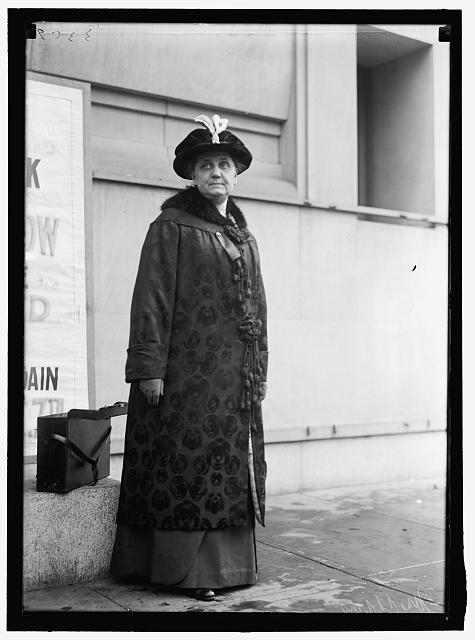
I started researching Jane Addams a few years ago for a course on women in American history I was preparing to teach. She seemed to fit well within the scope of my research interests as well, which are on peace history and the World War I era. After all, in addition to her social work, Addams was one of the best-known pacifists in America. She was even labeled “the most dangerous woman in America” because of her national stature and her pacifist views. As I read through her published works, her dedication to peace and humanitarianism were clear. Then I came across a brief article she wrote in 1921 titled “The Potential Advantages of the Mandate System.”[1] The article seemed completely opposed to her other work and worldview. The mandate system was created as a provision of the League of Nations after World War I that gave Western European nations control of the economic resources of the defeated nations and former colonies of Germany. For much of the twentieth and twenty-first centuries, the mandate system has been viewed as imperialist.
Was Jane Addams really promoting imperialism, a system linked to militarism and war?
Had her views changed since 1899, when she opposed the U.S. annexation of the Philippines in the aftermath of the Spanish-American War? Or had she been misunderstood by her contemporaries and scholars in some ways?
I could not find much in the secondary sources to help explain her views on imperialism or the mandate system. Addams was labeled generally an anti-imperialist. Marilyn Fischer, Professor Emerita at the University of Dayton and scholar on Addams, provided valuable guidance on Addams’s motivations and outlook. In the Jane Addams Digital Edition, I saw how Addams maneuvered through events and issues with peace as her north star.
I searched the digital edition to see if Addams expressed any thoughts to her colleagues in the Women’s International League for Peace and Freedom (WILPF), family members, or friends about her views on imperialism and the mandate system. Looking through various letters and material, I examined her views towards the Anglo-Irish War, or Ireland’s campaign for independence from imperialist England. It began in 1919 and ended with a truce in 1921 that divided Ireland into a free state and parts controlled by England. I also found the archive useful for understanding her views on the League of Nations and mandate system.
“Jumping into Boiling Oil:” Addams and the Anglo-Irish War
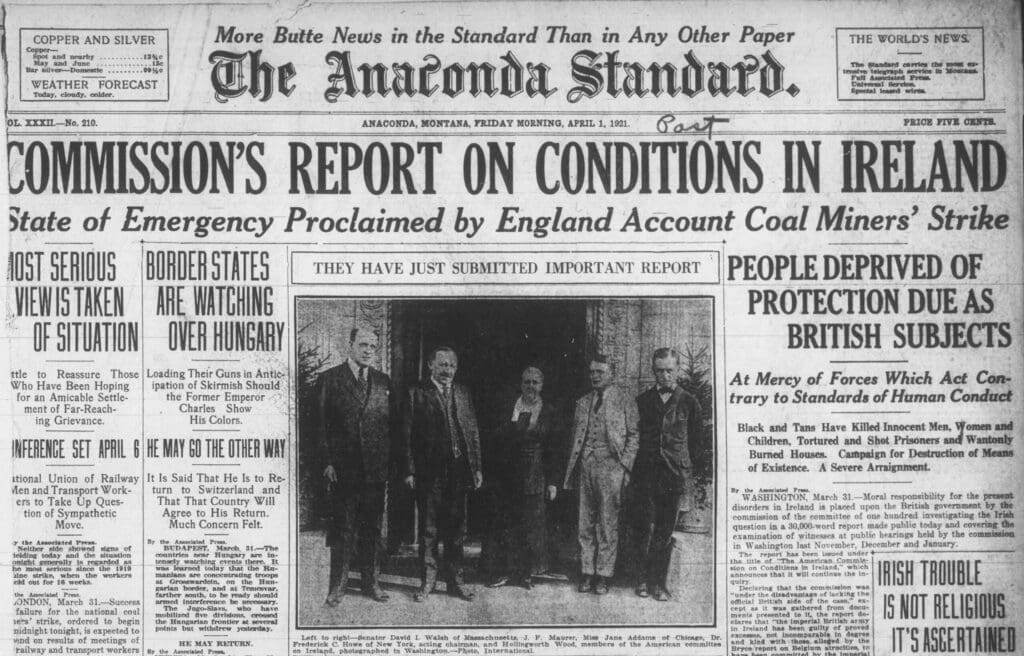
Opinion in America about the Anglo-Irish War was extremely divisive. Anti-British sentiments in America intensified as reports circulated of atrocities committed in Ireland by British soldiers. Addams was part of a group of 150 politicians, selected individuals, and clergy to examine the situation in Ireland. She even served as temporary chair of this group, known as the American Commission on Ireland. A letter written to Emily Greene Balch, International Secretary-Treasurer of WILPF, shows how dedicated Addams was to pursuing peace in this conflict. Addams wrote to Balch in 1920 about becoming involved with the Commission, “I quite realize that it is jumping into boiling oil as it were, but it may be useful and even afford a chance for our old idea of continuous mediation.”[2] In a letter to her English friend and WILPF colleague, Henrietta Octavia Barnett, Addams explained she was involved with the Commission to lessen the chance for military escalation.[3]
Addams viewed the Commission as a way to help England and Ireland arrive at a resolution. What was not in the digital edition was also meaningful. Addams expressed sympathy for the suffering of Irish civilians and helped how she could. In her correspondence, though, Addams did not express support for Ireland’s right to choose a government supported by the majority. In her published and unpublished writings, Addams prioritized food security for nations. For Addams, it was more important to avoid a war, which would further endanger the population in Ireland.
Addams and the Mandate System
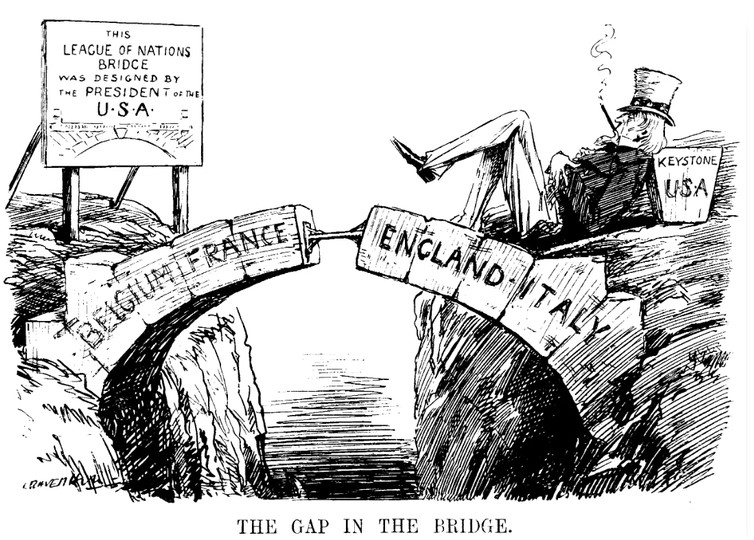
Reading through her unpublished letters in the digital edition, I understood better her support of the League of Nations and views of the mandate system. The thinkers she corresponded with discussed the mandate system as the path to peace in a world uprooted by war. Since the control over nations would be temporary, transparent, and supervised, they did not view the mandate system as imperialism. These thinkers reasonably influenced her views.
Addams began to envision a different pathway to permanent peace. Before the war, Addams was optimistic that citizens could work together to pressure their governments to create conditions necessary for peace. These conditions meant having enough food and resources. After the war, Addams viewed governments incapable of creating these conditions. Several governments had collapsed and economies were in shambles. For Addams, the League of Nations would be able to balance the world’s economic resources to provide humanitarian aid for immediate suffering and to help countries regrow their economies. Only then could the conditions for lasting peace be created. Addams expressed confidence that the League of Nations would be able to minimize nations from being exploited in this process.
Addams wanted America to join the League of Nations to help with this humanitarian aid. She had worked for the government during the war helping with international food relief efforts. She wrote to Balch after the war that famine relief was “the most useful thing that can be done just now.”[4] The digital edition contains several newspaper articles summarizing her various talks across the nation and abroad. The articles reveal how she tailored her message to each group to convey her message most effectively. Letters with Balch and Anna Garlin Spencer, the president of the U.S. Section of WILPF, indicate they had a different priority.[5] Undeterred, even when the U.S. did not join the League of Nations, Addams focused on bringing her message to the public. She continued to advocate humanitarian relief as a pathway to peace.
So, was Addams promoting imperialism?
After countless focused searches and fulfilling falls through rabbit holes in the Jane Addams Digital Edition and re-reading her published works, I had an answer to my original question. Addams was not promoting imperialism. However, she was not focused on refuting it, either. Addams was an independent thinker. She supported causes based on the consequences she foresaw. She theorized the Philippine population would not benefit from U.S. annexation in 1899, so supported the anti-imperialist side. She believed the Anglo-Irish War would lead to military escalation and endanger the population in Ireland. So, she did not promote Ireland’s right to self-determination. She deemed the League of Nations able to provide large-scale economic and humanitarian relief. So, she promoted it, providing certain guardrails were placed on Western nations. Embedded in her pacifism was the concept of food and resource security.
From examining her unpublished writings, we can get a better sense of the relationship between pragmatism, imperialism, and peace. Her writings reveal that anti-imperialism and pacifism are not always tied together. This understanding can be used in how we understand the women’s rights movement, international peace movement, and political landscape in the decade following World War I. We also gain a better understanding of Jane Addams. Her actions, a testament to her humanitarian and peace-focused worldview, speak louder than labels.
[1] Jane Addams, “The Potential Advantages of the Mandate System,” The Annals of the American Academy of
Political and Social Science 96, no. 1 (July 1921): 70–74, https://doi.org/10.1177/000271622109600115.
[2] Jane Addams to Emily Greene Balch, October 26, 1920, Jane Addams Digital Edition—Ramapo College f New Jersey (JADE), https://digital.janeaddams.ramapo.edu/items/show/21045.
[3] Jane Addams to Henrietta Octavia Barnett, April 22, 1921, JADE, https://digital.janeaddams.ramapo.edu/items/show/21984.
[4] Jane Addams to Emily Greene Balch, March 20, 1920, JADE, https://digital.janeaddams.ramapo.edu/items/show/28643.
[5] Anna Garlin Spencer to Jane Addams, February 23, 1920, JADE, https://digital.janeaddams.ramapo.edu/%20items/show/19973