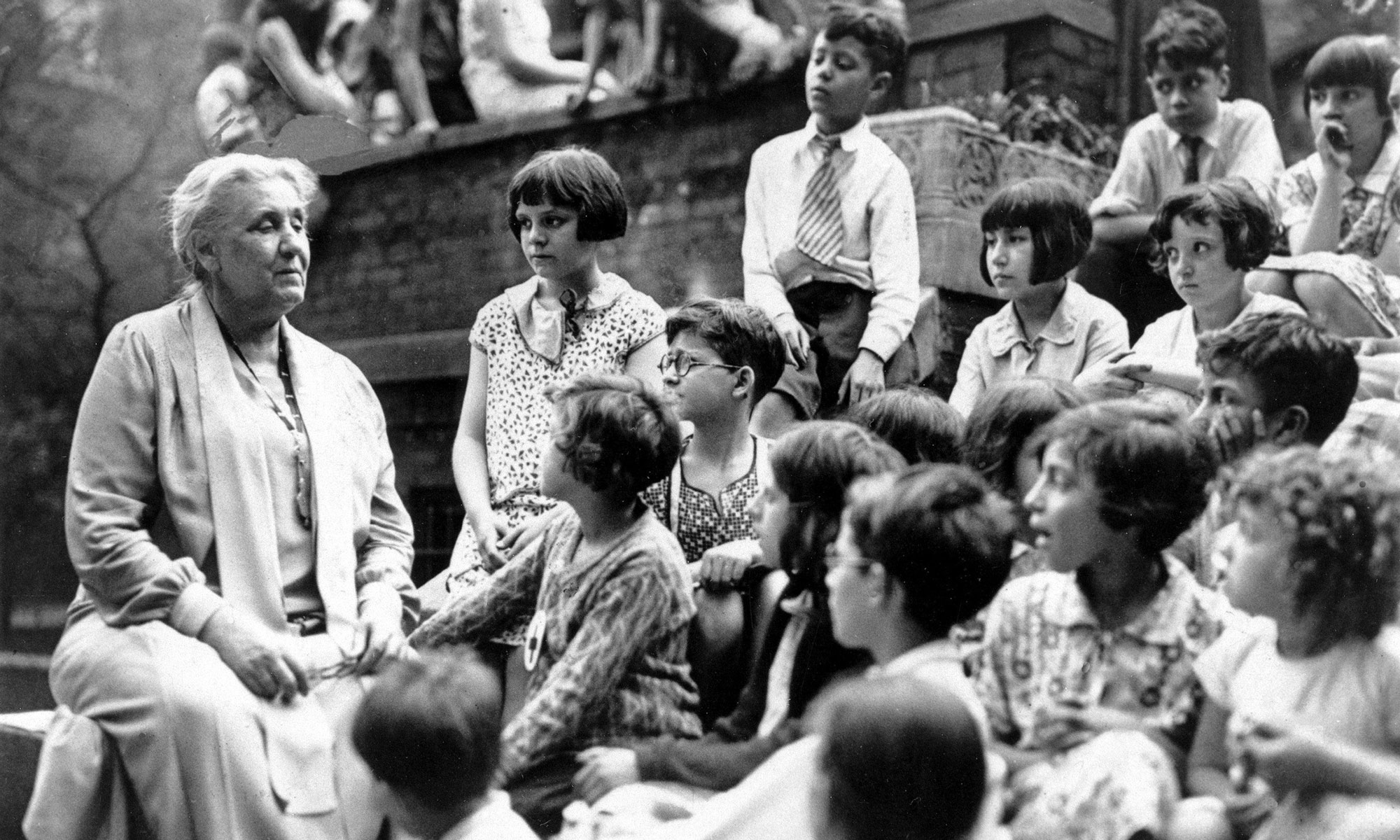

This post was written by Rima Lunin Schultz on September 11, 2020.
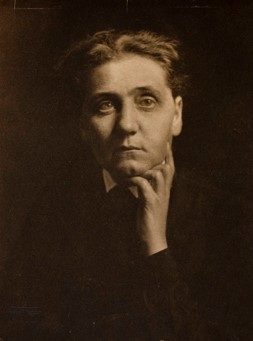
Jane Addams was one of the most well-known and influential women reformers of the late nineteenth and early twentieth centuries. She founded the Hull-House, a social settlement that became a leader in the new field of social work; she won the Nobel Prize for Peace in 1931 redeeming her reputation which had been attacked because of her pacifism during World War I; and she was a prominent suffragist representing politically organized women nationwide . She advised presidents Theodore Roosevelt, William Howard Taft, Woodrow Wilson, Herbert Hoover and Franklin Delano Roosevelt. As a writer of ten books and co-author of two more, hundreds of magazine and journal articles, as a lecturer and campaigner, what Addams said about democracy, the labor question, and international affairs had weight. One of the less known contributions of Addams, however, is in the field of cultural work. And that is our subject today. When we urge friendship and inclusion of newcomers to the American shores, when we valorize the contributions of diverse cultural backgrounds and admire traditional crafts, when we speak about making the motto: “one out of many” a fact of life, when we campaign for art and music in our public schools, we are validating the ideas and cultural pedagogy of Addams and her colleagues at Hull-House.
Today I want to tell you something about the history of Hull-House from 1889 to 1935, a settlement house located on Chicago’s Near West Side, a dense, industrial neighborhood populated by immigrant workers. Our focus is on the role of arts and crafts. Many of you will have an image of the Lower East Side of New York —as a congested tenement and sweatshop neighborhood filled with newly arrived immigrants. Hull-House was in Chicago’s “port of entry” neighborhood where immigrants found cheap accommodations having arrived at the railroad depots nearby. These photos make the point that Addams made when she thought that housing reform would be easier in Chicago than in New York, where tenements were taller and denser.
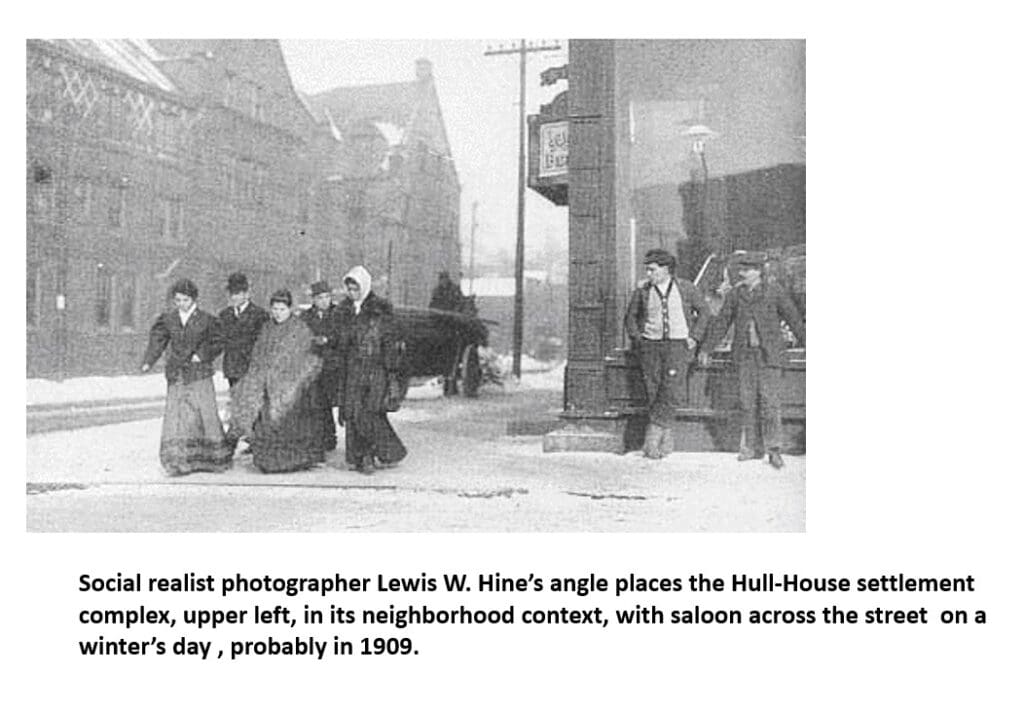
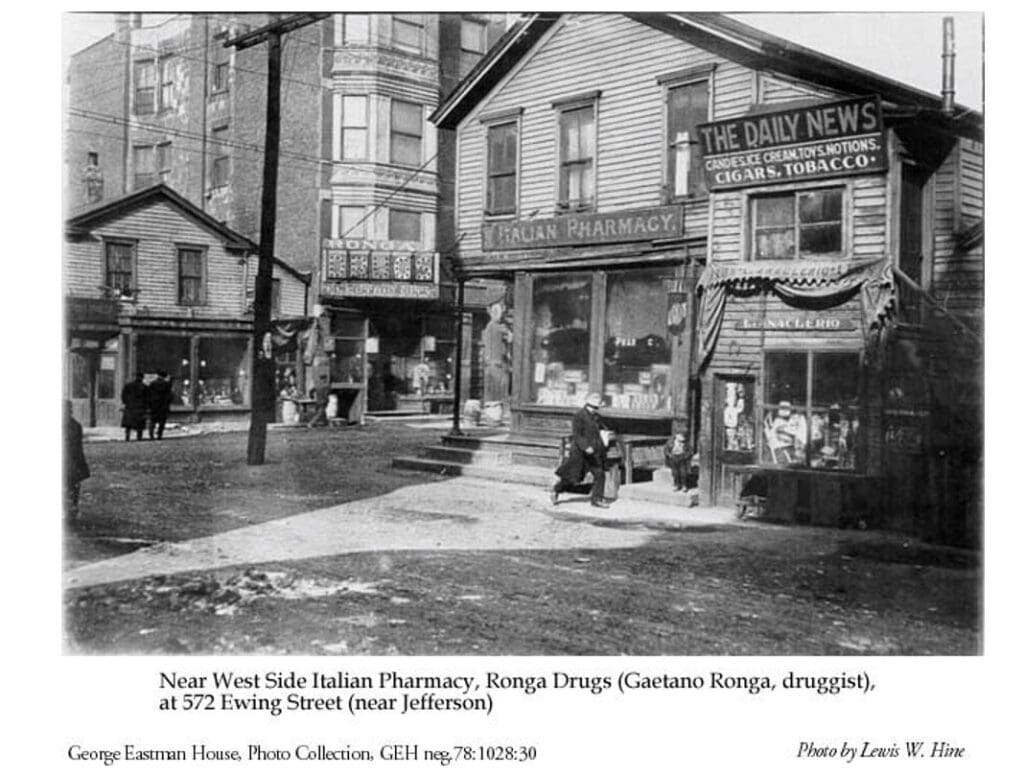
Settlement houses were community centers unlike charities or welfare bureaus. They were run by educated middle-to-upper-middle-class women and men who believed they could attack the worst aspects of industrialism and the chaos and ugliness of slum neighborhoods by bringing culture to the people in these neighborhoods.
The movement grew in American cities where by 1911 there were 400 settlement houses. By developing friendships with their neighbors, offering art and music classes, lectures and exhibitions they would “lift up the masses” and inspire an awakening that would have political and social transformative power. Soon Hull-House became a laboratory for teacher training, offered medical clinics, pioneered community and little theatre productions and became a think-tank initiating sociological and public health research projects. It lent its influence for the suffrage movement, to campaigns to outlaw child labor, and to efforts at mediating disputes between labor and capital.
Overall, the cultural programs remained the constant and most all-engrossing of the settlement’s offerings. Specifically, arts and crafts were made accessible to the neighborhood and the initial impulse of bringing art to the people turned into a much more complicated exchange where the people’s art and the canonical European heritage of art were brought together. A sign of this effort to re-think cultural production in an industrial democracy heavily influenced by the different traditions of its immigrants is the event that occurred in 1904 at the Annual arts and crafts exhibition held at the Art Institute of Chicago. It may well have gone unnoticed by many who visited the Art Institute. It may have had greater effect back in the neighborhood from whence the exhibited object derived: it was the inclusion into a prestigious exhibition of the work of highly trained artisans worldwide of a textile designed and handmade on a traditional loom by an Irish immigrant who came to Hull-House’s weaving room to practice her craft. This was noted quite simply in the show’s catalogue that listed Mrs. Brosnahan as the creator of a textile on display.
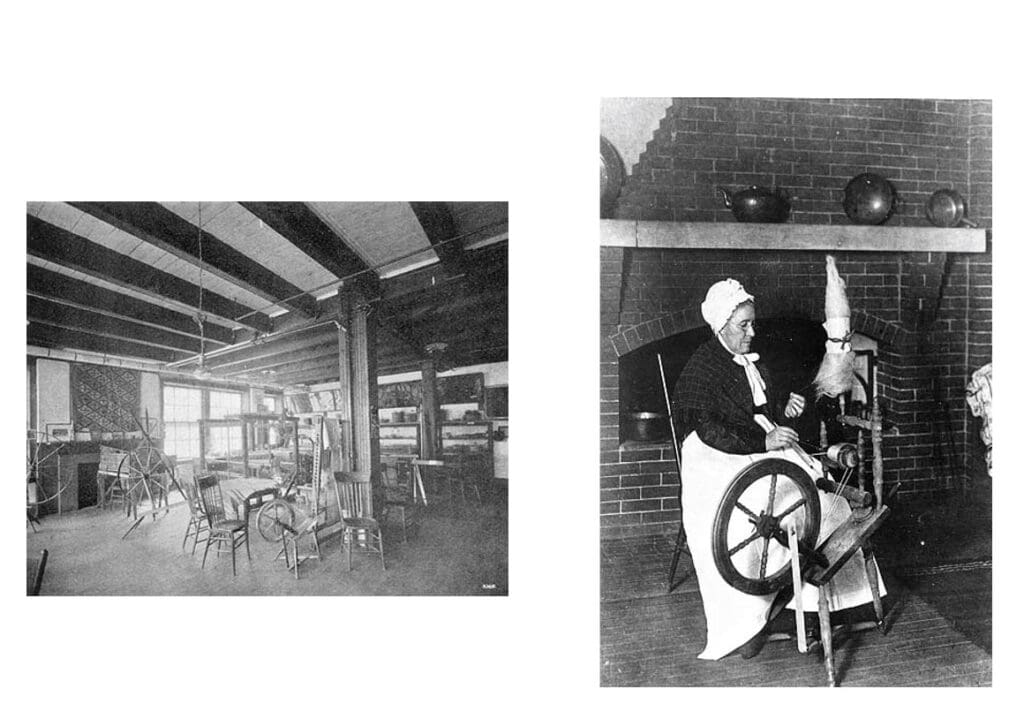
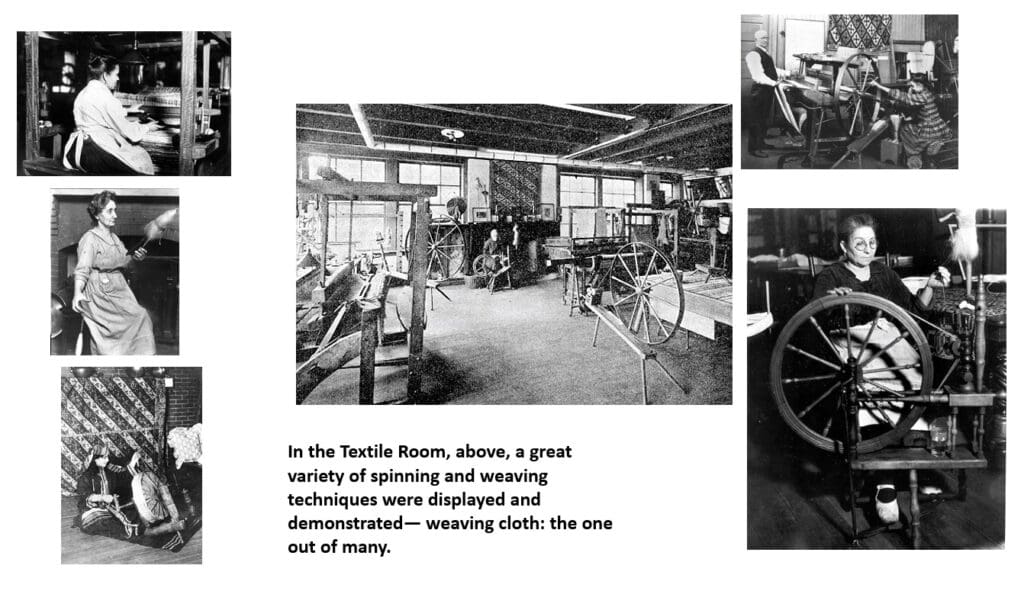
Honora Brosnahan was a housewife in the neighborhood; she frequently displayed her skill in Irish spinning to visitors from among the neighbors and others from far and wide who flocked to the settlement house on Saturday evenings where in the workrooms they encountered neighborhood people, often dressed in the clothing of their native lands, performing ancient crafts.[1]
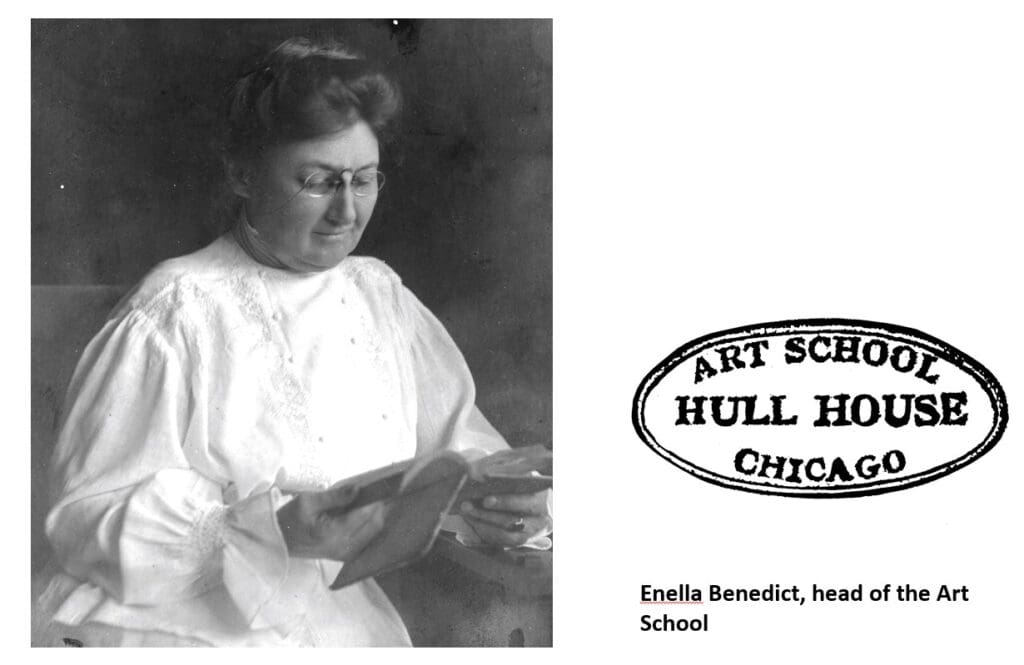
They might hear a lecture on the history of the technique—spinning, weaving, woodworking–or the history of the materials used. There might be accompanying music –folk or classic that spoke to the plight of workers such as “The Sweat-shop Song” composed by Eleanor Smith, head of the settlement’s Music School; and on the workshop walls there would be additional displays of handicrafts, tools, and even reproductions of genre paintings by European masters depicting artisans. at work or farmers in the fields chosen by Enella Benedict, artist-in-residence and head of the Art School at Hull-House.
For Addams it must have been a satisfying moment to enter Mrs. Brosnahan’s textile into the exhibit, a moment that she could relish as a realization of a major goal of the settlement. She had managed to create cultural space in which an immigrant woman’s skills were affirmed in her adopted homeland; her craft was valorized and included in a serious exhibition in the major museum of the Middle West. Her children and neighbors could see her valued in this downtown context as well as in the neighborhood space thereby knitting together the generations that had been upheaved by transplantation. This quiet cultural event spoke volumes and was key to Addams’s prescription for the social healing she believed was necessary for the growth of a new social ethic and a new respect for difference, for history, and for progress and the interconnectedness of humanity. This was happening at a time when fear of the stranger, the rise of race theories and the rhetoric of a nativist politics of exclusion was spreading in the land.
At Hull-House, the major settlement in the U. S. and the first to open in Chicago, two groups developed and interacted through art:
The first group was the colony of American-born and privileged women and men led by Jane Addams and Ellen Gates Starr—college friends. They had visited Toynbee Hall, the first social experiment of its kind, in the East London slum and in their minds their desires to find ethically useful work, to share culture with those less fortunate, and to live democratically among the people cohered in the example of the Oxford college men who had joined Canon Samuel Barnett and his wife Henrietta to work among London’s most disadvantaged.
Jane and Ellen decided they would use the former’s inheritance and the latter’s Chicago social and cultural connections—and open an American version of the English Toynbee Hall. The two young women were a sensation in Chicago, heralded by the city’s cultural and philanthropic elites and in less than five years of existence, Hull-House was on the list of attractions visitors to the Columbian Exposition in 1893 were told to view. Englishman William T. Stead—maverick journalist, moralist, and critic of industrialization famously wrote at the conclusion of the World’s Fair, that If Christ Came to Chicago (in a book by that title)—he would be most comfortable in the colony of humanitarians that had gathered at Hull-House to live among the poorest and most oppressed.[2]
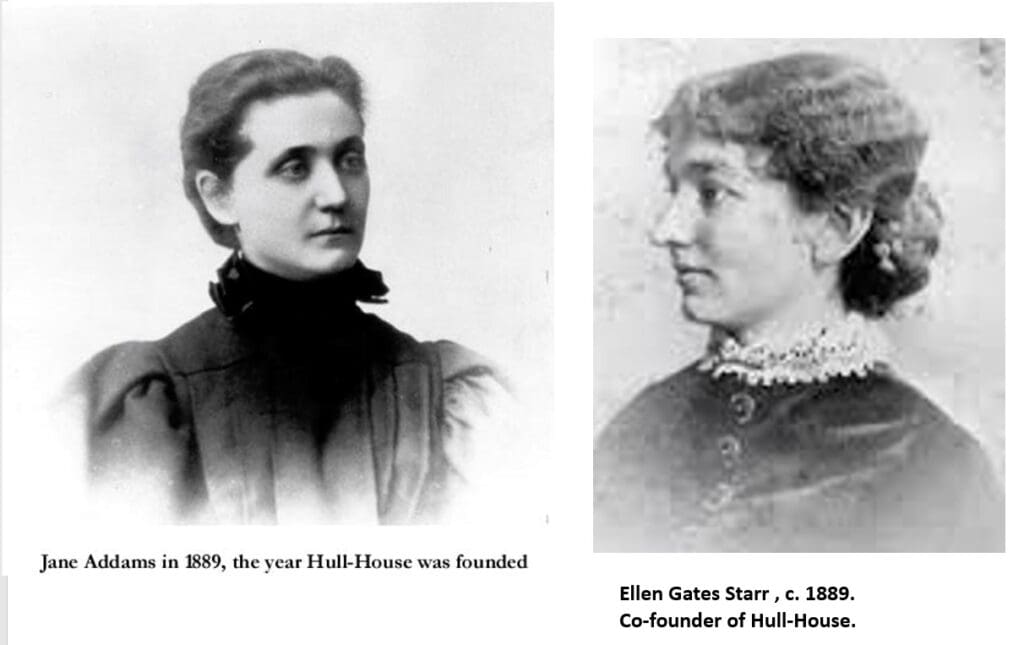
This brings us to the second group at Hull-House: The second group were the neighbors, in the beginning those Irish and German immigrant families already English-speaking, then Italians, Jews, and Greeks. Among them were Honora Brosnahan, Michael Gamboney, Jose Torres, and Nick Fosco and many others —– The two groups interacted and learned from each other in many positive ways. Yet the urban planning goals of transforming the neighborhood never materialized. However, the settlement “ideal” of a democratic cosmopolitanism and neighborliness represented best through the arts and cultural work succeeded in reaching many neighbors. As one Hull-House “boy,” now grown-up put it: “Hull-House showed us another way of living.” Jane Addams, in one of her more critical reflections, thought she had reached mostly “the transfigured few” not the masses.[3]
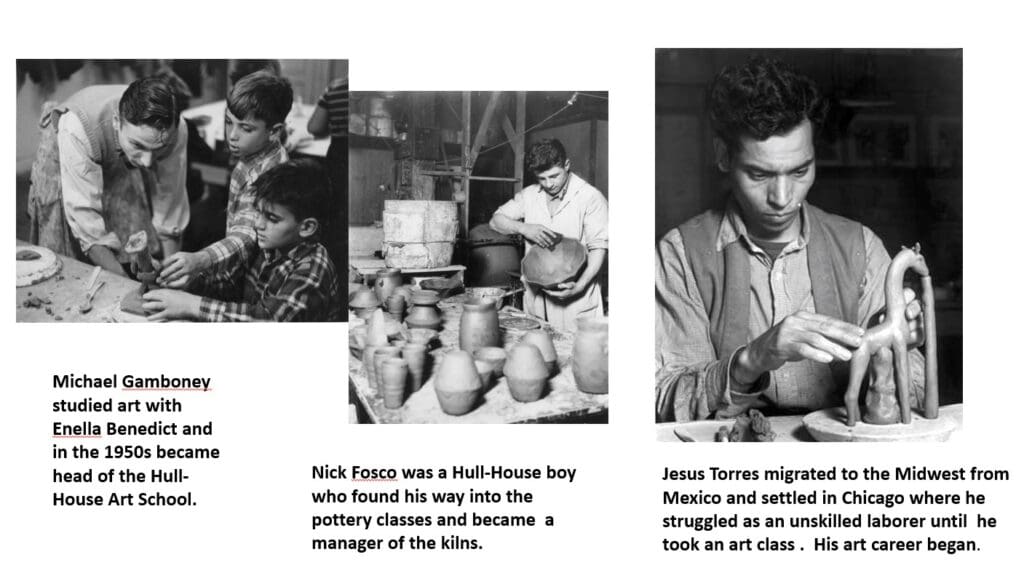
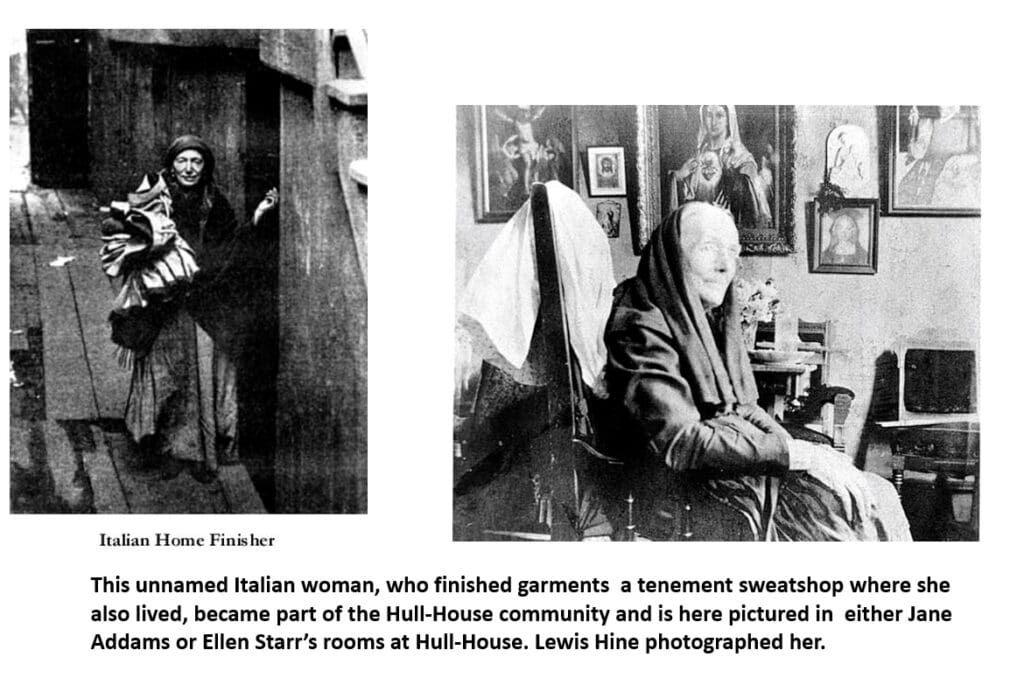
In a larger sense there were other successes. One of the major accomplishments is the acceptance of the importance of the arts in public schools, the acknowledgement that children need creative play and exposure to art, music, performance—and not just the children of the privileged in society, but those from all neighborhoods, all cultures, all economic classes. These ideas that we take for granted today, even when we fail to fully fulfill them, have become the measure of a compassionate, humane society. In addition, and equally important, the narrative told by Jane Addams in her writings, which are still in print and read, interpret the immigration story in a positive light and we learn how important immigrant’s cultural contributions have been to the American culture. Scholars have identified Addams and Hull-House with significant innovations of our educational institutions, our ideas about child development, art and occupational therapy, recreational therapy, criminology, and the field of social work.
Art and Labor
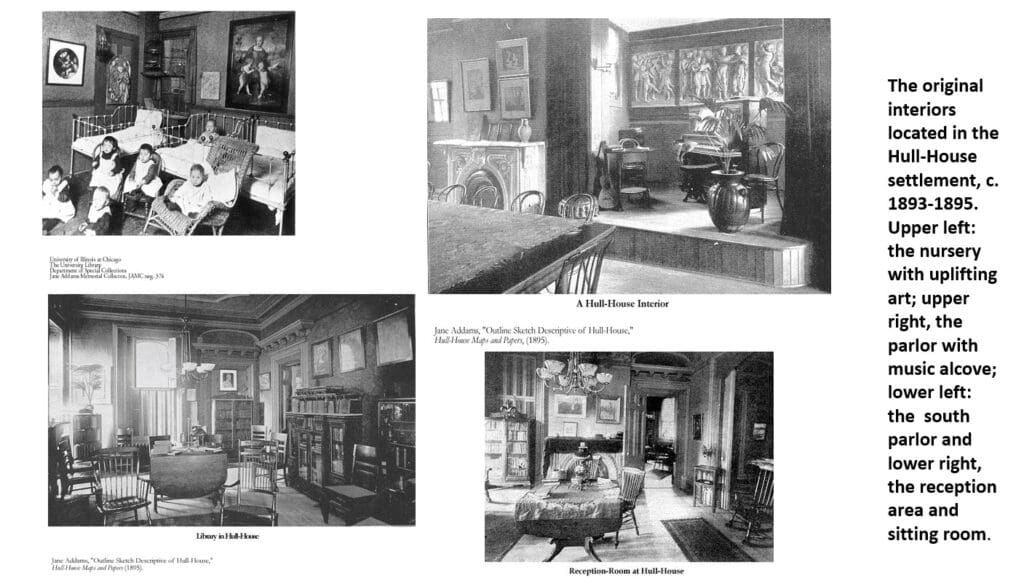
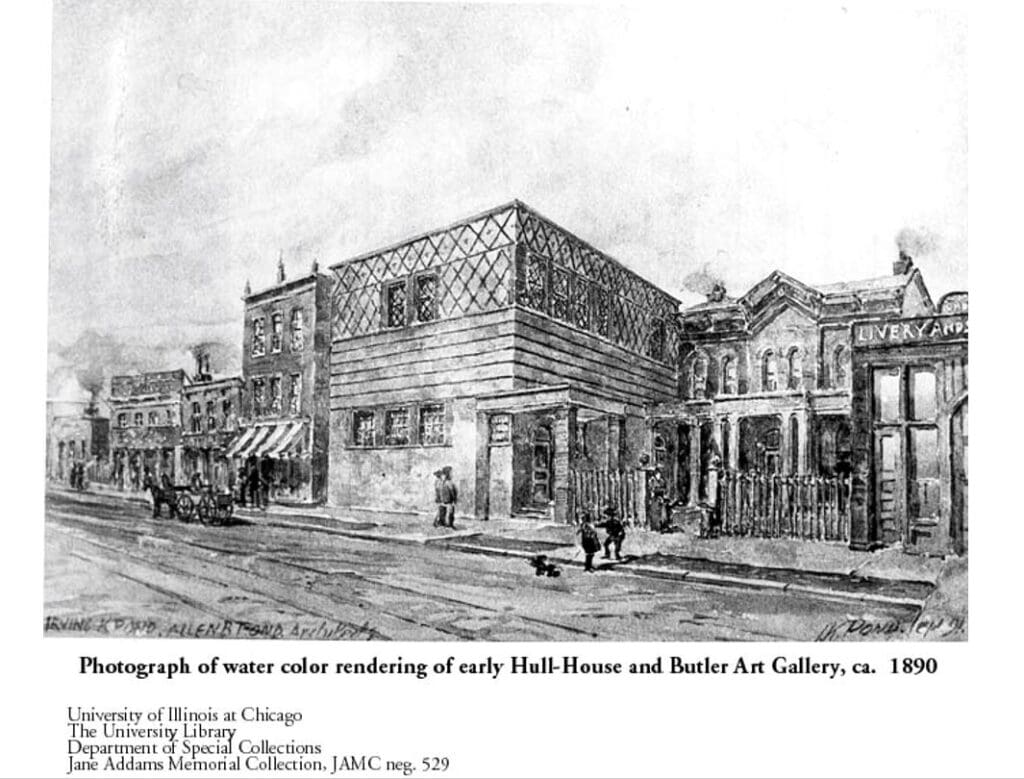
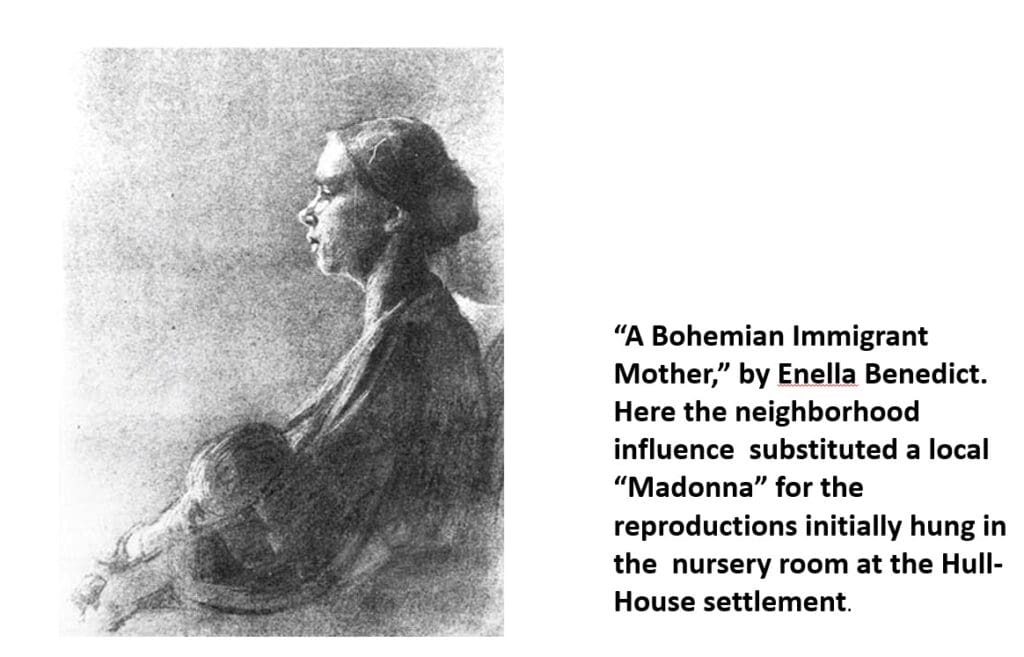
Chicago noticed the transformation of the interior space of the old Hull homestead where Jane and Ellen were launching their settlement house. Allen B. Pond, of Pond & Pond Architects, had aided the two women in locating the once-stately building as an ample place to begin their cultural work. His pen and ink drawing is one of the earliest images we have and shows the initial two-story additional building, known as the Butler Building, that Pond designed. The interior images illustrate the influences of Ruskin and Morris, and others we associate with the movement that argued for a moral aesthetic accessible to the working classes. T. C. Horsfall’s experiments with loaning art reproductions to the working classes of Manchester, England, would be tried here at Hull-House.
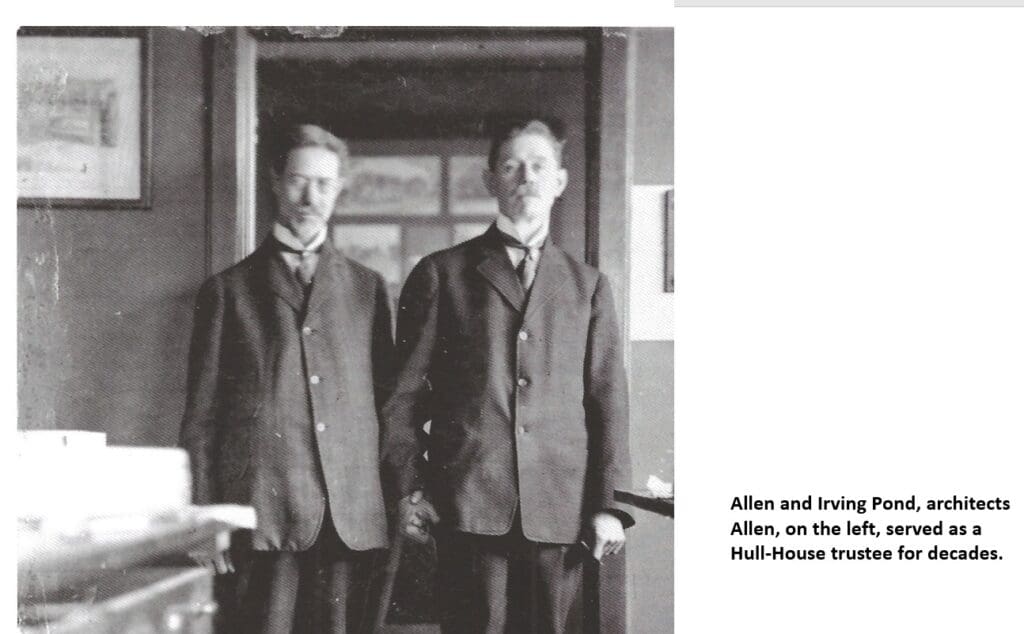
Allen Pond recognized kindred spirits in Addams and Starr. He remained their faithful architect for the twelve additional buildings of the settlement complex and he served as a trustee of the Hull-House Association until his death. It goes without saying that he is one of the Chicago Arts and Crafts Society.
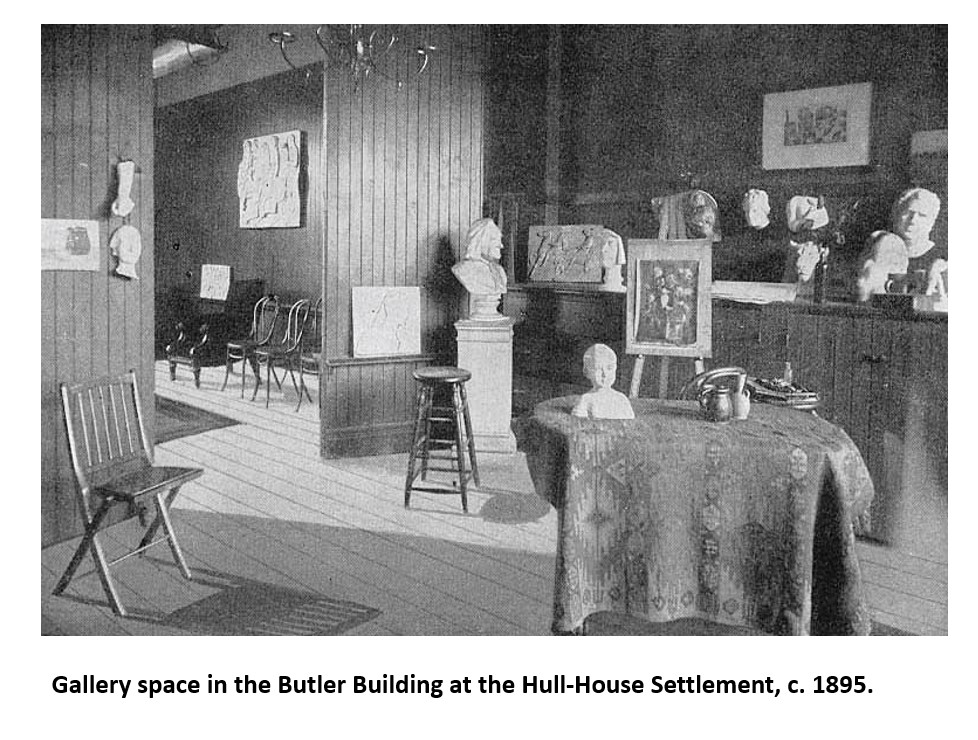
At the same time that the two women enticed Edward Butler, wealthy businessman, art collector, and a trustee of the Art Institute of Chicago, to donate $5,000 for the construction of the new building architect Pond was planning to adjoin the old settlement house for art exhibits, art studios, and a library, the colony of Hull-House residents had gotten deeply involved in the anti-sweatshop movement in Illinois. A cross-class campaign had been mounted when sensational articles exposed sweatshop conditions where women and children were working. There were demands for legislation to clean up the horrible tenement workshops and impose an 8-hour workday for women workers. Labor leaders, socialists, clubwomen, and religious leaders found in Addams, Starr, and a new Hull-House resident, Florence Kelley, inspiration and organization. This seemed to thrust the group far from the cultural evenings in which Ellen Starr read George Eliot’s Romola or lectured on art history or the work of the Chicago Public School Art Society of which she was President.
Starr asks rhetorically in her contribution to the settlement’s first publication, Hull-House Maps & Papers, (and I paraphrase here) is it ethical and practical to launch an expensive art gallery building in the midst of this struggle for survival among the garment workers in the neighborhood? She argues that there is a connection between the two movements, what later union women would sing out poetically in the phrase “give us bread and give us roses”—and that a society that has no justice for workers has no foundation to produce authentic art.
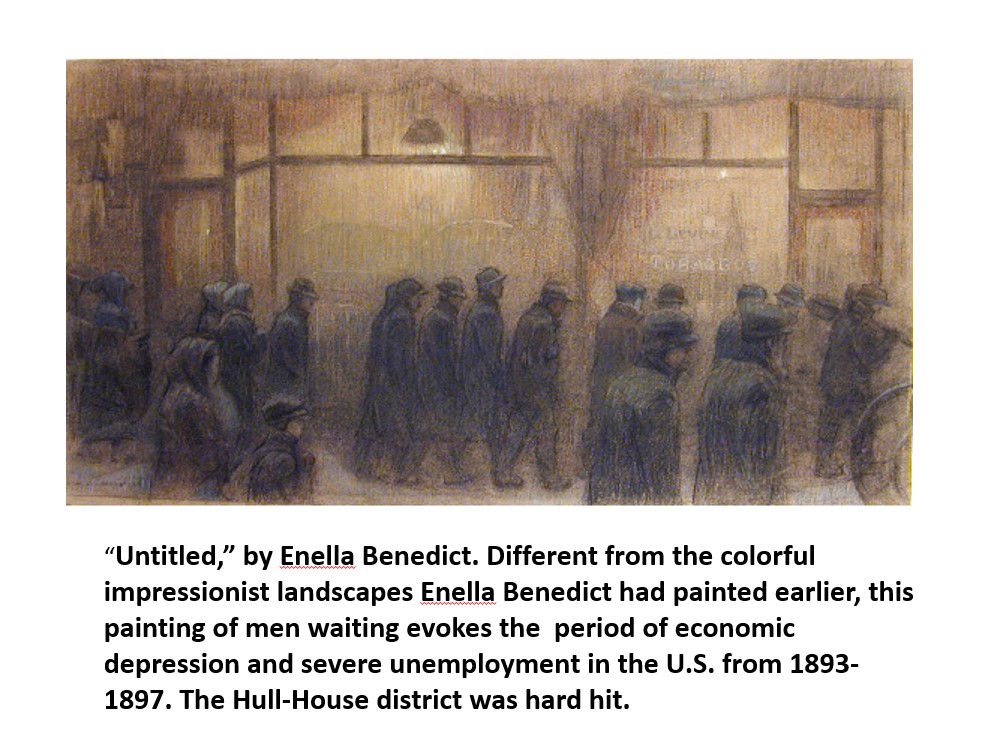
From the beginning Starr and Addams determined to involve themselves in the art and the politics of social change. This dual approach was possible because of the dedication of the group of cultural workers who joined them, some living and working at Hull-House for four decades. In this manner, Addams and Starr were constructing a non-elitist, differently gendered version of the artist in her or his studio. One example is Artist Enella Benedict, wealthy daughter of a manufacturer and real estate developer, had studied in Europe and taught at the art school of the Art Institute of Chicago. She chose to run an art school in the settlement and paint in a studio she shared with aspiring artists who lived in the neighborhood. She remained with Addams until her death, also teaching from time to time at the Art Institute, but deeply imbedded in the collaborative cultural work of the settlement where she designed and painted theater scenery and tableaux vivants that depicted classical Western religious art themes. She received no salary. Of course she could escape for vacations to the New England coast or Europe. But her paintings reflected the pull of the immigrant neighborhood she called her own. Two slides show paintings done by Benedict: one, the portrait of “Edith” a local Irish Catholic girl; and the misty pastel-like line of workers waiting.
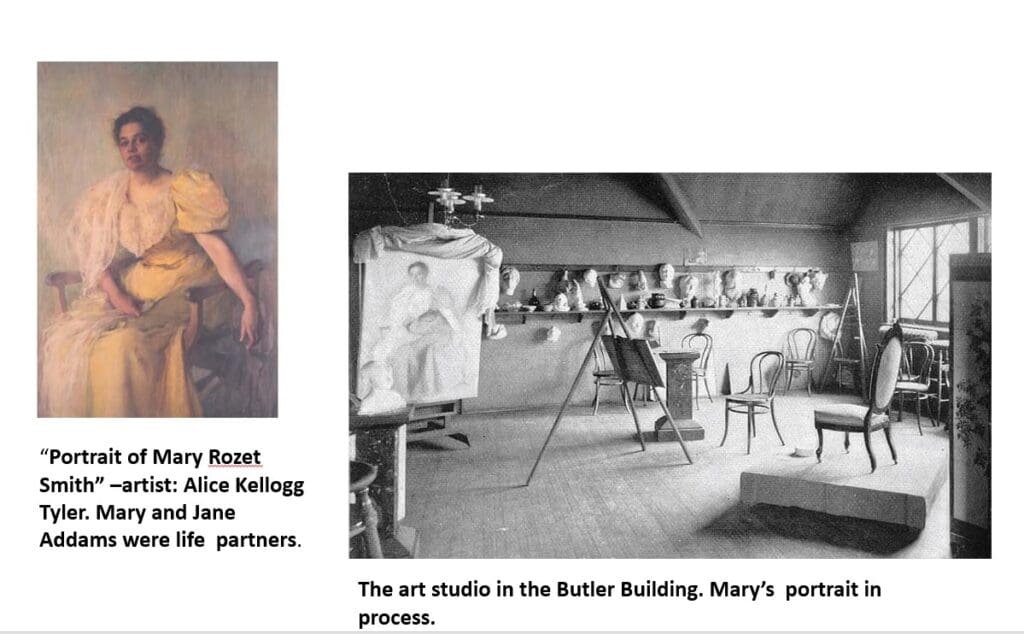
Addams and Starr were joined by artists, musicians, craftspeople, radicals and socialists who foresaw a soulless society with the deskilling of craft workers and the alienation of the masses into wage slaves. These bright, engaged women and men were disciples of John Ruskin, William Morris; some were Christian Socialists, others were influenced by Marx and Engels. From the start they performed a cultural pedagogy heavily tied to ideas of the trans-Atlantic arts and crafts movement. It is surprising that it took them eight years to launch the Chicago Society of Arts and Crafts in 1897, for from the start cultural work was at the very center of the enterprise.
The society’s aims were wide ranging: cultivating in its members and others a sense of beauty, encouraging beauty in articles produced for everyday use, influencing the manual-training movement and the design and decoration of both useful and ornamental objects, encouraging handicrafts, studying factory conditions with a view to reducing the dominance of the machine, and holding exhibits and founding centers for crafts activities. The society sponsored lectures on topics such as art education, the Arts and Crafts movement, the role of art in society, and specific crafts and held an annual exhibit, usually in November. Perhaps the society’s best-known lecturer was member Frank Lloyd Wright, who spoke March 6, 1901, on “Art and the Machine,” concluding that art was needed to give a soul to the machine. Charles Ashbee was prescient in seeing Chicago’s unique approach to arts and crafts in the acceptance of the machine and the attempt to humanize the product and the production so that worker and consumer would benefit rather than suffer from technology.
Membership in the society included wealthy businessmen Edward B. Butler and William R. Hutchinson—both trustees of the Art Institute of Chicago as well as trustees of the Hull-House settlement. Allen B. Pond with his brother Irving, participated in that cross-over between aesthetic and social reform that characterized the Chicago society’s approach. Frank Hazen [Hazenplug] was a staff artist at Stone & Kimball who designed for both the Chapbook and the Hull House shops. He also worked with the Hull-House Theater and taught metalwork. He later headed the metalwork at the Byrdcliffe Arts and Crafts Colony in Woodstock, New York. Byrdcliffe had a strong connection to the Hull-House arts and crafts group.[4] Artist Carl Eric Lindin, born in Sweden, [5] emigrated to Chicago and studied painting at the Art Institute and in Paris, became a resident artist at Hull-House where he met the Photo-secessonist photographer Eva Watson-Schutze and the Byrdcliffe, artists and craftsmen who overlapped with many of the Hull House group.[6] George Herbert Twose of Hull-House, was an Englishman who taught manual training in the public schools and woodworking at the Hull House shops, and was the first president of the Society.[7]
Strongly influenced by the arts and crafts movement, the New England artist Jessie Luther began her crafts career as director of the Labor Museum at Hull House, Chicago, at the invitation of Addams.[8] Adeline Titsworth worked in the Labor Museum and taught weaving classes.[9]
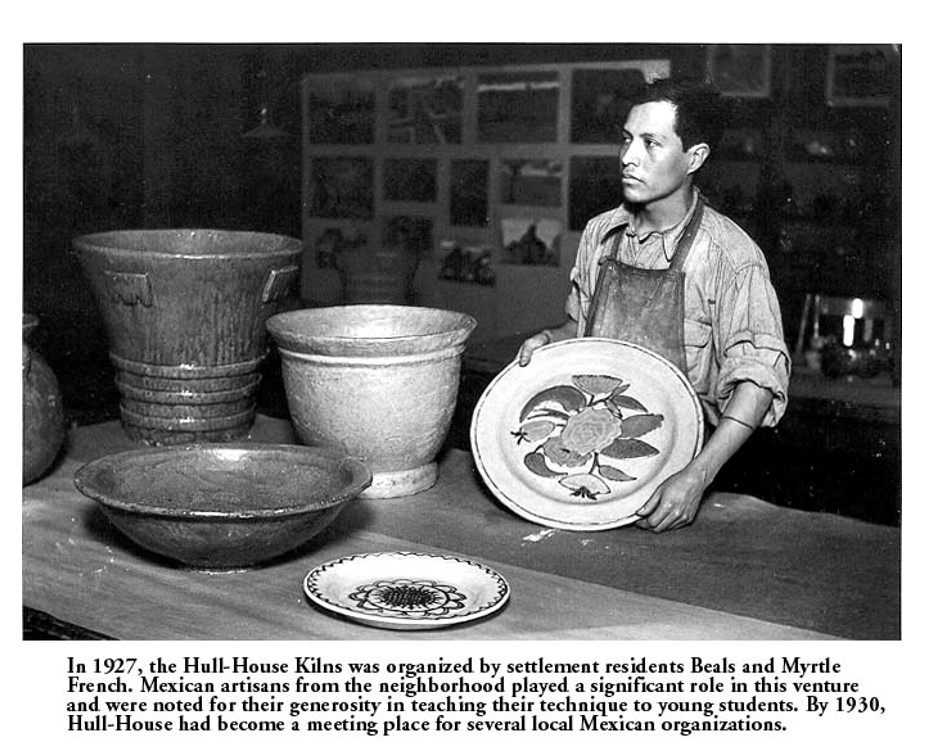
With the help of Eleanor Smith, the founder and director of the Hull-House Music School, Myrtle French, founder and director of the Hull-House Kilns, Edith de Nancrede, director of children’s drama and dance, and Laura Dainty Pelham, director of the Hull-House Players, one of the first Little Theatre Groups in the country, and Enella Benedict, head of the Art School at the settlement Addams and Starr experimented and evolved cultural pedagogies. They did so with the goal of developing a democratic and cosmopolitan ethos that unified cultural, religious, and socio-economic differences. I mention these women because it was no coincidence that the Hull-House model of cultural production was gendered differently from the membership and leadership of the Chicago Society of Arts and Crafts, which was from the start overwhelmingly male. The goals of the Chicago Society of Arts and Crafts and the departments of the settlement overlapped. Perhaps it was the marginalization of women in the arts that drove the Hull-House women to establish innovative institutional structures from which to launch themselves in order to be “eligible” in the eyes of the male custodians of culture to lead the society.
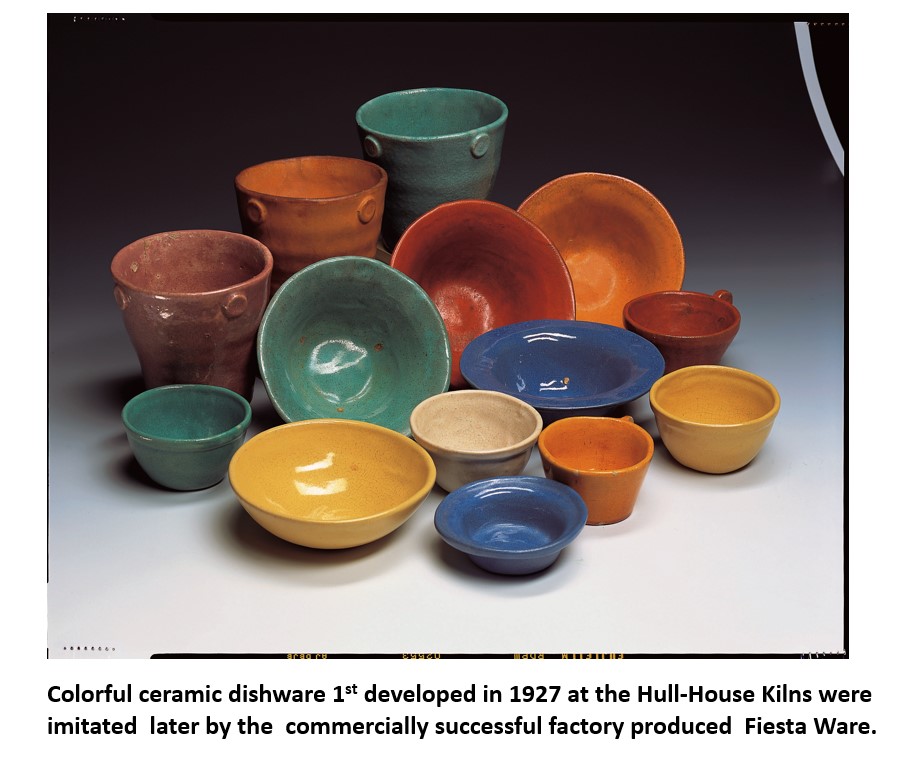
Forty years later, Hull-House itself had been transformed into a place of production—a pottery and ceramics business employing the Mexicans now living in the neighborhood. The dishware provided the model for the commercially successful and popular Fiesta dinnerware.[10] Industrial shops and workrooms, a school that taught textile weaving; dressmaking; a printing press, and with the infusion of New Deal monies, expanded studios and workshops teaching arts and crafts and industrial vocations. The machine was a reality but Hull-House attempted to contextualize its usage visually and performatively in the unique Labor Museum. This evolution reflects Addams’s and Starr’s goal of democratizing arts and crafts—an evolution that can be expressed as a transformation of the concept of bringing art to the people to the implementation of creating cultural space where the people had a direct role as cultural workers for themselves.
From 1895 until 1900, when the Labor Museum was opened, there was a progression toward creating space at Hull-House for neighborhood people to work in industrial shops and at handicrafts while the colony of resident artists also flourished.[11] This was the heyday of the Chicago Arts and Crafts Society at Hull-House. The society’s aims were wide ranging: cultivating in its members and others a sense of beauty, encouraging beauty in articles produced for everyday use, influencing the manual-training movement and the design and decoration of both useful and ornamental objects, encouraging handicrafts, studying factory conditions with a view to reducing the dominance of the machine, and holding exhibits and founding centers for crafts activities.
The society sponsored lectures on topics such as art education, the Arts and Crafts movement, the role of art in society, and specific crafts and held an annual exhibit, usually in November. Perhaps the society’s best-known lecturer was member Frank Lloyd Wright, who spoke March 6, 1901, on “Art and the Machine,” concluding that art was needed to give a soul to the machine. Charles Ashbee was prescient in seeing Chicago’s unique approach to arts and crafts in the acceptance of the machine and the attempt to humanize the product and the production so that worker and consumer would benefit rather than suffer from technology.
Searching for a Way to Democratize Arts and Crafts
Jane Addams and Ellen Starr were never satisfied with the programs Hull-House had established in the humanities, the fine, arts, and the performing arts. The major goal was to democratize culture as a necessary stage in the evolution of society. This meant devising ways to transmit quality humanities education outside of universities to the working people in their neighborhoods and to the public schools.[12]
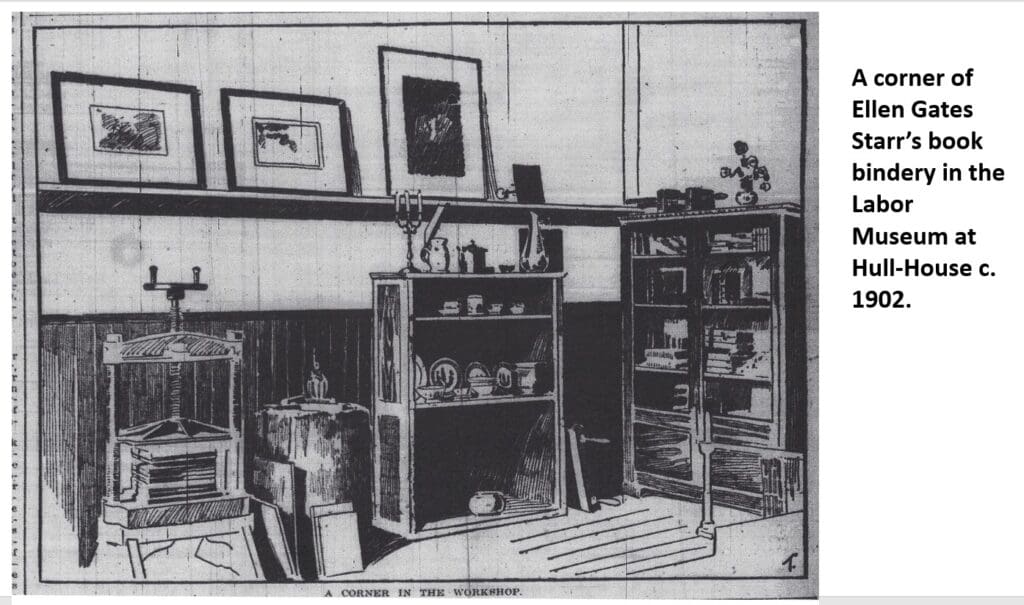
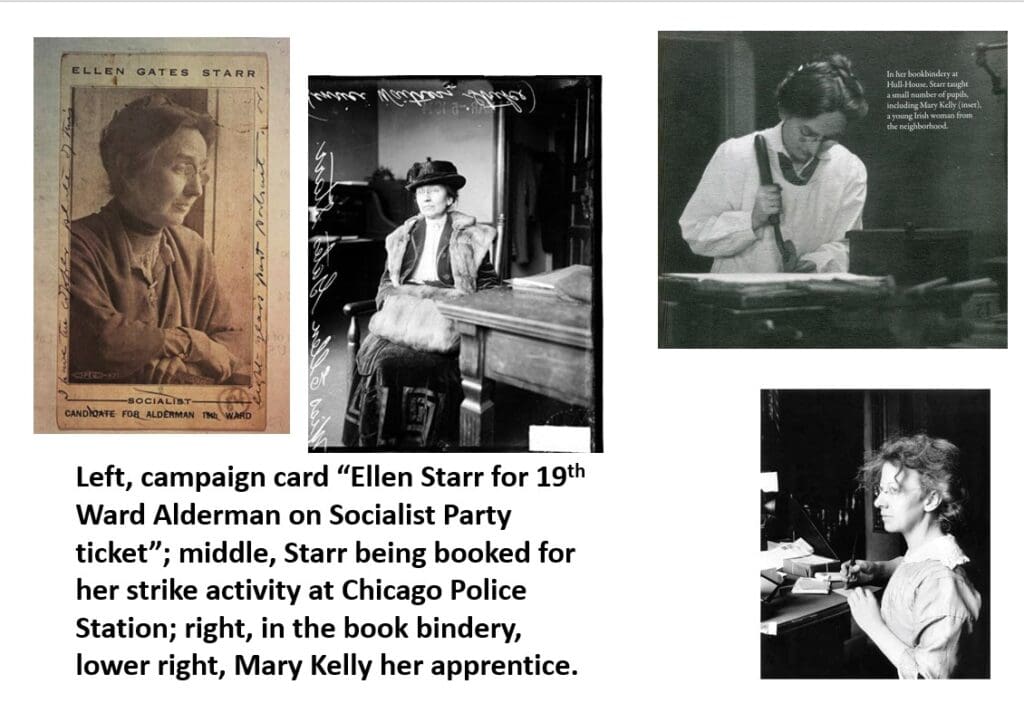
Ellen Gates Starr’s evolving pursuits in the labor movement and in the shops modeled this conception more than any of the other resident artists. She was also the resident who experienced the most inner turmoil and conflict over the relationship of art and labor. Initially Starr followed the arts and crafts movement closely. She began bookbinding “with the goal of unifying mental and manual labor and contributing in some small way to the beauty of objects” and in pursuit of this goal she spent a total of 15 months—12 in 1897 and 3 in 1899—at Doves Bindery in England, where she was one of the few American women to apprentice with T. J. Cobden-Sanderson.”[13]
Ellen Starr was a discordant voice from the start. She did not agree completely with the direction that Hull-House settlement was taking. It seemed Starr almost immediately felt the contradictions that Addams later alluded to when she wrote “how difficult it . . . [was] to put a fringe of art on the end of a day spent in a factory.”[14] Ironically, the contradictions were to become most obvious to Starr in the way her own work in the Labor Museum’s book bindery seemed at times irrelevant to her actual labor union activities and socialist politics. She rationalized that her work provided opportunity, albeit limited, to illustrate products of unalienated work and that in her bindery she was demonstrating work done in the “’spirit of the future’—that is, in a spirit allowing for self-expression.” [15] In 1892, Starr had accused Hull-House of being merely “an excuse for the things we ought to do and be and don’t and aren’t.”[16] She worried about the contradictions of offering bourgeois culture to workers but not sharing power with them. “If we don’t wish working people to stand upon the same ground with us, if we believe that there is an eternal distinction, if we believe in caste, no matter how we disguise it, then why shouldn’t we let them alone? Why insult people by saying to them, ‘you are different, you will be different always, you can never be as we, knowing false and true, beautiful and ugly, but we wish to be kind to you, we want you to enjoy in your poor capacity, what you are capable of enjoying, and so we come and give you this and this.'”[17]
Starr’s 1895 contribution, “Art and Labor,” discussed earlier, was anti-capitalist and anti-modernist in tone. Starr had warned that it was not enough to fight for wages, you had also to fight for the soul of man against the commercial and industrial world that was crushing him. She was uncomfortable with an elitist argument that an educated and cultivated class should guide the tastes of the uncultivated but succumbed to such an arrangement. The Chicago Public School Art Society, born out of Starr’s determination to bring objects of beauty into all the places she could, was a top-down organization that assumed the role of arbiter of taste and disseminator of bourgeois art. The activities in the Labor Museum, the arrangement of artifacts, and the interpretation of the presentations were controlled by Hull-House residents and staff.
Starr’s own complicated feelings about her loyalties surfaced as she began to feel a closer relationship to the working class and to those bright, ambitious young men and women who were attempting to better themselves. One of the great differences between Addams and Starr was that of their class positions. Issues of financial dependence had plagued Starr from her college days when she was able to complete only one year while Addams remained to finish college. Starr taught school and dreamt of more ambitious plans living on her own in the big city of Chicago. Jane always had the upper hand as a young woman of wealth and superior rank. The imbalance and dependency between them was understood by both women.”[18]
Addams drifted toward institution-building, an interest not shared by Starr whose bindery room seemed to offer scant comfort but, rather, felt incomplete as she imagined a socialist cooperative workshop buzzing with activity. Starr’s frustrations with teaching bookbinding and with the slow progress made in advancing the overall cultural and economic interests of the working class were further exacerbated by her basic disagreement with Addams about the need for revolutionary change in the social system. For Starr, nothing short of a religiously-inspired radical conversion to communitarian or socialist values would address the deep injustices caused by capitalism. Like her hero, William Morris, Starr married her own artistic expression and belief in socialism only to find that the contradictions were too dramatic. Expensive materials and long years’ training achieved great art at a cost beyond the means of workers. Ultimately, Starr was only able to train a handful of students in the craft[19] and the cultural world inhabited by artists and artisans in which she traveled and in which she exhibited her decorative and expensive rare books was becoming increasingly more remote from the picket lines she also inhabited in support of striking garment workers and waitresses.[20]
Starr’s discomfort with the contradictions that were expressed in the way the settlement movement developed did not cause her to break with Addams, or to give up fine art book binding or even change her ideas about cultural pedagogy.[21] As historian Suellen Hoy informs us “Until she closed her bindery in the 1920s, Starr earned a good part of her living by binding and ornamenting books.” [22]
At the same time her radicalism was becoming more public. On March 6, 1914, at age fifty-five, Starr was arrested and brought to trial on a charge of disorderly conduct stemming from her behavior on the picket line at a waitresses’ strike in Chicago.[23] She had shouted at the police, who she believed had unjustly arrested three waitresses on picket duty, “I am a citizen and as such protest this arrest.” The crowd became excited and it was reported that they shouted: “Kill the police.” After eight hours’ deliberation, a jury found her innocent.[24]
Starr’s plunge into a deeper and more catholic devotional life that served to pull her out of recurring emotional depressions, was also an expression of her lifelong search for fellowship and salvation.[25] In contrast to Addams, Starr was searching for something close to a sacramental community, a version of “social holiness” beyond “personal holiness” that would also reconcile her individuality as an artist with her desire to identify with workers.[26] Shortly after the Garment Workers’ Strike in 1910 Starr had joined the Socialist Party, and fit in with the Marxist, hard-line, predominantly immigrant organization. Although middle-class social workers were discouraged from joining, by 1915 Starr was serving on the Cook County Socialist Party’s executive committee.[27]
She did this even while deepening her commitment to Christianity. For Starr, her labor union radicalism seemed to draw her more deeply into her faith, or perhaps, the arduous task of standing up for the workers against the wealthy and powerful could only be endured by her through the strength of her religious convictions. It was her vision of the implementation of the social gospel here on earth that continued to inspire and sustain her as much as the realities of oppressive conditions stirred her rebellion. She ran unsuccessfully for alderman of the Nineteenth Ward as a socialist in 1916.
Jane Addams and Industrial Education: Contextualizing Factory Work and Elevating Craft at the Labor Museum
Starr remained conflicted about the craftsman ideal and attempts at cultural expression by working people in the top-down and controlled atmosphere of Hull-House and moved further into the trenches of class warfare. Addams moved toward institutionalizing cultural production and the settlement ideal of social amelioration as the answer to industrial conflict. She identified this as much more than the conflict between labor and capital in the workplace. Addams saw the disintegration of traditional family life, especially among immigrants, as intergenerational conflict exacerbated by the too-early employment of children and adolescents, and further negatively impacted by the attractions of popular culture. The museum’s workrooms and classes became models she used in advocating industrial and vocational education.
Addams was critical of the public schools and she questioned whether anything had been done to give boys who stayed in school until the required age of fourteen a consciousness of their social value. Instead she envisioned public schools as social centers that dealt with the larger issue of socializing work. She lobbied for curriculum to bridge the gap between traditional customs and youth’s embrace of popular culture by valorizing craftsmanship, folk music and dance, and theater of the immigrant generation and developing historical perspective while at the same time learning science, hygiene, and household skills for urban living. [28]
Work was at the center of the Labor Museum not as an antiquarian obsession with craft, as latter-day pro-labor New Dealers[29] would contend, but as an approach to socialize and humanize industrial occupations. Addams had become aware of the realities of workers’ families’ lives just as Starr. Central to her concern was the woeful inadequacy of educational preparation for workers’ children.[30] Workers’ children rarely attended high schools and for students who had no intention of attending college, high schools offered little in the way of training for jobs anyway. At the same time, families encouraged their post-grammar school sons and daughters to find whatever work was available. To Addams the long-range outcomes of this custom were dire, consigning young people to lives of insecure employment, low wages, and the sort of hollowness of spirit that led to negative habits and even criminal activity as the culture of the streets provided gratification.[31]
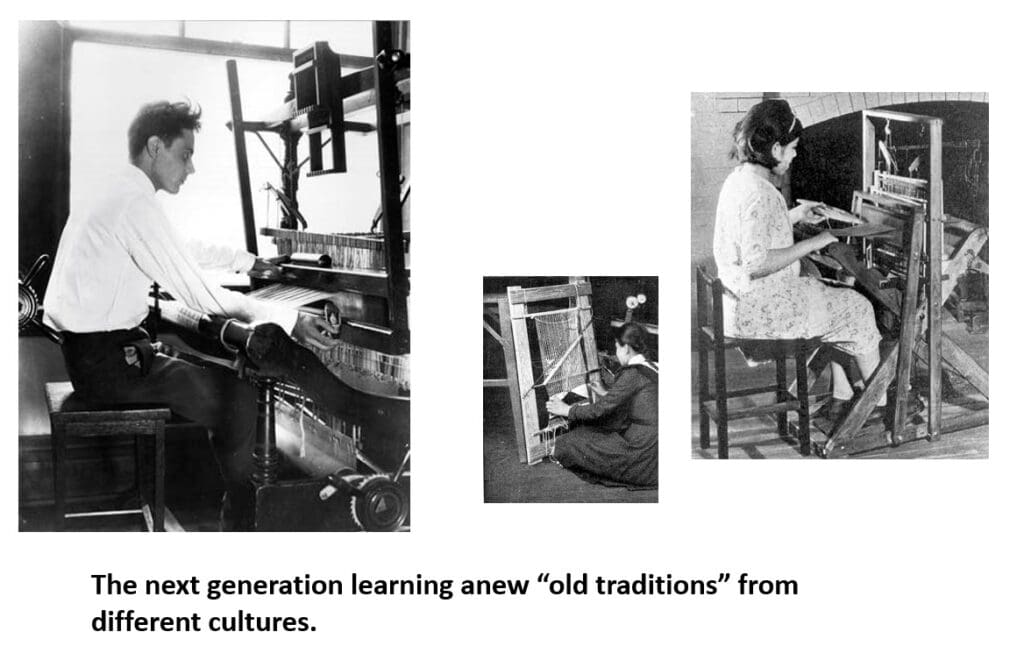
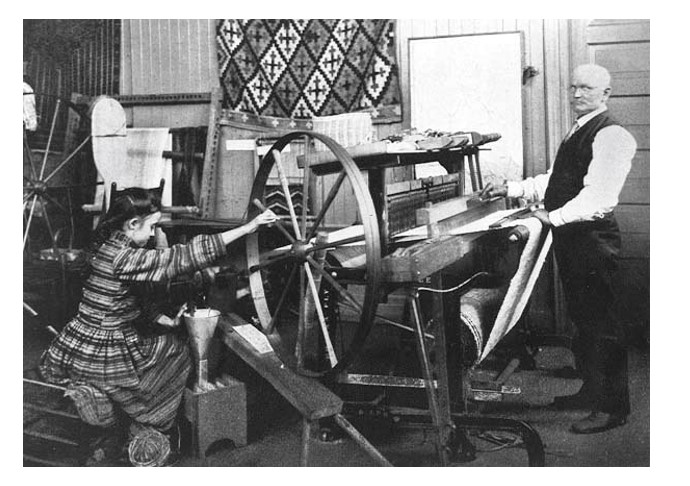
Classes and apprenticeship training became important pieces of the programs offered at Hull-House, part of a complicated equation that balanced demonstrations by immigrants “performed” to develop intergenerational understanding and respect of old world customs with the new vocational knowledge that aided first and second generation daughters and sons to enter the American economic system. Addams’s views of vocational guidance and industrial curriculum differed from both the plans put forward by business interests and those developed by organized labor precisely in this idea of connecting current skill learning with the history and art of craft. [32]
Instead Addams incorporated the immigrant women and men who regularly “performed” their artistry and crafts in the Labor Museum, in the education of young boys and girls. This was an innovation pedagogically. The elders took on young men and women as “apprentices.” The products of the work were made available for sale, with the same split between the House and the artisan. There are no statistics to measure how much any artisan “earned” or how many students transitioned into a permanent industrial job. The dissemination of the craftsman ideal to the youth of the neighborhood was much more important to Addams than running industrial shops that saw a profit or adapting youth to fit the specific employment needs of industry. [33]
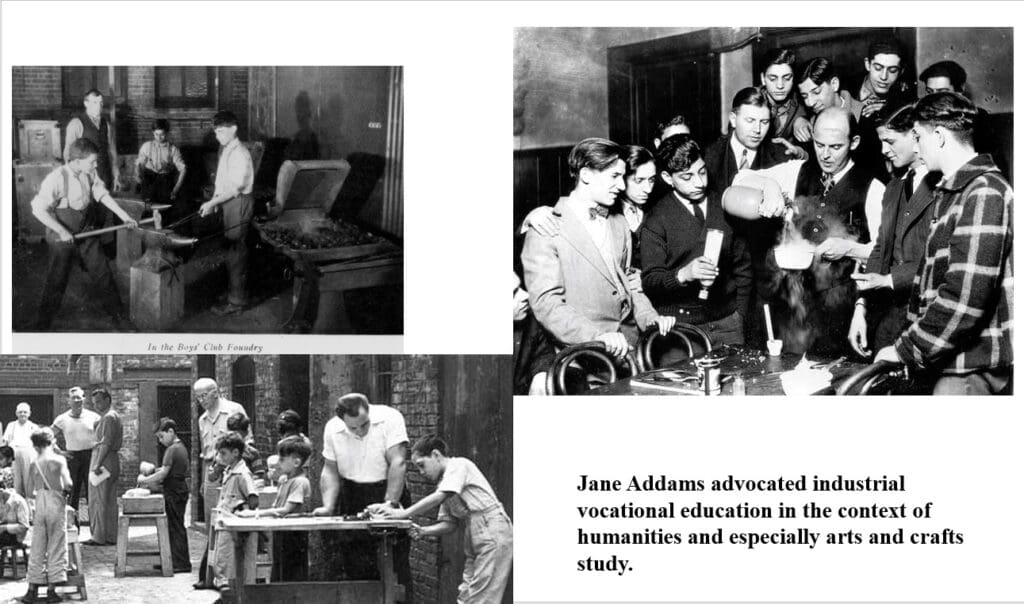
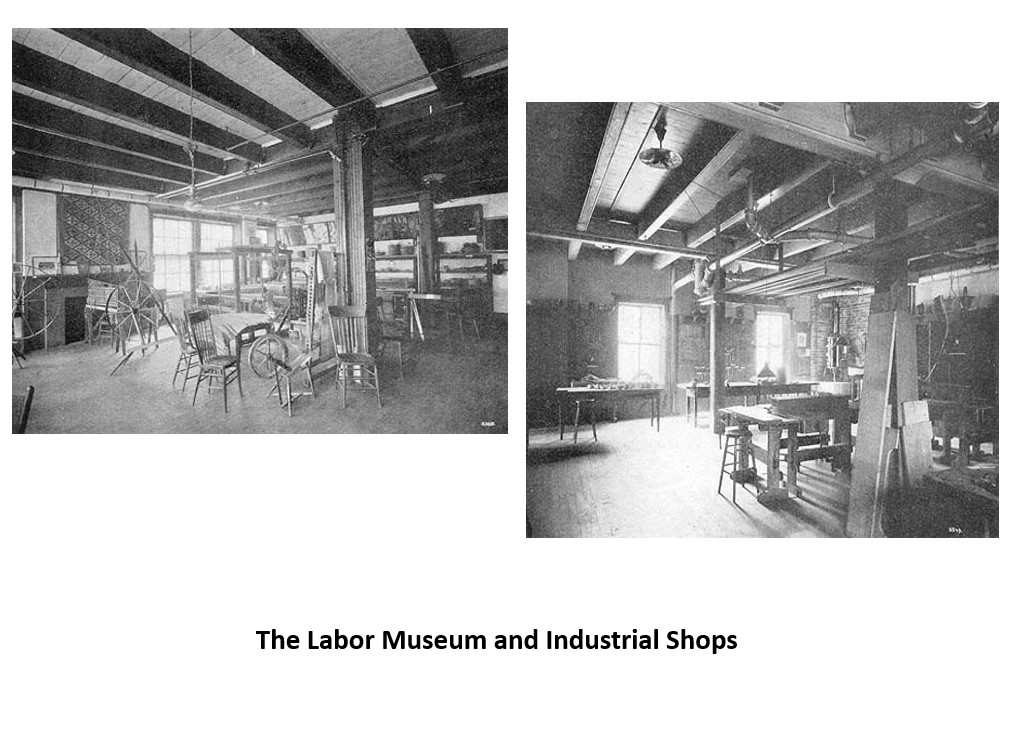
The Labor Museum and Industrial Shops were inaugurated by Addams at the peak of the arts and crafts movement in Chicago and at a time when “exhibition” to educate the public on industrial conditions, model housing, and municipal planning was a key strategy of reformers and practitioners of the new fields of sanitation, urban planning, and public health.[34] It was also a period in which middle-class native born Americans were not convinced that the “New Immigrants” were assimilable. The charts that demonstrated the continuity and similarity of craft in the history of industry also depicted universality among the different ethnic groups whose techniques were both culturally specific and part of the universal story. There was a positive response from middle-class visitors, a key piece in Addams’s agenda. Addams expanded programs, added classes, and collected more artifacts and encouraged the collaboration of all the other departments of the settlement house in this pursuit of an educational medium that would successfully connect immigrants and their children in a positive way to the long history of industrialism, and as well, connect Americans with their new neighbors.
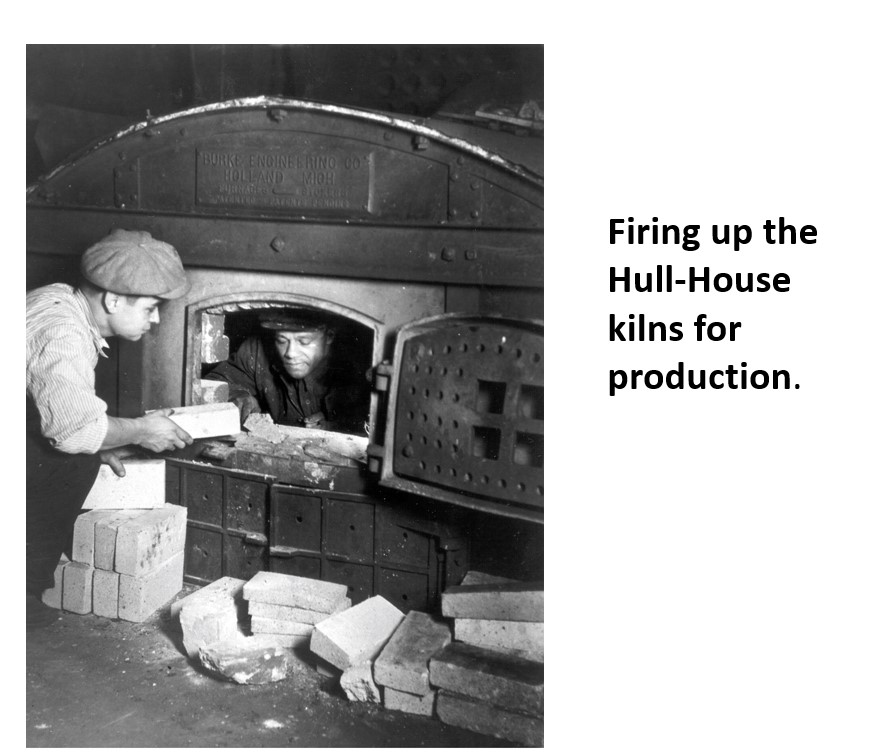
Hull-House used art to advocate for democratic principles, to teach democratic values by living up to the highest standards of conduct with respect to the rights of others; and to encourage the broadest, most inclusive cultural as well as civic engagement of the whole community. Long before the New Deal programs for theater and art inaugurated a period of intense public support for the arts in a democracy, Addams critiqued the narrow eighteenth century notion of democracy as being equated almost entirely with representation through voting, and sought to make democracy relevant to the cultural needs of the masses.
[1] Here I have not the time to interrogate the authenticity of traditional craftwork of the neighbors. In my chapters in Eleanor Smith’s Hull House Songs: The Music of Protest and Hope in Jane Addams’s Chicago co-authored with Graham Cassano and Jennifer Payette (Chicago: Haymarket, 2020), I deal with the more complicated performance of craft that went on. I called it constructed craftsmanship. See, Eleanor Smith, 278.
[2] William T. Stead, If Christ Came to Chicago: A Plea for the Union of All who Love in the Service of All who Suffer (Review of Reviews: 1894).
[3] Graham Cassano, Rima Lunin Schultz, and Jessica Payette, Eleanor Smith’s Hull House Songs: The Music of Protest and Hope in Jane Addams’s Chicago (Chicago: Haymarket, 2020), 170.
[4] Nancy E. Green, Byrdcliffe: An American Arts and Crafts Colony. Ithaca, New York: Herbert F. Johnson Museum of Art, Cornell University, 2004 catalog, 231.
[5] “From Sweden to Woodstock: The Art and Career of Carl Eric Lindin” by Tom Wolf. Catalogue: David Cook Fine Art, Denver, Colorado, 2005, 5.
[6] “From Sweden to Woodstock” 5-10. In 1904 Lindin exhibited thirty-two paintings at the Art Institute of Chicago. He married Louise Hastings in 1911; she was the daughter of a wealthy banker and civil engineer and was part of the Hull-House circle. She learned bookbinding from Ellen Starr. Carl and Louise wed at Hull-House. (Wolf, 10.) Louise Lindin worked on her bookbinding as well as weaving and sewing. (Wolf, 11.)“In 1911 he [Lindin] had an exhibition at the Art Institute of Chicago consisting of thirty-eight paintings, all landscapes.” (12) In 1923 and 1924 Carl and Louise spent the winters in Ojai, California, where they taught at the Ojai Valley School, founded by their old Hull-House friend, Ed Yeomans. (Wolf, 16.) Note: Lindin painted a portrait of Jane Addams and also one of Hervey White.
[7] Listed “In Memoriam,” Hull-House Residents 1889-1929. Note: Bruce Robert Kahler, “Art and Life: The Arts and Crafts Movement in Chicago, 1897-1910,” Ph.D. Dissertation, Purdue University, August 1986, lists Twose as the secretary of the Arts and Crafts Society. However, Eileen Boris, Art and Labor, says that George Twose was the society’s first president (pp. 45-46) and that its secretary was Ellen [Ella Raymond] Waite.
[8] In 1906, she was recruited by Dr Wilfred Grenfell, the medical missionary, to teach weaving to women at St Anthony, a small community at the northern tip of Newfoundland, and for four years she painstakingly laid the groundwork for a variety of craft industries. Jessie Luther at the Grenfell Mission is an annotated edition of a travel journal that Luther wrote from 1906 to 1910. Edited by Ronald Rompkey, author of the most authoritative biography of Grenfell, Luther’s journal provides an unusually intimate account of Wilfred Grenfell during these four years.
[9] “Occupations of the Residents of Hull-House,” 1935-36. She is listed in Hull-House Yearbook Forty-Fifth Year.
[11] Vincent L. Michael, “Recovering the Layout of the Hull House Complex,” Urban Experience in Chicago: Touring the Buildings: Inside The Complex, http://www.uic.edu/jaddams/hull/urbanexp (Urban Experience in Chicago: Hull-House and Its Neighborhoods, 1889-1963, Jane Addams Hull-House Museum website, UIC.
[12] Jane Addams, “Labor Museum at Hull House,” Current Literature Oct. 1900, Vol. XXIX, No. 4; American Periodicals Online, p. 423.
[13] Mary Ann Stankiewiez, “Art at Hull House, 1889-1901: Jane Addams and Ellen Gates Starr.” Woman’s Art Journal (Spring-Summer 1989), vol. 10, No. 1, 37.
[14] Jane Addams, Twenty Years, 375. Addams, however, proudly displayed the arts and crafts produced in the shops at the 3rd annual exhibit of arts and crafts held at the Chicago Art Institute: Catalogue, Third Annual Exhibition of Original Designs for Decorations and Examples of Art Crafts having Distinct Artistic Merit, The Art Institute of Chicago, December 6 to December 21, 1904, 53-55.
[15] Starr quoted in Eileen Boris, Art and Labor: Ruskin, Morris, and the Craftsman Ideal in America (Philadelphia: Temple University Press, 1986), 180.
[16] Elizabeth Palmer Carrell, “Reflections in a Mirror: The Progressive Woman and the Settlement Experience,” Ph.D. dissertation, The University of Texas at Austin, 1981, 30.
[17] “Chicago’s Hull House.” Report on an Address by Ellen Starr, 1895, Hull-House Scrapbook, III, JAMC, Spec. Col. Daley Library, UIC.
[18] “I have thought of the possibility of my dying [before] the experiment [Hull-House settlement] is in full sway,” Addams wrote her sister Alice. “As Ellen has given up her regular teaching and trusts all her future to the affair, I should like her to be given $1500.00 enough to support her for a year or more until she could get back into her regular work. I have now made a will and . . . know you would see to that for me.”[18] Jane Addams to Sarah Alice Addams Haldeman, August 31, 1889, JAP reel 2-1079-1080.
[19] In 1904 Starr’s pupils Peter Verburg and Mary Kelley exhibited bound volumes: Catalogue, Third Annual Exhibition of Original Designs for Decorations and Examples of Art Crafts having Distinct Artistic Merit, The Art Institute of Chicago, December 6 to December 21, 1904, 53-55.
[20] Starr was one of the founding members of the Chicago Society of Arts and Crafts. Eileen Boris, Art and Labor: Ruskin, Morris, and the Craftsman Ideal in America (Philadelphia: Temple University Press, 1986), 33, 45-46. When the arts and crafts community, Byrdcliffe, was established in Woodstock, New York, in 1902, Starr was a visitor. Nancy E. Green, “Byrdcliffe and the ‘Dream of Somewhere,’” The Journal of the Decorative Arts Society 1850 –the Present. No. 28, ARTS & CRAFTS ISSUE (2004), pp. 56-81.
[21] Starr reconciled to her displacement by Mary Rozet Smith as Addams’s partner and remained in residence at Hull-House until 1930, when illness forced her to relocate. Even then Addams and Starr remained deeply attached. Rima L. Schultz, “Smith, Mary Rozet,” in Women Building Chicago, 817-819.
[22] “Fine Work in Binding Books,” Chicago Chronicle, Apr. 22, 1900, 19; Suellen Hoy, Ellen Gates Starr. Her Later Years (Chicago: Chicago History Museum, 2010,) 5-7. Starr was a talented bookbinder and her work was exhibited along with the top artisans in the field. One of her best students, Peter Verburg, went on to have an outstanding career. Boris, 181.
[23] This was the Waitresses’ union strikes against the downtown Chicago popular restaurant, Henrici’s, that began in February of 1914: “Girl Pickets Open Boycott Fight on 35 Cafes in Loop,” Chicago Tribune, Feb. 6, 1014, pg. 13; “Ellen G. Starr’s Trial on Today,” Chicago Tribune, March 4, 1914, pg. 7. Suellen Hoy indicates Starr’s public activism troubled her fellow Hull-House residents. Suellen Hoy, Ellen Gates Starr. Her Later Years (Chicago: Chicago History Museum, 2010), 16-17.
[24] Carrell, 357-358. Lila Weinberg, “Wilmarth, Mary J. Hawes, “in Women Building Chicago, 982-986.
[25] Carrell, “Reflections in a Mirror,” 398-400. Starr to Wager, Hull-House, Feb. 12, 1917, Ellen Gates Starr Papers, Sophia Smith Collection, Box VIII, Smith College. Among her periods of depression, in 1896, after a garment workers’ strike, the first in which she was actively involved, Starr became exhausted and left for New York for a prolonged period. In 1907 she collapsed from nervous exhaustion, spent a month in a sanitarium, and spent 1908 abroad, living in relative isolation on a farm in Ireland. For her conversion to Roman Catholicism, see: Starr, “A Bypath into the Great Roadway,” Catholic World vol. 119, May 1924.
[26] Ellen G. Starr, “College Settlement Work: Hull-House,” 4th paper published by the Society of the Companions of the Holy Cross [Adelynrood, Byfield, Massachusetts: 1895], 1-3. Starr most likely was disappointed in the other group to which she attempted to meld art and labor: the Chicago Society of Arts and Crafts. Historian Eileen Boris found that “By 1910 it [the Chicago Society for Arts and Crafts] had dwindled to 26 members, who concentrated on running their own studio-shops rather than promoting cooperative ventures. Crafts workers increasingly were alumni of the School of the Art Institute, which had replaced Hull House as the center of the movement in Chicago. With this shift, the crafts—while flourishing as profession, personal avocation, and part of an appealing lifestyle—lost their more intimate relation to the reform impulse.” Boris, Art and Labor, p. 51.
[27] Carrell, 357.
[28] Elizabeth Fones-Wolf, “The Politics of Vocationalism: Coalitions and Industrial Education in the Progressive Era,” The Historian, Vol. 46, No. 1 (November 1983), 43.
[29] Charlotte E. Carr, headed Hull-House from 1937 to 1942, at the height of the settlement house’s engagement with the New Deal Popular Front and Cultural Front movements. Discussion of these developments follows.
[30] Addams was so concerned about the fate of young girls, fourteen years and older, that in 1912 the Hull-House Trade School for Girls was opened and used the area of the industrial shops and other classrooms. Dressmaking was emphasized and girls were placed in dress-making shops after completing a summer course. By 1915 a new department, The Hull-House Design Shop, prepared girls to work in children’s clothes shops. Anne S. Davis, “The Hull-House Trade School for Girls,” The Educational Bi-monthly, 207-208.
[31] Jane Addams, The Spirit of Youth and the City Streets (New York: The Macmillan Company, 1909), 107.
[32] Washburne, 571.
[33] Washburne, 571. Eileen Boris, Art and Labor: Ruskin, Morris, and the Craftsman Ideal in America (Philadelphia: Temple University Press, 1986).
[34] The 1893 Columbian Exposition, the Tenement House Exhibit of 1900 (New York City), the Chicago Child Welfare Exhibit in 1911, just to name a few. Addams was one of the jurors at the Paris Exposition of 1900 where she attended the lectures given by evolutionary sociologist Patrick Geddes, accredited with pioneering urban planning and took great interest in his exhibit. She had met him before and he had visited Hull-House during a lecture tour of the U.S. Jane Addams to Mary Rozet Smith, Paris, France, June 14, 1900, Swarthmore College Peace Collection Jane Addams Papers Series 1, JAP reel 3-1585-1588; Jane Addams to Mary Rozet Smith, Paris, France, June 27, 1900, Swarthmore College Peace Collection Jane Addams Papers series 1, JAP reel 3-1597-1601; Geddes work was known to Addams. I’m not sure when they met for the first time.