Hull House Has a Visitorโ€ฆAnd the Rest is History by Terrence J. McDonald.

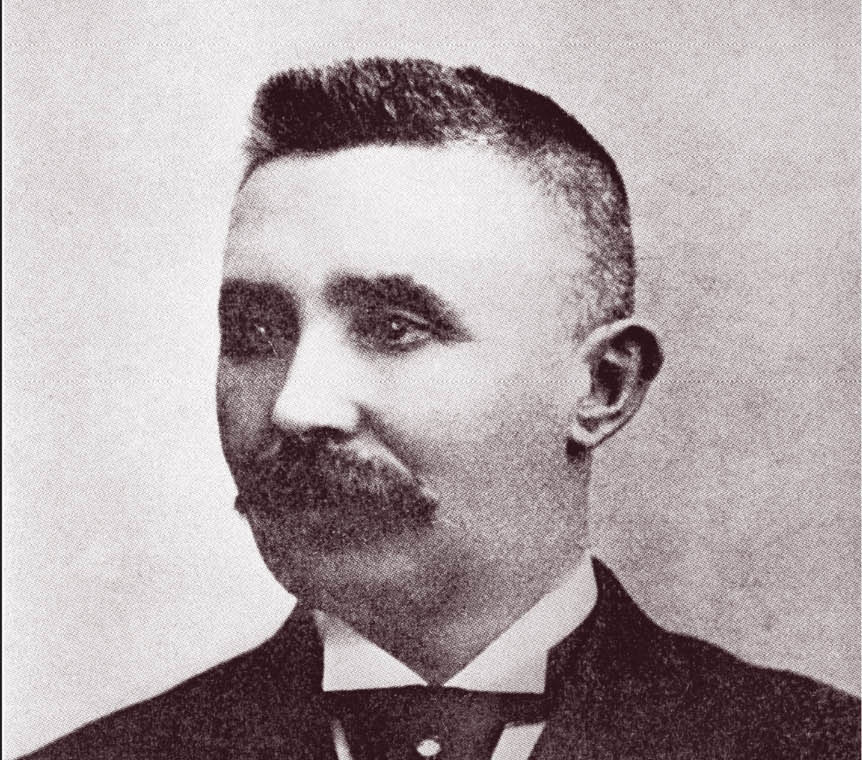
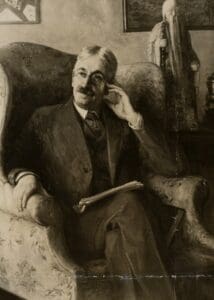
A sepia-toned portrait of a man with short hair and a thick mustache, wearing a suit and bow tie, looking slightly to his left.

In early December 1893 Chicagoโ€™s Hull House had an important visitor. The minutes of the residentsโ€™ meeting for December 10 noted that โ€œMiss Addams announced that she had been honored with a visit from Alderman Powers, who proposed giving some thousands of pounds of turkey and beef to the poor of the ward at Christmas, and desired Hull House to make the distribution.โ€ The proposal from Nineteenth Ward Democratic Alderman John โ€œJohnnyโ€ Powers set off a strenuous debate among the sixteen settlers at the meeting, with the minutes recording a โ€œprotest,โ€ two motions, and an amendment. Finally, โ€œby general consent it was agreed that the Chief [Addams] should write to Mr. Powers, as she had herself suggested, to the effect that Hull House had so much provender sent in at Christmas time that it would be well for him to distribute his turkeys through other agencies.โ€

So began what would become one of the most famous, complicated, and significant relationships between a โ€œbossโ€ and a โ€œreformerโ€ in American history. From then until the spring of 1898, Addams and her Hull House colleagues would steadfastly oppose Powers, first simply by attempting to clean up the ward without his permission, then by coordinating two attempts to defeat him for reelection to his aldermanic seat in 1896 and 1898. More important in the long run, Addamsโ€™s own reflections on this relationship would become among the most famous of her early writings and also a major source for thinking about the conflict between bosses and reformers and the possibilities for a kind of โ€œsocial ethicsโ€ in the American city in twentieth-century America, in her own time and thereafter.

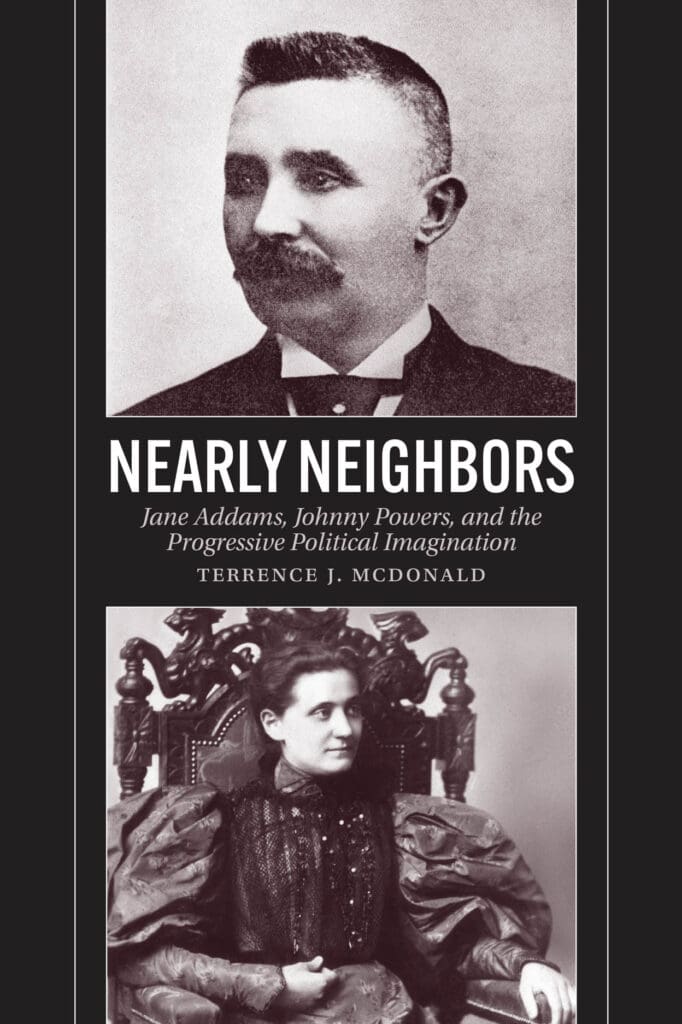
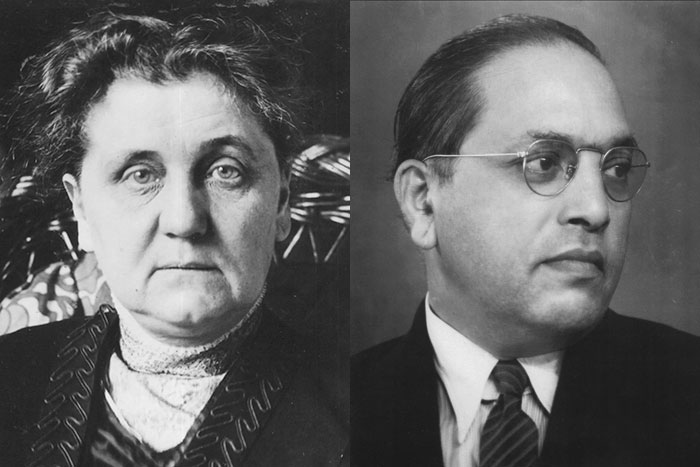
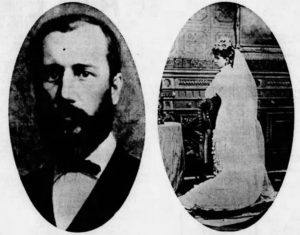
Book cover for Nearly Neighbors by Terrence J. McDonald, featuring black-and-white portraits of a mustached man in a suit and a woman in a high-collared dress seated in a decorative chair.

But my new  book, Nearly Neighbors: Jane Addams, Johnny Powers, and the Progressive Political Imagination is the first โ€“ ever โ€“ to attempt to write a contextualized history of this encounter,  embedding it in the social and political culture and structures of Chicago and the Nineteenth Ward in the 1890s and using that context to understand both how Powers and Addams operated politically and how her โ€“ definitely important โ€“ writings about this experience portrayed it.   

By 1896 Addams began lecturing on the way that ward bosses prospered politically, and by 1897 she had written a talk that was often entitled โ€œEthical Survivals in City Immorality.โ€ A much revised and lengthened version of this lecture was published in the International Journal of Ethics in 1898 under the title โ€œEthical Survivals in Municipal Corruption,โ€ and then a shortened form appeared in The Outlook, where it received the more popular title โ€œWhy the Ward Boss Rules.โ€ A version of the long version of this essay became the stirring last chapter of her 1902 book, Democracy and Social Ethics, and formed the core of her remarks at the 1904 Worldโ€™s Fair, which were published as โ€œProblems in Municipal Administrationโ€ in the American Journal of Sociology in 1905.

Addams set out in these writings humanely to reject the reigning conception among some reformers that municipal corruption stemmed from โ€œignorant foreignersโ€ driven to the polls by devious politicians. She wrote that the โ€œsimple peopleโ€ of the ward were cultureless, bound together only by their โ€œbasic human nature.โ€ But importantly they were also bundles of genuine economic need. Her argument was that it was perfectly rational for โ€œneedyโ€ immigrants to vote for corrupt politicians, and furthermore, that satisfaction of those immigrant economic needs that were legitimate by an expanded local state was the pathway to โ€œsocial democracy.โ€

In recognizing these needs, she argued โ€“ for a job, bail money, legal โ€œpull,โ€ rent money, presents at weddings, help with funeral expenses, etc. — the ward bosses, corrupt as they were, at least noticed them. Reformers, meanwhile, spent their time complaining about this state of affairs rather than humanely recognizing the needs of the immigrants.  Addamsโ€™s ringing conclusion was this: โ€œIf we discover that men of low ideals and corrupt practice are forming popular political standards simply because such men stand by and for and with the people, then nothing remains but to obtain a like sense of identification before we can hope to modify ethical standards.โ€

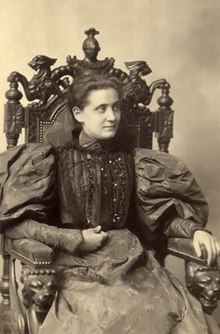
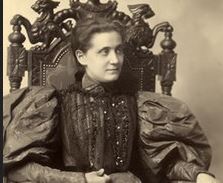
A woman in a Victorian-era dress with puffed sleeves sits on an ornate chair with carved griffins, looking slightly to the side. The photo is black and white, with a formal, historical atmosphere.
Jane Addams, ca. 1898

Addamsโ€™s views were powerful because of her position: not only was she living among the immigrant poor since 1889, but, unlike many others in the settlement movement she had bravely challenged the political โ€œbossโ€ of the ward.  But to make this argument Addams completely mis-characterized the ward population.  Her starting assumption that immigrants were โ€œculturelessโ€ was her rationale for the work of the settlers which was, after all, to bring the โ€œcorrectโ€ culture to the immigrants.  But this led her to ignore the dense markers of ethnic culture in the ward and, in particular, to leave out the fact that Hull House was surrounded by five ethnic Catholic parishes and their schools, including the largest English-speaking Catholic church in Chicago, Holy Family โ€“ home of the Irish โ€“ whose steeples were clearly visible from Hull House. These churches and schools had been in operation for decades before Hull House opened but the word โ€œCatholicโ€ would only casually appear in any version of her writings, and the word โ€œIrishโ€ would play no significant causal role. 

Moreover, her account ignored the event that galvanized an ethnic Catholic political identity, a ferocious statewide 1892 battle over a new compulsory education law that gave public school boards the power to qualify all parochial schools โ€“ Catholic, Protestant, or other — for meeting the law. Although Hull House resident Florence Kelley was more vociferous in her support for the law Addams, too, sided with the reformers against her ethnic neighbors.  And although neither of them was a nativist, the campaign on behalf of retaining the law was riddled with nativist arguments.

This battle has been mis-characterized by those around Hull House including pioneering scholars Edith Abbott and Sophonisba Breckinridge — as a fight over teaching in foreign languages.  But this meant nothing to the Irish, all of whose clergy and schools used perfect English.  The issue for all sponsors of parochial schools was control of the curriculum and, yes, the ethnic recognition that the Irish and Germans, in particular, demanded but that Addams, Kelley and the reform coalition refused to deliver. The schools were a remarkable testimony to the belief of hard-pressed immigrants, many of whom were illiterate, in the power of education for their children.  But this reality seemed lost on the upper-class reformers in favor of the law including those at Hull House.  And this failure of recognition eliminated the possibility of an alliance among both reformers and immigrants on behalf of education.

Condemned by Catholic and Protestant clergy alike, the law was quickly repealed after the election of Democratic governor John Peter Altgeld and Democratic majorities in both houses of the Illinois legislature.  Because municipal elections in Chicago occurred in the spring and state elections in the fall, this battle did not involve Powers directly at first. Powers had immigrated to Chicago in the 1870s and thanks to the pioneering work of an uncle and Powersโ€™s future wife had become the owner of both a bar and a grocery store in the ward.  He was a practicing Catholic, sent his children to the Catholic schools, and belonged to the relevant Irish associations.  But in a ward where every elected official was the same there was little need to stress his background for most of the years after his first election in 1888. For most of that time, too, he simply ignored Hull House in his campaigns. 

A sepia-toned portrait of a man with short hair and a thick mustache, wearing a suit and bow tie, looking slightly to his left.
Johnny Powers

But the political persistence of Addams led Powers to shift to a completely identity-based campaign in 1898. Its symbolic and real climax was a parade on the Saturday night before the election that local reports said involved 3,000 marchers and thousands of spectators and formed up about a block away from Hull House.  The parade itself was based on the periodic parades for first communions and holy days at Holy Family and the Holy Family youth temperance band (funded by Powers) โ€“ the St. Matthewโ€™s Cadets — led it off.  Of special interest were the Ladies Auxiliary of the Nineteenth ward Democratic Club and the Nineteenth ward Businessmenโ€™s Club.

Neither the St. Matthewโ€™s Cadets nor the Ladies Auxiliary or Businessmenโ€™s Clubs had been seen in ward politics before.  Powers had funded the first, and his campaign clearly organized the second and third. The Cadets were named after the famous Irish temperance advocate Father Theobold Matthew and proved that although Powers was Irish and a bar owner, he was comfortable with personal temperance efforts, including those of Holy Family parish itself. The Ladies Auxiliary and Businessmenโ€™s Club carried heavier water, the former to show that the โ€œlocalโ€ women supported him โ€“ unlike those at Hull House โ€“ and that latter that the โ€œcalumniesโ€ in the speeches and writings of the settlers and their candidates damaged the economic interest of the ward. 

But the key thing about this parade and the campaign more generally was the ability of Powers to identify himself as a member of the ward based ethnic, religious, and political culture defending its interests against the โ€œdowntownโ€ elites displayed in the Hull House campaign.  Unable to respond carefully to this neighborhood appeal the reform forces disastrously invited as their keynote speaker against Powers an โ€œuptownโ€ city council member who was the son of a United States supreme court justice and graduate of Princeton who emphasized that Powers was the โ€œPrince of Boodlersโ€ on City Council. Powers took 72 percent of the votes in this election and would remain on the council until 1923.

Although the settlers promised to keep up the fight, Hull House withdrew from ward politics just before the municipal election of 1900. In explanation Addams claimed that it was because, given his โ€œwealth and political methods he could easily defeat any honest man.โ€  But this had little to do with his victory.  He was certainly rich and he may very well have been corrupt but had won in 1898 because โ€“ partially out of desperation โ€“ he had found a way to endorse and celebrate the identity of the ward against the โ€œdowntownโ€ interests and โ€œhectoringโ€ reformers โ€“ most of whom had publicly supported the controversial school law that Addams herself never condemned.

It was an article of faith among progressive era intellectuals and reformers โ€“ originating with the young John Dewey — that an โ€œunidentifiedโ€ political subject and thus emerging citizen existed.  In her important 1902 essay โ€œFriendship in Politics,โ€ the New York settlement worker Mary Kingsbury Simkhovitchโ€”clearly influenced by Addams โ€” wrote that progress toward that goal was actually being made. โ€œThat is the hopeful thing about democracy,โ€ she wrote, โ€œit is slow but thorough.  A common consciousness is arising. The man is becoming the citizen.โ€ This emerging โ€œcommon consciousnessโ€ was a consciousness of shared human needs, not of differingโ€”and sometimes conflictingโ€”cultures. And it was founded on and ratified by the all-important experience of the settlement workers on the urban front lines who defined their mission as bringing culture to the immigrants, not necessarily discovering the role of immigrant cultures in political mobilization.

But as historian Richad Oestreicher pointed out in a classic essay about class and politics in the American city it is the process of political mobilization that helps create political consciousness and not the other way around. And that initial mobilization leaves a mark.  This process was repeated in Chicago through the next decades with the rise of the United Societies for Local Self-Government as the bane of reformers and the foundation for the election of the cityโ€™s first foreign born mayor, Anton Cermak. 

 Addamsโ€™s wise โ€“ if misdirected — words ring down through the centuries: โ€œIf we discover that men of low ideals and corrupt practice are forming popular political standards simply because such men stand by and for and with the people, then nothing remains but to obtain a like sense of identification before we can hope to modify ethical standards.โ€  But identify with what? The immigrants around Hull House were bearers of culture and not just bundles of economic needs. Their enrollment in what has come to be called โ€œidentityโ€ politics was a foundational historical reality rather than an obstacle to historical development based on some other criterion, such as class, mobility, assimilation, etc. And the failure of otherwise brave and self-less settlers to understand this has impeded the development of a positive theory of a multicultural society down through the twentieth century.


Selected Sources:

Jane Addams, “Residentsโ€™ Meeting of December 10, 1893,โ€ in The Jane Addams Papers, 1860โ€“1960, ed. Mary Lynn McCree Bryan (Ann Arbor, MI: University Microfilms International, 1984).

Jane Addams, “Ethical Survivals in Municipal Corruption,” International Journal of Ethics 8, no. 3 (April 1898): 273โ€“91; “Why the Ward Boss Rules,” The Outlook 58, no. 14 (April 2, 1898): 879โ€“82; โ€œPolitical Reform,โ€ in Democracy and Social Ethics (New York: Macmillan, 1902), 221โ€“77; โ€œProblems in Municipal Administration,โ€ American Journal of Sociology 10, no. 4 (January 1905): 425โ€“44. Twenty Years at Hull-House with Autobiographical Notes (New York: Macmillan, 1910).

Abbott, Edith, and Sophonisba P. Breckinridge. Truancy and Non-Attendance in the Chicago Schools: A Study of the Social Aspects of the Compulsory Education and Child Labor Legislation of Illinois. Chicago: University of Chicago Press, 1917.

Hamilton, Alice. Alice Hamilton to Agnes Hamilton, April 3, 1898. In Barbara Sicherman, Alice Hamilton: A Life in Hamilton Letters, 120โ€“22. Cambridge, MA: Harvard University Press, 1984.

Dewey, John. The Ethics of Democracy. Ann Arbor, MI: Andrews, 1888.

Simkhovitch, Mary Kingsbury. โ€œFriendship and Politics.โ€ Political Science Quarterly 17, no. 2 (1902): 189-205.

Oestreicher, Richard. โ€œUrban Working-Class Political Behavior and Theories of American Electoral Politics, 1870โ€“1940.โ€ Journal of American History 74, no. 4 (March 1, 1988).

Jane Addams, the Imperialist?! by Sheryl Gordon

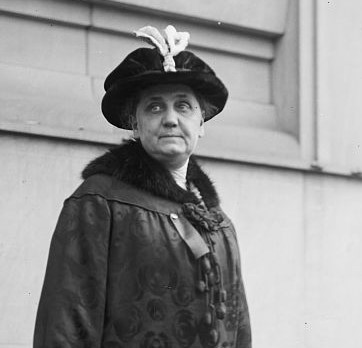
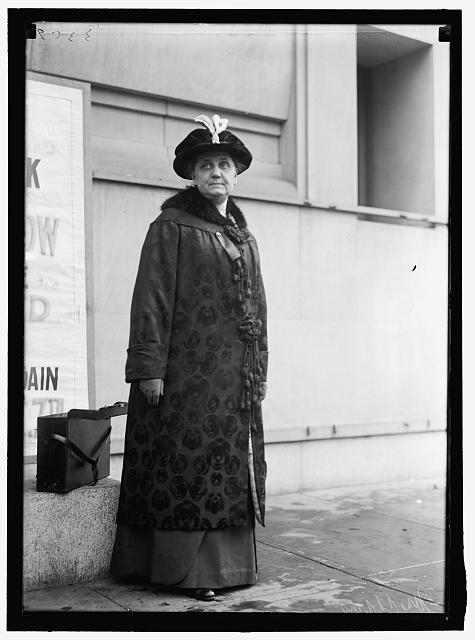
A woman wearing a dark, patterned coat with a fur collar and a decorative hat stands in front of a building, looking slightly to the side.

Sheryl Gordon is an Assistant Professor in the History and Political Science Department at Molloy University on Long Island, NY. Her research has centered on peace history and international relations in the early twentieth century. She published โ€œThe Limits of Labels: Jane Addams and Her Views on Self-determination and Imperialism, 1899โ€“1923,โ€ in Peace & Change: A Journal of Peace Research in 2024. She has book in press with Bloomsbury Academic entitled Marian P. Whitney and the Problem of Being a Prominent Person in the Progressive Era.

A woman in early 20th-century clothing, including a long patterned coat with a fur collar and decorative hat, stands on a sidewalk next to a case and a wall with a partial poster visible.
Jane Addams (1913) – Library of Congress

I started researching Jane Addams a few years ago for a course on women in American history I was preparing to teach. She seemed to fit well within the scope of my research interests as well, which are on peace history and the World War I era. After all, in addition to her social work, Addams was one of the best-known pacifists in America. She was even labeled โ€œthe most dangerous woman in Americaโ€ because of her national stature and her pacifist views. As I read through her published works, her dedication to peace and humanitarianism were clear. Then I came across a brief article she wrote in 1921 titled โ€œThe Potential Advantages of the Mandate System.โ€[1] The article seemed completely opposed to her other work and worldview. The mandate system was created as a provision of the League of Nations after World War I that gave Western European nations control of the economic resources of the defeated nations and former colonies of Germany. For much of the twentieth and twenty-first centuries, the mandate system has been viewed as imperialist.

Was Jane Addams really promoting imperialism, a system linked to militarism and war?

Had her views changed since 1899, when she opposed the U.S. annexation of the Philippines in the aftermath of the Spanish-American War? Or had she been misunderstood by her contemporaries and scholars in some ways?

I could not find much in the secondary sources to help explain her views on imperialism or the mandate system. Addams was labeled generally an anti-imperialist. Marilyn Fischer, Professor Emerita at the University of Dayton and scholar on Addams, provided valuable guidance on Addamsโ€™s motivations and outlook. In the Jane Addams Digital Edition, I saw how Addams maneuvered through events and issues with peace as her north star. 

I searched the digital edition to see if Addams expressed any thoughts to her colleagues in the Womenโ€™s International League for Peace and Freedom (WILPF), family members, or friends about her views on imperialism and the mandate system. Looking through various letters and material, I examined her views towards the Anglo-Irish War, or Irelandโ€™s campaign for independence from imperialist England. It began in 1919 and ended with a truce in 1921 that divided Ireland into a free state and parts controlled by England. I also found the archive useful for understanding her views on the League of Nations and mandate system.

โ€œJumping into Boiling Oil:โ€ Addams and the Anglo-Irish War

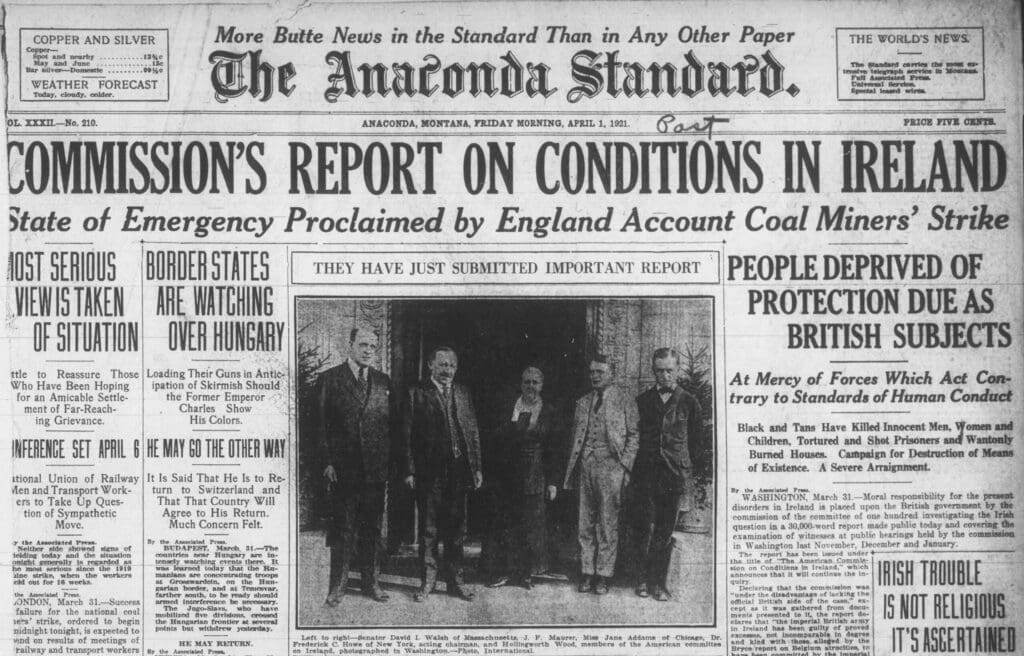
Opinion in America about the Anglo-Irish War was extremely divisive. Anti-British sentiments in America intensified as reports circulated of atrocities committed in Ireland by British soldiers. Addams was part of a group of 150 politicians, selected individuals, and clergy to examine the situation in Ireland. She even served as temporary chair of this group, known as the American Commission on Ireland. A letter written to Emily Greene Balch, International Secretary-Treasurer of WILPF, shows how dedicated Addams was to pursuing peace in this conflict. Addams wrote to Balch in 1920 about becoming involved with the Commission, โ€œI quite realize that it is jumping into boiling oil as it were, but it may be useful and even afford a chance for our old idea of continuous mediation.โ€[2] In a letter to her English friend and WILPF colleague, Henrietta Octavia Barnett, Addams explained she was involved with the Commission to lessen the chance for military escalation.[3]

Addams viewed the Commission as a way to help England and Ireland arrive at a resolution. What was not in the digital edition was also meaningful. Addams expressed sympathy for the suffering of Irish civilians and helped how she could. In her correspondence, though, Addams did not express support for Irelandโ€™s right to choose a government supported by the majority. In her published and unpublished writings, Addams prioritized food security for nations. For Addams, it was more important to avoid a war, which would further endanger the population in Ireland.  

Black and white 1921 newspaper front page with bold headline about Ireland, several articles, and a photo of seven men in suits standing outside a building.
Headline of the Anaconda Standard with image of Jane Addams and other Commissioners, April 1, 1921.

Addams and the Mandate System

Reading through her unpublished letters in the digital edition, I understood better her support of the League of Nations and views of the mandate system. The thinkers she corresponded with discussed the mandate system as the path to peace in a world uprooted by war. Since the control over nations would be temporary, transparent, and supervised, they did not view the mandate system as imperialism. These thinkers reasonably influenced her views.

Addams began to envision a different pathway to permanent peace. Before the war, Addams was optimistic that citizens could work together to pressure their governments to create conditions necessary for peace. These conditions meant having enough food and resources. After the war, Addams viewed governments incapable of creating these conditions. Several governments had collapsed and economies were in shambles. For Addams, the League of Nations would be able to balance the worldโ€™s economic resources to provide humanitarian aid for immediate suffering and to help countries regrow their economies. Only then could the conditions for lasting peace be created. Addams expressed confidence that the League of Nations would be able to minimize nations from being exploited in this process.

Addams wanted America to join the League of Nations to help with this humanitarian aid. She had worked for the government during the war helping with international food relief efforts. She wrote to Balch after the war that famine relief was โ€œthe most useful thing that can be done just now.โ€[4] The digital edition contains several newspaper articles summarizing her various talks across the nation and abroad. The articles reveal how she tailored her message to each group to convey her message most effectively. Letters with Balch and Anna Garlin Spencer, the president of the U.S. Section of WILPF, indicate they had a different priority.[5] Undeterred, even when the U.S. did not join the League of Nations, Addams focused on bringing her message to the public. She continued to advocate humanitarian relief as a pathway to peace.

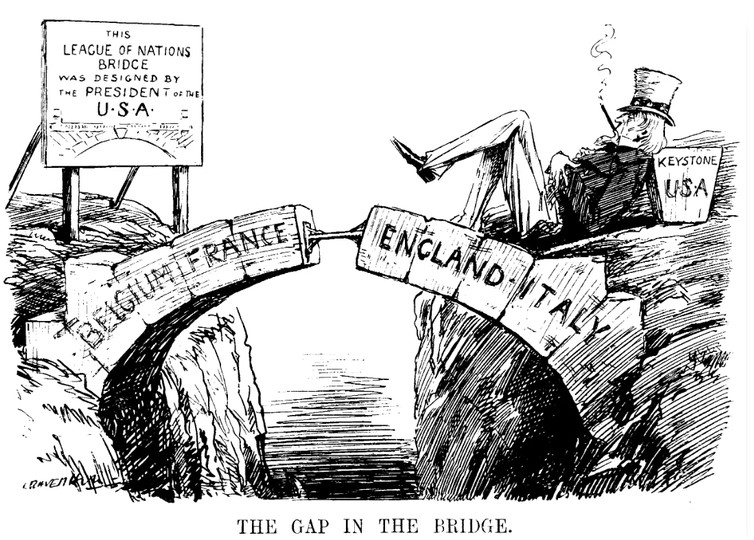
Political cartoon of a man in a top hat, labeled USA, sitting on a missing keystone between two bridge halves labeled Europe/France and England/Italy, with a sign about the League of Nations Bridge. Text: The Gap in the Bridge.
Cartoon highlighting the United States refusal to join the League of Nations (Punch, December 1919).

So, was Addams promoting imperialism?

After countless focused searches and fulfilling falls through rabbit holes in the Jane Addams Digital Edition and re-reading her published works, I had an answer to my original question. Addams was not promoting imperialism. However, she was not focused on refuting it, either. Addams was an independent thinker. She supported causes based on the consequences she foresaw. She theorized the Philippine population would not benefit from U.S. annexation in 1899, so supported the anti-imperialist side. She believed the Anglo-Irish War would lead to military escalation and endanger the population in Ireland. So, she did not promote Irelandโ€™s right to self-determination. She deemed the League of Nations able to provide large-scale economic and humanitarian relief. So, she promoted it, providing certain guardrails were placed on Western nations. Embedded in her pacifism was the concept of food and resource security.

From examining her unpublished writings, we can get a better sense of the relationship between pragmatism, imperialism, and peace. Her writings reveal that anti-imperialism and pacifism are not always tied together. This understanding can be used in how we understand the womenโ€™s rights movement, international peace movement, and political landscape in the decade following World War I. We also gain a better understanding of Jane Addams. Her actions, a testament to her humanitarian and peace-focused worldview, speak louder than labels.


[1] Jane Addams, โ€œThe Potential Advantages of the Mandate System,โ€ The Annals of the American Academy of

Political and Social Science 96, no. 1 (July 1921): 70โ€“74, https://doi.org/10.1177/000271622109600115.  

[2] Jane Addams to Emily Greene Balch, October 26, 1920, Jane Addams Digital Editionโ€”Ramapo College f New Jersey (JADE), https://digital.janeaddams.ramapo.edu/items/show/21045.

[3] Jane Addams to Henrietta Octavia Barnett, April 22, 1921, JADE, https://digital.janeaddams.ramapo.edu/items/show/21984.

[4] Jane Addams to Emily Greene Balch, March 20, 1920, JADE, https://digital.janeaddams.ramapo.edu/items/show/28643.

[5] Anna Garlin Spencer to Jane Addams, February 23, 1920, JADE, https://digital.janeaddams.ramapo.edu/%20items/show/19973

Scholar’s Corner: Patricia Shields

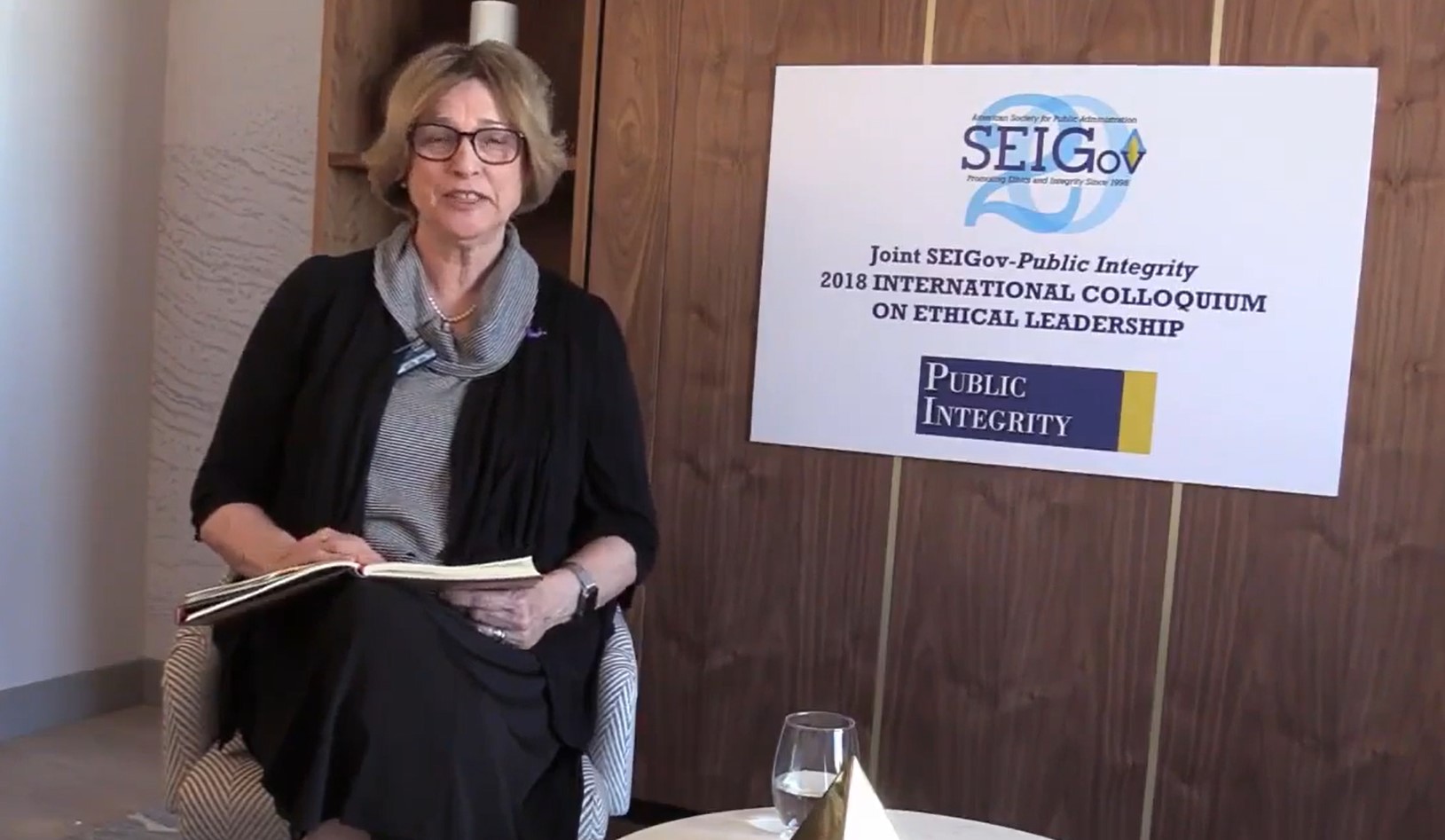
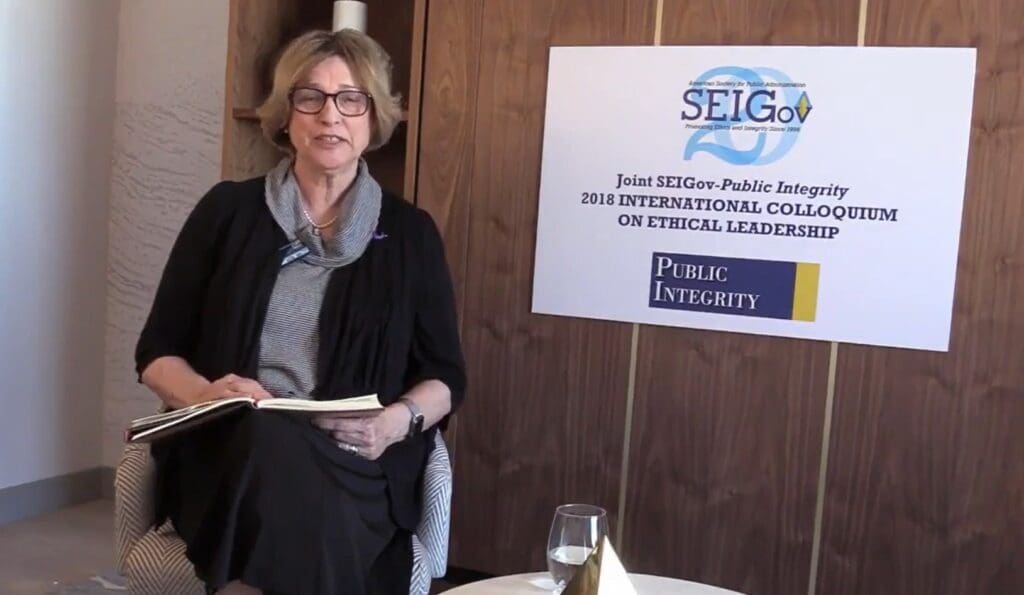
Patricia Shields sits holding a notebook, next to a sign reading 2018 International Colloquium on Ethical Leadership, Public Integrity, with SEIGov and Public Integrity logos visible behind her.

We want to thank Patricia Shields for sharing some of her research on Jane Addams!


Jane Addams’s Social Ethics (Video)

Patricia Shields on Jane Addams’s Social Ethics, April 24, 2018

https://hdl.handle.net/10877/8366

Patricia Shields sits holding a notebook, next to a sign reading 2018 International Colloquium on Ethical Leadership, Public Integrity, with SEIGov and Public Integrity logos visible behind her.
Patricia Shields, 2018


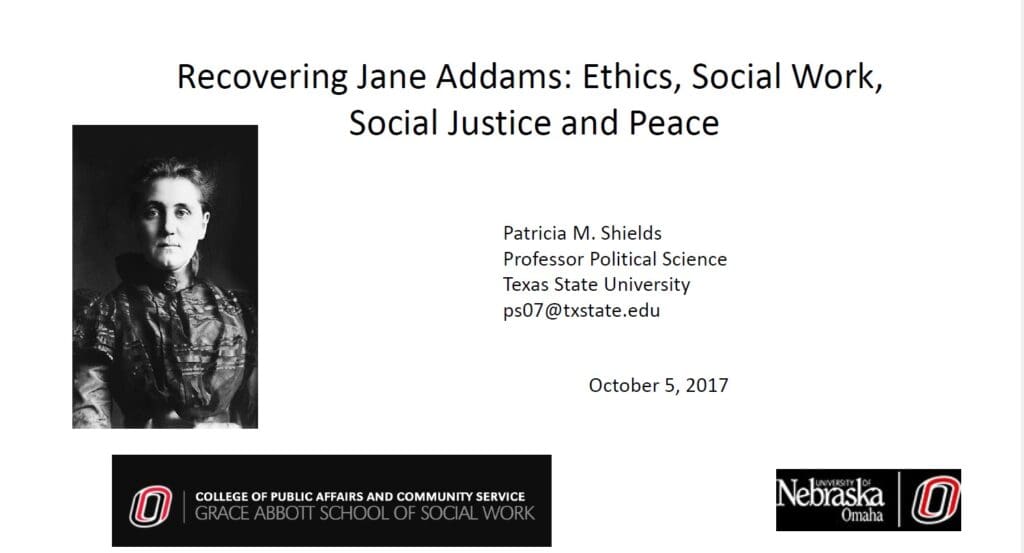
Recovering Jane Addams: Ethics, Social Work, Social Justice and Peace (PDF)

Patricia M. Shields, Recovering Jane Addams: Ethics, Social Work, Social Justice and Peace, Grace Abbott School of Social Work, University of Nebraska Omaha, October 2017.

Presentation slide titled โ€œRecovering Jane Addams: Ethics, Social Work, Social Justice and Peaceโ€ with a black and white photo of Jane Addams, event details, and logos of the University of Nebraska Omaha and Grace Abbott School of Social Work.


Jane Addams and the Women’s Peace Movement (Video)

Patricia Shields on Jane Addams and the Women’s Peace Movement, from Save Texas History Symposium on Texas and the Great War, September 16, 2017.


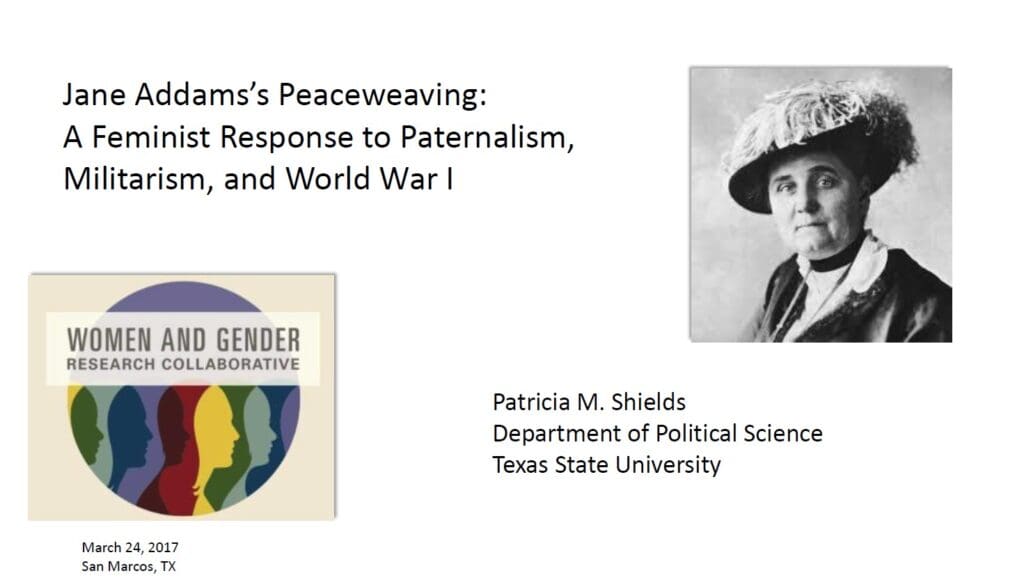
Jane Addams’s Peaceweaving: A Feminist Response to Paternalism, Militarism, and World War I

Patricia M. Shields, Jane Addams’s Peaceweaving: A Feminist Response to Paternalism, Militarism, and World War I, Women and Gender Research Collaborative, March 24, 2017.ย  (PDF)

Presentation slide titled Jane Addamsโ€™s Peaceweaving: A Feminist Response to Paternalism, Militarism, and World War I with Jane Addamsโ€™s photo, a Women and Gender Research Collaborative logo, and event details for Patricia M. Shields.

Florence Giovangelo Scala, Hull-House and Neighborhood Planning

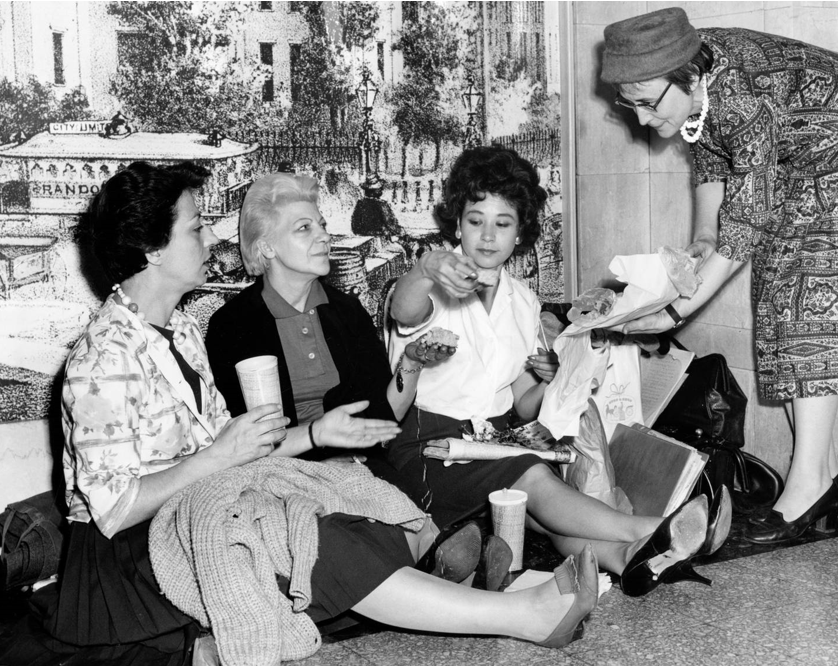
Three women sit on the ground eating and drinking, while a fourth woman, standing, hands them food. They are indoors, beside a wall with a mural. The women appear to be engaged in conversation and sharing a meal.

By Ann Keating.

Note by the author: Rima Lunin Schultz and I have been working for six years on a manuscript entitled: In the Shadow of Jane Addams: Planning in a Working-Class Neighborhood, 1889-1963.ย  We have encountered many interesting characters, including Florence Scala.ย  Scala is famous for leading the unsuccessful fight against construction of the University of Illinois in the early 1960s (she was in favor of a Chicago campus but not the Near West Side location).ย  Less well known was her strong connection to Hull-House and neighborhood planning efforts.

Black-and-white photo of a three-story corner building with worn walls and a striped awning over the entrance. People walk on the sidewalk, cars are parked, and a street sign reads Taylor and S. Miller St.
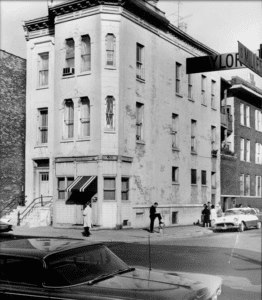
Giovangelo residence at 1030 West Taylor Street (Chicago Tribune, October 19, 1962).

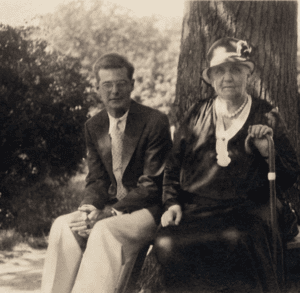
Florence Giovangelo Scala was born on September 17, 1918, to Italian immigrants Alex and Teresa (Scardepane) Giovangelo. She grew up with her younger brothers in an apartment above her parentsโ€™ tailor shop at 1030 W. Taylor on Chicagoโ€™s Near West Side. The Giovangelo children attended local public schools but also participated in programs at nearby Holy Guardian Angel Catholic Church and at Hull-House both before and after the 1935 death of Jane Addams. The settlement offered the siblings a place to go for sports, recreation, arts, and crafts activities.ย They particularly enjoyed theater productions under the direction of Edith de Nancrede and Eri Hulbert. In the early 1930s, Florence and her brother Ernie developed a close relationship with Hulbert, the grandnephew of Jane Addams.ย  Scala remembered that they were โ€œhis kids,โ€ and took many adventures with him.

A young man in a suit and glasses sits next to an elderly woman in a hat and dress, holding a cane, under a large tree outdoors. Both are looking at the camera with neutral expressions.
Jane Addams and grand-nephew Eri Hulbert, August 1932 (Jane Addams Papers, University of Illinois at Chicago).

On her high school graduation, Scala worked for the Federal Theater Project (WPA) at Hull-House, contributed to a local newspaper, and worked for the draft board.ย  She took college classes, got married, and lived in the same building as her parents on Taylor Street just west of Hull-House. During and after World War II, Scala, her brother Ernie (after attending the University of Illinois), and a group of their neighbors saw the threats to their neighborhood from plans for major expressways and slum clearance.ย  They found a staunch ally in Eri Hulbert who worked tirelessly to create the Near West Side Planning Board with the support of Hull-House. ย ย Scala remembered that Hulbert โ€œtorpedoed me into a big world of ideasโ€”the search for knowledge and understanding of people. To me he was a teacher and a persistent pioneer in this new idea that the people themselves must participate in the planning of their own communities.โ€[1] [2]

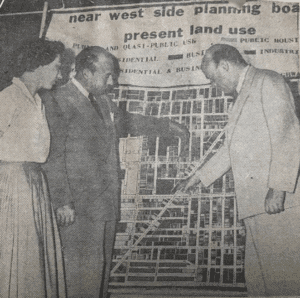
While her brother took a paid position with the Near West Side Planning Board, Scala volunteered as secretary and treasurer of the group between 1949 and 1958. An inveterate dog walker, Scala often had a camera in hand, taking photographs of her changing neighborhood. Scalaโ€™s photographs became a critical part of the reframing of the neighborhood not as a slum, but as a vibrant working-class district that needed rehabilitation and improvements.[3] The Planning Board undertook a survey of the Near West Side. Anita Villarreal, a thirty-six-year-old mother of six and active voice in the local Mexican community, created a seven-foot map of the area, while Scala continued to take photographs โ€œof the neighborhood, so that when we ha[d] our meetings, we could show these slides.โ€ Driving the area streets in her large car, she took candid color shots of everyday life that showed a working-class neighborhood with manageable problems. She developed and framed fifty of these images to create an illustrated lecture about the Near West Side, which she delivered to dozens of groups around the neighborhood with her brother. The siblings were central to creating an alternative to the idea that the neighborhood was blighted.[4]

Three people stand in front of a large planning board map labeled present land use, discussing and pointing to areas on the map as part of a planning meeting. The image appears to be from a newspaper.
Florence Scala, J. Ross Humphreys, and William Deknatel study a land use map. (Private collection of Father Steve Giovangelo).

Scalaโ€™s photographs, Villarealโ€™s map, and the raw survey data created a narrative to combat the idea that the whole neighborhood should be cleared. Instead, the Planning Board identified areas to be conserved, as well as some areas that would require slum clearance and redevelopment. That redevelopment could take several formsโ€”private housing, public housing, industrial renewal, and commercial revitalization. Their ideas came together in the groundbreaking 1950 NWSPB plan where, for the first time, a working-class community had developed its own plan for rehabilitation and renewal.

What followed was nearly a decade of delays and disappointments with little forward movement on the 1950 Plan.ย  Eri Hulbert died in 1955, the same year that Mayor Richard J. Daley began his long tenure at City Hall. Downtown interests had the ear of the new mayor, and they wanted new middle-class redevelopment to ring the central business district. They advocated the mass clearance of the working-class neighborhood around Hull-House. When the University of Illinois went looking for a Chicago location, Mayor Daley and those downtown interests endorsed a Near West Side location.

Three women sit on the ground eating and drinking, while a fourth woman, standing, hands them food. They are indoors, beside a wall with a mural. The women appear to be engaged in conversation and sharing a meal.
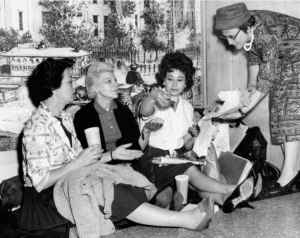
Florence Scala, left, during overnight sit in at Mayor Richard J. Daley’s office on October 11, 1962. (Frederick Giese / Chicago Tribune).

It is at this juncture, in 1961, that Florence Scala became a household name in Chicago. Her long years with the Planning Board and at Hull-House prepared her for the challenge ahead.ย  Well-known in the Near West Side for her unswerving support of planning initiatives, her neighbors pressed her to become their spokesperson. Scala quickly helped organize the Harrison-Halsted Community Group (HHCG) to protest the proposed campus site.[5]ย  She targeted the City Council and Mayor Daley in marches and sit-ins at City Hall that were well covered in local newspapers, radio, and emerging TV news. In 1963, sheย ran as an independent campaign for alderman; she criticized Chicago’s political “machine” and hoped to defend the interests of ordinary voters in her district. Scalaย endured ridicule, threats, and several bombingย attempts, but remained outspoken. But her campaign was not successfully and on March 5, 1963, the Hull-House trustees accepted $875,000.00 from the City of Chicago for their Near West Side properties.

A black-and-white photo of a large urban construction site, with multiple modernist buildings in progress, cranes in the background, and a city skyline visible under a partly cloudy sky.
Construction of the University of Illinois, Chicago campus, 1964 (College Archives, University of Illinois, Chicago).

Scala, who had for long years been a part of the Hull-House community, was bitter when the settlement turned its back on its neighbors. With the closure of Hull-House and the opening of the University of Illinois campus, the Near West Side was irrevocably changed. It was no longer a working-class neighborhood centered on industrial sites, religious institutions, local parks, and Hull-House. The university now shaped who lived and worked there. Scala lived in the same building at 1030 W. Taylor Street until her death in 2007, but her working-class neighborhood was gone.

Dr. Ann Keating is the Dr. C. Frederick Toenniges Professor of History at North Central College. She is a co-editor of the Encyclopedia of Chicago, and author of several books on Chicago’s buildings and development.ย 


[1] Remarksย byย  Florenceย Giovangeloย Scala,โ€ Eri Hulbert Memorial Meeting, Hull House Garden, May 19, 1955, pgs. 19-20, Eri Baker Hulbert III Papers, Box 1, Folder 39

[2]Sandro Corso, โ€œFlorence Scala: A Disowned Community Leader,โ€ Italian Americana, 37, 2 (Summer 2019), 100-101; Eastwood, Near West Side Stories, 140โ€“141; and Florence Scala interview transcript, 4, Folder 69, Box 4, Hull-House Oral History Collection, Special Collections, University of Illinois at Chicago. See also โ€œMore Unpublished Reminiscences Steven Giovangelo,โ€ January 29, 2014, in possession of Rima Schultz.

[3]โ€œFlorence Scala, 47โ€ in Studs Terkel, Division Street: America (Pantheon Books, 1967), 5.

[4]Florence Scala quoted in Eastwood, Near West Side Stories, 154; NWSPB executive committee meeting, January 26, 1950, Box 39, Hull House Collection. See also Sandro Corso, โ€œFlorence Scala: A Disowned Community Leader,โ€ Italian Americana, 37, 2 (Summer 2019), 99-118.

[5]Scala in Eastman, Near West Side Stories, 154.

Democratic Ensembles: Spoken Art and Politics at Chicago Settlement Houses, 1890-1920

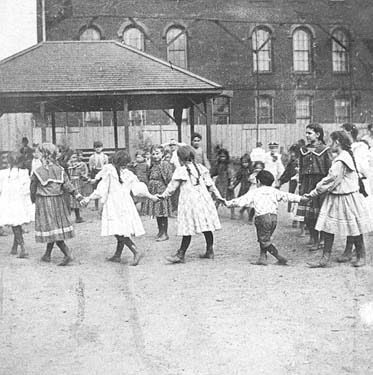
A group of children holding hands in a circle, playing outdoors on a dirt playground near a building with arched windows and a covered area in the background. The children are wearing old-fashioned clothes.

By Fiona Maxwell, PhD Candidate, Department of History, University of Chicago.

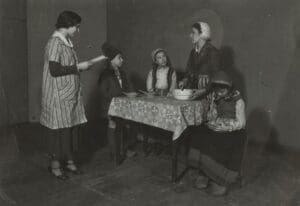
Four children in period costumes stand or sit around a table with bowls, while an adult woman in an apron stands beside them holding a book, possibly directing or reading to them in a staged setting.
Hull-House staffer Nicolette Malone working with actors for a dramatic performance (Hull-House Photograph Collection, University of Illinois Chicago).

In the Chicago settlement house movement, performance and sociability supplied a means and a metaphor for reimagining democracy as a collective project in service of the common welfare. My recently completed PhD dissertation, โ€œDemocratic Ensembles: Spoken Art and Politics at Chicago Settlement Houses, 1890-1920,โ€ takes self-governing settlement house clubs as a case study for exploring how Progressive Era concepts of social democracy unfolded in everyday practice. The project underscores the role of artistic collaboration in envisioning and bringing about desired political futures, and it introduces a more extensive dramatis personae to the history of Progressive reform.

Although a work of history, โ€œDemocratic Ensemblesโ€ has its origins not merely in writerly imagination and archival holdings, but in the actorโ€™s craft. I began studying at the Piven Theatre Workshop in Evanston, Illinois as a child, working my way through their performance ensembles and eventually joining the teaching staff. The Piven approach to actor trainingโ€”rooted in theatre games and story theatre adaptation, and defined by values of process, improvisation, and ensembleโ€”descends from the work of Neva Boyd and Viola Spolin at Hull-House during the 1920s and 1930s. While honing my skills as a performer and pedagogue, I kept hearing tantalizing whispers about a fabled prehistory of our approach.

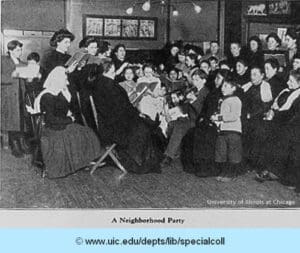
A black-and-white photo of a large group of women and children gathered indoors for a community event, labeled A Neighborhood Party. Some women appear to be reading or singing from papers.
A Neighborhood Party (Hull-House Yearbook Photos, University of Illinois Chicago)

When it came time to write a BA thesis as a History and Theatre major at Northwestern University, my mind immediately gravitated to Hull-House. I determined to learn as much as I could about the working-class Chicagoans who enrolled in settlement house arts education programs to further their educations, find like-minded peers, and exercise their creative imaginations. In this early stage, my research focused on the community reception of childrenโ€™s dramatics at Hull-House, with the goal of tracing the social and cultural history of early, pre-Spolin theatre education while foregrounding the perspectives of youth participants. I immersed myself in the Hull-House Collection at the University of Illinois at Chicago, as well as a burgeoning wealth of published and online resources, including the Jane Addams Papers Project. Wading through thousands of documents, I encountered Hull-Houseโ€™s dauntless cadre of reform-minded residents, as well as countless neighbors determined to realize their individual and collective aspirations. Reluctant to return home from this time travel expedition, I realized that pursuing a PhD was in order.

My early years of graduate school at the University of Chicago coincided with an explosion of public and scholarly discourse on democracy. During the late 2010s and early 2020s, historians began to revisit late nineteenth- and early twentieth-century reformers and theoristsโ€”particularly Jane Addams and John Deweyโ€”with renewed appreciation for their idea that democracy could be strengthened by social interaction across political and cultural divides and by prioritizing group welfare over individual gain. I embarked on my dissertation research paying close attention to how settlement workers articulated their theory of social democracy. I discovered that the language they used to describe their political philosophy mirrored the language that is still in practice today in ensemble-based theatreโ€”conceptual gifts from Progressive Era politics to contemporary artistic practice. Recognizing the broader political significance of the settlement story, I expanded my earlier focus on Hull-House theatre to embrace the โ€œspoken artsโ€โ€”including storytelling, group games, dramatic reading, oratory, and debateโ€”at settlement houses across Chicago, and I moved from children to โ€œchildren plus,โ€ examining how young people refined and implemented their artistic and political agendas as they aged and tracking how childrenโ€™s involvement catalyzed the participation of adult family members. I was lucky enough to discover a surfeit of underutilized materials in settlement club archives. At settlement houses across Chicago, working-class โ€œneighborsโ€ organized self-governing clubs that left plentiful records of their daily activities, in the form of constitutions and meeting minutes, neighborhood news and club gossip, and the occasional script, poem, joke, or lyric.[1] Piecing these fragments together recasts settlement houses, not merely as gathering places for the reform-minded middle and upper classes, but as genuinely grassroots centers of community education and local organizing.

A group of children holding hands in a circle, playing outdoors on a dirt playground near a building with arched windows and a covered area in the background. The children are wearing old-fashioned clothes.
Hull-House Circle Games

In its current iteration, โ€œDemocratic Ensemblesโ€ investigates the ways in which settlement volunteers and participants used the spoken arts to bridge social boundaries and develop a collaborative approach to democratic participation. Generations of scholars have explored the ways in which Chicago settlement leaders codified neighborhood service into new academic and professional fields, claimed a role for women in federal policymaking, and contributed to pragmatist philosophy and democratic theory. This dissertation uncovers the full โ€œensemble castโ€ of Chicago Progressivism by introducing two previously unexamined settlement constituencies: student volunteers from local universities, who drew on their interdisciplinary training in the arts, humanities, and social sciences to facilitate settlement pedagogy; and, most significantly, the neighborhood families who embraced settlement programming and made it their own. It joins an interdisciplinary scholarly conversation concerning how political, social, and artistic speaking genres have generated theories and practices of democracy, and it applies analytical frameworks drawn from book history, rhetoric, and theatre and performance studies. Combining archival research, interdisciplinary methods, and process-oriented theatre pedagogy, this project constructs a social and political history of spoken arts education, which adds to scholarly inquiry in urban history, gender history, and the history of childhood and youth and offers an actionable model for current practice. The dissertation tells the story of enfranchisement through cultural experiences and, in doing so, contributes a new conception of the role of the spoken arts in civic life.

The story begins with early settlement house founders diagnosing the lack of communal gathering spaces in industrial Chicago as a threat to the viability of democratic self-governance. The early chapters explore how settlement workers adapted traditional forms of domestic sociability and artistry to create a new piece of social infrastructure that invited equal participation from men, women, and children of all classes and cultural backgrounds. To explain how and why the spoken arts achieved such primacy in settlement programming, I analyze the formative experiences of a key yet previously unexamined subset of volunteer club and class leaders: students and graduates of Northwestern Universityโ€™s Cumnock School of Oratory, who organized settlement programs with a conviction that through performance and pedagogy, they could speak a more inclusive and collaborative public sphere into being.[2]

The remaining chapters conduct an in-depth analysis of on-the-ground settlement programming, tracking the transition from arts education to political organizing from the perspectives of school-aged children, working young people, and whole families. The ability of working-class, immigrant, and Black schoolgirls and boys to engage in collective deliberation and semi-autonomous artistic production inspired settlement workers to theorize childrenโ€™s club work as an apprenticeship for civic engagement. Working adolescents and young adults, meanwhile, utilized their skills in persuasive speech and organizational leadership to assert their voices in settlement administration and local reform. Experience with shared governance and extensive training in verbal expression enabled young people to transition from planning parties and staging plays to mobilizing in service of political change.[3] The participation of adult family members solidified the civic influence of the settlement project. When settlements inaugurated all-ages, mixed-gender governing bodies, fathers and sons were compelled to recognize their wives, sisters, and daughters as effective public actors. With the advent of municipal suffrage in 1913, neighborhood families began working to extend the vision of an activist, welfare-oriented local government they had devised in settlement clubs into formal electoral channels.

The idealism that accompanied whole-family politics shattered with the declaration of war in Europe in 1914. Global warfare abroad and racial violence at home exposed the challenges of bringing club ideals and methods into the world beyond settlement doors. โ€œDemocratic Ensemblesโ€ concludes by identifying postwar trends in settlement work and gesturing towards the subsequent evolution of settlement artistic methodologies, particularly their codification and widespread dissemination by mid-twentieth-century Chicago theatre practitioners and educators. Amidst the continued struggle to bring collaborative values and social consciousness into formal politics, Chicagoansโ€™ persistent commitment to neighborhood arts programs as a force for grassroots change has emerged as one of the most hopeful legacies of the Progressive Era.

Although the dissertation phase of this project is ending, it is only the beginning for โ€œDemocratic Ensembles.โ€ In the months and years to come, I intend to transform the dissertation into a book that has crossover appeal for scholars, practitioners, and the wider public. I look forward to continuing to mine settlement archives and sharing the stories they contain in a variety of formats, from academic writing to public performance.[4] The questions posed by settlement workers and participants over a century ago remain relevant today: as we continue to work towards more inclusive and equitable futures, how can engaging in everyday acts of cultural production help to foster common understanding, celebrate diversity, and provide the framework for an ensemble-based politics?

Fiona Maxwell is a final-year PhD Candidate in History at the University of Chicago. Her research and creative practice explore the connections between spoken performance and democratic social movements, with a focus on Progressive Era Chicago. In addition to her own writing and performance activities she collaborates with museums and arts organizations on content and program development. You can reach her at fmaxwell@uchicago.edu.


[1] I detail a key facet of this archiveโ€”club newspapersโ€”in Fiona Maxwell, โ€œClub Newspapers and Civic Collaboration at Chicago Settlement Houses,โ€ย C19: The Society of Nineteenth-Century Americanists Podcast,ย Season 8, Episode 3 (October 21, 2024).ย https://on.soundcloud.com/FY7sAtBt6ePA84pZ7

[2] For an article-length study of the gender dynamics of oratorical pedagogy at the Cumnock School, see Fiona Maxwell, โ€œโ€˜Expression is powerโ€™: Gender, residual culture and political aspiration at the Cumnock School of Oratory, 1870โ€“1900,โ€ Gender & History (2024): 1-18. https://doi.org/10.1111/1468-0424.12786

[3] For an example of this process, as illustrated by the Home Culture Club of young workingwomen, see Fiona Maxwell, โ€œโ€˜Talking lowd and laughing gay, Everyone has so much to sayโ€™: Working Girlsโ€™ Clubs, Spoken Art and Political Organising at Chicago Settlement Houses, 1890โ€“1920,โ€ Lilith: A Feminist History Journal (2025): 109-130. http://doi.org/10.22459/LFHJ.30

[4] I perform original, semi-fictional storytelling pieces based on settlement archival materials at universities, public history sites, and storytelling venues. Select appearances include Open House Chicago at the Jane Addams Hull-House Museum (2024) and Chicago Storytelling in Bughouse Square at the Newberry Library (2022).

Hull House and Benny Goodman

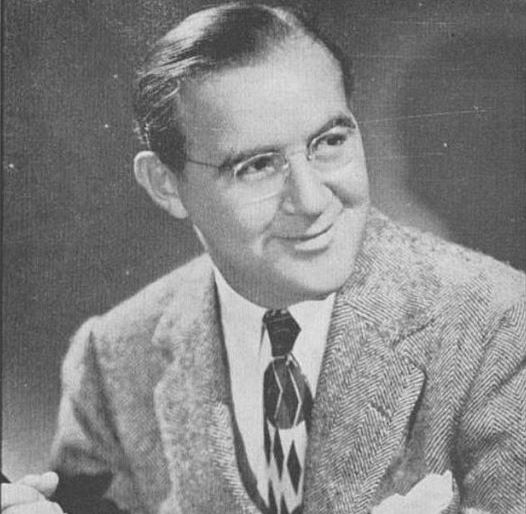
Black and white portrait of Benny Goodman wearing glasses, a suit with a patterned tie, and a herringbone jacket. He is smiling slightly and looking to the side, with his hair neatly combed back.


Black and white portrait of Benny Goodman wearing glasses, a suit with a patterned tie, and a herringbone jacket. He is smiling slightly and looking to the side, with his hair neatly combed back.
Benny Goodman featured in the Billboard 1943 Music Yearbook [Billboard, 1943]
Because of Hull-Houseโ€™s strong association with social and political causes, it can be easy for many to overlook the settlement houseโ€™s invaluable contributions to the arts. In bustling early 20th century Chicago, Hull-House served as a prime location for artistic expression and development. The experimental art classes of Dorothy Loeb at the settlement allowed students to express themselves in free and abstract ways. Enella Benedict provided nearly fifty years of service for Hull-Houseโ€™s Art School, which served as an educational beacon. The Hull-House Boysโ€™ Band, as it turns out, would have a hand in producing some of Chicagoโ€™s greatest musicians, the great Benny Goodman chiefly among them.

While most know Benny Goodman for defining an entire era of American music and helping to popularize jazz for mass audiences, his story begins like that of many other Chicagoans born during Hull-Houseโ€™s heyday. โ€œThe King of Swingโ€ was just one of twelve children born to Jewish immigrant parents. The family was defined by severe poverty, living in a slum neighborhood not too far from Hull-House. Goodman would later say โ€œJudging from the neighborhood where I lived, if it hadnโ€™t been for the clarinet, I might just as easily have been a gangster.โ€

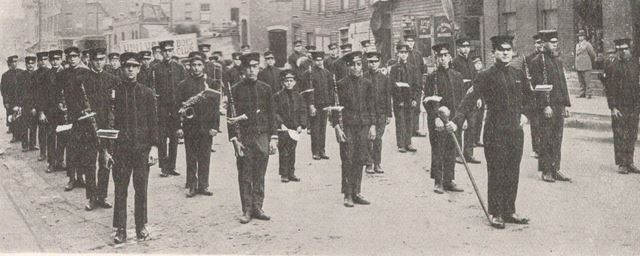
This escape through music was exactly what Goodmanโ€™s father sought to provide. He enrolled ten year old Benny and his brothers Harry and Freddy in the Kehelah Jacob Synagogueโ€™s music lessons, but this quickly fell through. Luckily for the Goodmans, the Hull-House Boysโ€™ Band, returning after a hiatus during WWI, had just reopened its doors.ย 

A black-and-white photo shows a marching band of young men in uniform, holding instruments, standing in formation on a city street, with buildings and onlookers in the background.
Hull-House Boys’ Band
[Hull-House Year Book, 1925]
Excitedly playing in his new uniform, Goodman developed his musical skills under the direction of James Sylvester, the Boysโ€™ Bandโ€™s leader and educator. Despite the bandโ€™s repertoire being far from the sounds of jazz that would soon envelop Goodman, he received additional lessons from Franz Schoepp, a well-respected Chicago clarinet teacher. Goodman quickly reached the advanced classes of Hull-Houseโ€™s music program, and was subsequently chosen by Sylvester to play in his 124th Regiment Field Artillery band. Thisย  marked a pivotal point in Goodmanโ€™s musical journey, as it allowed him to play with professional musicians and make money in the process.

As his musical abilities exponentially improved, Goodman also relished in Hull-Houseโ€™s other activities. He was an enthusiastic member of the settlementโ€™s summer camp at the Joseph Tilton Bowen Country Club, gladly taking part in the two-week retreat every summer with his brothers. The woodlands of Waukegan, Illinois were in stark contrast to the dingy conditions of the Chicago ghetto which the boys were exposed to for most of the year.

Goodman went on to work with the likes of Bix Beiderbecke and Ben Pollack, as his music career reached even greater heights. The โ€œKing of Swingโ€ never forgot his experiences at Hull-House, however, even returning to the settlement in 1940 to perform a free concert despite grueling sciatica pain in his leg.

Ultimately, itโ€™s clear that Hull-House provided an invaluable service to Benny Goodmanโ€™s life, supplying him with music, education and socialization at a time when the difficult social and economic conditions of Chicago may have led him on a much different path. Itโ€™s crucially important to remember that Goodman was just one of countless individuals who benefited from the settlementโ€™s services, and that organizations like Hull-House continue to have a hand in producing some of the worldโ€™s most distinguished artists and leaders.

— James La Forge, Editorial Assistant

Sources: Benny Goodman โ€“ The Official Website of the King of Swing. “Biography.” Estate of Benny Goodman. Accessed April 17, 2024; Firestone, Ross. “Swing, Swing, Swing: The Life and Times of Benny Goodman.Norton, 1993; Wilson, John S. “BENNY GOODMAN, KING OF SWING, IS DEAD.” New York Times, June 14, 1986. p. 1;ย 

Reconsidering Jane Addams: A Portrait of Anti-Imperialism?

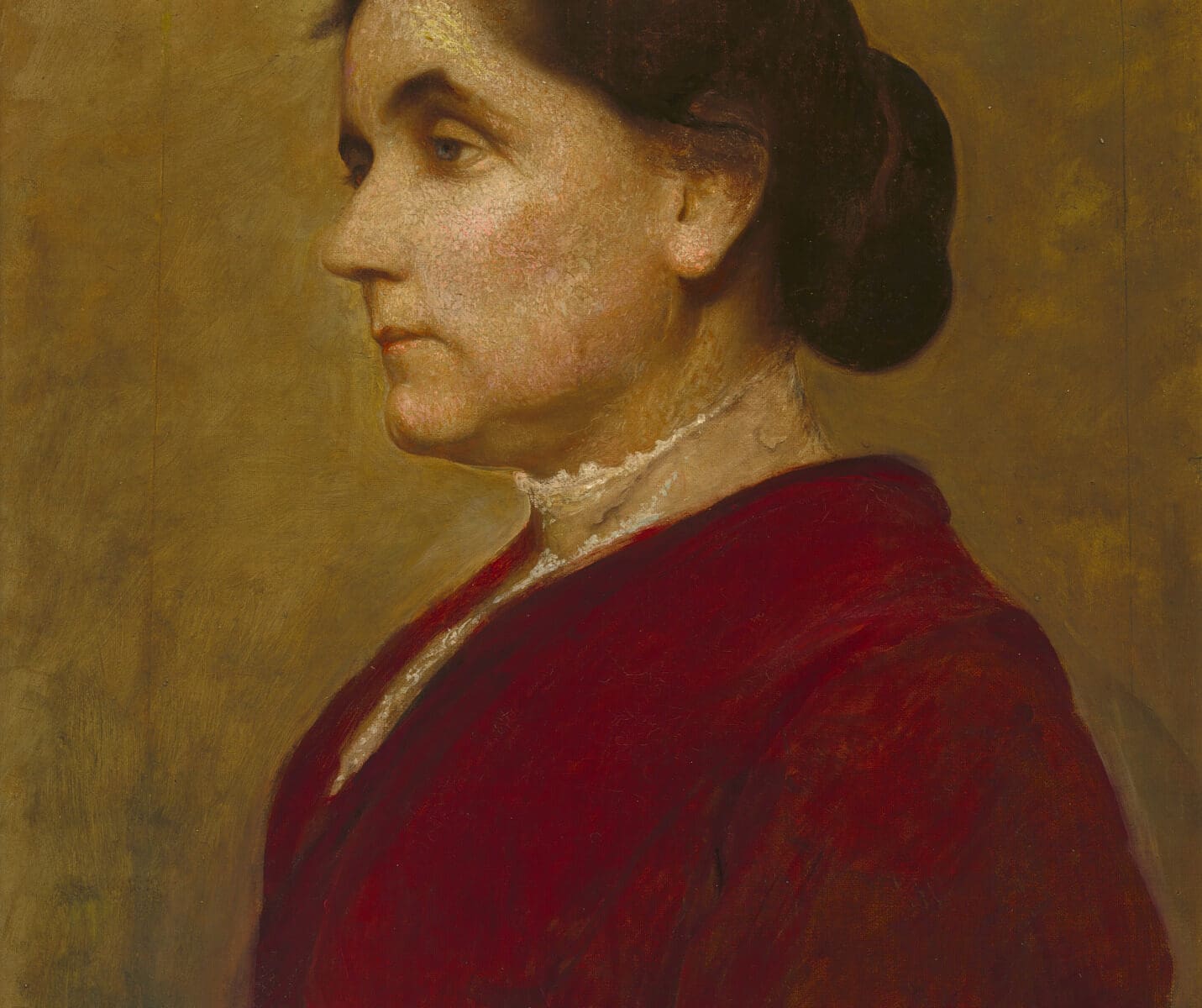
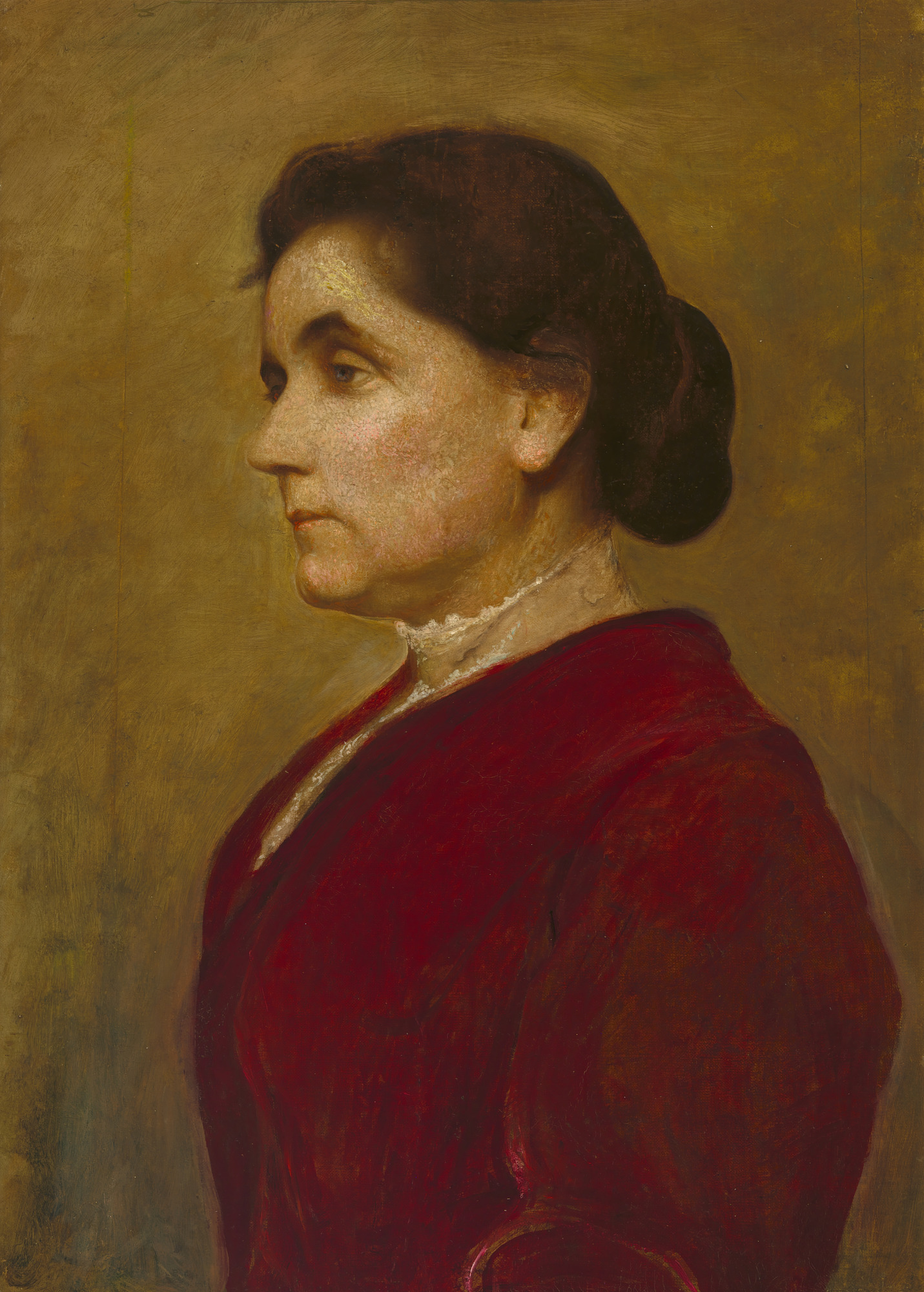
A painted portrait of Jane Addams in profile facing left, with dark hair pulled back and wearing a dark red garment and a white lace collar, set against a neutral brown background.

A painted portrait of Jane Addams in profile facing left, with dark hair pulled back and wearing a dark red garment and a white lace collar, set against a neutral brown background.
Jane Addams (1906) Oil on canvas, by George de Forest Brush. National Portrait Gallery.

Last July marked another passing of the Association for Documentary Editingโ€™s yearly conference, this time taking place in Washington, D.C. Our nationโ€™s capital has endless museums, attractions, and performances to explore, but there was only one woman I wanted to meet: Jane Addams, of course. The National Portrait Gallery houses the only known full-color image of Addams, painted by George de Forest Brush in 1906, the process of which was detailed in many letters that can be found within the digital edition. It took some work getting to her โ€“ the front desk claimed Addamsโ€™s portrait was not currently on display even though I had pulled up a location on the Galleryโ€™s website. Not one to be told โ€œno,โ€ I scoured the nooks and crannies of the museum, looking for Jane nestled among peace activists, child or immigrant welfare reformers, or suffrage protesters. Instead, I found her with what I believed to be a sort of motley crew in a section titled โ€œRepublic or Empire?โ€ that detailed America’s thoughts on Spainโ€™s involvement in the destruction of the USS Maine. Her fellow portrait sitters included Samuel Clemens, W.E.B. Du Bois, Benjamin Tillman, Moorfield Storey, Queen Liliโ€™uokalani, and Theophilus Gould Steward, gathered together under the roof of โ€œanti-imperialism.โ€ Since visiting the Gallery, Iโ€™ve been wondering: Does Jane Addams truly belong among these figures, or would she be better represented elsewhere?

A formal painted portrait of a regal woman with dark hair, wearing a black gown, blue sash, and sparkling jewelry, standing beside a red curtain and ornate chair against a soft, cloudy background.
Queen Liliโ€˜uokalani (c. 1892) Oil on canvas, by William F. Cogswell. Hawai’i State Archives.

Imperialism was a weighted topic during the early Progressive Era. The Berlin Conference of 1884-85 was convened specifically to regulate European colonization and trade in Africa, and to which the United States sent three diplomats to represent the American colonial empire. In 1887, the US renewed the Hawaiian Reciprocity Treaty of 1875, further increasing American economic influence in Hawaii. This renewal set the stage for the overthrowing of Queen Liliโ€™uokalani, the last reigning sovereign of the Hawaiian Kingdom, in 1893. In the 1890s, the โ€œScramble for Africaโ€ continued, with Egypt overtaken by the British in 1882, and Sudan, Nigeria, Kenya and Uganda subjugated in the 90โ€™s and early 20th century. These global events culminate in the Gallery sectionโ€™s primary focus, the 1898 sinking of the USS Maine, then stationed in Havana Harbor, Cuba to protect American interests during the Cuban War of Independence.

Admittedly, I am not an expert in Progressive Era imperialism, but I like to think I know Jane Addams quite well. During the events discussed above, Addams was dutifully creating and strengthening Hull-House, a settlement house in Chicago modeled after Toynbee Hall of London. While she would go on to become active in global circles like peace and disarmament, Addams began her reform work locally, ensuring that marginalized citizens of the Nineteenth Ward were given uplifting amenities and a space to gather and learn. By our records, in the 1890s Addams wrote speeches and articles primarily about Hull-House, working women, and labor strikes โ€“ issues that stopped at the state level. Her interest in international affairs wouldnโ€™t manifest fully until the onset of the first World War. Yet, despite all of this, Addams joined the Anti-Imperialist League in 1899.

It was in this same year that Addams gave her first signs of anti-imperial sentiments, with an article for the Central Anti-Imperialist League titled โ€œDemocracy or Militarism.โ€ In it, she shows contempt toward countries with โ€œan increased standing army, the soldiers of which are non-producers and must be fed by the workers.โ€ She goes on to scorn the idea of โ€œprotecting the weakโ€ as the excuse of a ruler to invade and subjugate outside nations, and shows disapproval toward the recent Spanish-American War. Even so, the last three paragraphs relate the then current state of Spain to events going on in Chicago rather than referencing any national affairs. After this, Addams didnโ€™t discuss imperialism, anti or pro, much, if at all. The next time it was brought up in any meaningful way was a letter from Erving Winslow, Secretary of the Anti-Imperialist League, dated August 12, 1912 in which he chided Addams for supporting Theodore Roosevelt, a known imperialist, in the 1912 Presidential election.

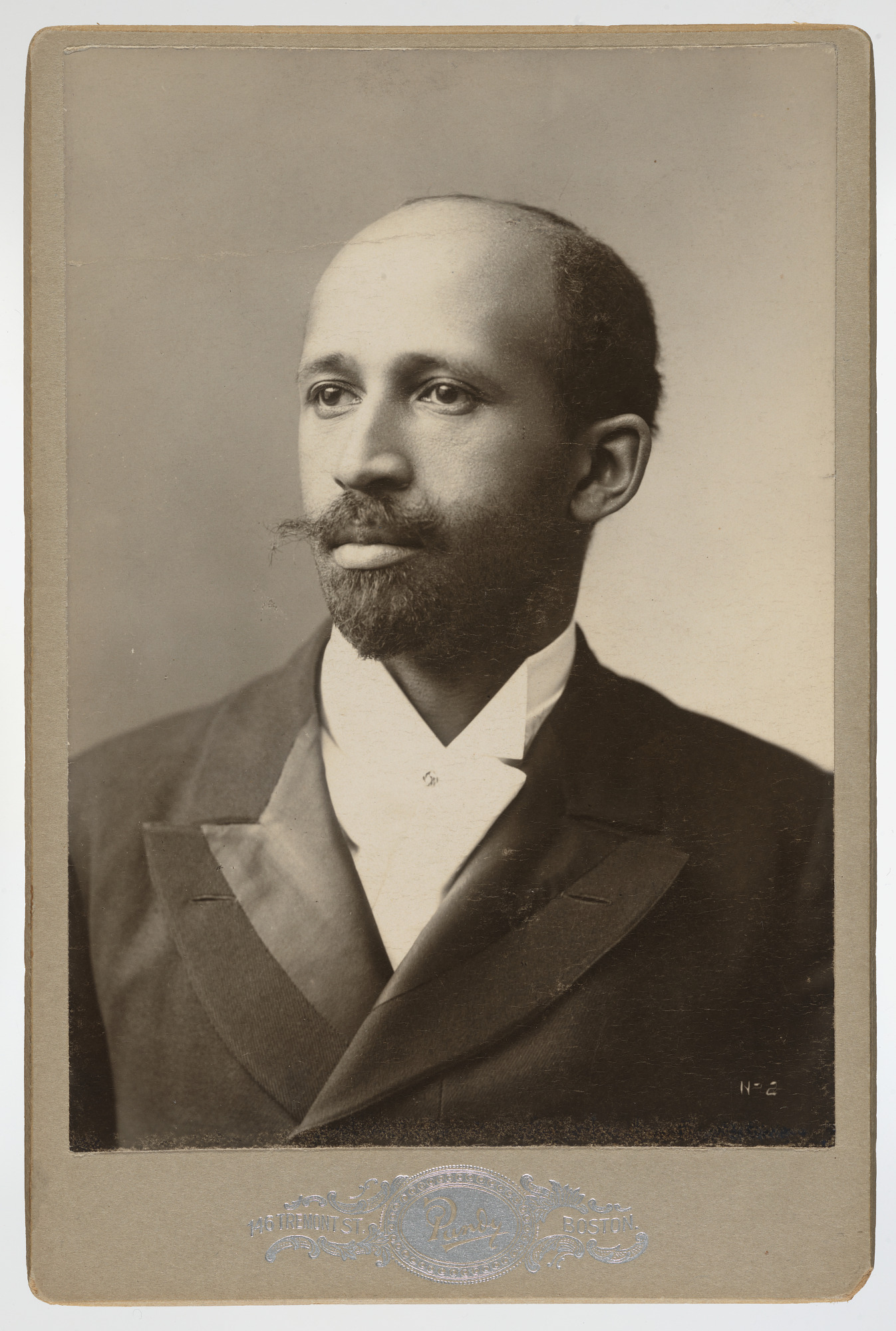
A sepia-toned portrait of a man with a mustache and goatee, wearing a suit with a high-collared white shirt and tie, looking slightly to the side. The photo has a decorative border at the bottom.
W. E. B. Du Bois (1907) Gelatin silver print, by James E. Purdy. National Portrait Gallery.

The men Addams was grouped with were, from all accounts, more entrenched in the anti-imperialist scene than Addams ever was. Samuel Clemens was shown to be in favor of imperialism until about 1900. From then until his death in 1910, Clemens spoke and wrote often about his thoughts on the Treaty of Paris and the burgeoning Philippine-American War, and he was vocally critical of foreign countriesโ€™ imperialism as well. Du Bois extensively advocated for anti-imperialism, especially in Africa where, he argued, the Scramble for Africa was the foundation for World War I. Tillman was a staunch anti-imperialist, though his sentiments stemmed from the belief that white American lives were being wasted in the pursuit of militaristically subduing Filipino natives after the Spanish-American War. Moorfield Story was the Anti-Imperialist Leagueโ€™s second and last president from 1905-1920, and believed in a connection between Americaโ€™s imperialistic endeavors and the countryโ€™s persecution of minority races. Queen Liliโ€™uokalani had the most direct impact of the Age of Imperialism, deposed in 1893 by a group of sugar and pineapple businessmen. If Liliโ€™uokalani was the most directly impacted, Steward was the least involved. Theophilus Gould Steward was primarily a clergyman, author, and educator, serving as a chaplain in the 25th Infantry Regiment, a racially segregated regiment, from 1891-1907, including serving in Cuba during the Spanish-American War, and later in the Philippines. Steward wrote about the experience of the African American soldier, which did touch on their struggle for freedom and citizenship, but he did not directly compare their strife to Filipinos resisting American colonial rule.

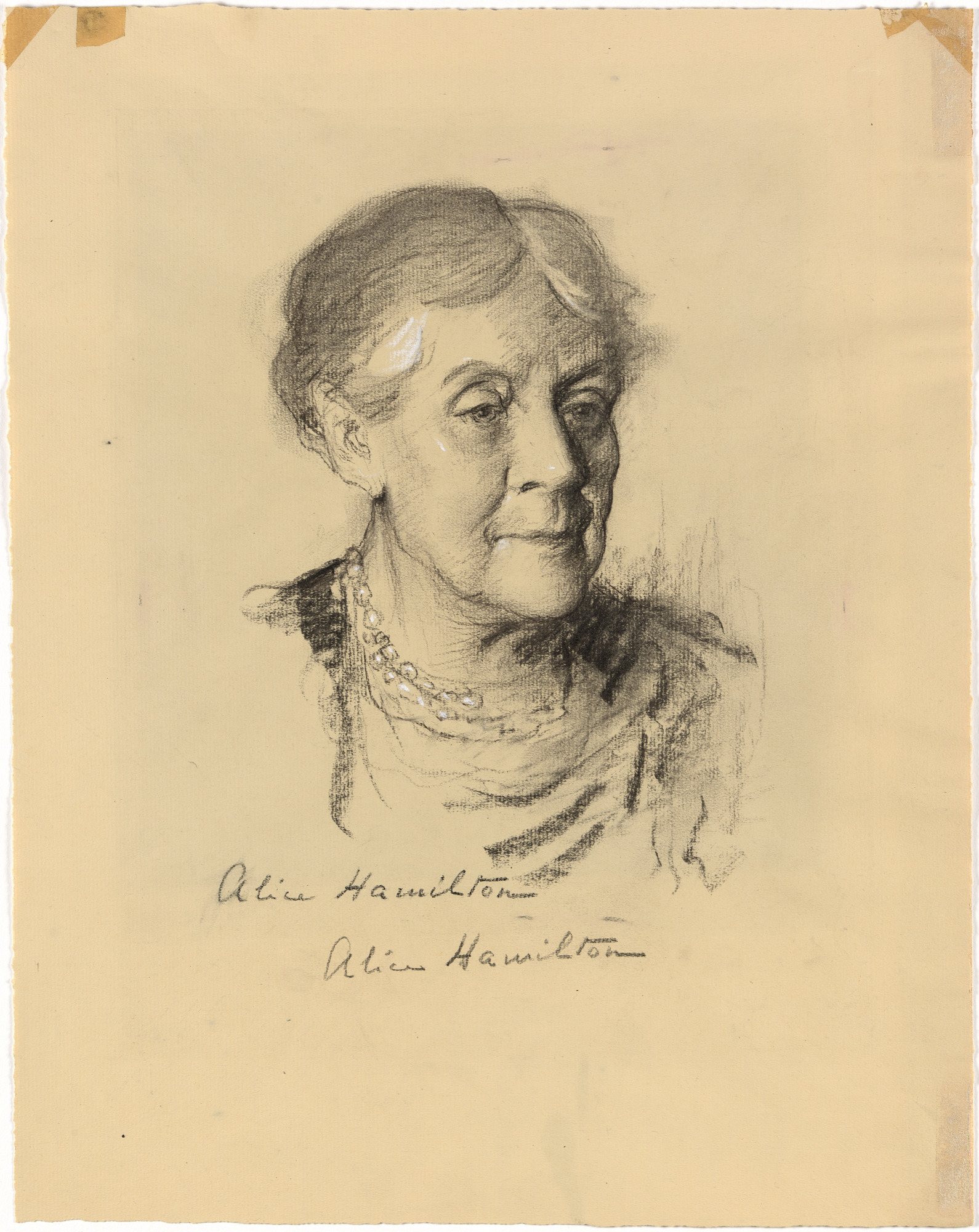
Pencil portrait of Alice Hamilton with short hair and a layered necklace, wearing a high-collared top. Below the drawing, Alice Hamilton is written twice in script. The background is plain and light-colored.
Alice Hamilton (1947) Charcoal and chalk on paper, by Samuel Johnson Woolf. National Portrait Gallery.

If not here, then where would Jane Addams belong? The National Portrait Gallery holds over 20,000 pieces in their various collections โ€“ certainly some of those could fit better with Addamsโ€™s narrative. To represent women building Chicago, they own a portrait of Frances Perkins, the first woman to serve on a cabinet of a US President and a Hull-House volunteer, Alice Hamilton, a Chicago doctor and Hull-House volunteer, or Nettie Fowler McCormick, a Chicago philanthropist. In a wider perspective, outside her Chicago colleagues, there is Woodrow Wilson, 28th President of the United States, Martha Carey Thomas, second president of Bryn Mawr College, and Julius Rosenwald, co-owner of Sears, Roebuck, and Co. and philanthropist.

At the end of the day, Jane Addamsโ€™s portrait is no longer on display. Neither Clemensโ€™s, Du Boisโ€™s, Tillmanโ€™s, Storeyโ€™s, Liliโ€™uokalaniโ€™s, or Stewardโ€™s portraits are currently available to view in person. I suppose that is the nature of a large collection of works with limited space to display them. Even so, this also means that Addams could be displayed along with any number of her peers at any point in time, perhaps to help tell an entirely different story about Americaโ€™s elaborate history.


Victoria Sciancalepore

Assistant Editor


Other Sources: โ€œBerlin West Africa Conference.โ€ Encyclopรฆdia Britannica, February 19, 2024. https://www.britannica.com/event/Berlin-West-Africa-Conference; Hixson, William B. Moorfield Storey and the Abolitionist Tradition. New York, NY: Oxford University Press, 1972; Jane Addams. โ€œDemocracy or Militarism.โ€ Liberty Tracts, no. 1 (1899): 35โ€“39; โ€œJoint Resolution to Provide for Annexing the Hawaiian Islands to the United States (1898).โ€ National Archives and Records Administration, February 8, 2022. https://www.archives.gov/milestone-documents/joint-resolution-for-annexing-the-hawaiian-islands; Lewis, David Levering. W.E.B. Du Bois. New York: H. Holt, 1993; โ€œMaine Blown Up at Havana.โ€ New York Tribune. February 16, 1898; Steward, Theophilus Gould. The Colored Regulars. Philadelphia, PA: A.M.E. Book Concern, 1904; Tillman, Benjamin. โ€œPolicy Regarding the Philippine Islands.โ€ Congressional Record 32, no. 2 (February 21, 1899): 1529โ€“33; Twain, Mark. โ€œTo the Person Sitting in Darkness.โ€ The North American Review 172, no. 531 (February 1901): 161โ€“76.

Jane Addams and the Roosevelts

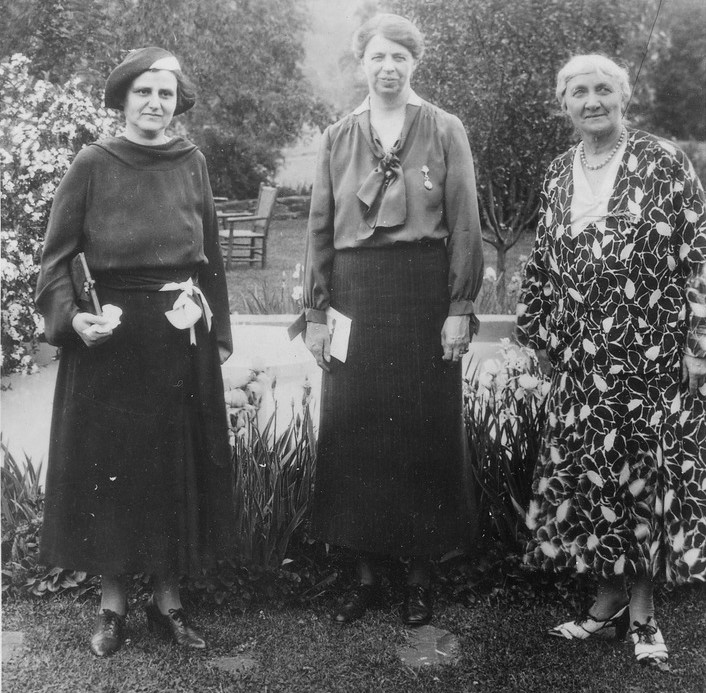
Three women stand outdoors in a garden, dressed in 1930s-style clothing. Two wear dark skirts and tops, while one wears a patterned dress. They pose together in front of blooming flowers and trees.

Three women stand outdoors in a garden, dressed in 1930s-style clothing. Two wear dark skirts and tops, while one wears a patterned dress. They pose together in front of blooming flowers and trees.
Eleanor Roosevelt, Elinor Morgenthau, and Jane Addams in Westport, Connecticut [Franklin Delano Roosevelt Library, 1929]
Few families in the history of American politics have reached the acclaim and historical scrutiny bestowed upon the Roosevelts. From Theodore Roosevelt uttering the phrase โ€œIt takes more than that to kill a Bull Mooseโ€ after an assassination attempt at a speech โ€” which has now been immortalized into American legend next to the likes of Washington crossing the Delaware โ€” to the high-stakes World War II meetings between Franklin Roosevelt (FDR), Joseph Stalin and Winston Churchill, seemingly every detail from this prestigious family has been extensively documented and analyzed.ย 

The historical legacy of the Roosevelts is largely associated with progressive change and reform. Theodore Rooseveltโ€™s administration marked the turn of the century with reforms such as the Pure Food and Drug Act of 1906, a new national park system, and support for labor unions. FDRโ€™s new deal, though the subject of heavy debate among historians, ushered in Social Security for elderly Americans, provided direct federal relief for a struggling American public, and attempted to ensure labor rights through the Wagner Act. Eleanor Roosevelt, aside from her work as First Lady, would go on to serve an important role in the United Nations and assist in the creation of The Universal Declaration of Human Rights.

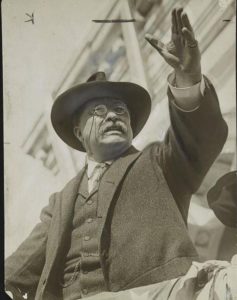
A man with a mustache, glasses, and a wide-brimmed hat, dressed in a suit and vest, raises his arm and smiles while speaking outdoors. The photo appears historical, with a building blurred in the background.
Theodore Roosevelt on the campaign trail, 1912. Roosevelt’s candidacy brought out strong feelings, both for and against him. (Library of Congress).

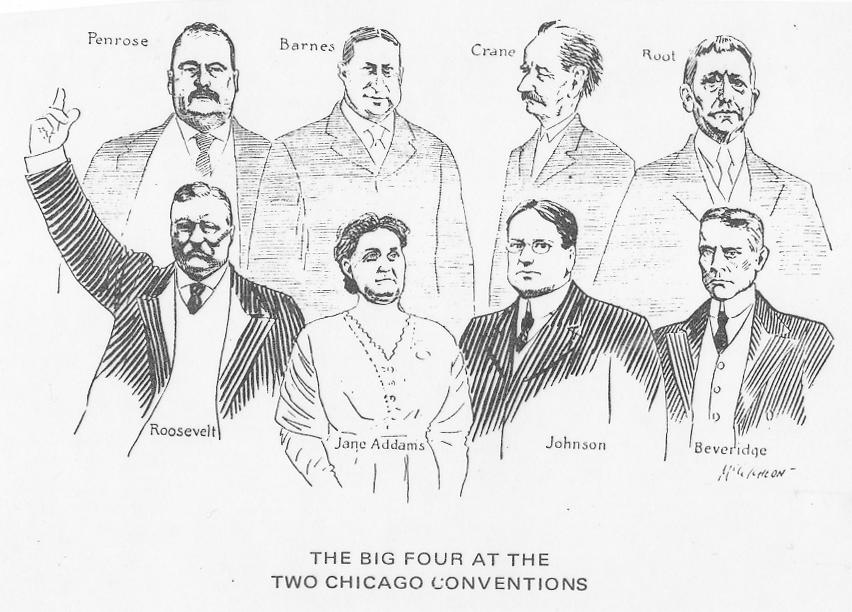
Jane Addamsโ€™ relationship with Theodore Roosevelt, or โ€œThe Colonelโ€ as he humbly preferred to be addressed, is well understood. Although Addamsโ€™ direct participation in politics was sparse, she supported and campaigned for Rooseveltโ€™s Progressive Party bid for president in 1912. Addams didnโ€™t shy away from disagreeing with The Colonel, however, such as over the treatment of African American delegates at the Progressive Party Convention. Despite these disputes, Addams greatly admired Theodore Roosevelt, declaring he โ€œembodied the best things in American citizenshipโ€ upon his death.

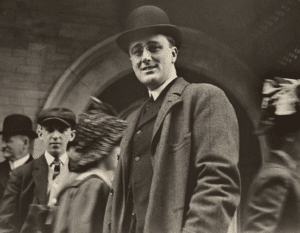
But what about those other Roosevelts? One would infer that Addams would follow a similar path with Theodoreโ€™s distant cousin, Franklin Delano Roosevelt (FDR), but the puzzle pieces are less clear. With her health on the decline by the 1930โ€™s, Addams no longer embarked on the large speaking tours of previous decades, which makes some of her opinions difficult to dissect. Despite this fact, she did still offer a healthy handful of writings and statements on the issues of the day, such as the Great Depression and the Roosevelt Administrationโ€™s response.

A young man in a bowler hat and overcoat smiles at the camera, standing outdoors among a group of people in early 20th-century attire. The background shows a brick building and an arched doorway.
Franklin Delano Roosevelt in 1912 (Smithsonian National Portrait Gallery).

For starters, Addams and FDR knew of each other, at the very least, for many years. Way back in 1912, State Senator FDR invited Addams to speak in Albany about her social work, though itโ€™s unclear if she ever took him up on the offer. FDR would climb the political ranks in the New York State Senate and the United States Department of the Navy before setting his eyes on New York Governorship in 1928. This same year, Addams would endorse Herbert Hoover for President โ€” one of her few presidential endorsements throughout her lifetime. This was largely a result of Hooverโ€™s relief work in Europe a decade prior. Itโ€™s unclear who Addams supported in 1932, but one can assume that the Democratic platform of repealing prohibition put Roosevelt in weaker standing in Addamsโ€™ esteem. To nobodyโ€™s surprise, Addams disapproved of this action from FDR once he assumed office, stating in July 1933 that the eighteenth amendmentโ€™s repeal would be โ€œnothing short of a calamity.โ€ย 

She did, however, write to President-elect Roosevelt in December of 1932 endorsing Frances Perkins for Secretary of Labor. FDRโ€™s appointment of Perkins would make her the first woman to serve in a presidential cabinet and eventually one of the longest serving presidential cabinet members in US history.ย 

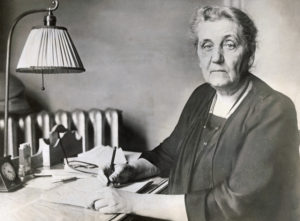
An older woman with gray hair sits at a desk, holding a pen and looking at the camera. There are papers, a lamp, and a clock on the desk. The setting appears to be an office or study.
Jane Addams, at her desk. Miss Addams established the social settlement, Hull House, in Chicago in 1889 and founded the American Civil Liberties Union. — Image by ยฉ Bettmann/CORBIS

Addams had positive things to say about the National Recovery Administration (NRA), one of the most noteworthy programs from FDRโ€™s โ€œNew Deal.โ€ She praised its efforts to end unemployment and ensure minimum wages, and spoke to the value of business practices being placed on a higher standard as a result of the NRA. Addams described the struggles of the average city workman during the Great Depression, and hailed โ€œThat the NRA has come to his rescue fills many of us with sincere gratitude.โ€

Despite this praise, Addams always maintained a critical eye. She asserted that the NRA โ€œdemands careful studyโ€ and that the issue of unemployment was complex, requiring greater effort than federal relief alone. While Addams generally supported government assistance, she was always quick to stress the additional importance of the work from community members, private citizens, and social workers. Addams described the importance of this supplementary social service in another writing from the same year, stating โ€œThe public relief work is concerned largely with food and clothing and, unhappily, not always with shelter. Our supplementary social services are, perhaps, more necessary simply because peopleโ€™s lives have been saved by governmental funds and they are distressed about it.โ€

The New Deal also established the Social Security program, providing welfare and benefits to senior citizens as well as additional unemployment insurance. Addams wrote considerably in favor of old age security in the later years of her life and certainly wouldโ€™ve had praise for the Social Security Act. Sadly, Addams died three months before the legislation was passed.

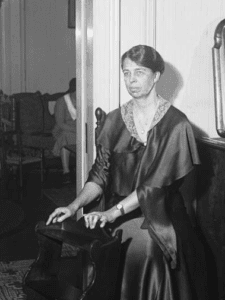
Eleanor Roosevelt in a dark, formal dress sits beside a chair in an indoor setting, looking slightly to the side with a calm expression. Another person sits blurred in the background.
Eleanor Roosevelt

Addams and Eleanor Roosevelt had immense mutual respect for one another and offered the highest praise and flattery for each other. In January 1933, Addams introduced Eleanor before a speech at Orchestra Hall, Chicago, and sang endless praises for the incoming First Lady. Addams commended her work with the Womenโ€™s Trade Union League, the Foreign Policies Association of New York City, and the Womanโ€™s City Club in New York. She also praised her work in education and her Hyde Park furniture and crafts shop, Val-Kill Industries. Addams aptly added in her remarks โ€œI am sure that some of you listening to my even incomplete list of Mrs Rooseveltโ€™s interests and activities must have been reminded of the abounding energy and unflagging concern for human affairs exhibited by another distinguished Roosevelt, and that you rejoice with me that such a spirit is once more to be domiciled within the White House.โ€

Eleanor Roosevelt would go on to have a pioneering and invaluable career in the White House and with the United Nations, breaking gender barriers and becoming one of the most influential women of her time. By helping to establish the Universal Declaration of Human Rights, in many ways she continued and honored the work which Addams devoted so many years of her life to.ย 

In the final month of her life, Addams was the guest of honor at a Washington D.C. dinner. Here, Eleanor Roosevelt labelled Addams โ€œthe greatest living woman.โ€ She also reflected on Addamsโ€™ life years later, stating โ€œMiss Addams served humanity so well she should never be forgotten. Anyone who knew her, will remember the inspiration of her presence, but her spirit went far beyond the individuals who knew her. It affected the thinking and living of people all over the world.โ€

While Addams and the Roosevelts played small roles in each otherโ€™s lives and history, they collectively played large roles in the ever-ongoing duty of creating a better world through progressive change.

–James La Forge, Editorial Assistant

Sources: Smithsonian Magazine. “The Speech That Saved Teddy Roosevelt’s Life“. Smithsonian Magazine. Accessed January 16, 2024; PBS. “Teddy Roosevelt and Progressivism.” PBS. Accessed January 16, 2024; Addams, Jane, โ€œStatement on the Death of Theodore Roosevelt, January 6, 1919,โ€ย Jane Addams Digital Edition, accessed January 16, 2024; Franklin Delano Roosevelt Library, “Papers As New York State Senator.” 1910-1913; Addams, Jane, โ€œStatement Endorsing Herbert Hoover for President, October 1928,โ€ย Jane Addams Digital Edition, accessed January 16, 2024; Addams, Jane, โ€œStatement on Prohibition, July 8, 1933,โ€ย Jane Addams Digital Edition, accessed January 16, 2024; Addams, Jane, โ€œStatement Endorsing The Appointment of Frances Perkins as Secretary of Labor, December 8, 1932,โ€ย Jane Addams Digital Edition, accessed January 16, 2024; Addams, Jane, โ€œSecond Draft of Address on the National Recovery Administration, September 1933,โ€ย Jane Addams Digital Edition, accessed January 16, 2024; Addams, Jane, โ€œWomen’s Part in Revealing Human Needs, October 30, 1933,โ€ย Jane Addams Digital Edition, accessed January 16, 2024; Addams, Jane, โ€œRemarks Introducing Eleanor Roosevelt at Orchestra Hall, Chicago, January 20, 1933,โ€ย Jane Addams Digital Edition, accessed January 16, 2024; United For Human Rights. “CHAMPIONS OF HUMAN RIGHTS ELEANOR ROOSEVELT (1884โ€Šโ€“1962)” accessed January 16, 2024; Barber, Elizabeth. “Jane Addams, world’s ‘best-loved woman,’ honored with Google doodle.The Christian Science Monitor, September 6, 2013.

Guest Post: Hearing Addams Speak

Jane Addams with neatly styled hair sits at a desk, writing on paper with a pen. She wears a dark dress with a lace collar and cuffs, and appears focused on her work in a softly lit room.

This is a guest post by Marilyn Fischer, Professor Emerita at the University of Dayton, who specializes in political philosophy and American pragmatism. She has edited Jane Addams’s writings on peace and is the author of Jane Addams’s Evolutionary Theorizing: Constructing Democracy and Social Ethics (2019). She is currently working onย  two additional volumes that examine Jane Addams’s writings. She is a member of the Jane Addams Papers Advisory Board.

Jane Addams with neatly styled hair sits at a desk, writing on paper with a pen. She wears a dark dress with a lace collar and cuffs, and appears focused on her work in a softly lit room.If you want to know how Addams wrote her books, ask her relatives. Her nephew, James Weber Linn, tells us Addams would begin with her speeches, and then revise, expand, or contract the material into a coherent whole.[1] Addamsโ€™s niece, Marcet Haldeman-Julius, reminisced, โ€œI can still hear my motherโ€™s infectious laugh as she watched Aunt Jane initiate me into her method of โ€˜pins-and-scissorsโ€™ writing.โ€[2] Addams would have loved word processing software. Copy and paste is so much simpler than scissors and pins.

Does it matter how Addams wrote her books? There are many ways to interpret a text. One can compare Addamsโ€™s ideas to those of John Dewey or Charlotte Perkins Gilman or even Dorothy Day. One can ask if Addamsโ€™s ideas are still relevant today to solving environmental problems, revitalizing democracy, ending discrimination against women, immigrants, the poor, or the disabled. These are all worthy uses of Addamsโ€™s ideas, and have been carried out without considering how Addams constructed her texts. Yet, knowing the characteristics of Addamsโ€™s speech-making can also shift readersโ€™ interpretations of her written texts, and is thus worth examining.

Addams gave thousands of speeches in Chicago and on lecture tours throughout the country and abroad. Her public reputation rested in large part on her speeches.[3] Manuscripts of some of her speeches are in the digital archives and the Jane Addams Papers Microfilm edition. From early in her career, Addamsโ€™s speeches were widely covered in the national press and throughout the English-speaking world. This was a world on which the sun never set, as the British Empire was at its height. News coverage typically included lengthy excerpts of what she said. Sometimes Addams spoke for up to an hour; often she shared the platform with multiple speakers who were each allotted a mere ten minutes. Addamsโ€™s challenge was to engage the audience so they didnโ€™t fall asleep or walk out, while saying something substantive enough to provoke new ways of thinking and imagining. Here I focus on three characteristics of Addamsโ€™s speech-making with which she engaged her audiences: orality, compression, and โ€œcircling round and spiraling out.โ€ She carried these techniques into her written articles and books.

Orality: Consider how Addamsโ€™s initial audiences heard her and the spaces in which she spoke. These ranged from intimate gatherings of a few dozen, to packed auditoriums that seated thousands. At the time, before radio and television, commentators spoke of the power of public addresses as โ€œa mystical form of electricity.โ€[4] The electricity began with the speaker, whose diction, movements, and tones amplified her wordsโ€™ meanings. Its power went out to the audience who felt its voltage reverberate in othersโ€™ murmurs, cleared throats, cheers, or hoots.[5] Hearing is intimate, as anotherโ€™s voice enters oneโ€™s own body.[6] As a result, speaker and audience think and feel and respond together, all at once.

The age of eloquence and oratory had not yet closed.[7] Public addresses educated, entertained, and builtโ€”or maybe fracturedโ€”communities, all at the same time. Addamsโ€™s audiences took part in many of these practices. They participated in religious revivals, attended politiciansโ€™ hours-long debates, and cheered or booed labor agitators. They were practiced at listening to and absorbing eloquent speech. Students memorized poetry and great speeches; their repertoire could include thousands of lines of poetry and orations.[8] Addams was ready for them. She had studied oratory and rhetoric in college, when, as historian Carolyn Eastman notes, โ€œtraining in oratory was indistinguishable from training as an actor.โ€[9] In college, Addams was on the debate team and participated in oratory contests.[10] Because Addams constructed her books around her speeches, we can think of her books as โ€œundelivered speeches,โ€ best approached through the ear, as well as the eye.[11]

Addamsโ€™s audiences felt her power. Of her talk, โ€œPhilanthropy Wonโ€™t Do,โ€ the reporter for the Indianapolis Journal wrote, โ€œMiss Addamsโ€™s personality is an immediate bid for the interest of an audience; and the sympathy in her face, voice and manner would warm the cockles of the most unaltruistic heart.โ€[12] The Times of Oswego, New York reported that no one was bored by Addamsโ€™s hour-long talk on settlements, stating, โ€œShe is a fluent speaker, with a crisp, vigorous, incisiveness of style that makes her speech a delight; and her broad culture, warm humanitarianism and keen insight into social problems impart a most convincing air to her words.โ€[13] Addams used her presence on stage to create relations with her audiences that would engage their emotions and imaginations, as well as their intellects.[14]

Speech is more powerful when it is vivid and concrete. Addams used stories to accomplish this. Now she could cite statistics as well as any sociological data-collector, and she usually tucked several of them into her texts. But statistics send little electricity from speaker to audience. Addams clothed the data with faces and bodies in particular situations. Addams did not begin her speech, โ€œChild Labor and Pauperism,โ€ with a catalog of data, or even with scenes inside exploitive workplaces. She began by placing her listeners where they often were, on the streetcar at six p.m., as men, women, and children poured out of factories at end of shift. Addams remarked, โ€œThe boys and girls have a peculiar hue, a color so distinctive that any one meeting them on the street even on Sunday in their best clothes and mixed up with other children who go to school and play out of doors, can distinguish almost in an instant the children working in factories. There is also on their faces a something indescribable, a premature anxiety and sense of responsibility which we should declare pathetic if we were not used to it.โ€[15] Her audience members had likely seen these children often, without ever really seeing them. The story startled them into recognizing that evidence of child exploitation was all around them, written on the faces of children they saw.

Black-and-white photo of children and adults working in a crowded cellar, filling and handling bottles near large barrels and wooden crates. The environment appears busy and cluttered with bottles and supplies.
Young children working in a bottle factory in Chicago– https://dp.la/primary-source-sets/theodore-dreiser-s-sister-carrie-and-the-urbanization-of-chicago/sources/1639

Addams aimed deeper than to increase her audiencesโ€™ sense of duty toward others. She aimed to change their fundamental moral and perceptual sensibilities, their ways of perceiving the world and themselves, and of their sense of relationship with others. These sensibilities are the soil out of which opinions and duties grow, or wither. Commenting on a speech by suffragist Anna Howard Shaw, Addams said, โ€œIt was a wonderful lesson in speech-making, not to desire to make an exposition of what you believed or did not believe, but absolutely to persuade your audience from one point of view, if you possibly could, to another point of view.โ€[16] For Addams to do this, she needed to enter each audienceโ€™s mode of perception, and use what they knew and valued and believed, so as to open them to others ways of knowing, valuing and believing. Appealing to their emotions, their sympathies, and imaginations was just as important as appealing to moral codes or their capacities for logical reasoning.

A woman in a floral dress with a white bonnet carries colorful flower baskets on a pole across her shoulders. The cover reads The Ladies Home Journal, January 1910, price fifteen cents.
Cover of the January 1910 Ladies Home Journal issue in which “Why Woman Should Vote” appeared.

Knowing all this complicates the interpretive task for scholars today. We read Addamsโ€™s writings to find out what she thought. Her writings contain her thoughts, but not directly. A good example is the opening paragraph of her widely read essay on suffrage, โ€œWhy Women Should Vote.โ€[17] Addams begins by stating how people had long believed that a womanโ€™s โ€œparamount obligationโ€ was to the home, and that was unlikely to change.[18] Recent scholars have used that statement to locate Addams in the maternalist, conservative wing of suffrage advocates.[19] However, good rhetor that she was, Addams began her talks by identifying common ground with her audience, and using that as a springboard to lead them to different ways of imagining the world. Addams wrote โ€œWhy Women Should Vote,โ€ for the Ladies Home Journal, the most widely read magazine in the U.S. at the time. Its primary audience was middle and lower-middle class women, generally homemakers, and likely opposed to womenโ€™s suffrage, who saw womenโ€™s place as in the home, not in the dirty world of politics.[20] Addams didnโ€™t lie; but she made her opening statement capacious enough that most everyone could find room for themselves inside it.[21] She then led her readers step by step into the lived realities of women like her immigrant neighbors who desperately needed the vote in order to provide their families with clean water, untainted food, and streets that were not fouled with garbage.

Compression: The second characteristic of Addamsโ€™s speech-making and writing, is compression. When speakers have only a short time to be substantive, what do they do? They leave out whatever they can, and rely on the audience to fill in the gaps. Because Addams and her audiences lived at the same time and place, they shared a great number of associations. The briefest mention could bring all that to mind. When Addams addressed an anti-imperialism protest rally in April 1899, she could simply say, โ€œWe suddenly find ourselves bound to an international situation.โ€[22] She did not need to tell the audience that the U.S. was deep in the muck of the Philippine-American War, or that the U.S. economy and their own economic well-being were deeply dependent on international trade, or that the navies of the European imperial powers were hungrily circling the Philippines, in case the U.S. should pack up and leave.[23] To Addams, these facts made the typical response of others in the American Anti-Imperialist League untenable, as they counseled the U.S. to just pull out.[24] Regardless of what the U.S. did with the Philippines, it would still be entangled in the international situation. And when Addams threw in the line, โ€œGovernment is not something extraneous, consisting of men who wear gold lace,โ€ her audience immediately knew she was mocking British and American imperialism.[25] At the time, the amount of gold lace on a military uniform marked the wearerโ€™s rank. This was a sign of hierarchy and on order maintained by force, rather than through democratic egalitarianism. Addamsโ€™s image, now obscure, was a potent element in her protest against the U.S. becoming an imperial power.

A cartoon-style drawing of a grinning navy officer in a blue uniform stands on a ship deck, holding a telescope. A flag and crossed sabers appear in the top right corner. The background shows water and distant land.
โ€œA is an Admiral. observe his gold lace. He is fond of good things, you can tell by his face.โ€ (The Comic Military Alphabet: Army, Navy, National Guard, by DeWitt C. Falls, 1894 (Hathi Trust).

Compression gives space for the audience to think along with the speaker. Alexander Bain, author of Addamsโ€™s college rhetoric and composition text, praised brevity and devoted a whole chapter to how to achieve it.[26] He included the pointer that โ€œthings well-known [can be] recalled by brief allusion.โ€[27] Bain also stressed the power of indirect speech noting, โ€œThe device of suggesting, instead of openly expressing, . . . give[s] a starting-point to the thoughts.โ€[28] Compression engages listenersโ€™ and readersโ€™ imaginations to fill in what is omitted. They become active participants in the event, rather than passive receptors. In effective speech-making, โ€œnailing it downโ€ is a weakness, not a strength.

Compression is a technique used by literary writers and especially by poets, the most aural of literary artists. Addamsโ€™s writings were considered poetic. A portrait of Addams in Collierโ€™s National Weekly notes, โ€œShe writes hardly a paragraph but is shot through with poetry.โ€[29] Settlement resident, Mary Kingsbury Simkhovitch, wrote in her review of The Spirit of Youth and the City Streets for Political Science Quarterly, โ€œMiss Addamsโ€™s recent book continues the note of realism suffused with imagination which characterizes all her utterances, whether oral or written. . . . [It] is her most lucid and poetical expression.โ€[30] If this be true, then Addamsโ€™s writings should be approached as works of art, as much as works of philosophical and sociological analysis.

Circling Round: The final characteristic of how Addams spoke and wrote Iโ€™ll call โ€œcircling round and spiraling out.โ€ The image comes from William Hard, a journalist with the Chicago Tribune who heard Addamsโ€™s convocation address at the University of Chicago. He wrote to her,ย โ€œI seemed to stand in the center of the subject and to revolve slowly round with a philosopher at my side.โ€[31] James Weber Linn, Addamsโ€™s nephew, commented that among the clashing opinions held by the many strong characters residing at Hull House, โ€œonly Jane Addams, perhaps, [could see] everything from everybodyโ€™s point of view.โ€[32]

A young girl stands between long rows of spinning machines in a textile mill, wearing a dress and apron, with loose cotton scattered on the floor in a dimly lit industrial setting.
Girl working at the Globe Cotton Mill in Augusta, GA. (National Child Labor Committee, Lewis Hine Photographs, Library of Congress)

Addams turned circling round into a style of speaking and writing. She could circle round multiple viewpoints in a brief paragraph, a chapter, or an entire book. Because Addams primarily addressed white, middle-class audiences, the demographic to which she herself belonged, she did not have the credibility, or โ€œethos,โ€ as Aristotle called it, to denounce white, middle-class conventions as Ida B. Wells-Barnett or Frederick Douglass did, both of whom were born enslaved.[33] By circling round, though, Addams could spell out the hypocrisies of the people she was addressing. She demonstrates this in her speech, โ€œChild Labor and Pauperism,โ€ mentioned above. Addams uses this topic to charge her middle-class audiences with grotesque levels of moral irresponsibility. The cumulative weight of her circlings is far heavier and more densely layered than saying, โ€œThose poor children. Letโ€™s help them.โ€

Addams does this by identifying herself with the audience, โ€œweโ€ do this, โ€œweโ€ neglect that. On each circling round, she inserts personal stories and research data to demonstrate the following stack of conclusions: 1) Child labor robs the future of what belongs to itโ€”the potential future strength and capacities of todayโ€™s children. 2) Todayโ€™s child laborers are tomorrowโ€™s paupersโ€”adults incapable of holding a job who must depend on agencies and local governments to support them. Addams reinforces her claim with the salvo, โ€œNo horse trainer would permit his colts to be so broken down.โ€ 3) By allowing industries to underpay children and adults, you allow your industries to be โ€œparasitic on the future of the community,โ€ creating โ€œthe pauperization of society.โ€ 4) Finally, child labor โ€œpauperizes the consumerโ€ (i.e., her audience members), by flipping the roles of giver and recipient of charity. For, as she states in the most personal of tone: โ€œIf I wear a garment . . . for which the maker has not been paid a living wage . . ., then I am in debt to the woman who made my cloak. I am a pauper and I permit myself to accept charity from the poorest people of the community.โ€ All of this, Addams charges, โ€œdebauches our moral sentiment, it confuses our sense of values.โ€[34] By noting Addamsโ€™s circling round, one sees that Addamsโ€™s speeches say less about the ostensible topic of child labor and pauperism, than builds a case, step by step, for middle-class Americansโ€™ utter failure to take responsibility for the kind of society they live in.

Four women in early 20th-century clothing and hats walk together on a cobblestone street, smiling and chatting, with a vintage streetcar in the background.
Young girls leaving a shoe factory in Chicago, 1910.

In some passages the compressing and the circling round happen so fast, todayโ€™s readers hardly see it. In The Spirit of Youth and the City Streets, a book largely derived from speeches, Addams gives a vivid portrait of young adolescent girls giggling as they walk down the street, wearing โ€œpreposterous clothing.โ€ One has on a โ€œhuge hat, with its wilderness of bedraggled feathers.โ€[35] Why, one might ask, is Addams bothering about adolescent fashion? Why is she being so stuffy and moralistic? First, the compression: Addams omits to say what her readers already knew, that concerned citizens immediately identified the huge hat as advertising the girlโ€™s sexual availability, and the fact that she walked down the street unchaperoned was a sure sign she was looking for johns.[36] Instead of sharing the moralistic concerns of these citizens, Addams uses the hat as a device to lay a heavy charge against them.

Immediately before describing the girl with the hat, Addams mentions the โ€œunrestrained jollities of restoration Londonโ€ that broke out as soon as โ€œthe soldiers of Cromwell shut up the peopleโ€™s pleasure palaces.โ€[37] She didnโ€™t need to tell her readers that the mid-seventeenth century โ€œjollitiesโ€ were disastrous days of chaos and disorder that broke out just after Oliver Cromwell (literally) lost his head. Addams immediately followed her description of the hat with its bedraggled feathers, saying, โ€œthe variation from the established type is at the root of all change,โ€ an allusion to Darwinโ€™s theory of how new species are generated. She quickly adds, โ€œIt is only the artists who see these young creatures as they areโ€”the artists who are themselves endowed with immortal youth.โ€[38]ย  This was a common trope, that artists have privileged access to realityโ€™s underlying truth.

Addams, without being pedantic, uses the girl with the hat to celebrate adolescent sexual energy as a fount of renewal for a society grown weary. By circling round the hat, she uses the collective weight of history, biology, and artistry to chastise concerned citizens for wanting to suppress a vital source of life. By leaving her texts incomplete, Addams invites her readers to construct them with her. And theyโ€”the texts and the readersโ€”are more powerful because of it.

Does all of this matter? To better interpret Addams should we start listening to audiofiles of Addamsโ€™s speeches and writings, uncompress her passages, and map her circlings round? I think it does matter, though more for some questions than others. To begin with, following these patterns reveals Addamsโ€™s character. She had a rapier wit, a delicious sense of irony, and at times was blazingly sarcastic. All of that is right there, on the page, though seldom seen.

Many people today are interested in Addams because they see her activism and her ideas as resources for bringing about social change. Addams was a first-rate public intellectual. Addamsโ€™s attention to selecting her vocal register, vocabulary, images, and examples so as to communicate most effectively with each specific audience she addressed is a worthy model to emulate.

Finally, attending to Addamsโ€™s use of orality, compression, and circling round leads to profound interpretations of Addamsโ€™s thought that are otherwise missed. Hearing Addams speak as well as studying what she wrote will enable us to enter into her thought and life more deeply.

—Marilyn Fischer

——————-

[1] Linn, Jane Addams, 116.

[2] Marcet Haldeman-Julius, Jane Addams as I Knew Her, 16.

[3] Louise W. Knight, โ€œAn Authoritative Voice,โ€ 221; Linn, Jane Addams, 242.

[4] Eastman, โ€œConclusion: Placing Platform Culture,โ€ 187.

[5] Eastman, โ€œConclusion: Placing Platform Culture,โ€ 187.

[6] John Dewey made this point, writing, โ€œThe connections of the ear with vital and out-going thought and emotion are immensely closer and more varied than those of the eye. Vision is a spectator; hearing is a participatorโ€ (The Public and Its Problems, 371.)

[7] See Stob, William James and the Art of Popular Statement, Chapter 1.

[8] Eastman, โ€œConclusion: Placing Platform Culture,โ€ 190-191.

[9] Eastman, โ€œConclusion: Placing Platform Culture,โ€ 191.

[10] Knight, Citizen, 87, 95, 98.

[11] The notion of an โ€œundelivered speechโ€ comes from Arnold, โ€œOral Rhetoric, Rhetoric, and Literature,โ€ 170.

[12] โ€œPhilanthropy Wonโ€™t Do.โ€

[13] โ€œSettlement Work and Its Results.โ€

[14] In other words, Addams made use of ethos, pathos, and logos, as called for in classical rhetoric.

[15] Addams, โ€œChild Labor and Pauperism,โ€ 115.

[16] Addams, โ€œAddress on Anna Howard Shaw,โ€ 7.

[17] A google search for โ€œWhy Women Should Voteโ€ shows that it is still widely read today, as it is posted on many history websites and academic websites.

[18] Addams, โ€œWhy Women Should Vote,โ€ 21.

[19] For scholars who regard Addams as a maternalist, and among the more conservative of the suffrage advocates, see Schultz, โ€œIntroduction,โ€ xli; Mink, The Wages of Motherhood, 1-13. Nackenoff claims that Addams used maternalist rhetoric for strategic reasons (โ€œNew Politics for New Selves,โ€ 131). Hamington regards โ€œWhy Women Should Voteโ€ as โ€œthe most conservative of her appeals for womenโ€™s enfranchisementโ€ (The Social Philosophy of Jane Addams, 69).

[20] Waller-Zuckerman, โ€œโ€˜Old Homes, in a City of Perpetual Change,โ€™โ€ 717.

[21] Addams was following the principle articulated by Bain, โ€œAs in argument, so in oratory generally, there must be some common ground to work uponโ€ (English Composition and Rhetoric, 214). Addamsโ€™s introduction and line of argument in โ€œWhy Women Should Voteโ€ is startlingly different from the ones she used in suffrage addresses to very different audiences. See โ€œWomenโ€™s Clubs and Public Policies,โ€ an address to the General Federation of Womenโ€™s Clubs; and โ€œThe Larger Aspects of the Womanโ€™s Movement,โ€ for the American Academy of Political and Social Science.

[22] Addams, โ€œDemocracy or Militarism,โ€ 35-36.

[23] For a succinct summary of the Spanish-American War and the war in the Philippines, see Herring, The American Century and Beyond, 11-31; Trask, โ€œIntroductionโ€; see also Jacobson, Barbarian Virtues, 97, 221-234, 241-247.

[24] For a discussion of the Anti-Imperialist movement see Tompkins, Anti-Imperialism in the United States. For transcripts of the speeches given with Addamsโ€™s address, see The Chicago Liberty Meeting. Addamsโ€™s address, โ€œDemocracy or Militarism,โ€ is on pp. 36-39.ย 

[25] Addams, โ€œDemocracy or Militarism,โ€ 38.

[26] Bain, English Composition and Rhetoric, 66-73.

[27] Bain, English Composition and Rhetoric, 67.

[28] Bain, English Composition and Rhetoric, 62.

[29] โ€œPortrait of a Woman,โ€ 11.

[30] Simkhovitch, Review of The Spirit of Youth and the City Streets, 555.

[31] William Hard to Jane Addams, January 15, 1905.

[32] Linn, Jane Addams, A Biography, 135.

[33] Bryan, Slote, and Angury, The Jane Addams Papers: A Comprehensive Guide, 95; Knight, โ€œLooking In from the Outside.โ€

[34] Addams, โ€œChild Labor and Pauperism.โ€

[35] Addams, The Spirit of Youth and the City Streets, 8.

[36] The Chicago Vice Commission included several examples of girls engaging in sexual acts in order to buy hats costing many times their weekly salaries. See Vice Commission of Chicago, The Social Evil in Chicago, 78, 204, 210.

[37] Addams, The Spirit of Youth and the City Streets, 7.

[38] Addams, The Spirit of Youth and the City Streets, 8, 9.

References

References

Addams, Jane. โ€œAddress on Anna Howard Shaw,โ€ Nov 13, 1919, typed manuscript, digital edition.

Addams, Jane. โ€œChild Labor and Pauperism.โ€ National Conference of Charities and Correction, Proceedings (1903): 114-21. Digital edition.

Addams, Jane. โ€œDemocracy or Militarism,โ€ in The Chicago Liberty Meeting, 35-39. Chicago: Central Anti-Imperialist League, 1899.

Addams, Jane. โ€œThe Larger Aspects of the Womanโ€™s Movement.โ€ American Academy of Political and Social Science, Annals 56 (1914): 1-8. Digital edition.

Addams, Jane. The Spirit of Youth and the City Streets. New York: Macmillan, 1909.

Addams, Jane. โ€œWhy Women Should Vote.โ€ Ladies Home Journal 27 (January 1910): 21-22. Digital edition.

Addams, Jane. โ€œWomenโ€™s Clubs and Public Policies,โ€ General Federation of Womenโ€™s Clubs. Biennial Convention Official Report (1914):ย  24-30. Digital edition.

Arnold, Carroll C. โ€œOral Rhetoric, Rhetoric, and Literature.โ€ Philosophy and Rhetoric 40 (2007): 170-187.

Bain, Alexander. English Composition and Rhetoric, a Manual. American Edition, Revised. New York: D. Appleton, 1867.

Bryan, Mary Lynn McCree, Nancy Slote, and Maree De Angury, editors. The Jane Addams Papers: A Comprehensive Guide. Bloomington: Indiana University Press, 1996.

Chicago Liberty Meeting. Chicago: Central Anti-Imperialist League, 1899.


Dewey, John. The Public and Its Problems. 1927. In John Dewey: The Later Works: 1925-1953: vol. 2, edited by Jo Ann Boydston. 235-372. Carbondale: Southern Illinois University Press, 1988.

Eastman, Carolyn. โ€œConclusion: Placing Platform Culture in Nineteenth-Century American Life.โ€ Thinking Together: Lecturing, Learning, and Difference in the Long Nineteenth Century, edited by Angela G. Ray and Paul Stob. 187-201. University Park, PA: The Pennsylvania State University, 2018.

Haldeman-Julius, Marcet. Jane Addams as I Knew Her. Girard, KS: Haldeman-Julius Publications, 1936.

Hamington, Maurice. The Social Philosophy of Jane Addams. Urbana: University of Illinois Press, 2009.

Hard, William to Jane Addams, January 15, 1905. Digital edition

Herring, George C. The American Century & Beyond: U.S. Foreign Relations, 1893-2014. New York: Oxford University Press, 2008.

Jacobson, Matthew Frye. Barbarian Virtues: The United States Encounters Foreign Peoples at Home and Abroad, 1876-1917. New York: Hill and Wang. 2000.

Knight, Louise W. โ€œAn Authoritative Voice: Jane Addams and the Oratorical Tradition.โ€ Gender & History 10 (August 1998): 217โ€“251.

Knight, Louise W. โ€œLooking In from the Outside, or A Few Angles on Rhetoric and Change.โ€ Rhetorics Change/Rhetoricโ€™s Change, edited by Jenny Rice, Chelsea Graham, and Eric Detweiler. Anderson, SC: Parlor Press and Intermezzo, 2018. (an ePub; no pagination)

Knight, Louise W. Citizen: Jane Addams and the Struggle for Democracy. Chicago: University of Chicago Press, 2005.

Linn, James Weber. Jane Addams: a Biography. 1935. Urbana: University of Illinois Press, 2000.

Mink, Gwendolyn. The Wages of Motherhood: Inequality in the Welfare State, 1917-1942. Ithaca, New York: Cornell University Press, 1995.

Nackenoff, Carol. “New Politics for New Selves: Jane Addams’s Legacy for Democratic Citizenship in the Twenty-First Century.” in Jane Addams and the Practice of Democracy, edited by Marilyn Fischer, Carol Nackenoff, and Wendy Chmielewski, 119-142. Urbana: University of Illinois Press, 2009.

โ€œPhilanthropy Wonโ€™t Do.โ€ Indianapolis Journal, July 5, 1900, p. 3.

โ€œPortrait of a Woman,โ€ Collierโ€™s: The National Weekly 43 (April 10, 1909): 11.

Schultz, Rima Lunin. โ€œIntroduction.โ€ In Women Building Chicago, 1790-1990: A Biographical Dictionary edited by Rima Lunin Schultz and Adele Hast. xix-lx. Bloomington: Indiana University Press, 2001.

โ€œSettlement Work and Its Results.โ€ Times (Oswego, New York), March 28, 1905, Jane Addams Papers Microfilm, reel 55, frame 1306.

Simkhovitch, Mary Kingsbury. โ€œReview of The Spirit of Youth and the City Streets. Political Science Quarterly 25 (Sept 1910): 555-556.

Stob, Paul. William James and the Art of Popular Statement. East Lansing: Michigan State University Press, 2013.

Tompkins, E. Berkeley. Anti-Imperialism in the United States: The Great Debate, 1890-1920. Philadelphia: Univ. of Pennsylvania Press. 1970.

Trask, David F. โ€œIntroduction.โ€ The Encyclopedia of the Spanish-American and Philippine-American Wars, edited by Spencer C. Tucker. xxix-xxxiii. Santa Barbara, CA: ABC-Clio, 2009.

Vice Commission of Chicago. The Social Evil in Chicago: A Study of Existing Conditions with Recommendations by The Vice Commission of Chicago. Chicago: The Vice Commission of Chicago, Inc., 1911.

Waller-Zuckerman, Mary Ellen. โ€œโ€˜Old Homes, in a City of Perpetual Changeโ€™: Womenโ€™s Magazines, 1890-1916.โ€ The Business History Review 63 (Winter, 1989): 715-756.

Guest Post: What B. R. Ambedkar Wrote to Jane Addams

Black and white portraits of two people side by side: on the left, an older woman with short hair and a serious expression; on the right, a man with glasses in a suit and tie, looking to the side.

This is a guest post by Scott R Stroud, an associate professor in the Department of Communication Studies at the University of Texas at Austin. He is the author of The Evolution of Pragmatism in India: Ambedkar, Dewey, and the Rhetoric of Reconstruction (2023), which has also been published by HarperCollins India as The Evolution of Pragmatism in India: An Intellectual Biography of B.R. Ambedkar (2023). This post was originally published on August 3 by the South Asian American Digital Archive and we thank them for permission to reprint here.

Black and white portraits of two people side by side: on the left, an older woman with short hair and a serious expression; on the right, a man with glasses in a suit and tie, looking to the side.
Portrait photographs of Jane Addams and Dr. B. R. Ambedkar

The Indian politician and anti-caste activist Bhimrao Ambedkar (1891-1956) was heavily influenced by his experiences in the U.S. and England. He was partially shaped by his expansive education there, studying at institutions such as Columbia University, London School of Economics, and Grayโ€™s Inn. Of this set of institutions, his time in New York perhaps had the most influence on him. It was at Columbia that he was exposed to a range of progressive thinkers, not the least of which was the American pragmatist, John Dewey. While there are many ways that Deweyโ€™s pragmatism mattered for Ambedkarโ€™s thought over the following decades, there is another figure in the pragmatist tradition that has an overlooked connection to Ambedkar: Jane Addams (1860-1935).

It is often thought that Ambedkar left New York in the summer of 1916 for London and that he did return to the U.S. until much later in his lifeโ€”in 1952 when Columbia bestowed upon him an honorary degree. This is not accurate, however. On December 5, 1931, a few days after the conclusion of the second Round Table Conference, Ambedkar left London and sailed for New York. The exact purpose of this visit is hard to divine, but he ended up spending much of his time near Columbia University until he left for London on January 4, 1932.1

It was during this month in New York that Ambedkar penned a letter to Jane Addams on December 15, 1931.2 The letter is written on Ambedkarโ€™s own stationary, and its return address reveals that Ambedkar was staying at the International House at 500 Riverside Drive near the Columbia campus he roamed as a student. This building was constructed in 1924 with the funding of John D. Rockefeller Jr. to create a diverse learning and living environment for the growing numbers of international students at Columbia. In all likelihood, Ambedkar was able to stay there for the duration of his short visit given his status as an international alumnus.


Image used with permission of Prakash Ambedkar and the Jane Addams Papers Project.

Why did Ambedkar write Addams in 1931? His ostensible purpose was to wish her โ€œa full and speedy recovery from your distressful illness.โ€ Perhaps Ambedkar was reminded of her importance to causes parallel to his own given that she had been awarded the Nobel Peace Prize on December 10, 1931. On the day of her receiving this award, she was also admitted to a hospital in Baltimore, Maryland, to deal with her continuing ill health. She had been battling to regain her health ever since she suffered a heart attack in 1926. Both news of her health and her award made the papers around the globe, so Ambedkar surely heard of Addams through the media.

Ambedkar also knew of Addams from John Deweyโ€™s classes at Columbia. In John Deweyโ€™s 1915-1916 classes, Philosophy 131-132 โ€œMoral and Political Philosophy,โ€ Ambedkar and his fellow students (including the Chinese reformer, Hu Shih) heard their professor praise Addamsโ€™ 1902 book, Democracy and Social Ethics, in support of his claim that democracy implicated a wide range of community relationships beyond the political.3 Addams was an important part to the diverse tradition of American pragmatism, and she was set apart by the unique endeavor of running the settlement Hull House in Chicago. Settlement houses were part of a social movement that started around 1890 to alleviate poverty and suffering brought on by rapid industrialization. Social workers and activists would establish community centers in which they lived side-by-side with poor local residents and tried to improve the living conditions of the surrounding community. Addamโ€™s Hull House is one of the most successful American instances of this movement. It was when Dewey was in Chicago that he became friends with Addams and familiar with Hull House. Addams was not simply working for the improvement of the condition of women, immigrants, the poor, and those who might suffer from the violence of war; she also wrote and thought about the philosophy that stands behind such activism.4 Addamsโ€™ thoughts on nonviolence and democracy influenced Dewey, as Deweyโ€™s ever-growing body of work influenced Addams in turn.

When Dewey left Chicago for Columbia University in 1904, he remained friends with Addams and a supporter of the settlement movement. Addams continued with her work and expanded into international peace advocacy. Her decades-long efforts against international conflict, as unpopular as they were during the Great War, earned her the Nobel recognition in 1931.

Ambedkarโ€™s letter, however, focuses on her illness and makes no overt mention of her award. It does seem implied however, since he tells Addams โ€œYour life of devotion to the submerged of the world has been the inspiration and encouragement for us all even in darkest India.โ€ Ambedkar seems aware of her settlement work to alleviate the burdens of the poor in Chicago at Hull House, as well as the care for those in other nations evinced by her peace-building work in America and Europe. Perhaps he also knew of her trip to India in 1923, a visit where Addams was largely exposed to the figures and movements fixating on Indian self-rule, and not on the battle against untouchability. Addams was a friend and correspondent of Gandhiโ€™s, but the two were unable to meet on this trip because he was imprisoned at the time.

Addams did not seem to prioritize, or even know much about, the social evils of caste. Ambedkar seemed motivated in his letter to not only wish her improved health, but to introduce himself and his anti-caste cause. Indeed, he starts the letter referring to himself โ€œas a representative of the sixty-millions of downtrodden untouchables in India.โ€ Ambedkar seemed motivated to put the social issue of caste on Addamsโ€™ mind with his references to the size and state of the mass of humans oppressed by these long-rooted and oppressive matters of social custom. Caste limited and dehumanized most of those caught in the grips of its hierarchy, but this function was often missed by Americans like Addams.

What do we make of this letter? In archives in the U.S. and in India, I have found no evidence that Addams sent a reply to Ambedkarโ€™s letter of December 15. Nor is there any record of future correspondence between these two thinkers. Addams, of course, was deluged with congratulatory letters and telegraphs after her receipt of the Nobel Prize; combined with her uncertain health and hospitalization, itโ€™s no surprise that she did not write back to the Indian civil rights leader.

From this letter, however, we can see something of Ambedkarโ€™s motivation. He not only introduced himself and his cause in the letter, he hoped for a personal audience with Addams. โ€œI devoutedly [sic] hope,โ€ he writes at the end of the letter, โ€œthat your recovery will come within the limits of my short stay in America to permit me to present my humble respects in person.โ€ Thereโ€™s no evidence that they ever met, and Addamsโ€™ health and residence elsewhere lead us to think she did not meet Ambedkar in New York. But we can guess that Ambedkar sought a meeting with Addams not only to congratulate her, but also to build bridges between her settlement and peace work and his struggle against untouchability and caste oppression. We know that Ambedkar would later (in the 1940s) try to build similar bridges to leaders in the civil rights movement such as W.E.B. Du Bois.

Perhaps Ambedkar wanted to convince Addams that eradicating untouchability was an overlooked part to the Gandhian quest for Indian self-rule or swaraj that she was so taken by.5 Or perhaps Ambedkar wanted to compare strategies on settlement houses and their use in the Indian context. After all, he had most likely long known about settlement housesโ€”the settlement house figure, Mary Kingsbury Simkhovitch, was married to Ambedkarโ€™s economics professor, Vladimir Simkhovitch. Mary Simkhovitch directed Greenwich House in New York and was friends with Addams. She and Vladimir lived at the Greenwich Village settlement during the week, and often brought Vladimirโ€™s students to visit it. Ambedkar may have heard about her settlement activities or even visited it during his enrollment in one of his five courses from Vladimir at Columbia. In any case, we see Ambedkar initiate a series of hostels and educational organizations that similarly aimed to educate and support the lower classes (and castes) in India upon his return in the 1920s. Like Addams and Simkhovitch, as well as Dewey, Ambedkar saw the power in a holistic education that involved classes, books, as well as edifying social activities outside of formal education.

The pragmatists are a diverse lot. But one of the themes that drives Addams, Simkhovitch, and Dewey is vitally important: life was educative and intelligent action could further shape the course of experience to maximize its effects on our habits and communities. Ambedkar felt the power in this commitment, and he would often argue in his writings for a view of democracy as a way of life or a matter of our habits of associated living with our fellow humans. Addamsโ€™ ideas of social reform were a noteworthy attempt to refine harmful social habits and customs, and Ambedkar surely saw her as a fellow traveler. This overlooked letter to Addams highlights Ambedkarโ€™s drive to internationalize his mission and to connect the battle of caste to the oppression of women, the poor, and to peace-making in general.

ยงยงยง
The author would like to thank Prakash Ambedkar, Kishor Walanju, Cathy Moran Hajo, and Marilyn Fischer for their assistance with this article.

Footnotes
1. These dates are derived from the account in K. N. Kadam, Dr Babasaheb Ambedkar and the Significance of His Movement (Bombay, Popular Prakashan, 1991) and Vijay Mankar, Life and the Greatest Humanitarian Revolutionary Movement of Dr B.R. Ambedkar: A Chronology (Nagpur, Blueworld Series, 2009). I have found no evidence of meetings between Ambedkar and his Columbia contacts (including Dewey) during this time.
2. This letter can be found in the Jane Addams Papers. It was brought to my attention by the Addams scholar, Marilyn Fischer, who knows this massive set of documents very well. No biographies note the existence of this letter.
3. For information on the courses with John Dewey and their content, see Scott R. Stroud, The Evolution of Pragmatism in India (University of Chicago Press & HarperCollins India, 2023).
4. For more on Addams as a philosopher, see Marilyn Fischer, Jane Addams’s Evolutionary Theorizing: Constructing โ€œDemocracy and Social Ethicsโ€ (Chicago, University of Chicago Press, 2019).
5. Addams would continue to advocate for Gandhiโ€™s movement in her correspondence and writings after 1923, and Gandhi would write her about various matters. Gandhi reprinted some of her work in edited volumes. For more on the relationship between these two thinkers, see Elizabeth N. Agnew, โ€œJane Addams, Mohandas Gandhi, and the Promise of Soul Force,โ€ Peace & Change, 45 (4), 2020, 481-512 and Tim Gilsenan, โ€œPeacemakers & Friends: Jane Addams & Gandhi,โ€ October 6, 2013.

Get a Clew: Changes in Word Spelling

A classical painting of a woman in a flowing dress sitting and gesturing toward a man in ornate armor and a red cape; they appear to be in conversation next to a large window with a distant landscape.

I have always been a prolific reader, engrossed in anything from a geometry text book, fantasy novel, or whatever I could get my hands on. After absorbing so many words, I think it only natural that I eventually wondered where our words began, how they must have evolved, and when they could have changed. My yearning to explore this new fascination and my need to spend as little money possible on this endeavor culminated in the discovery of my long-time favorite podcast: The History of English Podcast (THEP), written, produced, and hosted by Kevin Stroud.

Stroud, a practicing attorney, began THEP in 2012 by discussing Indo-European, a language that would branch off and evolve into many European languages, including modern English, spoken before any alphabets were created to express its unique set of sounds and grammar. This was the perfect recreational listening for me; not only was I surrounded by words, but learning the complex history behind those words gave me a feeling of appreciation for the English language I had not previously known. The podcast successfully guided me away from my work day, filling me with knowledge about a topic so far removed from Jane Addams and 20th century Progressive politics that I could only be amused when Episode 12 pulled me right back to her papers.

Just a week prior to listening to Episode 12, I had come across Pleads for Suffrage, April 17, 1906, an article written by Addams in support of women’s suffrage. Near the end of this article, she states:

“So many of the stumbling blocks against which we fall are the opportunities to which we have not adjusted ourselves. We keep hold of a convention which no longer squares with our genuine insight into life and we are slow to follow a [clue] which might enable us to solace and improve the life about us because it shocks an obsolete ideal.”

In this paragraph, we the editors have bracketed the word “clue” to express an effort to regularize unusual spelling for the sake of readability and searchability in our digital edition; the word was originally spelled “clew.” At the time I read this article, I bracketed the unorthodox spelling without a second thought. Addams incorporated several unconventional spellings in her correspondence and other writings, such as “inclosed” instead of “enclosed”, or “altho” instead of “although”, and I believed this instance to be another drop in this bucket of the quirky, irregular 20th century spellings she employed.

Map showing the Eastern Mediterranean during the Late Bronze Age, with land and sea trade routes connecting Mycenaean Greece, Crete, Troy, the Hittite Empire, and Egypt, labeled with major cities and regions.
Map Prepared by Louis Henwood for The History of English Podcast, Episode 12. This map shows the flow of renewed migration of Indo-European tribes in the region north of Greece in and around the Balkans.

Episode 12: Early Greek, Hittite and the Trojan War of THEP, originally released in August of 2013, set out to discuss the Minoan civilization living on the island of Crete, just south of modern day Greece, and their mythical king, Minos, for whom the society was named after. According to legend, Minos was in possession of a powerful half man, half bull creature called a Minotaur which he kept in a purposefully complicated cave, or labyrinth, as a prison. Eventually, a Greek prince, Theseus, offered to kill the beast. In order to avoid becoming lost in the maze of the labyrinth, he used a ball of thread, given to him by King Minos’ daughter, Ariadne, and tied one end to the cave’s door. After defeating the Minotaur in the center of the maze, Theseus used the thread to find his way back to its entrance, left Crete without Ariadne, and sailed back to his home in Athens. This thread used by Theseus to escape the labyrinth, or any ball of thread or yarn, was historically called a “clew.”

A classical painting of a woman in a flowing dress sitting and gesturing toward a man in ornate armor and a red cape; they appear to be in conversation next to a large window with a distant landscape.
Ariadne Helping Theseus by Giving him a Ball of Thread. Johann Heinrich Tischbein, 1779. oil on canvas.

According to Stroud, this story became wildly popular in the Middle Ages, during the time Old English was spoken. Authors used the idea of a “clew” being employed to solve a maze or a puzzle so often, eventually the word could mean either a ball of thread or yarn, or a figurative hint or guide depending on the context. In modern English, beginning around the late 16th century, two separate spellings emerged for the seemingly unrelated definitions, with writers eventually substituting the Middle English ending of “ew” with the French associated ending of “ue” for the latter meaning. Today, the word “clue” has lost its figurative status, and fully refers to an actual hint to a solution of a problem.

Looking back at Addams’s usage of the word “clew” with this newfound knowledge, we can make some guesses as to her choice of spelling. According to the Oxford English Dictionary, the spelling “clew” was being used to refer to a figurative hint or guide as late as 1855. There is a real possibility that Addams, born only five years later in 1860, may have picked up the word’s earlier usage and incorporated it into her lexicon. In either case, the meaning of the word leans heavily toward a hint or guide, no matter how figurative it may be, leading editors to choose “clue” over “clew.”

The battle editors face between fidelity and accuracy when transcribing a text is often fought on a delicate rope. We can only hope that the choices we make help bring Addams’s ideas to a larger audience, and give some kind of [clue] into the world of Progressive era activism.

By Victoria Sciancalepore
Assistant Editor

Sources: About the Host, The History of English Podcast; Episode 12: Early Greek, Hittite and the Trojan War, The History of English Podcast; Jane Addams to Miss Leppo, December 28, 1907, Jane Addams Papers Project; Jane Addams to Mary Rozet Smith, May 19, 1902, Jane Addams Papers Project; Pleads for Suffrage, April 17, 1906, Jane Addams Papers Project

Guest Post: A Tale of Many Cultures: Clara Landsberg’s Experiences at Hull House

Black and white portrait of a woman with dark hair pulled back, wearing a light-colored top. Above her head is a large handwritten signature that reads Clara Landsberg.

This article in its entirety was published in Volume 46, No. 3 Summer 2022 edition of Chicago Jewish History, a quarterly publication of the Chicago Jewish Historical Society and is being reprinted with the permission of the Society.

A Tale of Many Cultures:ย  Clara Landsbergโ€™s Experiences at Hull House with Eastern European Jewish Immigrants and White Anglo-Saxon Protestant Social Workers

by Cynthia Francis Gensheimer

A sepia-toned photo of Clara Landsberg as a young woman sitting on the grass, smiling and reaching toward a small white animal, with trees and bushes in the background.Clara Landsberg, a Jewish-born teacher, social worker, and pacifist, lived at Hull House in the room directly adjacent to Jane Addamsโ€™s for roughly 20 years and made significant contributions to the Chicago settlement house. However, scholars have paid scant attention to her story until now, perhaps because she never sought prominence during her lifetime.[1] While researching her connection with Bryn Mawr College as part of a larger project on early Jewish women students at the Seven Sisters schools, I have discovered that shortly after graduating in 1897, Landsberg left Judaism to become Episcopalian. Afterward, she maintained ties with her influential Jewish parents but also became a member of the nationโ€™s Protestant elite and of an international sisterhood of pacifists. Like many leading women intellectuals and social workers of her day, Landsberg lived with her lifelong partnerโ€”a womanโ€”in a predominantly female world. This article will provide an overview of Landsbergโ€™s biography, with a focus on her role at Hull House.

Clara was the daughter of a Jewish power couple: Rabbi Max Landsberg and Miriam (Isengarten) Landsberg, leading Jewish intellectuals and nationally known experts on charity administration, with 30 years of hands-on experience in helping the less fortunate in Rochester, New York.[2] Claraโ€™s parents had close working relationships with luminaries Jewish and non-Jewish, including Chicagoโ€™s Rabbi Emil G. Hirsch, Hannah Greenebaum Solomon, and Jane Addams.[3] Closer to home, Susan B. Anthony attended the Landsberg congregationโ€™s annual interfaith Thanksgiving services and, in 1892, recommended Miriam Landsberg for a statewide positionโ€”although that position was ultimately filled by Anthony herself.[4] The Landsbergs helped lead efforts for social good in Rochester with their closest friends: the Unitarian minister William Gannett and his wife, Mary T. L. Gannett. Clara Landsberg followed her parentsโ€™ example in many ways.

Clara can be taken as a case study in the difficulties that many Jewish women of her generation would have faced in attempting to achieve the Landsbergsโ€™ highest ideals. Clara graduated from the most intellectually rigorous womenโ€™s college on the East Coast and, through her partner, Margaret Hamilton, became a member of one of the countryโ€™s most elite Protestant families. Yet even after graduating from college and becoming Episcopalian, she was denied a job at a girlsโ€™ preparatory school because she was still considered Jewish. This discrimination against Jews, even those who had left the faith, was leveled against a young woman of eminent qualifications and impeccable manners. It belied her own parentsโ€™ fervent wish that Judaism should be considered only a religion, not a race, and that Jews should find full acceptance in American society.

Born in Rochester in 1873, Claraโ€”and her two younger sisters, Rose and Graceโ€”attended Miss Cruttendenโ€™s School for Girls, which offered a rigorous college preparatory curriculum, but also equipped its students for lives of simple refinement. Although their social world was predominantly Jewish, they had Christian friends as well. At Roseโ€™s confirmation, Rabbi Landsberg enjoined the teenagers coming of age in his Reform congregation to take a rational approach to religion and to determine their beliefs for themselves without feeling bound by tradition.[5] As the Landsberg children would have known, Susan B. Anthony and Mary T. L. Gannett had done exactly that by becoming Unitarians after growing up as Quakers.

A black-and-white portrait of Rabbi Max Landsberg, a bearded man in a suit, looking to the side. The caption identifies him as an esteemed clergyman from Rochester, New York.At Bryn Mawr College, Clara met her future life partner: Margaret Hamilton, daughter of an upper-class WASP family in Fort Wayne, Indiana.[6] Clara also became acquainted with Margaretโ€™s sisters: Alice Hamilton, who would later establish the field of industrial medicine, and Edith Hamilton, who would famously popularize classical Greek and Roman mythology.[7] Bryn Mawr, founded by Quakers, advertised itself as โ€œpervaded by a simple and practical Christianityโ€ and required daily chapel attendance.[8] Clara, the only Jew of the nearly 50 students in her graduating class, lived on campus and studied classical and modern languages, with a concentration in Latin and Greek.[9] After their 1897 graduation, Clara and Margaret studied abroad at the Sorbonne and the University of Munich.[10]

Around 1900, Clara Landsberg moved to Hull House, where she would room with Alice Hamilton for the next two decades.[11] By the time Clara arrived, three-quarters of Hull Houseโ€™s clientele consisted of Jews from Chicagoโ€™s Near West Side and other neighborhoods.[12] These Jewsโ€”mostly immigrants from Eastern Europeโ€”came to learn English, attend lectures and concerts, and participate in drama, music, and debate clubs.[13] Despite their apprehensions with respect to Christian proselytizing, they predominated among the 9,000 people who visited Hull House each week.[14] Clara Landsberg earned her living by teaching German and history at a local girlsโ€™ school; in her free time, she taughtโ€”and later supervisedโ€”the evening classes at Hull House.[15]

Jane Addams mentored Clara, who was initially in the unique position of being the only resident who had been born and raised Jewish. Jane Addams called her the โ€œdean of our educational departmentโ€โ€”in other words, supervisor of one of the settlementโ€™s core activities.[16] In 1908, a paragraph in the Bryn Mawr Alumnรฆ Quarterlyโ€”likely written by Clara herselfโ€”reported that she was living at Hull House to familiarize herself with the problems of immigrants living in โ€œcrowdedโ€ quarters. Rather than describing her students as Catholic or Jewish, Clara identified them by their various nationalities: โ€œItalian, Greek, Russian, Roumanian, Polish, Armenian, and German.โ€[17] She explained that they wanted to learn English not only to get good jobs, but also to โ€œstudy subjects more or less remote from their daily work for much the same reasons that induce people of more fortunate neighborhoods to study Browning, Shakespeare, Ibsen, or Bernard Shaw.โ€[18] During her early years at Hull House, Clara introduced her studentsโ€”primarily Eastern European Jewsโ€”to some of the classic works of English literature.[19] According to Jane Addams, Clara possessed โ€œan unusual powerโ€ as a knowledgeable teacher with an unassuming, quiet presence.[20] In addition, Landsberg had โ€œmany friends among the poor people of the neighborhood who are devotedly attached to her.โ€[21] Two of those friends were Hilda Satt and Morris Levinson.

Hilda Sattโ€™s life was transformed through her long association with the settlement and its residents. Hilda, who had first visited Hull House as a young teenager in 1895, later became a member of one of Clara Landsbergโ€™s reading groups. Certain her mother would disapprove, Hilda had initially declined an Irish friendโ€™s invitation to attend that yearโ€™s Hull House Christmas party. In her posthumously published autobiography, Hilda recalled her fear that she would be killed if she attended, because in Poland it had been dangerous for Jewish children to play outside on Christmas. She later wrote, โ€œThere were children and parents โ€ฆ from Russia, Poland, Italy, Germany, Ireland, England, and many other lands, but no one seemed to care where they had come from, or what religion they professed โ€ฆ I became a staunch American at this party.โ€[22]

A vintage sepia photo of Clara Landsberg in a graduation gown and cap, standing and looking slightly to her right. Handwritten text at the bottom reads Clara Landsberg, 97.In one of the first reading groups Clara conducted at Hull House, she ignited a love of English literature in Hilda, who spoke Yiddish at home and had left school after fifth grade to work days sewing shirt cuffs. In addition to the books Clara assigned, Hilda was soon reading โ€œevery book I could borrow.โ€[23] Only a few years earlier, Hildaโ€™s English vocabulary had been so limited that she did not yet know the word โ€œmushroom.โ€ During a meal at Hull House, she had been served a mushroom omelet, of which she would later recall, โ€œI was tortured with the question of whether the mushrooms were kosher.โ€[24] Soon, however, Hilda counted authors like Dickens and Louisa May Alcott among her friends. Months after meeting Hilda, Clara presented her with a Christmas gift of a copy of Elizabeth Barrett Browningโ€™s Sonnets from the Portuguese. Hilda would later recall this as her fondest memory of โ€œMiss Landsberg, โ€ฆ a fragile, ethereal, gentle woman โ€ฆ [who] opened new vistas in reading for me.โ€[25] With Clara Landsbergโ€™s help, Hilda Satt became an exemplar of the path to Americanization and upward mobility that the settlement aimed to encourage.[26]

Another of Claraโ€™s students, Morris Levinson, was, like many immigrants, eager to learn English and become an American citizen in the cultural as well as the political sense of the word. With Clara Landsberg as his mentor, he aspired to learn much more than basic skills of vocabulary, grammar, and usage.[27] Landsberg saved two letters that he wrote to her in 1905, while she was home in Rochester convalescing after a serious illness. In broken English, Morris expressed his concern that โ€œMiss Landsbergโ€ was โ€œtoo sweet, and delicate, to be confind to bed of illness [sic],โ€ reassured her that Ellen Gates Starr had taken him on as a pupil, and told her that he was studying a book she had given him to read: The Boys of 76, a collection of first-hand accounts of soldiers in the American Revolution:

I bolive I should have to know the history of this Country โ€ฆ I have resolved to read it over agan, so that I will remember everything better โ€ฆ Miss Landsberg, I bolive this history will make me a throught citesin.[28]

Morris also confided in Clara. He planned not to live solely seeking fun, โ€œas a great many of people do,โ€ but rather to โ€œtry to egicat [him]self as much as posebleโ€ in order to โ€œsee the mining of this beautiful world and of the real uman life.โ€[29] Clara was not only a teacher but a role model for Morris Levinson: someone he admired and to whom he felt a deep sense of gratitude.

Although Hilda, Morris, and Clara had all been raised in Jewish homes, their similarities ended there. Claraโ€™s highly educated, German-born parents spoke fluent English and shunned Yiddish. Like other Reform rabbis, Rabbi Landsberg jettisoned โ€œsuperstitious forms and antiquated dogmas,โ€ eliminating rituals he considered outmoded, such as Bar Mitzvah.[30] He endorsed the principles adopted by the Reform movement in its Pittsburgh Platform of 1885, but, like Rabbi Emil G. Hirsch of Chicagoโ€™s Sinai Congregation, he saw them as only the beginning rather than the end. In 1893, Rabbi Landsberg spoke in Chicago at the World Parliament of Religions, endorsing an expanded role for Jewish women in congregational life.[31]

Claraโ€™s approach to Judaism was virtually the antithesis of that of many of the Jewish immigrants at Hull House. Her father decried Orthodoxy as well as Jewish nationalism. The Jewish immigrantsโ€”familiar and comfortable only with Orthodox Judaismโ€”rejected Reform Judaism. Even those atheists, anarchists, and socialists who spurned all religion felt a connection to Yiddishkeit and Jewish peoplehood,ย concepts rejected by theย Landsbergs and most Reform Jews. Did these immigrant Jews nonetheless recognize Clara Landsberg as ethnically Jewish, or did they see her as one of many Protestant residents of Hull House? Might they have accepted her precisely because they had no idea she was Jewish?

Addams and her cohort respected religious differences and tried hard to make Hull House welcoming to all.[32] Yet Jane Addams was motivated by her Protestant faithโ€”especially by the literature and culture of social Christianity, which she described as a โ€œrenaissance of the early Christian humanitarianism โ€ฆ with a bent to express in social service and in terms of action the spirit of Christ.โ€[33] Addams has been criticized for failing to grasp that for many Eastern European Jewish immigrants, Judaism was far more than a religion. On the other hand, features of Hull House that Orthodox Jews would have found off-puttingโ€”the Chi-Rho cross Addams always wore, the Christian artwork on display, the lack of kosher foodโ€”would not have offended the most liberal Reform Jews such as Clara Landsberg or her mother, Miriam Landsberg.[34]

Portrait of a middle-aged woman with glasses, short curly hair, and a serious expression, wearing a dark dress with a lace collar and beaded embellishments. The photo appears historical and formal.Miriam Landsberg, Hannah G. Solomon, and other German Jews mirrored mainstream Americaโ€™s adulation of Addams. One of these Jewish admirers, Sara Hart, called Addams โ€œthe single, most influential citizen of my generation.โ€[35] Miriam Landsberg visited Hull House frequently and helped spearhead efforts among affluent Jews to establish a settlement in Rochester. In 1905, after spending several weeks at Hull House, she wrote: โ€œI do not wonder that any one who has ever lived at Hull House cannot bear to go back to ordinary life.โ€ She described the 21 residents (including her daughter Clara) as a โ€œfamilyโ€ composed of โ€œpeople of the finest mindsโ€ and life at Hull House as โ€œsimple, practical, โ€ฆ ideal.โ€[36]

Settlement work was popular among graduates of Bryn Mawr and similar colleges. Even so, it was not Claraโ€™s first career choice. She and Margaret had wanted to teach at the Bryn Mawr School in Baltimore, but two of the schoolโ€™s most influential trustees, Mary Garrett and M. Carey Thomas (then president of Bryn Mawr College), refused to hire her because she was Jewish.[37] In 1899, Edith Hamilton (then headmistress of the Bryn Mawr School) wrote to M. Carey Thomas to apprise her of Claraโ€™s conversion:

My sister has just written me that Miss Landsberg is about to become a member of the Episcopal church, and I have wondered whether this would make a difference in your and Miss Thomasโ€™ opinion that we could not offer her a position because she is a Jewess.[38]

Clara Landsbergโ€™s conversion made โ€œnot the least difference,โ€ either to Mary Garrett or to M. Carey Thomas, as Garrett explained in her response to Edith Hamilton:

Our objection is one of policy and very few Jews employed in schools or colleges are Jews by religion; it never had occurred to us that Miss Landsberg was really an orthodox Jew. We are wholly unwilling to connect with the school in any capacity a Jew by race, and in view of our feeling of the financial unwisdom of such a step we think that Jews ought to be ruled out of court for the future in consideration of possible appointments.[39]

Yet Clara persisted. In 1900, M. Carey Thomas wrote to Mary Garrett saying, โ€œThe Jews enrage me. Is nothing in the world settled? Have Miss Landsberg & the Jews to come up perpetually. It is awfully bad policy.โ€[40]

Clara remained at Hull House until 1920, when a Quaker organization sponsored her to travel to Vienna to perform postwar humanitarian relief work. Two letters of recommendation finally qualified her as a WASP and (therefore) fit to represent the U.S. abroad. Jane Addams provided a ringing endorsement, and Mary T. L. Gannett was careful to specify: โ€œAs a matter of information, Miss Landsberg, during her college course joined the Episcopal Church โ€“ and as far as I know is still a loyal member of that Communion.โ€[41]

When Addams and her partner, Mary Rozet Smith, learned that Clara Landsberg had been accepted to the Quaker program, they both wrote letters of congratulation and farewell. Addams wrote, โ€œI canโ€™t bear to think of H.H. [Hull-House] next winter without either Alice [Hamilton] or yourself.โ€[42] Mary Rozet Smith wrote: โ€œโ€ฆ no words will express โ€ฆ [our] sense of desolation โ€ฆ when we think of the year without you. โ€ฆ J.A. and I have decided that it is like losing a mother and a child at once. โ€ฆ With Alice in Boston and you in Vienna what will Hull-House be! It is too depressing to face.โ€[43]

Did Max and Miriam Landsberg know that their daughter was no longer Jewish? In the 1899 letter announcing Clara Landsbergโ€™s conversion, Edith Hamilton had written, โ€œUnder the circumstances her family would prefer her not to be at home.โ€[44] Yet there is no proof that Claraโ€™s parents did learn of her conversion. To all appearances, she maintained a positive relationship with her mother and father throughout their lives. In his final instructions to his children, Max Landsberg wrote, โ€œ[M]y life has been one of uniform happiness. The only serious trouble in my whole life has been the loss of my dear wife, your good mother.โ€[45]

As tolerant as Miriam was toward other beliefs, however, it is likely she would have cared deeply that Clara had left Judaism. At a national conference, as chair of the National Council of Jewish Womenโ€™s Committee on Religion, she worried that many German Jews were โ€œgiven over entirely to materialism and indifference to all Jewish affairs.โ€ She warned Jewish mothers that children raised without religion could โ€œfall prey to โ€ฆ pious sharks โ€ฆ eager for souls.โ€[46] A few years later, she implored mothers to transmit a love of Judaism to their children โ€œto preserve to our posterity that Judaism which gave Religion to the world.โ€[47] Despite Miriamโ€™s fears, it is doubtful her daughter would have fallen prey to โ€œpious sharks.โ€ Rather, through exposure to Christianity at school and through her closest friends and role models, Clara rejected the most modern version of Judaism, one carefully crafted by her own parents, in favor of the Episcopal Church, which her father had criticized for what he saw as its strict adherence to ritual and creed.[48]

Part Two of this article will discuss Clara Landsbergโ€™s becoming godmother to Jane Addamsโ€™ grandniece, Claraโ€™s travels with Addams, and Claraโ€™s own work as a pacifist, which was deeply informed by her connection with Addams. It will also document her retaining ties to her birth family, even as she joined the Hamilton family as well. And it will describe Landsbergโ€™s trip to Germany with Alice Hamilton just after Hitler had come to power. In a letter to herself documenting the onset of the Holocaust, Landsberg would write, โ€œI am a Jewess.โ€

Our thanks to Cynthia Francis Gensheimer and the Chicago Jewish History for allowing us to share this article with you.


[1] Even one of Clara Landsbergโ€™s fellow residents, Francis Hackett, seemingly forgot her surname: โ€œMiss Clara, of Bryn Mawr vintage, valiant, tense, souffrante, at once impatient and remorseful, indefatigable and worn-out.โ€ Francis Hackett, โ€œHull-House: A Souvenir,โ€ 100 Years at Hull-House, eds. Mary Lynn McCree Bryan and Allen F. Davis (Bloomington: Indiana University Press, 1969), 69.

[2] Max Landsberg, born in Berlin in 1845, was a rabbiโ€™s son and a protรฉgรฉ of Abraham Geiger. American Jewish Year Book 1903โ€“1904, 72; http://www.ajcarchives.org/AJC_DATA/Files/1903_1904_3_SpecialArticles.pdf. When Miriam Landsberg, who was born in Hanover in 1847, died, the American Israelite called her death a โ€œloss to American Jewry.โ€ American Israelite, April 25, 1912. Peter Eisenstadt, Affirming the Covenant: A History of Temple Bโ€™rith Kodesh, Rochester, New York, 1848โ€“1998 (Rochester: Temple Bโ€™rith Kodesh, 1999), ch. 2 and 3; Stuart E. Rosenberg, The Jewish Community in Rochester, 1843โ€“1925 (New York: Columbia University Press, 1954). At a 1910 meeting of the National Conference of Jewish Charities, during Miriam Landsbergโ€™s term as vice-president, Jane Addams gave the opening address, and Rabbi Landsberg served as delegate representing the Jewish Orphan Asylum of Western New York, which he had co-founded and led for decades. Sixth Biennial Session of the National Conference of Jewish Charities in the United States Held in the City of St. Louis, May 17th to 19th, 1910 (Baltimore: Kohn & Pollock, 1910). American Israelite, February 5, 1914, 3. Rabbi Landsberg was elected president of the New York State Conference on Charities and Correction in 1910, when Miriam Landsberg was the outgoing vice-president. โ€œConference of Charities Holds Three Busy Sessions,โ€ Democrat and Chronicle, November 17, 1910, 17.

[3] As chair of the Committee on Religion of the National Council of Jewish Women, Miriam Landsberg worked closely with Hannah G. Solomon, the organizationโ€™s founder. Susan B. Anthony wrote to Miriam Landsberg giving instructions for a meeting of the National Council of Women in Washington, D.C. and letting her know that Hannah G. Solomon and Sadie American had already arrived. Susan B. Anthony to Miriam Landsberg, February 12, 1899, University of Rochester Archives. After Hannah G. Solomonโ€™s daughter, Helen, visited the Landsbergs in 1902, Rabbi Landsberg wrote to Hannah telling her what a โ€œgreat treatโ€ it had been to have her visit: โ€œHelen reminds me so much of you, although she looks more like the best husband on earth.โ€ He signed the letter, โ€œWith love for your husband and all the sisters within your reach.โ€ Max Landsberg to Hannah G. Solomon, April 2, 1902. Helen Solomon Wellesley Correspondence, Hannah G. Solomon Family Collection, MC 749, American Jewish Archives. For the working relationship among Rabbi Hirsch, Hannah G. Solomon, and Jane Addams, see Rina Lunin Schultz, โ€œStriving for Fellowship: Sinaiโ€™s Rabbi Emil G. Hirsch and Hull-Houseโ€™s Jane Addams, A Not-So-Odd Couple,โ€ unpublished manuscript, February 24, 2015.

[4] Ida Husted Harper, The Life and Work of Susan B. Anthony (Indianapolis: Bowen-Merrill, 1898), 2:730. In 1891, Susan B. Anthony, Rabbi Landsberg, and Rev. William C. Gannett spoke at the annual Thanksgiving service. โ€œThe Benefits of Unrest,โ€ Democrat and Chronicle, November 27, 1891, 6.

[5] โ€œRochester, N.Y.,โ€ American Israelite, June 20, 1889, 2.

[6] For background on Bryn Mawr College, see Helen Lefkowitz Horowitz, Alma Mater: Design and Experience in the Womenโ€™s Colleges from Their Nineteenth-Century Beginnings to the 1930s (New York: Alfred A. Knopf, 1984) and Horowitz, The Power and Passion of M. Carey Thomas (New York: Alfred A. Knopf, 1994).

[7] For a significant biographical work on the nature of Clara Landsbergโ€™s relationship with Margaret Hamilton, as well as Edithโ€™s connection to Bryn Mawr College and the Bryn Mawr School, see Judith P. Hallett, โ€œEdith Hamilton,โ€ The Classical World ย 90, nos. 2/3, Six Women Classicists (November 1996โ€“February 1997): 107โ€“147.

[8] Bryn Mawr College Program 1892 (Philadelphia: Sherman & Co., 1892), 77.

[9] Clara Landsbergโ€™s student transcript, Bryn Mawr College Archives. Religious affiliations researched by the author.

[10] Clara Landsbergโ€™s alumna record, Bryn Mawr College Archives. Sandra L. Singer,ย Adventures Abroad: North American Women at German-speaking Universities, 1868โ€“1915 (Westport, Connecticut: Praeger Publishers, 2003), 75, 212.

[11] Presumably by the time that Clara Landsberg moved to Hull-House, she had become a member of the Episcopal church, but evidence surrounding the conversion is scanty, and that surrounding the exact dates of Clara Landsbergโ€™s tenure at Hull-House is contradictory. For Alice Hamiltonโ€™s experience at Hull-House, see Alice Hamilton, Exploring the Dangerous Trades (Fairfax, Virginia: American Industrial Hygiene Association, 1995), ch. 4 and 5; Barbara Sicherman, Alice Hamilton: A Life in Letters (Cambridge, Massachusetts: Harvard University Press, 1984), 3โ€“4, 5, 115โ€“136, 139โ€“141, 144โ€“152, 182, 244. Both Hamiltonโ€™s and Sichermanโ€™s books are valuable resources that contain references to Clara Landsberg throughout.

[12] Hannah G. Solomon, introducing Jane Addams as a speaker at a national convention of the National Council of Jewish Women. โ€œGeneral Council of Hebrew Women Meets,โ€ The Washington Times, December 3, 1902, 2.

[13] Philip Davis, โ€œEducational Influences,โ€ in The Russian Jew in the United States, ed. Charles S. Bernheimer (Philadelphia, Pennsylvania: The John C. Winston Co., 1905), 217.

[14] Hull-House was not the only center serving immigrant Jews in its neighborhood. German Jews in Chicago organized their own institutions, and in fact Jane Addams mediated between the German and eastern European Jews when the Jewish-run Maxwell Street settlement was established a few blocks from Hull-House. The first organizational meeting, held at Hull-House in 1892, nearly disbanded due to the terrible arguing between the immigrants and the German Jews who convened the meeting. In an essay titled โ€œA Resented Philanthropy,โ€ one of the immigrants at the meeting later credited Addams with reestablishing civility. He said, โ€œThe โ€˜cultureโ€™ which was to emanate from the settlement and permeate all corners of the Ghetto was conspicuously absent from the heated discussion of the โ€˜enlightenedโ€™ benefactors.โ€ In 1907, 150 people visited Hull-House weekly to lecture, teach, or supervise clubs. For Hull-Houseโ€™s purpose, the names of its residents, and its weekly attendance, see Hull-House Year Book 1907, 5โ€“6 (Archive.org, https://archive.org/details/hullhouseyearboo1906hull/page/38/mode/2up?q=jewish).

[15] Claraโ€™s work evolved over time. She worked full-time at Hull-House for one year, but, finding that too difficult, she eventually taught at the University School for Girls (Miss Haireโ€™s). Alice Hamilton to Agnes Hamilton, [mid-June? 1902], in Sicherman, Alice Hamilton, 142โ€“143. Clara Landsbergโ€™s alumna record, Bryn Mawr College.

[16] Jane Addams, Twenty Years at Hull-House (New York: Macmillan, 1912), 437 (A Celebration of Women Writers, ed. Mary Mark Ockerbloom, https://digital.library.upenn.edu/women/addams/hullhouse/hullhouse.html).

[17] Italians came to predominate during Claraโ€™s second decade. In 1902, the Chicago Tribune reported on a โ€œHebrew invasionโ€ in the โ€œcrowded west side districtโ€: โ€œAs soon as a Jewish family gets a foothold in a tenement other occupants vacate.โ€ โ€œRaces Shift Like Sand,โ€ย Chicago Tribune,ย September 26,ย 1902, 13.

[18] Bryn Mawr Alumnรฆ Quarterly Vol. 1โ€“2 1907โ€“1909 (Bryn Mawr, PA: Bryn Mawr Alumnรฆ Association, 1907โ€“1909) (https://core.ac.uk/download/pdf/214021114.pdf).

[19] Francis Hackett wrote in his memoir: โ€œRussian Jews and Jewesses came in great numbers to the classes at Hull House, and had special leanings toward literatureโ€ (72). Some English classes were composed entirely of Jews. Philip Davis, โ€œIntellectual Influences,โ€ in The Russian Jew in the United States, ed. Charles S. Bernheimer (Philadelphia, Pennsylvania: The John C. Winston Co., 1905), 217.

[20] Jane Addams to Anita McCormick Blaine, June 29, 1901, Anita McCormick Blaine Correspondence and Papers, 1828โ€“1958, Wisconsin Historical Society (Jane Addams Papers Project, https://digital.janeaddams.ramapo.edu/items/show/1015).

[21] Jane Addams, American Friendsโ€™ Service Committee (AFSC) letter of recommendation for Clara Landsberg, May 1, 1920. AFSC Archives.

[22] Hilda Satt Polacheck, I Came a Stranger: The Story of a Hull-House Girl (Urbana: University of Illinois Press, 1991), 51โ€“52, 66.

[23] Polacheck, I Came a Stranger, 66.

[24] Polacheck, I Came a Stranger, 66.

[25] Polacheck, I Came a Stranger, 66โ€“67.

[26] In 1905, Hilda Satt took over supervision of the evening classes in Claraโ€™s absence. In 1906โ€“07, she taught beginnersโ€™ English at Hull-House. Jane Addams to Clara Landsberg, July 4, 1905, Clara Landsberg Papers, University of Illinois at Chicago Library (Jane Addams Papers Project, https://digital.janeaddams.ramapo.edu/items/show/840); Hull-House Year Book 1906โ€“1907, 8.

[27] Addams noted the frequency with which young Jewish men who had patronized Hull-House also graduated from high school with help from their parents and then managed on their own to go on to college. Twenty Years at Hull-House, 346.

[28] Morris Levinson to Clara Landsberg, May 26, 1905, Additional Papers of the Hamilton Family, 1850โ€“1994, box 13, 83-M175-94-M77, Schlesinger Library. Levinsonโ€™s letters are quoted as written, without corrections as to spelling, grammar, or usage.

[29] Morris Levinson to Clara Landsberg, n/d, Additional Papers of the Hamilton Family, 1850โ€“1994, box 13, 83-M175-94-M77, Schlesinger Library.

[30] โ€œDr. Landsbergโ€™s Closing Lecture,โ€ Jewish Tidings, March 30, 1888, 19.

[31] Max Landsberg, โ€œThe Position of Woman Among the Jews,โ€ World Parliament of Religions, Chicago, Illinois, 1893 (GoogleBooks, https://books.google.com/books?id=q2U-AAAAYAAJ&pg=PA241&dq=%22max+landsberg%22+%22The+Position+of+Woman+among+the+Jews%22&hl=en&sa=X&ved=0ahUKEwi-3aifgMLPAhUk_4MKHRbLCOIQ6AEIIDAA#v=onepage&q=%22max%20landsberg%22%20%22The%20Position%20of%20Woman%20among%20the%20Jews%22&f=false). When virtually no other rabbi in America would perform an interfaith marriage, both Hirsch and Landsberg did so. Rosenberg, The Jewish Community in Rochester, 93โ€“94. Tobias Brinkmann, Sundays at Sinai (Chicago, Illinois: University of Chicago Press, 2012), 136.

[32] In Twenty Years at Hull-House, Addams explained that over time, she and the other residents abandoned Protestant evening prayer, and their demographic composition at least in part reflected the make-up of the neighborhood, including Catholics and Jews, โ€œdissenters and a few agnostics.โ€ Addams, Twenty Years at Hull-House, 448โ€“449. Rivka Shpak Lissak has claimed that although many traditional Jews avoided Hull-House, it โ€œhad a closer relationship with the marginal Jewish elements, the assimilationists and the radicals.โ€ Lissak, Pluralism and Progressives: Hull House and the New Immigrants, 1890โ€“1919 (Chicago, Illinois: University of Chicago Press, 1989), 80.

[33] Rima Lunin Schultz wrote: โ€œFor Addams, who affixed a Chi-Rho Cross to her bodice, her work at Hull-House was religious; yet by establishing her settlement as an independent association without ties to any religious organization, university, or other agency, and by not requiring religious worship or religious education, she set out to spread a Christian humanism that she envisioned as cosmopolitan and democratic, inclusive and tolerant. Did this mean that she resolved to exclude religious ideas from Hull-House? I would argue that this has been an area of misunderstanding about Addamsโ€™s intentions.โ€ Rina Lunin Schultz, โ€œJane Addams, Apotheosis of Social Christianity,โ€ Church History 84, no. 1 (March 2015): 207.

[34] Many eastern European Jewish immigrants were strongly attached to Jewish culture and Zionism, even as they lost their connection to Jewish worship. Jane Addams wanted children of immigrants to respect their parents, yet she also saw that many old customs and religious traditions made no sense to the younger generation and in some cases held them back. Addams, Twenty Years at Hull-House, 247โ€“248; Rivka Shpak Lissak, Pluralism and Progressives, 80โ€“94. In contrast, on a family trip to Germany when Clara was ten years old, the Landsbergs had appreciated the aesthetic value of medieval Christian architecture such as the Hildesheim cathedral. Clara Landsberg, โ€œLeaves from my Diary,โ€ 1887, 1โ€“4, Additional Papers of the Hamilton Family, 1850โ€“1994, 83-M175-94-M77, box 13, folder 81, Schlesinger Library.

[35] Sara Hart wrote of Jane Addams, โ€œIt was my pleasure to know her intimately for more than thirty years.โ€ Sara L. Hart, The Pleasure is Mine: An Autobiography (Chicago, Illinois: Valentine-Newman, 1947), 82. Hannah G. Solomon considered Jane Addams a leader of โ€œall humanityโ€ andย  โ€œthe greatest woman of our century.โ€ Jane Addams inspired Jewish women at the NCJWโ€™s third biennial in 1902, which Solomon attended as president and Miriam Landsberg as vice-president (Hannah G. Solomon, โ€œCouncil Welfare Work Forty Years Ago and Today,โ€ 4, n/d, Hannah G. Solomon Collection, Library of Congress, box 11, folder 5).

[36] โ€œSings Praises of Hull House,โ€ Democrat and Chronicle, March 17, 1905, 10.

[37] To understand Mary Elizabeth Garrett and the early history of Bryn Mawr School, see Kathleen Waters Sander, Mary Elizabeth Garrett: Society and Philanthropy in the Gilded Age (Baltimore: Johns Hopkins Press, 2008).

[38] Edith Hamilton to Mary Garrett, April 18, 1899, Bryn Mawr College Archives, Papers of M. Carey Thomas, reel 214.

[39] I am indebted to Helen Lefkowitz Horowitz, who cites this letter and gives a good overview of M. Carey Thomasโ€™s antisemitism in M. Carey Thomas, 230โ€“32, 267, 486. Mary Garrett to Edith Hamilton, April 24, 1899, Bryn Mawr College Archives, Papers of M. Carey Thomas, reel 214.

[40] M. Carey Thomas to Mary Garrett, September 26, 1900, Bryn Mawr College Archives, Papers of M. Carey Thomas, reel 23, nos. 37โ€“39.

[41] Mary T. L. Gannett, letter of recommendation, May 4, 1920, Clara Landsbergโ€™s personnel file, AFSC Archives.

[42] Jane Addams to Clara Landsberg, August 7, 1920, Hamilton Family Collection, 84-M210, box 1, folder 7, Schlesinger Library. Alice Hamilton had just been appointed the first woman professor at Harvardโ€™s School of Medicine.

[43] Mary Rozet Smith to Clara Landsberg, August 7, 1920, Hamilton Family Collection, 84-M210, box 1, folder 7, Schlesinger Library.

[44] Edith Hamilton to Mary Garrett, April 18, 1899.

[45] Max Landsberg to his children, January 16, 1918, Max Landsberg SC 6602, American Jewish Archives.

[46] โ€œThe Councilโ€™s Report on โ€˜Religion,โ€™ โ€ The Reform Advocate, March 24, 1900, 167 (The National Library of Israel, https://www.nli.org.il/en/newspapers/?a=d&d=refadv19000324-01.1.11&e=——-en-20–1–img-txIN%7ctxTI-%22miriam+landsberg%22————-1).

[47] Miriam Landsberg, โ€œReport of Committee on Religion,โ€ The Reform Advocate, January 3, 1903, 452 (The National Library of Israel, https://www.nli.org.il/en/newspapers/refadv/1903/01/03/01/article/29/?srpos=12&e=——190-en-20–1–img-txIN%7ctxTI-landsberg+committee+on+religion————-1).

[48] Max Landsberg criticized Episcopalians for requiring members to โ€œbelieve in the forty-nine articles of faithโ€ and Presbyterians for the Westminster catechism. โ€œWhat is Judaism?โ€ Democrat and Chronicle, November 22, 1899, 11. The Hamilton sisters, whose family Clara Landsberg joined, had been reared in the Presbyterian congregation founded by their grandfather, but, as children, they preferred the small Episcopal church on Mackinac Island, where they spent their summers. For a thorough discussion of the Hamilton sistersโ€™ religious upbringing, see The Education of Alice Hamilton, eds. Matthew C. Ringenberg, William C. Ringenberg, and Joseph D. Brain (Bloomington: Indiana University Press, 2019), esp. 13โ€“14, 23โ€“24. For a discussion of religion among the residents of Hull-House, see Eleanor J. Stebner, The Women of Hull House: A Study in Spirituality, Vocation, and Friendship (Albany: State University of New York Press, 1997).
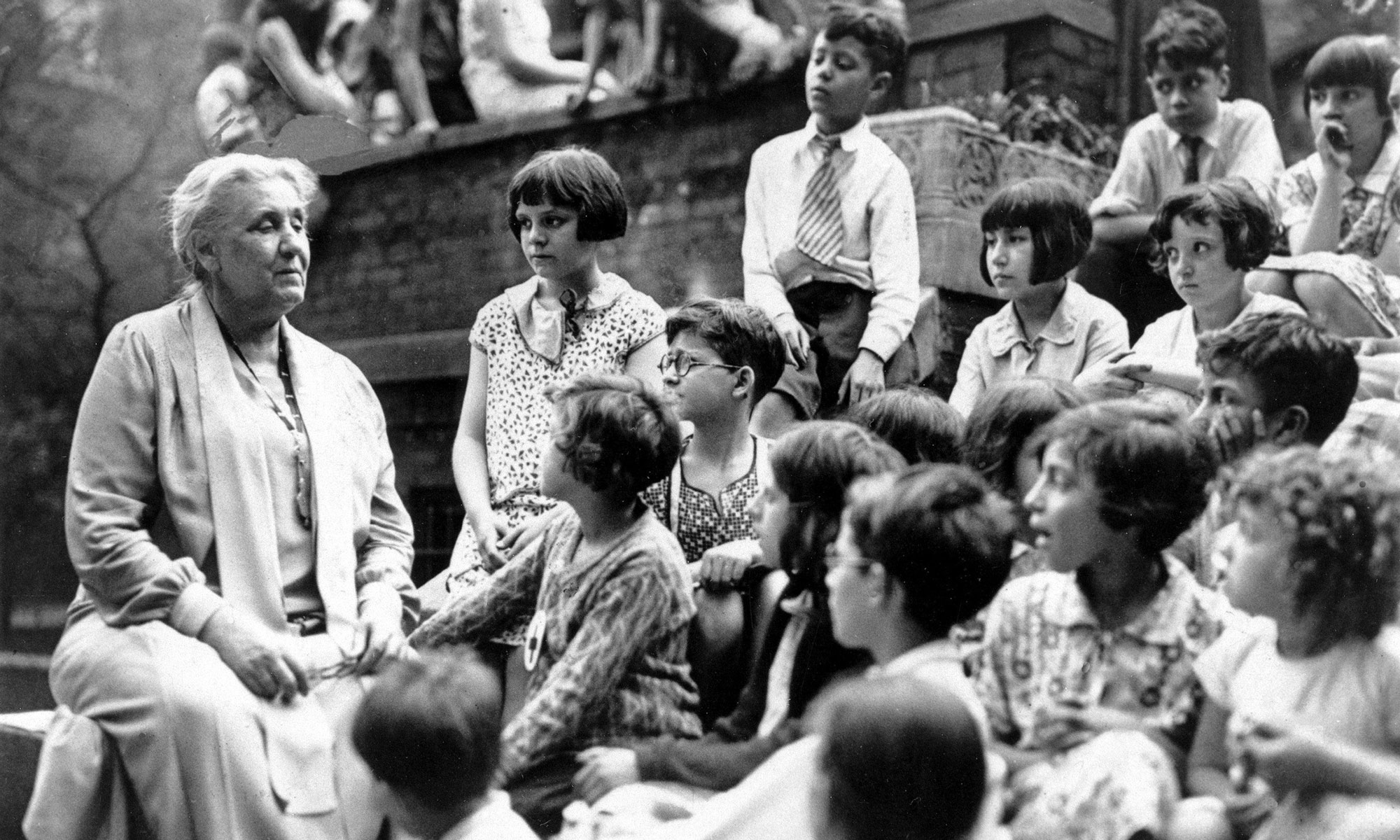
 

ย 

Guest Post: Jane Addams and the Great War

A group of women on a shipโ€™s deck hold a large banner that reads PEACE. Some are labeled, and all are dressed in early 20th-century clothing, wearing hats and flowers, smiling for the photo.

By Neil Lanctot

Book cover featuring sepia-toned portraits of three individuals with glasses. Bold text reads: The Approaching Storm: Roosevelt, Wilson, Addams and Their Clash Over Americaโ€™s Future by Neil Lanctot.The onset of a brutal global war in the summer of 1914 shocked Jane Addams and other American pacifists who were certain their cause was gaining widespread acceptance.ย  “Nobody who was not a mature personโ€ฆcan realize now how remote, how unbelievable, a European war then seemed,” her friend Alice Hamilton later wrote. “Believing as we did then in the slow but sure progress of the human race, we looked forward to nothing worse than sporadic outbursts in such unknown regions as the Balkans or South America, never in the highly civilized countries of the Europe which we knew so well.โ€

For Addams, a war of this scope (โ€œan insane outburst,โ€ she called it) meant โ€œa changed world,โ€ a world where the rising tide of militarism would undermine the cherished progressive social reforms she had tirelessly advocated over the prior two decades.ย ย  โ€œIt will be years before these things are taken up again,โ€ she told a reporter, โ€œThe whole social fabric is tortured and twisted.”

Almost immediately, Addams concluded that the war was likely to be a watershed event in human history and America would have an enormous role to play.ย  ย But military involvement, she believed, was not the answer.ย  Americaโ€™s job, as she saw it, was to find a way to bring the belligerent nations to the peace table, alone or with the assistance of other neutral powers.ย  “The United States,โ€ she observed, โ€œwith all neutral nations, should throw every bit of its power into the scale for peace.”

Her activities to achieve this goal in the months ahead were both remarkable and extensive: leadership of an unprecedented female-run organization โ€“ the Womanโ€™s Peace Party; a fascinating journey through Europe in 1915 meeting with the heads of state of Germany, France, England, and other belligerent powers; and involvement with the โ€œPeace Shipโ€ scheme of the eccentric mogul Henry Ford.ย  But she would pay a price for her pacifism as the war raged on.ย ย  The onetime most beloved woman in the nation, the so-called โ€œAmerican saint,โ€ would find herself viciously criticized for daring to question American foreign policy and the need for a military buildup at home. ย ย Letters and editorials denounced her as an โ€œancient spinster,โ€ a โ€œcrack-brain old creature who ought to be restrained in some institution,โ€ and a โ€œfoolish, garrulous womanโ€ who was โ€œbadly overrated.โ€

Theodore Roosevelt, her old friend and colleague in the Progressive or Bull Moose Party, also soured on Addams.ย  To TR, the nationโ€™s rather modest defenses needed to be drastically strengthened if the United States wished to be a global force for good.ย  ย Any peace efforts at present, he believed, were terribly misguided if not dangerous. As for Miss Addams and her female supporters who had journeyed abroad in 1915 to participate in an international womenโ€™s peace congress, they were a โ€œdisgrace to the women of America.โ€

Rooseveltโ€™s hated enemy, President Woodrow Wilson, appeared more sympathetic.ย  ย Wilsonโ€™s determination to avoid war with Germany despite repeated provocations (most notably the sinking of the Lusitania in May 1915) cheered Addams immensely in the early years of the conflict.ย  He was also willing to keep in regular contact with her, so much so that Addams and other pacifists truly believed they had a real friend in the White House.ย ย  Privately, Wilson was not especially receptive to her constant urging that America should act now to bring about peace.ย  Still, as a skilled politician, he was careful not to show his hand.ย  His advisor and close friend Colonel Edward House well understood the importance of Addams.ย  โ€œHer following,โ€ he admitted in his diary, โ€œis large and influential.โ€

By the fall of 1916, Wilson was finally ready to act.ย  Germany, he knew, was eager to resume unrestricted submarine warfare, even if it meant embroiling the United States in the war.ย ย  Wilsonโ€™s peace move that December, though it accomplished nothing, delighted Addams, as did his โ€œPeace Without Victoryโ€ speech to the Senate a few weeks later.ย ย  But his attitude soon changed once the Germans decided they could wait no longer.ย  Hoping to win the war in 1917, they planned to unleash their submarines to their full potential as of February 1.

To many Americans, the new submarine policy and subsequent diplomatic split with Germany suggested that war was now inevitable.ย  Addams believed otherwise.ย  After all, Wilson had repeatedly told the pacifists he did not want war.ย  โ€œThank God Woodrow Wilson is President,โ€ one enthused.ย  When Addams and her peace colleagues went to see Wilson in late February, she still thought he could be reached.ย  But the President was uninterested in any of their proposals to avoid war and seemed convinced that his own participation in the peace process was absolutely essential.ย  โ€œI found my mind challenging his whole theory of leadership,โ€ Addams later wrote. โ€œWas it a result of my bitter disappointment that I hotly and no doubt unfairly asked myself whether any man had the right to rate his moral leadership so high that he could consider the sacrifice of the lives of thousands of his young countrymen a necessity?โ€

A disillusioned Addams watched Wilson take the country into war a few weeks later.ย  She rejected the popular belief that the war was a necessary evil to achieve a better world or prevent future wars.ย  Nor could she understand why Wilson refused to seriously consider alternatives such as the conference of neutrals or โ€œcontinuous mediationโ€ proposals she had championed.ย  It was, in her nephew James Weber Linnโ€™s words, โ€œthe only defeat that she could not forget.โ€ โ€œIt seemed to me quite obvious,โ€ Addams later wrote, โ€œthat the processes of war would destroy more democratic institutions than he could ever rebuild however much he might declare the purpose of war to be the extension of democracy.โ€

During the years of American involvement, she found herself increasingly outside of the mainstream, now worked into a war-fueled patriotic frenzy. ย Not surprisingly, most Americans were now openly hostile to anything โ€œthat womanโ€ had to say, especially what they interpreted as โ€œpro-German twaddle.โ€ย  The vitriol dissipated somewhat after she began making speeches for the Food Administration, a new agency which emphasized production and conservation of food for the war effort.ย  Still, the American public remained suspicious of her pacifist activities throughout the war and the decade that followed.ย ย  Addams, some still believed, was the โ€œmost dangerous woman in the country.โ€

By the 1930s, when many Americans began to see involvement in World War I as a tragic mistake, Addamsโ€™ pacifist activities no longer seemed so threatening. ย ย Praise and accolades were showered upon her, ranging from selection to Good Housekeepยญingโ€™s list of the twelve โ€œgreatest living womenโ€ in 1931 to the Nobel Peace Prize that same year.ย ย ย  Much to her credit, she never distanced herself from her unpopular wartime stance.ย  ย โ€œWe of course never imagined that we could bring the war in Europe to an end,โ€ she explained to journalist Mark Sullivan in 1933, โ€œbut we did hope that a body of neutrals with no diplomatic power of course, sitting continuously, might be able to make suggestions for peace which would shorten the conflict.โ€

That such proposals had only a slim chance of success during World War I never deterred Jane Addams.ย ย  โ€œShe felt,โ€ her niece Marcet Haldeman later wrote, โ€œthat any gestures, any proposals of a pacific nature were infinitely more sensible than such mass murder.โ€

For more info or to order this new book, see The Approaching Storm‘s publisher’s page.


Fidelity, Accuracy, and the Delicate Balance

A person typing on a laptop at a wooden desk with headphones, handwritten notes, a cup of coffee, and a smartphone nearby.

A documentary editor’s top priority is unwavering accuracy to their collection’s text.

Wait, that doesn’t sound right.

A documentary editor’s goal should be the regularizing of words and writing styles so as to be easily read and searched by a reader.

But that doesn’t sound quite right, either.

These are the two schools of thought that a documentary editor grapples with when deciding on an editing style early in a project’s life. Fidelity: digitally representing an object exactly how it was created. Accuracy: changing characters or words to standardize and correct mistakes for various purposes. Humans are imperfect beings, leading us to make mistakes every so often, but also giving every person their own unique form of expression. But when someone’s written work, along with the imperfections it will undoubtedly have, is being prepared for increased access by being digitized and transcribed, how faithful should we be to their exact pen strokes?

For an example, take this salutation by W. E. B. Du Bois:

A greeting from a letter from W. E. B. Du Bois.
W. E. B. Du Bois to Jane Addams, April 19, 1905.

A common mistake made by over 400 authors in our digital edition so far, Du Bois spells Addams with a single D. In this case, as per our transcription guidelines, an editor would place [brackets] around the misspelled word and correct it. Our practices lean more toward accuracy than fidelity in this case, and would be applied to any incorrectly spelled name or word. After lengthy discussion, we felt this rule would aid with online searches . We also know that the spelling written above is factually wrong, and feel that correcting the mistake lessens confusion with names that may have been spelled 10 different ways across 10 different documents.

But what about another rule we have, concerning abbreviations:

A closing from a letter to Mary Rozet Smith.
Jane Addams to Mary Rozet Smith, August 24, 1906.

Here, in a closing of the letter to Mary Rozet Smith, Addams writes, “Always yrs J. A.” which is exactly as we have transcribed the line. But wait, “yrs” is decidedly not how you spell “yours” in which case it should be bracketed and corrected, right? In this case we are leaving the spelling as is, arguing that expanding and regularizing abbreviated words changes the tone of the writing too intrusively. By leaning more toward fidelity rather than accuracy here, we hope to retain the unique style of writing that an author may have had.

Our transcription guidelines include dozens of rules about how to treat difficult to read texts or irregularities in spelling and punctuation. With each rule, editors hope to keep the delicate balance between fidelity and accuracy in transcriptions. One rule that is visible across the site is the use of brackets. By using brackets around changed words, editors can easily inform readers that something about the text may be different than the original, and by providing an image the reader can quickly check the spot that the change took place.

The bright side to editors working on a digital edition is the ability to easily change project guidelines. If, for some reason, we decide to change any of our rules, it would be entirely possible, though perhaps time consuming. This allows our relationship with our transcriptions to continue to grow as our editors develop a deeper connection with our texts.

This blog post was inspired by Ben Brumfield’s blog post “The Transcription Quality Balancing Act”.

For further examples of different transcription practices, see the National Archives’ Transcription Tips and Family Search’s “How should I index incorrect records?”

— Victoria Sciancalepore, Assistant Editor

Guest Post: Jane Addamsโ€™ Pragmatist Theories of Democracy and Education

A black-and-white photo of a large group of men and one woman seated at tables in a formal setting, possibly a classroom or meeting room, with papers and books in front of them.

This is a guest post, written by Parysa Mostajir, a Teaching Fellow in Conceptual and Historical Studies of Science at the University of Chicago. She is currently researching the role of experience in diverse human practices like science, art, and democracy, and setting up an academic blog, Woman is a Rational Animal,ย dedicated to diversifying syllabi in the history of ideas.


Jane Addams is deservedly well-known for her tireless activism, having spent her life engaged in efforts to improve her society: She served on the boards of national and international organizations like the International Association for Labor Legislation, she campaigned for the rights of women, children, and workers, and she offered educational, recreational, and organizational resources to the immigrant communities surrounding Hull House. Although she spent most of her time in the world of action rather than the world of ideas, fewer people (including philosophers) give Jane Addams due credit for her role in developing a philosophical movement called โ€˜pragmatism.โ€™

A man with glasses and a mustache sits in an armchair, holding a stack of papers on his lap. He rests his head on one hand, and a tall statue is visible behind him. The scene appears to be from an old photograph or painting.
John Dewey (Wikimedia Commons)

Jane Addams was admired by some of the most celebrated pragmatist philosophers of her time, including John Dewey, George Herbert Mead, and William James. The correspondence of these professors at the University of Chicago and Harvard University, show that they recognized Addams as an imposing intellect from whom they had much to learn. In a 1908 letter on the Jane Addams Paper Project Digital Edition, George Herbert Mead describes โ€œhow deep an impressionโ€ Addamsโ€™ speech on โ€˜War and Progressโ€™ made on him and others in the audience. In a 1902 letter, William James describes Addamsโ€™ Democracy and Social Ethics as โ€œone of the great books of our timeโ€ and claims he โ€œlearned a lotโ€ from it. Deweyโ€™s correspondence reveals years of extensive visits and engagements with Hull House, during which he exchanged ideas with Jane Addams, the latter of whom he described as โ€œthe most magnificent exhibition of intellectual & moral faith I ever sawโ€ [1894.10.10 (00206): John Dewey to Alice Chipman Dewey]. He even attributed to Addams the first definite statement of the pragmatist thesis โ€œthat democracy means certain types of experience,โ€”an interest in experience in its various forms and typesโ€ [Volume 1: Political Philosophy, Logic, Ethics p. 2379].

An older woman in a dress sits outdoors on a ledge, surrounded by a group of children who are listening attentively. Other children sit in the background on a brick wall. The image is in black and white.
Jane Addams with Hull House children (ca. 1930)

So what is pragmatism, and how does Jane Addamsโ€™ work fit in? Pragmatism is a tradition of philosophy that began in the United States in the late 19th century and was characterized by several core beliefs to do with action and experience. Addamsโ€™ major contributions to the tradition of pragmatism were her theories of democracy and education, which contained substantial developments on these core principles of pragmatist philosophy. Pragmatists believed that knowledge and theories should be based on our practical experiences, and be constructed in such a way as to take our practical experiences into account. Most striking about Addamsโ€™ writings in philosophy is the extent to which she adhered to the pragmatist conviction that knowledge and theories should be consistent with practice. While other pragmatists were involved in practical applications of their theories, such as John Deweyโ€™s founding of the Laboratory School in Chicago, none of them were quite so embedded in everyday society as Jane Addams was at Hull House. Addamsโ€™ theories were derived from her practical activities at Hull House, instead of becoming lost in philosophical speculation. It was appropriate and inevitable, she wrote, that her experiences at Hull House would affect her convictions (Twenty Years, p. 308).

Pragmatists believed not only that theories should be derived from practical experiences, but that they should be applied to practical experiences in attempts to improve, enrich, and make sense of our lives. Unlike many contemporary philosophers who engaged in highly abstract theories having no relationship to the everyday world, pragmatists believed that theories gained their value by serving as instruments for empowering us to successfully take action in the worldโ€”this is the practical aspect of โ€˜pragmatism,โ€™ from which the tradition derives its name. As a pragmatist, Jane Addams therefore rejected the idea, popular among sociologists of her time, that settlements like Hull House were โ€˜laboratoriesโ€™ from which to derive pure theory (Deegan 1988, pp. 34-5; Twenty Years, p. 308). She wrote that her energies were directed โ€œnot towards sociological investigation, but to constructive workโ€ (Hull House Maps and Papers, pp. vii-viii). Her pragmatist goal was to use the knowledge she gained from her experiences at Hull House in the application of practical changes and improvements to society and the lives of the people she served, not to derive knowledge for its own sake or out of pure curiosity.

These core pragmatist convictions concerning knowledge, practice, and experience are evident in Addamsโ€™ theories of democracy and education. To begin with her theory of democracy, Addams did not believe that democracy was a matter of ticking a ballot box once every few years. In her celebrated book on Democracy and Social Ethics, she argued that democracy was not just โ€œa sentimentโ€ or โ€œa creed,โ€ but โ€œa rule of living,โ€ which needed to be integrated practically with peopleโ€™s everyday lives (Democracy and Social Ethics, p. 6). Many failures of contemporary democracy, she claimed, could be linked to the isolation of different sectors of society from each other, preventing familiarity with each otherโ€™s experiences. In order to resolve them and make our democracy more robust, we needed to ensure the connectedness of diverse types of people who shared the same society. For that reason, democracy could not be compartmentalized as a handful of remote political institutions, with the citizensโ€™ democratic participation reduced to a single act of casting a vote. Democracy had to be an active practice for all citizens, embedded in their lived experience as a way of life. This would only be achieved by โ€œmixingโ€ the diverse members of society together and giving them โ€œa wider acquaintance with and participation in the life about themโ€ (Democracy and Social Ethics, p. 5). Addams argued that it was through exposure to the different ways of life, struggles, and needs of the many people with whom we share our society that we can develop attitudes of sympathy, respect, and a democratic sense of moral obligation towards each other. For example, she mentioned the importance of newspaper and literature in giving people the chance โ€œto know all kinds of lifeโ€ (Democracy and Social Ethics, p. 8). This kind of โ€œdiversified human experience and resultant sympathyโ€ were, for Addams, โ€œthe foundation and guarantee of Democracyโ€ (Democracy and Social Ethics, p. 7).
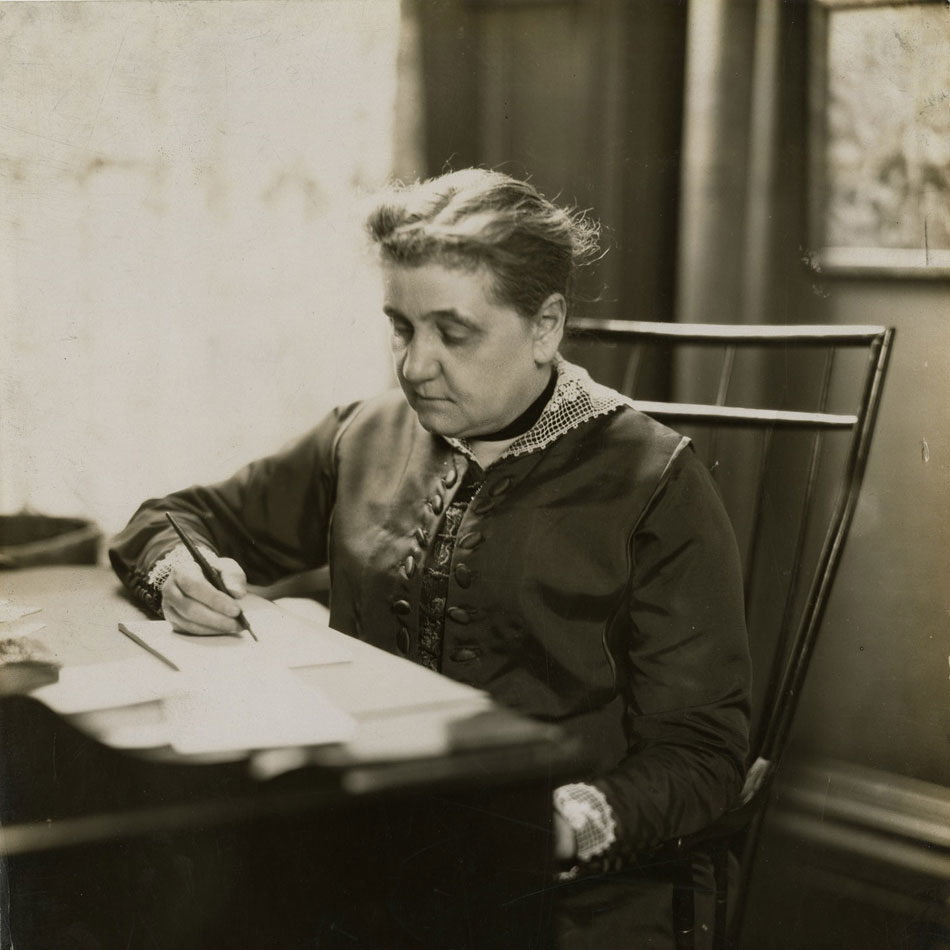
Black and white scanned page titled A Modern Lear by Jane Addams, featuring an image of Pullman buildings before the 1894 strike, with decorative initials and text discussing the social climate in Chicago in 1894.
Jane Addams described her views of the Pullman Strike in her 1912 article, A Modern Lear.”

As a true pragmatist, concerned with the connection between theory and action, Addams based her theory of democracy on what she encountered in her practical experiences, and applied her theory of democracy to suggest resolutions to the problems she encountered. For example, Addams was involved in mediating the 1894 Pullman Strike in Chicago, in which the workers of a large factory went on strike to demand better wages. What Jane Addams saw in this conflict was a failure of the democratic practice of connecting with the experiences of others. Pullman, the owner of the factory, had built a town for the use of his factory employees, with parks and recreational facilities, believing that he was acting generously. The factory workers, on the other hand, resented the extension of Pullmanโ€™s control into the private lives. When the workers went on strike, Pullman was confused by their anger, and he felt that the factory workers were being ungrateful for the resources he had given them. In her philosophical work, Democracy and Social Ethics, Addams wrote that the โ€œgood deedsโ€ Pullman thought he was conducting were in fact incomplete, because they were not conducted democratically. By not โ€œcalling upon the workmen either for self-expression or self-government,โ€ he ended up lacking any familiarity with the experiences and desires of the workers (Democracy and Social Ethics, p. 143-4), and had operated undemocratically in making his decisions. โ€œTo attempt to attain a social morality,โ€ Addams wrote, โ€œwithout a basis of democratic experience results in the loss of the only possible corrective and guideโ€ for actionsโ€”the daily experiences of other human beings (Democracy and Social Ethics, p. 176).
Addamsโ€™ theory of education was also deeply pragmatist in its commitment to connecting educational experiences to the practices and experiences of the individuals being educated. At that time, it was common for people to assume that manual laborers had no need of general education. When education was sometimes offered as part of universitiesโ€™ charitable effortsโ€”for example, University Extension Programs which sent professors to give general courses to the working class on topics like evolution, astronomy, psychology (Twenty Years, Chapter XVIII), or philanthropists who supported children in receiving clerical educationโ€”the idea was that such education either gave laborers a temporary mental escape from the mundanity of their work, or gave them the opportunity to leave their lives as factory workers and enter into more respected professions. Such educators did not consider education as having any possible genuine connection to the ordinary lives of factory workers.

A black-and-white photo of a large group of men and one woman sitting at tables in a formal classroom or meeting room, looking toward the camera, with books and papers on the tables.
Hull House class on immigration, held at the Coffee House, 1920s (Wallace Kirkland, Jane Addams Memorial Collection, University of Illinois at Chicago)

Addams, unsurprisingly, rejected these assumptions. Her pragmatist theory of education was based on extensive practical experience providing educational resources to the working-class neighborhood surrounding Hull House. In Democracy and Social Ethics, she insisted that factory workers could, and should, be provided with education on topics like history and economics which directly connected to their everyday practical experiences. Because of the division of labor, industrial workers spent most of their waking life operating machinery and manufacturing products to which they had no connection. They had no opportunities to understand the history of the invention and development of the machines they operated; they did not know the uses to which the products were put; and they did not understand the sales and distribution aspects of the businesses they worked for. Addams argued that this contributed to the poor quality of life of industrial laborers, and that education in how they fit into the workings of society would help to improve and enrich their daily experiences of manual labor. If educators, the state, and business owners were to take the value of their employees seriously, they needed to provide them with opportunities to connect their own experiences with the wider social, economic, and historical processes of which their manual labor was an important part. Such education would allow workers to make sense of the significance, purpose, and utility of their work, and would positively alter their sense of self, and their estimation of their own worth. In this way, education could be used not as an escape (either as temporary mental relief from monotony, or as an opportunity to move into a different line of work), but as a way of connecting to the ordinary lives of factory workers in such a way as to improve, enrich, and make sense of their everyday practical experience.

Sepia-toned portrait of Jane Addams, circa 1910, showing her with short, wavy hair, a serious expression, and wearing a high-collared dress. Text in the bottom right corner reads, Jane Addams, ca. 1910.
Jane Addams, ca. 1910

Amidst her extensive social, political, and community work, Addams found time to write several books threaded with innovative philosophical ideas and play a key role in establishing the new, pragmatist philosophical tradition in the United Statesโ€”a tradition which was characterized by its beliefs in the importance of connecting knowledge with action, enriching individual experience, and solving social problems. Because Addams had so much experience taking action in the world, her philosophical writings are, more than any other pragmatist, threaded with connections to social, political, and economic problems, and filled with practical suggestions for how to ameliorate those problems. She remains one of the greatest examples of how our philosophical ideas can impact the practical approach we take to politics, economics, and culture, and how politics, economics, and culture can influence the development of ideas. In a time like ours, when universities are highly specialized and losing touch with the needs of wider society, we can look to Addams as a model public philosopher, who put her theories into action and let her real-life experiences guide her theories.

References:

Addams, Jane. Democracy and Social Ethics. New York, London: The Macmillan Company, 1907.

Addams, Jane. Twenty Years At Hull-house: With Autobiographical Notes. New York: The Macmillan Company, 1911.

Deegan, Mary Jo. Jane Addams and the Men of the Chicago School, 1892-1918. New Brunswick: Transaction Books, 1988.

Dewey, John. Lectures, Volume 1: Political Philosophy, Logic, Ethics. Ed. Koch, Donald F., and The Center for Dewey Studies, 2016.

Each for Equal: International Women’s Day 2020

A group of six women in early 1900s attire stand on a cobblestone street holding signs and a banner advocating for womens suffrage, with buildings and a car in the background.

Each for Equal

This year’s International Women’s Day theme is #EachforEqual; an equal world is an enabled world. There are many women we could discuss today: Jane Addams, of course, for her work in the immigrant communities of Chicago, among many other areas she championed in the name of equality. Carrie Chapman Catt, who heavily campaigned for women’s suffrage rights. Lillian D. Wald, who taught women valuable skills out of the Henry Street Settlement. And Emily Greene Balch, a staunch supporter of peace as a central leader in the Women’s International League for Peace and Freedom. But there is, I believe, a group of women whom we often forget to include when discussing Addams, especially her work for peace — the women who aided Addams outside the United States.

It is easy to forget that many of Addams’s contemporaries were

A group of six women in early 1900s attire stand on a cobblestone street holding signs and a banner advocating for womens suffrage, with buildings and a car in the background.
Vereeniging voor Vrouwenkiesrecht (Society for Women’s Suffrage) Officers, 1914. Aletta Henriรซtte Jacobs, third from left.

located outside the United States. Dr. Aletta Henriรซtte Jacobs, a Dutch physician and suffrage activist, had multiple achievements to her name, including her life-long struggle for women’s equality. Jacobs was the first woman to attend a Dutch university, inspired by her father, physician Abraham Jacobs. Jacobs became a pharmacy assistant, continuing on to University of Groningen. In 1879, Jacobs set up a practice in Amsterdam, offering free appointments to poor residents, struggling to maintain large families. In a controversial move, in 1882 Jacobs offered birth control advice at her clinic, the first clinic ever to do so in the world. She paved the way for Dutch women to seek an education outside finishing school, and control the size of their families, lowering the infant mortality rate and improving women’s health in the process.

Chrystal Macmillan was a British pioneer, one of the first woman to graduate from the University Edinburgh in 1896 then finishing her studies in Berlin and Edinburgh. MacMillan fought for women’s rights at Edinburgh University. When World War I began, Macmillan threw her energies into providing food for Belgian refugees. Her staunch pacifist views made her a leader in

the English movement against war, and brought her into the international drive to end war. Macmillan was one of only three British women who attended the 1915 International Congress of Women and throughout the war worked for peace and a negotiated settlement. In March of 1919, Macmillan attempted to lessen the surrender terms to be implemented for Germany in the Treaty of Versailles, but no changes were made. Chrystal Macmillan dedicated her life to the equality and fair treatment of women and oppressed peoples, regardless of their country of origin.

A group of women sit at a long table covered with a cloth and flowers, with large palm plants behind them, suggesting a formal gathering or conference.
International Congress of Women, 1915. Library of the London School of Economics and Political Science

Rosika Schwimmer, a Jewish-Hungarian activist, was a powerhouse in the peace movement; her unswerving belief in peace and women’s equality were seen by some as abrasive and they found her difficult to work with. Before becoming a peace activist, Schwimmer worked as a governess, and bookkeeper, a correspondence clerk, and finally became president of the Nล‘tisztviselล‘k Orszรกgos Egyesรผlete (National Association of Women Office Workers), in 1901. After an international mentorship with American suffragist Carrie Chapman Catt, Schwimmer returned to Hungary, founding the Hungarian Feministรกk Egyesรผlete (Feminist Association). Their goals included equality for women in education, employment, and healthcare. Schwimmer was a driving force in the efforts to stop World War I. She convinced Henry Ford to mount a peace mission in 1915, and attended meetings to the Women’s Peace Party and the International Congress of Women in 1915. Schwimmer fought against anti-Semitism and sexism during the early twentieth century to secure better living conditions for Hungarian women and beyond.

With so much history right here in the United States, it’s easy to push international affairs out of our minds, preferring to learn about our own country’s struggles. But, as Jane Addams and her contemporaries have shown, the fight for equality for women encompasses is an international fight and women need to keep working until equality has been secured for all. As Addams wrote: “The good we secure for ourselves is precarious and uncertain until it is secured for all of us and incorporated into our common life.” This International Women’s Day, we remember the women working abroad for the equality of women worldwide.

— Victoria Sciancalepore, Assistant Editor

Further Reading:

International Women’s Day 2020 #EachforEqual

Women in Medicine: An Encyclopedia, Laura Lynn Windsor

Women at the Hague: The International Congress of Women and its Results; Jane Addams, Emily Greene Balch, Alice Hamilton

Rosika Schwimmer, SNAC


Guest Post: Striving for Social Justice: Jane Addams and Sophonisba Breckinridge

Sepia-toned portrait of a woman with light-colored, wavy hair styled back, wearing a high-collared patterned blouse, and looking slightly to the side with a neutral expression.

Book cover for Sophonisba Breckinridge: Championing Womenโ€™s Activism in Modern America by Anya Jabour, featuring a portrait of Breckinridge over a vintage newspaper background and a photo of a womenโ€™s march.

By Anya Jabour, Regents Professor of History, University of Montana

The subject of my new book, Sophonisba Breckinridge: Championing Womenโ€™s Activism in Modern America, worked closely with Jane Addams for decades. The two women, along with other reformers affiliated with Hull House, championed labor legislation, provided services to immigrants, promoted woman suffrage, and advocated for world peace. Together, they were a powerful force for social justice.

Born and raised in Kentucky, Breckinridge came to Chicago to pursue higher education at the coeducational University of Chicago. After earning her M.A. (1897) and Ph.D. (1901) in political science, she graduated with her J.D. (1904) at the top of the Law Schoolโ€™s first graduating class.ย  After completing her coursework, Breckinridge taught a pioneering course on โ€œThe Legal and Economic Position of Womenโ€ that brought her into contact with the Second Cityโ€™s labor organizers and social reformers.

Breckinridgeโ€™s concern about the plight of working women initiated her long association with Hull House and its head resident, Jane Addams. In 1905, at Addamsโ€™s suggestion, she accepted an appointment as Inspector of Yards, investigating the working conditions of women in Chicagoโ€™s infamous stockyard district. Breckinridge spent more than four months inspecting the facilities and interviewing the employees of โ€œPackingtown,โ€ mostly immigrant girls and young women between the ages of 16 and 22.ย  Working in cold, windowless rooms and standing on โ€œdirty, blood-soaked, rotting wooden floorsโ€ for ten hours a day, the workers โ€œtoil[ed] without relief in a humid atmosphere heavy with the odors of rotten wood, decayed meats, stinking offal,โ€ and human waste from the doorless privies that vented directly into the workrooms.ย  Breckinridge found her task exhausting, both physically and emotionally.ย  To Addams, she confessed, โ€œI was getting where I could not sleepโ€”the vision of the dayโ€™s work presses in so!ย  Not my own dayโ€™s workโ€”but that of the crews of girls I see marching past me now.โ€

Breckinridge translated her emotional response to women workersโ€™ abysmal working conditions into social scientific scholarship and policy recommendations. In addition to publishing her study on women workers in the stockyards, she reported her findings to the U.S. Labor Department. With the support of settlement house workers, clubwomen, and trade unionists, she helped persuade the department to provide funding for a full-scale investigation. Ultimately, the nineteen-volume report on the working conditions of wage-earning women and children, published between 1910 and 1913, provided the basis for the establishment of two new federal bureaus, the U.S. Childrenโ€™s Bureau and the U.S. Womenโ€™s Bureau.ย  These government agencies would advocate for a ban on child labor and better working conditions for women for decades to come.

Two women in long dresses stand on an ivy-covered buildingโ€™s porch, surrounded by plants. In the background, a large church or university tower is visible across a lawn. The photo is black and white.
Breckinridge (right) with Julia Clifford Lathrop (left) University of Chicago Photographic Archive, [apf1-02244], Special Collections Research Center, University of Chicago Library.
Breckinridgeโ€™s work with Addams on behalf of working women soon led to an invitation to live and work at Hull House. As Russell Ballard, one of the few male residents of Hull House, expressed it, โ€œa brilliant company of women were drawn to the settlement to pioneer in the promotion of social change. The scholarly and talented Sophonisba Breckinridge joined the company in 1907 to become one of Miss Addamsโ€™ closest friends and most helpful associates.โ€ Although her responsibilities at the University of Chicago prevented her from living at Hull House full-time, Breckinridge spent all of her vacation quartersโ€”and much of her limited free timeโ€”at Hull-House, where she was listed as an official โ€œresidentโ€ from 1907 until 1921.

Breckinridge became one of Addamsโ€™s closest colleagues. She helped to raise funds for the settlement, served as a substitute speaker when Addams was unavailable, and assisted Addams with her correspondence.ย  Breckinridgeโ€™s papers are filled with hastily scrawled notes from Addams, invariably beginning with the exclamatory greeting โ€œDear Lady!โ€ and closing, โ€œHastily yours, Jane Addams.โ€ In response to such letters, Breckinridge assisted Addams in innumerable ways, both large and small, leading Addams to close one typical letter asking Breckinridge to perform a task, โ€œI do hope that I am not putting too many things โ€˜offโ€™ on you.โ€ Breckinridge always came through for Addams, signing one letter, โ€œYours to command always.โ€

Soon after Breckinridge took up residence at Hull House, she joined a special committee investigating the conditions confronting young single immigrant women who arrived in the city, lost and alone and vulnerable to both sexual and economic exploitation.ย  A typical case was that of Bozena, โ€œa nice young Bohemian immigrant girlโ€ who was โ€œso eager for work . . . that she had taken the first job she could findโ€”in a saloon.โ€ย  As fellow Hull House resident Edith Abbott, Breckinridgeโ€™s colleague at the University of Chicago, explained: โ€œThe saloonkeeper had abused her shamefully and then turned her out when he found that she was to become the mother of his illegitimate child.โ€

Hull House residents helped Bozena file charges, obtain childcare, learn English, gain citizenship, and find work. But Breckinridge and Addams soon realized that the problem of โ€œlost immigrant girlsโ€โ€”as well as the difficulties confronting immigrant men and childrenโ€”was too widespread for existing service agencies to address.ย  As Addams explained the problem:

Every year we have heard of girls who did not arrive when their families expected them, and although their parents frantically met one train after another, the ultimate fate of the girls could never be discovered; we have constantly seen the exploitation of the newly arrived immigrant by his shrewd countrymen in league with the unscrupulous American; from time to time we have known children detained in New York and even deported whose parents had no clear understanding of the difficulty.

With Addamsโ€™s enthusiastic support, Breckinridge proposed the creation of a new organization, and the Immigrantsโ€™ Protective League was established in 1908.ย  As Abbott recalled: โ€œThis problem of the unaccompanied girls proved to be challenging; but nothing that ought to be done seemed impossible to Miss Breckinridge!โ€

A woman in academic regalia stands on stone steps in front of a large wooden door, with ivy-covered walls in the background. She wears a long robe with dark stripes on the sleeves and a cap.
Breckinridge at Green Hall at the University of Chicago. (Courtesy of University of Chicago Photographic Archive, [apf1-02252], Special Collections Research Center, University of Chicago Library.)
The Immigrantsโ€™ Protective League provided essential assistance to Chicagoโ€™s immigrantsโ€”women, men, and children. One of the Leagueโ€™s first major accomplishments was establishing โ€œa kind of immigration stationโ€ to welcome new arrivals.ย  Immigrants who arrived in Chicago by train met with League agentsโ€”chosen to represent the nationalities and speak the languages of their clientsโ€” who helped orient newcomers to the city.ย  Agents provided new arrivals with information about employment opportunities, social services, and evening classes. One of the principal goals of the League was to protect immigrants from exploitation.ย  At the welcome station, agents helped new arrivals steer clear of unscrupulous cab drivers, fraudulent employment agents, and the ever-present โ€œcadetsโ€ who recruited young women into prostitution.ย  Breckinridge also persuaded local womenโ€™s clubs to provide funds for the League to provide temporary lodging for young immigrant women.ย  In only four years, the League served close to 80,000 immigrants at its welcome station.

Breckinridge and Addams continued to team up to advance social reform. In 1911, they were elected vice-presidents of the National American Woman Suffrage Association (NAWSA). Under their leadership, the Second City quickly became a โ€œstronghold for the cause.โ€ However, internal dissension caused both women to dread meetings of the national board, which Addams compared to being immersed in โ€œboiling oil.โ€

Tensions came to a head in Fall 1912, when Breckinridge and Addams, in defiance of the suffrage organizationโ€™s traditional commitment to non-partisanship, declared their support for Progressive Party presidential candidate Theodore Roosevelt. Addams, Breckinridge, and other activists not only convinced the third-party candidate to support woman suffrage, but also helped to shape the Progressive Partyโ€™s agenda. The third-party platform, known as the โ€œContract with the People,โ€ was modeled on the โ€œPlatform of Industrial Minimumsโ€ adopted at the 1912 National Conference of Charities and Corrections, where both Breckinridge and Addams played prominent roles. The platform included demands for a โ€œliving wage,โ€ unemployment insurance, and workersโ€™ compensation for all workers, as well as special protections for women and children in the workforce.

However, Breckinridge and Addams failed to convince NAWSA leadership that the suffrage movement should use party politics to promote either womenโ€™s rights or social welfare. Instead, president Anna Howard Shaw publicly denounced โ€œparty ties.โ€ This uncomfortable situation led both Addams and Breckinridge to resign their posts after only a year in office.

Although they remained active in the suffrage movement, after leaving office, Breckinridge and Adams shifted their focus away from NAWSA and toward the Woman’s Peace Party, which they co-founded in 1915 in response to armed conflict in Europeโ€”what would later become known as World War I. The Womanโ€™s Peace Party was the first U.S. pacifist group to treat โ€œpeace as a womenโ€™s issue.โ€ Many members believed that women had a special responsibility to protect life and thus to prevent war. The party preamble and platform called on women, as โ€œthe mother half of humanity,โ€ to oppose the โ€œreckless destructionโ€ of human life resulting from warfare.ย  At the same time that they emphasized womenโ€™s special responsibility for peace work, feminist pacifists also demanded equal political rights for women.ย  Believing that womenโ€™s full participation in the political process was essential to ending global conflict, members of the Womanโ€™s Peace Party worked for both womenโ€™s rights and world peace.

As chairperson and treasurer of the Womanโ€™s Peace Party, respectively, Addams and Breckinridge represented the new organization at an international feminist-pacifist gathering known as the International Congress of Women and held at The Hague in 1915. The Congress enthusiastically adopted many of the measures proposed by the U.S. representatives, calling for the creation of an international peacekeeping body, national self-determination for all countries, and equal political participation for women. Following the Congress, two delegations visited political and religious leaders of both neutral and belligerent nations.ย  When Addams, who participated in the visits, returned home, she did so as the first president of the new International Committee of Women for Permanent Peace.

Addams, Breckinridge, and other members of the Womanโ€™s Peace Party took the lead in attempts to find a peaceful solution to the ongoing war.ย  After Addams returned to the United States, she and Breckinridge worked with both male and female pacifists in Chicago and New York to pressure President Woodrow Wilson to intervene in the European conflict as a neutral intermediary. Addams hand-picked Breckinridge for a special committee assigned to consult with other pacifists within and beyond the U.S. on strategies to โ€œmake propositions to the belligerenets [sic] in the spirit of constructive internationalism.โ€

Throughout the war, Addams, Breckinridge, and other members of the Womanโ€™s Peace Party pressured President Wilson to intervene in the war to produce a โ€œnegotiated peace.โ€ Wilson had made initial overtures in this direction at the warโ€™s outset, but his offer was rebuffed. Thereafter, Wilson adopted a pose of watchful waiting.ย  Although he steadfastly maintained his intention to offer mediation when the time seemed propitious, that time never arrived. However, Wilsonโ€™s willingness to meet with pacifist delegations, his cordial relationship with Addams, and his assurances that he considered the womenโ€™s proposals at The Hague โ€œby far the best formulationโ€ for world peace, encouraged the pacifist women to continue their efforts.


A black and white photo of a large group of women in early 20th-century attire, many wearing hats and coats, gathered on the steps outside a brick building for a formal group portrait.
Addams and Breckinridge co-founded the Woman’s Peace Party, later to become the U.S. chapter of the Women’s International League for Peace and Freedom, in 1915. (Courtesy Women’s International League for Peace and Freedom Collection, Special Collections, University of Illinois at Chicago Library)

Addams and Breckinridge continued their search for ways to prevent U.S. entry into the conflict, to end the war, and to prevent future wars. In the aftermath of the Lusitania episode, they urged President Wilson to steer clear of what they called โ€œa preposterous โ€˜preparednessโ€™ against hypothetical dangersโ€ and instead to provide โ€œthe epochal service which this world crisis offers for the establishment of permanent peaceโ€โ€”that is, to offer his services to mediate the ongoing conflict. Subsequently, they appeared before the U.S. House of Representativesโ€™ Committee of Foreign Affairs to express their support for a House Joint Resolution proposal to establish a โ€œCommission for Enduring Peace.โ€

A group of women in early 20th-century clothing stands on a wooden deck, holding a large banner reading PEACE. Some wear hats with plumes, and ship structures are visible in the background.
The U.S. delegation to the International Congress of Women in 1915 on board the Noordam. Jane Addams in center behind the banner, Breckinridge is on the far right. (Courtesy Swarthmore College Peace Collection)

Despite their best efforts, American pacifists were unable either to halt the ongoing war or to prevent the United Statesโ€™ entry into it.ย  Once hostilities ceased, Breckinridge and Addamsโ€”now part of the Womenโ€™s International League for Peace and Freedomโ€”sought new routes to โ€œenduring peace.โ€ They achieved a partial victory in the establishment of the League of Nations, which incorporated many of the principles adopted at the International Congress of Women. Although the U.S. failed to join the new organization, Addams and Breckinridge persisted in promoting their vision of a peaceful postwar world.ย  In 1923, they discussed submitting โ€œourโ€ set of principles for the American Peace Award.ย  The plan that Breckinridge and Addams proposed called for the United States to join the World Court and the League of Nations. They also demanded that the U.S. military refrain from defending the interests of private businesses abroad, that the U.S. end both the production and the sale of armaments, and that the U.S. cooperate with other nations in a process of universal disarmament.ย  Finally, they recommended โ€œcancelling or reducing debts due to the United Statesโ€ from the other Allied countries in return for an agreement to โ€œdivide the costs of commissions hitherto charged against Germany alone equally between Germany and the former alliesโ€ and offering โ€œa long moratorium to Germanyโ€ to allow that nation โ€œeventually to pay the balance on her reparations debt as estimated by an impartial commission of experts to be constituted for the purpose.โ€ Addamsโ€™s and Breckinridgeโ€™s joint plan thus called for the United States to promote peace not only by agreeing to abide by arbitration in future disputes and participating in a process of universal disarmament, but also by removing the reasons for rising resentment in Germany that would soon allow Adolf Hitler to rise to power. Sadly, their plan was never implemented. Nonetheless, in the years after the Second World War, many of their ideas would be adopted by the United Nations.

Addams and Breckinridge were not always fully successful in their efforts to promote social justice, but they shared a passion for justice that allowed them to persist in the face of difficulties and setbacks. Their collaboration with one another and with fellow reformers also enabled them to meet challenges with strong resolve and good cheer. Together, Addams and Breckinridge were a powerful force for social justice.

Coda: Because Breckinridgeโ€™s own papers, while extensive, are comparatively scant for the Progressive Era, to conduct my research on these decades of her life, I relied heavily on the 82-reel microfilmed edition of the Jane Addams Papers and the accompanying โ€œPink Bible,โ€ the 674-page guide to the microfilm collection, created with the guidance of Jane Addams Papers Project founder Mary Lynn Bryan. I am delighted that future researchersโ€™ work will be facilitated by the next generation of the Jane Addams Paper Project, spearheaded by Cathy Moran Hajo, which will make the Jane Addams Papers accessible in a digital format.


Anya Jabour is Regents Professor of History at the University of Montana. Her books include Topsy-Turvy: How the Civil War Turned the World Upside Down for Southern Children and Scarlett’s Sisters: Young Women in the Old South

Sources:

Abbott, Edith, and Breckinridge, Sophonisba P. โ€œWomen in Industry: The Chicago Stockyards,โ€ Journal of Political Economy, Vol. 19, No. 8 (October 1911), 632-654.

Addams, Jane. “Woman’s Suffrage and the Progressive Party,” Chicago Tribune, October 28, 1912, pg. 9.

Addams, Jane, Balch, Emily G., and Hamilton, Alice. Women at the Hague: The International Congress of Women and Its Results (New York: Macmillan Company, 1915).

Alonso, Harriet Hyman. Peace as a Womenโ€™s Issue: A History of the U.S. Movement for World Peace and Womenโ€™s Rights (Syracuse, NY: Syracuse University Press, 1993).

Ballard, Russell. โ€œThe Years at Hull House,โ€ Social Service Review, Vol. 22, No. 4 (Dec. 1948), 432-433.

Brush, Mary Isabel. โ€œSociety Leaders Will Promote Suffrage Cause in Chicagoโ€™s Fashionable Circles: National Association to Open Branch,โ€ Chicago Daily Tribune, December 24, 1911, pg. 13.

Bryan, Mary Lynn McCree, et al., eds., The Jane Addams Papers: A Comprehensive Guide (Bloomington: Indiana University Press, 1996)

Buroker, Robert L. โ€œFrom Voluntary Association to Welfare State: The Illinois Immigrantsโ€™ Protective League, 1908-1926,โ€ Journal of American History, Vol. 58, No. 3 (December 1971), 643-660.

โ€œCharity Honors for Chicago,โ€ Chicago Tribune, June 20, 1912, pg. 13.

Commission for Enduring Peace: Hearing Before the Committee on Foreign Affairs, House of Representatives, Sixty-Fourth Congress, First Session, on H.R. 6921 and H.J. Res. 32, Statement of Miss Jane Addams and Others, January 11, 1916 (Washington, D.C.: Government Printing Office, 1916),10-12.

โ€œConditions in Stockyards Described in the Neill-Reynolds Report,โ€ Chicago Tribune, June 5, 1906, pg. 4

Costin, Lela B. โ€œFeminism, Pacifism, Internationalism, and the 1915 International Congress of Women,โ€ Womenโ€™s Studies International Forum, Vol. 5, No. 3-4 (1982), 300-315.

Gonzalez, Suronda. โ€œComplicating Citizenship: Grace Abbott and the Immigrantsโ€™ Protective League, 1908-1921,โ€ Michigan Historical Review, Vol. 24, No. 2 (Fall 1998), 56-75.

Hull House Collection, Special Collections, Richard J. Daley Library, University of Illinois at Chicago, Chicago, Illinois.

Jane Addams Papers, 1860-1960 (microfilm edition).

Leonard, Henry B. โ€œThe Immigrantsโ€™ Protective League of Chicago, 1908-1921,โ€ Journal of the Illinois State Historical Society, Vol. 66, No. 3 (Autumn 1973), 271-284.

“Meet of Suffrage Chiefs: Chicago Women to Attend Executive Committee Session Today: Officers Will Be Chosen: Members Enthusiastic in Praise of the Progressive Party,” Chicago Tribune, October 1, 1912, pg. 5.

Patterson, David S. The Search for a Negotiated Peace: Womenโ€™s Activism and Citizen Diplomacy in World War I (New York: Routledge, 2008).

Records of the Immigrants Protective League, Special Collections, Richard J. Daley Library, University of Illinois at Chicago, Chicago, Illinois.

Sophonisba Preston Breckinridge Papers (microfilm), Breckinridge Family Papers, Library of Congress, Washington, D.C.

Sorensen, John, ed., A Sisterโ€™s Memories: The Life and Work of Grace Abbott, From the Writings of Her Sister, Edith Abbott (Chicago and London: University of Chicago Press, 2015).

โ€œUrge Home for Immigrants,โ€ Chicago Tribune, March 19, 1911, p. 5.

Wade, Louise C. โ€œThe Heritage from Chicagoโ€™s Early Settlement Houses,โ€ Journal of the Illinois State Historical Society, Vol. 60, No. 4 (Winter 1967), 411-441.

โ€œWarns Women of Illinois: Dr. Anna H. Shaw Advises Suffragists to Avoid Party Ties,โ€ Chicago Tribune, September 25, 1912, p. 5.

โ€œWill Ask Parties for Living Wage,โ€ Chicago Tribune, June 14, 1912, pg. 7.

โ€œWoman Puts O.K. on Neill Report,โ€ Chicago Tribune, June 11, 1906, pg. 2.


Dangerous Jane author Suzanne Slade Talks Inspiration for Children’s Book

Book cover illustration for Dangerous Jane shows a woman with brown hair in a bun, wearing a blue and green shawl. In the background, there are war-torn buildings and people in distress. Title and author names are displayed.

Suzanne Slade is no stranger to Jane Addams, who is commonly referred to as “the mother of social work.” Addams was a pioneer American settlement activist/reformer, social worker, public philosopher, sociologist, public administrator, protestor, author, and leader in women’s suffrage and world peace. Continue reading “Dangerous Jane author Suzanne Slade Talks Inspiration for Children’s Book”

Fame, Love, and Murder: The Story of Actress Mary Miles Minter

Black and white portrait of a young woman with wavy, light-colored hair, gazing slightly to the side. Soft lighting highlights her delicate features and creates a vintage, classic atmosphere.

by Sara Catherine Lichon.

A young woman with wavy, light-colored hair gazes softly into the distance. She is wearing a light, sheer blouse and resting her folded hands on a surface, illuminated by soft, gentle light.
Mary Miles Minter, silent film star and suspect in her lover’s 1922 murder.

Sometimes the stories and scandals of celebrities come up when researching for the JAPP. Oftentimes, the famous are only mentioned briefly in one of Addams’ letters, and their scandals become known when we research their lives to write their biographies. Continue reading “Fame, Love, and Murder: The Story of Actress Mary Miles Minter”

Jane Addams’ “Helping Hands”

A circular garden features five large, rough stone sculptures arranged on a dirt area, with an informational plaque on a stand in front. The garden is bordered by brick pathways and lush greenery.

Chicago, Il. is home to โ€œHelping Hands,โ€ the cityโ€™s first monument devoted to Jane Addams and those whom she helped. Addams fought for equality and is best known as the founder of Hull-House and the mother of the social work movement. She was also a passionate advocate for the rights of immigrants, the poor, and women, and a founder of the Womenโ€™s International League for Peace and Freedom. Itโ€™s safe to say that Jane Addams deserves recognition for her humanitarian and legendary work. ย  Continue reading “Jane Addams’ “Helping Hands””

The 1915 Trojan Women Tour

A grayscale vintage photo of a woman standing between two large structures, holding out her long, flowing dress with arms extended, creating a dramatic, wing-like effect.

1915 was a momentous year for womenโ€™s efforts for peace and suffrage. Jane Addams and others established the Womenโ€™s Peace Party (WPP), met at the International Congress for Women, formed the International Committee of Women for Permanent Peace (ICWPP), (known today as the Womenโ€™s International League for Peace and Freedom [WILPF]), and held a massive Suffrage parade in New York City, N.Y. While they worked together for one ultimate goal — equality — they used a variety of methods, one of which was revisiting Ancient Greece.

Continue reading “The 1915 Trojan Women Tour”

Guest Post: “From Hull-House to Herland”

A black-and-white portrait of a woman with dark hair parted in the middle, wearing a dress with a lace collar, looking over her shoulder toward the camera.

I had the pleasure of asking Lorraine Krall McCrary about her new article “From Hull-House to Herland: Engaged and Extended Care in Jane Addams and Charlotte Perkins Gilman,” (Politics & Gender, August 2018, 1-21). She examines the writings and activities of Jane Addams and Charlotte Perkins Gliman and how the two activists’ opinions on the roles women have in politics, society, and family differed. Continue reading “Guest Post: “From Hull-House to Herland””

Progressinโ€™: My Experience Working for the Jane Addams Papers Project

A woman in a Victorian-era dress with puffed sleeves sits on an ornate wooden chair carved with dragons, looking to her left with a composed expression. The photo is in black and white.

by Paige Drews, Susquehanna University

What is the one word every college student is guaranteed to hear during their summer break? Internship. ย Everyone wants to know the details: what does your day look like? Do you like your boss? Did you get anyone their coffee or copy papers? No two experiences are the same, but if theyโ€™re lucky, that student learns new skills and tools, gains valuable insight from colleagues and even has a little fun. ย Through my internship with the Jane Addams Papers project at Ramapo College, I can proudly say that I was fortunate enough to accomplish all of these things and more. Here is a first-hand look inside my internship at Ramapo. Continue reading “Progressinโ€™: My Experience Working for the Jane Addams Papers Project”

Teaching with Jane Addams

A group of young boys with dirty faces and worn clothing stand close together, looking at the camera. They appear to be child laborers from an earlier era, possibly the early 20th century.

By Renee DeLora

Over the last year, the Jane Addams Papers Project has been working on expanding audience participation by creating National History Day guides and lesson plans. This effort was funded by a grant from the New Jersey Council for the Humanities. I worked with Christina Dwyer and Mike Romano, Ramapo College teacher education students who work at the Jane Addams Papers. We were eager to apply what we learned in our courses and at the project for use in our classrooms. Continue reading “Teaching with Jane Addams”

Guest Post by Taylor Mills on The New Women of Chicagoโ€™s Worldโ€™s Fairs (1893-1934)

A black-and-white photo of a large domed building by a reflective pool, with a statue holding a staff and a figure raised in one hand in the foreground, at the Worldโ€™s Columbian Exposition in Chicago, 1893.

I was fortunate enough to get in contact with Taylor Mills, current curator at the Chisholm Trail Museum and recent graduate of the University of Central Oklahoma, who wrote her MA thesis on the women of the Chicago’s World’s Fairs from 1893-1934. She spoke of her interest in the topic, what her research focuses on, and her thesis process. Continue reading “Guest Post by Taylor Mills on The New Women of Chicagoโ€™s Worldโ€™s Fairs (1893-1934)”

The Tragic Case of Baby Bollinger

Black and white newspaper clipping with headline: Hes Going to Let Her Baby Die; This Woman Says Its for Best. Features portraits of Dr. H.F. Haiselden and Mrs. Anna Bollinger facing each other.

A woman lies in a hospital bed while a man in a suit sits beside her, holding her hand. The caption identifies them as key figures in a controversial case involving the death of an infant in Chicago.
Photo of Anna Bollinger and Henry Haiselden, Chicago Tribune, March 31, 1917.

A little over 100 years ago, the case of an infant allowed to die in a Chicago hospital captured the nation’s attention. Born on November 12, 1915, “Baby Bollinger” died five days later on November 17, after physician Harry Haiselden refused to operate to save his life. Haiselden made his decision because the child was born with deformities and he believed the the boy was was mentally and morally defective. He convinced the child’s mother, who said “the doctor told me it would be, perhaps, an imbecile, a criminal. Left to itself it has no chance to live. I consented to let nature take its course.” (Boston Globe, Nov. 17, 1915, p. 1.)ย  Haiselden’s controversial decision led to a heated debate in newspapers across the country. Continue reading “The Tragic Case of Baby Bollinger”

Addams’ Living Legacy in Color

Four hands of different skin tones and nail colors grasp each others wrists, forming a connected square shape. The background is plain and light-colored, emphasizing unity and diversity.
Giusti’s “Civilization,” made of india ink and gouache on paper, is owned by the Smithsonian American Art Museum.

The inspirational legacy and work Jane Addams left behind is no secret; from Hull House to social reform to womanโ€™s suffrage, Addamsโ€™ was a revolutionary thinker for her time and a true inspiration for so many people, including artist George Giusti (1908-1990) who was inspired to take Addamsโ€™ vision of equality and bring it to life in one of his best regarded pieces of art.

Jane Addams was an advocate for social justice including inclusivity regardless of skin color. Addamsโ€™ wanted to give every person and equal opportunity shown through her lifelong effort to fight for social reform and offer all an equal opportunity for a better life in Hull House. After her passing, her work was still unfinished but she gave hope and opened the door for true equality for all.

Flash forward 20 years after Addamsโ€™ death, Italian-born artist, George Giusti, created his Civilization is a method of living, an attitude of equal respect for all men.”–Jane Addams, Speech, Honolulu, 1933. From the series Great Ideas of Western Man in 1955. Giusti wanted to avoid classical art and focus on a more modern and relevant effect, which shows through many of his pieces. Giustiโ€™s works did not relate to the time period he created them in, giving them a futuristic effect that modern society still relates to.

So why did Giusti pickย  Addamsโ€™ quote for the title? Well, Addams was a known advocate for equality regardless of race. The drawing that Giusti created illustrates a sense of ย community, unity and equality, all goals to which Addams had dedicated her life. Her goals were not realized in her lifetime and by the 1950s were still plaguing American society. Racial tension in American society divided the nation, and Giusti was inspired to visualize Addams’ quote as a call for equality.

Despite years of advocating and pushing for change, social reform is still an issue in todayโ€™s society. Giustiโ€™s drawing received numerous awards and recognition, while Addamsโ€™ work has lead her to be one of the most historical and influential figures of the 20th century. Her unfinished business still inspires thousands to this day, with no sign of slowing down.


Civilization is a method of living, an attitude of equal respect for all men.”–Jane Addams, Speech, Honolulu, 1933. From the series Great Ideas of Western Man. (Smithsonian American Art Museum.)

George Giusti,” ADC Hall of Fame, 1979.


Facing Death Twice: Lawyer Francis J. Heney

This is the last in Sara Catherine Lichon’s series of blog posts about interesting characters that she came across while working as a co-operative education student for the Project this semester. Her work involves identifying and describing the over 5,000 unique individuals mentioned in Addamsโ€™ correspondence.

Black-and-white portrait of an older man wearing glasses, a pinstriped suit, white shirt, patterned tie, and a pocket square, posing and smiling slightly with a neutral background.
Francis J. Heney, a lawyer and politician whose life was threatened twice during his career.

Life in law can often be exciting, especially when cases take a dramatic turn. For Francis Joseph Heney, a lawyer and politician from California, drama and excitement was part of the job — and sometimes his job even became a matter of life and death. Heney was known for many cases throughout his career, but he was most famous for killing an opposing plaintiff and for being shot in the head by a juror.

As a member of the National Committee of the Progressive Party, Heney’s name appeared numerous times in letters to and from Jane Addams that discussed the National Committee. Heney was a delegate to the Republican National Convention in 1912 and ran for U.S. Senator from California as a Progressive in 1914. Outside of politics, he was a lawyer in both Arizona and California, and owned a cattle business in Arizona with his brother. From 1893 to 1895 he was Attorney General of the Arizona Territory, and he also served as the U.S. District Attorney for the District of Oregon. Heney was a well-known lawyer, having worked as a prosecutor on famous cases such as the Oregon Land Fraud scandal, where U.S. government land grants were being obtained illegally by public officials, and the San Francisco gaft trials, where members of the San Francisco Board of Supervisors were prosecuted for corruption.

Oval portrait of a bearded man in formal attire on the left, and on the right, a woman in a white dress with a veil kneeling at an ornate altar, viewed from the side.
Dr. John C. Handy and Mary Ann Page Handy

In 1889, Heney defended Mary Ann Page Handy, the abused wife of Dr. John Christopher Handy, in a divorce case. Handy was known for being violent and aggressive, having abused his wife throughout their marriage, threatening to kill her when she wanted to file for divorce, and causing her to become addicted to morphine. In July 1889, Handy filed for divorce himself and sent their children to live with his mother. Handy threatened to kill anyone who dared to defend Mary, scaring away most attorneys. Originally, C. W. Wright was to defend Mary, and he asked Heney to assist him. After Heney agreed, Wright withdrew from the case, and Heney decided to do the same. After some reconsideration, though, Heney decided to defend Mary, despite the anger of Handy.

Throughout the case, Handy threatened Heney numerous times, even trying to run him over with his buggy. Ultimately, Handy won the case and received custody of the children, which Heney was quick to appeal, and a new case soon started – and the threats continued. On September 24, 1891, Handy attacked Heney outside his office, grabbing his neck and pinning him to a wall. It’s here where there are different accounts of what happened next; some newspapers say Heney broke free, ran, and drew a revolver, which Handy tried to grab. During the struggle, Heney shot Handy in the abdomen. Other papers say Heney shot Handy while running from him. After the encounter, Handy was taken to Dr. George Goodfellow for an operation but died during the procedure. Heney surrendered to the police but was bailed out by three of his friends. In a hearing two days later, the court ruled Heney acted in self-defense and he wasn’t charged.

A black-and-white newspaper page with a headline about Roosevelt praising Heney, articles on citizens sympathy, and a photo of a man and woman standing together. Text and advertisements fill the page.
The San Francisco Call, Nov. 15, 1908

This was not the end of Heney’s exciting cases. During the San Francisco graft prosecution, Heney pointed out that one juror, Morris Haas, was ineligible to be a juror because he was an ex-convict. Heney also believed that Haas was planted by political boss Abe Ruef, who was being prosecuted by Heney at that time. Angered and resentful, Haas came into the courtroom a few weeks later while the trial was in recess and shot Heney in the head. Haas was then arrested, but found dead in his cell shortly after, leading some to believe he had been killed by one of Ruef’s gangsters. Others thought he committed suicide. Heney was expected to die, but he survived the attack. The newspapers of the time reveal how loved Heney was by the public; The San Francisco Call had an entire page dedicated to the story, describing how three thousand people gathered at Oakland’s town hall in support of Heney and how President Theodore Roosevelt sent Heney’s wife a telegram of sympathy.

Heney continued to be involved in law and politics after these incidents, and lived a fulfilling life. In 1906, he married Rebecca Wentworth McMullin. She died in 1911. Heney married to Edna I. Van Winckle in 1915, who managed his U.S. Senate campaign. Heneyย  died in 1937.

Heney’s work with the Progressive Party and in law have gone down in history, especially the stories of his near-death encounters. And he is yet another fascinating person who has appeared in Jane Addams’ papers!


Sources:

Dexter Marshall. “Thrilling Chapters in Lives of Public Men.” The Washington Herald. April 19, 1908, p. 36.

“Hand to Hand.” Tombstone Epitaph. September 27, 1891.

C. Martin. “Territorial Divorce – as Turbulent as the Times.” Arizona Daily Star. November 12, 1972, p. 57.

Oliver Tatom, “Francis J. Heney (1859-1937),” The Oregon Encyclopedia.

“Roosevelt Wires Tribute to Heney: Messages of Sorrow from Friends Abroad: Leading Citizens of Country Praise Prosecutor.” The San Francisco Call. November 15, 1908, p. 23.

“When Francis J. Heney Shot His Man, Too.” The Des Moines Register. December 6, 1908, p. 10.

“Francis J. Heney,” Wikipedia.

Guest Post: Addamsโ€™ Rhetoric on Home, City, and World

A black-and-white photo of an old weaving workshop with large looms, spinning wheels, and a person seated in the center, surrounded by tools and weaving equipment, with large windows letting in natural light.

Dr. Liane Malinowski is a Visiting Assistant Professor of English at Marist College. Her research explores Hull House residentsโ€™ rhetoric as it relates to their planning of domestic and urban spaces. This post derives from her recently-completed dissertation titled Civic Domesticity: Rhetoric, Women, and Space at Hull House, 1889-1910. Find her on Twitter @lianemalinowski.

My recent research on Addams and her Hull House colleagues focuses on how they reimagined urban space through visual, verbal, and material means. I was particularly interested in how women at Hull House claimed the authority to speak and write about urban space to local and national audiences, especially in the late-nineteenth century when women were not conferred the status of citizen, and rhetorical convention discouraged women from speaking in public.

I was motivated to take up this project in part because I think of Addams as an important but understudied speaker, writer, and theorist of concepts important to rhetorical studies, such as democracy, ethics, and memory. After surveying published and archival sources, I found that Addams and colleagues were prolific producers of experimental and hybrid texts that drew from parlor rhetoric traditions, domestic literature, social science genres, and city planning discourses. The Jane Addams Papers Project was a wonderful resource for studying documents related to Addams, Hull House, other residents, and the interconnected web of social welfare organizations in Chicago and beyond.

Regarding Hull House residentsโ€™ rhetorics of urban space, I argue Addams, along with Ellen Gates Starr, Julia Lathrop, Florence Kelley and others represented city spaces at a variety of scales as cosmopolitan, or nationally-diverse. These spaces included their West Side neighborhood and Hull House itself. An obvious example of this kind of representation is Florence Kelleyโ€™s โ€œNationalities Map,โ€ in the collaboratively-written Hull House Maps and Papers, in which she visually locates families of varying national backgrounds in Hull Houseโ€™s neighborhood.

Not only did residents represent urban space as cosmopolitan in documents, they also curated cosmopolitan spaces for rhetorical purposes. For example, upon founding Hull House, Addams and Starr curated it to reflect a cosmopolitan aesthetic through its artwork and artisan-made furniture and wares. They were motivated to do this in order to establish common ground with their immigrant neighbors with whom they believed they shared an interest in European art, music, and literature.[1]

Black-and-white photo of three women working in a textile workshop with large weaving looms, spinning wheels, and quilts hanging on the walls. The room has large windows and rustic wooden beams.
Hull House Labor Museum

Residents who represented spaces as cosmopolitan, however, did so with troubling political implications because they often spoke about and for their immigrant neighbors, and in so doing, flattened the specificity of their neighborsโ€™ national identity in favor of emphasizing diversity. As part of this problematic history of claiming authority over cosmopolitan geographies, residents often extended their representations of urban space to include nationally-diverse people as objects of display. For example, in the early 20th century, Hull House residents curated a Labor Museum that displayed local immigrants performing artisan labor such as spinning textiles and weaving baskets. Residents also disseminated texts about the museum, such as the First Report of the Labor Museum in 1902. In this report, Addams argued that the Labor Museum presented an evolutionary narrative of work to audiences, and showed manual, pre-industrial labor as preceding industrial labor. She hoped younger people in the neighborhood would learn to appreciate their parentsโ€™ and grandparentsโ€™ artisan skills that were rendered obsolete by the industrial economy in Chicago. At the same time the museum performed this teaching function, I argue it also objectified immigrant artisans and their cultural artifacts by reinscribing older, neighborhood artisans as outside the contemporary moment by placing them and their labor prior to present industrial conditions. And, while Addams constructed herself as an authority over the entire museum and its message in the First Report of the Labor Museum, neighborhood women were figured as objects of display through photographs, captioned to suggest they are representatives of different kinds of foreign womanhood (the captions read โ€œItalian Woman,โ€ โ€œSyrian Woman,โ€ and โ€œIrish Woman,โ€ for example). Through the museum itself, and also texts such as the First Report, Addams and other residents participated in a trend of American women asserting their privilege to claim knowledge over foreign places and people as a way to join in public discourse about civic space and identity.[2]

After researching Hull House residentsโ€™ representations of cosmopolitan spaces in the 1890s and 1900s, I appreciate there is still much to explore about Addamsโ€™ rhetoric, especially surrounding her theorizing of how culture and class identities play a role in enabling and constraining communication. Based on my research experiences, I would encourage others undertaking study of Addamsโ€™ rhetoric to look across the JAPP Microfilm Edition, the JAPP Digital Edition, and traditional archives dedicated to Addams and Hull House in libraries. Each of these resources is organized in different ways, which can help researchers make new connections between documents. For example, some of the traditional, library archives file documents organized by author name, whereas the JAPP Microfilm Edition is largely filed by the kind of text produced at Hull House (letters, meeting minutes, financial records, etc), and the JAPP Digital Edition gets even more specific because it tags documents by key terms. Triangulating my search for documents across these resources was incredibly generative for my reading of Addamsโ€™ rhetoric.


[1] To gain a sense of Hull Houseโ€™s cosmopolitan aesthetic, see Nora Marksโ€™s “Two Women’s Work: The Misses Addams and Starr Astonish the West Siders,” Chicago Tribune. 19 May 1890, or the photographs included in Hull House Maps and Papers.1895. Urbana: UI Press, 2007.

[2] Kristin Hogansonโ€™s Consumers’ Imperium: The Global Production of American Domesticity, 1865-1920. Chapel Hill: UNC Press, 2007, helped me understand the broader contours of American womenโ€™s claims to cosmopolitan geographies.

Poet and Con-Artist: The Story of Scharmel Iris

A sepia-toned portrait of a young person with curly hair, gazing to the side. They are wearing an open-collared shirt and a jacket, with a soft, blurred background.
Scharmel Iris (Lyrics of a Lad (1914)

Sara Catherine Lichon is writing a series of blog posts about interesting characters that she comes across while working as a co-operative education student for the Project this semester. Her work involves identifying and describing the over 5,000 unique individuals mentioned in Addamsโ€™ correspondence.

As a student, I’ve heard many a time that academic honesty is of the utmost importance, and that plagiarism can end one’s academic career. But back in the early 1900s, plagiarism was responsible for the rise of poet Scharmel Iris’s career, who made a living by fooling others.

Iris was born in 1889 with the name Frederico Scaramella in Castelcivita, Italy. When he was three years old, his mother married a man who helped them immigrate to the United States where they settled in Chicago. Iris changed his name and in 1905, when he was sixteen years old, his first poem was published in a Chicago Catholic newspaper. Soon his career skyrocketed as he was published in Harriet Monroe’s Poetry magazine, received positive reviews from Chicago newspapers, and published his own collections of poems. He received most of his funding and notoriety with the help of other famous poets and artists, such as T.S. Eliot, W.B. Yeats, Salvatore Dali, and Picasso, who wrote praise-filled letters to Iris’s patrons.

There was one major problem with Iris’s success, thoughโ€ฆit was based entirely on lies. Rather than being a great poet, Iris was simply a con-artist. Letters and praise from Eliot, Yeats, and Picasso were forged by Iris himself, and Iris even wrote about himself to publishers and patrons under the pseudonym Vincent Holme. Forgery and plagiarism, rather than talent, provided the base for Iris’s career and fame.

A typed letter dated Jan. 20, 1913, on Hull-House letterhead, addressed to Miss Harriet Monroe, Chicago. The letter discusses poets, critics, and charity, and is signed by hand at the bottom.
Jane Addams’ letter to Harriet Monroe, Jan. 20, 1913. Addams stated that Iris had “no right” to claim she advised him to reach out to different poets.

Jane Addams herself was a victim of Iris’s scams. Iris spent part of his life as a Hull-House resident, and when he published Lyrics of a Lad in 1914, he supposedly received praise from art critic John Ruskin and poets Algernon Charles Swinburne and Edmund Gosse. In January 1913, Addams wrote a letter to Harriet Monroe describing how Iris claimed she had told him to reach out to Gosse and even Yeats. Addams stated, “Poor Scharmel Iris really has no right to say that I advised him to write to Miss Guiney, or to Edmund Gosse, or to Mr. Yeats.” Words had been put in Addams’ mouth by Iris, and she was only one of many.

Iris’s scams even extended to his living situation. He lived at Lewis College, a Catholic school near Joliet, despite not working or teaching there. He stayed there until he was asked to leave in 1966, and he spent the remainder of his life at St. Patrick Retirement Hotel. He died in 1967.

Excerpt from a poem titled After the Martyrdom, describing the act of throwing stones and the resulting emotional burden, with lines reflecting on guilt and remorse for participating in harm.
A poem by Scharmel Iris, published in Poetry in December 1914.

Regardless of Iris’s talent as a poet, it’s hard to deny that he had a talent for fooling others. Iris’s entire life and career was built on plagiarism, yet he lived the life he had always dreamed of — that of a successful, well-known poet . . . even if it was actually a lie.


Sources:
Announcement of Lyrics of a Lad by Scharmel Iris, 1914.
Inventory of the Scharmel Iris Papers, 1911-1964, The Newberry Library.
Jane Addams to Harriet Monroe, January 20, 1913.
Nina C. Ayoub, “Forging Fame: The Strange Career of Scharmel Iris,” The Chronicle of Higher Education, August 17, 2007.

Behind Closed Doors: The Divorce Case of Dr. Lydia Allen DeVilbiss

A grayscale, slightly grainy portrait of a woman with curly hair, smiling and looking at the camera, wearing a dark top.
Dr. Lydia Allen DeVilbiss, in News-Journal, Jan. 16, 1914.

Dr. Lydia Allen DeVilbiss was a doctor and surgeon in Shelby, Ohio, who wrote Jane Addams a brief letter on August 10, 1912, commending her for her speech to the Progressive Party Convention. DeVilbiss was an active civic leader, serving as president of the Shelby Equal Franchise Association, president of the Richland county Woman’s Suffrage Association, secretary and treasurer of the Shelby Medical Society, president of the Anti-Tuberculosis Society, and medical director of the Better Babies Bureau of the Woman’s Home Companion. In addition, she was the first woman to become a member of the Shelby Socialist local. These accomplishments alone were newsworthy for a woman during the early 1900’s. But in 1912, DeVilbiss made the news for a very different reason; a dramatic divorce case that pushed her private life into the spotlight.

On Christmas day in 1906, Lydia married Albert K. Shauck, a professor and musician who was twenty years her senior. Early on, it appeared as though their life was going well; in 1907, for example, there was news of Albert opening a music school in Fort Wayne, Indiana, in the same building as his wife’s medical practice. But in November 1912, the News-Journal in Mansfield, Ohio reported that Lydia was suing for divorce. She accused Albert of having verbally abused her, using “foul, indecent and threatening language,” and slandering her reputation by spreading rumors. Lydia surmised that Albert treated her cruelly out of jealousy, as he also “materially interfered with her practice as a physician and surgeon.” Albert had also threatened Lydia’s life, she said, saying he would “take her life” and “circulate such slanderous stories about her” if she tried to leave him. Despite the threats, the couple had been separated for the six months before Lydia filed for divorce. When she made the decision to divorce Albert, she made arrangements to stay with her sisters in Fort Wayne and work as a drug saleswoman for Strong, Cobb & Company in Cleveland.

Newspaper headline reads: Suffragette Asks Divorce. Mrs. Lydia DeVilbiss Shauck Begins Suit for Divorce and Alimony. Alleges cruelty and bad language.
The first news announcement of the Shauck divorce case, News-Journal, Nov. 29, 1912.

Shortly after this news broke, Albert came forward with his own accusations. The News-Journal reported in early December that Lydia “treated him [Albert] worse than a dog,” subjecting him to verbal and physical abuse. He claimed that while he never abused Lydia or threatened her life, she had done so to him; in a statement made to the press, Albert presented a record of threats Lydia had made against him, which included “I wish someone would kill you” and “I wish there was no law against killing. I would just like to kill you.” Albert also alleged that Lydia once threw a butcher knife at him, smashed a bottle against his head, and broke his finger. He also complained of how, due to Lydia’s work, most of the housework fell to him.

The dramatic news coverage of the divorce case did not end there. Only about two weeks later, Albert refused to eat, and his health rapidly declined. He was sent to the Marion, Ohio sanitarium, and Lydia collected money due to him in order to pay for his treatment.

Black and white newspaper clipping with bold headlines: Professor was a good dodger, Knife just missed him, and An unhappy life with suffragette, describing a narrowly avoided knife attack.
Albert K. Shauck’s account, News-Journal, Dec 2, 1912.

No news appeared on the Shaucks until one year later, when, in December 1913, Lydia dropped the divorce case. The case was dismissed without prejudice, but not because the couple had reconciled; rather, the courts believed that Lydia’s suit was not strong enough to warrant a divorce. Lydia chose to remain in Fort Wayne rather than return to Shelby. That was the last time the Shaucks’ marriage appeared in the news, but by 1920, Lydia and Albert were divorced.

After the divorce, Lydia moved to Miami, Florida, where she opened the Mothers Health Clinic in 1928. There, she conducted research on birth control and came up with inexpensive soap-based spermicidal jellies to be used with a sponge. However, Lydia believed only educated women couldย  understand these methods. She practiced sterilization on those she deemed less intelligent. Most of the sterilized patients were African-American women who may have been forced or mislead into having the procedure. DeVilbiss initially supported the work of African American physicians who opened a black branch of the Mothers Health Clinic, but after disagreeing with their methods, she shut them down.

All that is known of Lydia’s private life after her divorce is that by 1930, she married to Dr. George Bradford. She died in Florida in 1964. We will never know the details of the Shaucks’ private lives, nor whose account held the most truth. For now, we are left with newspaper articles as the main glimpse into the life of Lydia Allen DeVilbiss, and what may have happened behind closed doors.

Sara Catherine is writing a series of blog posts about interesting characters that she comes across while working as a co-operative education student for the Project this semester. Her work involves identifying and describing the over 5,000 unique individuals mentioned in Addamsโ€™ correspondence.

Sources:

Cathy Moran Hajo, Birth Control on Main Street: Organizing Clinics in the United States, 1916-1939 (2010), pp. 70-71, 117.

Esther Katz, Peter C. Engelman, Cathy Moran Hajo, and Amy Flanders, eds. The Selected Papers of Margaret Sanger: Volume 2: Birth Control Comes of Age, 1928-1939 (2006), pp. 230-1.

Albert K. Shauck, 1920 United States Federal Census.

“Dr. Shauck is Now Medical Director of Magazine’s ‘Better Babies’ Bureau,” News-Journal (Mansfield, Ohio), January 16, 1914, p. 7.

Lydia DeVilbiss Bradford, 1930 United States Federal Census.

Lydia D Shauck, 1910 United States Federal Census.

“A New Conservatory,” The Monroeville Breeze, August 15, 1907, p. 8.

“Professor was a Good Dodger,” News-Journal (Mansfield, Ohio), December 2, 1912, p. 5.

“Refuses to Eat,” News-Journal (Mansfield, Ohio), December 18, 1912, p. 9.

“Shauck Case is Dismissed,” News-Journal (Mansfield, Ohio), December 13, 1913, p. 8.

“Suffragette Asks Divorce,” News-Journal (Mansfield, Ohio), November 29, 1912, p. 5.

Guest Post: Jane Addams and Christian Primitivism

Dr. Kyle Crews is an Assistant Professor at Saint Louis University where he also directs a program in interdisciplinary studies. His research explores the relationship between literature, theology, and culture. This post on Addams derives from his work on the theological roots of American literary anti-imperialism. You can contact Dr. Crews atย kyle.crews@slu.edu.

My recent work on Jane Addams explores the moral imagination or theological vision that animated her commitment to social reform. She was an outspoken critic of corrupt politicians, avaricious capitalists, and city officials who colluded against the working class, immigrants, and other disenfranchised peoples to maintain their political and economic control. She may be most notable for establishing Hull-House in Chicago, but Addamsโ€™ activism was far more robust, particularly her peace advocacy. For instance, she co-founded the Central Anti-Imperialist League in 1899 and the Womenโ€™s International League for Peace and Freedom in 1915. In fact, Addams exerted considerable influence as a female leader in the anti-imperialist movement.[1]

Black and white portrait of a woman with light hair pulled back, wearing a high-collared dress with a brooch at her neck, looking directly at the camera with a neutral expression.Addamsโ€™ writings also captured her moral vision. Like Walter Brueggemannโ€™s depiction of the Hebrew prophets, Addams nurtured, nourished, and evoked โ€œa consciousness and perception alternative to the consciousness and perception of the dominant cultureโ€ through her social activism and literary production.[2] She challenged existing power structures with the artistโ€™s โ€œresistant intellectual consciousness.โ€[3] In language similar to Brueggemann, Katherine Joslin describes Addamsโ€™ artistry in this way: โ€œHer imagination ranged beyond creativity for its own sake into dense moral thickets that confounded her generation and continue to vex us today: the social and economic disparity between rich and poor; the cultural ramifications of migration; the lure of the capitalist marketplace; the politics of fair play, especially in cities; and the strains of nationalism on world peace.โ€[4] Addamsโ€™ moral consciousness or imagination propelled her social activism; it empowered her desire to solve some of the โ€œdenseโ€ social problems that confounded her generation.

Scholars typically associate Addamsโ€™ moral imagination or theological vision with a popular current in American Christianity at the turn of the nineteenth century: the Social Gospel.[5] The association is not without merit since many of Addamsโ€™ progressive theological perspectives did align with social gospel teaching. My exploration into Addamsโ€™ moral imagination, however, revealed a more profound connection to Christian primitivism.[6] In fact, I would argue that Addams constructed a social imaginary through her writings and activism that was nourished by a fascination with earliest Christianity.[7] It was her attraction to the simplicity, pacifism, and social humanitarianism of the early Christians that energized her social-theological vision. She imagined her work as a participation in the purest form of Christianity exemplified by the pre-Constantinian church.

A few examples will demonstrate Addamsโ€™ fascination with this period in Christian history, and its popularity in American religious thought. Her interest in early Christianity began with a second trip to Europe from 1887 to 1888. During her travels she encountered Christian paintings and sculptures, admired Byzantine Cathedrals and mosaics in Ravenna, and experienced an epiphany in the Roman catacombs. These embodied forms of Christian teaching cast a vision of the earliest Christians that charmed Addams and guided her social reform efforts and critique of American militarism. She came to believe โ€œthat pre-institutionalized, underground Christianity, the faith shared by the early Roman poor before it became a symbol of power under Constantine, represented the most authentic form of Christianity.โ€[8]

The experience that really fomented Addamsโ€™ enthusiasm for early Christianity was her visit to the Roman catacombs. She prepared for her visit in early February by reading several studies of the cavernous graveyards decorated with Christian frescoes. In a 22 March 1888 letter to her sister, Sarah Alice Addams Haldemann, Addams described her initial impression of the catacombs:

The catacomb of St Agneseโ€™s is one of the best preserved in Rome and although it has not paintings as St Calixtus has, it is one of the most interesting in Rome.ย  The inscriptions are quite undisturbed and there are fewer graves of martyrs which have become shrine & hence chapels.ย  The early Christian symbols are so beautiful and attractive, as if they could scarcely find anything joyous and pe[a]ceful enough to express their eagerness for death and belief in immortality.[9]

A simple, carved Chi Rho symbolโ€”formed by overlapping the Greek letters X (chi) and P (rho)โ€”is inscribed on a rough, brown stone surface.
Chi Rho in Catacomb of St. Callixtus

Her interest in the iconography in the catacombs fueled her admiration for the earliest Christians. She was particularly influenced by one image imprinted on walls and ceilings: the Chi-Rho symbol. Chi and Rho are the Greek letters X and P, the first two letters of the word for โ€œChristโ€ in Greek.ย  The early Christians overlaid these two letters to fashion a symbol for the religion that actually predated the later popularity of the cross. At some point during her visit to Rome, Addams purchased a Chi-Rho pin, which she frequently wore during the 1890s.ย  According to Victoria Brown, the Chi-Rho pin โ€œannounced Janeโ€™s identification with that early moment in Christian history when, in Janeโ€™s mind, followers of Jesusโ€™ teachings comprised a democratic countercultureโ€ฆFor her, the brooch was symbolic of the pre-Constantinian era, as well as a pre-crucifix era, when Jesus was a guide to peaceful love in this life, not disembodied salvation in the next.โ€[10] The Chi-Rho pin signified Addamsโ€™ solidarity with the Christians of the first three centuries of the church as she worked for social justice and peace.

Addams continued to believe that a restoration of early Christianity could serve as a panacea for social injustice and war.ย  After opening the doors of Hull-House in 1889 she was invited to speak to The School of Applied Ethics in Plymouth, Massachusetts in 1892 to explain the necessity for social settlements and the motives underlying the movement.ย  The social reformer identified three motivating factors behind the settlement movement: the desire to โ€œextend democracy,โ€ the โ€œimpulse to share race life,โ€ and โ€œa certain renaissance of Christianity, a movement toward its early humanitarian aspects.โ€[11] Addamsโ€™ use of โ€œrenaissanceโ€ to describe the growing popularity of early Christian humanitarianism among social settlement advocates reflected the language of American theologians who promoted the โ€œrestorationโ€ of the early church.ย  American restorationism descended from Christian humanists and Protestant reformers in the sixteenth-century who viewed antiquity, and especially the primitive church, as the normative standard for all subsequent Christian faith and practice. In their study of Protestant primitivism, Richard Hughes and C. Leonard Allen explain how the restoration perspective has impacted American life:

Some Americans have enshrined first times as an ideal to be approximated and even as a kind of transcendent norm that stands in judgment on the ambiguities of the present age. In this case, the myth of first times has been a beacon summoning Americans to perfection.ย  On the other hand, some Americans have fully identified their religious denomination or even their nation itself with the purity of first times.ย  The allusion thereby fostered in the minds of these Americans is that they are an innocent and fundamentally natural people who, in effect, have stepped outside of history, thereby escaping the powerful influences of history, culture, and tradition.ย  These Americans therefore have often confused the historic particularities of their limited experience with universal norms that should be embraced, they have thought, by all people in all cultures and all times.[12]

Addamsโ€™ emphasis on the โ€œrenaissanceโ€ of early Christian humanitarianism mirrors at least two aspects of Hughesโ€™ and Allenโ€™s description of American restorationism: she undoubtedly โ€œenshrined first timesโ€ as the โ€œtranscendent norm,โ€ and she identified the social settlement movement with โ€œthe purity of first times.โ€ย  She was โ€œcertainโ€ that the renaissance of early Christian humanitarianism was โ€œgoing on in America, in Chicagoโ€; it was, indeed, the โ€œspiritual forceโ€ at work in the success of any settlement.[13] As far as Addams was concerned Hull-House restored the true character of the early church where people from every ethnicity and socio-economic condition lived together in peace, love, and unity; it stood โ€œon something more primitive than either Catholicism or Protestantism.โ€[14] Chicagoโ€™s first settlement was a light to the world, a beacon pointing xenophobic, corrupt, and violent Americans to the pure humanitarianism of the early church.

It may be tempting to dismiss Addamsโ€™ idealization of earliest Christianity as hagiography, but one cannot deny the formative influence of Christian primitivism on her social thought and peacemaking. She imagined her social activism as a recapitulation of the humanitarianism of the first Christians. The moral imagination that shaped her autobiography, speeches, and books on social reform and peace was enlivened by the mythology of Christian primitivism that other American religious reformers used to promote their vision of the restored faith.[15]


[1] For a fuller discussion of gender politics within the anti-imperialist movement see Erin L. Murphy, โ€œWomenโ€™s Anti-Imperialism, โ€˜The White Manโ€™s Burden,โ€™ and the Philippine-American War: Theorizing Masculinist Ambivalence in Protest,โ€ Gender and Society 23, no. 2 (April 2009): 244-270.

[2] Walter Brueggemann, The Prophetic Imagination (Minneapolis: Fortress, 2001), 3.

[3] Edward Said, Representations of the Intellectual (New York: Vintage, 1994), 16.

[4] Katherine Joslin, Jane Addams: A Writerโ€™s Life (Urbana: University of Illinois Press, 2004), 5.

[5] For one example, see Ronald White, Jr. and C. Howard Hopkins, The Social Gospel: Religion and Reform in Changing America (Philadelphia: Temple University Press, 1976), 102.

[6] There were primitivist elements in the Social Gospel. For instance, see Matthew Bowman, โ€œSin, Spirituality, and Primitivism: The Theologies of the American Social Gospel, 1885-1917,โ€ Religion and American Culture 17, no. 1 (Winter 2007). Nonetheless, the type of primitivism that attracted Addams was more closely associated with earlier movements in American Christianity like those identified by Leonard Allen and Richard Hughes in Illusions of Innocence: Protestant Primitivism in America, 1630-1875 (Chicago: University of Chicago Press, 1988).

[7] I rely here on Charles Taylorโ€™s definition of โ€œsocial imaginaryโ€: โ€œBy social imaginary, I mean something much broader and deeper than the intellectual schemes people may entertain when they think about social reality in a disengaged mode. I am thinking, rather, of the ways people imagine their social existence, how they fit together with others, how things go on between them and their fellows, the expectations that are normally met, and the deeper normative notions and images that underlie these expectations.โ€ See Charles Taylor, Modern Social Imaginaries (Durham: Duke University Press, 2004), 23.

[8] Victoria Bissell Brown, The Education of Jane Addams (Philadelphia: University of Pennsylvania Press, 2004), 194.

[9] Jane Addams, โ€œLetter to Sarah Alice Addams Haldeman 22 March 1888,โ€ in The Selected Papers of Jane Addams: Venturing into Usefulness, 1881-1888, eds. Mary Lynn McCree Bryan, Barbara Bair, and Maree De Angury (Urbana: University of Illinois Press, 2009), 2:586.

[10] Brown, 264.

[11] Jane Addams, โ€œThe Subjective Necessity for Social Settlements,โ€ in Philanthropy and Social Progress (New York: Thomas Y. Crowell & Company, 1893), 2.

[12] Allen and Hughes, xiii.

[13] Addams, โ€œThe Subjective Necessity for Social Settlements,โ€ 20.

[14] Jane Addams, โ€œThe Settlement as a Factor in the Labor Movement,โ€ in Hull-House Maps and Papers, a Presentation of Nationalities and Wages in a Congested District of Chicago, Together with Comments and Essays on Problems Growing Out of the Social Conditions by Residents of Hull-House, a Social Settlement (New York: Thomas Y. Crowell & Co., 1895), 194.

[15] See Richard Hughes, ed., The American Quest for the Primitive Church (Urbana: University of Illinois Press, 1988).

A Double Life: The Story of Lewis E. Larson

Black and white portrait of a man wearing round glasses, a suit, and a tie, looking slightly to the side with a neutral expression. The image appears old and has a grainy texture.
Lewis E. Larson was a member of the Chicago Board of Education before he disappeared for three years. Chicago Tribune, Oct. 1, 1926.

Sometimes the pressures of life can make one want to run away and start over. Oftentimes people do not act on these feelings, but in 1923 one person did: Lewis E. Larson. A member of the Chicago Board of Education, Larson once sent Jane Addams a report on kindergarten membership in 1906. Nearly two decades later, Larson went missing for over three years, and was next found in Texas living an entirely different life.

Larson lived a simple life in Chicago, where he served as secretary for the Chicago Board of Education and business manager for Chicago public schools. He also worked as a real estate agent, treasurer of the Portage Rubber company, and general manager of Willoughby & Co. Larson married Mary Wildman in 1897, and they had two children together. When Larson sent Addams a report on kindergarten monthly membership throughout 1905 and 1906, nothing seemed awry. But by 1923, it was clear that Larson was not satisfied with his current life.

On March 7, 1923, Larson mysteriously disappeared without a trace. His disappearance was reported in The News-Palladium, which also spoke of the disappearance of Reverend John Vraniak, suggesting the two cases were connected. Larson reportedly withdrew $200 from the bank before disappearing, and though his work and personal lives were apparently “in excellent shape,” according to the Chicago Tribune, he had been complaining about being overworked. Some thought Larson had amnesia, some thought he was dead, and others believed he hadn’t left Chicago at all; in April, his wife Mary visited a Miss Frances Heiple, who claimed to have seen Larson walking through the city. This story generated no new leads, however, and the search for Larson continued.

In September 1926, when hope seemed lost, Larson suddenly resurfaced – in Dallas, Texas. James D. Pasho, who used to work with Larson at the Portage Rubber company, saw the missing board member while walking past the Adolphus Hotel in Dallas. Pasho and Larson then reminisced about old times. Pasho described Larson as looking “better than I had ever seen him lookโ€ฆHe appeared very prosperous.”

A black and white photograph of four people: an older man and woman seated in front, with a younger woman and man standing behind them, all dressed in early 20th century clothing, posing outside a building.
Larson and his family reunited after three years. Chicago Tribune, Oct. 12, 1926.

In the three years Larson had been gone, he had a variety of jobs and lived in a plethora of places. He later explained to the Chicago Tribune that he left his former life because of a “mental lapse” caused by “nerves and worry.” He stated, “Something within me drove me on. I first went to St. Louis from Chicago. I was dizzy and my brain was reelingโ€ฆBut I couldn’t rest. I took a train to Kansas City.” In a separate Chicago Tribune article he said he “broke down under the strain.” Larson had also been to Shreveport, Louisiana, and Little Rock, Arkansas, before ultimately ending up in Texas. He found employment as a salesman for the General Motors Truck Company, as a truck driver, and as a superintendent of construction for an asphalt company.

Pasho had only heard of Larson’s disappearance in passing, and he wrote to their former boss and relative of Larson’s, W. W. Wildman, recounting the experience. The letter traveled to the Larson family, and soon arrangements were made for Larson to reunite with his family. But the reunification had a rough start. Larson’s son, Leonard, made arrangements to travel to his father, but because of a communication error, Leonard traveled to Baton Rouge while Larson remained in Texas.

But soon father and son were reunited, and Mary and Lucille, Larson’s daughter, traveled to meet him as well. Larson stated he was “tired of it all,” and would “be happy to get back to my family.” However, he did not want to return to Chicago quickly. Leonard and Lucille returned to Chicago shortly after the reunification, but Mary stayed with Larson in Texas for six weeks as he tied up loose ends in his new business ventures.

Eventually, Larson did return to his family and resume his old life in Chicago, though he also maintained business ties in Texas. He also began working for H. C. Speer & Son, an investment and bond company. Larson retired in 1949, and he died in February 1953. His obituary mentioned nothing of the period of his life in which he was missing, and it became just another story to be found in the archives of newspapers.

Sara Catherine is writing a series of blog posts about interesting characters that she comes across while working as a co-operative education student for the Project this semester. Her work involves identifying and describing the over 5,000 individuals mentioned in Addamsโ€™ correspondence.


Sources:

“Larson Still in City, Conviction of Mrs. Larson,” Chicago Tribune, April 3, 1923, p. 13.

Lewis E. Larson, 1910 United States Federal Census.

Lewis E. Larson, 1900 United States Federal Census.

Lewis E. Larson, Cook County, Illinois, Marriages Index, 1871-1920.

“Lewis Larson at Home Again After 3 Years,” Chicago Tribune, November 25, 1926, p. 1.

“Lewis E. Larson Found; Lost 3 Years,” Chicago Tribune, October 1, 1926, p. 1.

“Lewis Larson’s Son Home After Finding Father,” Chicago Tribune, October 12, 1926, p. 3.

“Lewis E. Larson Tells of His Wanderings,” Chicago Daily Tribune, Oct. 7, 1926, p. 1.

“Obituaries,” Chicago Tribune, February 12, 1953, p. 47.

“These Two In Port of Missing Men – But Where?” The News-Palladium, October 4, 1923, p. 1.

From Journalist to Criminal: The Story of Herbert George Buss

Herbert George Buss’s mugshot, Montana, Prison Records, 1861-1968

When researching those who have corresponded with Jane Addams, youย  come across a variety of unique individuals. As a research assistant who has been researching and writing biographies for a number of semesters, I’ve seen my fair share of interesting people — and I thought I’d share some of their stories with you!

Among all the people I’ve researched so far, one of my favorites is Herbert George Buss, a journalist who was sent to prison for extortion in 1919. Before being charged with extortion, Buss was a humble cattle rancher who quickly climbed the ladder of the journalism industry. During the Wilson Administration, Buss worked as a congressional reporter. Soon after he became a publicist for the United States Daily. By 1912 he was writing for The Menace, a weekly anti-Catholic newspaper published in Aurora, MO. Buss’s article, “The Torture Tunnel – The Underground Way – From God’s Altar to Hell’s Sweatshops,” a screed against forced labor at a Catholic sweatshop in Cincinnati, was sent to Jane Addams by William Ketchum, who implored Addams to take action.

By 1919, Buss was making the news, not just writing it due to his involvement in “a story of alleged lust, temptation, love, jealousy, hatred, poverty, attempted seduction and threatened murder,” according to the Montana Standard.

Buss had married Virginia Randolph in 1903, and they lived a happy life for a while with their two children. But in 1915/6 (the newspapers offer differing years), Virginia claimed that a local merchant, John E. Reid, began making advances towards her. He sent her presents and letters, professing his love for her and asking her to leave her husband, even offering her $

Front page of an old newspaper titled The Menace, dated August 3, 1912, featuring the headline The Torture Tunnelโ€”The Underground Wayโ€”From Gods Altar to Hells Sweatshops and several columns of dense text.
Buss’s article, “The Torture Tunnel – The Underground Way – From God’s Altar to Hell’s Sweatshops” in The Menace

10,000 and “the best little ranch in the valley” to do so. Virginia claimed her mother destroyed most of these letters, and only one survived. Virginia asked Reid why he was pursuing her when he himself was married, and he confessed that he had affairs with multiple women in the town. In June of that year, Virginia visited Reid’s store to look at some china. Reid took Virginia to the basement, where he grabbed her and kissed her until she almost called for help. Virginia never told Buss about the incident or the letters – until later when they were fighting over Buss’s drinking.

Once Buss found out about the incident, he met with Reid and threatened to bring the matter to court and sue. Reid offered Buss $10,000 to keep things quiet, which he accepted. But it did not stop there. Reid and his wife claimed that Buss threatened to accuse Reid of sexual assault and even threatened Reid’s life, claiming “there’ll be a new grave in Melrose by Christmas.” By April 1919, the issue was brought to court. Buss was accused of extortion and threats on Reid’s life. The trial was widely covered in the press, and in a twist of irony, the once successful journalist became the subject of one of the biggest stories in the state.

A newspaper clipping with the headline โ€œMelrose Case To End Today,โ€ detailing the trial of Herbert George Buss for extortion, resumed in Judge Lynchโ€™s court, mentioning charges and legal arguments.
Headline from the Montana Standard, April 11, 1919.

By the time of the trial, Buss and his wife had divorced, and Virginia was married to another Melrose rancher named Roy Bird. Buss was found guilty of extortion, and sentenced to serve six to twelve months in prison. After his release, Buss married again, to Ida M. Carbone. After that, we cannot figure out what happened to Buss. His death date is unknown, and in 1952 his son put a notice in the Chicago Tribune asking for information on his whereabouts. That was the last time Buss’s name appeared in a newspaper.

Though Buss’s name only appeared once in the JAPP collection, by digging a little deeper one can find a huge story. As a journalist, Buss surely would have agreed! And this is just one interesting story I’ve found during my research; keep an eye out for the next unique tale from the JAPP!

Sara Catherine is writing a series of blog posts about interesting characters that she comes across while working as a co-operative education student for the Project this semester. Her work involves identifying and describing the over 5,000 unique individuals mentioned in Addams’ correspondence.


Sources:

“Buss Takes Club Men Down Trail Ranch to Capitol,” Courier (Waterloo, Ia.) October 1, 1929, p. 4.

Herbert George Buss, U.S., World War II Draft Registration Cards, 1942.

H . George Buss, Montana, County Marriages, 1865-1950.

Virginia A. Buss, Montana, County Marriages, 1865-1950.

“Melrose Case to End Today,” The Montana Standard, April 11, 1919, p. 6.

“His Former Wife Tells Her Story,” The Anaconda Standard, April 11, 1919, p. 3.

“Find Buss Guilty Extortion Charge,” The Anaconda Standard, April 12, 1919, p. 3.

Jennie A Randolph, Missouri Marriage Records, 1805-2002.

Herbert George Buss, Montana, Prison Records, 1861-1968.

“Personal,” Chicago Tribune, May 3, 1952, p. 17.

Class and Work at JAPP Coming Full Circle

Working as a research assistant at the Jane Addams Papers is enjoyable for many reasons. That being said, something particularly rewarding about my job is when the people I research unfold in ways I did not initially suspect they would.

Because I write biographies, I am required to find the birth and death dates of correspondents and other people mentioned in Jane Addamsโ€™s letters and documents. After I scour census records, I use old newspapers that have been digitized, in addition to other research databases, to find out more information about the person I am writing about. Several times my research has led to my digging through the lives of completely fascinating people who have been (seemingly) forgotten.

A particularly memorable instance of this happening was when I did research on Anson Phelps Stokes. The Phelps Stokeses were a wealthy, well-known New York City family during the nineteenth century and early twentieth century. The same week I was assigned to write Anson Phelps Stokesโ€™s biography at JAPP, my art history class happened to be studying a portrait done on his son, Isaac Newton Phelps Stokes, and his daughter-in-law, Edith Phelps Stokes, by the painter John Singer Sargent.

A painted portrait of an older man with gray hair and a mustache, wearing a dark suit, white shirt, and red tie, set against a dark, muted background.
Anson Phelps Stokes, (1838-1913)

Imagine that! My art history major finally coming full circle!

I knew a little about the Phelps Stokes family prior to diving into their lives at the Jane Addams Papers. What I did know was that John Singer Sargent did a fantastic job of depicting the flush in their faces and the hint of New York City money and culture in their clothing.

What I didnโ€™t know was that Anson Phelps Stokes was an incredible archivist of his own life; this man described even the mundane things he experienced in a personal journal that I was able to access on the internet. The careful cataloging of his travels reveals so much about the world as it was. My favorite excerpt being from a summer trip through Europe, in which he describes his decision against visiting Prague, as there was a terrible outbreak of cholera in the city at the time.

Admittedly I spent a little too long perusing Anson Phelps Stokesโ€™s journal, but I could barely help it. It was fascinating and gave me an insight into events that I knew very little about- something that is an important facet of historical research.

So while some of the people I write biographies about are impossible to track down, others are a goldmine of information that I could never really imagine.

That is my favorite part about working at the Jane Addams Papers Project.

My Inspiring Research at JAPP

A woman with long dark hair and glasses smiles softly at the camera. She is wearing a blue top with thin turquoise stripes, and stands in front of a tiled gray background.
Talia Felner, ’19

The kind of work Iโ€™m doing at JAPP is hands on, because Iโ€™ve always been interested in working with primary sources and looking at artifacts. This summer, when I started working in the office, I was assigned to search newspaper and find transcriptions of Addamsโ€™s speeches. For the first time in my college career, I learned and really enjoyed my summer job. I was pouring through months of newspapers that praised, condemned, and even mundanely wrote about Addams in all forms. It really gave me a different perspective about American history and culture, especially the roots of the suffragist movement as written about in Addamsโ€™s speeches. The highlight of my findings was when she was given an honorary Masters of Arts at Yale Universityโ€™s graduation. The preceding newspaper articles from all over the country were about Addams being the first woman to speak at Yale. Looking back at my summer, I really grew to know and love Addams and all that she worked hard for.

Black-and-white photo of Jane Addams wearing an academic gown and cap. A caption above reads, Jane Addams first woman to be honored by Yale.
Addams in her graduation regalia, 1910

At the end of the summer, and the first few weeks of the Fall 2017 semester, I started looking at letters and logging correspondence between Addams and all her connections; whether it was Dr. Aletta Jacobs, or her family members. The letters ranged from pre-Hull House to her death in 1936. From looking at letters and newspapers, I am now searching through other libraries and archives for more correspondence with Addams. The research that Iโ€™m doing really ignites my passion to continue doing research after my time at Ramapo and the Jane Addams Papers Project; I would like to go to graduate school for Library Studies.
At school, I am the president of Ramapo Pride, the schoolโ€™s LGBT+ club on campus, and am involved with Hillel and other social justice clubs. Iโ€™ve wanted to be in the history program here because I have been involved with history all my life, being the historian of my small family, as well as excelling in history in my formative years. I enjoy drawing, laying in bed, making playlists, and listening to music. My favorite eraโ€™s to read about is Edwardian and Victorian eras, focusing specifically on fashion and entertainment at the time.

Uncovering the Unexpected Story

Two years ago I had the incredible opportunity to join the Jane Addams Papers Project. Thanks to a lot of amazing circumstances, I am happy to be with the project, even after graduating from Ramapo College this spring. On a typical day, I enter and transcribe Addamsโ€™ correspondence. I enter various people and do minor research on those I can find. One of the exciting projects that we are working on is the creation of National History Day guides. Only having just started working on them, I am glad to have the opportunity to combine my history skills with the lessons I have learned as I pursue my teaching certificate.

A smiling graduate in a black cap and gown holds a decorated graduation cap that reads History has its eyes on me. There are people and trees in the background, suggesting an outdoor graduation ceremony.
Renee Delora, ’17, graduated with a degree in history and is completing her teaching certificate

There is rarely a day that goes by that I donโ€™t learn something new from Addamsโ€™s documents. I am currently working on documents from late 1915, which mostly focuses on the international peace movement during World War I, before the United States had entered the war. This is a topic that is rarely covered or taught in high school, so learning about it through the in-depth, step-by-step happenings. It is like learning about history in real time, as every telegram and letter is sent.

For the common American student in 2017, it is unlikely that they will learn much, if anything, about the Womanโ€™s Peace Party. Maybe there are not enough resources and ways for teachers to access the information (although this project will change that). This was certainly the case during 1915. Every couple of days I enter a new document from students across the country asking Addams for materials on the peace movement or the Womanโ€™s Peace Party because they cannot find the materials on their own.

A large group of women and a few men in early 20th-century attire pose for a formal photo on the steps in front of a brick building with arched windows.
The delegation at Hague

Typically, I cannot find these students in Ancestry or other resources because they were teenagers when they wrote the letters. I was recently shocked when I did find one of these students. I typed her name into Google and an oral history of her life immediately popped up. This woman, Rosita Holdsworth, had lived to be 101 years old (1899-2000) and had received a good amount of news coverage in Texas when she was approaching her 100th birthday. To learn about her life, from an interview directly with, an interview that I might add is younger than I am, was not something I was expecting.

Not every person has such an unexpected story, but when I do find them, or a particularly interesting letter, it is a reminder that every person can have an impact and that everyone has a voice.

Jokes and Lessons at JAPP

Iโ€™m a senior at Ramapo College of New Jersey, double majoring in psychology and literature with a concentration in creative writing. I transcribe documents as well as add in the new documents. A lot of the documents that I find while working are actually really interesting and fun to read, showing the full span of the types of people that Jane Addams was in contact with and communicating with. One document that made me laugh was an article from June 25, 1914, that read more like a long joke than an actual published article, but was in fact a story told by Jane when comparing criticisms about womenโ€™s right to vote with other problems that men seem to have. As is written in the article, โ€œA tourist one Saturday evening in Glasglow entered a saloon for a lemonade and saw in huge letters behind the bar, ‘Remember the Sabbath.’

A smiling woman with long red hair and sunglasses stands outdoors in front of autumn trees and rocky terrain under a partly cloudy sky. She is wearing a white shirt and holding a brown bag strap over her shoulder.
Samantha Risman, ’18

“Quaffling his lemonade, the tourist told the landlord that it gave him very great pleasure to see a man of his profession show such becoming reverence to the day of rest.

“‘Oh,’ said the landlord, ‘that ain’t my reason for putting that there sign up there. The idea is to remind my customers of the Sunday closing law, so’s they’ll bring their flasks to be filled on Saturday night.'”

Another that I liked was from A Peace Movement written by Philip Zenner on May 1, 1915, where he makes great points about people and their outlooks on the world and how much perspective can affect opinions. What he says in this document is, to me, a timeless lesson that people can still learn now which is why I remembered it after reading it. It is about men and war, and how some men are saying that they want Germany destroyed and the men to die and suffer, including their leader. Zenner writes, โ€œ I often thought when speaking to some of these men that if they were on the other side, on the firing line, and felt the pressure of this fearful war in their own person, or in that of their families, they might have the same deep feeling, the same bitter hatred, but they would be very much more anxious for peace than they are now. It is much safer and more pleasant to stand and watch while others do the fighting.โ€

A Sweet Find at JAPP

As someone that has been studying history for some time now, I find that working for the Jane Addams Papers Project as a student editorial assistant is a great opportunity. It allows me to both learn more about a time period of history that I was at first not really familiar with and use my history degree in a professional environment. I have always wanted to work for a history research project, and now I have the great pleasure to work for one.

At the project, I do initial research on Addamsโ€™s unpublished and published work and speeches.ย  For the initial research, I look at the original microfilm scans of said documents and begin to enter them into our database.ย  I ensure that the document is correctly entered by the date it was published or the speech was given, as well as make sure all the names of people and organizations are entered into the database, if not already there. The interesting part about this task at the project is that I get to research old newspaper articles to find out who these people and organizations that Addams mentions are.ย  I really get the chance to use all the research training I learned while studying history.ย  This part of my job gives me a chance to really understand and learn more about some of the important events and movements that Jane Addams was a part of. Doing the research on all these people and organizations from the past can be really interesting; the things that I get to learn about them is just fascinating. Sometimes they are kind of funny.

A tray of glossy, caramel-topped pastries arranged in neat rows, displayed behind glass in a bakery with a small price sign nearby.
Pionono, the pastry

There is one instance when I was looking up information on one of the popes that Jane talks about in one of her speeches.ย  At first I did not know it was a pope I was looking up; the only name I had to go with was โ€œPionono,โ€ which was his nickname at the time.ย  The interesting thing about this was that there is a popular pastry with the same name.ย  For, what I think was ten minutes, I was searching around Google trying to find out who this person was, and every search the top result and the first couple of pages was this pastry!ย  I was very confused by this; Jane couldnโ€™t have been talking about a pastry in this speech!ย  Confused by only finding pastries, I decided to click on one of the links about this and found out that it was named after Pope Pius IX.ย  It was at that moment that I knew I found the right person; Jane was clearly talking about a pope in context to what she was referencing.

This is just one of the funny moments that happens when trying to find people that Addams talks and writes about.ย  I wouldnโ€™t have known who she was talking about, people at the time would have. I get to learn more things about a time period that I didnโ€™t know about.ย  Though I still donโ€™t know why there is a pastry named after a pope.

A Storyteller for the Past

When I first heard the Jane Addams Papers Project had come to Ramapo, I was beginning my sophomore year. I had just been thinking about research opportunities for history majors, so it seemed almost like fate when I saw posters around campus advertising for the JAPP interest meeting. Next thing I knew, I was part of the JAPP team as a research assistant and still am part of it as I begin my senior year.

A young woman with long brown hair and glasses smiles outdoors, standing in front of a grassy area with trees in the background.
Sara Catherine Lichon is a senior history major and international studies minor, working at the JAPP as a research assistant.

I’ve always had a passion for research and the past, so I knew when I enrolled at Ramapo that I wanted to be a history major. As I advanced in my academic career, I added a minor in international studies, developing an interest in how the past has led to current events. For both my history and international studies classes, I’ve researched international current events and the history behind them, and as a member of Ramapo’s Honors Program, I’ve attended numerous regional and national conferences to present my research. This past June, I published a paper titled “Identity Crisis: How the Outcome of the Cold War affects our Understanding of the Crisis in Ukraine” in the undergraduate research journal The Augsburg Honors Review. Currently, I am working on my Honors senior thesis, focusing on Scotland’s reaction to Brexit and how the historic relationship between Scotland and the United Kingdom contributed to this reaction. To gain a better understanding of Scotland’s culture and history, I studied abroad in Edinburgh over the summer, taking a Scottish History course and exploring the country from the cities in the Lowlands to the small towns in the Highlands. I even climbed Ben Vrackie, a mountain 2,759 feet above sea level, and visited Loch Ness during my travels!

Black and white portrait of a young woman with long, curly hair, wearing a light dress and a necklace, seated on a wooden chair, looking slightly to the side with one hand resting on her chest.
Mary Miles Minter, an actress who was a suspect in the unsolved murder of her lover in 1922.

As a lover of research, when I heard about the JAPP, I was immediately drawn to it. I began at the project by transcribing documents but soon realized that I preferred to research the people who made appearances in Jane Addams’s life – and I’ve been researching them ever since! I love uncovering the stories of their lives, and I especially love the challenge of digging for information on people who weren’t well-known. It’s very exciting when I can find information, and I feel like a detective! Sometimes I come across people with fascinating lives; recently I just wrote the bio for actress Mary Miles Minter, who was a suspect in the unsolved murder of her lover in 1922. I have even found myself writing the bios of people I’ve come across before, such as Victor Moore, an actor who starred in one of my favorite movies, It Happened on 5th Avenue. The stories of those who came before us are something that I can never get enough of, and at the JAPP I’m able to gather and share the stories of so many people, writing them into a narrative that will be accessible for years to come.

Outside of history and international studies, I have a passion for music, theater, and the arts. I sing, play ukulele, and am a member and business manager of Orchidstra, a barbershop quartet. I am also a Global Roadrunner, a member of Ramapo’s French Club, and in Phi Alpha Theta (history honors society), Sigma Iota Rho (international studies honors society), and Alpha Lambda Delta (first-year honors society). In addition, I enjoy photography, hiking, and spending time in the great outdoors.ย  I spent two summers interning at the Washington Township (Morris County) Municipal Building, and after graduation, I plan to pursue a career in government.ย  But while still at Ramapo, I continue to research and write the stories of various historic people, and I am loving my role on the JAPP team.

— Sara Catherine Lichon, Editorial Assistant

The Mystery and Empowerment of Working at JAPP

Iโ€™m a junior literature major with a creative writing concentration, and I work as research assistant at the Jane Addams Papers Project. My job mainly consists of editing the biographies in the database.

Each person mentioned in any of the documents or letters gets a biography. All of the finished biographies then get sent to me. I go through and make sure all the information on the person is correct.ย  Sometimes people have missing information like marriage dates, death dates or various personal facts. The most tedious task is finding and fixing citations for photographs and links. Itโ€™s a fun puzzle trying to format everything and make it perfect.

Sepia-toned portrait of a young woman with wavy dark hair, parted to the side, wearing a light-colored, off-the-shoulder dress and gazing softly at the camera against a blurred background.
Crystal Eastman

However, there are imperfections that I do enjoy. One of my favorite people that Iโ€™ve researched was named Western Starr. His name is was struck me as interesting first, but his life was also intriguing. Starr was a lawyer trained at Cornell and Columbia Law School who also worked in a real estate business in Chicago. He later abandoned the law and moved to Maryland to become a farmer. Thereโ€™s no information on him after 1920s. Heโ€™s such a mystery and I love it.

Another person I found to be interesting was Crystal Eastman. As a lover of feminism and history, I was overjoyed to research this suffragette. Eastman was a lawyer, feminist and journalist who was considered a leader in the women’s suffrage movement. She also co-founded and co-edited the radical arts and politics magazine The Liberator.

Besides being a socialist, Eastman was part of the anti-militarist movement. She was so progressive, and it was very empowering to read about Eastmanโ€™s life. I truly admire all of the efforts and the work that she did in her time.

Maid Labor Without Restitution

Since the Middle Ages, female servants referred to as maids have been serving Masters of prestigious wealth and status.ย  In the past, maidens, who were young, unmarried women, had to dedicate service to their Masters for life and did not marry; these women did not expect wages as long as they received food, clothing, and a home to sleep in.ย  As the working and living conditions of house maids have evolved, these domestic workers now have families of their own to serve.ย  Women needed to earn enough to put food on the table or pay that month’s rent.ย  Forming a lasting union where housekeepers can advocate for good pay, fair hours, and reasonable employers was often a figment of the imagination in the past and even now.ย  House maids are still victims of long work hours with underpay.

A grainy, black-and-white portrait of an older woman with short, curly hair, wearing a high-necked blouse and a necklace, looking directly at the camera.
Ellen Henrotin

Ellen Martin Henrotin, an active social reformer, tried to unite servant girls in 1901, believing that a union would provide better conditions for not only maids but also their employers as well.ย  Jane Addams supported this movement and agreed that maids should come to know each other through organization. In fact, Addams advocated that maids should have another home to return to at night where they could be surrounded by friends. She told this story,

“I have just received a letter from a clever young woman I know, telling me that she wanted to attend a university this fall and get a Ph. D. She would be glad to do housework as a means to the Ph. D. end, but she could not live with the family by whom she would be employed.”

However, the lack of strategy in organizing these domestic workers is why maids have not yet earned a national union today.ย  Each maid’s needs and working conditions are diverse, and it’s difficult for them to band together for a specific, common goal.ย  Housekeeping does not have a formal hiring process because job opportunities come by word-of-mouth, and wages are set verbally.

Mexico saw progress when The National Union of Domestic Workers applied for recognition in 2015.ย  The group targeted assistance toward victims of discrimination and violence in their employer’s homes.ย  Yet, exclusion of groups from unions does not bring justice to everyone and leaves women angry.

Sepia-toned portrait of a woman in profile, wearing a high-collared lace blouse and a pendant necklace, with her hair pinned back and a calm, contemplative expression on her face.
Jane Addams, circa 1900

When Sophie Becker organized the Working Women’s Association of North America in 1901, scrub women and laundresses were angry for not being asked to join. They cried, “I am just as good as you are.”

While maids have yet to band together for a national union, it is still important for women to fight for fair working conditions.ย  As Jane Addams wrote,

“The number is increasing of those optimists in this country who are prone to say that everything is right and will come out right in the end. But we who are working for the improvement of the condition of wage-earners, are inclined to think that the conditions of women need improvement and that their condition will be bettered only as we concentrate intelligent thought upon the subject and are active toward that end.”

Sources:ย Jennings, Karla. “The History of Maids.” Hankering for History, 12 Aug. 2013, http://hankeringforhistory.com/the-history-of-maids/. Accessed 22 Aug. 2017; “In Trouble Already.” The Topeka Daily Capital, 25 Aug. 1901, p. 11; “Union as Aid to Maid.” The Inter Ocean, 23 Aug. 1901, p. 2; “Women Will Organize Women Wage Earners.” Oakland Tribune, March 27, 1905, p. 7.

Addams as Inspiration for Modern Students

A lot of times, college students sit at their desks, tapping their pens against their notepads during the middle of a three hour lecture and begin to think, โ€œThis relates nothing to my major; why do I need to sit through this?โ€ย  Although initially eager to begin the college experience that opens up the doorway for a diverse range of opportunities, students are pummeled by essays and group assignments that heavily decrease their enthusiasm for a college degree.ย  Itโ€™s especially frustrating to heave through the general education requirements, like math, English, and science, when they do not relate to the studentโ€™s major.ย  How am I going to impact the world by sitting in Critical Reading and Writing 102, or First Year Seminar?ย  Are all these classes Iโ€™m taking even going to lead me anywhere?

A sepia-toned portrait of a woman with light eyes and hair pulled back, wearing a dark high-collared dress with a brooch at the neck. The background is plain and faded at the bottom.
Addams’s graduation picture from Rockford Seminary, 1881

Like most college students, Addams had a lot of ambition entering Rockford Seminary at the age of 17.ย  She, too, wanted to impact the world by pursing an education; however, Addams had many barriers and limitations that would delay her successes like the Hull House or recognition for her speeches on women suffrage, child labor, etc.ย  As New York Times writer David Brooks writes in his article, “The Jane Addams Model,” Addams was a “morally ambitious young woman who dreamed of some epic life service without much idea about how it might come aboutโ€ฆ In her twenties she was one of those young people who donโ€™t get to themselves quickly.”

During Addams’s education she desired to pursue a degree in medicine, but Rockford, which was a seminary at the time, encouraged careers associated with religion.ย  Like many college students who are indecisive in choosing their own majors, Addams considered transferring to Smith College in Massachusetts, but never followed through with it.ย  After finishing school at Rockford, Addams felt limited in her education because there weren’t many career paths options for women in additional education.

Addams faced a range of personal problems that affected her education as well.ย  After graduating Rockford, her father, whom she viewed as one of her closest friends, died.ย  She wrote two weeks after his funeral, โ€œhow purposeless and without ambition am I.โ€ Any motivation she had about pursuing another degree disappeared with the death of her father.ย  When Addams did eventually enroll in medical school, she suffered from severe back pains and psychological problems and chose to admit herself into a hospital instead.ย  In addition to these issues, she felt pressure from her family to focus inward on them rather than pursue her education.

Five women in Victorian-era clothing pose for a sepia-toned photograph. Three are seated, two are standing behind them. One standing woman is under a large, fringed umbrella. All have serious expressions.
Addams standing with parasol in her class picture at Rockford, 1881

Her life filled with the same uncertainties that many of us students have, Addams chose to leave these pressures and travel outside her comfort zone.ย  Seeing London’s streets of poverty rekindled the desire to connect with people personally.ย  Addams recognized the contrast between the way she lived her life and the streets of Chicago and felt inspired to not only provide effective services, but also protect the dignity of those she helped.ย  In order to do this, she thought about who she ought to be and started changing her life in small ways.ย  With these small changes, she was able provide comfort and safety to thousands of immigrants through the Hull-House.

Students may not always know where they are headed; but the truth is Addams didn’t know either.ย  Changing a lifestyle and becoming uncomfortable to do what’s good for others are small steps for big achievements.ย  A three hour lecture in Math for the Modern World may be boring, or writing an essay on a topic unrelated to a major may seem useless, but they may lead to opportunities or spark a buried passion.ย  For students, making an impact can be a simple as joining clubs on campus that they are interested in.ย  If Addams were alive today to speak to these students, she would encourage them to vocalize their desires on a club’s executive board.

Sources: Brooks, David. “The Jane Addams Model.” New York Times, 25 Apr. 2017, https://www.nytimes.com/2017/04/25/opinion/the-jane-addams-model.html?_r=1 Accessed 6 Jun. 2017. Schneiderhan, Erik. The Size of Others’ Burdens: Barack Obama, Jane Addams, and the Politics of Helping Others. Stanford University Press, 2015.
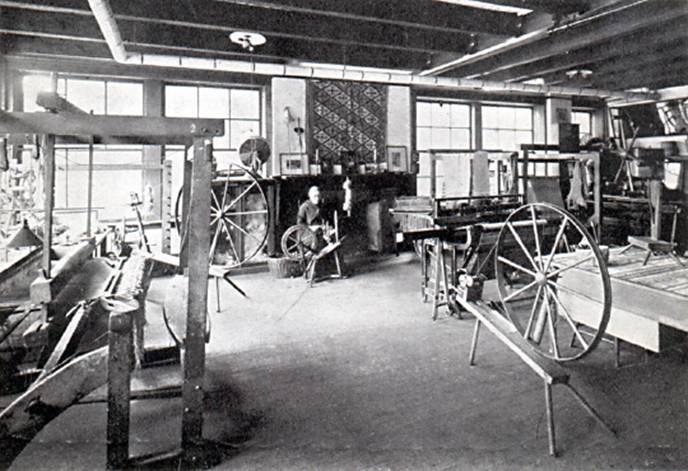
 

Jane Addams and Her Conflicts with Tolstoyism

Addamsโ€™ affection and admiration for Tolstoy is evident in both her correspondences and her published works. In her 1910 book Twenty Years at Hull-House, Addams recollected her visit to the Countโ€™s residence in Russia. She embarked in search of the answer to a question: โ€œI was most eager to know whether Tolstoyโ€™s undertaking to do his daily share of the physical labor of the world, that labor which is โ€˜so disproportionate to the unnourished strengthโ€™ of those by whom it is ordinarily performed, had brought him peace?โ€

leon_tolstoy_barefoot
“Leo Tolstoy Barefoot” (1901) – Ilya Repin

Addams gave a lecture in 1902 in which she explained the four types of labor Tolstoy believed every person should partake in. She noted that โ€œhe would, of course, always excuse the ill, the aged, and little childrenโ€ but believed that the bulk of people should perform manual and skilled labor as well as engage in literary work and social effort. According to Tolstoy, by reducing the amount of โ€œbrutal and dehumanizingโ€ labor that one performs it gives those unaccustomed to performing that type of labor a perspective that will change the way they view their own lives and commodities. Addams spoke of skilled labor: โ€œIf we had some of this experience we would try to simplify our lives, because we would then realize, as we do not now, some of the work on which it is founded. Many people would then stop wearing many things, and having many things in their houses which are not needed.โ€

Many people fear meeting their favorite celebrity since it is possible it will result in embarrassment or the shattering of a previously held illusion. Addams likely experienced both upon meeting the revered author. She recounted the โ€œdistrustfulโ€ manner with which Tolstoy regarded the sleeves of her dress during their first meeting. Tolstoy, who was clad in peasantโ€™s clothes, commented on the excessive amount of fabric on Addamsโ€™ dress and remarked that โ€œthere was enough stuff on one arm to make a frock for a little girl.โ€

Despite originally feeling disconcerted, Tolstoyโ€™s comments did not dissuade Addams from searching for the answer to her question. Addams recalled a particular instance in which she attended dinner with Tolstoy, his family, and his traveling guests in Twenty Years. She wrote:

The countess presided over the usual European dinner served by men, but the count and the daughter, who had worked all day in the fields, ate only porridge and black bread and drank only kvas, the fare of the hay-making peasants. Of course we are all accustomed to the fact that those who perform the heaviest labor eat the coarsest and simplest fare at the end of the day, but it is not often that we sit at the same table with them while we ourselves eat the more elaborate food prepared by someone else’s labor. Tolstoy ate his simple supper without remark or comment upon the food his family and guests preferred to eat, assuming that they, as well as he, had settled the matter with their own consciences.

coffee-house
Immigrant Visitors Congregating in the Coffee House, 1900

Addamsโ€™ time among Tolstoy, his family, and the peasants elicited such strong feelings in her that she made a mental vow to spend two hours each morning in the bakery which had recently been added to the coffee house at Hull-House. Upon her return she realized her vision was not possible due to her overwhelming responsibilities. In Twenty Years she wrote: โ€œThe half dozen people invariably waiting to see me after breakfast, the piles of letters to be opened and answered, the demand of actual and pressing wantsโ€”were these all to be pushed aside and asked to wait while I saved my soul by two hours’ work at baking bread?โ€

Earlier she pointed out Tolstoyโ€™s difficult stance:

Doubtless all of the visitors sitting in the Tolstoy garden that evening had excused themselves from laboring with their hands upon the theory that they were doing something more valuable for society in other ways. No one among our contemporaries has dissented from this point of view so violently as Tolstoy himself, and yet no man might so easily have excused himself from hard and rough work on the basis of his genius and of his intellectual contributions to the world.

While Addams admired Tolstoy, his way of life was incompatible with the life she had already established in Chicago. She wished to emulate him in some capacity, but her duties to Hull-House subsumed a great deal of her time. While writing books, giving lectures, traveling, and worrying about her own health and the health of her friends and family, Addams was always finding new ways to improve Hull-House. It is no surprise, then, that she was incapable of designating even two hours each morning to bake bread. The question remains: how might one find a compromise between Addamsโ€™ way of life and Tolstoyโ€™s?

Hull-House later received five hundred dollars which were left over from Tolstoyโ€™s profit from publishing his novel Resurrection. The bulk of the profit was given to the Dukhobors, a Russian religious group who had recently settled in Canada with the help of their government. When faced with the choice of what to spend the money on, Addams felt that it was only natural to use it โ€œfor the relief of the most primitive wants of food and shelter on the part of the most needy families.”
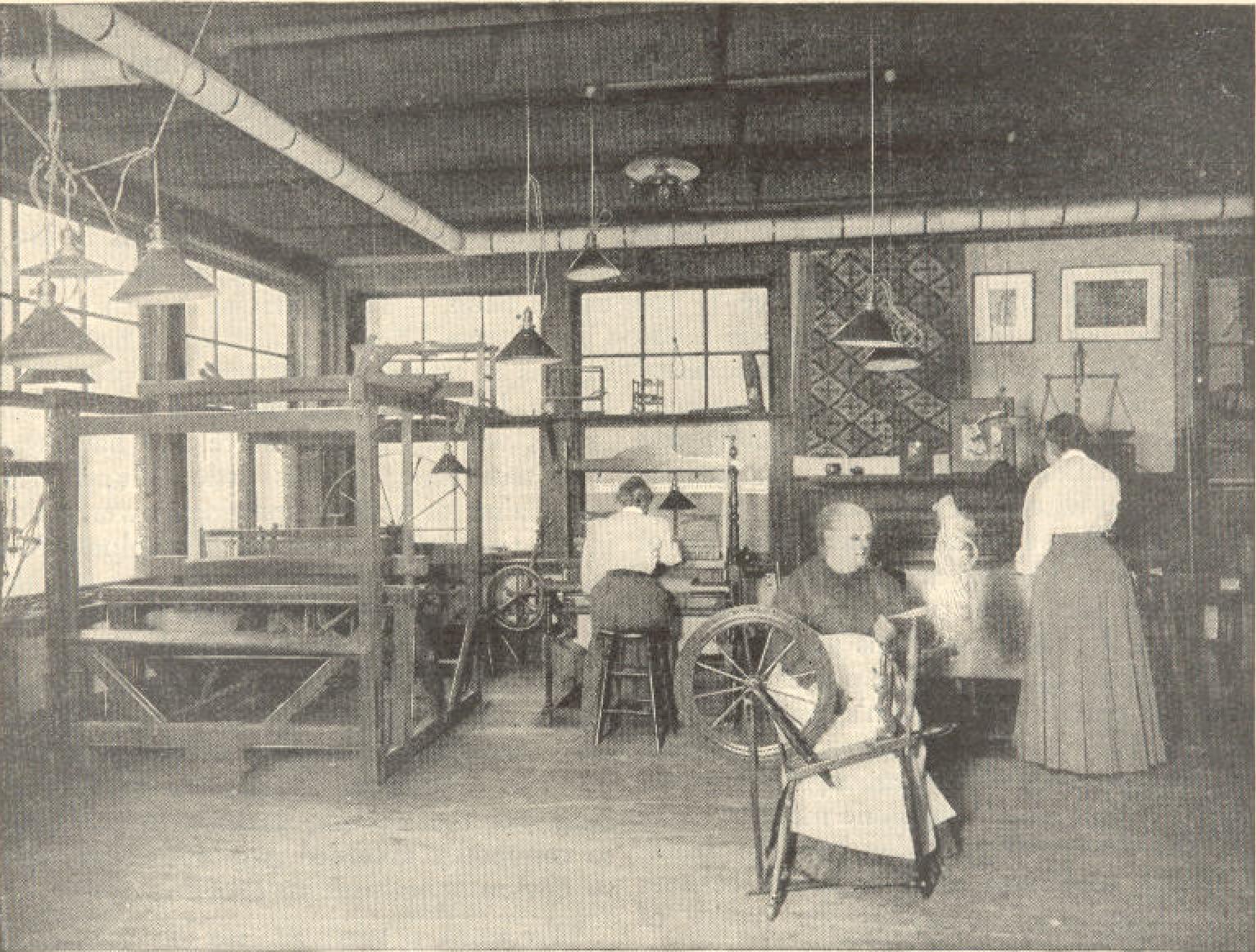
Ultimately, Addams assisted the Nineteenth Ward without spending two hours per day in the Coffee Shop baking bread. Instead, she used her talent as social reformer to improve the lives of those living in poverty around her. Although she saw the value in performing manual labor, Addams realized there was greater value, in her situation, in devoting her working hours to her role as the head figure of Hull-House.

Jane Addams and an Anonymous Bull Moose

A political cartoon shows an elephant reading a guidebook and sitting by a sign for the Armageddon Battle Field, while a donkey lies on its back, defeated. The sign references Woodrow Wilson and political accommodations.

Members of the losing party of a presidential election are met with disappointment and sadness. In the following months the party is left to recuperate and reorganize. The losing and winning party must also plan how they will function with each other in the future. In the election of 1912, the election involved a variety of political parties with some overlapping and some clashing goals. Jane Addams had an important role in the election of 1912 and its many political parties as she became the first woman to nominate a presidential nominee by seconding the nomination for Theodore Roosevelt in the Progressive Party. The backlash she received for seconding the nomination of Theodore Roosevelt for the Progressive Party, also known as the Bull Moose Party, was astounding. It lead to some of the most interesting letters I have ever read throughout my time at the Jane Addams Papers Project. After the election, Addams continued to receive letters about her participation in the 1912 election.

roosevelt-and-addams-cartoon
A 1912 US cartoon, showing the “Big Four at the Two Chicago Conventions”. Front row (Progressive or “Bull Moose” party): Theodore Roosevelt, Jane Addams, Hiram Johnson, Albert Beveridge. Back row (Republican party): Boies Penrose, William Barnes, Jr., Winthrop M. Crane, Elihu Root.
While the Progressive Party was attempting to recover after a presidential loss, Addams received a letter that claimed that the party would potentially be destroyed by all of the other political parties involved in the election of 1912. An anonymous writer, referring to himself as โ€œa Bull Moose,โ€ wrote Addams on December 13, 1912 an at first seemingly innocent letter, praising Addams for her efforts with the suffrage movement. As โ€œBull Mooseโ€ continues, he wrote to Addams about an alleged โ€œdisasterโ€ for the Progressive Party. In this alleged disaster the Republicans, Democrats, Socialists, and Prohibitionists had created a trap for the Progressive Party to fall into and ruin the party forever. โ€œBull Mooseโ€ decided to take it upon himself to create five โ€œshamtrapsโ€ for the Progressive Party, in order to expose the traps of the other parties, but the โ€œshamtrapsโ€ needed to be dealt with before December 15th or the plan would not work.

This was not even the strangest part of the letter. โ€œBull Mooseโ€ then goes on to say that Addams can tell no one else about the letter except Theodore Roosevelt, who he refers to as โ€œour future President,โ€ despite the fact that Roosevelt has already lost the 1912 election. โ€œBull Mooseโ€ must have been hoping for a 1916 victory for Roosevelt. Unfortunately for โ€œBull Moose,โ€ Roosevelt would not enter the 1916 election. โ€œBull Mooseโ€ proceeded to give Addams a list of instructions that will prevent the other political parties from trapping the Progressive Party. The first few seem pretty reasonable – instructions such as โ€œnot to side with either Drys nor Wetts,โ€ which makes sense since the Prohibition Party is allegedly involved in this โ€œshamtrapโ€ plot. Instructions six and seven are the strangest. In rule number six, โ€œBull Mooseโ€ instructed Addams that he would come to her as a โ€œpolish tramp to wash windows, with a raincoat onโ€ and told her all of the horrible ways to treat him. Rule number seven instructed Addams to treat a hobo the same way, perhaps worse, if โ€œBull Mooseโ€ should have sent a hobo in his place.

Addams was instructed by โ€œBull Mooseโ€ not to share the contents of this letter with anyone besides Theodore Roosevelt until 1917. So far there has been no indication that Addams ever shared the contents of the letter with anyone, including Theodore Roosevelt. The Jane Addams Papers Project works chronologically so we have not yet read and transcribed the letters from 1917. I will certainly keep my eyes peeled for any letters about โ€œBull Mooseโ€ once we get there.

political-humor-1912
This political cartoon follows the 1912 Presidential Election in which Woodrow Wilson (D) won in a landslide defeat over Theodore Roosevelt (Progressive/Bull Moose Party), William Taft (R), and Eugene Debs (Socialist Party). (From the November 8, 1912 issue of the Sandusky Register.)

โ€œBull Mooseโ€ was not entirely off the mark when he said that the other political parties were planning to destroy the Progressive Party. The Progressive Party ultimately did fall because of other parties, mainly the Republicans. The Progressive Party essentially merged back together with the Republican Party, especially after Roosevelt refused to accept the Progressive presidential nomination in 1916 and chose to campaign for the Republican Party. Maybe the Progressive Party would have lasted longer if Addams had followed โ€œBull Mooseโ€™sโ€ instructions!

This document can be located on the Jane Addams Papers microfilm on Reel 7, frame 542. It will soon be freely available to read and view in digital form on our database website, which can be found by clicking the link to the right of this post.


Elections: Then and Now

Three black-and-white portraits of Woodrow Wilson, Theodore Roosevelt and William Taft

As the final homestretch of the 2016 election approaches and peoples’ passionate responses to the candidates hits an all-time high, we at the Project are reading up on the 1912 election where Jane Addams is knee-deep in the political consequences of supporting the Progressive Party. Moving forward and making โ€œprogressโ€ is the aim of both the Progressive Party of 1912 and the 2016 Democratic Party, who call to their 2016 Party platform as the most progressive ever. What was progressive in 1912 is not necessarily progressive now, especially with a hundred year gap. Such as a reform close to Jane Addams’ heart, womanโ€™s suffrage. In 2016, progressive voting reform stands against voter discrimination and intimidation. The Progressive Party, as a third party, was a counter to the Democratic Party of 1912, led by Woodrow Wilson, and the Republican Party of 1912, led by William Taft and stood out as the first party to support universal suffrage. It was also the last third party to come so close to the Presidency, though ultimately the split in the Republican Party left the Democrats in control of the White House. Though by our standards the Progressive Party of 1912 is quite conservative, for the time it was remarkably radical.

The Democrats were still the “white man’s party” that they had been during the Civil War era but they were also very focused on wasteful spending and commercial concerns. Republicans were also concerned about money and the protection of American rights at home and abroad.ย  Progressivism focused primarily on improving the practical conditions of workers. The Progressive Party supported a minimum, living wage, as well as legal, comprehensive safety measures for workers, full and public disclosure about the wages and labor conditions.ย  In 1912, the Progressives called for a minimum wage and limited work hours specifically for women and โ€œyoung peopleโ€ and not for all workers. In 2016 the Democratic platform calls for a minimum wage of $15 for everyone, regardless of race, age, or gender. Both the 1912 Progressives and the 2016 Democrats support of the right of individuals to organize to protect their rights as workers.

The Progressive Party also had strong views on suffrage. While they did support womenโ€™s suffrage, the Party in general and Teddy Roosevelt in particular, were less kind to black people. Despite the 15th Amendment, passed in 1870, giving the right to vote to any man, regardless of race, some members of the leadership thought it should be taken away from them. This debate is not shared by the modern Democratic Party, who is firmly behind the right of all people to vote, and more importantly, to vote without intimidation. 2016 Democrats believe in making voting easier by making the voting booth more accessible, particularly for seniors and disabled Americans, an idea that follows the Progressive ideal of granting more rule to the people. Although not so easy that you can text it in quite yet! Maybe one day we will vote from the comfort of our homes, but for now everyone still has to vote by absentee ballot or at the polls. Prior to the passage of the 17th Amendment in 1913, US senators were appointed by the state legislature. The Progressive Party strongly opposed this practice, claiming that the people should have a right to elect their representatives more directly, yet another reform that made modern democracy possible

A progressive platform in 2016 goes far beyond the imaginations of Jane Addams and her fellow Progressive 100 years ago. Where they supported womenโ€™s suffrage, and Addams was criticized for taking an active role in traditional politics, the Democratic Party of 2016 has nominated a woman to fill the highest office in the country. The rights of minorities, including people of color and those in the LGBT community have taken center stage in 2016 in a way they never did in 1912. The world, including the United States, has changed dramatically since 1912.

And still, the roots of the same types of concerns that were discussed in 1912 are still discussed today. Things like womenโ€™s rights, workersโ€™ rights, discrimination, Big Business, healthcare, and voting were hot topics then just as much as they are today. Legal protections for women do not necessarily extend to their paychecks, despite the Equal Pay Act. Class differences are still stark and spark protests, like Occupy Wall Street. Workers rights are still being trampled on, especially for people who are here illegally or are impoverished. There is still work to be done and voting is one way to help make your voice heard.

Donโ€™t forget to vote tomorrow, Tuesday, November 8th!

Close-up of several red, white, and blue buttons with stars and the word VOTE in bold letters, symbolizing participation in an election.


Quit Clowning Around

Charles Cramer, alias Conway, the clown with a wooden leg, in a postcard photo with his wife, circa 1911 (Mysterious Chicago)
Charles Cramer, alias Conway, the clown
with a wooden leg, in a postcard photo with his
wife, circa 1911 (Mysterious Chicago)

“Clowns Gathering in the Woods,” blares CNN. “Creepy Clowns: Serious Matter or Sick Joke,” asks The Guardian. It all started in South Carolina, where groups of children swore that clowns, lurking in the shadowy woods, and attempted to lure them to an abandoned house deep within the forest. Police could not find any clown paraphernalia at the scene, but that did not stop another group of children from seeing a shady clown just one week later on the other side of town. Once again, police could not find any hard evidence of red noses, water-squirting flowers, or tiny cars that can somehow fit ten people inside.

Americans chuckled to themselves, “Oh those South Carolinians are too much!” Then the clowns went national. They started showing up all along the East coast, from Florida to Maine. Then, in some sort of clown-manifest-destiny, the clowns traveled West to Texas, Colorado, Utah, and eventually were found scaring fish and surfers in California. It is not known if any clowns have swam across the Pacific to haunt Hawaii.

Scary clowns are not unique to the fall of 2016. Oh no. As I was reading through old newspapers from 1912 Chicago in an attempt to find out more information about a specific correspondent, I stumbled across an incredible byline on the adjacent page. It was about a murderous clown, living in Chicago not far from Hull-House, where Jane Addamsย was busy toiling away, and his vaudeville singer wife who plotted the downfall of their wealthy roommate.

In early October, 1912, a Baltimore heiress named Sophie Singer came to Chicago with her fiance, Will Worthen. They were met at the station by a โ€œMrs. Conwayโ€ who suggested that they all get a flat together instead of a hotel. โ€œMrs. Conwayโ€ was really Mrs. Louisa Cramer, wife of Charles N. Cramer (alias Charles Kramer, alias Charles Conway). The couple was part of a traveling circus, he as a human cannonball and a clown, and she as a singer and a lion tamer. Oh, and he had a wooden leg, too.

The three moved in together, and were shortly joined by Mr. Cramer. The Cramers, under the alias of the Conways, were dirt poor and only lived off the wealth of their heiress roommate and her well-to-do fiance. All was well until Ms. Singer decided that she would move back to Baltimore, leaving the Conways with no well of money to draw from. This did not sit well with the carny couple, and one night while Mr. Worthen was away gambling, the one legged clown made his move.

Worthen came back to find the key-hole stuffed. Breaking down the door, he found Sophieโ€™s tangled legs sticking out from under their bed. She had clearly been strangled to death; her hands were tied with thin wire and Cramerโ€™s handkerchief was shoved so deep into her throat that police needed pincers to remove it. Her jewelry had been stolen.

sophiesingerphotoheadline
A sketch of Sophie Singer, Beatrice Conway, and Charles Conway (1912)

Several months later the Cramers were caught in Lima, Ohio. Mrs. Cramer quickly confessed and threw her husband under the bus as well. Charles would eventually confess as well, though he insisted that his wife had nothing to do with the murder.

During the arrest and subsequent trial Cramer the Clown decided to lighten things up with a couple jokes. โ€œSay, Captain?โ€ he asked during the trial. โ€œDo you know that in this case you canโ€™t hang a man with a wooden leg?โ€ When the Captain said heโ€™d never heard of a law like that, Cramer said โ€œYou have to use a rope!โ€ Ba Dum Cha!

Charles was sentenced to life in prison, and only narrowly avoided the gallows. As he was led away, he vowed that he would โ€œget out of this,โ€ and twelve years later he made good on his promise. In 1925, despite his assumed lack of running ability owed to that wooden stump on his left side, Cramer ran away from a work farm in Joliet, Illinois. He was never seen or heard from again.

The next time you hear about a clown sighting in your neighborhood, you may want to exercise extra caution. Who knows? Maybe its Conway the Clown, 100 years old and still chasing people with his stump leg.

— Robert Piper, Editorial Assistant

2016 Institute for the Editing of Historical Documents

Official Editing Institute Class of 20162016โ€™s Institute for the Editing of Historical Documents was held New Orleans, LA, in a hotel on the corner of Bourbon Street and Canal Street.ย  Its courses promised to educate those new to the field of documentary editing, as well as a chance to ask questions about our own projects.ย  Just after classes ended, the Association for Documentary Editing held their annual meeting in the same hotel.ย  And, with a generous grant from the National Historical Publications and Records Commission (NHPRC), the Institute offered a stipend for accepted students.
My very first question was โ€“ Where can I sign up?

After an application process and multiple emails with the Instituteโ€™s Education Director, the excitement of acceptance to the program gave way to agonizing anticipation.ย  Finally, after months of biding my time and waiting until the night before my flight to pack, I was stepping off the plane into the hot and humid air of Louisiana.

The next day, we began promptly at 8am with breakfast, and at 8:30 transitioned straight into class time.ย  I was one of 22 classmates, and initial introductions showed just how varied our backgrounds were: There were some, like me, working on a traditional project with a print edition of selected letters, as well as a digital edition on a website.ย  But there were some working on solo projects, with many questions on how best an institute could help their projects.ย  There were librarians who had enough of helping with research, and had decided to delve into their own projects.ย  And there were some still in school as Ph.D. candidates who had become swept up in the world of editing historical documents.

Classes were taught by experts in their fields, and those experts were Amanda Gailey (Scholarly Editing), Cathy Moran Hajo (Jane Addams Papers), and Jennifer Stertzer (Washington Papers).ย  We were educated in a range of topics, from encoding text to better represent a transcription on the web, to preparing to fund your project through your home institution and private donors.ย  There were classes on publishing digitally vs. publishing in print, as well as the best method for indexing and annotating those published documents.ย  And the week of classes wrapped up with a thought on the future of documentary editing.

But there were things we couldnโ€™t learn from our โ€œexpertsโ€, and could only discover by talking to the other Institute participants.ย  Each one had their own obstacles to overcome, such as funding and staffing, and their own experiences with editing documents.ย  But with each hurdle, they had their own slightly unique solution, and those collective exchanges definitely helped facilitate discussions for the keys to solving unanswered questions.

ADE-2016At the end of our stay, many of us knew how to get to Cafรฉ Du Monde by heart, and some had walked the length of Bourbon Street multiple times.ย  But each of us who attended the Institute found ourselves no longer identifying as a singular project, but rather as one documentary editor with a network of peers, never truly alone in our shared quest to preserve and interpret history.
— Victoria Sciancalepore, Assistant Editor

Reading Jane Addams’ Palms

Fortune telling, in the forms of reading tea leaves, tarot cards, palms, and crystal ball gazing, have long been popular forms of entertainment. People were and are fascinated to see readings of celebrities, hoping to learn more about them.

Nellie Simmons Meier

Palm readers could become celebrities in their own right, like Nellie Simmons Meier (1864-1944) who built an international reputation as a palmist by insisting that it was a scientific practice rather than an occult hobby. Meier did not tell fortunes–she conducted “character readings”–but she gathered them for some of the most famous people in the early 20th century–Albert Einstein, Margaret Sanger, George Gershwin, Walt Disney, and Jane Addams. Meier organized over 100 palm prints and character readings into chapters in a book, called Lion’s Paws, that she published in 1937.

Addams’ palms were included in the chapter “Can The Leopard Change His Spots?,” along with Norman Thomas, Margaret Sanger, Susan B. Anthony, Ben B. Lindsey, Carrie Chapman Catt, and Jacob Riis. She prefaced the readings with a question:

If a reformer or a radical makes his living in the very work of reform, he is doubly suspect; if he makes no money, he is believed to be seeking notoriety, honor, distinction. Do the hands of reformers and radicals sustain this suspicion?

Addams's right hand print, as published in Lions Paws
Addams’s right hand print, as published in Lions Paws

When Meier observed Addamsโ€™ palms she noted both the extraordinary similarities and important differences between her prints and those of Susan B. Anthonyโ€™s. Both women, she reported, demonstrated practical and executive ability, appreciation of the arts, and honesty, as well as strong wills and love for others. However, she saw important differences, primarily centering around the reasons that they did what they did.

Addams, Meier claimed, was motivated by the individuals she helped. For her it was not about fame or even about the โ€œcommon goodโ€ as she claimed it was for Anthony. Rather, everything came down to her interactions with individuals, and the justice and mercy served, rather than a more nebulous greater good. It is certainly evident that Addams cared about those around her and wanted to help people–if she had not she probably would not have started Hull House or crusaded for the rights of workers and immigrants.

Addams's left palm print, as published in Lion's Paws.
Addams’s left palm print, as published in Lion’s Paws.

According to the palm reader, Addams was also a born conservative, cautious about everything. Something that, intriguingly enough, appears to be present in many of her letters, which paint a picture of Addams as a woman who is faultlessly polite and dignified- the very image of a conservative woman.

Is Meier’s character reading an accurate one? It certainly seems to be in line with the Jane Addams in the letters being transcribed. However, this is also information anyone could get just by reading her books and news articles about her. These present a picture of a woman who sounds exactly as Meier described. Of course, it is possible that Jane Addamsโ€™ kindness, generosity, and care for others was indeed written in her hand, but perhaps it is more important that it was written in her life.


For more on Nellie Simmons Meier and her character readings, see finding aids to collections of her papers at the Library of Congress and the Indiana Historical Society. For details on her home, see a description of Tuckaway from Historic Meriden Park.

Guest Post: Six Remarkable Hull-House Women

Six Remarkable Hull-House WomenWhat stood out in my research about “six remarkable Hull-House women”–Jane Addams, Julia Lathrop, Florence Kelley, Alice Hamilton, and Grace and Edith Abbott–was the crucial role they played in the reform of America’s industrial system. Equally striking was the Supreme Court’s resistance to regulating it.
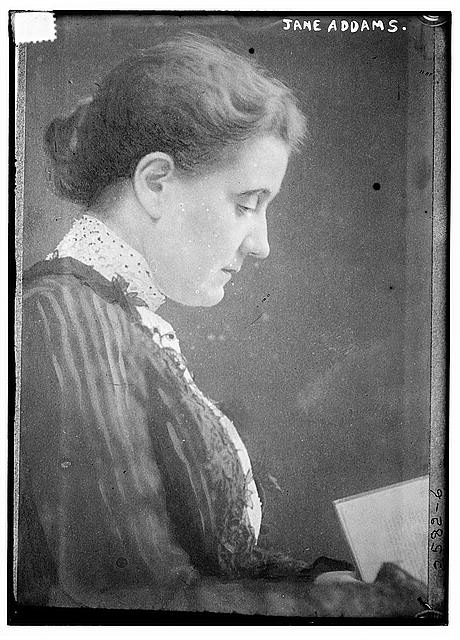
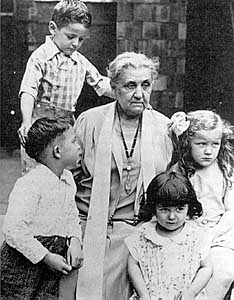
When the first generation of college educated women discovered that established professions like the law, government, higher education and the church were reserved for men, they sought alternative occupations. As caregiving had long been a female responsibility, reformers responded to the plight of poor immigrant workers and their families by creating “social settlements,” aย Consumer’s League, a federal Children’s Bureau, and the field of Social Work.ย  In turn, their service-oriented programs opened up career opportunities for women, and provided a supporting network of female organizations that fought for social justice from the Progressive Era to the New Deal.

Before proceeding from Hull-House in Chicago onto the national scene, Lathrop devoted her efforts to the reform of state charities, Kelley to an anti-sweatshop campaign, Hamilton to industrial medicine, Grace Abbott to protectingย  immigrants, and her sister Edith to social research. As the settlement’s head resident, Addams united them in pursuing common goals, and in pressing for labor legislation. But suchย hard-won laws as prohibiting child labor, limiting a woman’s workday, and establishing a minimum wage, were all-too-often declared unconstitutional in Supreme Court decisions setting an individual’s “freedom of contract,” above a state’s right to “promote its citizens’ welfare.”

In 1914 with Europe plunged into World War I–and America’s entry in 1917–the progressive period drew to a close. Early on, women activists had mobilized a peace party in Washington, which met with its European counterparts in Holland in 1915 to protest the fighting. Jane Addams presided over the conference, and after the war was elected president of the Women’s International League for Peace and Freedom that evolved from it. During her remaining years, she shared her time between settlement work and the cause of peace–for which she received a Nobel Prize in 1931.

Of Quaker descent on her father’s side and a pacifist during the war, she toured a devastated Germany following its surrender; and gave speeches back home to raise funds for Quaker relief of the defeated enemy. As much as anyย woman of her day, she was able to transcend national boundaries in the hope of alleviating human suffering.

–Ruth Bobick

What would this election mean to Jane Addams?

In the wake of Super Tuesday and with all the fuss about the presidential election, I was wondering: What would Jane Addams think about our latest crop of presidential candidates and the political system we have in general? Well, we canโ€™t really know since she died in 1935, but thanks to her prolific writing we do know what she valued in the political system. As always, her focus was on the people, not the ones in power. She had little patience for politicians who put their own interests and beliefs above those of the people they served, especially on the city level. However, she was also extremely critical of elected officials who pander too much to their constituents and put them before humanity as a whole. In short, Addams wanted a politician who could achieve a balance between caring about the people they served and being able to look towards effecting change on a much grander scale.

Addams-1900

Finding someone who fits this definition is not easy. After all, Tammany Hall may have been corrupt and self-interested, but also offered tangible help to their constituents. Was it any surprise then that they stayed in power so long? Addams argued that โ€œthe successful candidateโ€ฆmust be a good man according to the morality of his constituentsโ€ (Democracy and Social Ethics, 229). She was right then and her words ring true today as well. Today we see over and over again elected officials who focus exclusively on their most loyal groups, often to the exclusions and detriment of other groups, be they religious, racial, or socioeconomic. This is not a good way to run the most powerful country in the world. Placing the whims and needs of a few over those of the whole is selfish and makes any kind of progress for the good of the whole extremely difficult, but is also the simplest way to get elected.

The thing Addams criticized most in elected officials was their machinations and manipulations. She despised how they used events- sad and happy- to convince people to vote for them. She also disliked when officials bribed people, especially when they did it subtly enough that their constituents didnโ€™t realize what was happening. Addams strongly looks down on manipulating situations because โ€œmany a manโ€ฆhas formulated a lenient judgement of political corruptionโ€ (Dem & S.E., 239) She spoke primarily about more local officials, but arguably it can be applied to the national level as well, especially when one considers the role of backers and endorsements. The system is corrupt and works not for the good of the people, but for the good of those in charge. This arguably is one reason why there is so much opposition and difference in modern American politics. Neither of the parties in American politics put the people before the big funders and any attempts to make meaningful reform are blocked as quickly as possible to prevent upAddamsKids1930setting the donors. Therefore, the system is continually chasing its own tail and cannot actually accomplish anything.

So what would this election mean to Addams? Truthfully, she most likely wouldnโ€™t like any of the candidates. Her policies are more in line with Bernie Sanders than with Donald Trump, however, in her day she challenged all the elected officials and demanded that they improve and pay more attention to the needs of the people and I see no reason why she would change her opinion today. Addams was certainly a woman who knew her own mind and had no interest in keeping those opinions under wraps, at least not where the rights of the poor were concerned, and she wielded the influence she had to create change. That doesnโ€™t strike me as the kind of woman who would sit this election out and just quietly support a candidate, but rather a woman who would use the influence she wielded to force all candidates to listen to her.


All I can say is #JaneAddamsForPresident2k16

Jane Addams Plays Cupid

Letter from Mary Hill Dayton to Gerard Swope sent from Hull-House.

To get in the mood this Valentine’s Day, we here at the Jane Addams Papers Project are getting romantic inspiration from none other than the match-maker herself; Jane Addams.

Hear us out. In between the settlement work done at Hull House at the turn of the century, two residents entered into a courtship. One that was fostered by none other than Jane Addams.

New Jersey Native Mary Hill Dayton came to South Chicago to teach English classes. While teaching, Dayton met fellow Hull House resident Gerard Swope. An employee of GE, Swope was taking time off to teach classes on electronics and algebra.

The two teachers seem to hit it off because when Swope left Hull House in 1899, he and Dayton maintained a long distance relationship via correspondence.

The separation only seemed to strengthen their affections. In their writings they referred to their relationship as โ€œIT.โ€ Dayton wrote that โ€œevery time I turn on to Halsted St. my heart warms up about 50ยฐ – and I long for a time when we can be on it together.โ€

Perhaps Dayton worried about if โ€œITโ€ was indiscrete because this is where Jane comes in. She assuaged Dayton’s fears that the whole house was gossiping about โ€œIT”, confiding to Dayton that she had heard nothing about it.
Dayton thought that perhaps Addams was just being nice or just not in tune with the Hull House water cooler gossip, because Dayton was getting a healthy dose of teasing.

One night Dayton seemed to be slipped a note from fellow resident Julia Lathrop apologizing for teasing Dayton earlier in the day about her relationship with Swope. She closed her note, โ€œhoping we are all best friends.โ€

By 1900, Dayton and Swope had become engaged. On Valentineโ€™s day of that year, the couple asked Addams to break the news to their parents. And in 1901, Addams who officiated the wedding at Mackinac Island, Michigan.

Speaking at the wedding, Addams predicated, โ€œKnowing as we do something of the character of these two people, somewhat of the temper of their attachment and to form of the expression we may confidently predict that and all life’s journey through to the end is will be illuminedโ€ฆโ€

Jane was correct about that. The Swopes would go on to live very happy lives. Gerard became the CEO of GE and both he and Mary remained active in social work throughout their lives.

Jane Addams made a huge impact in the time she lived with her charitable and political work. What is so wonderful about these documents is that they offer a glimpse into the personal impact Jane Addams had. If it had not been for Hull House Mary and Gerard Swope may have never met, and would not have led their lives following her charitable model.

Hull House Haunting

Hull-House
Hull-House

As Halloween nears, we turn to the more spirited side of the Hull House that Jane Addams started. The House itself, which was built by Charles Hull in 1856, was in an area of Chicago that was extremely fashionable before the Great Fire in 1871. After the Great Fire, the wealthy of the area left and moved to other areas, leaving the West Side of Chicago to be turned into a place for the poorest of the poor, from prostitutes to immigrants. It was these people that Jane Addams and Ellen Gates Starr wanted to reach out to. They therefore rented the houseโ€ฆand made a surprising discovery. The house was haunted by Charles Hullโ€™s late wife.

Addams and Starr were not the first inhabitants of the Hull House to meet the late Mrs. Hull. The house had been rented out before and the tenants saw her ghostly figure in the room that had been hers. Terrified, they attempted to combat it by placing a pitcher of water over the threshold, believing that spirits could not get over the running water.

Jane Addams, ca. 1907 (Library of Congress)

Addams slept originally in the room where Mrs. Hull died, which was where her spirit allegedly remained. While there, she saw Mrs. Hull a few times and, though Addams determined that she seemed to mean no harm, eventually decided to move into another room. They did not completely close off the room, however, and sometimes had guests stay in there. Some of these guests also saw Mrs. Hullโ€™s spirit. Today, the house is included on Ghost Tours in Chicago and has a reputation as one of the most haunted places in Chicago, despite the relatively benign nature of the ghost.

In addition to the rather less frightening ghost of Mrs. Hull, there was the rumor of a Devil Baby ensconced in the attic of the Hull House. Though Jane Addams continually denied the existence of such a disfigured child hidden away in the attic, the legend persisted and even grew before it eventually died down, though it never vanished completely. Jane Addams herself took to The Atlantic in 1916 to explain the truth of the matter. In that article, she explores not just the legend of the Devil Baby, but why that story held the minds of the women that she serviced.

Headline from the Muskogee Times-Democrat, June 16, 1914.

The Devil Baby has two different versions, one for the Italian Catholics and one for the Jews, though they were essentially the same. In both versions, there is an innocent bride whose husband is the villain and causes their child to be born with horns and a tail- a Devil Baby. In some versions, the baby can also spout profanity within a few months. All stories, however, conclude with the distraught mother bringing the baby to the Hull House, where a mystified Jane Addams locked it in the attic because she had no idea what to do with it.

This story, of course, was fervently denied by Addams and the rest of the Hull House staff. They insisted that the first time they ever heard the story was when two women appeared at the doorstep, wanting to see the Devil Baby for themselves. Though they were quickly turned away, they were just the first in a steady stream of visitors, seeking to see this mysterious child. Though the child never existed, the legends of it persisted, and in many ways are similar to other urban legends, such as the Jersey Devil.

So why do these kinds of stories hold the imaginations of the people, even today? Jane Addamsโ€™ theory was simply that they were a form of warning tale. Abuse was exceptionally prevalent in this period, particularly domestic abuse of wives by their husbands. Thus, the story of the Devil Baby is a morality tale of what can happen when the man of the household fails to be faithful and appropriately religious and therefore disrespects his wife and family. Though there was no actual Devil Baby caused by a cruel father, the hope that it gave the women that it would keep the menfolk in line to hear of the potential consequences of their actions was an important aspect of Jane Addamsโ€™ work and this rumor helped her determine where the women needed the most help.

Whether the hauntings of Hull House were real or not, they are certainly a rich part of the houseโ€™s legacy and the importance of the house in the history of Chicago.


–Meg Szydlik, Editorial Assistant

Sources:

Jane Addams, “The Devil-Baby at Hull House,”ย The Atlantic, Oct. 1916.

Weird and Haunted Chicago: A guide to Ghosts, Local Legends, and Unsolved, Mysteries of the Windy City.

“Social Settlement as Contested Space: Addams’ Personal Faith versus her Public Uses of Religion,” in Urban Experience in Chicago: Hull-House and its Neighborhood, 1889-1963.

“Jane Addams and the Legends of Hull-House,” Chicago’s Haunt Detective.